New one on Antinote.. Broken glass, dogs barking & cats roaring: Succhiamo is back and gives us news from the scrapyarh with punkish synthpop traxx
Some words from the label:
Remember that straightforward mix of EBM and synth-punk that came out on Antinote last year, wrapped in a suggestive black and gold sleeve The lyrics were strictly not ambiguous and the music produced by Panoptique and Paula was joyfully aggressive.
Broken glass, dogs barking & cats roaring: Succhiamo is back and gives us news from the scrapyard.
The thing is, it seems that Succhiamo's scrapyard has been animated by Bill Plympton : in place of dogs and cats, it's a lew Pink Panther chasing a spaced-out Scooby-Doo on Dolore Dentro or Stai Male. Happily championing bad taste, the two musicians even venture into the illegitimate territories of italo-pop missed hits, shaped for lipsync performances on Rai Uno with the nagging Que Pena.
As we're getting close to the middle of the record, the music gets openly punkier, climaxing with the explicitly
named Desiderio Di Violenza, brushing past 200 BPM. While the inevitable silence following the last notes of Que
Pena temporarily puts an end to the pleasant nightmare that is Mani In Fuoco, the figures - somehow similar to
those inhabiting the world of Fritz the Cat - that Succhiamo insidiously inserts into the listener's head don't fade
away: they patiently wait for the duo's pulsing drum machines and the saturated synths to wake up again and set
them in motion for another ride.
Buscar:pas cam
SWINGTING017 is a bouncy JA-to-UK bashment banger that features a hefty combination of producers and vocalists from both the Equiknoxx & Swing Ting camps. The tune finds each artist at their most playful, riding the sparkly, jiggy riddim impeccably.
Jump to the Bar was built and voiced in two days at London Bridge's Red Bull Studios, late Summer 2017.
Day one involved Gavsborg , Time Cow , Platt & Samrai arriving from various residences of friends and family in the vicinity of the English Capital (shout to the Epsom crew). Alway early-birds, Gavs and Cow set to the task on various machines and available gear to construct the rough instrumental, with Platt & Samrai assisting on percussion and programming. Soon lush synths, tough kicks, flanged hats, grimy bass and snappy claps were combining neatly and the backdrop was set.
Day two featured Kingston's queen of the cool kids club Shanique Marie flying straight into the big smoke to lay down a witty hook in minutes before earning a lie down on the sofa. Original Brum-town don RTKal rolled in from the West-Midlands (driven by Farda Neeko) dropping a one-take freestyle (egged on by an excitable studio gathering including Randy Valentine, Mr Williamz & Specialist Moss) that later became his verse and the pre-chorus. With the clock ticking on the session, the flask was neatly passed to Mancunian stalwart Fox for the final flourish, giving shouts to buckfast tonic wine & organic herbal treats.
Supported by Toddla T (Coldest Record), Jubilee (BBC Radio 1 Residency), Chal Ravens (Top Flight), Max Glazer (Federation Sound Radio) as well as being added to Spotify's Dancehall Official Playlist.
Russian born and very gifted musician Aleceo is a new addition to the ongoing rooster of Copenhagen's prolific Music For Dreams label - Aleceo came to attention of label boss Kenneth Bager with the brilliant first Ep 'Clouds' - (all tracks included here.).
Aleceo has his own musical voice, he produces and composes music that is rich in harmonies and melodies - he sits somewhere between Balearic and Deep House - combining the past and moving forward and this double vinyl 'Teletrip' is an excellent taster of his many talents and a real body of work.
'Liebe Tanzen' is a sunny mood full of vintage Roland vocoders, imagine yourself in a Zeppelin watching the earth from the skies and hearing handclaps, acidic noodling and beautiful rhodes combined with a high-pitched soulful voice repeating 'Take My Love' and you have the mood of a modern soul track supported by the balearic brigade. 'Dipping Into You' is a deep house mood featuring the beautiful voice of Jelila- sounding like a late 80 ties Boy's Own track played in a barn just when the Sunrise appears.
One of the outstanding killer tunes and a real grower on the debut album by Aleceo is the single 'Whisper To the Wind' a track recorded with Canadian singer Wulf SoulFire - ten minutes of powerful Roland 909 drums, talking verses and a sublime chorus.
'Nevesomost' - a cinematic, melancholic acidic journey that was inspired by the old USSR Sci Fi movie 'Moscow - Cassiopeya' where a group of children was sent to Mars. 'Monotone' recorded in Bali and sung by guest singer Masha Verymaryland - a french song about a girl who loves to dance and sing with arpeggios, Xylophones that sets the mood for a dreamy French Riviera. 'Clouds' is first class ambience feat the Siberian multi-instrumentalist Sergi
Kampanella playing the Mandolla. The title track 'Teletrip' is tv samples mixed with 80 ties new wave drum machines. 'Priceless' is a downtempo documentary live recording Aleceo did with his American native friend Kita. 'Dome' full of accordions, balalaika, handclaps and melancholic keys tells the story of Dome of God - the place of peace and happiness and makes you wanna sit by the seaside.
'Know Him' is inspired by gospel from the Mississippi church. 'Mzi' wouldn't sound out of place in a Leo Mas warm up tape from Amnesia in Ibiza - middle 80ties with its obscure breakdown full of 30/40ties voices.
Bonus is the inclusion of Kenneth Bager's reprise of 'Dome'.
The album 'Teletrip' by Aleceo feels like a forgotten balearic album with a modern twist suddenly washed upon the shores on the White Isle.
vailable on 7-inch red vinyl single (includes free digital copy on MP3). Vinyl is limited to 500 copies.
Les Disques du Crepuscule presents All Through the Night, the first of two of newly recorded 7-inch coloured vinyl singles by The Passengers, the late 1970s new wave group from Brussels who subsequently became cult Factory/Crepuscule band The Names.
In 1978, with the Brussels scene still in the grip of raw punk, The Passengers offered a fresh, pop-oriented sensibility, mingled with the darker accents of later post-punk. This was young music in every sense, with none of The Passengers older than 22, shaped more by American than British influences, notably the Velvet Underground, whose radical style was in turn echoed by late Seventies bands like Richard Hell and the Voidoids, Talking Heads and Television. The presence of Isabelle Hanrez on vocals also made comparisons with Blondie inescapable.
With their first gigs in the five-piece quickly became a local sensation, and in March 1978 won a battle of the bands known as the 'First Belgian Punk Contest' - only to reject the prize (a one-off single deal) as a cynical commercial ploy. Instead, the band chose to tape All Through the Night for Brussels punk imprint Romantik Records, only for the label to fold before this came to pass.
The Passengers parted company soon after, with Michel Sordinia, Marc Deprez and Christophe Den Tandt becoming The Names on Factory Records, while Hanrez formed own pop-punk outfit, Isabelle et les Nic-Nacs. Four decades on, the original Passengers quintet decided to record and issue the singles denied a release at the time, recorded and played as if it were still 1978!
Cover portrait by Eric de Merkline. Design by Atomluft.
Available on 7-inch clear vinyl single (includes free digital copy on MP3). Limited to 500 copies.
Les Disques du Crepuscule presents All Through the Night, the first of two of newly recorded 7-inch coloured vinyl singles by The Passengers, the late 1970s new wave group from Brussels who subsequently became cult Factory/Crepuscule band The Names.
In 1978, with the Brussels scene still in the grip of raw punk, The Passengers offered a fresh, pop-oriented sensibility, mingled with the darker accents of later post-punk. This was young music in every sense, with none of The Passengers older than 22, shaped more by American than British influences, notably the Velvet Underground, whose radical style was in turn echoed by late Seventies bands like Richard Hell and the Voidoids, Talking Heads and Television. The presence of Isabelle Hanrez on vocals also made comparisons with Blondie inescapable.
With their first gigs in the five-piece quickly became a local sensation, and in March 1978 won a battle of the bands known as the 'First Belgian Punk Contest' - only to reject the prize (a one-off single deal) as a cynical commercial ploy. Instead, the band chose to tape All Through the Night for Brussels punk imprint Romantik Records, only for the label to fold before this came to pass.
The Passengers parted company soon after, with Michel Sordinia, Marc Deprez and Christophe Den Tandt becoming The Names on Factory Records, while Hanrez formed own pop-punk outfit, Isabelle et les Nic-Nacs. Four decades on, the original Passengers quintet decided to record and issue the singles denied a release at the time, recorded and played as if it were still 1978!
Cover portrait by Eric de Merkline. Design by Atomluft. e
To sign off 2018, Malka Tuti are releasing a mega 4- tracker ep by Khida, in collaboration with their old time friend from back home Mihai Balabas. The 4 different tracks were written over the past few years, slowly plotted produced and perfected, each in its own 'twisted' direction. There are no dancefloor killers here, but instead 4 very unique voyages, experimental sonic excursions in time and space. It was the track Chloe that caught our attention, back in 2015. It's not a typical Khidja track, but the musicality and the composition in it reminded us of lost balearic moments. It made us reminisce on summery Sunday mornings back when life was still a bit more innocent, and naive. Out of our infatuation with that track came the idea of 'sitting on it' until the right tracks will be ready, and here we are, more than 3 years later.
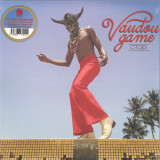
No one had been through those doors in years. Unchanged, seemingly untouched, just a Guard watching over it, one wondered whether the place would ever see the light of day again. Built in the 70s by Scotch, there were only twenty such places in the entire world. Twenty studios, all identical. Most had undergone a digital makeover in the 80s, but not this one; situated in Lomé, this studio had stayed true to its original form. Silent and uninhabited but waiting for one thing, and one thing only: for the sacred fire to be lit once again. That of the Togolese Recording Office, is studio OTODI for those in the know. Through thick layers of dust, the console was vibrating still, impatient to be turned on and spurt out the sound so unique to analog. That sound is what Peter Solo and his band Vaudou Game came to seek out.
The original vibrations of Lomé's sound, resonating within the studio space, an undercurrent pulsing within the walls, the floor, and the entire atmosphere. A presence at once electrical and mystical sourced through the amps that had never really gone cold, despite the deep sleep that they had been forced into. In taking over the studio's 3000 square feet, enough to house a full orchestra, Vaudou Game had the space necessary to conjure the spirits of voodoo, those very spirits who watch over men and nature, and with whom Peter converses every day.
For the most authentic of frequencies to fully imbibe this third album, Peter Solo entrusted the rhythmic section to a Togolese bass and drum duo, putting the groove in the expert hands of those versed in feeling and a type of musicianship that you can't learn in any school. This was also a way to put OTODI on the path of a more heavily hued funk sound, the backbone of which maintains flexibility and agility when moving over to highlife, straightens out when enhanced with frequent guest Roger Damawuzan's James Brown type screams, and softens when making the way for strings. Snaking and undulating when a chorus of Togolese women takes over, guiding it towards a slow, hypnotic trance. Up until now, Vaudou Game had maintained their connection to Togo from their base in France. This time, recording the entire album in Lomé at OTODI with local musicians, Peter Solo drew the voodoo fluid directly from the source, once again using only Togolese scales to make his guitar sing, his strings acting as channels between listeners and deities...
- A1: Introduction
- A2: City Of Dreams
- A3: Over The Edge
- A4: The Night Shift
- A5: Paper Chase
- A6: Outside Looking In
- B1: Midnight Sun
- B2: Behind The Wheel
- B3: Thicker Than Blood
- B4: A Sort Of Homecoming
- B5: Winner Take All
- C1: Death Mask
- C2: Jackie's Eyes
- C3: The Fading Faces
- C4: Mind Games
- C5: The Maze
- C6: Threshold
- D1: Flashback
- D2: Blood Sport
- D3: Survival Instinct
- D4: Hall Of Mirrors
- D5: Eulogy
- D6: The Messenger
- E1: Love Theme
- E4: Cruise Control
- E5: Wave Goodbye
- E6: Magic Gardens
- E7: An Eye For An Eye
- F1: The Point Of No Return
- F2: Cremation
- F3: The Nightshift (Reprise)
- F4: Memories Are Forever
- F5: Echoes Of The Mind
- F6: Streets Of Fire
- E2: Through The Gauntlet
- E3: Ghost Town
The neon lights that decorate a dive bar's window cast a vivid reflection in rainwater on the pavement outside, as steam rises from deep beneath the ground. A slow pan across the scene, past alleys cast in shadow, twilit corners & glass doorways streaked with the mist of humid bodies fuming inside: the camera catches the denizens of an unnamed city, studying faces heavy with secrets too sad to bear. Cut to the motorway. Sleek cars barrel through the night. Sirens moan. Engines rev. You're behind the wheel, over the edge as the credits roll.
This film does not exist — but the soundtrack does. Symmetry is Johnny Jewel & Nat Walker, & Themes For an Imaginary Film is their two-hour cinematic opus pokus, a sprawling score for a movie that screens only in your mind. A 'conceptual tangent between Glass Candy, Chromatics, Mirage, & Desire's more abstract sides,' as Jewel himself describes the project, Symmetry is a vigorous, electric, restless exploration of ideas on the bleeding edge of instrumental sound. Analog synthesizers roll and crest, drums collide, keys cascade clear & crystalline. These themes evoke the phantasmic images that inspired them: urgent and ethereal, sinister & romantic. It's a neo-noir epic of pink fog & femme fatales hidden behind rain drenched windshields after dark.
Produced By Johnny Jewel & Nat Walker
Following on from the three highly-acclaimed CoOp Presents 'Selectors Assemble' compilation EPs from the past year, it's now time to focus on some of the individual talents from the ever-evolving movement. As the international foundation grows, we invite aboard the extremely talented Neue Grafik into the fold.
French producer, instrumentalist and DJ, Neue Grafik, has been building a strong rep for himself over the past few years, releasing records previously on labels such as Rhythm Section, 22a and Wolf Music. His sound is a hybrid of jazz, house, broken beat and hip hop, all with his unique geographical flavours of African ethnicity, Parisian roots and a love for London thrown into the mix.
So to the music - two brand new tracks, 'I Miss Something' and 'Bed Stuy's Mood', complete with remixes from EVM128, Danvers, Xtra Bruk and NameBrandSound (aka label bosses IG Culture & Alex Phountzi) respectively, making this one essential package for the bruk soldiers and beyond.
In Neue Grafik's words...
"I remember the first time I was at a CoOp party and met IG - I just said something like "unbelievable party, well done! Thank you, man". I didn't expect to be a part of this brilliant family a few months after that; it's totally insane to think about it now.
I began to hang properly with the CoOp fam during a DJ session at The Flex in East London. I was so happy to live in this moment; surrounded by these talented performers, artists and producers, excitedly talking about unreleased music on everyone's USB sticks.
This EP is a personal vision of the broken beat scene and my love for that. A meeting with artists who build my own taste, with friends keeping the same vibrancy and desire for this music. 'I Miss Something' and 'Bed Stuy's Mood' are two tracks dedicated to Porte Des Lilas (Paris), and Bedford-Stuyvesant (New York). One was made in my house, the other on holiday. These two tracks, as well as the remixes from the Selectors Assemble crew, represent a real and deep friendship."
More essential music from the CoOp Presents camp, available on limited vinyl and all digital services. Don't sleep.
In the sweltering North-Eastern Brazilian state of Pernambuco lies the coastal city of Recife, where Amaro Freitas is pioneering the new sound of Brazilian jazz. For the prodigious young pianist, the spirit of his hometown runs deep. From the Afro-Brazilian maracatu born on the sugar plantations of slavery, to the high intensity carnival rhythms of frevo and baião, Amaro's heavily percussive approach to jazz is as indebted to these Pernambuco traditions as it is to Coltrane, Parker and Monk.
As with many of the greats before him, Amaro began playing piano in church aged 12, under the instruction of his father, leader of the church band. As his natural talents became obvious, the young prodigy quickly outgrew his father's instruction. He won a place at the prestigious Conservatório Pernambucano de Música but had to drop out as his family could not spare the money for the bus fare. Undeterred, Amaro gigged in bands at weddings and worked in a call centre to fund his tuition. The transformative moment came at age 15 when Amaro stumbled across a DVD of Chick Corea concert, 'he completely blew my mind, I'd never seen anything like it but I knew that's what I wanted to do with a piano'.
Despite not actually owning a piano, Amaro devoted himself to studying day and night - he would practice on imaginary keys in his bedroom, until eventually striking a deal with a local restaurant to practice before opening hours. By the age of 22 Amaro was one of the most sought-after musicians in Recife and resident pianist at the legendary jazz bar Mingus. It was during this time he met and begun collaborating with bassist Jean Elton and the pair went in search of a drummer. 'We kept hearing about this crazy kid who was playing in 7/8 or 6/4, we knew we had to meet him'. Hugo Medeiros joined, and the Amaro Freitas Trio was born.
'I want to show the simplicity of music, to break the stigma that the piano is for a particular social class. Yes, it's a difficult instrument, which many people do not have access to, but with it you can express everything.'
Following his critically acclaimed debut album Sangue Negro (black blood), the title of his sophomore release Rasif is a colloquial spelling of Amaro's home town. A love letter to his native northeast, Amaro explores its traditional rhythms through the jazz idiom, employing complex mathematical patterns reminiscent of some of the most challenging works by fellow Brazilian masters Hermeto Pascoal, Egberto Gismonti and Moacir Santos.
Preferring to see the piano as a though it were a drum with 88 unique tones, Amaro's intelligence and emotion intertwine on every track, from album opener 'Dona Eni': a scorching reconstruction of the baião rhythmic structure, played in seven measures instead of two, to the serene homage to the coastal reef and its ecosystems on the title track 'Rasif'. 'Aurora' is a suite of three parts, representing the sun's journey from the light and soft of the rise, to the aggressive dissonance at its midday zenith and descending chromatic cadences as the sun sets.
Due for an Autumn release on Far Out Recordings, Rasif sees Amaro Freitas take a deserved step onto the world stage. Having already made a name for himself in Brazil, Amaro and his phenomenal band will embark on their first European tour later this year.
Amaro Freitas - Piano
Hugo Medeiros - Drums & Percussion
Jean Elton - Double Bass
Henrique Albino - Baritone Sax, Flutes & Clarinet
All compositions by Amaro Freitas
Produced by Amaro Freitas
Recorded by Bruno Giorgi @ Carranca Studio, Recife, Brazil
Mixed and mastered by Bruno Giorgi @ Quarto Studio, Rio de Janeiro, Brazil
Executive producer and management: Laercio Costa
Camisole Records welcomes you on board for this Business Class Library compilation. During your flight you will be listening to music by Serge Bulot, Alan Shearer, Gérard Gésina and Pascal Wathelet. All these 80's electronic library tracks have been curated by your captain Silver Fox to assure you a pleasant journey. 'To Thwart Soul' by Gérard Gésina will guarantee you an easy take-off while 'Ondulations' by Serge Bulot is perfect to calm down during turbulences. For hours of magnificient dreams try 'Mouvements' by Pascal Wathelet. Landing with'Hollywood' or 'Marathon Life' by Alan Shearer will prepare you for your busy day to come. We thank you for flying on Camisole Records and hope to see you again on our lines. This trip is limited to 500 copies.
To put it simply, 'True Meanings', the fourteenth Paul Weller solo album, the twenty sixth studio album of his entire career, is a record unlike any he has ever made before.
'True Meanings', is released on September 14th and is an album characterised by grandiose-yet-delicate, lush orchestration: an aesthetic to which Paul's better-than-ever voice, singing some of his most nakedly honest words, is perfectly suited. A dreamy, peaceful, pastoral set of songs to get lost in, it is both an album that a lot of his faithful audience have been wanting him to make for a long time, and an album that many new people outside of that audience will relate to.
On the 25th May this year, Paul Weller turned 60: a milestone that has unquestionably had an impact on the feel, both lyrically and musically, of 'True Meanings' which comes across being the most singer-songwriter-style album he has ever made. However, it is also the most collaborative: with more guests than any record he's been involved in before.
As well as all the members of Weller's band, Rod Argent of the Zombies provides Hammond organ on 'The Soul Searchers' and piano and Mellotron on 'White Horses'; folk legends Martin Carthy and Danny Thompson add picked guitar and double bass respectively to 'Come Along'; Little Barrie plays lead guitar on 'Old Castles'; Lucy Rose sings backup on 'Books'; and 'Movin On' is the result of a 'scratchy demo'on Paul's phone that was sent to Tom Doyle of the White Label project. Even Noel Gallagher makes a sneaky appearance.
Perhaps most surprisingly of all, especially given how personal and introspective 'True Meanings' feels, lyrics for four of the fourteen songs here were written, to Weller's melodies, by others. Connor O'Brien from Villagers came up with the words to opener 'The Soul Searchers', while 'Bowie', 'Wishing Well' and the closing 'White Horses' are all the work, lyrically, of Erland Cooper from Erland & The Carnival.
'True Meanings' was produced by Paul Weller except 'The Soul Searchers', which was co-produced by Paul and Conor O'Brien and 'Movin On' which was co-produced by Weller and White Label. The album was engineered and recorded by Charles Rees and mixed by Jan Stan Kybert.
The album was recorded in just over 3 weeks at Paul's own Black Barn Studio, with the aforementioned, revolving cast of characters dropping in for a day here and there. The orchestration was added soon after, and that was that. It is always a good sign when the recording of an album is swift, and here you can just hear that the man at the centre of these songs is as focused and inspired - more inspired, even - than he has ever been.
The Strictly Rhythm imprint is legendary and is instantly recognisable by connoisseurs worldwide. It's a label that has contributed time and time again to dance music culture across it's almost 30 year lifespan. Countless classics passed through the NYC offices of Mark Finkelstein and Gladys Pizarro and this brand new 'Strictly Classics' series looks to celebrate this cornerstone dance label and it's immense catalogue by going back to the archives and presenting some double-header action for diehard fans and newcomers alike. That's right, the 'proper' mixes, reissued from source and remastered to the highest spec, each track spread across one side of a 12" for optimal sonic playback.
Number 3 in the series kicks off on a proper old-school tip with CLS' mammoth 'Can You Feel It' from 1991, a collaboration between Todd Terry and Benji Candelerio CLS made a huge and lasting impression with this euphoric and anthemic slab of dancefloor madness. Instantly recognisable from it's ravey riff and funky drum programming, file this one under 'rave classic'! Over on the flip side we have South Street Player's smoothed out '(Who) Keeps Changing Your Mind', a rolling and deep jam from Roland Clark and George Morel that came out in 1993. This one's some lights down, honest to god soulful house music, skipping garage drums and that organ driven groove offer the perfect vehicle for Clark's gorgeous vox to soar over. Yet another set of absolutely essential SR cuts from the archive!
Remastered with love by Optimum mastering, Bristol from original master sources. Made in conjunction with Strictly Rhythm 2018.
MANOID returns to Hafendisko this October with his debut long player 'Truth', comprising six original tracks on vinyl from the Polish producer and live act. Rising producer MANOID has been steadily developing his unique approach to electronic music for the past few years, releasing his first tracks in 2014 and co-producing material for fellow Polish artist Pola Rise, whilst taking his live act across the globe to The Netherlands, South Korea,Iceland and more. Here though, we see him marking a milestone in his career with his debut album for hafendisko, the Hamburg-based sublabel of hfn music. Across the Truth LP MANOID delivers an amalgamation of styles ranging from jazz-tinged electronica through to modern classical and techno- due to MANOID's origin often referred to as 'Forest Techno'. One half of Darkness Falls and Trentemøller collaborator Josephine Philip also delivers vocals on 'Take Me', adding yet another musical twist to the package, whilst further ideas came to fruition through field recordings such as 'When' which is based upon recordings from a textile museum in the city of Lodz, and 'For Roses' which was initially made as a lullaby for MANOID's niece but he felt was a little too dark so later developed it into this enchantingly eerie composition for the album. MANOID's debut album radiantly displays charm, maturity and musicality throughout and joins the thread of his musical influences and experiences perfectly.
If you check the credits of The Rolling Stones' Goats Head Soup LP from 1973 you'll find a certain "Pascal" listed on the percussion section. That is none other than Los Angeles based artist Nicolas Pascal Raicevik (1933-1994), aka 107-34-8933, aka Head, aka Nik Pascal, aka Nik Raicevic. Besides his hitting the bongoes on the Stones album, Nik was a great artist on his own, both as a painter and as a musician. As a musician, he was a pioneer in the use of synthesizers, preceeding the Berlin school by some years when his Head LP was released on on Buddah in 1970. Buddah probably saw in Head the opportunity to cash in some money from the remains of the psychedelic scene - the three tracks on the LP are named after drugs used in the late sixties. The sounds, however, are accomplished works that show Raicevic as one of the most interesting pioneers in the use of synths. The album probably didn't do too well, since Buddah didn't renew the contract with Raicevic, who instead took his own way releasing his works on his very own Narco Records and Tapes label. Between 1968 and 1975 Narco would issue 4 LPs credited either to Nik Raicevic (Beyond The End... Eternity) or Nik Pascal (The Sixth Ear, Magnetic Web and Zero Gravity) plus one credited to 107-34-8933 (Numbers, which is in fact the same LP as Buddah's Head, albeit with different cover art). Copies of these LPs came with an ironic sticker over the shrinkwrap that read "Do not listen to this LP if you are stoned".
Nik's last album, Zero Gravity (Narco NR123) came under the Nik Pascal name and had a fantastic side long piece on the title track which reminisces of the works of Cluster. B side features four tracks that also bear some Conrad Schnitzler reminiscences. This was to be Nik's last LP before he would sell all his synths to ex car racer and future electronic/ambient music star Steve Roach.
Besides his musical explorations, Nik was also an interesting painter. His paintings are auctioned from time to time, and are consciousness expanding works influenced by abstract cubism and surrealism, some kind of Salvador Dalí on drugs exploring the outter and inner space. All the artwork on the sleeves of his LPs is done by himself. Spacey landscapes and psychedelic colours that fit perfectly to the music they contain.
"Nik Raicevic's music is at the intersection of radical psycho-electronic weirdness and kraut kosmische music (in particular the scifi-hypno-minimal modules of Conrad Schnitzler in Grun, Rot and Blau). It presents mega epic & tripped out electronic improvisations.
"This is an absolute must for collectors and fans of visceral, neurotic soundscapes."
"As far as late-60s / early-70s American Bedroom' Electronic Music goes, these LPS have to be among the first transmissions from this sector, made all the more attractive when coupled with Raicevic's alien topographIes - the covers are high-color portrayals of Venusian lanes, knotted growths, & future-past architecture in a style you might equate with Vintage' sci-fi pulp-novel covers - & copious Downer' sentiment. This music is imbued with a sort of lonely, anti-social sensibility that's about as far as you can get from the Academic' Early Electronic vector. I will say that if the Steve Birchall, Cellutron & the Invisible, and/or Pythagoron™ seed your garden, this will likely do the same."
Never reissued before on vinyl format, the Wah Wah reissue features original sleeve artwork made of paintings and drawings by Nik himself, and reproduction of the famous ironic "Do not listen if you are stoned" sticker. Limited edition, 500 copies only.
If you check the credits of The Rolling Stones' Goats Head Soup LP from 1973 you'll find a certain "Pascal" listed on the percussion section. That is none other than Los Angeles based artist Nicolas Pascal Raicevik (1933-1994), aka 107-34-8933, aka Head, aka Nik Pascal, aka Nik Raicevic. Besides his hitting the bongoes on the Stones album, Nik was a great artist on his own, both as a painter and as a musician. As a musician, he was a pioneer in the use of synthesizers, preceeding the Berlin school by some years when his Head LP was released on on Buddah in 1970. Buddah probably saw in Head the opportunity to cash in some money from the remains of the psychedelic scene - the three tracks on the LP are named after drugs used in the late sixties. The sounds, however, are accomplished works that show Raicevic as one of the most interesting pioneers in the use of synths. The album probably didn't do too well, since Buddah didn't renew the contract with Raicevic, who instead took his own way releasing his works on his very own Narco Records and Tapes label. Between 1968 and 1975 Narco would issue 4 LPs credited either to Nik Raicevic (Beyond The End... Eternity) or Nik Pascal (The Sixth Ear, Magnetic Web and Zero Gravity) plus one credited to 107-34-8933 (Numbers, which is in fact the same LP as Buddah's Head, albeit with different cover art). Copies of these LPs came with an ironic sticker over the shrinkwrap that read "Do not listen to this LP if you are stoned".
1972 saw the release of The Sixth Ear (Narco NR666), this time credited to Nik Pascal. A more complex work than Beyond The End..., it adds consistent rhythmic patterns to the mix with the addition of bongoes and also explores some interesting chord progressions.
Besides his musical explorations, Nik was also an interesting painter. His paintings are auctioned from time to time, and are consciousness expanding works influenced by abstract cubism and surrealism, some kind of Salvador Dalí on drugs exploring the outter and inner space. All the artwork on the sleeves of his LPs is done by himself. Spacey landscapes and psychedelic colours that fit perfectly to the music they contain.
"Nik Raicevic's music is at the intersection of radical psycho-electronic weirdness and kraut kosmische music (in particular the scifi-hypno-minimal modules of Conrad Schnitzler in Grun, Rot and Blau). It presents mega epic & tripped out electronic improvisations.
"This is an absolute must for collectors and fans of visceral, neurotic soundscapes." (progarchives)
"As far as late-60s / early-70s American Bedroom' Electronic Music goes, these LPS have to be among the first transmissions from this sector, made all the more attractive when coupled with Raicevic's alien topographIes - the covers are high-color portrayals of Venusian lanes, knotted growths, & future-past architecture in a style you might equate with Vintage' sci-fi pulp-novel covers - & copious Downer' sentiment. This music is imbued with a sort of lonely, anti-social sensibility that's about as far as you can get from the Academic' Early Electronic vector. I will say that if the Steve Birchall, Cellutron & the Invisible, and/or Pythagoron™ seed your garden, this will likely do the same." (twoheadeddog)
Never reissued before on vinyl format, the Wah Wah reissue features original sleeve artwork made of paintings and drawings by Nik himself and reproduction of the famous ironic "Do not listen if you are stoned" sticker. Limited edition, 500 copies only.
If you check the credits of The Rolling Stones' Goats Head Soup LP from 1973 you'll find a certain "Pascal" listed on the percussion section. That is none other than Los Angeles based artist Nicolas Pascal Raicevik (1933-1994), aka 107-34-8933, aka Head, aka Nik Pascal, aka Nik Raicevic. Besides his hitting the bongoes on the Stones album, Nik was a great artist on his own, both as a painter and as a musician. As a musician, he was a pioneer in the use of synthesizers, preceeding the Berlin school by some years when his Head LP was released on on Buddah in 1970. Buddah probably saw in Head the opportunity to cash in some money from the remains of the psychedelic scene - the three tracks on the LP are named after drugs used in the late sixties. The sounds, however, are accomplished works that show Raicevic as one of the most interesting pioneers in the use of synths. The album probably didn't do too well, since Buddah didn't renew the contract with Raicevic, who instead took his own way releasing his works on his very own Narco Records and Tapes label. Between 1968 and 1975 Narco would issue 4 LPs credited either to Nik Raicevic (Beyond The End... Eternity) or Nik Pascal (The Sixth Ear, Magnetic Web and Zero Gravity) plus one credited to 107-34-8933 (Numbers, which is in fact the same LP as Buddah's Head, albeit with different cover art). Copies of these LPs came with an ironic sticker over the shrinkwrap that read "Do not listen to this LP if you are stoned".
Magnetic Web was released in 1973. It appeared under the Nik Pascal monicker and showed a clear evolution in sound, favoured by the addition of an Arp 2600 and some rhythm boxes. It also included percussions and cymbals. The Two Headed Dog site thinks "this is his masterpiece in all of its acid-laced glory."
Besides his musical explorations, Nik was also an interesting painter. His paintings are auctioned from time to time, and are consciousness expanding works influenced by abstract cubism and surrealism, some kind of Salvador Dalí on drugs exploring the outter and inner space. All the artwork on the sleeves of his LPs is done by himself. Spacey landscapes and psychedelic colours that fit perfectly to the music they contain.
"Nik Raicevic's music is at the intersection of radical psycho-electronic weirdness and kraut kosmische music (in particular the scifi-hypno-minimal modules of Conrad Schnitzler in Grun, Rot and Blau). It presents mega epic & tripped out electronic improvisations.
"This is an absolute must for collectors and fans of visceral, neurotic soundscapes."
"As far as late-60s / early-70s American Bedroom' Electronic Music goes, these LPS have to be among the first transmissions from this sector, made all the more attractive when coupled with Raicevic's alien topographIes - the covers are high-color portrayals of Venusian lanes, knotted growths, & future-past architecture in a style you might equate with Vintage' sci-fi pulp-novel covers - & copious Downer' sentiment. This music is imbued with a sort of lonely, anti-social sensibility that's about as far as you can get from the Academic' Early Electronic vector. I will say that if the Steve Birchall, Cellutron & the Invisible, and/or Pythagoron™ seed your garden, this will likely do the same."
Never reissued before on vinyl format, the Wah Wah reissue features original sleeve artwork made of paintings and drawings by Nik himself, and reproduction of the famous ironic "Do not listen if you are stoned" sticker. Limited edition, 500 copies only.
- A1: Emad Youssef - Al Bareedo Ana (The One I Love)
- A2: Abdel El Aziz Al Mubarak - Ma Kunta Aarif Yarait (I Wish I Had Known)
- B1: Kamal Tarbas - Min Ozzalna Seebak Seeb (Forget Those That Divide Us)
- B2: Madjzoub Ounsa - Arraid Arraid Ya Ahal (Love, Love Family)
- B3: Khojali Osman - Malo Law Safeetna Inta (What If You Resolve What's Between Us)
- C1: Zaidan Ibrahim - Ma Hammak Azabna (You Don't Care About My Suffering) (Live)
- C2: Saied Khalifa - Igd Allooli (The Pearl Necklace)
- C3: Taj Makki - Ma Aarfeen Nagool Shino! (We Don't Know What To Say!)
- D1: Hanan Bulu Bulu - Alamy Wa Shagiya (My Pain And Suffering) (Live)
- D2: Abdelmoniem Ekhaldi - Droob A Shoag (Paths To Love)
- D3: Samira Dunia - Galbi La Tahwa Tani (My Heart, Don't Fall In Love Again)
- E1: Mohammed Wardi - Al Sourah (The Photo)
- E2: Abdullah Abdelkader - Al Zaman Zamanak (It's Your Time)
- F1: Mustafa Modawi & Ibrahim El Hassan - Al Wilaid Al Daif (The Youth Who Came As A Guest)
- F2: Ibrahim El Kashif - Elhabeeb Wain (Where Is My Sweetheart)
- F3: Mohammed Wardi - Al Mursal (The Messenger)
In Sudan, the political and cultural are inseparable. In 1989, a coup brought a hardline religious government to power. Music was violently condemned. Many musicians and artists were persecuted, tortured, forced to flee into exile — and even murdered, ending one of the most beloved music eras in all of Africa and largely denying Sudan's gifted instrumentalists, singers, and poets, from strutting their creative heritage on the global stage.
What came before in a special era that protected and promoted the arts was one of the richest music scenes anywhere in the world. Although Sudanese styles are endlessly diverse, this compilation celebrates the golden sound of the capital, Khartoum. Each chapter of the cosmopolitan city's tumultuous musical story is covered through 16 tracks: from the hypnotic violin and accordion-driven orchestral music of the 1970s that captured the ears and hearts of Africa and the Arabic-speaking world, to the synthesizer and drum machine music of the 1980s, and the music produced in exile in the 1990s. The deep kicks of tum tum and Nubian rhythms keep the sound infectious.
Sudan of old had music everywhere: roving sound systems and ubiquitous bands and orchestras kept Khartoum's sharply dressed youth on their feet. Live music was integral to cultural life, producing a catalog of concert recordings. In small arenas and large outdoor venues, musical royalty of the day built Khartoum's reputation as ground zero for innovation and technique that inspired a continent.
Musicians in Ethiopia and Somalia frequently point to Sudan's biggest golden era stars as idols. Mention Mohammed Wardi — a legendary Sudanese singer and activist akin to Fela Kuti in stature and impact in his music and politics — and they often look to the heavens. A popular story is of one man from Mali who walked for three months across the Sahel to Sudan because the father of the woman he wanted to marry would only allow it if he got him a signed cassette from Wardi himself. Saied Khalifa is said to be the one of the few singers to make Ethiopian emperor Haile Selassie smile.
Such is the stature of Sudanese singers and the reputation of Sudanese music, particularly in the "Sudanic Belt," a cultural zone that stretches from Djibouti all the way west to Mauritania, covering much of the Sahara and the Sahel, lands where Sudanese artists are household names and Sudanese poems are regularly used as lyrics until today to produce the latest hits. Sudanese cassettes often sold more in Cameroon and Nigeria than at home.
But years of anti-music sentiment have made recordings in Sudan difficult to source. Ostinato's team traveled to Ethiopia, Somalia, Djibouti, and Egypt in search of the timeless cultural artifacts that hold the story of one of Africa's most mesmerizing cultures. That these cassette tape and vinyl recordings were mainly found in Sudan's neighbors is a testament to Sudanese music's widespread appeal.
With our Sudanese partner and co-compiler Tamador Sheikh Eldin Gibreel, a once famous poet and actress in '70s Khartoum, Ostinato's fifth album, following our Grammy-nominated "Sweet As Broken Dates," revives the enchanting harmonies, haunting melodies, and relentless rhythms of Sudan's brightest years, fully restored, remastered and packaged luxuriously in a triple LP gatefold and double CD bookcase to match the regal repute of Sudanese music.
A 20,000-word liner note booklet gives voice to the singers silenced by an oppressive regime.
Take a sail down the Blue and White Nile as they pass through Khartoum, carrying with them an ancient history and a never-ending stream of poems and songs. It takes two Niles to sing a melody.
The 8 track album features new collaborations with DJ Phil, Gantman, DJ Paypal, and Sirr Tmo, and a previously unreleased classic from 2013, co-written with DJ Rashad. WFM will be available in Vinyl and digital formats on September 7th 2018. Listening to WFM, the first thing that jumps out at you is Heavee's masterful use of synthesizers and sound design. You get the sense that these elements have been lovingly crafted during countless hours of sonic experimentation and invention in the studio. As Heavee explains, the primary focus on synths represents a departure from his usual creative process: 'Usually in my method of production, synths or sounds come somewhat close to last, likely after I find structure or rhythm. Basically, it's not something I particularly go for first, but this time around they became the building blocks'. Heavee has made a conscious decision to challenge himself, adopting a different approach to his past productions. In doing so, he moves away from the familiar sampling techniques which characterised his earlier work: 'I am a child of the last days of ghetto house culture as it shifted into juke/footwork. My parents, aunties, and uncles played house and ghetto house music at family functions, BBQs and house parties. That's my roots and where I came from. However, on this record, I chose to stray away from vocal samples, to give myself room to grow in different areas.' Heavee finds his voice in emphatic fashion on Cloud Ride feat. DJ Phil. His lyrical content and flow are on point as the track flips seamlessly from hip hop to footwork and back again. DJ Phil features on 3 tracks in total, a reflection of Heavee and Phil's close friendship and musical connection. As Heavee explains: 'Phil's studio is a safe space for me. Whether he is in the room or not, I don't feel weird about trying something that might be silly, taking it to the next level, or coming from a place of pure inspiration. Phil has historical, musical and cultural knowledge relevant to Chicago. He shares a lot of invaluable knowledge with me' WFM features It's Wack a classic collaboration with DJ Rashad that still sounds fresh today. Heavee remembers how Rashad would always stay connected, even during his relentless touring schedule: 'We'd get calls no matter where he was. We would talk about everything! He ALWAYS had new info; what new music was popping, scenes that were really accepting or supportive of what we were doing, blends that made the party go off, sites, adventures and just fuel us with support from him and give us living proof of the global support that was to come and the journey that was ahead of us.' Although Heavee makes music with the dancefloor firmly in mind, the sheer quality of his music transcends that space. So sit back and enjoy the next chapter in the Teklife story. All that remains is for Heavee to sign out with a message for the worldwide Teklife family: 'First, Thank you to everyone who supports what I do as an Individual, and Teklife Music as an entirety. You don't understand how much your support means to us, it literally keeps us moving. The takeover is far from over! Second, thank you to everyone involved in this project, I couldn't have made it without you. This process taught me so much about what it takes to become the person you want to be. It starts inside of you, and you have to really work for it, you can't wait and wonder. I feel beyond blessed to present this gift to the world, walking this journey of self -discovery through music with you!!!