- A1: Choni Bi Gutt
- A2: Skyn Saxo Derivato
- A3: Apparition Du Visage De Bela Lugosi Sur Une Tranche De Salami
- A4: Musique Hypertrophique Des Remontoirs
- A5: El Mal Ja Esta Fet
- A6: Final Del Districte V
- A7: Sea Yu L’ether Arigato
- B1: Nothing But U
- B2: Cimetière De La Photographie
- B3: L’orgie Parisienne (Ou «Paris Se Repeuple» / Arthur Rimbaud 1871)
Search:pascal m
After the well-earned Adarra prize awarded by San Sebastián city council in 2021, the name of Amaia Zubiria is back on people's lips, one of the most outstandingly beautiful voices in the history of folk and Basque music in general. In fact, thanks to the albums recorded with Haizea and with Txomin Artola and many other collaborations, she has been a constant presence in a long, fruitful career spanning over 40 years. However, despite this popularity, much of her extensive body of work is unknown or remains almost forgotten, apart from four or five records and her most popular songs. This is a shame, because her forgotten back catalogue contains many of Amaia's most moving songs. Among them, as a taster and an invitation to get into her music, we encourage you to listen to the enchanting "Itxasoan laino dago", recorded together with Pascal Gaigne in 1985. A track featuring the electronic sounds created with great care by Pascal and adorned by Michel Doneda's saxophone and guided with a magical sophistication by the talented sound engineer from Hendaye, Jean Phocas. It is an impossibly beautiful melt of avant garde and traditional music.
Pascal Comelade and Richard Pinhas met in Paris in 1974, when Pinhas was beginning to go on stage with his group Heldon. With Heldon and, afterwards, solo, Pinhas became the pioneer and accelerator of electronic music in France, and a fundamental reference throughout the world. Comelade's electronic period was much shorter, from 1974 to 1981. From 1983 on, he developed his policy of instrumental, strictly acoustic music. In 1975, Pinhas recorded the introduction to Comelade's Fluence album. In 1996, Comelade recorded 'Back to schizo' with Pinhas. In 1999, Comelade and Pinhas recorded their first duo album, a CD for the Les disques du soleil et de l'acier label: Oblique Sessions II. In 2012, they released a second CD album for the G3G label in Barcelona, Flip Side of Sophism. In 2018, Comelade again invited Pinhas on his album Le cut-up populaire. During the last few years, they have had several concerts as a duo in Paris (Cité de la musique, La Maroquinerie) and Barcelona (Sónar Festival). They met again in 2020 for this LP album, Le plan de Paris. It contains six titles that were either previously unreleased or completely revisited, developed, remixed.
- A1: Le Grand Néon À Roulettes
- A2: Deviationist Muzak (Version 2)
- A3: Dancing Le Mômo
- A4: Unicazzz
- A5: L’horizon Perdu Du Cornet À Gidouille
- A6: Leviens Vendledi
- B1: Roll Over Fuzmanchu
- B2: Stigmates De La Ligne Crade
- B3: Flip-Side Of Sophism
- B4: Last Ghost Train To Nothing
- B5: Sardana Dels Desemparats (Version 7)
- B6: Vals Burlesco (Version 4)
- C1: Coucher De Soleil Sur L’adriatique
- C2: Des Rails En Mou De Veau
- C3: Despintura Fonica
- C4: Evaporisme Sonor
- C5: Ze Orthopedic Doo-Wop
- C6: Alzina Muntanera
- D1: Élévation De Marie-Madeleine
- D2: Don’t Touch My Blue Oyster Shoes (Version 2)
- D3: (Mc) 5 Pianos In Detroit
- D4: No Sympathy For Symphony
- D5: Le Cut-Up Populaire
- D6: Ha Passat Un Angel (Version 3)
Le nouvel album de Pascal Comelade, dont la réalisation court sur 3 ans , expose avec frénésie ses éternelles obsessions pour la Muzak dégénérée, la répétition combinée aux rhizomes, les guitares bruitistes,les trompettes en plastique, les boites de conserves,les pianos désaccordés (qui sonnent comme un orchestre),l’auto-réduction de jouets sonores, les orgues à piles et à distorsion intégrée,les déviations chromatiques, la mélodie degenre, le Riff conducteur et le grand trémolométaphysique. On y retrouve entre autre Richard Pinhas (pionnier de l’électronique en France et compagnon de route depuis 1974, des figures historiques du Bel Canto Orquestra, et pour la 1ère fois en 45 ans de production : la présence d’un quatuor à cordes et d’ un « assez long solo de piano ».
Pascal Comelade has been working for 3 years to achieve his brand new album. Not only it features all of his musical obsessions & trademarks , some long time partners and friends such as Richard Pinhas & members of his former backing band Bel Canto Orquestra but for the very time in 45 years, ladies and gentlemen there is “quite a long piano solo” and a string quartet in the album.
DJ/producer Don Pascal has long been an advocate of fusing London’s sound system aesthetic with more traditional music from around the globe.
Following on from his 2014 release The Cali Experiment, (fusing Latin influences with the sounds of London’s underground club scene) we are happy to announce his forthcoming album The Dakar Experiment.
Featuring musicians from Senegal’s legendary evolving band Xalam, The Dakar Experiment is a sonic exploration fusing Senegalese musicianship and London’s Broken Beat scene.
As the homogenised sound of western pop permeates traditional music the world over, The Dakar Experiment offers an alternate pallet of influence, retaining tradition yet suggesting other possible paths.
The foundations of the album were laid at Henri Guillabert’s studio in Dakar over most of 2016 with Moustapha - Taffa – Cisse, Yahael Camara Onono and of course Henri and Don, then completed in London with an array of musicians, pulling on the city’s vibrant and re-emergent Broken Beat scene.
Featuring vocals by Lyric L, Rich BLK and Niara Scarlett, and remixes by EVM128, Trev and Xtra Brux, The Dakar Experiment is an exercise in finding what connects us in an increasingly divisive world.
For its 2nd release, Nanga boko Records is very proud to present you Ye Mot Ai Kare Mot,
the official 40 years anniversary reissue of the first album of the Cameroonian musician
Atangana Pascal 'Quelqu'un'.
7 raw Bikutsi & Soukous tracks (+ one exclusive bonus track !), recorded after midnight in a
single recording session in a nightclub of Yaoundé.
Deluxe hand-numbered edition, limited to 300, includes a bonus track never released on vinyl
before!
Each record comes with an insert that includes exclusive pictures and very detailed biographies
in both English and French languages, an HQ Digital Download Card and a A2 format (40 x
60cm) poster!
Approved by the artist himself, 100 % legit, all 8 tracks are under exclusive license of Nanga
Boko Records.
If you check the credits of The Rolling Stones' Goats Head Soup LP from 1973 you'll find a certain "Pascal" listed on the percussion section. That is none other than Los Angeles based artist Nicolas Pascal Raicevik (1933-1994), aka 107-34-8933, aka Head, aka Nik Pascal, aka Nik Raicevic. Besides his hitting the bongoes on the Stones album, Nik was a great artist on his own, both as a painter and as a musician. As a musician, he was a pioneer in the use of synthesizers, preceeding the Berlin school by some years when his Head LP was released on on Buddah in 1970. Buddah probably saw in Head the opportunity to cash in some money from the remains of the psychedelic scene - the three tracks on the LP are named after drugs used in the late sixties. The sounds, however, are accomplished works that show Raicevic as one of the most interesting pioneers in the use of synths. The album probably didn't do too well, since Buddah didn't renew the contract with Raicevic, who instead took his own way releasing his works on his very own Narco Records and Tapes label. Between 1968 and 1975 Narco would issue 4 LPs credited either to Nik Raicevic (Beyond The End... Eternity) or Nik Pascal (The Sixth Ear, Magnetic Web and Zero Gravity) plus one credited to 107-34-8933 (Numbers, which is in fact the same LP as Buddah's Head, albeit with different cover art). Copies of these LPs came with an ironic sticker over the shrinkwrap that read "Do not listen to this LP if you are stoned".
1972 saw the release of The Sixth Ear (Narco NR666), this time credited to Nik Pascal. A more complex work than Beyond The End..., it adds consistent rhythmic patterns to the mix with the addition of bongoes and also explores some interesting chord progressions.
Besides his musical explorations, Nik was also an interesting painter. His paintings are auctioned from time to time, and are consciousness expanding works influenced by abstract cubism and surrealism, some kind of Salvador Dalí on drugs exploring the outter and inner space. All the artwork on the sleeves of his LPs is done by himself. Spacey landscapes and psychedelic colours that fit perfectly to the music they contain.
"Nik Raicevic's music is at the intersection of radical psycho-electronic weirdness and kraut kosmische music (in particular the scifi-hypno-minimal modules of Conrad Schnitzler in Grun, Rot and Blau). It presents mega epic & tripped out electronic improvisations.
"This is an absolute must for collectors and fans of visceral, neurotic soundscapes." (progarchives)
"As far as late-60s / early-70s American Bedroom' Electronic Music goes, these LPS have to be among the first transmissions from this sector, made all the more attractive when coupled with Raicevic's alien topographIes - the covers are high-color portrayals of Venusian lanes, knotted growths, & future-past architecture in a style you might equate with Vintage' sci-fi pulp-novel covers - & copious Downer' sentiment. This music is imbued with a sort of lonely, anti-social sensibility that's about as far as you can get from the Academic' Early Electronic vector. I will say that if the Steve Birchall, Cellutron & the Invisible, and/or Pythagoron™ seed your garden, this will likely do the same." (twoheadeddog)
Never reissued before on vinyl format, the Wah Wah reissue features original sleeve artwork made of paintings and drawings by Nik himself and reproduction of the famous ironic "Do not listen if you are stoned" sticker. Limited edition, 500 copies only.
If you check the credits of The Rolling Stones' Goats Head Soup LP from 1973 you'll find a certain "Pascal" listed on the percussion section. That is none other than Los Angeles based artist Nicolas Pascal Raicevik (1933-1994), aka 107-34-8933, aka Head, aka Nik Pascal, aka Nik Raicevic. Besides his hitting the bongoes on the Stones album, Nik was a great artist on his own, both as a painter and as a musician. As a musician, he was a pioneer in the use of synthesizers, preceeding the Berlin school by some years when his Head LP was released on on Buddah in 1970. Buddah probably saw in Head the opportunity to cash in some money from the remains of the psychedelic scene - the three tracks on the LP are named after drugs used in the late sixties. The sounds, however, are accomplished works that show Raicevic as one of the most interesting pioneers in the use of synths. The album probably didn't do too well, since Buddah didn't renew the contract with Raicevic, who instead took his own way releasing his works on his very own Narco Records and Tapes label. Between 1968 and 1975 Narco would issue 4 LPs credited either to Nik Raicevic (Beyond The End... Eternity) or Nik Pascal (The Sixth Ear, Magnetic Web and Zero Gravity) plus one credited to 107-34-8933 (Numbers, which is in fact the same LP as Buddah's Head, albeit with different cover art). Copies of these LPs came with an ironic sticker over the shrinkwrap that read "Do not listen to this LP if you are stoned".
Magnetic Web was released in 1973. It appeared under the Nik Pascal monicker and showed a clear evolution in sound, favoured by the addition of an Arp 2600 and some rhythm boxes. It also included percussions and cymbals. The Two Headed Dog site thinks "this is his masterpiece in all of its acid-laced glory."
Besides his musical explorations, Nik was also an interesting painter. His paintings are auctioned from time to time, and are consciousness expanding works influenced by abstract cubism and surrealism, some kind of Salvador Dalí on drugs exploring the outter and inner space. All the artwork on the sleeves of his LPs is done by himself. Spacey landscapes and psychedelic colours that fit perfectly to the music they contain.
"Nik Raicevic's music is at the intersection of radical psycho-electronic weirdness and kraut kosmische music (in particular the scifi-hypno-minimal modules of Conrad Schnitzler in Grun, Rot and Blau). It presents mega epic & tripped out electronic improvisations.
"This is an absolute must for collectors and fans of visceral, neurotic soundscapes."
"As far as late-60s / early-70s American Bedroom' Electronic Music goes, these LPS have to be among the first transmissions from this sector, made all the more attractive when coupled with Raicevic's alien topographIes - the covers are high-color portrayals of Venusian lanes, knotted growths, & future-past architecture in a style you might equate with Vintage' sci-fi pulp-novel covers - & copious Downer' sentiment. This music is imbued with a sort of lonely, anti-social sensibility that's about as far as you can get from the Academic' Early Electronic vector. I will say that if the Steve Birchall, Cellutron & the Invisible, and/or Pythagoron™ seed your garden, this will likely do the same."
Never reissued before on vinyl format, the Wah Wah reissue features original sleeve artwork made of paintings and drawings by Nik himself, and reproduction of the famous ironic "Do not listen if you are stoned" sticker. Limited edition, 500 copies only.
If you check the credits of The Rolling Stones' Goats Head Soup LP from 1973 you'll find a certain "Pascal" listed on the percussion section. That is none other than Los Angeles based artist Nicolas Pascal Raicevik (1933-1994), aka 107-34-8933, aka Head, aka Nik Pascal, aka Nik Raicevic. Besides his hitting the bongoes on the Stones album, Nik was a great artist on his own, both as a painter and as a musician. As a musician, he was a pioneer in the use of synthesizers, preceeding the Berlin school by some years when his Head LP was released on on Buddah in 1970. Buddah probably saw in Head the opportunity to cash in some money from the remains of the psychedelic scene - the three tracks on the LP are named after drugs used in the late sixties. The sounds, however, are accomplished works that show Raicevic as one of the most interesting pioneers in the use of synths. The album probably didn't do too well, since Buddah didn't renew the contract with Raicevic, who instead took his own way releasing his works on his very own Narco Records and Tapes label. Between 1968 and 1975 Narco would issue 4 LPs credited either to Nik Raicevic (Beyond The End... Eternity) or Nik Pascal (The Sixth Ear, Magnetic Web and Zero Gravity) plus one credited to 107-34-8933 (Numbers, which is in fact the same LP as Buddah's Head, albeit with different cover art). Copies of these LPs came with an ironic sticker over the shrinkwrap that read "Do not listen to this LP if you are stoned".
Nik's last album, Zero Gravity (Narco NR123) came under the Nik Pascal name and had a fantastic side long piece on the title track which reminisces of the works of Cluster. B side features four tracks that also bear some Conrad Schnitzler reminiscences. This was to be Nik's last LP before he would sell all his synths to ex car racer and future electronic/ambient music star Steve Roach.
Besides his musical explorations, Nik was also an interesting painter. His paintings are auctioned from time to time, and are consciousness expanding works influenced by abstract cubism and surrealism, some kind of Salvador Dalí on drugs exploring the outter and inner space. All the artwork on the sleeves of his LPs is done by himself. Spacey landscapes and psychedelic colours that fit perfectly to the music they contain.
"Nik Raicevic's music is at the intersection of radical psycho-electronic weirdness and kraut kosmische music (in particular the scifi-hypno-minimal modules of Conrad Schnitzler in Grun, Rot and Blau). It presents mega epic & tripped out electronic improvisations.
"This is an absolute must for collectors and fans of visceral, neurotic soundscapes."
"As far as late-60s / early-70s American Bedroom' Electronic Music goes, these LPS have to be among the first transmissions from this sector, made all the more attractive when coupled with Raicevic's alien topographIes - the covers are high-color portrayals of Venusian lanes, knotted growths, & future-past architecture in a style you might equate with Vintage' sci-fi pulp-novel covers - & copious Downer' sentiment. This music is imbued with a sort of lonely, anti-social sensibility that's about as far as you can get from the Academic' Early Electronic vector. I will say that if the Steve Birchall, Cellutron & the Invisible, and/or Pythagoron™ seed your garden, this will likely do the same."
Never reissued before on vinyl format, the Wah Wah reissue features original sleeve artwork made of paintings and drawings by Nik himself, and reproduction of the famous ironic "Do not listen if you are stoned" sticker. Limited edition, 500 copies only.
Berlin-based Pascal Hetzel returns to Caduceus Records with a new slice of gritty industrial-tinged techno and finely tuned sound design. "Noxious Stimulus", the EP's title track, is a heavy peak-time filler with a mesmerizing bleepy modular sequence on top of rough monochrome beats. On her remix, rising talent Denise Rabe cranks up the paranoia and turns "Noxious Stimulus" into an unrelenting pitch black grinder. "Pain Tolerance Threshold" starts off as hefty with yet another dose of metallic atmospheres and crushing modular sequences, until a bright pad appears out of the dark. Proper techno goodness for the wee hours in your favorite warehouse.
After a short break, Caduceus Records returns with a weighty techno 12" by long-time friend Pascal Hetzel. The Berlin-based producer delivers four storming tracks that cleverly translate the 90s techno heritage into the present. On "Motion Blur" a hypnotic bleep sequence gives way for majestic pad sweeps just in time for your serotonine rush. "Stutter" is more restrained, with a modulating chord sequence and sturdy drums, while "Timelapse" catapults into darker territory filled with industrial shrapnel and an extra bit of high-octane paranoia. "Strobe" is the fittingly titled closer of the ep. A pummeling piece of monochrome techno hypnosis with a massive kickdrum drenched in reverb and icy atmosphere.
D b2 | Strope
After a bit of a hiatus, Expansion Unit is finally back with another slice of moody and brooding electro trickery. Courtesy of Berlin-based Pascal Hetzel, the two tracks Extra Terra' and Fermi Paradox' showcase raw and rugged machine funk with a strong wide-eyed escapist undercurrent. The future is now.
Coming from Geneva (Switzerland) but "napoletano" by heart, Pascal Viscardi is a new face in the deep-house panorama. The 31 years old fellow started his career (as a producer) a few years ago with 2 twelve inches on "The Exquisite Pain", including remixes from some heavy weights : Mark E, Session Victim and Agnes.
For his debut on "Frole Records", Pascal kicks in with a single track. "The Warmest Color" is the kind of cut you might play when the sun shows up and the bodies are ready for the slower and sexiest loops. In a totaly "Modern Swiss Vibe" (Did you say Agnes...) this double kicked tune offers you a straight, extra-shuffled, moodygritty and dubby moment. Is this Love at first sight! Yes, it is...
Our new friend didn't come alone, chosing carefully his remixers to complete your wax in a most accurate way.
On the A side - together with Pascal's "Original Swiss Swing"- we're proud to present you the greek berliner : Kindimmer. If you ask Ralph Lawson (2020 Records), the boss could tell you how talented the young dude is... At least, his record on the inconic label proves it all. Here on our release, Kindimmer offers a subtle and minimalistic approach to satisfy all your germanic house needs.
The B side starts with the german puncher Manooz, well known for his bangers on labels like "Tomorrow is Now Kid!", "Morris Audio", " Housewax ", and more... His version is a devastating big room nugget you should drop if you wanna see your dancefloor burning.
On B2 we have the third remix which comes from a really interesting outsider, our french mate : Toni Be. His releases on "Courtesy Of Balance Recordings", "Soul Notes" and "Rawthenticity" have truely convinced the genre specialists. Concerning his tune : dont look further, here you have the deepest cut of the bunch.
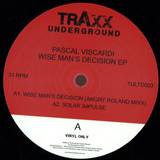
Born 31 years ago in Geneva (CH), Pascal brings his gritty mellow tones and extra shuffled patterns to the Traxx Underground familly. Strongly routed into jazzy vinyl samples, black speaches and spatial atmosphers, the 3 tracks composing « Wise Man's Decision EP » take inspiration from the past to showcase a true vision of what Slow-Deep-House should be in 2015. At last but not least, the great Fred P came to make his hands dirty, delivering a true reshape of "Wise Man's Decision", offring us a tunnel from where it aint easy to escape.
Geneve Based Pascal Viscardi bring his rich and sweltering textures to SAFT with his first EP for the Spanish label. The swiss producer's Paradiso EP is already the 9th installment and by no means an odd addition to the family. Strongly rooted in soulful sounds with firm aesthetics and blissful melodies, this release is exactly what SAFT is all about. From the moment the pad in the title track starts riding, Paradiso immediately hints to a deserted paradise.
Tales From The Emax (A2) is a groove laden Anthem that will soothe those that are into soulful but firm sounds. On the B side, we find remix work of both originals. Swiss house stalwart 'Agnes' stirs things up with his thriving rework of Paradiso called 'Agnes' La Charme Chambertin Mixx'. On the B2 cut we find SAFT familiar 'Jefferson Belmondo' with a cracking rework of the title track 'Paradiso' called Jefferson's Beach Mix. 4 strong, groove-laden cuts that celebrate the SAFT sound like never before.
2022 Repress
"Cellular Automata" is the new album from Dopplereffekt (Rudolf Klorzeiger and To-Nhan), their first in ten years since 2007's Calabi Yau Space on Rephlex.
Cellular Automata approaches mathematical growth and decay as an iterative process, with each data input considered individually relative to the overall model. The result represents one of the group's boldest creative endeavors, defying expectations while remaining unmistakably Dopplereffekt.
Cellular Automata is the third Dopplereffekt release to come via Berlin's Leisure System label, following 2013's "Tetrahymena" and 2014's "Hypnagogia".