2020. Full On Lockdown: Musician LaurenceMasonputs together this off the wall idea meshing together two of his biggest musical heroes, Dave Greenfield of the tough 1970's proto-punk band The Stranglers with the oh so cool 1960's jazz of Dave Brubeck. He puts up his demo on Youtube not really expecting much in the way of feedback. And gets ONE MILLION hits. And hundreds of requests for a release. Jazz Room Records Head Honcho Paul Murphy says "Do you wanna record that and release it?"."Affirmative!" The result is this grooving Soulful and Funky Jazz version of "Golden Brown". We're rush releasing this as when announced we were swamped with requests asking when it will be available.
On the "B" side is a languid and super cool version of "Walking On The Moon", originally by 80's Supergroup The Police.
Each copy of the Take Vibe E.P. will contain a Cut Out and Keep Fully Customizable Front Cover Sticker Sheet
This is just a taster for what we're confident will be a must have album to be readied for 2021 release.
Buscar:paul st hi
Grammy nominated DJ and production mastermind Paul Woolford steps up to deliver a timeless house reworking of Gabriels 'Angels & Queens'.
The title track from the trio's debut album (part 1) that took 2022 by storm. Endeared by the masses and critically acclaimed Gabriels set out a refreshing new take on soul that the world was subconsciously crying out for - an antidote to over produced pop - providing a deeper, more meaningful and heartfelt cause at its centre.
Tantalising from the outset, Woolford steps up to the plate with a hard-hitting remix that drives in straight to your centre. Punchy TR-909 drums combine with thundering bass tones and his archetypal, rising piano hooks. A combination that brings Jacob Lusk's inimitable vocals to new heights.
After a feverish reception to Paul's Instagram tease of the track, we've been itching to release this remix into the wild. It's a big one, don't miss it!
'Three supremely talented artists simply excelling at what they do' - Paul Woolford
Gerd Janson - 'Gabriels!!! - Total madness at Panorama Bar. Like it was made for the room'
DJ Feedback:
Prins Thomas – I’m melting….Amazing
Groove Armada – Love this!
Gorgon City - yessss
Fred P - Dope!!!!
Marco Faraone - Super remix!!!
Sasha – Quality
Bakermat – tasty
Mano Le Tough – Ace
Hector Romero - Gabriels have quickly become my fav new artist. Paul!! You nailed it. Great collaboration.
Horse Meat Disco – Pretty big remix!
Gerd Janson – MEGA
You know Krash Slaughta right? The man behind the recent wildly successful DOOM/Sugacubes mash-up LP Sugar-Coated DOOM, not to mention his unofficial remixes of the Wu’s K.R.E.A.M. and P.L.O. Style and collab. 45 with Phill Most Chill, Rebel Base? ‘Is he at it again?’ the monkey hears you ask. Yes, he is at it again, though the closest of the the three aforementioned releases to what he’s about to drop is the Wu remix 45. And what he’s about to drop is Diggin Deeper, not a single this time but a whole remix album of one of his (and the monkey’s!) all-time favourite hip-hop LPs – to wit, Niggamortis – more usually known as Six Feet Deep (especially in the U.S., though minus the best track under that name) by hip-hop supergroup Gravediggaz.
As many will know, this LP with its horror-movie fixated lyrics gave birth to a whole hip-hop sub-genre – that of ‘horrorcore.’ However, none of those who came after seemed to manage the lyrical humour of The RZArector, The Grym Reaper and The Gatekeeper (a.k.a. RZA, Poetic and Frukwan) and the only bit of production by The Undertaker (a.k.a. Prince Paul) that they seemed interested in was the sub-metal rap sludge of the shouty Bang Your Head – i.e. the LP’s one weak spot. But don’t worry, Krash isn’t interested in that sort of thing. Not only does he avoid rap-metal beats for Bang Your Head, he doesn’t use any on the LP at all – hurrah! What he does do is employ, arguably, as eclectic an array of sample sources as Prince Paul on the original – though with an entirely different end result. Bang Your Head with its apparently sixties garage band-derived beat for example is one of the standouts. The skeletal piano skank of 6 Feet Deep is another, while a beat featuring spaced-out eighties synths forms the new musical backdrop to Constant Elevation. Two more of the monkey’s favourites on this one are Here Comes The Gravediggaz, now underpinned by double-bass-led funk and the glorious inappropriately joyous bounce of Blood Brothers. The result? Your favourite cuts on this one might not be the same as your favourite cuts on the original. Two different versions of a much-loved LP, then; it’s why people remix hip-hop. All the vocal stems were created by Krash and the ultimate intention is to do a limited vinyl release. Cover art is by the Dead Residents’ Junior Disprol.
GRAILS don’t mince words. Awesomely communicative but entirely instrumental, this dynamic band’s violin, guitars, piano, and drums collide with sober melodies and massive emotion. At alternate moments, Grails can sound vaguely classical, Eastern European, Irish, like the lost tapes of Pauline Oliveros, and, you know, rock. They’re not really like anything else on the Neurot roster, but they’ve got something in common with all the Neurot bands: a commitment to intense music that forges new paths and, yeah, communicates in the most real way possible.
Grails have their fair share of ambient noise - shivery violins, a trickle of a high-hat, the amplified scrape of a guitar string - but their music is based on strong, narrative melodies that resonate in the heart. At times it sounds delicate, but they never cower; Grails ROAR, even when they’re being quiet.
The Burden of Hope is the debut LP, following a pair of self-released, eponymous ep’s in 2000 and 2002. The LP is the culmination of a year’s worth of recordings, including a reinterpretation of Sun City Girls’ classic “Space Prophet Dogon.”
Grails are gathered in Portland, Oregon from Baltimore, Little Rock, Louisville, Chapel Hill, and Reno. As an ensemble, their respective backgrounds in hardcore, classical, folk, and rock blend seamlessly. Formed in late 2000 to execute live the bedroom recordings of guitarist Alex Hall, the once-tentatively-assembled group found unexpected success with both audiences and local press. Originally formed under the moniker Laurel Canyon, the name of the group was changed to Grails to coincide with the release of The Burden
It’s been a few years since Captain Mustache took a ride with Kompakt – 2021, to be exact, when he released the “Everything” single, and subsequently made an appearance on that year’s entry in the Total series. But this visionary French producer has been busy, indeed fiercely productive, ever since, appearing on Helena Hauff’s Return To Disorder and John Digweed’s Bedrock, collaborating with Dave Clarke, Popof, The Advent, Paris The Black Fu, Keith Tucker from AUX88... and two beautifully eloquent albums, Tourbillon Nocturne and Indigo Memories. But with The Super Album, Captain Mustache returns to Kompakt with his most sublime collection yet. On The Super Album, the Captain soundtracks an imagined “whole day for party people.” He welcomes friends old and new on board: opening with the poetic club banger of “About Love”, with guest appearance from Speakwave (aka dynArec), The Super Album shifts gears into the lush, sunny “Shifting Basslines”, where Captain Mustache’s pulsing electro-disco is the perfect fit for a third collaboration with electroclash pioneers Chicks on Speed. After the deep techno pulsations of “Laser Me” and the glitzy pop shine of “Gimme Ya Mustache”, more guests arrive: Arnaud Rebotini of Black Strobe on the slinky “I Love Watching U”, and then a spoken cameo from the truly legendary French disco diva Amanda Lear on “Mustache Of The Universe”, a glitzy glitterball of a song that’s shrouded in ghostly synths. All those tracks appear on the 12” version of The Super Album – download the digital version and you get six more slices of Mustache magic. Here, the narrative turns more insular, more dancefloor focused – the party people have moved through the daytime and they’re in their element, diving deep into the night-time economy. The album spirals, beautifully, into stark electro, driving techno, with great moments of beauty and melancholy – see the pointillist arpeggios of “Everything” (which features Play Paul), the disco stomp of “Acapulco Citron”, and a breath-taking double-bill of stripped back psychedelic electro on “Pulsions Organiques”, and the layered, luscious, swooning “Clair-Obscur”. From there, it’s an astral glide into the Dopplereffekt-ish “Galaxian Symbiosis” before Foremost Poets join Captain Mustache to wave the night goodbye with the brittle, brilliant “Floorwax”. It’s a day in the life, but all in service to the pleasures of nightlife; the dancefloor is The Super Album’s beacon, your body the pliable material moulded into evocative new shapes by this dense, hypnotic, brilliantly pop album.
Caserta’s favourite era of house was when the line between hip hop and house was really only made visible by the tempo of the songs. An art mastered by legends like Kenny Dope, Armand Van Helden and DJ Sneak to name a few.
FF to 2023, Caserta returns to that form with Joe’s Boutique. An obvious nod to the craftwork of the seminal album Paul’s Boutique by the Beastie Boy’s. Caserta fired up the samplers and sliced and diced his way to his first EP in years. With swinging drums, heavy basslines, chopped up vocals and music you might think you stumbled across a lost Strictly Rhythm acetate but mixed and mastered to year 2728 by the man himself.
Complete with vocal interludes segueing from track to track this truly is a listening experience as well as a dance floor filler all in one.
Mal-One was always fascinated by the story of the legendary Gibson Les Paul Custom guitar, that Steve Jones, the guitarist of the Sex Pistols came to use. It was like a talisman object that got handed down from Sylvain Sylvain, the guitarist of the New York Dolls to Mr Jones. The story goes that Malcolm McLaren, during his brief stint working with the New York Dolls, acquired the guitar and carried it back to England. For monies owned to him for his work and on a promise that Sylvain Sylvain, was to come over to England to work with his new prodigies, the Sex Pistols. The guitar would be waiting for him.
Well history tells us that Sylvain Sylvain, did not make that trip and Steve Jones’s temporary use, became permanent. The guitar looked great with it’s two girly stickers ( decals ) and became a signature look for Steve Jones. Adding to this the story that Steve Jones stole Mal-One’s bike when he was seven years old. That story had to be told. Punk Art Poetry, that turned into a song. Hope you enjoy the indulgence.
Great rhythms matched with magic from King Tubby’s studio at the hands of Prince Jammy.
- A1: Wrong (Album Version)
- A2: Wrong (Thin White Duke Remix)
- B1: Wrong (Trentemøller Club Remix)
- B2: Wrong (Caspa Remix)
- C1: Wrong (Magda's Scallop Funk Mix)
- C2: Wrong (D I.m. Vs Boys Noize Remix)
- D1: Wrong (Trentemøller Club Remix Dub)
- D2: Oh Well (Black Light Odyssey Remix)
- E1: Peace (Single Version)
- E2: Peace (Sixtoes Remix)
- E3: Come Back (Jonsi Remix)
- F1: Peace (Ben Klock Remix)
- F2: Peace (The Japanese Popstars Remix)
- G1: Peace (Sid Lerock Remix)
- G2: Peace (Justus Köhncke Extended Disco Club Vocal Remix)
- H1: Peace (The Exploding Plastic Inevitable Jk Disco Dub)
- H2: Peace (Pan/Tone Remix)
- I1: Fragile Tension (Stephan Bodzin Remix)
- I2: Fragile Tension (Kris Menace's Love On Laserdisc Remix)
- J1: Hole To Feed (Popof Vocal Mix)
- J2: Hole To Feed (Paul Woolford's Easyfun Ethereal Disco Mix)
- K1: Perfect (Roger Sanchez Club Mix)
- K2: Perfect (Ralphi Rosario Dub)
- L1: Peace (Hervé's 'Warehouse Frequencies' Remix)
- M4: Fragile Tension (Laidback Luke Remix)
- N1: Fragile Tension (Peter Bjorn And John Remix)
- N2: Hole To Feed (Joebot Remix)
- N3: Perfect (Ralphi & Craig Club Mix)
- N4: Fragile Tension (Solo Loves Panorama Remix)
- L2: Peace (Sander Van Doorn Remix)
- M1: Fragile Tension (Radio Mix)
- M2: Hole To Feed (Radio Mix)
- M3: Come Back (Sixtoes Remix)
Sounds Of The Universe | The 12" Singles, a deluxe collector's
edition box set, contains seven 12" vinyl discs presenting
singles--including Wrong, Peace, the double A-side Fragile
Tension/Hole To Feed--alongside B-sides, remixes, dub
versions and other recordings contemporaneous to Depeche
Mode's 12th studio album, Sounds Of The Universe, originally
released by Mute Records in April 2009.
Sounds Of The Universe | The 12" Singles offers a full range of
ear-grabbing mixes--radio, club, dub and more--of Depeche
Mode originals with three discs (Discs Two, Four and Seven)
newly compiled for this collection, bringing together B-sides
and mixes first released across CD and maxi-singles
contemporaneous to the album's release.
When it came time to record the Sounds Of The Universe
album, DM's classic core (Dave Gahan, Martin Gore, Andrew
Fletcher) returned to the studio to make their second album
with producer Ben Hillier, whose intuitive contributions to
their previous studio album, 2005's Playing The Angel, had
created new sonic possibilities for the band expanding
Depeche Mode's vision and repertoire while continuing their
tradition of issuing monumental 12“ singles.
You know Krash Slaughta right? The man behind the recent wildly successful DOOM/Sugacubes mash-up LP Sugar-Coated DOOM, not to mention his unofficial remixes of the Wu’s K.R.E.A.M. and P.L.O. Style and collab. 45 with Phill Most Chill, Rebel Base? ‘Is he at it again?’ the monkey hears you ask. Yes, he is at it again, though the closest of the the three aforementioned releases to what he’s about to drop is the Wu remix 45. And what he’s about to drop is Diggin Deeper, not a single this time but a whole remix album of one of his (and the monkey’s!) all-time favourite hip-hop LPs – to wit, Niggamortis – more usually known as Six Feet Deep (especially in the U.S., though minus the best track under that name) by hip-hop supergroup Gravediggaz.
As many will know, this LP with its horror-movie fixated lyrics gave birth to a whole hip-hop sub-genre – that of ‘horrorcore.’ However, none of those who came after seemed to manage the lyrical humour of The RZArector, The Grym Reaper and The Gatekeeper (a.k.a. RZA, Poetic and Frukwan) and the only bit of production by The Undertaker (a.k.a. Prince Paul) that they seemed interested in was the sub-metal rap sludge of the shouty Bang Your Head – i.e. the LP’s one weak spot. But don’t worry, Krash isn’t interested in that sort of thing. Not only does he avoid rap-metal beats for Bang Your Head, he doesn’t use any on the LP at all – hurrah! What he does do is employ, arguably, as eclectic an array of sample sources as Prince Paul on the original – though with an entirely different end result. Bang Your Head with its apparently sixties garage band-derived beat for example is one of the standouts. The skeletal piano skank of 6 Feet Deep is another, while a beat featuring spaced-out eighties synths forms the new musical backdrop to Constant Elevation. Two more of the monkey’s favourites on this one are Here Comes The Gravediggaz, now underpinned by double-bass-led funk and the glorious inappropriately joyous bounce of Blood Brothers. The result? Your favourite cuts on this one might not be the same as your favourite cuts on the original. Two different versions of a much-loved LP, then; it’s why people remix hip-hop. All the vocal stems were created by Krash and the ultimate intention is to do a limited vinyl release. Cover art is by the Dead Residents’ Junior Disprol.
Finally the wait is over. Played for years as an unreleased weapon – not only by Priku - Ave is this kind of track where you just can’t forget the synths. You will still hum them while walking the streets months after. The mighty melody can catch the whole crowd creating memorial moments on the dancefloor.
B1 with „For your love“ is an older track but old is gold, right? It fits perfectly with its house beat and sexy vocals on the B-Side. The track gets even more love on top from Bärtaub with an excellent sounding remix – as usual for their work - completing the Ep as the B2. Thank you guys.
Paul Walter, who definitly defined producing as his lifestyle, runs also Meduka Records and has released music on labels such as Do Easy Records and Neostrictly.
On June 16th momentum continues apace for Alex Paterson’s Orbscure records, with the new album by Chocolate Hills – his duo project with Paul Conboy. Purveying world class melodic ambience and plenty beyond, colours in this high-fidelity-headphone-wonderland range from languid chill, kitsch exotica, library music, space age pop, ye olde folk and even drum and bass – all seasoned with (in)appropriately random plunderphonics from Paterson’s infinite goodie bag. Loosely based around a nautical journey to the Bermuda triangle and back, this is a fantastic voyage, but seas remain calm – more ‘Life Aquatic’ than ‘Moby Dick’. Tracks gently bob and float on bass which is roomy and buoyant like the hull of a ship, whilst luxuriously fluffy clouds meander overhead, before their vessel dives deep below to marvel at aquatic delights, guided by sonar. Paul Conboy’s approach as a member of cult analogue tinkerers Metamono – who use no computers, only old pre-digital gear – has carried over into his new joint venture. Both groups write, record and perform at same time, then later edit for release. For ‘Yarns from the Chocolate Triangle’ Paul set himself and Alex up with assorted gear, including a record deck, synths and drum machines, then the pair recorded the raw version of the album on the fly. These long live jams where then then discreetly augmented, embellished and edited, with a nip and tuck in Logic. As well as releases as A.P.E. on Dorado and Far Out recordings, TV and film scores plus his ongoing membership in Metamono, Conboy recorded three albums as part of Bomb The Bass, with whom he also toured Australia jointly with The Orb. On a boat trip over to Bali, Paul made Paterson pancakes, and their friendship was sealed. Having stayed in contact, many years later the duo began an exploration of ideas with their 2019 debut ‘A Pail Of Air’ on Painted World records (who’ve also released records by Nik Turner from Hawkwind, Youth, Roger Eno and Jaz Coleman). So far the duo have performed a low key gig at Paterson’s unofficial lair The Book And Record Bar, plus a bigger stage at the Roundhouse, alongside Leftfield, GAS, Ulrich Schnauss and System 7. Clearly making a lasting impression on Alex, the duo’s name was first referenced on The Orb’s own ‘Chocolate Hills Of Bohol’ remix of their single ‘Assassin’ in 1992, which was the same year Alex got blown away when visiting the prehistoric geological formations and enchanting jungles of the Bohol province in the Philippines.
- A1: Ciência
- A2: Iix 03
- A3: Qliq 07
- A4: Untitled 01
- A5: #04
- A6: Butô 05
- A7: Nandemo 12
- A8: Sem Título I
- A9: Spam 08
- A10: Qliq 02
- A11: Lctrnc 08
- A12: Sem Título
- B1: Excerto Da Trilha Sonora Do Vídeo "The Kids
- B2: Sjc 01
- B3: Spam 05
- B4: Croquis 2 06
- B5: Nandemo 05
- B6: Mimevoc 05
- B7: #03
- B8: Lctrnc 06
- B9: Spam 12
- C1: Mbiẽta 02
- C2: Ar 02
- C3: Mbiẽta 01
- C6: #1
- C7: Sjc 06
- C8: Cnandemo 08
- C9: Qliq 08
- C10: Mbiẽta 05
- D1: Sem Título
- D2: Cerâmica 03
- D3: Cerâmica 06
- D4: Cerâmica 08
- D5: Spam 10
- D6: Sjc 04
- D7: Qliq 05
- D8: #06
- D9: Qliq 09
- D10: Sim
- C4: Ar 05
- C5: Untitled 02
Tracks are mixed together.
"In this album, Akira Umeda mixes 42 recordings, dated between 1988 and 2018, which, in a sense, reflect the incredible range of his creative work: from songs, to ambient music; from field recordings to prank calls. The cassette tapes, whose contents make up this double-LP, had been stored in Umeda’s house in São José dos Campos, in São Paulo, Brazil.
Restless, and easily bored, Akira moved seamlessly from one activity to another – he was a little bit of everything (and nothing at all). Such people usually go unnoticed and unrecognized, something which Umeda found perfectly acceptable. Nevertheless, unlike most people, he had no right to see himself in this light – in the light of ephemerality and anonymity –, for in everything he tried his hand at, he inevitably left an impressive and distinctive mark.
The term cruising refers to the practice of seeking and obtaining instant, no-strings-attached sexual gratification with strangers. Akira Umeda was well-acquainted with this term, but his practice of it was not restricted to the aforementioned context. Rather it extended into all spheres of his life and work. A historian by training, he later became a ceramicist, a photographer, a visual artist, a draftsman, a graphic designer, a DJ, a musician, an audio technician, a writer, a researcher... He made forays into a myriad of artistic and academic fields – with a single intention: to achieve a specific objective and promptly exit stage left, as it were."
This debut album is the work of London based producer, sound artist and composer, Paul Cousins. Paul works with meticulously maintained reel to reel tape machines to transform and alter his electronic compositions. His prepared tape loops form the basis of ‘Vanishing Artefacts’ 12 intricate compositions. The original ideas processed through 1/4” tape become a hazy facsimile of their former state as tape is manipulated and effected to mould something new.
“There is great freedom in limitations. The sonic limitations of tape, at least in the lo-fi way I use it, are also a factor. Being able to physically touch and manipulate the sound is a very important and visceral part of this. Opposed to a lot of ambient music I have written, I want this music to be tactile, and very tangible. Yes, it can float away, but I also want to show the string tied to the balloon. For this reason many of the tracks contain the sound of the room, and the wonderful noises these machines make."
Freestyle Records presents Albert "Alchemist" Thompson's Promise Land, an EP featuring vocals from reggae & dancehall greats Frankie Paul, Joseph Cotton, Prince Malachi & Anthony John, representing a musical collection that has gradually evolved, matured & marinated over the course of the past 32 years - now finally seeing it's first ever release.
Albert Thompson (brother to the great Peter Chemist) was chief engineer at the storied I&I Sound Recording Studio after it moved it's base from Los Angeles to Jamaica in 1989, working with a wide range of heavyweight artists such as Dennis Brown, Bunny Wailer, Mighty Diamonds, Gregory Isaacs & many many more. During some studio downtime in early 1991, Albert laid down the rhythm track (itself a take on Aswad's Love Fire riddim, made most famous by Dennis Brown's iconic Promised land vocal track) with musical assistance from Tony Thomas.
16 years and a move to London later, Albert had founded his Alchemist Recording Studio on Brixton's Acre Lane in a space above the legendary Supertone Records - recording dubplates with talented local artists and touring Jamaican artists alike. Digging out the Promise Land tape, he proceeded to cut these 4 vocals on the version during the course of 2007. Another 16 years gone, and after hearing the tracks following a chance encounter with Albert in South East London, we felt they were finally ready to see release!
A certified maestro of his time, king of Cool Jazz with a penchant for unusual time signatures, Dave Brubeck is as prolific as they come. For their third release, Major Keys lovingly remaster and reissue three of his key pieces as The Dave Brubeck Quartet including the instantly recognisable ‘Take Five’ on 180g vinyl in a Major Keys sleeve.
On the A side one of the most famous jazz pieces of all time. Released in 1959 as part of the Quartet’s Time Out LP, which become the first jazz album to sell more than a million copies with the ‘Take Five’ single also taking that that coveted spot whilst going on to become the best-selling jazz single of all time. Accolades aside, it’s an intricate, absorbing and elating piece of jazz history, with one of the most recognisable melodies ever to be written. Timeless genius written by the quartet’s saxophonist Paul Desmond and performed by Dave Brubeck, Paul, Joe Morello and Eugene Wright, reissued for a new generation of listeners.
The B side sees ever more experimentation from the quartet, with the time signatures Dave heard on the streets of Istanbul providing the inspiration that gave birth to the lead track from Time Out - ‘Blue Rondo a la Turk’. As cool and complex as they get, stirring up those meters like a slick Manhattan. Rounding off the package, American jazz singer Carmen McRae’s 1962 vocal version of ‘Take Five’ gives an extra dose of sophistication to proceedings. All in all, a must have for any discerning music lover.
We are proud to present the Mr Bongo pressing of Guilherme Coutinho E O Grupo Stalo's self-titled mythical album. Blending lo-fi, Brazilian tropicalia, jazz, funk and MPB with a unique aroma, this record is pure perfection.
It was originally released in 1978 on Erla - Estudio Rauland, an obscure record label from Belém in Brazil, that only released 7” singles, with this album being one of two exceptions. During the 1970s, Belém had a thriving nightclub scene, but it is thousands of miles away from the music industry hubs of Rio de Janeiro and São Paulo, making this record insanely difficult to find, even in Brazil. Added to the scarcity factor is the magical nature of the recording, which has naturally resulted in a hefty price tag to match. Original copies have become a prized, collector’s item.
The elusive Brazilian band leader and keyboard player, Guilherme Coutinho is a true cult artist. He passed away in 1983, at the age of just 41, and during his career he only seems to have appeared on a handful of marvellous records, which makes them all the more special. This album feels individualistic and distinctive from other albums of the day. Listening back to vocalist Elinho’s (aka Hélio Rubens de Oliveira) delivery, it sounds not too dissimilar to some of Belle & Sebastian’s songs. ‘Guilherme Coutinho E O Grupo Stalo’ is rich in charm, quirky and playful. It feels cinematic, soothing and benefits from being heard in its entirety. A proper album experience.
Recently created Guatemalan label Identidata is extremely proud to present Sacratávica, the very first collected survey of Joaquín Orellana’s compositions. With a career spanning over 50 years of activity across contemporary art, performance, theater and sound art, Orellana is a highly singular figure in Guatamalan culture. Often considered to be the sole avant-garde composer in the country, his work has a deeply interdisciplinary quality. Most of his music was created using an orchestra of his self-built instruments, also known as Útiles Sonoros. Sitting at the border of sculpture, sound installation and musical instrument, these Útiles Sonoros, which he’s been building and developing since the late ‘60s, are at the center of his artistic activity.
Aside the obvious formal aspect, his compositions also have a strong political message, while being deeply rooted in Guatemalan history, folklore and various identities, both indigenous and modern. Playful opener “Híbrido a presión” was one of the first of his compositions to be performed entirely using the Útiles Sonoros. However, due to its technical complexity the piece was seldom reproduced, except for a later staging that Orellana directed in Louisville, Kentucky. “Ramajes”(1984), initially titled “Evocación profunda y ramajes de una marimba” , tracks the many incarnations of the marimba across history, before reaching its final form as one of Orellana’s instruments by combining vibrational percussion with melody and poetry fragments.
The title track, ‘’Sacratávica’’, represents one of the most ambitious and emotionally charged pieces from the album. An expansive 22 minute composition mixing textures that mimick field recordings and multi-layered vocal melodies culminating in choral catharsis, ‘’Sacratávica’’ deals in baroque maximalism without ever feeling cluttered. For the casual listener, the track immediately stands out, not only because of the moving vocal layered harmonies, but also through its epic scale and strong sonic narrative. Dubbed “Las voces del Rio Negro”, the piece references the massacres that took place in Coban during a period where the army massacred numerous towns, throwing the bodies in the nearby Rio Negro (the Black River).
Final track, “Fantoidea”, a glistening, metallic ambient improvisation, was a reimagining of Disney’s Fantasia using Paul Dukas’s “The Sorcerer's Apprentice” as inspiration.
Despite his work being presented in numerous exhibitions and concerts in various prestigious museums and theaters across the world, very few quality recordings exist to date. The only previously available recordings so far or either of very poor quality or did not receive enough attention. This is why, although The compositions presented not being previously unheard, having them all together in a high quality audio object represents a key moment In Guatemalan and Latin American culture.
Recorded on August 31st 2016 during a historical concert attended by over 1000 people at the Centro Cultural Miguel Angel Asturias, designed by Efrain Recinos, one of Guatemala’s leading contemporary artist from the last century, the four pieces were performed by a selection of over 90 musicians (including 60 vocalists) who were already familiar with Orellana’s instruments, cherry-picked from the Guatemalan Conservatory.
For the people behind Identidata, it has been a long and arduous process to put together these pieces. Trying to offer a panoramic view of Orellana’s work, the curators have selected pieces ranging from different decades and artistic periods. Sacratávica is a portrait of a singular artist whose work speaks not only to his culture, but carries strong aesthetic sensibilities that resonate universally.
- A1: Intro
- A2: The Magic Number
- A3: Change In Speak
- A4: Cool Breeze On The Rocks (The Melted Version)
- A5: Can U Keep A Secret
- A6: Jenifa Taught Me (Derwin’s Revenge)
- A7: Ghetto Thang
- A8: Transmitting Live From Mars
- A9: Eye Know
- A10: Take It Off
- A11: A Little Bit Of Soap
- B1: Tread Water
- B2: Potholes In My Lawn
- B3: Say No Go
- B4: Do As De La Does
- B5: Plug Tunin’ (Last Chance To Comprehend)
- B6: De La Orgee
- B7: Buddy (With Jungle Brothers And Q-Tip From A Tribe Called Quest)
- B8: Description
- B9: Me Myself And I
- B10: This Is A Recording 4 Living In A Full Time Era (L I.f.e.)
- B11: I Can Do Anything (Delacratic)
- B12: D A.i.s.y. Age
2X12 VINYL[35,25 €]
Orange Version[18,28 €]
Yellow VINYL[35,50 €]
Magenta version[35,50 €]
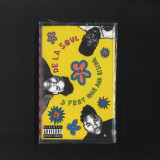
Finally back on tape, officially reissued. Must have! 3 Feet High and Rising is the debut studio album by hip hop trio De La Soul and was released on March 3, 1989 It marked the first of three full- length collaborations with producer Prince Paul, which would become the critical and commercial peak of both parties. Critically, as well as commercially, the album was a success. It contains the singles, "Me Myself and I", "The Magic Number", "Buddy", and "Eye Know". The album title came from the Johnny Cash song "Five Feet High and Rising". It is listed on Rolling Stone's 200 Essential Rock Records and The Source's 100 Best Rap Albums. When Village Voice held its annual Pazz & Jop Critics Poll for 1989, 3 Feet High and Rising was ranked #1. It was also listed on the Rolling Stone's The 500 Greatest Albums of All Time. Released amid the 1989 boom in gangsta rap, which gravitated towards hardcore, confrontational, violent lyrics, De La Soul's uniquely positive style made them an oddity beginning with the first single, "Me, Myself and I". Their positivity meant many observers labeled them a 'hippie' group, based on their declaration of the 'D.A.I.S.Y. Age' (Da. Inner. Soul. Yall). Sampling artists as diverse as Hall & Oates, Steely Dan and The Turtles, 3 Feet High and Rising is often viewed as the stylistic beginning of 1990s alternative hip hop (and especially jazz rap).
Radio Slave double header with the A side featuring Dixon’s anthemic edit of Radio Slave ft. Nez ‘Wait A Minute’ and the monstrous ‘You Don’t Know’ on the flip!
Innervisions boss Dixon was the only artist to receive a super upfront copy of the track in early Summer 2022 and went on to hammer the release across countless festivals and club shows over the season. Dixon being Dixon, he didn’t stop there and went on to edit the track into a six and half minute groover that draws out Radio Slave’s production and NEZ’s raucous vocals perfectly. Now, this ‘Track ID’ favourite, which in its original vocal form has already been championed by Jennifer Cardini, Roman Flugel, Kolsch, I. JORDAN and more.
On the flip ‘You Don’t Know’, Radio Slave enters House mode, employing hooky vocal snippets,
chunky drum hits, and filtered synths to hypnotic effect across the deep 9-minute track. Championed by Honey Dijon, Gerd Janson, Paul Woolford, Ame and Laurent Garnier amongst others.
During the summer youth program of 1970 and '71 at St Paul's Catholic church a young Tunnie Smith was singled out by Father George Artist for his outstanding singing abilities. He was soon introduced to Joe Delpit and Reginal Brown to sing along with their show and dance band "The 13Th Amendments. It didn't take long before Tunnie was a full member of the band and became a featured singer performing throughout Louisiana. After a year and a half of performing at nightclubs, military bases and universities Tunnie landed a record deal with Rick Hall's Fame/UA record label. His first single from 1973 was a wonderful mid-tempo number entitled "Finders Aren't Always Keepers" flipped with "Do That To Me"It gained National distribution and had some good success. Tunnie left Fame records and was introduced to Stax record executives Al Bell and John Smith. After signing with Stax, Tunnie met legendary writer and performer David Porter where they recorded an album which was scheduled for release around 73/74.Unfortunately Staxs association with CBS came to a halt and the project got shelved. From those session arose the wonderful "U And Me Together", leading on from the well produced "Finders Keepers" cut the song builds up with an epic 1:30 string and drum arrangement that really sets the picture for Tunnie to arrive with vocals way above his young age would suggest. A story of a boy and girl determined to make it and be the great combination that their love affair deserves. We can’t believe a gem like this has been waiting to come out and should have catapulted Tunnie to the next level or artist rosters. Alas, Tunnie went home and carried on performing around the Louisiana area with his new band Sweet Music Orchestra Fast forward to 1983 Tunnie whilst recording some vocals at River City Recording met Chicago producer and arranger George "Paco" Patterson. George was musical director and had worked with The Isley Brothers Wilson Pickett and many other well known artists. During this period Tunnie along with George formed a great partnership and along with some top session musicians record some incredibly lush, well produced and atmospheric songs The A Side "Join Together " is from the same session as "Dancing On Da Clouds" and could have easily be picked for his first single on Pass The Baton records. It oozes the same heavy production with opening piano cords and layered scatting then bosh, in comes the drums and Vox taking you on a mesmerising space like 2 step extravaganza. So, there you have it, once again two amazing slices of soul on one single from Tunnie Smith. Let’s hope this artist finally reaches his potential from that young man who started recording in 1973.