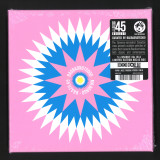
Krishnanda is an album in the truest sense of the word - a spiritual, psychedelic Brazilian masterpiece from start to fnish - celebrated by everyone from Seu Jorge and Kassin to Floatng Points, Madlib and DJ Nuts. These days, originals change hands for thousands of dollars. Pedro dos Santos, born in Rio in 1919, was a percussionist virtuoso, composer and inventor of instru-
ments that apparently included oddites such as the 'Tamba' (electrifed bamboo drum) and the mouth berimbau whistle. Nicknamed Perdo 'Sorongo' afer the rhythm he invented, that features throughout 'Krishnanda'. A highly spiritual man who was regarded as a philosopher by many. He worked with greats including Baden Powell, Elis Regina, Maria Bethany, Elza Soares, Sebastão Tapajós, Roberto Ribeiro, Milton Nascimento, Clara Nunes, Paul Simon and Arthur Verocai, playing on
his legendary self-ttled LP. In the same vein as Verocai and his self-ttled LP, 'Krishnanda' was Pedro's chance to shine with his own, and only, solo recording. Krishnanda was produced by Hélcio Milito, the drummer of Tamba Trio, and arranged by conductor Joppa Lins, and originally released in 1968 on CBS (Brasil). Musically, the album touches folk, samba,
afro-brazilian and psychedelia plus added efects, with a lyrical depth and diversity to match; themes including morality, percepton, existence and ego. Despite the genius of the record and the infuence that it had on musicians at the tme of release, it
disappeared into obscurity. We frst discovered the record around 2003, through a friend Julio Dui. Around that tme Brazilian funk and bossa was the favour of the day, so didn't catch our ear immediately, however it contnued improve with age and now we consider it to be one of the best albums ever made, regardless of genre or origin.
Поиск:pedro santos
Все
- 1
The sounds of Brazil in the late 60's were thriving with creative growth in thought and world minded values. The age of fusion was alive and well and a lost hidden gem from this era comes in the sole Pedro Santos 1968 LP Krishnanda. Tracks include "Ritual Negro", "Água Viva", "Um Só", "Sem Sombra", "Savana", "Advertência", "Quem Sou Eu", "Flor de Lótus", "Dentro da Selva", "Desengano da Vista", "Dual", "Aranbindu".
Belgian dance label LA MUSIQUE DU BEAU MONDE turns 20, spawning a massive amount of hits spanning two decades. Ranging from commercial hits by DJ Antoine, Laurent Wery, Remady, Jay Santos, to more credible tracks by Phonkers, Merdan Taplak, Les Mecs, and others.
This is the first record in a series of five, and the first one kicks off with a bang. The importance of Pedro Cazanova’s classic Selfish Love in the house scene cannot be underestimated. It grew iconic in the remix by Gregor Salto, as featured on this 12”.
Rock Your Body by Phonkers was one of the most played tracks on Benelux radio stations during the summer of 2011. The track gained massive popularity not only in Belgium and Holland but also in Australia, New Zealand, Poland, and beyond.
Daniel Bovie is undoubtedly one of the best Belgian dance producers of the past four decades. His 2014 masterpiece Way Too Long is included on this record.
In 2014, Ralpheus had a big international club hit with the catchy clubhouse tune Do What? Gospel chants built around a big clubhouse beat, still a floorfiller today!
Black Vinyl LP with insert (including the story behind the album and lyrics with English translation)
After their first LP, in 1987, Pedro gathered his usual band, Carlos Sousa on keyboard, Bulimundo on drums, Nuno Santos and Zézé on lead and rhythm guitars, Augusto Rasta on bass, Daló on sax and finally Dalú on percussions, for yet another project, one that carried both their names: Jacinta Sanches - Pedro Ramos. Eight days, no more, that’s all Pedro Ramos and Jacinta Sanches needed inside the Estúdios Musicorde. The process was natural, as with all their music, memories recollected and arranged by Pedro on café napkins, rehearsed and perfected at home with Jacinta. Together they imagined music where Cape Verdean saudade could dance together with Kingston’s skank, two island hearts beating inside European concrete.
His name is Pedro Correia Ramos Varela, born in Praia, Santiago, Cabo Verde on April 6th 1954; her name is Jacinta Lopes Veiga Varela, born in Cidade Velha, Santiago, Cabo Verde on January 22nd 1959. The two met in Praia, where a few exchanged words turned into long evening conversations; conversations into friendship; friendship into love; and love into six wonderful children. After the independence of Cabo Verde, they got married in 1978 and moved to Portugal, where Pedro started working as a welder for Lisnave and playing the guitar in a band in Ramada. Trading shipyard sparks by day for the after-hours pulse of Cova da Moura, his love for music proved harder than steel. And in 1982, after seeing Bob Marley and Peter Tosh in Rotterdam, he opened his own Dancing Bar just below their house, a pioneering space for the promotion of reggae music in Portugal.
Their Dancing Bar kept its doors open from 1982 to 1994, seeing the release of two albums and more singles. To this day, Pedro and Jacinta are still making music, one the inspiration of the other. They define themselves as simple people, living happy without prejudice, friends with the world.
- A1: O Terno - Tudo Que Eu Não Fiz
- B1: Chico Bernardes - Até Que Enfim
- C1: Menahan Street Band Feat Rogê - Tropical Man
- D1: Dora Morelenbaum - Vento De Beirada
- E1: Naire - Um Dia Azul De Abril
- F1: Guilherme Coutinho & Grupo Stalo - Rio Corrente
- G1: Antonio Adolfo E A Brazuca - Transamazonica
- H1: Som/3 - Um Minuto
- I1: Sebastiao Tapajos & Pedro Dos Santos - Despedida De Mangueira
- J1: Ana Mazzotti - Agora Ou Nunca Mais
Grammy-nominated Canadian ensemble BADBADNOTGOOD present the latest edition of Mr Bongo’s iconic Brazil 45 boxset series.
Hailing from Toronto, the band, which now consists of Alexander Sowinski, Chester Hansen and Leland Whitty, made its name by crossing genres and developing a distinctive amalgamation of jazz, hip hop and psychedelic grooves. Their rise to the forefront of their scene has led to collaborations with icons such as Tyler, The Creator, Kendrick Lamar, MF Doom, Samuel T. Herring (Future Islands) and Ghostface Killah. With a penchant for an earworm hook, their sound takes cues from across the globe, both past and present, not least from the wealth of music that has emanated out of Brazil over the last 70 years.
Beatmakers, musicians and record collectors at their core, the influence of Brazilian music on BADBADNOTGOOD’s productions is clear to see, with previous collaborators including Arthur Verocai and Tim Bernardes. It seemed only right then, to hand them the reins for the next edition of our signature boxset series. As ever, the brief was simple, compile a selection of your favourite Brazilian cuts from the country’s rich musical makeup. A captivating collection of sought-after tracks crossing genres, decades and tempos, offering a glimpse into BADBADNOTGOOD’s eclectic tastes, whilst exploring ever further the richness of Brazil’s musical history.
HIGHLIGHTS We are happy to present here two Tropical versions of massive disco hits that retain all the party spirit of the originals. 'Da Ya Think I'm Sexy' (Rod Stewart) by La Cumbia Moderna de Soledad is a playful mix of the old and the modern that guarantees some dancefloor heat each time the needle hits the surface of the vinyl, and the Machuca Cumbia rendition of Bee Gees 'Stayin' Alive' becomes a dancefloor winner full of hypnotic percussions and guitars. A perfect follow-up to the acclaimed previous singles in our 'Tropical 45s series' that so far has included recordings by the likes of Jimmy Salcedo or Sebastiao Tapajos/Pedro Dos Santos. DESCRIPTION Few melodies have been played so many times on radio, movies or TV commercials as these two compositions from the golden age of mainstream disco music. Top international hits and iconic milestones of an era, both songs are immediately recognizable after just a few chords by almost anyone on this planet. These two compelling tropical versions retain all the party spirit of the originals, guaranteeing some dancefloor heat each time the needle hits the surface of the vinyl. A perfect follow-up to the acclaimed previous singles in our 'Tropical 45s series' that so far has included recordings by the likes of Jimmy Salcedo or Sebastiao Tapajos/Pedro Dos Santos. In the rendition of Rod Stewart's 'Da Ya Think I'm Sexy' we find a playful mix of the old and the modern made by Pedro "Ramayá" Beltrán, signed under his project La Cumbia Moderna de Soledad; a group from Barranquilla, Colombia, that recorded a set of songs that exudes both tradition and innovation. Machuca Cumbia, a Colombian studio band under the direction of "Cachaco" Brando, add some unexpected cumbia arrangements to the Bee Gees 'Stayin' Alive ', resulting a dancefloor winner full of hypnotic percussions and guitars that, at times, even recall other genres such as surf.
Enigma is the first studio album by the space age, glass-harp powered, tropicalia quartet Os Barbapapas. Understandably, those adjectives could invoke images of kitschiness in one’s mind; that concept is smashed by the ice cold shot of Brazilian jazz riffing in the album’s opener and first single, “Se Liga Na Sequência”.
Os Barbapapas trapeze the vast richness of Brazilian/South American music heritage and beyond, as a collective with members who have variously travelled to Morocco to master Gnawa; played in circuses, or were born in the heartland of samba – these experiences and much more inform the complex yet breezy instrumentals of Enigma.
It’s a joy to pick through the notable influences that resound over Enigma. Ethiopian Jazz bursts from "Caminho para Itiwawa", backed by an Afro-Latin swing, fostered by drummer Barbara Mucciollo. There’s tonalities from North African artists such as Omar Khorshidor West African artists such as Tinriwen and Ali Farka Touré, as well as rhythmic influence from Afro-Cuban and Afro-Brazilian music. The dynamite track “(L)Atitude(S)” contains the explorative excitement of Brazilian 60s luminaries like Pedro Santos, however none are as special as layered percussion of “Gaba Gaba”, connected to the very specific rhythms of Northeast Brazil. It's evident from listening to Enigma that Os Barbapapas are an exceptional live band. They have their sights set on Europe soon, with the Glass Harp packed away safely. Until then please enjoy this electrifying album of their work so far, understanding: this is an extremely exciting project, still in its auspicious infant years
Enigma is the first studio album by the space age, glass-harp powered, tropicalia quartet Os Barbapapas. Understandably, those adjectives could invoke images of kitschiness in one’s mind; that concept is smashed by the ice cold shot of Brazilian jazz riffing in the album’s opener and first single, “Se Liga Na Sequência”.
Os Barbapapas trapeze the vast richness of Brazilian/South American music heritage and beyond, as a collective with members who have variously travelled to Morocco to master Gnawa; played in circuses, or were born in the heartland of samba – these experiences and much more inform the complex yet breezy instrumentals of Enigma.
It’s a joy to pick through the notable influences that resound over Enigma. Ethiopian Jazz bursts from "Caminho para Itiwawa", backed by an Afro-Latin swing, fostered by drummer Barbara Mucciollo. There’s tonalities from North African artists such as Omar Khorshidor West African artists such as Tinriwen and Ali Farka Touré, as well as rhythmic influence from Afro-Cuban and Afro-Brazilian music. The dynamite track “(L)Atitude(S)” contains the explorative excitement of Brazilian 60s luminaries like Pedro Santos, however none are as special as layered percussion of “Gaba Gaba”, connected to the very specific rhythms of Northeast Brazil. It's evident from listening to Enigma that Os Barbapapas are an exceptional live band. They have their sights set on Europe soon, with the Glass Harp packed away safely. Until then please enjoy this electrifying album of their work so far, understanding: this is an extremely exciting project, still in its auspicious infant years
Far Out Recordings proudly presents Hermeto Pascoal’s remarkable self-titled debut album. Recorded in 1970 at A&R studios in New York, the album features certified North American titans including Ron Carter, Hubert Laws, Joe Farrel and Googie Coppola, and Brazilian stars Airto Moreira and Flora Purim (who also produced the album).
While it was Hermeto’s first album released under his own name, he had spent the decade or so prior making a name for himself in Brazil and internationally as a composer, arranger and instrumentalist with groups including Sambrassa Trio, Quarteto Novo and Brazilian Octopus, before going on to work with (amongst countless others) Edu Lobo, Antonio Carlos Jobim, Donald Byrd, Airto Moreira and Miles Davis, who allegedly called Hermeto “one of the most important musicians on the planet”.
With Hermeto’s otherworldly orchestral arrangements, ghostly vocal performances from Flora Purim and Googie Coppola, and the inimitable drumming and percussion stylings of Airto Moreira, Hermeto easily rivals some of the oft-celebrated MPB albums of the early 1970s, sitting somewhere between the string-heavy magic of Arthur Verocai’s 1972 debut and the unplacable early experimentalism of Pedro Santos’ 1968 album Krishnanda.
With his phenomenal natural musical genius and a ceaseless sense of creative freedom, Hermeto is widely known for using unconventional objects to make music. In the album’s sleeve notes, Airto highlights the track “Velório (Mourning)” explaining how Heremto filled 36 apple juice bottles with different amounts of water and tuned them to precise pitches in order to create the beguiling harmonies heard.
The reissue of Hermeto Pascoal’s Hermeto, follow’s Far Out’s recent unveiling of a previously unheard Hermeto Pascoal live concert Planetario da Gavea from 1981, and 2017’s release of Hermeto Pascoal’s lost 1976 studio album: Viajando Com O Som.
Hermeto will be available on vinyl LP and CD from the 20th May 2022 via Far Out Recordings.
A complete album masterpiece in every sense of the word, considered by many people to be one of the greatest ever made, regardless of genre.
Recorded at Studio Somil, Rio De Janeiro in 1972, the album was produced, arranged, directed by the self-taught, Arthur Verocai.
Previously he had worked on many records in various capacities, with artists including Jorge Ben, Ivan Lins and Celia, but this album gave him the chance to do his thing in it’s most pure form.
The 29 minute masterpiece, perfect in it’s arrangement and fusion of sonics, epitomises the sound of Brazil at the time; strings, guitars, pianos, break beats, bass lines, synthesizers, vocals from the wonderful Célia, Carlos Dafe and Oberdan (Banda Black Rio), plus percussion from Pedro Santos and Paulo Moura on sax. Bossa nova, samba, jazz, MPB, psychedelics and funk sit side by side effortlessly.
The album transcends the genre of Brazilian music, and infact all genres. Highlighted in part by the number of artists that have sampled from it; MF Doom, Ludacris & Common, Little Brother, Jneiro Jarel aka Dr Who Dat?, Dibiase and Action Bronson amongst others.
The original Continental version of the album now fetch around $2000. Our definitive re-issue is an exact replica of the gatefold original LP and the source master is taken from the Continental tapes, re-mastered in 2012 under Arthur’s supervision.
'Sinal Vermelho' - midtempo psyche-funk workout tough on the drums. Brilliant vocal from Marilene. Taken from 1973 compacto 7' released on Copacabana.
'Verão Vermelho' is taken from Nonato Buzar's 1970 LP 'Temas De Novelas', a collection of songs he wrote for Brazilian soap operas. The song features Pedro Santos on percussion.
- 1