Blue Marbled Vinyl
A1 Fred Hush - Close Your Eyes
This track is cracking and is the unofficial follow up to open your eyes. Some sounds have been taken from OYE and mixed with new sounds and a new discreet vocal. For the people who like hypnotic long and deep climaxes.
A2 Fred Hush - I Say (Remix Noseda)
I SAY is a niche record released on Emmanuel Top's Fokalm label. This version is a remix by techno man Noseda known from Ragnarok Berlin and releases on Deborah De luca's Solamente label.
B1 Emmanuel Top Acid Phase (Fred Hush & Dimitri Andreas Rework)
Acid Phase, an unbelievable record that is hard to match, was repackaged by Fred Hush & Dimitri Andreas. A slightly dreamier and more melodic tone was indicated in a compelling beat. This version was released before but quickly sold out. Played by Sven Vath.
B2 Fred Hush - I Say (Remix Klaudia Gawlas)
International DJ Star Klaudia Gawlas also let her go for a while to make her own version. Very strong sound and an unmissable second break that certainly works on the dance floor.
Cerca:peo
The Athenian producer and co-founder of WonTon records made his debut in 2020, with the album "IRINA" and his collaboration with Lena Platonos on the eponymous track, putting him on the lists of the top domestic albums of the year.
His fixation with analog synths, endless synthetic sequences and world-weary narratives of urban everyday people continues in the second LP with the, representative of his sound, title "CANCELLATION" (ΜΑΤΑΙΩΣΗ).
repressed !
From samba and bossa nova through to baile funk, with carioca expressions of jazz, rock and hip hop in between, the sound of Rio de Janeiro, while continually evolving, has always held an unnameable quality which reflects the magic and mystique of the city itself. Multi-instrumentalist and arranger Antonio Neves is the city’s newest trailblazer: the enfant-terrible of Rio’s music scene, leading a vital and diverse constellation of both emerging and well-known artists advancing the city’s musical legacy.
“It all started one sleepless night, after watching a Quincy Jones documentary”. Inspired by the legendary music magnate, Neves began writing a list of artists residing in Rio de Janeiro “people that I admire, that I consider geniuses of their instruments, who share with me affinities, anxieties and projects.” The list included some of Brazil’s most revered living musicians who Neves has worked with in recent years: Hamilton de Holanda, Leo Gandelman and Dorival Caymmi. Neves also called on some of Brazil's most exciting emerging talents including Alice Cayymii and Ana Frango Eletrico.
A Pegada Agora É Essa (The Sway Now) is Neves’ second album: a vibrant portrait of the current Brazilian music scene. From the regional to universal, popular to erudite, samba to rap, Latin rhythms to jazz, MPB and pop to good old rock'n'roll, Neves walks with fluency and mastery amongst all the musical genres that Brazil has to offer.
“My offer to the musicians was complete freedom to express themselves through the songs I proposed – classics like “Summertime”, “Luz Negra” and “Noite de Temporal”, and compositions of my own – creating a space of authorship for the band and the guests. A space for inventions, purges, delusions, laughter. The idea was to bring the freedom of jazz crossed by Brazilian rhythms, such as the traditionals Partido Alto (A Pegada Agora É Essa) and Jongo (Jongo no Feudo and Luz Negra); rhythms of African-Brazilian religions like Candomblé (Noite de Temporal) and Umbanda (Forte Apache); and a tribute to newest Rio de Janeiro’s contribution to Brazilian music, the Funk Carioca (Simba)”.
Coming from a musical family, Antonio’s father, Eduardo Neves, was a renowned conductor and a professor at Juilliard School of Music and the California Jazz Conservatory. In the bohemian neighbourhood of Lapa, aged 14, Antonio began his career as a drummer, before experimenting with brass. He would soon become a skilled trombonist and arranger achieving the recognition of his teachers and peers. It wasn’t long before he would be playing with some of the biggest names in Brazilian music, such as Hamilton de Holanda, Leo Gandelman, Moreno Veloso, Kassin and Elza Soares.
His debut album as a trombonist was PA7 (2017, Rock It), released at the same time he was travelling the world playing with artists like Moreno Veloso, Kassin and Leo Gandelman, and recording the albums Jobim, Orquestra e Convidados (2017, Biscoito Fino), with Mário Adnet and Paulo Jobim; and Elza Soares Canta e Chora Lupi (2017, Coqueiro Verde Records). More recently, Neves was the arranger for the acclaimed Little Electric Chicken Heart album, by Ana Frango Elétrico, which has been nominated for a Latin Grammy and voted 2019’s ‘Brazilian Music Revelation’ by The Art Critics Association of São Paulo.
Welcoming Hermanez to Satya has naturally induced the label to transcend musical boundaries by opening up the creative parameters to more electronic artistry. Taking spring by storm, Hermanez has adopted 009 with grace and unequivocal individuality. With his full-body thrilling tracks, he empowers the listener to Rewire their listening programming, refreshing their palette with a high-energy burst of sexy flavors.
“The urge for freedom during the lockdown was a big thing for me. I personally had a production burst. Everyone needed to deal with what happened, so I did it in my own way by purely doing the only thing that kept me moving forward: creating a space to stock a feeling. Rewire is a story that is beyond words, as it is made up of healing sounds. Although there were cultural contradictions these past years, what mattered most for me was and still is people’s love for music. Overall, 009 was inspired by the beautiful collision of people and their experiences.” - Hermanez
Through defined grooves, rolling bass lines, granular uplifting synths and pad use, Rewire is literally wired with deeply hypnotic and mystical atmospheres. Hermanez truly strikes and presents us with four dance floor weapons.
When the body starts moving
And the mind stops racing,
The heart ends up pumping
And a smile keeps spreading.
Our programming is now rewiring
Our perspectives now expanding,
With all 5 senses heightening
Because of what is resetting,
Recalibrating and realizing.
Rewiring to a new reality.
- Ty Alexander
Alvars Orkester was formed in 1987 in Johannishus, a small village in the south-east of Sweden by a group of young boys interested in the mysteries of psychic sickness, mental institutions, industrial music culture and the power of sound. For the first very creative years, Alvars was very active within the independent cassette culture scene releasing their stuff (that quite soon drifted from the industrialism inspired by Test Dept, TG, SPK and z'ev to an atmospheric, psychedelic and quite ambient version of noise) on small labels in Italy, Portugal, USA etc.
Joachim Nordwall writes: "1990-1991. In the middle of all teen confusion going on, me and Zwarre had a long creative time together. Recording every weekend, connecting with like-minded (or at least we thought so) people around the world and trading tapes with whoever. Our world was analogue synths, Party Zone late Friday nights on MTV, zines and out-there experimental music. By then, we had a few tapes out and had "Nobody Finds Nothing" being released on the Italian super-label (in our opinion) Biotope Art Organization. We were in the midst of something and recorded "Nuthull" for another Italian top level label called Old Europa Café. However, they did not like it and the tape was abandoned and forgotten. Then years and years later, close to present time, Zwarre was in touch with OEC for some reason and had the master returned." - Joachim Nordwall, Gothenburg, 21 February 2023
- A1: Beyond The Dream - Kenny Cox
- B1: Tune For L.n. - Larry Nozero
- B2: Face At My Window - Sam Sanders
- B3: People We Got To Do Better - The Soulmates
- C1: Noh Word - The Contemporary Jazz Quintet
- C2: Joy Road - The Lyman Woodard Organization
- C3: Time Is Wasting - Tj
- C4: Root In 7/4 Plus - Maulawi
- D1: Salsa Pt. 1 - Fito Foster2. Maiden Voyage - Ursula Walker
- D3: You're The One - Tj
- D4: Where Is The Place? - Maulawi
- E1: Saturday Night Special - The Lyman Woodard Organization
- E2: Inner City Player - Sam Sanders
- F1: Island Song - Kenny Cox
- F2: All But Blind - Mixed Bag Feat. Ursula Walker
- A1: Report From The Frontlines
- A2: Ask Believe Feel Receive
- A3: Lost In Solitude
- A4: Art Is The Only Real Translation Of Living For Me
- B1: We Belong To Never
- B2: Pain
- B3: Superrare
- B4: We Want To Feel Love
- C1: Musik Ist Meine Sprache
- C2: Equalista
- C3: Mirrors
- C4: Skin
- D1: Free
- D2: Still Feat Pascal Schumacher
- D3: Afterhour
ENARCHY is the debut album by Leipzig-based producer and singer Maria die Ruhe. It is the result of a deep and thorough look the
artist took into both her own inner workings and the world around her. In 14 tracks, she explores different types of energy,
oscillating between head and heart. Final destination of this sometimes painful process of self- exploration is the embodiment of
her own power and creativity; the realization, that she manifests her role as catalyst, healer, and fighter for freedom and equality
by reporting on her experiences. These songs are about nothing less than that. And you can also dance to them.
In a musical sense, Maria surpasses herself compared to previous releases. She is bolder, more explorative and dissolves genre
boundaries. Acoustic instruments like the cello and the piano unite playfully with electronic beats. Her expressive voice speaks and
sings from the lowest lows to the loftiest heights. Her self-disclosing lyrics communicate the deepest messages of the soul. One can
tell right away: something is at stake here, this is about a real human living through something real, and now reporting from the
front lines of the human experience.
With lines like „Things are changing all the fucking time“ (ENARCHY) she posts a reminder for the current zeitgeist and the resulting
global uncertainty. „Some things need to be destroyed before they can heal“ is a demand for openness towards change, even if it is
challenging, requires energy, and leaves behind some scars.
In ART IS THE ONLY REAL TRANSLATION OF LIVING FOR ME, Maria uses sentences like „I’ve been trying to please you, I got headaches
and I still don’t fit“ to express her desperation with existing structures of injustice and the lack of livability of the artist lifestyle.
„Ah, you’re an artist - and what do you do professionally?“ Everyone loves music and art! When, o when, will the understanding
follow that there need to be people who make this art as a central part of their lives?
Frustration takes turns with hope and a growing acceptance of the self. In EQUALISTA, Maria discusses antiquated conditions like the
inequality between the sexes in a kind of manifesto, with a simple proposal for solution: „Let’s both be selfish and raise our
energies, to create a whole world with all the things we need.“
In WE BELONG TO NEVER, Maria sings about the everyday horror of toxic relationships. Lines like „Disengagement and rage, I’ve become such a slave.“ express the despair of the emptiness that results from a lack of affection. She also describes treacherous
narcissistic manipulation: „You cut me small just to feel tall.“
In SKIN, she confesses: „I’m not as enough as everyone else.“ and describes the long and painful way from rejecting her own body
to loving herself unconditionally. „I hate what I feel, while I pretend to be free“ means she doesn’t want to be reduced down to
her body, doesn’t want to be seen as an instagrammable, thoroughly designed product; she wants to be acknowledged as an
individual.
In LOST, she poses a question that many are currently forced to ask themselves: „What do we do with all this solitude?“ Maybe
making use of the reclusion by exploring the shadow self. „Can you cope with the truth?“
The conclusion: energy is being freed up through the means of self-experience and living through the personal darkness -
ENARCHY. The realization: every human being is self-determined and should simply do what they feel. It is everyone’s right to
choose their own life’s path. Here, intuition serves as a signpost. This is both feminine and strong.
ENARCHY celebrates an embodied anarchy by working through the personal shadow and the genuine, healthy integration of the
struggle survived - not as a destructive rebellion, but as a testament of shameless, joyful self-empowerment.
„In the end, I want to be alive, because in reality, I’m free.“
The second EP from this mysterious edit series and they definitely don’t disappoint!
On the edit block this time... Tropical Jazz funk, African boogie, killer lost female AOR, & a Rare Gospel meets Street Soul cut. The first EP sold out fast so don’t sleep on this one folks!
- A1: Strut Your Funky Stuff
- A2: Saddle Up
- A3: Saddle Up (Interprete Par Bon Entendeur Vs David Christie)
- B1: All Night Man
- B2: Love Is The Most Important Thing
- B3: Our Time Has Come
- B4: Don't Stop Me I Like It
- C1: Cindy Lou
- C2: Rally Down To Sally
- C3: Stress
- C4: Falling In Love In Summertime
- C5: Jaywalk
- D1: Saddle Up/The Right Trip
- D2: Medley David Christie
In order to celebrate the disco legend, Editions Miliani presents a
magnificent double album of remastered tracks by performer and
songwriter David Christie.
David Christie, a.k.a Jacques Pepino, passed away 25 years ago and for the anniversary of his death, Editions Miliani has compiled these tracks to bring to life timeless music that continues to make people dance! Carefully selected, the tracks include the "Saddle Up" version by Bon Entendeur.
David Christie has composed for artists such as Sylvie Vartan, Joe Dassin, Demis Roussos, Morris Albert, Gloria Gaynor, Jimmy James, Grace Jones and Tina Charles, for whom Christie wrote the 1976 hit "I Love to Love" that topped the UK charts. The album pays tribute to the career of this musical genius.
Two rarities from Deadmau5’s illustrious collection get a much deserved repress. First up ‘People Are Still Having Sex’, a cover version of the 1991 original by LaTour that was produced in Deadmau5’s mid-2000s heydays and has never been released on vinyl before. Trademark big beats and electrified synths lay the foundation for the looped-up hook vocal to run wild.
On the flip the twisted, tribal channelling John Made remix of 'Desynchronized' from 2009 that has previously only ever been available on a bootleg release, now officially released for the first time.
- A1: Mlo - Birds & Flutes
- A2: Pulusha - Isolation (Part Two)
- A3: Space Time Continuum - Fluresence
- B1: David Moufang - Sergio Leone's Wet Dream
- B2: La Synthesis - Frozen Tundra (Dub)
- C1: Richard H Kirk - Oneski
- C2: A Positive Life - The Calling (Loved'ub Mix)
- D1: Sideral - Mare Nostrum
- D2: Primitive Painter - Levitation
- D3: Sun Electric - Love 2 Love
- E1: Lfo - Helen
- E2: Dubtribe Sound System - Sunshine's Theme (Sunshine Remix)
- E3: Human Mesh Dance - 8 (Infinit) (Infinit)
- F1: Link - Arcadian (Global Communication Remix)
- F2: The Arc - Orphic Mysteries
- F3: Bedouin Ascent - Joyriding Iii
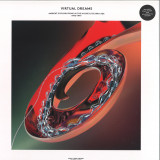
Music From Memory is delighted to be turning 50 with a special release: MFM050 - V/A - Virtual Dreams: Ambient Explorations In The House & Techno Age, 1993-1997 (3xLP/2xCD). The first in a series of compilations, alongside more in depth artist-focused releases, Virtual Dreams will delve into music produced during the 1990’s that redefined the boundaries of ‘Ambient’. This was music that explored the possibilities of Ambient music within a new setting, created often by House & Techno music producers for a world beyond dance floors but made very much with the pre and post-clubbing listener in mind.
When House and Techno exploded out of America in the mid 1980s a whole generation was redefined not only musically but also culturally and chemically speaking. Peaking, quite literally, with a second ‘Summer of Love’ in 1988, millions of young people across the world would experience the life-changing ups of a brave new world but with it of course came the downs; enter the concept of a ‘Chill-out’ room. Whilst early Chill-out rooms lacked a specific sound and were often soundtracked by music such as reggae and soul, slowly young Techno and House producers themselves would become increasingly interested in developing a futuristic ‘Ambient’ soundtrack to a world beyond the thud of the main room.
‘Ambient’ in this new age now though had sharper teeth than in Brian Eno's key text for ‘Music for Airports’, instead here the sounds were the mode of transport rather than the backdrop. While the melodies were pretty, the soundscape steered away from the pastoral, dreaming of outer-space and technology as opening up exciting new dimensions. Much like in the first Summer Of Love; the musicians were again exploring psychedelic, mind-altering and transcendental possibilities of music. And also much as in the first Summer Of Love, a psychedelic visual language would accompany the music. Though now the tracks could be accompanied by music videos, utilising early CGI techniques, they would look almost entirely to the future: envisioning technology, nature and humanity intertwined in a new Utopian future. Virtual Dreams of a better world.
From Ambient and early Chill-out classics, to lesser known one-off projects, as well as Ambient deviations by some of House and Techno’s leading producers, Volume One of Virtual Dreams features tracks by Bedouin Ascent, LA Synthesis, LFO, Marc Hollander, Mark Pritchard & Kirsty Hawkshaw, Richard H. Kirk and more.
To celebrate our 50th release the first 1000 copies include a holographic 'Virtual Dreams' sticker plus a special insert poster with artwork by Victoria Pacheco and design by Steele Bonus.
Moiss Music is dropping two slabs of heat this month - their sixth and seventh EPs overall. Both are various artists' collections with plenty of 'floor-facing disco fun. Mathew Ferness opens this one with 'Paradisio' which has plenty of inspiration taken from late afternoon dances somewhere like Ibiza. 3kelves & We Are Neurotic get you working your feet with the busy percussive grooves and squelchy synth funk of 'Laguna Reservoir Funk' while Naux brings lots of loopy fun and throwback vocal goodness to his steamy 'Foxxy Cleopatra.' Partner Music rounds out the EP with the most energetic and busy of the lot - the restless melodies of 'People Should Romance.'
British musician, multi-instrumentalist, producer and DJ cktrl returns with the release of his new EP ‘Yield’. Born from a desire to change the narrative around contemporary Black British music, the boundary-pushing musician aims with this project to prioritise the art of bonafide musicianship. A stark departure from cktrl’s previous work, ‘Yield’ is a celestial and palpably more inward body of work that harkens back to the pre-electric age of modal jazz while simultaneously pulling in elements from the disciplines of classical and baroque music. Speaking on the project’s sonic identity, cktrl says: “I want to be able to show that you can make things from scratch again that have that feeling and beauty without having to sample an old record. Even though that’s an art-form within itself, I want to show raw orchestration and instrumentation can be the sole source” The origins of the title came from a period where cktrl was looking to find solace in himself after an introspective period of grief and heartbreak. As an intentionally instrumental project with minimal vocals, cktrl wants prospective listeners to see these new songs as guided meditations where they can wholly insert themselves in it. Eliciting and reaping whatever feelings come to the fore. Speaking on what ‘Yield’ means to him as a concept, cktrl explains: “Some people who I've asked to define the word ‘yield’ have looked at it from a harvest point of view, whereas others have seen it as something to submit to, to render, like you're giving up yourself. I see it as a barometer for how you feel - no matter if you're at your lowest or your highest vibration, you still need to show up for yourself. You still have to be present. It’s about getting the best from yourself no matter where you are in life” The new project is the follow up to last year’s ‘Zero’ which featured collaborations with esteemed contemporaries like the GRAMMY-nominated Mereba and anaiis. Upon the project’s release, it was met with a plethora of critical acclaim from highly regarded publications and platform such as British Vogue, Dazed, CRACK Magazine, Resident Advisor, NOTION, Harper's Bazaar and ES Magazine for its sprawling and experimental scope, spanning avant-garde jazz, classical music, alternative R&B and electronica. cktrl has a tune for every occasion: as content making beats by himself at home in Lewisham as he is amongst this generation’s fashion and cultural vanguards. Music has been a part of his life for as long as he can remember: from clarinet lessons throughout his school life to fond memories from his NTS days. Moulded by a unique blend of his West Indian heritage, years of classical training in both the clarinet and saxophone, cktrl strives to do what hasn’t been done before. His approach to creation is decidedly wide-ranging and broad. In fact, where sonic descriptions might fail to encompass the breadth of cktrl’s scope, three words surface when he unpacks his musical aims: freedom, range and feeling. Elsewhere, throughout his career, cktrl has been recognised and heralded by fashion and film VIPs as he firmly embeds himself within the black cultural renaissance emerging here in Britain. Acquiring a global network of creatives that include the late Virgil Abloh, Bianca Saunders, Tremaine Emory, Saul Nash, Maximilian Davis, Ahluwalia, Stephen Isaac Wilson, Sean Frank, Campbell Addy, Ib Kamara and Jenn Nkiru who secured him a cameo in Beyoncé’s ground-breaking film ‘Black Is King’.
- A1: Approach 1' 52
- A2: Omaggio A Fellini 1' 50
- A3: Pipes 4' 05
- A4: Orgal 3' 38
- A5: Babbel 3' 54
- A6: Yaya 4' 21
- B1: Ba Loon 3' 17
- B2: Clocking 3' 37
- B3: Wail 8' 34
- B4: Bottom 3' 34
- B5: Feeder 1' 36
- C1: Spindrift 3' 35
- C2: Surfer 4' 00
- C3: Low Roller 3' 24
- C4: Still 4' 56
- C5: Beating 3' 51
- D1: Picolo 5' 41
- D2: Wire 2' 07
- D3: Knock 6' 21
- D4: Wah 3' 02
- D5: Aah 1' 40
Tod Dockstader's Aerial series, an electronic/drone masterpiece, is cherished among fans of the artist's work and this second volume is available in an audiophile quality double LP edition.
Tod Dockstader's Aerial series is sourced from his life long passion for shortwave radio. Dockstader collected over 90 hours of recordings, made at night, and comprised of cross signals and fragments plucked from the atmosphere.
Opening with airwave drones, Dockstader gradually allows elements to slowly come and go, summoning an ominous atmosphere of ethereal cloud clouds. Malignant placidity continues, giving the feeling of eavesdropping upon late-night audio activity not unlike discovering number stations while sweeping the dials. These sounds pull you in as their density and rhythms come and go.
Backward voices, deep echoing choruses of conversations flowing under the surface, ocean sounds, pulsing electro-rhythms, all seem to be created via the collaging of many hours of source recordings. A masterwork of collage and juxtaposition by an overlooked pioneer of American electronic music.
Artwork by John Brien (Imprec) is inspired by the propagation of shortwave radio signals throughout the earth's atmosphere.
"This return of Dockstader is something to cherish, not just because his output has been so limited and scarce but because what we do have is so intriguing, persuasive and cliche-free; the music of an inspired explorer who trails in nobody's slipstream." The Wire
"One of the great figures of musique concrete composition." Dusted
The Aerial project
I've written before of my interest in shortwave radio, in the notes to the Quatermass CD. Also, in the notes to the Omniphony CD (which has my first "Aerial" mix, "Past Prelude," in it), I mentioned "The Aerial Etudes," which was my working title for what became the three CDs you have. And, at the end of an interview with Chris Cutler (which can be found in the "Unofficial TD Website"), the piece I mentioned I was starting to work on at the time became Aerial.) When I was very young, people got most of their entertainment from radio. They called it "playing the radio," as if it were a musical instrument. That's what I've tried to do in this piece. About this time, a few people encouraged me to look into using a computer for this work.
I'd never used one, but I saw it would allow me to keep my mixes digital - no more transfer losses. So, at the end of 2001, I got a computer and an editing program for it, and spent what seemed a long time learning it. I began selecting mixes and loading them into the computer in late March, 2002. Out of the 580, I selected 90 "best" mixes - eventually reduced to 59, the ones on the CDs. Finally, in assembling the CDs, I followed David Myers' suggestion to allow each piece to flow into the next - making a continuous journey to the end. Tod Dockstader, 14 september 2003
About Tod Dockstader: Dockstader moved to New York in 1958 and became a self-taught sound engineer and sound effects specialist and apprenticed as a recording engineer at Gotham Recording Studios. It was around this time that he started to use his off-work hours to experiment with mixing and manipulating sounds on magnetic tape (musique concrète). By 1960 he had amassed enough material to assemble his first record Eight Electronic Pieces which was released on the Folkways label in 1961 (this would later be used in the soundtrack of Fellini’s Satyricon). The last of the eight pieces was later re-worked into his first stereo piece. In 1961 he applied to use the facilities at the Columbia-Princeton Electronic Music Center and was denied access by Vladimir Ussachevsky. Ussachevsky’s official reason was the “overstrained” scheduling of the studios, although many suspect that Dockstader’s lack of academic training was a factor in the decision. He continued to create music throughout the first half of the 60s, working principally with tape manipulation effects. His last piece at Gotham was Four Telemetry Tapes in 1965, after which he left to work as an audio-visual designer on the Air Canada Pavillion at Montreal’s Expo ‘67. It was around this time in 1966 that some of Dockstader’s pieces were released on three Owl L.P.s, and his work became known to a larger audience. He achieved modest recognition and radio play alongside the likes of Karlheinz Stockhausen, Edgard Varèse, and John Cage.
August Greene culminates years of mutual respect and friendship, channeling the musicians’ various talents into a cohesive project. The perfect marriage of jazz, hip-hop and soul, it’s music that just is. This is black expression the way God intended: earnest, unfiltered, and harmonious. Throughout August Greene, you feel the abundance of Glasper’s rolling keys, the sheer honesty of Com’s lyrics, and the nuanced subtlety of Riggins’ drum work. It’s a fluid sound that’s sorely needed in today’s landscape, and a teachable moment for the next wave of creators. “I feel like we need to set the bar for this generation of musicians and producers,” Riggins says. “There’s a lot of computer-driven music. This is the opposite of that. We’re showing you can still use your creative muscle on an instrument to generate your own sound.” August Greene is a meditative offering that stands tall against the era of “fake news.” “They body snatching black girls in D.C. / Politics and propaganda on the TV,” Common observes on the opening track. On “Nirvana,” the lyricist uses a stuttering percussive loop and faint piano chords to search his inner being: “Thought I was gonna fly when Obama became the king … when it’s all done, will I have heaven’s dress code, and been able to let God and let go.” As Com puts it, Glasper and Riggins’ soundtrack allowed him to open up in ways he hadn’t done previously. Like on “Fly Away,” for instance, where he riffs on the public relationships he’s had. Other songs, like “Black Kennedy,” feel spacious and scenic. “I got to go new places with the music, and it didn’t have to fit within a genre for me to participate on it,” he says. “This gave me an experience I haven’t had in a long time, so I want people to feel that. I want this to be a cleansing of whatever doesn’t feel good or inspiring.” In the end, August Greene speaks to those pushing through the dark for brighter days. It's a masterpiece from which virtue can shine. “I want people to go on the ride and be open,” Glasper says. “We just created and it became a sound. I want people to approach this with an open mind and without expectations.” —Marcus J. Moore
Arma Records is about to drop its 25th release, an album by Vakula, an Ukrainian producer, active contributor to the underground community that has been united around Moscow's Arma17 since early 2010s.
On the 25th of June, '108 Mysteries' — a double vinyl comprising 9 tracks created by Vakula at his studio, mostly by the artist himself, few in collaboration with the vocalist Amrita Ananda — will be available on major distribution platforms.
Affected by circumstances, the release was repeatedly postponed until a mutual decision to move forward with its publication was made by the artist and the label. The tragedy that was forced upon Ukrainian and Russian people, throwing both nations into an unthinkable circle of pain, hatred and death, had a devastating effect on our cultures, historically perceived as a whole. The catastrophe unwraps further, taking lives, burning homes, destroying connections between people. At that terrifying moment we, the community of artists, still have the voice that used to bring us together — our music.
Philosophical and meditative, '108 Mysteries' is a new chapter in Vakula's discography. 'Highest Love', 'A Breath Of Life', '?????? ?????', 'Spirit Okarine' are a high-spirited mix of oriental and Ukrainian folk motifs — an unusual combination that happens to sound so full of life.
'Intensely textured, interlocking guitar riffs weave together on New Bright Object, the debut album from Berlin and Edinburgh-based duo I’m Not You.
Working under the name I’m Not You, artist Alex Gibbs (bass & vocals) and sound designer Niall McCallum (guitar & drums) have honed a sound that draws in equal measure from jazz funk of Weather Report and the math rock of Don Caballero. Their debut album, New Bright Object is their most developed statement to date, an intricate, robust and unique collection of songs born from serpentine jam sessions in rural idylls.
The duo make no secret of their admiration for bands like Battles and Tortoise. They reference Jim O’Rourke’s lounge numbers and the droll lyricism of Modern Lovers’ Jonathan Richman. There’s a touch of Vini Reilly in their sparse and serpentine guitar lines. A hint perhaps of Mogwai. All these names place New Bright Object within a constellation of albums made with bigger budgets for wider audiences.
New Bright Object opens In a flash of light, comet-like, with the sound of ‘Mr. Wind- Up Bird’. The threads they weave are full with intent, as moments of density rise like hills from the track’s quieter valleys. It’s easy to imagine the pair looking out over the rolling fields of the garden studio in East Lothian where they recorded the album, as they assiduously try and draw their own landscapes in sound.
Similarly, there is a crispness to ‘A Certain Arrangement Of Atoms’ - every clipped hat, rim-shot snare and tightly wound tom a fine-tipped mark on the score. It is intricate and precise, a result perhaps of Niall’s attention to detail. Then there is the piano, Alex’s grandmother’s, slightly out of tune, which adds a few expressionist strokes to this pointillist composition. The piece loosens, until all we’re left with is the bass.
Although the album orbits around the pendulum sway of ‘The Older I Get’, it is ‘What Cats Think About’ that stands out most. That it does is by design – a nod to the Sun City Girls and albums that like to throw their listeners a curveball every now and then. Pleasantly ramshackle, confusingly domestic, agreeably strange.
All this speaks to the spirit of the album and the creative relationship between two best friends whose differences seem to have been the only things they could agree on.'
Franco Esse is the moniker of Francesco Semproni, who in the late 60s began working as a music and recording assistant in major recording studios in Rome, Italy. He started out at Dirmaphone (then located in Via Pola) under sound engineer Gianni Fornari, before following him to the Emmequattro studios in Viale Mazzini, which at the time were the headquarters of Edipan, the record label founded by composer and conductor Bruno Nicolai after parting ways with friend and fellow composer Ennio Morricone.
Semproni tried to become a singer-songwriter in the early 80s, when he recorded a number of demos with the session musicians who gravitated around the studios. None of these demos was ever released though, for reasons that are still unclear today – his thorny and stubborn personality may have been a factor, since it apparently made him reluctant to compromise with the major record labels of the time.
The unsuccessful efforts to launch his solo artist career led to a personal crisis, and Franco Esse eventually quit music to go to work as a sales assistant in a toyshop in Rome's Prati neighbourhood.
Today he seems to have vanished without a trace, but after extensive research, we managed to dig some of his demos out of an abandoned archive and miraculously bring back to life two semi-instrumental tracks he recorded in 1983.
Both of them reveal Franco Esse as a refined musician with a reserved personality, an almost minimalist approach to lyric-writing, and a strongly cinematic synth-pop style that is in line with the musical trends of the time and gives a nod to the soundtracks of Fabio Liberatori, falling somewhere in between slow-wave and new-romantic.
These two ballads would have been the perfect soundtrack to cold winter nights in the early 80s, with snowflakes floating down on ski slopes, people clad in puffy down jackets, and music pouring into headphones from walkmans kept in back jean pockets.