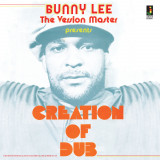
King Tubby and Producer Bunny ‘Striker’ Lee are intertwined in the birth of Dub Music. After discovering a mistake that made a ‘serious joke’ (more of which later...) they went on to release the first pressings of this new musical genre namely ‘Dub Music’. Tubby’s vast knowledge of electronics and Bunny’s vast catalogue of rhythms would lay the foundations of what today is taken as a standard... the Remix / Version cuts to an existing vocal tune.
Osbourne ‘King Tubby’ Ruddock was born in Kingston, Jamaica on 28th January 1941 and grew up in the High Holborn Street area of downtown Kingston. He studied electronics at Kingston’s National Technical College and also on two correspondence courses from the U.S.A... When he had qualified Tubby began repairing radios and other electrical appliances in a shack in the back yard of his mother’s home. His work in the early days included winding transformers and building amplifiers for Kingston’s Sound Systems. Tubby built his first Sound System in 1957 playing jazz and Rhythm & Blues at local weddings and birthday parties. His reputation as a man who knew and understood both electronics and music grew steadily and as the sixties drew to a close. Tubby purchased his own basic two track equipment. He installed this alongside his dub cutting machine, a homemade mixing console and his impressive collection of Jazz albums in the back bedroom of his home at 18 Dromilly Avenue which he christened his music room.
Tubby and Striker were at Treasure Isle Studio’s one day while Ruddy from Spanish Town was working with the engineer Byron Smith....
“Tubby and myself was talking when Ruddy was cutting some dub but Smithy (engineer) made a mistake through we were talking and forgot to put in the voice. It was two track recording in those days. Ruddy said ‘No Man! Make it stay! and so they cut the rhythm. When I went over to Ruddy’s that Saturday night a dance was in progress and when they played the vocal to the tune... then he said we’re going to play ‘Part Two’. They never called it ‘Version’..and then he played the rhythm track. The song was a catchy song and everybody started to sing along and the deejay started to toast so everything went down well. On Monday morning I went up and I said ‘Tubbs the mistake we made was a serious joke. It mash up Spanish Town! The people went wild. So you have to start to do that now ‘cause when the man put on the ‘Part Two’ everyone start singing this song. It played about twenty times. I said you try Tubbs!’...Well the next Saturday night now when Tubby strung up down the farm U Roy said he’s going to play ‘Part Two’ but Tubby did it different now. He started with the voice then dropped it out and let the rhythm run and then he brought in the voice in the middle and from there Tubby started to get really popular.’’
Bunny ‘Striker’ Lee
Dynamic Sounds upgraded to sixteen track recording in 1972 and Tubby purchased, again with the help of a deal brokered by Bunny Lee. The old four track equipment and the MCI console from their Studio B. The four tracks now gave him far wider scope to work with and he began to create a new musical form where the bass and drum parts were brought up while the faders allowed Tubby to ease the vocal and rhythm in and out of the mix. It was only a matter of time before Tubby’s dub plate experiments began to make it on to vinyl and the first ever long-playing King Tubby releases would feature a collection of his mixes to a selection of Strikers rhythms. So please sit back and enjoy this historic set of sounds, mixed by King Tubby and Mr Prince Phillip Smart and another set of scorcher Bunny Lee rhythms.
Suche:people at night
Tape
Los Angeles native Sha Sha Kimbo undeniably lives for the rave. As exemplified through her every intentional move as a producer, DJ, promoter, radio host and label owner, Sha Sha radiates an unwavering love for amplifying, nurturing and supporting the culture of underground electronic music and the community that surrounds it, with her forthcoming release absolutely no exception to this.
Set for release as a digital download and limited edition cassette tape on August 13, the LA rave staple is happy to announce her debut EP on Evar Records, Total Chaos. A brilliant testament to the cathartic importance of staying up late and getting lost in a buzzing crowd of kindred spirits, Total Chaos harnesses the universal experience of having pent-up energy into massive, angst-ridden breakbeat anthems. Over six tracks, Sha Sha channels the hair-raising spirit of '90s rave along with her formative experiences with DMZ-via-Low End Theory dubstep and punk rock. Finding her place within LA's bass music, house, techno and rave scenes while defying easy categorization, Sha Sha personifies the no-rules electronic music ethos behind John Frusciante and Aura T-09's Evar Records. To supplement Total Chaos' three originals, LYZZA, Machine Girl and LCY provide three raw remixes highlighting various aspects of Sha Sha Kimbo's renegade rave spirit.
Drawing from the Los Angeles punk rock and '90s rave music that soundtracked her youth, Total Chaos personifies how she grew up on the dance floor, showcasing Sha Sha's tried and true ability to express rich, nuanced emotions through tracks that, first and foremost, can level a warehouse party. Kicking off the vibe on July 30, the EP's lead single "Save The World" is a perfect representation of this, with the jump-up rave cut employing a megaton breakbeat and sickly-sweet vocal samples over simmering base of dark, UK-influenced atmospherics. From the late night energy of the title track to the euphoric, dawn-breaking feel of "Limited Perfect," Total Chaos offers the refuge of a robust dance floor with the warm reassurance to be one with the universe.
Rounding out Total Chaos EP are three remixes that amicably and serendipitously support Sha Sha Kimbo's visionary aim to both explore the unknown and bring people together along the way. Brazilian-born, Amsterdam-based powerhouse LYZZA adds a full verse and a nest of serrated rhythms to her version of "Total Chaos," while New York's Machine Girl applies their trademark punk electronics approach to "Save The World." Meanwhile, Bristol's own LCY hollows out "Limited Perfect" into a haunting amalgam of post-punk minimalism and low-frequency pressure. A study of the opposing light and dark energies of underground dance music, Total Chaos presents a breakbeat-heavy vortex, sure to awaken everyone's inner raver.
A Ride is the new dark alt-country concept album on the road by Phill Reynolds, to be released on June 17th, 2022 by Bronson Recordings; Like all the best concept albums, A Ride takes you on a journey. This one concerns the last three days of an American runaway’s life. Part road-trip, part engrossing mystery, part search for redemption, it’s the fictional tale of a troubled man whose past comes back to haunt him. Via eleven intimate, chronologically-sequenced songs, we travel with him. There are epiphanies and dream sequences, drunken dive-bar nights and chats with Jesus and Lucifer. As the narrator battles with his dark side, it is ultimately we, the listeners, who must weigh-up and flesh-out his story. According to its creator Phill Reynolds, AKA Italian alt-country singer-songwriter Silva Martino Cantele, the key to The Ride’s mystery might lie within its fifth song, A Clockwork Dream. “That’s where we discover that, because of some kind of courtroom trial, the narrator has lost someone who was very important to him”, Reynolds explains. “But we never find out her name or her relationship to the main character. Is she a blood relative? Is she his wife or someone else?”. The origins of A Ride go back to 2015. On tour in the US, Reynolds took in the shifting landscapes, the people he met and their stories. All of this fed into the album he recorded at the all-analogue TUP Studio in Brescia, near Milan. Reynolds played almost all of the instruments himself and co-produced A Ride with long-term collaborator Bruno Barcella. If A Clockwork Dream features a full band arrangement – “I think of it as the kind of thing Neil Young & Crazy Horse might do on a Sunday morning”, says Reynolds – other songs are sparer, more intimate. Banjo, Fender Rhodes, harmonica and glistening slide guitar all feature as Reynolds delivers haunting confessionals such as Run, Run Away and The Fault Is Mine, songs likely to appeal to fans of artists such as Damien Jurado, Strand Of Oaks or For Emma, Forever Ago-era Bon Iver. Intricate, rapid-fire fingerpicking on the first single This Isn’t Me and The Call of The Dark demonstrates Reynolds’ dexterity, while his voice is a rich, fully-lived in instrument seasoned with the salt of experience,and strengthened by the 120 or so gigs a year he used to do before COVID took his one-man show off the road. Long an inhabitant of picturesque Italian towns in the Vicenza province, Phill Reynolds was born in Marostica and currently lives in Zugliano. He was only five when The Beach Boys’ Barbara Ann worked its magic upon him via the radio. Later a fan of ‘90s Californian punk bands, Reynolds was writing and performing in his own post-hardcore bands by 13, but didn’t make it to the nearest big city, Milan, until he was 19. Bands still matter deeply to him. But his love for folk music has deepened over the last decade or so, hence his solo act alter-ego. Where did the name Phill Reynolds come from? “Everybody asks me this,” he smiles. “Especially in the UK. The truth is I needed an alternative name for a gig I was doing, and at the time I was in love with the music of Phil Ochs and Malvina Reynolds. Malvina Ochs didn’t sound too good to me, so I became Phill Reynolds, and I like that, because it sounds like a normal person”. The esteemed Italian label Bronson Recordings will release his fourth solo album A Ride on June 17th, 2022, on CD, vinyl and digital. A Ride is the most ambitious and fully-realised Phill Reynolds album to date. He was assisted by Stefano Pilia (lead guitar on Dive Bar Oblivion), IOSONOUNCANE (backing vocals, synth, bass and field recordings on World On Fire), and C+C=Maxigross (bass, drums and backing vocals on In The Dark). The record’s story is a dark one, but not one without hope. “Every end is a new beginning”, says Reynolds. “One of the main themes here is that life can be a sort of trap unless you recognise your own demons and try to deal with him. So we must be prepared and try to live well”.
Aside from being one of Anamanaguchi’s most streamed songs, “Miku,” featuring the vocaloid pop star Hatsune Miku, is an anthem for a new type of musical icon, one that doesn’t need to be attached to a physical human body. Miku, which was officially released in 2013, is a Vocaloid software voicebank developed by Crypton Future Media. Her voice is based around Japanese actress Saki Fujita and uses Yamaha Corporation's Vocaloid 2, Vocaloid 3, and Vocaloid 4 singing synthesizing technologies. Anamanaguchi wrote “Miku” with the virtual musician and were the first band to perform live alongside the Hatsune Miku hologram on the Miku Expo tour in 2016. Since then, the song has been streamed tens of millions of times around the globe and given way to several viral TikTok moments with 20K+ unique videos, signature dance moves, and millions of views.
Consistently engaging their audience in both the real world and the virtual internet-sphere, Anamanaguchi has had TV performances on Late Night with Jimmy Fallon and Adult Swim’s Fish Center, multiple appearances at Porter Robinson’s Secret Sky Fest, and co-curated one of the first major live stream events for indie musicians with the Nether Meant Festival, which was featured in the New
York Times and The Washington Post. The band has also continued to stay true to a uniquely cohesive collaborative spirit, sharing tracks with artists such as HANA, Planet 1999, Flux Pavilion, Porter Robinson, Dorian Electra, Pussy Riot, Village People, and POCHI.
For 2022, Polyvinyl is proud to announce the release of Miku on vinyl for the first time. The release will feature the original composition as well as 8 bonus versions of the song including remixes from LLLL, Carpainter, Ben Aqua, Mino Mino, Lazerdisk, as well as an NES version, a Japanese version, and an instrumental version.
It is to the detriment of our understanding of musicality that we mostly measure it by the capacity to produce, and much less by the capacity to receive some sort of acoustic information or event. The virtuosity of listening, of understanding the sonic situation and its potential, is, however, that which defines one's capacity to interact – with other musicians, with the audience, and with the environment. This could also be taken to mean that an ethical act is implied in the situation of listening – the decision to relate, to be attentive to, to actively position oneself in relation to what is heard.
Rarely is this capacity so thoroughly pronounced and ethically conscious as in the case of Manja Ristić, the Belgrade-born and Royal Academy of Music-schooled musician, composer, sound and multimedia artist (the list could go on), who currently lives on the island of Korčula in the Croatian part of the Adriatic. Ristić’s recent, field recording-based work, is indeed all about attentiveness, most of all towards the environment and the acoustic traces of the endangered ecological layers of her old-new Mediterranean surroundings. With that in mind, it is indeed no wonder that her newest album draws from Milton’s Paradise Lost, which could easily be the anti-slogan of the endangered Croatian coast, eaten up by the pressures of touristification and the usurpation and privatization of once common space. More precisely, the album is inspired by one of the fifty Gustave Doré illustrations of Milton’s epic, Him, fast sleeping, soon he found, In labyrinth of many a round, self-rolled, from which it draws its title. The verses and the scene are from Book IX, and depict the moment Satan inhabits the Serpent, the beginning of his subversion of God’s autocratic rule, as some interpretations would have it.
For Ristić, the actual Paradise she introduces us to is in a state of imbalance – the idyllic soundscapes of her island surroundings overlain with sonic anxiety, such as on the album’s first track, The Flies, with its unrelenting, nervous buzzing evoking the ominous Biblical entity of Beelzebub, or The Lord of the Flies. The next track, Whales, which beautifully utilizes archival whale recordings, could also be taken to establish an intertextual relation to Milton through Melville, whose Moby Dick was strongly influenced by Paradise Lost. The middle track of the album, dedicated to the Croatian-American painter and muralist Maksimilijan Vanka, uses to great, unsettling effect what to my ears sounds like a buried hydrophone, a technique often employed by Ristić in her work, giving us a rough, grinding impression of water beating the pebbles over a high-pitched drone. But perhaps the most ominous, pessimistic image is painted in The Flag Pole, in which the symbol of revolutionary victory (I’m thinking of the Yugoslav modernist Tin Ujević and his proto-avant-garde sonnet Farewell from 1914) becomes a source of terrifying sonic unease, as we are listening to the incessant sound of its rope hitting the metal pole. However, with Dlana Night comes relief – the drones become airier, calmer; there is a distant notion of people, dogs, everyday life, all shrouded in the calming sound of the crickets on the island of Silba. Ristić, ultimately, serves us some hope on this wonderful new album, showing us that something has been lost, but that something can also be gained through the thoughtful attention with which she listens to the world around her.
„My recording techniques all boil down to one thing – intuition. I do not use expensive or highly sensitive equipment nor do I employ special techniques. On the contrary, I believe that the information regarding a space or an object can be recorded well enough on an average device. My personal guideline when recording sound is the positioning of myself as the listening medium, active and with the intention of establishing a connection that is sometimes intellectual, sometimes conceptual, and sometimes phenomenological.” - Manja Ristić, in an interview for Kulturpunkt.hr
- A1: Whole Lotta Shakin
- A2: Down & Down
- A3: Run Run Rudolph
- A4: Open All Night
- A5: Don't Pass Me By
- A6: Nights Of Mystery
- A7: Battleship Chains
- A8: Mon Cheri
- A9: White Lightnin
- A10: I Go To Pieces
- A11: Shake Your Hips
- A12: Games People Play
- A13: Can't Stand The Pain
- A14: Keep Your Hands To Yourself/It's Only Rock N Roll
- A15: Sheila
- A16: Hippy Hippy Shake
- A17: Railroad Steel
- A18: I Wanna Be Sedated/Shake Rattle & Roll
Red & Black Smoke Vinyl[23,95 €]
First Ever LIVE Release! “Even 33 plus years later, it hasn’t lost any of its charm, intensity, or unvarnished power.” – American Songwriter “Vocalist/rhythm guitarist Dan Baird and lead man Rick Richards let the slippery riffs fly.” – Vintage Guitar Magazine “You can really hear the bar-band roots of this band listening to this show . . . There’s a real magic to the chemistry they all had as a group.” – Ultimate Classic Rock “. . . the live album sounds wonderful and captures their exciting show nicely.” – Goldmine “. . . offers fans a chance to travel back through time and experience a singular night of all-out rock and roll as only the Georgia Satellites could provide. The title of the album is absolutely accurate.” – Exclusive Magazine “. . . captures the the sweaty excitement and spontaneity . . . of that special night 33 years ago.” – The Music Universe In 1988, the Georgia Satellites rolled into Cleveland, Ohio for a blistering Monday night at local watering hole Peabody’s, formerly the punk haven Pirates Cove. With Open All Night giving the band a second album to draw on, their salty, wide-open Chuck Berry riff’n’roll was full swagger – whether drawing on their reprise of the Swinging Blue Jeans’ “Hippy Hippy Shake” from the Tom Cruise film “Cocktail,”Joe South’s swerving “Games People Play,” George Jones’ “White Lightnin’”or Jerry Lee Lewis’ all-out “Whole Lotta Shakin’.” Just as importantly, gap-toothed guitarist/lead singer Dan Baird and combustive lead guitarist Rick Richards set the pummeling groove of drummer Mauro Magellan and bassist Rick Price ablaze. Delivering an 18-song masterclass in roots, rock and raunch, the Satellites not only incinerated “Battleship Chains,” “Railroad Steel” and “Can’t Stand The Pain,” they led the beyond SRO crowd through a shout-along of “Keep Your Hands To Yourself” threaded with a brazen stripper grind on the Rolling Stones’ “It’s Only Rock & Roll.” Fans of reverb, thrashing drums, the rush of rock & roll momentum and all manners of electric guitars giving it over to basic 3 chord rock & roll, Lightin’ in a Bottle retires the jersey. As the southern equivalent of the Replacements, the Ramones hillbilly (redneck) little brothers, no band delivered as much balls as the Satellites, who’ve never had an official live record. For a band who leaves it all onstage, that seems wrong. Leave it to Cleveland International to unearth this blistering recording, wipe off the sweat and somehow figure out how to get it all in one double disc package captured in the Rock & Roll Capital of the World. -Holly Gleason
- A1: Whole Lotta Shakin
- A2: Down & Down
- A3: Run Run Rudolph
- A4: Open All Night
- A5: Don't Pass Me By
- A6: Nights Of Mystery
- A7: Battleship Chains
- A8: Mon Cheri
- A9: White Lightnin
- A10: I Go To Pieces
- A11: Shake Your Hips
- A12: Games People Play
- A13: Can't Stand The Pain
- A14: Keep Your Hands To Yourself/It's Only Rock N Roll
- A15: Sheila
- A16: Hippy Hippy Shake
- A17: Railroad Steel
- A18: I Wanna Be Sedated/Shake Rattle & Roll
Black Vinyl[23,95 €]
First Ever LIVE Release! “Even 33 plus years later, it hasn’t lost any of its charm, intensity, or unvarnished power.” – American Songwriter “Vocalist/rhythm guitarist Dan Baird and lead man Rick Richards let the slippery riffs fly.” – Vintage Guitar Magazine “You can really hear the bar-band roots of this band listening to this show . . . There’s a real magic to the chemistry they all had as a group.” – Ultimate Classic Rock “. . . the live album sounds wonderful and captures their exciting show nicely.” – Goldmine “. . . offers fans a chance to travel back through time and experience a singular night of all-out rock and roll as only the Georgia Satellites could provide. The title of the album is absolutely accurate.” – Exclusive Magazine “. . . captures the the sweaty excitement and spontaneity . . . of that special night 33 years ago.” – The Music Universe In 1988, the Georgia Satellites rolled into Cleveland, Ohio for a blistering Monday night at local watering hole Peabody’s, formerly the punk haven Pirates Cove. With Open All Night giving the band a second album to draw on, their salty, wide-open Chuck Berry riff’n’roll was full swagger – whether drawing on their reprise of the Swinging Blue Jeans’ “Hippy Hippy Shake” from the Tom Cruise film “Cocktail,”Joe South’s swerving “Games People Play,” George Jones’ “White Lightnin’”or Jerry Lee Lewis’ all-out “Whole Lotta Shakin’.” Just as importantly, gap-toothed guitarist/lead singer Dan Baird and combustive lead guitarist Rick Richards set the pummeling groove of drummer Mauro Magellan and bassist Rick Price ablaze. Delivering an 18-song masterclass in roots, rock and raunch, the Satellites not only incinerated “Battleship Chains,” “Railroad Steel” and “Can’t Stand The Pain,” they led the beyond SRO crowd through a shout-along of “Keep Your Hands To Yourself” threaded with a brazen stripper grind on the Rolling Stones’ “It’s Only Rock & Roll.” Fans of reverb, thrashing drums, the rush of rock & roll momentum and all manners of electric guitars giving it over to basic 3 chord rock & roll, Lightin’ in a Bottle retires the jersey. As the southern equivalent of the Replacements, the Ramones hillbilly (redneck) little brothers, no band delivered as much balls as the Satellites, who’ve never had an official live record. For a band who leaves it all onstage, that seems wrong. Leave it to Cleveland International to unearth this blistering recording, wipe off the sweat and somehow figure out how to get it all in one double disc package captured in the Rock & Roll Capital of the World. -Holly Gleason
Imperfect Stranger is the pseudonym of Glasgow based soundtrack composer and producer Kenny Inglis. “Everything Wrong is Right” is his debut solo album for Castles in Space.
Born in 1975, Kenny didn't listen to much music, unless it was the opening credits to a TV show or a film score that had caught his ear. "I loved the pre-title music on a lot of those 80's U.S. TV shows. From the family orientated stuff like The A-Team, to darker dramas such as The Equalizer. My mother would let me stay up to watch the opening sequence of the latter then send me to bed because the story would be too heavy for a kid. That left me with this hanging sense of ambiguity as to what would happen in that hour after the titles came up.”
Exposure to a work colleague’s tiny project studio in a kitchen cupboard was a lightbulb moment for him and the experience of utilising music technology as a way of writing and producing entire tracks stirred a wave of determination to chase a career in music using the opportunities that technology could offer. Kenny figured the best way to move forward was to start a small project studio and learn his craft as a recording engineer. "It was a bit of a shock to the system. I literally had no idea how to work any of the equipment. Kenny focused on learning as much about the craft as he could whilst winging his way through recording and mixing everyone from the likes of singer/songwriters to bands, to voiceovers artists and anything in between. "Eventually, I stopped writing the music I thought people would want to hear, and started writing the music I wanted to make. I didn't come from a music loving background, but I was always obsessed by the way music and film would interact - how music brings this atmosphere and tone to even the most mundane visual stuff. I wanted to capture that. I wanted to grab some of that ambiguity I felt from the TV shows of my childhood and make it into a project of some sort". That project was Spylab. A dark, downtempo project with a cinematic edge. The initial demo consisted of three tracks, with the melancholic 'This Utopia' leading the playlist.
"At the time you did demos on normal cassette tapes. I remember having this endless battle with the bias control to try and get the best sound I could on these little tapes. Ten went in the post one Monday morning, and the following Monday there were three offers from three different labels. Studio K7 were interested in a singles deal, as was Flying Rhino in London. But then there was an offer from a Chicago based label by the name of Guidance Recordings. They wanted an album, and were offering a $15,000 advance. It wasn't a difficult decision to make"
Writing and recording Spylab 'This Utopia' began in 1999. The album took a whole year to produce. The album was to catch the attention of Mary Anne Hobbs at Radio One. At the time Mary Anne was presenting The Breezeblock - a late Sunday night show with an eclectic playlist of alternative electronic music. Picking out the album's title track 'This Utopia', Mary Anne would go on to play it no less than 8 weeks in a row. A request for Spylab to DJ on the show was to follow. "I had never DJ'd before. I think I had a week to figure out how to do that and put a playlist together. I'm not entirely sure how I pulled that off.” In March 2001 the Spylab album was finally released to a hoard of excellent reviews. A North American live tour would follow. From the launch party in Los Angeles, to a sell out show at SXSW in Austin. "I then started a new project under the name Cinephile. It had some of the core elements of the Spylab sound but it was deeper, more cinematic.” Kenny received news that a track from the previous project Spylab had been requested by HBO for the first episode of a new TV drama called Six Feet Under. This was to become a major turning point in Kenny's career. The Spylab track 'Celluloid Hypnotic' dropped during a poignant party scene of the first Six Feet Under episode. Within a couple of days Kenny was getting requests for music from other music supervisors. "It was a chain reaction. The Six Feet Under sync was like the tip of an iceberg. One day I called CBS in America and they put me on to the CSI music supervisor and I managed to get on a call with him. I sent the Cinephile stuff out and within a few months I got this fax through from CBS - a quote request for one of the tracks for a potential use on CSI. It changed my life."
The tone and style of Kenny's music sat perfectly with the CSI score requirements. So much so he found himself part of a pool of incidental writers who worked on all three aspects of the franchise - CSI, CSI: NY, and CSI: Miami. This would continue until 2013, when the last of the series would come to an end.
"I was juggling a bunch of stuff for those ten years. Writing material for CSI, whilst releasing new Cinephile stuff and playing live. As Cinephile continued to gather pace, one of the tracks from Kenny's efforts on CSI was chosen for the Hollywood trailer for the Samuel L. Jackson film 'Lakeview Terrace'. Further trailers would follow, from Gangster Squad to Dead Man Down, Spike Lee's Undisputed Truth, to Fifty Shades Freed.
At the same time, Kenny picked up his first factual commissions in the UK, and this too would be the beginning of a regular run of fully scoring factuals and documentaries. By 2021, six of these had won BAFTAs. He also would find himself soundtracking adverts for the likes of Nike, Audi, and American AirlinesIn early 2020, Kenny made a return to focusing on his own music under the pseudonym Imperfect Stranger. A tweet from Colin Morrison from Castles In Space regarding a charity compilation album 'The Isolation Tapes' caught his eye. Kenny had made a start on his debut album as Imperfect Stranger and submitted the track 'Hymn To The Sun' (which would become the lead track on the album). Further discussions ensued, and the album found a home on CiS. "I had been doing TV and film stuff for almost ten years. It paid the bills and was as close to a 'real job' as I'd had, but I yearned to get back to writing for myself, so doing an album for Castles in Space was a joy.
“The music I write is like a diary. There's an authentic narrative to everything i do. I don't write tracks for the sake of writing. I write tracks to diarise and process the stuff that I've lived through, and the experiences that have come along with the passing years. That's what makes me tick. It's a very public and vulnerable way of expressing myself. If people want to know the real me, all they have to do is listen."
100 copies only
Apron Records has been instrumental in shaping the current landscape of contemporary electronic music coming out of the U.K. since 2014. After almost a decade of pushing their unique vision has made the Apron Records imprint one of the most in-demand labels in most independent record stores. Now more than 45 releases deep in their journey, Apron Records have teamed up with Patta Soundsystem to work on their first various artists release and to celebrate this monumental milestone, both camps have collaborated to create a clothing capsule to accompany this release. After working with the artist formerly known as Funkineven on ‘The Wave’ late last year, it was only right to showcase the diverse talents behind this movement.
Sharing a drawing board with Patta for the first time with Apron Records, together they have created a Trucker Cap and a Graphic T-Shirt that echo the racing theme of the whole project. Better Together is the slogan that runs throughout the entire collaboration, stressing how unity makes us stronger as individuals. Artwork for the record has been provided by Amsterdam based artist Jim Klok. His unique Acetone printing technique has now been immortalised on this LP, juxtaposing vintage cars with checkered racing flags to create a dynamic cover that would be right at home in a picture frame as well as a record bin.
System Olympia’s ‘Passi Mai’ is a beautiful 80’s inspired driving riddim layered with her own vocals that wouldn’t be out of place in an arcade or a sticky nightclub floor. Followed up by ‘Leven’ by Brassfoot, we get a wobbler from the NTS regular. Layed with Jamaican vocal samples and audacious arpeggiated bleeps, Leven is a soulful approach to techno tropes that have been bouncing around Brassfoot’s head. Shamos’ 737363 is a cryptic masterpiece. With dreamy pads as a backdrop for shuffling drum beats, euphoric sweeps and dynamically designed synthesis, this closes off the themes explored in the first half of the record.
Side B kicks off with J M S Khosah’s contribution to the record titled ‘Lessons’ which is a dancefloor filler, adorned with glamorous percussion, vocal samples and syncopated stabs ontop of a driving 4x4 kick pattern. Kicking things into 6th gear is a club-ready production from London's most soulful selector Shy One. Groovy basslines and a 2-step riddim make ‘Candy Floss’ an ode to the grimey and the glittery sides of London nightlife. This project champions one of the people that have been pivotal in the success of the label, Steven Julien whose track E46 is an emotional journey through his synth-laden East London studio. Bookending the project are two compositions from Compton’s-own AshTreJinkins. Showcasing his abilities to approach the project from both an ambient and a pure beat-making perspective in order to hold the whole project together.
A lot has been said and repeated about the interiority of this club music - how the joyful tremor of the "Raingurl" refrain holds hands with such soft and doubtful verses. How special it is that house music so of New York can contain storytelling cultivated so far away. That repetition is born of people all over the world going out, and staying in, with this music as a compass; songs that define so many late night hangs for crews of friends, singalongs in DJ booths, contemplative 5am walks home from the club. What can get lost in that repetition, in the shifting canonization of these recordings as symbols of any one scene or moment, is what was behind the pair of round glasses reflecting so tirelessly outwards. Yaeji, an exceptional friend only at the very beginning of finding her path as a cross-disciplinary artist and collaborator. Yaeji wrote this music while going out nearly every night of the week to DJ and support her own NYC community of friends at their turns behind the decks. These tracks originated from explorations in dancefloor anonymity, growing from seeds planted by sharing her first musical experiments online.
"The letter X marks the spot, crosses over, literally with a cross. It’s the former, the ex-. The ex-lover known simply as “an ex”. Ex- is the latin prefix meaning “out”. Exterior, an exit. Extraordinary. Excellent. It’s exciting. Generation X. X-files. X is the unknown. X is Extreme“
Extreme is Molly Nilsson’s tenth studio album. Recorded in 2019 and throughout the 2020 global pandemic at home in Berlin, Extreme is a departure for Nilsson, an explosion of angry love. It’s an album of anthems for the jilted generation, soaked with joy and offering solace, bristling with distorted, Metal guitars and planet-sized choruses that bring light to the dark centre of the galaxy. It’s an album of the times, by the times and for the people. It’s a record about power. About how to fight it, how to take it and how to share it.
Absolute Power explodes with massive guitars, double kick beats and the instantly iconic line “It’s me versus the black hole at the centre of the galaxy.” Nilsson’s performance itself portrays absolute power in its confidence but the song is a call-to-arms, an entreaty to grasp the here and now, to take the power back. It’s Nilsson pacing the ring and we’re instantly in her corner. Earth Girls takes familiar Molly Nilsson themes - female empowerment and subverting the patriarchy - but casually throws in one of the choruses of her career. “Women have no place in this world” she sings, but it’s the world that isn’t good enough. Stadium-sized but still warmly hazy, Earth Girls has its fists in the air, glorifying in harmony, almost ecstatic in its feeling good. Nilsson’s Springsteen-level conviction and righteousness bleeds through the speaker cones, the cognitive dissonance between the song’s cadences and angry lyrics redolent of Bruce in his prime. Female empowerment isn’t always an angry energy on Extreme, however. On Fearless Like A Child, Nilsson’s anthem to the female body and women’s sovereignty of it, she croons over a mid-80s blue-eyed Soul groove. It sets a nocturnal scene as the narrator surveys her past and her surroundings. Before we’re fully submerged in a dreamlike, Steve McQueen-era Prefab Sprout poem to learning from your mistakes the song erupts into one of those lines only Molly Nilsson can get away with: “I love my womb, come inside I feel so alive” she fervently sings. Against the backdrop of ever-encroaching, conservative rulings on women’s reproductive rights in places like Texas, it’s simultaneously angry and full of love.
Every song on Extreme is a gleaming gem in a pouch of jewels. On Kids Today, Nilsson is the voice of wisdom, archly commenting on the eternal struggle between youth and authority. Wisdom infuses Sweet Smell Of Success with a transcendent love that forgives the narrator’s shortcomings and celebrates the moment, it’s a letter to the author from the author that asks “what is success” and concludes that this is it, this song, this moment. It’s a rare moment of simple reflection that is generous in its insight to Nilsson’s inner life. “Success” is a tool of power and we don’t need it… We need power tools and there are moments on Extreme where it feels like Nilsson is showing us how to find them. It's an open conversation through out Extreme. She’s a warm, comforting presence through out the album and specially on these songs of encouragement, songs perhaps sang to a younger Molly Nilsson or, really, to whomever needs to hear them. “They’ll praise your efforts, they’ll call you slurs a rebel, a master, an amateur / Merely with your own existence, you already offer your resistance.” On Avoid Heaven she’s even more direct, pleading with us to avoid concepts of purity and to embrace the glorious, ebullient, emotional mess we’re often in as a method of upending the power structures who need things to be perfect.
They Will Pay brings back the big, distorted power chords in the form of a agit-punk, pop slammer. Of course, when Molly Nilsson does punk pop we get the catchiest chorus this side of The Bangles or The Nerves. It’s rendered in an off the cuff, throwaway manner that is just perfect in its roughness. However, it’s on Pompeii that Nilsson delivers the album’s epic, emotional heartbreaker. Like 1995 on Nilsson’s album Zenith, or Days Of Dust on Twenty Twenty, the lyrics of Pompeii are heavy with a transcendent sadness, an aching poetry that cuts to the truth of the heart like the best Leonard Cohen lines, though here delivered with an uplifting, life-affirming love. It contains the most personal moments of Extreme, a song lit by the dying embers of romance. Yet it’s here where the alchemy at the base of all Nilsson’s best work is found. Turning small nuggets of personal truth into big, generous universal moments that invite everyone to cry, to love and to fight the power. In an album of jewels, it might be the shining star.
Molly Nilsson’s biggest, boldest and most vital album to date, Extreme is about power. Against the love of power and for the power of love.
20th Anniversary edition pressed on Californian Sunburst vinyl with
newly designed artwork and bonus 7” featuring ‘Brown Eyes’ and the
previously unreleased ‘The Earth From Above’.
‘California’ was released in 2002 to massive critical acclaim and reached
a much wider audience across Europe. Features the hit singles ‘This
Life’ and ‘Ordinary Day’.
The album features Glenn Garrett on bass, Neil Conti (David Bowie /
Prefab Sprout) on drums and Dickon Hinchcliffe (Tindersticks ) and Rick
Carter (The Sisters of Mercy) on keyboards.
‘California’ was mostly co-written with Italian composer Marco Sabiu,
who collaborated with and was mentored by the late, great Ennio
Morricone.
Perry Blake, Sligo-born singer / songwriter, is one of music’s great
untapped resources. After his first three singles - taken from his debut
album - received Single Of The Week on Jo Wiley BBC Radio 1, Blake
moved to France, where he was met with critical acclaim with his next
four albums, touring Europe with Carla Bruni and writing two songs for
Francoise Hardy’s Platinum-selling album ‘Tant de belles choses’,
appearing on various TV shows in France as her special guest.
You may very well wonder what to expect of an album with American
West Coast orientations from an Irishman who happens to be critically
acclaimed on the Continent but is largely ignored in Britain. Thankfully,
Blake lives up to his billing with apparent ease. His song writing is
evidently mature and melodic; he incorporates lush orchestral
arrangements with tender vocals; and combines pop-like hooks with a
deep sonic texture.
‘California’ is a thriving and absorbing collection of songs in which
orchestral arrangements strain with emotion, melodies thrive and bloom,
like The Verve at their peak, though far more fragile and balmy.
‘California’ is ether for the soul - a truly magnificent and touching
collection of frankly beautiful songs, which is up there with class of Bryan
Ferry, The Blue Nile and anyone else who can turn a night around.
Blake’s glimpses of people living a state of mind is one of those great
escapes it’s very hard to get away from. His gift here is to take a
subdued, grown-up collection of songs but make them sound like they
deserve daytime radio.
Radio - Radio 2 Jo Whiley session.
MY DYING BRIDE'S CLASSIC 1996 SHOW FROM KRAKOW, POLAND, FOR
A NIGHT OF DOOM METAL MAGIC
PRESENTED ON DOUBLE GATEFOLD VINYL, & ON THE VINYL FORMAT FOR THE
FIRST TIME.My Dying Bride has been the leading light of doom metal since the
debut album 'As The Flower Withers' was released on Peaceville Records back in
1992. Influenced by acts such as Celtic Frost & Candlemass, the British band's
heavy atmospherics have carved a huge worldwide following over the years to
stand as one of the true enduring & distinguishable pillars of the genre. 'For
Darkest Eyes' contains the band's iconic 1996 performance from Krakow, Poland,
featuring numerous classic doom anthems from the early career of the UK Metal
Gods. The show was recorded as the band was riding a wave of popularity due to
their recent breakthrough third album, 'The Angel & the Dark River' (plus their tour
with British metal legends Iron Maiden in the winter of 1995), showcasing several
tracks from that release such as 'The Cry of Mankind' & 'Your Shameful Heaven',
as well as renditions of other established numbers such as 'The Crown of
Sympathy' & 'The Forever People'.
This edition of 'For Darkest Eyes' is presented on double gatefold vinyl & first time
on the vinyl format & contains cover artwork adapted from the original video tape
release.
A lot has been said and repeated about the interiority of this club music - how the joyful tremor of the "Raingurl" refrain holds hands with such soft and doubtful verses. How special it is that house music so of New York can contain storytelling cultivated so far away. That repetition is born of people all over the world going out, and staying in, with this music as a compass; songs that define so many late night hangs for crews of friends, singalongs in DJ booths, contemplative 5am walks home from the club. What can get lost in that repetition, in the shifting canonization of these recordings as symbols of any one scene or moment, is what was behind the pair of round glasses reflecting so tirelessly outwards. Yaeji, an exceptional friend only at the very beginning of finding her path as a cross-disciplinary artist and collaborator. Yaeji wrote this music while going out nearly every night of the week to DJ and support her own NYC community of friends at their turns behind the decks. These tracks originated from explorations in dancefloor anonymity, growing from seeds planted by sharing her first musical experiments online.
- A1: Ain't No Stoppin' Us Now (Vocal)
- A2: Ain't No Stoppin' Us Now (Version)
- B1: Good Times
- B2: One More Time (Instrumental)
- C1: I'm Caught Up
- C2: Argument
- D1: It' S My House (Special Disco Version)
- D2: It's My House (Version)
- E1: Bringing Out The Sunshine
- E2: Risco Music
- E3: Reggae Music
- F1: Sitting In The Park
- F2: Park Version
- F3: Stopping (Version)
Drummer "Drummie" Joe Isaacs had already created history as the house drummer at Studio 1 in Jamaica on countless pre-reggae classics before moving to Canada in 1968 and is credited with slowing down the fast pace of ska during the rocksteady era. With Risco Connection, Isaacs released a series of choice reggae / disco covers, from 'Ain't No Stopping Us Now' and 'Good Times' to 'I'm Caught Up (In A One Night Love Affair)' and 'It's My House' as limited 12" singles on his own Black Rose imprint. "Arriving in Canada, we were one of the first set of musicians out of Jamaica coming here," explains Isaacs. "With Risco Connection, we wanted to try something new, songs that would have a crossover between disco and the rocksteady feeling and the right lyrics. We had trouble getting them well distributed widely at the time but people still picked up on the sound." 'Risco Version' brings together all of the vocal versions, dubs and extra tracks from the singles. Both formats feature an interview with Joe Isaacs and liner notes by journalist Angus Taylor. Audio is restored by Sean P and fully remastered and cut loud and proud by The Carvery.
"The past 5 years we have taken our music all over the world: Europe, Asia, Africa besides our homeland Denmark, and even though we cannot speak with many of the people we meet, our music is a universal language that transcends borders. The meetings we have had (and continue to have) all over inspire us to create new music. But of course we are the composers of the music, so this is our representation of those meetings.
Our 3rd album is called AFROTROPISM. Tropism is a biological phenomenon that indicates growth of a plant in response to the environment; so when you see a plant turning for the sunlight, this is tropism. In other words, this is not so much about the plant's roots but more about how it reacts when it touches the air, feels sunlight or rain - in other words the outside world. So AFROTROPISM refers to the fact that we are drawn towards the African traditions, but we are "growing" our own music.
On our first two albums we have recorded extensively with African musicians, and AFROTROPISM is centered around The KutiMangoes (TKM) as a band. We are developing our artistic direction by going more in depth with how we can mix our inspirations with our own musical heritage. Our musical mission is (and has always been) to mix cultures and create our own sound.
With our background in jazz music, TKM counts virtuoso instrumentalists with a heartfelt intent and sound innovators with our horns, effect pedals, synthesizers, drums and percussion from all over the world. AFROTROPISM is a further and deeper development of our trademark bold sound that experiments with synthesizers, soundscapes and a bit of electronic effects without losing it's focus on groove, melody, atmosphere and musicianship."
The KutiMangoes, July 2019
About each track:
STRETCH TOWARDS THE SUN
This track opens up with a synthesizer groove that is inspired by the polyrhythmic grooves played by the balafon (a predecessor of the piano) from West Africa. Our rolling sequence could not be played on the balafon because of the key changes, but the basic idea comes from that instrument. Quick and light, we wanted to write a song where you can feel the sun coming out and feel the energy it's rays give. The combination of the programmed groove, the horn-arrangement, the huge percussion section and the live instruments makes for a sound that we have not heard before, and it illustrates what this album is all about (and what the track's title refers to): that we stretch towards the things that give us energy – and that although our roots are in Denmark, when we encounter a musical tradition as rich as in West Africa, it changes us and our music.
A SNAKE IS JUST A STRING
The first time we saw Mali-bluesman extraordinaire Vieux Farka Touré on stage was just after we had played at a huge festival in Burkina Faso, and we almost literally caught on fire. Their groove was so strong and insistent that we were mesmerized, and it inspired us to come up with the opening guitar part of this song. Basically a bluesy tune with some unusual chord changes and a crazy synthesizer solo by Johannes Buhl Andresen reminiscent of that fuzzy guitar-sound we love so much in the Mali blues. The title is an homage to the Nigerian writer Chinua Acheba, who in his masterpiece novel "Things Fall Apart" tells that in the village during the night, to ward off the fear of darkness, people would call dangerous animals by a different name: don't be afraid, a snake is just a string.
KEEP YOU SAFE
It is a basic human necessity to have a place where you can feel safe. But there are far too many people in our world that fear for their safety, their livelihood, their children, their relatives – and this is surely not a feeling that helps us to flourish as humans. With this song we are saying that we all need to make it a priority to help our fellow humans to feel safe. And of course, if our song can offer a feeling of safety and comfort for a short time to those who listen, we are truly thankful.
MONEY IS THE CURSE
This track is directly inspired by Fela Kuti's ability to create music that is both physical and political. Dance music with a serious message about our times. For the solo part we wanted a more melancholy, pensive feel (than the full-on baritone-trombone melody) and also wanted to experiment with some choppy, stuttering effects to make the horns sound desperate. Money is the curse because it can become the objective of our life; money is the curse because it changes the relationships we have with our fellow humans. Money is the curse.
THORNS TO FRUIT
This melody is inspired by the scales and developments of a traditional Bambara folk-song. We love the way these melodies constantly evolve with small developments and changes. We felt like an accompaniment that is really dry, sparse and earthy would fit well and then made a contrasting solo part. As a group we are interested in how to develop our improvisations together and create sonic landscapes that evoke a distinctive atmosphere – so here, we have no soloist, but a collection of synthesizer parts, saxophone lines and guitar-sounds that together create a dreamy and lush ambience.
SAND TO SOIL
We started out with a short ngoni riff played by our good friend and master musician Aboubacar Konaté. We then sampled it, built soundscapes and our own both meditative and pumping groove around it. We created a melody with both melancholy and joy, with afterthought and impulse and then the brilliant Aske Drasbæk added an emotive and blistering saxophone solo. The title refers to the contrasts in our humanism. As part of our human nature, we have a dark side that drives us (and each other) towards destruction – making the fertile soil into barren sand. The title is an encouragement to emphasize the opposite movement in our nature: to create life and help it flourish. We keep ourselves human by insisting that we must never forget this side of our nature no matter how tough, tiresome or trying it might be. Let's keep our focus on the light, the warmth, the positive energy – that can turn the cold stone into fertile ground.
Having initially met more than a decade ago at a local community radio station, sometimes doing guest slots on each other’s live, improvised noise shows, Cormac Culkeen and Dave Grenon knew they had a mutual interest in working with sonic textures. They listened to each other’s bands for a handful of years, and in 2017, “made good on a threat” that they’d been making for quite a long time: to start a band. At Cormac’s gentle but clear urging—declaring that they’d gone ahead and booked a space in which to record a video—the two wrote their first song, “Sebaldus,” an ambitious 12-minute trip, which also serves as the fireworks finale to their self-titled debut album. With surges of pathos that smooth out into something more soothing in turn, Cormac goes: “The hunter, you’ve seen him / The archer, his arrows are strong / And hunger, you’ve known her / I know the winter is long.” The track is as much about enduring a Canadian winter as it is about the eponymous 8th century hermit, shot through with sublimated desire. As Cormac put it, Joyful Joyful’s songs are “a little bit outside of time.” But while the lyrics beg close, oblique reading unto themselves, there’s also a distinct sense that they’re only one of many more ways that the duo shapes sound. Cormac, whose voice is like a sea with irregular tides, lights up about an idea in traditional sean-nós Irish music that songs already exist and are out there; it’s up to the singer to become the conduit. This belief in music as something to be channelled, and something more than sound, resonates with the singer’s fundamentalist religious past. To paraphrase: lots of group singing, harmonies, no instrumentation, totally unmediated, no priest, congregational—not choral, not a performance, not about talent, the spirit moves through people. “Of course that informs how I think about singing,” Cormac says. So, when they were exiled from the church because of their queerness, they took the music with them, dislocating it from its dogmatic bounds but not from its transcendent potential. This record might be thought of, then, as a kind of queering of sacred, devotional traditions—or at the very least, a space where all of these things can be held at once. Perhaps perceivable by some as contradictions, these intersecting influences create the conditions for an incredibly singular sound. Dave is steady and exploratory in his handling of this multiplicity, arranging sounds as they’re revealed, corralling them, coaxing them into form. “Because Dave is there,” Cormac says, “I get to sing three times higher, and three times lower, and faster, and backwards, and all of these sounds! That are there. They’re all there.” When asked about early musical memories, Cormac recalled an immediate fascination with harmony: from demanding that the first person they ever heard singing it explain what they were doing, to always (still, to this day) singing in harmony with their twin sister around the house, to being part of a children’s choir that sang soprano in Handel’s Messiah—not realizing until they entered the room with all the other ranges that their learned melody was but one part of the whole. Just as tellingly, Dave reflects on his early attraction to “abstraction and becoming abstract,” describing childhood afternoons messing with microphone and speaker feedback loops, producing long, enduring sounds with almost undetectable variations. In a way unique to the coalescing of these two listeners, notions of harmony are central to their output. Dave samples field recordings, old keyboards and synths, and vocal drones, running the live singing through four or five parallel effects chains, sampling and treating everything again in the moment. “Another way to put it is that Cormac’s voice comes into the board and then comes back out shifted, delayed, and shattered; Cormac and I hear it, live with it, and respond,” Dave says. This work is contingent not only on a deep intuition (neither of them read sheet music) of polyphony and due proportion (something St Thomas Aquinas famously listed as an attribute of beauty) but also on their connection to each other and ability to read subtle cues. Dave says they’d hold each other’s hands while performing if it was more convenient to do so, riffing on something else Cormac mentioned about traditional Irish singing: that someone would always hold the singer’s hand, for fear that without a tether to the ground they might find themselves utterly lost, unsure how to return. Joyful Joyful doesn’t shy away from offering such experiences of departure; they’re willing to unsettle their audiences because they themselves are unsettled. Their shared penchant for spooky, heavy music, and self-described “omnivorous” listening practices equip them with an array of sonic concepts that support this effort; Diamanda Galás, The Rankin Family, Pan Sonic, Pauline Oliveros, Keith Fullerton Whitman, Yma Sumac, and Catholic hymnody were just a few that came up. Observing their audience gives them insight about the effect of each song—something they considered while arranging the album. Its arc is marked by soft, sometimes sudden oscillations between cacophony and euphony, day and night (listen for insects), and from sexual, visceral entanglements to more ephemeral, celestial ones. Front to back, it arouses expansion, unraveling. Of lightning, Vicki Kirby writes: “quite curious initiation rites precede these electrical encounters. An intriguing communication, a sort of stuttering chatter between the ground and the sky, appears to anticipate the actual stroke.” By all accounts, something similar seems to happen at Joyful Joyful shows, between those on the stage and those off it, between what’s earthly and what’s beyond. “A lightning bolt is not a straightforward resolution of the buildup of a charge difference between the earth and a cloud … there is, as it were, some kind of nonlocal communication effected between the two,” writes Karen Barad, extrapolating on Kirby’s thought. Cormac acknowledges that while they and Dave play a role in this mysterious charge that comes about, they’re not solely responsible. However ineffable it may be, it’s undoubtedly a form of communion—and a sensuously shocking one at that
- 1: Scroll
- 2: Montana (Main Theme)
- 3: Noise Destroys Something
- 4: Wonderful
- 5: Pesticides
- 6: Revenge
- 7: Comtech
- 8: Greyhound
- 9: Second Test
- 10: Desecration
- 11: Tell Me Your Heart
- 12: Dark Materials
- 13: Becky's Theme
- 14: Blue Tunnel
- 15: Manifesto
- 16: Ranger Gary
- 17: At Peace - Freedom Club
- 18: Prophecy
- 19: Skidders
- 20: Montana (Reprise)
Ted K. Kaczynski is notorious for both tragically murdering three people (and wounding an additional 23) via bombs sent in the mail and for his numerous writings on the evils of technology he composed during his primitive residency in the woods of Montana. Film director Tony Stone's choice to have the renowned electronic artist Blanck Mass score the film is somewhat ironic and creates an obvious tension perfect for the controversial and complex subject matter. 2020 saw the first Blanck Mass movie score, for the soundtrack to Nick Rowland's acclaimed cinematic debut Calm with Horses. This expansion into new areas of melodic composition and textural exploration won Blanck Mass many new fans, with the BBC's acknowledged number one film buff Mark Kermode proclaiming the work the soundtrack of the year. In 2021, Blanck Mass won the prestigious Ivor Novello Award for Best Original Film Score and has firmly established himself at the forefront of the latest wave of experimental soundscape wizards. Recording during lockdown at his studio in Edinburgh, Scotland, Blanck Mass's Ben Power was in the perfect setting for a musical piece intended to capture the isolation central to Kaczynski's story. Power was also working with a director in a time zone 10 hours behind and thus many sessions required working in the middle of the night, which added a fitting intensity to the composition process. He said of the project "I wanted it to feel like an `epic'" and drew on the legends Sergio Leone and Ennio Morricone for inspiration in encapsulating the energy of the perceived good vs. evil. The gentle madness of sound achieved is exquisite and slowly builds in intensity and desperation as the score moves along. Power is able to perfectly capture the complexity, the terror and the deep emotionality of the film while presenting an often breathtakingly beautiful and always masterful album that stands on its own as a work of art. For Fans of Tim Hecker, Oneohtrix Point Never, DJ Shadow, Coil, Arca, Andy Stott, Fuck Buttons.
- A1: Scroll
- A2: Montana (Main Theme)
- A3: Noise Destroys Something
- A4: Wonderful
- A5: Pesticides
- A6: Revenge
- A7: Comtech
- A8: Greyhound
- A9: Second Test
- A10: Desecration
- B1: Tell Me Your Heart
- B2: Dark Materials
- B3: Becky's Theme
- B4: Blue Tunnel
- B5: Manifesto
- B6: Ranger Gary
- B7: At Peace - Freedom Club
- B8: Prophecy
- B9: Skidders
- B10: Montana (Reprise)
Ted K. Kaczynski is notorious for both tragically murdering three people (and wounding an additional 23) via bombs sent in the mail and for his numerous writings on the evils of technology he composed during his primitive residency in the woods of Montana. Film director Tony Stone's choice to have the renowned electronic artist Blanck Mass score the film is somewhat ironic and creates an obvious tension perfect for the controversial and complex subject matter. 2020 saw the first Blanck Mass movie score, for the soundtrack to Nick Rowland's acclaimed cinematic debut Calm with Horses. This expansion into new areas of melodic composition and textural exploration won Blanck Mass many new fans, with the BBC's acknowledged number one film buff Mark Kermode proclaiming the work the soundtrack of the year. In 2021, Blanck Mass won the prestigious Ivor Novello Award for Best Original Film Score and has firmly established himself at the forefront of the latest wave of experimental soundscape wizards. Recording during lockdown at his studio in Edinburgh, Scotland, Blanck Mass's Ben Power was in the perfect setting for a musical piece intended to capture the isolation central to Kaczynski's story. Power was also working with a director in a time zone 10 hours behind and thus many sessions required working in the middle of the night, which added a fitting intensity to the composition process. He said of the project "I wanted it to feel like an `epic'" and drew on the legends Sergio Leone and Ennio Morricone for inspiration in encapsulating the energy of the perceived good vs. evil. The gentle madness of sound achieved is exquisite and slowly builds in intensity and desperation as the score moves along. Power is able to perfectly capture the complexity, the terror and the deep emotionality of the film while presenting an often breathtakingly beautiful and always masterful album that stands on its own as a work of art. For Fans of Tim Hecker, Oneohtrix Point Never, DJ Shadow, Coil, Arca, Andy Stott, Fuck Buttons.
LIMITED TO 500 COPIES // HIGH-QUALITY TIP-ON COVER // INCL. DOWNLOAD CODE
OFFICIAL RE-ISSUE, DONE IN COOPERATION WITH THE FAMILY OF BOBBY COLE !!!
If you lived in New York during the 1950s through the 1990s and liked jazz, you knew about Bobby Cole. He played piano, sang, composed, arranged and, in 1967, released an album of original compositions titled "A Point of View" (Concentric Records). He had fans but avoided becoming mainstream. He stayed contemporary without becoming current. Jazz, folk, rock, modern dance scores…he wrote and performed them all. He smoked too much, drugged too much, drank too much. He was also cerebral, curious, a prodigious reader of poetry, philosophy, theology, and an uncommonly intelligent and literate lyricist.
On a December night in 1996, he had a heart attack while walking to work. An ambulance brought him to New York Hospital where, a few hours later, he died. Bobby Cole performed throughout Manhattan for forty years, but he spent most of the 1960s headlining at Jilly's, the midtown bistro owned by Frank Sinatra and his friend Jilly Rizzo. Sinatra called Bobby "my favorite saloon singer."
Bobby Cole caught the attention of Judy Garland, who visited Jilly's one night in 1964. She was hosting a weekly television show, and in the midst of a feud with her special materials arranger, Mel Torme. Three weeks later, Mel was out, and Bobby was in. He performed on Judy's show with his Trio. Bobby was scarcely 30 years old and it was his first time on television, but he was unruffled, sophisticated, and so damn cool. After Judy's show ended, Bobby occasionally arranged and conducted for her until she died.
Today, Jilly's is called the Russian Samovar and the piano is in the same spot. My husband and I ate there a few years ago. As we enjoyed our meal, I talked about Jilly's in the Sinatra era. Jilly had an apartment on the upper floor. I pointed up to the apartment and the balcony, where Jilly and Frank would sometimes drop water-balloons on unsuspecting pedestrians below. Another story described Jilly's as "tough, and you had to be tough to work there. Bobby Cole was tough. Frank and Jilly used to throw firecrackers at him to see if they could rattle him, but nothing rattled Bobby Cole. He ignored them and kept on playing." In the 1980s, Bobby headlined at a club called the Café Versailles. His daughter sometimes visited with her friends. She recalled that when she and her father would exit the club after work, a panhandler would be waiting for him. Bobby, who fought his own losing battle with the bottle, would slip the guy twenty dollars and wryly admonish him, "Be sure not to spend it on food." The night my husband and I visited the Russian Samovar there was a guy playing piano there, very young, and trying hard. I talked to him a little bit between his numbers about Bobby and the history of Jilly's and he was sweet, but I could tell he didn't care. I felt like one of those old people who bore young people to death with stories about things that happened before they were born – which, let's face it, is what I was. Nonetheless, when we were ready to leave, I put twenty dollars in his tip jar and said, "This is with compliments from Bobby Cole." After we left my husband said I should have added, "Be sure not to spend it on food."
Marie Hegeman (December 2021)



