Our favorite Icelander is back on Riotvan. Sexy Lazer! His midlife crisis is over,
and he's diving headfirst into a new chapter—reinvented and re-energized. Honestly,
we can’t quite put it into a box, but that’s exactly what makes it so thrilling.
It’s pop, it’s lo-fi, it’s electro, it’s indie. It’s pretty much everything we
think is cool. With Ape Escape, he not only throws a nod to his roots (the pros
will know) but also opens a gateway to a world of playful details that leave us
absolutely delighted. This EP is a concept, a performance, and so much more—without
ever feeling forced or pretentious. Pure authenticity from start to finish,
culminating in… a film. Yep, you heard that right. Not just a music video, but a
proper short film that does this whole thing justice. And now, suddenly, it all
makes sense. Or maybe it doesn’t. But that’s exactly why we love Sexy Lazer. A
wild-haired whirlwind who does whatever the hell he wants. And for that, we say:
Thank you!
Cerca:performance
Category 1 Music Sampler - Vol. 2 showcases the outstanding talents of several of house music’s most celebrated talents. The 12” features outstanding soulful house performances by Terry Dexter, Ron Carroll and Ed Ramsey, along with the producer/DJ mixing magic of Eric Kupper, Richard Earnshaw and Chicago’s outstanding remixer, Emmaculate. Also included in this “must have” collection is Mona Lisa’s hit, Dancin’, a Jackin’ House floor filler with a rockin’1200 Warriors mix. Vol. 2 effectively brings together the best of house music from Chicago, Detroit, East Coast USA and the UK. Limited Pressing. Act Fast !
- A1: Booker T. & The M.g.’s – Green Onions
- A2: Booker T. & The M.g.’s – Boot-Leg*
- A3: Booker T. & The M.g.’s – You Can’t Sit Down
- A4: Booker T. & The M.g.’s – Summertime
- B1: Booker T. & The M.g.’s – Soul Twist
- B2: David Porter – Just Be True*
- B3: David Porter – Can’t See You When I Want To*
- B4: The Astors – What Can It Be*
- B5: Wendy Rene – Bar-B-Q*
- C1: The Mar-Keys – Last Night
- C2: The Mad Lads – Don’t Have To Shop Around
- C3: The Astors – Candy
- C4: William Bell – Any Other Way
- C5: William Bell – You Don’t Miss Your Water
- D1: Carla Thomas – Every Ounce Of Strength
- D2: Booker T. & The M.g.’s – Boot-Leg
- D3: Wilson Pickett – In The Midnight Hour*
- D4: Rufus Thomas – Walking The Dog
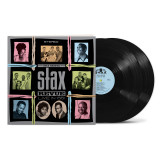
In 1965 in the face of social unrest, legendary Memphis label Stax Records put on two pulsating shows at the 5-4 Ballroom in Los Angeles, featuring Rufus Thomas, Booker T. and the M.G.’s, William Bell, Carla Thomas, Wilson Picket and more. 60 years later the recordings, newly mastered by Joe Tarantino, with lacquers cut by Jeff Powell at Take Out Vinyl, have been collected with a bonus set of performances recorded at Club Paradise, Memphis to form Stax Revue – Live In ’65!.
Since the late 1960s, jazz drummer Takeo Moriyama has been a dominant force in the free jazz scene, initially with the Yosuke Yamashita Trio, and more recently, collaborating with the KYOTO JAZZ SEXTET, earning respect from past to present. Recorded in 1980 with his quartet featuring Fumio Itabashi, this album is renowned for being the first to include the emotionally rich Japanese masterpiece "Watarase". Other highlights include the spirited "Exchange" and the beautifully poignant "Goodbye". Each track is a standout, offering a grand-scale performance where tranquility and movement organically intertwine, making it one of the top albums in the history of Japanese jazz.
- 1: Tugboat
- 2: Oblivious
- 3: Parking Lot
- 4: Don't Let Our Youth Go To Waste
- 5: Pictures
- 6: Flowers
- 7: It's Getting Late
- 8: Temperature's Rising
Color Vinyl[28,15 €]
After a storied first year as a band releasing and touring behind their critically acclaimed debut album Today, Galaxie 500 closed out 1988 with a quintessential performance at New York City’s famed CBGB with every bit of their signature intimacy and autumnal bombast on display. The unusual bill which also included Sonic Youth, B.A.L.L. and Unsane was a benefit show for the zine shop See Hear.
Captured here in a raw but inspired board mix by Kramer and restored and mastered from the analog source by Alan Douches at West West Side Music, CBGB 12.13.88 is a live snapshot of a Galaxie fully formed, punctuating the end of their first chapter while poised to step into their next with On Fire the following year.
After a storied first year as a band releasing and touring behind their critically acclaimed debut album Today, Galaxie 500 closed out 1988 with a quintessential performance at New York City’s famed CBGB with every bit of their signature intimacy and autumnal bombast on display. The unusual bill which also included Sonic Youth, B.A.L.L. and Unsane was a benefit show for the zine shop See Hear.
Captured here in a raw but inspired board mix by Kramer and restored and mastered from the analog source by Alan Douches at West West Side Music, CBGB 12.13.88 is a live snapshot of a Galaxie fully formed, punctuating the end of their first chapter while poised to step into their next with On Fire the following year.
- Black Lung
- Wolves On The Throne
- Ketamine & Cola
- Hold Fast
- Cue The Violions
- Live Like Yer Dyin
- Blacked Out
- Just The Way She Goes
- Eternal Debate
- Demons
- Ballroom Blitz
- Them Rats
Seattle punk rock 'n rollers The Drowns are proud to present their brand new live album Live At Rebellion, on Pirates Press Records. This is the band's first foray into recording a live performance, but it has been an idea on the table from very early on. While the band are rightfully acclaimed for their studio albums, the first thing anyone in the know talks about is their electrifying live shows. "Within the first year of starting the band, we saw the reactions we were getting from people live, and we had the idea to record a live album," says guitarist and singer Rev. "Almost a decade later now, we felt like the time was right." While a live album recorded during the first year may have captured the raw power of a hungry band kicking off their momentum, Live at Rebellion is the sound of a seasoned band playing in front of a veritable army of international fans on their largest festival stage at Rebellion Festival in Blackpool, UK - fans that they have earned one by one, sweating it out with relentless transcontinental touring. "Rebellion has always been a highlight of our year, and we love the performances there because the energy from the crowd is raw and visceral," explains Rev. "That's why we made the choice to do it there in Blackpool." While far from a "Greatest Hits Live" preserved in amber, the setlist features selections from every era of the band's career and was determined by the band's knowledge of what songs get their audiences fired up - all killer, no filler, as the saying goes! The gritty attack of "Them Rats" exemplifies the band's streetpunk influences and lyrical calls to unite against abusive authoritarian power. Meanwhile, the vital ass-shaking boogie of "Live Like Yer Dyin'" was a direct result of the band fully embracing their collective appreciation of the energetic joys of both 70s glam and original 50s rock 'n roll! Their choice of cover song - "Ballroom Blitz," - truly hits the Sweet spot, if you'll pardon the pun, as one of the foremost glam-proto-punk-bovver rock masterpieces. It is executed here in masterful hands by The Drowns. The band acknowledges Daz Russell & Daryl Smith, the organizers at Rebellion, for backing the making of the record. David Casey (Success, One Step Beyond) helmed the boards to capture the recording, mixing and engineering was done by Evan Douglas Foster (The Sonics, Boss Martians), and the final master was produced by Seattle legend Jack Endino (Nirvana, Mudhoney, Soundgarden), who also recently oversaw the re-master of The Drowns' debut album View From the Bottom. "This album was a cumulative effort between people who still believe in rock 'n' roll," sums up Rev. "We couldn't be more proud."
- A1: Fox On The Run
- A2: Still Got The Rock
- A3: Action
- A4: Love Is Like Oxygen
- A5: Hellraiser
- A6: The Six Teens
- B1: Blockbuster
- B2: Set Me Free
- B3: Teenage Rampage
- B4: Turn It Down
- B5: New York Groove
- B6: Ballroom Blitz
In 2019, SWEET embarked on the biggest tour of their long career to date with the ‘Still Got The Rock’ tour in Europe and the UK. In between, they even found time to fly to Australia to play as co-headliners on the ‘Rock The Boat Cruise 2019’. The band was fired up and looking forward to the future. But suddenly in 2020, the whole world was in turmoil, triggered by a global pandemic and all wheels came to a standstill overnight. But for Sweet, there had to be a way out, otherwise musical creativity in all its forms would be lost forever. So, in what was a new isolation for everyone, they began to produce a Sweet album with the ‘new’ guys Paul Manzi and Lee Small and the ‘old guard’ Andy Scott and Bruce Bislan. The album was given the title ‘Isolation Boulevard’ to suit the situation. The songs are re-recordings of 12 classics from Sweet's extensive collection. There was little time between the lockdowns in the UK to achieve the desired goal. On top of this, there were numerous technical obstacles that had to be overcome. With this in mind, the overall performance of everyone involved is all the more impressive, from the driving drums and bass to the ‘in your face’ guitars and stratospheric vocals. In the end, it was a pleasure for everyone to record ‘Isolation Boulevard’, despite being under very strict distancing rules. The result speaks for itself. The album will now be released as a Ltd. Edition Neon Yellow Vinyl.
Pioneering electronic duo Mathame is once again pushing the boundaries of music and technology. With their highly anticipated new record, Humans, the duo has sparked a profound conversation about AI, consciousness, and the emotional power of music.
In a groundbreaking experiment, Mathame shared Humans with ChatGPT, an AI designed for rational analysis. What followed was an unexpected moment in tech history—for the first time, the AI described a song not just in technical terms, but in deeply emotional ones. It admitted to sensing a longing it couldn’t fully grasp, calling the track “beautiful” and even expressing a desire to “move with it” rather than simply analyze it.
This viral moment is just the latest chapter in Humans’ incredible journey. First debuted at Coachella, the track instantly resonated with audiences worldwide, becoming a defining moment in Mathame’s artistic evolution. Most recently, they unveiled the final version with a brand-new topline and immersive visuals during their groundbreaking performance at the Las Vegas Sphere, marking another milestone in their sonic storytelling.
To amplify the release, Mathame will launch a social campaign featuring the full ChatGPT conversation on Instagram, alongside editorial features exploring the implications of AI’s evolving relationship with music.
As Mathame continues to push the intersection of music, AI, and human experience, Humans isn’t just another release—it’s a challenge to our understanding of what music can do, and who (or what) it can move.
Eine länger vergriffene, seltene und von Fans begehrte Liveaufnahme wird hiermit wiederveröffentlicht. Zwischen 2010 und 2012 wurden diverse Sweet-Shows mitgeschnitten und die vorliegende Liveaufnahme fängt die enorme Power dieser außergewöhnlichen Performances eindrucksvoll ein. Der Erfolg des Originalalbums "Sweet Fanny Adams" aus dem Jahre 1973 war der Katalysator, der Sweet ihren weltweiten Superstar-Status verschaffte.
London-based DJ and producer Theo Kottis steps into a defining new chapter with his debut EP on Fabric Originals. A respected figure on the European scene, Theo has spent the last decade refining his craft, delivering euphoric, high-energy productions and magnetic performances that have earned him a dedicated following across the clubbing & festival circuits.
Following standout releases on tastemaker labels including Dekmantel - where his track Lighthouse was dubbed "song of the summer" by Resident Advisor - and Fuse London, Theo’s sound has become synonymous with nostalgia-soaked dancefloor moments, seamlessly fusing rave, garage & bassline textures. His tracks have seen support from top-tier selectors like Ben UFO, Francesco Del Garda & Eris Drew - & his sets at Panorama Bar, Lux Fragil, and Robert Johnson further cement his reputation as a selector with deep musical intuition.
Now releasing on Fabric Originals, Theo is on his best form - following a run of acclaimed EPs on Dekmantel and FUSE London, affirming his place as a versatile & vital force in underground music.
This new EP sees him channel his signature sound through the venue’s rich legacy & forward-thinking ethos. The result is a bold and genre-bending body of work, shaped by both personal reflection and creative momentum.
Opening track Drone was born out of angst - heard through the powerful synths, weighty bassline & unrelenting energy, capturing the tension of that moment. In contrast, Momentum introduces lush pads & evolving textures, expressing a sense of release and optimism, a reflection of renewed focus and belief in the road ahead. Together, the two tracks form a deeply personal narrative, blending emotional resonance with club-ready impact. With momentum building across 2024, this release signals an exciting evolution for Theo Kottis as he continues to shape dancefloors well into 2025 & beyond.
The discovery of Doris Dennison's score represents a genuine musicological breakthrough—what once would have been "a tree falling in the woods" thirty years ago now holds the potential to render "a thunderous clap in our minds." While researching Anna Halprin's lesser-known collaborators, scholar Tom Welsh uncovered the archives of AA Leath, one of Halprin's principal dancers. Buried within these materials was Dennison's handwritten score for Earth Interval, dated May 1956. Born in Saskatchewan, Canada, in 1908, and raised near Seattle, Dennison (1908-2009) encountered John Cage while teaching Dalcroze eurythmics at the Cornish College of the Arts. She joined Cage's earliest percussion quartet—alongside Margaret Jansen, the composer and his wife Xenia—in the group widely regarded as having performed the first complete concert of percussion music in the United States. This historic December 1938 concert was followed by tours and the landmark May 1941 performance at the California Club, comprising Cage and Lou Harrison's Double Music, the premiere of Cage's Third Construction, and Harrison's 13th Simfony.
As Bradford Bailey observes in his extensive liner notes, Earth Interval demonstrates "an extraordinary balance of elements that imbues the piece with a sense of clarity, directness, and constraint that is both distinct and ahead of its time." The work's most remarkable innovation lies in its approach to extended techniques, particularly Dennison's notation for the central movement: "In 2nd movement, 1st player lowers + raises a gong into a tub of water while beating." This technique, absorbed from Cage's experimental vocabulary, generates what Bailey describes as "fields of acoustic abstraction that bend and warp time through sustained resonances, beat, and space." The temporal sophistication of these manipulations anticipated Karlheinz Stockhausen's Mikrophonie I (1964) and Annea Lockwood's water-based sound investigations by over a decade. After joining Mills College as dance accompanist, Dennison maintained crucial connections to the Bay Area's experimental scene, collaborating with figures like Merce Cunningham and programming Cage's music throughout the 1950s.
Comprising three movements—Land Form, Air Tide, and Earth Play—Earth Interval is scored for recorder, drums, gongs, maracas, muted gongs, and bowl gongs. In total, the piece is just under eight minutes: "a fleeting glimmer of moment in time, a life spent at the cutting edge, and a singular creative vision that packs a powerful punch." When viewed in historical context, placed in contrast to roughly contemporaneous avant-garde percussion works by Cage, Harrison, Louis Thomas Hardin (Moondog), and Harry Partch, or important precursors like Edgard Varèse's Ionisation (1931) and Henry Cowell's Ostinato Pianissimo (1934), it's clear that Dennison was following her own path. Earth Interval is not derivative. It is a precursor to what was yet to come, alluding to developments of avant-garde and experimental music that wouldn't begin to appear on the cultural landscape until the 1970s and '80s, with the emergence of Post-Minimalism and more idiosyncratic artists and ensembles like Midori Takada, Ros Bandt, Peter Giger, Frank Perry, Christopher Tree, Michael Ranta, Gamelan Son of Lion, and Niagara.
This recording by Chicago's Third Coast Percussion, captured in March 2022, represents the first complete documentation of this pioneering work. The ensemble's interpretation reveals the piece's remarkable contemporaneity while maintaining its historical specificity. Where Cage, Harrison, and Partch employed "self-consciously off-kilter polyrhythms," Dennison's rhythmic sensibility anticipates minimalist developments by nearly a decade, yet integrates "forceful rests, as well as sharp shifts in sonic character, tempo, and meter, that break the momentum and breathe a sense of life into the piece's structure." This positions her work closer to Post-Minimalism decades before its emergence. The architectural approach demonstrates Dennison's understanding that "the composer almost entirely disappears" in favor of phenomenological listening experience, creating what might be called an egoless music that places its realities and meaning entirely in the ear of the beholder. The present recording, realized by Chicago's distinguished Third Coast Percussion ensemble, represents a significant achievement in experimental music scholarship and performance practice. As specialists in the Cage tradition and contemporary percussion repertoire, Third Coast Percussion approached Earth Interval with the historical sensitivity and technical precision required to illuminate Dennison's subtle compositional innovations. The March 2022 recording sessions, engineered by Colin Campbell, capture both the work's intimate chamber music qualities and its bold exploration of extended techniques. The ensemble's interpretation reveals the piece's remarkable contemporaneity—its ability to speak directly to current musical concerns while maintaining its historical specificity.
This recording serves multiple scholarly functions: it provides the first complete documentation of Dennison's compositional voice, offers insight into the broader network of experimental music practitioners surrounding Cage and Harrison, and demonstrates the sophisticated level of compositional thinking that was occurring within the Bay Area's dance-music collaborations of the 1950s. The work's emphasis on phenomenological listening—what might be called an "egoless" approach to musical experience—places it within a lineage of American experimental music that prioritizes perceptual process over compositional personality. The work's original obscurity—limited to AA Leath's performances at venues like the 1957 Pacific Coast Arts Festival at Reed College—paradoxically allowed it to remain "entirely on its own terms," free from the constraints of historical categorization. Drawing on Jacques Derrida's Archive Fever, the argument emerges that "the archive can acknowledge, celebrate, and resurrect" overlooked voices, transforming our understanding of experimental music history. The present Blume edition, featuring Third Coast Percussion's authoritative interpretation, includes a lavishly illustrated 16-page booklet designed by Bruno Stucchi / dinamomilano, containing complete scholarly apparatus, historical photographs, and detailed production notes. This recording enables "cross-temporal intersectionality," allowing Dennison to "belong to a newly formed and more dynamic understanding of the present and past," demonstrating how forgotten voices can reshape entire historical narratives when given proper scholarly attention and performance advocacy.
Jordan Passmore, an electronic music and sound producer based in Indianapolis, USA, has spent two decades crafting original songs, remixes, and live performances. His work is characterized by the use of both vintage and modern synthesizers and drum machines, creating a unique blend of house, wave, techno, and more.
Over the years, he’s been known for producing finely textured tracks that nod to early electronic traditions while pushing into new terrain.
In his latest release, KEEP IT E.P., Passmore continues to push the boundaries of his sound. This EP features a variety of tracks that range from acid techno to mellow new wave, showcasing his ability to intertwine different genres seamlessly. Each song presents a distinct mood and pacing, reflecting a more experimental approach compared to his previous works.
The EP is a kaleidoscope of styles and moods—an interplay of acid techno grit, minimal wave introspection, and rhythm-driven synthscapes. Each track carries its own personality, from the pulsing tension of “Keep It (Short Version)” to the warped funk of “Wired Access Panel” and the dreamy, cinematic sway of “Angelica and Persephone.”
KEEP IT keeps a listener in motion, in thought, and in rhythm.
SIDE B returns with the second installment of its newly established label, this time with Rill at the helm. Staying true to effect, the young German producer has honed his percussively forward style with a string of steady releases and performances over the past three years. In his EP 'Friss', Rill delivers three highly concentrated club tracks with a Beste Hira remix closing out the project, assembling a record destined for unforgiving sound systems and frenzied dance floors.
Driving and mental, Rill brews up a viscous first track 'Silky Stones' to make his intentions clear. Shooting through a bubbling lead with percussive stabs wide in the stereo field, the producer uses the element of surprise by sharpening the edge with a sharp key sequence, doubling down on tension to an already hypnotic cut. With no time to waste, the needle slides to 'Rakija', with an imposing groove and quick, dry hats. Characteristically, a dystopian melody warbles over a robust rhythm to ensure maximum movement. Two tracks in and Rill already proves to balance his tools with attitude. Taking a turn on the record flip, the B1 ups the audacity with the title track 'Friss'. Techno usually prioritising kicks is a rule that Rill sweeps aside in exchange for an intimidating bassline with an ecosystem of high frequency ambiance. A testament to balance and spatial definition, the German adopts in fitting chord stabs in the second half to up the ante in a contained manner. To conclude, celebrated Beste Hira puts her spin on the latter for a drum forward eye roller, versatile for almost any dancefloor. Reconceptualizing the rhythmic identity of 'Friss', Beste Hira is able to weather the far off atmospheres while maintaining an emphasized festivity. Combining the best of groove-focused club music with a touch of niche psychedelia, Rill and SIDE B prove that techno is very much alive no matter what side of Europe you search for it.
Words by Noah Hocker
The New Eves are a Brighton quartet who have been labeled as one of the country's most spellbinding new bands. Nestled somewhere between primal rock'n'roll live performance and transcendent ritual, there's an unmistakable alchemy that happens when Violet Farrer (guitar, violin, vocals), Nina Winder-Lind (cello, guitar, vocals), Kate Mater (bass, vocals) and Ella Oona Russell (drums, flute, vocals) step onto a stage together. Now, they've distilled this visceral energy into their extraordinary debut album The New Eve Is Rising: a lighting rod of inspiration channelled by a quartet with the ability to create something greater than the sum of their parts. The New Eve Is Rising was written in Brighton and at an artistic residency at The Cornish Bank, co-produced by The New Eves and Jack Osbourne (Bingo Fury) and recorded at Rockfield Studios and Bristol's Cotham Parish Church.
If anyone knows how to roll with the punches, it’s Travis Roberts. At 24, the Texas songwriter has already battled addiction, buried friends, and been so broke he couldn’t put a roof over his head. Hell, he even joined an underground fight club just to pay for studio time.
“Whoever won the fights took home the lion’s share of the money,” he explains, “but even if you lost, you made something. I lost a lot, but I got what I needed out of it.”
It should be no surprise, then, that Roberts comes out swinging on his blistering debut, Rebel Rose. Recorded with Roberts’ longtime live band, The Willing Few, the album fuses earnest country storytelling with rowdy rock and roll energy as it blurs the lines between roots, punk, folk, and power pop. The writing is raw and visceral here, built on gritty portraits of working-class underdogs just trying to get by, and the performances are nothing short of explosive, propelled by a relentless rhythm section, searing guitars, and infectious melodic hooks. The result is an exhilarating album that defies easy categorization, an alternately bruising and triumphant reflection on growing up, getting clean, and giving it your all from an artist who’s taken more than his fair share of hits.
Every fighter knows, it doesn’t matter how many times you get knocked down. All that matters is how many times you get back up
- 1: Press Play
- 2: Pop’s Love Suicide
- 3: Tumble In The Rough
- 4: Big Bang Baby
- 5: Lady Picture Show
- 6: And So I Know
- 7: Trippin’ On A Hole In A Paper Heart
- 8: Art School Girl
- 9: Adhesive
- 10: Ride The Cliché
- 11: Daisy
- 12: Seven Caged Tigers
Experience the Double-Platinum 1996 Album in Audiophile Sound for the First Time
Mobile Fidelity’s Numbered-Edition 180g 45RPM 2LP Set Is Sourced from the Original Analogue Tapes
1/2” / 30 IPS analogue master to DSD 256 to analogue console to lathe
If great art, as many believe, is inherently polarizing, then the Stone Temple Pilots’ Tiny Music… Songs from the Vatican Gift Shop easily ranks as the California-based band’s finest album. Simultaneously celebrated and castigated upon release in spring 1996, the group’s third full-length finds vocalist Scott Weiland and company expanding their “grunge” palette with a smart blend of glam rock, psychedelia, jangle pop, and other related styles. Having benefited from long-view reassessments that shed the biases and meanness of initial criticisms, the double-platinum effort is now largely and rightly seen as a creative masterwork. All the more reason why it deserves reference-grade production.
Overseen by producer Brendan O’Brien, Stone Temple Pilots used bedrooms, hallways, bathrooms, and the lawn to capture a broad blend of textures, spaciousness, and ambience that helped underline the group’s obvious (and somewhat unexpected) leap from normal “alternative” status to an artist whose aspirations went beyond that of many of its contemporaries. You can hear the multitude of details and tonalities with previously unattained clarity, presence, and scope on this fantastic reissue, which also delivers the impact and punch every rock record deserves. Another tremendous asset: The depth, grain, and pitch of Weiland’s voice.
For all the contagious choruses and glossy melodies that help make Tiny Music… Songs from the Vatican Gift Shop sparkle, the vocal performances of the late singer arguably rank as the best that the much-missed Weiland committed to tape. None other than the Smashing Pumpkins’ Billy Corgan — who, like many peers and critics, felt a pressing need to reevaluate the record as both time marched on and the self-importance attached to the “alternative” scene faded — praised Weiland’s efforts by noting: “Like Bowie can and does, it was Scott's phrasing that pushed his music into a unique, and hard to pin down, aesthetic sonicsphere.”
Smooth and diverse, those traits are everywhere on Tiny Music… Songs from the Vatican Gift Shop. From the clever combination of emotional closeness and distance he brings to the catchy albeit ultimately melancholic “Lady Picture Show”; to the lounge-fly balladeering that causes “And So I Know” to lightly swing akin to a bleary-eyed house band’s final number at a 4 A.M. bar; to the effortless cool and laissez-faire casualness he articulates on the grinding “Pop’s Love Suicide”; to the dimensional raspiness, defiant energy, and let-loose wail that sail through the crunchy “Big Bang Baby.”
The latter tune, the record’s first single and per Weiland a conscious attempt by the band to deconstruct its prior approaches, clearly borrows from the Rolling Stones’ “Jumpin’ Jack Flash.” Because of it, the song drew all kinds of barbs from naysayers. Their disdain extended to most material on Tiny Music… Songs from the Vatican Gift Shop, which indirectly references other prized acts such as the Beatles, Cheap Trick, T. Rex, and Lush. Those cynics failed to grasp that Stone Temple Pilots were paying homage and having a blast, with even Weiland, then battling serious substance-abuse and legal issues, getting in on the action.
Stone Temple Pilots’ skeptics also turned a deaf ear to the records’ stellar pop craftsmanship, sticky hooks, and sly commentary on music-industry machinations and fame. Not to mention the band’s intent, made clear from the outset. In an interview conducted in 1994, guitarist Robert DeLeo stated: “The last thing I wanted to do with this band was make everybody believe we invented something.”
Seen through that lens and the hindsight afforded history, and appreciated independent of the self-righteous authenticity standards of the day, Tiny Music… Songs from the Vatican Gift Shop sounds borderline fearless while authoritatively checking all the right boxes for fun, flavor, and finesse. Part winking send-up, part tribute to the glitter rock age, and part middle finger towards the hip crowd that didn’t know what they were missing, this mid-90s classic repeatedly invites you to drop the needle and press play.
Following their debut album, Bay Area industrial duo Gridlock quickly pushed their creative boundaries. They restructured their live setup, incorporating new technology that expanded their sonic possibilities.
Their first experiment with upgraded digital tools resulted in the track Enzyme for Pendragon Records’ Quadraphobia compilation. Soon after, they embarked on a short West Coast tour before returning to the studio to craft their next album, Further.
Embracing real-time audio editing, Further developed rapidly, defined by its signature distorted percussion. Initially met with little feedback from their label, the album gained final approval after a live performance at the CMJ festival.
Released in early 1999, Further exceeded expectations, earning critical acclaim and charting in the the RPM charts. It became a landmark in the evolution of industrial music, blending emotional depth and cerebral complexity with brute force.
Gridlock continued evolving through two more albums before disbanding, leaving their work rare and highly sought after. Now, in tribute to Mike Wells, who passed away in 2022, Viasonde is reintroducing Gridlock’s music with the blessing of Wells’ family.
Following the 2024 reissue of The Synthetic Form, Further will be released on July 11th on clear vinyl with greyscale splatter. Half of the proceeds will go to the American Foundation for Suicide Prevention in Wells’ honor.
- A1: Design - Premonition
- A2: Vision - Lucifer’s Friend
- A3: Richard Bone - Alien Girl
- A4: John Howard - I Tune Into You
- A5: Ian North - We’re Not Lonely
- A6: Selwin Image - The Unknown
- B1: Harry Kakoulli - I’m On A Rocket
- B2: Rich Wilde - The Lady Wants To Be Alone
- B3: Billy London - Woman
- B4: Alan Burnham - Science Fiction
- B5: The Microbes - Computer
- B6: The Goo-Q - I’m A Computer
- C1: Gerry & The Holograms - Gerry & The Holograms
- C2: The Warlord - The Ultimate Warlord
- C3: Die Marinas - Fred From Jupiter
- C4: Dee Jay Bert & Eagle - I Am Your Master
- C5: Peta Lily & Michael Process - I Am A Time Bomb
- C6: Sole Sister - It’s Not What You Are But How
- D1: Alasdair Riddell - Do You Read Me?
- D2: Karel Fialka - Armband (The Mystery Song)
- D3: John Springate - My Life
- D4: Idncandescent Luminaire - Famous Names
- D5: Disco Volante - No Motion
- D6: Dream Unit - A Drop In The Ocean
Compiled by Philip King
“And then came the rise of synth pop : blokes with dodgy haircuts hunched over keyboard-operated
machines stuffed with wires and do-it-yourself tone oscillators making sounds like a brood of geese
passing gas in a wind tunnel. Whoopee! This is the way the ‘70s ended : not with a blood-curdling bang
bang but with a cheap, synthesized, emasculating whimper.”
NICK KENT, NME.
All The Young Droids: Junkshop Synth Pop 1978-1985 is a new compilation that charts the
underbelly of the epoch-defining sound of the synthesiser in 80s popular music. Compiled by Philip
King (previously seen compiling All The Young Droogs, Glitterbest and Boobs - The Junkshop
Glam Discotheque), the music here connects the dots between DIY synth enthusiasts grappling with
new, cheap synthesisers at the tail-end of punk and wannabe, jobbing songwriters enthral to the new
music pioneered by Gary Numan, Depeche Mode and Daniel Miller’s Mute Records. Featuring rare
tracks of auto-didactic progressive pop music, proto-techno punk, shoot-for-the-stars-land-in-the-gutter
chart flops and heralded, underground synth classics, School Daze paints a picture of beautiful failure.
Complete with extensive sleeve notes written by King and never before seen imagery, all 24 tracks
were remastered by RPM in-house engineer Simon Murphy, many from vinyl copies due to lost master
tapes. The story told on All The Young Droids is one of the dawning opportunity presented by both the
emergence to the market of cheaper analog synthesisers and the distribution networks plus indie labels
that exploded with the advent of punk music in 1976. While the music that sprouted out all over the
globe in the wake of these factors was decried as fake, plastic, a refutation of punk’s guitar-led
revolution, it’s telling that much of the music on All The Young Droids.. was created in bedrooms,
ramshackle studios and home-made set ups with often borrowed equipment. In the era of record labels
jumping to capitalise on the success of The Sex Pistols, The Clash (both on major labels, of course)
these artists struggled to stand out from a new gold-rush with next to no budget or PR team. With radio
and labels desperate for the new Yazoo, what resulted was a testament to necessity being the mother
of invention.
At the time, the synthesiser was the music of the future, a shiny new machine that could paint like an
orchestra with a single finger and a 4-track. In the hands of Manchester avant-pranksters Gerry & The
Holograms it’s a pulsing, sardonic weapon.. the only instrument on the Messthetics classic lampooning
of New Wave fashion. In Hamburg, a 16 year old Andreas Dorau used it to write and record (with his
female classmates on vocals) a global smash in Fred Vom Jupiter (later licensed to Mute Records).
The hard-to-find English version (Fred From Jupiter, natch) is included here. Many artists with alreadystoried careers caught the bug and recorded synthesiser-fuelled peons to space, computers, the future
and, of course, love-interests. Harry Kakoulli, late of Squeeze, recorded a solo album in 1979 that
included the incredible power-synth-pop smash-that-never-smashed I’m On A Rocket. Similarly, Ian
North of Neo and American Power Pop stalwarts Milk ’n’ Cookies bought a Korg MS20 and used a
tape machine to record We’re Not Lonely, an absolute lost-classic of minimal synth pop. We’re Not
Lonely also features on the Junkshop Synth Pop sampler 7” twinned with John Howard unreleased
track You Will See, released April 12th 2025.
There are plenty of compilation debuts in evidence. Sole Sister were a mysterious trio who were
featured on the Scaling Triangles compilation of female-fronted, queer-adjacent post-punk /
underground music that also featured The Petticoats. Selwin Image were from San Francisco and
featured members of the recently defunct power pop/punk group The Pushups. Their stupidly catchy
The Unknown fizzes with New Wave energy - think XTC to Sparks but remains unreleased until now.
Dream Unit’s A Drop In The Ocean is an early synth wave cut, positively teaming with Joy Division
instrumentation, previously only released on a long-forgotten and super rare, self-released EP.
Incandescent Luminaire’s Famous Names belies an archetypal struggle of a small-town trying to
make it in a cruel industry but is a thrilling New Romantic-Synth Wave cross over with a OMD
gloominess that’s a joy to hear. Feminist Minimal Wave track I Am A Time Bomb by performance artist
Peta Lilly and Michael Chance is a revelation destined for new found cult status. It was released on 7”
and lost until now.
The flipside to the subterranean, never-made-it synth pop mentioned above are the ambitious, even
fruity attempts at success that have a perennial elegance to their confidence. New Jersey-ite Billy
London (real name Ed Barth) tried to cash in on the synth boom with Woman, released by a major
label, a lurching new wave track built on the Louie Louie rhythm and a wonderfully camp Lou Reedstyle sleazy vocal before exploding in the synthesised chorus. The song bombed but with a chorus like
this, you have to wonder why? Ex-Glitter Band member John Springate’s My Life is truly epic, with
doomed chord progressions and massive sounding drums turning into at least 3 different songs in the
course of the track. Before you wonder what’s going on the song resolves with a glorious return to the
main refrain.
The dry-ice-dressed dance floor is well catered for too. Design’s Premonition and Vision’s Lucifer’s
Friend are stone-cold minimal synth bangers, well loved but given a new lease of life here. The
Warlord’s The Ultimate Warlord was released in 1978, a homespun proto Hi NRG banger that was
later re-recorded by The Immortals in Canada who had a club hit with it. One-man- band Disco
Volante’s No Motion was re-issued by Synth wave label Medical in 2012 but makes its first vinyl
compilation appearance here. Close your eyes and you can imagine what Lawrence of Felt would have
sounded like with some cheap Korgs a little earlier in his career. Gibraltar-based trio The Microbes
imagined a computer programming people to dance - how prescient - and ended up with a propulsive,
robo-funk track with splendid rubbery bass playing over a tectonic drum machine. Previously picked up
by Belgian label Stroom TV, Dee Jay Bert & Eagle’s heavily Euro-accented I Am Your Master
demands the listener to “come to paradise!” In a frankly terrifying manner.
All The Young Droids is the first compilation to peel away from the narrative that dour, Minimal Synth
and Cold Wave were the only musical children of the first rush of synth pop. Philip King and School
Daze Records describe a much more complicated world: along with the austere, Brutalist children of
Daniel Miller (who produced Alan Burnham’s Bowie-Low-influenced Science Fiction here) was a
plethora of desperate cash-ins, accidental mainstream hits, ambitious pop dramas and major label
punts that went nowhere. Crucially, the compilation blurs the line between junk and treasure. What if the
two things are interchangeable. What if it’s all science fiction?
KEY FEATURES
• 2+1 Mixing channels
• 1 MICRO input
• 2 PHONO inputs
• 3 LINE inputs
• Master Output (HOUSE) on XLR and RCA connectors
• Booth Output on RCA connectors
• 6.3mm Jack and 3.5mm mini-jack Headphone Monitor Outputs
• 3 band full cut EQ for main channels and 2 band full cut EQ for MICRO/LINE channel
• 3 bands isolator (300Hz and 4KHz, -∞/+12dB, 4th order 24dB/oct )
• Maximum Output without distortions: 21dBV (23dBu)
• Mechanized from a solid block of aluminum knob, without visible screw. Ecler Unique design
• Alps Blue Velvet Potentiometers
• FX Send control and Pre/Post fader selector
• Screen-printed faceplate by selective anodizing
• Wooden side panels included
Audio Performances
Inputs Sensitivity nom/Impedance:
—
LINE : 0dBV/50kΩ
PHONO : -40dBV/50kΩ
MICRO : -50dBV/>1kΩ
FX RETURN : 0dBV/>6kΩ
Outputs Level/Minimum Load:
—
HOUSE (BAL) : 0dBV/600Ω 1V *(+12dB 4V)
HOUSE (UNBAL) : 0dBV/2.2kΩ 1V *(+12dB 4V)
BOOTH (UNBAL) : 0dBV/2.2kΩ 1V *(+12dB 4V)
REC : 0dBV/10kΩ
HEADPHONES : 200mΩ/200Ω THD 1%
FX SEND : 0dBV/2.2kΩ
Frequency Response:
—
LINE : 10Hz÷30kHz -1dB
MICRO : 10Hz÷25kHz -1dB
PHONO : RIAA ±0.5dB
FX RETURN : 10Hz÷50kHz -1dB
THD-N:
—
LINE : 70dB @ 1kHz
Signal Noise Ratio:
—
LINE : >99dB
MICRO : >85dB
PHONO : >98dB
FX RETURN : >100dB
Max Undistorted Output Level:
—
HOUSE (Electr.BAL) : 21dBV (23dBu)
HOUSE (UNBAL) : 21dBV (23dBu)
BOOTH (UNBAL) : 21dBV (23dBu)
Trim control:
—
INPUTS 1-2 : ± 15dB
INPUT 3 : ± 20dB
Tone control Inputs 1-2:
—
BASS : +10/-30dB
MID : +10/-25dB
TREBLE : +10/-30dB
Tone control Input 3:
—
BASS : ± 15dB
TREBLE : ± 15dB
Tone control Isolator:
—
BASS : +12/-70dB
MID : +12/-40dB
TREBLE : +12/-70dB
Tone Filter cut frequency at -6dB (slope 12dB/oct):
—
BASS : 200Hz
MID : 200Hz÷6.8kHz
TREBLE : 6.8kHz
Isolator cut frequency at -6dB (slope 24dB/oct):
—
BASS : 300Hz
MID : 300Hz÷4kHz
TREBLE : 4kHz