Seminal, Grammy-nominated, genre-bending metal band Periphery
returns with their first new music in 4 years
Wildfire, the first single, is rife with snarling riffs, thick groove, and a sing-along,
sweeping chorus. The band will be touring with Underoath in March around the
album release
Buscar:periphery
- A1: Enei - The Process
- B1: Break - In The Clouds
- B2: Sam Binga Feat. Eva Lazurus - Show U Something
- C1: Mefjus - Mirage
- D1: Kasra - Phases
- D2: Hyroglifics - Swish
- E1: Ivy Lab - Amber
- F1: Upbeats - Grasshopper
- F2: Foreign Concept - Breaking Again
- G1: Emperor - Bad Blood
- H1: Klax - The Mute
- H2: Halogenix Feat. Solh - Flames
- I1: Current Value - Leave Behind
- J1: Signal - Periphery
- J2: Shyun - Unfold
Critical Music reaches its 100th release in its 15th year, celebrating with the landmark album Fifteen Years Of Underground Sonics. Spanning the broad spectrum of drum & bass that the Critical sound represents, the exceptional 15 album is as bold as it is beautiful and looks to serve the test of time in the D&B history books.
>
Kasra Critical
Get The Hose is the fabled, long awaited debut release from Montreal duo Plumbing, featuring Martyn Bootyspoon aka Jason Voltaire (Fractal Fantasy/LuckyMe/Fool’s Gold Records) and Stephen Ramsay of Young Galaxy (Paper Bag Records/Smalltown Supersound).
Born in 2018 as a live, analog hardware-based studio project, the duo worked quietly on the periphery of the left-field electro scene, only venturing out to do occasional, legendary winter warehouse DJ sets and a still-vaunted live set at MUTEK in 2021, which was so visceral that it knocked every person present into their seats simultaneously.
As cheeky and playful as it is gritty, relentless and overdriven, Plumbing’s new EP showcases their love of the raw and grimy, bare-bulbed basement aesthetic of underground dance music, where Paranoid London, Drexciya, MMM and Blawan meet to steal your drink and ignite the dancefloor.
It’s getting hot in here, it’s time to Get The Hose…
Yeong Die would typically be described as DJ, musician, or “experimental” composer, but in reality she is a sculptor. Between the rapidly disintegrating boundaries of composition and sound design, her work employs a hunting and gathering of intangible material—bursts of memory, fragments of liminal space, interstitial banalities—materializing as boundless expressions that evade genre constructs. As an integral presence among Seoul’s most forward thinking sound artists, Yeong is in a constant uphill battle rejecting the reverence that so quickly creeps in and infects contemporary craft, that relegates even the most audacious attempts of her peers to pigeon-hole pastiche. Given this style-agnostic starting line, her ESP Institute debut 'Uncapturable' exudes non-urgency, an unfettered pace that allows breathing room, affording the listener freedom to mentally isolate and explore elements without fear of missing a “bigger picture.” There is a warm and welcoming feeling that invites repetitive, even studied listening. While half the work is somewhat singular in presentation—'1km', 'Like Your Flaw', or 'Burnt'—there are moments of meticulous complexity—'Morning Rum Punch' (featuring vocals by Cifika) and 'Did' (featuring a smattering of spoken words by icecream drum), both underground Korean peer artists. These moments feel more of like an acute focus on execution that compliments the overall shape of the album, rather than a dynamic contrast. Cifika’s vocals, in particular, command the listener’s periphery in a playful and refreshing way, exaggerating negative space and in-between moments that not only the paint an arresting stereo field but a remarkable sense of depth, not easily achieved without production sorcery. It is, without a doubt, these beautiful fleeting moments that we describe as 'Uncapturable'.
Melbourne / Naarm stronghold Butter Sessionsclock 15 years in the game with a trilogy of 12"s, sustaining their uncompromising streak of peak-form electronics. The family-style V/A binds friends, collaborators, former studio neighbours and DJ booth allies, capturing a label that exists as community as much as catalogue.
Disc Two lifts off with recurring contributor Rory McPike's first label outing as Rings Around Saturn, a blissed-out cosmic floater skimming the periphery. Booked in the early days of the label's formative Mania residency, Japanese don Gonno twists freestyle, techno and breaks into pure ecstasy, before the unerringly bold Jennifer Loveless spikes the punch with a hallucinatory mix of drums, disembodied voice and jazz club keys.
On the flip, Boorloo's Guy Contact rolls out Dance In The Grey, a shadowy prog churn pitched between new-romantic vocal sheen and EBM muscle, with Kate Miller completely rewiring the script on Sub Series E - a masterfully minimal, double-time meditation. suki presents his Sniper1 alias to close with a demonic body-jacking groove loaded for the system.
Whether taken alone or folded into the three-disc triptych, each instalment stands as a bag-ready constant, charged with Butter Sessions' curatorial finesse.
Renowned for his visceral work with HIGH-FUNCTIONING FLESH, Greg Vand dives deep into the experimental proto-industrial with his solo project NEWBOY, revealing a darker, looser, and more hypnotically unstable side of the music machines. “The Color of Everything” is a transmission compilation with cracked circuitry, lysergic funk, warped tape hiss, and urban hallucinations.Think Cabaret Voltaire jamming with Bourbonese Qualk, Ike Yard, and Esplendor Geométrico: a mutant rhythm ritual for abandoned clubs and alleyway rites. This is rhythm as both weapon and escape. A dystopian groove engine primed for fans of the avant-garde, the unstable, and the underground, all tuned into the fractured future of dance music.presented in ONE-OFF truly limited edition of 300 copies lacquered pressed on 180 gr. high quality solid BLACK vinyl.
- A1: Montego Bay - Everything (Paradise Mix) 04 59
- A2: Atelier - Got To Live Together (Club Mix) 06 06
- A3: Golem - Music Sensations 04 56
- B1: The True Underground Sound Of Rome Feat. Stefano Di Carlo - Gladiators 05 26
- B2: Eagle Parade - I Believe 04 26
- C1: Dj Le Roi - Bocachica (Detroit Version) 05 28
- C2: Green Baize - Synthetic Rhythm 01 41
- C3: M.c.j. Feat. Sima - Sexitivity (Deep Mix) 05 30
- D1: Kwanzaa Posse Feat. Funk Master Sweat - Wicked Funk (Afro Ambient Mix) 06 31
- D2: Progetto Tribale - The Bird Of Paradise 06 29
- D3: Mbg - The Quite 06 59
Vol 1[28,99 €]
Googling “paradise house”, the first results to pop up are an endless list of European b&b’s with whitewashed lime façades, all of them promising “…an unmatched travel experience a few steps from the sea”. Next, a little further down, are the institutional websites of a few select semi-luxury retirement homes (no photos shown, but lots of stock images of smiling nurses with reassuring looks). To find the “paradise house” we’re after, we have to scroll even further down. Much further down.
It feels like yesterday, and at the same time it seems like a million years ago. The Eighties had just ended, and it was still unclear what to expect from the Nineties. Mobile phones that were not the size of a briefcase and did not cost as much as a car? A frightening economic crisis? The guitar-rock revival?! Certainly, the best place to observe that moment of transition was the dancefloor. Truly epochal transformations were happening there. From America, within a short distance one from the other, two revolutionary new musical styles had arrived: the first one sounded a bit like an “on a budget” version of the best Seventies disco-music – Philly sound made with a set of piano-bar keyboards! – the other was even more sparse, futuristic and extraterrestrial. It was a music with a quite distinct “physical” component, which at the same time, to be fully grasped, seemed to call for the knotty theories of certain French post-modern philosophers: Gilles Deleuze, Félix Guattari, Paul Virilio... Both those genres – we would learn shortly after – were born in the black communities of Chicago and Detroit, although listening to those vinyl 12” (often wrapped in generic white covers, and with little indication in the label) you could not easily guess whether behind them there was a black boy from somewhere in the Usa, or a girl from Berlin, or a pale kid from a Cornish coastal town.
Quickly, similar sounds began to show up from all corners of Europe. A thousand variations of the same intuition: leaner, less lean, happier, slightly less intoxicated, more broken, slower, faster, much faster... Boom! From the dancefloors – the London ones at least, whose chronicles we eagerly read every month in the pages of The Face and i-D – came tales of a new generation of clubbers who had completely stopped “dressing up” to go dancing; of hot tempered hooligans bursting into tears and hugging everyone under the strobe lights as the notes of Strings of Life rose up through the fumes of dry ice (certain “smiling” pills were also involved, sure). At this point, however, we must move on to Switzerland.
In Switzerland, in the quiet and diligent town of Lugano, between the 1980s and 1990s there was a club called “Morandi”. Its hot night was on Wednesdays, when the audience also came from Milan, Como, Varese and Zurich. Legend goes that, one night, none less than Prince and Sheila E were spotted hiding among the sofas, on a day-off of the Italian dates of the Nude Tour… The Wednesday resident and superstar was an Italian dj with an exotic name: Don Carlos. The soundtrack he devised was a mixture of Chicago, Detroit, the most progressive R&B and certain forgotten classics of old disco music: practically, what the Paradise Garage in New York might have sounded like had it not closed in 1987. In between, Don Carlos also managed to squeeze in some tracks he had worked on in his studio on Lago Maggiore. One in particular: a track that was rather slow compared to the BPM in fashion at the time, but which was a perfect bridge between house and R&B. The title was Alone: Don Carlos would explain years later that it had to be intended both in the English meaning of “by itself” and like the Italian word meaning “halo”. That wasn’t the only double entendre about the song, anyway. Its own very deep nature was, indeed, double. On the one hand, Alone was built around an angelic keyboard pattern and a romantic piano riff that took you straight to heaven; on the other, it showcased enough electronic squelches (plus a sax part that sounded like it had been dissolved by acid rain) to pigeonhole the tune into the “junk modernity” section, aka the hallmark of all the most innovative sounds of the time: music that sounded like it was hand-crafted from the scraps of glittering overground pop.
No one knows who was the first to call it “paradise house”, nor when it happened. Alternative definitions on the same topic one happened to hear included “ambient house”, “dream house”, “Mediterranean progressive”… but of course none were as good (and alluring) as “paradise house”. What is certain is that such inclination for sounds that were in equal measure angelic and neurotic, romantic and unaffective, quickly became the trademark of the second generation of Italian house. Music that seemed shyly equidistant from all the rhythmic and electronic revolutions that had happened up to that moment (“Music perfectly adept at going nowhere slowly” as noted by English journalist Craig McLean in a legendary field report for Blah Blah Blah magazine). Music that to a inattentive ear might have sounded as anonymous as a snapshot of a random group of passers-by at 10AM in the centre of any major city, but perfectly described the (slow) awakening in the real world after the universal love binge of the so-called Second Summer of Love.
For a brief but unforgettable season, in Italy “paradise house” was the official soundtrack of interminable weekends spent inside the car, darting from one club to another, cutting the peninsula from North to centre, from East to West coast in pursuit of the latest after-hours disco, trading kilometres per hour with beats per minute: practically, a new New Year’s Eve every Friday and Saturday night. This too was no small transformation, as well as a shock for an adult Italy that was encountering for the first time – thanks to its sons and daughters – the wild side of industrial modernity. The clubbers of the so-called “fuoriorario” scene were the balls gone mad in the pinball machine most feared by newspapers, magazines and TV pundits. What they did each and every weekend, apart from going crazy to the sound of the current white labels, was linking distant geographical points and non-places (thank you Marc Augé!) – old dance halls, farmhouses and business centres – transformed for one night into house music heaven. As Marco D’Eramo wrote in his 1995 essay on Chicago, Il maiale e il grattacielo: “Four-wheeled capitalism distorts our age-old image of the city, it allows the suburbs to be connected to each other, whereas before they were connected only by the centre (…) It makes possible a metropolitan area without a metropolis, without a city centre, without downtown. The periphery is no longer a periphery of any centre, but is self-centred”.
“Paradise house” perfectly understood all of this and turned it into a sort of cyber-blues that didn’t even need words, and unexpectedly brought back a drop of melancholic (post?)-humanity within a world that by then – as we would wholly realise in the decades to come – was fully inhuman and heartless. A world where we were all alone, and surrounded by a sinister yellowish halo, like a neon at the end of its life cycle. But, for one night at least, happy."
The wax is hot. The tunes are massive. Oath’s sub-label, Last Year at Marienbad, dispenses a foursome of punchy house tracks for its fifth release, lovingly crafted by some of the genre’s finest producers.
‘The Way We Flow’ by Sam Paradise pairs detuned, lo-fi samples with thumping kicks, and muffled drums. Just when those innocent lo-fi elements simmer, the drums slam back into your periphery harder than ever, making for an absolute dancefloor smasher.
‘De Nuit (3 A.M)’ by Nu-Cleo descends deeper. Swinging drums and chocolatey, indulgent keys lay the basis for a hypnotic acid bassline. Real tension builder.
Flipping over to the B-Side – careful, it’s hot – is ‘She Wrote’ by Gloved Hands. Seemingly just a ride through a well-made bouncing synth and house groove combo at first, this track soon shows off Gloved Hands’ knack for leftfield flavours. There’s an unexpected trap-esque vocal that gets re-contextualised for the club alongside piercing synths and a bulging broken beat.
‘Hard Deep’ by Rick Wade is an obvious one. The stalwart of the house scene serves up another of his zesty, masterful grooves. Shimmering, effortless keys steer a tight drum groove while a subtle bassline nestles between the kick’s low end.
Four cuts from four house experts. Is there much more a dancefloor could ask for?
- Open Fields
- Memory
- Opioid
- Reset
- Always You
- Seeker
- Warnung
- Gabriel
- Kind
- God Is Lonelier
- Warum
- Neuzeit
Mute welcomes German synthesizer and producer duo Felsmann + Tiley to the roster with the release of their new album Protomensch. Out February 13, 2026 on limited edition black vinyl packaged in a special gatefold sleeve featuring a mirror foil lamination on the inner panel revealing a ‘self-portrait of the protomensch.’
On Protomensch (German for “proto-human”), Felsmann + Tiley blend shimmering synthwave, pounding trance, and introspective IDM with synth-pop-infused tracks featuring guest vocalists including London’s Pet Deaths and Australian artists The Kite String Tangle, Woodes, and Laius.
This juxtaposition between sentient beings and machines permeates the whole album – right from the duo’s manifesto introducing us the highly intelligent yet irrevocably shortsighted and downright tragic character of Protomensch – the cover artwork featuring turtleneck wearing chimpanzee, futuristic music videos, and stark social media aesthetics to seated, next-level live-shows involving collaboration with dozens of visual artists.
Despite their online ubiquity, sparked in part by their viral reinterpretation of label-mate M83’s “Solitude,” which has been used over 1 million times on TikTok and high-profile syncs on shows including Young Royals (season two), the BAFTA-winning crime thriller Top Boy (season three), and Amazon’s The Better Sister, Felsmann + Tiley have lingered largely on the periphery, their origins cloaked in quiet anonymity, until now. With the release of Protomensch, Felsmann + Tiley present their fully realized artistic vision and step into the spotlight.
Written during a period of geographic and artistic transition, Country Music traces Severin Black’s movement from London to Berlin, unfolding through cycles of isolation and adaptation. Composed on the city’s periphery, the album’s material was continually dismantled and reassembled, reflecting a process of both artistic and personal reconstruction. The album marks a shift in production methodology, moving away from the immediacy of summed live takes toward a more deliberate, stratified multitrack approach. Sparse yet hypnotic, the record distills layers of sound formed by constant relocation, recurrent solitude, and a recalibration of instinct. In many ways, it echoes the experience of exile, not in a political sense but in the quieter, more insidious form of displacement that alters one’s perception of time and self. The music drifts between structure and dissolution, a reflection of existing at the threshold of different spaces—both physically and sonically.
The shedding of the previously used Nape moniker signaled a decisive sonic transformation, informed by extended time spent in the Pyrenees and a renewed engagement with folkloric material. Severin began playing the clarinet while making this record, and though its presence is minimal, it reveals itself as an interest in acoustic simulation, particularly the digital approximations of classical instruments that emerged within 1990s synthesizer technology. This interrogation of authenticity and mediation parallels the album’s thematic engagement with memory, where recollection functions not as a retrieval of fixed experience but as an iterative process of distortion and reconstruction. The relocation to Berlin reignited an affinity for grime music, evident in the syncopated brass of Pilgrim Wine and the fractured vocal layers of March, while memories of childhood in rural Wales permeate the record’s atmospheric spaces. The album includes contributions from longtime collaborator Vanessa Bedoret and Berlin-based artist Pavel Milyakov (Buttechno).
Country Music situates itself within an unresolved dialogue—between past and speculative futures, between folk lineage and digital fragmentation, between place and its embodied and sonic traces. What emerges is not a fixed statement but a process, an ongoing negotiation between what is left behind and what is brought forward. Words by Chantal Michelle
Mastered by Owen Pratt / Design by Severin Black / Center label image by Nicky Kidd / Back cover text by Alya Kanıbelli
- A1: March
- A2: Dragon
- A3: Living
- A4: Maelstrom
- A5: Changes
- B1: Periphery
- B2: Red Car
- B3: Exhale
- B4: Vessel
- B5: The Emptying
Das zweite Album der Indie-Folk-Künstlerin erscheint am 17. Oktober über Dirty Hit
Mit And Your Song Is Like a Circle veröffentlicht Skullcrusher (Helen Ballentine) am 17. Oktober 2025 ihr zweites Album auf Dirty Hit – eine fragile, ambient-getränkte Fortsetzung ihres gefeierten Debüts Quiet the Room (2022).
Das Album entstand über mehrere Jahre hinweg in fragmentierten Sessions – keine Momentaufnahme, sondern eine klangliche Spurensuche nach etwas, das sich nicht vollständig greifen lässt. Im Mittelpunkt steht die Vergänglichkeit des kreativen Prozesses: Ideen, die aufblitzen und wieder verschwinden, Stimmen, die für einen kurzen Augenblick durch Raum und Zeit gleiten.
And Your Song Is Like a Circle ist ein meditatives Werk, das sich dem Offenen und Flüchtigen verschreibt – zart, intim und tief atmosphärisch.
Ein Muss für Fans von Indie-Folk, experimenteller Ambient-Musik und poetischer Reduktion.
Metatone is a tonic-containing substance used to help restore health and vitality after illnesses or when you are feeling tired. A metaphor, which perfectly describes Ement's debut album - a mixture of peak-time electro/techno tunes spiced up with the modern traces of EBM, which perfectly fits clubs and festivals. It is a personal dancefloor experience materialization of a non-stop party rebel, who started his music production journey in the periphery and got inspired by his brother's hard dance production experiments. After an intensive exploration of the local and foreign club scene through years of intensive djing, remixing and never-ending afterhours, Ement finalized his recent definition of dance, which launches on the new co-curated PZ Records label.
An unexpected break and a long-lasting limbus of the dancefloor consumption turned out as a perfect slot to reveal one of many underestimated Lithuanian producers, who are too shy and too critical to themselves. It's no fiction, as "How Much Is Too Much" was already noticed and compiled by Dave Clark in his "Whitenoise" radio show.
- Obsolete
- Violence Voyager
- Earthshaped
- Congratulations Champion
- Human Bean Instruction Manual
- Steps
- Massive Everything
- Infinite Trolley
Pickle Darling has always existed just outside of the periphery. In a heightened time of fast music, algorithmic consumption and rapid virality, Lukas Mayo (they/them) has remained focused on the album. Their discography is a reflection of their creative evolution, and they deliberately look for ways to push sonic boundaries from release to release. Since debuting with Bigness in 2019 followed by Cosmonaut in 2021, Mayo has curated a catalog that is deeply personal and strangely tactile, where tiny, unexpected details_an off-kilter loop, a whispered aside, the warmth of an old Casio_become as crucial as melody itself. Their 2023 LP Laundromat was a precise and polished expansion of that world, a record that felt like it had been carefully placed behind glass. Their forthcoming fourth album, Battlebots, by contrast, is unruly and full of static: a collection of songs that feel like they could only ever exist on scratched CD-Rs passed between friends. Self-recorded in their home studio in Christchurch, New Zealand, it finds Mayo taking a scalpel to their own songwriting. Songs were stretched, chopped, reversed. Some ideas started as "unlistenable garbage" before morphing into something unexpectedly beautiful. If a song felt too straightforward, Mayo had to mess it up. That friction of old and new, organic and digital, melody and noise is what drives Battlebots. Drawing inspiration from a strange, scattered lineage: Four Tet's Rounds, The Books, Neneh Cherry's Broken Politics, The Wrens' Three types of reading ambiguity, but also the emotional directness of 2000s pop like Madonna's Ray of Light and Robyn's Body Talk, the result is an album that feels like a glitch in the system, pushing against past constraints while embracing the weird, beautiful mess of making something new.
When unknown virtuoso guitarist Tosin Abasi released his debut solo album under the moniker ANIMALS AS LEADERS in 2009, few would have predicted the band's meteoric rise over the next two years. Although Abasi earned acclaim as the lead guitarist in the Washington, D.C.-based metalcore act Reflux, it was still a long-shot that an instrumental album of progressive metal with jazz, electronic and ambient flourishes would develop anything more than a cult following. With "Weightless," the group's sophomore effort, ANIMALS AS LEADERS is revered worldwide as a trailblazing pioneer of modern heavy music. The group's genre-defying compositions have earned extensive praise; Steve Vai called the band "the future of creative, heavy virtuoso guitar playing," and MetalSucks recently ranked Abasi #2 on their list of modern metal's top guitarists. Whereas the group's self-titled debut was a collaboration between Abasi and Periphery's Misha Mansoor, "Weightless" features the recording debut of ANIMALS AS LEADERS, the true band; Abasi (guitars), Javier Reyes (guitars) and Navene Koperweis (drums). After nearly two years of touring together, the trio wrote and recorded "Weightless" together in mid-2011, with Koperweis producing and Reyes mixing. The group debuted a new track, "Isolated Incidents," during their inaugural headlining tour that summer, which included sellout shows from coast-to-coast.
COMPUMA's new new album “horizons”now available on vinyl via his own label Something About!
The album “horizons” is a further development of COMPUMA's “horizons EP”, which was released in July 2023 as a digital-only EP on his Bandcamp. The songs are inspired by the scenery and environment of Lake Ezu, Kumamoto, where the artist's roots lie, and by his walks in various places around Japan.
Horizons 1”, in which the undulations of electronic sounds seem to represent a leisurely walk across a clear expanse of sky and lake scenery, and the vocoder voice somewhat reminds us of people's activities, and the piece changes to a more minimalistic play of rhythms and electronic sounds, as if focusing on introspection in the midst of walking. The album also includes “horizons 2,” which changes with exquisite salinity, “horizons 3,” which pays homage to early electronic music, and “horizons 4,” a more stoic minimal electro-dubwise piece that seems to be immersed in the act of walking, The last track on the album, “horizons 5,” is a non-beat ambient track with a hint of the waterfront, as if the artist is gazing at the vast sky, as if the steps of the first half of the album are expanding into a faint memory, and is accompanied by a field recording. The album includes “horizons 5”, a non-beating ambient taste that is covered by field recordings and depicts the atmosphere of a wandering waterfront, and five versions of “horizons” that remind us of the days of “walking”, sometimes immersed in the scenery and walking, sometimes lost in thought, with “horizons interlude” in between, which reminds us of the surface of a bobbing lake, and is a self-titled version of “View 2” from the previous album, “A View”. The album contains seven songs in total, including a self-remix of “View 2” and an electro version of “view 2 electro”, reminiscent of the shimmering surface of a lake.
Personally speaking, this work reminds me somewhat of Kraftwerk's “Autobahn,” which depicted the countryside of West Germany with minimal electronic sounds, and this work also seems to depict a scene of a “walk” with electronic sounds. However, what is different from “Autobahn” is that there is an element in the middle part of the album that seems to go into introspection in the midst of walking, and it is a work that shows various views (including feelings) throughout the album. From a macro perspective, this album is a new response to the recent environmental music revival and generalization of ambient music, which he has introduced as a DJ and record buyer for a long time.
The album was co-produced by hacchi, who also works with Deavid Soul, Urban Volcano Sound, and as a recording/mastering engineer, and mastered by Nakamura Soichiro of Peace Music, a studio that has produced many masterpieces, including Shintaro Sakamoto's solo work. The package artwork is by designer Seiichiro Suzuki. The package artwork is by designer Sei Suzuki. (The package artwork was designed by designer Sei Suzuki.)
******
Compuma is a Tokyo-based log-serving DJ whose extensive knowledge of obscure and left-field music across so many genres and different regions of the world established himself as one of the most respected record buyers in Japan,
a country well known as record collectors’ paradise. While he built his career in record business over decades, he has also been sharing his expertise in music as a DJ just as long. Not only the breath and the depth of where his selection derives are hard to compete, the way he blends them all together is also a state of art. Often intricately layered and collaged, Compuma is capable of sculpting something entirely new with bits and pieces of existing tracks in various forms such as ambient soundscapes to dubbed out club sets. In 2017, his unique ability caught the attention of Berlin Atonal directors and he was invited to play at the festival in Berlin.
He extends his skills into remixing which can be heard on the released from EM Records - “Compuma meets Haku” (2015) and “Bangkok Nights” (2017.) In June 2022, he released his first solo album, A View.
He is also an active member of a DJ trio called Akuma No Numa (which translates to “devil’s swamp”) in which he explores darker and more psychedelic periphery of dance music.
- Rorbach
- Kircheim
- Handschusheim
- Neckargenm?Nd
- K?Ln Hfc
- E Lemon
- Mannheim Hbf
- Heidelberg Hbf
- Weisloch-Waldorf
- Aachen Hbf
- Parkplatz
"So the bad news is, in a fit of pique, I asked Chat GPT (nicely) to compose a one-sheet for the new Shit and Shine double album, Mannheim HBF. The even worse news (yes, even worse than resorting to such tactics) is that the resulting biography is halfway passable and on some levels, superior to the sort of thing being published by what’s left of our weekly coupon-shoppers. But for fuck’s sake my friends, Craig Clouse did not get to where he is today today by settling for halfway passable and neither should you. That Shit and Shine’s discography is vast and dizzying is already well established; what’s not nearly as established are these recordings being specifically dizzying. I don’t know if there’s anyone else in modern music as skilled in waltzing around the periphery of so many disparate idioms ('noise', being one of the least prominent this time around) and somehow, against all odds, tying ‘em together in the most intricate of knots. And who doesn’t love knots? We all have our favorite ways to experience music that’s all-engulfing, but whether your preferred method is thru a stadium sized sound system or ear buds affixed as you’ve leapt off the tallest building in Bastrop, TX (the Jerry Fay Wilhelm Center for the Performing Arts, since you asked), not for the first time, Shit and Shine is entirely appropriate in either instance, possibly every instance. There are moments where I think this is a club record. The Friars Club, however. Far be it from me to provide guidelines for how and when you take in Mannheim HBF. 'No interruptions', 'no distractions' are merely suggestions on the label’s part, though we cannot be held responsible for what happens if you ignore ‘em. Thank you."
‘Ora che non ho più te’ by Cesare Cremonini is one of the most successful Italian electro pop singles of 2024 with 100 million streams.
Many DJs have remixed it and included it in their electronic DJ sets; Mondo Groove decided to put 4 of them on vinyl.
– Benny Benassi is an internationally renowned Deejay and record producer, pioneer of electro house, a genre brought into the mainstream by his 2002 summer club hit “Satisfaction”.
He received the Grammy Award for best remix in 2008.
– Deborah De Luca, born under the shade of the sails of Scampia, a difficult neighborhood at the periphery of Naples, over the years has refined her style, which is reflected in this remix: a solid techno base skillfully mixing melodic and minimalist elements.
– DJ Ralf, the most underground of the ranks, tries his hand at a lengthy Future Acid House remix.
– Samuele Sartini and Nicola Zucchi, respecting the soul of the song, project it into a more club-like dimension, enriched by a magical riff that enhances its intensity.
Limited edition hand numbered copies on white colored vinyl
- A1: Progetto Tribale - The Sweep
- A2: Onirico - Echo Giomini
- A3: Open Spaces - Artist In Wonderland
- B1: Alex Neri – The Wizard (Hot Funky Version)
- B2: M C.j. Feat. Sima - To Yourself Be Free - Instrumental Mix Energy Prod
- B3: Mato Grosso - Titanic Expande
- C1: Dreamatic - I Can Feel It (Part 1)
- C2: Carol Bailey - Understand Me Free Your Mind (Dream Piano Remix)
- C3: The True Underground Sound Of Rome - Secret Doctrine
- D1: Don Carlos - Boy
- D2: Lazy Bird – Jazzy Doll (Odyssey Dub)
Vol 2[28,99 €]
Volume 1 of this expertly curated project of 90s Italian House - put together by Don Carlos.
If Paradise was half as nice… by Fabio De Luca.
Googling “paradise house”, the first results to pop up are an endless list of European b&b’s with whitewashed lime façades, all of them promising “…an unmatched travel experience a few steps from the sea”. Next, a little further down, are the institutional websites of a few select semi-luxury retirement homes (no photos shown, but lots of stock images of smiling nurses with reassuring looks). To find the “paradise house” we’re after, we have to scroll even further down. Much further down.
It feels like yesterday, and at the same time it seems like a million years ago. The Eighties had just ended, and it was still unclear what to expect from the Nineties. Mobile phones that were not the size of a briefcase and did not cost as much as a car? A frightening economic crisis? The guitar-rock revival?! Certainly, the best place to observe that moment of transition was the dancefloor. Truly epochal transformations were happening there. From America, within a short distance one from the other, two revolutionary new musical styles had arrived: the first one sounded a bit like an “on a budget” version of the best Seventies disco-music – Philly sound made with a set of piano-bar keyboards! – the other was even more sparse, futuristic and extraterrestrial. It was a music with a quite distinct “physical” component, which at the same time, to be fully grasped, seemed to call for the knotty theories of certain French post-modern philosophers: Gilles Deleuze, Félix Guattari, Paul Virilio... Both those genres – we would learn shortly after – were born in the black communities of Chicago and Detroit, although listening to those vinyl 12” (often wrapped in generic white covers, and with little indication in the label) you could not easily guess whether behind them there was a black boy from somewhere in the Usa, or a girl from Berlin, or a pale kid from a Cornish coastal town.
Quickly, similar sounds began to show up from all corners of Europe. A thousand variations of the same intuition: leaner, less lean, happier, slightly less intoxicated, more broken, slower, faster, much faster... Boom! From the dancefloors – the London ones at least, whose chronicles we eagerly read every month in the pages of The Face and i-D – came tales of a new generation of clubbers who had completely stopped “dressing up” to go dancing; of hot tempered hooligans bursting into tears and hugging everyone under the strobe lights as the notes of Strings of Life rose up through the fumes of dry ice (certain “smiling” pills were also involved, sure). At this point, however, we must move on to Switzerland.
In Switzerland, in the quiet and diligent town of Lugano, between the 1980s and 1990s there was a club called “Morandi”. Its hot night was on Wednesdays, when the audience also came from Milan, Como, Varese and Zurich. Legend goes that, one night, none less than Prince and Sheila E were spotted hiding among the sofas, on a day-off of the Italian dates of the Nude Tour… The Wednesday resident and superstar was an Italian dj with an exotic name: Don Carlos. The soundtrack he devised was a mixture of Chicago, Detroit, the most progressive R&B and certain forgotten classics of old disco music: practically, what the Paradise Garage in New York might have sounded like had it not closed in 1987. In between, Don Carlos also managed to squeeze in some tracks he had worked on in his studio on Lago Maggiore. One in particular: a track that was rather slow compared to the BPM in fashion at the time, but which was a perfect bridge between house and R&B. The title was Alone: Don Carlos would explain years later that it had to be intended both in the English meaning of “by itself” and like the Italian word meaning “halo”. That wasn’t the only double entendre about the song, anyway. Its own very deep nature was, indeed, double. On the one hand, Alone was built around an angelic keyboard pattern and a romantic piano riff that took you straight to heaven; on the other, it showcased enough electronic squelches (plus a sax part that sounded like it had been dissolved by acid rain) to pigeonhole the tune into the “junk modernity” section, aka the hallmark of all the most innovative sounds of the time: music that sounded like it was hand-crafted from the scraps of glittering overground pop.
No one knows who was the first to call it “paradise house”, nor when it happened. Alternative definitions on the same topic one happened to hear included “ambient house”, “dream house”, “Mediterranean progressive”… but of course none were as good (and alluring) as “paradise house”. What is certain is that such inclination for sounds that were in equal measure angelic and neurotic, romantic and unaffective, quickly became the trademark of the second generation of Italian house. Music that seemed shyly equidistant from all the rhythmic and electronic revolutions that had happened up to that moment (“Music perfectly adept at going nowhere slowly” as noted by English journalist Craig McLean in a legendary field report for Blah Blah Blah magazine). Music that to a inattentive ear might have sounded as anonymous as a snapshot of a random group of passers-by at 10AM in the centre of any major city, but perfectly described the (slow) awakening in the real world after the universal love binge of the so-called Second Summer of Love.
For a brief but unforgettable season, in Italy “paradise house” was the official soundtrack of interminable weekends spent inside the car, darting from one club to another, cutting the peninsula from North to centre, from East to West coast in pursuit of the latest after-hours disco, trading kilometres per hour with beats per minute: practically, a new New Year’s Eve every Friday and Saturday night. This too was no small transformation, as well as a shock for an adult Italy that was encountering for the first time – thanks to its sons and daughters – the wild side of industrial modernity. The clubbers of the so-called “fuoriorario” scene were the balls gone mad in the pinball machine most feared by newspapers, magazines and TV pundits. What they did each and every weekend, apart from going crazy to the sound of the current white labels, was linking distant geographical points and non-places (thank you Marc Augé!) – old dance halls, farmhouses and business centres – transformed for one night into house music heaven. As Marco D’Eramo wrote in his 1995 essay on Chicago, Il maiale e il grattacielo: “Four-wheeled capitalism distorts our age-old image of the city, it allows the suburbs to be connected to each other, whereas before they were connected only by the centre (…) It makes possible a metropolitan area without a metropolis, without a city centre, without downtown. The periphery is no longer a periphery of any centre, but is self-centred”.
“Paradise house” perfectly understood all of this and turned it into a sort of cyber-blues that didn’t even need words, and unexpectedly brought back a drop of melancholic (post?)-humanity within a world that by then – as we would wholly realise in the decades to come – was fully inhuman and heartless. A world where we were all alone, and surrounded by a sinister yellowish halo, like a neon at the end of its life cycle. But, for one night at least, happy.
- Golem
- Disciple
- Periphery
- Resilience
- Shield
- Splitterzelle
Das portugiesisch-deutsche Duo Splitterzelle hat sich von den hypnotischen, loopbasierten Space-Rock-Jams ihrer früheren Arbeiten entfernt. Auf
dem selbstbetitelten Album verfolgen Pedro Pestana (10 000 Russos, Tren Go! Sound System) und Sidney Jaffe (Arcane Allies, Burnpilot, Parse,
Ornamental) einen wesentlich produktiveren Ansatz, der hauptsächlich von Drum-Machine und Synthies angetrieben wird. Stampfende Subbässe und
dunkle elektronische Texturen stehen hier im Vordergrund und bilden einen Mittelweg zwischen clubtauglicher Industrial-Techno-Schwere und
dröhnendem psychedelischem Lärm.
Nach der Zusammenarbeit ihrer Soloprojekte auf dem 2021 erschienenen Tren Go! Sound System & Ornamental 'Assessment' LP und einigen
Tourneen in Portugal und Deutschland, erkannten Sidney und Pedro bald, dass eine neue Band im Entstehen begriffen war und machten ihre
Partnerschaft 2023 mit der Gründung von Splitterzelle offiziell. Angefangen als Gitarren- und Schlagzeug-Duo, erlaubten ihnen die gemeinsame Zeit
und vielleicht auch die geografischen Umstände, in verschiedenen Ländern zu leben, die Freiheit, radikal unterschiedliche kreative Ansätze zwischen
dem Live-Session-Album „The Drumhard Sessions Vol. 1“ von 2024 und der Vollgas-Elektronik der kommenden „Splitterzelle“-LP zu erkunden.
Opaque yellow vinyl in reverse board jacket.
A full four years after Chicago organ maestro Jimmy Lacy’s legendary maiden voyage as SiP, Leos Naturals, he returns with its lush, layered, long-awaited sequel: Leos Ultras.
Conceived and recorded in a corner of a large floorplan warehouse-turned-sound lab called Homan Gardens, the album radiates a rare joy and colour, projected through a technicolor slideshow of cosmic keys, clarinet, kalimba, sax, melodica, flute, tambourine, and drumbox. The songs feel warm and weathered, like familiar garments treasured through passing seasons.
Many seasons did pass while these songs took shape, spiked with seismic changes – Lacy’s first daughter was born, followed 17 months by a second. Daily routines grew denser, but he never lost faith in the melodies simmering in the periphery of his thoughts: “I knew the music would be there whenever I had the time. It felt good to stay calm about it.” Patience paid off; Leos Ultras is indeed the ultimate SiP statement to date, rich with detail, discovery, beauty, lofted improvisation, and shades of spiritual jazz. It’s music both casual and cosmic, playful and poignant, channelled from long shadows and wordless hours in celebration of life, love, and Leo.
"Five years since her debut album Delivery, Mikaela Davis has moved away from her hometown of Rochester, shared the stage with the likes of Bob Weir, Phil Lesh, Christian McBride, Bon Iver, Lake Street Dive and Circles Around the Sun and entered a new decade. But it’s the ever-evolving relationships between her closest friends and bandmates that has propelled the Hudson Valley-based artist onto her latest album And Southern Star––a truly collaborative effort that ruminates on the choices we make, and the people we always come back to.
The band, made up of Davis (harp/vocals), Alex Coté (drums), Cian McCarthy (guitars/vocals), Shane McCarthy (bass/vocals) and Kurt Johnson (steel guitar), have been playing together for over a decade and it’s the first time they’ve appeared on a full length record together. Weaving 60s pop-soaked melodies, psychedelia and driving folk rock, And Southern Star picks apart the reflection we used to recognise, while trying to build a new one. It navigates the periphery of past selves, the coexistence of isolation and excitement in a new environment and the tension of growing away from what we thought we wanted, tackling it with a luscious, kaleidoscopic grace. “I finally feel like this album is more me than anything else that’s been released,” Davis says, adding that producing the album along with her four bandmates allowed them to carve out their own ideas, rather than someone else’s. It’s the band’s collective step into adulthood that has informed much of And Southern Star’s thematic landscape."
- Little Drummer Bolero
- Sleepwalking Through Christmas
- Me And Maurice
- Christmas Time Rhyme
- Waiting For Snow
- We Could Have This (Feat Lindsey Kraft)
- The Christmas Song
- The Bell That Couldn T Jingle
- Xmas Aye Eye
- You Don T Have To Be A Santa Claus
“Christmas is constant,” says Ben Folds. “Allowing you to take stock of what’s different, to understand who you are and all the ways you’ve grown and changed.” That notion lies at the heart of Folds’ brilliantly titled new holiday collection, Sleigher. Built on an eclectic mix of originals and reimagined classics, the album examines thepassage of time through the lens of Christmas, reflecting on memory, loss, and longing as it explores the variety of ways the yuletide season marks the chapters of our lives. The songs are playful here, full of humor and cheer, but they’re also laced with an inescapable sense of melancholy, a looming darkness that always seems to hover around the periphery of those late December nights. Folds’ performances, meanwhile, flirt with the standards while stretching the boundaries of tradition, at times offering up flashes of Vince Guaraldi and Burt Bacharach while still remaining true to Folds’ singularly virtuosic brand of off-kilter indie pop. The result is not so much a Ben Folds Christmas record as it is a Ben Folds record set at Christmas, a meditation on the inexorable turning of the calendar and our ever changing selves as observed at the most wonderful—and challenging—time of the year.
"New album from Connecticut metal/hardcore outfit BOUNDARIES via 3DOT Recordings, the label owned and ran by iconic progressive metal band Periphery.
'Death Is Little More' is the band's fourth studio album - their most aggressive and complete body of work to date, including featured guest vocals by giants of the global contemporary heavy rock scene - Lochie Keogh from Alpha Wolf (AU), Marcus Vik from Aviana (SE) and Matt Honeycutt from Kublai Khan TX (US)."
On August 16, Toronto-based musician and producer David Psutka aka ACT! (fka Egyptrixx / Anamai / Ceramic TL) will release his latest project ‘Face to Face, Day by Day’ for his own Halocline Trance imprint.
This is is Psutka’s third album proper as ACT! following the release of the “sonic mixtape” ‘Universalist’ in 2018 and the augmented reality soundtrack ‘Grey Matter AR’ in 2021; a series of Snapchat filters created by artist Karen Vanderborght and soundtracked by ACT! which explored the poetic and existential potential of AR and social media.
“Aesthetic accidents in the periphery of the ‘work’ can be the message. In 2018, at an Egyptrixx concert at Bagni Misteriosi de Teatro Franco Parenti - a gorgeous, sprawling outdoor pool theatre in Milan - I had a clarifying moment. Gigs around then had mostly been in pummelling, dark music venues, so I wasn't prepared for this expansive space (and the thoughtful work of the organisers who had layered sheets of plastic film on the pool to parallel eco-materialist themes from a previous album). It was the midday soundcheck that struck me most - brittle digital sounds from the set echoed off the colonial Milanese facades and ricocheted down the Via Carlo Botta, pinging off buildings in the distance and clashing with the noise of traffic, tourists and whatever else. It was a strange, collisionist moment, and a reminder that my essential approach to music is, above all, a preoccupation with the materiality of sound.
Everything on Face to Face, Day by Day began as an improvisation. Openness to accidents and the emotional complexity that comes from centering them in composition has become important to my work, and helps the music go beyond the possibility of what is playable, imaginable. I also wanted to channel adventurous solo pop records of the 1970’s and 80’s, like Yasuaki Shimizu, Jon + Vangelis and Stevie Wonder. These came from an interesting era in commercial music as studio production techniques became increasingly formalised as compositional devices, like AMS RMX16 percussion sounds and early digital stereo effects.
Like many musicians, I’ve been travelling and performing less since the pandemic and as a result, have wanted studio sessions to feel more collaborative and improvisational. There were great writing and recording sessions for this album. Vox, synth, sax and guitar jams - much of what ended up on the record isn’t edited much, if at all. I jammed a sm57 into Colin Fisher’s sax bell and created feedback loops using various preamps and distortion units. The clunky sounds were sampled and used as percussion elements. I also had a great synth jam session with Jeremy Greenspan at Barton Building Studio in Hamilton, which was recorded by filmmaker Liz Adler.
I’ve had a few months to sit with this album and see clear throughlines connecting it to previous projects. There are aspects of the experiential and structuralist sound design ideas from the EGYPTRIXX records; and also some arrangement tricks borrowed from ANAMAI - specifically, the use of interruptionist sound events. Perhaps most of all, it feels connected to the Ceramic TL + Ipek Gorgun record ‘Perfect Lung’ and its splattered take on musical complexity. “ (David Psutka)
In addition to ACT!, Psutka has released music with numerous projects including Anamai, Egyptrixx and Ceramic TL, he has collaborated widely with artists such as Junior Boys, Ipek Gorgun, and Kuedo as well as Jessy Lanza (2016) and an official remix for Massive Attack’s ‘Hymn of the Big Wheel (2012). The contributions on this album, from Robin Dann and Ben Gunning, reflect the deeply collaborative nature of the Halocline Trance label and the Toronto creative scene more broadly.
Many of Psutka’s releases have received critical acclaim from media outlets such as Pitchfork, Exclaim, The Quietus and Resident Advisor. As a live performer, he has toured extensively including performing at Sonar Festival, Roskilde, Mutek, MOMA PS1 Warm-UP and CTM Festival. He’s also presented sound installations at various institutions such as Galeria Civica Commune di Modena, and Art Gallery of Ontario (AGO).
In 2015, Psutka launched Halocline Trance as a home for his various sound projects, events and collaborations. Now a creative collective and label, it has grown to include a diverse array of artists including Casey MQ, Xuan Ye, Myst Milano, Colin Fisher and others. The label is described as “genre-agnostic” and conceptually open, supporting work across a wide spectrum of creative fields including soundtrack recording, AR design and traditional artist albums. Their impeccable roster also includes, theorist/improviser Eldritch Priest, and AR/VR artist Karen Vanderborght. In recent years, Halocline Trance has established itself as a platform that facilitates many of Canada’s most exciting creative music projects. Many of the releases have received critical acclaim from outlets including Pitchfork, Exclaim, Bandcamp and Resident Advisor.
Salétile return to the Keroxen tenfold with their second long play of 60’s inspired psychedelia and neo shoegaze tunes.
With its members hailing from a particular area of northern Tenerife with its ever present “panza de burro” —a layer of insistent low clouds overcasting the region—, the tone and feel of Salétile’s music had to be naturally clouded and sombre. A periphery sound from the periphery then, a local approach of a popular sound with a calm and serene atti-tude.
While their first album, Humanoides del abismo (Humanoids of the Abyss), evoked an underwater journey, for their second outing Salétile emerge swiftly into the surface to continue their peculiar sound explorations of their precious surroundings, adding different layers of pressurisation.
A more pronounced melodic intention is present but without abandoning the care for textures and atmospheres that defined their debut, as well as the use of contemporary techniques such as looping and real-time processing, encom-passing influences as diverse and timeless as classical music, 1950s R&B, 1960s pop, hip-hop, dub, 1990s English shoegaze, concrete music, slowcore or math rock.
A loopy pot of sources from a hermetic band that is not afraid of pushing their many influences to the foreground. Emerge!
Salétile are Daniel García, Elsa Mateu and Ruymán García
Mastered by Daniel García
Artwork by Gustavo García
Vinyl pressed in Spain
Repress.
Welcome to “Through Lines”, a collection of hand picked tracks by genre nomad and bass innovator Martyn, made between 2005 and 2015, carefully recovered and remastered for vinyl and digital release on 3024. Previously only available on 12” across a scattering of different labels, this set includes essential ‘Martyn Music’ (as the producer likes to classify it); tracks like “Vancouver” (A 140 staple to this day), “Mega Drive Generation” and his classic remix of TRG’s “Broken Heart”, as well as deeper cuts like the rare “Friedrichstrasse” and house gem “For Lost Relatives”.
This is not just a compilation of remastered music, it’s a document of an era of UK inspired dance music where ideas, genres, tempos and scenes seemed to rapidly merge and splinter off. An exciting time where producers constantly tried to one-up each other with new ideas and influences, in a vibrant international scene of small club nights from FWD>> and DMZ in London to Red Zone (co-run by Martyn) in the periphery, the earliest online forums like Dubstepforum and radio shows like Dj Flight’s BBC 1xtra show and Mary Anne Hobbs’ Breezeblock. Innovation in music never happens in a vacuum and is always a product of community, producers, writers, and other makers continuously inspiring and pushing each other to come up with the next thing. This ethos is present in all of Martyn’s music throughout the years, but also in his work with Jeroen Erosie as 3024 and within the 3024 Mentoring Program he runs today.
Anatolian Weapons on Third World Records.
After such classics as “Silhouettes” or “Dualism”, they were recognized as one of the first bands to develop the modern technical metal genre, all while sharing the stage with illustrious acts such as Meshuggah, Gojira, Machine Head and The Dillinger Escape Plan.
When disbanding in 2018, Dutch Math Metal wizards TEXTURES left a
significant hole in the global progressive metal community. However, after a break of 6 years, the pioneering Dutch metal six-piece has resurrected and announced their reunion with a new album and a return to the stages in 2024.
Throughout their career, they have had the honor of sharing the stage with illustrious acts such as Meshuggah, Sepultura, Machine Head and The Dillinger Escape Plan. Bands like Gojira, Volbeat, Parkway Drive and Architects supported them in their early years of their musical journey
Additionally, they have toured alongside esteemed acts including
Periphery, Amorphis, All That Remains and Arch Enemy, solidifying their influence on the modern metal scene. With their 3rd and 4th albums “Silhouettes and “Dualism”, the combo's innovative and distinct sound came to the forefront when they were recognized as one of the first bands to develop the modern djent genre.
Their pioneering efforts have influenced other notable bands such as
Periphery, Animals as Leaders and Tesseract, carving a path for a new wave of technical and heavy music. Their electrifying live shows quickly solidified their status as a must-see act at major metal festivals worldwide - and now, the band returns to claim their spot again.
Seit mehr als drei Jahrzehnten kreieren EVERGREY Songs, die mit einer Symbiose aus Härte und Melancholie direkt ins Herz gehen und ziehen damit Fans weltweit in ihren Bann. Mit ihrem 14. Album Theories Of Emptiness schreiben die Poeten aus Schweden um Bandgründer, Sänger und Gitarrist Tom S. Englund ihre Erfolgsgeschichte weiter und beweisen, warum sie zu Recht unangefochten an der Spitze des Genres stehen.
Das Album Theories Of Emptiness wurde von Tom S. Englund und Jonas Ekdahl produziert und von Adam „Nolly“ Getgood (Ex-Periphery) gemischt, mit dem EVERGREY während des gesamten Entstehungsprozesses eng zusammengearbeitet haben, um das klangliche Profil bestmöglich zu entfalten.
Gemastert wurde Theories Of Emptiness von Thomas „Plec” Johansson, der durch seine Arbeit mit Soilwork, The Night Flight Orchestra, Onslaught, The Gems, Eleine und vielen weiteren Bands bekannt ist.
Seit ihrem Debüt The Dark Discover (1998) haben EVERGREY 13 Alben veröffentlicht und bewegen sich in einem Spektrum zwischen hartem Progressive und düsterem Melodic Metal. Theories Of Emptiness ist der Nachfolger des 2022 erschienenen A Heartless Portrait (The Orphean Testament), mit dem EVERGREY weltweit Charterfolge verbuchen konnten (#3 in Schweden Metal, #5 der Top New Artist Albums USA, #7 in Finnland und #12 in Deutschland).
The Slovenian label Cogo is back for another unmissable 4-tracker vinyl compilation with the heaviest hitters in the scene who represent the most artistically driven hypnotic techno to date. Jeroen Search, Border One, ORBE, and Tonske all lend a hand to provide an understated and deep vibe to this release full of music actively attempting to remove your mind to otherworldly places hitherto unknown.
Jeroen Search kicks off the release with ''Observer'' expertly drawing you in with a very simplified but polyrhythmic staccato synth and kick combination that slowly builds with modulating and swirling pads until it reaches a climax with a tightly regulated drum track and disorienting LFO sequenced synth patch.
Border One continues the theme of the release of minimalistic aesthetics with ''Contour'' featuring polyrhythmic ideas and evolving dissociative synths. The release culminates in a very simplified and restrained drum track that opens up the doors to a massive sonic environment where you're lost completely within the music, sitting somewhat awestruck by passing elements unfolding in front of your mind's eye.
Not to be outdone, ORBE takes a different tact with ''Wolheim'' by introducing the groove elements first and bringing in his deep understanding of setting the sonic stage with his signature atmospheres and scintillating synth hits. The track also echoes the thematic choices previously laid down by Border One and invites you into this strange alien world full of sonic curiosities and audio biology.
Tonske buttons up the release with ''Droid''. A track that has an overall sense of pulling the sonic environment toward you while you travel as a listener in your mind's eye. Outward synth blips are constantly coming from the outer periphery into view as if they are passing stars while traveling forward at a deliberate and determined pace.
Die aus Andorra stammende Progressive/Melodic Death Metal-Band PERSEFONE, bekannt für intensiven Klangwelten und technisches Können, setzt neue Maßstäbe im modernen Extreme Progressive Metal.
Seit ihrer Gründung in 2001 veröffentlichte das Sechstett fünf Studioalben, von denen jedes einzelne den musikalischen Weitblick der Band unter Beweis stellt: hohe technische Qualität, ausgefeilte Melodien und mitreißende sowie anspruchsvolle Riffs. Die Band tourte weltweit mit namhaften Acts wie Obituary oder Leprous und stand auf den Bühnen des Wacken Open Air, den Metal Days, Brutal Assault, ProgPower und 70.000 Tons of Metal.
Nun erscheint das neueste Werk metanoia am 04.02.22 via Napalm Records! Nach der Zusammenarbeit mit Produzenten wie Jens Bogren (At The Gates, Haken, The Ocean), Logan Mader (Gojira, Periphery, Once Human) und Jacob Hansen (Volbeat, Amaranthe, Epica) wurde das neueste Werk metanoia von David Castillo abgemischt, der bereits mit Genre-Größen wie Leprous, Soen und Opeth gearbeitet hat, und von Tony Lindgren (Enslaved, Ihsahn, Sepultura) gemastert.
metanoia ist eine atmosphärische und düstere Reise durch dichte Soundwelten. Die Band überschreitet Genregrenzen mit Leichtigkeit und erschafft ihren eigenen Kosmos, der den Hörer mit abwechslungsreichem Songwriting und technischer Präzision in seinen Bann zieht und so PERSEFONEs würdigen Platz im Genre
des Extreme Progressive Metal unter Beweis stellt!
- 1: Specht0' 55
- 2: Sonne' 10
- 3: Skulptur2' 12
- 4: Immenweide2' 06
- 5: Glaswände1' 03
- 6: Weidplan2' 07
- 7: An Der Mühlenau2' 46
- 8: Zement2' 12
- 9: Am Morgen2' 30
- 10: Pflugacker1' 34
- 11: Plattenladen1' 45
- 12: Sark1' 25
- 13: Wildacker2' 21
- 14: Magnolien2' 22
- 15: Zentimeter2' 02
- 16: Feldmark2' 25
- 17: An Der Kollau2' 18
- 18: Am Abend0' 56
Perifaerye is a multi-part work of art comprising of 18 soundscapes, 36 digital drawings and 24 writings. Perifaerye is at once a record release, a book, a website; in the autumn of 2023 a series of playlists were published on billboards, linking the online soundscapes to the real-life physical realm. This publication is an artistic hybrid: a vinyl record / book combining sound, image and text.
The 18 audio works condense the sounds of the urban periphery into a sonic cartography. In Hamburg-Eidelstedt, people live in smaller detached houses and in larger apartment blocks. New housing estates have been developed recently in direct neighbourhood to the motorway, and currently in the district centre; a district where post-war housing estates and architectural remnants from a village past co-exist. Even meadows and fields, surrounded by the noise of motorways and other traffic, aeroplanes (the airport is close by) and railways (passenger and und freight trains, long distance, regional and local services). This collection of soundscapes – each a short composition on its own – presents a sonic portrait of a contemporary urban area.
In spring 2023, Jorn Ebner recorded the urban spaces of the Hamburg district of Eidelstedt. For each audio piece there is an image. The artist’s writings reflect and accompany the creative process.
For this book and record, Sebastian Kokus and Thomas Korf created a very haptic design. Each part of the whole can be experienced as a single piece: the A2-sized poster is part of the outer sleeve; the booklet presents image and text (German only); the record is visible through the holes in the inner and outer sleeves and forms part of the cover.
Novo Line – aka Berlin's algorave maestro Nat Fowler – delivers a noisy, ultramarine voyage into the depths of his archaic hardware. Clawing at the periphery between leftfield electronics and avant-garde pop, Zeit is an entirely new sonic universe, eerily familiar yet utterly uncharted. A visionary synthesist, Fowler is renowned for his productions that make use of mainly '80s equipment including vintage digital synths, discarded MIDI Hi-Tech, tape delay and even an ancient Atari ST computer. But, despite the aged technology, the result is far from nostalgic.
'Ain't That a Mess' slams in with Monica Kremidi's crooning à la Little Annie Anxiety with reeving car engines and guitar-rock static fed through a pan effect. Multilayered melodies soar on 'Stein', the pounding drums matched by gliding strings, crafting that holy grail of cavernous, booming textures and uplifting euphoria that mark out the most transcendent of rave tracks. The deceptively gentle opening bars of 'Morning Star' are interrupted by a viscously squelching bassline, Cass McCombs' vocals dancing deliciously with the raw beat.
Rejecting contemporary tech-fetishism, Novo Line has a near-supernatural ability to exorcise novel sequences, weaving together a record that speaks to the ghost in the machine.
Jdotbalance left the moon and the sky for a city that works. This is their first offering for the ESP Institute. On side A, 'Sublimate' combines two aspects of a digital pipe and mallet assortment—both as the percussive base for a groove, and as an interstitial layer where inherent resonances are massaged into melody. Bubbles and squeaks dance around the sound-stage periphery, occasionally pierced by high frequency statements, presenting as either ghostly yelps from the aether or as bursts of kaleidoscopic shards. A third of the way through the track, the instrumentation truly does sublimate, crystallizing into a new self—bolder and naughtier, abandoning its pensive optimism for a detour around the spectrum's dark end. On the flip, 'Precipitate' continues with its predecessor's primer of metallic percussion, but accelerates the pace to reveal Jdot’s attitude leaning toward cunty malice. The kick drum relentlessly pounds us as 16th note droplets metamorphose from chrome-dipped hail into full-blown acid wind. As intensity retreats beneath the digital rubble and the track draws to a close, so does our stream of Jdot’s consciousness. These two songs will accelerate your nervous system.
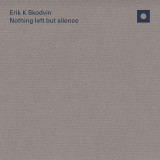
'Nothing left but silence' is Erik K Skodvin’s third solo album for Sonic Pieces and his most quiet to date. Subtitled as "Musical improvisations and quiet collages from the subconscious”, Skodvin reduces his instruments to guitar, reverb and amp - and creates a skeleton of eight hypnotic ragas that meanders in an eternal loop between ephemeral and singular.
Only on the horizon it’s possible to sense that Skodvin has also touched the neoclassical terrain in earlier productions - on Nothing left but silence, however, he acts as a twilight player who is not afraid of the coldness of endless space and who knows how to subjugate the shadowiness of the visible world. Carried by the noise of the amp and the occasional click of the effects pedals, a monolithic, reduced blues emerges, whose mediumistic quality nevertheless reveals that Skodvin's music always comes from the body - and as such is always searching for space. A space that - in this case - blends the vastness of the Norwegian steppe with the brittleness of American wasteland (as if Deathprod and Loren Connors were one and the same person), creating a persistent state between deceleration and absence of presence - that leads Skodvin ever closer to the inner essence of sound.
Initially recorded at Saal 3, Funkhaus, Berlin by Nils Frahm in 2015, the album has itself been subjected to silence as a forgotten relic, re-found and now released in a time where it might connect more with the contemporary state of mind. Welcome to the entrance to the periphery.
Mit der Veröffentlichung des ersten Full-Length-Albums "Entropic Reflections Continuum: Dimensional Unravel" wurde sofort deutlich, dass VoidCeremony einen Weg beschritten, den nur wenige gehen. Das Album bewies, dass Death Metal mit dem gleitenden, kontrollierten Chaos und dem geschmeidigen Fluss eines Jazz-Quartetts dargeboten werden kann und den Hörer dennoch in einem Kerker gefangen hält, mit wenig HP, ohne Zaubersprüche und umgeben von tödlichen Dämonen.
"Threads of Unknowing" ist eine Reise, die frühere Konzepte wieder aufleben lässt und immer progressivere und technischere Kompositionen hervorbringt. Mastermind und Gitarrist/Sänger Garrett Johnson sowie Gitarrenvirtuose Phil Tougas (Atramentus, Chthe'ilist, Worm, First Fragment) teilen sich hier den Gesang und die Leadgitarre, während Bass-Gott Damon Good sowohl den bundierten als auch den fretless Bass meisterhaft beherrscht und Schlagzeuger Charlie Koryn nicht nur Geschwindigkeit und Brutalität, sondern auch eine feine Mischung aus Präzision und Improvisation aus dem Jazz-Fusion einbringt. Das Endergebnis ist VoidCeremony und ihr unverkennbarer Sound: Zeitschmelzender Death Black Fusion.
Mit einem treffenden Coverbild, das die lyrische und philosophische Vision einer alten und vergessenen Zukunft darstellt, scheint VoidCeremony selbst in einer alternativen Death Metal-Zeitlinie zu operieren, die einst nur kurz präsentierte und bald für mehr kommerzielle Attraktivität zurückgelassen wurde. Doch das Portal hat sich wieder geöffnet und die Verschmelzung dieser grenzenlosen Möglichkeiten und Richtungen wird nun wieder direkt hervorgebracht.
- Das erste Album in voller Länge seit dem Debüt "Entropic Reflections Continuum" von 2020
- Die Vinyl-Version enthält eine Klappeinlage
- Cover-Gemälde von Juanjo Castellano (Majesties, The Black Dahlia Murder, etc.)
- Die Band besteht aus Mitgliedern von Atramentus, Worm, Mournful Congregation, Stargazer, Ascended Dead, Incantation, Chthe'ilist und First Fragment
- Gemischt und gemastert, mit zusätzlichen Synthies von Gabriele Gramaglia von Cosmic Putrefaction
- FFO: Stargazer, Pestilence, Chthe'ilist, Morbid Angel, Immolation, The Chasm, Aenigmatum, Atheist, Timeghoul, Liers in Wait, Innana
Mit der Veröffentlichung des ersten Full-Length-Albums "Entropic Reflections Continuum: Dimensional Unravel" wurde sofort deutlich, dass VoidCeremony einen Weg beschritten, den nur wenige gehen. Das Album bewies, dass Death Metal mit dem gleitenden, kontrollierten Chaos und dem geschmeidigen Fluss eines Jazz-Quartetts dargeboten werden kann und den Hörer dennoch in einem Kerker gefangen hält, mit wenig HP, ohne Zaubersprüche und umgeben von tödlichen Dämonen.
"Threads of Unknowing" ist eine Reise, die frühere Konzepte wieder aufleben lässt und immer progressivere und technischere Kompositionen hervorbringt. Mastermind und Gitarrist/Sänger Garrett Johnson sowie Gitarrenvirtuose Phil Tougas (Atramentus, Chthe'ilist, Worm, First Fragment) teilen sich hier den Gesang und die Leadgitarre, während Bass-Gott Damon Good sowohl den bundierten als auch den fretless Bass meisterhaft beherrscht und Schlagzeuger Charlie Koryn nicht nur Geschwindigkeit und Brutalität, sondern auch eine feine Mischung aus Präzision und Improvisation aus dem Jazz-Fusion einbringt. Das Endergebnis ist VoidCeremony und ihr unverkennbarer Sound: Zeitschmelzender Death Black Fusion.
Mit einem treffenden Coverbild, das die lyrische und philosophische Vision einer alten und vergessenen Zukunft darstellt, scheint VoidCeremony selbst in einer alternativen Death Metal-Zeitlinie zu operieren, die einst nur kurz präsentierte und bald für mehr kommerzielle Attraktivität zurückgelassen wurde. Doch das Portal hat sich wieder geöffnet und die Verschmelzung dieser grenzenlosen Möglichkeiten und Richtungen wird nun wieder direkt hervorgebracht.
- Das erste Album in voller Länge seit dem Debüt "Entropic Reflections Continuum" von 2020
- Die Vinyl-Version enthält eine Klappeinlage
- Cover-Gemälde von Juanjo Castellano (Majesties, The Black Dahlia Murder, etc.)
- Die Band besteht aus Mitgliedern von Atramentus, Worm, Mournful Congregation, Stargazer, Ascended Dead, Incantation, Chthe'ilist und First Fragment
- Gemischt und gemastert, mit zusätzlichen Synthies von Gabriele Gramaglia von Cosmic Putrefaction
- FFO: Stargazer, Pestilence, Chthe'ilist, Morbid Angel, Immolation, The Chasm, Aenigmatum, Atheist, Timeghoul, Liers in Wait, Innana
After the ambitious A Distant (Dark) Source (2018) and the subsequent artistic triumph of its live recording in 2021, French avant-garde metal outfit HYPNO5E return with their sixth studio album. Once more, these four visionary musicians and cinematographers take us back to the lost shores of the palaeolithic Lake Tauca, where we dive deeper into its dark source to fnd vibrant visions of a memory both distant and hazy as well as warm and evocative. Sheol shows HYPNO5E at the top of their game, revealing the epitome of their idiosyncratic sound while also exploring new and exciting aspects of their artistic identity. Since 2006 HYPNO5E have been taking grand strides in honing their brand of cinematographic metal, with each of their albums developing elements that would become essential building blocks to their sound. Their 2007 debut album Des Deux l'Une Est l'Autre harnessed a raw, chaotic energy, while the following Acid Mist Tomorrow (2012) saw them apply a hazy filter to their ferocious sound. On Shores of the Abstract Line (2015) HYPNO5E already transformed into the true modern metal grandmasters they are today, while the special soundtrack album Alba - Les Ombres Errantes explored a more subdued acoustic side of the band. Sheol sees the band sounding warmer and brighter than anywhere else in their storied discography, and the arrival of new drummer Pierre Rettien and bass player Charles Villanueva adds a fresh touch the classic HYPNO5E sound. The sweeping finales of «Lands of Haze» and «The Dreamer and His Dream» as well as the pastoral qualities of the quiet finger-picked parts on «Bone Dust» and «Lava From The Sky» hearken back to the old prog rock records of the seventies, albeit with an updated sonic palette and modern production parameters. Besides, these eight tracks also see the band carefully exploring new patterns, shapes, and forms within their own musical universe: from the alternating use of ritardando and accelerando on the aforementioned rim-clicks to the increased employment of string sections and vocal harmonies. With the addition of a whole new palette of warmer and brighter tones, HYPNO5E superbly bridge the sounds of the modern progressive metal and retro prog-movements creating an evocative sonic experience. FOR FANS OF Gojira, Opeth, Periphery, Uneven Structure, Steven Wilson Limited (100 copies ww) Single Colour (Gold Vinyl) Edition!
Soreab – Sensitivity 6.0 Soreab debuts on Avian.
Dario Picchi, whose repertoire includes forays into Dancehall, Bass Music and genres less easily classified, alongside a spate of intriguing collaborations, keeps things sparse on Sensitivity 6.0. The six track EP offers up idiosyncratic takes on IDM, Techno and Ambient music with a focus on intricate sound design, showcasing the Baroque Sunburst label head’s admirable versatility as a producer.
Brazen opener Squirrel Stampede might surprise listeners expecting a more delicate approach from the EP title. Neatly layered and economic in its execution, it’s a forceful slice of modern Techno. Meditative follow up Trub marries a thick, undulating percussion line with a saccharine melody. Loose synths emerge sporadically from the sonic periphery, breaking up the rolling drum pattern to create a cinematic atmosphere. Closing out the A side is Giale Draws, an intriguing beatless piece with nods to both vintage Musique concrète and more contemporary compositions from the electronic music leftfield.
On the B side, Soreab ups the tempo and goes fathoms deep with the cavernous Dust Eater. Landing somewhere between Autonomic Drum & Bass and Dub Techno, it sets the tone for the dense… more