Tape
Charlemagne Palestine (born Charles Martin ni 1947 in Brooklyn, New York) wrote intense, ritualistic music in the 1970s, intended by the composer to rub against audiences' expectations of what is beautiful and meaningful in music. A composer-performer, he always performed his own works as soloist. His earliest works were compositions for carillon and electronic drones, and he is best known for his intensely performed piano works. He also performs as a vocalist. Palestine's performance style is ritualistic; he generally surrounds himself (and his piano) with stuffed animals, smokes large numbers of kretek (Indonesian clove cigarettes) and drinks cognac.
Oren Ambarchi (born 1969 in Australia) is a composer and multi-instrumentalist with longstanding interests in transcending conventional instrumental approaches. His work focuses mainly on the exploration of the guitar, "re-routing the instrument into a zone of alien abstraction where it's no longer easily identifiable as itself. Instead, it's a laboratory for extended sonic investigation". (The Wire, UK).
Oren Ambarchi's works are hesitant and tense extended songforms located in the cracks between several schools: modern electronics and processing; laminal improvisation and minimalism; hushed, pensive songwriting; the deceptive simplicity and temporal suspensions of composers such as Morton Feldman and Alvin Lucier; and the physicality of rock music, slowed down and stripped back to its bare bones, abstracted and replaced with pure signal.
From the late 90's his experiments in guitar abstraction and extended technique have led to a more personal and unique sound-world incorporating a broader palette of instruments and sensibilities. On releases such as Grapes From The Estate and In The Pendulum's Embrace Ambarchi has employed glass harmonica, strings, bells, piano, drums and percussion, creating fragile textures as light as air which tenuously coexist with the deep, wall-shaking bass tones derived from his guitar.
Ambarchi works with simple constructs and parameters; exploring one idea over an extended duration and patiently teasing every nuance and implication from each texture; the phenomena of sum and difference tones; carefully tended arrangements that unravel gently; unprepossessing melodies that slowly work their way through various permutations; resulting in an otherworldly, cumulative impact of patiently unfolding compositions.
Ambarchi has performed and recorded with a diverse array of artists such as Fennesz, Otomo Yoshihide, Pimmon, Keiji Haino, John Zorn, Rizili, Voice Crack, Jim O'Rourke, Keith Rowe, Phill Niblock, Dave Grohl, Gunter Muller, Evan Parker, z'ev, Toshimaru Nakamura, Peter Rehberg, Merzbow, Kassel Jaeger, Anthony Pateras, Crys Cole, Giuseppe Ielasi, Judith Hamann, Sunn 0))), James Rushford, Stephen O'Malley and many more.
For 10 years together with Robbie Avenaim, Ambarchi was the co-organiser of the What Is Music? festival, Australia's premier annual showcase of local and international experimental music. Ambarchi now curates the Maximum Arousal series at The Toff In Town in Melbourne and has recently co-produced an Australian television series on experimental music called Subsonics. Ambarchi co-curated the sound program for the 2008 Yokohama Triennale. Ambarchi has released numerous recordings for international labels such as Touch, Southern Lord, Table Of The Elements and Tzadik.
Belgian drummer Eric Thielemans is one of the most idiosyncratic figures in Belgian music, someone who not only demonstrates that special musicians always seek out (and find) their own place, but above all that they always remain students of the art of questioning and listening. No musician better illustrates the difference between playing music and playing with music than percussionist Eric Thielemans. He gets to the heart of the matter with an at times extremely minimalist approach, but on the other hand he frequently relies on a range of objects beyond the regular drum kit: a drum placed on its side, a bicycle wheel with a bow, hands and the body.
Search:permutation
Tape
Charlemagne Palestine (born Charles Martin ni 1947 in Brooklyn, New York) wrote intense, ritualistic music in the 1970s, intended by the composer to rub against audiences' expectations of what is beautiful and meaningful in music. A composer-performer, he always performed his own works as soloist. His earliest works were compositions for carillon and electronic drones, and he is best known for his intensely performed piano works. He also performs as a vocalist. Palestine's performance style is ritualistic; he generally surrounds himself (and his piano) with stuffed animals, smokes large numbers of kretek (Indonesian clove cigarettes) and drinks cognac.
Oren Ambarchi (born 1969 in Australia) is a composer and multi-instrumentalist with longstanding interests in transcending conventional instrumental approaches. His work focuses mainly on the exploration of the guitar, "re-routing the instrument into a zone of alien abstraction where it's no longer easily identifiable as itself. Instead, it's a laboratory for extended sonic investigation". (The Wire, UK).
Oren Ambarchi's works are hesitant and tense extended songforms located in the cracks between several schools: modern electronics and processing; laminal improvisation and minimalism; hushed, pensive songwriting; the deceptive simplicity and temporal suspensions of composers such as Morton Feldman and Alvin Lucier; and the physicality of rock music, slowed down and stripped back to its bare bones, abstracted and replaced with pure signal.
From the late 90's his experiments in guitar abstraction and extended technique have led to a more personal and unique sound-world incorporating a broader palette of instruments and sensibilities. On releases such as Grapes From The Estate and In The Pendulum's Embrace Ambarchi has employed glass harmonica, strings, bells, piano, drums and percussion, creating fragile textures as light as air which tenuously coexist with the deep, wall-shaking bass tones derived from his guitar.
Ambarchi works with simple constructs and parameters; exploring one idea over an extended duration and patiently teasing every nuance and implication from each texture; the phenomena of sum and difference tones; carefully tended arrangements that unravel gently; unprepossessing melodies that slowly work their way through various permutations; resulting in an otherworldly, cumulative impact of patiently unfolding compositions.
Ambarchi has performed and recorded with a diverse array of artists such as Fennesz, Otomo Yoshihide, Pimmon, Keiji Haino, John Zorn, Rizili, Voice Crack, Jim O'Rourke, Keith Rowe, Phill Niblock, Dave Grohl, Gunter Muller, Evan Parker, z'ev, Toshimaru Nakamura, Peter Rehberg, Merzbow, Kassel Jaeger, Anthony Pateras, Crys Cole, Giuseppe Ielasi, Judith Hamann, Sunn 0))), James Rushford, Stephen O'Malley and many more.
For 10 years together with Robbie Avenaim, Ambarchi was the co-organiser of the What Is Music? festival, Australia's premier annual showcase of local and international experimental music. Ambarchi now curates the Maximum Arousal series at The Toff In Town in Melbourne and has recently co-produced an Australian television series on experimental music called Subsonics. Ambarchi co-curated the sound program for the 2008 Yokohama Triennale. Ambarchi has released numerous recordings for international labels such as Touch, Southern Lord, Table Of The Elements and Tzadik.
Belgian drummer Eric Thielemans is one of the most idiosyncratic figures in Belgian music, someone who not only demonstrates that special musicians always seek out (and find) their own place, but above all that they always remain students of the art of questioning and listening. No musician better illustrates the difference between playing music and playing with music than percussionist Eric Thielemans. He gets to the heart of the matter with an at times extremely minimalist approach, but on the other hand he frequently relies on a range of objects beyond the regular drum kit: a drum placed on its side, a bicycle wheel with a bow, hands and the body.
American jazz pianist Chuck Marohnic was in Denmark in the summer of
1981 on a European tour, when he recorded this intriguing solo album in
Copenhagen
Marohnic (b. 1941) has an impressive background having played with Ira Sullivan,
Eddie Jefferson, Richie Cole, Bill Hardman, Junior Cook, Chet Baker, Buddy Rich to
mention a few.
"The eight performances here are bright and absorbing examples of what
Marohnic means when he says that awareness of the harmonic permutations of
a tune gives a musician great freedom." - Chris Sheridan
The Howling is a collaborative project started by writer Ken Hollings and sound artist Howlround devoted exclusively to their shared love of text, audiotape and trash aesthetics. An intense collision of spoken word and analogue tape effects, the Howling's first performance took place at the Iklectik in September 2019 as part of a special programme to celebrate The Tapeworm's 10th anniversary.
Despite the pandemic, they have managed to continue working and conferring together since then, sharing sound files, texts and mixes online, which has resulted in All Hail Mega Force, their first full-length release for The Tapeworm. The two extended tracks contained on this audiocassette reflect their shared interest in Fluxus and how informal rules and permutations can be set up to work themselves out through loops and repetitions. A straight line connects Terry Riley's tape experiments in Paris from the early 60s with their experimental recordings in the Wimpy Bar on Streatham High Road, one of their favourite meeting places. 'The idea of instant, disposable one-off creations appealed to us a lot at the time,' The Howling explain, 'particularly as both pieces were conceived and developed during different phases of Covid lockdown in the UK.'
The title and source material are derived from the kid's adventure movie MegaForce, starring Barry Bostwik and Michael Beck. Designed to sell a range of Mattel hi-tech action toys, MegaForce tanked at the box office but lives on in the collective consciousness of those who share with The Howling a special love for Trash and Trash Aesthetics.
The two tracks also share similarities in approach and realization.
'All Hail Mega Force' was created by reading combinations of the words 'All Hail Mega Force' into a voice memo recorder, transferring it to tape, cutting the whole thing as a single long loop and then stretching it across three reel-to-reel machines simultaneously, using two pencils and a pint glass full of loose change to try and maintain sufficient playback tension. Over time the loop started to degrade, which accounts for the increasingly slurry and unpredictable playback, plus frequent ruptures caused by the tape becoming jammed and having to be tugged through the machine workings by hand. Twenty-four minutes later and the result was a completed new work and a slight backache.
The text for 'Are You Man Enough For Mega Force?' was recorded live in the Wimpy Bar on Streatham High Road, 28 November 2021. It was cut to tape and looped on 3 December 2021 at Warrior Studios, Loughborough Junction. Dragged by motor and then by hand across two tape machines with copious amounts of closed input feedback provided by a third rushing in to fill the gaps. One take with no effects or overdubs, but one tiny edit in the middle when something fell over.
Three years have passed since the world first learned of Ursula Bogner's work. Since then, her identity has been surrounded by rumours, her graphic work have been exhibited (CEACC, Strasbourg, France, 2011 and elsewhere) and her compositional instructions have been performed (by Mo Loschelder, Andrew Pekler, Kassian Troyer, Jan Jelinek among others). The release of Sonne = Blackbox brings together all of these aspects in one CD and book: compiled by Andrew Pekler, the CD presents Bogner's early experiments with voice and tape music – a previously unknown emotional side of her music is revealed here through her singing. The 126 page book contains, along with drawings, photos and other curiosities from Bogner’s life, an introduction by Jan Jelinek, texts by Momus, Andrew Pekler, Tim Tetzner, and Bettina Klein as well as interviews with the orgone researcher Jürgen Fischer and the ethnographer Kiwi Menrath. Sonne = Blackbox attempts to locate Ursula Bogner, the sound experimentalist within broader cultural history. A central theme is the phenomenon of fake: how did the erroneous suspicion of fakery come about in the case of Ursula Bogner and what is a post-fake? Answers in this book.
Re-issue of 1968 album by British jazz guitarist (born January 2, 1933 in Doncaster, England). He played with Norman Burns, "Ray Ellington's Quartet", Benny Goodman (in tour in England, 1971), "Don Lusher's Big Band", and as a session man in the 1970s, 1980s and 1990s.
Judd uses varying permutations of the following instruments on various tracks. Twelve string guitar, electric Fender guitar, electric Gibson guitar (L4) with a Charlie Christian bar pick-up, and a Maton acoustic guitar.
Both noted for strikingly forward-thinking bodies of solo work dating back to the 1990s, the duo of Andrew Pekler & Giuseppe Ielasi - collaborators for the better part of a decade - reemerge with 'Palimpsests’, their first outing with Shelter Press. Built from deconstructed layers of texture, tone, and arrhythmic percussiveness, the album’s 2 sides distill 6 years of work into 9 splintered, airy reimaginings of minimalism - each surprising, creatively rigorous, and startlingly beautiful - that rest at the outer reaches of contemporary electroacoustic practice and musique concrète.
Based in Berlin and Milan respectively, Andrew Pekler and Giuseppe Ielasi have individually carved singular paths across numerous disciplines within experimental music for more than 20 years, each deploying sampling, synthesis, and acoustic sources to weave their own, distinct worlds of sonorous abstraction. Brought together by years of friendship and a shared devotion to layered texture and complex, fractured structure, the pair first joined their creative energies in 2013, a collaboration that culminated as the LP, ‘Holiday For Sampler’, issued by Planam.
'Palimpsests’, the duo’s second outing, draws its material from a series of improvisations made by the Pekler and Ielasi in Milan during 2015. Over the ensuing six years, those recordings would undergo various transformations - cut, reworked, sampled, and added to by each artist, working at geographic distance between Berlin, Kyoto and Monza - before culminating, like the album’s title suggests, as a unique manifestation of musical palimpsest; “an object reused and altered, while still bearing visible traces of its earlier form”.
With each of the album’s compositions nodding toward a city with which Pekler and Ielasi hold biographical connections, 'Palimpsests’ constructs sound as poetic metaphor; a series of ghosts - traces of memory, image, and action - cut and reassembled, in cycling permutations, before been set into action at a glacial pace with layered, transparent forms.
Defined by remarkable restraint and pointillistic precision, across the album’s two sides Pekler and Ielasi weave the fractured remnants of their sessions - reduced to glitches and warbling fragments of texture and tonality - into pulsing expanses of spatial ambiance that defy imagism, blur the boundaries between the synthetic and organic - reducing their sources to a series of unknowns - recast the boundaries of electroacoustic practice on markedly singular terms.
Shelter Press is thrilled to present 'Palimpsests’, another brilliant outing from the duo of Andrew Pekler and Giuseppe Ielasi. Issued in a limited edition of 500 copies on black vinyl, with artworks on printed inner and outer sleeves by Traianos Pakioufakis.
2023 Repress
Black Truffle is pleased to announce the first-ever vinyl reissue of Alvin Curran’s classic Fiori Chiari, Fiori Oscuri, originally issued in 1978 on Ananda, the cooperative label run by Curran, Roberto Laneri, and Giacinto Scelsi. Fiori Chiari, Fiori Oscuri (Light Flowers Dark Flowers) – its title inspired by an intersection in Milan – is the second in the series of four solo recordings Alvin Curran issued in the 1970s and early 1980s, preceded by Songs and Views from the Magnetic Garden (1975), followed by The Works (1980) and Canti Illuminati (1982).
Each of these solo works combines field recordings with performances on synthesiser, various acoustic instruments, and voice, arranged in languorously paced, dreamy sequences. Far from the bracing pointillism of much musique concrete, the elements encountered on the meandering course followed by Fiori Chiari, Fiori Oscuri – whether a frenetic piano improvisation, dense layers of Serge synthesiser and ocarina, or a monologue from Frederic Rzewski’s five-year old son, Alexis – often occupy the foreground of our attention for minutes at a time. As Curran explains, his approach is like that of a filmmaker in the editing process, working with “whole blocks of recorded time”. The purring of a cat, toy piano, a child counting, plaintive synthesiser tones, the cacophony of exotic birds at the London Zoo – each disappears into the next, until, on the LP’s second side, a solo piano performance takes centre stage, moving unexpectedly from percussive minimalist permutations to a halting rendition of Georgia on My Mind. A subtle yet stunning work that more than forty years on still seems charged with possibility, Fiori Chiari, Fiori Oscuri arrives in a loving reproduction of the original sleeve, featuring Edith Schloss’ beautiful cover painting, remastered audio and with new liner notes by Alvin Curran and Francis Plagne.
'Leone' is the first meeting of electric guitarists Loren Connors and Oren Ambarchi. It's somewhat surprising it's taken this long as these two are connected by ongoing collaborators, like Jim O'Rourke and Keiji Haino. Connors, for more than 40 years, developed an iconic sound tethered to radical permutations of the blues. Ambarchi's own multi-decade transfiguration of the guitar inhabits a rarefied realm of abstracted tones and dissonance pitched between improvisation and composition. This album, like its title, is a sum of parts: solo performances by Connors and Ambarchi bookend a duo. On 'Lorn,' Connors unravels an aggressive ternary form, with an opening section wrapped in distortion and extreme phasing that contrasts against ghostly, distant single notes. Ambarchi's 'Nor,' supplants a guitar performance with melodic, shifting organ-like tones that are swallowed into a fluttering, glitchy squall. On 'Ronnel,' the duo, each audio landscape created by the two slowly rotates and overlaps the other, as if each is drawing the others' portrait on opposite sides of a translucent sheet. Recorded November 2017 by Bob Bellerue at the Issue Project Room. Mixed and mastered by Joe Talia and cut by Carl Saff. Cover illustration by Marissa Huber. Edition of 500; includes download.
“The earth shall rise again...”
AMOR/LEMUR finds the Glasgow quartet AMOR in partnership with Norwegian improvising ensemble LEMUR to hopeful and ecstatic effect. Conceived before the onset of Covid 19 but finished during spring lockdown, their eponymous EP is the most loose, alive and elevated recording in AMOR’s catalog. AMOR/LEMUR takes the template of throbbing avant disco expanded upon on previous recordings for Night School and lifts it into new
territories, with new tonalities and unexpected turns on the journey. More than anything, the expanded, near- cinematic expression of human connectivity feels like a lightning new energy to grasp in the dark.
Following a revelatory concert in Glasgow in January 2020 wherein the two sets of musicians met and performed together for the first time, a recording session was arranged the following day, resulting in the most elevated permutation of AMOR’s art to date. Each track was built upon a rhythmic bedrock of percussion and drums performed by Paul Thomson and samples/synthesizer by Luke Fowler. Thomson used bamboo Javanese gamelan (most notably on For You) and scrap metal, as well as traditional percussion and drums while Fowler incorporated processed ambient field recordings recorded in enclosed acoustic spaces around Glasgow. Singer/pianist Richard Youngs contributes some of the most bright and mindful work of his career. Acoustic bass player Michael Francis Duch, whose lush playing as ever provides the elastic spine to each song, scored the string parts for LEMUR on piano at home in Norway. The addition of swelling strings and drones fills out the AMOR sound significantly, lending a sonorous tone to 8 minute, epic closer For You or an ascending melodic introduction to Stars Burst that feels like a new morning dawning on a world saved from certain death. With the circumstances of lockdown forcing the musicians to work differently, a thread of optimism and utopia grounded in the moment weaves through these tracks. Unravel reveals a spine tingling vocal from Youngs. It’s a song about the simultaneously grounding and ecstatic effect of love, feeling connected to others. It’s a simple message, “I’m finding myself in your smile, always unravels me” speaks of ego death, the dissipation of the material into a nirvana of pure energy, the power of surrender. This isn’t a quasi-religious message, this is the power of each other, a love song to connection in a temporary age of isolation. Stars Burst is a play on the inner and outer cosmos, with narrator Youngs exploring wonder to a pounding galloping rhythm and snake-charming synth. It’s an open dance, with the group locked in together for the wild ride. Fear is the centerpiece of the record, starting with drones and scraped overtones before swirling synth notes filter upwards to meet reverberating minor chords. Over 8 minutes of tight but loose playing, Youngs is the shaman instructing us to use Fear as a celebration of the moment, embrace it and jump into the unknown. The only way to overcome your fear is to feel it, use it as an energy. The use of the studio as an instrument throughout side 2 is particularly important, with the dubbing and mixing prowess of engineer Paul Savage (who mixed unattended due to lockdown restrictions) and tape manipulations performed by Jason Lescallet coming into play. For You closes out with a largely instrumental, evolving composition that uses many of the abstract and novel aspects of this permutation to aid the trance. It’s massive, an unfurling creature with unexpected tonalities and serious heft.
Repress!
Cutting edge innovators Rashad Becker and Mark Fell re-work material from Sote’s extraordinary ‘Parallel Persia’ album alongside a killer non-album track by Ata Ebtekar aka Sote himself. Highly recommended if yr into the complex tunings and arrhythmic geometry of Dariush Dolat-Shahi, Autechre, Xenakis...
Last year’s ‘Paralell Persia’ album took the trajectory of his preceding ‘Hardcore Sounds From Tehran’ (2016) and ‘Sacred Horror In Design’ (2017) to thrilling new heights for Diagonal. Turning traditional instrumental music inside-out with computers and modular synths, he arrived at a thrilling mix of sound that stood out as one of the year’s most original and striking releases.
Wrapped around the incendiary core of ‘Artificial Neutrality’ which features Pouya Damadi’s Tar and Arash Bolouri’s Santour sculpted into fiery folk futurism by Sote, the remixes by celebrated mastering engineer and improvising composer Rashad Becker and minimalist rhythmatist Mark Fell exert incredible new spins on Sote’s originals that remain faithful to the material in their inimitable styles.
Rashad Becker’s Dramatic Reenactment of ‘Pseudo Scholastic’ combs and curdles the original into 7 segmented minutes of squirming tones and melted rhythms that, through twists and turns, come to recall Korean classical court music and Florian Hecker as much as they recall the original.
Mark Fell, meanwhile, impresses with his quadruply extended 20 minute Parallel Yorkshire mutation of ‘Modality Transporter’, where he unravels its syncopated flex in endless permutations of laser-guided pulse drops, puckered strings and choral stabs that come to sound like Autechre letting off fireworks at a Dariush Dolat-Shahi show.
a 1. Pseudo Scholastic Dramatic Reenactment - Rashad Becker (06:59)
Parallel Yorkshire - Mark Fell (19:50)
In the spirit of global collaboration, Specials Worldwide’s first release comes courtesy of Vancouver’s own ZDBT & Washington, DC’s own Dreamcast. The collaborative “On Love EP" between the producer and singer/songwriter is a musical anthology of 2019 “love in this club” anthems, featuring the lead single “Take A Chance (On Love)” and B-Side “Time For You”.
The EP is the end result of a multi-day studio session in August of 2018 when Dreamcast was invited out to Vancouver for a live show with locally based imprint Pacific Rhythm. With immediate chemistry abound, the result was “Take A Chance (On Love)”, a beautiful permutation of R&B and Techno that melds the soulful vocals of Dreamcast with the peak time Techno of ZDBT (known for his work with 1800HaightStreet on labels like Lobster Theremin). B-Side “Time For You” is a slowed down, dubbed out one-take vocal with Dreamcast featuring his soaring vocal range over moody Techno chords, resulting in another ode to the pursuit of finding love in the club.
Rounding out the EP is a blissed out, Trance tinged take on “Take A Chance (On Love)” courtesy of Montreal based producer Project Pablo and an even deeper, dubbier version of “Time For You” by DJ Sports, the Danish producer and member of Århus based collective Regelbau.
In addition to the inclusion on the "Movements Vol.10" double-gatefold LP we felt that a release of The Headliners' "Little Sister (Sho Nuf Fine)" on our beloved 45-rpm single format is more than justified.
Walt Maddox, owner of the Super M label on which "Little Sister" was released, started singing as a teenager on the street corners of his Manchester neighborhood on Pittsburgh's Northside.
In 1961 he joined The Marcels. ... In the following years they released three full length albums and numerous hit singles with sales in the millions. Maddox sang with the group through its many permutations for four decades before becoming its manager and producer in 1999.
Maddox produced The Headliners sole single which has become a sought after collectors item on the Northern Soul/Funk scene in recent years.
With their debut, MME dUO send us across an impulsive sound collage omniverse of enigmatic Dada - long live imperfection! Formerly working together as Sculptress of Sound, Cologne based Patricia Koellges and Tamara Lorenz make use of a variety of instruments and devices: DIY electroacoustics, small synths, loopers, tuning forks, electric bass, percussion and voice are thrown into the game and shape a sound that’s as diverse as it is striking. The four sides of the record are the four seasons of the year. The cover artwork depicts an oddly shaped honey locust situated just outside MME dUO’s rehearsal room; homebase for a year of recordings for awholerunboom. From spring to winter the album opens up a wayward palette of experimental music. Sweet Cold Night could be a soundtrack for a movie scene of ourselves trudging through a swamp. CutCut somehow sounds as if caught in a loop early in the morning after an extensive club night. RZCK, a deliberately stumbling forward percussion piece is the longest of the 21 tracks. Several video clips go along with awholerunboom, one of which features the artists going through some kind of a ritual exercise inside of a two person costume, trying to put things straight it seems. The track itself Isn’t It Isn’t functions by way of permutations of spoken phrases and it might actually make you wonder if Gertrude Stein had gone electric. Mixed and mastered by Volker Hennes. Cover artwork by MME dUO. Edition of 300.
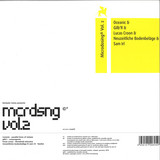
Microdosing is a series of compilation 12”s selected by Julienne Dessagne aka Fantastic Twins, and designed in collaboration with French visual artist Geff Pellet. Microdosing is a collective experiment aimed at helping you fighting back your modern obsession with happiness. You may deserve a nice day but the day does not need a nice you, nothing should be forced, everything is permitted. Microdosing will provide you with sonic healing weapons on regular basis and at irregular dosage. Those doses will favour psychedelic social techniques against self help tyranny, creation over soma, provoking over numbing, our outer-selves over our inner-selves. Microdosing refuses the fatality of the pleasure principle. Life is a struggle, time to embrace it. —— "My battery is low and it’s getting dark” We at Microdosing will make Opportunity’s famous last words fully ours. Some would see these as an epitaph on a black screen, we embrace them as a reclaimed fragility. Are we grains of sand wandering in space, hoping for a goal? No. We are the cosmos, the cosmos is us, unafraid of the end, unafraid of the void. Before the rise of the infinite silence, Microdosing brings you new guiding lights, white sun or black hole being a simple permutation of the kinetic rainbow. Oceanic’s “Parallel Lines Of Stripes” is a meandering mantra, an synthesised Moebius ring, a mission to your heart, that furthest star in the sky. Gilb’R’s “Cosmogonie” simply reminds us of the profound relation between spatial systems and the holy act of birth (cosmo, world and gon, conceive). The universe is a body, your body is your universe. Lucas Croon’s “Threshold Stimulus” is the soundtrack of a never ending voyage, the man is on a trip to the core sanctum. Imagine Space as a reverberation room cladded with bakelite. Losing yourself in delay repeats sometimes is the shortest way. Neuzeitliche Bodenbeläge & Sam Irl’s “Faeden” is another hymn to the umbilical chords joining us to the outer world, a black monolith of kraut acid, a pagan dance as portal to a destination only you can choose. Microdosing will be back soon with more enablers, helping to turn your petty struggles into a search for a meaning of life. The Quest lives on.
Yonder Kids get a deserved spotlight 20 years after the journey suddenly stopped.
A musical legacy which could have been lost in the background noise of time is finally edited, mastered and cut into vinyl.
Domestic Exile are proud to present the devastatingly deplorable and malevolent recordings (that are sure to corrode yet electrify your ears) by Glasgow's very own KLEFT.
KLEFT aka Vickie McDonald is rooted in and has actively propagated the underground DIY radical queer punk and feminist movement here in Glasgow. Their projects have included the skull crushing sludge doom of Cartilage, the unflinching and infamous multi- membered hard core stars that were DIVORCE and the sacrificial, druid drone glitch of MOURN. Alongside these projects they have uncompromisingly disrupted, motivated and facilitated collective endeavors to take down the capital power structure of the dominant system of patriarchal club venues and abhorrent fuckers in this town.
For this record 'H+ Sexualis', KLEFT explores the neo-modern space where flesh is left behind. Negotiating, analyzing and tearing to shreds the relationship and balance between flesh and technology. KLEFT's expansive and palpable sonic offerings delve into themes of transhumanism and body hacking and seep into our collective skin begging the question; can flesh ever be created digitally. Does a lack of physicality alienate human experience in a post transhumanism society Are we all destined to be skinless yet digitally connected Will the body become superfluous Toward "the utopian dream of the hope for a monstrous world without gender," as stated on Donna Haraway's essay ''A Cyborg Manifesto.'
From the opening track 'Ossein' the listener grasps a foreboding lethargic build up, lurking out of the spatial ritualistic shadows into a sea of suffocating nothingness. A void where there is no gravity. Skeletal and brittle shattering rhythms which echo DMZ / Skull Disco dubstep alongside the more frozen, glacial ominous explorations of grime are often felt proving KLEFT is an artist whose inspirations run deep and wide and generally exist in the darkest recesses of our subconscious. These fearful, disjointed rhythms are set against weightless atmospheric oscillated synths, as if roaming through bleakly opaque, claustrophobic narrow corridors on a first person survival horror video game such as Resident Evil.
Moving through to 'CMBR', KLEFT's dissonant, degrading soundscape ferociously ascends. The resilient kick drum is propulsive and pulverizing akin to 'ardcore tekno - or intense gabba if you have the guts to adjust the tempo up to +8 - aesthetics that overwhelm and agitate finally revealing it's grotesque biological / amorphous bio structure. Elevating the repetitive 4/4 kick to a destructive, distorted banger of a track as layers of converging atonal noise and sound design simultaneously further enhances the sense of imminent radioactive contamination.
Next is 'Writhe, Squirm, Broken' continuing the convulsive, nauseating permutations of the prior track but reconfigured like a mangled, gruesome Cronenberg-esque parasite that has infiltrated an open wound, excruciatingly feeding off of the inner anatomy of it's hosts body from within. Repulsively reformulating the shape and dimension. The intro is akin to a panic stricken bouncy ball contracting and expanding, the spring reverb building momentum and traveling further away in distance and speed.
'Hackfleisch Deluxe' is a muuurrderous stomper and is one of the more grime / bass orientated tracks that deconstructs and disrupts the tempo familiar to sub-low producers on Black Ops / Jon E Cash / DJ Dread D. The crawling, plummeting frequency of the synth is a nauseating rush of coagulating blood to the heed; a deep throbbing sensory depravation in sharp, paradoxical contrast with the driving harmony layered on top which proves to be infectiously addictive. Furthermore are splintering programmed vocal samples that gives a sense of artificial disorientation, mind over matter, a possible hint at our evolving sentient cognition within a nightmarish simulated, augmented reality
Second to last we have 'Keratin' which is filled with the near fatal dissolving thud of Djax-Up acid that gives the impression that you're a biologist peering through a microscope into a petrie dish and witnessing the rapid and furious genetic cellular replication of bacterial and viral organisms.
Culminating in 'Bruised and Bleeding Hands' where the squashed density of a deflated and depressurized helium filled balloon and elastic umbilical cords, barbed wire and copper wires grind n' coil around the lens of a zooming camera. Taking no prisoners, this is a punishing grime weapon. A phat, surgical kick drum bulldozes its way thru causing carnage, syncopated punching snares after every rave stab and dizzying third beat. It won't be long until ye hear this on Silver Drizzle's youtube channel in the near future.
This record transports us to the hyperkinetic mutation scene on the cult cyberpunk film Tetsuo The Iron Man where the organic flesh / mechanical rust of the Iron Man metamorphoses with the Metal Fetishist during the rebirth sequence and we say 'LONG LIVE THE NEW FLESH!''.
After nearly a decade in the making, Zomby finally dispatches Mercury's Rainbow, his astonishing and uniquely formulated dedication to Wiley's series of Eskibeat releases, a.k.a. the cornerstone of grime.
Originally recorded over an intense couple of weeks while suffering from circadian dysrhythmia,
Mercury's Rainbow documents Zomby riffing on intricately hand-programmed arpeggios, using theories of colour and its relation to the sonic chromatic spectrum - the circle of fifths - to place an expressively avant spin on the Wiley Kat's slyding Triton squares and frozen, post-garage drum patterns.
Rather than simply imitating Wiley's foundational unit of grime currency, Zomby innovates with a structure of bewildering, modal styles, refracting 16 diamond-cut permutations according to a colour-sound spectrum of tonalities. In the process he effectively loosens up and liquifies the Eski riddim, rendering its bones and sinew in varying states of reactive, physical deliquescence or GIF-like micro-organisms.
For dancers and DJs, the fluid contours and viscous, displaced rhythmic anticipation of Mercury's Rainbow suggests myriad geometries for movement in-the-mix, and serves to single-handedly put to sleep a whole genre of also-ran, prosaic 'future grime' thru its methodical, inventively ground-up construction.
While it's difficult to say with certainty, if Mercury's Rainbow was issued at the same time it was created, it may have arguably altered the course of UK grime instrumentals in much the same way
Wiley's original template coined a whole new genre, essentially making it the last word in grime futurism, proper.
On Arise , Zara McFarlane returns to a buoyant UK jazz scene with a head-turning third album. Exploring the musical possibilities of British-Jamaican identity, it's a cultural exchange that's born of London's current musical climate. Released on Gilles Peterson's Brownswood Recordings, it sees her working with much-feted drummer and producer Moses Boyd. Both rose through London's Tomorrow's Warriors programme, a finishing school for many young vanguards of the live, ascendant jazz scene springing up across the UK capital. Sharing Caribbean family heritages, it's a product of their joint exploration of the meeting points between jazz and the rhythms of Jamaica, reggae, Kumina, calypso and nyabinghi, shaded with hints of the psychedelic.
Zara's breakthrough 2012 track, a jazz cover of Junior Murvin's 'Police and Thieves', provided a jumping off point to further explore the blurred, colourful territory in between jazz and roots-reggae. Covering Nora Dean's 'Peace Begins Within', she breathes a syncopated groove into a soulful, reggae classic. A beautifully poised version of the Congos' Fisherman teases out the poignant lyrical content of the 1977 classic. Meanwhile new, original compositions from Zara, like 'Fussin' and Fightin'' and 'Freedom Chain', combine a deep, reverberating bass with a steady-stepping roots rhythm. Album opener 'Ode To Kumina' touches on the kumina tradition brought to Jamaica by indentured labourers from The Congo in the later part of the 19th Century. Part of Zara's deeper research into her Caribbean heritage, it alludes to a deep-rooted culture encompassing music, dance and religion.
Similarly, 'Silhouette' arose from that same research, in this case, however, it was about how records and documents often get lost in Jamaica. It kind of came out of the idea of black history and blackness and feeling like you're trying to find yourself,' she explains. Trying to be proud of your history and who you are. And never forgetting the things that brought you to where you are.' Alongside drummer Moses Boyd on production, the album features a stellar line up of some of the key players on the London scene Binker Golding on tenor sax, Peter Edwards on piano, Shirley Tetteh on guitar, Nathaniel Cross on Trombone and an unusually restrained turn on Clarinet from Shabaka Hutchings.
Shared between all of them is a tendency to find the common points between different musical ilks: from US hard bop jazz, to dub and London-rooted hybrids and permutations, the band on Arise reflect the musical diversity of their home. Boosted by new platforms, like East London showcase Church of Sound and a newly-refreshed Jazz Café, the record surfs the momentum currently propelling jazz-influenced music in the UK.
For Zara, Jamaica's musical legacy is deeply intertwined with her sense of the place itself. Spending whole summers in the hills of Jamaica, it's the sounds and smells which she most vividly associates with her stays there. In particular the local sound systems which were an everyday feature of the local area, be it in shops or bars, each of the small local shacks would have a sound system where they'd play music through the day and evening.
From where my nan used to live, in Cauldwell there's a sound system almost opposite her house,' she says. So you feel this boom of the bass, and then all the smells of the hills and the greenery of Hanover. When you land in Jamaica and you go to walk off of the plane, the heat and the smells hit you and it feels like home away from home for me. When I hear Jamaican music, these are the senses that come.'
Restive Plaggona is the music project of the Corfu-based artist Dimitris Doukas -also producing under Matriarchy Roots, Leftina Osha and Plaggona-. After releasing a series of cassettes in different labels along 2016 and 2017 -including his own Several Minor Promises- 'Leaving The Body' arrives as an electronic composition of beats and synthesizer bodies disguised as a sense of provocation and mystery. Each of the seven pieces offers more than a smattering of interesting textures separated by spans of great decline, but a master class of permutations in-between accompanying sounds, stretching rhythms and viscera-and- violence noises. Driven by a deeply expressive narrative, Restive Plaggona makes a strong statement about
his post-industrial vision adding technoid inclinations in a delightful dystopian world.