Jon Porras draws a staggering array of atmospheres out of even the simplest instrumentation. Across his work as one-half of psych-drone duo Barn Owl and his solo releases, Porras welds monoliths and ether into propulsive music that is deeply felt. Arroyo, named for the Spanish word for "stream" in a nod to Porras' heritage as a first generation Colombian?Japanese American, drifts gently from one tributary to the next in unhurried contemplation and euphoria. The portentous weight and abrasive textures of Porras' previous work give way to the trickle of richly detailed acoustic instruments slipping in and out of the fold. On Arroyo, Jon Porras evokes a distinct sense of resplendent anticipation and calm with a fathomless flow and softly gorgeous colors. For Porras, Arroyo became a rumination on simplicity and simple truths, a work of complete immersion and continuous motion where separate elements coalesce into an ever-changing whole. Porras spent the year leading up to 2020 living nomadically across Europe where he was able to soak in a deep appreciation for the effortless beauty of overgrown gardens, the basic principles of classical architecture and a more transient sensibility. The album was written and recorded in a time of even more change for Porras: after the birth of his daughter. Like a stream's steady glide across bedrock that waxes and wanes with each gradual turn, the music of Arroyo exhibits a transportive stillness. The compositions take on a light, gaseous buoyancy as discreet drones swell with measured fluctuations and ripples of piano rest atop the surface. Arroyo borrows harmonic concepts from modal jazz to create a unique sense of ease and endlessness. Each of the four pieces on the album centers around a single suspended chord, a chord most commonly associated with devotional music which embodies a space between harmonic tension and resolution. Porras embellishes that liminality with arrangements that feel less like distinguishable layers of instruments and more like one undulating nebula of sound. In the past decade of Porras' solo work, his music has grown increasingly engaged with elaborate synth textures and detailed processing. With Arroyo, Porras consciously takes a step back from those more intricate compositions and focuses on more organic, unadorned textures and places each sound with the same precision. Stark piano and guitar patiently hover over modest currents of Hammond organ and Yamaha DX7 with the sustain of each chord and phrase acting as a natural guide to the album's subtle rhythm. The four pieces that comprise Arroyo each encompass their own idyllic channel, slowly weaving their way in and out of the album's elegant stir. Porras' reflections on simplified elements take shape in gorgeous arrangements that impart clarity amidst a tranquil mist. Arroyo is an album that unearths splendor in a unified feeling of space, serenity in perpetual renewal
Search:perpetual motion
"This is the kind of songwriting I've always been drawn to," says Jeremy Ivey. "The perpetual motion, the intricate melodies, the sprawling arrangements. This album is the real me." Juxtaposing raw, unflinching personal reckonings with jaunty, buoyant melodies and rich, kaleidoscopic production, Invisible Pictures, Ivey's third album for ANTI- Records, is indeed a revelation. Though the songs are rooted in a 21st century swirl of chaos and uncertainty, the record is, at its core, an undeniably feel-good collection, one that refuses to surrender to the existential ache it so artfully captures. Instead, Ivey embraces the sheer, unmitigated joy of creative freedom and sonic exploration here, drawing on everything from flamenco and classical music to vintage indie rock and British Invasion tunes to craft a passionate, transcendent album more reminiscent of John Lennon or Elliott Smith than anything coming out of Nashville these days. "I try to put a little bit of hope into everything I do," Ivey reflects. "No matter how heavy, no matter how dark things may get, there's always a little bit of light shining through."
The seven-headed Aussie rock beast King Gizzard & The Lizard
Wizard return with a new vinyl edition of ‘Fishing For Fishies’,
perhaps their most perfectly-realised album to date.
The Eco Edition has been pressed on Eco-Mix vinyl and is housed
in a brown paper bag after previous pressings quickly sold out.
Released on the band’s own Flightless Records, here is a world
where the organic meets the automated; where the rustic meets
the robotic. Where the past and future collide in the beautiful
present.
‘Fishing For Fishies’ is a blues-infused blast of sonic boogie that
struts and shimmies through several moods and terrains. From the
soft shuffle Outback country of the opening title track through the
sunny easy listening of ‘The Bird Song’ (think a lysergically-soaked
Laurel Canyon circa 1973) and on through the party funk of
‘Plastic Boogie’ (which somehow summons the spirit of Stevie
Wonder’s ‘Innervisions’) the road-trucking, Doors-like highway
rock of ‘The Cruel Millennial’ and ‘Real’s Not Real’ - what
Carpenters might have sounded like had they existed entirely on
vegemite and weed - it’s a dizzying, dazzling display which
addresses a number of pertinent environmental issues along the
way.
“We tried to make a blues record,” says frontman Stu Mackenzie.
“A blues-boogie-shuffle-kinda-thing, but the songs kept fighting it -
or maybe it was us fighting them. Ultimately though we let the
songs guide us this time; we let them have their own personalities
and forge their own path. Paths of light, paths of darkness. This is
a collection of songs that went on wild journeys of transformation.”
Quiet though it was on the record front, 2018 was hardly a year of
rest for King Gizzard & The Lizard Wizard. In almost perpetual
motion, the band continued their unstoppable rise as their
juggernaut of a live show grew and grew and grew, with a mindblowing headline slot at Green Man Festival, a massive sold-out
US tour in the summer which saw them play their biggest venues
to date, a brain-frying sold out Brixton Academy show, two gigs in
Russia and Istanbul where they played in front of over 15,000
people and putting on the fourth edition of their annual Gizzfest in
Melbourne amongst the highlights.
MLD (Minimal Lethal Dose) was a Japanese project lead by Takayuki Shiraishi after his first mythical release with BGM on Vanity Records in 1980. Made with the help of Jun Sonohara it was active between 1983 and 1986 in Tokyo. This compilation collects nine unpublished tracks from the original tapes and confirms his unique offbeat style ranging from Post-Punk, Dub, and Industrial.
MLD (Minimal Lethal Dose) was a Japanese project lead by Takayuki Shiraishi after his first mythical release with BGM on Vanity Records in 1980.
Made with the help of Jun Sonohara it was active between 1983 and 1986 in Tokyo.
This compilation collects nine unpublished tracks from the original tapes and confirms his unique offbeat style ranging from Post-Punk, Dub, and Industrial.
It's completed by "Perpetual Motion" and "Dynamo" previously released in 1983.
With his quirky approach, this record unveils another piece of Japanese experimental music history.
All these tracks have been carefully remastered by Krikor Kouchian.
There’s a fundamental truth that Los Angeles musician and songwriter Lexi Vega embraces on Mini Trees’ debut album Always In Motion - time keeps moving forward, for better or worse. The consequences of this perpetual motion spark this latest collection of relatable indie-pop songs that acknowledge our collective anxiety about life’s improbability
Squid announce their debut album, ‘Bright Green Field’, already one of 2021’s most highly anticipated releases.
Produced by Dan Carey, ‘Bright Green Field’ is an album of towering scope and ambition, it is deeply considered, paced and intricately constructed. With all band members playing such a vital and equal role, this album is very much the product of five heads operating as one.
Some bands might be tempted to include previous singles on their debut - and the band already released two more in 2020 via ‘Sludge’ and ‘Broadcaster’ - but instead ‘Bright Green Field’ is completely new. This sense of limitlessness and perpetual forward motion is one of the key ingredients that makes Squid so loved by fans and critics alike, from 6 Music, who have A-Listed previous singles ‘Houseplants’, ‘The Cleaner’ and ‘Match Bet’, to publications such as The Guardian, NME, The Face, The Quietus and countless others. The band was also on the longlist for the BBC Music Sound Of 2020 poll.
‘Bright Green Field’ features field recordings of ringing church bells, tooting bees, microphones swinging from the ceiling orbiting a room of guitar amps and a distorted choir of 30 voices, as well as a horn and string ensemble featuring the likes of Emma-Jean Thackray and Lewis Evans from Black Country, New Road.
Squid’s music - be it agitated and discordant or groove-locked and flowing - has often been a reflection of the tumultuous world we live in and this continues that to some extent. “This album has created an imaginary cityscape,” says Ollie Judge, who writes the majority of the lyrics and plays drums. “The tracks illustrate the places, events and architecture that exist within it. Previous projects were playful and concerned with characters, whereas this project is darker and more concerned with place - the emotional depth of the music has deepened.”
For all the innovative recording techniques, evolutionary leaps, lyrical
themes, ideas and narratives that underpin the album, it’s also a joyous and emphatic record. One that marries the uncertainties of the world with a curious sense of exploration as it endlessly twists and turns down unpredictable avenues.
- A1: High Velocity (02 26)
- A2: Crash Course (02 40)
- A3: Crash Course Ii (00 14)
- A4: Crash Course Iii (00 10)
- A5: Matter Of Urgency (02 37)
- A6: Dawn Of Aquarius (02 50)
- A7: Dawn Of Aquarius Ii (02 50)
- A8: Staying Power (03 28)
- B1: Trucking Company (02 32)
- B2: Trucking Company (A) (01 03)
- B3: Trucking Company (B) (00 50)
- B4: Trucking Company (C) (00 38)
- B5: Hot Cargo (02 25)
- B6: Espionage (03 08)
- B7: Interplay (01 55)
- B8: Omen (05 17)
- B9: Perpetual Motion (03 30)
They Say: “Contemporary scores for visual effect”.
We say: Synth-heavy, low-slung space-funk masterpiece.
The creator of the romping tunes that became the iconic themes to the BBC’s Grandstand programme and their televised Wimbledon Tennis Championship coverage, Keith Mansfield was perhaps KPM’s most prolific artist from the mid 1960s right the way through the 1980s. As well as the sort of pop orchestral sound that is all over these classic library records, he could also turn his hand to raw, edgy rock and funk. Quentin Tarantino is a big fan, going as far as including some of Keith’s work on the soundtracks to Kill Bill and Grindhouse.
This is it. This is THE ONE for us: Keith “The Man” Mansfield’s Vivid Underscores from 1977. A sample freak’s wet dream and one of Be With Rob’s favourite ever KPM records. A must for fans of Brian Bennett’s Voyage (yes, THAT good). And no, we’ve no idea either why it took us this long to get round to tackling this monster of a record. But then again some things are worth waiting for.
Attention! Calling all crate diggers, DJs, beat heads, Hip Hop junkies, MF DOOM fans! Behold! Vivid Underscores makes sampling easy. Prepare to be up all night, every night, chopping, looping and splicing these endless grooves and spacey synths. The highlights are too many and too mind-blowing so we’ll pull out a few particular highlights. Trust us, this library LP is just jaw-dropping.
“High Velocity” sets the tone with its aggressive horns, wah-wah guitars, funky baseline and wobbly synth refrain. So good and so hypnotic that Memphis Bleek just had to swipe the ominous, frazzled intro for “What You Think of That” featuring Jay-Z. Also, for real drama, the 1985 Lakers retrospective “Return to Glory” used it to soundtrack the footage from the legendary game five of the NBA finals at the Forum. Heady days. “Crash Course” - Stetsasonic horn refrain? Beautiful - jazzy chase-funk, amazing warm keys, percussion and funky horns - all action.
The more restrained “Matter Of Urgency” is an utterly amazing, brass-heavy underscore. The grandiose, uplifting “Dawn Of Aquarius” still sounds like the future with its tense, thundering drums, killer bassline and swirling synths. Version II loses the drums and percussion but is no less startling. “Staying Power” closes the first side with a relentless, pounding groove which *will* snap your neck. Be warned.
“Trucking Company” is a pacey, synth-and-string masterpiece and its accompanying parts (a–c) mess with the formula to great effect. Part (a) adds echo delay to really dazzle and part (c) plays the breezy, beautiful middle section without the tension. “Hot Cargo” and “Espionage” are both tense spy-funk themes par excellence. “Interplay” is a quiet killer, with flutes over a glistening piano refrain just waiting to be looped. The intro to the menacing “Omen” might’ve been sampled by 7L & Esoteric for their classic “So Glorious” but the entire 5 minute track is a mini-drama masterpiece, one only Mansfield could create.
Even though its a mix of short themes in-and-amongst longer, full-length tracks, Vivid Underscores is still thoroughly listenable from start to finish. That’s not something that can be said of all library records and it still manages to serve as rich resource to keep even the keenest samplers busy for a while.
As with all of our KPM re-issues, the audio for Vivid Underscores comes from the original analogue tapes and has been remastered for vinyl by Be With regular Simon Francis. And as usual, the sleeve reproduction duties were handed over to Richard Robinson, the current custodian of KPM’s brand ident
pink vinyl limited to 500
Insides’s music shimmers and tingles with the tantalising promise of a different direction that UK pop could’ve gone: future-facing and fresh, rather than nostalgic regurgitation.” Simon Reynolds, author and music critic, writing in Euphoria re-issue liner-notes in 2019
“A sound still as dew fresh, dawn dazzled and shot through with luscious darkness as it was nigh on three decades ago.” Neil Kulkarni, The Wire, 2019
Insides are Julian Tardo and Kirsty Yates. They first recorded together in the early 90s as Earwig, and released an album, 'Under My Skin I am Laughing', which brought them to the attention of 4AD. Earwig morphed into Insides and two further albums were released on 4AD’s Guernica imprint: ‘Euphoria' (1993) and 'Clear Skin' (1994). In 2019 ‘Euphoria' was reissued for US Record Store Day by Beacon Sound, and was hailed as a lost treasure by discerning outlets.
'Soft Bonds' is Insides’ first release for 20 years. It’s the sound of heart-stopping slow motion, blood rushes, fingers digging into bruised flesh, and sleeping with clenched fists.
“We found some things that were recorded a long time ago. We added some things that have been haunting us for for years and recorded some other ideas that we’d just thought of. Recording started at home in 2012, and continued every now and then in our studio, on trains, in the Greek island of Naxos and while wandering around Cissbury Ring, Chanctonbury Ring and Devil’s Dyke in the South Downs. We finally walked away from the recordings in late 2019 and decided to release a small run of CDs and LPs on our own Further Distractions label.
'Soft Bonds' is about the past haunting the present, and gripping onto your crumbling sense of self. It’s informed by the spirit of This Heat/This Is Not This Heat, Patty Waters, Annette Peacock, Eartheater, Mhysa, Hailu Mergia, Scott Walker and Arca.”
The first track to be released, 'Ghost Music', was also the first to be finished and came about by scrapping the original structure, leaving only the trace elements. Working in the negative space that’s left behind, where rhythms are pulses and heartbeats and melodies are memories, it’s insistent, staring, but not shouting. Almost absent, or heard from another room. The video uses footage of Kirsty and Julian filmed and used in live shows in 1993 and cut with more recent footage from 2016. The past haunts the present.
“Pop loving the sound of itself to death. And hating the fact that it can’t stop loving.” Rob Young, The Wire, 1993
“...they seemed to be creating an entirely new version of pop. Their hooks were unmistakable, in that they triggered movement like perpetual-motion clockwork. Their grooves were sparse and spectral and nagged at you like breakbeats but made your heart and hair-follicles dance more than your feet. Their music was amniotic, ebbing and alive with iridescent melodic detail and lyrics that turned the turmoils and trauma of love into the sweetest searing honesty you’d been privy to since you first heard the Supremes.” Neil Kulkarni, The Quietus, 2011
The term 'tourbillon' has two meanings - it is the French word for "whirlwind" and also a device used in watchmaking to improve the accuracy of a timepiece. Both definitions feel apt when listening to Tourbillon, the latest release on Central Processing Unit from Australian producer Tim Koch. Following on from Koch's CPU debut Spinifex back in 2018 - an album that initially emerged via minidisc - Tourbillon is a four-track EP which dazzles with its perpetual-motion post-IDM productions.
These tracks draw you into their webs by forming dense interlocking sonic patterns over the course of several minutes. While the rhythmic programming and lattice of alien percussion tones can appear discombobulating at first, Koch also bewitches the listener with the slyly melodic synth work that he laces throughout Tourbillon.
Opening track 'Estranger' is a fine example of this combination. The first section here is a blend of blown-out drum sounds which comes off like an industrial electro tune run through a meat grinder. However, the track soon blossoms with the introduction of some amazingly atmospheric synth pads, and the two contrasting elements come together for a strange and rather beautiful whole.
'Estranger' finds a mirror-image in Tourbillon's final cut 'Hankert', a track in which more of those gurgling percussive tones play off the rich chord progressions that chirrup away in the background. Between 'Estranger' and 'Hankert' we get two propulsive grooves in the form of 'Disfugue' and 'Dreitark'.
How, then, to contextualize such unique material? Calum Gunn's recent outing for CPU is a good point of comparison, and the electronics here bang and whirr in a manner which nods to the post-IDM innovations of artists like μ-Ziq. One can also see Tourbillon as descended from acts like Cabaret Voltaire, the industrial electronics innovators from CPU's home city of Sheffield. However, Tourbillon is ultimately an EP which exists in its own lane, an open-minded and open-hearted set which runs with the futurist spirit of CPU and Koch's previous home of Merck Records.
Australian producer Tim Koch returns to Sheffield's Central Processing Unit with Tourbillon, an EP of otherworldly post-IDM productions.
RIYL: μ-Ziq, Calum Gunn, Proswell, Modeselektor
The different seeds that have been planted throughout the life of Croatian Amor come to bloom on 'All In The Same Breath,' affirming an equilibrium that's all its own. Spiralling through the half-light electronics are gentle bumps and breaks that are layered into moments of elevation. A coarse edge remains just an arm's length away, but there is an unmistakable element of celebration throughout the album's 10 tracks. As the syncopated terrains ring out, their perpetual rhythmic motions call a medley of human voices that speak in security. They sing to everyone just as they sing to themselves. In the years since the seminal Croatian Amor album 'Love Means Taking Action' Loke Rahbek has strode a twofold path. There are the delicate, meditative compositions that he has made with Frederik Valentin; setting acoustic instrumentation against affecting digital treatments, each of their collaborative albums are an exercise in the magnificence of subtle restraint. And with the sharpest of turns you'll find Rahbek's parallel universe of rave-shocked rhythms and kinetic helixes that eddy through genre and tempo with few constraints. Collaborations with Varg²™ have yielded the wildest of this, and remain ongoing, yet the traces were already apparent across much of the previous Croatian Amor album 'Isa' with its treated vocalizations and cascading rhythmic mechanics. 'All In The Same Breath,' arrives as a steady handed synthesis of these divergent instincts. Elaborating the distinct techniques and themes that form the wistful essence of the project, the album's quiet composure is a sign that these familiarities have been set adrift to settle into their own private ecosystem.Small vessels travel in a perfect array. Light following shadows, following light. Every movement a signal, every second is camouflage. 'All In The Same Breath' is perhaps more than anything an invitation to be open to wonder.
Life Notes returns with its 3rd transmission and proudly presents the Mentality EP. After starting the label under his Motion Process moniker, Life Recorder is welcoming on board 2 of his favorite producers with the Birmingham UK based producer, Jayson Wynters who already left a strong impression with releases on Mr G's Phoenix G, or Don't Be Afraid and one of the best current Chicago's deep sound purveyors and Perpetual Rhythms co-founder, Taelue.
Guided by a natural artistic and human being connection, the 3 producers and dj's are sharing the wax here to present their vision of deep, meditative house/techno speaking to the mind and the dancefloor.
Known for its 808s, Bass, Alligators, & Cocaine Cowboys, Florida is the home of Vanguard Sound's Chris Mitchell, who follows his contribution to Squirrels On Acid with an EP of four absolute Rippers at the intersection of classic booty bass & new-school goth electro.
“Every Asshole” announces its presence with an up-tempo red-lined booty beat that will shake the walls of the Strip Mall Strip Club in any neighborhood. Funk is the key ingredient, and it is added generously, even when the synthesizer melodies bring in a darker texture. “Grippers” is more sinister, but no less funky. Dirty South Cold Wave at full frequency, propulsive & punk rock, but this is strictly party music at its core. The drum patterns stay in perpetual motion, programed with skill & precision. “Sh4” is another banger. The sound of a malfunctioning Fairlight over intricate drums & angular arpeggios. Mitchell's tracks never sit still, and again here, the drum programming shines. This is someone who has put in their 10, 000 hours on the MPC, and it shows. “Land Of Make Believe” slows things down & turns ups the Goth. Cybertron Sci Fi Soundtrack moods, but rump shaking nonetheless, wordless alien vocal textures & synth strings weave with the drums, which here are slightly more sparse than the previous tracks, but programmed with the same attention to detail.
If you're familiar with Chris Mitchell, this EP will not disappoint, & if this is your introduction to his music, you'll be wanting to hear more. This sixth release from the world of Squirrels is NOT for standing around at the party looking cool. This for shaking the tail, sweating with strangers at legendary all-ages club & birthplace of Miami Bass the Pac Jam in hedonistic abandon.
Another win for the Glowing Pin as Müller & Wandt drop a fresh new age groover on a killer club dub tip. Elsewhere Phazer Boys, Suzanne Kraft, Philipp Otterbach and River Yarra remix the pscht out of their favourite tracks from ‘Instrumentalmusik..’. Expect Goan hits, cosmic trips, loved up rave and chilled out wave on this flawless five tracker.
Growing Bin becomes Glowing Pin for the most anticipated rematch of the century. Back at the beginning of 2018, Wolf Müller and Niklas Wandt went head to head for a box office smash, throwing a high school percussion tray, wall of hardware and voodoo skull into the ring for the tribal trip of ‘Instrumentalmusik Von Der Mitte Der World’. Now the multi-instrumental duo face off once again, but this time it’s a royal rumble with Phazer Boys, Suzanne Kraft, Phillip Otterbach and River Yarra all bringing the noise to the Glowing Pin.
Müller and Wandt dominate the action on the A1, playing loose with sampler vox, serene pads and future primitive rhythms on the unreleased ‘Fun Dub’ of the also unreleased ‘Dub Dub’. Imagine Ferris Bueller’s trampoline tumble trading Chicago to the Weissenhof and you’ll sense the mood of this New Age groove. Germany’s number one party dudes, those freaky Phazer Boys take a break from dropping killer Candomblé cuts to reach for the lasers on the A2, taking ‘Ahu’ to another dimension. Dripping in neon body paint and armed with fire poi, the Düsseldorf duo power up progressive house sequences, didgeridoo bass and thumping tribal house percussion for a wall-shaking, speaker-breaking remix.
The B1 belongs to synth whiz Suzanne Kraft who revels in glistening, gliding glory on an expansive remix of ‘Auflösung’. Sleek, serene and futuristic, the track shimmers like Fritz Lang’s Metropolis, free from inequality and rendered with the 5D(ub?) majesty of a DMT breakthrough.
B2 hears Salon associate and serious talent Philipp Otterbach take over on a stripped back and psychedelic post punk dub of ‘Expedition’. Angular bass by Süne Große and a stuttering rhythm underpin astral flourishes and the hazy vocals of Lucas Croon before the African elements begin to move to the forefront.
Last man standing is Australian outlier River Yarra, who leads us into the Krautback with a chugging dub of ‘Weltraumsandalen’. Lent a lysergic sparkle by a percolating one-note bassline, this slow motion stunner masters perpetual motion amid the eerie echoes of the bush, organic percussion and electronic animal cries fading into the night. Let the pins glow again.
Patrick Ryder
"The first series comprises six related movements, usually organised in pairs, electronic sounds with instrumental and more rarely, concrete sounds: Incidences/resonances brings into play controlled resonances akin to sounds of concrete origin in a process that helps to expand the variable electronic sound sources.
Here, 'incidents' are opposed to one-off 'accidents' in the second movement: Accidents/Harmoniques (Accidents/Harmonics). In the second movement, very short events of instrumental origin change the harmonic tone of the continuum they interrupt or overlap.
Moreover, the high notes are underplayed, which stimulates the attention given to other phenomena generally hidden by the melodic form applied to the instrumental play. Géologie sonore (Sound Geology) is similar to a flight over an area where different 'sound' layers come to the surface one after the other.
When seen from high above, instrumental and electronic sounds seem to fuse ... Dynamique de la resonance (Dynamics of Resonance) is a microphonic exploration of a single sound resonating through different forms of percussion. L'Etude élastique (Elastic Study) places together various sounds produced by 'touching' elastic or instrumental skins (baloons, doumbeks) or vibrating strings and a number of instrumental gestures close to this 'touch', using electronic processes to generate white noise.
Conjugaison du timbre (Conjugated Tone), the last movement in the series, uses the same substance to apply rhythmic forms onto a perpetually varying tone continuum. "The second series of movements draws its inspiration from concrete and electronic sources rather than instrumental ones. Incidences/battements (Incidences/Beatings) is a reminder of the first movement in the first series which then quickly moves into Natures éphémères (Ephemeral Natures): ephemeral play on instrumental and electronic sounds, singled out by their internal trajectory rather than by the material itself. Matières induites (Induced Matters): just as molecular effervescence triggers a changes of state, it seems that the different states of these sound materials can be generated by each other or through induction processes.
In Ondes croisées (Crossed Waves), the pizz vibrations interfere with somehow 'visible' water drops on the surface of a similar material. Pleins et déliés (Downstrokes and Upstrokes) can be listened to as the energies absorbed in the motion of bouncing bodies, while hollow 'bubbles' and points bring together some people's gravity and others' downwards movements. The work finishes with Points contre champs (Reverse Angle Points).
Here, the notion of perspective of the different sound threads weaving a kind of network, or field, traps the occasional iterative elements in the foreground and progressively absorbs them, giving more space for the angle - and the chanted sound - to grow." (B.P.).
‘Synth Expressionism/Rhythmic Cubism’ LP from Chicago’s Jamal Moss aka Hieroglyphic Being is a collection of idioms that have no past and no future, his jarring use of polyrhythmic polyphony imbues a sense of timelessness.
The prolific catalog of Moss’ covers many musical dialects from his hometown and beyond. Never standing in one artistic sphere for too long, this adventure for On the Corner Records sees Hieroglyphic Being exploring a multitude of expressions of the American Avant-garde.
Abstractions Of The Future Past — Afro-Cubism: The Designation, conceived by an African With A Mainframe — An Etude Of Effigy — A Hieroglyphic Being.
Rhythmic Cubism: In this ‘Dissertation Of Disorientation’ Neal Andrew Emil Gustafson temporal considerations are put aside as polyrhythmic propulsion is the current flowing through the work. As prelude the fastidious ‘Rhythmic Cubism’, Moss enacts a flurry of white noise and musical coda as it phases in-and-out of synchronicity.
The disjointed dance of an alternative Black Music, ‘The Spiritual Or ‘Electromagnetic Worlds’ takes the meter down a fraction to exonerate a granular groove of visceral refracted complexity. Sonorus static sits alongside spastic shards of synthesis to reveal a melancholic medley before its conclusion.
‘Apocrypha’ collages distinct rhythmic source materials in an entrancing abstraction of ‘Hypersonic Hemiola’. An assertion of Art Blakey proportions. Perpetually pushed forward through the building of distorted percussion, Moss precludes into syncopated synapsis before and end of reductive symmetry.
Evolving into a studdered off-kilter groove, ‘The Redemption Project’ flows as a dissipating organ medley dissolves into a deluge of layered sonic textures, creating an indiscernible metric center before fading to a distant vanishing point.
Departing with a common-time ‘Timbuk2’ takes off like a classic Chicago Acid track, then makes a left turn towards the center as it drives the rhythmic motion into a dystopian dreamland, as the sax line surges forcing the track to break free from it’s charted course.
The Fragmented Fantasy of The Synth Expressionism/Rhythmic Cubism LP is a conclusive work that has no end, a conundrum of conceptual calculated improvisation. Drifting through time, this fragmented abstraction of Afro-Cubism leaves room for posterity, as each listen summons a new perspective on the suite. Something ever so common in the work of Jamal Moss. Charting new sonic directions, the very nature of its precedent makes it a truly Hieroglyphic affair.
Words By Neal Andrew Emil Gustafson
Destiny is made. Realised. Driven by the acts of vision. Hireroglyphic Being is a seer. Atomic resonance echoing from the big bang defies the conceptual reality of purity. The nuclear static of ‘white noise’ is HBs canvas. Channeling poly rhythms into the universe. Experience, repetition and eternal decay. From purity back to the absolute by way of a deluge of slurry across time. Infinite layers of distortion and refracted complexity. This is HBs canvas. Sound of eternity channelled through a bass bin, represented by its own impure reflection and fragments. Always more than it's whole but never as was before.
This album seeks to reach beyond ideas and emotions, beyond the comprehension of a human archetype. Beyond ultimate history, forwards and back. To ends and a singular beginnings. Timbuk2 is the frenetic intersection where the call and response of these ideas lock and dissipate back into the void.
talo-Iranian producer Sciahriar Tavakoli, commonly known as Sciahri, after releasing on renowned label as Ilian Tape, Mord, Opal Tapes/Black Opal and MANHIGH finally presents his first long playing record “Double-Edged”, and he does it on his own imprint, Sublunar Records.
The LP is an extended, carefully compiled exploration of the many facets of his signature sound, where emotional melodies collide with dense and rasping basslines.
The artist aims to express emotions with unsettling simplicity, showcasing techno compositions that are both thoughtful and primal.
Within the space of ten tracks, Sciahri’s sound design reveals his structure, pushing the listener through a labyrinth of textures and rhythms.
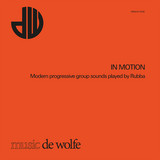
L’Illustration Musicale, Sonimage, Técipress-In Editions (Timing), Musax, Freesound,
Montparnasse 2000 in France but also De Wolfe and Chappell in England, every of these
sound illustration labels have in common to bring out as a legendary spectre the name of Jacky
Giordano and his aliases. Widespread practice in the library music world, Joachim Sherylee,
chosen for the In Motion album, is one of his plentiful aliases (with José Pharos, Jacky
Nodaro, Gruppo Sounds, Rubba...) used by the french composer, that we regain as well for
Black Devil with Bernard Fèvre or even for the Shifters with Yan Tregger.
For his enthronement on the mythical English label De Wolfe, it's under the obscure name of
the Rubba collective that Jacky Giordano aka Joachim Sherylee sneaked in the londonian De
Wolfe studios with the companionship of British colleagues such as John Hyde (aka John
Saunders, James Harrington, Astral sounds or even Wozo) and his wife Monice Hyde (aka
Monica Beale), Alan Howe (aka John Collins), Robert Poole and Tim Broughton.
Published in 1980, the In Motion: Modern Progressive Group Sounds Played By Rubba LP
and its minimalistic and utilitarian red record cover which contains 13 tracks, mainly composed
by Joachim "Giordano" Sherylee and was never reissued since then. This record became cult
over time; it will have taken that the Hip-Hop world seizes it in order to dig out from the
disregarded and underestimated musical gems graveyard. First of all with beatmaker Madlib
and Freddie Gibbs in 2011 with the track “Thuggin'”, in which he sampled the track “Way Star”,
also used more recently by Mil and the rapper Westside Gunn on his track “Brains Flew” by
(1964 Version).
Nearly 40 years after, the Farfalla Records label, after publishing Timing Archives, presents
another aspect more progressive and psychedelic of the multi-faceted composer Jacky
Giordano by fully reissuing at last this coveted, mysterious and mesmerizing "Rubba". Very
desired by crate-diggers, In Motion appears in the want-list of plenty enthusiasts in this
enigmatic world of the library music. (Erwann Pacaud)
"a kind of Radiophonic Workshop Rebel Alliance…" - The Quietus
Modern music concrete quartet Langham Research Centre follow-up their debut album, Tape Works, Vol. 1 with a short EP of remixes, also on nonclassical. Remixes come from a fan of theirs – experimental veteran Jim O'Rourke – and Berlin-based industrial duo group A.
On Side A, Jim O'Rourke uses 'Quasar Melodics' as his source material, transforming fizzing grains of sound into an oceanic swirl of noise. On the flip, group A find metallic rhythms and eerie melancholy in 'Perpetual Motion'.
On 7" and digital, the EP has gained radio play on BBC's Late Junction.
'For the 9th Marionette, Kilchhofer and Anklin release their collaboration record Moto Perpetuo. Michael Anklin is a drummer and percussionist based in Switzerland. He's involved in various bands, collaborations and interdisciplinary projects. Anklin has previously appeared on a few recordings from Kilchhofer's Album The Book Room. Kilchhofer uses his main instrument - the modular synth - in a more electroacoustic manner, where he derives and processes voltages from Anklin's playing.
The album title describes the fascinating idea (yet impossible reality) of a perpetual motion - where no energy is lost yet energy is constantly being created, an endless music, yet far away from generic ambient or minimal music. Anklin's live drumming influences delicate feedback patches on Kilchhofer's synth, where dry and transient heavy percussion and synthesizer sounds erupt into a feral electroacoustic instrument.
A fluid concept of time where the Rhythmic Pulse constantly shifts is at the heart of the record. The idea was to create an instrument where acoustics and electronics are interconnected and dependent on each other. The smallest disturbance could sway the entire system out of order. This idea of a circular motion was at the center of the recording process and is also reflected in the artwork which resembles a topographical view of a closed natural habitat.
Kilchhofer and Anklin draw inspiration mainly from their rural surroundings and mountain landscapes where natural overtones and stumbling rhythms navigate through high plateaus and velds to stony ravines and wooden trails - on a never ending quest for an "ur-klang'; a primordial, ancestral music.'
- Astonishing solo debut by acclaimed cellist and composer Lucy - A daring, non-conformist and deviant approach to composition and instrumentation - One side of filigree, multi-layered autobiographical collage-work, the other of raw and phased cello glissandi - RIYL: Mark Leckey, Alvin Lucier, Beatrice Dillon, Nate Young, Valerio Tricoli, Popol Vuh
Lucy Railton is a prolific performer who has appeared on countless recordings and collaborations with many important figures in contemporary music over the last few years. Paradise 94 is, remarkably, her solo debut - featuring archival, location and studio recordings which serve as a time capsule of all the myriad disciplines and influences that have brought her to this point in time. It both plays up to and shatters expectations of her music, which harnesses a duality of energies - acoustic/electronic, real/imagined, iconic/iconoclastic, pissed-off/romantic; out of place and androgynous - resulting in a visceral emotional insight and rare narrative grasp. Variegated, asymmetric, and located somewhere between her usual fields of exploration, Paradise 94 gives free reign to aspects of her creativity that have previously been subsumed into collaborative processes and interpretations of other composers' work. Here, she's free to probe, sculpt and layer her sounds through a much broader range of techniques and strategies, placing particular focus on non-linear structural arrangements and exploring the way her cello becomes perceptibly synthetic through collaging, rather than FX. At every turn Paradise 94 is bewilderingly unique. The A-side unfolds an oneiric, inception-like sequence traversing temporalities, timbres and tones from what sounds like a spectral ensemble playing on a traffic island in Pinnevik, to bursts of rabbit-in-headlights trance arps emerging from meticulously dissected musique concre`te in The Critical Rush, and a collision of masked vocals, string eruptions and a deeply moving, light-headed Bach rendition in For J.R. On the other hand, Fortified Up on side B tests out a far rawer approach, sampling herself playing the same glissandi over and again, which she layers into a sort of perpetual, sickly motion, the Shepard Tone riffing on the listener's psychoacoustic perceptions before calving off into a cathartic dissonant folk coda in its final throes. In the most classic sense, you can only properly begin to f*ck with something from the inside once you truly know it. Railton's dedicated years of service have more than equipped her with the nous and skill to do just that, gifting us with what will no doubt be looked back on as a raw, exposed and important solo debut in years to come.