Tuff Culture displaying a love of original UKG, back from the Sunday session days of the genre's infancy. 'Day Dream' has masterfully dry drums and hits and a classic vocal sample that packs in the soul. Smart filters and effects build tension before the big drop, gun fingers and pinging bass all explode to life. Irresistible. On the flip, 'Perpetual Motion' is another stripped-back, scuffed-up, low-key but high-impact garage shuffler with plenty of pent-up energy and a wicked Erykah Badu sample.
Cerca:perpetual motion
- 1
We have the honour to welcome the Belgian duo PTTRN. Curators at the Onraad nights in Antwerp and part of the Float Records Family. PTTRN Follow up strong releases on labels like Token, MindTrip, Float, and Illegal Alien.
PTTRN drop their EP, The Perpetual Motion Process. Containing five original tracks. PTTRN serve up a neat package of rolling contemporary Techno - Dynamic and broad in terms of tone.
We are pleased to have them on the label.
2024 Repress
''Based in Flint, Michigan, USA, the four young sons of an electrician welded together their debut album. This album, titled Elektroworld, is a personal tribute to the well known pioneers of the electro-disco-beat; Kraftwerk.'' Clone Classic Cuts reissue of the illustrious Elecktroids' one and only album from 1995.
Originally released on Prestige in 1957, this is the third LP from NYC street performer and avant garde/minimalist composer Moondog. Perhaps the least accessible of his early releases, this album is made up of percussive jams, usually on instruments of his own creation, street sounds, poetry, and Far East melodies, despite opening with a swinging number that is, oddly, the most bizarre thing on the album. Another classic from Moondog reissued with its original Andy Warhol artwork. Limited edition of 1,000 on purple and green starburst vinyl.
Mostly known for her work with Trinity & Beyond, having releases with the likes of Luke Hess, Alexkid, XDB and Klartraum. Nightime Drama brings to you a a new solo ep. from the Australian based producer along with remixes from Eric Cloutier and label boss Vibrio. For those of you who were in Berlin in recent times may have caught one of her brilliant live or DJ sets at Tresor or Studio R as well as playing at Harry Klein in Munich.
Side A kicks off with Slippin, a solid groove construction that builds with echoes of dubby stabs and edgy percussion. Combined with warm, glowing atmospheres the build up and tension will hold you to the end. Accompanied with a deep and outstanding thought provoking remix by Eric Cloutier, stripping it down to it's bare minimum,re inventing the atmospheres and stabs. This alternative draws you in and sends you out on a moody and peculiar late night dubbed out trip.
Diving Deep, the title says it all. A fine palette of percussion exploring dreamy echoes with beautiful depth and production methods. Sustaining a simple yet effective chord progression, it enhances the mood as the track builds and modulates through time. Followed by Vibrio's drama cut remixing the track with a little more drive makes for a fine chaperone to the original.
- Identified Patient – The Female Medical College Of Pennsylvania (Marcel Dettmann Pitched High Version)
- Tocotronic – Bis Uns Das Licht Vertreibt (Marcel Dettman Version 2 Remix)
- Cristian Vogel – Untitled (Marcel Dettmann Cut)
- John Bender – Victims Of Victimless Crimes (Marcel Dettmann Cut)
- Clark – Dirty Pixie (Marcel Dettmann Edit)
- Junior Boys – Work (Marcel Dettmann Remix)
- Mutant Beat Dance - The Human Factor Ft. Naughty Wood (Marcel Dettmann Edit)
- Experimental Products – Who Is Kip Jones (Marcel Dettmann Cut)
- Marcel Dettmann – Water Feat. Ryan Elliott (My Own Shadow Remix)
- Severed Heads – We Come To Bless The House (Marcel Dettmann Edit)
- Albert Kuningas - Astraaliprojektio (Marcel Dettmann Edit)
- K.alexi Shelby – Season Of The Real (Marcel Dettmann Edit)
- Ian North – Sex Lust You (Marcel Dettmann Edit)
- Ford Proco – Expansión Naranja (Feat. Coil) (Marcel Dettmann Edit)
- Nitzer Ebb – Shame (Marcel Dettmann Edit)
- Frank Duval – Ogon (Marcel Dettmann Edit)
- Yello – Limbo (Marcel Dettman Version 2 Remix)
- Conrad Schnitzler – Das Tier (Marcel Dettmann Edit)
LP 3x12"[28,99 €]
A DJ, producer and significant figure in contemporary electronic music, Marcel Dettmann steps forward to contribute to Running Back’s ongoing Mastermix series. Whereas previous editions of Mastermix have taken an ear to the sound of lapsed, legendary clubs such as Wild Pitch and Front, Dettmann’s curation deftly captures the man himself in ongoing perpetual motion, raiding the vault for his own precision-tooled edits, long-employed on dancefloors to devastating effect. Alongside a continuous mix, this release arrives as a 3LP gatefold, and as a limited edition cassette.
Closely associated with Berlin’s techno landscape, Dettmann was born and raised in the former GDR, then later immersed in the bleary-eyed counter cultural landscape of post-unification Berlin. Initially oriented by post-punk, industrial and new-wave music, Dettmann has been DJing since 1993, always expanding and perfecting his repertoire. He later began working behind the counter at the city’s tastemaking rave boutique Hard Wax, and a decade after he first dropped a needle, became (and remains) resident at notable local nightspot Berghain/Panorama Bar, where his instincts have helped sculpt the signature sound of both main dancefloors.
Of course, you’re probably not asking, “Who is Marcel Dettmann?” More importantly, you might want to know; just what treats has he gifted us here? The trip begins with a simple pitch-shift skywards, transforming Identified Patient’s creeping ‘The Female Medical College of Pennsylvania’ into a peak-time freakout, before an alternate take on Toctronic’s ‘Bis uns das Licht vertreibt’ emerges from the vaults for the first time. Dating from 1995, and one of Dettmann’s all-time favourites, Cristian Vogel’s ‘Untitled’ clambers back into the box with respectable cuts, while John Bender’s ‘Victims of A Victimless Crime’ kicks off the flip sporting a new arrangement, transporting us back to the foundations of a confident, stripped-back sound.
A few subtle edits to Clark’s perilously funky ‘Dirty Pixie’ takes us to Dettmann’s remix of Junior Boys. Produced in 2010, it transposes the Canadian duo’s sophisticated pop with our curator in his minimal prime, and has since become an irresistible prize for high-minded diggers. The same can be said for Experimental Products’ explosive proto-electro anthem ‘Who Is Kip Jones?’, empowered from pricey Discogs purgatory with just the slightest of tweaks. It’s deservedly sandwiched between the guiding influences of Chicago and Detroit in the form of Mutant Beat Dance’s raw ‘The Human Factor’ and a shimmering new version of previous solo production ‘Water’, featuring close friend and Ostgut Ton ally, Ryan Elliot.
The second half of the Mastermix seamlessly connects the mechanical past and digital present of EBM and industrial in the dance, with Dettmann’s instincts as a guiding hand. Severed Heads’ iconic ‘We Have Come To Bless This House’ emerges with mere nips and tucks, while Nitzer Ebb’s ‘Shame’ is significantly reimagined as a highwire act of rhythm and tension, setting up a sensual second take on a 2017 remix of ‘Limbo’ from Swiss synth heroes, Yello.
Core musical memories are shaken and stirred with a context-shifting take on Frank Duval’s emotional classic ‘Ogon’, while Ian North’s ‘Sex Lust You’ and Ford Proco’s notable Coil collaboration ‘Expansion Naranja’ effectively throb with only minor adjustments, respectfully imagined as “shadow versions”. Meanwhile, a simple breakbeat lifts Albert Kuningas’s ‘Astraalprojektio’ in the direction of wide-eyed dancefloors, while a fresh take on K-Alexi Shelby’s ‘Season of The Real’ inexplicably emerges somehow even funkier than before.
The conclusion of the compilation leads back to Das Tier from the prolific experimentalist Conrad Schnitzler, whose swirling synths and hypnotic vocals are duly tightened by Dettmann, but only as he puts it, “in conversation with the original.” Concluding three discs and thirty years of commitment to the dancefloor, this Mastermix not only offers us the opportunity to eavesdrop on this endless exchange, but to gain some sought-after material for our own record collections.
From Germany to Montreal, a cross-continental dialogue takes form as Oovation and Jares unite for The Shift, a sweeping coalition of emotion and rhythm marking both artists’ debut on W. Anchored in cinematic depth and driven by kinetic pulse, The Shift stands as a powerful first statement, further expanded through stunning reinterpretations by Coeus, ACNØR, and Turker.
The original take of “The Shift” finds Oovation & Jares constructing a restrained groove before thumping kicks and meandering blips send us off on a highly narcotic affair. With the foundations in place, a swaying bassline takes control of the piece, infusing it with an irresistible sense of movement. As we venture deeper inside the rabbit hole, a lush arpeggio rummages across the piece, taking us closer to an airy break where echoes osurrender to a new directive.
For the first reimagining, Coeus drives “The Shift” into more dangerous, sensual territory. Built on a thunderous rhythmic foundation, the Serbian producer laces the mix with ghostly vocal traces and a relentless synthetic tension. The result feels cinematic in scope: an after-hours odyssey pulsing with urgency and redemption, where desire and danger move in lockstep.
Next, ACNØR transforms The Shift into a perpetual motion device where tension breathes and recedes like a living organism, shimmering under dim light. Reflective and transportive, this version feels like moving through mirrored corridors. Each twist refracts a new emotion, a new identity, culminating in a tantalizing entropy.
Finally, Turker closes the circle with a radiant reconstruction that leans toward transcendence. Textured percussion, raspy stabs, and a gleaming lead line spiral upward, pushing “The Shift” toward a horizon bathed in gold as vocal phrases drift in and out of focus, painting the mirage in full technicolor for a finale that feels both cathartic and luminous.
The saga of squelch continues. After the first round proved that the acid line might be the most durable cliché in dance music (and still the best one), part two turns the resonance knob a little further.
Steve Bug & Stefan Braatz, Deetron, Todd Osborn, and Mathew Jonson with The Mole join forces for another ode to the silver box - less museum piece, more perpetual motion machine. Proof that you can't retire a sound that never had a desk job.
Once again, Gasius supplies the visual psychedelia, while the tracks handle the auditory side of the trip.
Dial 303, accept the charges, and remember: the only thing more reliable than acid is its ability to surprise you.
- A1: Cluster & Eno - Ho Renomo
- A2: Roedelius - Veilchenwurzeln
- A3: Der Plan - Die Wüste
- A4: Rolf Trostel - Hope Is The Answer
- A5: Vono - Hitze
- B1: You - E-Night (Bureau B Edit)
- B2: Serge Blenner - Phrase Iv
- B3: Moebius - Falsche Ruhe
- B4: Harald Grosskopf - Oceanheart
- B5: Lapre - Tedan (Bureau B Edit)
- C1: Riechmann - Abendlicht
- C2: Adelbert Von Deyen - Per Aspera Ad Astra - Mental Voyag
- C3: Faust - Lampe An, Tür Zu, Leute Rein! (Bureau B Edit)
- C4: Conrad Schnitzler - Electric Garden (Bureau B Edit)
- C5: Moebius & Plank - Nordöstliches Gefühl (Bureau B Edit)
- D1: Deutsche Wertarbeit - Unter Tage (Bureau B Edit)
- D2: Asmus Tietchens - Räuschlinge
- D3: Pyrolator - Minimal Tape 1/8
- D4: Rüdiger Lorenz - Southland (Bureau B Edit)
- D5: Thomas Dinger - Alleewalzer
On their last trip to Silberland, Bureau B hurtled along the chrome highways and glass skyways of the kosmische landscape, powered ever onwards in perpetual motorik motion. This time, however, the Hamburg imprint opt for an unhurried itinerary, coasting far beyond the familiar rhythmic terrain to explore crystal caverns and emerald pastures, immersing listeners in the ambient side of this alternative Allemagne. Building on the tape loops, tone poems, and minimalist compositions of the 60"s avant-garde, these musicians utilised the sweeping scope of the synthesiser to create expansive meditations on outer-planetary escapism, human connection, and the natural world. This compilation offers a survey of this singular era, blending pioneering voices with lesser-known artists for an immersive sonic experience.
The album’s title deftly gestures to the sheer vastness of astronomical dimensions, while simultaneously capturing the musical breadth within, where the eight planets are imagined as the eight notes of an octave. The work draws inspiration not only from earlier compositions —most notably Gustav Holst’s The Planets—but also from the rich astronomical and cultural contexts surrounding these celestial bodies. Here, the focus transcends direct citation of melodic motifs, instead embracing an intriguing conceptual approach on a meta level, unfolding in a series of vividly contrasting soundscapes. These contrasts shape a sweeping sonic journey, one that fully embraces the album format with both arms, inviting the listener to venture into realms both strange and wondrous, feeling the immensity of the interstellar space that lies between them. Contrast, after all, is the brushstroke that enriches our world.
Embarking on an auditory voyage, "Astral Guide" establishes the sonic framework that propels us into the boundless expanses of the cosmos. Its ethereal tones evoke the vastness of space, crafting a mood ripe for exploration within the realms of sci-fi. The subsequent tracks unfold like constellations, weaving a rich tapestry of sound that seamlessly marries cinematic soundscapes with pulsating, club-oriented rhythms. This album invites listeners to traverse its immersive landscapes, whether nestled in the comfort of home or dancing under the starlit sky, each note a guide through the transcendent experience of a nocturnal journey.
"Solar Flares" draws its inspiration from the awe-inspiring expanse of solar phenomena, capturing the majestic power of the sun as it reaches into the cosmos. This track resonates with the idea that energy, while vital, can also be a force of destruction when unleashed with overwhelming intensity. The composition beautifully mirrors the sun’s duality, where brilliance and devastation coexist, inviting listeners to reflect on the delicate balance between creation and annihilation. Through its rich textures and dynamic shifts, "Solar Flares" serves as both a homage to the celestial and a poignant reminder of nature's formidable power.
"Mercury – The Winged Messenger" embodies a meticulously crafted soundscape where artistry meets astronomy. The tempo of 173.6 BPM, derived from precise astronomical data, propels the composition into a vibrant realm that resonates with cosmic energy. Synthwave sound design intertwines seamlessly with the fluid rhythms of Drum’n’Bass, imbuing the piece with an uplifting dynamism that evokes the ethereal grace of Mercury itself. In this sonic exploration, listeners are invited to ascend on wings of sound, navigating the celestial tapestry of the universe with each invigorating beat.
"Venus, The Bringer of Peace" strikes a decidedly cozy note, presenting a poignant contrast to the more tempestuous themes often found in cosmic narratives. This composition evokes a nostalgic vision of an optimistic era, one in which humanity transcended borders and embraced the infinite possibilities of space exploration, where no destination felt too distant. The dense, languid atmosphere envelops the listener, creating a tangible sense of serenity that unfolds gradually, allowing for a meditative journey through sound. Each note serves as an invitation to linger in this tranquil embrace, reflecting on the harmonious potential of our collective aspirations and the beauty of connection in a vast universe.
The central theme of „Gaia, The Bringer of Life“ —originally not part of the planetary cycle— is the profound enabler of life on Earth. The arrangement delicately mirrors the slow, tentative unfolding of this potential, marked by an initially sparse orchestration that gradually builds in momentum. This progression crescendos, embodying the explosive dynamism of the Cambrian burst of life, ultimately culminating in a euphoric fanfare—a triumphant, celebratory flourish echoing life’s victorious emergence.
"Blue Moon" unfolds as a contemplative reverie on the tranquil clarity of a night sky, now seldom glimpsed in its natural purity, unclouded by the relentless haze of urban light. The listener is drawn into the vast embrace of the star-strewn firmament, a journey that sways between euphoric awe at nature’s sublime beauty and a profound melancholy for its fragile and imperiled state. Musically, this duality finds expression in the delicate interplay of modal mixtures, while an ever-shifting triplet groove, poised at the intersection of Outrun and melodic house, lends a pulse that is both nostalgic and forward-looking—echoing the beauty and transience of a world on the brink.
Rather than replicating the original composition of „Mars, The Bringer of War“, this interpretation seeks to evoke its profound, foreboding atmosphere. Cyberpunk emerges here as an ideal genre, channeling the dark, relentless march synonymous with Mars, the ancient god of war. The piece reverberates with intensity, as distorted vocalizations rise, embodying the anguish and visceral torment that shadow war’s violent crescendo. This auditory descent into conflict captures the relentless pulse of warfare, where sound itself becomes an embodiment of suffering and fury.
Majestically, "Jupiter, the Bringer of Jollity" emerges on the celestial stage, sweeping away the somber tones with its radiant vigor. Drawing inspiration from the triumphant strains of the original, and borrowing a melodic motif in the refrain, the piece expresses joy and buoyancy through a shift to a major key and the lilting sway of a danceable 12/8 meter. Spirited and exuberant, it leaps boldly from major to minor and back again, playfully shifting time signatures to capture a mood of unbridled festivity and jollity.
Here, a more conciliatory concept is chosen than in the original inspiration. „Saturn“ aligns with the number six, being the sixth planet from the Sun and bearing the iconic hexagonal pattern at its northern pole. What, then, could be more fitting than to render this piece in a 6/8 time signature? The arrangement unfolds with a multifaceted richness, mirroring the countless stones and ice fragments that form the foundations of Saturn’s majestic rings.
„Uranus“ adopts the theme of a light-footed, dancing instrumentation, giving the impression of perpetual motion, never quite settling. This musical choice harmonizes with the planet’s own orbit, as it spins with breathtaking velocity, teetering and swaying, seemingly unable to attain rest or stability.
The chill and vastness of the cosmos find expression in „Neptune, The Mystic“. At its core, an electronic soundscape envelops a classical arrangement, its unreachability intensified by an ethereal, otherworldly choir. Hovering at the outermost boundaries of the solar system, where warmth is but a distant memory, the composition lingers in a slow, contemplative tempo, evoking a realm where space for speculation stretches wide and silence reigns supreme.
Though Pluto may have lost its planetary status, and its companion Charon never achieved one, this shift in classification subtly aligns with the cosmic scale invoked here—one that mirrors the musical tradition of an eight-note sequence. Fittingly, the album closes with „Kuiper Belt“, a composition emblematic of the turbulence and vitality of countless smaller
celestial bodies that, though diminutive, find their rightful place within the vast architecture of the solar system.
They say nature is the greatest composer, shaping the universe with a symphony of chaos and order, beauty and danger. It is this duality that fuels the artistic vision of Edictum—a producer who, armed with a doctorate in chemistry, delves as deeply into the mysteries of molecules as he does into the depths of sound. In the tension between the vastness of the cosmos and the microscopic processes that dictate life’s rhythm, Edictum creates sonic landscapes that dissolve the boundaries between science and art.
His music is a story of contrasts—a sonic tale where the raw forces of nature clash with the intricate structures of human culture. Opposites intertwine to form a harmonious whole: the primal rhythms of the earth meet the celestial melodies of the cosmos, the rigid laws of physics blend with the boundless freedom of art. Edictum explores these polarities with meticulous devotion, each composition an expedition into uncharted soundscapes—a quest to give voice to the unfathomable.
With over 20 years immersed in the realms of electronic music, Edictum has honed a keen sense for rhythm and movement. His driving beats compel both body and mind into a hypnotic flow. Yet beyond the pulse of dance lies a complex framework of conceptual thought. Today, his creative focus revolves around holistic album projects—self-contained worlds with overarching narratives that embrace contrast and complexity. Each track stands alone as a fragment of the whole, but together, they weave a cohesive tapestry, much like the chapters of a novel that guide the listener on an emotional and sonic journey.
Edictum’s distinctive musical signature has earned him international recognition. With over 150 releases, many on prestigious platforms like the iconic *NewRetroWave* label, and collaborations with artists such as Jan Johnston, Azumi Inoue, Powernerd, and Turbo Knight, he has solidified his place in the global electronic music scene. His latest work, *A Cosmic Scale*, marks his seventh vinyl album and is released under his own label, *Echoes of Expanse*. The label’s name is no coincidence—it captures the essence of his art: echoes of infinity, the vibrations of the universe distilled into a singular sonic experience that carries the listener ever further into the boundless expanse of sound and space.
A curated compilation showcasing the depth and diversity of Swiss techno. This release unites emerging talents and established producers for an immersive journey through various shades of techno. Enjoy the inaugural volume in a series celebrating the great creativity of artists from across Switzerland.
Ruby Red - Transparent - Galaxy effect vinyl in dub style jacket (jacket sleeve with center hole cut out so label of LP shows through) a black paper inner sleeve and poly bag.
PART ONE’ METAL HAMMER - 8/10 review. FOR FANS OF : Lustmord, Om, Sunn O))) . “An exercise in freeform ambience, ritualistic repetition and the rapturous, womb-like power of bass…strange and affecting. We remain lucky to share in the great man’s vision.”
At its heart, music has always been a questioning of inheritance – a dialogue with predecessors and forebears, the forging of one’s own perspective in relation to what has come before, and for some, a plunge into the boundless realms between. For Steve Von Till, that process has always taken on an added dimension to become the most sacred of tasks. Whether through the apocalyptic uprising of Neurosis, the sonic deconstructions of their sister project, Tribes of Neurot, the invocatory intimacy of his eponymous solo albums or his instrumental psychedelic reveries in the guise of Harvestman, that dialogue has never just been with musical influences, but with what underpins them: the primordial, elemental forces now banished to the peripheries of our contemporary consciousness, yet still broadcasting a signal for all who will listen.
Drawn to the megaliths, ruins and ancient sites mapped out along the British and European mainland’s geographical and psychic landscapes, the folklore and apocrypha forever resurfacing as portals from a rational world, “Triptych” is a meditation forged from traces and residues, and an hallucinatory recollection of artists who have tapped into that enduring otherworldliness embedded within us all. It’s a dream diary narrating a passage through Summer Isle where Flying Saucer Attack are wafting out of a window, a distant Fairport Convention are being remixed by dub master Adrian Sherwood, celestial scanners Tangerine Dream are trying to drown out Bert Jansch and Hawkwind are playing Steeleye Span covers, all prised out of time yet bound to its singularity.
Woven together from home studio recordings that span two decades, this latest outing as Harvestman finds parallels with nature’s cycles not just in its release dates but in the repeated structure that binds each album, like an imprint refracted through three separate strata. As with April’s “Part One” and the forthcoming “Part Three”, “Part Two”, starts on a collaboration with Om bassist and long-term friend of Steve’s, Al Cisneros, with a dub take opening the B-Side. Here, the opening track, “The Hag Of Beara Vs The Poet”’s languid, tribal groove expands into a chromatic wash, like an endless drip of oil spreading out under a midsummer haze.
A filtering of the alpha-state travelogues of its predecessor, “Part Two” reaches even deeper into primal yet pristine states. It journeys from the undulating drone and slow-thawing wonder of “The Falconer”, as if the Myst soundtrack were being broadcast from outer space, through “Damascus”’s perpetual-motion, dreamtime bazaar and “Vapour Phase”s seismograph frequencies measuring supernatural tremors to “The Unjust Incarceration”s distorted bagpipes, sounding a noise-frayed lament
If “Triptych” is a multi- and extra-sensory experience, it extends to the remarkable glyph-style artwork of Henry Hablak, a map of correspondences from a long-forgotten ancient and advanced civilization. As with “Triptych” itself, it’s an echo from another time, an act of binding, a guide to be endlessly reinterpreted, and a signpost to the sacred that might not indicate where to look, but how.
The harmonious nature of creation, the search for symmetry, the perpetual motion of bodies. Characteristics that amplify the sensations when we face something bigger than ourselves. In the same way, the lake reveals itself as a mirror for the soul, and the carp begin to flow into our soul, bringing out some "Distance Problems", able to be filled only with music.
KOI008 is brought to you by the enigmatic yet oniric outer-world creator S.O.N. with three mesmerizing original tracks. On the remix duties, Romanian superstar Sublee delights us with his take on "Vanessa", in front of which we must only surrender.
HYPER GAL are restless. Since 2019, Kansai’s minimalist duo has been in persistent, perpetual motion.
In January of 2024, SKiN GRAFT Records introduced HYPER GAL to western audiences, giving the previously self-released album “Pure” a worldwide release. It was followed by “After Image”; a new full-length record; in September of that same year. In short order HYPER GAL left Japan to embark on a month-long European tour, performing at festivals such as Left of the Dial in Rotterdam and Le Guess Who? in Utrecht.
Consisting of Koharu Ishida (vocals) and Kurumi Kadoya (drums), HYPER GAL craft a sound all their own, characterized by avant-garde rhythms, looping landscapes, and hypnotic vocals. Their music resists traditional genre boundaries to carve out a truly singular sonic space.
With their fourth album “Our Hyper”, HYPER GAL thrust their sound into a deeper, harder core. Songs unfold into surprising shapes, embracing shadowy turns emboldened by a heavier low-end, while unearthing sharp takes on Japan’s harsh noise roots. The drums have grown even more acrobatic and unorthodox, while the vocals take on new colors, shifting from mesmerizing repetition to melodic, pop-tinged expression.
The album’s artwork is no less adventurous and features masks created by contemporary artist Tokiyoshi Akina and photographed in the band’s own hands, signaling resistance to the performative dualities of social media and a commitment to authenticity.
Despite the lean, unadorned two-piece setup, HYPER GAL’s music attains an intense and unmistakable presence - an unwavering momentum driven by an unrelenting intent. “Our Hyper” is HYPER GAL amplified.
"With each release they appear as mirage sculptors, using simple tools (drums, keyboards, vocals) in craft of multi-genre spanning work which only becomes more captivating the simpler their execution becomes...”
– MYSTIFICATION
A label long synonymous with raw, off-centre electronics and uncompromising club tools, Bjarki’s bbbbbb recors welcomes a producer whose approach feels cut from the same cloth, London’s Henry Greenleaf. In an era where functionality often outweighs feeling, ‘Brawn’ is a record that doesn’t court approval; it insists on impact. Built for high-pressure systems and low ceilings, it channels force not as spectacle, but as design.
Greenleaf’s catalogue to date, spanning labels such as Par Avion, YUKU, and ARTS, sketches a restless trajectory between precision and collapse. His productions operate where rhythm becomes architecture: kicks land like poured concrete, subs buckle and flex beneath shifting percussive grids, and textures are stretched until they fray at the edges. Sound is treated as a physical material, layered and stress-tested, reshaped until the familiar mutates into something tactile and strange.
Across the EP, that philosophy takes full form. A1 ‘Brawn’ sets the tone with dense, piston-like drums and tightly coiled low-end pressure, balancing brute force with meticulous spatial control. ‘Jump Up To Be’ follows with a more fractured swing, percussive shards ricocheting across a framework that feels perpetually on the verge of rupture. On the flip, ‘Gawk’ strips things back to skeletal components, carving negative space between distorted pulses and menacing, warped rhythmic figures, before ‘UNTUNTUNT’ closes the record in driving fashion, delivering a raw, functional workout that reduces the groove to its bluntest, most hypnotic form.
True to the label’s ethos, ‘Brawn’ doesn’t chase trends or smooth its edges. It folds air and pressure into motion, pares club music down to its working parts, and leaves room for spontaneous chaos to erupt within the grid; moments where structure splinters, energy misbehaves, and control gives way just enough to keep things volatile. Engineered yet unpredictable, utilitarian yet unruly, the EP embodies the tension, unpredictability, and uniqueness that have long defined bbbbbb recors.
B. Chamber (Stratum A), by B. Close, is the first full length solo release by Los Angeles-based multi-disciplinary artist Brian Close. The first of two volumes assembled from some thirteen hours of music produced by Close while residing in Connecticut from 2021-2025, B. Chamber (Stratum A) offers a vivid, fractal afterimage of a prolific, specific time and space in the artist’s oeuvre.
After leaving New York City early in the pandemic to a farmhouse in the countryside with dedicated spaces for multiple sound stations, Close developed an intensive daily practice of melding with the machines. The vast, pastoral backdrop of rural CT provided inspiration and contrast for his ongoing investigations into dynamic, poly-rhythmic electronic music. The sounds on B. Chamber (Stratum A) range from the machine-modeling of acoustic instruments and natural environments to the utterly unhuman, spinning on the axis between crystalline, pointillist precision and shifty blown-cone distortion. Close’s atypical interpretations of rhythm, noise and other undefined musics land in a hybrid zone of their own.
Throughout B. Chamber (Stratum A), Close’s productions are in perpetual motion. Foxtrot’s shifting hi-hats and disembodied voices rise like cicadas propelled by glitching machines and tangled rhythms, Many Drive draws momentum from dubby stabs and twinkling atmospherics. Character Community’s nimble, drifting snares and erratic static are uplifted by swelling synths, and Mpan’s modular mining forgoes drums but is no less propulsive for it. Acre Voices’ seasick pads and deft drum patterns tap an energizing nerve, and closer 5D Bow’s ambush of pummeling machine gun fire spirals into the tryptamine palace and emerges completely rinsed and refreshed.
Equally powerful in the club as in the outdoors, in the headphones eyes closed or on the move, B. Chamber (Stratum A) grants an immersive temporary trip on B. Close’s unique wavelength, with Stratum B to complete the picture in the summer of 2026.
RIYL - Mark Fell, muay thai, Vladislav Delay, gaming, Errorsmith, modular synthesizer.
+++++
Brian Close (b. 1979, NYC) uses the cold logic of mathematics to trigger states of total sensory displacement. Close co-founded multiple AV studios to explore the "hypnotic"—a ritualistic practice of motional-graphism and improvisational sound. His work is a study in synesthesia and the architecture of trance, using geometric precision to dissolve the sense of time. It is a digital-visceral experience built on heavy logic, designed for large-scale immersion and timelessness.
Close is one half of Georgia who have released records on Palto Flats, Firecracker Recordings, Meakusma, Youth, OOH-Sounds and EM Records, and have a long-running residency on NTS.
B. Chamber was written, produced and mixed by Brian Close.
Mastered by Rashad Becker.
Artwork by Brian Close.
Splatter Vinyl[20,97 €]
Fifteen years after it first surfaced on the short-lived Lithuanian netlabel Dumblys, Sraunus – Out Of The City returns remastered, recontextualized, and ready for a new wave of deep listeners. What once felt like a hidden gem now reads as a quiet cornerstone, a record whose significance only grew clearer with time.
Behind Sraunus is Paulius Markutis, one of Lithuanias earliest deep-dub explorers. His moniker translates to “flowing” or “fluid,” and that spirit runs through the entire album: the music breathes, circulates, and drifts with calm inevitability, revealing fresh details on every pass. Rooted in the classic Berlin-born dub tradition yet unmistakably shaped by Markutis own sense of space, mood, and narrative, the result feels beautifully suspended in time, warm in its chords, patient in its arrangements, and guided by a subtle emotional current. This is dub techno at its most enduring: fluid, deep, and endlessly replayable.
The reissue, part of Greyscales Archive Series, arrives on superbly pressed double vinyl, with artwork chosen with intent: Marija Marcelionytė-Paliukės “High Tide and Low Tide,” an image of perpetual motion that perfectly mirrors the albums flowing spirit.
Black Vinyl[20,97 €]
Fifteen years after it first surfaced on the short-lived Lithuanian netlabel Dumblys, Sraunus – Out Of The City returns remastered, recontextualized, and ready for a new wave of deep listeners. What once felt like a hidden gem now reads as a quiet cornerstone, a record whose significance only grew clearer with time.
Behind Sraunus is Paulius Markutis, one of Lithuanias earliest deep-dub explorers. His moniker translates to “flowing” or “fluid,” and that spirit runs through the entire album: the music breathes, circulates, and drifts with calm inevitability, revealing fresh details on every pass. Rooted in the classic Berlin-born dub tradition yet unmistakably shaped by Markutis own sense of space, mood, and narrative, the result feels beautifully suspended in time, warm in its chords, patient in its arrangements, and guided by a subtle emotional current. This is dub techno at its most enduring: fluid, deep, and endlessly replayable.
The reissue, part of Greyscales Archive Series, arrives on superbly pressed double vinyl, with artwork chosen with intent: Marija Marcelionytė-Paliukės “High Tide and Low Tide,” an image of perpetual motion that perfectly mirrors the albums flowing spirit.
- A1: Identified Patient – The Female Medical College Of Pennsylvania (Marcel Dettmann Pitched High Version)
- A2: Tocotronic – Bis Uns Das Licht Vertreibt (Marcel Dettman Version 2 Remix)
- A3: Cristian Vogel – Untitled (Marcel Dettmann Cut)
- B1: John Bender – Victims Of Victimless Crimes (Marcel Dettmann Cut)
- B2: Clark – Dirty Pixie (Marcel Dettmann Edit)
- B3: Junior Boys – Work (Marcel Dettmann Remix)
- C1: Mutant Beat Dance - The Human Factor Ft. Naughty Wood (Marcel Dettmann Edit)
- C2: Experimental Products – Who Is Kip Jones (Marcel Dettmann Cut)
- C3: Marcel Dettmann – Water Feat. Ryan Elliott (My Own Shadow Remix)
- D1: Severed Heads – We Come To Bless The House (Marcel Dettmann Edit)
- D2: Albert Kuningas - Astraaliprojektio (Marcel Dettmann Edit)
- D3: K.alexi Shelby – Season Of The Real (Marcel Dettmann Edit)
- E1: Ian North – Sex Lust You (Marcel Dettmann Edit)
- E2: Ford Proco – Expansión Naranja (Feat. Coil) (Marcel Dettmann Edit)
- E3: Nitzer Ebb – Shame (Marcel Dettmann Edit)
- F1: Frank Duval – Ogon (Marcel Dettmann Edit)
- F2: Yello – Limbo (Marcel Dettman Version 2 Remix)
- F3: Conrad Schnitzler – Das Tier (Marcel Dettmann Edit)
Cassette / Tape[16,18 €]
2025 REPRESS
A DJ, producer and significant figure in contemporary electronic music, Marcel Dettmann steps forward to contribute to Running Back’s ongoing Mastermix series. Whereas previous editions of Mastermix have taken an ear to the sound of lapsed, legendary clubs such as Wild Pitch and Front, Dettmann’s curation deftly captures the man himself in ongoing perpetual motion, raiding the vault for his own precision-tooled edits, long-employed on dancefloors to devastating effect. Alongside a continuous mix, this release arrives as a 3LP gatefold, and as a limited edition cassette.
Closely associated with Berlin’s techno landscape, Dettmann was born and raised in the former GDR, then later immersed in the bleary-eyed counter cultural landscape of post-unification Berlin. Initially oriented by post-punk, industrial and new-wave music, Dettmann has been DJing since 1993, always expanding and perfecting his repertoire. He later began working behind the counter at the city’s tastemaking rave boutique Hard Wax, and a decade after he first dropped a needle, became (and remains) resident at notable local nightspot Berghain/Panorama Bar, where his instincts have helped sculpt the signature sound of both main dancefloors.
Of course, you’re probably not asking, “Who is Marcel Dettmann?” More importantly, you might want to know; just what treats has he gifted us here? The trip begins with a simple pitch-shift skywards, transforming Identified Patient’s creeping ‘The Female Medical College of Pennsylvania’ into a peak-time freakout, before an alternate take on Toctronic’s ‘Bis uns das Licht vertreibt’ emerges from the vaults for the first time. Dating from 1995, and one of Dettmann’s all-time favourites, Cristian Vogel’s ‘Untitled’ clambers back into the box with respectable cuts, while John Bender’s ‘Victims of A Victimless Crime’ kicks off the flip sporting a new arrangement, transporting us back to the foundations of a confident, stripped-back sound.
A few subtle edits to Clark’s perilously funky ‘Dirty Pixie’ takes us to Dettmann’s remix of Junior Boys. Produced in 2010, it transposes the Canadian duo’s sophisticated pop with our curator in his minimal prime, and has since become an irresistible prize for high-minded diggers. The same can be said for Experimental Products’ explosive proto-electro anthem ‘Who Is Kip Jones?’, empowered from pricey Discogs purgatory with just the slightest of tweaks. It’s deservedly sandwiched between the guiding influences of Chicago and Detroit in the form of Mutant Beat Dance’s raw ‘The Human Factor’ and a shimmering new version of previous solo production ‘Water’, featuring close friend and Ostgut Ton ally, Ryan Elliot.
The second half of the Mastermix seamlessly connects the mechanical past and digital present of EBM and industrial in the dance, with Dettmann’s instincts as a guiding hand. Severed Heads’ iconic ‘We Have Come To Bless This House’ emerges with mere nips and tucks, while Nitzer Ebb’s ‘Shame’ is significantly reimagined as a highwire act of rhythm and tension, setting up a sensual second take on a 2017 remix of ‘Limbo’ from Swiss synth heroes, Yello.
Core musical memories are shaken and stirred with a context-shifting take on Frank Duval’s emotional classic ‘Ogon’, while Ian North’s ‘Sex Lust You’ and Ford Proco’s notable Coil collaboration ‘Expansion Naranja’ effectively throb with only minor adjustments, respectfully imagined as “shadow versions”. Meanwhile, a simple breakbeat lifts Albert Kuningas’s ‘Astraalprojektio’ in the direction of wide-eyed dancefloors, while a fresh take on K-Alexi Shelby’s ‘Season of The Real’ inexplicably emerges somehow even funkier than before.
The conclusion of the compilation leads back to Das Tier from the prolific experimentalist Conrad Schnitzler, whose swirling synths and hypnotic vocals are duly tightened by Dettmann, but only as he puts it, “in conversation with the original.” Concluding three discs and thirty years of commitment to the dancefloor, this Mastermix not only offers us the opportunity to eavesdrop on this endless exchange, but to gain some sought-after material for our own record collections.
- The Voice Of Water
- Lake Of Sphinxes
With »Roto«, Derek Piotr revisits the aqueous terrain first explored in his 2016 album »Drono«, where the paradox of water’s stillness and perpetual motion was refracted into looping voices and glitching textures. Conceived as a »spiritual successor« and recorded in 2019, the album has lain dormant for six years before surfacing on Discreet Archive. That stretch of silence seems to have deepened its charge – the sound feels unearthed rather than made, like a whirlpool biding its time in obscurity until now.
Unlike »Drono«’s mosaic of shorter pieces, »Roto« unfurls as two expansive half-hour tracks, allowing Piotr to probe repetition with greater intensity. Vowels accumulate until they shimmer with alien sentience, drones grow dense and psychoacoustic, and the smallest digital artifacts flicker like neural sparks. The result is a work that denies familiarity; recurrence here only breeds strangeness, unspooling into a procession of hidden pulses and altered voices that resist prediction, drawing the listener deeper into a submerged, otherworldly space.
Derek Piotr is a folklorist, researcher and performer whose work focuses primarily on the human voice. His work covers practices including fieldwork, vocal performance, preservation and autoethnography; and is primarily concerned with tenderness, fragility, beauty and brutality. He has collaborated with artists including Scott Solter, Nathan Salsburg and Thomas Brinkmann across various disciplines.
He is lead archivist and creative director of the Fieldwork Archive.
Since its founding back in 2014, Blume has carved a unique place in cultural landscape, issuing free-standing works, spanning the historical and contemporary, that represent singular gestures of creativity within the field of experimental sound. Joining their broad efforts in building networks of context and understanding that already includes the works by Werner Durand, Sarah Hennies, Bruce Nauman, John Butcher, Jocy de Oliveira, Mary Jane Leach, Valentina Magaletti, Alvin Curran, Julius Eastman, Alvin Lucier, and following the first ever vinyl release to attend to James Tenney's legendary Postal Pieces, the label now presents the first LP published by the visionary Swiss composer Jürg Frey. Drawing from the transformative power of breath and resonance, this release represents one of the most profound explorations of musical metamorphosis to emerge from the contemporary experimental landscape.
The completed work represents a "conjunction of these two artists" that has "activated a transformative form of experimentalism." These renderings "dance with an airy lightness, humour, and play, imbuing them with a beauty and emotiveness that can be rare within experimental music." They exist as "breaths, carrying the curiosities of life, belonging to no time and all time, to no one and everyone: a human music to be inhaled and pondered, for which the outcome remains unknown." In this liminal space between composition and interpretation, between breath and resonance, Zurria and Frey have created something that transcends the boundaries of experimental music itself, offering what might be called a metaphysical cartography of sound in its most essential form. As Bradford Bailey observes in his penetrating liner notes, "music is rarely a fixed entity," existing instead in a state of perpetual flux, "taking on the influences of its interpreters and performers." This fundamental truth finds its most eloquent expression in the transformative collaboration between Italian flutist Manuel Zurria and Frey, longtime member of the Wandelweiser Group. Where conventional recordings might preserve a definitive version, this release activates what Bailey calls "states of unknowing and continued experimentation," allowing Frey's compositions to evolve into entirely new dimensional territories. The original string quartet and piano works dissolve into breath-carried architectures of sound, where "the original remains in a constant dialogue with its transformation." This is not mere arrangement but ontological metamorphosis - an alchemical process through which crystalline harmonies are reborn as atmospheric phenomena.
The metaphysical dimensions of this transformation become clear through detailed analysis of the musical result. Where Frey's original compositions operate through what he calls "basic confidence in the clear and restricted material," Zurria's interpretation activates entirely new perceptual territories. Space holds almost atomic sense of weight against the airy punctuations of timbres, textures, and tones, creating "suspensions of time within which questions and identities posed by instrumentation fade." The Extended Circular Music pieces - each comprising "a small number of bars to be repeated an undetermined number of times" - become organizations of sound that defy being definitive or fixed. Originally scored for different combinations of violin, viola, cello, and piano, these works now exist as pure phenomena of breath and resonance, where "hanging, breath-length utterances dance and intertwine amongst complex harmonic clusters and conjunctions."
The philosophical implications of this transformation illuminate a lineage of composers who have moved "away from abstraction and responding to the need to create" something beyond mere technique. Drawing parallels to Morton Feldman's understanding of non-functional harmony, Zurria's approach represents "a transformative form of experimentalism" that activates what Frey calls the "thaumaturgic power" of music - its capacity to heal and transform consciousness itself. The result is "a radical reimagining of ambience: sprawling sonorities and resonances adrift in space, carrying the liberated traces of the work's former incarnations and their truths." In Zurria's interpretation, Frey's String Quartet n.3 becomes something approaching "an organ played in slow motion, its seals leaking," while the Extended Circular Music pieces transform into "glacial chords from a diverse palette of voicings, harmonies, timbres, and tones."
Performed by Manuel Zurria. Recorded and mixed by Zurria at BigCardo, Catania between 2022-2024, with mastering by Bruno Germano at Vacuumstudio, Bologna, this Blume release represents a profound exploration of musical transformation.
Pain Management welcomes London cult favourite DJ ojo, who arrives on the label with a hazy three tracker of trademark nether zone system music. On his most dubbed out full length to date, ojo span’s the full emotive spectrum of dub sonics with a range of both the eerie and more tender expansions of low end atmospherics, the resulting 12” equally suited for the club and the journey home alike.
‘Tongue Tied’ opens the record, a lysergic offering from the darker edges of dub music. A slippery fugue-state hit of narco-ambience built around a crooning, intelligible vocal refrain and chest shot sub weight. A real nightfall system pusher built to simmer in the early hours. It kicks off the EP on an amorphous, hypnotic note that sustains throughout.‘Oil Dub’ sinks deeper into the fog, melodic kinesis and expansive delays upholding an underworld of feedbacked percussion and tongue in cheek sub motion; a seven minute sound bath of ambiguous dub ASMR.
The B-side balances out the darker strains found on its counterpart with an overtly tender digidub closer. Clocking in at almost ten minutes long ‘Cloud Suck’ is a nebulous bliss of perpetually ascending late-summer warmth. The kind of liminal dream-state embrace that you wish would never end. True to the name, it evokes tender, dusk and dawn hued moments, a quiet ride-home flash of introspection on the way to or from some pursuit of meaning. Pain Management essential right here.
Limited run of 200 hand-stamped 12” records available now.
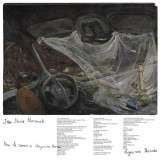
The road is a wrinkled timeline. Uncanny flatness conceals unfolding textures, transparent layers and open tabs. The truck cuts the landscape, tracing the road with a line of mad logic that composites time, space, thought. On “Le Camion de Marguerite Duras,” French duo Jean-Marie Mercimek have returned with a road movie for the blind. Composed and recorded by Marion Molle and Ronan Riou over six years across France and Belgium, this unlikely distillation of microtonal MIDI composition, French B.O., and post-punk chansons brazenly expands the duos’ penchant for lowkey narrative spectacle.
Across “Le Camion,” sounds form a theatrical screen. Our ears are the curtains drawn wide and listening with a look that pans across the shot. No title cards, they cut straight to action. The truck is a camera, zooming and framing the tracks as scenes. Songwriting and sound design blur in a tangle of delicate economy. The balance of mutant music-boxes and dewy miniatures recalls otherworldly hits from Gareth Williams’ Flaming Tunes, Residents, and catchier corners of the Lovely Music catalog. Strange, sure, but this flick is never quite a cartoon. Molle and Riou’s vocals dilate into a cast of very human characters. Voices sing borrowed texts like untrained actors (playing themselves, in fact) stepping into the frame once before disappearing forever. And when they’re gone, you miss them. But here in the truck, it all comes back again under the cyclic spell of repose in perpetual motion. Turn up the radio and appuyez sur le champignon. - Turner Williams Jr.
- 1: Heartbreak
- 2: Swarm
- 3: Never Look Back
- 4: Suspended
- 5: Limelight
- 6: Get Through
- 7: Better Dreaming
- 8: How Big Is The Rainbow
- 9: See You There
- 10: Perpetual Motion
- 11: Sanctuary
Black Vinyl[23,32 €]
"Kunst zu kreieren ist für mich ein ständiger Kampf den Fokus zu behalten; denn wir leben in einer Zeit voller Unterbrechung und Zerrüttung, äußert sich die Tune-Yards Sängerin Merrill Garbus über ihr sechstes Album "Better Dreaming". Mit einer klaren Haltung zu Antifaschismus, Befreiung und Anderssein präsentiert das neue Album einige der eingängigsten und funkigsten Pop-Momente von Tune-Yards bisher - und ja, tanzen kann man dazu auch. Die Songs entstanden für Garbus und ihren Bandkollegen und Partner Nate Brenner mit ungewöhnlicher Leichtigkeit - sie ließen die Musik einfach fließen und folgten jeder kreativen Spur, die sich ergab. Nach der Isolation in der Pandemie und der langen Pause von Tourneen und Live-Shows war das Bedürfnis, sich von Musik bewegen zu lassen, stärker denn je. Auch die einzigartige Erfahrung, ein menschliches Wesen heranwachsen zu sehen, prägte den Entstehungsprozess. Ihr gemeinsames Kind, heute drei Jahre alt, ist auf dem Song "Limelight" zu hören - ein Song, der aus gemeinsamen Tanzmomenten zur Musik von George Clinton entstand. Die Songs wurden als Duo aufgenommen und basieren - mit einer Ausnahme - auf Merrills Drum-Loops und Rhythmusstrukturen, ähnlich wie auf ihren frühen Alben_Ç»"Bird-Brains"_Ç»und_Ç»"W H O K I L L". Der Opener_Ç»"Heartbreak"_Ç»baut riesige Vokalharmonien um einen druckvollen Beat aus Klicks, Pops, Samples und gedubbten Snares. Garbus besingt darin Herzschmerz als Antrieb, als Herausforderung - Zeilen wie "Watch me survive another heartbreak"_Ç»wirken wie ein Aufruf zum Weitermachen. Das treibende_Ç»"How Big is the Rainbow"_Ç»setzt auf Four-on-the-Floor-Rhythmus und versprüht Disco-House-Energie - mit der Atmosphäre eines queeren Club-Hits voller Strobo und Intensität. "Better Dreaming"_Ç»ist ein kraftvolles Manifest für Selbstliebe, kollektives Handeln, Befreiung auf der Tanzfläche sowie die Hoffnung auf eine bessere Zukunft. Angesichts der Herausforderungen und Unsicherheiten der Gegenwart stellt sich Tune-Yards die Frage: Wie viel echte Energie und Freude lassen sich durch Musik überhaupt transportieren? Mit seinem mitreißenden, lebensbejahenden Art-Pop für eine Welt im Umbruch macht_Ç»"Better Dreaming"_Ç»genau das.
- 1: Heartbreak
- 2: Swarm
- 3: Never Look Back
- 4: Suspended
- 5: Limelight
- 6: Get Through
- 7: Better Dreaming
- 8: How Big Is The Rainbow
- 9: See You There
- 10: Perpetual Motion
- 11: Sanctuary
Blue Vinyl Edition[23,32 €]
"Kunst zu kreieren ist für mich ein ständiger Kampf den Fokus zu behalten; denn wir leben in einer Zeit voller Unterbrechung und Zerrüttung, äußert sich die Tune-Yards Sängerin Merrill Garbus über ihr sechstes Album "Better Dreaming". Mit einer klaren Haltung zu Antifaschismus, Befreiung und Anderssein präsentiert das neue Album einige der eingängigsten und funkigsten Pop-Momente von Tune-Yards bisher - und ja, tanzen kann man dazu auch. Die Songs entstanden für Garbus und ihren Bandkollegen und Partner Nate Brenner mit ungewöhnlicher Leichtigkeit - sie ließen die Musik einfach fließen und folgten jeder kreativen Spur, die sich ergab. Nach der Isolation in der Pandemie und der langen Pause von Tourneen und Live-Shows war das Bedürfnis, sich von Musik bewegen zu lassen, stärker denn je. Auch die einzigartige Erfahrung, ein menschliches Wesen heranwachsen zu sehen, prägte den Entstehungsprozess. Ihr gemeinsames Kind, heute drei Jahre alt, ist auf dem Song "Limelight" zu hören - ein Song, der aus gemeinsamen Tanzmomenten zur Musik von George Clinton entstand. Die Songs wurden als Duo aufgenommen und basieren - mit einer Ausnahme - auf Merrills Drum-Loops und Rhythmusstrukturen, ähnlich wie auf ihren frühen Alben_Ç»"Bird-Brains"_Ç»und_Ç»"W H O K I L L". Der Opener_Ç»"Heartbreak"_Ç»baut riesige Vokalharmonien um einen druckvollen Beat aus Klicks, Pops, Samples und gedubbten Snares. Garbus besingt darin Herzschmerz als Antrieb, als Herausforderung - Zeilen wie "Watch me survive another heartbreak"_Ç»wirken wie ein Aufruf zum Weitermachen. Das treibende_Ç»"How Big is the Rainbow"_Ç»setzt auf Four-on-the-Floor-Rhythmus und versprüht Disco-House-Energie - mit der Atmosphäre eines queeren Club-Hits voller Strobo und Intensität. "Better Dreaming"_Ç»ist ein kraftvolles Manifest für Selbstliebe, kollektives Handeln, Befreiung auf der Tanzfläche sowie die Hoffnung auf eine bessere Zukunft. Angesichts der Herausforderungen und Unsicherheiten der Gegenwart stellt sich Tune-Yards die Frage: Wie viel echte Energie und Freude lassen sich durch Musik überhaupt transportieren? Mit seinem mitreißenden, lebensbejahenden Art-Pop für eine Welt im Umbruch macht_Ç»"Better Dreaming"_Ç»genau das.
An extremely prolific artist, whose work encompasses composition, opera, theatre, radio plays, film or performance, Ergo Phizmiz returns in due time to the Discrepant fold long after his 'Two Quartets' and 'Disco Carousel' - under his given DW Robertson name - albums. A purveyor of the Creative Commons rights, Phizmiz has been deploying much of his work on the ever expanding Free Music Archive directed by WFMU since the early 2000's, creating a sprawling and defiant body of work that defies given and stale notions of sound hierarchies, history and copyright through a process that comprises collage, sampling, reappropriation, songwriting, covers and pretty much any available media with a playful and thoughtful approach.
For this new Discrepant entry, Phizmiz goes back in time to push into the future a number of pieces recorded more than two decades ago creating this perpetual motion outside a linear chronologic progression. Anticipating by almost 20 years the memefication of ASMR videos, 'Selected Ambient & ASMR Works 2001-2003' - itself a pun on the AFX classics - embraces the ambient tag not at its functional face value, but instead as a means to the "evocation of imaginary spaces, and correspondingly the invention of their sonic environments". Collecting recordings from a myriad of instruments - violin, xylophone, banjo, kora, found percussion and so on...-, shortwave radio and field recordings to create loops with different lengths that play with and/or against themselves continuously in a process "(dis)conjunction" not far removed from Feldman's 'Why Patterns?' or hip-hop's sampledelia. A free-floating temporal space that collapses the flashing images of Angelfire pages unto Web 2.0 sense of displacement.
Fera’s trajectory sticks out like a sore thumb, you need to invest time, carefully divided between body & mind, to truly take a deep dive into his audacious output. After the acclaimed ‘Stupidamutaforma’ and ‘Corpo Senza Carne’, Fera is back with ‘Psiche Liberata’, an oblique, imperfect and broken record, in other words, exactly the type of magical voyage you want to be on. The mind, finally liberated.
Fera is Andrea De Franco, electronic composer from Southern Italy now residing in Bologna, also known for his work as visual artist/designer and member of the Undicesimacasa collective. His musical cosmos is profound and imaginative, intergalactic atmospheres that condense fragmented IDM, scintillating textures, distorted synthscapes, crunchy technoid rhythms and swirling abstractions that weave gently, sometimes moody and stark, more often celestial and awe-inspiring.
Mixed in Berlin by Steve Scanu ‘Psiche Liberata’ encapsulates Fera’s dense and intricate thought process in contrast with his simple and direct approach to writing and recording that finds its more natural output in his rapturous live sets where a mono signal runs through a few analog pedals transforming instantly into menacing alien grooves and fluid ecstasis.
Like ‘Psiche Liberata’s artwork, hand-drawn by Fera, every detailed miniature leads to a single cell of sound, tracks collide against each other in a psychotic kaleidoscope where every safe space is confronted with subsequent noise, alterations or interruptions. The black terror of ‘Celestial Anacusma’ is followed by the space-jazz banquet of ‘Milk Tears In The Hug Chamber’ doped up cyber Sun Ra extravaganza featuring Laura Agnusdei and Luigi Monteanni (Artetetra) on saxophones and flutes; ‘Silenzio Solare’ sprinkles Mille Plateaux era minimalism all over hallucinations, while ‘Diluvia’ crosses industrial acid with perpetual motion; title track ‘Psiche Liberata’ murmurs mechanically, a downtempo drifter for the wide-eyed 7AM comedown: ‘Simulacrima’ melts Boards Of Canada’s mellow pastoralism with dystopian meta-level dreamland and ‘Riposa’ showcases an overwhelming melancholy executed with elegance in a slo-mo world where the ineffable transcends notions of ambient and becomes a warm embrace.
Created on a Monotribe, MS20 & Volca Sample/fm, ‘Psiche Liberata’s velvet heaviness was achieved by re-amping many of the instruments through a Leslie Rotary Speaker and a reel-to-reel Telefunken. Fera’s sonic tapestry is in constant flux, underlying themes of love longing and affection run through the record but in a turbulent, volcanic, unleashed fashion, almost on the brink of utter noise or complete silence, reminding us that this is an artist like no other amidst the ever changing electronic scene. These are transmissions from the gutter, where the inevitable meets the unattainable and collapses.
"Fera’s tarnished materials are destined for ruin; “Stupida,” full of longing and regret, sounds like an elegy for a fallen world." Pitchfork
"A cut of dark magic that fits like a glove to overcast days, wild winds and lashing rains. Insistent, the treacle-thick bassline oozes out, soaking the space between the melancholic synth lines." Inverted Audio
"The songs on Stupidamutaforma feel hypnotizing...it establishes De Franco as a composer who uses space and time to create a set of rich, immersive works." Bandcamp 'Album Of The Day'
Circling guitar lines; the rise of fall of delicate bass; deep, breathy horns: sonic elements that exist in a state of slow, perpetual motion, like ideas sprouting from some kind of cognitive compost. With wonder and charm, G. S. Schray's new solo album, Whispered Something Good, evokes a realm of new growth while offering a fitting soundtrack for its exploration, as if tailor made for both the daydreamer and silly adventurer.
We start in the darkness of "Unlit Center" with elliptical phrases of jazz guitar. A conversation between double bass, synthesiser, and piano plays out on "In Tears Twice A Page" before we're ushered into the reflective zone of "Another Haunted Mirror." There is synth mist which trumpet cuts through decisively like a shaft of light from the sun: warm and clear. As the album proceeds, firmer rhythms coalesce. On "Prelude for Probably," clattering drums lock into a triumphant groove with horns. And then, to close, the instrumental art-pop of "Gone in Amber," probing not necessarily towards a final destination but another stop-off, one of distant birdsong and the faintest flicker of synth. Intimate and inviting, the act of listening to Whispered Something Good is akin to digging through an imagination. It's a place of subliminal melodies blooming into rhizomatic musical shapes, stray musings coalescing as bolts of inspiration — change fostering yet more change.
Chelsea Wolfe has always been a conduit for a powerful energy, and while she has demonstrated a capacity to channel that somber beauty into a variety of forms, her gift as a songwriter is never more apparent than when she strips her songs down to a few key components. As a result, her solemn majesty and ominous elegance are more potent than ever on Birth of Violence.

There is a core element to Chelsea Wolfe’s music—a kind of urgent spin on America’s desolation blues—that’s existed throughout the entirety of her career. At the center, there has always been Wolfe’s woeful longing and beguiling gravity, though the framework for compositions has continuously evolved based on whatever resources were available. Her austere beginnings were gradually bolstered by electronics and filled out with full-band arrangements. The music became increasingly dense and more centered around live performances. Her latest album, Birth of Violence, is a return to the reclusive nature of her earlier recordings
“I’ve been in a state of constant motion for the past eight years or so; touring, moving, playing new stages, exploring new places and meeting new people—an incredible time of learning and growing as a musician and performer,” Wolfe says of the era leading up to Birth of Violence. “But after awhile, I was beginning to lose a part of myself. I needed to take some time away from the road to get my head straight, to learn to take better care of myself, and to write and record as much as I can while I have ‘Mercury in my hands,’ as a wise friend put it.“ Birth of Violence is the result of this step out of the limelight. The songs stem from humble beginnings—little more than Wolfe’s voice and her Taylor acoustic guitar. Her longtime musical collaborator Ben Chisholm recorded the songs on a makeshift studio and helped fill them out with his modern production treatments and the occasional auxiliary flourish from ongoing contributors Jess Gowrie (drums) and Ezra Buchla (viola).
The album opens with “The Mother Road,” a harrowing ode to Route 66 that immediately addresses Wolfe’s metaphoric white line fever. It explains the nature of the record—the impact of countless miles and perpetual exhaustion—and the desire to find the road back home, back to one’s roots. Songs like “Deranged for Rock & Roll” and “Highway” offers parallel examinations on the trials and tribulations of her journeys while the ghostly “When Anger Turns to Honey” serves as a rebuttal to self-appointed judges.
While the record touches upon tradition, it also exists in the present, addressing modern tragedies such as school shootings in the minor-key lullaby “Little Grave” and the poisoning of the planet on the dark wind-swept ballad “Erde.” But the record is at its most poignant when Wolfe withdraws into her own world of enigmatic and elusive autobiography. Much like Alan Ginsberg’s hallucinatory long-form poem Howl, the tracks “Dirt Universe” and “Birth of Violence” weave together specific references from her past into an esoteric overview of the state of mankind. Though the lyrical minutiae remain secret, the overall power of the language and delivery is bound to haunt the listener with both its grace and tension.
“These songs came to me in a whirlwind and I knew I needed to record them soon, and also really needed a break from the road,” Wolfe says. “I’ve spent the past few years looking for the feeling of home; looking for places that felt like home. The result of that humble approach yields Wolfe’s most devastating work to date.
European Headline tour confirming now for 2020. UK/EU Publicity handled by Lauren Barley at Rarely Unable. Immense support from Press, including coverage with NPR, Pitchfork, FADER, Vice, Revolver, Decibel, Under The Radar.
The second album by F.K. Raeithel, just after the operetta DIE WURLITZERORGEL DES GEISTES, explores the realms of interlocked rhythm sample and hold music. On 16 tracks different setups of self generating modular synthesizer patches are gathered on this release.
The concept of Dance With Uncertainty is deeply rooted in philosophical, artistic, and cultural traditions. The notion of embracing uncertainty and change has been explored in various forms throughout history, often symbolizing the human experience and the impermanence of life. In the context of music and sound, Dance With Uncertainty could be seen as a reflection of the constant ebb and flow of life‘s uncertainties, captured and conveyed through sonic textures and evolving compositions.
Interlocked Rhythm Sample & Hold Music, this approach to sound creation weaves a mesmerizing tapestry of rhythm, texture, and sonic exploration, captivating listeners and defying traditional musical boundaries. At its core, Interlocked Rhythm Sample & Hold Music is a synthesis of technology, creativity, and a deep understanding of rhythmic intricacies. The foundation lies in the Sample & Hold circuit, a device that captures and freezes incoming voltages, creating distinct musical snapshots that evolve over time or an Linear Feedback Shift Register (eg. Rungler), a circuit used in electronic music synthesis and sound manipulation to create unique and evolving musical textures. The Rungler was created by Rob Hordijk. A more sophisticated use of a 8 bit shift register and by combining this with a typical sequencer design is the Klee Sequencer developed by Scott Stites. A cheap version of this design is the Turing Machine. Another tool is the Analog Shift Register. In the context of creating arabesque melodies, an analog shift register (invented by Fukushi Kawakami and later adapted by Serge Tcherepnin) can be a fascinating tool to generate intricate and ornamented musical patterns. Yet, it‘s the interlocking of these snapshots that sets this genre apart, infusing the compositions with an intricate dance of patterns and pulses. A fourth device is a pendulum or random addressed sequencer, that in the first case moves in a drunken unpredictable manner. Each of these devices for uncertainty becomes a rhythmic sculptor, freezing the dynamic interplay of melodies, beats, and textures. These frozen moments are then interwoven, each snapshot forming a unique thread in a sound tableau that stretches and contracts, pulses and breathes. The result is an auditory experience that challenges preconceptions of rhythm and structure. The interlocked rhythms give rise to complex grooves that ebb and flow in unpredictable ways, evoking a sense of perpetual motion and transformation. The music becomes a living organism, its heartbeats synchronized yet untamed, its evolution both deliberate and free-spirited. The juxtaposition of staccato bursts and fluid flows, of machine-like precision and organic unpredictability. As listeners delve into the world of Interlocked Rhythmic Sample & Hold Music, they embark on a sonic odyssey. The music becomes a companion, guiding them through a labyrinth of rhythmic landscapes that simultaneously challenge and invite them to the dance with uncertainty.
toechter is an all-female trio operating from Berlin. toechter’s 2nd full-length album »Epic Wonder« sees its classically trained members blend elaborate string arrangements with ethereal indie pop and delicate rhythms. Katrine Grarup Elbo, Lisa Marie Vogel and Marie-Claire Schlameus exclusively use analogue sound sources (such as violin, viola, cello, and their voices), which were then electronically processed.
Named after the Greek god of the wind, toechters 2022 album »Zephyr« exhaled deeply with concurrently invigorating and confusing sounds. »Epic Wonder«, their second album, was created in the spring and summer of 2023. Playing with forms and contours, the music sounds like the awakening of something new. One seems to be listening to an ongoing conversation, an exchange about what music could be, where it wants to go and how it contributes to our view of life. It all rests on a simple premise:
»Every sound you hear in our universe comes from us. The string trio is the core of toechter, the starting point of all our work.«
Those looking for new worlds of sound can find them in the work of this classically- trained musicians. Whether they add voices or percussive instruments, sample the sounds, or manipulate them electronically; ultimately they are exploring the string trio's place in a world shaped by the digital.
»Prelude« opens the album, seemingly a conversation, yet not only between humans. We catch the word ›love‹ which soon morphs into pure sound images, while a violin theme tentatively takes over. Is it the dawning of a new day? The chorus of sound transforms into a fascinating rhythmic figure, creating a club-like experience that fades out in delicate structures. A perpetual transformation.
According to toechter, »Epic Wonder« is all about making connections. Connections between people, animals, plants, fungi, rocks, soils, oceans, ice caps, stars, and planets. One imagines oneself in a folk-pop song of the 60s, or even blown around by Morricone's desert wind:
»The world as we see it is in desperate need for a deeper understanding; for compassion, for empathy. We have to understand that we are all part of the same organism. Epic Wonder is a dream, a wish, a longing for kinship between all species that share the world - all that is alive.«
The acoustic throbbing and knocking in »Sea Of Serenity« makes you think of encounters with mythical creatures or planetary oceanography; and out of the mechanically clacking groove of »Shift Souls« a gentle, but steady movement awakens with voices that seem to sound from the depths of the sea. Everything is in flux, floating in and out of dimensions and elements.
The album ends with »Mercury«, spherically elegant and almost science fiction-like. Here, a pizzicato melody leads us back to the baroque, simultaneously representing a detail of intertwined sonic worlds, while the steady, housy baseline develops its driving theme.
»Creating the music for the album, we allowed ourselves to waft away with the aspiration that connections are possible. Sometimes dwelling on subtle, yet marveling phenomena like the evening fog covering a valley on Midsummer, sometimes on grandiose splendors like the genesis of mountains or the birth of a child - letting interactions and encounters with other beings float through the musical universe as drips of emotional perceptivity.«
For the visual manifestation of »Epic Wonder«, toechter has engaged with Finish up-and-coming lens-based artist Aino Kontinen. Her work will grace both the cover art of the album and accompany the first single and video as an ephemeral tale in motion.
A quietly funky collection that repays repeated play by creating a mesmeric, almost
hypnotic, cocoon to lose yourself in" Echoes
Examining our relationship with the cosmos as well as more intimate liaisons closer
to home; new transatlantic future soul duo Cosmic Link are set to release their
eponymous debut album on 24th November.
The duo consists of Florida based Jay Myztroh and Bristol based producer Ben
Dubuisson, best known for the Hundred Strong project. Citing influences of Erykah
Badu, Prince, Alice Coltrane, Stevie Wonder and Esperanza Spalding; the album
crosses cosmic soul/RnB, low-end weighted hip hop, and conscious jazz. While the
musical vibrations lay down a groove on a sensory level, the lyrics prompt deeper
subconscious thought.
Under a “Cosmic” header, side one of the album starts with ‘Let It Go’, a song about
releasing the things that no longer serve you in your life, before exploring
meditation (‘Quiet Time’), karma, and responsibility in the way you live your life
(‘Metaphysical’).
Side two of the album is grouped with the theme “Link” and as narrative, explores
the evolution of a relationship: ‘Cellphone’ expresses the desire to be close to
someone, ‘Shoot’ is the introduction to the courting stage, and ‘Show U Love’ is a
request to take a step into a committed relationship.
“All of these songs are personal,” says Jay. “They explore either my experiences or are
written to me as understandings to help me navigate this plane of existence. The
personal nature of the music is what makes it universal to all humans”.
The overall theme of the album is summed up in the lyrics of the closing title track,
“Our motion is perpetual/together we move/at the speed of life/ intertwined by our
timelines/which coincide”.
Jay explains, “There is no separating the all from the source. With all living things
being products of the Cosmos, we are forever linked to it. We all share a source, atimeline, a planet, air, a sun etc. We are linked by simply being and doing the things
beings do”.
Introduced by mutual artist friends, the catalyst for their collaboration was the 2017
album 'Black Diamonds' by Jay's previous project Stono Echo, produced by the late,
great Paten Locke. Over the course of a few years they began remotely exchanging
music and lyrics, building a catalogue of finished tracks. During this time, Myztroh
was also completing his Masters degree in choral conducting that focused on
discovering and promoting compositions from the African Diaspora. Run by Ben
Dubuisson, High Noon Music has been based in Bristol since the early 2000s,
releasing records by artists including Ben’s own Hundred Strong, plus Boca 45,
Joseph Malik, Kali Phoenix, One Cut, Mr Fantastic, and Numskullz.
- 1: Spectacular
- 2: Best Believe
- 3: Vibe Check (Ft. Cadence Weapon)
- 4: Baby Boy (Ft. Paul Wall)
- 5: Loosen Up (Ft. B.k. Habermehl)
- 6: Alexis (Ft. Harriet Brown)
- 7: We Still Here (Ft. Harriet Brown)
- 8: Opportunist Convention
- 9: Kickin’ In
- 10: Don’t Tap In / Contusion (Feat. B L A C K I E)
- 11: Boss Up
- 12: Make A Baby
- 13: Jasper, Tx
With I Will Make a Baby in this Damn Economy, Fat Tony embodies the kind of quixotic figure he would rap about; a singular entity who’s motivated, confident, and hungry; a perpetual-motion-machine locked in a staring contest with his country. It’s the latest album in his catalog produced entirely by L.A-based producer Taydex since 2020’s Wake Up. Later that same year Fat Tony released Exotica, and ever since he’s demonstrated he is in his own lane as a professional rapper with the mind of a magician, as quick to conjure an image as pull it out from under you, deftly manoeuvring through so many details and references a listener feels as if they have witnessed the work of an illusionist. He paints these canvases inside of songs that rarely spill past three minutes; they’re pocket-sized diaries replete with acute observations, character studies, microdoses of storytelling, and single-minded ruminations on a topic that bud, blossom, and fade before too long. Fat Tony & Taydex’s I Will Make a Baby in this Damn Economy cements Tony’s status as someone whose albums are not so much lyrically-lyrical as they are picaresque.
As with any Fat Tony project, the bars are tight as ever, but are so fluid for the 34-year-old it’s almost easy to take for granted the details, warmth, and humanity inside his free-associative tales of day-one friends who’ve passed, edgelord grifters who want to spit game, and nights on ketamine. Taydex’s production sprints through disparate yet simpatico styles, dipping its toes into Pi’erre Bourne-esque bass (see lead single “Spectacular”), house (“Loosen Up”), and even hyperpop. Meditations on loss and grief are woven throughout, but Tony throws a few curveballs as well: Consider “Alexis,” which sweetly reflects on a long-term platonic friendship. Taydex finds a Teddy Riley-indebted New Jack Swing groove just deep enough for the feeling to land and underlines the song’s sincere candor. This is the appeal of Fat Tony writ-large: his boisterous voice and genial personality invite you to the party, then you stick around to hear what he’s saying, which is frequently more introspective and complex than one assumes.
Written and recorded in Taydex’s new studio in North Hollywood, Tony says, “We had much more freedom and flexibility in making this album and you can hear it. It felt like a family project.” If the album is comfortable and loose, it is also dense and substantial. The album’s final two tracks contextualize the immediacy of what came before it—the mezcal with ices drank, Paul Wall swangin’ through to drop knowledge, the Polaris Prize-winning rapper Cadence Weapon providing a vibe check. “Make a Baby” accounts for Tony who’s seen everything, and knows he’s met the one to be a father with, and yet chooses to take his time to get it done. Taydex’s beat recalls turn-of-the-century R&B and the millennial promise of an endless good time. Sombre closer “Jasper, TX” is Tony coming to grips with the story of James Byrd, Jr., a Black man from East Texas dragged to his death by three white supremacists in 1998. These songs are not only trademarks of Tony’s fastidious rapping—they are deeply personal examples of his approach to artistry and life itself, where every decision is made in the shadow of history.
It’s here the mission statement of I Will Make a Baby in this Damn Economy comes into focus—you get the sense he means it, he’s ready for it, he’ll fight for it. He’s waiting to take the world at its word.
Colour Vinyl[36,93 €]
Sandrider are a band who have clearly poured hours of time and endless
energy into making their latest offering, Armada, one of the strongest
stoner rock records of the year so far
With excellent guitar tone and a perpetual sense of forward motion, it is with
great honor that we bring you the exclusive stream of this record. This is a scene
that has a relatively low barrier of entry and consequently it unfortunately
propagates a lot of subpar music. Sandrider seem to see that and use that as
inspiration to push beyond. A cut above their peers, this is what stoner rock
should have been about in the first place. Jam it now!
Black Vinyl[36,93 €]
Sandrider are a band who have clearly poured hours of time and endless
energy into making their latest offering, Armada, one of the strongest
stoner rock records of the year so far
With excellent guitar tone and a perpetual sense of forward motion, it is with
great honor that we bring you the exclusive stream of this record. This is a scene
that has a relatively low barrier of entry and consequently it unfortunately
propagates a lot of subpar music. Sandrider seem to see that and use that as
inspiration to push beyond. A cut above their peers, this is what stoner rock
should have been about in the first place. Jam it now!
Armed with a disdain for pastiche and a penchant for experimentalism, rRoxymore has spent the last decade pushing the boundaries of what constitutes club music. Across a steady stream of releases, the Berlin-based artist has continually reinvented her sound, shifting from hypnotic leftfield techno to UK bass mutations, genre-eschewing dub oddities and so much more.
On Perpetual Now, her sophomore album, she again displays this propensity for pushing the sonic envelope. It’s a slow-burning record, and one that blurs the lines between the electronic and the organic.
Subverting the traditional album format, Perpetual Now is made up of four extended soundscapes - each taking the listener on a journey through tempo, texture and emotional state. Downtempo opener ‘At The Crest’ gently sets things into motion, allowing the sparse percussion to tentatively find its feet. ‘Sun In C’ is a peculiarly meditative excursion, crafting a rich, intoxicating atmosphere across its nine minutes. ‘Fragmented Dreams’, with its pulsating rhythms and fractured melodies, sees the album fleetingly burst into life, before ‘Water Stain’ winds things down in the most effortless of manners.
A daring, unconventional album, Perpetual Now is everything we’ve come to expect and more from one of electronic music’s most unique producers.
Armed with a disdain for pastiche and a penchant for experimentalism, rRoxymore has spent the last decade pushing the boundaries of what constitutes club music. Across a steady stream of releases, the Berlin-based artist has continually reinvented her sound, shifting from hypnotic leftfield techno to UK bass mutations, genre-eschewing dub oddities and so much more. On Perpetual Now, her sophomore album, she again displays this propensity for pushing the sonic envelope. It's a slow-burning record, and one that blurs the lines between the electronic and the organic. Subverting the traditional album format, Perpetual Now is made up of four extended soundscapes - each taking the listener on a journey through tempo, texture and emotional state. Downtempo opener `At The Crest' gently sets things into motion, allowing the sparse percussion to tentatively find its feet. `Sun In C' is a peculiarly meditative excursion, crafting a rich, intoxicating atmosphere across its nine minutes. `Fragmented Dreams', with its pulsating rhythms and fractured melodies, sees the album fleetingly burst into life, before `Water Stain' winds things down in the most effortless of manners. A daring, unconventional album, Perpetual Now is everything we've come to expect and more from one of electronic music's most unique producers. French-born, Berlin-based DJ, sound artist and producer rRoxymore first emerged on the scene with `Wheel of Fortune', a ten-minute epic released on Planningtorock's Human Level back in 2012. She has since put out music regularly, dropping her debut album Face To Phase in 2019, and more recently "I Wanted More", a four-track EP that veered from downtempo ambience to lush deep house.
Portsmouth post punks Hallan reveal their
pulsating new single, ‘Sich Übergeben’, via Nice
Swan Records (English Teacher, Sports Team,
Courting).
The track is a study in perpetual motion, caught
between an exhilarating swagger and a drunken
lurch. Built around a spiralling, infectious synth
lead line, rolling bass and drums, and skittish
guitars, this all provides the backbone for Conor
Clements’ visceral vocal spitting.
It tells a tawdry tale, examining the propensity for
unhinged views born of banal insularity. As the
band explain: “A father hiding behind a screen, a
family watching the Queen’s jubilee and a wife
leaving her unloving husband for a new life in
Spain. We’ve seen all of these people and we
know them too.”
Jon Porras draws a staggering array of atmospheres out of even the simplest instrumentation. Across his work as one-half of psych-drone duo Barn Owl and his solo releases, Porras welds monoliths and ether into propulsive music that is deeply felt. Arroyo, named for the Spanish word for "stream" in a nod to Porras' heritage as a first generation Colombian?Japanese American, drifts gently from one tributary to the next in unhurried contemplation and euphoria. The portentous weight and abrasive textures of Porras' previous work give way to the trickle of richly detailed acoustic instruments slipping in and out of the fold. On Arroyo, Jon Porras evokes a distinct sense of resplendent anticipation and calm with a fathomless flow and softly gorgeous colors. For Porras, Arroyo became a rumination on simplicity and simple truths, a work of complete immersion and continuous motion where separate elements coalesce into an ever-changing whole. Porras spent the year leading up to 2020 living nomadically across Europe where he was able to soak in a deep appreciation for the effortless beauty of overgrown gardens, the basic principles of classical architecture and a more transient sensibility. The album was written and recorded in a time of even more change for Porras: after the birth of his daughter. Like a stream's steady glide across bedrock that waxes and wanes with each gradual turn, the music of Arroyo exhibits a transportive stillness. The compositions take on a light, gaseous buoyancy as discreet drones swell with measured fluctuations and ripples of piano rest atop the surface. Arroyo borrows harmonic concepts from modal jazz to create a unique sense of ease and endlessness. Each of the four pieces on the album centers around a single suspended chord, a chord most commonly associated with devotional music which embodies a space between harmonic tension and resolution. Porras embellishes that liminality with arrangements that feel less like distinguishable layers of instruments and more like one undulating nebula of sound. In the past decade of Porras' solo work, his music has grown increasingly engaged with elaborate synth textures and detailed processing. With Arroyo, Porras consciously takes a step back from those more intricate compositions and focuses on more organic, unadorned textures and places each sound with the same precision. Stark piano and guitar patiently hover over modest currents of Hammond organ and Yamaha DX7 with the sustain of each chord and phrase acting as a natural guide to the album's subtle rhythm. The four pieces that comprise Arroyo each encompass their own idyllic channel, slowly weaving their way in and out of the album's elegant stir. Porras' reflections on simplified elements take shape in gorgeous arrangements that impart clarity amidst a tranquil mist. Arroyo is an album that unearths splendor in a unified feeling of space, serenity in perpetual renewal
"This is the kind of songwriting I've always been drawn to," says Jeremy Ivey. "The perpetual motion, the intricate melodies, the sprawling arrangements. This album is the real me." Juxtaposing raw, unflinching personal reckonings with jaunty, buoyant melodies and rich, kaleidoscopic production, Invisible Pictures, Ivey's third album for ANTI- Records, is indeed a revelation. Though the songs are rooted in a 21st century swirl of chaos and uncertainty, the record is, at its core, an undeniably feel-good collection, one that refuses to surrender to the existential ache it so artfully captures. Instead, Ivey embraces the sheer, unmitigated joy of creative freedom and sonic exploration here, drawing on everything from flamenco and classical music to vintage indie rock and British Invasion tunes to craft a passionate, transcendent album more reminiscent of John Lennon or Elliott Smith than anything coming out of Nashville these days. "I try to put a little bit of hope into everything I do," Ivey reflects. "No matter how heavy, no matter how dark things may get, there's always a little bit of light shining through."
The seven-headed Aussie rock beast King Gizzard & The Lizard
Wizard return with a new vinyl edition of ‘Fishing For Fishies’,
perhaps their most perfectly-realised album to date.
The Eco Edition has been pressed on Eco-Mix vinyl and is housed
in a brown paper bag after previous pressings quickly sold out.
Released on the band’s own Flightless Records, here is a world
where the organic meets the automated; where the rustic meets
the robotic. Where the past and future collide in the beautiful
present.
‘Fishing For Fishies’ is a blues-infused blast of sonic boogie that
struts and shimmies through several moods and terrains. From the
soft shuffle Outback country of the opening title track through the
sunny easy listening of ‘The Bird Song’ (think a lysergically-soaked
Laurel Canyon circa 1973) and on through the party funk of
‘Plastic Boogie’ (which somehow summons the spirit of Stevie
Wonder’s ‘Innervisions’) the road-trucking, Doors-like highway
rock of ‘The Cruel Millennial’ and ‘Real’s Not Real’ - what
Carpenters might have sounded like had they existed entirely on
vegemite and weed - it’s a dizzying, dazzling display which
addresses a number of pertinent environmental issues along the
way.
“We tried to make a blues record,” says frontman Stu Mackenzie.
“A blues-boogie-shuffle-kinda-thing, but the songs kept fighting it -
or maybe it was us fighting them. Ultimately though we let the
songs guide us this time; we let them have their own personalities
and forge their own path. Paths of light, paths of darkness. This is
a collection of songs that went on wild journeys of transformation.”
Quiet though it was on the record front, 2018 was hardly a year of
rest for King Gizzard & The Lizard Wizard. In almost perpetual
motion, the band continued their unstoppable rise as their
juggernaut of a live show grew and grew and grew, with a mindblowing headline slot at Green Man Festival, a massive sold-out
US tour in the summer which saw them play their biggest venues
to date, a brain-frying sold out Brixton Academy show, two gigs in
Russia and Istanbul where they played in front of over 15,000
people and putting on the fourth edition of their annual Gizzfest in
Melbourne amongst the highlights.
MLD (Minimal Lethal Dose) was a Japanese project lead by Takayuki Shiraishi after his first mythical release with BGM on Vanity Records in 1980. Made with the help of Jun Sonohara it was active between 1983 and 1986 in Tokyo. This compilation collects nine unpublished tracks from the original tapes and confirms his unique offbeat style ranging from Post-Punk, Dub, and Industrial.
MLD (Minimal Lethal Dose) was a Japanese project lead by Takayuki Shiraishi after his first mythical release with BGM on Vanity Records in 1980.
Made with the help of Jun Sonohara it was active between 1983 and 1986 in Tokyo.
This compilation collects nine unpublished tracks from the original tapes and confirms his unique offbeat style ranging from Post-Punk, Dub, and Industrial.
It's completed by "Perpetual Motion" and "Dynamo" previously released in 1983.
With his quirky approach, this record unveils another piece of Japanese experimental music history.
All these tracks have been carefully remastered by Krikor Kouchian.
There’s a fundamental truth that Los Angeles musician and songwriter Lexi Vega embraces on Mini Trees’ debut album Always In Motion - time keeps moving forward, for better or worse. The consequences of this perpetual motion spark this latest collection of relatable indie-pop songs that acknowledge our collective anxiety about life’s improbability
Squid announce their debut album, ‘Bright Green Field’, already one of 2021’s most highly anticipated releases.
Produced by Dan Carey, ‘Bright Green Field’ is an album of towering scope and ambition, it is deeply considered, paced and intricately constructed. With all band members playing such a vital and equal role, this album is very much the product of five heads operating as one.
Some bands might be tempted to include previous singles on their debut - and the band already released two more in 2020 via ‘Sludge’ and ‘Broadcaster’ - but instead ‘Bright Green Field’ is completely new. This sense of limitlessness and perpetual forward motion is one of the key ingredients that makes Squid so loved by fans and critics alike, from 6 Music, who have A-Listed previous singles ‘Houseplants’, ‘The Cleaner’ and ‘Match Bet’, to publications such as The Guardian, NME, The Face, The Quietus and countless others. The band was also on the longlist for the BBC Music Sound Of 2020 poll.
‘Bright Green Field’ features field recordings of ringing church bells, tooting bees, microphones swinging from the ceiling orbiting a room of guitar amps and a distorted choir of 30 voices, as well as a horn and string ensemble featuring the likes of Emma-Jean Thackray and Lewis Evans from Black Country, New Road.
Squid’s music - be it agitated and discordant or groove-locked and flowing - has often been a reflection of the tumultuous world we live in and this continues that to some extent. “This album has created an imaginary cityscape,” says Ollie Judge, who writes the majority of the lyrics and plays drums. “The tracks illustrate the places, events and architecture that exist within it. Previous projects were playful and concerned with characters, whereas this project is darker and more concerned with place - the emotional depth of the music has deepened.”
For all the innovative recording techniques, evolutionary leaps, lyrical
themes, ideas and narratives that underpin the album, it’s also a joyous and emphatic record. One that marries the uncertainties of the world with a curious sense of exploration as it endlessly twists and turns down unpredictable avenues.
- A1: High Velocity (02 26)
- A2: Crash Course (02 40)
- A3: Crash Course Ii (00 14)
- A4: Crash Course Iii (00 10)
- A5: Matter Of Urgency (02 37)
- A6: Dawn Of Aquarius (02 50)
- A7: Dawn Of Aquarius Ii (02 50)
- A8: Staying Power (03 28)
- B1: Trucking Company (02 32)
- B2: Trucking Company (A) (01 03)
- B3: Trucking Company (B) (00 50)
- B4: Trucking Company (C) (00 38)
- B5: Hot Cargo (02 25)
- B6: Espionage (03 08)
- B7: Interplay (01 55)
- B8: Omen (05 17)
- B9: Perpetual Motion (03 30)
They Say: “Contemporary scores for visual effect”.
We say: Synth-heavy, low-slung space-funk masterpiece.
The creator of the romping tunes that became the iconic themes to the BBC’s Grandstand programme and their televised Wimbledon Tennis Championship coverage, Keith Mansfield was perhaps KPM’s most prolific artist from the mid 1960s right the way through the 1980s. As well as the sort of pop orchestral sound that is all over these classic library records, he could also turn his hand to raw, edgy rock and funk. Quentin Tarantino is a big fan, going as far as including some of Keith’s work on the soundtracks to Kill Bill and Grindhouse.
This is it. This is THE ONE for us: Keith “The Man” Mansfield’s Vivid Underscores from 1977. A sample freak’s wet dream and one of Be With Rob’s favourite ever KPM records. A must for fans of Brian Bennett’s Voyage (yes, THAT good). And no, we’ve no idea either why it took us this long to get round to tackling this monster of a record. But then again some things are worth waiting for.
Attention! Calling all crate diggers, DJs, beat heads, Hip Hop junkies, MF DOOM fans! Behold! Vivid Underscores makes sampling easy. Prepare to be up all night, every night, chopping, looping and splicing these endless grooves and spacey synths. The highlights are too many and too mind-blowing so we’ll pull out a few particular highlights. Trust us, this library LP is just jaw-dropping.
“High Velocity” sets the tone with its aggressive horns, wah-wah guitars, funky baseline and wobbly synth refrain. So good and so hypnotic that Memphis Bleek just had to swipe the ominous, frazzled intro for “What You Think of That” featuring Jay-Z. Also, for real drama, the 1985 Lakers retrospective “Return to Glory” used it to soundtrack the footage from the legendary game five of the NBA finals at the Forum. Heady days. “Crash Course” - Stetsasonic horn refrain? Beautiful - jazzy chase-funk, amazing warm keys, percussion and funky horns - all action.
The more restrained “Matter Of Urgency” is an utterly amazing, brass-heavy underscore. The grandiose, uplifting “Dawn Of Aquarius” still sounds like the future with its tense, thundering drums, killer bassline and swirling synths. Version II loses the drums and percussion but is no less startling. “Staying Power” closes the first side with a relentless, pounding groove which *will* snap your neck. Be warned.
“Trucking Company” is a pacey, synth-and-string masterpiece and its accompanying parts (a–c) mess with the formula to great effect. Part (a) adds echo delay to really dazzle and part (c) plays the breezy, beautiful middle section without the tension. “Hot Cargo” and “Espionage” are both tense spy-funk themes par excellence. “Interplay” is a quiet killer, with flutes over a glistening piano refrain just waiting to be looped. The intro to the menacing “Omen” might’ve been sampled by 7L & Esoteric for their classic “So Glorious” but the entire 5 minute track is a mini-drama masterpiece, one only Mansfield could create.
Even though its a mix of short themes in-and-amongst longer, full-length tracks, Vivid Underscores is still thoroughly listenable from start to finish. That’s not something that can be said of all library records and it still manages to serve as rich resource to keep even the keenest samplers busy for a while.
As with all of our KPM re-issues, the audio for Vivid Underscores comes from the original analogue tapes and has been remastered for vinyl by Be With regular Simon Francis. And as usual, the sleeve reproduction duties were handed over to Richard Robinson, the current custodian of KPM’s brand ident
pink vinyl limited to 500
Insides’s music shimmers and tingles with the tantalising promise of a different direction that UK pop could’ve gone: future-facing and fresh, rather than nostalgic regurgitation.” Simon Reynolds, author and music critic, writing in Euphoria re-issue liner-notes in 2019
“A sound still as dew fresh, dawn dazzled and shot through with luscious darkness as it was nigh on three decades ago.” Neil Kulkarni, The Wire, 2019
Insides are Julian Tardo and Kirsty Yates. They first recorded together in the early 90s as Earwig, and released an album, 'Under My Skin I am Laughing', which brought them to the attention of 4AD. Earwig morphed into Insides and two further albums were released on 4AD’s Guernica imprint: ‘Euphoria' (1993) and 'Clear Skin' (1994). In 2019 ‘Euphoria' was reissued for US Record Store Day by Beacon Sound, and was hailed as a lost treasure by discerning outlets.
'Soft Bonds' is Insides’ first release for 20 years. It’s the sound of heart-stopping slow motion, blood rushes, fingers digging into bruised flesh, and sleeping with clenched fists.
“We found some things that were recorded a long time ago. We added some things that have been haunting us for for years and recorded some other ideas that we’d just thought of. Recording started at home in 2012, and continued every now and then in our studio, on trains, in the Greek island of Naxos and while wandering around Cissbury Ring, Chanctonbury Ring and Devil’s Dyke in the South Downs. We finally walked away from the recordings in late 2019 and decided to release a small run of CDs and LPs on our own Further Distractions label.
'Soft Bonds' is about the past haunting the present, and gripping onto your crumbling sense of self. It’s informed by the spirit of This Heat/This Is Not This Heat, Patty Waters, Annette Peacock, Eartheater, Mhysa, Hailu Mergia, Scott Walker and Arca.”
The first track to be released, 'Ghost Music', was also the first to be finished and came about by scrapping the original structure, leaving only the trace elements. Working in the negative space that’s left behind, where rhythms are pulses and heartbeats and melodies are memories, it’s insistent, staring, but not shouting. Almost absent, or heard from another room. The video uses footage of Kirsty and Julian filmed and used in live shows in 1993 and cut with more recent footage from 2016. The past haunts the present.
“Pop loving the sound of itself to death. And hating the fact that it can’t stop loving.” Rob Young, The Wire, 1993
“...they seemed to be creating an entirely new version of pop. Their hooks were unmistakable, in that they triggered movement like perpetual-motion clockwork. Their grooves were sparse and spectral and nagged at you like breakbeats but made your heart and hair-follicles dance more than your feet. Their music was amniotic, ebbing and alive with iridescent melodic detail and lyrics that turned the turmoils and trauma of love into the sweetest searing honesty you’d been privy to since you first heard the Supremes.” Neil Kulkarni, The Quietus, 2011
The term 'tourbillon' has two meanings - it is the French word for "whirlwind" and also a device used in watchmaking to improve the accuracy of a timepiece. Both definitions feel apt when listening to Tourbillon, the latest release on Central Processing Unit from Australian producer Tim Koch. Following on from Koch's CPU debut Spinifex back in 2018 - an album that initially emerged via minidisc - Tourbillon is a four-track EP which dazzles with its perpetual-motion post-IDM productions.
These tracks draw you into their webs by forming dense interlocking sonic patterns over the course of several minutes. While the rhythmic programming and lattice of alien percussion tones can appear discombobulating at first, Koch also bewitches the listener with the slyly melodic synth work that he laces throughout Tourbillon.
Opening track 'Estranger' is a fine example of this combination. The first section here is a blend of blown-out drum sounds which comes off like an industrial electro tune run through a meat grinder. However, the track soon blossoms with the introduction of some amazingly atmospheric synth pads, and the two contrasting elements come together for a strange and rather beautiful whole.
'Estranger' finds a mirror-image in Tourbillon's final cut 'Hankert', a track in which more of those gurgling percussive tones play off the rich chord progressions that chirrup away in the background. Between 'Estranger' and 'Hankert' we get two propulsive grooves in the form of 'Disfugue' and 'Dreitark'.
How, then, to contextualize such unique material? Calum Gunn's recent outing for CPU is a good point of comparison, and the electronics here bang and whirr in a manner which nods to the post-IDM innovations of artists like μ-Ziq. One can also see Tourbillon as descended from acts like Cabaret Voltaire, the industrial electronics innovators from CPU's home city of Sheffield. However, Tourbillon is ultimately an EP which exists in its own lane, an open-minded and open-hearted set which runs with the futurist spirit of CPU and Koch's previous home of Merck Records.
Australian producer Tim Koch returns to Sheffield's Central Processing Unit with Tourbillon, an EP of otherworldly post-IDM productions.
RIYL: μ-Ziq, Calum Gunn, Proswell, Modeselektor
The different seeds that have been planted throughout the life of Croatian Amor come to bloom on 'All In The Same Breath,' affirming an equilibrium that's all its own. Spiralling through the half-light electronics are gentle bumps and breaks that are layered into moments of elevation. A coarse edge remains just an arm's length away, but there is an unmistakable element of celebration throughout the album's 10 tracks. As the syncopated terrains ring out, their perpetual rhythmic motions call a medley of human voices that speak in security. They sing to everyone just as they sing to themselves. In the years since the seminal Croatian Amor album 'Love Means Taking Action' Loke Rahbek has strode a twofold path. There are the delicate, meditative compositions that he has made with Frederik Valentin; setting acoustic instrumentation against affecting digital treatments, each of their collaborative albums are an exercise in the magnificence of subtle restraint. And with the sharpest of turns you'll find Rahbek's parallel universe of rave-shocked rhythms and kinetic helixes that eddy through genre and tempo with few constraints. Collaborations with Varg²™ have yielded the wildest of this, and remain ongoing, yet the traces were already apparent across much of the previous Croatian Amor album 'Isa' with its treated vocalizations and cascading rhythmic mechanics. 'All In The Same Breath,' arrives as a steady handed synthesis of these divergent instincts. Elaborating the distinct techniques and themes that form the wistful essence of the project, the album's quiet composure is a sign that these familiarities have been set adrift to settle into their own private ecosystem.Small vessels travel in a perfect array. Light following shadows, following light. Every movement a signal, every second is camouflage. 'All In The Same Breath' is perhaps more than anything an invitation to be open to wonder.
Life Notes returns with its 3rd transmission and proudly presents the Mentality EP. After starting the label under his Motion Process moniker, Life Recorder is welcoming on board 2 of his favorite producers with the Birmingham UK based producer, Jayson Wynters who already left a strong impression with releases on Mr G's Phoenix G, or Don't Be Afraid and one of the best current Chicago's deep sound purveyors and Perpetual Rhythms co-founder, Taelue.
Guided by a natural artistic and human being connection, the 3 producers and dj's are sharing the wax here to present their vision of deep, meditative house/techno speaking to the mind and the dancefloor.
Known for its 808s, Bass, Alligators, & Cocaine Cowboys, Florida is the home of Vanguard Sound's Chris Mitchell, who follows his contribution to Squirrels On Acid with an EP of four absolute Rippers at the intersection of classic booty bass & new-school goth electro.
“Every Asshole” announces its presence with an up-tempo red-lined booty beat that will shake the walls of the Strip Mall Strip Club in any neighborhood. Funk is the key ingredient, and it is added generously, even when the synthesizer melodies bring in a darker texture. “Grippers” is more sinister, but no less funky. Dirty South Cold Wave at full frequency, propulsive & punk rock, but this is strictly party music at its core. The drum patterns stay in perpetual motion, programed with skill & precision. “Sh4” is another banger. The sound of a malfunctioning Fairlight over intricate drums & angular arpeggios. Mitchell's tracks never sit still, and again here, the drum programming shines. This is someone who has put in their 10, 000 hours on the MPC, and it shows. “Land Of Make Believe” slows things down & turns ups the Goth. Cybertron Sci Fi Soundtrack moods, but rump shaking nonetheless, wordless alien vocal textures & synth strings weave with the drums, which here are slightly more sparse than the previous tracks, but programmed with the same attention to detail.
If you're familiar with Chris Mitchell, this EP will not disappoint, & if this is your introduction to his music, you'll be wanting to hear more. This sixth release from the world of Squirrels is NOT for standing around at the party looking cool. This for shaking the tail, sweating with strangers at legendary all-ages club & birthplace of Miami Bass the Pac Jam in hedonistic abandon.
Another win for the Glowing Pin as Müller & Wandt drop a fresh new age groover on a killer club dub tip. Elsewhere Phazer Boys, Suzanne Kraft, Philipp Otterbach and River Yarra remix the pscht out of their favourite tracks from ‘Instrumentalmusik..’. Expect Goan hits, cosmic trips, loved up rave and chilled out wave on this flawless five tracker.
Growing Bin becomes Glowing Pin for the most anticipated rematch of the century. Back at the beginning of 2018, Wolf Müller and Niklas Wandt went head to head for a box office smash, throwing a high school percussion tray, wall of hardware and voodoo skull into the ring for the tribal trip of ‘Instrumentalmusik Von Der Mitte Der World’. Now the multi-instrumental duo face off once again, but this time it’s a royal rumble with Phazer Boys, Suzanne Kraft, Phillip Otterbach and River Yarra all bringing the noise to the Glowing Pin.
Müller and Wandt dominate the action on the A1, playing loose with sampler vox, serene pads and future primitive rhythms on the unreleased ‘Fun Dub’ of the also unreleased ‘Dub Dub’. Imagine Ferris Bueller’s trampoline tumble trading Chicago to the Weissenhof and you’ll sense the mood of this New Age groove. Germany’s number one party dudes, those freaky Phazer Boys take a break from dropping killer Candomblé cuts to reach for the lasers on the A2, taking ‘Ahu’ to another dimension. Dripping in neon body paint and armed with fire poi, the Düsseldorf duo power up progressive house sequences, didgeridoo bass and thumping tribal house percussion for a wall-shaking, speaker-breaking remix.
The B1 belongs to synth whiz Suzanne Kraft who revels in glistening, gliding glory on an expansive remix of ‘Auflösung’. Sleek, serene and futuristic, the track shimmers like Fritz Lang’s Metropolis, free from inequality and rendered with the 5D(ub?) majesty of a DMT breakthrough.
B2 hears Salon associate and serious talent Philipp Otterbach take over on a stripped back and psychedelic post punk dub of ‘Expedition’. Angular bass by Süne Große and a stuttering rhythm underpin astral flourishes and the hazy vocals of Lucas Croon before the African elements begin to move to the forefront.
Last man standing is Australian outlier River Yarra, who leads us into the Krautback with a chugging dub of ‘Weltraumsandalen’. Lent a lysergic sparkle by a percolating one-note bassline, this slow motion stunner masters perpetual motion amid the eerie echoes of the bush, organic percussion and electronic animal cries fading into the night. Let the pins glow again.
Patrick Ryder
"The first series comprises six related movements, usually organised in pairs, electronic sounds with instrumental and more rarely, concrete sounds: Incidences/resonances brings into play controlled resonances akin to sounds of concrete origin in a process that helps to expand the variable electronic sound sources.
Here, 'incidents' are opposed to one-off 'accidents' in the second movement: Accidents/Harmoniques (Accidents/Harmonics). In the second movement, very short events of instrumental origin change the harmonic tone of the continuum they interrupt or overlap.
Moreover, the high notes are underplayed, which stimulates the attention given to other phenomena generally hidden by the melodic form applied to the instrumental play. Géologie sonore (Sound Geology) is similar to a flight over an area where different 'sound' layers come to the surface one after the other.
When seen from high above, instrumental and electronic sounds seem to fuse ... Dynamique de la resonance (Dynamics of Resonance) is a microphonic exploration of a single sound resonating through different forms of percussion. L'Etude élastique (Elastic Study) places together various sounds produced by 'touching' elastic or instrumental skins (baloons, doumbeks) or vibrating strings and a number of instrumental gestures close to this 'touch', using electronic processes to generate white noise.
Conjugaison du timbre (Conjugated Tone), the last movement in the series, uses the same substance to apply rhythmic forms onto a perpetually varying tone continuum. "The second series of movements draws its inspiration from concrete and electronic sources rather than instrumental ones. Incidences/battements (Incidences/Beatings) is a reminder of the first movement in the first series which then quickly moves into Natures éphémères (Ephemeral Natures): ephemeral play on instrumental and electronic sounds, singled out by their internal trajectory rather than by the material itself. Matières induites (Induced Matters): just as molecular effervescence triggers a changes of state, it seems that the different states of these sound materials can be generated by each other or through induction processes.
In Ondes croisées (Crossed Waves), the pizz vibrations interfere with somehow 'visible' water drops on the surface of a similar material. Pleins et déliés (Downstrokes and Upstrokes) can be listened to as the energies absorbed in the motion of bouncing bodies, while hollow 'bubbles' and points bring together some people's gravity and others' downwards movements. The work finishes with Points contre champs (Reverse Angle Points).
Here, the notion of perspective of the different sound threads weaving a kind of network, or field, traps the occasional iterative elements in the foreground and progressively absorbs them, giving more space for the angle - and the chanted sound - to grow." (B.P.).
‘Synth Expressionism/Rhythmic Cubism’ LP from Chicago’s Jamal Moss aka Hieroglyphic Being is a collection of idioms that have no past and no future, his jarring use of polyrhythmic polyphony imbues a sense of timelessness.
The prolific catalog of Moss’ covers many musical dialects from his hometown and beyond. Never standing in one artistic sphere for too long, this adventure for On the Corner Records sees Hieroglyphic Being exploring a multitude of expressions of the American Avant-garde.
Abstractions Of The Future Past — Afro-Cubism: The Designation, conceived by an African With A Mainframe — An Etude Of Effigy — A Hieroglyphic Being.
Rhythmic Cubism: In this ‘Dissertation Of Disorientation’ Neal Andrew Emil Gustafson temporal considerations are put aside as polyrhythmic propulsion is the current flowing through the work. As prelude the fastidious ‘Rhythmic Cubism’, Moss enacts a flurry of white noise and musical coda as it phases in-and-out of synchronicity.
The disjointed dance of an alternative Black Music, ‘The Spiritual Or ‘Electromagnetic Worlds’ takes the meter down a fraction to exonerate a granular groove of visceral refracted complexity. Sonorus static sits alongside spastic shards of synthesis to reveal a melancholic medley before its conclusion.
‘Apocrypha’ collages distinct rhythmic source materials in an entrancing abstraction of ‘Hypersonic Hemiola’. An assertion of Art Blakey proportions. Perpetually pushed forward through the building of distorted percussion, Moss precludes into syncopated synapsis before and end of reductive symmetry.
Evolving into a studdered off-kilter groove, ‘The Redemption Project’ flows as a dissipating organ medley dissolves into a deluge of layered sonic textures, creating an indiscernible metric center before fading to a distant vanishing point.
Departing with a common-time ‘Timbuk2’ takes off like a classic Chicago Acid track, then makes a left turn towards the center as it drives the rhythmic motion into a dystopian dreamland, as the sax line surges forcing the track to break free from it’s charted course.
The Fragmented Fantasy of The Synth Expressionism/Rhythmic Cubism LP is a conclusive work that has no end, a conundrum of conceptual calculated improvisation. Drifting through time, this fragmented abstraction of Afro-Cubism leaves room for posterity, as each listen summons a new perspective on the suite. Something ever so common in the work of Jamal Moss. Charting new sonic directions, the very nature of its precedent makes it a truly Hieroglyphic affair.
Words By Neal Andrew Emil Gustafson
Destiny is made. Realised. Driven by the acts of vision. Hireroglyphic Being is a seer. Atomic resonance echoing from the big bang defies the conceptual reality of purity. The nuclear static of ‘white noise’ is HBs canvas. Channeling poly rhythms into the universe. Experience, repetition and eternal decay. From purity back to the absolute by way of a deluge of slurry across time. Infinite layers of distortion and refracted complexity. This is HBs canvas. Sound of eternity channelled through a bass bin, represented by its own impure reflection and fragments. Always more than it's whole but never as was before.
This album seeks to reach beyond ideas and emotions, beyond the comprehension of a human archetype. Beyond ultimate history, forwards and back. To ends and a singular beginnings. Timbuk2 is the frenetic intersection where the call and response of these ideas lock and dissipate back into the void.
talo-Iranian producer Sciahriar Tavakoli, commonly known as Sciahri, after releasing on renowned label as Ilian Tape, Mord, Opal Tapes/Black Opal and MANHIGH finally presents his first long playing record “Double-Edged”, and he does it on his own imprint, Sublunar Records.
The LP is an extended, carefully compiled exploration of the many facets of his signature sound, where emotional melodies collide with dense and rasping basslines.
The artist aims to express emotions with unsettling simplicity, showcasing techno compositions that are both thoughtful and primal.
Within the space of ten tracks, Sciahri’s sound design reveals his structure, pushing the listener through a labyrinth of textures and rhythms.
L’Illustration Musicale, Sonimage, Técipress-In Editions (Timing), Musax, Freesound,
Montparnasse 2000 in France but also De Wolfe and Chappell in England, every of these
sound illustration labels have in common to bring out as a legendary spectre the name of Jacky
Giordano and his aliases. Widespread practice in the library music world, Joachim Sherylee,
chosen for the In Motion album, is one of his plentiful aliases (with José Pharos, Jacky
Nodaro, Gruppo Sounds, Rubba...) used by the french composer, that we regain as well for
Black Devil with Bernard Fèvre or even for the Shifters with Yan Tregger.
For his enthronement on the mythical English label De Wolfe, it's under the obscure name of
the Rubba collective that Jacky Giordano aka Joachim Sherylee sneaked in the londonian De
Wolfe studios with the companionship of British colleagues such as John Hyde (aka John
Saunders, James Harrington, Astral sounds or even Wozo) and his wife Monice Hyde (aka
Monica Beale), Alan Howe (aka John Collins), Robert Poole and Tim Broughton.
Published in 1980, the In Motion: Modern Progressive Group Sounds Played By Rubba LP
and its minimalistic and utilitarian red record cover which contains 13 tracks, mainly composed
by Joachim "Giordano" Sherylee and was never reissued since then. This record became cult
over time; it will have taken that the Hip-Hop world seizes it in order to dig out from the
disregarded and underestimated musical gems graveyard. First of all with beatmaker Madlib
and Freddie Gibbs in 2011 with the track “Thuggin'”, in which he sampled the track “Way Star”,
also used more recently by Mil and the rapper Westside Gunn on his track “Brains Flew” by
(1964 Version).
Nearly 40 years after, the Farfalla Records label, after publishing Timing Archives, presents
another aspect more progressive and psychedelic of the multi-faceted composer Jacky
Giordano by fully reissuing at last this coveted, mysterious and mesmerizing "Rubba". Very
desired by crate-diggers, In Motion appears in the want-list of plenty enthusiasts in this
enigmatic world of the library music. (Erwann Pacaud)
"a kind of Radiophonic Workshop Rebel Alliance…" - The Quietus
Modern music concrete quartet Langham Research Centre follow-up their debut album, Tape Works, Vol. 1 with a short EP of remixes, also on nonclassical. Remixes come from a fan of theirs – experimental veteran Jim O'Rourke – and Berlin-based industrial duo group A.
On Side A, Jim O'Rourke uses 'Quasar Melodics' as his source material, transforming fizzing grains of sound into an oceanic swirl of noise. On the flip, group A find metallic rhythms and eerie melancholy in 'Perpetual Motion'.
On 7" and digital, the EP has gained radio play on BBC's Late Junction.
'For the 9th Marionette, Kilchhofer and Anklin release their collaboration record Moto Perpetuo. Michael Anklin is a drummer and percussionist based in Switzerland. He's involved in various bands, collaborations and interdisciplinary projects. Anklin has previously appeared on a few recordings from Kilchhofer's Album The Book Room. Kilchhofer uses his main instrument - the modular synth - in a more electroacoustic manner, where he derives and processes voltages from Anklin's playing.
The album title describes the fascinating idea (yet impossible reality) of a perpetual motion - where no energy is lost yet energy is constantly being created, an endless music, yet far away from generic ambient or minimal music. Anklin's live drumming influences delicate feedback patches on Kilchhofer's synth, where dry and transient heavy percussion and synthesizer sounds erupt into a feral electroacoustic instrument.
A fluid concept of time where the Rhythmic Pulse constantly shifts is at the heart of the record. The idea was to create an instrument where acoustics and electronics are interconnected and dependent on each other. The smallest disturbance could sway the entire system out of order. This idea of a circular motion was at the center of the recording process and is also reflected in the artwork which resembles a topographical view of a closed natural habitat.
Kilchhofer and Anklin draw inspiration mainly from their rural surroundings and mountain landscapes where natural overtones and stumbling rhythms navigate through high plateaus and velds to stony ravines and wooden trails - on a never ending quest for an "ur-klang'; a primordial, ancestral music.'
- Astonishing solo debut by acclaimed cellist and composer Lucy - A daring, non-conformist and deviant approach to composition and instrumentation - One side of filigree, multi-layered autobiographical collage-work, the other of raw and phased cello glissandi - RIYL: Mark Leckey, Alvin Lucier, Beatrice Dillon, Nate Young, Valerio Tricoli, Popol Vuh
Lucy Railton is a prolific performer who has appeared on countless recordings and collaborations with many important figures in contemporary music over the last few years. Paradise 94 is, remarkably, her solo debut - featuring archival, location and studio recordings which serve as a time capsule of all the myriad disciplines and influences that have brought her to this point in time. It both plays up to and shatters expectations of her music, which harnesses a duality of energies - acoustic/electronic, real/imagined, iconic/iconoclastic, pissed-off/romantic; out of place and androgynous - resulting in a visceral emotional insight and rare narrative grasp. Variegated, asymmetric, and located somewhere between her usual fields of exploration, Paradise 94 gives free reign to aspects of her creativity that have previously been subsumed into collaborative processes and interpretations of other composers' work. Here, she's free to probe, sculpt and layer her sounds through a much broader range of techniques and strategies, placing particular focus on non-linear structural arrangements and exploring the way her cello becomes perceptibly synthetic through collaging, rather than FX. At every turn Paradise 94 is bewilderingly unique. The A-side unfolds an oneiric, inception-like sequence traversing temporalities, timbres and tones from what sounds like a spectral ensemble playing on a traffic island in Pinnevik, to bursts of rabbit-in-headlights trance arps emerging from meticulously dissected musique concre`te in The Critical Rush, and a collision of masked vocals, string eruptions and a deeply moving, light-headed Bach rendition in For J.R. On the other hand, Fortified Up on side B tests out a far rawer approach, sampling herself playing the same glissandi over and again, which she layers into a sort of perpetual, sickly motion, the Shepard Tone riffing on the listener's psychoacoustic perceptions before calving off into a cathartic dissonant folk coda in its final throes. In the most classic sense, you can only properly begin to f*ck with something from the inside once you truly know it. Railton's dedicated years of service have more than equipped her with the nous and skill to do just that, gifting us with what will no doubt be looked back on as a raw, exposed and important solo debut in years to come.
Something is looming on the horizon, a flickering presence, a sparkle in the twilight, hardly visible at first, then slowly taking shape and finally coming into view: "I will depart/I see, I will, I won't go far," Stefanie Boehm (Couch) sings on "Sirens", one of 10 tracks Ms. John Soda have recorded for "Loom", their first album in eight years – and it's true: It's a return that often feels like yet another departure, like it's time to say farewell once again, one last hug and off it goes into the valley, where life is already waiting.
A lot has changed since Ms. John Soda released the first 7" back in 1998, since Micha Acher (The Notwist, Tied & Tickled Trio, Alien Ensemble) joined Stefanie Boehm and completed the creative nucleus of this band around the turn of the millennium; day-to-day life indeed feels different some 16 years later (and half as many since the release of their sophomore album, "Notes and the Like"), but the basic chemistry, the intricate balance of electronic and analog molecules that orbit this nucleus – and thus, the resulting mood and vibe -, they're still recognizable, still undeniably Ms. John Soda: Whether it's the dense, intensely rushing soundscapes of "Hero Whales", numerous layers pushing and taking off into the same direction, the propelled clatter of "Sirens", a track like "Millions" that blows off more and more steam, a glistening, wheezing sort of madness even (though there is a tender side to it as well), the perpetual, magic lantern-like motions of "Name It" (think Trish Keenan and Broadcast) or the gradually descending melodies of opening track "In My Arms" – they're all lined with a certain tension, underpinned by a certain atmosphere, a unique brand of melancholy that never quite gives in, keeps searching for new outlets and answers.
The album title Ms. John Soda have chosen for their third full-length, "Loom", obviously hints at this feeling of re-emergence, gathering and looming, but according to the singer, it also refers to a weaving loom: It's about "weaving and combining a vast number of influences, ideas, instruments, melodies, rhythms, and layers to create a whole," says Boehm, whose vocals span these new tracks like thick, reliable ropes that glow with marine luminescence. "It's about weaving individuals into a group ('Millions'), weaving and merging former ideals and hopes with reality ('The Light'), combining 'hi' and 'bye', beginning and end ('Hi Fool'), interweaving opposite or contradicting concepts, such as pushing forward vs. being pushed ('In My Arms')." And while the weaving, just like life itself, can easily get out of hands, "because you lose track, and yet life goes on ('Name It')," a lot of these songs – e.g. "Hero Whales", the billowing "Sodawaltz", "Fall Away" – revolve around a shimmering sense of something we can't quite grasp or put a finger on just yet: "Intuitions, hopes, dreams, wishes, affinities, distances, temptations…"
Whereas Cico Beck aka Joasihno (drums, electronics), also part of Aloa Input and the latest addition to Ms. John Soda's live band, and drummer Thomas Geltinger helped out on various tracks they recorded with Oliver Zülch in Weilheim, Boehm and Acher were also joined by Karl-Ivar Refseth (percussions) and Matthias Götz (trombone). Together, they keep feeding the loom with countless spools of yarn, until epic piano closer "Fall Away" seems to offer a temporary respite: "find your way/take the dry suit off/for a night". Time to rest, to take a deep breath. Or is it already the first rays of dawn looming on the horizon?
- 1