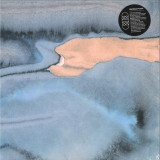
Fractal City, the latest Cubenx album is a collection of terrestrial jams and arachnean ambient ballads that are particularly apt for urban listening. If its predecessors cracked the musical codes in force and shone by the versatility of their references, this new opus offers its listener an intense and symbolic sound environment.
The raw material of Fractal City was first conceived as a series of sound patches, designed to run in parallel with Canadian digital artist Maotik's installation. Broadcasted in real-time by generative patches reacting to various external and non-human data, those musical excerpts have been rendered in hundreds of nuances and extended over infinite durations. This unusual approach confers to the recording of the finished album's outstanding immersive strength.
Recorded live on a single track over a short period of a few weeks, the nine compositions of Fractal City capture the obsessions of its author for postmodern urban landscapes, and the revelation of new perspectives on the city of Paris.
The opening piece `Ssarg´ seems to hide the figure of the Mexican ambient producer Jorge Reyes. Cubenx built a cocoon of energetic layers, a new home of the mystical kind harmoniously integrated in a flourishing rainforest ecosystem.
`Transect ´refers to the urban development model of the same name, which is based on a division of the city into autonomous "fractal" zones. It also echoes the concept of "metro polarities" which considers the city as a mosaic of social groups. "By cycling in the evening with a friend, we could get away from the city centre to the suburbs of Paris. The contrasts are striking. You move from chic districts to bedroom communities, from industrial zones to improvised caravan camps. But there is a kind of energy in this heterogeneity that pushes you to always pedal further."
A few miles away, it would look like Art and urbanism have tried to level the cultural and social discrepancies of the outskirts of Paris. "Architectural sites like the Arcades of Bofill are splendid. There are completely extravagant projects, which seem to emerge from nowhere."
These buildings with ambitious aesthetics off the beaten tourist track, deteriorate over time and often remain far from the expectations of the local population. A feeling of nostalgic beauty is particularly perceptible on the slowest and most introspective ballads of the album as 'Urban Decay', 'Hagel' or 'Axe Majeur'. The producer leaves nonetheless no room for melancholic emptiness. "Every time, I have the impression that urban culture is taking its rights back and that young people appropriate the places in one way or another."
Just like `Transect', ` Quantified' and `Fractal City' present themselves as mirrors of a daily urban life in constant motion. All three are empowered by an overheated factory, which dispatches hypnotic beats and burst of analogue compressors with a clinical precision and direct them straight away to the reptilian areas of their listener's brains.
The sequencing leaves however space and time to take breath and makes way for aerial sonic excursions of spiritual and enlightened nature. On `Human Dilemma', Cubenx shows some concerns to opening the Pandora's box of transhumanist theories. While a long cosmic wave gives the listener a feeling of perfect fullness, a dizzying guitar distortion cast doubts on long term outlooks. `Smash Other' on the other way alternates gentle dissonances over an ocean of white noise and concludes the album on ethereal note.
With ´Fractal City", Cubenx eludes his irreconcilable love for shoegaze pop song and techno to concentrate exclusively on the production of mutant experimental materials. The result is an uncanny musical object, rich in image and sensation. Cubenx give us a guiding framework, enthralling enough to engage the listener to a tour of town. But he leaves it to the sole listeners to design their own projection of the city.
Suche:perspectiv
After a period of spending time in nature living in the Spanish coastal town of Dexo - producer Roi speaks of his experience of returning to city life on his second EP for Fanzine Records on Crunia EP. Set to drop this summer, Roi shares two tightly honed original tracks inviting Carl Finlow and The Exaltics to remix.
The EP is a counterpoint to Deixo EP - his 2019 EP on Fanzine that speaks from his opposite perspective of the self-knowledge born out of his isolation when he first moved to the coast out of the city. Crunia marks his time preparing the return to the jungle of the asphalt.
It's a new chapter moving from an introverted to extroverted existence and between nature and man's constructs in the city. Opening the EP Maianca works in deep breakbeats with shimmering synths with a jumping and uplifting feel. Carl Finlow's remix builds it into an ultra-funky electro boogie number that perfectly speaks of the carefree existence of living in nature.
Crunia takes the EP into a more frantic corner of urban life - to light up dark corners gritty warehouse dance floors. For their remix The Exaltics take's Roi's heavy handed lead and brings a heavily kicking version of Crunia to the mix ready to pump the city's sound systems.
Fanzine Records is part of Fanzine Project - promoters and educators based in A Coruna, Spain. They focus on developing and supporting local artists through Fanzine Records, Fanzine Fest and Fanzine School.
- 1: All I Need
- 2: Kiss Like The Sun
- 3: About Last Night
- 4: Downtown
- 5: Rabbit Hole
- 6: Lost
- 7: Scene
- 8: Lonely Hours
- 9: Maybe It’s Today
- 10: Screaming
- 11: Hold Tight
It may be his fifth album, but Saturday Night, Sunday Morning marks the start of chapter two for Jake Bugg. Arguably his most complete and coherent record to date, Saturday Night, Sunday Morning manages to combine a love of ABBA, the Beach Boys, Supertramp and the Bee Gees, with a contemporary pop sound: one that’s already spawned his most ubiquitous song in years via euphoric lead single, All I Need. “I knew what I was looking for this time around,” the 27-year-old says, firmly. “And I feel like I accomplished it.” It’s almost 10 years since a two-fingered Bugg burst onto the scene with his eponymous debut, one that topped the UK album charts and saw the then 18-year-old from Nottingham fêted as the next Bob Dylan. A Rick Rubin-produced follow up, Shangri La, quickly followed. But progress stalled with Bugg’s third, largely self-produced, record, On My One, in 2016. “I was having a hard time on that third record,” Bugg admits, five years removed. “The support from the industry wasn’t what it was. All those people telling you how great you are weren’t there anymore. It does feel like the rug’s been swept from under your feet.” What that record provided, however – along with its comparatively stripped-back follow up, Hearts That Strain (2017) – was a much-needed course corrector: one that set Bugg on the upward trajectory he finds himself on today. “When I came to terms with that was when I left the ego at the door,” he says. “It didn’t work out. But it led here. And this is probably my strongest record." It’s testament to Bugg’s rediscovered confidence that Saturday Night, Sunday Morning – a nod to the debut novel by Nottingham author Alan Sillitoe – sees him working with some of his highest profile collaborators to date, most notably American songwriters Andrew Watt and Ali Tamposi, best known for their work with pop heavyweights Post Malone, Dua Lipa, Miley Cyrus, Camila Cabello. “I was looking for how I can incorporate my sound for a more modern era. And I kind of struck gold working with Andrew Watt and Ali Tamposi,” Bugg says. Convening in LA, the first track the trio wrote together is the jealousy-inflected About Last Night, a song about the “insecurities you go through as a young person in a relationship with someone.” “It’s got such dark undertones, which I love,” Bugg says, of a song that showcases a newly discovered, Beach Boys-esque falsetto. “But it’s also very, very pop. That’s what I’ve always loved. With ABBA, with Supertramp. I love pop music. But when you can get it to be dark, I love it even more.” It’s a trick the trio repeated again on Scene, Bugg’s personal favourite from the album and a song that best encapsulates the combination of old and new: Watt’s George Harrison-esquire guitar brushing up against contemporary melodic choices by Tamposi. “I love writing with her,” Bugg says of the Havana hitmaker. “She brought that women’s perspective. And I knew that I’d got that balance of what I wanted. That old school chorus with contemporary verses. That to me was my favourite song when I wrote it, and it still is.” Perhaps the biggest example of Bugg’s newfound ego-less approach to writing, however, came in the shape of Downtown, a song that grew from an idea by Jamie Hartman (Celeste, Lewis Capaldi, Rag'n'Bone Man), and sees Bugg deploy the higher range of his voice to ethereal, ’60s Bee Gees effect. “Usually, the initial spark of an idea comes from me. And when it doesn't, it sometimes loses my attention,” Bugg admits. On Downtown, however, he relished his role as arranger: “Because there were a lot of moving parts and chords, it was almost like a puzzle,” he says. “I’d never approached a song like that before. “What I’ve been enjoying on this record is the collaborative process,” he continues. Working with people, writing with people. Because I’ve realised all I really want to achieve is to be the best writer I can possibly be. And I think by working with other people, it allows you to learn a lot as well.” It’s a theory Bugg has put to the test during lockdown, when he was approached by his manager about writing the soundtrack to an upcoming documentary, The Happiest Man In The World, about Brazilian footballer Ronaldinho. “It’s kind of a completely different experimental outlet,” Bugg explains of his first ever score. “I approach my own work quite professionally. But with this I can just switch off and go into a different world. And it’s been brilliant – I’ve had to learn different styles of guitar: bossa nova, samba. It’s a bit Vangelis, who’s probably my favourite artist – which may surprise people.” Possibly. But you get the impression that surprising is what Bugg likes to do. “I don’t like to be stuck doing the same thing,” he admits. “And that’s what this record Saturday Night, Sunday Morning was. I wanted to push myself. I’m always learning new influences. I’m careful not to get stuck on the same thing. “It’s not going to be right every time. It’s not going to be good every time,” he continues. “But if that’s the process it takes to get to this record, where people are loving the songs again, then that’s the journey we have to take.” For Jake Bugg, chapter two starts now. New album ‘Saturday Night, Sunday Morning’ is out August 20th on RCA Records
Bonander is the shorthand for Ellinor Sterner Bonander. Sporting the role
of musician, arranger and producer, the native Swede is a woman
unchained, injecting darkness into the vein of candied pop with her tropes
of existentialism and feminist revolt.
Following the arc of ‘Backseat’ and ‘Martha’, Bonander’s latest single, ‘Gone
In The Wind’ leads the way for the album with its emotional outpour of lost
sisterhood. Tribal thrashes of drums, pipe organ and soaring vocals combine to
manifest the pain and frustration at the heart of the song.
She says, “The song is about abandonment of a person who’s been like a sister
to you, someone you admire and cherish... The pipe organ and strings are the
most emotional instrumentation I can think of. They represent that suppressed
feeling of anger and frustration, that later in the song is set free.”
The album tells the stories of women both from history and her personal life
whose contributions have previously been overlooked.
“The idea for the album is to create a musical, cinematic and dramatic journey
full of contrast between intimate string sections and huge synth landscapes,
between mechanical rhythms and flowing tempos.
The lyrics will together speak of the identities and emotional life of different
women, both through private and historical perspectives. All of the songs discuss subjects concerning women that ought to be talked about more, but sadly
are not...” // Bonander
Fragments, The Debut Album From Trifecta (Beggs, Holzman, Blundell)
Trifecta, a new addition to the Kscope roster, features 3 of the contemporary
music scene’s most lauded and revered musicians - bassist and songwriter Nick
Beggs, keyboardist extraordinaire Adam Holzman and completing the line-up,
Craig Blundell - one of the world’s most celebrated drummers.
Having performed together as part of Steven Wilson’s band, the three would
jam together after soundchecks and from these sessions the fledgling ideas for
Fragments were born. Nick Beggs comments “after the last tour with Steven
finished, we had a handful of tracks ready to work on and as we moved through
our various separate projects we agreed to work on Trifecta.”
The record primarily leans toward a fusion of jazz rock, being instrumental except for the first single (the wonderfully titled “Pavlov’s Dog Killed Schrodinger’s Cat”), the lyrics of which, Beggs states, “are written from the perspective of
a layman trying to understand quantum mechanics...and failing.”
Each band member completed the recording and engineering of their own
contributions in their various home studios, helping to bring their individual
production ideas to each track. Adam Holzman mixed the record at his New
York home studio with the mastering handled by Andy VanDette (Rush, David
Bowie, Deep Purple, Porcupine Tree, Beastie Boys) in New York.
Asked what fans of the musicians can expect from Trifecta, Beggs says, “Fission!
It’s like Fusion but less efficient and more dangerous.”
The debut album resulting from this “fission” of these extraordinary musicians
is entitled ‘Fragments’ and will be released on Kscope on 20th August 2021.
The full-length debut from Bendigo Fletcher, Fits of Laughter is a collection of moments both enchanted and mundane, sorrowful and ecstatic: basking in the beauty of a glorious lightning storm, waking with a strand of your beloved’s hair happily caught in your mouth, drinking malt liquor while bingeing “The X-Files” on a lonesome Saturday night. As lead songwriter for the Louisville, KY-based band, frontman Ryan Anderson crafts the patchwork poetry of his lyrics by serenely observing the world around him, often while working his grocery-store day job or walking aimlessly in nature (a practice partly borrowed from the late poet Mary Oliver). When matched with Bendigo Fletcher’s gorgeously jangly collision of country and folk-rock and dreamy psychedelia, the result is a batch of story-songs graced with so much raw humanity, wildly offbeat humor, and a transcendent sense of wonder.
True to its spirit of purposeful wandering, Fits of Laughter unfolds in a wayward yet lushly detailed sound, embroidered with everything from crystalline harmonies to blistering guitar riffs to heady drum-machine beats. For help in forging the album’s ragged elegance, Bendigo Fletcher worked with producer Ken Coomer (the original drummer for Wilco and Uncle Tupelo), whom Anderson met in a flash of strange serendipity. Soon after he’d connected with Coomer via phone and bonded over a shared affection for Pink Floyd’s Obscured by Clouds, the band headed to Nashville to record in Coomer’s garage studio, laying down the album’s eight songs in nine frenetic days.
In keeping with the regional perspective that defines much of folk and country music, Fits of Laughter ponders certain paradoxes inherent in the band’s homeland. “In Kentucky there’s a long-running frustration of tradition and stubbornness versus progress,” says Anderson. “On one side you’re looking at things like the coal industry or Mitch McConnell, but then there’s also a feeling of togetherness and a fuck-the-man attitude and a loving desire for everyone to be left alone.” Referring to Fits of Laughter as a coming-of-age album, Anderson also examines a more internal conflict throughout the songs, including his choice to abandon his medical-school aspirations in favor of pursuing a career in music. “The title’s really about the spectrum of emotions I’ve felt on the way to finding what makes me feel like I’m living truthfully, rather than holding onto what I think other people’s expectations are of me,” he says. “It’s a phrase that bridges all of those emotions—everything from joy to hysteria.”
Today, beloved DJ, producer and songwriter Lauren Flax announces her forthcoming EP, Out Of Reality out August 6 via 2MR. Much of Out Of Reality’s cohesion comes from Flax’s expansive production, using simple elements to craft intricate backdrops for the questions posed by her songs. On the EP’s titular track, Alejandra Deheza (School of Seven Bells)’s crystalline vocals are woven against a delicate tapestry of arpeggiated keys, sparse percussion and haunting cello. Watch “Out of Reality” here.
Detachment isn’t always detrimental; sometimes you have to step outside to get a better view. Lauren Flax knows this - as a DJ, producer and songwriter, her discography is notoriously genre-defiant, consisting of an impressive array of solo tracks, collaborations, and remixes. The most recent of these – her mesmerizing take on Pale Blue’s “Breathe” - saw her experimenting with a new style of writing. “I wanted to explore that sound more,” Flax explains, “more of a synth exploration, textures with less beats.” The pared-down songwriting approach lent itself to thematic considerations as well: she’d been thinking about the repetitive nature of the life cycle - the Indian concept of Samsara - and felt a general disappointment at humanity’s lack of progress. On her new EP Out Of Reality, she washes that disappointment in lush sonic hues, stepping outside the quotidien for a new perspective.
Though its themes span beyond the scope of our current socio-political moment, Out Of Reality feels, right now, like an especially tantalizing proposition. Pandemic-driven escapism has bred a new crop of otherworldly music designed to transport the listener somewhere better. But Flax isn’t interested in escapism for its own sake - there’s still work to be done here on Earth, after all. Instead, through a combination of live instrumentation and ethereal synths, Out Of Reality grants us a respite from the real so we can return to it with a clear head.
- A1: Branko Over There (Feat. Miles From Kinshasa)
- A2: Branko - Movimento
- A3: Branko - Stand By (Feat. Umi Copper)
- A4: Branko & Sango - Hear From You (Feat. Cosima)
- A5: Branko & Pedro - Mpts (Chords Version)
- B1: Branko - Sempre (Feat. Mallu Magalhães)
- B2: Branko - Amours D'été (Feat. Pierre Kwenders)
- B3: Branko - Tudo Certo (Feat. Dino D'santiago)
- B4: Branko - Bleza
- B5: Branko - Agua Con Sal (Feat. Catalina García)
- B6: Branko & Dengue Dengue Dengue - Lucuma
The first thing that strikes you when hearing 'Nosso' is its feeling of intimacy and warmth. The title, which means 'Ours' in Portuguese, is apt since he sees the record as the result of letting a wild variety of people into his world. João notes that 'I didn't know most of the collaborators before meeting up with them in a studio somewhere in the world, so most of these songs are coming from a very immediate and honest sense of collaboration where you spend an afternoon with someone learning about each other at the same time as you're making music. It's a shared experience, a moment where two or more people came up with ideas together, that they probably wouldn't have had if they were in their comfort zone.' These meetings were turned into songs at home in Lisbon once the main ideas were created collaboratively elsewhere. 'On this album, like in everything else I did so far, the focus on the instrumental side of things was experimenting with rhythmic patterns and genres from the Portuguese-speaking universe while applying them to songs created with other artists from completely different backgrounds and places.' There's something in this process that has left the album sounding super fresh as this is a sound without borders that pulls you in. It's music everyone can be a part of, where even the most rugged up-tempo cut sounds welcoming. It's an overwhelmingly positive and joyous experience to immerse yourself in 'Nosso.' It's no wonder that the central motif of the album artwork shows a less common view of Lisbon, one where instead of looking at the historic city centre we face the suburbs, where these musical and cultural experiments have been and still are occurring, undeniably shaping the musical and cultural landscape of Lisbon in the process. As much a soul record as it is a record infused with the beats of the Portuguese-speaking world, 'Nosso' is a reflection of Branko's ongoing musical explorations and his vision of Lisbon as a privileged cultural hub for the Portuguese-speaking world and beyond. Branko fuses local rhythms from kizomba to baile funk and afrohouse through European electronic genres with a clear accessible pop sensibility and the aim of creating a unified sound that puts all these individual musical expressions in perspective as part of a greater whole. For João, this is the logical next step in his musical evolution.
Hamburg's very own Christoph Kähler a.k.a. Zwanie Jonson has many names. He is, depending on your perspective, theee eternal drummer, who has toured with legions of seminal German bands of all genres, he is just as well theee eternal underdog, for whose solo debut album "It's Zwanietime" infamous DJ Koze invented his very first label Hoobert in 2007 - out of pure love and just to be able to release it. (Koze taken with it: "The sweetness and kindness that runs through all the songs makes you think Zwanie is on the verge of his enlightenment."). He's been called a fake Swede, JJ Cale from the Waterkant, taller than Jesus (sic!), but above all he's the man who makes Hamburg look like a sweet spot at the end of Laurel Canyon, Los Angeles.
In summer 2011, Zwanie's second album "I'm A Sunshine" was released by Staatsakt. The album track "Golden Song" became a late radio hit in 2015 through its use in the film "Victoria". In 2017 he released "Eleven Songs For A Girl", also on Staatsakt, and now his fourth album "We Like It" is scheduled for early august on Fun In The Church. Recorded virtually alone, just like any of Zwanie's
After the exploration of snowy mountains of Alpestres, released on Hands in the Dark in 2018, French composer Matthias Puech ventures into new territories, sketching a cartography of the invisible where the journey, in chiaroscuro, is announced as a rite of passage. A Geography of Absence, as introspective as unpredictable, immerses the listener into a unique sensory whirlwind where organic matter becomes almost palpable. A researcher in theoretical computer science and an engineer at GRM, Matthias Puech constructs a dialog between synthetic music and field recording, capturing sounds that surround him and creating his own sonic language with the help of synthesizers he designs and develops; notably the Oscillator Ensemble and the Tapographic Delay, made by the American company 4ms.
Composed during a moment marked by ordeal and mourning, A Geography of Absence retraces an inner journey where the physicality of sound leads the listener into an initiatory tunnel filled with apparitions, ghosts, visions. With sound oscillations as a navigational map, we progress, step by step, through the meanders of an unknown world, dazzled by the prospect of a new synthetic horizon, an electronic biotope teeming with life and incarnations. Playing with time, space and matter in an approach similar to that of musique concrète, Matthias Puech combines ambient and noise, floating sounds and electroacoustic experimentations, thus shaking up our listening perspective, which finds itself walking through a parallel universe, strata after strata, sequence after sequence.
The trip begins with “Hollow”, as if on board a night train travelling at full speed through ghost towns. Or is it a spaceship? Removed from their original habitat, sounds – picked up during walks or moduled by synths – are free to be interpreted differently by everyone, according to the memories that shape us. Granular and metallic, this first piece takes us to an elsewhere in orbit. "Work Song" is built around the pulsation of the void, of space, where strange creatures and liquid emanations abound. We become fetus, cocoon coiled in the placenta, heart beating to the rhythm of the gooey choreography of the human body. "Chrysalis" awakens the racket that lies dormant in us, when the skin changes, when the transition takes place. One seems to recognize certain sounds stemming from nature but they could also be mirages, imitating reality to render the barely perceptible engulfing. “Tunnel Vision” brings out a herd of haunted bells, slowly swelling in a pastoral maelstrom, ending in a deafening buzz. Further on, the chirping of an animatronic bird mixes with the hooting of an owl: "A Faint Beacon" invokes a nocturnal vigil that mixes the crackling of a fire and icy gusts of wind blowing everything away. Like an epic, sucking the listener into the breach of a black hole in the center of the Milky Way, it's up to "Homeostasis" to conclude in the high spheres and contemplative vapors, where the balance of dawn announces a rebirth.
A Geography of Absence is a meticulous and sensitive piece that constructs a delicate symphony of extremes, between introspection and desire for the unknown. Accompanied by the ink work of the artist Léa Neuville, whose folds of prints sketch this imaginary atlas, Matthias Puech becomes a narrator of mental adventures. And succeeds once again in transcending reality to dig a path to the unspeakable.
Tomas Nordmark's music operates on multiple, equally thrilling planes. Having cultivated a deep appreciation for conceptual art and the phase-shifting minimalism pioneered by the downtown avant-garde community of NYC in the `60s, Nordmark set out to blend that with his pop-oriented upbringing and unique perspective on electronic music. The Swedish-born, London-based composer's new album pulses with unrelenting energy, waving and cresting around ambient tension and gorgeously realized melodies. Exit Ghosts is partly influenced by the history of film scores and the aesthetics carried by that tradition. As an instrumental album, Nordmark is tasked with conjuring emotions without words, and the way he utilizes specific cues mirrors the process of film scores, in addition to the work of seminal composers such as Tim Hecker, Arthur Russell, and Jóhann Jóhannsson.
Natalie Chami and Whitney Johnson perform as a duo under the
name Damiana.
Both artists have built their own catalogs as multi-instrumentalist improvisers
and composers in the Chicago experimental scene, exploring the intersections
between ambient, electro-acoustic improv, and more legible songcraft based
around their voices and their work with synths and electronics -- all filtered
through their backgrounds in classical performance and education.
Chami’s solo recordings under the TALsounds moniker have appeared on labels
such as NNA Tapes, and Ba Da Bing!, and her collaborative projects include
the trio Good Willsmith. Johnson has released a series of solo LPs as Matchess
on the label Trouble in Mind, and has contributed to recordings and live performances by Ryley Walker, Circuit Des Yeux, and Tortoise’s 20th anniversary
performances of TNT, among other artists.
After meeting in the early 2010s, Chami and Johnson embarked on multiple US
tours together, and their informal duo collaborations naturally crystallized over
time into the Damiana project The duo’s debut album Vines presents their first
recordings after years of live sets and home recording sessions.
The album strikes a balance between the realms of deliberate compositional
sculpting and free-form improvisation, as Damiana’s evolving sessions of looping synth phrases and harmonized vocal lines emphasize austere beauty and
meditation as much as spectral disorientation and instrumental complexity.
While the tracks on Vines create the illusion at any given moment of a standing
cloud, often colored by Johnson’s lush viola and Chami’s effect-manipulated
electronics, a zoomed out perspective of each session reveals an undulating
story arc with contrasting emotional resonances and constantly shifting timbral
focus.
Treading the line between transportive stasis and upward motion, the duo has
honed their sense of when to push forward with a new texture or melodic
flourish without disrupting the atmospheres that they meticulously build together. Packaging: LP Black vinyl. Artwork by Heather Gabel (from the band
HIDE). Manufactured at 8Merch in Poland.
Silver Lining Music to release the first project by Saxon's Biff Byford and son Seb Byford of Naked Six. On July 23rd 2021, there’s going to be a new rock ‘n’ roll sheriff in town, and as their name suggests, Heavy Water aren’t for the light-hearted. Soaked in gritty, riff-baked blues, yet rich with the sound and metre of classic hard rock, Red Brick City’s ten songs refuses to let you go. From the taut, elastic swing of the ‘Solution’ riff to the rich, layered balladic strains of ‘Tree in the Wind’, Red Brick City moves with the class and cadence of a cracking journey uniting vintage rock ‘n’ roll sensibilities with the crackle and excitement of a fresh, youthful perspective.
With Seb on guitar and Biff on bass duties and both providing their vocal talents the foundations for Heavy Water’s sound are set in both that incredible father/son chemistry and a lifetime of know-how and experiences. Take the title track -and first single- ‘Red Brick City’, all steam and smoulder wrapped around a riff Soundgarden would’ve been proud of, and then there’s the sun-soaked smile of ‘Follow This Moment’ with harmonies evoking the Beach Boys relayed through Led Zeppelin, a gorgeous ‘70’s trip right down to the fade out. Produced by Seb Byford and Biff Byford, with Jacky Lehmann mastering, Red Brick City is a rich, lustrous ride through profoundly rewarding rock waters.
- A1: The Nips - Gabrielle
- A2: Dolly Mixture - New Look Baby
- A3: The Blades- Revelations Of Heartbreak
- A4: The Crooks - Modern Boys
- A5: Inspiral Carpets - Saturn 5
- A6: The Users - Kicks In Style
- A7: Untamed Youth - Untamed Youth
- B1: Les Elite - Get A Job
- B2: The Gents - The Faker
- B3: The Name - Fuck Art Let’s Dance
- B4: The Scene - Something That You Said
- B5: The Killermeters - Why Should It Happen To Me
- B6: The Accidents - Blood Spattered With Guitars
- C1: The Fixations - No Way Out
- C2: The Leepers - Paint A Day
- C3: The Variations - Fight Back
- C4: The Same - Movements
- C5: The Kick - Stuck On The Edge Of A Blade
- C6: Daggermen - Ivor The Engine Driver
- C7: New Hearts - Only A Fool
- D1: The Long Ryders - Looking For Lewis And Clark
- D2: Ocean Colour Scene - The Day We Caught The Train
- D3: Nine Below Zero - Pack Fair & Square
- D4: The Jolt - I Can’t Wait
- D7: The Moment - Sticks & Stones
- D5: The Inmates - Dirty Water
- D6: Scarlet Party - 101 Dam-Nations
In 1979 as a 15-year-old Eddie Piller was perfectly placed to be at the epicentre of the Mod revival. An inquisitive passion
for music, a family connection to Mod royalty The Small Faces, and an attitude that saw him travelling his home city, then
the country and then the world to take in the sounds that were emerging. In the years since, Piller has been a legendary
figure within the music industry setting up and continuing to own the ground-breaking Acid Jazz label, signing multiplatinum artists such as Jamiroquai and The Brand New Heavies collaborating on compilations with Martin Freeman and as
an award winning broadcaster even setting up his own Totally Wired Radio station. In The Mod Revival he looks back at the
movement that set him on his way.
• Mod is a sixties youth movement original built on sharp clothes, American soul music and nights on the town, that has never
really died. The originals added young British groups to their likes and then moved on, but their influence echoed on
through the 1970s in Northern Soul clubs, and in the sixties influenced bands of the pub rock era. When punk arrived, it was
supposed to sweep away the past, but instead the Sex Pistols were covering the Small Faces. The Clash brought in Mod DJ
Guy Stevens to produce London’s Calling, The Buzzcocks sounded closer to the Hollies than The Ramones and in The Jam’s
Paul Weller there was a musical and sartorial nod to the past of The Who, The Beatles and pop art arrows.
• Weller had spent the 1970s becoming obsessed by mod and saw punk as having a similar youthful energy to the era he had
missed by being born a decade too late. For others Weller’s style proved an inspiration, and as the Jam broke through in late
1978, they saw a wave of bands follow in their wake, and they themselves influenced others to form their own groups. But
there were other things. In bleak late 70s Britain the glorious optimism of the 1960s looked bright and shiny, and as it was
only a decade or so in the past, it was easy to pick up original records, clothes and books for pennies, and as you bought
these you met other like-minded souls who did the same. For those a little too young for punk, it was a community of gigs,
scooters, clothes, bands and records, and for many it developed on through.
• Eddie never stopped being a mod and has a unique perspective having now lived through four decades of being intimately
involved in the music that has emerged from the mod scene. In this part two double vinyl edition (Part 1 and its CD
equivalent reached #14 in the UK compilations charts) Ed guides us through some of his favourite music from the scene. He
guides us through a plethora of bands whose influences include The Who, The Kinks and the Jam, to sixties soul and R&B,
those with an eye on psychedelia. The records have a vitality and a certain stylish swagger to them, that marks them out as
mod. In the deluxe booklet, Piller has written a 5000 word note describing what it meant to him and has granted access to
his own scrapbooksfrom his many years of gig-going from which pages and memorabilia are reproduced.
• Eddie Piller’s Mod Revival is a personal appraisal from the founder of The Modcast, on what the mod explosion of the late
70s and 80s means to him…
- A1: Vertigo Prelude & Rooftop
- A2: Madeleine & Carlotta's Portrait
- A3: The Beach
- A4: Farewell & The Tower
- A5: The Nightmare & Dawn
- B1: Love Music
- B2: The Necklace & The Return & Finale
- B3: Theme From Alfred Hitchcock Presents (Funeral March Of A Marionette) (Funeral March Of A Marionette)
- B4: Theme From Dial M For Murder (Bonus Track)
- B5: Mouvements Perpetuels From Rope (Bonus Track)
- B6: Theme From The Trouble With Harry (Bonus Track)
- B7: Juke Box #6 From Rear Window (Bonus Track)
- B8: Prolouge, Duet For Four Feet From Stangers On A Train (Bonus Track)
Snowy White VINYL[19,96 €]
Orange Vinyl
Vertigo is a 1958 American film noir psychological thriller film directed and produced by Alfred Hitchcock. The story was based on the 1954 novel D'entre les morts (From Among the Dead) by Boileau-Narcejac. The film was shot on location in San Francisco, California, and at Paramount Studios in Hollywood. It is the first film to use the dolly zoom, an in-camera effect that distorts perspective to create disorientation, to convey Scottie's acrophobia. As a result of its use in this film, the effect is often referred to as the Vertigo effect'. Vertigo received mixed reviews upon initial release, but is now often cited as a classic Hitchcock film and one of the defining works of his career.
To accompany the unrestrained awesomeness of DC’s Dark Nights: Death Metal comic series, execute producer / composer Tyler Bates (Guardians of the Galaxy, John Wick) present the Dark Nights: Death Metal soundtrack. Directly inspired by the comic series’ storyline, the diverse soundtrack illuminates the darkest corners of each DC character’s psyche. Available on CD, double blue vinyl, and exclusive double yellow vinyl for indie retailers. Features tracks from bands such as Mastadon, Soccer Mommy, Rise Against, Denzel Curry to name a few. TYLER BATES: Tyler Bates has become not only an artisan at architecting music for film, television, and video games, but an in-demand multi-instrumentalist, writer, and producer. His film credits include Dawn of the Dead (2004), 300 (2007), Watchmen (2009), several collaborations with Rob Zombie including The Devil's Rejects (2005), Halloween (2007), and Halloween II (2009), the Guardians of the Galaxy saga (2014, 2017), the John Wick series (2014, 2017, 2019), Atomic Blonde (2017), Deadpool 2 (2018), Fast & Furious Presents: Hobbs & Shaw (2019 ), and many more. “In Dark Nights: Death Metal, Loma Vista Recordings and I saw an opportunity to bring artists together to create a diverse soundtrack that is inspired directly by this incredible comic series. Our intent is not to literally create a death metal soundtrack, but instead, to illuminate the darkest corners of each character’s psyche from an authentic perspective that is thematically inherent in death metal music.” - Tyler Bates.
Director David Lynch once said "I long for a kind of quiet where I can just drift and dream. I always say getting inspiration is like fishing. If you're quiet and sitting there and you have the right bait, you're going to catch a fish eventually. Ideas are sort of like that. You never know when they're going to hit you." Inspired by this quote in both name and spirit, Hollie Kenniff's The Quiet Drift is an ambient gallery of cloudlike synths, seraphic strings, echoing guitars, and other celestial textures guided to cohesion by Hollie's own wordless singing. Though the album certainly creates (and originates from) the kind of space where Lynch's proverbial "fish" can be caught, The Quiet Drift is a fitting title for Hollie's own history, both recent and distant. During the course of the album's creation, Hollie and her family moved cross-country from an island in Washington state, to an island in Maine before ultimately relocating to Canada. "As a child I visited Ontario year-round," she explains in her own words. She continues "More than any other landscape, I think the lake, rivers, and woods there left the most enduring impression on me. The landscape and pace of life of these places will always stay with me." But the reverberant spaces Hollie crafts need no physical headquarters. Instead of conjuring views of nature at the ground level, her sound more readily evokes a top-down perspective, with the distinct features of the land shrinking underfoot as the listener becomes untethered from geography altogether. The Quiet Drift belongs more to the liminal spaces between life and afterlife, memory and fantasy, landscape and dreamscape, than any mappable locale. Describing her formative years, Hollie says "As a dual US/Canadian citizen who spent my childhood in a rural town-- one that I haven't returned to in many years - I have a sense of not entirely belonging anywhere. When I was a teenager my close friends were male musicians, so I was also an outsider to the degree that they were wild and anarchic in a way that I wasn't. I was a quiet book reader and avid music listener who enjoyed being around a creative group. I was also a radio DJ for alternative and punk music throughout high school." In this light, The Quiet Drift attests that creativity is placeless, and calls into question the stereotype of artists as scene-centric city dwellers. Having come of age in the absence of metropolitan sensory overload, Hollie learned to spot the muse in nature, and within herself, instead of the echo chamber of a frenzied peer group. On The Quiet Drift Hollie Kenniff wholly escapes from such pop-culture feedback loops into transcendent, shimmering realms, and she brings the listener along with her. In this age in which we have all been called to reevaluate our relationship to indoor spaces, and seek refuge in the great outdoors, The Quiet Drift provides an apt soundtrack for such rebalancing.
Action/Adventure (A/A) is a pop-punk band hailing from Chicago ready to shatter the decades-long stereotypes of the scene. As a band comprised solely of BIPOC, their mission is to create #PopPunkInColor and ensure pop punk is a genre where everyone is represented on and off stage. Playing collectively together since 2014, the band has gotten the attention of alt scene tastemakers like Alt. Press and Kerrang!, garnered nearly 20k monthly listeners on Spotify, over one million plays on TikTok, and even secured a slot at the final Vans Warped Tour in 2018. The band consists of Adrian Brown (drums), Blake Evaristo (lead vocals), Manny Avila (bass), Oren Trace (guitar), and Brompton Jackson (vocals/guitar). Pulling Focus will be the bands fourth EP joining Going Heal (2018), Last Minute Stuntman (2016), and Ruble Pak (2016). The dynamic five-piece collectively write music that slides along the vast spectrum of pop punk, typically landing in the area of melodic hardcore. Poppy lyrics and melodies bring an air of familiarity that are simultaneously bringing a fresh perspective through a new lens, and gripping riffs and trashing breakdowns that you can nod your head to. A/A has now successfully planted their flag into the national landscape of the pop-punk scene following the release of their powerful 60-second single, “Barricades,” which details the discrimination the band has faced while gigging at pop-punk shows across the country. On a whim at the suggestion of a friend, the band posted the impactful music video for “Barricades” onto TikTok one afternoon with their hashtag #PopPunkInColor, and uninstalled the ap shortly after. By the end of the day, they had over 60k plays #PopPunkInColor. Within three weeks, the guys had over one million plays and an email from their dream label in their inbox.
2021 Repress
Rone is a stalwart of the French electronic scene and returns with his fourth album, 'Mirapolis', a synesthetic journey with features from Bryce Dessner (The National), Baxter Dury, John Stanier (Battles) and Saul Williams. The artwork was created by the critically acclaimed director Michel Gondry.
Stepping into Rone's music is like sleepwalking through a vividly colourful dream, eventually stumbling across a strange, scintillating Megapolis of saturated light and colours: 'Mirapolis'. Its twelve tracks / districts, each with their own specific planning, pulsate as though animated by their musical mastermind.
The project was an opportunity to get reacquainted with long- time stage and studio partners John Stanier, Gaspar Claus and the Vacarme band and Bryce Dessner (guitarist for The National,) while bringing in new collaborators (and thus, new interpretation of Rone's dreams). We find American slam-poet Saul Williams, who happened to be in Paris for a moment and contributes a searing anti-Trump screed, Baxter Dury, who brings an irresistible East London touch to 'Switches', a kind of fan fic that reimagines the Beatles' Sergeant Pepper lounging pensive in a club chair, Israeli electronic music muse Noga Erez, who inspired 'Waves' which, despite being recorded remotely, betrays a euphoric partnership, and finally, Kazu Makino, Blonde Redhead's bewitching singer and multi- instrumentalist, who contributes to the album's closer, the gauzy 'Down For The Cause'.
Rone remains a producer of grand instrumental pieces, which cannot be easily categorized in the architectural canon of our electronic music galaxy. Hypnotic, cinematic opening track 'I Philip' is an offshoot from the score for the first French virtual reality fiction, built around Philip K Dick - the perfect gate into a city that then opens up myriad temporal perspectives.
fter a hiatus of over eight years Fuzzy Lights are making a welcome return. Burials is the follow-up to the critically acclaimed album Rule of Twelfths, and the fourth album from the Cambridge-based post-folk collective.
Their sound has been stripped back to its component parts, deconstructed and rebuilt under less obvious influences. There’s a bedrock of folk-rock - predecessors like Trees and Fairport Convention - but this is then built upon through multiple layers, from the stillness of Talk Talk to the orchestral chaos of Godspeed You! Black Emperor. With Burials Fuzzy Lights have cultivated these sounds and influences into something new and fresh that distances the album from the rest of the folk-rock crowd.
The most striking element of these songs is how intimate they are. Lyricist Rachel Watkins has revealed a lot about herself in these seven songs, which have been written from a very personal perspective. Raw experiences have been distilled into each piece, her translucent vocals often betraying the content of the songs themselves. The album is bookended with the most personal of these. Opener ‘The Maidens Call’ reveals her loss from suffering a miscarriage, whilst album closer, ‘The Gathering Storm’ frames the rallying cry of women’s rights around how individuals must work together now, and in future generations, to destroy prejudice. There is also engagement with humanity’s immediate surroundings and the environment. ‘Under The Waves’ deals with devastation of coral reefs, ocean resources and our natural world, and ‘The Graveyard Song’ imagines the perception of time from the juxtaposed views of a yew tree and a young woman.
As scenarios, paths, and outcomes shift around us, Burials’ amalgam of glowering, intense instrumentation, timeless, weightless melody, and exactingly revealing lyricism carves a very particular path through the world. This is music that tears us away from the everyday not just as a form of escapism, but as a means of self-reflection on hardship and the strategies we develop to overcome it. It is the band’s rawest yet most accomplished statement to date.