The identity of Deep Drive comes in large part from the way Zummo moves through the world. Using his smartphone, he records daily fragments: of daydreams and conversations, signage and slogans, moments that that strike him as insightful, odd, amusing, thereby creating a sonic collage of rhythms, melodies and voices. His deep baritone is imbued with laconic humour, and Deep Drive's track titles riff off his messaging. "Prepare For Docking" refers to the Staten Island ferry and the spectacle of humdrum city movements, but also suggests the nautical deep or even extraterrestrial life, with otherworldliness woven deep into the sound. "It's not a recital," says Zummo, of this way of working, "it's a movie." Deep Drive, then, is an album about the totality of the artistic process, seen from a generous and honest vantage point. The record was recorded in Copenhagen alongside Mabe Fratti, Sebastian K, Peter Broderick and Joseph Carvell
Buscar:peter zummo
- 1
Repress
Peter Zummo (born 1948) is an American composer and musician. He plays the trombone, valve trombone, euphonium, synthesizer, other electronic instruments, and also sings. He is associated with the postminimalist and Downtown aesthetics, and he describes his music as "minimalism plus a whole lot more." He's well-known for his work with Arthur Russell.
"In this project for Optimo, the listener can hear that my musical food pyramid has musicians at top, or maybe they are at the bottom. In any case, they are important. That is why, from track to track, I selected
segments in which one player or another is featured in the take. Some may think that we musicians do multiple takes to get the perfect performance, but I like to find the special interactions lurking in each excursion. Different players came forward in each of the takes, which were recorded in the studios Seaside Lounge and Headroom, in Brooklyn, and live in performances at Cube Cinema, in Bristol, U.K., as well as in Long Island City and on Staten Island, New York.
In order to escape the tyranny of the lyric, I am exploring in this release the possibilities of nonsensical and non-emotional lyrics. These kinds of lyrics bring the singing voices into the mix without an overweening message. The tracks include open-form compositions in which the duration was not specified."
- A1: Lucky Cloud (Ft. Peter Zummo)
- A2: Jackpot Pothole Eleven
- A3: Tomber
- A4: Aquatint
- A5: Pad Tide
- A6: Vila Inerane
- A7: Howler Hiccup (Vc-10 Eternal Selectric)
- A8: I'm Honkin' Here
- A9: Five Five Three (Ft. Jeremy Strachan)
- A10: Five Three Three (Ft. Ryan Driver)
- A11: You The Vandal
- A12: Bolan Muppets (Dan Bodan Remix)
- 1: Lucky Cloud (Ft. Peter Zummo)
- 2: Jackpot Pothole Eleven
- 3: Tomber
- 4: Aquatint
- 5: Pad Tide
- 6: Vila Inerane
- 7: Howler Hiccup (Vc-10 Eternal Selectric)
- 8: I'm Honkin' Here
- 9: Five Five Three (Ft. Jeremy Strachan)
- 10: Five Three Three (Ft. Ryan Driver)
- 11: You The Vandal
- 12: Bolan Muppets (Dan Bodan Remix)
20 Jahre nach ihrem selbstbetitelten Debütalbum bringen Glissandro 70 jetzt ihr nächstes Album raus. Es besteht aus Aufnahmen aus einem ganzen Jahrzehnt, die aufgegeben wurden, bei einem Festplattenunfall verloren gingen, in Form von rohen Stereomischungen wiedergefunden, mit der Zeit neu bewertet und schließlich restauriert/ergänzt/verbessert wurden und nun endlich das Licht der Welt erblicken.
- A1: Another Thought (02:16)
- A2: A Little Lost (03:18)
- A3: Home Away From Home (05:12)
- A4: Lucky Cloud (02:16)
- B1: This Is How We Walk On The Moon (04:42)
- B2: Hollow Tree (02:30)
- B3: See Through Love (04:46)
- C1: Keeping Up (06:20)
- C2: In The Light Of The Miracle (06:05)
- C3: Lucky Cloud (Return) (03:00)
- C4: Just A Blip (03:42)
- D1: Me For Real (04:55)
- D2: Losing My Taste For The Night Life (04:34)
- D3: My Tiger, My Timing (05:41)
- D4: A Sudden Chill (02:45)
2026 Repress
Another Thought was the first collection of Arthur Russell’s music to be released after his death in 1992. Released in 1993 on Point Music it marked the beginning of nearly 30 years of work to let the world hear the enormous archive of unreleased recordings Arthur left behind. Be With revisits this first compilation for a new gatefold double vinyl version and a triple-fold digipak CD reissue.
Both versions of Be With’s 2021 reissue of Another Thought have been mastered by Simon Francis and the vinyl cut by Pete Norman. The original artwork has been restored and tweaked at Be With HQ for the gatefold sleeve and the triple-fold digipak, with the essential help of Janette Beckman. Each version comes with an insert reproducing the liner notes and lyrics from the original CD release.
Together with Calling Out Of Context, Soul Jazz’s World of Arthur Russell, and much of the ongoing work of Audika, Another Thought is absolutely essential for even the most casual Arthur Russell collection. In fact we’d argue it’s essential for any fan of non-obvious pop music. This is the only place where you can hear some of Arthur’s most recognisable tunes and it’s an album that absolutely deserves to be kept in press.
We’ll assume that by now you’re all at least a little familiar with the story of Arthur Russell, the farm boy from Iowa who moved to 1970s New York. Arthur Russell the genuine musical genius who died just 40 years old, leaving behind a wealth of music that dwarfed the few 12"s and LPs that were released during his short life.
Although Arthur had been working on an album for Rough Trade during his last years, with the label no-longer operating it was Point Music (Philip Glass and Michael Riesman’s label set up together with Philips) who stepped in to help Arthur’s partner Tom Lee start working out exactly what Arthur had left behind.
Tom suggested that Arthur’s friend Mikel Rouse was the right person to make the first catalogue. Working in Tom and Arthur’s apartment he had only two weeks to go through what turned out to be around 800 tapes.
As Tom explained “at the end of each day he would generally wait for me to come home and I would, to the best of my knowledge, name and identify pieces in question from that day’s work. As he worked Mikel compiled about a dozen cassettes that he thought would present the most finished sounding songs for Don/Point to use. As Don listened he would then suggest and ask me and thus we collaborated on the choices.”
Don is Don Christensen, Another Thought’s producer. With a final selection of songs from recordings made between 1982 and 1990, including sessions with some of Arthur’s regular collaborators Peter Zummo, Steven Hall, Mustafa Ahmed, Elodie Lauten, Julius Eastman, Jennifer Warnes and Joyce Bowden, it was then Don’s job to turn these into a finished album.
Another Thought is a little different from the compilations of Arthur’s music that came out since. In our conversations with Steve Knutson (who founded Audika Records and who manages Arthur’s estate together with Tom), he explained that “more than any project released by Arthur during his lifetime or posthumously by Audika, ‘Another Thought’ is the most worked over. The material was significantly edited and rearranged from the original source tapes”.
If the aim was to release a comprehensive exploration of every facet of Arthur’s music, from the most avant-garde of his avant-garde compositions through to the most disco-not-disco of his disco-not-disco tunes then the project was a spectacular failure. But as a coherent album of non-obvious pop music Another Thought is wonderful.
Starting with the sparse voice-and-cello of the title track, A Little Lost adds some guitar along with the sneaking suspicion that we’re listening to something nowhere near as simple as it first sounds. By the time we get to This Is How We Walk On The Moon - it could be the moment you notice the congas, or the percussion that’s been building behind them, or maybe it’s that blast of trumpet and trombone - we realise we’ve gone from splashing around to being completely submerged in the musical world of Arthur Russell.
From here the album heads off on its journey around the sounds of the left-field contemporary classical music of the time, re-directed towards pop ears, with minor detours through the swirling woozy disco of the half-remembered night before on In The Light Of The Miracle and My Tiger, My Timing. Whether it’s just Arthur, his cello and some bleeps on Just A Blip, or whether he has some vocal help as he does on the bounding Keeping Up, this is difficult music made so, so easy. And through it all is Arthur’s voice and cello. Sometimes drowned in distortion and sometimes clear as a bell, but always there somewhere.
A Sudden Chill finally returns us to the calmer waters we started in and this last track closes the album with a melancholy that’s not surprising given how soon after Arthur’s death the album was put together.
Whilst Another Thought holds together with the consistency of a proper album, there’s still no getting away from the fact that this was put together from audio recorded in different ways, in different places, with different people at different times. Those with keen ears will hear traces of tape hiss, the occasional blown-out note and some digital fuzz, all fingerprints of those original recordings as well as of the 1990s digital equipment that was used to piece Another Thought together.
Add to this Arthur’s obvious pleasure in making music from the sort of sounds that can make microphones, speakers and ears uncomfortable, it’s no surprise that Another Thought isn’t glossy and pristine. Don Christensen’s productions have been careful to not scrub up those original recordings so much that they lose their original vibe, understandable given that Arthur wasn’t around as a guide. We’ve applied a similarly light touch with the mastering for these Be With versions, just working to make sure they sound like they should on both the vinyl and the CD.
Despite the Discogs rumours, Another Thought was never originally released as an LP. So when it came to the sleeve for this Be With vinyl version we took the original CD artwork as a starting point to come up with something that looks like it could have been in the record racks back in 1993.
We have to thank Janette Beckman for helping us reproduce her iconic photograph of Arthur in his newspaper boat hat. One of many photographs she took of Arthur, Janette shot this in her New York studio back in 1986 for a short article in the January ’87 issue of The Face Magazine. Those with eagle-eyes will notice we’ve used an ever-so-slightly different shot from the one that appeared in The Face and then again on the original cover of Another Thought. The original has long since been lost so we’ve worked with what is left in Janette’s archives. And we also have to thank Tom Lee for giving us permission to reproduce his liner notes from the original CD booklet, together with Arthur’s lyrics.
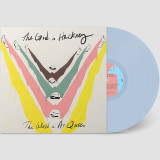
'The World in Air Quotes' is a genre-shifting style-melting kaleidoscope of art-rock, jazz, techno, folk & industrial. The God In Hackney sound like very little else from the early 2020's and whilst 'The World In Air Quotes' innovative progenitors are manifold - Eno, Coil, The Durutti Column, 1980s ECM jazz to name a few - it sounds beholden to none of them.
The God In Hackney's first album 'Cave Moderne' was Andrew Weatherall's album of the year for NTS Radio.
The God In Hackney's second LP, 'Small Country Eclipse', was album of 2020 for critic Sukhdev Sandhu of The Colloquium for Unpopular Culture: "Mordant music: stuttering, dread, black humour. A record that felt truly independent, beholden to no genre, out of step with all centres and signposted nodes."
'The World In Air Quotes' is The God In Hackney's 3rd album and their most musically emotive and lyrically inventive to date. It's an album that resonates with feelings about climate change, isolation, extinction, the social impact of technology, the flattening of history—and illuminates the darkness with imaginative rhythm, melody, noise & poetry. Songs range from widescreen, anthemic rock, to strange intricately arranged jazz-influenced songs, to abstract, textural electronic pieces. There's a strain of dark and surreal comedy too that runs through the lyrics and some of the choices the band makes in their sounds and arrangements.
The core God in Hackney quartet of Andy Cooke, Dan Fox, Ashley Marlowe and Nathaniel Mellors has expanded to include American multi-instrumentalists and composers Eve Essex (Eve Essex & The Fabulous Truth, Das Audit, Peter Gordon & Love of Life Orchestra, Peter Zummo, Liturgy) and Kelly Pratt (Father John Misty, David Byrne/St Vincent, Beirut, and Lonnie Holley among many others), signalling a new and ambitious direction for the band.
The album cover features original artwork by Iranian-American artist Tala Madani, recently the subject of a career survey exhibition at the Museum of Contemporary Art, Los Angeles.
Advertising:
The Wire, Maggot Brain
Reviews & features:
Maggot Brain - forthcoming feature
Hi-Fi+ Magazine - album review in April 2023 issue
Dereck Higgins (You Tube review)
Sonosphere - interview / feature
Weirdo Shrine - interview
It's Psychedelic Baby - interview
Spettacolo (Italy) - feature.
Ghettoblaster Magtazine (USA) - feature
Airplay:
Gilles Peterson - BBC Radio 6 Music
Steve Lamacq - BBC Radio 6 Music
Dublab - playlisted & featured in Dublab Recommends (Los Angeles)
Cian Ó Cíobháin - RTE Raidió na Gaeltachta (Ireland)
WFMU - playlisted
Resonance FM - The Wire presents Adventures In Sound & Music
Human Pleasure Radio (New Zealand)
Pete Wiggs & James Papademetie - The Seance (Repeater Radio, Sine FM & others)
Peter Hollo's Utility Fog - FBI Radio (Australia)
Jonathan Lethem & Sam Sousa on Radio Free Aftermath (KSP Claremont 88.7)
Life Elsewhere
WRPB Princeton
In Memory of John Peel
Mike Watt's Watt from Pedro Show
Arthur Russell first visited The Gallery in 1976 with his then boyfriend Louis, who introduced him to Nicky Siano. Arthur became a regular at the space and one night as Siano was playing “Turn the Beat Around”, which had just been released, Arthur waved at him from outside the booth and asked to come in. Nicky opened the door and Arthur suggested they make a record like this together. This ended up being a huge step for Siano as it marked the first ever production by a DJ making a record from scratch.
Arthur had written a song and had an arrangement for it so they assembled a band featuring Wilbur Bascomb who was one of Nicky’s favorite bassists, as well as, Allan Schwartzberg, David Byrne, Miriam Valle, Peter Gordon and Peter Zummo who were all friends of Arthur’s. Russell played the cello and piano – and that was the band. They recorded throughout 1977 and the “Kiss Me Again” 12 inch was finally released in 1978 on Sire Records selling more than 300,000 copies.
Week–End Records is proud to release the first ever reissue by this outstanding disco production. Remastered from the original tapes. With liner notes by David Byrne, Nicky Siano, Peter Gordon and Peter Zummo.
Mary Jane Leach is a composer focussed on the physicality of sound, its acoustic properties and how they interact with space. She has played an instrumental role in NYC’s pioneering Downtown scene alongside Arthur Russell, Ellen Fullman, Peter Zummo, Philip Corner and Arnold Dreyblatt, as well as devoting years to the preservation and reappraisal of Julius Eastman’s work since his death in 1990, compiling the »Unjust Malaise« 3CD set in 2005 and editing the 2015 book »Gay Guerrilla: Julius Eastman and His Music«. »Woodwind Multiples« is her second album for Modern Love, following »(f)lute songs« (2018).
»Woodwind Multiples« features four pieces for multiples of the same instrument: four bass flutes, nine oboes, nine clarinets, and seven bassoons. Each piece works closely with the unique sound of each instrument, combining pitches that create other, sometimes unexpected, tones, primarily combination and interference tones, as well as rhythmic patterns. What you hear is what happens naturally - there is no processing or manipulation.
»8B4 (1985/2022)«, played by Manuel Zurria, is for four bass flutes. It is a revision of 8x4, which was written in 1985 for the DownTown Ensemble and was only performed once, due to its unusual instrumentation: alto flute, English horn (originally bass oboe), clarinet, and voice.
»Xantippe’s Rebuke« (1993) was written for Libby Van Cleve, for eight taped oboes and one live, solo oboe. The eight taped parts are equal and dependent, while the solo part is meant to be a solo with the tape as accompaniment. The piece works with the unique sound of the oboe, starting with unison pitches that create the richest sound, building the piece from there. Pitches and rhythmic patterns that occur naturally are notated and then played later, which in turn create other pitches and rhythmic patterns. So, in effect, the nature of the oboe and its natural sound determine the direction of the piece.
»Charybdis« (2020), played by Sam Dunscombe, is for solo clarinet and eight taped clarinets. It combines a somewhat obscured reference to Weep You No More, a John Dowland piece, which combines with the sound phenomena created from the melody and supporting chords of the Dowland.
»Feu de Joie« (1992) was written for bassoonist Shannon Peet and is an homage to the bassoon and its wonderful sound. It is for seven parts—six taped and one »live.« The taped bassoons combine to create a bed of sound that exploits the unique qualities of the bassoon, creating combination and interference tones, starting off with unison pitches, creating a rich sound that builds from there. Most of the subsequent pitches and phrases occur naturally, and are then notated later on in the piece, which in turn creates other notes and phrases.
Mexico city based, Guatemalan cellist Mabe Fratti releases second album (translated Can We Understand Each Other Now) on new experimental label Unheard of Hope (Peter Zummo, Military Genius). Reconciling Mabe's steps throughout her musical past, the LP features pop and experimentation that reflects her time working amongst the improvisation scene in Mexico City. Mabe Fratti's sensibility is the triumph of experimentation over technical do-minion of an instrument. The experimentation of sound with feelings, with ex-istence itself, with an open heart, letting herself to be transformed by what she lives and hears. This is what has led Mabe Fratti from Guatemala to Mexico City. From the crea-tion of pop songs to free improvisation, from the academy to noise, from col-laborations in ensembles and duos to the profound personal journey that is reflected in her solo works. This album was created during May 2020 in an old juice factory in a place in Veracruz called La Orduna. We were quarantining with many musician friends who had moved into the place some months before everyone went into lock down. The general lyri-cal idea of the album was inspired by a conversation about how we are some kind of funnel and how we need to simplificate in order to communicate. Even when we want to communicate things to ourselves. The idea of understanding becomes complicated but based in this fact of omission and clumsiness.
"Love Is Overtaking Me", originally released in 2008 comprises 21 demos and home recordings of unreleased pop, folk and country songs from Arthur"s vast catalogue. While much critical and popular affection for Russell"s music has come about well after his untimely death from AIDS in 1992, many fellow artists believed in his genius and were drawn to collaborate with him during his lifetime. The legendary producer John Hammond (Billie Holiday, Bob Dylan, Bruce Springsteen) recorded Russell on several occasions; a number of these recordings can be heard on "Love Is Overtaking Me". Alongside songs recorded with various incarnations of The Flying Hearts, a group formed by Russell with Ernie Brooks whose shifting line up included, by turns, Jerry Harrison, Rhys Chatham, Jon Gibson, Peter Gordon and Peter Zummo as well as Larry Saltzman and David Van Tieghem. Several other Russell projects are represented on Love Is Overtaking Me, including The Sailboats, Turbo Sporty and Bright & Early. Compiled from over eight hours of material, "Love Is Overtaking Me" reaches back further to Russell"s first compositions from the early `70s and spans forward to his very last recordings, made at home in 1991. Chris Taylor of Grizzly Bear contributed mixing, restoration and editing to the album, whose tracks were selected by Audika"s Steve Knutson, Ernie Brooks and Russell"s companion, Tom Lee. Several songs feature prominently in Matt Wolf"s film "Wild Combination: A Portrait of Arthur Russell". Extensive "Love Is Overtaking Me" liner notes by Tom Lee provide an intimate perspective on Russell"s diverse catalogue, which spanned an extraordinary diversity of styles and won the love of artistic communities that would seem utterly disparate, from Philip Glass, John Cage and Allen Ginsberg to rock bands like The Talking Heads and The Modern Lovers; the pre-Studio 54 disco-party scene of Nicky Siano"s Gallery and David Mancuso"s Loft; and DJ-producers like Francois Kevorkian and Larry Levan, among others.
The Layers are a collection of compilations by 7K! Records to support a range of contemporary classical music. Duet Layers pays tribute to the first edition of Piano Layers, String Layers, Ambient Layers and Wind Layers. In this new compilation, each track is made up of two musicians merging their musical expressions together. The result is a collaborative record between twelve of the most interesting artists from around the world, sharing their sonic landscapes. Featuring: Hania Rani, Colin Stetson, Niklas Paschburg, Bryan Senti, Simon Goff, Dobrawa Czocher to name a few.
The Layers collections showcase compilations by 7K! Records, supporting a range of contemporary classical music. Duet Layers pays tribute to the first editions of Piano Layers, String Layers, Ambient Layers and Wind Layers, honoring the layers thematic template, and challenging the artists to work together to find a common ground. The results of this are something new and unexpected.
The first edition to be pressed on vinyl, Duet Layers contains six duets. The result is a collaborative record written and performed by twelve of the most interesting artists from around the world, a sharing of sonic landscapes.
The release opens with a collaboration between the saxophonist Colin Stetson and pianist Hania Rani. Divided equally between an astonishing piano line, synths, a trace of vocals and the stunning melody of the saxophone. The music finds its feet in silence and developing into a new world full of sounds. The second track slowly moves into an artistic-axis held between Stefano Guzzetti’s piano and Neil Leitner’s (Echo Collective) viola – paying tribute to the slow passage of time. Following, the Polish cellist Dobrawa Czocher and British-Berlin violinist & producer Simon Goff, meet with a dark and poignant track.
'Foom label head Benjamin Freeney reworks Tim Burgess & Peter Gordon's restless, psychedelic epic, "Temperature High" into three new forms (two cuts for the dancefloor, and one ambient interlude), rearranging the rich source material of the original (metallic field recordings from the New York subway, Peter Gordon's original Korg bassline reincarnated in sub-bass form, Tim Burgess' ethereal vocal cut-up into new patterns) and fusing it with new percussive and melodic elements. The original track was featured on Tim Burgess & Peter Gordon’s Same Language, Different Worlds album from 2016, with contributions from Arthur Russell's close collaborators Peter Zummo and Mustafa Ahmed, as well as Factory Floor’s Nik Void.'
- 1