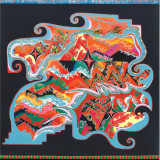
Habibi Funk is excited to share “Marzipan” - our first full length contemporary release courtesy of Beirut’s multi-instrumental phenom Charif Megarbane, also known as the man behind prolific Cosmic Analog Ensemble. The LP is a journey into Charif’s styling, one he terms “Lebrary”: a vision of Lebanon + Mediterranean expressed through the kaleidoscopic sonics of library music. Drawing from artists that encapsulates the HF sound, such as Ziad Rahbani, Ahmed Malek and Issam Hajali, Charif translates these influences into an LP that is equally at home in ’23. We always wondered why Charif’s music stayed under the radar for so long, that all changes with “Marzipan”.
Charif Megarbane, the staggeringly prolific producer, instrumentalist, and all-around musical mastermind returns with full LP “Marzipan.” Following his previous release of EP “Tayara Warak” in 2022, “Marzipan” is a sonic journey that seeks to capture the full scope of Megarbane’s habitus. As a composer and producer, Megarbane touts hugely versatile, sometimes volatile musicianship — his 100+ catalogue of projects (including legendary groups like the Cosmic Analog Ensemble, Free Association Syndicate, Monumental Detail, etc.) features a huge domain of sonic direction. This collection was previously developed in Megarbane’s own Hisstology label which hosts a wealth of collaborative efforts. Now, Habibi Funk represents Megarbane under his own name. Megarbane finds a sonic through-line in his surrounding soundscapes as he draws on the chaotic energy of the crowded Beirut metropolis (“Souk El Ahad”), the warm atmosphere of the Lebanese countryside (“Chez Mounir”), or the lushness of a Mediterranean beach resort (“Portemilio”). Reflecting the aural composition of his direct surroundings into kaleidoscopic instrumentation provides a unique insight into how one musical phenomenon transposes sight into sound. Habibi Funk is thrilled to share “Marzipan” and finally throttle this under-theradar phenomenon into the solo spotlight. Despite the magnitude of his catalog, Megarbane’s LP sounds as fresh—as resolutely inspired—as a debut record. “Marzipan” continues down the winding path he trod on EP “Tayyara Warak” (released Decmber, 2022) which features solid footing in the hectic city sounds Megarbane hears as home. Despite his obvious musical acumen, Megarbane’s greatest talent seems to be his open ears. In many ways, “Marzipan” is a cartographic feat — it travels and traces a journey across many dimensions (both sonic and physical). Megarbane’s instrumental catalogue is vast: toy glockenspiel, harpsichord, pedal steel, a classic Wurlitzer, et al are used liberally on the record. The resultant sound is as sprawling as the musician’s instrumental dexterity. “Marzipan’s” closing track “Bala 3anouan” can be translated loosely to “without address” — a fitting final word. Despite the entire record being a sincere testament to Megarbane’s environmental approach to music-making, the record is not bound to any particular coordinates, or any particular sound for that matter. The vastness of his influences — beloved artists like Ahmed Malek and Issam Hajali (both Habibi Funk veterans); West African funk deep cuts; European cinematic scores; et al — result in a record of somewhat unparalleled expansiveness. Floating melodies and frantic rhythmic interludes both find natural homes across “Marzipan.” The record is tinged with psychedelic elements—fuzz-drenched guitar, sliding microtonal interludes, hypnotic rhythmic breakdowns. Reflecting on his creative process, Megarbane cites a stream of consciousness approach: “It’s a very spontaneous, playful, and diary-like approach and workflow…I trust my instinct because instinct is based on experience.” Lead single “Souk El Ahad” opens the roll-out with a raucous energy, out June 12. Megarbane abstracts busy city sounds into a psychedelic framework, casting technicolor hues on everyday experience. Following is second single “Pas de Dialogue” out June 23. The track jerks the listener towards a more meditative state with lulling harpsichord and expanding, cinematic sound. “Marzipan” will be available physically and digitally everywhere on July 14, 2023. Be sure to listen for focus track “Chez Mounir” that captures the warmth of community in a joyful, laidback groove.
Uncover greater insight into the world of Charif Megarbane in the booklet accompanying the LP
Search:phen x
'Since 2018, João Pais Filipe (drums) and Burnt Friedman (electronics/synth) have investigated into automatic pattern–composition rooted in doubling and halving; the unimpeachable laws of motion. The offer of freedom can be seen as a way to get in touch with necessity.
On "Mechanics Of Waving" the attempt is made to succumb to such a mode of action, the drilling of a method, not through individual cunning or displayed musicianship.
Through constant practise Friedman & Pais discover the principles of rhythmic phenomena while dis–associating the music from cultural idioms. Inspired by rare infrasound–ratios ranging from 11 to 23, Nonplace releases the results of a 4 years long operation.'
Drums recorded and engineered by José Arantes.
Mastered by Kassian Troyer, Dubplates & Mastering.
- 1: Helplessly - Moment Of Truth
- 2: After You've Had Your Fling - The Intrepids
- 3: Welcome To The Club - Blue Magic
- 4: I Can't Move No Mountains - Margie Joseph
- 5: Supernatural Thing Part 1 - Ben E King
- 6: Mellow Me - Faith, Hope & Charity
- 7: Georgia's After Hours - Richard "Popcorn" Wylie
- 8: Date With The Rain - Eddie Kendricks
- 9: Just As Long As We're Together - Gloria Scott
- 10: Wendy Is Gone - Ronnie Mcneir
- 11: Got To Get You Back - Sons Of Robin Stone
- 12: Night Of The Wolf (Tema Del Lupo) - Ivano Fossati
- 13: Good Things Don't Last Forever – Ecstasy, Passion & Pain
- 14: Tell Me What You Want - Jimmy Ruffin
- 15: Keep It Up - Betty Everett
- 16: Free & Easy - Satyr
- 17: Each Morning I Wake Up - Major Harris
- 18: It's The Same Old Story - Act I
- 19: You Can't Hide Love - Creative Source
- 20: The Whole Damn World Is Going Crazy – John Gary Williams
- 21: If That's The Way You Feel - White Heat
- 22: Wake Up Everybody - Harold Melvin And The Bluenotes
Before there was Saturday Night Fever there was underground disco. DJs across America went out and found the music to play; dancers went out and found the clubs. At this point, in the early seventies, the disco was the venue and not a genre of music.
By the time Nik Cohn’s short story Tribal Rites of the New Saturday Night was published by New York magazine in June 1976, disco was the biggest genre of music on the charts and was about to get bigger still, becoming an all-enveloping cultural phenomenon. Cohn sold the film rights to Robert Stigwood, and his classic club yarn became Saturday Night Fever.
“Tribal Rites Of The New Saturday Night” is the soundtrack to Cohn’s story, where disco began; a 1975 score for the underground clubs of Brooklyn and Queens that played R&B, soul and Latin beats to people who lived for the weekend.
Bob Stanley has put this collection together, sourcing what was actually played in Brooklyn discos in 1974 and 1975. Only a few specific records were mentioned in Cohn’s feature, but two of them – Ben E King’s ‘Supernatural Thing Part 1’ and Harold Melvin’s ‘Wake Up Everybody’ - were cosmically great and both are included here, alongside underground favourites like Moment Of Truth’s Four Tops-like ‘Helplessly’ and Gloria Scott’s Barry White-produced modern soul classic ‘Just As Long As We’re Together’. Ivano Fossati’s incredible ‘Night Of The Wolf’ has fans in northern soul, disco and prog circles.
Without Cohn’s original story, it’s quite possible that disco would have remained an underground phenomenon – “Tribal Rites Of The New Saturday Night” paints a scene in full flower. Saturday Night Fever would eventually, if unintentionally, wreck the underground nature of this scene, and clubs like Studio 54 would destroy the democracy of the party, but for two or three years the scene was largely undocumented and magical. This album is the sound of disco before it was captured.
Far Out Recordings proudly presents Hermeto Pascoal’s remarkable self-titled debut album. Recorded in 1970 at A&R studios in New York, the album features certified North American titans including Ron Carter, Hubert Laws, Joe Farrel and Googie Coppola, and Brazilian stars Airto Moreira and Flora Purim (who also produced the album).
While it was Hermeto’s first album released under his own name, he had spent the decade or so prior making a name for himself in Brazil and internationally as a composer, arranger and instrumentalist with groups including Sambrassa Trio, Quarteto Novo and Brazilian Octopus, before going on to work with (amongst countless others) Edu Lobo, Antonio Carlos Jobim, Donald Byrd, Airto Moreira and Miles Davis, who allegedly called Hermeto “one of the most important musicians on the planet”.
With Hermeto’s otherworldly orchestral arrangements, ghostly vocal performances from Flora Purim and Googie Coppola, and the inimitable drumming and percussion stylings of Airto Moreira, Hermeto easily rivals some of the oft-celebrated MPB albums of the early 1970s, sitting somewhere between the string-heavy magic of Arthur Verocai’s 1972 debut and the unplacable early experimentalism of Pedro Santos’ 1968 album Krishnanda.
With his phenomenal natural musical genius and a ceaseless sense of creative freedom, Hermeto is widely known for using unconventional objects to make music. In the album’s sleeve notes, Airto highlights the track “Velório (Mourning)” explaining how Heremto filled 36 apple juice bottles with different amounts of water and tuned them to precise pitches in order to create the beguiling harmonies heard.
The reissue of Hermeto Pascoal’s Hermeto, follow’s Far Out’s recent unveiling of a previously unheard Hermeto Pascoal live concert Planetario da Gavea from 1981, and 2017’s release of Hermeto Pascoal’s lost 1976 studio album: Viajando Com O Som.
Hermeto will be available on vinyl LP and CD from the 20th May 2022 via Far Out Recordings.
A wild and funky collection of Afro grooves that was ahead of its time in 1977 and has become a collector’s item in recent years, especially due to the growing international interest in Colombian picó sound system culture. Fruko and his studio bands Wganda Kenya and Kammpala Grupo treat us to a diverse set of African and Caribbean styles, laced with crazy synths, psychedelic guitar and infectious pan-African polyrhythms. By the time Discos Fuentes released the album “Wganda Kenya Kammpala Grupo” in 1977, Wganda Kenya’s discography was expanding with many 45 singles and appearances in various artists collections. The group’s 1975 debut record “África 5.000” was a full length LP in the U.S. and a various artists compilation in Colombia, which was followed by the self-titled long player the following year. However, Kammpala Grupo, which shared the album’s title and was credited to three songs on the record, had never appeared before, yet was basically the same studio group as Wganda Kenya. Most likely the creation of this short-lived studio band was just a ploy by the label to make it seem like there were more groups playing the type of exotic afro tracks favored by the picotero DJs of Colombia’s Caribbean coast (especially in Barranquilla and Cartagena). 1974 Discos Fuentes’ management had sent musician, band leader and producer Julio Ernesto “Fruko” Estrada to the coast on an A&R mission to discover what people were dancing to in the verbenas (communal open air neighborhood parties) run by the owners of picó sound systems (decorated mobile DJ rigs). Always game for an adventure, Fruko was tasked with bringing some popular examples of these esoteric, hard-to-find African, French and Dutch Antillean records back to Medellín to serve as inspiration (or to outright copy) so that the label could enter into the growing regional market and spread its popularity to the interior of Colombia and other Latin American countries via its own studio creation, Wganda Kenya. Fuentes was always returning to exploit the rich African-rooted culture of the coast as it had with the cumbia and other regional genres before, so in a way it was not surprising that they were attuned to this particular niche phenomenon from a marginalized sector of the population. The most popular genres with the champeta dancers in the 70’s and 80’s were styles like Congolese rumba, highlife, afrobeat, juju, mbaqanga and soukous as well as the music of Haiti, Guadeloupe, Martinique, Curaçao and Dominica, all of which were fiercely guarded by the DJs who had managed to acquire them often through extreme means of travel, barter and intense digging. The record kicks off with the joyful ‘El Gallo Africano’ which features exquisite interplay between Sepúlveda’s highlife style guitar and an authentic-sounding African style saxophone, perhaps played by Carlos Piña. In reality it was ‘Go Call Police Chief’ by prolific Nigerian highlife guitarist Chief Oliver Sunday Akanite, aka Oliver De Coque. Next up is Kammpala Grupo’s ‘La Yuca Rayá’ (‘Grated Yuca’), written by Isaac Villanueva in a style he termed son haitiano which sounds much more like Zimbabwe Shona mbira music. Wganda Kenya’s ‘Caimito’ (star apple, a type of tropical fruit), on the other hand, is actually a cover of a relatively well-known Haitian merengue song. Kammpala Grupo then takes us from the French Antilles to the multi-cultural discotheques of Paris, where a cover version of Black Soul’s Afro-boogie anthem ‘Black Soul Music’ is retooled and renamed ‘King Kong’, perhaps in a nod to the 1976 remake of the monster flick of the same name. Side two introduces us to the infectious merengue rebita of Angola via ‘La riphyta’ with “Paparí”, aka Mariano Sepúlveda, doing the vocals and faithfully replicating the Angolan guitar style. ‘La Trompeta Loca’ (‘The Crazy Trumpet’), probably the nuttiest track on the album, is an ingenious cover of ‘Ye Gbawa Oo Baba (Tribute To Nigeria)’ by Joe Mensah of Ghana. As with all their covers of African tunes, this rendition tightens up the original with some pop sheen, more consistent drumming and higher production values, remaking it into a powerful slow-burning dance floor filler. This is followed by one of the most powerfully original songs to come out of the entire Wganda Kenya project, Mike Char’s reggae anthem ‘El Nativo’ with Joe Arroyo on vocals. The record ends on a more authentically Caribbean sounding note with the instrumental ‘El testamento’, a cheerful islands banger with bright brass, syncopated calypso beats and chunky cuatro guitar (or ukulele). The original was in the mento genre and titled ‘Sweet meat’, written and recorded by Jamaican trumpeter Bobby Ellis. First time reissue. 180g vinyl.
When Belgian Adolphe Sax invented the saxophone in the mid-19th century, he could not have imagined what he had set in motion with his invention. Neither in classical music nor in military music did his new woodwind instrument find much appreciation. It was only long after his death that it became the most important instrument in jazz music via swinging big bands. It would probably have amazed Mr. Sax if he had been able to witness a young trio from Germany playing loudly against climate change and the lack of political consequences with two noisy saxophones and a drum set on a stage in front of the Reichstag in Berlin in front of more than 50,000 people jumping up and down during the climate strike in September 2021: BRASS RIOT.
The trio around Constantin von Estorff (Sax), Simon Sasse (Drums) and Carl Weiß (Sax) have been a band since their school days in Lüneburg. What started there as street music became a permanent and sought-after formation through the proximity to political initiatives, above all the Fridays-For-Future movement, and appearances at countless demonstrations. The band's name is slightly misleading, as "brass" in music refers to brass instruments such as the trumpet or tuba, even though most brass bands always include a saxophone. Moreover, the word "brass" means something in the German language, which in turn fits perfectly with this young, energetic trio: Fury.
On the heels of their debut album "Matschsafari" (2018), their second studio album "The Never Acting Story" is now released on Fun In The Church. The album title, in critical allusion to the world-famous fantasy book by Michael Ende, sums up well what the music of BRASS RIOT is about at its core: the possibility to get a noisy outlet for all the fury about the failed politics of the last decades and the frustrations and fears that go with it, and to free oneself from it for a moment. That this path has produced the wildest live music on this crisis-ridden planet is an irony of history - and certainly not the first time it has happened. It's no different in the jazz of Charlie Parker than in the songs of Patti Smith, the raps of Little Simz or the Afro-beat of Fela Kuti.
Musically, BRASS RIOT move more in the area of the melodic ska-pop of Madness, the fake jazz of the Lounge Lizards and contemporary rave brass ensembles like MEUTE between house music and electro beats. The fact that they have managed to politicize their sound so strongly over the years, despite all the party that goes with it, and without any song lyrics at all, is truly phenomenal.
Lost soul phenomenon Lewis Taylor's Numb finally arrives on double vinyl! One of UK soul’s most fascinating artists, most enigmatic figures and most under-appreciated talents, Andrew Lewis Taylor is a prodigious multi-instrumentalist and eclectic polymath. He enjoys a fiercely loyal following which, over the years, has included celebrity champions like Bowie, Elton and D'Angelo. Numb is Taylor's sixth album, initially released on his own label Slow Reality (an anagram of his name) and licensed to Be With for this long-awaited physical edition. It captures Taylor's wholly unique, intoxicating take on lush, late-night psychedelic soul music.
Lewis wrote and recorded these 10 brand new tracks after a 17 year break from making music, although the album came together over a two-year period. The years away have done nothing to dull Taylor's unique musical vision. He still astounds. The lyrical themes, however, have shifted. Understandably, more than a decade and a half of soul searching and unflinching self-examination cannot fail to influence this most honest of songwriters, and boy does it show. Numb marks a return to the darker, more mysterious side of his output: "Brian Wilson-channels-Smokey Robinson atmospheres", as Mojo put it recently.
After playing a rapturously received gig at the Bowery Ballroom in NYC in 2006, Lewis unceremoniously walked away from music and disappeared completely. An interview in 2016 shed light on some of the reasons for Taylor’s withdrawal from the business, but there was no hint of a return anytime soon. Then in June 2021, news emerged out of the blue that he was readying new music alongside Sabina Smyth with whom he had worked first time around.
On Numb, Lewis deftly balances stark, soul-bearing lyrics with moody mid-tempo pop-soul sheen. He deals candidly with depression, mental turmoil, even thoughts of suicide - clearly more personal than Taylor's earlier songs. The music is rich, warm and layered, with infectious melodies and hooks that stick with you. A true grower of an LP, it really does reward repeated listens. As Jim Irvin in Mojo reflected, "despite the depths these plumb, it's a curiously uplifting experience, unfurling like a concept album about life's challenges with an optimistic beauty at its heart."
Triumphant dubwise horns ring out yet, almost instantly, “Final Hour” takes on a dark, downbeat vibe. With lyrics that confront (and, seemingly, confound) death head-on, Lewis ensures the groove is still there, the beats still swing and your head still nods, strings glissade. Woven around delicate yet insistent piano and subtle strings over a killer bassline, the title track “Numb” is a good example of the lyrical themes throughout the album. As Taylor reflects, "So removed I feel no pain / And for all I know I could be having the time of my life" with a coda that feels very much in conversation with Brian Wilson's finest harmonies. "Feels So Good" is sophisticated 90s-sounding soul of the highest order. The music and vocals feel simultaneously optimistic and despondent. Downlifting. A neat trick, and one Lewis has been so adept at over the years. "Apathy" is a mini-epic, a symphonic-soul gem which builds and glides and, eventually, soars. “Worried Mind" is another slow-builder, creeping out the gate in a sketchy, discordant fashion before climbing to half-crescendo but never quite breaking free of its disorientating restraint.
The brighter "Please" presents a more hopeful mood, with the refrain "I still believe" ringing out as Lewis harmonises with himself. "Brave Heart" quietly struts from step one, as Lewis's falsetto swaggers over a downtempo backdrop with ace echoey drums, beautiful strings and serene electric guitar. Closing out Side C, "Is It Cool" answers its own (non-) question with a spellbinding five and a half minutes of swoonsome deep soul that oscillates between a restrained, barely-there backdrop and a lushly full musical accompaniment of acoustic and electric guitar and organ over bass and slick drums. The penultimate track "Nearer" is a magical, soul-stirring ballad in which Lewis sings of reaching a sweet salvation and achieving a peace of mind. If the hairs on the back of your neck aren't standing up by the midway point, you might need to check your pulse. Album closer and true tear-jerker "Being Broken" places Lewis's gorgeous voice high in the mix and the wordless falsetto and melodies invite you to ponder what Pet Sounds might sound like if it were refashioned as a dubby 21st Century electronic soul album. Astonishing.
Simon Francis’s vinyl mastering spreads out the ten tracks over a double LP so, as ever, nothing is compromised. And as usual, the records have been cut by Cicely Balston at Air Studios and pressed at Record Industry. Turn it up and let the Lewis Taylor sound envelop you.
Stoned Part I was the first self-released album from lost soul phenomenon Lewis Taylor. His third album proper, it was initially released on his own label Slow Reality in 2002 and it's been licensed to Be With for this long-awaited double LP release, its first ever vinyl edition. The songs are varied, hook filled and outstanding. Beloved by his legions of diehard fans, it's nothing short of a masterpiece.
After parting ways with Island, and without a label deal, Lewis went back to his home studio and began to record Stoned Part I in 2001. Co-written and co-produced with longtime collaborator Sabina Smyth, Lewis sings and plays all the instruments on this beautiful, emotional and very human album. It represents Lewis at his most accessible and finds him in the middle ground between his two Island releases. In some ways, Stoned Part I distills the best of his musical sensibilities. The flawless production is dense, layered and very early-2000s slick. The bottom end is thick, funky and sexy.
The complex, proggy-soul of title track "Stoned" opens the album and instantly captivates. Deep swinging funk with truly sweet soulful vocals, complemented by wah-wah guitar and swelling acidic synths. As Lewis himself told us, the ad libs at the end of the track were a nod to Paul McCartney at the end of "Hey Jude". Fan favourite "Positively Beautiful" has shades of Curtis and Marvin; its richly layered harmonies propelled by a simple, metronomic click-track that gives way to a more fully fleshed beat for the magnificent coda.
The slow, sweeping majesty of "Lewis IV" is all moody atmosphere, featuring dense, richly textured music and heavenly multi-tracked harmonies. The stop-you-in-your-tracks incredible "Send Me An Angel" could have been a huge AM radio hit, beautifully crafted sophisticated soul-pop songwriting in the vein of the very best Sade records. Yep! *That good* The smooth, psychedelia-lite "Til The Morning Light" is a gorgeous, sun-dappled love song, layered with Lewis' distinctive honey drenched vocals and, again, the type of record you could've easily heard all over the radio at the time of initial release.
The remarkable, wide-eyed "Shame" packs so many shifting styles into one song, it has to be heard to be believed. Opening in a laconic, breezy style, not unlike a Dallas Austin or Rodney Jerkins produced R&B hit of the day, it morphs into a heavy psych-soul Soulaquarians wig-out (the solo bearing an uncanny resemblance to Carlos Santana’s on "She’s Not There") before elegantly sliding into string-assisted symphonic soul and then back around again. And again. Sheer brilliance. The sublime, gentle head-nod funk-soul of "When Will I Ever Learn" (Part 1) is a strikingly well-turned-out tune, a neat, sweet bass-driven guitar-soul jam that ensures our jaw won't be leaving the floor anytime soon. "Lovin’ U More" sounds like a classic turn-of-the-century Neptunes production, the likes of which they'd lay on for JT BITD. A Latin-tinged groover with more than a little Nile Rodgers-driven slick funk stylings, it's yet another instant Lewis bomb with those gorgeous harmonies and chart-friendly irresistible key-changes to boot. Another indisputable (non-)HIT!
The funky seductive swagger of "From The Day We Met - Part II" opens the final side of wax, giving way to the gigantic buzzing synth-funk beast "Lovelight", a track so insouciantly mighty it should have been a massive hit for someone. Wait, what's that? Robbie Williams covered it? Ah, OK, well, I guess that says something about the effortless pop genius contained within. Containing a seemingly unnoticed nod to Kraftwerk’s "Computer World", it's Lewis's favourite song on the album. It's easy to hear why: "Sabina’s production totally nails it. I love the restraint and the subtlety, and that mixture of warmth and sweetness from the singing against the slightly cold, yet beautiful airy-ness of the backing track." To close this phenomenal album, the twisted electronic soul of "Sheneverdid" marries Lewis's beautiful falsetto to his virtuoso playing and an easy-cum-ominous musical backdrop. Stunning.
Simon Francis’s vinyl mastering, approved by Lewis himself, presents the eleven tracks over a double LP so, as ever, it sounds sensational. The records have been cut by Cicely Balston at Air Studios and pressed at Record Industry. Allow Lewis Taylor to get you Stoned.
Paperback: 288 pages
Product Dimensions: 12.9 cm x 19.8 cm x 2.3 cm
• A global view of Discovery as a cultural phenomenon, placing the album at the centre of celebrity culture, fan clubs, video, the music business etc., while also examining its profound musical impact.
• An examination of Discovery as a flawed jewel, rather than blatant hagiography, as the album celebrates its 20th anniversary.
• An antidote to the revisionist history about Daft Punk and Discovery, from a journalist who has lived with the idea of Daft Punk for more than 20 years and interviewed the band.
Daft Punk’s Discovery is a record that looked into the future and liked what it saw; an album that predicted the electronic music explosion, YouTube and the end of privacy, while dragging soft rock back into vogue. Discovery was not only one of the best albums of the 2000s, it was one of the most prophetic, the kind of record that makes you wonder: how did they know?
You can draw lines from Discovery to Glass Swords, Kanye West, EDM, Autotune, iTunes, Beyoncé, Guilty Pleasures, social media and more. Discovery's footprints can be found all over the modern world but it also looked back to Daft Punk’s childhood, to Van Halen records, Japanese cartoons and even Johann Sebastian Bach.
Discovery was a record that confounded many fans when it was released in 2001, thanks to its blatant pop hooks and unlikely sonic bricolage. It was a record that was - and still is - widely misunderstood; Discovery’s impact has only become clear with the passing of time, as Daft Punk have been proved right time and time again.
This book is a homage to a fascinating, troubled beast of an album that casts a huge shadow over the 21st Century, as Discovery reaches its 20th anniversary.
“Incredible biography of the most colossal electronic act of our generation, by one of the best music writers of our time. Ben Cardew charts the history of Daft Punk from their humble rock band beginnings, to starting the groundbreaking and genre-defining Roulé records, to achieving stadium status as superhuman robot selectors.” Sinjin Hawke
The next chapter of the Natural Information Society is here. Since Time Is Gravity, credited to Natural Information Society Community Ensemble with Ari Brown, presents a newly expanded manifestation of acclaimed composer & multi-instrumentalist Joshua Abrams nearly 15 year, 7 albums &-counting flagship ensemble. Joining the core NIS of Abrams (guimbri & bass), Lisa Alvarado (harmonium) Mikel Patrick Avery (drums) & Jason Stein (bass clarinet) are Hamid Drake (percussion), Josh Berman & Ben Lamar Gay (cornets), Nick Mazzarella & Mai Sugimoto (alto saxophones & flute), Kara Bershad (harp) & Chicago living legend of the tenor saxophone Ari Brown. Recorded live to tape at Electrical Audio & The Graham Foundation, cover painting Vibratory Cartography: Nepantla, by Lisa Alvarado. 2xLP on Eremite USA, 2xLP & CD on Aguirre/Eremite Europe. Out 14-04.
Since first developing Natural Information Society in 2010, Joshua Abrams has been gradually expanding the group’s conceptual underpinnings, its musical references & the sheer number of the group’s members. Its music is, in a sense, an expansive form of minimalism, based in repeated & overlaid rhythmic patterns, ostinatos & modality. Its roots, its scale & its meaning become clearer in time. If time is gravity, it also allows us to carry more. Having begun as fundamentally a rhythm section with Abrams’ guimbri at its core, the version here can stretch to a tentet, including six horns.
Abrams has been expanding his minimalism gradually, but he has long understood a key to minimalism’s potential: the breadth of its roots in the late 1950s & early 1960s, ranging from the dissatisfaction of young European-stream composers with the limitations of serialism to the simultaneous dissatisfaction of jazz musicians with the dense harmonic vocabulary of bop & hard bop. The former began exploring rhythmic complexity & narrow tonal palates in place of harmonic abstraction (Steve Reich’s Drumming, Philip Glass’ Music with Changing Parts; perhaps above all Terry Riley’s In C & his late ‘60s all-night organ & loop concerts); the later reduced dense chord changes to scales (signally with Miles Davis' Kind of Blue, but rapidly expanding with John Coltrane’s vast project). In the 1950s the LP record opened the world with documentation of Asian & African musics, key influences on both minimalists & jazz musicians. If John Coltrane’s soprano saxophone suggested the keening shehnai of Bismillah Khan, the instrument was rapidly taken up by two key minimalists, LaMonte Young & Riley, similarly appreciative of its flexible intonation, the same thing that kept it out of big bands.
If the guimbri, the North African hide-covered lute that Abrams plays with NIS, involves a rich tradition of hypnotic healing music associated with the Gnawa people, Abrams’ music also touches on other musics as well — other depths, memories & healings, different drones, rhythms & modes. As the group expands on Since Time Is Gravity, he has made certain jazz traditions in the same stream more explicit as well. If there is a mystical & elastic quality involved in the experience of time, both in direction & duration, you will catch it here. The parts for the choir of winds expand on the roles of Abrams’ guimbri, Mikel Patrick Avery & Hamid Drake’s percussion & Lisa Alvarado’s harmonium: at times, the winds are almost looping in the tentet version, each hitting a repeating note in turn, at once drone & distinct inflection on temporal sequence. The brilliance of the work resides in Abrams’ compositions, the NIS’ intuitive execution & in Ari Brown’s singular embodiment of the great tenor saxophone tradition, including the oracular genius of Eddie “Lockjaw” Davis, & Yusef Lateef. The three pieces by the expanded NIS featuring Brown —the opening “Moontide Chorus” & “Is” & the ultimate “Gravity”— have an immediate impact, & togther might be considered a kind of concerto for tenor saxophone. Here Brown presses almost indistinguishably from composed melody to improvised speech, getting so close to language that he might have a text. Everything here is a sign. Note the tap of the Rhythm Ace that links “Moontide Chorus” to “Is”, the attentive heart always present, even when signed by a machine. There’s a link here to the methodologies & meanings of dub music & the linear & vertical collage of beats, textures & tongues: treated with reverence, a sample of a beat-box can be as soulful, as hypnotic, as a mbira or a tamboura. If those pieces with Brown are heard as a suspended concerto, the three embrace & enfold the other works, like the sepals of a flower. That placement will also touch on the mysteries of our perception of time.
Particularly in “Is”, but elsewhere as well, a phenomenon of transcendence arises in which time appears to be tripartite, at once moving backwards & forwards & standing still. This is an act of technical brilliance certainly, but also an illumination of music’s ability to represent temporal consciousness through polymetrics. This particular listener has only heard it before in a few places, including the horn shouts & bowed basses of Coltrane’s Africa, in moments of Charles Mingus’ The Black Saint & the Sinner Lady, in certain pieces where tapes were literally running backwards, & earlier still in Dizzy Gillespie’s Cubana Be, Cubana Bop, in which the composer George Russell & conguero Chano Pozo found a music that spoke at once in the voices of Stravinsky’s Rite of Spring & the vestigial rites, rhythms & songs of the Yoruba language & Santeria religion of inland Cuba.
In Joshua Abrams’ compositions & the realization of them by the NIS, in the time of one’s close listening & memory thereof, distinctions between the “natural” & the “social”, the “quotidian” & the “transcendent” are erased, suspended or perhaps irrelevant. Consider two of the ensemble pieces, one named for nature, the other social science. In “Murmuration” the repeated wind figures of flute & alto saxophone combine with the interlocking patterns of harp, guimbri & frame drum (tar) to create a perfect moving stillness, not an imitation but a witness to the miracle of the starlings’ astonishing collective art, a surfeit of beauty that might be the ultimate defense tactic.
“Stigmergy” takes its name & concept from the Occupy movement’s Heather Marsh, who proposes a social system based on a cooperative rather than competitive models, one in which ideas are freely contributed & developed as ideas rather than an individual’s property. In its form, Abrams’ “Stigmergy” is the closes thing to traditional jazz, a series of accompanied solos by each of the wind players. However, the composed accompaniment is a radically collectivist notion: a repeated rhythmic figure, call it ostinato or riff, in which the different winds each play only a note or two of the figure, a concept both more collectivist & individualistic in its conception than any typical unison figure. It suggests another of the underlying recognitions that propel the Natural Information Society, the group as social organism, the teleology of hypnotic anarchy, all parts in place, functioning systematically, evolving & expressing itself, its nature & society, as a transformative organism.
George Lewis has described music as “a space for reflection on the human condition”. This suggests that, rather than a “distraction”, at least some music might serve as a distraction from distraction. It’s a focus, a clarity, a awareness, an external invitation to interiority, as if music itself is a model for form & contemplation, an organism contemplating for us or as us. If that is a possibility, & I am sure I have heard such musics, than this music is among them. How many of our rhythms, melodies & harmonies (cultural, historical, biological, psychic) might such music carry, translate & transform in the particulate ecstasy of our own murmuration? (Stuart Broomer, April 2022)
Paul Terzulli & Eddie Otchere
Who Say Reload: The Stories Behind The Classic Drum & Bass Records Of The 90s
• Contributions from over 40 of the biggest names in jungle/drum & bass such as Andy C, Fabio, LTJ Bukem and DJ Fresh
• In-depth commentary on the anthems and classics that defined the scene
• Previously unseen images from photographer Eddie Otchere’s extensive archive
• Deluxe coffee table hardback book in full colour on 130 gsm matt art paper.
Who Say Reload is a knockout oral history of the records that defined jungle/drum & bass straight from the original sources. The likes of Goldie, DJ Hype, Roni Size, Andy C, 4hero and many more talk about the influences, environment, equipment, samples, beats and surprises that went into making each classic record.
This is the story of music forged from raw breakbeats and basslines that soundtracked a culture of all-night raves, specialist record shops and pirate radio stations. It’s the story of young producers embracing and re-appropriating new technology, trying to best their peers and create something that would have hundreds of people screaming for a rewind on Saturday night.
Photography is provided by Eddie Otchere who has an extensive archive of images from the period in question, having been the photographer at Goldie’s seminal Metalheadz nights. His previously unseen visuals capture the essence of the music in a way that only someone who was fully immersed in the culture at the time could, and are the perfect accompaniment to the story being told.
“Who Say Reload is essential reading for fans of the golden era of 90s drum n bass” - J Majik
“Nice to see a different take on DnB’s history as Who Say Reload captures the early productions that laid down the music’s foundations.” - LTJ Bukem
“Jungle is the most unique and influential musical movement to come out of England. It’s important that the pioneers get to tell their stories like this. It’s great to see underground legends represented and put on a platform that highlight their contributions to a music genre that has become a worldwide phenomenon.” - Mampi Swift
The formidable Rex The Dog returns with his first single for Kompakt in three years, “Change This Pain For Ecstasy”, a slow-burning disco-glitter stomp that’s charged with analog energy. Pushing his self-built modular hardware set-up to its limits, “Change This Pain For Ecstasy” is taut and thrilling, stripped-back and pulsating, with sweeping chords shimmering through a classic Moroder arpeggio, as a delirious voice sings out a psychedelic raver’s plaint for liberation, pleading for you to "take away my sorrow and this pain”. Deeply emotional, it’s also a masterwork in tension and release, dizzy with snare-rush peaks, and dark, humid valleys where Rex is bound to the patchbay.
On the flipside, Rex gives us “Moto”, which tickles your ear with cymatic phenomena, its gentle vibrations building, beautifully, into a monster-piece of stealth techno. Rex’s DIY synths work overtime as he chases patterns and phases through circuitry, wielding the tones until they erupt into a spray of pointillist pizzicato. The sounds here crackle and corrode, the textures so tantalizing, so sensual, you can almost grab hold of them with your hands. It’s great to have Rex The Dog back, making livewire, yet deeply human techno, alive and bursting with electricity.
Der formidable Rex The Dog kehrt mit seiner ersten Single für Kompakt seit drei Jahren zurück, “Change This Pain For Ecstasy”, ein mit analoger Energie aufgeladener, stürmischer Disco-Glitter-Stomper. Man kann förmlich spüren, wie Rex’ selbstgebautes modulares Hardware-Setup an seine Grenzen gerät. “Change This Pain For Ecstasy” ist eine Hymne an das Nachtleben, an die kathartische Qualität einer durchtanzten Nacht. Über schwungvolle Akkorde und ein hochenergetisches Moroder-Arpeggio bittet eine delirierende Stimme um Befreiung von allem Leid und Schmerz. Das ist zutiefst rührend und emotional – da es sich hier aber um ein Meisterwerk der Spannung und Entspannung handelt – schwingt sich der Track plötzlich auf in schwindelerregende Höhen der Euphorie.
Auf der anderen Seite gibt Rex uns “Moto”, das das Ohr mit zymatischen Phänomenen kitzelt, deren sanften Vibrationen sich zu einem Monster von Stealth-Technotrack aufbauen. Rex’ DIY-Synthesizer machen Überstunden, während er Muster und Phasen durch die Schaltkreise jagt bis sie in einen Sprühregen aus pointillistischem Pizzicato ausbrechen. Die Sounds hier knistern und korrodieren, die Texturen so verlockend, so sinnlich, dass man sie fast mit den Händen greifen kann.
Es ist großartig, Rex The Dog zurück zu haben, der hochverdrahteten und doch zutiefst menschlichen Techno macht, voller Leben und Elektrizität.
- A1: Lynyrd Skynyrd – The Seasons (4.09)
- A2: Barefoot Jerry – Smokies (2.14)
- A3: Joe South – Hush (3.47)
- A4: Bobbie Gentry – Papa, Won’t You Let Me Go To Town With You (2.34)
- A5: Area Code 615 – Stone Fox Chase (3.17)
- A6: Cher – I Walk On Guilded Splinters (2.32)
- B1: Cowboy – Please Be With Me (3.48)
- B2: The Allman Brothers – Ain’t Wastin’ Time No More (3.40)
- B3: Link Wray – Be What You Want To (4.29)
- B4: Boz Scaggs – I’ll Be Long Gone (4.08)
- B5: Lynyrd Skynyrd – Comin’ Home (5.29)
- C1: Bobbie Gentry – Seasons Come, Seasons Go (2.52)
- C2: Leon Russell – Out In The Woods (3.37)
- C3: Tony Joe White – Polk Salad Annie (3.42)
- C4: Barefoot Jerry – Come To Me Tonight (4.43)
- C5: Dan Penn – If Love Was Money (3.29)
- C6: Linda Ronstadt – I Won’t Be Hangin’ ‘Round (2.59)
- D1: Waylon Jennings – Big D (2.30)
- D2: Big Star – Thirteen (2.37)
- D3: Bobbie Gentry – Mississippi Delta (3.06)
- D4: Travis Wammack – I Forgot To Remember To Forget (2.54)
- D5: Johnny Cash & June Carter – If I Were A Carpenter (3.01)
- D6: Billy Vera – I’m Leavin’ Here Tomorrow, Mama (4.13)
Black Vinyl[29,62 €]
Long out of print (10 years!), this new edition of Soul Jazz Records' classic Delta Swamp Rock, features a killer all-star line-up of seminal artists who all first blended rock, soul and country together to create a stunning new sound of southern American music in the 1970s.
Featuring the Allman Brothers, Dan Penn, Leon Russell, Tony Joe White, Johnny Cash, Bobbie Gentry, Big Star, Link Wray, Area Code 615 and loads more!
This album comes as a superb limited-edition gold vinyl double vinyl release complete with extensive original sleevenotes, interviews and exclusive photography, all spread over a 12-page full-size magazine and two bespoke inner sleeves. The works!
Delta Swamp Rock is an interstate southern road-trip through the United States of America where country, rock and soul met at the crossroads - an exploration of the musical and cultural links between the cities of Memphis, Muscle Shoals and Nashville in the 1960s and 70s.
At the start of the 1970s, a new type of music emerged out of the southern states of Alabama, Tennessee, Georgia, Mississippi and Florida. Southern rock, the creation of young blue-collar white Americans, blended rock, soul, country and blues music together to present a new vision of the south – a post-civil rights southern identity complete with a celebration of the regions natural landscape and its way of life.
The Allman Brothers and Lynyrd Skynyrd epitomised the definitive southern rock groups – a mixture of blues-rock and country with a southern rebelliousness and attitude. Unfortunately both The Allman Brothers and Lynyrd Skynyrd were to be struck by tragedy, which would affect the movement’s rise and fall.
The backstory to southern rock is the fact that a number of the people involved in its creation had been central to the production of southern soul music in the 1960s mainly in Memphis, Tennessee, and the small town of Muscle Shoals (population around 10,000) deep within the bible-belt, liquor-free, deeply segregated state of Alabama, creating 100s of R&B hits on an almost daily basis.
Here in Muscle Shoals, with its proximity to Memphis and Nashville, an all-white group of in-house musicians, (famously referred to by Lynyrd Skynyrd in the song ‘Sweet Home Alabama’ as the ‘Swampers’), created countless classic soul records for the likes of Aretha Franklin, Wilson Pickett, Etta James, Clarence Carter and more during the 1960s.
This album charts the rise and fall of southern rock from its funky swamp roots in southern soul to its phenomenal success in the first-half of the 1970s, including its influence on Nashville’s ‘outlaw’ country and tracing it right back to the arrival of rock and roll in the 1950s - the first meeting of black and white American music at the crossroads.
- A1: Short Term Agreement
- A2: Slump (Feat Freddie Dredd)
- A3: Grub (Feat Jeshi)
- A4: No Witness (Feat Apoc Krysis)
- A5: 9873465923846637282385
- A6: Theroom
- A7: External Memories
- A8: Saint-Laurent (Feat 8Ruki)
- A9: Focus Point
- A10: Syntheticcigarette Interlude
- B1: Find The Bag (Feat Baby.com & Lord Pusswhip)
- B2: Hollowhunt
- B3: Panic!
- B4: Everyday Further From You Is A Better Day (Feat Arthrn)
- B5: Mosh O’clock (Feat Chlobocop)
- B6: Tell Me (Feat Pollari)
- B7: Alone (Feat Bitsu)
- B8: Head! Shot!
- B9: Short Terme Agreement Pt 2
The name NxxxxxS (pronounced "N-Five X-S”) sounds like it could be an equation, or a mystery. But to begin to unravel the identity of the French producer who just signed to Because Music and Mad Decent (the label founded by Diplo), you first have to look for clues on YouTube and Soundcloud, where so many underground artists have found a place to hone their craft. In the ten years preceding the release of his second album Short Term Agreement in 2023, NxxxxxS built up a solid reputation for himself in the international vaporwave, vaportrap & phonk scenes. This is no small feat considering he didn’t have any real knowledge of production or composition before deciding to take on these classic genres of “Internet music”.
The Paris native first gained exposure when he started making beats on YouTube, taking his inspiration from American rappers of the blog era - when artists, especially in hip hop, used digital technology to break away from traditional distribution models - like Mac Miller or Odd Future. Building on this initial success, NxxxxxS turned to Soundcloud, an essential platform for music enthusiasts, tastemakers or anyone on the lookout for the sounds of tomorrow.
Following in the footsteps of The Alchemist and other producers of the same ilk, NxxxxxS soon became one of the pioneers of vaporwave and vaportrap music. Featured prominently in modern productions, these styles originated on social media platforms such as Reddit or Tumbler in the 2010’s and are recognisable by their frequent use of commercial samples ranging from the 70’s to the 2000’s (taken from jingles, lounge, jazz or elevator music). Altered, chopped up and slowed down to around 60 to 70 BPM to match hip-hop standards, the music offered a critique or satire of capitalism, consumer society and any culture that grew out of it, most notably yuppies from the 80’s.
NxxxxxS put his own spin on the recipe by creating a new world filled with soaring melodies and countless references to movies and horror scenes, and eventually released his debut album Fujita Scale (a scale used to measure the damage inflicted by tornadoes) in 2014. The album reached a worldwide audience because of its composer’s story and of the secrecy around his French nationality, and even won over unexpected fanbases such as the highly closed off Chinese market. Fujita Scale landed on one of China's streaming platforms, making NxxxxxS an identifiable artist in Asia who went on to tour his album three times across the continent.
NxxxxxS kept the ball rolling, collaborating on a new series of more accessible projects, which aimed to be less niche in terms of the references or sub-genres they tapped into, so he could find a new audience. This led to his first hits, “Synthetic Corporation” - which would also become the name of his label - “Remember Last Summer” and “Formatted Excess”, as well as his most popular track to date, “Playa Shit”, with over 11M streams on Spotify. The upcoming album’s title, Short Term Agreement, is a playful reference to his unyielding desire for independence and productivity, and his eagerness to preserve the personal freedom he turned into strength.
Yet NxxxxxS is never one to refuse support, and he has now joined forces with Because Music & Mad Decent to further establish himself as a producer at the international level - alongside Diplo especially, who is a case in point - so that this understated and ever prolific artist can meet his ambitions of widening his audience and have his name known by all.
And so the tracks on Short Term Agreement serve as the foundation for NxxxxxS' new identity, featuring a rich and diverse array of sounds thanks to the numerous guests involved: London rapper Jeshi - a new British rap phenomenon also freshly signed to Because Music, French rappers 8ruki & Bitsu, Canadian Freddie Dredd and American underground talents Pollari . Avoiding the pitfalls of a compilation-like producer album, NxxxxxS has once again carved out his own style from the modern hip hop rule book.
In other words, NxxxxxS’ constant evolution has brought us this much closer to solving the mystery that is his name.
Boudica is a platform founded and curated by DJ and producer Samantha Togni, that aims to give visibility to women, trans* and non-binary artists. It was launched in 2019 and has since evolved into a series of club events in London at The Pickle Factory, FOLD and E1, a radio show, a music conference and a record label.
Their mission is to promote greater gender equality within the music industry. By showcasing diverse role models from marginalised communities, they aim to inspire the new generations of artists from all backgrounds to pursue their talents.
Their second vinyl is the reflection of the continuous evolution of Boudica throughout the years and its commitment to pioneering uniqueness in the electronic music industry with a forward-thinking vision.
Following the previous vinyl artwork cover, they showcased another member of the Boudica LGBTQIA+ community, bringing the vinyl to life and fully capturing the essence of what the Boudica project represents.
The second vinyl opens up with a song by Infinity Division, which title "Dreams That I Can't Quite Remember" inspired the name of the VA itself. The track opens up with pulsating percussions and a rave infused melody, the two marry together perfectly into an hypnotic journey.
"Love Q", the second track of the project, is an uplifting and dreamy adventure by Copenhagen based artist Peachlyfe. In the artist's words "I made this track as a declaration of love to someone very special to me and played it for her on her birthday on a big sound system. It's an over-the-top, melt-where-you-stand, dance-your-heart-out, unapologetic love song!"
Side two opens up with a fast paced journey by Sentimental Rave, the song is called "Miles Away". The vocal snippet in the track guides the listener on a march led by distinctive Hardcore kicks and a fierce groove that the artist is a master at creating. Guided by the vocal snippet, the listener is led on a march by the artist's mastery in creating fierce grooves accompanied by their unique kicks.
Yazzus delivers a phenomenal end to the vinyl, with a track that's already a psychedelic anthem. "Grand Theft Audio" constantly evolves but never drops momentum, instead it demands a non-stop feet mover from the listener. This mind-blowing uncompromising Electronic track is due to be an unmissable gem in everyone's playlist.
The first album of the polish band Kristen was released by Gusstaff Rec. only in a limited edition of CD and on cassette in 2000.Kristen were one of the first who creatively transferred to Poland the fascination of the American independent guitar scene, such phenomena as math-rock, post-rock or whatever we call it.Today, they are often referred to as "one of the most important Polish alternative bands" or "the best band in the country from the circles of broadly understood independent music".The decision to reissue the debut, but for the first time on vinyl, was on the one hand dictated by the more and more frequent questions from fans, and on the other the publisher's conviction that this album has not grown old and should finally be released as it should be.
"The Last Man On Earth" ist das neue Soloalbum von Lee Small. Wegen seiner melodischen, souligen Stimme wird er oft mit Künstlern wie Glenn Hughes, Bobby Kimball und Steve Walsh verglichen. Er hat sich weltweit als Künstler etabliert und war als Sänger auf mehr als 40 Aufnahmen zu hören, darunter Tom Galley's Phenomena Projekt, Shy, Signal Red, Ten und viele andere.
Lime green (yellowish?) vinyl LP Finnish noise rock duo NYOS deliver a clairvoyant Celebration of the present, written at a time when that present was shimmering just like the feathers of the cover art courtesy of animal photographer Zac Herr. Combining the danceable grooves of Battles with Sonic Youth - infused noise bursts and the yearning electric melodies of And So I Watch You From Afar, Celebration is a defiantly joyful, loud, and festive affair. A promising cure for the drudgery of the times we live in. Recorded by Brooke in his own Tonehaven Recording Studio, Celebration is the latest testament to the undeniable synergy these musicians have built over the past seven years. With the material largely written before the advent of corona, Celebration is a reflection of life before lockdown, filled to the brim with infectious grooves and glaring melodies. "We tried for something upbeat this time to contrast the times," explains Tom Brooke about the recording process, which in turn did take place during pandemic life. "We always love it when people can move to our music, so a big focus for the record was to embrace the dance vibe and go for it." This collection of eight colourful, jarring tracks is rife with small nods to dance music throughout the world. Take a song like "Light" with its complex syncopated drum pattern that recalls the Amen Break so typical for drum and bass music, but listen closely and the song reveals an off-beat skank that flips over into experimental reggae territory. Similarly, a track like "Tucano" recalls the experimental IDM of Bristol-based producer Vessel, while "Gold Vulcan" offsets a gnarly gyrating guitar riff with Latin- American and oriental melodies. The attention to detail on Celebration is phenomenal. The album contains some of the band's most layered compositions to date, but it is also the first NYOS record to feature improvised live recordings, the aptly named "First Take" as well as the celestial "Cloudberry". These musical sketches show two musicians at the apex of their connectedness. Every time that one of them appears to be taking a somewhat questionable turn, you'll find yourself carefully and respectfully readjusting your own interpretation of the song's intention - and what NYOS are all about.