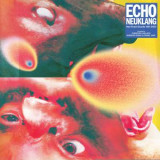
'Since 2018, João Pais Filipe (drums) and Burnt Friedman (electronics/synth) have investigated into automatic pattern–composition rooted in doubling and halving; the unimpeachable laws of motion. The offer of freedom can be seen as a way to get in touch with necessity.
On "Mechanics Of Waving" the attempt is made to succumb to such a mode of action, the drilling of a method, not through individual cunning or displayed musicianship.
Through constant practise Friedman & Pais discover the principles of rhythmic phenomena while dis–associating the music from cultural idioms. Inspired by rare infrasound–ratios ranging from 11 to 23, Nonplace releases the results of a 4 years long operation.'
Drums recorded and engineered by José Arantes.
Mastered by Kassian Troyer, Dubplates & Mastering.
Suche:burnt friedman
- 1
Explorer Series Vol.4, Original ethnic music of the peoples of the world
Berlin 2019
In welthistorischer Einmaligkeit erscheint auf dem Berliner Label Nonplace die erste ethnologische Edition der musikalischen Traditionen Zentraleuropas, am Beispiel Berlins der Gegenwart, zusammengefasst von Burnt Friedman. Nachdem House und Techno, oder Clubmusik, zum Kulturphänomen geworden war, und seit 30 Jahren bei festlichen Anlässen und fortwährend in allen Kulturstätten erklingt, wurde es Zeit für eine Aufarbeitung, für diese musikethnologische Bestandsaufnahme des kreativen Spektrum Berlins im Licht Zentraleuropas.
Bisher konnte der geneigte Hörer im Fach "Weltmusik" die entsprechenden Tondokumente finden, die einen direkten akustischen Einblick in Kultur und Tradition der seltensten Volksgruppen und entlegensten Landstriche geben konnten. Doch die Traditionen und Bräuche weisser Zentraleuropäer blieben bei diesen Bestandsaufnahmen nicht selten aussen vor. Dieser klaffenden Lücke in den Musikarchiven wird mit dieser Neuerscheinung endlich gerecht. Im Zuge der Musealisierung von bedrohtem Kulturerbe, können der Gemeinschaft aller, die besonderen Beispiele westlicher Prägung im Bereich Musikerzeugung, Techno, Jazz, Dub, usw., nicht mehr vorenthalten werden.
In Musik und Text verschmelzen über alle 11 Titel hindurch Stimmungen, Eindrücke der Sub-Sahara Konzert-Tour von B.Friedmann 2013 und Fetzen von Erinnerungen an eine imaginierte Zukunft. Sie reagieren auf reale "Kpafuca" - "things falling apart" - Zustände afrikanischer Metropolen und kollabieren zu Grooves und Phrasen, die an Chris Marker´s Science-Fiction-Apokalyptik ( "La Jette"/ "Sans Soleil" ) erinnern. In dieser Polyphonie der Un-Orte schwingt auch der Geist reisender Klangabenteurer, zB. der musikethnologischen Praktiker Hartmut Geerken und Roman Bunka (Embryo), deren Visionen und Musik-Wirken sich gegen reduktionistische, essentialistische Inszenierungen sträubt. Gegen jene kulturellen Landkarten, die in die Musik immer wieder zwanghaft hineingezeichnet werden, setzt Friedman auf "Cease To Matter" im intuitiven Modus die befreiende Kraft des Rauschens, der Über-Mensch-Maschinen-Musik, der krummen Beats und des technischen Zufalls-Defekts, kurz: das "Un-gehör-sam" (Johannes Ismaiel-Wendt) gegenüber der normativen Deutungshoheit musikalischer Weltkarten.
Die Stimme des aus Texas stammenden in Berlin lebenden Performers und Vokalisten Daniel Dodd-Ellis wirkte bereits 2007 auf Burnt Friedman´s Album "First Night Forever" (non22). Die Lyrics stammen von beiden Autoren und wurden von Friedmann während der Produktionsvorgänge 2013 bis 2014 mehrfach zerlegt und neu zusammengesetzt. Die Zeile "Sky Is Blue Inside Of You" ist dem 1932 erschienenen Roman "Brave New World" von Aldous Huxley entnommen. Tracks 04 und 09 ("Cease To Matter") enthalten ein Piano Sample Edit basierend auf einer Komposition von Georges Invanovich Gurdjieff (1872-1949).
Theo roars into a fierce, uglier-than-ugly edit, with no let-up for thirteen minutes, when it crashes to a standstill: a hurtling, mesmerizing ride, multi-layered and clustered with synth washes, bleeps and alarms, galloping drums, clattering percussion.
Burnt's Shangaan variation is perforce more chilled, lithe, reverberating. The drums are crafted and fatback, with moody vocal interjections and haunting keys, chocka with dub thrills and spills, lethally spiked with bass.
On EP5, legendary German musician Burnt Friedman makes his Dekmantel Records debut with 'Monsun'. The Berlin based artist, who built a reputation for himself through his explorations into obscure, finely-tuned, experimental dub through his label Nonplace, alongside his collaborative relationship with the late Can drummer Jaki Liebezeit, is one of the crucial, sonic manipulators of our time. 'Monsun' finds Friedman crafting flowing, percussive, dub techno that is both esoteric, and progressive. Befitting of a Dekmantel release. Alongside Friedman sits legendary Detroit act Ectomorph, aka. BMG & Erika, also making their Dekmantel inauguration, with a record that surmises' the group's anologue, style of Motor City beats.
.
There would be no Dekmantel celebration without longtime family members, JuJu & Jordash. With three LPs and countless EPs released on the imprint to date, alongside a sleuth of festival, and party appearances, the improvisational duo have become masters of off-kilter, and poly-rhytmic electronic funk, of which 'Neon Swing' -a fast-paced and extremely invigorative cut- is of prime example. And then there's Dekmantel favourite Fatima Yamaha - an artist who has a keen ear for gentle, analogue hooks that have gone to become ample festival fodder. The Dutchman maintains an ear for the serene with the track 'Platforms', a sullen, yet beautiful ambient track, the drives deep into the emotive world of soft, tender, heartfelt music.
Sometimes the title of an album tells you everything you need to know. Laurence Pike’s Possible Utopias for Jazz Quintet is like that: The music within represents a search for freedom, potentiality—liberatory strategies that transcend the ego and the solitary, atomized figure.
But in this case, the album title is also a red herring, because there is no jazz quintet here—just Pike, his drums, and his machines, not so much an ersatz ensemble as a purely notional one, a thought experiment equipped with drumsticks, circuitry, and the desire to go beyond hardwired limits.
And the results, strictly speaking, aren’t really jazz, though they incorporate the vocabulary of jazz, along with that of ambient, electronica, and post-rock. They are some other thing, cognizant of genre but never beholden to it. Again, we’re talking about a search for freedom here.
The Sydney-based musician has a long history of coloring outside the lines, not just in his solo recordings—including four albums for the Leaf label between 2018 and 2024—but also in the trio Pivot (later PVT); Szun Waves (alongside saxophonist Jack Wyllie and Border Community’s Luke Abbott); Triosk, which recorded an album with Jan Jelinek in 2003; and even post-punk titans Liars, whom he joined in late 2018.
Of his first album for Balmat, Pike says, “My loose concept was: What does music sound like when the expectations of late capitalism are removed from it? How might a jazz musician from an idealised culture of the future, or even another world, utilise musical language when the conventions of style and marketing are no longer a factor in music making?”
That inquiry, he says, connects to his “guiding principle: that the purpose of music is to access something bigger than the individual, and reveal a sense of possibility and freedom in the world to the listener. To create an understanding that the future can be something other than what we imagined or expect, even unconsciously.”
Heady ideas, but plug into his stream-of-metaconsciousness flow and you may start to intuit what motivates him. There is a deeply lyrical expression in these pieces—in the ruminative piano of opener “Guardians of Memory,” for example—but also a sense of exploded perspective, of ideas approached from more angles than any one mind could dream up. Of a collectivized consciousness, of mycelial networks branching across tone and rhythm and timbre, of ideas articulated in distributed fashion, nodal points dancing across drum heads.
Pike’s imaginary quintet is hardly without precedent; it’s a continuation of concepts floated across Jan Jelinek’s Loop-Finding-Jazz-Records, Burnt Friedman’s many guises, and much of the recombinant improv of the International Anthem roster, not to mention the far corners of ECM’s catalog in the late 1970s and 1980s, which Pike says have been integral to his development since he was a teenager. Possible Utopias for Jazz Quintet is a point in a continuum, a voice in a conversation, a question with no obvious answer: How can the search for otherness in music manifest something true about ourselves?
- A1: The Only Daughter (Remixed By Ryoji Ikeda)
- A2: Blemish (Remixed By Burnt Friedman)
- A3: The Heart Knows Better (Remixed By Sweet Billy Pilgrim)
- A4: A Fire In The Forest (Remixed By Readymade Fc)
- A5: The Good Son (Remixed By Yoshihiro Hanno)
- B1: Late Night Shopping (Remixed By Burnt Freidman)
- B2: How Little We Need To Be Happy (Remixed By Tatsuhiko Asano)
- B3: The Only Daughter (Remixed By Jan Bang And Erik Honoré)
- B4: Blemish (Remixed By Akira Rabelais)
Available for pre-order! Expected to be available from Jan 31, 2025. Your order will be shipped as soon as the item is in stock. If a partial delivery is desired, additional shipping costs may apply.
João Pais Filipe delivers three acoustic solo percussion works for Ondes HXCX. The tracks were originally recorded for an exhibition called "Membrana" which took place in a church in Northern Portugal, using only drums. Different odd time signatures were extensively explored on each of the tracks. 18/16, 19/16, 23/16 and for the first time, a technique called "omission" was also introduced. It consists of omitting notes of the Rhythm without changing it, creating a sense of illusion and changing the perspective of the Rhythm. Burnt Friedman, an accomplice of João's studies on odd rhythms focused on blending counter-rhythmic electronic elements into the 23/16 track.
Ink stamped artwork.
Das Kasseler Duo Some More Crime formierte sich 1990 mit der Idee, die gesprochene, aus Pre-Internet-Medien gesampelte Stimme als ausschließliches Text-Instrument einzusetzen. Während des Kunststudiums hatte sich der Trommler Bernd Friedmann (Burnt Friedmann / Nonplace Urban Field) mit dem Gitarristen Frank Hernandez zusammengetan, um die Abgründe des Zusammenhangs von Gewalt in den Medien, bzw. mind control, zu studieren und zu verstehen, und diese im Studio als Quasi-Collagen mit Grooves zur Entfaltung zu bringen. Some More Crime kann heute gewissermaßen als Nachzügler von Laibach, oder als konzeptueller Vorläufer von Rammstein betrachtet werden. Mit Ihrer dritten, 23 Titel umfassenden CD schafften es die Konstrukteure an Samplern und Atari-Sequenzer, Frank Hernandez und Burnt Friedman 1993 schliesslich in den Fokus internationaler Aufmerksamkeit zu kommen. Ihre überwiegend aus dem Amerikanischen gewonnenen, de-kontextualisierten Text-Cluster aus Interviews mit Gewaltverbrechern und damit verbundenen Medienkommentaren versuchte zu zeigen, dass die steifer werdende Deutungshoheit der Medien-Narrative zumindest eines vermochte, nämlich anstatt sinnstiftend zu wirken, die Massen in Angst und Verwirrung zu versetzen. Mit Friedmann's Umzug nach Köln wurde Some More Crime bereits 1994/95, also nach 3 Studio Alben beendet. Im Alleingang erzeugte Friedmann eine vierte, allerdings wenig beachtete CD, die angefangene Skizzen 1996 noch zur Vollendung und Veröffentlichung brachte. ZZO recordings Gründer Thomas Luckmann, Nürnberg, nahm sich des Duos 1990 an und unterstützte die künstlerische Arbeit trotz starken Seitenwinds des aufstrebenden, unwiderstehlichen Technosounds, der Anfang der 90ziger durch Deutschland's Musikszene zu wehen begann.
- 1: Stefan Thelen & Olek Gelba - Der Weg Nach Innen (Außen)
- 2: Burnt Friedman - Platin Tundra
- 3: Haindling - Weite Welt
- 4: Conny Frischauf - Lichterloh
- 5: Moebius & Renziehausen - Hydrator
- 6: Deutsche Wertarbeit - Deutscher Wald
- 7: Kreidler - Winter
- 8: Workshop - Eskapade
- 9: Love-Songs - Love-Songs Gegen Die Zeit
- 10: To Rococo Rot - Took
- 11: Härte
- 12: Schlammpeitziger - Schlafatemwagen
- 13: Rheingold - Strahlende Zukunft
London-based record label Wisdom Teeth kicks off 2021 with something close to home: Blush - the playful, dynamic debut LP by label co-founder, Facta. Recorded unusually quickly over a short stint in early 2020, the record is the product of a period of refreshed and unfussy creativity. It’s an innovative and distinctly contemporary album that moves a good few steps beyond the artist’s work to date - loosely rooted in UK dance music but taking added influence from ambient, modern classical, dreampop, Balearic, folk music and beyond. The result is a lush, ornate record populated by aqueous pads, bleeping arps, wandering melodies and sparse broken rhythms; acoustic instruments that play out alongside FM synths, all processed with a pristine UV sheen inherited from modern pop music. The record opens with ‘Sistine (Plucks)’ - a crystalline synth piece with a stumbling, shifting metre revolving around an odd-ended MIDI harp loop, coloured through with washed-out pads and snatches of found sound. This breezy mood follows through to ‘On Deck’, where an FM vibraphone rings out on top of woozy, warping chords and a subby soca groove. Moving forward the record moves cohesively through a range of shifting moods and hues. The machine jazz of ‘Brushes’ is tense and coiled, with nods towards Burnt Friedman, Photek and Eli Keszler. ‘Iso Stream’ sees a rich, colourful sprawl of arpeggiated synths and dissociated vocal chops unspool slowly to form pooling, lowlit melodies. Title track ‘Blush’ is a forlorn Autonomic love song built from clicks-n-cuts - like dBridge & Instra:mental reduced and reinterpreted by SND. Throughout, bold, broad melodies take centre stage, and the tracks build like compositions rather than loops or club tools. There are echoes of the dancefloor - particularly in the slo-mo bruk of ‘Verge’ and the glacial subs underpinning ‘Diving Birds’ (a collaboration with friend and Trilogy Tapes regular Parris) - however the end results find us somewhere far off. ‘Blush’ is the second long-form release to come from Wisdom Teeth following K-LONE’s 2020 debut album, ‘Cape Cira’, which was widely ranked as one the best LPs of 2020.
Auf "Small Favours" - der 6–Songs Vinyl–Auskopplung des Albums "Favours", verbündet sich Elektronikmusik–Zauberer Wolff Parkinson White mit verschiedenen SängerInnen, unter anderem Norah Jones, Natalie Beridze und Pascal Leboeuf.
Wolff Parkinson White's typisches Maschinengewehr–Feuer aus manipulierten Audio–Splittern steht hier in krassem Kontrast zu der Wärme der menschlichen Stimme. Seine erste EP–Veröffentlichung auf Nonplace bedient sich an vergleichsweise bekannten Liedstrukturen und beantwortet die Frage, wie ein Projekt von Björk und Venetian Snares klingen würde, wären sich beide jeweils der Nachteile diatonischer Monotonie und der endlosen harmonischen Wüste bewusst.
Die 6 Tracks der EP wurden von Labelchef Burnt Friedman persönlich von den 13 Album–Tracks ausgewählt. Der Schlagzeuger Jochen Rückert, der hinter dem Spitznamen "Wolff Parkinson White" steht, spielt auf "Heaps Dub" (nonplace20) von Root 70 und "Coptic Dub" (nonplace27) von Hayden Chisholm's Projekt The Embassadors.
“Mohammad Reza Mortazavi is a virtuoso percussionist known for playing traditional Persian instruments such as the tombak and daf. After developing more than thirty new striking techniques and progressing to be one of the most prominent players in Iran, Mortazavi travelled to Germany, eventually settling in Berlin to record and perform regular concerts the world over. His acclaimed performances have taken in venues such as Berlin Philharmonie and Sydney Opera House. In recent years, he has been embraced by the experimental electronic music community, collaborating with Burnt Friedman, Fis and Mark Fell.
Ritme Jaavdanegi is Mortazavi’s sixth LP, and his first one available on vinyl. The album came together from recordings made in Berlin in June 2019, inspired by Mortazavi’s vivid reminiscence about profound experiences he had listening to music as a child. As he drifted in this time-slipping reverie, the phrase ‘ritme jaavdanegi’ or ‘rhythm of eternity’ came to mind, and he found the phrase itself to match the 11/8 metre he was striving for. As such, all eight pieces on this album adhere to this time signature, which in itself harks back to the Aksak, a rhythmic pattern based on the alteration of binary and ternary quantities executed in a fast tempo, intrinsic to traditional music from Iran, Turkey, Afghanistan and the Balkans.
In the same way these non-standard folk rhythms started to impact on Western music in the early 20th Century, so now you can hear an ever-increasing embrace of polyrhythms and metres that break away from the dominant 4/4 ideology. What’s most striking about Ritme Jaavdanegi, perceived through a lens of modern Western experimental music, is how Mortazavi’s virtuosic playing rivals the intensely programmed dynamics of electronica. His rapid, needlepoint drum hits bend their tonality in incredibly musical ways, but there is still an underlying focus on cyclical repetition that encourages the same ancient transcendental quality that so many contemporary artists strive for.”
Since its launch in 2013, Bright Sounds has established itself as a label bridging the gap between the dancefloor and more experimental sounds, releasing EPs by the likes of Shlomo, Tilliander, Burnt Friedman or more recently Conforce.
On its eleventh release, the label welcomes Ben Thomas aka BNJMN with 'Final Network EP', the UK producer based in Berlin and releasing on Tresor, Delsin, Counterchange or more recently on his newly founded imprint: Tiercel.
The EP opens up with 'Reticuli', an ambient techno journey into a forest of otherworldly sounds. 'Neurocity' comes next with its rattling sounds met by disorienting and spooky melodies. On the B-Side 'Cloaked' starts off with bare kick and congos before waves of drones add textures producing an eerie atmosphere. The title track closes this EP, slowly building to create an ecstatic floating mood, leaving you longing for more as it gently fades away.
Tidy Line-up including Randomer, Gilb'R, Voiski and Tolouse Low Trax...TIP!
In terms of experimental, techno, very few come close to the impact that this UK producer has had on the scene. With a sound that is rarely classifiable, Randomer's Dekmantel contribution is a staggered, minimally-twisted, dark, kind-of-two step, awesome thing. Versatile Records' Gilb'R has found himself an integral part of the Dutch scene since moving to Amsterdam, and brings forth his organic, percussive grooves that have helped define his music, and label to date. Salon Des Amateurs' Tolouse Low Trax provides a seasoned session of amniotic, grizzled, hypnotic post-everything music, that is eerily discomforting and wonderfully pleasurable at the same time. And on the EP's fourth track, Parisian techno wizard, Voiski adds layered organic, futuristic loops that work to stale the progress of time, and space.
To date the 10-year anniversary series has seen new releases by the likes of The Egyptian Lover, Levon Vincent, Gigi Masin, Fatima Yamaha, Burnt Friedman, and many more. Each record is held together by stylistic glue, touching upon the varying facets that come to define Dekmantel as a label, and event series. Along the way, many pioneering artists have been brought under the Dekmantel umbrella, making their debuts on the label - and this, the seventh EP is of no exception, with Gilb'R, and Tolouse Low Trax all releasing their first full tracks with the Dutch imprint, while Randomer and Voiski, having previously released on Dekmantel's UFO techno side imprint, are also brought into the main fold.
The second EP of Samuel Rohrer's Range of Regularity album presents two more striking reinterprations. These new remixes provide an intriguing parallax view of the original tracks, using the percussive eclecticism of the parent LP as a starting point from which to journey into sonically vibrant, feature-rich territories. The production specialists on hand for this project include Burnt Friedman and Ricardo Villalobos. Villalobos, has already formed a strong working relationship with Rohrer's AMBIQ trio, lends his talents to both of the EPs. (RoR REMIXES I - AMEL-EP716). Nonplace label boss Friedman, as well, has carved out a unique space for himself within the electronic world, logging several decades' worth of releases that with dub-wise production sensibility, skewed humor, and riots of tone color. Though each individual remix has its own character, they are all united in their ability to provide a quick cure for fatigue with the common 'loop': though not improvised, they are strung together from fleeting phrases that evolve as if they are taking on a life independent of their creators.
Burnt Friedman's own dramatic interpretation of 'Microcosmoism' pairs up his consciousness of deep bass and analog inventiveness with Rohrer's continually transforming sound objects, making for a flowing and wordless narrative that simply dares listeners to stop paying attention. Feeling more like a collaboration in 'real time' than a remix proper, Friedman brings his characteristic 'mad scientist' wit to the proceedings and delivers an energetic piece that simply glows in the dark.
This is complemented nicely by Villalobos' remix of 'Microcosmoism'. It carries the energy level of the 1st EP over to a new disk, while heavily experimenting with feelings of emotional ambiguity. At some points aggressive and at other points merely curious, this mischievous collage of attitudes feels as inspired by the questing jazz of Sun Ra as it is by continental techno. Contemplative keyboard runs, enthusiastic spring-like percussion and malfunctioning machine chatter all coalesce to make this a most fascinating piece of multi-purpose electronic music.
Coming hot on the heels of Samuel Rohrer'sRange of Regularity album are two EPs of striking reinterpreta- tions. These new remixes provide an intriguing parallax view of the original tracks, using the percussive eclecticism of the parent LP as a starting point from which to journey into soni- cally vibrant, feature-rich territories. The production specia- lists on the first EP include Ricardo Villalobos and Vilod, the collaborative duo with Max Loderbauer. Villalobos, has alrea- dy formed a strong working relationship with Rohrer's AM- BIQ trio, lends his talents to both of these new EPs. The se- cond one will be completed by a remix of Burnt Friedman. Each individual remix has its own character, they are all united in their ability to provide a quick cure for fatigue with the common loop': they are strung together from fleeting phra- ses that evolve as if they are taking on a life independent of their creators.Villalobos' compelling take on Lenina' pulsates from start to finish with a kind of voluntary anxiety, a commitment to painting every corner of the sonic surface with clearly defined pointillist touches. While this kind of approach would cause less confident producers to collapse at their editing worksta- tion, Villalobos takes to the task with gusto - leaving see- mingly no corner un-animated by sound, he pieces together something surprisingly funky and hyper-real from a catalog of distinct percussive hits, time-reversed ephemera, and playful kitchen sink' ambience. Vilod's Uncertain Grace' remix, though marginally more laidback than the flipside, is no less engaging. A buzzing beehive of activity powered by an organ- like refrain, this is one of those pieces that will induce a fee- ling of perpetual movement into even the most still of physi- cal surroundings. This is especially true when, after four and a half minutes of flotation, a straight-ahead techno rhythm ta- kes over and all the disparate hovering elements fall into place.
Tohuwabohu are Saam Schlamminger (aka Chronomad) and Burnt Friedman.The first joint 4-track EP was produced in Friedmans studio in summer 2013.
- 1