Sean Huber, best known as the drummer of the beloved & defunct band Modern Baseball, has been releasing music with his band Steady Hands since 2013.
Back for the first time since 2018 with new album “Cheap Fiction,” Huber pays homage to all of the deities you’d expect someone with a New Jersey birth certificate and a dog named Bruce to wor- ship, with rollicking saxophone and piano over tales of hard- on-their-luck neighborhoods, and stadium-rock-ready guitar zaps over odes to the misrepresented people of Florida.
He grapples with lapsed religion like so many with Irish names have done before him. And he fits in real nicely with the mod- ern heroes of Philadelphia’s punk scene, blending the best of heartland rock and straight-up punk with his own penchant for the tropical. Huber’s lyrics tell stories of a very real world where people in power use it for evil, the people who need help don’t get it, but the person at home makes life beautiful despite it all, and
Поиск:phil back d
Все
The “Nite Dreams” release features remixes (called here Dreamixes) by Emil of one of his own Change Request productions and two by other artists.
The three lustrous Dreamixes on Emil's Nite Dreams are, put simply, irresistible. Chicago-based music collective Artispure (feat. The Remedy) opens the release with the enticingly swinging “Chicago Underground,” its dynamic house groove sprinkled with claps, chunky synth chords, slick hi-hat accents, and soulful vocal interjections.
Made over by Emil, the tune's straight-up fabulous. The snappy Change Request production “Sunday's Best” glides breezily on a tropical wave of claps, a skipping house groove, and gentle melodic figures that give the music a nostalgic, even plaintive quality. The closing cut, Emil's soulful treatment of “Sunlight” by native Chicagoan Elbert Phillips and singer Andre Espeut, shows no drop-off. With a snare-popping groove driving the tune and Espeut laying a beautiful vocal across the percolating backdrop, “Sunlight” rivals the other two tracks for quality and appeal. Vaz keeps bringing them strong.
- A1: Zagueiro 3:05
- A2: Assim Falou Santo Tomaz De Aquino 3:04
- A3: Velhos, Flores, Criancinhas E Cachorros 3:16
- A4: Dorothy 3:58
- A5: Cuidado Com O Bulldog 2:53
- A6: Para Ouvir No Rádio (Luciana) 4:20
- B1: O Rei Chegou, Viva O Rei 3:03
- B2: Jorge De Capadócia 3:53
- B3: Se Segura Malandro 2:53
- B4: Dumingaz 3:30
- B5: Luz Polarizada 2:20
- B6: Tesualda 4:06
A reissue of Jorge Ben's Solta o Pavao, originally released in 1975. Jorge Ben is one of Brazilian music's iconic and best-loved figures. Born Jorge Duilio Lima Menezes in Rio in 1942, he took the stage name, Jorge Ben, in deference to his mother's Ethiopian roots, and later used Jorge Ben Jorge for further distinction. Playing tambourine and singing in a church choir from an early age, Ben began playing in Carnival blocos and was performing in nightclubs as a teen. Signed to Philips in 1963, his "Mas Que Nada" became an instant international sensation that has never waned, despite being sung entirely in Portuguese. Beginning in samba, Ben's openminded approach saw him embrace aspects of bossa nova, the "Jovem Guarda" rock movement of the mid-1960s and the experimental Tropicalia form, the broad palette and diverse influences yielding a number of adventurous and abstruse albums during the 1970s, of which Solta o Pavao is one of the most rated by connoisseurs, though somewhat overlooked in general; its title translates roughly to "Unleash the Peacock" and apparently concerns the outward expression of inner beauty. Against a backdrop of lushly produced samba rock with shades of MPB, highlights include opener "Zagueiro", in which Ben salutes football center-backs in typically playful and poetic language; closing number "Jesualda" is a heady ballad of a chance encounter leading to a girl's social climbing and "Para Ouvir No Radio (Luciana)" a love song with striking flute and string arrangements; Dadi Flavi's bubbling bass and occasional string synths help keep the sound non-standard.
Mike Cooper wrote his final songwriter record, a suite of gloaming glam-rock anthems performed with a spiritual jazz trio, while living on the Costa Tropical of Granada, Spain, an era when he was considering retiring from music altogether. A chance encounter and a last-ditch record deal convinced him to make one last album, which he recorded in 1974 at Pathway Studios in London, with “The Greatest Rock and Roll Band in the World,” featuring the inventive South African jazz rhythm section of Louis Moholo and Harry Miller with UK saxophonist Mike Osborne. This first-ever reissue includes a bonus CD of Milan Live Acoustic 2018, a previously unreleased solo set that represents Cooper’s return, after forty-four years pursuing free improvisation and electronics, to a new, deconstructed approach to singing, steel guitar, and songcraft. The deluxe LP+CD edition also features a six-panel insert with additional artwork and an essay by the artist about both records. The deluxe 2xCD gatefold edition features an eight-panel version of the same insert. In the wake of his magisterial triptych of early 1970s avant-folk-rock records Trout Steel (1970), Places I Know (1971), and The Machine Gun Co. (1972) the British songwriter, guitarist, and fledgling improviser Mike Cooper retreated to the Costa Tropical of Granada, Spain. With no prospects for touring or recording again, his fiery band the Machine Gun Co. had disintegrated. Cooper sets the scene in his liner notes of the first-ever reissue of his unjustly forgotten next album Life and Death in Paradise (1974): No one came running with offers of fame and riches, and we fell apart, and I left the country and headed for the beach, disillusioned and a bit disorientated musically. I went to Almuñécar in Andalusia, a place I had been going since 1969, because a painter friend from Reading, Rowland Fade who made the collage in the gatefold of my earlier album Trout Steel had moved there in 1968. It was in this synthetic coastal “paradise,” unmoored and adrift, considering retiring from music altogether, that he began tentatively writing new songs. A chance encounter with producer Tony Hall, who offered Cooper a last-ditch record deal on Hall’s nascent Fresh Air label, convinced him to make one last album with the stipulation that he could assemble what he called “The Greatest Rock and Roll Band in the World.” I told Tony that I would do it if I could hire some of my South African jazz musician friends that I had used on my Pye/Dawn albums and some friends from Reading that I still knew and admired. I called up Harry Miller, Louis Moholo, and Mike Osborne, who were in fact a trio at the time … and several local Reading heroes, including the singer-songwriter Terry Clarke. The result, recorded live with minimal overdubbing at Pathway Studios in London, was Life and Death in Paradise, an utterly singular suite of gloaming glam-rock anthems performed with a spiritual jazz trio comprising the inventive South African jazz rhythm section of Moholo and Miller with UK saxophonist Osborne. Unlike anything else in Cooper’s extensive catalog. Fresh Air fizzled, and Life and Death became Cooper’s final record as a songwriter, having pushed the form as far as he could. Drifting north from Spain back to the UK, he fell into the scene of the London Musicians Collective (LMC) including Paul Burwell, David Toop, and saxophonist Lol Coxhill, Cooper’s bandmate in the Recedents and fully embraced free improvisation. He was still, however, interested in singing and lyrics, so, influenced by Tom Phillips, William Burroughs, and Brion Gysin, he began experimenting with text collage and cut-up techniques, arriving at his own hybrid compositional strategy for improvisatory songs. The previously unreleased solo set Milan Live Acoustic 2018 represents Cooper’s return, after more than four decades pursuing free improvisation and electronics, to a new, deconstructed approach to singing, lap steel guitar, and songcraft. Presented here together with Life and Death in Paradise, the two records provide fascinating bookends to Mike Cooper’s long, mercurial, and pioneering practice as a songmaker.
Back in stock!
Produced by Philadelphia's Legendary Sonny Hopson, Santiago is Indeed Neftali Santiago from Mandrill who took a break from the band in 1975 and did a little experimenting, this came out of a 6 hour sessions in which 3 tracks were recording, two being on this 45 and is Santiago's only lead vocal to date . The band lasted a year in that time supporting Gil Scott Heron and The Ohio Players live. A two sided disco stormer with all the right ingredients, great guitar hook, solid horn section and great vocal.Essential Disco
'Seven Years Of Love' is our second label compilation with nine original tracks by resident artists and friends from around the world. The versatile vibe spreads across two parts, each dedicated to a certain dancefloor mood: System 108 and RadugaDiscoClub. Outstanding artwork has been created by Uno Moralez.
Part 1 of the compilation is opened by new Locked Club gem that playfully recycles a well known video meme, 'Smog Izdevatsya'. Followed by Philipp Gorbachev's industrial / house / dub infused (!) fairy tale about a bird. ('Raven'). The last track of side A comes from our new shooting star, Maksimovna. Originally sent as a demo, '3a Gribami' tells a story about collecting mushrooms, it got signed immediately and is destined to become a big hit! Time to flip the side and enter the kingdom of dark physical beats and fun acid blackouts on side B: it is Kovyazin D who is back at it with 'Brainwash'. Disconnected electro mind, disconnected electro mind, disconnected electro mind! Closing out the EP is an exclusive by Inga Mauer. Rare to hear Inga's vocal experiments provide a transcendental experience in 'Comes From Nothing'
- 1: Aretha Franklin - God Bless The Child
- 1: 2Bettye Swann - Make Me Yours
- 1: 3Barbara Lynn - You'll Lose A Good Thing
- 1: 4The Marvelettes - Please Mr. Postman
- 1: 5Betty Padgett - Sugar Daddy (Part )
- 1: 6Diana Ross & The Supremes - Your Heart Belongs To Me
- 1: 7Nina Simone - Plain Gold Ring
- 1: 8Millie Jackson - All The Way Lover
- 1: 9Gwen Mccrae
- 1: 0Dee Edwards - Why Can't There Be Love
- 1: Brenda Lee - I'm Sorry
- 1: 2Helene Smith - Help Me To Keep What I've Got
- 1: 3The Shirelles - Will You Love Me Tomorrow
- 2: 1Etta James - I Just Want To Make Love To You
- 2: Esther Phillips - Release Me
- 2: 3Martha Reeves & The Vandellas - My Baby Won't Come Back
- 2: 4Dionne Warwick - Don't Make Me Over
- 2: 5Gladys Knight & The Pips - Every Beat Of My Heart
- 2: 6Mary Wells - The One Who Really Loves You
- 2: 7Lavern Baker - Love Me Right
- 2: 8Ella Fitzgerald & Nelson Riddle And His Orchestra - Geo
- 2: 9Alice Russell & Tm Juke - Hurry On Now
- 2: 10Spanky Wilson & The Quantic Soul Orchestra - Message To
- 2: 11Greyboy, Quantic & Sharon Jones - Got To Be A Love (Pau
- 2: 1Marva Whitney - I Am What I Am (Parts 1 & )
- 2: 13Sandra Nkaké - Happy
Obwohl der Begriff "soul" schon während der Dreißigerjahre in der US-amerikanischen Populärmusik auftauchte, entstand Soul als eigenständiges Genre erst in den 1950ern aus Gospel und Rhythm"n"Blues sowie je einer Prise Blues und Jazz. Schon bald darauf sollte Soul zum Inbegriff "schwarzer Popmusik" werden. Kennzeichnend für die afroamerikanisch geprägte Unterhaltungsmusik sind emotional gefärbte Sangeskünste. Sich mit ganzer Seele und herzergreifendem Gesang den Vibes, dem Groove und der Message hinzugeben, das macht Soul aus. Sängerinnen wie Aretha Franklin, Etta James, Tina Turner, Lavern Baker, Marlena Shaw oder Diana Ross beherrschten dieses Metier meisterhaft. Sie finden sich neben Dionne Warwick, Nina Simone, Dusty Springfield, Irma Thomas, Amy Winehouse, Ibeyi und vielen anderen Künstlerinnen auf der geschmackvoll kompilierten Doppel-LP "Soul Women".
New York, NY (May 09, 2023) - Techno powerhouse, Charlotte de Witte releases her highly anticipated EP, Overdrive as the anchor to her larger Overdrive Campaign within the KNTXT Label. Following de Witte’s breakthrough to the top of the electronic music scene in 2019 with her signature sonic approach that refuses to be boxed in, Overdrive is a reflection of this ethos. The EP aims to showcase street style that is both rough and energizing, while delivering high-energy tracks meant to pull listeners into the fast-paced thrill that unlocks one's turbocharged version of themselves. Listen HERE.
“While making Overdrive, I didn’t fully realize how applicable the lyrics are to my philosophy of life,” said de Witte. “The fast-paced tempo, which goes full force without looking back, is all about the feeling of being on the edge and living life to the fullest.”
Best known for her “dark and stripped-back” brand of techno and underground music, DJ, record producer, and label head de Witte pushes the boundaries of the electronic genre with music that has a distinct and unforgettable sound that is uniquely her own. De Witte’s innovative ability allows her to seamlessly blend genres and styles that have won her a dedicated fan base and critical acclaim.
“Overdrive is a love story between hip hop and techno, it’s inspired by both genres, but coated in a techno jacket,” said de Witte. “It’s meant to be played loud while driving at night and watching the city lights pass by, and where better to experience that than in New York City?”
Overdrive marks de Witte’s first release since her single “High Street,” and first EP on her KNTXT label since her last EP, “Apollo” which was released in October 2022 as well as her collaboration with fellow techno artist Enrico Sangiuliano on the “Reflection” EP in March 2023. De Witte had previously worked with Sangiuliano on their remix of “The Age Of Love”, which amassed over 40 million streams on Spotify and achieved certified gold status in Belgium. De Witte’s other recent releases include her “Universal Consciousness” EP in 2022 and her “Formula” EP in 2021, which featured the chart-topping lead track “Doppler”.
Following a 2020 debut on DJ Monchan’s Dailysession Records, Tinker’s Knob returns with a five-tracker on a new imprint, Pinehurst Music. “These edits were selected from projects dating back to 2017,” he explains, “and most of the revisions have to do with structure and arrangement, which are indispensable. I’m beholden to the original musicians and producers for providing the ‘bones’ of these edits. Some of the recordings are uncommon, some less so, but each has elements of magic, sparks blowing off of a burning branch that drove me to follow them into the night.”
Highlights from the collection include: “Juice,” an early Tom Moulton mix refreshed and dripping with strings (fiddle, not philharmonic); “Thief,” a looped-up boogie number with a break that goes all the way across the urban highway; and “Happy Air Dance,” a heartfelt homage to the late Hamilton Bohannon. Limited to 212 copies.
Three timeless tracks from the esteemed D.C. LaRue back catalogue get brand new remixes from three equally exciting producers to give a modern spin to these ‘70s classics.
LaRue joined the music industry by recording two top 40 pop records influenced by the teen-idol era. In his early adulthood, he began writing songs about the fast-growing club and bar subculture he frequented where the most outcast of society’s young and marginalized could safely congregate after being ostracized in work, church, school, and often family. In this relatively brief selection of LaRue classics, contemporary remixes paradoxically bring out the timelessness of his songs, in tone, message and musicality.
First up, ‘Do You Want the Real Thing’ gets a fresh update from re-edit royalty Opolopo in the style of the lush yet sharp Motown and Philadelphia production pieces that inspired the arrangement originally, still resonates as a nightly inner dialogue or negotiation, another of LaRue’s literary signatures.
‘Let Them Dance’ greeted in its time as a one of the breakthrough moments of new music technology, is reinterpreted by Dr Packer mainly with its live acoustic tracks, also retaining bright, rhythmic synthesizer hooks with results that are still true to his intentionally oblique lyric, a novelistic portrayal of the drug dealers, the LGBTQ+ underground community, and the powerful upper class elite that made up the multi-racial, socially integrated crowds on the dance floors at the height of disco.
Last up, ‘Indiscreet’ from LaRue’s 1976 concept album, ‘The Tea Dance,’ tells much of the story about how disco had already birthed its own far more popular and influential successor form, Hip-Hop, by the time it was declared dead by the superannuated establishments of the radio, media, and record businesses. Released in a highly limited, personally inscribed 12-inch 45 rpm edition for a select list of top disco DJs, its complex, elastic polyrhythm made it as irresistible to younger black DJs and breakdancing teens as any of the year’s other big street breakouts. Only Good Vibes Music head honchos and Scotland’s finest The Knutsens give it the magic touch for the modern dancefloor.
Bobby's 2019 tour ended in New York City and he had two days off before flying home to Finland. Leon invited him to the Diamond Mine to record some music. Bobby had been talking about wanting to stretch out lyrically and write about more esoteric subject matter, Leon was game. They recorded "Reasons" in one session which put the chemistry between the two on the world stage and sparked the idea of doing a full length album together. More than halfway through the recording process, they have decided to treat us to another two-sider of the new material. On the A side, "Whatcha Know" Bobby explores death and the human experience, putting his philosophical ponderings into his music. Michels' production and overall ethos is the perfect complement to Bobby's desire to stretch out his sound. EMA provides a gorgeous backing track that compliments Bobby's style and simultaneously broadens its scope. The B side "Losing It" is a dramatic and moving number that Bobby sings in Spanish and English. A gorgeous guitar riff is countered with eerie sound effects that crescendo when the drums come in. Bobby professes he's "Losing It" over a love too strong and El Michels Affair's production turns the whole affair into a saga that thunders through speakers.
Miles Away Records are proud to introduce our latest single to land on the label: the cosmic soul gem "Super Star" by Ruth Waters and the State of Mind Show Band.
A Texas native, Ruth "Silky" Waters was best known for her two disco-infused album's "Never Gonna Be The Same" and "Out In The Open"- produced by the late, great John Davis (John Davis Orchestra). It was however some of Ruth's early material that caught our interest when we started the label as far back as 2018. "Super Star", released on the tiny independent KMBA Recordings label in the late 1970s, draws from the wells of modern soul and gospel with a touch of cosmic synthy goodness. An proper ear turner, it was like nothing we'd heard before. Flip it and "Super Star Pt.2" goes deeper into the cosmic essence of the track with extended guitar and synth solos making this a crackin' little 45.
The track has been lovingly remastered by Phil Kinrade at the legendary AIR Studios and the lacquer was cut deep by Jukka at Timmion Records. It's now presented in our custom teal green labels and house bag.
Green Vinyl
For its fifth release, french label The Bass Academy goes back into time!!! Originally written by legendary Man Parrish, "Boogie Down Bronx", a cult classic from 1984, sees a mighty resurrection with a "fresh mix" rework from UK Electro veteran Bass Junkie. Not the first time Phil Klein (Battle Trax, Breakin' Records) remixes Man Parrish as he committed in 2002 the heavy “Bass Junkie's Boogie Down Bass Mix” of “Hip Hop Re Bop”. Today, he serves up an uncompromising electro funk mayhem made of old schoolish samples, vintage synth melodies, retro congas, relentless scratches and pounding 808 beats. This brand new Sci-Fi anthem, enhanced with the legitimate legacy from the past, will invite you for some irresistible B-Boy breakdancing movements on the linoleum!!! Tuuuuuunnne! On the flipside, Phil teams up once again with long time partner in crime Simon “The Dexorcist” Brown. Together, as Gods Of Technology, (Battle Trax), they revisit another untouchable song, “Future Computer”, an exclusive to TBA track written by Jamie Jupitor and published in 2017 (TBA02). Metallic sororities melt with nasty vocoder sequences and imparable whispers turn the cut into an ode to the dancefloor thanks to harsh and hammering beats. What a timeless monster in pure West Coast tradition! With abrasive outings to appear on the forthcoming months including an incredible album with Matt Whitehead on Dominance Electricity, Phil Klein definitively returns to studios stronger than ever, putting a end to a short blackout. Rush in this hypnotizing collector 12”, limited as usual to 150 copies as it marks one of Phil Klein’s best releases to date!
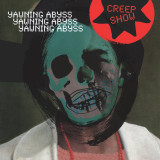
In the five years since Creep Show’s acclaimed Mr Dynamite album was released it’s fair to say that we’ve all been through a fair bit. Sitting here, in 2023, things don’t seem to be getting any better. There’s the cost of living crisis and political meltdowns; we're in deep water with global warming and to top it all there’s a war on our doorstep.
Back in 2018 everything seemed less complicated. Sure, there was stuff to get riled about, but we knew nothing about what was to come. Mr Dynamite was a fairground ride into the dark corners of a world that was on the brink of being blitzed in a blender. It was a record teetering on the edge. Five years down the line you’d expect the follow-up, Yawning Abyss, would double-down and bring the white-knuckled, teeth-gritted fury of the last five years to the boil. And yet….
A quick recap? No problem. Wrangler + John Grant = Creep Show. And Creep Show? “A band of musical misfits who have found a voice or two”, says Wrangler’s Ben “Benge” Edwards, whose Bond villain studio on the edge of a moorland is Creep Show Grand Central as well as home to an analogue synth arsenal that could sink ships.
Wrangler have known each other for a while. Tunng’s electronics wizard Phil Winter and Cabaret Voltaire’s trailblazing, pioneering frontman Stephen Mallinder go way back, while Phil and Benge crossed paths in the 21st century when they seemed to be increasingly in the same venues at the same times. Meanwhile, Mal had been living in Australia since the mid-90s and when, in 2007, he returned to the UK his old pal Phil suggested he meet Benge and the three of them immediately began working together.
Wrangler collectively bumped into Grant at their soundcheck for Sheffield’s Sensoria Festival in 2014 where they were playing with Carter Tutti. A friendship blossomed and when they were invited to perform together for Rough Trade’s 40th anniversary show at London’s Barbican in 2016, well, they jumped at the chance... and Creep Show was born.
Let’s talk about the new album... What is the ‘Yawning Abyss’? You might well ask. According to Mal, it’s “a cosmic event horizon that I can see from my attic window when stand on a chair”. Yeah. Thanks.
“On this album”, offers Benge, feet firmly on the floor, “Wrangler wrangled some vintage synths, mostly Roland, Moog, and the ‘Crystal Machine’ - then John Grant joined in the fun at Memetune Studios where lots of musical experiments were carried out. Then Mal and John ran off to Iceland with the master tapes and recorded a load of madcap vocals. Back at Memetune, me and Phil were left to try and make sense of it all. Which wasn’t hard because what they did in Iceland was totally magnificent.”
Which kind of brings us back to where we began. You’d imagine ‘Yawning Abyss’ would be blowing steam out of its furious ears. Mr Dynamite but kicking a wasps nest. Repeatedly. And yet…
Opener ‘The Bellows’ comes on like a modular ‘Radio Ga Ga’, the singalong ‘Moneyback’ (“You want your money back? / I didn’t think so”) sounds like Godley & Creme’s ‘Snack Attack’ meets Prince Charles And The City Beat Band (“Pennies, pounds, dollar bills, signed agreements, death wills”). ‘Yahtzee!’ is an unhinged electro breakdance party in four minutes and nine seconds.
Where Mr Dynamite was menace, a mélange of mangled voices, with Grant and Mallinder being heavily treated, pitched up or down, rendering their contributions largely indistinguishable, Yawning Abyss takes a more direct approach. You hesitate to say feelgood, but there’s a skip in the step here for sure.
The title track plays John Grant’s vocal straight. Completely. It’s good, so very good. Like ‘Axel F’ covered by Vangelis. The delicious shimmering synths of ‘Bungalow’ also plays those Grant pipes with a straight bat. ‘Matinee’ delves into darker, very funky territory. With Mal upfront it comes on like ‘The Crackdown’. Choice lyric: “You are starting to breakdown / And it’s so fun for me to see / You should have thought of that / You should have come prepared / You can see what’s happening and you look a little scared”.
So, you know, not all feelgood. But it does feel good. It’s probably best to draw your own conclusions... This is Creep Show after all.
The next chapter of the Natural Information Society is here. Since Time Is Gravity, credited to Natural Information Society Community Ensemble with Ari Brown, presents a newly expanded manifestation of acclaimed composer & multi-instrumentalist Joshua Abrams nearly 15 year, 7 albums &-counting flagship ensemble. Joining the core NIS of Abrams (guimbri & bass), Lisa Alvarado (harmonium) Mikel Patrick Avery (drums) & Jason Stein (bass clarinet) are Hamid Drake (percussion), Josh Berman & Ben Lamar Gay (cornets), Nick Mazzarella & Mai Sugimoto (alto saxophones & flute), Kara Bershad (harp) & Chicago living legend of the tenor saxophone Ari Brown. Recorded live to tape at Electrical Audio & The Graham Foundation, cover painting Vibratory Cartography: Nepantla, by Lisa Alvarado. 2xLP on Eremite USA, 2xLP & CD on Aguirre/Eremite Europe. Out 14-04.
Since first developing Natural Information Society in 2010, Joshua Abrams has been gradually expanding the group’s conceptual underpinnings, its musical references & the sheer number of the group’s members. Its music is, in a sense, an expansive form of minimalism, based in repeated & overlaid rhythmic patterns, ostinatos & modality. Its roots, its scale & its meaning become clearer in time. If time is gravity, it also allows us to carry more. Having begun as fundamentally a rhythm section with Abrams’ guimbri at its core, the version here can stretch to a tentet, including six horns.
Abrams has been expanding his minimalism gradually, but he has long understood a key to minimalism’s potential: the breadth of its roots in the late 1950s & early 1960s, ranging from the dissatisfaction of young European-stream composers with the limitations of serialism to the simultaneous dissatisfaction of jazz musicians with the dense harmonic vocabulary of bop & hard bop. The former began exploring rhythmic complexity & narrow tonal palates in place of harmonic abstraction (Steve Reich’s Drumming, Philip Glass’ Music with Changing Parts; perhaps above all Terry Riley’s In C & his late ‘60s all-night organ & loop concerts); the later reduced dense chord changes to scales (signally with Miles Davis' Kind of Blue, but rapidly expanding with John Coltrane’s vast project). In the 1950s the LP record opened the world with documentation of Asian & African musics, key influences on both minimalists & jazz musicians. If John Coltrane’s soprano saxophone suggested the keening shehnai of Bismillah Khan, the instrument was rapidly taken up by two key minimalists, LaMonte Young & Riley, similarly appreciative of its flexible intonation, the same thing that kept it out of big bands.
If the guimbri, the North African hide-covered lute that Abrams plays with NIS, involves a rich tradition of hypnotic healing music associated with the Gnawa people, Abrams’ music also touches on other musics as well — other depths, memories & healings, different drones, rhythms & modes. As the group expands on Since Time Is Gravity, he has made certain jazz traditions in the same stream more explicit as well. If there is a mystical & elastic quality involved in the experience of time, both in direction & duration, you will catch it here. The parts for the choir of winds expand on the roles of Abrams’ guimbri, Mikel Patrick Avery & Hamid Drake’s percussion & Lisa Alvarado’s harmonium: at times, the winds are almost looping in the tentet version, each hitting a repeating note in turn, at once drone & distinct inflection on temporal sequence. The brilliance of the work resides in Abrams’ compositions, the NIS’ intuitive execution & in Ari Brown’s singular embodiment of the great tenor saxophone tradition, including the oracular genius of Eddie “Lockjaw” Davis, & Yusef Lateef. The three pieces by the expanded NIS featuring Brown —the opening “Moontide Chorus” & “Is” & the ultimate “Gravity”— have an immediate impact, & togther might be considered a kind of concerto for tenor saxophone. Here Brown presses almost indistinguishably from composed melody to improvised speech, getting so close to language that he might have a text. Everything here is a sign. Note the tap of the Rhythm Ace that links “Moontide Chorus” to “Is”, the attentive heart always present, even when signed by a machine. There’s a link here to the methodologies & meanings of dub music & the linear & vertical collage of beats, textures & tongues: treated with reverence, a sample of a beat-box can be as soulful, as hypnotic, as a mbira or a tamboura. If those pieces with Brown are heard as a suspended concerto, the three embrace & enfold the other works, like the sepals of a flower. That placement will also touch on the mysteries of our perception of time.
Particularly in “Is”, but elsewhere as well, a phenomenon of transcendence arises in which time appears to be tripartite, at once moving backwards & forwards & standing still. This is an act of technical brilliance certainly, but also an illumination of music’s ability to represent temporal consciousness through polymetrics. This particular listener has only heard it before in a few places, including the horn shouts & bowed basses of Coltrane’s Africa, in moments of Charles Mingus’ The Black Saint & the Sinner Lady, in certain pieces where tapes were literally running backwards, & earlier still in Dizzy Gillespie’s Cubana Be, Cubana Bop, in which the composer George Russell & conguero Chano Pozo found a music that spoke at once in the voices of Stravinsky’s Rite of Spring & the vestigial rites, rhythms & songs of the Yoruba language & Santeria religion of inland Cuba.
In Joshua Abrams’ compositions & the realization of them by the NIS, in the time of one’s close listening & memory thereof, distinctions between the “natural” & the “social”, the “quotidian” & the “transcendent” are erased, suspended or perhaps irrelevant. Consider two of the ensemble pieces, one named for nature, the other social science. In “Murmuration” the repeated wind figures of flute & alto saxophone combine with the interlocking patterns of harp, guimbri & frame drum (tar) to create a perfect moving stillness, not an imitation but a witness to the miracle of the starlings’ astonishing collective art, a surfeit of beauty that might be the ultimate defense tactic.
“Stigmergy” takes its name & concept from the Occupy movement’s Heather Marsh, who proposes a social system based on a cooperative rather than competitive models, one in which ideas are freely contributed & developed as ideas rather than an individual’s property. In its form, Abrams’ “Stigmergy” is the closes thing to traditional jazz, a series of accompanied solos by each of the wind players. However, the composed accompaniment is a radically collectivist notion: a repeated rhythmic figure, call it ostinato or riff, in which the different winds each play only a note or two of the figure, a concept both more collectivist & individualistic in its conception than any typical unison figure. It suggests another of the underlying recognitions that propel the Natural Information Society, the group as social organism, the teleology of hypnotic anarchy, all parts in place, functioning systematically, evolving & expressing itself, its nature & society, as a transformative organism.
George Lewis has described music as “a space for reflection on the human condition”. This suggests that, rather than a “distraction”, at least some music might serve as a distraction from distraction. It’s a focus, a clarity, a awareness, an external invitation to interiority, as if music itself is a model for form & contemplation, an organism contemplating for us or as us. If that is a possibility, & I am sure I have heard such musics, than this music is among them. How many of our rhythms, melodies & harmonies (cultural, historical, biological, psychic) might such music carry, translate & transform in the particulate ecstasy of our own murmuration? (Stuart Broomer, April 2022)
Andrius Arutiunian’s debut album »Seven Common Ways of Disappearing« was first conceived as an installation for the Armenia Pavilion at the Venice Biennale in 2022. The Armenian/Lithuanian artist and composer uses hybrid forms of music, focusing on sonic vernaculars, hypnotic musical forms, and aural cosmologies. Arutiunian is known to work with installations, sound objects, and time-based collaborations with ensembles and performers. The piece on this record was written for two musicians, a retuned piano and analogue electronics, and it borrows an enneagram as its score—the world-ordering model introduced by the controversial Armenian-Greek mystic and composer G.I. Gurdjieff. The result is an album that is both aesthetically and spiritually intoxicating music of the spheres, at once reminiscent of the masterpieces of minimal music and improvised, if not stochastic music. G.I. Gurdjieff was one of the first thinkers and (quite possibly charlatans) to introduce a syncretic idea of Eastern philosophy into the West. His unique way of teaching was based on an esoteric blend of Middle Eastern, Buddhist, and Dervish philosophies, and oscillated between a genuine search for enlightenment and a complex form of trickery. Borrowing from Gurdjieff’s writing on the world ordering and musical tuning, Arutiunian used the enneagram to organise the musical and structural matter of the piece that was originally conceived as a live performance.»Seven Common Ways of Disappearing« is written for a grand piano—the epitome of Western composition and musical production—and follows a simple set of rules: the two musicians have to navigate the topography of the score, rendering the piece in a different configuration each time. In a sense, this gripping recording is thus only one of the potentially infinite versions of how it could be played, but also seems to take on different shapes and forms with each new listen. It documents a truly mystical composition that follows its own logic
Damian Lazarus’ Secret Teachings imprint welcomes a unique project from Malian and French pairing Siraba, unveiling their debut single ‘Ngana Fôlly’ alongside remixes from Philou Louzolo and Peaking Lights. Meaning ‘The Great Path’ in Bambara, Siraba - the duo consisting of Malian hunter Boubacar Samake and Damien Vandesande, one half of French electronic band dOP - are on a path of bringing the traditional sound of the Wassoulou to the world. They met in 2003 when Damien visited Mali to work with local artists and met Boubacar’s father - the legendary Sibiri Samake. Working together on multiple occasions, the two promised to work with one another and Boubacar on a project one day, and 17 years later, the two connected to begin to develop their unique sound and showcase their shared universe.
Inspired by the music of the master hunters from across Mali, the ‘Dozo’, the project transmits values based on justice and righteousness, love and respect for others, moral and spiritual rectitude and protection for everyone. Debuting on Damian Lazarus’ Secret Teachings imprint, an outlet for the Crosstown Rebels boss to delve deeper into musical realms outside of the norm and away from the dance floor, the pair will release their debut album in September, with a series of live performances set to be announced. Their first single arrives in early June with ‘Ngana Fôlly’
A spiritual and hypnotic production rooted within Dozo musical tradition, featuring Boubacar playing the Ngoni while singing in Bambara, ‘Ngana Fôlly’ is a resonant and rich production combining organic textures with warping synths, rich bass and sweeping electronics, capturing the magical essence of Mali across a fascinating journey. Providing the first remix on the package, Dutch DJ/producer and DJ Mag ‘Artist To Watch for 2023’ Philou Louzolo harnesses Boubacar’s vocal and places it at the heart of his soaring remix as stripped-back percussion and a commanding low-ends guide sweeping synths, before handing over to San Francisco husband-and-wife pairing and Dekmantel signees Peaking Lights who tip things down a bright and blissful rabbit hole of soundscapes as vibrant guitar riffs and twisting leads work amongst off-kilter melodies and acid flecked tones for an eight-minute trip.
- A1: Carlos Picklin - La Charanga Del Espacio
- A2: Tito Chicoma - Cumbia A Go Go
- A3: Choche Merida - El Rock De Los Chinos
- A4: Benny Del Solar, Melochita, Ita Branda - Rumba Espanola
- A5: Lucho Macedo - Rock & Roll Mambo
- A6: Nallye Fernandez - Batijugando
- A7: Nelson Ferreyra - Twist En Guaracha
- B1: Los Kintos - Kintos Boogaloo
- B2: Patty Pastel - Computador Electronico
- B3: Luciano Luciani - A Bailar Bump
- B4: Willy Marambio - Trompeta A Go Go
- B5: Los Vikingos - Go Go En Patines
- B6: Edgar Zamudio - Dia De Pago
- B7: Lucha Macedo - El Maestro Del Rock & Roll
Exotica, ye-yé cumbia, guaracha infused twist, rock’n roll mambo, Spanish rumba, boogaloo beat, tropical garage and other unexpected bastard genres are featured in this festive compilation of bizarre hits taken from the glorious catalog of records released during the 60s and 70s on the Peruvian label Discos MAG. Some clearly unite genres, others are projects with creative names, but all are bold musical initiatives that got and will always get people onto the dance floor. “Sabroso Go Go” brings together fourteen musical mixes created in the recording studios of Manuel Antonio Guerrero (MAG), in which music directors combine rhythm with alchemy in a quest to find the philosopher's stone of the dance. Exotica, ye-yé cumbia, guaracha infused twist, rock’n roll mambo, Spanish rumba, boogaloo beat, tropical garage and other unexpected bastard genres are featured in this festive compilation. Although this compilation begins in 1957, experiments like this (some more memorable than others) were not new in Peru. The songs on this album were however much more successful hybrids. Some clearly unite genres, others are projects with creative names, but all are bold musical initiatives that got and will always get people onto the dance floor. At the end of the fifties, rock music shook the foundations of Peru, and orchestras rushed to cover hit songs and explore the possibilities of mixing them with tropical music. Lucho Macedo's orchestra took up the mantle and reinterpreted a well-known guaracha by Celia Cruz ('Rock and Roll') in mambo style, renaming it 'Rock and roll Mambo'. 'Maestro de Rock and Roll', a hit by the Cuban Conjunto Casino, received similar treatment. Another mix in this vein is the rock tune 'El Rock de los Chinos' by the Mexican Manolo Muñoz (author of 'Speedy González') recorded by the Chilean Choche Mérida for MAG in 1961. The following year, Chubby Checker’s 'The Twist' hit the scene and was immediately fused with guaracha by maestro Nelson Ferreyra. A legendary MAG musician, Carlos Pickling, composed 'La Charanga del Espacio' in 1963. The space sounds are produced by Pickling and his inseparable Hammond. He himself is the one who leads the orchestra that accompanies Benny Del Solar, Lita Branda and Pablo "Melcochita" Villanueva in the tropicalized version of Spanish Rumba, when the beats of the Iberian rumba were still exotic in South America. Around that time, the Chilean Willy Marambio was already living in Lima. In the track included on this album, the go-go style showcases his virtuosity on the trumpet. Another outstanding trumpet player, Roberto "Tito" Chicoma from Chiclayo, played as a session musician with MAG from 1959. A few years later, he became one of the most popular Colombian cumbia players, a talent he demonstrates in the song on this compilation, which blends the fun of go-go with yé-yé beats. 'Batijugando' was a hit from Mexico and was played in all the rhythms played across the Hispanic world since 1967. Inspired by the "Batman" series, it was performed at MAG by the Betico Salas orchestra, with vocals by the Panamanian lady crooner Nallye Fernández. 'Computador Electrónico' is another surprise on this album, performed by Panamanian vocalist Patty Pastel, it is the only known version in Spanish of 'Der Computer Nr. 3', originally sung in German by France Gall. Two other songs feature Edgar Zamudio. The versatility of Zamudio y Los Vikingos (originally a Chilean group) is demonstrated in the guitar-heavy song composed specifically for the late sixties skate fashion ('Go Go en Patines') and in his idiosyncratic protest song ('Día de Pago') performed in beat style. In the mid-seventies, Los Kintos, led by guitarist Francisco Acosta, developed different harmonic ideas in an instrumental track that veers from boogaloo to salsa, the fashionable rhythm of the day. Finally, in 1976, when the bumping hips dance craze swept the continent, Manuel Guerrero was quick to jump onto the bandwagon, composing a Bump song, together with his son Carlos. The Italian musician based in Lima, Luciano Luciani performed the song 'A Bailar Bump' backed by his band of local musicians Los Mulatos.
Gacha Bakradze releases his third album on Lapsus entitled "Pancakes", and while the name may appear conventional at first glance, it actually contains esoteric philosophical concepts.
The Georgian producer perceives the making of pancakes -a transformative and healing parental activity that he loves to partake in with his son- as a metaphor for alteration, metamorphosis and change. A reflection that also accentuates the importance of balance during each process of preparing a simple recipe, which in turn highlights key human attributes such as patience, attention to detail and willingness to adapt to shifting circumstances.
On a sonic level, Gacha’s new album embodies precisely that: the contextual reworking of his music, while maintaining the essence of his previous work. "Pancakes" provides the typically melancholic yet vibrant genetics already recognisable in his music, but also embraces new genres, including his unique and personal take on hyper-pop and trance. It is an album of contrasting elements, where bucolic interludes make way for heavier tracks that are more suited to a club environment, an aural universe that hybridises IDM, electro, bass music and cutting edge techno, and once again demonstrates that trying to pigeonhole Gacha Bakradze's sound is a somewhat fruitless task.
Tidal Waves Music proudly presents ‘Fly By Night’ for the FIRST TIME on vinyl (the album was only released as a limited compact disc back in the early nineties).
This unique record comes as a deluxe 180g vinyl edition (strictly limited to 500 copies) with obi strip.NonReturnable.
This vinyl edition also features the original painted front cover artwork by Virgil Grady (known for his work with Tribe records) and back photography by acclaimed Detroit scene photographer & author Barbara Barefield, whose work has appeared in many renowned publications such as The New York Times, LA Times, People magazine and countless others.
Released exclusively for Record Store Day 2023 (UK/Europe) and available in participating stores on April 22, 2023.
Wendell Harrison was born in Detroit in 1942 where he began formal jazz studies for piano, clarinet and tenor saxophone. At 14, while still in high school, Harrison started performing & recording professionally with artists such as Marvin Gaye, Grant Green, Sun Ra, Hank Crawford … and many others.
In 1971, Harrison began teaching music at Metro Arts (a multi-arts complex for youth) where he also connected with Marcus Belgrave, Harold McKinney and Phil Ranelin…soon after they formed the (now
legendary) Afro-centric TRIBE record label and artist collective. TRIBE used the Metro Arts complex as a vehicle to convey a growing black political consciousness. Wendell Harrison also published the very popular TRIBE magazine, a publication dedicated to local and national social and political issues, as well as featuring artistic contributions such as poetry and visual pieces.
In 1978 Harrison and McKinney co-founded REBIRTH, a non-profit jazz performance and education organization, in which many notable jazz artists have participated. Around the same time Wendell Harrison
also created the WENHA record label and publishing company, which released many of his (now classic) recordings as well as those of other artists, such as Phil Ranelin, Doug Hammond and Reggie Fields (The Real ShooBeeDoo).
In the early 1990s, Wendell Harrison was awarded the title of “Jazz Master” by Arts Midwest. This distinction led Harrison to collaborate with fellow honorees and gave him the chance to tour throughout the UnitedStates, Middle East and Africa. Even to this day Wendell Harrison's recordings for the TRIBE, WENHA and REBIRTH labels have a large worldwide fanbase.
It is on WEHHA in 1990 that Harrison released (and self-produced) the opus: ‘Fly By Night’ which we are proudly presenting you today. ‘Fly By Night’ is a monster of an album featuring an all-star line-up that
includes Doug Hammond (Mingus, Lonnie Liston Smith) on drums, Kirk Lightsey (Chet Baker, Calvin Keys) on piano, Cecil McBee (John Hicks, Pharoah Sanders, Alice Coltrane) on bass, Jaribu Shahid (Sun Ra) on contrabass and Pamela Wise (Tribe) on Piano. Harrison is killing it here with this selected ensemble (guys he grew up with in Detroit in the late 50’s, when hard bop was the thing and Miles and Coltrane were the heroes of the day). This group of talented veterans are taking this classic album to unseen heights.
On ‘Fly By Night’ the gloves come off…no more jazzy-funk or poppy-jazz. Wendell picks up his tenor for one tune but the remainder of the sessions he performs on clarinet. Wendell’s mastery coaxes the sweet piquant sound of the instrument and as it re-emerges in the contemporary jazz scene. The eight handpicked tunes demonstrate the fertile new directions Wendell Harrison has been working on, combing standards with a fresh new approach.
On these amazing recordings (recorded at the Rebirth Studios in Detroit) the listener is invited to experience a synthesis of what has been and what is now. The record shows Wendell’s trademark proficiency. All of the above makes this incredible record both timeless and as relevant today as it was back when it was initially
released.