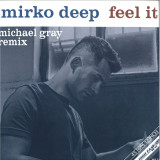
Mirko Deep’s new single ‘Feel It’ is a real house gem! An up to date yet classic sounding vocal house standard that will surely stand the test of time.
The release come with a hot new Michael Gray Remix. Michael’s mix oozes quality house vibes. His tight percussive beat leads you onto the dancefloor with a melodic piano hook and gorgeous female vocal before a funky bassline grooves all the way to Philly and back. Oh yes!
Italian producer Mirko Deep has immersed him self in all things house over the last few years. Key influences include Frankie Knuckles, Masters at Work, Kerry Chandler and Tony Humphries to name but a few and after listening to his new productions it’s clear to see why.
Поиск:phil back d
Все
Philadelphia band Stereo League has always been about discovering new genres and working with artists who can bring unique sensibilities to their music. On their latest EP Endless Mirage, the band, comprised of boyhood friends Alex Savoth and Dan King, collaborated with the Synth & Soul record label and production crew Eraserhood Sound. The result is a timeless, shimmering collection of songs which tell evocative tales of loneliness and longing, set against the backdrop of Eraserhood Sound's signature analog production. Stereo League, who have been named Artist to Watch by NPR station WXPN, believe this release to be the clearest and best representation of their vision to date, delivering the soulful sound they have been searching for. Lead single "Money In Your Mouth" is a force to be reckoned with, featuring pulsating "Superfly"-esque drums and percussion, electrifying synthesizer stabs, and a powerful lyric from lead singer Savoth. Follow up single "Miss Me" is a tough as nails r&b burner, and features Saundra Williams (Mavis Staples, Saun & Starr, The Resonaires) providing background vocals that are as sweet as honey. Look for Stereo League to be performing their new EP in Philadelphia and beyond in the coming year, as well as their first 7" vinyl courtesy of Eraserhood Sound in 2022.
- A1: Elle Cato - I Feel Love
- A2: Ultra Nate - I Can Dream
- A3: Michelle Perera - Never Give Up
- B1: Mr V - Dj Rae - Scott Paynter - The Feels
- B2: Blondewearingblack - What Can I Do
- B3: Blakkat - Second Chance
- C1: Joe Roberts – Easy
- C2: Dj Rae - Come Undone
- C3: Blakkat - Can’t Get Enough
- D1: Michelle Perera - Life Is A Song (Philly Mix)
- D2: Lea Lorien - Never Looking Back
- D3: Michelle Perera – Addicted
There is nothing quite like an evening under the rhythmic spell of the legendary David Morales. Stepping on the dancefloor while he's behind the decks requires full trust and surrender. You agree to hand the reins of your mind, body, and spirit to his intuition and ability to guide you to where you need to be at all times. It will occasionally be cathartic and intense. It will often make the hairs on your body stand on end, and make you sweat more than you ever have before. The endorphin release will be powerful. You will feel like you can touch joy and euphoria it in the air around you. As he gently brings you back down to reality, you will feel renewed and ready for anything life brings your way. This is more than a night of dancing. This is an experience at the hands of a magical maestro of music. How is this possible from a night on the dancefloor? Well, it begins with the brilliant mind of an artist at the peak of his creative power, imbued with the empathy necessary to connect with what has become a global legion of fans. "If there is any secret, it's really simple: I love what I do with all of my heart," Morales says. "I'm a DJ first. I thrive on human interaction. I am always adjusting my sets based on what the people in the room need. Each night, we form an emotional connection that inspires the music as it comes."
For Morales, "working in the studio is important, but it exists as a way of supporting the DJing experience. It's all to inform how it will work on the dancefloor."
To that end, you're reading these words as you dive into a new collection of Morales classics. Ever the collaborator, he has enlisted the input of a wide range of voices and talent. There is the diva power of fellow legend Ultra Nate, who brings her signature sass to "I Can Dream," while Michele Perera's explosive chemistry with David is all over the inspiring "Life is a Song" and "Never Give Up", as well as the impassioned "Addicted."
Morales reminds the listener of his ever-evolving musical scope in collaborations with blondewearingblack ("What Can I Do"), Lea Lorien ("Never Looking Back"), and Blakkat ("Can't Get Enough"). There's the clubland supergroup of David with Mr. V, Scotty P. and DJ Rae on "The Feels." Rounding out the set is a reunion with longtime muses Elle Cato ("I Feel Love") and British soul icon Joe Roberts ("Easy"). Just be sure to listen closely, because there's bound to be a surprise tucked between these grooves to tickle your ears and move your body.
The beauty of this sparkling new foray into electronic music is the heightened intimacy between Morales and the music. What you are hearing here is almost exclusively from the man's own fingertips. "The technology has evolved in the most extraordinary and liberating ways," he says, adding that he is now able to be far more directly hands-on during the building of each track. "Back in the '90s, I had to have more people involved, With the changes and growth in technology, I can now do it, myself. I don't even have to be in the studio anymore. It's smart, financially, but it's also way more fun and creative."
David adds, "I don't have to wait to manifest an idea anymore. I can just build my ideas as they come to me." In fact, he reveals that many of these new tracks were born in unique places, like planes, cars, his bedroom, and a host of other settings. "Music is always spinning around my mind. I no longer worry about losing an idea."
Surviving the highs and lows of an ever-changing world has also brought Morales back to the basic essentials of life and music. "The pandemic has brought things full circle for me," he says. "I love what I do and I still have the passion of a kid who is just getting started"
Yet, we know that Morales has been in the game for longer than a minute. He's a Grammy award-winning producer, remixer, and songwriter. He has lent his skill to countless of records by icons that include Mariah Carey, Madonna, Whitney Houston, Michael Jackson, Aretha Franklin, Donna Summer, Seal, and Jamiroquai. As a turntable artist originally from New York City, he earned his bones of credibility back in the '80s and '90s in clubs like the Paradise Garage, Red Zone, Tunnel, and Club USA. He initiated the concept of DJs touring beyond their hometowns with countless, wildly successful treks that have taken him the farthest-reaching corners of the world. As electronic music thrives on pop radium, David tops the list of every young artist and DJ as a primary influence.
Even with such a staggering legacy, Morales never looks over his shoulder.
"That is how you stumble and fall," he says. "If you get all caught up in the past, you're going to lose sight of what is right in front of you. You lose the excitement of discovery. That is what gets me off; taking what I know and combining it with what I don't know as I learn it. There is nothing better than experiencing how it all comes together. It's different every time."
And that is the ultimate secret to that extraordinary spell that David Morales casts over us all every single time.
- A1: Dick Khoza And The Afro Pedlars - Chapita
- A2: Ensemble Of Rhythm And Art - Pelican Fantasy
- A3: Spirits Rejoice - Sugar Pie
- B1: Makhona Zonke Band- The Webb
- B2: Abacothozi - Night In Pelican
- C1: The Black Pages - There Goes
- C2: The Headquarters - Moshate
- C3: The Shyannes - Asso-Kam
- D1: Almon Memela’s Soweto - Pelican City
- D2: The Drive - I Have A Dream
‘The Afro Modern Seventies Sounds of Soweto’s First Nightclub
• Over ten years in the making, this is the first compilation from South African vinyl re-issue specialists Matsuli Music
• Ten track double gatefold album journey through jazz, funk, fusion and disco, detailing the incredible story and sounds behind the Soweto nightclub during the height of apartheid
• Uniquely South African take on the trans-Atlantic sounds of Philadelphia, Detroit and New York City
• Cover artwork by Zulu Bidi (of Batsumi fame) with unseen photographs, and liner notes by Kwanele Sosibo featuring interviews with key musicians, players and a former president of South Africa
• Audio mastered and cut for vinyl by Frank Merritt at The Carvery with heavyweight 180g vinyl pressed at Pallas in Germany
A night-time haunt in the backstreets of Soweto run by a well-known bootlegger should have been a prime zone for nefarious underworld activities. Instead, it nurtured an underground of a different kind. Soon after its opening in 1973, Club Pelican became a spot where musicians steeped in the tradition of South African jazz began to cook up experimental sounds inspired by communion, competition and the movements in funk and soul blowing in from the West. Located in an industrial park on the western edge of Orlando East, Soweto, Club Pelican was off the beaten track, among a matrix of railway and industrial infrastructure. In a different time and place, this would have been a prototypical nightclub location, except there was no local precedent to follow. This was Soweto’s first night club.
In the intervening years, this location has served to heighten the now-defunct spot’s legendary status as a singular venue, one that ruled the night in the Seventies. Initially called Lucky’s and established in 1973, the Pelican’s impact on the Soweto cultural landscape was immediate. Lorded over by a charismatic figure known as Lucky Michaels, the club became the jewel in a nondescript collection of family businesses. It boasted a diverse pool of talent in its succession of house bands and an A-list of ghetto-fabulous singers as
its cabaret stars. Its VIP section was a veritable who’s who of Soweto society and its stage, hosting a mix of the day’s pop culture infused with the creativity and individual histories of the musicians, the Pelican filled a live music vacuum.
One Night in Pelican captures the halcyon seventies period with a single nightclub embodying an indomitable spirit of its troubadour players. While schooled and rooted in “standards” and local forms, the music could take any direction, at a moment’s notice. This compilation features all the key groups and players of the time: Abacothozi, Almon Memela’s Soweto, The Black Pages, Dick Khoza and the Afro Pedlars, The Drive, Ensemble of Rhythm and Art , The Headquarters, Makhona Zonke Band, the Shyannes and Spirits Rejoice.’
- A1: Tonight's The Night
- A2: Prayin’
- A3: Baby I'm Back
- B1: I Should Be Your Lover
- B2: If You're Looking For Someone To Love
- B3: Your Love Is Taking Me On A Journey
• Harold Melvin & The Blue Notes; one of the most successful worldwide cross-over hit-making soul groups of the early to
mid-1970s.
• Having signed to Philadelphia International Records under the watchful eyes of Kenny Gamble and Leon Huff, the band
featured the raspy golden tones of the late, great Teddy Pendergrass. Between 1973 and 1977, they had six UK Top 40 hits.
• After leaving PIR and recording two albums for ABC, they ended the decade recording an album on Logan H. Westbrooks
label, Source Records, which gave prominence to the Group’s long-term singer, Sharon Paige.
• “The Blue Album” spawned three Billboard R&B Chart Hits, including ‘Prayin’ and ‘I Should Be Your Lover’, whilst the
album hit the main Billboard Album Charts.
• Keeping with the contemporary soulful vibe, three of the tracks were written by McFadden & Whitehead during their own
hit Singles period, with the other tracks penned by Gamble & Huff, Alicia Myers and Kevin McCord (from One Way) and
James Mitchell.
• Make no mistake, this is no second-rate album! This is forgotten gem that heralded the Group into the 1980s, during which
they resurrected their chart career with two further albums, ‘All Things Happen In Time’ (1981) and ‘Talk It Up (Tell
Everybody)’ (1984).
• This is the first vinyl reissue of ‘The Blue Album’, since the album was initially released.
Six months on from the release of their critically-acclaimed fourth album, ENTERTAINMENT, DEATH, Philadelphia trio SPIRIT OF THE BEEHIVE closeout 2021 with brand new 7” THE DOOR, comprising two previously-heard but never physically released songs in “THE DOOR IS OPEN” and “THE DOOR IS CLOSING”.
A special and limited release, 500 copies of the single have been pressed on cloudy teal vinyl. The 7” is led by “THE DOOR IS OPEN”, a 2020 single that marked a new chapter for the band ahead of the release of ENTERTAINMENT, DEATH. The song “continues to defy definition”, Stereogum said upon its initial release, before adding: “It’s amazing that they made such a short track feel like such a dreamy journey.”
It’s backed by “THE DOOR IS CLOSING”, a bright and skewed gem of a track that was originally released earlier this year via Through The Soil, a charity compilation that benefited the NAMI COVID-19 Mental Health Support Fund.
Whether opened or closed, THE DOOR is a bold reminder of SPIRIT OF THE BEEHIVE’S many layered and colourful ideas. It also ribbon-ties a brilliant 2021 for the band, one which saw ENTERTAINMENT, DEATH labelled as “an intensely beautiful, intensely difficult record” by Pitchfork, a “sprawling odyssey of haunting dissonance and blissful euphoria” by Flood Magazine, and a "storm of sound with a deep humanity coming through” by Fader.
SPIRIT OF THE BEEHIVE is Zack Schwartz, Rivka Ravede and Corey Wichlin.
»Infuso Giallo aka Philipp Carbotta originally hails from rural Western Germany, first cut his teeth in the music scene of nearby Cologne and conducts a host of activities in Berlin for a couple of years now – co-running the label Kame House, designing graphics and producing and playing leftfield electronic music. His debut LP Ocular Soda presents an intersection of these activities – self-released, self-designed and of course self-produced. Even before the first synth chords and reverse atmospheres of the two-part opener 'Every Waking Hour' tickle the ear, it is the eye that is drawn to the bright, cut-out style cover art – itself made up of two eyes on the front and what seem to be their rough shapes or discarded counterparts on the back.
To stay within that metaphor, Infuso Giallo's music is indeed of a reflective and calm nature, taking cues from Berlin School, library and New Age musics from roughly the 1970s to the 1990s – steadily repeating and slowly evolving ostinatos, lush digital pads, quirky filtered toplines and electronic percussion that mostly eschews four-four monotony in favor of much more subtle syncopations. Balearic bomb 'The Big Rip' with its big drums and acid bass turns the energy level up a notch while retaining the somnambulistic, lingering quality that makes Ocular Soda such a coherent listening experience – music on the sheath of waking and dreaming, both worlds and their inherent logics freely bleeding into each other. There are moments of great expanse, such as in 'Mole Gaze' – I couldn't help but see myself hovering somewhere in mid-air while the music unfolds as if on a great deserted plane below me. Maybe this is what it sounds like once the mole leaves his tunnels and takes in the sound of the world overground. 'Hello World', indeed, in its multitude of information to eye and ear, in its gently overwhelming quality. The title track 'Ocular Soda' closes the proceedings with a whimsical nod to 1970s botany-centered library music, its brooding chord sequence and sweet lead lines gradually fading in the distance. A fitting ending to an impressive LP of highly evocative, at times sombre and at times blissfully naive pieces that leave me yearning for more.«
Written, recorded & produced by Infuso Giallo in 2020 & 2021 in Berlin. Mixed by Philipp Janzen & Sebastian Blume at Dumbo Studios, Cologne. Mastered by Sam Irl in Vienna. Design by Infuso Giallo.
- A1: Unknown Artist – When She Finds The Way Back Home
- A2: The Lavenders – Wanderer
- A3: Nancy Lee Jordan – Happpy Don't Last Forever
- A4: Artie Minz, Ellie Shepperd & The Countryment – Just Another Name
- A5: Curley Fields & The Kentuckians – Firsco Flower Tale
- A6: Dave Davis – Kentucky Sunshine
- A7: Patti Whipp – It's Gone
- B1: Gene Ski & The Troubadours – Six Foot Down
- B2: Dixie Drifter – Little Hero
- B3: Larry Phillipson – Challenge
- B4: Harrison Two – Run Little Girl
- B5: Johnny Madrid – Hello Houston (Goodby Ol' L.a.)
- B6: Duane And The Drifters – Tell Me
- B7: Sam Podany – There's A River
- C1: Shunka Wa Kaon – Legend Of The White Buffalo
- C2: Frank Gay & The Gayblades – Down Bound Train
- C3: Unknown Artist – Now They're Gone
- C4: Rog Winters & The Plainsmen – When I See You
- C5: Harrison Two – La Fraja
- C6: The Chieftones – The Sun Is Shining
- C7: Patti Whip – Walkin
- D1: Gary Chamberlain & The Country Cats – Muleskinner Blues
- D2: Rod & Terry – I Still Love You
- D3: Janet Kaye – Heaven Help The Working Girl
- D6: Tom Sheehan – God Help The World
- D7: Sam Podany – Highway
- D4: Curley Fields & The Kentuckians – Trouble Sweet Trouble (Just A Barstool Away)
- D5: Georgette Beltran – This Lovely Day Is Mine
Black vinyl[43,99 €]
Home to Cuca Records and hundreds of Nashville-fantasizing pluckers and singers, Wisconsin’s Driftless region was a hotbed of country music in the 1960s. Influenced by old-timey ethnic songs, Bakersfield outlaws, countrypolitan rainbows, and the lonesome twang of every rural route roadhouse, these 17 Driftless Dreamers washed up at Jim Kirchstein’s Sauk City record plant with little more than $100 and a longing. Collected here are the fruits of Cuca’s documentary approach to record making, capturing the voices and stories of a culture and glacier in abatement.
From its earliest utterances, experimental music has been particularly disposed to transnational and cross-cultural collaboration. Seeking the answer for a fundamental problem - how to transcend the boundaries of difference, distance, and time - it presents a means to find common ground and communicate through the elemental form of sound. Over the last 5 years, this precisely what the duo of Félicia Atkinson & Jefre Cantu-Ledesma has achieved, intertwining sublime sonorities across the geographic expanses between their respective homes in France and the United States. Their third album for Shelter Press, ‘Un hiver en plein été’ (‘A winter in the middle of summer’) - the first to have been largely recorded by Atkinson and Cantu-Ledesma together in the same space - distills a mesmerizing pallet of acoustic and electronic sources into an open discourse of radically poetic forms, offering glimpses of warmth and intimacy waiting in the post-covid world to come.
Both veteran experimentalists with celebrated bodies of solo work behind them - each traversing the challenges of electroacoustic practice in their own singular ways - prior to their first recorded outing in 2016, Félicia Atkinson and Jefre Cantu-Ledesma had only crossed paths in person once, initially meeting in San Fransisco during 2009. The mutual bond formed during that brief encounter flowered into their first LP, ‘Comme Un Seul Narcisse’, followed two years later by 2018’s ‘Limpid As The Solitudes’. Both recorded remotely - sending files back and forth, fortified by conversations on a vast range of subjects - these two albums were guided by impassioned conceptual nods to Guy Debord, Baudelaire, Brion Gysin and Sylvia Plath, while seeking resolutions for the challenges and unique possibilities that working at a distance provoked.
Where the triumphs of its predecessors rose from the bridging of disparate moments and divergent spaces, ‘Un hiver en plein été’ culminates as a celebration of closeness, a result of Atkinson and Cantu-Ledesma working together in the studio, responsively in real time, for the first time. Recorded in Brooklyn during August of 2019 - a handful of months before the pandemic would impose chasmic distances across the globe - its six discrete works, carefully crafted and finalized over the ensuing year, evolve seamlessly across the album’s two sides, weaving a sprawling tapestry of sonority, within which both artists retaining their own voices and visions, while drawing each other towards uncharted ground.
Atkinson likens the recording of ‘Un hiver en plein été’ to have been akin to “a playground”, each artist “hungry for each sound, a bit like the rush in the Louvre in Godard’s Bande à part”, to which Cantu-Ledesma adds that the process seemed to have had “a mind of its own”, with both “along for the ride”. This organic sense of entropy and enthusiasm - a joyous exploration of the unknown - guides the momentum of the album’s evolving arc, as unfolding chasms of ambient space ripple with humanity, life, and fleeting glimpses of the actions that led to its material core.
Crafted from deconstructed melodic elements and drifting long-tones - laden with subtle nods to Indian classical ragas and free jazz - searching patterns of speech, textural elements captured within the studio and the outside world, and searching tonal and percussive interventions, ‘Un hiver en plein été’ coheres as a multi-faceted series of electroacoustic dialogues; nesting conversations between two artists working at the juncture of abstraction and narration, field recording and harmony, and the philosophical and phenomenological, in search for the meaning of friendship, and its manifestation in pure sound.
Alogte Oho & His Sounds of Joy are back with a new single release after their album debut "Mam Yinne Wa", which can be seen as a harbinger of the second album. You can hear another Frafra Gospel masterpiece by the king of this genre.
"Doose Mam" is a soulful piece that goes straight to the limbs with its repetitive rhythm. The jubilant middle section, in which the wind instruments and the choir pass the balls to each other, is to be emphasized. "Gure Yose Me" ties in with the Frafra Gospel tradition of making use of reggae rhythms. Here we hear a stepper played by Josie Coppola, Europe's No.1 reaggae drummer. Both pieces were produced both in Berlin and in Kumasi by Max Weissenfeldt in Philophon's in-house Joy Sound Studios.
Duane Pitre returns to Imprec with Omniscient Voices, an articulate, intense and emotionally resonant set of five pieces for justly tuned piano and electronics.
Omniscient Voices is a uniquely distinct work that follows Pitre's trilogy of releases which culminated with 2015’s Bayou Electric and included the critically acclaimed Feel Free (2012) and Bridges (2013) albums. Where those albums were rooted in long form pieces, Omniscient Voices is a collection of shorter pieces, offering more harmonic variety than previous works, with a unique sound and feel that is still unmistakably the work of Duane Pitre.
In 2019, after a five year period where Pitre did not focus on outward facing music, but instead on his own personal practice, a small idea in the form of a question came to him: would the combination of his latest computer- and electronic-based experiments, used in conjunction with justly tuned piano, produce interesting results; simply put, would it “work”? Concurrently, Pitre was studying a handful of Morton Feldman scores for their focus on tonal clusters, reading a book on Arvo Pärt’s life and work, and contemplating the pulse-based rhythms of Steve Reich and Phillip Glass.
In 2020, with no intention of making a new album, the composer tried to answer this question. The results would spawn five pieces that would become Omniscient Voices. On this new work, Pitre finds himself giving equal priority to both piano and electronics, utilizing his Max/MSP-based generative network to real-time convert precomposed piano motifs, into data, which is then used to communicate with two polyphonic, microtonal hardware synthesizers whose patches Pitre authored; this process generates the electronic component of the album. Pitre also utilizes controlled improvisation to interact with the piano-reactive electronics in a spontaneous and inspired manner, going back and forth between these two pianistic approaches. In all, this approach creates a “musical feedback loop” of sorts.
Despite Omniscient Voices being the culmination of 15 years of hard work and inspiration, this beautiful album somehow materialized in a natural, intuitive and effortless way (like any artist's best work.)
Artist's statement: “When making the pieces that would become Omniscient Voices, I often viewed the piano as human action, a single note becoming a single gesture that has the potential to change the electronic environment, the electronics becoming the environment surrounding that human in the natural world, who then has the power to change their actions based on their surroundings. All actions have consequences. The interconnectedness of everything. Single actions making waves of change.”
RIYL: Arvo Pärt, Morton Feldman, Steve Reich, Phillip Glass
Mastered and cut by Golden and pressed at RTI for maximum fidelity.
Wiseblood is one of the most well-known Corrosion of Conformity albums and was released in 1996 as the fifth studio album by the American heavy metal band. The album charted on the Billboard Top 200 Album Charts and peaked at #104. The history of Corrosion of Conformity in modern heavy music is highly significant, not least due to guitarist Pepper Keenan’s formation of all-star project Down, along with Pantera’s Philip Anselmo and members of Crowbar.
Wiseblood includes the tracks “Drowning in a Daydream”, which was nominated for Best Metal Performance at the 40th Grammy Awards, and “Man Or Ash”, on which Metallica’s James Hetfield provides backing vocals.
Wiseblood is available on black vinyl.
Wendell Harrison was born in Detroit in 1942 where he began formal jazz studies for piano, clarinet and tenor saxophone. At 14, while still in high school, Harrison started performing & recording professionally with artists such as Marvin Gaye, Grant Green, Sun Ra, Hank Crawford … and many others.
In 1971, Harrison began teaching music at Metro Arts (a multi-arts complex for youth) where he also connected with Marcus Belgrave, Harold McKinney and Phil Ranelin…soon after they formed the (now legendary) Afro-centric TRIBE record label and artist collective. TRIBE used the Metro Arts complex as a vehicle to convey a growing black political consciousness. Wendell Harrison also published the very popular TRIBE magazine, a publication dedicated to local and national social and political issues, as well as featuring artistic contributions such as poetry and visual pieces.
In 1978 Harrison and McKinney co-founded REBIRTH, a non-profit jazz performance and education organization, in which many notable jazz artists have participated. Around the same time Wendell Harrison also created the WENHA record label and publishing company, which released many of his (now classic) recordings as well as those of other artists, such as Phil Ranelin, Doug Hammond and Reggie Fields (The Real ShooBeeDoo).
In the early 1990s, Wendell Harrison was awarded the title of “Jazz Master” by Arts Midwest. This distinction led Harrison to collaborate with fellow honorees and gave him the chance to tour throughout the United States, Middle East and Africa. Even to this day Wendell Harrison's recordings for the TRIBE, WENHA and REBIRTH labels have a large worldwide fanbase.
It is on WENHA that Harrison released the opus: DREAMS OF A LOVE SUPREME (1980), which we are presenting you today.
DREAMS OF A LOVE SUPREME is a monster album that features an all-star line-up that includes Phil Ranelin (Freddie Hubbard, Solomon Burke, Mulatu Astakte) on trombone, Harold McKinney (Tribe) on Keyboards and Roy Brooks (Yusef Lateef, Chet Baker, Mingus) on percussion. Although you can hear the 80ies creeping in with a smoother sound, more synths, and disco/R&B vocals… this remains a very spiritual (and soulful) jazz record. The record’s an irresistible blend of soul jazz combined with funky electric instrumentation…a groovy sound which is very much of its time, yet overtly timeless and as relevant today as it was back when it was initially released.
Tidal Waves Music now proudly presents the first ever vinyl reissue of ‘Dreams of A Love Supreme’ since its release in 1980. This official reissue is now available as a deluxe 180g vinyl edition (limited to 500 copies) and comes with an unreleased bonus track.
The latest thrilling incarnation of master rock'n'roll storyteller Tex Perkins (The Cruel Sea, Beasts of Bourbon, Thug, Tex Deadly and the Dum Dums, Tex, Don et Charlie.) and the Fat Rubber Band began with a rare vinyl copy of Link Wray's Beans and Fatback album, recorded in 1971. Perkins and his respected musician, songwriter, producer and bandmate Matt Walker share a mutual admiration of the American electric guitar innovator, whose iconic power chords in his signature 50s rock'n'roll instrumentals, had a profound influence on the evolution of rock guitar. The Fat Rubber Band is borned with this rare vinyl, the pair have enjoyed countless musical conversations over the decade while hanging out backstage and on the road. Walker offered the debut album's opening track, the wide-screen drama of "Pay The Devil's Due". Perkins responded with the plaintive blues of "My Philosophy". Walker replied with the album's fuzz driven debut single "Danger Has Been Kind" and Perkins countered with the glacially-paced, intimate "Poor Simple Minded Fool". The pair road-tested their works in progress as a duo before enlisting bassist Steve Hadley, drummer Roger Bergodaz and Evan Richards on percussion to complete the Fat Rubber Band line-up to record the album's ten tracks at Walker's Stovepipe Studios in Victoria's Dandenong Ranges. "At Matt's studio - you open the door to the studio and nature floods in," Perkins says. "We wanted it to sound rural, to feel the dirt and the grass and the leaves." Even after all these decades, when you think you know that gravelly baritone inside out, Perkins finds new emotional tones in the service of the Fat Rubber Band's songs vivid narratives, with their characters wrestling, but sometimes dancing, with the tougher, darker qualities of the human condition. This is truly existential blues. Bubbling underneath those upfront vocals and raw harmonies are intricately entwined guitar conversations and unexpected percussive flourishes. "Another aspect that we wanted was for the sound to be sometimes a collision and sometimes a marriage of acoustic and electric instruments. We wanted that tension between mandolins and bouzoukis meeting fuzz guitars." "We also considered percussion to be a vital element of the sound we were going for; we noticed in the recordings we loved from the 50s and 60s that often the tambourine hit, or the maracas, or whatever percussion, was right up there in the mix, right next to the vocal," Perkins says.
Four Flies' new record series, ITALIAN LIBRARY SONGBOOK - Masters of Cinematic Music Reimagined into Song, hopes to build a bridge between the modern and the contemporary. Producers and songwriters from today's music scene put their spin on hidden tracks and outtakes from the catalogues of Italian soundtrack maestros, reimagining them into new, previously unheard songs poised between pop and club culture – a sound nestled somewhere in between Balearic, downtempo, and organic grooves.
Volume I focuses on Alessandro Alessandroni, a composer whose trajectory is emblematic with respect to Four Flies' journey as a label and publisher. Despite being best known in his lifetime for his unmistakable whistle in Ennio Morricone's soundtracks for Sergio Leone's spaghetti westerns, Alessandroni was way more than that. He was a refined composer and multi-instrumentalist, and one always ahead of his time. Partly thanks to Four Flies and its contribution to the rediscovery of the Maestro with releases such as the EP "Afro Discoteca" and the compilation album "Lost & Found", this has become unquestionably clear in the past few years, which have seen his name climb to the top of collectors' want lists and gain recognition in the international music industry.
This release goes back to one of Alessandroni's lesser known film scores, Sangue di sbirro (written for Alfonso Brescia's 1976 poliziottesco Cop's Blood), where he created his own version of the soul-infused jazz-funk music typically found in 70s Blaxploitation movies.
More specifically, Neapolitan producer pAd and London singer-songwriter Jessica Duncan reimagine the original "Philadelphia", which appears on Side B and whose title clearly refers to the city that, back in the 70s, saw the birth of (mellow) disco. The result of their collaboration is "Do You Wanna Get Close?" on Side A, a downtempo, jazz-funk and Balearic gem pervaded by warm, sexy and elegant pop-soul vibes that make it a perfect club track to enjoy the night until the early hours of the morning.
To ensure maximum audio quality, the mastering was done by Fabrizio De Carolis at his Reference Mastering studio in Rome's Prati neighborhood (the same neighborhood that was once the epicenter of Roman library music) while the vinyl cut at the The Carvery, the multiple Grammy-nominated London studio behind some of the best organic grooves records of the past decade. The result is a deep, full, rich and three-dimensional sound that enhances the beauty of both tracks.
The series and volume artwork is by graphic designer and calligrapher Luca Barcellona, an artist used to working with analog tools such as ink, brushes and pencils. He drew inspiration from the world of literature, imagining each release as one of the volumes in an elegantly bound classics book series - an analogy that reminds us of the tactile element that makes vinyl records so unique and precious, while also suggesting the cultural value of a music that aims to connect the legacy of the past and the creativity of the present.
- A1: The High Numbers - I Am The Sea
- A2: Cross Section - The Real Me
- A3: James Brown - I'm One
- A4: The Kingsmen - 5.15
- A5: Booker T & The Mgs - Love Reign O'er Me
- B1: The Cascades - Bell Boy
- B2: The Chiffons - I've Had Enough
- B3: The Ronettes - Helpless Dancer
- B4: The Crystals - Doctor Jimmy
- C1: Zoot Suit
- C2: Hi Heel Sneakers
- C3: Get Out & Stay Out
- C4: Four Faces
- C5: Joker James
- C6: The Punk & The Godfather
- D1: Night Train
- D2: Louie Louie
- D3: Green Onions
- D4: Rhythm Of The Rain
- D5: He's So Fine
- D6: Be My Baby
- D7: Da Doo Ron Ron
Replica LP reissue of the soundtrack from the classic and influential 1979 film, adapted by director Franc Roddam from the Who’s 1973 rock opera, that gave rise to the self-styled mod revival in the UK.
Features a searing, star-making performance by Phil Daniels as Jimmy the disaffected mod. Set in 1965, and also starring Leslie Ash, Ray Winstone and Sting as the ‘ace face’, the film is set against a backdrop of the mods and rockers battles of the period.
Includes 13 Who tracks, including 5:15, Love Reign O’er Me, Bell Boy & others – several re-recorded and remixed exclusively for the soundtrack.
Also features 3 tracks not featured on the original 1973 album – Get Out And Stay Out, Four Faces & Joker James, and classic tracks from the 60's mod era by James Brown, Booker T & The MGs, The Ronettes and others.
Tough Love have partnered with West Coast imprint Mt St Mtn for the release of Free Advice, the instant slowcore/dreampop classic by San Fran four piece, Cindy. The full album is available to stream/download now, while a highly limited transparent vinyl pressing will be released on 20th November. Limited to just 250 copies, this pressing follows the long sold-out edition of 100 released earlier in the year and which was previously only available in the US. Free Advice offers a somber-yet-uplifting take on sobered dream pop. Imagine if Galaxie 500’s On Fire didn’t have a guitar solo or if The Trinity Session was stripped of its folk & blues roots; it’s just pure mood. Like sitting in a half-empty movie theater that’s playing Alphaville or Wild Strawberries and watching patron’s heads briefly illuminated from the screen; Free Advice (and all of the Cindy output) transfers you to these momentary worlds. Cindy is Karina Gill on guitar/vocals, Aaron Diko on synth/keys, Simon Phillips on Drums/Percussion, and Jesse Jackson on Bass/Keys + Simon and Jesse on backing vocals. The songs on Free Advice are these moments in mood: Phillips & Jackson’s rhythms create the foundation, while Diko’s keys rise and fall. Gill’s guitar rattles, vocals brood, and lyrics create these narratives that depict observers, not necessarily wronged rather, cautious and investigative of the world around them
**LIMITED BLACK VINYL** Rival Consoles returns with a resonant
and explorative soundscape of original
music, composed for renowned
choreographer Alexander Whitley’s
contemporary dance production
Overflow.
Exploring themes of the human and emotional
consequences of life surrounded by data, the piece
echoes the concept of social media, advertising,
marketing companies and political factions
exploiting our data to gain wealth, political
advantage and sow division. Key reading for the
project was based around the contemporary
philosophical work Psychopolitics: Neoliberalism
and New Technologies of Power by Byung-Chul
Han.
“The piece opens with Monster which has a kind of
drunken madness to it, highly repetitive to mirror the
repetitive nature of how we as humans engage with
technology such as social media. It’s sometimes
edging towards chaos but yet always returning back
to the same starting point, but eventually giving way
to exhaustion. I wanted to create a bold opening
piece for Overflow,” states West.
I Like features the mapping of data from dancer Tia
Hockey’s personal monologue, which allows chords
to be heard - but only based on the activity of her
voice, drawing attention to things happening behind
the curtain, invisible systems, algorithms.
The album also features the previously released
standalone slice of euphoria, Pulses of Information
— described by UK mag Clash as “typically
entrancing, Pulses of Information seems to
encourage a form of internal dialogue, between our
inner and outer selves.”
Overflow was premiered by the Alexander Whitley
Dance Company in May 2021 at the Sadler’s Wells
in London and is scheduled to tour through theatres
in Europe in spring 2022. The score will be released
by Erased Tapes on limited edition vinyl and CD as
well as digital formats on December 3.
- A1: Let Her Rest
- A2: Queen Of Hearts
- A3: Under My Nose
- A4: The Other Shoe
- A5: Turn The Season
- B1: Running On Nothing
- B2: Remember My Name
- B3: A Slanted Tone
- B4: Serve Me Right
- C1: Truth I Know
- C2: Life In Paper
- C3: Ship Of Fools
- C4: A Little Death
- D1: I Was There
- D2: Inside A Frame
- D3: The Recursive Girl
- D4: One More Night
- D5: Lights Go Up
In 2011, Toronto’s Fucked Up delivered an album
that chafed the edges of punk rock’s conceptual
boundaries - a set of songs that splayed freely into
unexpected instrumentation, psychedelic drift, and
situationist philosophy. Its ambition was limitless
and its run time opulent. Which is to say, they
made a concept album.
Matador Records celebrate the 10th Anniversary of
Fucked Up’s titanic 78-minute early ‘10s
masterpiece, ‘David Comes to Life’, with a special
edition double LP reissue on lightbulb-yellow vinyl.
‘David Comes to Life’ is a story of lost love, global
meltdown, depression, bombs, guilt and madness.
Or is it? A modern-day morality tale set amid the
dour backdrop of a British industrial town in the
late ’70s, it’s a four-part play that follows the dark
moods and inner psyche of the titular hero. At the
same time, the reliability of the narrator gets called
into question. The tables are turned, responsibility
shifts, and the story goes meta. Of course, you
could always ignore the backstory and just listen to
a fiercely imaginative double album of blistering,
melodic rock ‘n’ roll shot through with all manner of
psychic weirdness.


