Tape
Charlemagne Palestine (born Charles Martin ni 1947 in Brooklyn, New York) wrote intense, ritualistic music in the 1970s, intended by the composer to rub against audiences' expectations of what is beautiful and meaningful in music. A composer-performer, he always performed his own works as soloist. His earliest works were compositions for carillon and electronic drones, and he is best known for his intensely performed piano works. He also performs as a vocalist. Palestine's performance style is ritualistic; he generally surrounds himself (and his piano) with stuffed animals, smokes large numbers of kretek (Indonesian clove cigarettes) and drinks cognac.
Oren Ambarchi (born 1969 in Australia) is a composer and multi-instrumentalist with longstanding interests in transcending conventional instrumental approaches. His work focuses mainly on the exploration of the guitar, "re-routing the instrument into a zone of alien abstraction where it's no longer easily identifiable as itself. Instead, it's a laboratory for extended sonic investigation". (The Wire, UK).
Oren Ambarchi's works are hesitant and tense extended songforms located in the cracks between several schools: modern electronics and processing; laminal improvisation and minimalism; hushed, pensive songwriting; the deceptive simplicity and temporal suspensions of composers such as Morton Feldman and Alvin Lucier; and the physicality of rock music, slowed down and stripped back to its bare bones, abstracted and replaced with pure signal.
From the late 90's his experiments in guitar abstraction and extended technique have led to a more personal and unique sound-world incorporating a broader palette of instruments and sensibilities. On releases such as Grapes From The Estate and In The Pendulum's Embrace Ambarchi has employed glass harmonica, strings, bells, piano, drums and percussion, creating fragile textures as light as air which tenuously coexist with the deep, wall-shaking bass tones derived from his guitar.
Ambarchi works with simple constructs and parameters; exploring one idea over an extended duration and patiently teasing every nuance and implication from each texture; the phenomena of sum and difference tones; carefully tended arrangements that unravel gently; unprepossessing melodies that slowly work their way through various permutations; resulting in an otherworldly, cumulative impact of patiently unfolding compositions.
Ambarchi has performed and recorded with a diverse array of artists such as Fennesz, Otomo Yoshihide, Pimmon, Keiji Haino, John Zorn, Rizili, Voice Crack, Jim O'Rourke, Keith Rowe, Phill Niblock, Dave Grohl, Gunter Muller, Evan Parker, z'ev, Toshimaru Nakamura, Peter Rehberg, Merzbow, Kassel Jaeger, Anthony Pateras, Crys Cole, Giuseppe Ielasi, Judith Hamann, Sunn 0))), James Rushford, Stephen O'Malley and many more.
For 10 years together with Robbie Avenaim, Ambarchi was the co-organiser of the What Is Music? festival, Australia's premier annual showcase of local and international experimental music. Ambarchi now curates the Maximum Arousal series at The Toff In Town in Melbourne and has recently co-produced an Australian television series on experimental music called Subsonics. Ambarchi co-curated the sound program for the 2008 Yokohama Triennale. Ambarchi has released numerous recordings for international labels such as Touch, Southern Lord, Table Of The Elements and Tzadik.
Belgian drummer Eric Thielemans is one of the most idiosyncratic figures in Belgian music, someone who not only demonstrates that special musicians always seek out (and find) their own place, but above all that they always remain students of the art of questioning and listening. No musician better illustrates the difference between playing music and playing with music than percussionist Eric Thielemans. He gets to the heart of the matter with an at times extremely minimalist approach, but on the other hand he frequently relies on a range of objects beyond the regular drum kit: a drum placed on its side, a bicycle wheel with a bow, hands and the body.
quête:phil harmonic
- A1: Seventh Mirror
- A2: Ionization
- A3: Cloud Chamber
- A4: Harmonic Oscillator
- A5: Transfiguration
- A6: Urzeit
- A7: Cybernetic Dreams
- B1: Interference
- B2: Computer Garden
- B3: Pyramid
- B4: Halide Crystals
- B5: Integratron
- B6: Imaginary Forces
- B7: Phantom Lfo
- B8: Opticks
- C1: Mannequin
- C2: Mind In Light
- C3: Palantir
- C4: Vertigo Of Flaws
- C5: Exit Syndrome
- C6: Stasi
- D1: Atomic Voyage
- D2: Ultraviolet
- D3: Violence Cascades
- D4: Traumsprache
- D5: Zeitgeber
- D6: Prism
- D7: Threnody
- D8: Mind Oscillation
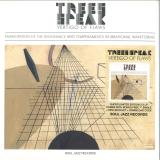
Trees Speak are back!
Speak’s new album, “Vertigo of Flaws: Emancipation of the Dissonance and Temperaments in
Irrational Waveforms” comes as a double-vinyl edition, single CD and digital release. The limitededition first pressing only of the vinyl includes a bonus 45 enclosed in an 8-page 7”x7” booklet
insert housed within the gatefold sleeve with cover artwork created by Soviet Union propaganda
artist Lazar Markovich Lissitzky in 1911.
Trees Speak are back!
This new release is a vast leap into an ocean of space and sound, a quantum leap into cybernetics, biology, anti-gravity,
time travel, dream speech and transfiguration. A seriously next step release!
Showing no signs of slowing down their rapid creative pace – incredibly this is their fourth album in the space of just over
one year – ‘Vertigo of Flaws’ is a mighty 29 tracks, one and a half hours of music across one double album that is surely
going to be a defining point in their musical career, a giant leap into the sonic unknown, an epic exploration of intensity
and sound.
Alongside their now trademark German krautrock motoric-beat rhythms, angular New York post-punk attitude, tripped-out
60s spy soundtrack, psyche-rock, and 70s synthesizers and vocoders, here you will also hear a new cosmic spacial
awareness (both personal inner space and galactic outer space) and a truly wilful pushing of sonic boundaries - as police
sirens, static noise, alarms, radio signals, avant-garde voices, and orchestral string quartets, all collide to add beautiful
dissonance to uber-powerful, intense, addictive and propulsive rhythms - in the process creating a truly unique
soundscape that Trees Speak have made wholly their own.
If you ever wanted to hear Can, Hawkwind, Destroy All Monsters, Pere Ubu, electric eels, John Cage, Liquid Liquid,
Tangerine Dream, Suicide, Neu!, Laurie Spiegel, Art Ensemble of Chicago, John Barry, Mother Mallard’s Portable
Masterpiece Company, Sun Ra, Stockhausen, John Carpenter, Electro-Acoustic and Musique Concrete and Mars in one
band - then this is it!
Trees Speak are Daniel Martin Diaz and Damian Diaz from Tucson, Arizona and their music often draws on the cosmic nighttime magic of Arizona’s natural desert landscapes. ‘Trees Speak’ relates to the idea of future technologies storing
information and data in trees and plants - using them as hard drives - and the idea that Trees communicate collectively.
Special guests from the hyper-creative hub of the Tucson music scene on this release are Gabriel Sullivan, Ben Nisbet, Saul
Millan, Stephani Guilmette, and Davis Jones.
The album Vertigo of Flaws was recorded in Brooklyn, New York, and Tucson, Arizona during the plague of 2021.
Extract from Vertigo of Flaws sleevenotes:
‘As we travel through space and time, avoiding the discarded remains of the industrial period, the
deconstruction of social norms through the expression of art, music, and philosophy guide the human
experience towards the unknown.
All that remains are musical echoes scattered throughout the universe, like ancient vibrations that now
populate the cosmos. These waves now show signs of decay. Melody, beauty, tonality have all but fallen
away as dissonance blossoms. As John Cage wrote in 1937,
“Whereas, in the past, the point of disagreement has been between dissonance and consonance, it will be,
in the immediate future, between noise and so-called musical sounds. New methods will be discovered,
bearing a definite relation to Schoenberg’s twelve-tone system and present methods of writing percussion
music and any other methods which are
free from the concept of a fundamental tone”.
Similarly, George Van Tassel claimed the Integratron as capable of
rejuvenation, anti-gravity, and time travel. So, what remains of the
“people”? We have adopted from them our own Zeitgeber: their pulses
now guide our sun, our planets, our earths, and are the new circadian,
diurnal, and ultradian rhythms of the galaxy. Traumsprache, dream
speech, is now the internal language of trees.
Decaying metal and machines liberated the note unto nature’s table,
and we sip the delicious nectar of music once more irrational, elaborate,
violent, vast. The past is the future, musical disintegration its own rebirth.
We are nature, once more the computer of the Universe.’
In the 1970s, Kazuki Tomokawa catapulted into Tokyo's avant-garde scene with his cathartic and utterly electrifying performances. Straight from the Throat, Tomokawa's second album, released in July 1976 by Harvest Records, finds the musician in his truest form: as the "screaming philosopher" he would come to be called-cynical but fair, cheeky and melancholic, and looking at the world with truth-seeking eyes. In Straight from the Throat, Tomokawa shrieks and shouts and wallows with ritualistic abandon-his avant-folk stylings are cosmic and, at times, well to ground-shaking rock. He speaks of adolescence, passing hearses, and wedding chapel cars in a poem to his younger brother, Tomoharu, and watches ice melt on the Mitane River with spring's turn. Tomokawa's sound is, as Kiichi Takahara would later dub it, "I-music": revelatory and deeply intimate songs that turn to the everyday and the interior. They are portraits of a man in search of meaning, who is taking stubborn control of his life by doing so. As he croons in "The Spring Is Here Again Song," "I'll drink till I've had my fill / And fall in love until I die."
Renowned agent and jazz pioneer Wim Wigt founded Timeless Records in 1975. This Dutch record label has specialized in bebop, although it also did a sub-series of releases of Dixieland, Swing and Classical recordings. As of today, Timeless Records has, together with its three sub-labels, released over 900 albums. Notable releases include Dizzy Gillespie Meets Phil Woods Quintet, McCoy Tyner's Bon Voyage, Lou Donaldson's Forgotten Man, Eastern Rebellion and albums by the George Adams-Don Pullen Quartet, Chet Baker, Bill Evans, Art Blakey's Jazz Messengers and many more.
To celebrate the legacy of Wim Wigt's Timeless Records, Music On Vinyl is releasing a 45th anniversary jazz series. The series features albums that are part of the Timeless Records legacy and will be released throughout 2021/2022. To kick off this series, Pharoah Sanders' Africa is released on the 19th of November 2021.
Pharoah Sanders possesses one of the most distinctive tenor saxophone sounds in jazz, which has earned him royal status amongst free jazz players, critics and collectors. Harmonically rich and heavy with overtones, his sound can be as raw and abrasive as it is possible for a saxophonist to produce. His 1987 album Africa is soulful but also searching for a strong groove at the same time. The album is recorded with John Hicks, Curtis Lundy and Idris Muhammad and was an explicit tribute to his late mentor John Coltrane, another giant of jazz.
Africa by Pharoah Sanders is available on black vinyl. The album includes an insert with upcoming Timeless Records titles from the Timeless Records 45th Anniversary Jazz series. The sleeve contains liner notes by Kevin Whitehead.
- A1: The Exceptions - So Much In Love
- A2: Lee Williams & The Cymbals - Please Say It Isn't So
- A3: The Vanguards - Somebody Please
- A4: The Manhattans - Follow Your Heart
- A5: The Lovers - Someone
- A6: The Superbs - It Hurts So Much
- A7: Little Ben & The Cheers - (I'm Not Ready To) Settle Down (I'm Not Ready To)
- B1: The Radiations - That's The Way Our Love Is
- B2: Reuben Bell - It's Not That Easy (With The Casanovas)
- B3: The Esquires - No Doubt About It
- B4: Bobby Burn - I'm A Lonely Man
- B5: The Persians - Here It Comes
- B6: Melvin Hicks & The Versatiles - I'm Just Passing Time
- B7: Houston Outlaws - What Am I Gonna Do
Our Lowriders album is an amalgam of the two “This Is Lowrider Soul” CDs. We have chosen 14 tracks that represent the sounds loved by Los Angelenos, often of Mexican descent, that emanate from their fabulously designed motors while cruising Whittier Boulevard in East LA or, say, Van Nuys Boulevard in the northwest of the city.
The classic Los Angeles vocal group the Superbs are featured here on their glorious ‘It Hurts So Much’, but it is mainly the records discovered by sweet soul collectors that dominate. The Carnival label has a great reputation on this scene; Lee Williams & the Cymbals’ ‘Please Say It Isn’t So’ and ‘Follow Your Heart’ by the Manhattans are a pair of killer ballads perfect in tempo and harmony for the cruisers. Other East Coast offerings include the Persians’ captivating ‘Here It Comes’ and two gems which were only on master tape prior to their Kent releases – Melvin Hicks & The Versatiles’ ‘I’m Just Passing Time’ and the similarly unknown outfit the Exceptions, with the wailing ‘So Much In Love’.
Chicago has always been a breeding ground for black harmony groups. The Esquires saw much success at Bunky; ‘No Doubt About It’ was their equally great first release at Wand. Little Ben & The Cheers hailed from the same city; their ‘I’m Not Ready To Settle Down’ fetches big bucks due to Lowrider demand, as does ‘What Am I Gonna Do’ by the mysterious Houston Outlaws – their origins are uncertain, but must be Midwestern. The Vanguards hailed from Indianapolis and deservedly charted with ‘Somebody Please’, licensed to LA’s Whiz label. All of their seven singles on Lamp are also fine, harmonic soul tracks. The Lovers were a Bay Area group who recorded in Los Angeles with the maestro Arthur Wright; their ‘Someone’ was tipped for the charts when licensed to Philips, but flopped, leaving it ripe for revival by the soul connoisseurs. Like the Lovers, the reputation of Reuben Bell’s ‘It’s Not That Easy’ has grown over the decades and a record once considered common can now fetch hundreds of dollars – class will out.
Duane Pitre returns to Imprec with Omniscient Voices, an articulate, intense and emotionally resonant set of five pieces for justly tuned piano and electronics.
Omniscient Voices is a uniquely distinct work that follows Pitre's trilogy of releases which culminated with 2015’s Bayou Electric and included the critically acclaimed Feel Free (2012) and Bridges (2013) albums. Where those albums were rooted in long form pieces, Omniscient Voices is a collection of shorter pieces, offering more harmonic variety than previous works, with a unique sound and feel that is still unmistakably the work of Duane Pitre.
In 2019, after a five year period where Pitre did not focus on outward facing music, but instead on his own personal practice, a small idea in the form of a question came to him: would the combination of his latest computer- and electronic-based experiments, used in conjunction with justly tuned piano, produce interesting results; simply put, would it “work”? Concurrently, Pitre was studying a handful of Morton Feldman scores for their focus on tonal clusters, reading a book on Arvo Pärt’s life and work, and contemplating the pulse-based rhythms of Steve Reich and Phillip Glass.
In 2020, with no intention of making a new album, the composer tried to answer this question. The results would spawn five pieces that would become Omniscient Voices. On this new work, Pitre finds himself giving equal priority to both piano and electronics, utilizing his Max/MSP-based generative network to real-time convert precomposed piano motifs, into data, which is then used to communicate with two polyphonic, microtonal hardware synthesizers whose patches Pitre authored; this process generates the electronic component of the album. Pitre also utilizes controlled improvisation to interact with the piano-reactive electronics in a spontaneous and inspired manner, going back and forth between these two pianistic approaches. In all, this approach creates a “musical feedback loop” of sorts.
Despite Omniscient Voices being the culmination of 15 years of hard work and inspiration, this beautiful album somehow materialized in a natural, intuitive and effortless way (like any artist's best work.)
Artist's statement: “When making the pieces that would become Omniscient Voices, I often viewed the piano as human action, a single note becoming a single gesture that has the potential to change the electronic environment, the electronics becoming the environment surrounding that human in the natural world, who then has the power to change their actions based on their surroundings. All actions have consequences. The interconnectedness of everything. Single actions making waves of change.”
RIYL: Arvo Pärt, Morton Feldman, Steve Reich, Phillip Glass
Mastered and cut by Golden and pressed at RTI for maximum fidelity.
The 7th edition in the Exit Planet Earth vinyl series features another serving of electronic cuts designed for space travel with 20/20 Vision debuts from The Exaltics & Paris The Black Fu, Alex Jann, Lost Souls of Saturn and Kim Cosmik.
Opening with an interstellar serving of classic electro funk from the pivotal figurehead of Germany's electro-tipped underground 'The Exaltics' of 'SolarOneMusic' and 'Paris The Black Fu' from the mighty 'Detroit Grand Puhbas'.
This heavy weight collaboration comes in the form of 'wea poni zedin form ation' a masterclass in acid-influenced and undoubtably charismatic electro, complete with distinctive Kraftwerk-esque vocals. Alex Jann follows up on the A side with 'Android Memory' combining bleep techno elements with futuristic electro in an expertly crafted high paced does of sci-fi funk peppered with chaotic glitches, driving grooves and punchy kicks.
On the flip side we're joined by Seth Troxler and Phil Moffa under their inter dimensional moniker 'Lost Souls Of Saturn'. L.S.O.F offer up a mind altering hybrid of sci-fi inspired electronica, techno, electro, acid, free-jazz and more, blurring genre lines and pushing boundaries deep into the cosmos. Under-pinned by a predominately break beat groove 'Rave is Back' incorporates a plethora of un expected elements, from orchestral drones and harmonic melodies to unidentifiable machine glitches.
Wrapping up the 7th outing in the Exit Planet Earth vinyl series, we're joined by long-time purveyor of UK Electro -
Cybersoul's 'Kim Cosmik', firing on all cylinders with a tripped out assault on the senses. Her track 'Moonrise' hammers home with a fast paced, glitch heavy groove, serving up complex patterns across an ominous soundscape littered with ghost like echoes.
Diving into the archives of Alter Ego - the Italian experimental ensemble of Manuel Zurria, Paolo Ravaglia, Aldo Campagnari, Francesco Dillon, Oscar Pizzo, and Eugenio Vatta - Die Schachtel is thrilled to present Microwaves, a never before released body of recordings of works composed by Atli Ingólfsson, Giovanni Verrando, Yan Maresz, and Riccardo Nova, made with Pan Sonic (Mika Vainio and Ilpo Vaisanen) in 2005. Resting at the outer reaches of avant-garde chamber and electronic music, the LP’s blistering structures, tones, and textures - plowing forward with frenetic energy - remain radical and ahead of their time, more than 15 years after they were first laid to tape.
A modular chamber ensemble with a pointedly anti-academic approach to music, over the course of its activities - running roughly between 1990 and 2010 - Alter Ego developed a devoted following among some of the most forward thinking voices in experimental music, all the while collaborating widely with artists spanning a vast range of practices and disciplines, including Robin Rimbaud, Philip Jeck, Matmos, Gavin Bryars, Andrew Hooker, William Basinski, David Moss, Alvin Curran, Terry Riley, and near countless number of others.
Alter Ego’s diverse activities can be understood as interventions with the disposition toward formality within contemporary chamber music, often pairing themselves with artists working well beyond their own context as a means to develop highly original interpretations of a specific composer’s work. In 2004, this process led them to instigate a collaboration Pan Sonic, the Finnish duo of Mika Vainio and Ilpo Vaisanen, pioneers of a remarkably distinct form of rhythmic, experimental electronic music, and regarded by many as one of the most visionary and irreverent projects working in the field during the '90s and 2000s.
Initially conceived with Fausto Romitelli in 2004 before being sidelined by the composer’s untimely passing the following year, Microwaves acts, in part, a remembrance in sound, featuring four works by some of his closest friends, the composers Atli Ingólfsson, Giovanni Verrando, Yan Maresz, and Riccardo Nova. Each composition, Ingólfsson’s Snap, Verrando’s Harmonic Domains #3, Maresz’s Link, and Nova’s Thirteen13x8@Terror Generating Deity, have roots in a pallet of samples and fragments drawn by each composer from existing works by Pan Sonic. Upon completion, these compositions then entered into a collaborative process between Mika Vainio and Ilpo Vaisanen (Pan Sonic) and Alter Ego (Manuel Zurria, Paolo Ravaglia, Aldo Campagnari, Francesco Dillon, Oscar Pizzo, and Eugenio Vatta), and were performed collectively by both groups during an extensive tour that year.
Distinct and free-standing, while operating as a seamless whole, the four works encountered across the album’s two sides - built from the sounds of flute, clarinet, violin, cello, piano, electronics, and further treatments - present an engrossing intersection between electronic and acoustic sound that diverges from most standing conceptions of electroacoustic music. Each composer’s carefully rendered structures rise and fall within the startling, conversant interplay between the two groups, finding perfect balance - between the frenetic and restrained - in what can only be regarded as one of the most striking and singularly unique expressions of contemporary chamber music realized during the 2000s.
Vast in scope, visionary in concept and artistry, and sonically engrossing, Die Schachtel is thrilled to present these never before heard recordings from the archives of Alter Ego. Microwaves is available on black vinyl, in a limited edition of 350 copies.
Dans le Sable is the first new album in over 40 years by composer, pianist, and digital audio pioneer Loren Rush (b. 1935). Active in the Bay Area new music scene since the late 1950s alongside composers such as Robert Erickson and Pauline Oliveros, he also co-founded the Stanford University’s Center for Computer Research in Music and Acoustics in 1975. His music has been performed by the Boston Symphony, the New York Philharmonic, and the San Francisco Symphony Orchestra amongst others.
The title piece "Dans le Sable" (1967-68, 70) covers the first side of the record, of which Charles Shere in the Oakland Tribune (1972) writes: “A surreal opera scene. A narrator dwells on the significance of passing time. A soprano sings Barbarina's cabaletta from Figaro, which describes her distraught search in the sand for a lost pin. The chamber orchestra—mostly solo instruments—plays soft, half-forgotten tunes reminiscent of the Parisian music hall. If Marcel Duchamp wanted to put painting once more at the service of the mind, so did Rush seem to want to make a composition that speaks directly to that thing behind the mind—the point where it connects with the soul. And he succeeded. But only because the work is so brilliantly constructed, so careful in its structure and the timing of its phrases, so well balanced in the disposition of its parts that it quite overcomes the audience.”
The second piece on the album “Song and Dance” begins with the watery held tones of “Song.” Melancholy phrases are deconstructed and stretched in different retellings, invoking a harmonic fog. We are then thrust into “Dance,” one of the first orchestral pieces to employ computer-generated digital synthesis. A hypnotic and percussive march is propelled into a storm of early computer-processed cannonades.
Recital is proud to now illuminate the deeply overlooked composer Loren Rush, whose meticulous attention to detail has perhaps kept his toiled-upon works in the shadows these past decades. Dans le Sable is among the most gorgeous records I have heard.
- A1: Say Yes (Detest Of Sirens)
- A2: Stay True (Vinyl Version)
- A3: Back Again (Vinyl Version)
- A4: Run The Streets (Vinyl Version)
- A5: Rekontext #1 (Berger&Apos;S Theme)
- A6: Where We At (Vinyl Version)
- A7: Cthru (Vinyl Version)
- B1: Cleanser #1 (Vinyl Version)
- B2: Losing Mine (Vinyl Version)
- B3: Rekontext #2 (Vinyl Version)
- B4: What I Meant (Vinyl Version)
- B5: Cleanser #2 (Detached Observer&Apos;S Theme)
- B6: Deià (Bends)
- B7: Test Of Sirens (Vinyl Version)
Oliver Torr is about to release his first full length solo album. The album features many moods and colours, with Oliver exploring the use of his voice and lyrics as a new form of his expression. Successfully mixing electronic avant-garde/experimental forms with pop-like harmonic structures is the main theme of the record.
The idea of recontextualisation and themes of observation are mainly inspired by the philosophical literature and ideas of John Berger, Marshall McLuhan, and many others was a driving force during the creation of the album. The lyrical and sound design content is mainly inspired by panic attacks and depression, and serves as a therapeutic tool to aid in personal psychological healing.
Tracks make use of creative sound design by utilising field recordings and various experimental instruments and sources of sound, such as the Radical Chip, designed by John Richards (one of Oliver's mentors) and Max Wainwright. Tracks like 'Deià' which create a chaotic sonic palette are the author's representation of his mind under the siege of an intense panic attack, experienced in the seaside town of the same name that is located on the island of Mallorca.
Oliver feels like the album has been writing itself for the past 5 years, and in the past few months it has decided to finally show its form. With the help of Aid Kid, who is mixing the album and providing additional production, Oliver has put together a 14-track rollercoaster record, with the help of some special guests. Guests on vocals include Chrysalism, BCAA's Bilej Kluk, and sci fi RnB newcomer LVCIFER. Other sonic collaborators include Sunnbrella (guitars on two tracks), Bastl Instruments' David Strobach (distorted samples in intro), Peter Kutin, and Radio Laude's DeSteffan and R.A. (distorted samples/vocal on one track).
The record's sonics are a combination of Oliver's conscious influences, including experimental music, classical avant-garde, shoegaze, IDM, EBM, electronica, hints of modern club music, as well as PC music influences.
Oliver Torr is known as a composer, music producer, performer and installation artist. Outside of his solo projects, he has worked with many prominent musicians and creative companies/film makers worldwide. He is the founder of XYZ project, a music label concentrating on electronic music and audiovisual art (xyzproject.bandcamp), and a member of the noise.kitchen crew (a music and synth shop run by Bastl Instruments in Prague). Oliver is also a part of the 2020 SHAPE Platform roster (shapeplatform.eu), and the 2021 Gravity Network roster (gravitynetwork).
Oliver releases the album prior to the release of his 'Trans Europe Postal Express' project (supported and arranged in collaboration with SHAPE Platform) and gallery exhibition at MeetFactory art space Prague, that will take place in March, and will further the sonic palette of the album.
The album's artwork is directed and designed by Kristyna Kulikova and photographed by Lukas Havlena (VICE, National Gallery of Prague).
The album's pre-release sees a teaser trailer shot and directed by Tereza Halamova and Filip Kettner that will be released 1st of February. A short movie music video with the same crew is scheduled a month after the album's digital release.
A remixed version with reworks from established European electronic musicians (including Peter Kutin, Fausto Mercier, Wim Dehaen, Natalie Plevakova, Evil Medved, NobodyListen, David Herzig, Ancestral Vision and Trauma), will be coming in the next few months after the release.
- 1: Road To Avalon
- 2: Click Click Domino (Feat. Marcus King)
- 3: Line On The Page
- 4: Raining For You
- 5: Little Liars
- 6: Deep River (Feat. Marcus King)
- 7: Heartworn Traders
- 8: Calico Coming Down
- 9: Learn To Love You Better
- 10: Long Gone & Heartworn (Feat. Jake Kiszka)
- 11: Mountain Lion Blues
- 12: Sing A Hallelujah
- 13: Has My Midnight Begun
For nearly two straight years following the release of their critically acclaimed debut, Chasing Lights, Ida Mae lived on the road, crisscrossing the US from coast to coast as they performed hundreds of dates with everyone from Willie Nelson and Alison Krauss to Marcus King and Greta Van Fleet. And while those shows were certainly formative for the electrifying British duo, it was what happened in between — the countless hours spent driving through small towns and big cities, past sprawling suburbs and forgotten ghost towns, across rolling plains and snow-capped mountains — that truly laid the groundwork for the band’s transportive new album, Click Click Domino. Written primarily in the backseat of a moving car, the record embodies all the momentum and possibility of the great American unknown, offering up a series of cinematic vignettes full of hope and disappointment, promise and regret, connection and loneliness. The songs on Click Click Domino are raw and direct, fueled by an innovative mix of vintage instruments and modern electronics, and the performances are loose and exhilarating to match, drawing on early rock and roll, classic country, British folk, and 50’s soul to forge a sound that’s equal parts Alan Lomax field recording and 21st century garage band. Turpin and Jean produced the album themselves, recording primarily on their own in their adopted hometown of Nashville during the COVID-19 pandemic, and while the collection is certainly bolstered by appearances from high profile guests like Marcus King, Greta Van Fleet’s Jake Kiszka, and Ethan Johns, the heart and soul of the record remains Ida Mae’s intoxicating chemistry, which has never felt more vibrant, ambitious, or self-assured. Now married, Turpin and Jean first met a little over a decade ago while attending university in Bath. The pair bonded immediately over their love for the sounds of bygone eras, and they quickly earned rave reviews everywhere from the BBC to the NME with their raucous first group, Kill It Kid. Starting over fresh as a duo named for Sonny Terry and Brownie McGhee’s “Ida Mae,” the first song they ever harmonized on, Turpin and Jean relocated to Nashville in 2019 and released Chasing Lights to similarly widespread critical acclaim. Rolling Stone hailed the album’s “stomping swirl of blues and guitar-heavy Americana,” while The Independent lauded its “retro lustre” and “impressive experimentation,” and NPR’s Heavy Rotation called it “tightly drawn, harmonic and hypnotic.” The music helped the earn the duo a slew of support dates with the likes of Greta Van Fleet, The Marcus King Band, Blackberry Smoke, Josh Ritter, Rodrigo y Gabriela, and The Lone Bellow, as well as performances at Bonnaroo, the Telluride Blues & Brews Festival, the Philadelphia Folk Festival, Germany’s Reeperbahn Festival, and Switzerland’s Zermatt Unplugged.
The ethereal harmonies of Eve were ever present, but the psychedelic girl group feel of their previous band, Honey Ltd, was replaced with funky grooves and a stoned country rock vibe that permeated Los Angeles in the early 1970s. In the late 1960s, four teenage girls from Detroit hitch-hiked to Los Angeles to follow their dream. Known as the Mama Cats, their combined voices, created a magical instrument, a holy harmonic vehicle built upon the inspiration and improvisation of four close friends. Their ethereal voices and heavenly harmonies sounded like no one. Upon meeting Lee Hazlewood in Los Angeles, he was bowled over, offering them a recording contract on his label, Lee Hazlewood Industries (LHI), renaming them, Honey Ltd. Their sole 1968 LP never saw the light of day. Out of the ashes of the group, the three remaining members continued on under the name Eve. In the spring of 1970, Eve and producer Tom Thacker went into the studio to record "Take It And Smile". The ethereal harmonies were ever present, but the psychedelic girl group feel of the Honey Ltd album were replaced with funky grooves and a stoned country rock vibe that permeated Los Angeles in the early 1970s (Think John Philips "Wolfking Of L.A.). Backed by another amazing group of musicians, the recording sessions included members of the Wrecking Crew, Elvis' TCB band, Ry Cooder, Sneaky Pete and Glenn Frey from the Eagles. Featuring songs by James Taylor, Fred Neil, The Gibb Brothers, Burt Bacharach, Bob Dylan, Mac Davis and a handful of amazing originals including the beautiful "Dusty Roads" and the title track "Take It And Smile," co-written with Glenn Frey. Upon its release, the album failed to find an audience. After recording one last song, "So Tired" for The Vanishing Point soundtrack, the girls went their separate ways, each continuing to sing professionally with artists that include Bob Seger, Neil Young, Tina Turner, Loretta Lynn and countless others. Remastered from the original analog tapes by GRAMMYr-nominated engineer John Baldwin, the reissue is complimented by a new Q&A interview with Eve members Laura Creamer, Temmer Darigan & Joan Glasser and GRAMMYr-nominated reissue producer Hunter Lea. This record is the first release in a new series of full albums reissues from the LHI (Lee Hazlewood Industries Records) catalogue that Munster will be releasing over the next months. All the releases include liner notes and exclusive interviews with the artists, rare photos, and restored original artwork
Eight years passes like nothing for Birds of Maya. Their fourth
album kicks out the Philly jams with every bit as much fervour
as their earlier releases - in fact, as it was recorded in 2014, it
kind of is one of their earlier releases.
A long era of dull ringing and nothing else in our ears is over.
Once again, winds of warm guitar and humid thunderheads of
bass and toms rumble all around. With ‘Valdez’, Birds of Maya
are back in flight. And like the first song title explicitly states, this
latest is a soaring blast of riffers, rife with punk rock abandon,
sludge, treble, distortion, neck-throttling rock ‘n’ roll solos,
pummelling drums and bass and half-shouted/half-gargled
vocals, all of it half on and half off the mic.
‘Valdez’ was recorded in 2014 at Black Dirt Studios in otherstate New York. After a Purling Hiss session there, Birds of
Maya got a bunch of tunes they liked into shape - that is,
different shapes on different days. But nice shapes. Once they
got to the studio, they loaded in and set up, curious to see how
they felt playing in a different room. Pretty good as it turned out
- running through the songs that first night, they accidentally
recorded the whole album. Then they finished up the next day,
mostly. Trading the crushed harmonics of their basement tapes
for studio-grade mics, overdubs in the mix and only slightly lessbruised harmonics, their roiling essence not only survives but
thrives, non-stop, on ‘Valdez’, stuttering, screaming and
stomping through six circuitous numbers.
At the time this was recorded, Birds of Maya were standing on
the other side of ten years kicking around town, suddenly far
away from the primordial ooze they’d flopped forth from. The
streets where all this had happened on were changing, with new
money rolling in, but they were the same old Birds, content with
their libations and ear-splitting variations on old favourite
Stooges chords. The cover art of Valdez is a couple of images
from those days, glimpses at the old grass roots before they
were ripped up by developers to build condos. But nothing ever
really goes away. ‘Valdez’ is a totem of the wildness that refuses
be tamed
The music on Dance Nos. 1-5 was originally conceived as a three-way collaboration between composer Philip Glass, choreographer Lucinda Childs and artist Sol LeWitt. Dance received its world premiere in Amsterdam on October 19, 1979 and its New York premiere at the Brooklyn Academy of Music on November 29, 1979.
Post-dating Einstein on the Beach - Glass’s 1975-76 collaboration with director Robert Wilson - Dance was another Glass collaboration, this time with choreographer Lucinda Childs, known for her austere, athematically exact dances, and artist Sol LeWitt, who provided a ghostly, gigantic black- and-white film for several of the piece’s five sections.
RELEASE: 5-3-2021
• 180 GRAM AUDIOPHILE VINYL
• DELUXE HEAVYWEIGHT SLEEVE WITH GLOSS LAMINATE
• PVC JACKET
• THE COMPLETE ALBUM, AVAILABLE ON VINYL FOR THE FIRST TIME IN ITS ENTIRETY ON A 3LP-SET
WITH FIVE SIDES OF MUSIC
• INCLUDES PHILIP GLASS CATALOGUE WITH INFO ON THE PHILIP GLASS SERIES ON MOV
SIDE A
Dance has an abstract purity that easily earned it the label “minimalist,” a term that Glass himself disavows but that seems appropriate, at least in this case. After Dance, Glass’s music took several turns, not so much in style as in the various new contexts in which it was presented: major opera commissions and film scores led him to write for forces other than those of the Philip Glass Ensemble. At the same time, an attempt to reach a wide audience resulted in some shorter, perhaps more accessible, narrative pieces. Dance marked the blossoming of the composer’s experimental work. Here, though, the music - particularly Dance Nos. “1”, “3” and “5”, all written for the Ensemble— has an unforgettable exuberance that somehow speaks all at once of joyful innocence, intense erotic desire, tenderness, regret and, finally, acceptance. On the other hand, Dance Nos. “2” and “4” see Glass composing several large-scale works for solo organ; for instance, Dance No. 2 originated as a 1978 work entitled Fourth Series Part Two. This piece, later incorporated into Dance, and Dance No. “4” as well, have a more subdued, more darkly romantic quality than the work’s other sections and are quite unlike anything Glass had previously written. Still, they too, with their mysterious tilts of time and key signatures, continue the exploration of polyrhythms and harmonic complexities within the context of Glass’s repetitive, “minimalist” style.
The complete Dance Nos. 1-5 album is now available on vinyl for the first time in its entirety on a 3LP-set with five sides of music. The 3 LP’s are housed in a heavyweight sleeve.
Kiwi Jr. is a phenomenal "rock" and/or "punk" and/or "indie-rock" (whichever you like more) band from Canada, made up of Jeremy Gaudet (mic, guitar), Brohan Moore (drums), Mike Walker (bass), and Brian Murphy (guitar). Cooler Returns is their second album, and their first for Sub Pop. Despite being a snapshot of the pandemic-infused beginnings of this decade, Cooler Returns is truly a whole lot of fun. RIYL indie-pop from down under, things that are smart/exuberant/catchy all at once. Buildings burning in every direction; macabre unknowns in your friendly neighbor's basement; undecided voters sharpening their pencils: under pressure we could call Kiwi Jr.'s Cooler Returns "timely." But what year is it, again? On Cooler Returns, Kiwi Jr. cycle through the recent zigs & looming zags of the new decade, squinting anew at New Year's parties forgotten and under-investigated small town diner fires, piecing together low-stakes conspiracy theories on what's coming down the pike in 2021. Put together like a thousand-piece puzzle, assembled in flow state through the first dull stretch of quarantine, sanitized singer shuffling to sanitized studio by streetcar, masked like it's the kind of work where getting recognized means getting killed, Cooler Returns materializes as a sprawling survey from the first few bites of the terrible twenties, an investigative exposé of recent history buried under the headlines & ancient kings buried under parking lots. Not so long since their debut Football Money in archaeological time, unending gray eons later in the dog years of quaran-time, spiritually antipodean Canadians Kiwi Jr return to disseminate this year's annual report to the shareholders, burying the incriminating numbers in the endless appendices of a longform narrative record, a 3,000 word tract for stakeholders to pore over. These stories - memories of Augusts past, unrepressed & transcribed fast - go down easier thanks to meaningful changes enacted in 2019's KiwiCares Pledge: delivering on a promise to transition from Crunchy to Smooth by 2021, the caveman chug of Football Money has been steamed & pressed with the purifying air of a saloon piano - operated with bow-tie untied - and a spring green side-salad of tentatively up-tempo organ taps & freshly fluted harmonica. A chronically detuned spin of the dial through swivel-chair distractions & WFH daydreams, an immersive ctrl-tab deluge cycling through popular listicle distractions like the unentombing of Richard III, or the deja vu destruction of the Glasgow School of Art, Kiwi Jr. sing this song to an indoor audience, crisscrossing canceled, every other prestige distraction source wrung dry, only songwriting remaining to deliver engrossing tales to the populace, just how I imagine it worked in the old days. Fixing loose ingredients into a sturdy whip, Kiwi Jr. beam in live from the 9-5, striding into 2021 with a mastered brainwave that comes equally from the back room of the record store as the penalty box. And how do we, left holding this box of deliberate entanglements, sign off to those as yet uninitiated, undecided, uncertain, unseen, absent return coordinates - Best Wishes, Warm Regards, Good Luck? Cooler Returns, Cooler Returns, C o o l e r R e t u r n s ! Cooler Returns was produced by Kiwi Jr., mixed and engineered by Graham Walsh (METZ, Bully) in Toronto, and mastered by Phillip Shaw Bova at Bova Labs in Ottawa, Ontario.
LTD. LOSER EDITION
Kiwi Jr. is a phenomenal "rock" and/or "punk" and/or "indie-rock" (whichever you like more) band from Canada, made up of Jeremy Gaudet (mic, guitar), Brohan Moore (drums), Mike Walker (bass), and Brian Murphy (guitar). Cooler Returns is their second album, and their first for Sub Pop. Despite being a snapshot of the pandemic-infused beginnings of this decade, Cooler Returns is truly a whole lot of fun. RIYL indie-pop from down under, things that are smart/exuberant/catchy all at once. Buildings burning in every direction; macabre unknowns in your friendly neighbor's basement; undecided voters sharpening their pencils: under pressure we could call Kiwi Jr.'s Cooler Returns "timely." But what year is it, again? On Cooler Returns, Kiwi Jr. cycle through the recent zigs & looming zags of the new decade, squinting anew at New Year's parties forgotten and under-investigated small town diner fires, piecing together low-stakes conspiracy theories on what's coming down the pike in 2021. Put together like a thousand-piece puzzle, assembled in flow state through the first dull stretch of quarantine, sanitized singer shuffling to sanitized studio by streetcar, masked like it's the kind of work where getting recognized means getting killed, Cooler Returns materializes as a sprawling survey from the first few bites of the terrible twenties, an investigative exposé of recent history buried under the headlines & ancient kings buried under parking lots. Not so long since their debut Football Money in archaeological time, unending gray eons later in the dog years of quaran-time, spiritually antipodean Canadians Kiwi Jr return to disseminate this year's annual report to the shareholders, burying the incriminating numbers in the endless appendices of a longform narrative record, a 3,000 word tract for stakeholders to pore over. These stories - memories of Augusts past, unrepressed & transcribed fast - go down easier thanks to meaningful changes enacted in 2019's KiwiCares Pledge: delivering on a promise to transition from Crunchy to Smooth by 2021, the caveman chug of Football Money has been steamed & pressed with the purifying air of a saloon piano - operated with bow-tie untied - and a spring green side-salad of tentatively up-tempo organ taps & freshly fluted harmonica. A chronically detuned spin of the dial through swivel-chair distractions & WFH daydreams, an immersive ctrl-tab deluge cycling through popular listicle distractions like the unentombing of Richard III, or the deja vu destruction of the Glasgow School of Art, Kiwi Jr. sing this song to an indoor audience, crisscrossing canceled, every other prestige distraction source wrung dry, only songwriting remaining to deliver engrossing tales to the populace, just how I imagine it worked in the old days. Fixing loose ingredients into a sturdy whip, Kiwi Jr. beam in live from the 9-5, striding into 2021 with a mastered brainwave that comes equally from the back room of the record store as the penalty box. And how do we, left holding this box of deliberate entanglements, sign off to those as yet uninitiated, undecided, uncertain, unseen, absent return coordinates - Best Wishes, Warm Regards, Good Luck? Cooler Returns, Cooler Returns, C o o l e r R e t u r n s ! Cooler Returns was produced by Kiwi Jr., mixed and engineered by Graham Walsh (METZ, Bully) in Toronto, and mastered by Phillip Shaw Bova at Bova Labs in Ottawa, Ontario.
Following 2019’s New Atlantis LP under his experimental techno alias Efdemin, Phillip Sollmann’s Monophonie is a project dedicated to uniting different strands of utopian music. His approach: combining and recontextualizing rare historical instruments of sonic research of Hermann von Helmholtz (19th century) with the self-designed, microtonal instruments of Harry Partch and metal sound sculptures of Harry Bertoia.
The result is a psychedelic investigation into just intonation – alternative tuning systems that create unique sets of harmonics not found in conventional scales. Monophonie recasts these sounds into new rhythmic environments where epic kosmische, polyrhythms, acoustic techno and microtonal glow are interwoven into a rare music.
Over nine tracks, the album explores multiple forms of minimalism, from unwavering repetition to paired-down chords and sparse sonic environments. But it also seeks to expand the sound spectrum of Partch’s custom built organs and melodic percussion instruments as well as Bertoia’s sonambient singing metal rods into a atmospheric otherworldliness.
Monophonie was first composed in 2016 and premiered at Berlin’s Volksbühne theatre in 2017, before it went on to the renowned Ruhrtriennale and Kampnagel in Hamburg. It was performed by one of Germany’s premier neue musik collectives Ensemble Musikfabrik together with Sollmann himself on von Helmholtz’s original double siren, with set design by Michael Kleine and wardrobe by Peter Kisur of Honeysuckle Company.
At the start of the year, Rocafort Records treated us to it's first roots reggae outing in the form of 'The Circle of Confusion' featuring the legendary Studio #1 vocalist 'Cornel Campbell'. ... Warm, feel-good, socially conscious, intergalactic dub.
We hoped for more, and finally it's here! Although slightly more digital in production, "Yesterday was History" cannot be claim to differ enormously from its predecessor. But hey, why mess with the formular when the results are pure and damn-near perfect ... ?
'The Circle of Confusion' are a Swiss production duo: Seb.K (Shakedown productions) and Phil'eas (Black Diamond Sound).
Recorded at Addis records in Geneva on the day of Mandela's passing, this track is another slice of dubby humanity-driven peace and love that buoyantly skips along aided by the sweetest scatting voice in reggae, (not showing any signs of it's 73 years), and all the appropriate studio space-age sound effects, harmonics and vintage keys. Modern roots reggae at its best, where the dub version is as banging and cosmic as the A Side.
- A1: Friendly Fires
- A2: Dirty Disco
- A3: C.p
- A4: Loose Talk (Costs Lives)
- A5: Inside Out
- A6: Melt Close
- B1: Hit
- B2: Babies In The Bardo
- B3: Be Brave
- B4: New Horizon
- C1: Knew Noise
- C2: Up To You
- C3: Girls Don’t Count
- C4: After Image
- C5: Human Puppets
- D1: Charnel Ground
- D2: Haunted
- D3: Je Veux Ton Amour
- D4: One True Path
- E1: Loose Talk (Costs Lives) (Live)
- E2: Human Puppets (Live)
- E3: Knew Noise (Live)
- E4: Friendly Fires (Live)
- E5: Girls Don’t Count (Live)
- F1: New Horizon (Live)
- F2: Haunted (Live)
- F3: You’re On Your Own (Live)
- F4: One Step Backward (Live)
- G1: Always Now
- G2: Visitation
- G3: Regions
- G4: The Wheel
- G5: No Abiding Place
- G6: Once Before
- H1: There Was A Time
- H2: Wretch
- H3: Sutra
- I1: Fallen Monument
- I2: Are You There?
- I3: Virtually Everything
- I4: Tape Loop
- I5: Subferior
- I6: In The Garden Of Eden
- I7: Cry
- J1: Red Voice
- J2: Floating
- J3: Reading Uni Jam With New Order 1981
Factory Benelux is proud to present a deluxe 5 disc vinyl box set edition of Always Now, the debut album by cult Factory Records group Section 25, produced by legendary sonic architect Martin Hannett and sleeved by Peter Saville.
All tracks are newly re-mastered from the original quarter-inch tapes. The first 1000 copies of the box set are pressed in coloured vinyl: disc 1 (black); disc 2 (clear); disc 3 (yellow); disc 4 (red); disc 5 (silver). The outer case in printed in PMS 123 with spot varnish.
The 16 page booklet features unseen images by noted photographer Philippe Carly and texts by founder members Larry and Vin Cassidy. Also included is the first ever interview with guitarist Paul Wiggin, whose sudden departure in late 1981 saw Tony Wilson try (and fail) to recruit pre-Smiths teenager Johnny Marr as replacement.
Recorded as a trio at Pink Floyd’s Britannia Row studio in London in January 1981, Always Now combined austere post-punk rhythm and noise with elements of Can, Krautrock and modern psychedelia. Key tracks include Friendly Fires, Dirty Disco and New Horizon, along with C.P. (a collaboration with Hannett) and Hit (extensively sampled by Kanye West for the track F.M.L. on his 2016 album The Life of Pablo).
Disc 2 gathers together several non-album singles from 1980 and 1981, including Charnel Ground, Je Veux Ton Amour and debut EP Girls Don’t Count – the latter produced by mentors Rob Gretton and Ian Curtis (of Joy Division).
Disc 3 offers a complete live show professionally recorded at Groningen (Netherlands) on 26 October 1980, as part of a Factory package tour.
Disc 4 is part-improvised second studio album The Key of Dreams, recorded and produced by the band themselves a few months after Always Now, and released by Factory Benelux in June 1982.
Disc 5 consists of further experimental material recorded in 1981 and self-released on a cassette called Illuminus Illumina. This final disc closes with an extended (and previously unreleased) live encore jam recorded with all four members of New Order at Reading University on 8 May 1981.
“One of the best albums Britain's second city has unleashed” (Uncut);
“In 1980 their bass-driven mantras were thoughtlessly dismissed as second-rate Joy Division, but hindsight judges them more kindly. The wind-dried skeins of their blasted guitar harmonics and skimped electronics gauntly cling to the songs’ skeletal frames. With telltale titles like Babies in the Bardo their Buddhist interests hang heavy over these early stirrings. But, combining a bass-led drone with a characteristic groaning vocal, Charnel Ground succinctly pins down Section 25's pre-disco appeal” (The Wire)
incl. Download Code
- A1: The Time Is Now For Change- Recorded April 27, 1974
- A2: Time Is Running Out- Recorded November 11, 1973
- B1: Of Times Gone By - Recorded April 27, 1974
- B2: Black Destiny - Recorded April 27, 1974
- B3: 13Th And Senate - Recorded April 27, 1974
- B4: He The One We All Knew Pt. 1 - Recorded April 28, 1974
Phil Ranelin's first record as a leader is worlds away from his later 1976 offering, Vibes From the Tribe. The Time Is Now is a vanguard jazz record, full of the spirit, determination, and innovation inspired by John Coltrane, Eric Dolphy, Cecil Taylor, Pharoah Sanders, and Archie Shepp. Recorded in 1973 and 1974 and released at the end of 1974, the set shows Ranelin to be an imposing composer and frightfully good trombonist. The original album contained six compositions that are a deep musical brew of avant-garde improvisation, hard bop jazz esthetics, and soulful melodic ideas that were superimposed as a jump off point for both harmonic and rhythmic (read: Latin) invention. The stamp of Detroit is all over this thing. Tracks like the title and "Black Destiny" reflect the anger and vision of the era, while moving it all in a positive musical direction. Soloists on the set include the rest of the Tribe collective -- Marcus Belgrave and Wendell Harrison -- as well as local players who deserved far more than they received in terms of national recognitions: bassist Reggie "Shoo-Be Doo" Fields, trumpeter Charles Moore, pianist Keith Vreeland, drummer Bill Turner, and others including Ranelin himself. The arrangements on The Time Is Now were ahead of their time, clustering a rhythm section as part of the horn's front line ("13th and Senate" and the title track) and a stylistic angularity that reflected both musical history and futurism in jazz and R&B ("Time Is Running Out" and "Times Gone By"). The Time Is Now is a must for any vanguard jazz aficionado or anyone interested in the strange, rhythm-oriented evolution of Detroit music. Thom Jurek/AMG


![The Circle of Confusion - Yesterday Was History/Yesterday Was History (TCOC Yesterdub Mix) [feat. Cornel Campbell]](https://www.deejay.de/images/l/4/4/943844.jpg)


