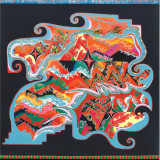
The next chapter of the Natural Information Society is here. Since Time Is Gravity, credited to Natural Information Society Community Ensemble with Ari Brown, presents a newly expanded manifestation of acclaimed composer & multi-instrumentalist Joshua Abrams nearly 15 year, 7 albums &-counting flagship ensemble. Joining the core NIS of Abrams (guimbri & bass), Lisa Alvarado (harmonium) Mikel Patrick Avery (drums) & Jason Stein (bass clarinet) are Hamid Drake (percussion), Josh Berman & Ben Lamar Gay (cornets), Nick Mazzarella & Mai Sugimoto (alto saxophones & flute), Kara Bershad (harp) & Chicago living legend of the tenor saxophone Ari Brown. Recorded live to tape at Electrical Audio & The Graham Foundation, cover painting Vibratory Cartography: Nepantla, by Lisa Alvarado. 2xLP on Eremite USA, 2xLP & CD on Aguirre/Eremite Europe. Out 14-04.
Since first developing Natural Information Society in 2010, Joshua Abrams has been gradually expanding the group’s conceptual underpinnings, its musical references & the sheer number of the group’s members. Its music is, in a sense, an expansive form of minimalism, based in repeated & overlaid rhythmic patterns, ostinatos & modality. Its roots, its scale & its meaning become clearer in time. If time is gravity, it also allows us to carry more. Having begun as fundamentally a rhythm section with Abrams’ guimbri at its core, the version here can stretch to a tentet, including six horns.
Abrams has been expanding his minimalism gradually, but he has long understood a key to minimalism’s potential: the breadth of its roots in the late 1950s & early 1960s, ranging from the dissatisfaction of young European-stream composers with the limitations of serialism to the simultaneous dissatisfaction of jazz musicians with the dense harmonic vocabulary of bop & hard bop. The former began exploring rhythmic complexity & narrow tonal palates in place of harmonic abstraction (Steve Reich’s Drumming, Philip Glass’ Music with Changing Parts; perhaps above all Terry Riley’s In C & his late ‘60s all-night organ & loop concerts); the later reduced dense chord changes to scales (signally with Miles Davis' Kind of Blue, but rapidly expanding with John Coltrane’s vast project). In the 1950s the LP record opened the world with documentation of Asian & African musics, key influences on both minimalists & jazz musicians. If John Coltrane’s soprano saxophone suggested the keening shehnai of Bismillah Khan, the instrument was rapidly taken up by two key minimalists, LaMonte Young & Riley, similarly appreciative of its flexible intonation, the same thing that kept it out of big bands.
If the guimbri, the North African hide-covered lute that Abrams plays with NIS, involves a rich tradition of hypnotic healing music associated with the Gnawa people, Abrams’ music also touches on other musics as well — other depths, memories & healings, different drones, rhythms & modes. As the group expands on Since Time Is Gravity, he has made certain jazz traditions in the same stream more explicit as well. If there is a mystical & elastic quality involved in the experience of time, both in direction & duration, you will catch it here. The parts for the choir of winds expand on the roles of Abrams’ guimbri, Mikel Patrick Avery & Hamid Drake’s percussion & Lisa Alvarado’s harmonium: at times, the winds are almost looping in the tentet version, each hitting a repeating note in turn, at once drone & distinct inflection on temporal sequence. The brilliance of the work resides in Abrams’ compositions, the NIS’ intuitive execution & in Ari Brown’s singular embodiment of the great tenor saxophone tradition, including the oracular genius of Eddie “Lockjaw” Davis, & Yusef Lateef. The three pieces by the expanded NIS featuring Brown —the opening “Moontide Chorus” & “Is” & the ultimate “Gravity”— have an immediate impact, & togther might be considered a kind of concerto for tenor saxophone. Here Brown presses almost indistinguishably from composed melody to improvised speech, getting so close to language that he might have a text. Everything here is a sign. Note the tap of the Rhythm Ace that links “Moontide Chorus” to “Is”, the attentive heart always present, even when signed by a machine. There’s a link here to the methodologies & meanings of dub music & the linear & vertical collage of beats, textures & tongues: treated with reverence, a sample of a beat-box can be as soulful, as hypnotic, as a mbira or a tamboura. If those pieces with Brown are heard as a suspended concerto, the three embrace & enfold the other works, like the sepals of a flower. That placement will also touch on the mysteries of our perception of time.
Particularly in “Is”, but elsewhere as well, a phenomenon of transcendence arises in which time appears to be tripartite, at once moving backwards & forwards & standing still. This is an act of technical brilliance certainly, but also an illumination of music’s ability to represent temporal consciousness through polymetrics. This particular listener has only heard it before in a few places, including the horn shouts & bowed basses of Coltrane’s Africa, in moments of Charles Mingus’ The Black Saint & the Sinner Lady, in certain pieces where tapes were literally running backwards, & earlier still in Dizzy Gillespie’s Cubana Be, Cubana Bop, in which the composer George Russell & conguero Chano Pozo found a music that spoke at once in the voices of Stravinsky’s Rite of Spring & the vestigial rites, rhythms & songs of the Yoruba language & Santeria religion of inland Cuba.
In Joshua Abrams’ compositions & the realization of them by the NIS, in the time of one’s close listening & memory thereof, distinctions between the “natural” & the “social”, the “quotidian” & the “transcendent” are erased, suspended or perhaps irrelevant. Consider two of the ensemble pieces, one named for nature, the other social science. In “Murmuration” the repeated wind figures of flute & alto saxophone combine with the interlocking patterns of harp, guimbri & frame drum (tar) to create a perfect moving stillness, not an imitation but a witness to the miracle of the starlings’ astonishing collective art, a surfeit of beauty that might be the ultimate defense tactic.
“Stigmergy” takes its name & concept from the Occupy movement’s Heather Marsh, who proposes a social system based on a cooperative rather than competitive models, one in which ideas are freely contributed & developed as ideas rather than an individual’s property. In its form, Abrams’ “Stigmergy” is the closes thing to traditional jazz, a series of accompanied solos by each of the wind players. However, the composed accompaniment is a radically collectivist notion: a repeated rhythmic figure, call it ostinato or riff, in which the different winds each play only a note or two of the figure, a concept both more collectivist & individualistic in its conception than any typical unison figure. It suggests another of the underlying recognitions that propel the Natural Information Society, the group as social organism, the teleology of hypnotic anarchy, all parts in place, functioning systematically, evolving & expressing itself, its nature & society, as a transformative organism.
George Lewis has described music as “a space for reflection on the human condition”. This suggests that, rather than a “distraction”, at least some music might serve as a distraction from distraction. It’s a focus, a clarity, a awareness, an external invitation to interiority, as if music itself is a model for form & contemplation, an organism contemplating for us or as us. If that is a possibility, & I am sure I have heard such musics, than this music is among them. How many of our rhythms, melodies & harmonies (cultural, historical, biological, psychic) might such music carry, translate & transform in the particulate ecstasy of our own murmuration? (Stuart Broomer, April 2022)
quête:phil harmonic
- A1: Carlos Picklin - La Charanga Del Espacio
- A2: Tito Chicoma - Cumbia A Go Go
- A3: Choche Merida - El Rock De Los Chinos
- A4: Benny Del Solar, Melochita, Ita Branda - Rumba Espanola
- A5: Lucho Macedo - Rock & Roll Mambo
- A6: Nallye Fernandez - Batijugando
- A7: Nelson Ferreyra - Twist En Guaracha
- B1: Los Kintos - Kintos Boogaloo
- B2: Patty Pastel - Computador Electronico
- B3: Luciano Luciani - A Bailar Bump
- B4: Willy Marambio - Trompeta A Go Go
- B5: Los Vikingos - Go Go En Patines
- B6: Edgar Zamudio - Dia De Pago
- B7: Lucha Macedo - El Maestro Del Rock & Roll
Exotica, ye-yé cumbia, guaracha infused twist, rock’n roll mambo, Spanish rumba, boogaloo beat, tropical garage and other unexpected bastard genres are featured in this festive compilation of bizarre hits taken from the glorious catalog of records released during the 60s and 70s on the Peruvian label Discos MAG. Some clearly unite genres, others are projects with creative names, but all are bold musical initiatives that got and will always get people onto the dance floor. “Sabroso Go Go” brings together fourteen musical mixes created in the recording studios of Manuel Antonio Guerrero (MAG), in which music directors combine rhythm with alchemy in a quest to find the philosopher's stone of the dance. Exotica, ye-yé cumbia, guaracha infused twist, rock’n roll mambo, Spanish rumba, boogaloo beat, tropical garage and other unexpected bastard genres are featured in this festive compilation. Although this compilation begins in 1957, experiments like this (some more memorable than others) were not new in Peru. The songs on this album were however much more successful hybrids. Some clearly unite genres, others are projects with creative names, but all are bold musical initiatives that got and will always get people onto the dance floor. At the end of the fifties, rock music shook the foundations of Peru, and orchestras rushed to cover hit songs and explore the possibilities of mixing them with tropical music. Lucho Macedo's orchestra took up the mantle and reinterpreted a well-known guaracha by Celia Cruz ('Rock and Roll') in mambo style, renaming it 'Rock and roll Mambo'. 'Maestro de Rock and Roll', a hit by the Cuban Conjunto Casino, received similar treatment. Another mix in this vein is the rock tune 'El Rock de los Chinos' by the Mexican Manolo Muñoz (author of 'Speedy González') recorded by the Chilean Choche Mérida for MAG in 1961. The following year, Chubby Checker’s 'The Twist' hit the scene and was immediately fused with guaracha by maestro Nelson Ferreyra. A legendary MAG musician, Carlos Pickling, composed 'La Charanga del Espacio' in 1963. The space sounds are produced by Pickling and his inseparable Hammond. He himself is the one who leads the orchestra that accompanies Benny Del Solar, Lita Branda and Pablo "Melcochita" Villanueva in the tropicalized version of Spanish Rumba, when the beats of the Iberian rumba were still exotic in South America. Around that time, the Chilean Willy Marambio was already living in Lima. In the track included on this album, the go-go style showcases his virtuosity on the trumpet. Another outstanding trumpet player, Roberto "Tito" Chicoma from Chiclayo, played as a session musician with MAG from 1959. A few years later, he became one of the most popular Colombian cumbia players, a talent he demonstrates in the song on this compilation, which blends the fun of go-go with yé-yé beats. 'Batijugando' was a hit from Mexico and was played in all the rhythms played across the Hispanic world since 1967. Inspired by the "Batman" series, it was performed at MAG by the Betico Salas orchestra, with vocals by the Panamanian lady crooner Nallye Fernández. 'Computador Electrónico' is another surprise on this album, performed by Panamanian vocalist Patty Pastel, it is the only known version in Spanish of 'Der Computer Nr. 3', originally sung in German by France Gall. Two other songs feature Edgar Zamudio. The versatility of Zamudio y Los Vikingos (originally a Chilean group) is demonstrated in the guitar-heavy song composed specifically for the late sixties skate fashion ('Go Go en Patines') and in his idiosyncratic protest song ('Día de Pago') performed in beat style. In the mid-seventies, Los Kintos, led by guitarist Francisco Acosta, developed different harmonic ideas in an instrumental track that veers from boogaloo to salsa, the fashionable rhythm of the day. Finally, in 1976, when the bumping hips dance craze swept the continent, Manuel Guerrero was quick to jump onto the bandwagon, composing a Bump song, together with his son Carlos. The Italian musician based in Lima, Luciano Luciani performed the song 'A Bailar Bump' backed by his band of local musicians Los Mulatos.
Erstauflage auf farbigem "Red & Blue" Vinyl. Jubiläums-Edition zum 30. Jahrestag des Debütalbums von Six Finger Satellite, The Pigeon Is the Most Popular Bird, mit einer brandneuen, vollständig remasterten CD und einer Doppel-LP-Neuauflage. Die 1990 in Providence, Rhode Island, von J. Ryan (Sänger/Keyboard), John MacLean (Gitarre), Peter Phillips (Gitarre), Chris Dixon (Bass) und Rick Pelletier (Schlagzeug) gebildeten Six Finger Satellite wurden für die Weapon EP schnell von Sub Pop unter Vertrag genommen. Nach Weapon machte sich die Band daran, ihr Debütalbum mit Bob Weston (von Shellac, die später eine Single The Bird Is the Most Popular Finger zu Ehren von Six Finger Satellite benannten) zu produzieren. Das 1993 veröffentlichte The Pigeon Is the Most Popular Bird war die erste Veröffentlichung, die den abenteuerlichen, bissigen Geist und Sound von Six Finger Satellite wirklich einfing. Das Album ist ein Meilenstein des lauten, beunruhigenden Post-Punk, mit Einflüssen von Gang of Four, The Birthday Party und Wire, aber auch mit einer gesunden Dosis der eigenen, einzigartigen Klangfeindlichkeit der Band. Zwischen den spröden Rocktracks finden sich auf The Pigeon Is the Most Popular Bird einige Keyboard- und Studioexperimente, die auf den späteren Alben der Band stärker hervortraten und LCD Soundsystem, DFA Records und einen Großteil des Post-Punk-Revivals der frühen 2000er Jahre vorwegnahmen. Pitchfork bezeichnete The Pigeon Is the Most Popular Bird zu Recht als "eine der besten Noise-Rock-Platten der 90er Jahre" und schrieb, dass "die Übergänge von albern zu bissig den unvorhersehbaren und ätzenden Ansatz von Six Finger Satellite hervorheben - dies war das erste von mehreren Beispielen dafür, wie sie Underground-Trends verschmähten, und ihre aufregendste bittere Pille, die es zu schlucken galt".
‘Before the Odysee, there was the Iliad; a tale of the golden age of heroes and warriors.'
The idea behind the new Iliads series is to return to the sound of the golden age of Jungle/Drum & Bass, and more specifically the original ‘heroes’ of the Odysee label.
This first in the series pays homage to the style of music heard in the Oblivion releases that Source Direct delivered through Bassment Phil’s Street Beats imprint between 1995 & 1996.
Forbidden Affections is a classic Deep Amen track, made with tracks like Sands Of Time and Secret Liaison very much in mind. Right from the onset where the pads are given plenty of time and space to draw you in, it is completely faithful to that mid-90’s SD style. All the trademark break switches and deep 909 sub lines are present, and the palette of sounds are all drawn from those same sources that first inspired the SD sound (as such it is Atmospheric Jungle with a strong Techno persuasion). The finishing touches come from the achingly gorgeous female vocal ad-libs that were also such a trademark of the early, more atmospheric SD tracks.
Hidden Rooms is perhaps even more authentically SD, especially with its focus on arrangement, and the way it uses the selection of samples that are once more drawn from those same Deep Techno sources. The interaction between the rolling curls and cuts of the Apache at the start, and the crisp injection of the Think breaks at the drop comes straight out of the early SD portfolio. The bass drops down super deep underneath the drum work, punctuated by exposed electro hits and well-chosen samples. It is the haunting keys nearly 4 minutes in however that give this track the authentic SD twist more than anything, calling tracks like Fabric Of Space and Made Up Sound very much to mind.
Drifting Through is the final track of the E.P. with its beautifully sharp rolling Hotpants/Worm combination. This track leaves plenty of space; dubbed out to just breaks and bass for much of the duration, with the occasional injection of an obscure electronic sample, or the sweet vocal ad- libs to hold the tune together. Further down the track there is a touch of the Jazz influence as the Rhodes chords add an extra level of harmonic warmth.
Look out for Volume II where we will be returning to the distinctive flavours of the original Mirage releases on Odysee!
As NuNorthern Soul eases into its second decade, the label welcomes back a familiar face: Benjamin J Smith, a multi-instrumentalist, songwriter, and pro-ducer whose emotive, colourful and atmospheric compositions are the very definition of ‘Balearic’.
Famously, it was Smith’s The Movedrill Projects album that kicked off the NuNorthern Soul story way back in 2012, and he’s periodically returned to the imprint on numerous occasions since. It’s fitting, then, that Smith is stepping up once more, with NuNorthern Soul found-er Phil Cooper selecting to showcase two overlooked gems from his bulging back catalogue.
Both tracks are taken from Smith’s digital-only album Mojave (Vintage Californian Dreams), a set of thor-oughly gorgeous, West Coast-inspired library music compositions smothered in sumptuous strings and in-formed by the artist’s love of jazz-funk, languid jazz-rock and the kind of luscious, sunset-ready soundscapes that defy neat categorization.
Opening proceedings, and sitting on side A of the vinyl release, is the breath-taking ‘Marina Del Rey’, where layered, reverb-laden harmonic vocalisations, twin-kling electric piano improvisations, lazy guitar licks, spacey synth flourishes and sultry strings slowly rise above a toasty bassline and gentle, Latin-tinged beats. Smith cannily adds layers of sound throughout while moving the musical story forwards, leading to a mem-orable, awe-inspiring conclusion.
In contrast, ‘Big Sur’ sees Smith take an imaginary road trip through the driest, dustiest parts of the Cali-fornian countryside. Psychedelic rock style organ mo-tifs, sustained Hammond B-3 chords and glistening West Coast rock guitar solos dance atop a rubbery bassline and intoxicated, loose-limbed drums, with Smith’s eyes-closed vocalisations – drenched in reverb and delay – adding extra layers of aural loveliness. Like ‘Marina Del Rey’, ‘Big Sur’ is a vivid, widescreen con-coction tailor-made for soundtracking films that have yet to be made.
Since its beginnings, Hypnótica Colectiva has always shown a special interest in the music recorded and released in the city of Detroit.
A place with which we have both a blood and spiritual bond because of what occurred there socially and artistically during the 20th century.
This love led us to become ambassadors of what was happening there on a musical level, holding cultural events to screen documentaries translated into Spanish, as well as a number of themed sets at our events, dedicated motor city sections in our record shop or recently lectures on the history of the city and its music at the Museum of Illustration and Contemporary Art of Valencia (Muvim).
The time has now come to bring all this history, this musical influence, to the editorial section of our label HC records.
Detroit Legacy was born from the idea of capturing these influences on vinyl. Seeking artists from all over the world who share this passion that inspires them to create their music, what we can define as the universal Neo-Detroit.
For this first edition or first volume, the collective has enlisted in its ranks creators affiliated to the label who have shown us in their careers, this influence and this feeling.
Paul Cignol opens the record with Distance. From Dublin he offers us a track of warm sequences inspired by Deep Techno, with deep pads responding to organ keys and a subtle touch of 303.
Mallorcan LLuis Barcelo Sureda is responsible for the second track Funk Station. With a Techno Soul character that we might hear from Detroitish labels like Acacia or producers like Blake Baxter.
A real eminence in Techno is the Catalan Don Alex Martín, who already released in the mid-90s on Monssieur Garnier's label (France Communications). The Barcelona native brings his wealth of experience and wisdom through Megatech, which transports us to the spectrum of Derrick May’s Transmat who, in his day, was nicknamed "The Innovator". This track provides agile sequences of complex syncopated rhythms, combining with a dreamy Michigan style synth.
The anthem of the album comes from Ghent. The sublime Belgian creator, Mariska Neerman, once again makes our hairs stand on end and our hearts melt with a heavenly composition entitled Stellium.
No one interprets Neo-Detroit quite like Mariska, whom we baptise as a sovereign heiress of the genre in the world. If we have to think of an influence for this piece, we go straight to the genius of Detroit, the one and only Jeff Mills, in his most symphonic and harmonic facet of tracks released on his label Axis Records such as "The March", A Universal Voice That Speaks To All That Will Listen or A New Found Sense Of Being.
Some of these songs have been re-interpreted by world class philharmonic orchestras such as the Montpellier Philharmonic Orchestra at the 2005 Blue Potential (Pont Du Garde). Mariska's score in this song fuses organ keys with harmonic layers and violin - favourite instruments of the Detroitian extraterrestrial - with a harmonic result of strength and hope. An authentic anthem of classic emotional Techno.
Old School electro takes centre stage with the Master from Terrassa Ivan Arnau a.k.a. Dark Vektor. In the influence of Juan Atkins (the creator) as Cybotron or Model 500 and later creators who developed this sound like Aux 88. Metaverso Frik is a great recital of a urban poetry created and interpreted by Ivan, to completely devastating effect.
Croatian Bojan Jascur a.k.a. N-TER, closes the vinyl with We Will Emerge, in a exercise of vindication, a common weapon in the context of Detroit music. Raging, trippy electro in the purest style of Cosmic Force or Dynarec.
This first tribute to 8 Mile doesn't end with the vinyl, as 2 digital bonus tracks are included in the release.
We return to Barcelona with Pastin Futon in another sequence of consecutive oscillated rhythms oscillated much like Kevin Saunderson (The Elevator) in his day and the Techno Groove that we know today.
The most robotic touch of the release is the closer with this synthetic jigsaw puzzle of a track with echoes of the 1967 Detroit Riot, the Detroit Rebellion. Again produced by another Barcelona native, The Bandit (Dj Spy / Util Records). The sequences are very reminiscent of Arpanet and Drexciya.
The idea for the cover comes from Motor City itself by Jon Yowell, first cousin of HC records founder and head of HC records David Verdeguer.
Born, raised and a lifelong resident of Detroit, Jon is an enormously talented musician capable of writing lyrics, performing them on the mic and manipulating a number of stringed instruments as well as the drums, where he is a true master.
The cover is a tribute to the formative backgrounds of many of the city's musicians in every sonic trend. Wayne State University in the capital of Michigan.
Founded in 1868, it has offered didactic teaching to many of the city's musicians.
Not all of Detroit's creators went to university, and even less so when talking about Techno, many artists are self-taught or learned in a non-academic way, but it seems to us a good base to begin to highlight the origins of the city's music in a historic building, where those who have the opportunity to learn about music have been and continue to be educated.
The adapted designs are the work of our image manager Dani Requeni.
Mastering by Steve Voidloss at Black Monolith Studios in London (UK).
- A1: Kristi Brud - Variations Of La Folia - The Abduction Of Europa
- A2: Joel Ivar - Svalov 9 Juli
- A3: Inre Kretsen Grupp - Interlud
- A4: Fai Ling - Ikaros Svett Short Version
- A5: Borringe Kloster - Hommage A Eva Ramel
- B1: Philipp Otterbach - The Lost Track
- B2: Moonilena - Onio
- B3: Digge Shim - A Friend In Deed
- B4: Spivak - Oauver
- B5: Moisture - Blue Tea
Enter The Decagon assembles friends of the label - near and far - for further excursions into the abyss of industrial, folk, jazz and ambient music.
From Copenhagen hails Kristi Brud (Bride of Christ) extending us with a shimmering violin contemplation initially made for the short art film piece "The Abduction of Europa", absorbing a modal ambiance of harmonics rooted in central European renaissance. Recorded in Svalöv in rural Skåne comes a hillbilly folk jazz piece constructed by Joel and Ivar on equal parts violin, flute, upright bass and percussion, recorded somewhere in the misty era of of 2012-2015. Then, an interlude follows, reconstructed from the very early live sets of the label's own Inre Kretsen Grupp, laden with tuned metallic percussions and synthesized bow sounds. Following up, the idiosyncratic local talent Fai Ling offers a piece of Basinski/Hassel-esque horn repetitions in full deterioration. Concluding the A-side of the compilation is the band that never was - the only released material of Prins Emanuel and Golden Ivy's Börringe Kloster project - encapsulating their minimal maximal approach of low quality sound samples turned in to a wall of sound of rhythm of sorts.
The B-side picks up on different musings in the form of ambient cadence and carefully sculpted soundscapes signed Phillipp Otterbach, who gives us an unraveling journey into kalimba-hampered harmonies carried through a bed of industrial, synthesized sounds. Moonilena follows up with an eerie yet beautiful minimal composition of radio disturbances and repetitive, ear catching melodies.
Breaking the barrier of stillness, local producer and Catholic chant music fiend Digge Shim performs a rhytmical, tongue-in-cheek number that pulls widely from both the hymnal traditions of medieval Europe as well as the zonked out ambient trance sounds you'd meet in a mid nineties Goa chill-out room.
Near the tip of the decagon, we find the Cypriot producer, singer and lyricist Spivak presenting us with a feeling of the-familiar-but-never-heard in the form of an ambient pop breakbeat number with carefully crafted choirs oscillating on top - hauntingly beautiful and equally danceable.
Ending in the best of styles, well-mannered umarel and purveyor of drum-smitten metallic sounds shows us what Moisture is really about - the mental image of finding your true self dancing in purgatory in a never-released Kenneth Anger film set, encumbered with red lights and occult paraphernalia.
Check point Catherine
“In the afternoon we performed in a rather austere theatre in East Berlin. Then I remember we crossed Checkpoint Charlie that evening to play in a club in West Berlin. The atmosphere was completely different. I felt as though we were living in a black and white spy movie.” Nicolas Fiszman recalls that chaotic day of 13 June 1982. Two outstanding guitarists, Philip Catherine and Nicolas Fiszman, who at the time was only seventeen years old, were taken from one side of Berlin to the other in pouring rain to perform to unlikely audiences. At both concerts, they played the same programme of seven pieces written by Philip, with the exception of “Crystal Bells”, composed by Charlie Mariano. The pair were not master and student. Rather, Philip remembers Nicolas like a young brother he might have taken to the beach. After the 1960s, Philip became a major figure on the jazz scene, working with the greatest: Charles Mingus, Chet Baker, Stéphane Grapelli, Dexter Gordon, to name only a few. Nicolas has played with Charles Aznavour, Vanessa Paradis, Francis Cabrel and Eric Serra, and travels the world with Sting.
On that gloomy afternoon, the two guitarists, alone on stage, decided to brighten up the morosity that reigned. The pieces they played bore titles such as “Janet”, “Babel” and “Petit Nicolas”. It is hard to believe that this varied, well-constructed, polyphonic music was not entirely written down on paper. Philip says, “Nothing is written from beginning to end. I compose the themes and some harmonic bridges. Then we have a chord chart … and that’s it.” The foundations are written; inspiration, taste, fantasy and friendship do the rest. We feel as though we are taking a nonchalant walk through Rio or Miami. The concert is punctuated by thunderous applause.
For these brief minutes in that year 1982, the East Berliners were able to fly over their tightly closed borders.
We are privileged to have unearthed this unique concert where two outstanding artists bring together two cultures to create an intense blaze of happiness.
Philip Catherine, Guitar
Nicolas Fiszman, Guitar & Bass
With the kind authorization of the Artists
Back in stock !
First Word Records is very proud to present a brand new full-length album from Kaidi Tatham. 'It's A World Before You'.
Following on from two EPs released on First Word last year ('Changing Times' and 'Hard Times'), Kaidi has delivered us thirteen tracks that deftly illustrate his various talents as a multi-instrumentalist.
Kaidi is probably best known for his work with Bugz In The Attic, though his musical contributions over the years have also included Amy Winehouse, Slum Village, Mulatu Astatke, Soul II Soul, Moonchild, Leroy Burgess, Amp Fiddler, Chris Dave, Macy Gray, King Britt, DJ Spinna, Mr Scruff and IG Culture to name but a few! In recent times, he's worked with DJ Jazzy Jeff on a variety of projects, including his most recent album 'M3', touring Europe for Jeff and Will Smith's reunion shows, and on the PLAYlist album 'Chasing Goosebumps', with Glenn Lewis, Stro Elliot (The Roots), Masego, Maimouna Youssef, Rich Medina, Daniel Crawford and more.
All this in addition to heating up dances around Europe with his inimitable DJ sets, and working heavily with First Word label-mate, Eric Lau (who also mixed this album) on a variety of projects, and adding releases to his already impressive catalogue on 2000 Black, Eglo and Theo Parrish's Sound Signature, with regular compadre, Dego (who features on the album's title track).
This album personifies Kaidi's diverse palette of sounds - bar Eric & Dego's features, every piece of music is played by himself. Largely flowing on a broken beat rhythm section, Kaidi effortlessly incorporates washes of afro, latin and funk throughout. From the harmonics of 'Your Dream Don't Mean A Thing', to the breakneck funk of 'Outta Audah', each and every riddim exudes energy. But this isn't simply a bruk record. The album is laced together with downtempo beats and future jazz interludes throughout, and some sweet synth boogie is never very far away, especially on the weighty vibes of 'It's About Who You Know'. To top it all off, there's two delightful nuggets of hip hop soul - Mancunian label-mates, Children of Zeus, feature on the neo-soul vibes of 'Out Here On My Own', and there's a feature from Amir Townes, better known as Uhmeer - an upcoming MC from Philadelphia, and son of one Jazzy Jeff Townes - who rides a sub-heavy, piano-led slice of boom bap, voicing an assortment of characters to tell the tale of 'Cupid'.
'It's A World Before You' is set to cause serious damage to sound-systems over the Summer, and show and prove once again the skills of one of the UK's best unsung musical talents, Kaidi Tatham.
Second Editions presents a new collaborative work by Marja Ahti and Judith Hamann.
After their distinguished duet ‘Portals’ for Cafe Oto's Takuroku label, ‘A coincidence is perfect, intimate attunement’ is a wonderful sophomore collaborative work pieced together over two years of changing seasons, ideas, moods, and feelings. The release is formed from a shifting field of sound correspondence that pivots on moments of coincidence, of a tuning in.
What are we opening ourselves to when we tune in to sound? How can one be truly open to a sound? How can the activity of recording move beyond notions of capture and release into more generative frames? Rather than a tool purposed for preservation or ‘conservation’ of memory, of time and place, can recording sound instead form new vibrant or vibratory spaces of attunement?
‘A coincidence..’ is an LP length composition of multiple interlocking parts, created through exchange, alignment, unpredictability: the title borrowed from poet Fanny Howe falling right into place, a flock of birds in flight, pitches matched and moved across different geographies and temporal frames. Marja & Judith have created an intuitive, lyrical longform piece that considers the idea of attunement itself as, in some sense, the smallest form of measure or denominator connecting their respective practices: across field recording, just intonation, electronic sonorities and instrumental bodies. ‘A coincidence..’ reflects a sense of a willingness to tune in to impulses given, or gifted to the other, a position that embraces an intimate synchronicity.
Recordings & correspondances between 2020-2022. Mixed by Marja Ahti & Judith Hamann. Mastered and cut by Anne Taegert at Dubplates & Mastering in Berlin, 2022. Title quotation from Night Philosophy by Fanny Howe, Divided Publishing, 2020. Photogrpahy by Joshua Bonnetta. Thanks to Nino Bulling, Niko-Matti Ahti and leo. The work was supported by Kone Foundation, Akademie Schloss Solitude and NEUSTART KULTUR.
Marja Ahti (b. 1981) is a Swedish-Finnish composer and sound artist based in Turku, Finland. Ahti works with field recordings and other acoustic sound material combined with synthesizers and electronic feedback in order to find the space where these sounds start to communicate. She makes music that rides on waves of slowly warping harmonies and mutating textures – rough edged, yet precise compositions, rich in detail. Ahti has presented her music in many different contexts around Europe, in Japan and the United States. She is currently active in the duo Ahti & Ahti with her partner Niko-Matti Ahti and in the artist/organizer collective Himera.
Judith Hamann is a cellist and performer/composer from Narrm/Melbourne in so-called Australia, currently based in Berlin. Their work encompasses performance, improvisation, electro-acoustic composition, field recording, electronics, site specific generative work, and micro-tonal systems in a deeply considered process based approach to creative practice. Currently Judith’s work is focused on an examination of expressions and manifestations of 'shaking’ in solo performance practice, a collection of works for cello and humming, as well as ongoing research surrounding ‘collapse’ as a generative imaginary surface, and the ‘de-mastering’ of bodies (human and non-human) in European settler-colonial heritage instrumental practice and pedagogy. Judith likes working with and thinking-with other artists which sometimes includes people like Joshua Bonnetta, Dennis Cooper, Charles Curtis, Golden Fur (with James Rushford and Sam Dunscombe), Lori Goldston, the Harmonic Space Orchestra, Sarah Hennies, Yvette Janine Jackson, and Anike Joyce Sadiq.
Rare & unreleased 80's bangers from Sao Tome e Principe's most iconic singer !
Bongo Joe pursues their work with friend DJ Tom B and are sharing the fourth effort in their São Tomé & Principe series : “Recordar é viver”, the first volume of an anthology dedicated to the one and only Pedro Lima, , "A voz do povo de São Tomé" (the people's voice of Sao Tomé).
“Recordar é viver: Antologia Vol. 1” features some previously unreleased tracks and gives a comprehensive look into the discography of one of the islands’ biggest stars, known for his political outspokenness as much as for his soft voice, delicate rumbas, and high-energy puxas.
With his band Os Leonenses he built a brand new genre around the strong rhythms and infectious energy of Sao-Toméan Samba Socopé ("only with the feet” in Portuguese), but with the influence of Congolese soukous, Cape Verdean Coladeira, elements from French West-Indies Cadence/Compas, and Brazilian Afoxé, it soon developed into the infectiously danceable style known as “puxa”. The band kept playing together up until Pedro’s death in 2019, performing at large events around the islands and on the continent.
But Pedro shined also on his own. Alone, he demonstrated his compositional skills and ability to balance the band’s powerful rhythm section with São Tomé & Principe’s harmonic backing vocal traditions, creating strong, dance floor ready puxas or melodic, delicate rumbas.
Pedro Lima died in 2019, leaving behind the 23 children he fathered, with thousands of mourners accompanying him to his final resting place. The public funeral, paid for by ex-president Pinto da Costa, was one of the biggest the islands have ever seen. Lima, "O cantor do povo” (“The people’s singer”), was buried with his wireless microphone, so his powerful voice would always be heard.
Available from Blank Forms for the first time since its original 1980 release on ALM-Uranoia, New Sense of Hearing documents a collaboration between Takehisa Kosugi and Akio Suzuki, two luminaries of Japanese experimental music in the lineage of Fluxus. Blank Forms's high-quality reissue of the sought-after, long out of print LP, is produced by musician-artist Aki Onda and mastered from the original tapes recorded on April 2, 1979, at Tokyo's Aeolian Hall. Described by Suzuki as the "culmination" of their sound,New Sense of Hearing features the two musicians improvising together in that empty Tokyo theater, Kosugi on vocals, violin, and radio transmitter and Suzuki on the Analapos, his namesake glass harmonica, spring cong, and kikkokikiriki, all apparatuses of his own invention. Suzuki and Kosugi first met at the city's Minami Gallery in 1976 on the occasion of "Sound Objects and Sound Tools," an exhibition of Suzuki's homemade instruments. Two years later, at the Festival d'Automne in Paris, Suzuki invited Kosugi to join him for a suite of performances as part of the exhibition "MA: Espace - Temps au Japon," organized by architect Arata Isozaki and composer-writer Toru Takemitsu. Suzuki and Kosugi performed together at the Musée des Arts Décoratifs, Paris, nearly fifty times, honing their approach to mutual improvisation, before traveling with the exhibition to Stockholm and New York_critic Tom Johnson wrote in the Village Voice that he had "seldom seen two performers so completely tuned in on the same types of sounds, the same performance attitude, the same philosophy, the same sense of what music ought to be."For New Sense of Hearing, the duo reunited in Japan and produced an extraordinary dispatch from their collaboration of arioso violin, echoing vocals and bangs, and metallic twangs. As Johnson observed in 1979, Kosugi and Suzuki are "in a very subtle artistic world where there can be no direct relationships. . . . Only coincidence." Takehisa Kosugi (1938-2018) was a composer, artist, and violinist from Tokyo. In 1960, Kosugi founded Group Ongaku, the country's first improvisational performance collective dedicated to Happenings, with Mieko Shiomi and Yasunao Tone. Four years later, Fluxus leader George Maciunas published Events, an eighteen-piece set of his text compositions. Between 1971 and '74, his band the Taj Mahal Travelers produced four live albums. In 1977, the Merce Cunningham Dance Company invited Kosugi to be their resident musician; from 1995 to 2011 he served as the company's musical director. The Whitney Museum of American Art presented "Takehisa Kosugi: Music Expanded," a two-day retrospective of Kosugi's work, in 2015. Akio Suzuki (b. 1941) was born in Pyongyang, North Korea, to Japanese parents. For the artist-musician's first Fluxus-style work Kaidan ni Mono wo Nageru (Throwing Things at the Stairs), 1963, Suzuki tossed a bucket of miscellaneous objects down a flight of stairs in Nagoya Station and listened to the sounds it produced. During the next decade, he would create original instruments including the Suzuki-type glass harmonica and the echo instrument Analapos. In 1976, Tokyo's Minami gallery hosted his first exhibition, "Akio Suzuki's World: Sound Objects and Sound Tools." For his 1988 performance piece Space in the Sun, Suzuki spent twenty-four hours listening to his surroundings on the meridian line which runs through Amino, Kyoto. Suzuki has performed and exhibited at many venues and music festivals, including Documenta 8 (Germany, 1987), the British Museum (2003), Musée Zadkine (France, 2004), Kunstmuseum Bonn (Germany, 2018), and the Museum of Contemporary Art Tokyo (2019).
Super limited edition pressed on heavyweight 180g vinyl housed in a picture sleeve and clear plastic outer sleeve – never to be repressed. Only 175 units.
Tokyo-based DJ, producer and sound artist Yuu Udagawa inaugurates the freshly launched Cyphon Recordings with her debut EP, ‘Forever’.
Growing up on a cocktail of everything from rock, hip-hop and Latin jazz to techno and house, Yuu’s immersive musical output draws inspiration from this diverse pool of influences to create ‘uplifting and healing’ music for the mind and body. There’s an elegance and sophistication to her productions, which stems from her desire to make music guided by the Golden Mean philosophy of finding a middle ground between two extremes: excess and deficiency.
Active as a DJ since the millennium, which saw her playing at clubs, festivals and fashion shows across the country, she soon turned her attention to music production and has since self-released a handful of singles and contributed audio commissions for Sony Playstation3, museums, theatres and apparel brands. Yuu’s meditative pallet of sounds instantly grabbed Cyphon’s third ear which led to the tracks that make up ‘Forever’: a collection of analog slo-mo electronica and leftfield minimal house that strike a perfect balance between warmth and depth.
The release opens with the titular track: a deep, emotive electro cut punctuated by a twinkling synthline and blissful vocals. ‘Mojito’ continues the EP’s voyage into the deep, matching softly spoken word with jazz-tinged chords and meandering melodies, before ’Hug Close’ strips things back, guided by a crunchy minimal groove, warm, resolute keys and reflective synths.
The B-Side steers things on a soulful course. The dark, enveloping atmosphere of ‘Illuminated Night' is lifted by bright synth stabs and harmonic R&B-flavoured vocals. These influences continue on closer ‘Stay With Us’. Slowing down the pace, the track is a wash of shimmering funk-inspired chords and shuffling rhythms, laced once again with effortless, soaring vocal tones.
DJ Feedback:
Joyce Muniz - Nice one!
Andrew Wowk - "Mojito" is awesome - such a nice groove (followed up)
Geordie Elliot-kerr - Some really interesting stuff in here. Digging the whole thing.
Simon Caldwell - Cool and different.
Paul Beller - super star release.
Fred Peterkin - Dope...
Alex Barck - Sounds fresh to me
Ruben Mandolini – Nice
Gabriel Izarraraz - great music will play for sure
Kristijan Molnar - Very nice!
Chris Loxton - superb
Danton Eeprom - Really love the production and original vibe of this record. bring it on!
Raymundo Rodriguez - cool release
New album by Steamhammer - British blues-rock band STEAMHAMMER
was formed at the end of 1968 by Martin Quittenton (guitar), Kieran White
(vocals, harmonica, guitar), Martin Pugh (guitar), Steve Davy (bass) and
Michael Rushton (drums)
Their first album "Reflections" (AKA "Junior's Wailing") was released in 1969. Pete
Sears played piano on this album before he joined Rod Stewart on his four early
classic recordings. Pugh also played on Rod Stewart's first solo album, "The Rod
Stewart Album" (AKA "An Old Raincoat Would Never Let You Down") with Ron
Wood, Mickey Waller, Martin Quittenton and Keith Emerson. After "Reflections",
Quittenton and Rushton both quit the band to be replaced by Mick Bradley
(drums) and Steve Joliffe (sax, flute), who gave a jazzy influence to the band in
their second album, "Mk. II" (1969). Shortly after this release, Joliffe left the band,
which continued as a 4 piece in their third album "Mountains" (1970), which was a
returning to the blues- rock of the first album. After a major turnover, Pugh and
Bradley invited Louis Cennamo (bass) and, along with special guest Garth WattRoy (vocals), recorded "Speech" in 1971. This last album was released
posthumously, after Bradley's death in 1972.Now, exactly 50 years after the
release of "Speech" and 53 years after Pugh and Sears collaborated on the band's
first LP, Steamhammer will release a new album, "Wailing Again". Featuring beside
1968 founder member Martin Pugh (guitars) and Pete Sears (bass, keys &
background vocals), member of Jefferson Starship from 1974 to 1987, Manfred
Mann's Earth Band - drummer John Lingwood, who joined Steamhammer in 1972,
and Phil Colombatto (vocals & harmonica).
Toots Thielemans was a jazz harmonica virtuoso from Belgium. Together with guitarist Philip Catherine, pianist Joachim Kuhn and other session musicians, he recorded the 1974 album Toots Thielemans/Philip Catherine & Friends, which was later reissued as Two Generations. The album features some of his best known works such as “Bluesette” and “Inner Journey”, which were previously cd-only compositions.
Two Generations is part of the Timeless Records 45th Anniversary Jazz Series and is available as a limited edition of 750 individually numbered copies on white coloured vinyl. The sleeve features the artwork of the
1996 reissue.
A Ride is the new dark alt-country concept album on the road by Phill Reynolds, to be released on June 17th, 2022 by Bronson Recordings; Like all the best concept albums, A Ride takes you on a journey. This one concerns the last three days of an American runaway’s life. Part road-trip, part engrossing mystery, part search for redemption, it’s the fictional tale of a troubled man whose past comes back to haunt him. Via eleven intimate, chronologically-sequenced songs, we travel with him. There are epiphanies and dream sequences, drunken dive-bar nights and chats with Jesus and Lucifer. As the narrator battles with his dark side, it is ultimately we, the listeners, who must weigh-up and flesh-out his story. According to its creator Phill Reynolds, AKA Italian alt-country singer-songwriter Silva Martino Cantele, the key to The Ride’s mystery might lie within its fifth song, A Clockwork Dream. “That’s where we discover that, because of some kind of courtroom trial, the narrator has lost someone who was very important to him”, Reynolds explains. “But we never find out her name or her relationship to the main character. Is she a blood relative? Is she his wife or someone else?”. The origins of A Ride go back to 2015. On tour in the US, Reynolds took in the shifting landscapes, the people he met and their stories. All of this fed into the album he recorded at the all-analogue TUP Studio in Brescia, near Milan. Reynolds played almost all of the instruments himself and co-produced A Ride with long-term collaborator Bruno Barcella. If A Clockwork Dream features a full band arrangement – “I think of it as the kind of thing Neil Young & Crazy Horse might do on a Sunday morning”, says Reynolds – other songs are sparer, more intimate. Banjo, Fender Rhodes, harmonica and glistening slide guitar all feature as Reynolds delivers haunting confessionals such as Run, Run Away and The Fault Is Mine, songs likely to appeal to fans of artists such as Damien Jurado, Strand Of Oaks or For Emma, Forever Ago-era Bon Iver. Intricate, rapid-fire fingerpicking on the first single This Isn’t Me and The Call of The Dark demonstrates Reynolds’ dexterity, while his voice is a rich, fully-lived in instrument seasoned with the salt of experience,and strengthened by the 120 or so gigs a year he used to do before COVID took his one-man show off the road. Long an inhabitant of picturesque Italian towns in the Vicenza province, Phill Reynolds was born in Marostica and currently lives in Zugliano. He was only five when The Beach Boys’ Barbara Ann worked its magic upon him via the radio. Later a fan of ‘90s Californian punk bands, Reynolds was writing and performing in his own post-hardcore bands by 13, but didn’t make it to the nearest big city, Milan, until he was 19. Bands still matter deeply to him. But his love for folk music has deepened over the last decade or so, hence his solo act alter-ego. Where did the name Phill Reynolds come from? “Everybody asks me this,” he smiles. “Especially in the UK. The truth is I needed an alternative name for a gig I was doing, and at the time I was in love with the music of Phil Ochs and Malvina Reynolds. Malvina Ochs didn’t sound too good to me, so I became Phill Reynolds, and I like that, because it sounds like a normal person”. The esteemed Italian label Bronson Recordings will release his fourth solo album A Ride on June 17th, 2022, on CD, vinyl and digital. A Ride is the most ambitious and fully-realised Phill Reynolds album to date. He was assisted by Stefano Pilia (lead guitar on Dive Bar Oblivion), IOSONOUNCANE (backing vocals, synth, bass and field recordings on World On Fire), and C+C=Maxigross (bass, drums and backing vocals on In The Dark). The record’s story is a dark one, but not one without hope. “Every end is a new beginning”, says Reynolds. “One of the main themes here is that life can be a sort of trap unless you recognise your own demons and try to deal with him. So we must be prepared and try to live well”.
Nightlands is the solo project of The War on Drugs’ bassist and multi-instrumentalist Dave Hartley. Amid massive global paradigm shifts Dave Hartley (aka Nightlands) became a father twice over and left his native Philadelphia for Asheville, where the pace of daily life is slower and it's easier to maintain a zoomed-out perspective on modern life. From the newfound refuge of a studio he built using the bones of a barn attached to his hundred-something-year-old house in the mountains, Hartley has tailored a collection of well-crafted pop rock, pointedly titled Moonshine. Guided by some of the harmonic sensibilities that have helped make The War on Drugs a force in modern music, Moonshine combines immaculate-yet-dense vocal stacks and billowy clouds of effected keyboards with classic songcraft, revealing previously unseen acreage in the unfurling dreamscape that is Nightlands. The surrealistic album art by Austin-based illustrator Jaime Zuverza depicts an archway opening to the stars over the surface of an idyllic sea flanked by both moon and sun. Similarly, Moonshine reveals portals within portals leading to ever deeper places in Hartley's vocal-centered labyrinth. Throughout the album, there are plenty of buoyant high moods where the pitter-patter of drum machine and humming digital organ hints at Hartley's low-key tropicalia streak, but the lyrics anchor the dreaminess in real-world sorrow and resignation. Nowhere are these sentiments more apparent than on the title track, a nearly acapella recitation of "America the Beautiful" that poignantly hovers over a mirage of soft keyboards before dovetailing into Hartley's own words about the hypocrisy of the American dream. "This was never intended to be an overtly political record" he admits. "I have so many friends who are able to process the frustration of current events gracefully or with wisdom or in a nuanced way, but I often find myself just consumed with anger about it all. I decided to just let that come out, and it manifested itself lyrically." Moonshine's wide-eyed, utopian instrumental backdrops provide sharp contrast to Hartley's lyrics, which sting even harder within the sweetness. Even in light of the album's vocal emphasis, Hartley's history as a bassist brilliantly beams through Moonshine, giving effortless and sprightly movement to songs like "Down Here," which also features an extended section of saxophone lent by his Western Vinyl labelmate, Joseph Shabason. In addition to Shabason, the album hosts a short list of remote collaborators including four of Hartley's bandmates from The War on Drugs, Robbie Bennet, Anthony Lamarca, Eliza Hardy Jones, and Charlie Hall, as well as exotica virtuoso Frank Locrasto (Cass McCombs, Fruit Bats), and producer Adam McDaniel (Avey Tare, Angel Olsen). Hartley was forced to keep the guest list small out of the necessity of pandemic isolation, coupled with his move to a smaller city, all of which challenged him to do most of the album's heavy lifting right down to the mixing duties, resulting in the most independent effort of his career. By that measure, Moonshine is also the clearest image yet of Dave Hartley as a person and creator.
Amid massive global paradigm shifts Dave Hartley (aka Nightlands) became a father twice over and left his native Philadelphia for Asheville, where the pace of daily life is slower and it's easier to maintain a zoomed-out perspective on modern life. From the newfound refuge of a studio he built using the bones of a barn attached to his hundred-something-year-old house in the mountains, Hartley has tailored a collection of well-crafted pop rock, pointedly titled Moonshine. Guided by some of the harmonic sensibilities that have helped make The War on Drugs a force in modern music, Moonshine combines immaculate-yet-dense vocal stacks and billowy clouds of effected keyboards with classic songcraft, revealing previously unseen acreage in the unfurling dreamscape that is Nightlands. The surrealistic album art by Austin-based illustrator Jaime Zuverza depicts an archway opening to the stars over the surface of an idyllic sea flanked by both moon and sun. Similarly, Moonshine reveals portals within portals leading to ever deeper places in Hartley's vocal-centered labyrinth…
sferic cruise the best coast with Jake Muir's solo debut, arriving in pursuit of the immersive ambient-architextural themes which also influenced Space Afrika's warmly received 'Somewhere Decent To Live' LP and Echium's lush 'Synthetic Space' side.
Jake Muir is a sound designer and artist from Los Angeles, California, where he's previously recorded and released albums under the Monadh moniker for Further Recordsand Dragon's Eye Recordings, the latter of which recently lead to his inclusion on the Touch compilation 'Live At Human Resources', where he took part in a beautiful group tribute to Jóhann Jóhannsson along with a number of solo contributions.
On 'Lady's Mantle' Muir unfurls a poignant sound image crafted from samples of a well loved American pop group and later smudged with field recordings made everywhere from Iceland to California. In nine succinct scenes, the results loosely limn a wide sense of space and place with its fading harmonic auroras and glinting, half-heard surf rock melodies rendered in an abstract impressionist manner that suggests a fine tracing of in-between-spaces, perhaps describing metropolitan sprawl giving way to vast mountain ranges and oceanic scales.
In effect the album recalls the intoxicated airs of Pinkcourtesyphone (a.k.a L.A. resident Richard Chartier) as much as Andrew Pekler's sensorial soundscapes and even the
plangent production techniques of Phil Spector. But for all its implied sense of space, ultimately there's a paradoxically close intimacy to proceedings which feels like you're the passenger in Muir's ride, and he patently knows the scenic route.
Tape
Charlemagne Palestine (born Charles Martin ni 1947 in Brooklyn, New York) wrote intense, ritualistic music in the 1970s, intended by the composer to rub against audiences' expectations of what is beautiful and meaningful in music. A composer-performer, he always performed his own works as soloist. His earliest works were compositions for carillon and electronic drones, and he is best known for his intensely performed piano works. He also performs as a vocalist. Palestine's performance style is ritualistic; he generally surrounds himself (and his piano) with stuffed animals, smokes large numbers of kretek (Indonesian clove cigarettes) and drinks cognac.
Oren Ambarchi (born 1969 in Australia) is a composer and multi-instrumentalist with longstanding interests in transcending conventional instrumental approaches. His work focuses mainly on the exploration of the guitar, "re-routing the instrument into a zone of alien abstraction where it's no longer easily identifiable as itself. Instead, it's a laboratory for extended sonic investigation". (The Wire, UK).
Oren Ambarchi's works are hesitant and tense extended songforms located in the cracks between several schools: modern electronics and processing; laminal improvisation and minimalism; hushed, pensive songwriting; the deceptive simplicity and temporal suspensions of composers such as Morton Feldman and Alvin Lucier; and the physicality of rock music, slowed down and stripped back to its bare bones, abstracted and replaced with pure signal.
From the late 90's his experiments in guitar abstraction and extended technique have led to a more personal and unique sound-world incorporating a broader palette of instruments and sensibilities. On releases such as Grapes From The Estate and In The Pendulum's Embrace Ambarchi has employed glass harmonica, strings, bells, piano, drums and percussion, creating fragile textures as light as air which tenuously coexist with the deep, wall-shaking bass tones derived from his guitar.
Ambarchi works with simple constructs and parameters; exploring one idea over an extended duration and patiently teasing every nuance and implication from each texture; the phenomena of sum and difference tones; carefully tended arrangements that unravel gently; unprepossessing melodies that slowly work their way through various permutations; resulting in an otherworldly, cumulative impact of patiently unfolding compositions.
Ambarchi has performed and recorded with a diverse array of artists such as Fennesz, Otomo Yoshihide, Pimmon, Keiji Haino, John Zorn, Rizili, Voice Crack, Jim O'Rourke, Keith Rowe, Phill Niblock, Dave Grohl, Gunter Muller, Evan Parker, z'ev, Toshimaru Nakamura, Peter Rehberg, Merzbow, Kassel Jaeger, Anthony Pateras, Crys Cole, Giuseppe Ielasi, Judith Hamann, Sunn 0))), James Rushford, Stephen O'Malley and many more.
For 10 years together with Robbie Avenaim, Ambarchi was the co-organiser of the What Is Music? festival, Australia's premier annual showcase of local and international experimental music. Ambarchi now curates the Maximum Arousal series at The Toff In Town in Melbourne and has recently co-produced an Australian television series on experimental music called Subsonics. Ambarchi co-curated the sound program for the 2008 Yokohama Triennale. Ambarchi has released numerous recordings for international labels such as Touch, Southern Lord, Table Of The Elements and Tzadik.
Belgian drummer Eric Thielemans is one of the most idiosyncratic figures in Belgian music, someone who not only demonstrates that special musicians always seek out (and find) their own place, but above all that they always remain students of the art of questioning and listening. No musician better illustrates the difference between playing music and playing with music than percussionist Eric Thielemans. He gets to the heart of the matter with an at times extremely minimalist approach, but on the other hand he frequently relies on a range of objects beyond the regular drum kit: a drum placed on its side, a bicycle wheel with a bow, hands and the body.