Check point Catherine
“In the afternoon we performed in a rather austere theatre in East Berlin. Then I remember we crossed Checkpoint Charlie that evening to play in a club in West Berlin. The atmosphere was completely different. I felt as though we were living in a black and white spy movie.” Nicolas Fiszman recalls that chaotic day of 13 June 1982. Two outstanding guitarists, Philip Catherine and Nicolas Fiszman, who at the time was only seventeen years old, were taken from one side of Berlin to the other in pouring rain to perform to unlikely audiences. At both concerts, they played the same programme of seven pieces written by Philip, with the exception of “Crystal Bells”, composed by Charlie Mariano. The pair were not master and student. Rather, Philip remembers Nicolas like a young brother he might have taken to the beach. After the 1960s, Philip became a major figure on the jazz scene, working with the greatest: Charles Mingus, Chet Baker, Stéphane Grapelli, Dexter Gordon, to name only a few. Nicolas has played with Charles Aznavour, Vanessa Paradis, Francis Cabrel and Eric Serra, and travels the world with Sting.
On that gloomy afternoon, the two guitarists, alone on stage, decided to brighten up the morosity that reigned. The pieces they played bore titles such as “Janet”, “Babel” and “Petit Nicolas”. It is hard to believe that this varied, well-constructed, polyphonic music was not entirely written down on paper. Philip says, “Nothing is written from beginning to end. I compose the themes and some harmonic bridges. Then we have a chord chart … and that’s it.” The foundations are written; inspiration, taste, fantasy and friendship do the rest. We feel as though we are taking a nonchalant walk through Rio or Miami. The concert is punctuated by thunderous applause.
For these brief minutes in that year 1982, the East Berliners were able to fly over their tightly closed borders.
We are privileged to have unearthed this unique concert where two outstanding artists bring together two cultures to create an intense blaze of happiness.
Philip Catherine, Guitar
Nicolas Fiszman, Guitar & Bass
With the kind authorization of the Artists
Suche:philip
- A1: The Poet Acts
- A2: Morning Passages
- A3: Something She Has To Do
- A4: “For Your Own Benefit”
- B1: Vanessa And The Changelings
- B2: “I'm Going To Make A Cake”
- B3: An Unwelcome Friend
- B4: Dead Things
- C1: The Kiss
- C2: “Why Does Someone Have To Die?”
- C3: Tearing Herself Away
- D1: Escape!
- D2: Choosing Life
- D3: The Hours
‘Was there ever a more perfect film for Glass’s lyrical manner? He refers to his own past, but the way in which the material is treated transforms it inevitably into that eternal present. Such a feeling of fragile beauty is a rare achievement.’ – Gramophone
‘Simple and complex by turn, Glass’s score adds dignity and depth to the movie, and to the tragedies and triumphs, big or small, of ordinary life.’
– Guardian
‘Underpinning the anguish at the heart of The Hours a beautiful score. Glass’s motifs capture the passage of time and the universality of human experience.’ – Classic FM’s Best Soundtracks
Nonesuch releases Philip Glass’s award-winning soundtrack to The Hours on vinyl for the first time to coincide with its 20th anniversary and Glass’ 85th birthday concert season. Originally released in December 2002, Glass’s score to the Academy Award-winning film was itself nominated for an Academy Award, as well as a Golden Globe and a Grammy, and went on to win a BAFTA and a Classical BRIT.
Directed by Stephen Daldry, The Hours is the story of three women searching for more potent, meaningful lives. Based on Michael Cunningham’s 1999 Pulitzer Prize–winning novel, with a screenplay by David Hare, the film interweaves the stories of three women – a book editor in New York (Meryl Streep), a young mother in California (Julianne Moore), and the author Virginia Woolf (Nicole Kidman). Their stories intertwine, and finally come together in a surprising, transcendent moment of shared recognition.
Philip Glass’s score was conducted by Nick Ingman, with Michael Reisman on piano and the Lyric Quartet, and recorded at Abbey Road Studios and Air Studios, London. The score was a key element in this acclaimed triptych of dramatic tales. ‘The inter-cutting of personal stories over a wide span of time,’ said NPR, ‘is held together by a single music approach.’
In his original liner note, Michael Cunningham wrote, ‘Each novel I’ve written has developed a soundtrack of sorts; a body of music that subtly but palpably helped shape the book in question. The one constant since I started trying to write novels, however – my only ongoing act of listening fidelity – has been the work of Philip Glass. I love Glass’s music almost as much as I love Woolf’s Mrs. Dalloway. Glass, like Woolf, is more interested in that which continues than he is in that which begins, climaxes, and ends; he insists, as did Woolf, that beauty often resides more squarely in the present than it does in the present’s relationship to past or future. So, when I heard he’d agreed to contribute the music to the film version of The Hours, it seemed both inevitable and too good to be true. I’m not sure if I can offer any higher praise than this: When I saw the movie with the music added, I thought automatically of how I could use the soundtrack, when it came out, to help me finish my next book.’
“This is a movie about art and how art affects life," explains Philip Glass. “The story is very complicated and the music could take on a very important role in the film, as I saw it – to make it viewable, to make it comprehensible, so the stories of the three women in the film didn’t seem separate, that they were tied together. The music had to be the thread that tied the movie together. There’s no question that the emotional point of view is conveyed by the music. Music is the arrow you shoot in the air. Everything follows that.’
Born in Baltimore, Maryland, in 1937, Philip Glass is a graduate of the University of Chicago and the Juilliard School. By 1974, Glass had created a large collection of music for The Philip Glass Ensemble. The period culminated in the landmark opera, Einstein on the Beach. Since Einstein, Glass’s repertoire has grown to include music for opera, dance, theater, orchestra, and film. His scores have received Academy Award nominations (including Kundun and The Hours, both released on Nonesuch, as well as Notes on a Scandal) and a Golden Globe (The Truman Show). Recent works include Glass’s memoir, Words Without Music, Glass’s first Piano Sonata, opera Circus Days and Nights, and Symphony No. 14. Glass received the Praemium Imperiale in 2012, the US National Medal of the Arts from President Barack Obama in 2016, and 41st Kennedy Center Honors in 2018.
Nonesuch’s relationship with Glass began in 1985, with the release of the score for Paul Schrader’s Mishima. In addition to The Hours (2002) and Kundun (1997), over the years other Glass works on Nonesuch have included Einstein on the Beach (1993), Music in Twelve Parts (1996), the soundtracks for Powaqqatsi (1988) and Koyaanisqatsi (1998), Glass Box (2008), and Kronos Quartet’s Performs Philip Glass (1995), amongst others.
Philip Lawn is an Italian music producer, co-founder of Turbokitchen, releasing on labels such as Motek and My Favorite Robot Recordings.
In his debut EP as solo artist for Thisbe Recordings, “Ten Years of Travel”, he tells the tale of the Odyssey and his protagonist Ulysses through the use of machines (such as Nord Lead 4, Roland SPD-30, Behringer TD -3, Yamaha Reface CS & Moog sub 37) and hot grooves. Out of his secret garden, a perfect acoustically isolated walk-in closet, “Ten Years of Travel” was born. Particular to the structure of the EP is that each track has its own remix.
With a rework of “Distorted View”, Days of Being Wild deliver a dark disco classic, true to their idiosyncratic sound and original beats, mesmerizing the dancefloor straight away. Traveller and cosmic poet Pyrame rework of the single “Start” first feels like rain dropping before the storm comes and reveals an euphoric feeling as the break starts. Romain FX nails a fine remix of Ten Years of Travel, the main single of Philip Lawns´EP. His remix is a pure italo disco rework of the original, infused with pop synths and keys, that won´t leave anyone still and quiet. Banger.
The soundtrack to ‘Pig’ is now available on LP, pressed on pink vinyl and housed in a spined sleeve with double sided printed insert and
download card included.
The score reflects the mood of the lead character, played by Nicolas Cage, with the simple ‘folk’-like colours of the solo violin and acoustic guitars creating a richly mournful tone.
More modern, aggressive electric guitars, distorted colours and drums provide a strikingly ominous, propulsive backdrop to the character’s more intense moments.
Alexis Grapsas says this about the film’s score: “The score was born after lots of trial and error and experimentation under the guidance and vision of the filmmakers, where we tried very original acoustic and electric sounds. In the process of creating an environment that would capture the lead character’s emotional world, we landed on a very unique raw and gritty sound that remains true
to the story while being self-aware.”
The NEON film, written and directed by Michael Sarnoski, was released in theatres on July 16th.
Array expresses the experience of a remote Antarctic research station through the convergence of sound, site and performance. The result is an immersive and affective experience of the spaces, protocols and conditions comprising the bracing polar environment. Array is a companion piece to Polar Force, a performance-installation work by Philip Samartzis and Eugene Ughetti, presented by Speak Percussion.
Array features recordings of radar and scientific instrumentation used for upper atmospheric research and terrestrial communication. These sounds reveal the sophisticated technology and architecture used and heard within the Australian Antarctic Territory. Many of the recordings focus on the way the built environment is transformed through stress and fatigue caused by extreme climate and weather events including freezing temperatures and high velocity winds.
Together with the field recordings are layers of live performance using custom built instrumentation to produce a unique series of textures, rhythmic cycles, resonances and timbral phenomena. The application of tension and pressure upon the assorted instruments recalls the distressed state of highly specialised infrastructure found within the perimeters of a research station.
A polar research station comprises many types and volumes of prefabricated space. In dialogue with this are the unique spaces used to record the instrumental performance. By merging different spaces Array brings into focus various industrial resonances, spatial characteristics, timbres of metal and concrete, and sonic artefacts produced by hard and permeable materials and surfaces.
In three parts, Array presents Antarctica as a liminal space oscillating between representation and abstraction to challenge often repeated tropes. The intent is to blur the relationship between the recorded and performed to produce a hyper-realistic encounter of the powerful forces that operate at the margins of our planet. One hears the precariousness of a remote research station contorted by unrelenting stress, compressed air forced through waterborne fipples and the volatility of weather events.
Life on remote research stations is progressively resembling the broader contemporary experience, in which strict protocols are used to govern and preserve life. The resilient communities who live and work in these places have learnt how to co-exist with an increasingly hostile environment, along with its unknowns and necessity for hyper-vigilance. Rather than consider it as a place on the edge of elsewhere, Antarctica and its assemblage of durable, super modern colonies provides an archetype for an uncertain future in anticipation of the volatility that awaits.
New solo record from Philip Frobos of Omni (Sub Pop, Trouble in Mind), this record is released in conjunction with a novel by Philip of the same name.
Philip Frobos' ‘Vague Enough to Satisfy’ will be released on 180g black vinyl - Only 500 Pressed Worldwide October 1st 2021. The novel will be published by Hex Enduction Books in Seattle on the same day.
‘Vague Enough to Satisfy’, is Philip Frobos’ debut solo album, it is also the original soundtrack to his debut novel of the same title. This lounge-inspired punk album acts as the musical bedrock for the story of a young man who revels in the day to day details (both romantic and mundane) of his experiences in Leipzig and Atlanta. The tone of the record reflects the tides of the protagonist’s confidence and self-doubt throughout the novel.
‘Vague Enough to Satisfy’ rushes straight to the point with it's bossa nova beat and seductive lo-fi musings. ‘Vague Theme’ opens the album with a groove reminiscent of ‘Whammy’ era B-52s while the vocals tell the story of a young romantic confused of his place within a relationship and the city around him.
‘Vacant Street’ proceeds with a hooky bassline, the revolving, cryptic sort that Frobos is known for as a member of Atlanta post-punks Omni. ‘No Packages Today’ is similarly sprightly and circuitous, sounding like the Au Pairs refining an obsession with Bowie’s ‘Lodger’. “I’m afraid that you need more than I can offer” opines Frobos bedecked by shuffling beats and burgeoning waves of saxophone. ‘Never Noticed’ and ‘Through with Buzz’ introduce notes of tension and intrigue to the frisson of the story, “you’re stuck in the same day” confesses Frobos in the former.
Instrumental tracks help to prolong an uneasy feeling of ambiguity too, with compositions like ‘Pool Disturbance’ and ‘Inflatable Flamingo’ taking their musical cue from Henry Mancini. Curious flourishes, a metronomic headiness and shuddering xylophones bring to life the intensely vivid imagery and cynical humor that suffuse the novel.
‘Pathetic’ collides the casual, magnetism of Serge Gainsbourg with tight Cars-style vocals and choruses. Meanwhile ‘Singer Not The Song’ and ‘Saturn Return’ showcase a more sedate approach, languid and arch. ‘Vague Enough to Satisfy’ is a trip, plunging you into a curious world populated by the unexpected.
Nottingham don Lukas Wigflex and "The Wizard" Tom Smith come correct with their Me & Meds project. Following on from their debut together on Wigflex, the follow up is just as inventive & playful.
2 years in the making- the studio skills of the pair shine through across the 3 tracks. The opener "Curtains Nine Tails" moves and warps over the first few minutes only to penetrate the listener with a crescendo of god-like basslines and tripped out vocals.
Faffhammer which gained big popularity when Lukas played it on that boat party at Love International is an atmospheric, wonked out euphoric number of the highest order.
The records finished off with the offside ramblings of another notorious Notts head - Des Hagenasty. This is his first outing on wax and it does not disappoint, backed by the analog wobbles and techno grit of Me & Meds, this one bites. The videos an eye opener too, just you wait!
0115 is alive.
- A1: Prelude: Refrain, Verse 1, Verse 2
- A2: Prelude: Verse 3
- A3: Scene 1: Funeral Of Amenhotep Iii
- B1: Scene 2: The Coronation Of Akhnaten
- B2: Scene 3: The Window Of Appearances
- C1: Scene 1: The Temple
- C2: Scene 2: Akhnaten & Nefertiti
- C3: Scene 3: The City. Dance (Beginning)
- D1: Scene 3: The City. Dance (Conclusion)
- D2: Scene 4: Hymn
- E1: Scene 1: The Family
- E2: Scene 2: Attack & Fall
- F1: Scene 3: The Ruins
- F2: Scene 4: Epilogue
Akhnaten is the third in the composer Philip Glass’ trilogy of operas about men who changed the world in which they lived through the power of their ideas. Akhnaten‘s subject is religion. Its title was derived from the Egyptian pharaoh Akhnaten, who was the first monotheist in recorded story. His substitution of a one-god religion for the multi-god worship when he came to power ultimately resulted in his exclusion from lists of rulers compiled by later pharaohs, and his legacy became all but lost to history until the late 19th century. The opera describes the rise, reign, and fall of Akhnaten in a series of tableaus.
Cuernavaca / Stateville / Frankincense And Myrrh / Apsara / Ancestral / Spin / Zincali
Approaching his eighty-fifth birthday, sharp and lean, Phil Cohran lives a couple of blocks from the lake on the north side of Chicago. His modest apartment is filled with a palpable richness. His cornet and trumpets, zithers, French horn, harp and frankiphones (an electric kalimba of his own invention); his beloved telescope; African art; a mural of the Chinese monastery where Muslim monks bestowed on him the name Kelan ('holy scripture'); hand-printed posters from the culture wars of 1960s Chicago; all reflect a life dedicated not just to music, but also to science and astronomy, to history and activism. In its range of subject matter the track-list of Kelan Philip Cohran & The Hypnotic Brass Ensemble embodies this invigorating and all-embracing curiosity: a Mexican hill-town filled with perfume and flowers... an Illinois state prison where Cohran taught inmates in the 1960s... heavenly dancers in the temples of Cambodia... a tribute to a sixteenth-century Venetian musicologist. Welcome to the musical world of Kelan Philip Cohran.
Cohran was born in Mississippi and grew up in St Louis. In the immediate post-war years St Louis was a jazz heartland, home of stalwarts like Clark Terry and Oliver Nelson (both of whom he played with), not to mention a genius called Miles Davis. In 1950 Cohran moved to another heartland, Kansas City, where he played trumpet in one of the hardest swinging swing-groups, led by Jay McShann (who famously had given Charlie Parker his first job). With McShann he spent 'the best year of my life', touring as far as Mexico and playing proto-rock'n'roll in Texas with the likes of Big Mama Thornton on vocals. Back in St Louis Cohran led his own group, the Rajas Of Swing, whose show involved wearing red jackets, grey slacks, blue suede shoes and turbans.
Then in the mid-50s he moved to Chicago. He had a small group with a friend, the legendary tenor saxophonist John Gilmore, whose regular gig was to play at Sarah Vaughan's weekly 'birthday' parties, an excuse for the Sassy One to splash the cash and have some fun. ('What, Sarah Vaughan would sing with you and John Gilmore' 'No way, Sarah didn't sing, she was too busy partying.') And in 1959, through Gilmore, he was invited to join Sun Ra's Arkestra, at a crucial period in the evolution of that extraordinary group. Effortlessly wrapping traditions as divergent as boogie-woogie and electronica in an Afro-centric, intergalactic mythology of his own making, Sun Ra casts a huge shadow across conventional narratives of jazz history. 'With Sunny', Cohran simply says, 'I found my own voice'.
You can hear the emergence of this voice on the LP Angels And Demons At Play, recorded in 1960 - Sun Ra's masterpiece from the period. On the track Music From The World Tomorrow, against the urgent whipped and chopped percussion of the Arkestra, it is Cohran's zither, initially bowed and then plucked and strummed, which is the track's magic ingredient. More profoundly it was Sun Ra's example - his defiant self-confidence and sense of purpose - that set Cohran on his own (to quote another Ra composition) 'pathway to unknown worlds'. Indeed this spirit of self-belief led Cohran to turn down the invitation to accompany the Arkestra when Sun Ra moved east in 1961.
Staying in Chicago, Cohran founded the Affro-Arts Theater and performed with the Artistic Heritage Ensemble, recording the group for his own Zulu Records imprint. (Co-members went on to become Earth Wind & Fire; Cohran taught the group's leader Maurice White the mysteries of the frankiphone). The AACM, a musicians' collective of immense influence and importance, had its first meeting in Cohran's front room. With Oscar Brown Jr and Gene Page he wrote and performed in a show celebrating the nineteenth-century Afro-American poet Paul Lawrence Dunbar. He taught music tirelessly in schools and prisons. His studies into music theory and history led him to the discovery of a key book in his life, Gioseffo Zarlino's treatise on harmony, published in Venice in1558. Astronomy is another passion and another area of expertise. One of the gems of the Cohran discography is African Skies, with its lovely harp playing, commissioned by the Chicago Planetarium in 1993.
In Chicago he also raised a large family. Many of his children have gone on to become professional musicians; eight of them are the Hypnotic Brass Ensemble. For each of them, their first teacher was their father, who famously insisted on giving them music lessons not just for several hours after school, but for several hours before school as well. Their father's music was all around them as children; they all vividly remember lying in bed at night not being able to sleep because their father was rehearsing with the Jazz Workshop downstairs.
For the Hypnotic Brass Ensemble, the voyage to where they are now - whether tearing up festivals from Glastonbury to Melbourne, or touring with Gorillaz, or recording their first album on Honest Jon's - has involved a necessary stepping away from their father's shadow. Phil Cohran is the first to recognise this, happily allowing their sound - heavy on the funk, with the urgency of hip hop never far away - to blossom.
But likewise this album is for all of them a natural step. Recorded in Chicago in June 2011, the idea was beautifully simple - 'my music and their band' as Phil puts it, 'we don't have to rattle on more than that'. Only to point out perhaps that here - in the majestic surge of Zincali, for instance, or in the sheer verve and bounce of Cuernevaca - is music not just filled with the warmth of home. This is music that plumbs the depths and rings with joy.
'Cuernevaca is a town in the mountains south of Mexico City. I was there in 1950 when I was on the road with Jay McShann's band. It's a place close to paradise, a city filled with the fragrance of flowers. I always wanted to go back... In 1974 I taught workshops at the prison in Stateville, the Big House where Al Capone spent time. There's a huge wall around the prison, and once I took Hypnotic there - ha - to see what the future holds for them... Makeda, the Queen of Sheba, sent a caravan of gifts to King Solomon - a caravan that took more than a day to pass one point - and the main gifts were Frankincense And Myrrh... I wrote Apsara in 1967, when Jackie Kennedy was in the news with her visit to the temple of Angkor Wat in Cambodia. Apsara were celestial beings, dancers who brought forth the civilization of ancient Cambodia, by dancing in the holy nectar called Amrita... Ancestral is a meditation drone written for my Friday-night residence at the Ethiopian Diamond Restaurant in Chicago's Rogers Park... Spin is the latest of these compositions. Everything in the cosmos spins, from the smallest objects we can see in a microscope to the largest galaxies. Spin is the motion of all things whether it looks like it or not... Zincali is a name Spanish gypsies call themselves. 'Zin', East Africa; 'cali', the people. One of the offshoots in my research into Moorish Spain has led me to Gioseffo Zarlino, the sixteenth-century master of music at St Mark's in Venice. It's said that Bach lost his sight reading Zarlino's treatise on counterpoint. His greatest composition is his setting of the Song of Songs - 'Nigra Sum', 'I am black'. This is my tribute to Zarlino and to the zincali.'
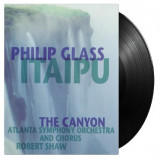
Itaipu, written by American composer Philip Glass, were commissioned by the Atlanta Symphony Orchestra and Chorus. Along with The Light (1987), they marked Glass’s continuation of a symphonic trilogy of “portraits of nature” as he had recently turned to making orchestral music. The composition pays a beautiful homage to the Itaipu Dam, which is the world’s largest hydroelectric dam built on the Paraná River between Paraguay and Brazil. The text was written in Guaraní, and translated by Daniela Thomas. The piece was first performed in 1989. This LP also includes The Canyon on the D-side, which was first performed in 1988 and commissioned by the Rotterdam Philharmonic Orchestra.
Itaipu and The Canyon are available on vinyl for the first time. It comes a in deluxe heavyweight sleeve with gloss laminate, and includes an insert with linernotes as well as the Philip Glass catalogue with info on the MOV Philip Glass series.
We kick start the return of Wigflex records with a brand new release from first time flexer and Nottingham's biggest blades fan... Son of Philip. Inspired by the story of how Cans drummer Jaki Liebezeit was once told to "play monotonous" during the LSD-induced ramblings of a fan; and the experimentation into repetition which followed.
We first heard Rubber Stamp during a wonky walk around Dam in the early hours of the morning, it made perfect sense then and still makes perfect sense now. King of hazy, crystallised electronics Actress steps things up a notch and takes the ep away from a Hoffman-esque bicycle ride and onto the dance floor.
The music on Dance Nos. 1-5 was originally conceived as a three-way collaboration between composer Philip Glass, choreographer Lucinda Childs and artist Sol LeWitt. Dance received its world premiere in Amsterdam on October 19, 1979 and its New York premiere at the Brooklyn Academy of Music on November 29, 1979.
Post-dating Einstein on the Beach - Glass’s 1975-76 collaboration with director Robert Wilson - Dance was another Glass collaboration, this time with choreographer Lucinda Childs, known for her austere, athematically exact dances, and artist Sol LeWitt, who provided a ghostly, gigantic black- and-white film for several of the piece’s five sections.
RELEASE: 5-3-2021
• 180 GRAM AUDIOPHILE VINYL
• DELUXE HEAVYWEIGHT SLEEVE WITH GLOSS LAMINATE
• PVC JACKET
• THE COMPLETE ALBUM, AVAILABLE ON VINYL FOR THE FIRST TIME IN ITS ENTIRETY ON A 3LP-SET
WITH FIVE SIDES OF MUSIC
• INCLUDES PHILIP GLASS CATALOGUE WITH INFO ON THE PHILIP GLASS SERIES ON MOV
SIDE A
Dance has an abstract purity that easily earned it the label “minimalist,” a term that Glass himself disavows but that seems appropriate, at least in this case. After Dance, Glass’s music took several turns, not so much in style as in the various new contexts in which it was presented: major opera commissions and film scores led him to write for forces other than those of the Philip Glass Ensemble. At the same time, an attempt to reach a wide audience resulted in some shorter, perhaps more accessible, narrative pieces. Dance marked the blossoming of the composer’s experimental work. Here, though, the music - particularly Dance Nos. “1”, “3” and “5”, all written for the Ensemble— has an unforgettable exuberance that somehow speaks all at once of joyful innocence, intense erotic desire, tenderness, regret and, finally, acceptance. On the other hand, Dance Nos. “2” and “4” see Glass composing several large-scale works for solo organ; for instance, Dance No. 2 originated as a 1978 work entitled Fourth Series Part Two. This piece, later incorporated into Dance, and Dance No. “4” as well, have a more subdued, more darkly romantic quality than the work’s other sections and are quite unlike anything Glass had previously written. Still, they too, with their mysterious tilts of time and key signatures, continue the exploration of polyrhythms and harmonic complexities within the context of Glass’s repetitive, “minimalist” style.
The complete Dance Nos. 1-5 album is now available on vinyl for the first time in its entirety on a 3LP-set with five sides of music. The 3 LP’s are housed in a heavyweight sleeve.
- Episode One
- Episode Two
- Episode Three
- Episode Four
- Episode Five
- Episode Six
Demon Records presents the first part of His Dark Materials – now a major TV series.
In this BBC Radio full-cast dramatisation of Northern Lights, 11-year-old Lyra discovers dark forces at work involving kidnapped children and a mysterious substance called ‘Dust’. This thrilling adaptation stars Lulu Popplewell as Lyra, Terence Stamp as Lord Asriel, Emma Fielding as Mrs Coulter, Bill Paterson as the Master, and Kenneth Cranham as Farder Coram, with a large supporting cast.
A lavish gatefold sleeve features Dust-inspired illustrations, spectacularly realised in metallic copper ink, plus full cast and production details and exclusive sleeve notes by Philip Pullman himself. This gripping drama is presented on three heavyweight 180g discs of Daemonic Dustburst splatter vinyl.
Philip Pullman’s bestselling trilogy of children’s books, which has sold more than 19 million copies worldwide, is now the inspiration for the major HBO/BBC TV series His Dark Materials.
- Episode One
- Episode Two
- Episode Three
- Episode Four
- Episode Five
- Episode Six
Demon Records presents the second part of His Dark Materials – now a major TV series.
In this BBC Radio full-cast dramatisation of The Subtle Knife Will finds an opening into the haunted world of Cittàgazze - where daemon-destroying Spectres roam – and meets Lyra for the first time. This thrilling adaptation stars Daniel Anthony as Will, Lulu Popplewell as Lyra, Emma Fielding as Mrs Coulter, Tracy-Ann Oberman as Serafina Pekkala, and Peter Marinker as Lee Scorseby, with a large supporting cast.
A lavish gatefold sleeve features Dust-inspired illustrations, spectacularly realised in metallic copper ink, plus full cast and production details and exclusive sleeve notes by Philip Pullman himself. This gripping drama is presented on three heavyweight 180g discs of Daemonic Dustburst splatter vinyl.
Philip Pullman’s bestselling trilogy of children’s books, which has sold more than 19 million copies worldwide, is now the inspiration for the major HBO/BBC TV series His Dark Materials.
- Episode One
- Episode Two
- Episode Three
- Episode Four
- Episode Five
- Episode Six
Demon Records presents the third and final part of His Dark Materials – now a major TV series.
In this BBC Radio full-cast dramatisation of The Amber Spyglass the young adventurers Lyra and Will must find each other and journey into the World of the Dead. This thrilling adaptation stars Lulu Popplewell as Lyra, Daniel Anthony as Will, Emma Fielding as Mrs Coulter, Tracy-Ann Oberman as Serafina Pekkala, and Terence Stamp as Lord Asriel, with a large supporting cast.
A lavish gatefold sleeve features Dust-inspired illustrations, spectacularly realised in metallic copper ink, plus full cast and production details and exclusive sleeve notes by Philip Pullman himself. This gripping drama is presented on three heavyweight 180g discs of Daemonic Dustburst splatter vinyl.
Philip Pullman’s bestselling trilogy of children’s books, which has sold more than 19 million copies worldwide, is now the inspiration for the major HBO/BBC TV series His Dark Materials.
Dancepieces, originally released in 1987, presents music that American composer Philip Glass created for two separate dance performances. The first half of the album accompanied the Twyla Tharp Dance Foundation in a show called “In the Upper Room,” and the second piece accompanied choreographer Jerome Robbins’ “Glasspieces”. Glass writes the majority of his music for visual performances, most frequently dance and opera, and the presence of a visual twin to his music is evident throughout the selections from Dancepieces.
In discussing his technique for writing music to accompany dance, Glass has stated that melody, harmony and rhythm are key factors. Within the first seconds of each song on Dancepieces, the strength of Glass’ strong rhythmic sense can clearly be heard.
Following 2019’s New Atlantis LP under his experimental techno alias Efdemin, Phillip Sollmann’s Monophonie is a project dedicated to uniting different strands of utopian music. His approach: combining and recontextualizing rare historical instruments of sonic research of Hermann von Helmholtz (19th century) with the self-designed, microtonal instruments of Harry Partch and metal sound sculptures of Harry Bertoia.
The result is a psychedelic investigation into just intonation – alternative tuning systems that create unique sets of harmonics not found in conventional scales. Monophonie recasts these sounds into new rhythmic environments where epic kosmische, polyrhythms, acoustic techno and microtonal glow are interwoven into a rare music.
Over nine tracks, the album explores multiple forms of minimalism, from unwavering repetition to paired-down chords and sparse sonic environments. But it also seeks to expand the sound spectrum of Partch’s custom built organs and melodic percussion instruments as well as Bertoia’s sonambient singing metal rods into a atmospheric otherworldliness.
Monophonie was first composed in 2016 and premiered at Berlin’s Volksbühne theatre in 2017, before it went on to the renowned Ruhrtriennale and Kampnagel in Hamburg. It was performed by one of Germany’s premier neue musik collectives Ensemble Musikfabrik together with Sollmann himself on von Helmholtz’s original double siren, with set design by Michael Kleine and wardrobe by Peter Kisur of Honeysuckle Company.
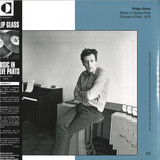
Lost PHILIP GLASS Recordings from 1975 - ORTF
The newly discovered and unreleased concert from 1975 recorded by the Philip Glass
Sextet at La Maison de la Radio, Paris.
The sextet is composed of Philip Glass, Jon Gibson, Dickie Landry, Michael Riesman, Joan
La Barbara and Richard Peck.
Music in Twelve Parts is a set of twelve pieces written between 1971 and 1974. This
performance in France includes part 1, 2, 3, 11 and 12 on a double LP.
Also included a very rare Philip Glass interview from 1974 in his NYC loft during the
rehearsals of this piece, produced for the French radio by Daniel Caux - musicologist and
co-founder of Shandar Records.
A never before released -Philip GLASS (1975) live recordings, released in partnership with
the National Audiovisual Institute - INA.
"A new sound and a new chord suddenly break in, with an effect as if one wall of a room
has suddenly disappeared, to reveal a completely new view." - A. Porter
Four tracks sure to get some antifreeze in your veins, prevent you from turning to a brick of ice during this brutal winter.
Philip Budny is a Berlin-based producer who's making his LPH debut here with Somnambulism, an easy, buoyant grip of tracks that'll lift your heart to the heavens as they keep your feet shuffling. Starry-eyed house.
Packaged in a custom graph paper sleeve.
Pittsburgh-born Phillip Ballou's earliest years were spent in the gospel field, after he moved to New York City in the '70s, he teamed up with Bennie Diggs and Arthur Freeman, founding members of The New York Community Choir and singer Arnold McCuller to form the group Revelation. The quartet recorded for RSO Records, scoring some R&B success in the US with tracks like Get Ready For This' and You To Me Are Everything,' touring the Bee Gees among others. Phillip also sang on albums by NYCC recorded for RCA Records and continued with Revelation until 1982.Frequently hired for sessions in and around New York, Phillip teamed up with UK soul music journalist David Nathan (who he'd met in 1974 during Nathan's first US visit) and John Simmons, formerly a member of The Reflections, another New York vocal group to write a series of songs for his own proposed solo record deal. Although a contract did not materialize, one of the songs - Ain't Nothing Like The Love' - got some interest from famed Philadelphia producer Thom Bell who presented it to The O'Jays. Ultimately, the tune was turned down by Kenny Gamble and John Simmons, by then musical director for Stephanie Mills, recorded his own version for a small independent label in 1981.Phillip continued his own musical journey, touring and recording with James Taylor and Todd Rundgren. In addition, Phillip's name graced recordings by George Benson, Billy Ocean, Kashif, Nona Hendryx, Jonathan Butler, Teddy Pendergrass and Melba Moore, in 1981, he began recording with Luther Vandross and became a part of Luther's touring band for many years, as well as singing on productions by Luther on Aretha Franklin, Dionne Warwick and others, continuing his association with him until Luther's 2003 stroke. Phillip returned to his gospel roots in 2004 as Minister of Music at a Brooklyn church and passed away in March 2005, aged 55. Thanks to renewed interest in the John Simmons' 1981 recording on YouTube, David Nathan has uncovered several tracks from the 1978 and 1979 he did with Phillip and John including Phillip Ballou's original version of Ain't Nothing Like The Love,' gaining its first ever worldwide release as a 7' single on Nefer Records in association with Super Disco Edits