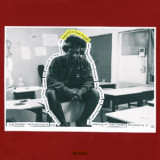
Michal Vaľko, aka Line Gate makes a return to mappa with his third cassette for the label. Once again the material is deeply minimalist, but shows marked evolutions in the Slovak, Prague-based artist’s unique trajectory. This time comprising two relatively short pieces (compared to the 40- and 60-minute works previously published on mappa), 'Trap' is perhaps Line Gate’s darkest yet.
Whereas previously his works focused on psychoacoustic phenomena, or highlighted the sacredness and timelessness of “the drone”, ‘Trap’ is a personal reflection of the artist’s innermost feelings, and perhaps a mirror that is held up to each listener: disillusionment, hopelessness and apathy have become an ever-present features of the society around us. ‘Trap’ very directly expresses the feelings of being lost, of despair, of wandering and not seeing the end. Vaľko utilises drones and repetitive vocal/instrumental phrases to express the endlessness of these feelings, and his own captivity within them.
The pieces draw once again on the hurdy-gurdy, but also on Vaľko’s processed, sometimes transposed voice. On “Maze I” layers of humming voices and meandering sung melodies form an impenetrable wall of sound, as the voices’ timbres intertwine and overlap, giving rise to fascinating overtones and singular resonances. On “Maze II” Vaľko returns to the earthy sound of the hurdy-gurdy alongside some deep, crooning voices (transposed an octave lower) and embellishes its drones with a performance on glass cups. More than ever, Line Gate's music resonates not just in sonic terms, but also in its deep humanity and social relevance.
out of Stock
Last delivered 8 months ago available to reorder, subject to availability
DNO welcomes two new signees, Slovenian producer Marka San and UK rapper Axel Holy, for one of the label’s darkest releases yet. The ‘Hidden Knowledge’ EP presents five tracks of dread bass and bad-trip sonics, as the Bristolian MC delivers cut-throat bars with the kind of calm, looming menace of a tomcat toying with its prey.
It was DEDW8, Axel’s horror-touched collab with Split Prophets’ Blanka, that first made him known in Slovenia, prompting Marka San to get in touch about working together. The same sinister vibe that drives that project has spread its tendrils right through the ‘Hidden Knowledge’ EP, from the twisted brass and squirming bass of ‘Where Did You Go’, which drags its feet like some zombified blues track as Axel repeats the titular phrase in his husky drawl, to the equally chilling ‘Classics’— all eerie samples and abyssal lows, with a pitched-down hook and braggadocious bars.
On ‘Patterns’, Axel goes to war, attacking the creeping beat with vicious battle bars and stories of the hustle, while ‘Hidden Knowledge’ sees him flex his vocabulary to take swipes at the powerful, and ‘Robert Downey’ makes his unswerving determination clear over grungy guitar.
Deliciously macabre, with intricate layers and lyrics that’ll have you spotting something new on every listen, yet still heavyweight enough for the dance, this is a match made in the nine circles and we can’t get enough of it.
Rhythms of postmodern realism at the very bottom of the DNO.
out of Stock
Last delivered 2 years ago available to reorder, subject to availability
Released in 2001, I Giorni paved way for the rise of Ludovico Einaudi to mainstream success. This beautifully melodic record features only solo piano, but captivates throughout with it’s gorgeous shapes and phrasing taking the listener on a journey with Ludovico himself. Quite aptly, the album contains the title track I Giorni, which has now been certified as a gold record in the UK. This is the first time this album has appeared on highly collectable coloured vinyl.
Liverpool’s acclaimed sensual existentialist Brad stank today announces the release of his resolutely romantic new album In The Midst of You on January 26th via his new label Sunday Best Recordings. He launches the album alongside the quintessentially Brad ‘Natty Wine’ and its accompanying video. The new single ‘Natty Wine’ neatly encapsulates the many charms that emerge throughout the album. With Brad backed by soulful female vocal harmonies, the song’s jazzy psychedelia possesses a touch of twanging Americana, its warm and vibrant live instrumentation making for a song as relaxed as a Sunday afternoon in the sun. It’s also notable for featuring Brad’s favourite percussive instrument deep in the mix: a wooden frog. He adds, “This is a tongue-in-cheek song I wrote after being gifted a bottle of natural wine by a friend. I’m a working class boy who would much rather drink shitty lager at a party, like Stella or Holsten Pils. I’ve got no right to be writing a song about natty wine but I was feeling bougie. It’s a love song in disguise, I liked the imagery of lyrics like, ‘Your sweet loving just keeps dripping from the vine.’” In The Midst of You finds Brad in late night lothario mode, his previous seductive style now taking a more resolutely romantic and perhaps surprisingly spiritual direction. The phrase “in the midst of you” comes from the Bible, Zephaniah 3:17, “the full quote is something along the lines of “God is in the midst of you” - basically meaning that you have to look inward for peace or enlightenment, etc. the album is about that in parts and also, as always, I tried to put a romantic twist on it so that the “in the midst of you” is about being in love with somebody. It’s kind of a juxtaposition but I’ve always enjoyed taking spiritual messages and giving them a double meaning, explains Brad. “Hopefully it’s a positive message of prostrating yourself to somebody, or to spirituality or something - but giving yourself fully to something , being in the midst…”
It's the pair you've all been waiting for! FINALLY!
Alan Tew's Drama Suite Part II. What can we really say? Honestly? We guess the first thing that strikes you is how clean the drums are. Almost impossibly slick but dripping so, so heavy with the neck-snapping funk you'd expect from perhaps the most sought-after library funk set of them all! The cheapest on Discogs is, currently, £1300+. Now's your chance to remedy that. If you know, you know. And we think you know...
"The Rub" is a cool, low-slung heavy-funk roller with relaxed brass and alto flute phrases. Up next, "Money Runner" is another edgy funk glider, its easy-tempo moving in harmony with slinky rhythmic riffs and featuring a seemingly ad-libbed electric piano solo. Strutting along after, "White Elephant Walk" is another laconic, deeply stoned walking theme with electric piano and alto flutes. There follows a couple of brief "walking" links before the brilliantly tense "Master Plan" slowly builds. Expectancy grows to the main theme around a minute in and then a melodic theme builds slightly to the 3 minute mark before floating down gradually and elegantly to its climax. It's utterly fantastic. The smoky, after-hours "Night Watch" is a slow, cool gem featuring alto flutes and synths.
Now we're talking, "The Fence (a)" is just sensational and worth buying this album all on its own. It's likely the reason you're here, anyway. Another impossibly funky, slow and easy tempo with a bass riff to die for, dramatic guitar with gorgeous electric piano and alto flute phrases. It was sampled for "Action Satisfaction" by J5, way way back. "The Fence (b)" is a slower, more deliberate version of the previous heater, but it's no less essential. Indeed, it's absolutely jaw-drooping. Closing out this remarkable side, "Surveillance" is another horizontal masterpiece of relaxed yet dramatic jazz-funk. Vibes ad-lib in centre section and give you an idea of how Roy Ayers making library funk in the mid-late 70s might've sounded. Sensational.
Flip over for "Total Silence", a near-beatless and understated scene-setter featuring neat interplay of guitar and synthesizer themes over bass and hi-hats. The slow "Eyes" follows, a brief gem with subdued electric piano solo and a light climax. The fantastic "Drama Backcloth (1a)" is up next, a repetitive piano and bass refrain with guitar figures over the top. Its creeping crime-funk vibe was pilfered for "Outta Town Shit" by Ghostface Killah in 2006. "Drama Backcloth (1b)" is a short, subdued version without the guitar figure. "Drama Backcloth (2)" features an expectant, background marimba figure over light rhythm whilst the cool "Drama Backcloth (3)" centres around a relaxed riff and the angular "Drama Backcloth (4)" presents eerie progressions with piano interjections. It's decidedly non-rhythmic!
We're then onto 14 (!) different half-minute "Scenechanges", all jazzy and funky, some cool and dramatic, some slow and rhythmic. All ace and groove-fuelled. The aptly-titled "Final Statement" closes proceedings, a slow, pensive theme on guitar joined by cool brass and a solo trumpet to its climax.
As with all of our KPM re-issues, the audio for Drama Suite Part II comes from the original analogue tapes and has been remastered for vinyl by Be With regular Simon Francis. And as usual, the sleeve reproduction duties were handed over to Richard Robinson, the current custodian of KPM’s brand identity. We're not quite sure what else to say about this landmark record, other than, GET IT!
out of Stock
Last delivered 21 months ago available to reorder, subject to availability
Delasi, the Koforidua-based producer, singer and rapper has released his new single ‘Amplifier’ featuring Nii Noi Nortey.
Prophetic, spiritual and frenetic, ‘Amplifier’ is Delasi’s testimony in musical form. A manifestation of Delasi emerging triumphant after many years in limbo as he searched for a long-awaited breakthrough in the music industry.
Produced by Delasi himself alongside Morgan Greenstreet, ‘Amplifier’ is underpinned by the texture of coastal rhythms indigenous to Accra and tightly ornamented with bustling drum breaks, electronic synth lines and jazz sensibilities.
Veteran Ghanaian multi-instrumentalist and sound designer Nii Noi Nortey appears on the track to deliver an explosive and rhythmically intense saxophone performance throughout as it tastefully builds to an emphatic crescendo.
Self-described as a prayer, the track’s maximalist and percussive instrumentation is cleverly juxtaposed with minimal lyrics where Delasi’s faint vocal repeats a series of repeated phrases like evoking the mood and semblance of a meditative chant and religious experience. Harkening to the work of afrofuturistic jazz musicians like Sun Ra and Pharaoh Sanders.
Speaking on the track’s meaning, Delasi said: “‘Amplifier’ is my prayer and like with other songs of mine it can scare me because I write things and then it’ll manifest in exact detail. The song is basically outlining how hard I’ve worked and how I need an amplifier to have my desires fulfilled. It's like a mantra and that’s why it's not so lyrical”.
‘Amplifier’ marks Delasi’s first release as a lead artist since his 2015 self-released project ‘#thoughtjourney’ which garnered support and praise from Rolling Stone, BBC6 Music, Worldwide FM, KCRW, Afropop Worldwide, Deutschlandfunk Kultur, NRK and legendary French DJ/Producer Laurent Garnier. Additionally parlaying into touring and festival gigs across Nairobi, Berlin, Morocco, Denmark and Sweden.
Delasi is an artist that has been quietly prolific for over a decade. Honing his musicianship exploring sonic possibilities with Ableton and Teenage Engineering. Eventually entrenching himself in the Ghanaian rap scene via collaborations with Hammer of The Last Two, Reggie Rockstone and Yaw P with whom he would release a joint project ‘Imperfections: The Break Up Vol 1’ in 2013.
He was musically raised on a diet heavily influenced by his father who exposed him to the sounds of Marvin Gaye, Bob Marley & The Wailers, Bobby McFerrin, Jim Reeves and Billy Ocean alongside the soundtracks for movies like Doctor Zhivago, The Sound of Music and La Bamba. Delasi’s own tastes would be heavily informed by linchpins of US Hip-Hop like Wu-Tang Clan, Nas, Onyx and M.O.P in addition to alternative R&B artists Frank Ocean and James Blake.
After many years of operating as a proudly independent and self-contained artist, Delasi has now partnered with Gilles Peterson’s Brownswood Recordings. One of the world’s leading indie labels, famed for their instrumental role in breaking the likes of KOKOROKO, Yussef Dayes, Swindle, Joe-Armon Jones, Shabaka And The Ancestors, Zara McFarlane and Ghostpoet.
With Delasi now being granted resources to give his music the grand and worthy footing, he is now on the cusp of the artistic breakthrough that was long out of reach. Speaking further on how the deal with Brownswood inspired the new single, Delasi said:
“The music I’ve created this go round is so strong that I can’t handle it all by myself. Though I had a lot of fun doing it all by myself with ‘#thoughtjourney’, this time around I needed it to be with a home who could properly amplify it.”
Recorded over a four-week period in early 2022, Freedom Lapse is the debut solo release of Australian multi-instrumentalist and composer Adam Halliwell. A versatile improviser and lover of performance, Halliwell has been an active contributor to numerous musical communities in recent years. The release of Freedom Lapse marks an exciting stage in Halliwell’s journey as an artist with the culmination of several important musical facets that are now becoming foundational to his practice.
As Halliwell tells us, Freedom Lapse owes its genesis to an epiphanic moment experienced whilst traversing a mountainous passage in Mexico, a place where ‘the past present and future stretch out in one place’. Entranced by this environment, its colours, the villages and local life, Halliwell listened to music that inspires him (he cites Jon Hassell here). The result: ‘complete aural, visual and spiritual completeness’, a moment of discovery, he explains. Shortly after, the material that now comprises Freedom Lapse was recorded, distilling this powerful sensorial experience into a body of music that he has now invited the world to share with him.
Throughout these recordings restrained improvised phrases and melodic ideas feature, often appearing as long refrains that soar above idiosyncratic beds of fractured percussion and junkyard bass-work. This use of contrast, which is central to the work, allows Freedom Lapse to tap the lucidity-chaos juxtapositional-style that lies at the heart of all good music in the ‘fourth-world’ idiom. Halliwell’s sensitivity to dynamics, form and narrative is potent on these recordings, which allow his winding, free-improvisations the space to unfold and extend patiently. All instruments on Freedom Lapse were written and recorded by Haliwell, with additional trumpet on Cygon Dance supplied by regular-collaborator Reuben Lewis. Freedom Lapse was mixed and produced by Halliwell and Jim Rindfleish.
out of Stock
Last delivered 2 years ago available to reorder, subject to availability
The Fall's fourth studio album Perverted by Language was released in 1983. The album was produced by the band's vocalist and songwriter Mark E. Smith and recorded at various studios in Manchester.
Perverted by Language features some of The Fall's most renowned tracks, including "Garden". The album's sound is characterized by its sharp and angular post-punk guitar riffs, driven by a heavy bass and drums rhythm section, all layered with Mark E. Smith's distinctive vocals.
Lyrically, Perverted by Language deals with themes of alienation, disorder, and the unpredictability of modern life. Smith's idiosyncratic and cryptic wordplay, including his penchant for inventing new words and phrases, adds to the album's overall sense of unease and dislocation.
Despite its challenging sound and lyrics, Perverted by Language is considered by many critics and fans to be one of The Fall's finest albums, showcasing the band at their creative and innovative peak. The album is available as a limited edition of 1500 individually numbered copies on pink coloured vinyl and includes an insert.
Music For Dreams are proud to announce the release of Jacob Gurevitsch’ new album El Terreno. It is the fourth LP from the Danish guitarist with the Spanish guitar, whose world of misty, Mediterranean romance is charming listeners all over the world.
El Terreno is named after the neighborhood in Palma, Mallorca, in which Gurevitsch wrote it over the past couple of years. The tranquility and beauty of this setting is reflected in the music: eight songs of Gurevitsch’ Spanish guitar meandering through the cobblestone streets, idling on town squares frozen in the afternoon sun, drifting on the perfumed evening air.
Two special guests feature on the album. On ‘For Your Love’ the legendary Cuban jazz trumpetist Arturo Sandoval is invited to play along. And on ‘Santa Teresa’ the esteemed Danish rock singer Annisette lends her characteristic smoky phrases to the drama. Throughout the album, Gurevitsch’ Spanish guitar is accompanied by a band of drums, percussion, bass and keyboards.
out of Stock
Last delivered 2 years ago available to reorder, subject to availability
Four dazzling, extended engagements with mbalax master-drumming.
The contribution from Holy Tongue is chase-the-devil steppers — thumping, clangorous, reverberating — super-charged with energy and atmosphere. From the off drummer Valentina Magaletti detonates a hard rain of small bombs, rounds of fire, ticking fuses. Musical co-ordinates are somewhere between classic On-U Sound crew like African Head Charge, The Mothmen, and Creation Rebel, and the experimental funk of the Pop Group and 23 Skidoo, at their funkiest. Thrillingly, the two dubs are increasingly deranged.
Adjusting the same wavelengths as her superb Workaround LP, Beatrice Dillon plays spaced-out, abstract synth-work against the bodily physicality of the ancient, shifting mbalax rhythms. The music is poised, mindful, tentative; but also limber, fleet, and magical.
Phantasmagorical and efflorescent, Lamin Fofana’s one-two is simply stunning. Both excursions are wide-open, beautiful, epic, and propulsive — the first mix is banging and headlong, the second more syncopated and serpentine — teeming with freshly sublime, funkdafied updates on Jon Hassell’s Fourth World possible musics.
The two parts of LABOUR’s Etu Keur Gui engage the same sequence of drum patterns (called bakks) from different perspectives. The duo performed portions of this piece at the opening ceremony of the Dakar Biennial in 2022, at the Grand National Theater, with thirty sabar players from the family of Doudou Ndiaye Rose. This Wolof phrase for the inner-court of a home — a meeting-place — doubles here as a metaphor for inner space on a metaphysical level; and Pan Sonic, Muslimgauze, Zoviet France, early Shackleton… all ghost across the threshold.
out of Stock
Last delivered 5 months ago available to reorder, subject to availability
Telephone Explosion proudly presents the self-titled debut LP from Toronto’s UH HUH, out physically and digitally on April 14, 2023. The album features eight tracks of dub-damaged art rock which conjure a potent vision of spaced-out 1980s post-punks feeding their angular rhythms and bass-heavy grooves through layer upon layer of grime-spattered spring reverb.
There is a palpable sense of discovery and exploration throughout UH HUH’s 37 heady minutes. Elastic basslines and serpentine guitar phrases throb and glide, cutting through dubwise reverberations like hands moving through an opaque cloud of reefer smoke.
Formerly known as Teenanger, the reconfigured (and reinvigorated) group’s newfound sense of sonic identity is put on display the moment the door kicks open. The percolating spaciousness of opener “Somewhere Beyond” is followed by the cyclical grooves of “Redemption Pause.” Vocalists Christopher Swimmings and Melissa Ball each take respective turns at lead vocal duties, showcasing their contrasting yet complimentary styles.
“Babylon”, a slab of overcast, loping funk features both singers on the same track, alternating between Swimmings’ stoned syncopation and Ball’s saccharine melancholy. This juxtaposition leans against a backdrop of reverb-soaked drums, watery guitar chords and rippling trumpet.
The slinking, fractured grooves of “Rain (In The Afternoon)” and “Citrus Song” call to mind the deranged minimal dub-wave of Naffi or Vivien Goldman. Both songs feature lyrical content heavily inspired by the Florida swamplands, although the aural landscape on these tracks is decidedly more brutalist than Boca Raton. Two of the songs included here are reworkings of previously released Teenanger numbers. “Blinds Drawn” is reduced to its core elements of bottom-heavy rhythm, spliced guitar shanks and Swimmings’ murmured ruminations. “Good, You”, on the other hand, is completely re-imagined as a blissed-out melt of opiated bossa nova.
After countless hours of experimentation during the album’s recording sessions at Toronto’s Studio Z, the band decided to send their drum machines, snare drums and percussion through an obscure 1960’s Japanese Guyatone guitar amp with a notoriously ecstatic spring reverb sound. The result was immediately inspiring.
The dank, busted and clanking tones produced by the Guyatone evoke a muggy, humid atmosphere that mimics the photo on UH HUH’s cover. The process of re-amping is literally the means through which UH HUH found the sound of this record. UH HUH is a record that asks more questions than it does provide answers. This is searching music that requires that the listener lean into it, the more time you spend in between the beats, bars, notes contained within, the more vivid the picture becomes.
A1 - Synergy
A long-awaited release for seasoned fans of the label familiar with ASC's DJ sets since creating Spatial, Synergy has been requested for release many times and is finally here - and it hasn't aged a bit. A track which lifts you gradually through a true journey of escalating, dynamic atmospheric soundscapes with crisp detailed break patterns that ebb and flow to an intricate collage of synths, keys and vocal hits to an inquisitive melody. A
stunning piece which somehow has something new to offer each time you hear it.
A2 - Suspended Animation
Conjuring an ethereal feeling with grand atmospheric backdrops reminiscent of early Intense, Suspended Animation is a calming yet suspenseful track which slowly builds with expressive break patterns and minimal kickdrums as subtle basslines rumble below. Long echoing effects and melodies gently nudge the proceedings forward, ASC once again showcasing the diversity of his production toolset.
AA1 - Repetition
It's been a while since a pure two-step drum loop has had this much impact - make no mistake - the breaks of Repetition will bore their way into your brain like Pulp Fiction did in the mid 90's with a thumping kickdrum and stabbing snare tweaked to perfection. While the beats drive the track along, a collage of audio texture surrounds them with a signature female vocal sample closing out phrases filled with finely tuned synthwork.
AA2 - Pharaoh
Landing with immediate impact and building the mood with a subdued urgency, the Hot Pants breaks of Pharaoh surf the dunes of sound to an abundance of sheer atmosphere as ASC crafts a stunningly evocative track which is aptly titled, transporting the listener to mystical Egyptian sands, the synths and horns whispering like the echoes of of a bygone era demanding their timely reprise through the medium of Spatial.
Epic.
Words by Chris Hayes
out of Stock
Last delivered 2 years ago available to reorder, subject to availability
Sourced from the Original Master Tapes and Presented in Audiophile Sound for the First Time: Mobile Fidelity’s Numbered-Edition 180g SuperVinyl LP Plays with Riveting Detail
Three decades before he released The Philosophy of Modern Song — an insightful book devoted to 66 tunes that both impacted his career and the music world at large — Bob Dylan issued Good As I Been to You. The under-heralded 1992 album, Dylan’s first solo acoustic album in nearly 30 years and first all-covers effort in nearly 20 years, can be seen as a prophetic prelude to what has become the Nobel Laureate’s celebrated late-career arc. It’s also an absorbing continuation of the custom Dylan has embraced since he first picked up a guitar.
Sourced from the original master tapes, pressed at RTI, and housed in a Stoughton jacket, Mobile Fidelity's numbered-edition 180g SuperVinyl LP of Good As I Been to You reveals the immediacy, detail, and stripped-down nature of recording sessions that took place in Dylan’s garage studio in California. Simple, raw, and unplugged, the record presents Dylan in peak form — and showcases a diversity of vocal phrasing, soulful chording, harmonica accents, and close-up ambience that on this reissue emerge like never before. As the first-ever audiophile edition of this almost-lost classic, this LP also benefits from SuperVinyl’s extraordinary properties: a nearly inaudible noise floor, superb groove definition, and dead-quiet surfaces among them.
Recorded and mixed by Micajah Ryan, and supervised by Debbie Gold, Good As I Been to You took shape at Dylan’s home shortly after the singer-songwriter completed sessions in Chicago with a full band. Unaccompanied, he again gravitated to existing works — in this case, traditional folk music — and, with Gold serving as a trusted advisor, performed the songs in multiple keys and tempos until he arrived at what he desired. That careful, determined albeit loose, organic approach emanates from this reissue, on which each note, movement, and space come across more directly, fully, and immediately than on the original formats. It helps draw a through-line to Another Side of Bob Dylan (1964) as well as the similarly themed follow-up, World Gone Wrong (1993) and immersive old-world storytelling of Tempest (2012) and Rough and Rowdy Ways (2020).
Well before Dylan made those renowned 21st century LPs, however, he needed to find a way out of a funk that — save for his 1989 collaboration with Daniel Lanois, Oh Mercy — followed him for years. As author Clinton Heylin reported Dylan admitting in 1997: “My influences have not changed — and any time they have done, the music goes off to a wrong place. That’s why I recorded two LPs of old songs, so I could personally get back to the music that’s true for me.”
Truth: Few, if any, concepts better encapsulate Good As I Been to You. It resonates with the same originality, honesty, resolve, and age- and time-defying relevance as the seminal Anthology of American Folk Music that fired Dylan’s imagination as a kid in small-town Minnesota and, later, per Greil Marcus’ That Old Weird America book, informed Dylan and the Band’s Basement Tapes sessions. This record also contains the type of music Dylan was playing during his acoustic sets at his period Never Ending Tour shows; within a year of the record’s release, Dylan would play half the album’s songs live.
As for those songs: Rife with strange mystery, common circumstance, and epic adventure, the stories appeal to our base instincts. Their themes — jealousy, temptation, sacrifice, love, revenge, identity, opportunity — operate on a fundamentally human level immune to trends, generations, or eras. They’re ancient and modern, serious and comical, open and disguised, simple and multi-layered. They talk of vengeance and justice (“Frankie & Albert”; “Jim Jones”), romance and tenderness (“Tomorrow Night,” “Froggie Went a Courtin’”), the troubled and trouble-free (“Hard Times,” “Sittin’ on Top of the World”). They lend voice to lovers scorned and freed (“Blackjack Davey”), the used and users (“Diamond Joe”), the powerful and powerless (“Arthur McBride,” “Canadee-I-O”), the followed and followers (“Little Maggie”). And akin to much of Dylan’s finest output, things are not always what they appear to be.
Spanning country, folk, sea shanty, bluegrass, and blues motifs, Good As I Been to You re-confirms Dylan’s position as an elite interpreter and sculptor — not of just structure but emotion. Dylan delivers the tunes as if he’s known them forever. He plays with a subtle sense of mischievousness and retains a largely upbeat demeanour; his eyes seemingly twinkle as he sings and picks. His guitar serves as the guidepost for shuffles, boogies, ballads, and mess-arounds while his innate feel for each specific arrangement and melody helps inform pacing, tone, attack.
Like a great author, he understands the importance of adhering to concision, luring an audience, holding their attention, and maximizing the impact of details, actions, and unexpected turns. Though already coarse and ragged, his voice feels ideal for the subject matter and his phrasing — from the clever ways he stretches syllables to underline meanings on the surprise twists of “Canadee-I-O” to the sheer delight he gets from singing “rowdy-dow-dow” on the protest song “Arthur McBride” — outstanding.
Decision Paralysis is the first collaboration by Eva Sajanova and Dominik Suchy.
Their music is very minimalist, repetitive, still, the compositions // songs surprisingly evolve over time. The cold synths are beautifully augmented with raw or effected layers of Sajanova's vocal. Of striking prominence is the decision to forgo the use of any beats or percussive elements. The whole album revolves just around vocals, synths, and layers, and the richness they possess enough in themselves.
This goes in line with Suchy's previous work, one of his trademarks being working mostly with melody and harmony, defying a lot of what is going on in contemporary experimental music. In a way, it is a strive to return to classical or pop ????? in her deepest sense; experimental more in the use of sounds, approaches and forms, rather than defying the musical.
The lyrics are exclusively in Slovak, open to interpretation and perhaps leaving the listener unburdened by meaning, enabling them to focus on Sajanova's voice, phrasing, and vocal techniques. They span from child-like repetitive dadaist poems, to heavy existentialist statements on life's inherent beauty yet meaninglessness.
All of it is further supported by the album cover by the Slovak illustrator Martu, blurring the lines between the naive, the beautiful, the natural, synthetic, dark, and glowing. All at the same time.
Despite producing countless 7” scratch records and being the host of the DMC World Championships online Portablist battle since it’s inception, turns out that Woody’s been saying the word ‘portablism’ wrong the whole time! Referring to the genre as ‘Poor-tablism’. But let’s face it, if you choose ’scratch DJ’ as a career path, the odds are that it’s a pretty accurate description!
This record switches up the predictable format of the traditional 7” skip-proof’ scratch tool. Each track contains 1 scratch sound that repeats every rotation (making it fully skip-proof) with the other samples in the phrase repeated every 2 rotations (allowing for more variation in the samples). Side A is arranged at 100 bpm whilst Side B is arranged at 133 bpm, each side contains 6 different tracks and end with a full scratch sentence.
The record combines freshly dug and unused samples with original vocal recordings from UK rap legend MC Mercury of the group Gunshot alongside DC born MC and longtime collaborator BluRum 13.
‘The Poortablist’ is pressed on Gold vinyl with full colour picture sleeve illustrated by Woody himself.
• Produced by 2x World Champion DJ Woody
• 12 unique scratch phrases and full sentences
• Features original samples from MC Mercury and Blu Rum 13
• Perfect go-to record for any portablist jam or 7” DJ set.
Temple, Bassey, MacLaine and now, Hurt; in a world of Shirleys, the name Sophia Ruby Katz has chosen for her music is perhaps prophetic as it captures her stunningly emotive vocal approach. And whilst Shirley Hurt might be the perfect nom de plume for the creative Toronto-based artist, it’s her self-titled debut album which positions her as protagonist of her own universe.
Traversing sonic landscapes, Shirley Hurt’s vocals ebb and flow like lyrical Ley lines tracking the contours of her own well-travelled map. By the age of 18, Hurt had travelled extensively, having lived in upwards of 20 different apartments and houses, as a result never really feeling “at home” anywhere. At this age was when Hurt found herself in New York, dipping her toes into various scenes and musical realms. The first and only place she ever felt at home, and a partial home-base for her, she travelled between Toronto and New York until the age of 26.When the project she was working on in New York reached a dead-end she returned West, moving in with musicians Harrison Forman (Hieronymus Harry, Zones) and Patrick Lefler (Roy, Possum). Being surrounded by their improvising at all hours, a new approach emerged. “Harrison is a virtuosic guitar player, and I hadn't picked up a guitar in any serious way since I was 16,” she says, “by osmosis I started playing again for fun.” Without agenda, the process grew organically from there.
Hurt and Forman decided to travel across the US and Canada in a trailer for half a year, with the entire album written in the final months of their trip. Hurt had been writing loose ideas here and there but felt blocked creatively. When the pair reached Berkley, they wound up house-sitting for a tuned-in friend who recommended she pray, in a very direct way, to remove the block. “I took her advice and to my surprise it worked. The album was conceptualized and finished within a couple of months.” Shapeshifting in tone and phrasing, Hurt’s music alchemizes the furthest corners of experimental indie folk, pop, and country into a singular sound with elegant unpredictability.
Whilst Shirley Hurt’s lyrical and structural ideas may have emerged on the road, the album was self-produced and recorded at Joseph Shabason (The War on Drugs)’s Aytche studio in Toronto’s West End. It was engineered by Nathan Vanderwielen and Chris Shannon (Bart), and Hurt enlisted collaborators Jason Bhattacharya, Nick Dourado, Patrick Lefler, and Harrison Forman to hone her vision. “I wasn’t sure what was going to happen with the songs until we returned to Toronto,” she recalls. “Joseph and I had been talking about working together after sending across some demos and Jason happened to recommend his studio at the exact same time, so everything came together naturally at that point.”
Whilst her most recent adventures may have seen Shirley Hurt bound for Texas as an official SXSW artist (hand-picked by Gorilla Vs Bear to perform at their own showcase), she currently resides in her native Canada, more specifically rural Ontario, close to friends and family, and is already working on her second album. The ties to lineage are interwoven in the fabric of the music. Hurt’s mother, artist Leala Hewak, instilled a lust for life and innate value of creativity in her from a young age as she explored the role of gallery owner, vintage jewellery show host, mid-century modern furniture expert, real estate agent, painter. Hurt’s father, a civil litigation lawyer and new-wave obsessed music lover with an extensive vinyl collection, introduced Hurt to a wide-range of artists at a young age such as Nina Hagen, Laurie Anderson, Tom Tom Club, and endless others.
In her video for ‘Problem Child’ Hurt’s grandmother walks her through a generationally revered pie-making process. One would be tempted to hear this, and other songs, as autobiographical. Yet, Hurt’s lyrics are rarely pulled from her relationships or personal history––at least not consciously. Rather, they arise from somewhere less tangible or defined. “Lyrics tend to come to me when I am doing non-musical things - washing dishes, brushing my dogs, walking to the grocery store. I have a lot of voice memos on my phone and half-filled notebooks and when I hear something, I have to stop what I'm doing to get the idea down. Usually it’s bits and pieces. It's rare a full song comes to me in one go, but it's great when they do, and those are often my favourites.”
Carving out a space of her own in an all-encompassing universe, Shirley Hurt is the introduction to a long artistic story, and if the journey so far is anything to go by, it will be stippled with evermore unpredictable chapters.
Die Doppel-LP folgt auf vier Live-Alben der Band, die seit Anfang des Jahres veröffentlicht wurden und mit Gästen wie Kelly Doyle, Ruben Moreno, The Suffers und Robert Ellis im Stubb's in Austin, Nubya Garcia im Radio City in New York, Men I Trust im RBC Echo Beach in Toronto und Toro y Moi im Fillmore in Miami aufwarten. Khruangbin sind bekannt für ihre Verbindung von Klängen aus aller Welt - darunter "eine Mischung aus R&B, Reggae, Surf-Rock, Melodien aus dem Nahen Osten, persischen Phrasierungen, lateinamerikanischen Rhythmen, Hip-Hop der 90er Jahre, westafrikanischer Instrumentierung, ätherischen Harmonien, psychedelischen Effekten und rumpeliger Disco" (Vanity Fair). Das Trio war mit zahllosen Welttourneen unterwegs und stand auf fast allen großen Festivalbühnen der Welt, darunter Glastonbury, Primavera und Coachella.
out of Stock
Last delivered 2 years ago available to reorder, subject to availability
A track filled with textural character, ‘DM Tones’ is an eclectic mix of sensations and sounds burned into steady rhythmic motifs. We’re invited into the ‘deep mist’, one that is ‘too deep for comfort’. Bouncing back and forth between decisions, declarations and uncertainties, the phrase ‘I don’t know where I’m going but I’m heading out’ is folded into the components of the music neatly; impulse mixing with ambivalence.
The poetry of the human voice encounters the magic of contemporary electronic musical technology. Heart, mind and spirit, conveyed by the word, are augmented and altered, enhanced and embraced, by electronic sound. Air from Air is a collaboration between Japanese vocalist/producer Dove and American electronic duo Georgia. This singular partnership is a collection of audio poems in which words breathed by Dove are modified and expanded, cradled and celebrated, syllable by syllable and phrase by phrase. Georgia thoughtfully highlight Dove’s voice, transforming breath and air through the ether of circuitry, dismantling meaning, yet paradoxically revealing new meaning, both verbal and musical. Part of the magic here is that Japanese-speaking listeners will find clouds and constellations of meaning in these atmospheres, while those who do not understand Dove’s native language will nevertheless find pure pleasure in these same atmospheres. While some listeners may perceive it as a brand new extension of the attempts of contemporary music pioneers to explore the possibilities of human
voice sound in sound art and electronic music, Air from Air will be rather a foray into the unexplored territory of new music, yet difficult to be named, extended into modern bass music and other fields.
Disc is made of environmentally friendly new material BioVinyl. Cover art by Sakura Kondo.
out of Stock
Last delivered 2 years ago available to reorder, subject to availability
180g audiophile vinyl reissue of American blues guitarist Melvin Taylor's 1995 album 'Melvin Taylor & The Slack Band', which is appearing on vinyl for the first time with remastering by Cicely Baston at Alchemy/Air Mastering, London "The U.S. release of Melvin Taylor's two early-'80s LPs by Evidence a decade later was a shock introduction to a blues guitarist who seemingly blazed out of nowhere - outside of Rosa's Lounge in Chicago, that is. "Blazed" is the right word, too, because Taylor is a total maximalist who unleashes torrents of notes to fill up every space. But he's so convincing a player that the concept of "blues guitar hero" might get a good name again, even with fans dead- tired of excess who never thought they'd think things like, "Man, can Melvin Taylor play the ever-loving (add the expletive superlative of your choice) out of the guitar" again. Taylor's first real-time release, Melvin Taylor & the Slack Band, is a pretty straightforward affair - basic trio with minimal overdubs, serviceable vocals in an Albert King mode, and a mix of originals and very classic covers. The opening "Texas Flood" lets him rip on a slow blues, constantly changing up his playing with wah-wah blitzes as the real ace in his sonic hole. The originals "Depression Blues" and "Groovin' in New Orleans" add some funk flair, while "Talking to Anna Mae" is a straight- up Chicago boogie instrumental that Taylor shines on. But he's even more in his element on the unadorned slow blues "Tin Pan Alley" and King's "Don't Throw Your Love on Me So Strong." It's partly the speed but even more the phrasing - the unexpected stops and starts, the spiky and blazing runs and flurries, the unusual note selections he tosses in - that sets his playing apart. The other covers have their sporadic moments - "TBone Shuffle" is inconsequential, but Otis Rush's "All Your Love" and "Voodoo Chile" are worth listening to, even if the latter doesn't add anything to the famous Hendrix wah-wah workout. Taylor actually doesn't sound that radical here, like he was playing to establish blues circuit credentials by putting his stamp on familiar songs more than indulging offbeat personal touches like the mellow lounge jazz take on the Champs' "Tequila." But his playing can be truly electrifying and Melvin Taylor & the Slack Band is recommended for anyone, especially Stevie Ray Vaughan fans, looking for a distinctive new blues guitar voice." - Don Snowden, AllMusic Personnel: Melvin Taylor, guitar, vocals / Willie Smith, bass guitar / Steve Potts, drums Recorded and mixed on March 27-30, 1995 at Dockside Studios, Maurice, LA
One of the most in-demand producers in indie rock, and one half of Foxygen, Jonathan Rado's recordings for The Killers, Father John Misty, The Lemon Twigs, Whitney, and Weyes Blood devour the canon, and return something distinctly modern. On For Who The Bell Tolls For, Rado's first solo release in ten years, the producer unveils a refined version of his signature sound, intricately sculpted by anthemic maximalism and good old-fashioned studio magic. The album is an exercise in mournful maximalism, transforming the mythos of American pop music into a vibrant meditation on death. The spirit of late producer Richard Swift _ Rado's friend and mentor _ can be found across the collection, imbuing tracks like "Easier" with a tangible sense of loss, and Swift-ian turns of phrase. On other songs, such as the addictive "Don't Wait Too Long," Rado paints an arena-ready production with streaks of longing and hopelessness. In many ways, For Who The Bell Tolls For is a musical ode to Swift, nodding to the late producer's legacy with homespun epics that straddle the line between joy and grief. Recorded at Electric Lady Studios, New York and Sonora Recorders and Dreamstar II, Los Angeles, the album features appearances by Rado's frequent collaborators, including The Lemon Twigs, Brad Oberhofer, Andrew Sarlo, Jackie Cohen, and Kane Ritchotte. Despite this esteemed lineup and the gargantuan sound of the record, For Who The Bell Tolls For is a solo album at heart. Rado plays the studio like an instrument, his distinct voice present in every nook and cranny of the structure. This presence can be easily detected in every project that the artist touches, but it's never sounded so honest, so shimmering, or so Rado as it does here.
The Roger Webb Sound's Moonshade is one of the coolest records ever. Originally appearing via the legendary De Wolfe library in 1971, it's a sumptuous jazz-soul-funk instrumental set. Full of melodic, melancholic yet sun-drenched songs, rich with colour and contrast, it was composed by self-taught jazz pianist Roger Webb and features vocal performances by Barbara Moore. That's right; *the* powerhouse library music duo! It makes Moonshade the perfect precursor and accompaniment to Barbara Moore's eternal classic Vocal Shades And Tones. It will come as no surprise that original copies, if you can ever find them, will set you back north of 200 notes.
Moonshade is a phenomenal showcase of Brit maestro Webb's own roots in jazz. Those roots are served up here with a plethora of fast-stepping rhythms that truly give flight to the vocals of Barbara Moore, as they soar in wonderful ways. Moore sings wordlessly throughout, allowing her voice to act like another instrument in concert with the horns and keyboards elevating the fine arrangements. This is a deeply beautiful record.
The album opens with the ornate Baroque pop splendour of the sun-dappled melancholia of "Sunshine". Strings, piano and wordless female vocals combine to create this brief beauty of unimaginable grace. The cool "Gentle Eyes" features haunting and beautiful vocals, smooth jazz piano and horns and a general easy vibe without being easy listening, if you know what we mean. You do. Just listen. The pounding "Heavy Lace" is one for the beat-heads, funky open drums (!) with muted organ, bassy piano chords and ace horns. Sampled by Quakers for their great debut album on Stones Throw. The nostalgic "Yesterday" is wistful and beautifully melodic instrumental soul music with gorgeous acoustic guitar and flutes. It's followed by the light, lilting "Petal Soft" which features more Baroque styles, overflowing with flutes and harps. The bright, bouncing "Coaster" is an easy-going piano-led, guitar-driven swinger whilst "Grey Sigh" is another classic. A real highlight, with more fantastic propulsive drums and percussion and plaintive wordless vocals courtesy of Barbara. Speaking of which, the soft, sweet Rhodes jazz of the lilting "Sweet Thing" is another staggering showcase of the brilliance of Barbara. Just astounding.
Head straight past the honky-tonk-by-numbers piano jaunt "Cough Drop" and luxuriate in the soft, delicate beauty of the album's melodic, cyclical title track, "Moon Shade". Fragile flutes and acoustic guitar float across judicious bass notes before giving way to slightly ominous piano and, again, those beguiling wordless vocals. And then round again to the flute refrain of the intro. This time with the vocals to see us out. Majestic drama jazz at its finest. The cello-and-flute adorned "Sapphire" is a fluid orchestral beauty whilst "Interweave" rides with more urgency in its string and bass stabs. When the warm keys enter, it's a bonafide mellifluous wonder. The softer "Musette" begins in beautifully gentle fashion before pivoting for a driving yet elegant piano middle section. It reverts back to the mellow intro, for its outro. Understood? The melodic organ and prominent rhythm section running through "Reminiscence" makes for a delightfully understated folk-funk instrumental whilst the cool, rolling piano feels of "7.30 For 8.00" seem to perfectly suit the phrase "dinner jazz". It's no bad thing, c'mon. This classy, memorable set is rounded out by the half-minute mince of the Barbara-blessed "Sparky". It's just over too soon!
The audio for Moonshade has been brilliantly remastered by Be With regular Simon Francis, ensuring this release sounds better than ever. Cicely Balston's expert skills have made sure nothing is lost in the cut whilst the records have been pressed to the highest possible standard at Record Industry in Holland. The original, iconic sleeve has been restored here at Be With HQ as the finishing touch to this long overdue re-issue.
out of Stock
Last delivered 2 years ago available to reorder, subject to availability
Debut album of heavy Colombian salsa by the obscure and short-lived El Clan Antillano. Founded in 1975 by singer Jacky Carazo and radio personality / composer Mike Char and backed by a studio orchestra comprised mostly of Fruko Y Sus Tesos band members. The record has been remastered from the original tapes, with an additional three bonus cuts taken from two rare 45 singles, including the sought after track ‘Alma’. First time reissue. 180g Vinyl.
El Clan Antillano was an obscure, short-lived salsa group started in 1975 by singer Jacky “El Caballo” Carazo, originally from Cartagena, and radio host / song composer Mike Char, from Barranquilla. The band was active only until 1977, with a mere two albums to its name. Carazo and Char, “los amigos costeños” (friends from the Caribbean coastal area) created El Clan Antillano as a fresh start after the previous group Carazo had been the lead singer for, El
Afrocombo, had become inactive.
Char primary passion was music, especially songwriting. One of his skills in this area was adapting foreign songs, often in a different language, rhythm, arrangement or genre, and refashioning the tune in an uptempo Caribbean dance mode as a salsa or cumbia. This formula, as well as his own original compositions, soon brought him success not only with costeño friends like Carazo and Vicentini, but also with Medellín’s Fruko, allowing him to make a name for himself with record labels in that city. It was at this juncture, in 1975, that El Clan Antillano was born. This is their first album and was recorded with local studio musicians. It’s been said that most on the first album were from Fruko Y Sus Tesos (the voice of Joe Arroyo can be heard on coro) as well as others involved with various groups like La Protesta (de Colombia) and Juan Piña’s La Revelación.
The album kicks off with ‘Donde ‘sta? Donde ‘sta?’, a medley of costeño lyrical phrases quoting various popular porros. Gradually changing the vibe, this is followed by Enrique Aguilar’s ‘El baile del
ratón’, a humorous cumbia that changes into a salsa halfway through. As if El Clan Antillano were not entirely confident about featuring purely salsa from the start, the same cumbia/salsa hybrid formula is used in the third piece, a faithfully rendered version of Eddie Palmieri’s ‘Mi cumbia’.
‘Estás equivocada’ rocks hard like the best Venezuelan salsa of the time. ‘Esta mañana’ is a cover version of an obscure bolero from Curaçao’s Erwin Castaneer with Super Combo Castaneer. ‘En la oscuridad’ is an interesting mashup of Puerto Rican bomba and New York style pachanga. ‘El despertar’ is a sunny sounding pop song reinvented as a Nelson y sus Estrellas style salsa/cumbia hybrid with a fantastic ‘montuno’ section.
Up next is a hard salsa jam in the ‘pregón’ (street vendor’s cry) genre, written by Fruko Y Sus Tesos percussionist Álvaro Velásquez (composer of ‘El preso’). The original album track list closes out with a fantastic rendition of Puerto Rican singer/composer Bobby Capó’s classic ‘El negro bembón’ that the world first leaned to love through Cortijo y Su Combo. Three bonus tracks have been added to the album as it was originally very short. Interestingly, there were four songs from two 45 singles cut by the band that were never included on either long play. While the ephemeral El Clan Antillano may not be as well known as the groups it’s related to, namely El Afrocombo and Fruko Y Sus Tesos, it certainly deserves credit as a worthy participant in the historical evolution of salsa colombiana.
out of Stock
Last delivered 10 months ago available to reorder, subject to availability
Mount Maxwell returns with another full-length journey into memory, melody, and geography - this time roaming beyond the BC environs of his previous records into a stranger, less knowable country. While still woozily nostalgic in the vein of Only Children and The People’s Forest, this outing feels more exploratory and wide ranging in scope, with a denser mixture of influences at play. The somnambulistic drift of Sea of Milk sets the stage with a series of wavering synth pulses that push us languidly toward land, eventually setting us down on the sands of Maze Crete, where a shadowy latticework of hand drums, flutes and synths await. From there we ascend to the aptly named Sky Eye, a rolling mixture of acoustic beats and analog string machines that gives us our first bird’s eye view of the album’s landscape. A Long Road pushes the acoustic instrumentation further, with shimmering tambourine marking time for a collection of hand drums and shakers, while Ages summons up an occult-like dream of glacial arpeggios and whispering synths. Slow Moves and Tree Motion float effortlessly along on beds of lazy congas and woodblocks before finally giving way to the title track - a heady juggernaut of distorted synths and trundling rhythms that propels us through the album’s second half like a locomotive through darkening hills. Drawing the record to a close, the gently repeating keyboard phrase of Mist blooms unexpectedly into a rainbow of human voices before evaporating into the oceanic swells of Hi Traveller. And there Littlefolk leaves us as it found us; adrift in a rolling sea.
Limited edition high-definition premium vinyl for super fidelity, 180g audiophile pressing - the complete LP + 2 bonus tracks Coltrane's sessions for Atlantic in late October 1960 were prolific, yielding the material for 'My Favorite Things', 'Coltrane Plays the Blues', and 'Coltrane's Sound'. 'My Favorite Things' was destined to be the most remembered and influential of these, and while Coltrane Plays the Blues is not as renowned or daring in material, it is still a powerful session. As for the phrase "plays the blues" in the title, it's not so much an indicator that the tunes are conventional blues, but more indicative of a bluesy sensibility.
‘A Concrete Pasture’ by Coen Oscar Polack is the follow-up to ‘Haarlemmerhout’ (2020), an album named after a park close to his home in Haarlem in the Netherlands. ‘A Concrete Pasture’ brings Polack’s interest in exploring the larger world around him back into his music. Polack is a magician in combining field recordings from all over the world, be it a temple in Bangkok, the Dutch Wadden Islands or a the percussive Gamelan instruments, and electronic processing of these recordings. With all these ingredients he creates a vivid, nostalgic, futuristic but familiar world of sounds and emotions.
At first, the colors of the recordings seem scattered, the sounds unrelated, but there is a deeper train of thought running through the music. It is the persistent impression of a travelogue; of places, family and friends, helping Polack in co-creating his music. In ‘Cuore Nero’, nostalgic powerchords are composed into tapestries of ambient-noise, ‘Unseen Shores’ uses a recomposed recording of Polack’s children on the Dutch island of Schiermonnikoog and develops into visceral, almost spiritual music, and a field recording of Wat Po in Bangkok in ‘Phra Buddhasaiyas’ becomes a luminous homage that the incorporated guitar sound burns into your skull.
While listening, it becomes evident that Polack is being reflective in auditive images and memory, giving a meaning to a music that is liberated of its formalities and charged with a poignant imagery by transformation, one that is bright and lucid and respects the process from recording until ornamentation.
The longest piece of the album ‘Kraaiennest’, starts with the recording of a Hong Kong traffic light, later to be cut up and transformed into a technoid Musique Concrète piece, with a slow progression into a warm crescendo-decrescendo themed electroacoustic piece, which takes on a life on its own. The finale is Polack on this tenor saxophone putting a stamp on the completion of his work, a performance reminiscing of the raw expressiveness of Albert Ayler.
‘A Concrete Pasture’ points to a landscape, or to a person’s current situation in life. Coen Oscar Polack did himself justice by writing an elegant, vibrant album, a tribute to his reflection of reality, his aesthetics, and with raw authenticity and skill, leaving a great space for the audience’s imagination.
Singer, songwriter and author Ali Sethi had been entranced by Jaar's music long before they began collaborating. He'd absorbed the sounds over a number of years, listening casually and taking in their subtleties in bars and rooftop parties across Lahore and London. "It felt familiar to me, that sense of adventure you have when you hear his music, like a tale that teases you and plays with your expectations as it unfolds," says Sethi. "In that sense it resembled the leisurely improvised ghazals and qawwalis I grew up hearing in Pakistan." So when the two were finally introduced by Indian visual artist Somnath Bhatt, a regular Jaar collaborator who also handled the album's artwork, Sethi was well prepared. He began to sketch out voice notes using loops snipped from Jaar's acclaimed 2020 album 'Telas', improvising vocalizations and seductive Urdu poems over Jaar's weightless, time-bending productions. Jaar was astonished by the result; "It was what 'Telas' had been missing," he explains.
Improvisation has been important to the Chilean artist for many years. Before he had even started making electronic music, Jaar jammed on accordion with friends on the street in New York City. It's at the core of his practice, "a moment in time," in his own words. 'Intiha', the opening track on the album, is the first they finished together, and positions Sethi's evocative phrases over Jaar's faded, metallic percussion. It's a perfect proof of concept, re- imagining the world of 'Telas' and augmenting it with a sense of ancestral melancholy and giddy euphoria that's truly transformational.
Sethi is best known globally for his attempts to revive the ghazal, an ancient poetic form that was taken by Sufi mystics from the Arab world to Persia and throughout the Indian subcontinent, where it captivated the royal court. It's been unfashionable in the last few decades, a mannered style associated with decadence, and Sethi offers it a new lease of life through his playfully revisionist covers and renditions. (His most popular single 'Pasoori' is a global phenomenon, one of the most Googled songs of 2022, with hundreds of millions of listeners tuning into its timeless message of forbidden love.) Sethi updates the ghazal form by using his years of training in raga music, lifting metaphors that reflect his journey as an out-of- place queer kid in Pakistan who became a US citizen and now lives in New York City.
out of Stock
Last delivered 2 years ago available to reorder, subject to availability
To celebrate the 10th Anniversary of Major Arcana, Speedy Ortiz will release a remastered edition, on Carpark Records.
On their debut full-length, Western Massachusetts' Speedy Ortiz manages a bit of magic by conjuring the spirits of classic American indie rock, while twisting those ghosts into new shapes. It's easy to hear the influences of Helium, Jawbox, and Chavez on this album, as well as nods to their contemporaries including Grass is Green, Pile, and Roomrunner. Sweet vocal harmonies run up against gnarly distortion, aided by basic, chunky bass parts and heavy, fill-laden drums.
The album was recorded in a few days in November at Justin Pizzoferrato's (Dinosaur Jr., Chelsea Light Moving) studio, Sonelab, a huge space in an old factory in Easthampton, Mass. The sessions went from very early in the day until very late at night, with the band taking its time to experiment. Pizzoferrato's collection of old distortion pedals were utilized on both the record's guitars and vocals.
The theme of the occult and the supernatural runs deep through Major Arcana, inspired by singer-guitarist Sadie Dupuis' reading on black magic. Dupuis' sometimes knotty and abstract lyrics bring to mind fellow wordsmith Stephen Malkmus, while referencing horror film tropes, chemistry, and neuroscience. Major Arcana's literal translation is 'major mysteries,' a phrase from tarot cards. 'I don't write in a narrative way and am more concerned with use of language than meaning,' Dupuis says, 'so I like the open-endedness of the title and the way it invites interpretation.'
After too much time freelance writing and watching re-runs in a windowless Brooklyn basement, guitarist and songwriter Sadie Dupuis left New York City for the wilds of Northampton, MA in order to pursue a master's degree in poetry. In doing so, she began Speedy Ortiz, a self-recorded lo-fi project named after a minor character from the Love and Rockets comic series. Speedy Ortiz soon became something else entirely as bassist Darl Ferm, guitarist Matt Robidoux, and drummer Mike Falcone teamed up to form a full band, balancing abrasive noise with infectious earworms. The newly minted Speedy Ortiz quickly found an audience in the Boston DIY scene, playing frequently with their friends Pile, Grass is Green, Fat History Month, Sneeze, Krill, and Arvid Noe.
Almost immediately, the band recorded a two-song single, 'Taylor Swift' and 'Swim Fan,' with Paul Q. Kolderie (Pixies, Hole) and Justin Pizzoferrato (Chelsea Light Moving, Dinosaur Jr.), and self-released it in March of 2012. Shortly thereafter they spent a few weekends at the dingy yet atmospheric Sex Dungeon Studios in Philadelphia recording the Sports EP, a five-track, loosely conceptual 10' released that June on Exploding in Sound Records.
The creation of Major Arcana, their full-length debut, marks the evolution of Speedy Ortiz into a wholly collaborative effort. Darl leans toward basic, chunky parts, while Mike, a talented songwriter in his own right, helped arrange while also providing aggressive, boisterous drums. And Matt is a classically trained guitarist, but his experience in noise and experimental music comes through in his anti-melodic guitar solos, which counterbalance Sadie's angular, scalar guitar riffs and poppy vocals.
The end result is a band able to distill their influences and creative impulses into something at once dissonant and melodic, noisy yet undeniably pop.
Bathed in a green haze, the crowd oozed to the mutant rock and roll roaring from the basement's dusty depths — everything and everyone was sweaty and sticky. But as Speedy Ortiz crammed into the back corner, their grins just inches away from ours, D.C.’s Dougout became a moshed-and-sloshed sauna of 20-somethings delirious on rock euphoria.
After spending much of the new millennium bored out of my skull by network soap indie, Speedy Ortiz — not to mention its pals in Pile, Ovlov, Grass is Green and the rest of New England’s burgeoning basement scene — was rock's wild howl. The songs were unpredictable, yet weirdly memorable, swaggering with a winky and wry sense of self. Riffs would twist with a topsy tenderness, then slam a ruptured discord. Sadie Dupuis' sphinxian-yet-sensitive lyrics were not only matched but accentuated by her coil-sprung vibrato. How could Speedy Ortiz not immediately become my new favorite band?
What began as a short-lived solo project recorded in Dupuis' off-hours as a rock camp counselor became a four-piece band in Northampton, Mass., by the end of 2011: Dupuis on guitar and vocals with drummer Mike Falcone, bassist Darl Ferm and guitarist Matt Robidoux. They made cool mixtapes, cracked inside jokes and gushed about teenagers that opened for them on tour. They freaked out (via LiveJournal) when they met the bassist from Polvo or Helium's Mary Timony, but also rolled their eyes at '90s indie-rock comparisons. The band's first single — the gender-bending got-laid grunge yowler "Taylor Swift'' — elicited that rare response of the simultaneous giggle and headbang. The Sports EP amped up the taut yet rubbery riffery.
Released July 9, 2013, Major Arcana is filled with wedding chapel exorcisms, oiled-down attractants and criminally twisted puny little villains — this is Dupuis' haunted lexicon as she scales the toxic Aggro Crag of a breakup. And while Dupuis wrote these songs, the band's convulsing arrangements and diverse influences sprawled the squigglier edges of feedbacked fuzz to mete out matters of the heart. Falcone — who, it's worth noting, has a knack for vocal harmony — swung as much as he smashed the drums. In easily tipoverable songs, Ferm's burly bass and percussive overdubs gave the unruly glee its momentum. Robidoux ripped skronky guitar solos and countered Dupuis' riffs with decorative splatter. Over a four-day marathon session at Sonelab in Easthampton, recording engineer Justin Pizzoferrato sparked the studio imagination of Speedy Ortiz — not only leaning into gritty tones but layer-caking dense dynamics that made these songs pop and pulverize.
For all her sweet-toothed seething, Dupuis was not easy on herself. Everyone's allowed the idiot growing pains of your 20s and the misery that follows, but I can only imagine the emotional exhaustion that playing these songs on the road, night after night, must have wrought. "But you left something on my lips: a mark so sick," she repeats over the doomy destruction that ends the album. Thinking back to the many Speedy Ortiz shows I caught in those early years, including an unofficial after-after party for my own wedding, "MKVI" often served as the noisy down-and-out closer — heads would bang in solidarity as the crowd became co-authors in the chaos, the biting phrase now a hex, Speedy Ortiz forever our coven. —Lars Gotrich
To celebrate the 10th Anniversary of Major Arcana, Speedy Ortiz release a remastered edition on Carpark Records.
180g virgin vinyl pressing, limited edition of 1000 copies only - the complete album + 1 bonus track With her intriguing, smoky voice and her graceful, behind-the-beat phrasing and ironic interpretations of song lyrics, Carmen McRae (1922-1994), who started her career as a pianist, became one of the most memorable vocalists in jazz. McRae sang in jazz clubs throughout the United States - and across the world - for over fifty years. 'After Glow' presents Carmen accompanying herself on piano on four tracks backed by a trio that includes her husband Ike Isaacs on bass, and Specs Wright on drums. For the remaining tracks, Carmen gives way to pianists Ray Bryant and Ronnell Bright joining the trio, each taking four songs apiece
For over a decade, Dean Johnson’s rustic tenor and simply strummed acoustic guitar have been perking up ears around the Pacific Northwest and beyond. Johnson has gradually built a devoted fan base — strictly through live performances and word of mouth — singing existential cowboy waltzes, ballads about wishing one could find a way out of heaven, honest confessionals, and other heartbreakers from a unique perspective. The phrase “hidden gem” would seem appropriate here, but it’s a misnomer when talking about Dean Johnson. He shines bright, in plain sight, and it was only a matter of time before people stopped to take a look. Dean’s gentle and passionate approach to songwriting has inspired many, and his work provides the listener the opportunity to believe once more that a song can be more than the sum of its parts. If you catch even a phrase of his melodies or the sobering tone of his voice, it waltzes its way into your heart like a letter written, signed, sealed, and delivered just for you. His debut album 'Nothing for Me, Please' (Mama Bird Recording Co.) was recorded at Mashed Potato Records in New Orleans with the help of Sam Gelband and Charlie Meyer, Dean’s bandmates in The Sons of Rainier; as well as Mashed Potato regulars Sam Doores (The Deslondes), Duff Thompson and Steph Green. The record is a hazy, relaxed daydream – anthems for those who know the sweetness and coldness of quiet moments, the power and the pain of love. Whether you’ve been waiting patiently these many for Dean to release these songs, or you’re just now coming across his work for the first time, the name Dean Johnson, much like his songs, won’t soon leave your mind.
Daneshevskaya (Dawn-eh-shev-sky-uh), the project of New York's Anna Beckerman, writes songs steeped in the folklore of her own personal history. Her artist (and real middle) name comes from her Russian-Jewish great-grandmother, a person whose presence she has always felt although their paths never crossed in real life. Beckerman grew up in a musical family; her father is a music professor, her mother studied opera and her own songs often feel spiritual, less so by any religious connotation and more as a hymn-like, archival record of Beckerman's own past, present and future. Her first release on Winspear, Long is the Tunnel, contemplates how the people you meet impact the pathway you travel. Through songs like the poignant "Somewhere in the Middle," the lilting "Challenger Deep" and the surreal "Big Bird," the EP paints a distinctive collage between traditional songwriting and modern turns of phrase that remain spellbound in the unadulterated luster of self discovery. The seven songs read as both patchwork memories/diary entries and elegies to those in her life. Co-produced by Ruben Radlauer and Hayden Ticehurst of Model/Actriz and Artur Szerejko, the final versions of these initial demos also saw contributions from Lewis Evans of Black Country, New Road (saxophone), Maddy Leshner (keys) and Finnegan Shanahan (violin), adding to the gleaming instrumentation that makes each song sound like a world within itself. Long is the Tunnel is filled with hyperreal imagery that denotes a form of escapism: two of the songs reference birds, which Beckerman describes as about being transfixed by something you can't take your eyes o‑ while also being able to leave at will. Long is the Tunnel prolongs this feeling of being completely immersed: by desire, emotion, and fantasy, though the somber melancholy of her love songs are often more manifestations to her internal self than anyone else.
Daneshevskaya (Dawn-eh-shev-sky-uh), the project of New York's Anna Beckerman, writes songs steeped in the folklore of her own personal history. Her artist (and real middle) name comes from her Russian-Jewish great-grandmother, a person whose presence she has always felt although their paths never crossed in real life. Beckerman grew up in a musical family; her father is a music professor, her mother studied opera and her own songs often feel spiritual, less so by any religious connotation and more as a hymn-like, archival record of Beckerman's own past, present and future. Her first release on Winspear, Long is the Tunnel, contemplates how the people you meet impact the pathway you travel. Through songs like the poignant "Somewhere in the Middle," the lilting "Challenger Deep" and the surreal "Big Bird," the EP paints a distinctive collage between traditional songwriting and modern turns of phrase that remain spellbound in the unadulterated luster of self discovery. The seven songs read as both patchwork memories/diary entries and elegies to those in her life. Co-produced by Ruben Radlauer and Hayden Ticehurst of Model/Actriz and Artur Szerejko, the final versions of these initial demos also saw contributions from Lewis Evans of Black Country, New Road (saxophone), Maddy Leshner (keys) and Finnegan Shanahan (violin), adding to the gleaming instrumentation that makes each song sound like a world within itself. Long is the Tunnel is filled with hyperreal imagery that denotes a form of escapism: two of the songs reference birds, which Beckerman describes as about being transfixed by something you can't take your eyes o‑ while also being able to leave at will. Long is the Tunnel prolongs this feeling of being completely immersed: by desire, emotion, and fantasy, though the somber melancholy of her love songs are often more manifestations to her internal self than anyone else.
Daneshevskaya (Dawn-eh-shev-sky-uh), the project of New York's Anna Beckerman, writes songs steeped in the folklore of her own personal history. Her artist (and real middle) name comes from her Russian-Jewish great-grandmother, a person whose presence she has always felt although their paths never crossed in real life. Beckerman grew up in a musical family; her father is a music professor, her mother studied opera and her own songs often feel spiritual, less so by any religious connotation and more as a hymn-like, archival record of Beckerman's own past, present and future. Her first release on Winspear, Long is the Tunnel, contemplates how the people you meet impact the pathway you travel. Through songs like the poignant "Somewhere in the Middle," the lilting "Challenger Deep" and the surreal "Big Bird," the EP paints a distinctive collage between traditional songwriting and modern turns of phrase that remain spellbound in the unadulterated luster of self discovery. The seven songs read as both patchwork memories/diary entries and elegies to those in her life. Co-produced by Ruben Radlauer and Hayden Ticehurst of Model/Actriz and Artur Szerejko, the final versions of these initial demos also saw contributions from Lewis Evans of Black Country, New Road (saxophone), Maddy Leshner (keys) and Finnegan Shanahan (violin), adding to the gleaming instrumentation that makes each song sound like a world within itself. Long is the Tunnel is filled with hyperreal imagery that denotes a form of escapism: two of the songs reference birds, which Beckerman describes as about being transfixed by something you can't take your eyes o‑ while also being able to leave at will. Long is the Tunnel prolongs this feeling of being completely immersed: by desire, emotion, and fantasy, though the somber melancholy of her love songs are often more manifestations to her internal self than anyone else.
In the decade or so that hard-working New York quartet Sunwatchers have operated, the group has steadily & subtly refined their sound - a brain-blasting mixture of jazz, psychedelia, krautrock, punk, noise, & Saharan blues - into something that is avant-leaning enough to appeal to the discerning jazz & experimental music fan & weird & wooly enough to get the true heads' toes tapping. "Music Is Victory Over Time" is the band's 5th album, and fourth for Chicago-based Trouble In Mind Records, seeing the long-running lineup of Peter Kerlin (bass guitar), Jim McHugh (guitars), Jason Robira (drums), and Jeff Tobias (alto saxophone and keyboards) in prime form. Album opener "World People" is a classic Sunwatchers number whose title expresses their Anarcho-Internationalist ideology (and the atypically multi-culti make up of their crowds), with an underlying melodic resonance to New Orleans funeral marches à la Albert Ayler _ a triumphant call to arms to all peoples. Live fave "Too Gary"'s gang vocal shout punctuates a motorik rager named for a phrase often uttered by a badass eight year old skateboarder McHugh knew with a speech impediment (it means "that's too scary"). "T.A.S.C." (or "Theme For Anarchist Sports Center") is inspired by Sonny Sharrock's maligned 80's output & sounds exactly like a wrathful, mutant version of a prime-time athletic show theme, replete with the requisite "sitcom ending." The sun- scorched "Foams" - a longform piece intended to depict natural stuff like tides, nightfall, and time slowly passing, ancient, peaceful and slightly gross all at once - practically jumps out of the speakers, its palpable intensity crackling in your eardrums. The title of "Tumulus" might reference an ancient burial mound, but the music itself might be the group's most high-tech song to date, complimented by an arpeggiating sequencer, three different forms of tape delay and an electric saxophone; ecstatic, fiery & deeply spiritual. "There Goes Ol' Ooze" is a smoky creeper that lets Tobias & Kerlin take a walk for a while, with respectful nods to the Stones and Steve Reich. "Song For The Gone" closes out the album, showcasing a sincerely tender moment for the gang, as an expression of love and resolve for dear friends who had recently, tragically died. Its cascading, bluesy melody attuning itself to our own collective unconscious grief. Having the distinct pleasure of being the first band to record in John Dwyer 's new LA-based recording studio Discount Mirrors, "Music Is Victory Over Time" boasts a beefed up sound. The band worked closely with in-house engineer Eric Bauer - facilitator, troubleshooter, sonic obsessive, a legendary freak and a DIY lifer. The band also had full access to the studio's epic armory of gear: amps, axes (it's Dwyer's Eddie Harris model electric sax), synths, a bass guitar once belonging to Klaus Flouride of the Dead Kennedys. Crucial for the sounds and the vibe. The album art was created by Josh MacPhee, the activist artist, author, archivist and founding member of both the radical artist collective Just Seeds and Interference Archive, a public collection of materials from social movements based in Brooklyn. MacPhee's participation in the project works as a statement of Sunwatchers' progressive utopian intentionality, and organically underscores their involvement in revolutionary projects within and without of their hometown. Listening to "Music Is Victory Over Time", Sunwatcher's rebellious spirit & unbridled enthusiasm remain fully intact, but the secret sauce is their infectious irreverence in the face of the horrors of this world. Much of our best cultural commentary is Trojan-horsed to the general public via humor & satire & the band has a knack for lacing the ridiculous with the radical. It's good to have them back. "Music Is Victory Over Time" is released worldwide digitally via most DSPs, on CD, black vinyl & a limited "Sunflare" blue/red splatter vinyl while supplies last.
In the decade or so that hard-working New York quartet Sunwatchers have operated, the group has steadily & subtly refined their sound - a brain-blasting mixture of jazz, psychedelia, krautrock, punk, noise, & Saharan blues - into something that is avant-leaning enough to appeal to the discerning jazz & experimental music fan & weird & wooly enough to get the true heads' toes tapping. "Music Is Victory Over Time" is the band's 5th album, and fourth for Chicago-based Trouble In Mind Records, seeing the long-running lineup of Peter Kerlin (bass guitar), Jim McHugh (guitars), Jason Robira (drums), and Jeff Tobias (alto saxophone and keyboards) in prime form. Album opener "World People" is a classic Sunwatchers number whose title expresses their Anarcho-Internationalist ideology (and the atypically multi-culti make up of their crowds), with an underlying melodic resonance to New Orleans funeral marches à la Albert Ayler _ a triumphant call to arms to all peoples. Live fave "Too Gary"'s gang vocal shout punctuates a motorik rager named for a phrase often uttered by a badass eight year old skateboarder McHugh knew with a speech impediment (it means "that's too scary"). "T.A.S.C." (or "Theme For Anarchist Sports Center") is inspired by Sonny Sharrock's maligned 80's output & sounds exactly like a wrathful, mutant version of a prime-time athletic show theme, replete with the requisite "sitcom ending." The sun- scorched "Foams" - a longform piece intended to depict natural stuff like tides, nightfall, and time slowly passing, ancient, peaceful and slightly gross all at once - practically jumps out of the speakers, its palpable intensity crackling in your eardrums. The title of "Tumulus" might reference an ancient burial mound, but the music itself might be the group's most high-tech song to date, complimented by an arpeggiating sequencer, three different forms of tape delay and an electric saxophone; ecstatic, fiery & deeply spiritual. "There Goes Ol' Ooze" is a smoky creeper that lets Tobias & Kerlin take a walk for a while, with respectful nods to the Stones and Steve Reich. "Song For The Gone" closes out the album, showcasing a sincerely tender moment for the gang, as an expression of love and resolve for dear friends who had recently, tragically died. Its cascading, bluesy melody attuning itself to our own collective unconscious grief. Having the distinct pleasure of being the first band to record in John Dwyer 's new LA-based recording studio Discount Mirrors, "Music Is Victory Over Time" boasts a beefed up sound. The band worked closely with in-house engineer Eric Bauer - facilitator, troubleshooter, sonic obsessive, a legendary freak and a DIY lifer. The band also had full access to the studio's epic armory of gear: amps, axes (it's Dwyer's Eddie Harris model electric sax), synths, a bass guitar once belonging to Klaus Flouride of the Dead Kennedys. Crucial for the sounds and the vibe. The album art was created by Josh MacPhee, the activist artist, author, archivist and founding member of both the radical artist collective Just Seeds and Interference Archive, a public collection of materials from social movements based in Brooklyn. MacPhee's participation in the project works as a statement of Sunwatchers' progressive utopian intentionality, and organically underscores their involvement in revolutionary projects within and without of their hometown. Listening to "Music Is Victory Over Time", Sunwatcher's rebellious spirit & unbridled enthusiasm remain fully intact, but the secret sauce is their infectious irreverence in the face of the horrors of this world. Much of our best cultural commentary is Trojan-horsed to the general public via humor & satire & the band has a knack for lacing the ridiculous with the radical. It's good to have them back. "Music Is Victory Over Time" is released worldwide digitally via most DSPs, on CD, black vinyl & a limited "Sunflare" blue/red splatter vinyl while supplies last.
Black Truffle is thrilled to present a previously unheard performance by rudra veena master Ustad Zia Mohiuddin Dagar, recorded in the North Indian city of Vrindavan at the Druhpad Samaroh festival in 1982. Z.M. Dagar was a nineteenth-generation descendant of the Dagar family of musicians, famed for their profoundly meditative approach to the tradition of Hindustani court music. Perhaps the most revered members of the family were the brothers Mohinuddin and Aminuddin Dagar, who played a key role in reawakening interest in dhrupad in the mid-20th century. The great exponents of the tradition from whom Z.M. Dagar descended were all singers, and dhrupad is essentially vocal music. However, as Z.M. Dagar explained, the veena family of instruments plays an important role in the education and practice of dhrupad singers, especially as an aid to mastering the fine microtonal nuances of pitch essential to the genre. Introduced as a child by his father to the rudra veena, a large and low-pitched veena amplified by two enormous gourds, Z.M. Dagar became the first modern dhrupad musician to perform with it as an instrumental soloist, giving his first recital at the age of 16. Devoted to the instrument throughout his life, he made innovations to its design and materials, as well as introducing novel techniques (such as playing without the use of the traditional wire plectrum, resulting in the remarkable warmth of his tone). In the great Dagar family tradition, his approach to the various ragas that make up the dhrupad repertoire was stately, slow, and considered, with a great emphasis on the alap, the heavily improvised exposition section. True to form, in this recording of Dagar performing the night raga Yaman Kalyan, the alap section stretches out to more than forty minutes of slow-motion bliss, a frozen tanpura drone hovering above Dagar’s gracefully bent notes and elegantly twisting phrases. In the alap’s first half, Dagar’s figures are so intently focused on the lower reaches of the rudra veena’s range that they register more as shudders and moans than melodic patterns. As the performance continues, he slowly climbs in pitch, though continuing with the same intent focus on the articulation of single notes and subtle microtonal variations. This leads to the jod section of the performance, which, though still accompanied only by the tanpura, gradually takes on a more rhythmic character. Developing almost imperceptibly over the course of nearly thirty minutes, the jod moves from the stillness of the opening alap to a rapid pulse that announces the closing section of the piece, where Dagar is joined by Shrikant Mishra on the pakhawaj (a double headed hand drum). Where many performers use the final section of the raga as an exercise in unrestrained virtuosity, Dagar and Mishra subtly weave a web of finely shifting accents and hypnotic melodic variations, bringing the recording to a fitting conclusion while remaining within the meditative space occupied by the performance as a whole. Adorned with beautiful archival photographs of Dagar taken by Swedish percussion legend Bengt Berger and accompanied by detailed notes from Bradford Bailey, Vrindavan 1982 is a stunning document of music unmatched in its patient focus and mysterious emotional depth. .
out of Stock
Last delivered 2 years ago available to reorder, subject to availability
“A piece of music never truly comes to An end. Revisiting a theme illustrates this idea that life goes on.” These are the words of Wayne Shorter, uttered in 2018 upon the release of Emanon, his final opus. On this record, the octogenarian uses dusky hues to shade in the passions of his youth - drawing and science-fiction, as well as the causes he has defended all his life - the fight against ecological upheaval and structural racism. This sentiment did not fail to resonate with Julien Lourau, who has reached a stage in life where he has begun to look back over certain pages written by the man he has always considered one of the masters of his trade. Five years later, this Parisian native has also chosen to revisit his glory days, offering reworked versions of specific tracks composed by his titular elder throughout the 80s. “When I play this music, I find myself back in my teenage bedroom. These are my standards, and they remind me of autumn in Rambouillet.” At that time, after practising his scales, Julien would also play Dungeons & dragons, and immerse himself in SF as well as heroic fantasy - epic influences which are not without a certain connection to the dreamworlds Shorter conjured up, as another fan of landscapes beyond the grasp of reality.
This album features four themes taken from Atlantis, which came out in 1985, and two from Joy Ryder, released three years later. To these, he has added a composition penned at around the same time for Sportin’ Life, the penultimate LP by Weather Report. This is rounded off by a tune taken
from Native Dancer, the record which, ten years earlier, in 1975, brought together this saxophonist who learnt his trade alongside Art Blakey, before joining Miles’ second quintet, and Brazilian Milton Nascimento.
“Between Native Dancer and Atlantis, Shorter did not release anything under his own name, but he took the time and care to really perfect his writing. Upon his return, he injected a very Brazilian form of subtlety into his compositions, especially rhythmically. And from a harmonic point of view, these themes are extremely sophisticated, and reveal truly singular colours. In fact, he decided to display the score as if it constituted the liner notes of Atlantis.”
Julien Lourau is a fan of every Wayne Shorter era, from his Blue Note days, where Mr Gone defined the bases of a truly unique repertoire, all the way to his final quartet - a reference like no other. He decided to focus on this “highly electric” period, which is not necessarily Shorter’s best known, nor his most widely appreciated - despite being a unanimous reference, Shorter has nonetheless never had a direct descendent. In Lourau’s line of sight there lies a desire to focus on typically South American tonic accents which characterise this repertoire, twinned with the ambition to switch up their actual sound “by attempting to open up onto a production highly influenced by eighties fusion". However, he admits that modifying the structures of these most unique of worlds constituted a fresh challenge. “There’s this labyrinthine harmonic system where you’ve no idea how it holds together, but where it’s actually impossible to touch the slightest element without the whole edifice wavering. It is in fact a very difficult thing to achieve!”
In order to successfully transcribe all this creativity free of obstacles, Julien Lourau once again called upon the help of Mathieu Debordes. From January 2023 onwards, Mathieu endeavoured to break down all the musical elements, on paper, before creating any actual music. The record was therefore constructed on the faith of these scores, without necessarily transiting through a creative residency - just two live gigs, to make sure the setup worked. Besides Mathieu Debordes and his synthesisers, Julien Lourau has assembled an ad hoc team by his side. On the bass, according to the track, we can hear erstwhile companion Sylvain Daniel or a new acolyte on the fretless bass, Joan Eche Puig.
Stéphane Edouard, on percussion, even dives headfirst into an unlikely proto-rap of sorts, on Pearl On The Half Shell (where, on the original version, Bobby McFerrin adjusted his interventions in a rather madcap style). Aesthete and drummer Jim Hart as well as pianist Leo Jassef also figure on this release - both were present on previous project devoted to label
CTI. “At sixteen, I wanted to sound like Michael Brecker rather than Ben Webster - that was equated with modernity in those days”, adds Julien with a smile, as for him, all this rings out a little like a logical next step, a joyful immersion into the fountain of youth. And if, for this record, he plays the soprano more than ever, the saxophone Shorter set in his sights on, he never tries to replicate an unattainable ideal note by note. What would be the point?
“Wayne Shorter is not just a saxophonist’s saxophonist. In fact, I don’t know a single person who has risen to challenge of his solos. I have not done it myself either, but on the other hand, I have retained a lot of his phraseology. His way of approaching the instrument reveals a more evanescent language, a work on colour and shape. Keeping this in mind has allowed me to gravitate towards certain elements, that in hindsight, I find echoes of in my work, even in Groove Gang.” Shorter etches out these phrases, creating a groove within which Lourau had traced subtle punctuation, managing, from a highly written base, to create fresh apertures, promises of a great escape. Emblematic of this standpoint, his regal version of Ponte de Areia, originally a wonderful dialogue between Milton Nascimento and Wayne Shorter. Here, the Frenchman takes liberties with the original melodies, without ever growing distant from the original spirit, extending one section with delicacy, offering a rubato development and then a groove “like a little suite”. Julien Lourau also renews with an accomplice from last century, Magic Malik, who lends his high-pitched vocals to the track. Though they had not recorded together for more than twenty years, the two of them got on as if they had only ceased collaborating yesterday, everything flowed naturally. The track was wrapped up in just one take, much like other themes, such as opener Who Goes There where the flautist deploys smooth, enchanted and smoky wisps.
Fundamentally, reflecting of the sleeve which features a child playing with a ball, image that could symbolise the sun just as much as the moon, Julien Lourau manages to translate the ambiguous candour which characterizes Shorter’s work - solar and crepuscular at the same time, that of a visionary and poet definitively situated outside of all chronology, but with whom Julien shares surprising and ‘timely’ coincidences. Shorter was born August 25, 1933, the same day as Julien’s father, “if we take time zones into account”, and who died on Lourau’s birthday, March 2, 2023. Should we take this as a random fact? Or could we not see here the sign of a destiny connecting the agnostic Frenchman to the man who, as a fervent Buddhist, believed in the transmission of his spiritual flow ?
Assegai is an instrumental rock outfit consisting of saxophone, bass, guitar, and drums. Each member of the group brings a variety of musical influences to the eclectic entanglement that is Assegai’s distinct sound. No matter where you place yourself musically you will always find something to grab your attention in their odd type of instrumental rock. The album Water Worlds and Dry Spells is the product of a mutual pile of ideas; written sketches, memorized conversations, and cell phone recordings which were all collected in a joint cloud folder, and eventually laid the foundation of the compositions. Continuing from their 2020 album Kraal and their 2022 album 53, this release is a further development of the unity that the band have found themselves in, where jazz phrases fuse with krautrock repetition, traditional folk themes, and polyrhythmic structures. The compositions on Water Worlds and Dry Spells showcase the intensity that the band has cultivated during the last couple of years of live performances. On Water World and Dry Spells Assegai acts as the perfect live band for a future abandoned water world
Straight Outta Caledonia is the first commercially available “Greatest Hits” of the outsider songwriter Jackie Leven, an artist
who has largely remained in obscurity in his native Scotland despite being one of the greatest wordsmiths – and singers – it ever
produced. A well-travelled musician who began making psychedelic, progressive music in the late 60s before emerging as an
epic storyteller full of pathos, humour and humanity in the 90s, Leven lived and wrote like many of the fragile, gregarious
characters of his songs; large, full of life and empathy. Leven passed away in 2011 after recording 30+ albums under different
guises or with his briefly successful New Wave band Doll by Doll. Straight Outta Caledonia is a compilation collated by Night
School Records on its Archival label School Daze that seeks to introduce Leven’s music to new generations.
In an age of isolation, alienation and loss of visceral experience, Jackie Leven’s music can be massive and welcoming. It feels
connected to some universal humanity and vibrates with vitality. His songs are often full of tragedy and comedy simultaneously,
cutting straight to the heart, often plugging directly into the nervous system of the listener. His lyrics are rich, dense with imagery
that can veer from apocalyptic to the comically banal in a sentence, with a songwriting panache that can be heavy handed to
almost bursting point before skewering the song with a clownish, warm punchline. His productions ranged from Bob Dylan’s
Rolling Thunder Revue style rock band orchestrations with strings and organ as on the epic Ancient Misty Morning or they could
be pared down to the purest form of folk song as on Poortoun: Leven on stage alone with an acoustic guitar, albeit played with a
mastery of the instrument that he often only hinted at. Musically his sound can bend traditional structures or stay completely
confined within them yet still forever push towards an ecstatic release, as on the cinematic Snow In Central Park.
The most exciting, jaw-droppingly effective tool at Leven’s disposal was his voice. A multi-octave instrument that, though
damaged during a savage assault in Fife, he used with flair; he had both a brazen disregard for the rules and a deep humility, all
of which is evidenced with every phrasing. A baritone that could flit up through the register – always touched by his gentle
Kirkcaldy accent – it’s the prime delivery method for his songs. Leven’s voice enabled him to inhabit the characters in his songs to
an uncanny degree, a skill that in turn enables the listener to empathise with them and, subsequently, the singer. It’s most evident
in stand out song The Sexual Loneliness Of Jesus Christ, a breathtaking re-telling of the life of its protagonist, not as a pure,
sinless messiah but as a sexually frustrated, solitary man condemned to an existential loneliness no one else will ever feel. In
many ways the track is the archetypal Jackie Leven song. Produced by Pere Ubu’s David Thomas, what strikes the ear first –
after the samples of unemployed workers in Glasgow following the closing of the Clyde shipyards – is the audacious, rhythmic
tremolo effect Leven employs through the verses before the production opens up to allow Leven’s vocal to lift into a soar, a
freeing glide powered both by the force of the singer’s chutzpah and the inherent, doomed destiny of the protagonist. With any
other singer such subject matter could come across as gauche or worse, pretentiously sonorous, but Jackie Leven’s genius was
such that he could be this cinematic and brazen while touching something elemental and true in the beholder. It’s a skill evident in
every song on Straight Outta Caledonia, the trademark of a songwriter who revelled and excelled in intensity with a lightness of
touch.
In his lifetime, Jackie Leven toured, wrote and recorded at a ferocious rate. He recorded under aliases to avoid record contract
restrictions, played house shows in Europe after or instead of official concerts, events which were often spoken word story telling
masterclasses as well as performances of his often bewilderingly dense songbook. His music has traditionally been catalogued
as “folk” music and has been largely banished to a small, dedicated group of international fans and apostles both private and well
known, like author Ian Rankin or Glenn Matlock. Since his passing in 2011 however, there has been a growing recognition
amongst a newer generation, with artists like James Yorkston or Molly Nilsson publicly stating the influence of the unsung
troubadour on their own craft. Jackie Leven’s fairytales for hard men are often forensic deconstructions of masculinity, sad and
ecstatic, light and shadow, always endlessly rich, a resource as bountiful as Leven himself’s human spirit undoubtedly was.
out of Stock
Last delivered 2 years ago available to reorder, subject to availability