Beyond Illusion EP is the debut release from Uruguayan record label Mettamaya. Four sonic explorations by Agu Alegre, Pi, Lightmaker, and Juanma Alegre, who contribute powerful yet melodic tracks that energize the dancefloor while also accompanying an intimate listening experience.
Beyond Illusion EP proposes a sound aimed at deeper, more authentic listening — a spiritual search for inner connection. A sonic journey to be experienced with full awareness.
Mettamaya is a label rooted in the ideas of compassion, illusion of reality, and transcendence. Its name brings together Metta — loving-kindness — Maya — the illusion of reality — and Meta — that which goes beyond. A platform dedicated to conscious sound and inner exploration.
Cerca:phuture t
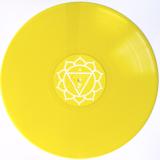
Utter presents Marshall Jefferson's previously unreleased meditation opus 'Yellow Meditation For The Dance Generation' alongside two remixes from French production maestro Joakim.
Marshall Jefferson: Chicago House music pioneer, creator of the anthemic ‘Move My Body’, an original collaborator of Adonis, Ce Ce Rogers and Roy Davis Jr., production mastermind of countless dancefloor classics such as Phuture’s ‘Acid Tracks’, Sterling Void’s ’It’s All Right’, Hercules’ ‘7 Ways’… and the soothing voice behind a 36 minute healing meditation guide. Yes, really.
But let’s rewind, slightly.
In 2017, Marshall was approached and encouraged by Ian ‘Snowy’ Snowball to write his autobiography and the pair set about putting Marshall’s account of the history of House music together. The book, ‘Marshall Jefferson: Diary of a DJ’ was published in 2019.
Following the book’s release, Ian and Marshall's collaboration continued and during the pandemic an outlandish idea arose to create a piece of music combining Ian's interest in meditation (he runs Club Chi specialising in Shibashi Qigong - a form of Tai Chi Qigong - which is a gentle form of movement therapy/exercise) and Marshall's willingness to experiment musically to see what might be possible.
The result is ‘Yellow Meditation For The Dance Generation’, where Marshall vocalises Ian’s lyrics in his instantly recognisable voice. The keen-eared out there may also recognise aspects of the music itself as a stripped back, lengthened and far mellower version of Marshall’s 1985 obscurity ‘Vibe’:
“I would take tapes to the Music Box and Ron Hardy would play my music. ‘Vibe’ was one of those tracks. I recorded ‘Vibe’ in 1985, but it became one of my tracks that I just forgot about until some guy on Facebook sent me a recording of it that was taken from a club. The only person who I ever gave a recording of ‘Vibe’ to was Ron Hardy. The other people I know who had copies of the track were Gene Hunt and Emanuel Pippin (DJ Spookie).
"The original version of ‘Vibe’ was made using a Roland 707, Roland JX-8P keyboard and a Roland 727 drum machine. I was still working at the Post Office at the time, and this was pre-‘Move Your Body (The House Music Anthem)’. ‘Vibe’ has the building blocks for ‘Move Your Body’ because it was using the instruments on the track that I discovered what I could do with the bass sound, to make a track like ‘Move Your Body’.”
Still, Ian’s initial intention for ‘Yellow Meditation’ was function and it was designed to be a ‘Sequential Relaxation Exercise’ focusing on the Solar Plexus. Bearing this in mind, Marshall took a bare-bones and hypnotic approach to this particular re-recording of ‘Vibe’ so that the voice takes centre stage and listeners (hopefully) find themselves on a meditative journey. In fact, this long-form track was always intended as a private tool purely for meditation at Club Chi rather than released to the public - after all, Marshall had also created and released a more drum heavy, ’traditional’ club-focused 'Vibe Three' instrumental version for that very purpose - but a chance airing of the full 36 minute version changed its path.
Much like those 1985 ‘Vibe’ cassettes, Marshall had sent the track to a few close contacts, one of whom was Kieran at Phonica Records who aired it over the shop’s basement soundsystem. Its unorthodox nature caught the ear of colleague Alex (of Utter) and the seeds of a physical release were planted.
Eventually, with the full-version carefully whittled down to a vinyl friendly length of 24 minutes, full track parts in hand and a b-side to fill, Alex sought out one of his favourite producers to take up the remix reigns: Joakim. The Tigersushi co-founder and Crowdspacer boss has a long history of boundary-pushing remixes that straddle both dancefloor functionality and experimentation. This time the original material resulted in Joakim coming up with a number of ideas and he finally delivered two versions - one club focused (‘Vertical’), the other more introspective and meditative (‘Horizontal’), both of which appear on the final 12”.
The limited edition 12” also includes a download code giving buyers access to all of the vinyl tracks plus an 18 minute extended version of Joakim’s ‘Horizontal’ remix, its instrumental counterpart (for those who can live without Marshall's voice) and full 12 minute acapella (for those who can't!)
Alex
a A1. Yellow Meditation For The Dance Generation (Edit) 24:00
b B1. Yellow Meditation For The Dance Generation (Joakim's Vertical Remix) 9:09
9:05
This version comes with sample CD
The sample CD's contain over a 100 samples from the legendary Waldorf Wave Synthesizer and have been out of press since 2015.
The Long awaited release of My Life With The Wave Vol 2 is here. Mike Huckaby is finally ready to take you on another journey of skillful sound programming using the legendary Waldorf Wave Synthesizer.
Yes, this is Volume 2 of My Life With The Wave. 4 tracks of strictly deep house music made entirely from the Wave. Enjoy another experience of music made exclusively with this synthesizer, The Waldorf Wave.
- A1: Sefa - Het Ergste Moet Nog Komen
- A2: Sefa - Requiem For Frenchcore
- A3: Sefa - Bach Met Discobal
- A4: Sefa & D-Block & S-Te-Fan - Symphony Of Life
- A5: Sefa & Max Alexander - Turn Back Time
- A6: Sefa - Blood & Honey
- B1: Sefa - Het Ergste Moet Nog Komen (Orchestral)
- B2: Sefa - Justify (Orchestral)
- B3: Sefa & D-Block & S-Te-Fan - Symphony Of Life (Orchestral)
- B4: Sefa & Vertile - Battlefield (Orchestral)
- B5: Sefa - Requiem For Frenchcore (Orchestral)
- B6: Sefa - Hallelujah (Orchestral)
- C1: Sefa - Aller Vers Toi
- C2: Sefa & Devin Wild - Into Space
- C3: Sef - Help Me
- C4: Sefa - Justify (Intro)
- C5: Sefa - Justify
- C6: Sefa & Vertile - Battlefield
- D1: Sefa - Sisyphus
- D2: Sefa - Prelude
- D3: Sefa - Left Behind
- D4: Sefa & Phuture Noize - Exodus
- D5: Sefa - Asturias
- D6: Sefa - Het Ergste Moet Nog Komen (Outro)
Der niederländische Frenchcore-DJ Sefa ist zurück mit seinem Vinylalbum "Het Ergste Moet Nog Komen" ("Das Schlimmste kommt noch"). Mit brandneuen Titeln, Kollaborationen mit u.a. Devin Wild und Phuture Noize und Orchesterversionen einiger seiner Meisterwerke ist diese Doppel-LP sein bislang ambitioniertestes Werk und ein Leckerbissen für seine Fans. Tracks wie "Requiem For Frenchcore“" und "Justify" reflektieren Herausforderungen im Leben, Sucht und Erlösung. Begleitend zum Release startet Sefa eine Welttournee mit Stopps in Städten wie Madrid, Antwerpen, Hamburg und Den Haag, um den Fans das ultimative Live-Erlebnis zu bieten.
New label Ché Wax launches with a double header: Buzz / Raga.
‘Love Buzz’, originally released in 1969 on Shocking Blue's At Home, gained fame when Nirvana covered it as their debut single nearly 20 years later. The Ché Wax rework enhances its psychedelic drama with acid disco elements, making it a dance floor staple 55 years on.
On the flip, RAGA: In 1982, Indian musician Charanjit Singh fused traditional ragas with Roland TR303-driven disco in Ten Ragas To A Disco Beat, recognized as a precursor to acid house, predating Phuture’s Acid Tracks.
Ché Wax reimagines Ten Ragas with an electro beat inspired by early ‘80s New York music, bringing this hybrid version to vinyl for the first time.
- A1: Piano Progression (Dee Sub Remix)
- A2: The Hurricane (Jimmy J Remix)
- B1: Back 2 Basics (Sunny & Deck Hussy Remix)
- B2: The Shivers (Sub Fundation Remix)
- C1: Insanity Clause (Pete Cannon Remix)
- C2: Free As The Sky (Ben Venom Remix)
- D1: A Little Radicalical (Innercore Remix)
- D2: Victory (Fibzy Remix)
- E1: The War (Nookie Remix)
- E2: Snow In Summer (Paul Bradley Remix)
- F1: Bassline (Phuture Assassins Remix)
- F2: 6Six6 (Gothika Shade Remix)
Repress.
Acen's Trip To The Moon series is simply unmissable, and these color vinyl represses are severely limited in number. Spanning all the original mixes, plus new material and new remixes from the likes of Pete Cannon, Danny Byrd, Phuture Assassins and Scott Brown, every EP in this series is essential.
Slip this delirious disc out of the lime/slime green sleeve and you're up close and personal with the new chapter in the TD saga.
A dance floor triptych of such seismic scale that the crew spent two years trying to wrangle the tracks on wax, finally finding a plant with the power to press them up.
Sprawling across the A-side is the devastating 'Doner Summer', an instrumental extension of some lost Munich disco masquerading as an Anatolian excursion. Ditching the vocals and cutting the kase, the crew lay down a galloping groove topped with Turkish licks and disco strings, take us into the psychedelic swirl of a tumbling drum breakdown before hitting the big red button marked banger for a searing second half. Firing up the hardware, TD blast this one further into the Phuture, dropping technoid sequences, nagging 303 and Cowley-style FX fuckery for a full on club assault.
In the alternate B-side universe, Hans Zimmer lost his dread note and Denis Villeneuve was forced to turn to Talking Drums for the Dune soundtrack. They obliged with the sci-fi rai of 'Chaba Ranks', reshaping an Algerian OG with a dancehall kick, off beat vamps and star-crossed synths, then letting loose with a heavy bass tone.
|In time honoured fashion, the team also drop a dub version, cutting out the vocals and focussing on those additional elements for the wildly cosmic 'Chaba Skanks'.
Now who's getting the spice in?
Limited Press - Numbered Insert - Drum Fun Guaranteed !
repress !
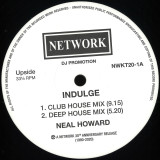
Network’s 30th Anniversary celebrations continue with the re-issue of the debut release from the iconic label. The launch of the logo with Neal Howard “Indulge” in 1990 caused a sensation, with the track being instantly acclaimed as a Classic, and Network noted as a new label to watch.
“Indulge” hails from Chicago, but sounds like its’ DNA is Techno City Detroit.
A futuristic call to dance from Windy City mystery man Neal Howard, whose previous releases “The Gathering” and “To Be Or Not To Be” had already reached cult status. Those gems, and “Indulge” were recorded by Chicago label Phuture Sound. Plans were being laid for the transformation the Kool Kat label - the UK outlet for Kevin Saunderson, Derrick May and Juan Atkins - into Network, but the dilemma was finding something “really really special” for the first release. That search for the perfect beat ended when Network’s Neil Rushton on a visit to Chicago heard the just mixed “Indulge” on a cassette played by Phuture Sound boss Terry Baldwin, who after prolonged negotiations agreed to cancel a USA release so the new UK label could have an exclusive.
The label design for this release is a replica of the original DJ Promo 12” that introduced Network to the World with exactly the same tracks; Terry Baldwin’s much loved Club House and Deep House mixes of “Indulge”, coupled with “To Be Or Not To Be” remixes by Chicago’s Bad Boy Bill and Detroit’s Derrick May. network - it is what it was...
Is a (4 Track) offering from the (Trax) 'Golden Boy' Daniel Smith AKA (Late Nite 'DUB' addict). The self confessed 'House' Addict says he is privileged to release on the same label as some of his heroes in the house world such as (Mr Fingers) aka (Larry Heard) / Joey Beltram / Jesse Saunders / Chip-E / Phuture / Saytek & DJ Rush. He is a prolific producer that has released more than (x200) original tracks on (Trax Records) alone with
some remixes under his belt from (Screamin Rachael) / (Joe Smooth) / (Todd Terry) & (Armando). This Solid Underground House EP once again shows that this New Cat in the Chicago House Scene is still hitting with the Big Hitters and is a statement that his sound is here to stay.
Acen's Trip To The Moon series is simply unmissable, and these color vinyl represses are severely limited in number. Spanning all the original mixes, plus new material and new remixes from the likes of Pete Cannon, Danny Byrd, Phuture Assassins and Scott Brown, every EP in this series is essential.
This series of remixes, stretching all the way back to 1993, continues to progress and expand its base of talented and incredible old skool talent. Part 16 brings some high caliber talent to the table with both Phuture Assassins and Tim Reaper on remixes duty for the first time. Plus we have stellar work from both Mannik and Shoreman, two of Kniteforce’s finest…
- A1: Logic System - Unit
- A2: Kraftwerk - Computerwelt (2009 Remastered
- B1: Whodini - Magic's Wand
- B2: Rocker's Revenger - Walking On Sunshine (Feat Donnie Calvin
- C1: Klein & Mbo - Dirty Talk (European Connection
- D1: Liaisons Dangereuses - Los Niños Del Parque
- D2: Yello - Bostich
- E1: The The - Giant
- F1: The Residents - Kaw-Liga
- G1: Clan Of Xymox - Stranger
- G2: A Split - Second - Flesh
- H1: Severed Heads - Dead Eyes Opened
- H2: The Weathermen - Poison!
- I1: New Order - Blue Monday
- J1: Anne Clark - Our Darkness
- J2: 16 Bit - Where Are You?
- K1: Phuture - We Are Phuture
- K2: Model 500 - No Ufo's (Vocal
- L1: Frankie Knuckles Feat Jamie Principle - Your Love
- L2: Quest - Mind Games (Street Mix
- M1: Jasper Van't Hof - Pili Pili
- N1: Guem Et Zaka Percussion - Le Serpent
- N2: Hugh Masekela - Don't Go Lose It Baby
- O1: Sly & Robbie - Make 'Em Move
- Q1: The Ecstasy Club - Jesus Loves The Acid
- R1: Foremost Poets - Reason To Be Dismal?
- S1: Lhasa - The Attic
- S2: A Guy Called Gerald - Voodoo Ray
- T1: M/A/R/R/S - Pump Up The Volume - Usa 12" Mix
- T2: Bobby Konders - Nervous Acid
- U1: Meat Beat Manifesto - Helter Skelter
- V1: Raze - Break 4 Love
- W1: Sueño Latino With Manuel Goettsching Performing E2-E4 - Sueño Latino (Paradise Version
- X1: Off - Electrica Salsa
- O2: Brian Eno - David Byrne - Help Me Somebody
- P1: Primal Scream - Loaded (Andy Weatherall Mix
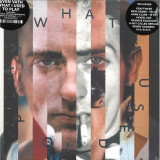
For this uniquely personal retrospective spread over twelve vinyl discs, Sven Väth takes us back to the early days of his DJ career. On What I Used To Play we meet great pioneers of electronic music, gifted percussionists, obscure wave bands, and innovative producers of a bygone 'new electronic' era. Rough beats and irresistible grooves from the identification stage of house, techno, and acid remind us not just how far electronic music has evolved over the past four decades, but how great it was to dance to EBM, techno, and house for the very first time.
If there is one protagonist of the electronic music scene who has remained curious, innovative and at the very cutting edge of music for over four decades, it's Sven Väth. His multi-layered artist albums and Sound of the Season mix compilations have been defining the genre for over two decades, and even today, he is constantly on the lookout for the next top tune to add to the highlights of his next set. At least, that's the case when he's not producing them himself as an artist or remixer. "Actually, it's always been part of my DNA to think ahead," and nothing had been further from his mind than looking back at his past, but when in spring of 2020 the international DJ circuit had to be scaled down to virtually zero, the 'restless traveler' suddenly had time. Time to stop and reflect on "how it actually was back then, at the very beginning of my career..."
"It was a great trip and with every track, beautiful memories came flooding back".
In the London apartment, he had just moved into, Sven has set up a "little music room", where he cocooned himself for several days, "to look way back for the first time and review my musical journey through the eighties, so to speak."
The interim result was six thematically oriented playlists with a grand total of 120 tracks from 'early 80s' to 'Balearic late 80s', together with excursions into afrobeat, European new wave, and EBM sounds and a few epochal techno/house tracks from the USA in between. From these 'Best of Sven Väth's favorites', the project What I Used To Play crystallized. Sven remembers how the Cocoon team reacted to his proposal: "They found the idea of making a compilation out of it MEGA from the beginning and everyone said 'Sven, go for it', but then, of course, the work really started, namely, to clear the rights and to get clean sounding masters of the up to 40-year-old tracks. There was also disappointment, of course. We couldn't clear certain titles because the rights holders in the USA had fallen out with each other or simply disappeared from the scene. In short, it wasn't easy, but now I can safely say we got the most important tracks."
Finally, after two years of research, curation, design, and administrative fine-tuning, the "little retrospective" from 1981 to 1990 is available. The exquisitely packaged, and three-kilo heavy box set is not only physically impressive, WIUTP is also the definitive record of Sven Väth's musical development. On each of the twenty-four sides of vinyl, you can trace track by track, what influenced him during which phase, and how he took off as a DJ from his parents' Queen's Pub straight into the spotlight at Dorian Gray. There and at Vogue (later OMEN), Sven became the style-defining player in the DJ booth that he still is today.
1981 - 1990: Future Sounds of Now
In the early eighties, the crowd in clubs like Vogue and Dorian Gray danced to what nowadays we call 'dance classics' - mainly disco, funk, soul, and chart pop. It was up to a new generation of DJs, including Sven Väth, the youngest protagonist in the Rhine-Main area at the time, to create their own club-ready music mix. Good new tracks and potential floor-fillers were rarities that had to be sought out and found, in order to prove oneself worthy.
Without MP3s, internet streaming, or other digital download possibilities, music didn't just gravitate to the DJ, instead, it had to be tracked down. In well-stocked record stores in Frankfurt and Wiesbaden or even in Amsterdam, London, or New York, Sven and friends sourced the material for countless magical nights. On WIUTP we can follow Sven's very personal journey through this wild, innovative era in which synth-pop, funk, hip-hop, and disco were successively replaced as 'club music' by house, techno, acid, and breakbeat. By the end of the decade, it was clear to see that these once exotic 'fringe' phenomena would soon become 'mass' phenomena.
Early 80s
Dirty Talk by the Italian-American duo Klein & M.B.O. represents the most innovative phase of the Italo-disco genre in the early eighties like no other track. Mario Boncaldo (I) and Tony Carrasco relied entirely on the original synthetic drum and percussion sounds of the Roland TR-808, coupled with the raunchy vocals of Rossana Casale and guitar accents of Davide Piatto. Of course, other tracks from this period were also influential in style, most notably Unit by Logic System, which worked as the perfect soundtrack to the laser lighting system at the legendary Dorian Gray club. With stomping beats and robotic rap interludes, Bostich by Yello also belongs on Sven's eternal playlist - after all, it caught the attention of Afrikaa Bambaataa, who invited the Swiss duo to perform at the Roxy in New York in 1983.
EBM Wave - Mid 80s
From today's point of view, the almost ten-minute-long, downtempo track Giant by Matt Johnson's band project The The, would probably not be considered an obvious club classic. However, a closer (re)listen reveals the rhythmic intricacies of the percussion overdubs by JG Thirlwell (aka Foetus) on Johnson's composition, and it becomes clear why this exceptional piece of music is one of Sven's absolute favorites. Other classics from this phase include Kaw-Liga by the mysterious The Residents, the hypnotic-synthetic Our Darkness by Anne Clark (and David Harrow), and last but not least, the somber, monotonous anthem Where Are You? by 16Bit, one of Sven Väth's projects together with Michael Münzing, Luca Anzilotti from 1986.
US House - Late 80s
You certainly can't talk about Chicago house without mentioning Frankie Knuckles. The resident DJ at the Warehouse not only gave the name to an entire genre, but also produced epochal floor fillers on the Trax label like the timeless Your Love, sung (and moaned) by Jamie Principle. Acid house protagonists Phuture also hail from Chicago, and on We Are Phuture (also released on Trax) we hear the chirping acid sounds of the legendary Roland TB-303 in full effect. Another featured classic is No UFO's by Detroit's Model 500 aka Juan Atkins, who is rightly considered the 'Godfather of Techno' even if the genre-defining track from 1985 still breathes with the spirit of hip-hop and electro from the first breakdance era.
Afrobeat
Le Serpent, by Algerian-born Abdelmadjid Guemguem, is a track that sounds completely different from everything else on WIUTP. Made in 1978, it's a monumental, rousing groove created without bass or synths, just with five congas! Even though Guem sadly passed away in 2021, his immortal, acoustic beats are understood all over the world and will continue to enrich many thousands of DJ sets for years to come. Another classic that not only Sven appreciates beyond measure is Hugh Masekela's Don't Go Lose it, Baby. In addition to being one of the most important jazz pioneers, the trumpeter and freedom fighter from Johannesburg was very experimental, integrating electronic sounds into his music in later years, in a similar vein to Miles Davis and Herbie Hancock. Dutch jazz pianist Jasper van't Hof's afrobeat project Pili Pili has also aged well. The trance-like, almost sixteen-minute-long track of the same name, manages to fill a whole side on the seventh of twelve vinyl discs in the WIUTP box.
UK-US-Euro - Late 80s
Time for a change of scene, in the truest sense of the word, and from a musical perspective, this section is like landing on another planet. First up is Andrew Weatherall's classic remix of Primal Scream's Loaded, featuring the iconic Peter Fonda sample (lifted from the 1966 biker film Wild Angels) that came to personify the mood triggered by the British Second Summer of Love in the late eighties: "We wanna be free to do what we wanna do, and we wanna get loaded...". This period also saw the emergence of M/A/R/R/S whose only single, 1987's Pump Up The Volume, became a club classic with support from DJ legend CJ Mackintosh. In this most eclectic of sections, we also encounter New York house and reggae producer Bobby Konders and his seminal Nervous Acid.
Balearic - Late 80s
Those who know him, know that Sven had already lost his heart to the 'magic island' of Ibiza as a teenager, so with that in mind, the WIUTP project couldn't end without a Balearic chapter. Inspired by Manuel Göttsching's E2-E4, the immortal, eponymously titled Sueño Latino belongs in there without question. Equally popular on the island was, and still is Break 4 Love by Raze, which thinking about it, would also fit perfectly into the house chapter. Last, but not least, there's an overdue reunion with Sven Väth himself, in his role as frontman of the successful Frankfurt trio OFF. Together with Michael Münzing and Luca Anzilotti (later of Snap!) this 'Organization For Fun' created the off-the-wall club hit Electric Salsa in 1986 which incidentally turned into an international chart smash, putting Sven in the enviable position of having to decide between pop stardom and a DJ career. Well, we all know how that decision turned out and the rest, as they say, is history. A not insignificant part of his story is What I Used To Play. Enjoy!