System Error keeps it FunFunFun with the arrival of b²z!p. Straight out of Frankfurt’s underground, the Reality Report EP delivers four super inventive dancefloor workouts, bending genres and expectations in all the right ways.
Traversing through rugged takes on Detroit electro and minimal shades of house, every track bringing its own playful character. This is forward-thinking club music with a raw, analogue soul - unpredictable, intriguing, and primed to shift the energy on any floor. An essential report from the reality we want to dance in...
quête:play out music
The first release to document the solo cello work of musician and composer Lucy Railton, the 40-minute composition Blue Veil recorded at Église du Saint-Esprit in Paris invites listeners into the realm of precision-tuned states of resonance: states made manifest through Railton's careful traversal of her cello's most subtle acoustic characteristics as they harmonically interlock with mind's embodied modalities of attention and imagination. Blue Veil arises out of, is sustained in and finally dissolves back into Railton's momentary presence with her intimate connection to the cello, a way of hearing that allows for a deeper engagement with harmonic resonance, one that opens a space for immediate encounters of mind and sound. Railton's exploratory practice of harmonic perception emerges from a focus on the physical qualities of intervallic and chordal sounds, their textural qualities, degrees of friction, and inner pulsations. Composing in the moment guided by resonances within the cello's body, her own, and their shared vibrational space, Railton moves through Blue Veil by giving sounds what they ask for: sounds of pure texture manifesting as a move through temporal transparency, sounds of rough texture marking regions of dimensionally dense space. Railton's creative and highly refined use of just intonation harmony deforms sound's inner movements in ways that suggest a mode of listening that actively supplies imagery of sounds implied or completely absent rather than merely savouring those fully present. This active mode of "listening-with", playfully and semi-metaphorically referred to by Railton as "sing-along music", allows listening to reflexively participate in the music's movement as it gradually passes through richly saturated domains of harmonic imagination. And just as the precision-tuned tones of Blue Veil lose their individuality when fusing multifaceted uniformity, listening's structures of reference and recognition dissolve into nameless waves of intensity, continuously unfolding themselves upon and merging with the listener. Blue Veil is the result of a deep exploration of the inner worlds of tuning, an undertaking in turn informed by and emerging out of Railton's realisations of the music of Catherine Lamb and Ellen Arkbro, her collaborative work with Kali Malone and Stephen O'Malley as well as her interpretive practice in performing the work of Maryanne Amacher, Morton Feldman and others.
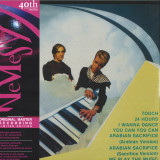
On the occasion of the 40th anniversary of its original release, this limited edition Black vinyl is reissued in an exclusive version, created using the Original Master Tape to ensure an authentic and faithful sound to the original recording. The high-quality mastering process ensures optimal sound performance, enhancing every detail of the production, from the depth of the bass to the clarity of the highs. Pressed on 180g Black vinyl, this product is marked with the SIAE trademark to guarantee authenticity and has been carefully crafted to provide a flawless listening experience.
This limited edition also includes an autographed photo from the band, making it even more personal and collectible.
This limited edition, available in a limited run of only 250 copies, is designed for true collectors and enthusiasts. Each copy of the 40th Anniversary Limited Edition Black Vinyl pays tribute to an album highly appreciated by Italo-Dance music lovers.
Originally released in 1985, the album challenged the conventions of the time with an alternative and innovative sound, standing out in the Italo Disco scene. The album received international praise, especially from the most demanding audiophiles, for its pioneering production and ability to distinguish itself from mainstream sounds. The remastering process from the Original Master preserves the authenticity of the original sound, delivering superior quality.
With the included removable OBI, this special edition gains an additional distinctive touch, completing its design and reinforcing its status as a cult item. Don’t miss the opportunity to own this unique vinyl, perfect for those who appreciate authentic music and wish to enrich their collection with a rare and valuable piece.
180 G. BLACK VINYL WITH LINER NOTES IN CREOLE, FRENCH, ENGLISH
Originally released in 1979, "Spiritual Sound" lives up to its name, a soaring, triumphant album, six tracks of spirit magic from Guadeloupe.
Telluric, intense, terribly alive, the gwoka drums of Guadeloupe carry the identity of a painful and fervent island. Marked forever by the crime of slavery, Guadeloupe's créolité cherishes the ka drums and their natural environment: the low-pitched boula drum with male goatskin, the high-pitched soloist makè drum with female goatskin, the chacha, ti bwa, triangle, calabash and other percussion instruments that surround them, and the voices - the fiery, proud, timbred, urgent voices of the gwoka.
This album is also a legend for its voices: in his then dazzling youth, singer Lukuber Séjor was one of the first gwoka artists to largely feminize the chorus of répondè, who converse with his text delivered in a straight and powerful voice.
And everything here sets new standards. In 1979, Mizik Filamonik - Spiritual Sound proclaimed a spiritual patriotism of ferocious intensity. The album by Lukuber Séjor - whose spelling alone is a battle - sets out to give Guadeloupe the intangible weapons of self-respect and self-knowledge, through a singular practice of traditional music.
The genesis of gwoka music is less straightforward than one might imagine... The drums performed the servile task of accompanying the work of slaves in the fields and during the “corvées” imposed by the administration, before being freely practiced by the common people after the abolition of 1848. At the heart of the conviviality of the Guadeloupeans furthest from the cities - geographically and socially - the gwoka drums come out for carnival, funeral wakes and neighborhood celebrations, but also during strikes, fits of anger and armed vigils of the riots and revolts that have punctuated the island's history. For generations, governors of the colony and then the prefects of the overseas department of Guadeloupe have been viewing the gwoka as a potential for turbulence and a threat to public order.
But as the Beatlesmania, “chanson engagée” and rock revolutions unfolded in Europe, young people turned to the drums of mizik a vié nèg (“bad negro music”, in Creole), which Guadeloupeans had learned to despise by following the “assimilation” process advocated by the school system and most of the political class. At the end of the sixties, in a Guadeloupe mourning the deadly repression of the May 1967 social movement, they played traditional music, refusing to wrap it up in tourist prettiness and madras folk costumes. Instinctively, they played a rough and contemporary gwoka, led by the incendiary Guy Konkèt. This was the era of decisive 45 rpm records such as Robert Loyson's Kann a la richès, which brought to light the fieriest words of union rallies.
At his home in Sainte-Anne, Lukuber Séjor played with flautist Olivier Vamur and his brother Claude Vamur, who cobbled together a drum kit from tin crockery and became, a few years later, the most influential drummer in Kassav'.
These were the years of the Bumidom program, when young Guadeloupeans were encouraged to emigrate to mainland France. At the age of twenty, Lukuber Séjor embarked on the liner Irpinia, disembarking at Le Havre and taking the train to the Gare Saint-Lazare - the route taken by thousands of young West Indians who went on to study or looked for work, all the while trying to maintain a link with their homeland. In this case, it's at the Antony university residence, where Lukuber played the drum and participated in a thousand gwoka updates and aggiornamentos, while exile reinforced the need for a spiritual link with the native land.
In 1978, Guy Konkèt played at the Salle Wagram, a historic event for West Indian music. After serving as répondè - i.e. backing vocalist - on one of his home-recorded albums, Lukuber joined his live band. Little by little, he became one of the key artists on a circuit parallel to French show business. At a student party in Caen, he met a young woman from Martinique who, at the time, was more motivated by her ambitions as a visual artist than by her vocation as a musician. Her name was Jocelyne Béroard and, a few years before she plunged into the Kassav' adventure and became the greatest West Indian singer of her generation, she designed the cover of Lukuber Séjor's LP.
This ambition was obvious and imposed its will. A more or less regular band was formed, with Roger Raspail, Rudy Mompière and Éric Danquin on ka drums, Claude Vamur on ti bwa, Olivier Vamur and Françoise Lancréot on flutes and Annick Noël on keyboards. Lukuber Séjor is set on wanting to extend the gwoka palette to other instruments, as the jazz-rock revolution opens a thousand new doors. Annick Noël will play a wide range of timbres and textures on electric piano and synthesizer. Another novelty: the répondè are two men and two women, Roger Raspail, Olivier Vamur, Françoise Lancréot and Maryann Mathéus ...
Mizik Filamonik - Spiritual Sound is a self-production in which the singer and leader sank all his savings, allowing him no more than a single day in the studio. The first side is more of a musical manifesto, with the first two tracks, Éritage and Penn é plézi, being instrumentals. The third, Son, forcefully celebrates the need for Guadeloupeans to connect with the gwoka. In fact, Jocelyne Béroard's cover shows a tambouyé in the shadow of a cloudy sky, against which a radiant sun is rising and whose light will soon flood the entire landscape. The silhouette and face of this man strongly evoke the immense Vélo, master of the ka, rejected at the time on the fringes of society.
The second side of the LP is surprising. Formally, three tracks are explicitly linked like the three parts of a triptych. Primyé voyaj evokes the appalling tribulation of Africans deported as slaves to Guadeloupe; dézyèm voyaj speaks of the Bumidom program and the economic, political and social forces driving young Guadeloupeans towards the mirage of prosperity in France; twazyèm voyaj closes the cycle with the emigrants' return from Europe after years away from their island...
This gwoka, obsessed with the need to save Guadeloupe spiritually, appeals far beyond the politicized audience. Mizik Filamonik - Spiritual Sound instantly became a classic, although Lukuber Séjor never really made a career for himself as a musician.
After all, the album was released in 1980, with no promotional resources in France or Guadeloupe - and therefore no concerts. The thirty-two-year-old author, composer and performer made his own third trip back to Guadeloupe. He set up a small woodworking business, which he lost in Hurricane Hugo in 1989. His other activity, teaching in a medical-educational institute, became the core of his professional life. He continued to be an active campaigner - a campaigner for the Creole language, a campaigner for the reawakening of identity, a campaigner for special education, a campaigner for a thousand causes that he ignited with his generous and perceptive enthusiasm, such as the defense of breadfruit fries...
The echoes of his 1979 album have not died down. Of course, the use of Penn é plézi as the theme tune for Radio Guadeloupe's funeral notices from 1980 to 1992 kept him in the collective memory, but he continues to sing and compose sporadically, as with his all-female
vocal group Vwapoulouéka... Still convinced that music is a means of liberating the spirit, he continues the journey of a young man eager to deploy the power of Creole music and language.
Bertrand Dicale
Heavy, mind-warping techno built for the late-night sessions. Kosh delivers deep, rolling basslines and spaced-out textures with pure underground energy. A must-have for selectors who like it deep and driving.
Radio Slave (Rekids) : Feeling "Whiplash"...
Laurent Garnier : cool EP
Ben Sims : Now downloading. Will check asap!
Marcel Dettmann : thx
Enzo Siragusa (FUSE) : Really nice EP!
Raresh (ar:pi:ar) : thanks
Archie Hamilton (Microhertz / FUSE) : Lovely stuff
Dorian Paic (Raum Musik) : No Exit is the one for me. Thx for the promo.
Truncate : Nice cuts
KT (Space Dust / Sisu) : Belter EP
Jerome Sydenham (Ibadan) : Downloaded for Jerome Sydenham
Domenic Cappello (Subclub) : nice release
Chloé Caillet (Smile Records) : love this!
Italojohnson (Italojohnson) : No exit for me
Darko Esser / Tripeo (Balans / Clone) : Kosh always delivers. Straight in the bag!
Mystic Bill (Classic / Trax / Relief) : Great release here, thanks!
Fred Everything (Lazy Days Music / 20:20 Vision) : Enjoying the dubby Whiplash, thanks!
Ame (Innervisions) : thanks
Ryan Elliott (Faith Beat) : Whiplash!!
Bill Brewster (NTS) : Lost in change is v good.
Harri (Sub Club) : nice, will play and support
Tal Fussman (Survival Tactics / Innervisions / Cod3QR / Drumpoet / Rekids) : nice one!!
Greg Gow (Restructured / Transmat / KMS) : great vibes will play out
Bake (All Caps/Rinse FM) : sick. thank you!
Enrica Falqui (ERIS, Plexus 4) : Love it!
Luke's Anger (real name Luke Sanger) delivers his first outing on Love Love, Ceiling Walker. Sanger is a relentlessly interesting hero of the underground, probably best known as a techno and electro producer and an active player in the live experimental techno scene across Europe, notably including multiple appearances at Berghain/PanoramaBar. Based out of Norwich, UK, Luke has put out a plethora of banging records for two decades in styles from across the rave spectrum on some of our favourite record labels like Tigerbeat6, Don't and Sneaker Social Club, as well as an increasing amount of more ambient-leaning releases under his real name in recent years. Recognised as a true techno stalwart, Luke has received support from the likes of Surgeon, Dave Clarke, The Advent and Jerome Hill.
This EP fits firmly into the 'banging' camp - more than a nod to classic stateside sci-fi electro stylings as well as UK dance music's bleep techno bass foundations, this is popping, caustic, mechanical phunk expertly engineered to make you shake and wiggle. Particle Swarm kicks the EP off with strung-out synth chirps and plenty of latex squelch before moving onto the bounciest number, Threshold Rider, with buoyant bassline droplets poking through a solid 808 framework. On the flipside, title track Ceiling Walker utilises rushing crescendos and fluttering analogue rhythms to keep the dancefloor in rapture while closer, Silicon Boogie, achieves maximum levels of funk by aptly juxtaposing digi vocal snippets against square wave bass.
Liner Notes by Martyn Pepperell
A collection of ten hypnotic guitar renditions that dive deeply into the traditional compositional musicality that underpins Harakami’s hallucinatory beatscapes before reconsidering them under a fresh, innovative and engaging new light. River: The Timbre of Guitar #2 Rei Harakami signals a new level of awareness and understanding of both Rei Harakami’s significance and Ayane Shino’s undeniable talent.
VITAL SALES POINTS:
In 1996 Tokyo-based label Sublime Records received a cassette demo from Rei Harakami, a 26-year-old Japanese experimental filmmaker, and musician. Within one year Harakami’s debut LP ‘Unrest’ was released. As the 21st century dawned, Harakami was becoming a critically acclaimed figure, and there was a feeling in Japan that Harakami would be an inevitable successor to such luminaries as Haruomi Hosono and Ryuichi Sakamoto. Sadly Harakami passed away at age 40 in 2011, leaving behind a musical legacy that seemed to deserve more recognition. A fitting tribute now comes from the incredibly gifted classical guitarist Ayane Shino. Continuing her album series ‘The Timbre of Guitar’ (the inaugural release of which was ‘Sakura’ - a cover album of Susumu Yokota's seminal album, released through the Swiss label, Mental Groove Records in 2021), she now presents ‘River ???? : The Timbre of Guitar #2 Rei Harakami’. Ayane has reworked some of Harakami’s standout tracks into an album of tranquil yet complex compositions helping to build a new level of awareness and understanding of Rei Harakami’s significance. A collection of ten hypnotic guitar renditions that dive deeply into the traditional compositional musicality that underpins Harakami’s hallucinatory beatscapes before reconsidering them under a fresh, innovative and engaging new light.
In the years that followed Harakami’s untimely passing, Sublime Records continued to sign and support new artists emerging from Japan’s rich and fertile electronic music scene. This eventually led to a meeting with gifted classical guitarist Ayane Shino in 2020. Although a new name within electronica, Shino’s classical resume is impeccable. She has performed with a range of prestigious orchestras in concert halls and at music festivals across Japan, Europe, and South America while playing classical guitar for numerous animations, movies and television commercials and holding various educational roles. These days, she also hosts the Tokyo Harmonics radio show, which is syndicated through Hyogo prefecture’s Ashiya Radio and TJS Radio in Los Angeles.
During her time completing a masters at Tokyo’s University of the Arts, Shino became fascinated by Brian Eno, Aphex Twin, Oneohtrix Point Never, Steve Reich, and, closer to home, Harakami and Susumu Yokota. ”I found myself in an environment where I was surrounded by fellow students who produced computer music, live electronics, and installations,” she explains. Following her meeting with Sublime, Hideoki Amano, the producer and owner of Musicmine, the parent company of the label, asked Shino if she would be open to transcribing and recording an album of covers of the late, great composer, producer and DJ Susumu Yokota’s music in incorporate into then-upcoming events commemorating the 5th anniversary of his death and reissues of his past works. “Yokota made music with the Roland TB-303 bass synthesizer and samplers, not in a way like a conventional instrumentalist, so I was aware it might be more of a challenge for her,” Amano explains. Fittingly, Shino was up for his suggestion, leading to ‘Sakura: The Timbre Of Guitars #1 Susumu Yokota’. Song by song, Sakura highlighted Shino’s free-flowing playing and prowess at translating electronic music into classical guitar shapes.
After considering Harakami’s background as an instrumentalist, Amano felt revisiting his catalogue should be the next step for Shino. Well-versed in how often classical versions of electronic music tend to fall flat, he asked her to examine Harakami’s songs closely, select the musical phrases suitable for guitar and create arrangements that would sound interesting to music listeners with a deep engagement with ambient, techno and electronica. In Harakami’s discography, Shino discovered “a sense of simplicity, warmth, moisture and a floating sensation.” “I was gripped by his songs, which had an array of sounds that gave me a sense of mystery but also coexisted with a sense of familiarity,” she explained. Moving beyond his official releases, Shino began digging through YouTube to find live recordings, radio appearances and obscure outtakes. Within her mind’s eye, imagining playing his songs on guitar was effortless. On her approach to the album, Ayane explains: “For this album, I succeeded in spinning some exquisite, silk thread like delicate tones, interwoven with human warmth, gentleness and simplicity. And I was also able to rework Rei Harakami's distinctive sound with a floating feel to it and transform it into a very classical guitar sound. I hope many people will be able to receive this group of sounds that I created in this album that I played with all my heart.” A record of limitless innate beauty, ‘River ???? : The Timbre of Guitar #2 Rei Harakami’ is a delicate and thoughtful body of work. A true masterclass in deconstruction and subsequent rebuilding, and an eternal lesson in how the art that we leave behind can outlive us all.
WRWTFWW Records is honored to announce the first ever vinyl release of Joe Hisaishi’s original soundtrack for the critically acclaimed and all around classic 1993 Japanese yakuza/crime/thriller movie Sonatine. The legendary album comes in a limited edition housed in a luxurious heavyweight sleeve with selective varnish printing and a special paper obi belt.
The celebrated Sonatine was directed, written and edited by Takeshi Kitano, who also takes center stage as the main protagonist of the thrilling yakuza film. Director, screenwriter, comedian, actor, tv personality and icon, 'Beat' Takeshi is also known for Boiling Point, Hana-Bi, Battle Royale, Johnny Mnemonic, Ghost in the Shell and many many more.
Considered one of the greatest ever, Joe Hisaishi is a composer, musical director, conductor and pianist behind over 100 film scores including Kitano’s A Scene at the Sea, Kikujiro, and Brother, as well as his famed work for director and animator Hayao Miyazaki’s Studio Ghibli masterpieces Castle in the Sky, My Neighbor Totoro, Princess Mononoke and the list goes on. Little known fact: his first ever produced-album is a collaboration with percussionist Midori Takada (Through the Looking Glass): MKWAJU Ensemble’s MKAWJU also released on WRWTFWW Records.
The Sonatine movie score showcases the composer’s more contemplative, minimalistic, and intimate side in a superb and deeply evocative neo-classical and ambient musical journey. The depth and emotional resonance of the compositions make for an exceptional and timeless soundtrack. It is known to be one of Hisaishi’s own favorites.
Sonatine (Original Soundtrack) by Joe Hisaishi follows the release of the soundtrack of Takeshi Kitano’s Violent Cop (1989), as well as music from another groundbreaking Japanese movie, Shin’ya Tsukamoto’s Tokyo Fist (1995). Collect them all on WRWTFWW Records!
To speak to Luca Daniel Schwarz aka LDS about his music is to be enthusiastically guided into a complex world of his own creation: clean and powerful techno which pulses with life from the textured patterns and drum sequences that have fills and accents that would make anyone who’s picked up a set of drumsticks envious. Yet this ecosystem of noise is deceptive; Schwarz’s process for making music is very different to how a live drummer would create the same subtlety of performance. Forever researching new technology, Luca got deeply interested in different programming languages, and created a series of probability-based music tools for manoeuvring sounds and sequencing.
Manipulating those probabilities takes a skilful alchemy, needing understanding of both musical structure and how the tools he devised work. To return to the drummer analogy, if the drummer is focussed and intentional in the moment of playing, then the method used in LDS tracks is almost diametrically opposed, with all of the intention coming in the assembly of the instruments, potential paths, and gateways; once play is pressed the music flows, following all the rules that were set in advance, not unlike a domino run or Rube Goldberg machine. And like a domino run, the results are fascinating and, ultimately, fun: staccato vocals pop in and out in ‘zipp prompt’; laser-like synths pulse; background noises sweep across the aural plane of the dub techno of ‘diff, blockmix’ and ‘pow’ adding texture that brings vitality all-too-easily missed out when complex mathematical
processes become entwined with music creation. The high sensitivity to texture and rhythmic detail in Stadion Progg is multiplied further on Jean Redondo's remix - whose track, Hypersonic, was the backbone of 2023’s ‘yet’ compilation on Tresor.
The balance between technology and a sense of fun might also come from the maker; it’s not easy to overstate Schwarz’s passion for what is now his favourite way to make music, “it never gets boring. There’s always a moment of anticipation to see what actually emerges.” And the true “power of 2” comes into play when the resulting music can be fed back through the system again and again, potentiating the music in exponential ways.
DJ Rocca and Chris Coco spent some time hanging out together by the pool at an intimate festival called La Casella in Umbria in the
late summer of 2019.
They spent a lot of time talking about Italo Disco, the Rimini / Riccione riviera in it’s heyday in the 90s and classic clubs from the early
days of the Italian scene.
By the end of that beautiful weekend they had decided to make some music together that would somehow capture and reflect their own
hazy memories of places they visited or played and nostalgic dreams of earlier scenes they were too young to participate in.
Over the ensuing months the idea developed into an imaginary retro-futuristic club called CocoRocca DiscoTeca, a fantasy version of
a past club that never existed and at the same time a future club that was really possible to create one day.
If there was such a club, what would the music sound like?
Surely, a fusion of various sounds of dub/house/disco that the pair of DJs had been collecting and playing out for years. So inspiration
lists were made and ,slowly, a soundtrack for a night at that imaginary club began to take shape, beginning slow and dreamy, for the
moment of arrival; lifting up to a peak; and finally drifting down to the final tune of the night.
The result goes something like this…
Spread across two discs for maximum fidelity, this is sound system music with grooves primed for mixing and dialed-to-a-Tee bass weight, but hovering above the grounded structures are fleeting rhythmic textures that veer things off into a world worth getting lost in. Throughout its 11 tracks, “Club Dream” plays out like a full mix, ebbing and flowing through a variety of energy levels and moods. Some of the range you’ll find here includes half-time dream-step, peak time pulses, and dubbed out mid-tempo tech, all done with a cohesive restraint and appreciation of atmosphere. The record imparts it’s own kind of dance floor dream logic onto the listener, inviting us to let go of making sense of things and trust in its fuzzy logic.
- A1: Raz Fresco– Who Mapped The Earth
- A2: Romderful– Maybe With You
- A3: Dowker– Call Me
- A4: Speak– Sakuraba
- A5: Cookin' Soul, Ovrkast– Flying
- A6: Monster Rally, Demahjiae– Clooney
- A7: Mr Scruff– Flute Boom
- A8: 645Ar– Shooting Star
- B1: Peanut Butter Wolf, Waragainstgod?, Mikah 9– Organic A I
- B2: Chuck Strangers, Graymatter– Marigold
- B3: La Jay, Pigeon John– Thank You
- B4: Dj Harrison– Applechopchutney
- B5: Monster Rally, Homeboy Sandman– I Love You
- B6: Low Leaf– Faerie Function
- B7: Pouya, Boobie Lootaveli– Bitch, Park Backwards
- C1: Eddie Chacon, John Carroll Kirby– Comes And Goes (Live At Isc)
- C2: Devin Morrison– Givin Up
- C3: Suzi Analogue– King
- C4: Lee Perry– Morning Star
- C5: Dayytona Fox– Woooaaah
- C6: Bombay , Rvyo– Kflex
- C7: Crimeapple, Don Leisure– Vic Damone
- C8: Eyebriss– Don't Clap When I Win
- D1: Ncy Milky Band, Quelle Chris– High Speed Clouds
- D2: Mr Mumblz, Daniel Son – Snake Eyes
- D3: Girl Talk, Freeway, Waka Flocka Flame– Tolerated
- D4: Swum, Big Lordy– Shinto
- D5: Xavier Wulf– 2 Can Wulf
- D6: Tommy Wright Iii– Chrome Thang
- D7: Tjil– Metta
Cassette[13,87 €]
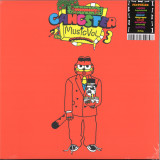
**Gangster Music Vol.3: The Most Gangster Music Trilogy of All Time Comes to a Triumphant Close**
Imagine curating a dream lineup of MCs and producers from every corner of the rap world—sounds impossible, right? Not for artist and illustrator Gangster Doodles, who has been bringing this vision to life for the past decade. Now, with “Gangster Music Vol.3”, the trilogy reaches its grand finale, and it’s bigger, bolder, and more unpredictable than ever before.
Gangster Doodles himself puts it best:
"It’s hard to believe that I’ve been actively working on this Gangster Music series for the past 10 years. The most gangster music trilogy of ALL TIME is almost complete!! And in my humble opinion Vol.3 is the most exciting out of the 3, both from a music standpoint (special shout-out to all my music heroes on Vol.3) and artistically speaking this is the most fun I’ve had in years”
Since launching Volume 1 in 2019 and following up with the second volume in 2022, Gangster Doodles has been shaping the Gangster Music series into a one-of-a-kind sonic universe—an unfiltered mix of underground titans, unsung legends, and rising stars. Volume 3 is the biggest installment yet, boasting a staggering 30 tracks that traverse the entire spectrum of rap and beat culture.
This time around, the lineup is as eclectic as ever. From legendary pioneers like Lee Perry and Tommy Wright III, to veteran producers such as Mr. Scruff and Peanut Butter Wolf, the album pays homage to hip-hop’s roots while pushing forward into fresh territory. The roster also includes established up-and-comers like Devin Morrison, Low Leaf, DJ Harrison, Quelle Chris, Homeboy Sandman, and Suzi Analogue, ensuring a mix of classic flavors and new-school innovation. The bubbling underground is well represented too, with artists like Raz Fresco, Atlanta’s 645AR, and Pro Era’s Chuck Strangers bringing their own distinct heat.
From pioneering SoundCloud rappers like Pouya to genre-bending composer John Carroll Kirby, from Birmingham’s Romderful to Chile’s RVYO, the album encapsulates a truly global soundscape, proving once again that Gangster Doodles’ ear for cutting-edge talent is second to none.
As always, the cover art is a vital piece of the puzzle. This time, Bootleg Garfield & Friends take center stage, bringing the same playful irreverence that has defined Gangster Doodles’ artwork for years. Fans are encouraged to engage, remix, and make the cover their own, staying true to the spirit of interactive creativity that has always fueled the series.
After years of meticulous curation, countless DMs, emails, and behind-the-scenes wrangling, Gangster Music Vol.3 is here to complete the trilogy in legendary fashion. Expect boundary-pushing beats, next-level lyricism, and a lineup that celebrates hip-hop in all its many forms.
“Thanks to everyone who’s actively supported and continues to tap-in. Believe & trust when I say I've got more dope stuff cookin’. STAY TUNED!! GANGSTER DOODLES 4EVER. 1LUV."
Gangster Music Vol.3 is out April 7th on All City. Stay tuned, stay tapped in, and get ready for the most gangster music experience yet.
Red Pig Flower brings you her sensational debut album Practice Love, available on Sound Of Vast from 10th April. Her unique sound sits upon the apex of a three-sided pyramid. With Berlin, Tokyo and Seoul as the base, Red is a third culture kid, greater than the sum of her parts. The centre is filled with her incredible appreciation and knowledge of house and electronic music from every pin drop through history.
So taken with Red Pig Flower’s sound, Honey Dijon invited Red to her Southbank Centre show to play alongside her. Moxie loves her that much, that she invited Red to record a mix and to guest on her NTS show. Alan Fitzpatrick, and Just Her are amongst Red’s growing posse of followers.
Practice Love is a culmination of all of Red Pig Flower’s life experiences, brimming with her positive energy and an outlook on life of pure love. Red has collaborated with like-minded artists at every level: the music, the cover art and video all produced with talented friends, who get Red as the wonderful person she is and understand her vision. Her label partner and good friend, Knock in particular helped make Practice Love the incredible album it is. So intuitive is their musical symbiosis, they made 20 tracks and carefully curated and ordered nine of these, making an album of tracks that stand out on their own, yet flow perfectly as an album. Practice Love will make you feel joyous when you play it. By the end, you will feel like you know Red like a friend.
Practice Love kicks off with I don’t care, it makes you feel good: a dreamy, tribal mantra of a track that does exactly what it says on the tin. Next up is I Love To Dance. Red’s beautiful soft vocal is sweet yet poignant, leaving you in no doubt of her sincerity. Thirdly comes Feel Good Music. Are you getting a feel from the track names yet that this is an album of warmth and positivity? You can imagine this one at a Café Del Mar sunset, where those who get the spirituality of Ibiza come together, in the moment to appreciate the beauty of a sunset and understand that no matter how many you see, each is magical and unique.
The three tracks so far have taken you to twilight. The titular Practice Love takes you by the hand onto the dancefloor. There is a double meaning to ‘Practice Love’- The first is to make love your practice. The second is that you need to practice love to be able to become a practitioner of love. The video, shot by her friend Jelly, features Red Pig Flower in Brick Lane, London, wearing a little piggy mask and offering free hugs. The first passersby ignore her sign, but Red isn’t disheartened, spreading the right message, dancing with joy. Her optimism is rewarded, making peoples day better on a cold English afternoon.
Fifth track Sax and Drugs takes things a little sleazier, the beat is filthy and the synths are sexy. Your body starts to move to this one before your brain even realises. The incredible Declan McDermott joins on saxophone, the funkiest synths and Red’s sultry vocal washing your soul with Laurent Garnier inspired sunlight. On Thisiz House Music, again featuring Declan, Red takes you even further back. About Frankie Knuckles O’Clock, with a portal straight to 2025.
By now, you will agree with me that Practice Love flows so, so well. I Wanna Meet Somebody follows incredibly, continuing the feeling that if you close your eyes, you’re dancing with David Mancuso at the Loft. No Money completes this EP-within-an-album. Perfect vocal samples, valve synth riff and 808 drum patterns showing that producers as good as Red Pig Flower make it sound effortless. The best albums finish memorably and No Genre is one of those perfect finishers. Think Andrew Wetherall’s production on Screamadelica. The lights are up in the club, nobody wants to go home, arms in the air wanting more.
Red Pig Flower explains: Practice Love resonates deeply with me because house music has always been a sanctuary—a place for unity, joy, and self-expression. As a nomad and outsider, club culture and house music became my shelter. The cities I’ve lived in—Seoul, Tokyo, Berlin, and London and more—nurtured me and shaped who I am today. That’s why the cover, by the incredible Carlos Sulpizio features their skylines, and the album is multilingual, representing the diverse influences in my life.
Practice Love is like a meal that has been prepared lovingly. They always taste better. And there’s plenty more to come from Red Pig Flower. How was your appetizer?
The needle drops, and with it, a fresh chapter in the world of re-edits comes to life. This electrifying
new EP offers four masterfully crafted tracks, each one a gateway into a distinct musical world.
From epic anthems to intimate grooves, these cuts promise to leave a lasting imprint on the dancefloor.
Vinyl-only, limited edition—this is not one to miss.
A1 - Rewind The Drill Step back in time with an epic late 80’s anthem that channels the power and
raw energy of a golden era. With thunderous beats and soaring melodies, "Rewind The Drill" is an
instant classic that bridges past and present with finesse and force.
A2 - Pizzichella An ode to Tokyo’s iconic 90’s Shibuya Kei movement, "Pizzichella" is a vibrant
tribute to a beloved scene. Melding playful nostalgia with modern production, it’s a kaleidoscope of
sound that’s as colorful as the streets of Shibuya themselves. A must-listen for fans of cross-cultural sonic adventures.
B1 - Jara Sevo Immerse yourself in the haunting beauty of "Jara Sevo." With a Balkan-inspired feel, this melodramatic anthem evokes the chill of a winter’s night and the warmth of love’s glow.
Poignant strings and cinematic swells make it a standout moment of emotional resonance.
B2 - Come Vanno i Grøøvöni Closing out the EP is "Come Vanno i Grøøvöni," a sweet, romantic
groovy house cut that’s as gentle as it is infectious. Smooth, soulful, and effortlessly cool, it’s the
sound of a perfect night in motion. With lush pads and subtle swing, it’s the kind of groove that’s
impossible to resist.
Limited Edition, Vinyl Only As always, exclusivity is key. This EP is a one-time pressing, and once
it’s gone, it’s gone for good.
Collectors and DJs, take note: this is a sonic treasure you’ll want in your arsenal.
Stay tuned for release details and grab your copy before it’s too late. Four tracks, four journeys—and one unforgettable record.
Slow-moving finger-picked ambient folk straddling the synthetic and organic divide – that is “The Ending Was A Typical Part”, the first album by the Zurich-based duo Gūsū. It combines the tradition of playing the guzheng with electronic instruments, allowing different yet harmonious worlds to collide.
The collaboration between Xueyan Chen and Nicolas Balmer alias Gūsū was born out of their shared musical explorations in 2022 and has evolved into a dialogue of sound. Chen’s guzheng, an instrument deeply linked to Chinese history, resonates with improvised and self-composed melodies, freeing its pentatonic scale from its traditional bounds. Her playing is underscored with the cryptic hum of Balmer’s modular synthesizers, the deep bass and layered textures that combine the organic with the electronic. Together they create a sonorous exploration of identity, displacement and unity.
Xueyan Chen has been playing the Guzheng since her early childhood. With her moving to Zurich, Switzerland she started reimagining its historical identity through improvisation and self-composed melodies. With this approach, Chen emancipates the instrument from its classical heritage, weaving a contemporary and deeply personal narrative. Nicolas Balmer meanwhile brings a contrasting yet complementary dimension with modular synthesizers, bass guitar, and electronic textures. His layered soundscapes amplify and distort the Guzheng’s pentatonic timbres, enveloping them in mysterious tones and expansive harmonics.
At the start of the 1980’s X-Plode’s dad had a second-hand colour TV business in Bolton, Lancashire where he would buy, sell, repair and trade TVs. He would come back home with all kinds of things he had traded for a TV but the most memorable, to a 10 year old kid at that time, were the keyboards. He use to watch his dad play songs from the 1960’s on these keyboards and when his dad had gone out, Lee X-Plode would sneak on them and start messing about, experimenting with the drum programs and fiddling with the buttons, trying out ideas. He had to move fast though because these keyboards didn’t stay in the house for long as his dad would trade them again for something else; one time that was an old analogue echo chamber, which Lee also messed about with when his dad was out. That echo chamber was a revelation to Lee and opened up the possibilities of what was possible with sound. So by the time Lee was 16, he decided he wanted his own keyboard and started saving. When his 17th birthday came around he had saved up £200 and visited his local Argos where he bought himself a Yamaha PSS 680, an FM synthesizer with memory banks and a basic drum machine incorporated. ‘It was shit quality like, but I didn’t mind. I just wanted it for the programmable drum machine, the synth and the memory banks that came with it” Lee recalls. The year was 1987 and by this time in Lee’s life he was into reggae and hip hop, the latter he first embraced in 1983 by the way of breakdancing and listening to electro, so all he wanted to do when he got his gear was make reggae and electro sounding beats. Recalling his youth and the fun he had with the echo chamber, the next edition to his home set up was to acquire one of those, which he did via a mate of his. But by the time he got his minimal set up sorted in 1988, his musical tastes had changed. House music had landed here in UK and this was Lee’s new passion, so from that point on wards he started experimenting, trying to nail a decent house groove. ‘I wanted 808 sounds, but I didn’t know what one was!’ Lee explains.
Around late 1990 or early 1991, Lee started to improve upon his set up, purchasing an Atari STE, a Cheetah MS6 , a 6 voice polyphonic/multi-timbre analogue rack mounted synth that linked up to his Yamaha – “It wasn’t a great bit of kit, I kept getting electric shocks from it. Eventually it just blew up!” Lee had acquired a cracked copy of Cubase on floppy disk from his local computer game shop but struggled with it. “It was so complicated to understand and took me ages to get used to it. I was stoned a lot back then and I just couldn’t concentrate on anything for long” Lee laughs, continuing “I also picked up a 4 channel sampler/sequencer which plugged into the side of the Atari and that’s when I first started sampling, I think this would have been late 1991. I had the Simon Harris ‘Breaks, Beats and Scratches’ vinyl that he put out on Music for Life which were a godsend back then. I was also sampling a lot from cassette tapes, especially reggae. I would also record the Stu Allan show on Key 103FM, one of the main stations broadcasting out of Manchester. He would do a 3 hour show with hip hop and house, and then hardcore house came along. Eventually he dropped the hip hop altogether and it was just house and hardcore. I recorded the shows onto cassette most weeks and started to learn more about how house and hardcore was put together by listening to those shows.”
50th ANNIVERSARY EDITION
Heavyweight Vinyl 45 RPM Cut / Original glued prints on Thick Cardboard 700 gram / 2 Separated parts hand-glued / Glossy lamination / PVC outer / 30x30 cm insert with interview to Steve Kuhn by Tony Higgins printed on 250 gram Favini Lanilla Yellow / 20 Pages 21 x 30 cm "Real Book" with transcripts of the songs in the "Real Book" style, handwritten by The Maestro Carlo Spanò with main theme, chords and lyrics printed on 120 gram Shiro Eco paper, 100 gram Favini Crush Alghe. Carlo also edited an introduction with technical analysis of the session, which solves some of the little mysteries around this music gem.
Personnel:
Steve Kuhn - Vocals, Piano
Airto Moreira - Percussions
Billy Cobham - Drums
Ron Carter - Bass
Gary McFarland - Arranged by
Notes:
The album features the group playing Gary McFarland arrangements of Kuhn's compositions, accompanied by a string section on several tracks, with Kuhn delivering stream of consciousness lyrics in an unplanned and largely improvised fashion in the studio. However, that wasn't the only surprising aspect to the session. Airto Moreira's appearance was more by chance than design, he having just popped by the studio, again, unplanned. The 'Steve Kuhn' album is all the stronger for these extemporaneous and serendipitous elements and showcases a band at the top of their game; tight and funky yet relaxed and flowing like molten gold, with stabs and washes of keyboard from Kuhn. Splashes of free playing enter the session, but the band never stray too far from a melodic and harmonious centre of gravity. Kuhn's deft keyboard skills provide melodic embroidery to the impressive rhythmic textures and tonal colours of Carter, Cobham and Moreira. As if the music wasn't enough, the album is given extra significance by the fact that, within a few months of the recording, McFarland would die after being mysteriously poisoned by methadone in a New York bar. In a sense, it is a valedictory album from McFarland, channeled by Kuhn and the band.
It's among the hardest of Kuhn's albums to find so this reissue is most welcome. Luxuriate in the glow of Kuhn's Fender Rhodes and the pliant funky bass of Ron Carter; immerse yourself in the percussive interplay of Moreira and Cobham, a pairing that has rarely sounded so good. This is such an exquisite album; you will lose yourself in its delicate power and find yourself coming back to it again and again.
15 Years Of Dame-Music Vol.1 is an ode to the unmistakable sound of the TB-303, a core element of Bloody Mary’s widely respected sound and label. Above all, it celebrates fifteen years of quality dance music, set to continue across its three excellently curated volumes in 2025.
The first volume, releasing 28th March 2025, features a track from Bloody Mary and welcomes back Thomas P. Heckmann, E-Bony, and Hardfloor to the imprint.
15 Years Of Dame-Music Vol. 1 with label regular Thomas P. Heckmann’s ‘Days Of Buzz’ electrifying the dancefloor with waves of mind-melting acid over a resolute beat.
Label head Bloody Mary then drops ‘Fractal Waves’, playful, 303-licked, and comfortably switching between straight 4/4 and raw, crunched-up breaks; this is a raveready cut showing Mary at her best.
On the flip, artist E-Bony returns to Dame-Music after closing the label’s 2024 schedule with the ‘Machine Code’ EP. His ‘303 Elements’ builds from a low-slung groove to an intense climax as acid drips, oozes and rains over crisp drums while hoover sounds create an otherworldly atmosphere at its peak. Closing out the first volume is 90s Acid Techno duo Hardfloor with ‘I’ll Never Own A Helicopter’, providing a hands-in-the-air club track to work the dancefloor into a frenzy.
Mastered by Thomas P. Heckmann
Artwork by Philip Mercieca
(c) Dame-Music 2025, all right reserved
Good friends and Record Mission co-captains, Dan Tyler (one half of the Idjut Boys) and Nick The Record, take the reins for the third volume of the Mr Bongo Edits 12" series. With previous editions coming courtesy of Danny Krivit and Luke Una, Dan and Nick set their sights on a hand-picked selection of iconic ‘70s Cuban recordings for this three-track cosmic whirlwind. Across the A side, Dan picks out two Juan Pablo Torres tracks, with Nick taking on Grupo Los Yoyi on the B. Tweaking, extending and reworking the recordings with a dose of extra magic they remould the tracks to fit the sounds and structure of today’s dancefloors.
Having formed the Idjut Boys in the early ‘90s, Dan and Conrad McDonnell have crafted a dubbed-out, disco-tinged style that permeates their countless productions, remixes and DJ sets. Speaking of the two tracks Dan has chosen to rework for this EP he mentions, “Having been caught under an avalanche of good music from Mr Bongo, I took it upon myself to extend and add effects to a couple of the fantastic tracks from the Juan Pablo Torres LPs they recently re-issued. Just for disco jockey and barn dance use.”
First, Dan looks to Cuban maestro Juan Pablo Torres’ 1978 album 'Algo Nuevo', taking one of the standout tracks ‘Cacao’ and giving it more space to breathe. Teasing out the scatting vocal line and percussive climax that nods to George Kranz's ’83 electronic disco anthem 'Din Daa Daa', whilst adding more cosmic tripped-out synths and space echoed dubs, Dan builds the tension to fine effect. This track sounds immense on a big club system and the swirling synths felt like they were lifting the ceiling off when we played it at the amazing La Paloma ballroom in Barcelona.
Dan then turns his attention to Torres’ 1977 'Super Son' album, giving the psych-Latin-funk track 'Pastel En Descarga' a dub makeover. Rich in delay and drama, whilst maintaining and extending the breakers funk intro, he juices it up into a punchy, no-nonsense, cosmic-funk delight.
On the B side, Tangent co-founder, long-standing Life Force resident and seasoned rework master, Nick The Record, revisits an edit that he originally constructed in 2009. Clocking in at over double the length of the original cut, Nick’s edit of Grupo Los Yoyi’s 1977 cut 'Paco La Calle', is made with dancers firmly in mind. This secret weapon builds and simmers, with the drums and percussion pushing and pulling before the psychedelic synth lines return in a sweltering fashion. In this new 2025 version, Dan is drafted in to work some brilliant new synth lines into the mix.
Bristol label-turned-blog Innate launches a new sub-label, Innate Editions, which it says is dedicated to timeless UK techno, IDM, electro and ambient music, and it will all come on heavyweight vinyl. The first release revives Connective Zone's Palm Palm, a millennium-era cult classic and Ben UFO favourite that first came out on Mark Broom and Dave Hill's Unexplored Beats in 2001. Now, this long-out-of-print, expensive and hard to find gem has been remastered by Jamie Anderson and so sounds superb with many lavish electronic layers, richly emotive melodies and dynamic drums that lean on UK techno, IDM, and deep electro. Sounds as good now as it ever did.
DJ Feedback
Dan Curtin (Metamorphic):
"This sounds fantastic. I don't think I ever got it back when it came out but I'm glad I do now, it's really nice. Every track is the standout track!"
Dj Harri (Sub Club):
"Lovely stuff here, will be playing and supporting."
Laurent Garnier (COD3QR):
"Awesome 4 tracker, thanks a million times for this. Beautiful way to start a new label."
Midland:
"Thanks for sending this over. Really in to it, Function especially."
Mr Scruff (Ninja Tune):
"Thanks for this! Didn’t know this release. Function is great. Quite like Returned too."