Favorite Recordings presents an exclusive reissue of the first private press eponymous LP by Sacbé, a Mexican Jazz Fusion masterpiece from 1977. Unique and beautifully recorded, with a breezy feel brought by the synthesizers, Sacbé could be likened to what Azymuth was doing at the same time in Brazil. Available as a vinyl-only limited pressing Deluxe Tip-On LP, coming with its original printed innersleeve, remastered by The Carvery.
Sacbé was composed of Eugenio (keyboards), Enrique (electric bass) & Fernando Toussaint (drums), three brothers hailing from the huge Mexico city, and their friend and sax player Alejandro Campos. Growing up in a family of musicians, they quickly became familiar with jazz music. However they were mostly self-taught, most of them choosing at first to work and study outside the music industry, but somehow, Eugenio had the opportunity to start studies at the Berklee Music University. Before leaving, he deeply wanted to play jazz with his brothers. That’s how Sacbé was created on a hot day of October 1976.
The band then built step by step a challenging repertoire including Chick Corea, Herbie Hancock, Weather Report, Milton Nascimento, Focus, Passport, and many more… Gradually, Eugenio started to compose more tracks, and through a cooperative work of arrangement, Sacbé ended up playing only their own compositions. That was not an easy choice for the band, resulting in a lot fewer opportunities to play in bars and clubs at night, while they were cumulating small jobs during the daytime. But their dedication, tightness, and integrity started to attract a wider audience thanks to their sessions at the Musicafé and helped Sacbé to assert its imprint within Mexico’s creative artistic circles. A group of artists with similar attitudes was created and they began working almost as a team, holding live shows, exhibitions, and dance performances, all with a very unique and creative proposal. It’s at this period that the band met Luis Gil, a young designer and recording engineer, who had access to one of the best studios of the city called LAGAB. Recording at nights and weekends for free, the Toussaint brothers had, therefore, the chance to really put their band quite literally under the microscope.
With tenacity, they explored all the possibilities of interpretations, structures and improvisations, collaborating with great musicians and finding themselves in the position of being their own producers, despite being only around 20 years old! This album is the result of this perfectionism ethics, shared by everyone involved. “Sacbé” means white road in the Mayan culture, it was the name for the roads connecting the main ceremonial centres with the jungle, made of roughly three feet of coral limestone. They were sacred roads used by high priests and warriors, which echoed the musical path of the three brothers. Putting the pieces together, they managed to create their own label and pressed 1000 copies of their reunited recordings in 1977. The artwork was painted by Enrique, inspired by the work of Le Douanier Rousseau and the Mayan jungle. Hopefully, the LP met some success in Mexico and California, opening many radio and TV doors for them. It was the starting point for a whole career of recordings, with a total of seven albums including various guests.
Поиск:player
Все
We present to you our last release of this bizarre year, thirteenth release on 7” format, a new collaboration between Ojah and Nik Torp, keyboard player from The Specials.
The A side contains the track “Notting Hill”, a tribute to the famous carnival (greatly missed this year) featuring sounds of the vintage and rare Yamaha SK-20 organ played by Nik over a riddim formed by 80’s & 90’s synths and drum machines. Underlying the whole riddim is the recording of a baby’s heartbeat in the womb.
On the B side we find a dub version as is customary, sparse and full of fx, reminiscent of those open air dub sessions at Notting Hill Carnival, mixed live by Ojah on his analog console.
Limited edition of 350 copies, hand-stamped and hand-numbered, served in a thick custom reversed kraftliner sleeve.
Produced by Ojah, recorded at Alchemy Dubs Studio, London.
Organ by Nik Torp, recorded at Eastcote Studio 4, London.
Mixed & mastered by Oscar Pablos “Ojah" at Alchemy Dubs Studio, London, 2020.
Graphic design by Victor Castro.
all rights reserved
The band that modernised Zimbabwean music, and by doing so revolutionised the music industry in their country. Available for the first time on vinyl (180 gramms) with gatefold cover, and now all tracks fully remastered !
In 1972, the country of Rhodesia – as Zimbabwe was then known – was in the middle of a long-simmering struggle for independence from British colonial rule.
In the hotels and nightclubs of the capital, bands could make a living playing a mix of Afro-Rock, Cha-Cha-Cha and Congolese Rumba. But as the desire for independence grew stronger, a number of Zimbabwean musicians began to look to their own culture for inspiration. They began to emulate the staccato sound and looping melodies of the mbira (thumb piano) on their electric guitars, and to replicate the insistent shaker rhythms on the hi-hat; they also started to sing in the Shona language and to add overtly political messages to their lyrics (safe in the knowledge that the predominantly white minority government wouldn’t understand them).
From this collision of electric instruments and indigenous traditions, a new style of Zimbabwean popular music – later known as Chimurenga, from the Shona word for ‘struggle’ – was born.
And there were few bands more essential to the development of this music than the Hallelujah Chicken Run Band. The band came into being when a young trumpet player named Daram Karanga offered to assemble a group to entertain the workers at a copper mine in the town of Mhangura.
The original line-up – which included legendary singer Thomas Mapfumo, who would bring the sounds of Chimurenga to the world in the early 1980s with his band the Blacks Unlimited, and Joshua Hlomayi, one of the pioneers of mbira- style guitar – started out playing the Rumba and Afro-Rock styles popular in the capital. Although this was a hit with the white owners of the mine, the workers greeted it with indifference. But when they started adding electric arrangements of traditional Shona music to their repertoire, the audience went wild.
With the addition of “Zim” sounds to their arsenal, the HCR Band became unstoppable. Their reputation spread quickly and, in 1974, they were invited to the capital to compete in a national music contest organised by the South-African Teal label. Not only did they win the competition, but they also attracted the attention of famed producer Crispen Matema, who quickly organised their first recording sessions.
On their first day at Jameson House studios, they recorded half a dozen songs, including “Ngoma Yarira” and “Murembo”, two singles that would alter the course of Zimbabwean popular music.
During the next five years, the band would relocate from their small mining town to the capital city, go through numerous line-up changes and pay a few more visits to the recording studio, without ever losing the raucous urgency that had transformed them from popular entertainers into titans of Zimbabwean culture.
- A1: Impressions Of Copenhagen/R.v
- A2: The Northstar
- A3: I’ll Say No This Time
- B1: Quiet Dawn
- B2: Why Am I Here?
- B3: Lush Life (Bonus Track)
Re-mastering by: Ray Staff at Air Mastering, Lyndhurst Hall, London
Originally released by Theresa in 1981, this frequently exquisite set features the McCoy Tyner-inspired piano of Joe Bonner on four originals, Cal Massey's "Quiet Dawn," and "Lush Life." Bonner and a rhythm section are joined by a string quartet, trumpet, trombone, and flutist Holly Hofmann (the leader provided the arrangements) for music that is both lyrical and often passionate. Bonner is an underrated talent, and this is one of his finest recordings. by Scott Yanow
Bonner is only the second-most famous pianist born in Rocky Mount, N.C., behind Thelonious Monk. It’s indicative of Bonner’s lack of fame and appreciation that Monk is listed as a notable resident on Rocky Mount’s Wikipedia page, but Bonner is not.
But the pianist Bonner was most often compared to was not Monk but McCoy Tyner. Scott Yanow’s allmusic review of Impressions of Copenhagen said Bonner’s piano playing was “McCoy Tyner-inspired.” Bonner’s admittedly biased drummer, Tom Tilton, even felt Bonner surpassed Tyner. “Joe Bonner has all the power of McCoy, he has all the capability of McCoy, but he’s so much more romantic,” Tilton said, according to westword “I mean, I’ve been there time after time where there were tears running down people’s faces when he would play a ballad. He could captivate a room like nobody I’ve ever experienced before.”
Bonner did most of his playing over the last two decades in Denver, where he was beloved and appreciated. Even Gov. John Hickenlooper was a Bonner fan. “He was without question, the most talented piano player I’ve ever heard,” the governor told the website heyreverb in a remembrance of Bonner. “… I want people to know that I loved Joe Bonner.”
We are back on Boogie Butt with a soul track just like back in the days, this time with a Lord Funk & Samm Culley collaboration. We’re bringing back to your ears this giant artist, who crosses decades of music with its great personality and many groovy songs.
Samm Culley is an R&B, soul & funk keyboard player and a dope songwriter. His music career started within the band Tiny Tim & The Hits with Tom Price & Bill Collier. This trio soon left Tiny to form their own group The Diplomatics with Irving Waters as the lead singer. They later on became the legendary Skull Snaps.
Over the years, Samm co-produced and/or played with many unforgettable famous artists such as Hot Chocolate, The Fatback Band, George Kerr, Patrick Adams, Vaughan Mason, Reggie Griffin, De-De, Van Mc Coy, Lloyd Price & even later in Hip Hop music with Marley Marl or Freddie Foxxx.
“Let It Go” brings you back in 1970 with a great killer dance floor track for Bboys and soul lovers: the dru break is hot and on the same time, the guitar hook and bassline make you feel James Brown on the scene. Close your eyes and easily imagine John Shaft dancing on “Soul Makossa”.
The B side is the instrumental reworked by our well-known Lord Funk, with Samm on bass. Enjoy & play loud!
Technically, Syrup are a hip-hop group with unmistakable leanings towards soul and jazz. The group consists of an MC (Turt), a pianist/singer (C.Tappin) and a beatmaker (Twit One).
Their music is rooted in the tradition of collectives like Native Tongues and Soulquarians, and they have come up with a pretty appropriate term to describe their sound, which is "cool bap". But if we put formalities aside and look at the bigger picture, Syrup are also a perfect example of how music can connect people beyond national borders, language and tradition. And furthermore, how Afro-American culture has influenced not only the musical taste but the views and opinion-making of generations of young people worldwide. The sheer existence of Syrup is also a big fat "Fuck Brexit!" which makes the group even more likeable. The story of Syrup begins in 2015 when Twit One is booked to play a dj gig in Bristol. Twit One is a producer, DJ, radio host, record friend and former bass-player from Cologne (where he also co-owns the Groove Attack Record Store). He is a member of a small group of pioneering producers, who during the 2010s laid the foundation for the European beat-scene as we know it today. Inspired by the likes of Dilla and Madlib these guys made it look cool to not be the rapper. And they recorded some pretty dope music, too, which we had the honour to release via Melting Pot Music as the "Hi-Hat Club" series (a title that Twit came up with). During that night in Bristol, Twit got acquainted with two young men by the name of Turt and C.Tappin. Two childhood friends who had moved from London to Bristol for their studies and had been avid fans of Twit's music for some time. "Back in Cologne, Twit told me about these MCs from Bristol with whom he might record some tracks" Olski remembers, "Needless to say that I never heard about them again until summer 2017 when the annual Radio Love Love boat party was about to happen and Turt and Tappin were actually coming over for the first time, to party and to rock the mic. A couple of months later we released "Hay Luv" a new Twit album that featured Turt and Tappin on two songs. On their next visit, the two were accompanied by Turt's brother Slim, a very talented beatmaker and one half of Summers Sons. We spent some quality time while mastering the 'Undertones' EP (including remixes by Twit One, FloFilz and Cap Kendricks) and shooting the album cover at the Groove Attack record store basement. Since then we released two more album by Summers Sons ("Uhuru" - a joint project with Tappin and "The Rain"), C.Tappin's debut EP "Ashes To Ashes" (with remixes by Reginald Omas Mamode IV, Hulk Hodn & Slim) and a KOOP beat tape by Slim. During the same time, Twit recorded two albums: "Dispo To Dispo" as Flatpocket (a project with Lazy Jones) and "Two", the long awaited follow up to the very first Hi-Hat Club album as Testiculo Y Uno (with Hulk Hodn)." In 2018, Turt and Tappin moved back to London (the Lightworks headquarter is now located in Streatham). They toured with Children of Zeus and shared stages with artists like Melodiesinfonie and FloFilz. But it wasn't until Brexit before the long talked about super group finally became a reality. At the final recording sessions in September 2019 we already knew that the next Eurostar ride would be a different one. Now with Covid-19 we have no clue when all three members of the group will be in the same room again – let alone rock a stage together. But fortunately, we were sitting on a big pile of great singles that we released over the summer months. The album "Rosy Lee" will follow in late September.
Rising London-based talent Casey Spillman debuts on LOCUS with his latest four-track EP, ‘Bit More Raggo’.
A hotly-tipped name within the UK house and minimal scene, London’s Casey Spillman continues to impress as one of the city’s key emerging DJs, producers and label owners. Founder of his own blossoming imprint Temperature, his releases and remixes via the likes of e1ven records, Sukhumvit and Infuse have gained support from a long list of the scene’s key players - solidifying his growing profile as one of FUSE’s key up-and-coming talents, whilst featuring across a string of their infamous events within the UK capital. Next up, Spillman’s latest outing welcomes a debut on recently launched FUSE imprint LOCUS, delivering four typically impressive cuts in the form of his ‘Bit More Raggo’ EP.
Opening cut ‘What I Say’ delivers a moody, up-front production armed with metallic percussion licks, resonant chords and driving low-ends, whilst the skipping hats and sweeping key leads of the slick ‘Gambling Man’ reveal a classy yet warping journey to close out the A-side. On the flip, ‘Humidity Meter’ introduces a hypnotic combination of shuffling percussion atop of escalating electronics and squelching bass patterns, before closing proceedings via the tripped-out vocals, crisp, raw drum shots and menacing bassline of final track, ‘Commands’.
Reissue of this mesmerizing record including an unreleased alternate mix of "Subterranean Zappa Blues". Hypnotic rhythms made of slow minimal beats, industrial textures, intoxicating drones and repetitive voices that seem to merge from dreams. Everything built by two of the most brilliant industrial music minds: Steven Stapleton and Colin Potter.
"This album arrived somewhere after a dream meeting of several individuals, Graham Bond, Joe Meek, Jacques Berrocal and myself. After a few beers and a heated disscussion of puncture repair we all lay down in a circle and point our penises at Venus, telepathic messages are sent out to Colin saying he can use the two golden microphones. He did, and here we are." Steven Stapleton, 17.1.94.
Rock 'n Roll Station began life with Steven Stapleton asking engineer Colin Potter to remix some of the more rhythmic elements of 'Colder Still' from 1992's Thunder Perfect Mind. As Potter gradually warped these sections into weirder and weirder pieces, a new album began to emerge. Potter himself explained it to David Keenan in England’s Hidden Reverse: “What I sometimes did in the studio was to ‘over-use’ effects and processors to totally mutate a piece into something completely different” while Stapleton observed how “it was almost as though telepathic messages were sent over to Colin. We’d started an album together at IC Studio that was never finished. He then sent me some vague mixes, which were just what I had in mind. So, from that basis, I started putting the album together.”
Potter would quickly become a key player in Nurse With Wound’s productions, a position he continues to fulfil to this day. He was first credited as a member on 1992’s Thunder Perfect Mind, a tour-de-force of cold, at times hostile, machined atmospheres, but considers Rock ‘N Roll Station from the following year to still be his favourite.
Building on percussion and drone elements, Stapleton and Potter throw in a huge range of bizarre and atmospheric elements: didgeridoos, chanting voices, and their usual selection of unidentifiable sounds.
Its strong focus on rhythm was erroneously surmised by some as an attempt to join the then rising electronic dance music scene. But it was Stapleton’s recent obsession with the music of ‘King of the Mambo’ Pérez Prado that was beating at the heart of Rock N’ Roll Station’s heady rhythms.
The album’s title alluded to two specifically rock-related stations of influence: the song of the same name by Jac Berrocal, of which a surprisingly straight cover opens the album in homage; and the tragic life of the Sixties British R&B organist Graham Bond who influenced bands such as Deep Purple and Cream. Beset by mental health problems (at one point believing he was the son of Aleister Crowley), Bond died under a train at a Tube station in 1989 and it is this tragic scene that Rock ‘n Roll Station’s closing track, ‘Finsbury Park, May 8th, 1:35 PM (I'll See You In Another World)’, sets in sound.
SUMMER OF SEVENTEEN are MONIKA KHOT (NORDRA, ZEN MOTHER), WILLIAM FOWLER COLLINS, DANIEL MENCHE, FAITH COLOCCIA (MAMIFFER), and AARON TURNER. (SUMAC, SPLIT CRANIUM).
Wildfires plagued Washington state during the summer of 2017, their smoke drifting westward toward the Seattle area and toxifying the air. Shortly before that trauma, MONIKA KHOT, WILLIAM FOWLER COLLINS, DANIEL MENCHE, FAITH COLOCCIA, and AARON TURNER had gathered at the latter two musicians' House Of Low Culture studio on idyllic Vashon Island with revered producer RANDALL DUNN. There they cut eight songs that capture the makeshift band's feelings of what COLOCCIA calls "a kind of doomsday lurking in the background." It's as if these highly attuned players had a premonition.
"Summer Of Seventeen" -which was edited and arranged by MONIKA KHOT, who records apocalyptic music solo as NORDRA and plays in the avant-rock band ZEN MOTHER—is a nuanced admixture of these musicians' sounds and a culmination of all of their previous collaborations. COLOCCIA and TURNER have created eldritch folk and chamber rock for over a decade in MAMIFFER while engaging in various solo and group projects that explore their profound spirituality in sound. MENCHE has been a fixture on the abstract composition scene for 31 years and COLLINS is a savvy explorer of drone and ambient forms. Their ephemeral summit meeting has yielded a masterwork for the ages.
A heaven/hell and beauty/beastliness dichotomy pervades the album—as if a titanic struggle was transpiring in that small studio. The fearsome trumpet fanfare that starts "Chorus Of The Innocents" heralds a baleful fate. With a subliminal industrial rhythm bristling beneath the eerie exhalations, the song submerges us in a slow-motion maelstrom, a horror-film facsimile of MILES DAVIS' "Bitches Brew". "Perceived Slight" threads death-metal screams through a stark, suspenseful atmosphere, with austere glints of guitar and beats like fists on a casket lid intensifying the dread.
Angelic chants and celestial drones perfume the air in several of the songs on "Summer Of Seventeen", countered with muted blast beats, serrated hums, jagged glitches, simulacra of grinding gears and lightning. It's as if no good deed goes unpunished. "Spirits Of Redeemer" could be an elegy for the human race while "Cultural Orphan" sounds like a symphony for a malfunctioning factory. The album ends with "Theatre Needs An Audience," a harrowing ballad somewhere between EINSTÜRZENDE NEUBAUTEN and MERZBOW; it's a savage rent in the space-time continuum.
"Thinking about this record now," COLOCCIA recalls, "it seems like we were all sort of anticipating something like this current pandemic happening, although we were thinking about it as fire in the hands of man (literal fire, and also gunfire) that would overturn the normal running of things and reveal the current false beliefs systems holding up most of America."
That grave aura infiltrates "Summer Of Seventeen", However, a hopefulness bubbles beneath the foreboding architecture of sound and noise summoned here. The bunker is the new penthouse.
-Dave Segal, April 2020
The story of how Transatlantyk came to be is, in many ways, one typical of our times. We've grown accustomed to being isolated, even stranded, in recent months, and Technology has become our means of overcoming these aspects of quarantine.
For Lübeck-based producer David Hanke, a.k.a. Keno, and Los Angeles-based musician Tristan de Liège, their intercontinental relationship began long before the days of lockdowns and social distancing. The pair 'met' on-line through mutual friends back in 2018 and quickly realised they were, in a musical sense, kindred spirits. Their shared tastes meant that what started out as a single track quickly morphed into an EP, and finally the full length album that you're enjoying right now.
Tristan's experience as a neo-classical musician was the ideal foil for Hanke's skills with a sample and production expertise. Both shared a love of the more lush and cinematic end of instrumental Hip-Hop and Downtempo music. This sound partnership is evident throughout the album, but particularly on tracks like Nkosi, and the title track, where luscious string sections dance playfully with fractured, programmed beats; or the melancholic opener, Kouyou, where more laid back drums underpin muted horns and joyous harps.
The pair's perfectly formed fusion isn't the end of the story though, as French chanteuse Elodie Rama is on hand to provide not only some impeccable vocals, but also irresistible melodies to this already mellifluous long-player. Speak The Language sees this brilliant vocalist drift seamlessly between euphonious song and spoken word whilst delivering one of the ariose moments of the whole album. Elsewhere, on Dancing In The Dark, Elodie gives a slightly more sombre performance, combining with lavish strings and driving rhythms to a tee; and on To Find A Way offers up an even more emotional and almost heart-breaking performance, aided by wistful and forlorn instrumentation.
Transatlantyk is a body of work from an amalgamation of rare talents who combine beautifully to take us through myriad emotions; from the urgent and compelling Off The Mark via the pensive Forever We Were, and finally find their Way Across thanks to a shared love of graceful and refined musicality and a good song.
To this day the three have never actually met in person, but here's a last hopeful thought that one day soon, as we emerge out of the darkness, they can finally join together in a physical, as well as a musical, embrace.
A stunning new production by the Rhythm And Sound ace, drawn from his recording sessions with some of Senegal’s greatest musicians — a griot clan of Sabar drummers from Kaolack in Senegal, led by Bakane Seck, with guest players and vocalists, including many mainstays of the bands of Baaba Maal, Youssou N’Dour and company.
Jeri-Jeri’s style of Mbalax is swingeingly masterful — heady and hard-grooving, with highly complex, fiercely succinct poly-rhythms — an ancient-futuristic music, mesmeric but sharp as nails, super-charged with drama. Featuring the lovelorn vocals of guest Mbene Diatta Seck, Sabar traditions are fused with furious Afro-Cubanismo, hard funk-rock, and shards of high-life.
Ernestus’ nasty, hypnotic, stripped dub — an Mbalax first — edges in the bass, profiles the talmbat and tungun drums, and scoops the semantics out of the singing.
Composed, produced, and arranged by Eartheater alone, Phoenix: Flames Are Dew Upon My Skin draws a path back to the primordial lava lake from which she first emerged, as it also testifies to the reincarnating resurrections the project has undergone over its first full decade of existence. While the album renews her focus on guitar performance and legible structure, Eartheater balances the unabashed prettiness of acoustic harmonic songs with the dissonant gestural embroidery of oblique instrumentals. Having fallen back in love with the idioms that first captivated her, she worked to crack open the techniques that had fossilized inside of her, while still seeking to apply the electro-alchemical knowledge she picked up along her journey. The result of a laborious revival in fire, Phoenix recontextualizes Eartheater’s combinatorial approach to production within her most confident abstractions, adjacent to some of her most direct songs to date.
Eartheater composed and workshopped most of Phoenix over a ten-week artist residency (FUGA) in Zaragoza, Spain, housed in a sprawling, cubic glass facility that looked out over wildflower-flecked mountains. Following an intensive period of recording and touring, the residency provided her with an unprecedented period of solitude in the small Spanish town. Her newfound sense of isolation ultimately became liberating, leading her to sidestep the crutches and steady grids inherent to electronic music, and to conceive pieces rooted in her guitar and her desire to perform with other players live.
Eartheater’s voice glows brighter than ever at the center of Phoenix’s arrangements — her familiar operatic highs are grounded by newly expanded velvety lows, leaping lucidly up and down octaves. Her intricate guitar work flits across baroque fingerpicked passages and latches into cyclical figures that meet her voice in lush harmonic progressions. From her own guitar parts, to the orchestral string arrangements she wrote for the Spanish conservatory group Ensemble de Camara, to the harp and violin lines performed by her close friends and collaborators Marilu Donovan and Adam Markiewicz of LEYA, Eartheater’s applications of acoustic instruments bring an extraordinary emotional emphasis to her compositions. Phoenix prepares for a future where electronic sound — or even electricity itself — isn’t guaranteed, but where her music could still come to life with a group of hands dexterously winding across instruments against the light of the fire. Eartheater drew inspiration for Phoenix from geological imagery, whose turbulence and potential for genesis mirror the trajectory of her own life and relationships. The album’s instrumental pieces directly reference these moments of upheaval, colliding audio of volcano and lightning storms with resplendent string and vocal arrangements. “Volcano” looks out over the album from its peak at the center, its tectonic plates colliding in towering melodies and layers of vocal harmonies, as piano accents crest and cascade down the mountainside. When Eartheater sings, “I’m still building mountains underground,” she is trying to reconcile the pinnacles of her ambition with the comforts of a simple existence buried beneath the surface. “Diamond in the Bedrock” finds her admiring the gemstone forming under intense pressure inside her, but rejecting the romantic promise that the diamond signifies, choosing instead to escape a relationship that has come to stifle her.
With the album’s subtitle, Flames Are Dew Upon My Skin, Eartheater imagines being tempered to a state of perfect equilibrium, suspended between melting and freezing, where fire could streak across her body and appear as a crystalline blush. This image captures the tension at the heart of the Eartheater project, as she decides how best to distill her passion and render it cool to the touch; to find beauty in simple pleasure, while keeping one eye fixed on the peaks that loom in the horizon. The album is mixed by Kiri Stensby and mastered by Heba Kadry, featuring photography by Daniel Sannwald.
- A1: Rush Hour/Elegua (Feat. Kevin Haynes Grupo Elegua)
- A2: Frontline (Feat. Kevin Haynes Grupo Elegua)
- A3: Rye Lane Shuffle
- A4: Drum Dance
- A5: Axis Blue
- B1: City Nocturne (Feat. Zara Mcfarlane)
- B2: Waiting On The Night Bus (Feat. Terri Walker & Louis Vi)
- B3: Marooned In S.e.6 (Feat. Kevin Haynes Grupo Elegua)
- B4: Ancestors (Feat. Kevin Haynes Grupo Elegua)
Moses Boyd is at the forefront of the New British jazz scene having worked and recorded with like of Giles Peterson, Four Tet, Sons Of Kemet, Zara McFarlane and more. With 2 MOBO Awards to his name and Multiple Releases via his Label Exodus Records. Moses has established himself as one of the leaders in bringing the worlds of Jazz and Electronic music together.
This latest release is taken from the same sessions that brought us Rye Lane Shuffle. Displaced Diaspora is a collection of music from Moses Boyd recorded in 2015 that features some of the now leaders of the New British Jazz Scene Such as Theon Cross, Nubya Garcia and Nathaniel Cross. As well as the Iconic British Soul Vocalist Terri Walker, Saxophonist and Bata Player Kevin Haynes and his group, Grupo Eleggua and Rapper Louis VI. The music is a mix of Jazz, Yoruba chants with Hip Hop and electronica influenced beats.
After the initial release of ENV012 Kloudmen started sending music that was a level beyond what we had previously heard from the duo. Remixes of and Plays by major scene players such as Caspa and Hatcha as well as the fresh blood in the forms of Bukez, Samba, Sepia etc.
Then out of nowhere in a fashion that caught our ears Kloudmen x Rez. We had to know more! The result was this release.
Birds are singing, a soft female voice embraces the stars, then the funk hits the fan: the second album of mysterious Japanese singer Nadja haunts immediately and marks one of the most exquisite reissues in the ever-growing catalogue of Studio Mule. Originally released in 1989 as promo only CD on the Japanese label Polystar, the album features some of the finest eighties pop funk fusion arrangements of the era. A deeply enchanting lost gem, that gets listeners instantly into heavy repeat addiction.
All ten songs are arranged by a group of grandmasters of their art. Japanese saxophonist, composer and music producer Yasuaki Shimizu, man behind the electronic ambient fusion classic “Kakashi”, was in charge for tunes like “Wac-Wack”, a neon light funk pop song, full of soft big city eroticism, ultra-slick synth lines and real funkateer explosions. It’s followed by “夢のとりこ”, the most stirring pop tune on the album, that originally was written by French composer, multi-instrumentalist, actor and singer Areski Belkacem, known for his and long-time collaborations with French avantgarde singer Brigitte Fontaine. Shimizu transformed the song into a low hanging funk jewel, with a cool rolling bassline, dub depth and synths that cry for cosmic help. Above all Nadja signs with a sexy chill, that somehow could only emerge in the 1980ees, when the cold war even made pop music real cool. The follow up is named “真珠のように”, features again music by Belkacem, this time transformed by Shimizu into electronic erotic pop - dreamy, witchy and precisely musical composed.
The B-Side opens with “Velvet Rain”, a funky urban boogie composition by Japanese keyboard player, composer and producer Akira Inoue, enlarged with glimmer camp kitsch, that immediately puts a smile on the listeners faces. It gets followed by “Paradise Catcher”, a soft pop tune with longing string and horn sections, arranged by legendary Jamaican rhythm and production duo Sly & Robbie. It somehow marks one of the strangest songs in their longstanding career, as it is largely minimal orchestral but yet super tight when it comes down to the rhythmic magnitudes. The next tune, “Private Tripper”, also stays soulful, funky and horn driven. Always pleasing the super tight, yet feathery voice of Nadja, that is dancing about boogie grooves and illuminating melodies with a seducing tragical coolness. Finally the album ends with a stylistic break in the overall musical atmosphere. It comes from Japanese musician Hiroaki Goto, it’s called “地図をずっと南へ”and features Afro-Brasilian voodoo rhythms, pan flutes, cosmic piano notes and Nadja, singing like a rain forest sorceress from outer space.
Ten arrangements by a bunch of high-grade arrangers, that all left Nadja’s voice enough space to widespread her talent as a supremely seducing singer, who wrote all lyrics, vocals and chorus by herself in order to present her touching vocal class in a vivid, bewitching timeless style. Come in and get ensnared!
- A1: Intro
- A2: Say The Name
- A3: 96 Neve Campbell (Feat Cam & China)
- A4: Something Underneath
- B1: Make Them Dead
- B2: She Bad
- B3: Pain Everyday (With Michael Esposito)
- C1: Check The Lock
- C2: Looking Like Meat (Feat Ho99O9)
- C3: Eaten Alive (With Jeff Parker & Ted Byrnes)
- D1: Body For The Pile (With Sickness)
- D2: Enlacing
- D3: Secret Piece (Composed By Yoko Ono)
In the horror genre, sequels are perfunctory. As the insufferable film bro Randy explains in Scream 2, "There are certain rules that one must abide by in order to create a successful sequel. Number one: the body count is always bigger. Number two: the death scenes are always much more elaborate-more blood, more gore. Carnage candy. And number three: never, ever, under any circumstances, assume the killer is dead." Last Halloween, Los Angeles experimental rap mainstays Clipping ended their three-year silence with the horrorcore-inspired album There Existed an Addiction to Blood. This October, rapper Daveed Diggs, and producers Jonathan Snipes and William Hutson return with an even higher body count, more elaborate kills, and monsters that just won't stay dead. Visions of Bodies Being Burned is less a sequel than it is the second half of a planned diptych. It turns out, Clipping took to the thematic material of horrorcore like vampires to grave soil. Before the release of There Existed an Addiction to Blood, Clipping and Sub Pop Records divided the material up into two albums, designed to be released only months apart. However, a global pandemic and multiple cancelled tours pushed the release of the project's "part two" until the following Halloween season. Visions of Bodies Being Burned contains sixteen more scary stories disguised as rap songs, incorporating as much influence from Ernest Dickerson, Clive Barker, and Shirley Jackson as it does from Three 6 Mafia, Bone Thugs-N-Harmony, and Brotha Lynch Hung. Clipping's angular, shattered interpretations of existing musical styles are always deferential, driven by fandom for the object of study rather than disdain for it. Clipping reimagine horrorcore-the purposely absurdist hip-hop subgenre that flourished in the 1990s-the way Jordan Peele does horror cinema: by twisting beloved tropes to make explicit their own radical politics of monstrosity, fear, and the uncanny. The album features a host of collaborators: Inglewood's Cam & China, fellow noise-rap pioneers Ho99o9, Tortoise guitar genius Jeff Parker, and experimental LA drummer Ted Byrnes. The final track, "Secret Piece," is a performance of a Yoko Ono text score from 1953 that instructs the players to "Decide on one note that you want to play/Play it with the following accompaniment: the woods from 5am to 8am in summer," and features nearly all of the musicians who appeared on both albums. Since their last album, Daveed Diggs-the group's Tony and Grammy Award-winning rapper-has starred in the TNT science fiction series, Snowpiercer, voiced a character in Pixar's Soul, and portrayed Frederick Douglass in Showtime's The Good Lord Bird. Writer Rivers Solomon's novella based on Clipping's Hugo-nominated song "The Deep" has been nominated for the Nebula, Hugo, and Locus Awards, and won the Lambda Literary Award for best LGBTQ SF/Fantasy/Horror novel. Clipping's song "Chapter 319"-a tribute to George Floyd (AKA Big Floyd) the former DJ-Screw affiliated rapper who was murdered by police officers in May of 2020-was released on Bandcamp on June 19th and raised over $20,000 for racial justice charities. A clip of the song also became a popular meme on TikTok, generating over 50,000 videos in which teenagers rapped the song's lyrics ("Donald Trump is a white supremacist, full stop_") directly into the frowning faces of their conservative parents. The band also contributed a Skinny Puppy-esque rework of J-Kwon's "Tipsy" to Save Stereogum: An '00s Covers Comp.
- 1: The Mabon Dawud Quintet - Abeba
- 2: Thomas Meloncon - Ain't Gonna Wait Too Long
- 3: Al Williams Quintet Plus One - Sandance
- 4: Deep Jazz - Mystic Sky
- 5: Sheila Landis - Leigh Ann's Dance
- 6: Sal Nistico - Beautiful Black Casanova
- 7: Roy Hytower - Song Of Deliverance, Pt. 1 (Feat. The Crowd Pleasers)
- 8: Now - Easy Tune For Dancing
From 1963 to 2014: "Peace Chant - raw deep and spiritual jazz" exhibits 51 years of music. A well matched anthology with sounds to dive into, hard rhythms to dance to and vocals to meditate on.
The Tramp Records crew has compiled 8 tracks in nice order and dramaturgy. Some tunes you might have never heard before unless you own one of the rare original vintage vinyl records. Peace Chant is released on two separate LPs with own catalogue numbers and on one CD. Some songs I can't get out of my mind.
These days Mabon Dawud Quintet from Ethiopia is on the trail of Mulatu Astatke. Tramp Records provides the first release of "Abeba" - a funky and stoic track in Amharic mother tongue sung by a high male lamenting voice.
Even more haunting is "Ain't Gonna Wait Too Long" by Thomas Meloncon. The self-taught guitar player recorded this protest song at the age of 20. Voice, guitar, congas and double bass are plenty enough for a heavily pushing song complaining that black man's slavery isn't gone after 400 years. Artist, poet and civil right activist Meloncon (alias Muntu Mwaminifu) wrote and directed theatre and radio plays. His works are collected at Texas Southern University in Houston. "Ain't gonna wait too long" probably is his earliest artistic outing, he just had left school in 1968.
The compilation concludes with a song by Now, a band no one outside Munich might know. "Easy Tune for Dancing" can be found on a record of cultural and concert location Feierwerk form 1990. It really was a surprise to hear the quintet of trumpeter Konstantin Kern and Klaus Pfister on sax playing Afro-Cuban jazz that easily and nonchalant. If Dizzy Gillespie turned up with his bent trumpet and Lalo Schifrin sat in like he did on "Gillespiana Suite" I wouldn't be astonished!
Charlotte de Witte mints her new KNTXT label with a suitably epic collaboration, joining forces with techno royalty Chris Liebing for ‘Liquid Slow’, due for release on 27th September. The CLR boss and German techno pioneer has been a regular at KNTXT parties over the years, not least at the sold-out stadium event at Antwerp's Sportpaleis last year where he will be returning to once again this November, alongside de Witte, just after the release of this new EP.
The influential pair spent time hanging out together at Awakenings Festival last year when they had the idea to collaborate. “I field-recorded the sound of a crane that was already taking stuff down next to us and thought it would be a good starting point“ says Chris. Whilst he admits the sample didn't made it on to this release, he teased a future collaboration saying "who knows, maybe there is more in the pipeline, I still have the recording". Current BBC Radio 1 resident Charlotte de Witte is once again in the midst of a non-stop summer that finds her taking her dark, stripped and powerful sounds to the biggest clubs and festivals in the world. She adds, “we have shared a lot of laughs, a couple of beers and a million different mixdown versions of both tracks. I consider Chris to be my friend and I’m very proud and honoured to have worked with him on this EP". Opener ‘Liquid Slow’ is seven minutes of heavy and hypnotic techno. It is stripped back to an acid bassline and earth rumbling kicks, with a meandering lead synth line and a darkly absorbing spoken word vocal over the top sure to lock in the dance floor for the duration. ‘In Memory’ ups the pressure with rumbling drums and bass sweeping you up as more acid twitches and tough hits nail down the groove. It is another powerful and compelling piece of techno from this vital pair.
This is the latest fascinating development in the story of Charlotte de Witte and her KNTXT brand. Now a label as well as a radio show and event series, KNTXT strives to be a progressive player within the vibrant techno scene.
- A1: Intro
- A2: Say The Name
- A3: 96 Neve Campbell (Feat. Cam & China)
- A4: Something Underneath
- A5: Make Them Dead
- A6: She Bad
- A7: Pain Everyday (With Michael Esposito)
- B1: Check The Lock
- B2: Looking Like Meat (Feat. Ho99O9)
- B3: Eaten Alive (With Jeff Parker & Ted Byrnes)
- B4: Body For The Pile (With Sickness)
- B5: Enlacing
- B6: Secret Piece
In the horror genre, sequels are perfunctory. As the insufferable film bro Randy explains in Scream 2, "There are certain rules that one must abide by in order to create a successful sequel. Number one: the body count is always bigger. Number two: the death scenes are always much more elaborate-more blood, more gore. Carnage candy. And number three: never, ever, under any circumstances, assume the killer is dead." Last Halloween, Los Angeles experimental rap mainstays Clipping ended their three-year silence with the horrorcore-inspired album There Existed an Addiction to Blood. This October, rapper Daveed Diggs, and producers Jonathan Snipes and William Hutson return with an even higher body count, more elaborate kills, and monsters that just won't stay dead. Visions of Bodies Being Burned is less a sequel than it is the second half of a planned diptych. It turns out, Clipping took to the thematic material of horrorcore like vampires to grave soil. Before the release of There Existed an Addiction to Blood, Clipping and Sub Pop Records divided the material up into two albums, designed to be released only months apart. However, a global pandemic and multiple cancelled tours pushed the release of the project's "part two" until the following Halloween season. Visions of Bodies Being Burned contains sixteen more scary stories disguised as rap songs, incorporating as much influence from Ernest Dickerson, Clive Barker, and Shirley Jackson as it does from Three 6 Mafia, Bone Thugs-N-Harmony, and Brotha Lynch Hung. Clipping's angular, shattered interpretations of existing musical styles are always deferential, driven by fandom for the object of study rather than disdain for it. Clipping reimagine horrorcore-the purposely absurdist hip-hop subgenre that flourished in the 1990s-the way Jordan Peele does horror cinema: by twisting beloved tropes to make explicit their own radical politics of monstrosity, fear, and the uncanny. The album features a host of collaborators: Inglewood's Cam & China, fellow noise-rap pioneers Ho99o9, Tortoise guitar genius Jeff Parker, and experimental LA drummer Ted Byrnes. The final track, "Secret Piece," is a performance of a Yoko Ono text score from 1953 that instructs the players to "Decide on one note that you want to play/Play it with the following accompaniment: the woods from 5am to 8am in summer," and features nearly all of the musicians who appeared on both albums. Since their last album, Daveed Diggs-the group's Tony and Grammy Award-winning rapper-has starred in the TNT science fiction series, Snowpiercer, voiced a character in Pixar's Soul, and portrayed Frederick Douglass in Showtime's The Good Lord Bird. Writer Rivers Solomon's novella based on Clipping's Hugo-nominated song "The Deep" has been nominated for the Nebula, Hugo, and Locus Awards, and won the Lambda Literary Award for best LGBTQ SF/Fantasy/Horror novel. Clipping's song "Chapter 319"-a tribute to George Floyd (AKA Big Floyd) the former DJ-Screw affiliated rapper who was murdered by police officers in May of 2020-was released on Bandcamp on June 19th and raised over $20,000 for racial justice charities. A clip of the song also became a popular meme on TikTok, generating over 50,000 videos in which teenagers rapped the song's lyrics ("Donald Trump is a white supremacist, full stop_") directly into the frowning faces of their conservative parents. The band also contributed a Skinny Puppy-esque rework of J-Kwon's "Tipsy" to Save Stereogum: An '00s Covers Comp.
Nas has had a career of generally consistent excellence, punctuated with a few lulls. He’s an incredibly skilled rapper sometimes accused of having a tin ear when it comes to choosing beats – especially on albums (and the entirety of ‘Illmatic’ aside, obviously).
‘Made You Look’ was a shot in the arm for Nas at a time when he’d shed some of his core, street fanbase. After the unfocussed ‘Nastradamus’ and ‘I Am…’ albums he’d had a return to some kind of form with ‘Stillmatic’, but many felt he came off second best in the ensuing battle with Jay-Z.
This single, a club and street classic almost from the moment it dropped, is exactly what he needed to reconnect with his fans and to show he could still throw down. Lyrically, it’s hardcore bragging 101, delivered with panache and numerous quotables that themselves would go on to be sampled.
Key to it all, however, is that beat. Salaam Remi was no stranger to resurrections, having almost single-handedly turned The Fugees from forgettable also-rans to major-players. The beat here is deceptively simple, one of hundreds of records to chop up Incredible Bongo Band’s ‘Apache’ but doing so in a way that felt instantly fresh. Nearly 20 years later it still has the power to get a stationary crowd moving, an empty dancefloor to fill, a still head to nod.
This original version has never been on 7” before. It’s presented with full artwork.
GES: Anthology of American Pop Music
Six great pop standards remembered: five pop songs are dissected by sampler, stretched, compressed, and re-collaged. In this way, their identity is lost. What remains is a vague concreteness: flashes of déjà vu and remote echoes that evoke the original.
GES (Gesellschaft zur Emanzipation des Samples)
-
Active members: Helmut Schmidt, Jan Jelinek
Founded: 2009
Headquarters: Federal Court of Justice, Karlsruhe, Germany
-
GES Glossary
Acoustic Surveillance Series
A 7-inch vinyl record series curated by GES focussing on historical methods of acoustic surveillance. Each record introduces a surveillance system from the past. Starting with Uguisubari in 2017, the series will continue with the release of Orecchio di Dionisio in 2021. GES is open to further suggestions on this subject.
Bundesgerichtshof (German Federal Court of Justice), Karlsruhe
“The use of audio samples as artistic practice may justify the infringement of copyright and intellectual property rights.” (ruling of the German Federal Court of Justice pertaining to Metall auf Metall II, 2016). The court is also the official headquarters of GES.
Circulations
What happens to copyright claims when music from a passing car is captured in a street recording? Is it legal to use this recording freely or is it necessary to obtain licensing rights? Circulations re-enacts this recording situation: audio players are placed in public spaces, where they reproduce the desired sample material. The acoustically choreographed space is then recorded, creating a field recording in which everyday noises circulate together with seemingly incidental music.
Emancipation of Sampling
Fuelled by its criminalization, the act of sampling existing recordings forfeited some of its artistic prestige (see Sampling). GES wishes to rehabilitate and re-emancipate the practice of sampling as a form of art in its own right. Strategy: 1. Name samples and sources explicitly. 2. Choose samples that are as popular and as recognizable as possible (Beatles, Carpenters, etc.). 3. The editing and manipulation of the sample must not compromise its recognizability (negotiable). 4. Use as many samples as possible. 5. Always name more sample sources than were actually used in the composition.
Field Recording
A compositional practice widely used in sound art and ethnomusicology that involves the recording of natural acoustical phenomena. Two additional requirements are usually imposed: The recording process should take place outside a studio environment, i.e. outdoors. And the person recording does not generate any of the acoustic material him/herself. GES expands this definition by introducing the concept of choreographed public space (see Circulations).
Gambling
An acoustic event favoured by GES, already used in numerous sound collages (must take place in public). The most popular option is thimblerig, a cup and ball gambling game commonly played in the street. Compositional instruction by GES: Place an audio playback device in the proximity of a thimblerigger. Play works for orchestra (by Debussy or Mahler). Move slowly towards the gamblers with a microphone.
Helmut Schmidt
Multiple identity and fictional character devised by GES. Figures variously within the semiotic system of GES as member, guest artist or public representative. Following the historical example of Subcommandante Marcos (EZLN).
Kraftwerk
The German band founded by electropop musicians Florian Schneider-Esleben and Ralf Hütter (a.k.a. Die Prozessoren) is the natural enemy of GES. Protected by computer-generated avatars, Kraftwerk operates a quote-hostile cultural hegemony. Their strategy: Install a special brand in the collective consciousness by means of a sophisticated system of quotations and references that may in turn not be quoted by anyone else. Other bands with such delusions of omnipotence: U2, Metallica.
Marcel Duchamp
As the inventor of the readymade, Duchamp may be viewed as a precursor to the art of sampling. However, the artist is appreciated above all for his sonorous qualities, as his vocal silence has often been sampled and processed. It was the inspiration for Jelinek's radio play Zwischen.
Orecchio di Dionisio
This 65-meter-deep limestone cave in the Sicilian town of Syracuse, carved out of a hillside in ancient times, has exceptional acoustics: A person standing at the cave entrance can hear every word whispered deep down inside it. The painter Michelangelo da Caravaggio gave it its name (The Ear of Dionysius) in 1608. The cave indeed resembles an ear and – according to Caravaggio – had a specific function: The tyrant Dionysius I imprisoned his political prisoners in the cave in order to spy on them. Orecchio di Dionisio will be featured in the Acoustic Surveillance Series in the near future.
Sampling
Compositional practice whereby recorded music is fragmented, turned into sound collages and transferred into different contexts of meaning. Since the advent of affordable sampling technology in the 1990s, the music industry has been trying to criminalize and/or promote the practice. Both strategies are driven by the same principle: Profit.
Uguisubari
Sound-making floorboards in Japanese temple and castle complexes, featured in the Acoustic Surveillance Series in 2017. In the Edo period, the “nightingale floor” (literal translation of uguisubari) was a popular acoustic warning system. The principle was straightforward: When someone stepped onto the boards, nails would rub against metal clamps beneath the floor, creating a tell-tale squeaky sound that was said to resemble the chirping of the Japanese nightingale.
Wind
A generator of acoustic events and an amplifier/transmitter of existing sounds. A meteorological form of energy appreciated by the GES on account of its unpredictability. A series about wind as an acoustic phenomenon is planned. Working title: Hotel Corridors.
Zwischen (Between)
Radio play by GES member Jan Jelinek based on recordings of various public interview situations. From the speech of the interviewees (all of them eloquent personalities) the pauses between coherent utterances were extracted and assembled. What we hear is an archaic body language: modes of breathing, word particles and onomatopoeic turmoil. A key question for GES: Which comes first, personal rights or artistic freedom? For Zwischen, Jelinek used only recordings by public figures that were already available to the public.
We present to you our twelfth release on 7” format, a collaboration between Ojah, Chazbo & Yuuri Bamboo.
The A side contains the track “Resilience”, a melodica version over a 90’s inspired steppers riddim. The first verse is played by UK Dub legend Chazbo, while the second verse is played by Japanese melodica player Yuuri Bamboo, bringing to the table two unique and different yet complementary melodica styles.
On the B side we find a hypnotic and adventurous stripped-down dub version, reminiscent of those early morning dubs at a Shaka session, mixed live in analog by Ojah at his studio.
Limited edition of 350 copies, hand-stamped and hand-numbered, served in a thick custom reversed kraftliner sleeve.
Produced by Ojah, recorded at Alchemy Dubs Studio, London.
Melodica by Chazbo & Yuuri Bamboo, recorded at Roots Temple Studio, Japan.
Mixed & mastered by Oscar Pablos “Ojah" at Alchemy Dubs Studio, London, 2020.
Graphic design by Victor Castro.
all rights reserved
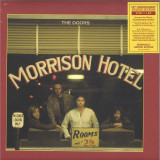
The Doors returned to their roots and were reborn a rock ’n’ roll band on Morrison Hotel, the group’s fifth studio album. Completed in only a few weeks and released in February 1970, the hard-charging album took its name from the Skid Row hotel in downtown Los Angeles that’s featured in the iconic cover photo taken by Henry Diltz.
Morrison Hotel: 50th Anniversary Deluxe Edition includes the original album newly remastered by The Doors’ longtime engineer and mixer Bruce Botnick, plus a bonus disc of unreleased studio outtakes, and the original album on 180-gram virgin vinyl. The music will also be available from digital and streaming services the same day.
For this new collection, the original album has been expanded with more than an hour of unreleased recordings taken from the sessions for Morrison Hotel. These 19 outtakes transport listeners into the studio with Jim Morrison, John Densmore, Robby Krieger, and Ray Manzarek for an unprecedented perspective on the making of the album. Botnick says: “There are many takes, different arrangements, false starts, and insightful studio conversations between the band – who were in the studio – and producer Paul Rothchild – who was in the control room. It’s like being a fly on the wall.”
Several of these unheard recordings spotlight how Queen Of The Highway and Roadhouse Blues evolved across multiple sessions. It’s especially interesting to hear how the band played with different bass players on Roadhouse Blues. Early versions include Harvey Brooks, who played on the band’s previous album, The Soft Parade. Later takes feature guitar legend Lonnie Mack on bass along with The Lovin’ Spoonful’s John Sebastian on harmonica who, due to contractual restrictions at the time, had to be credited as G. Puglese.
Among the treasure trove of unreleased outtakes are also rough versions of Morrison Hotel tracks Peace Frog and Blue Sunday, as well as The Doors rarity I Will Never Be Untrue. The collection also captures some incredible session outtakes of the band jamming on cover versions of the Motown classic Money (That’s What I Want) and B.B. King’s Rock Me.
From Mille Plateaux to Leaf, Staubgold and Raster-Noton, ~scape, or on his own label Ripatti, the Finnish artist Sasu Ripatti aka Vladislav Delay has been exploring various iterations of the dub culture vs. electronica, since 1997. His sonic crafts and unique signature sound has been sought after by an eclectic range of bands and artists, ranging from Massive Attack, Hauschka, Black Dice, Autopoieses, Animal Collective or AGF.
Somewhere between the old-school electronica culture, the soundscaping, the experimental paths of Lee Perry and Adrian Sherwood, ghostly clubbing anthems, minimalism, pop, jazz, without being, influenced, Vladislav Delay is building a drifting and coherent sound enigma.
Vladislav Delay met Sly Dunbar and Robbie Shakespeare (the most prolific Jamaican rhythm section and production duo) thanks to a series of jam sessions. Trumpet player Nils-Petter Molvaer had been asked by the Jamaicans to join them and he invited Delay alongside guitar player Eivind Aarset to tag along, which eventually turned into the Nordub project.
The result of these jam sessions turned into an album, mixed and mostly produced by Vladislav Delay, released on the label Okeh. It was also followed by an extensive series of live dates. This one-shot reunion was the beginning of another story: a trio composed by Delay, Dunbar and Shakespeare.
In January 2019, Vladislav Delay went to Kingston and spent some days at The Anchor studios, to record drums and bass with S&R, some voice takes and a series of atmospheric field recordings. Back to Finland, Delay started to experiment with this precious material, mixing and overdubbing, in the comfort and quiet of his studio, based on the island of Hailuoto, Baltic Sea, Northern Finland, giving another feeling to the Jamaican trip.
This became a tribute to the 'dub spirit', but in a very personal way, far beyond any influence or "the obvious". 500-PUSH-UP is two worlds collapsing, merging, also showing some intriguing approach of the Jamaican groove, used as a filigree, like the echo or the ghost of reggae, converging and conversing with a post-industrial and experimental approach. To file beside experiments - for instance - such as Lee Perry's 'Scientist Rids The World Of The Evil Curse Of The Vampires' or the On U-Sound productions.
An exchange between several voices of African artists (the Congolese Flamme on guitar, the late Cameroonian Hilaire Penda on bass, the Beninese Angélique Kidjo on vocals, and the dj singer producer
from South Africa Mo Laudi on the mike) gathered for the dance and celebration of this World Heritage work. The most popular anthem of classical music revisited in Afro Pop mode for crowds around the world. About this project, the producer Philippe Cohen Solal (ex-Gotan Project) tells: « When Mo Laudi, a Paris-based South African DJ, joined me in the studio, he delivered a great rap full of positive energy and geopolitical rhymes, from Patrice Lumumba to Biko and from Congo to São Paolo. Then Queen Angelique Kidjo, like a divine diva, fervently sang her hymn "Lonlon" in the Mina language, where the Afro literally meets the Bolero. We will not forget the fine team that allowed me to concoct this sacred cocktail: Flamme Kapaya,
outstanding Congolese guitarist, the Parisian DJ-beatmaker Lazy Flow and the late Hilaire Penda, Cameroonian bass player who unfortunately left us since. Benin, South Africa, Congo and Cameroon meet in Paname, the capital of World Sound, but the musical adventure did not stop there. The remixes take us straight to London with Poté, to Berlin with Daniel Haaksman and to Johannesburg with the super-group Batuk formed by the godfather of the African electro Spoek Mathambo, the kwaito maestro Aero Manyelo and the Mozambican singer Manteiga. At a time when travel is prohibited or
not recommended, let us be glad that music does not need certificates or passports and knows no borders ».
Repress!
For its second release, Radiant Love sticks to family values. Paying homage to the party and label’s co-director and resident Byron Yeates, Byron’s Theme comes from the likes of Vani-T (one half of Berlin’s forceful, femme party Climax) and D. Tiffany (who threw down a ruthless remix on the label’s first release by Fio Fa). Together, they take the name of Pillow Queen – a semi-pejorative term for the kind of sub who expects to receive pleasure like a well catches rainwater. No reciprocation, just a reign of sexual passivity.
Their tracks, however, give plenty. “Byron’s Theme” presents a rich palette in its 2-minute buildup: a dry trance hook, high-end synths buzzing and wavering, pitch-shifted voice samples and a pan-flute ran through with tremolo. Throbbing, the 303 bassline picks up after a breakdown at the 4-minute mark, and only then does one realise the song’s still building. There’s still room in the last 40 seconds for some percussion modeled on a breakbeat loop – which is to say, the track is incredibly cheeky and hard-hitting – all that I would hope for in any lover.
While the EP’s first track feels wide, rangy, “Estrel Nights” opens the EP’s B-side in a much closer, tighter space. The build is percussive: bongo taps, claps, cowbell; then a hi-hat snaps things into shape, and in lopes the kick drum. And rhythm remains the central player here. It’s not until 3 minutes in that the percussion finds a melodic backdrop – a dreamy, detuned pad, choral, like a moan.
Ex-Terrestrial’s remix of “Byron’s Theme” repositions some of the elements and ratchets up the tempo of the original, but maintains its respiration: the energy and erotics flow into a different structure, closer to traditional trance, with sharp hi-hats and loopy arpeggios that phase in and out of syncopation, measure to measure. Diagonal, we incline to a climax that dizzily plateaus at 6 minutes, de-escalates and breaks down over the next 2, glows until it’s just a kick drum, slower, slower still; we’re catching our breath.
Walter ‘Junie’ Morrison released his third solo LP, Suzie Super Groupie, in 1976. A slick, smooth and soulful record, it’s a genre-melting tour de force with rich elements of proto-boogie, funk and jazz. In short, this is yet another essential album reissue from Be With.
The sublime “Suzie Thundertussy”, is a favourite of Harvey and Theo, and was brilliantly sampled by Madlib for Kanye West’s “No More Parties In LA”. The track opens with a sinuous synth and combines Junie’s storytelling abilities with an emphatic vocal style and funky arrangements. The powerful bass and sinister chords create an undeniable groove, and the explosive chorus is full of ambition and joy.
“If You Love Him” is a great, mid-tempo soul song. With a swinging jazz-infused middle-eight, it demonstrates Junie was much more than a mercurial funkateer. The laconic groove of “What Am I Gonna Do” recalls “Fresh”-era Sly Stone, whilst the frantic “Super Groupie” showcases his sharp imagination and sense of fun. The lyrics range from humorous to dirty, all fuelled by an infectious groove and tight horn arrangements.
The P-Funk of B-side opener “Surrender” bounces and sparkles, with a strutting Junie backed by great harmony vocals and joyous horns. “Suzie” is a sleek, softer affair albeit with a disco pulse; a beautiful combination of bright, funky horns, fluid basslines and vigorous rhythms. “Stone Face Joe” is another character song, this time one that chugs along on a sweet boogie rhythm.
The winner for us, however, is the closing piece. An extended funk-rock jam, “Spirit” has a heart-rending spoken-word intro and, as a nod to Jimi Hendrix, creates a live concert sound, complete with screaming crowd and fuzzy vocals.
Junie made his name as the lead singer and keyboardist of the Ohio Players. As the mastermind behind “Pain”, “Pleasure”, “Ecstasy”, and the oft-sampled “Funky Worm”, he was beloved by countless musicians, not least Prince. As co-writer of some of Funkadelic’s seminal works - “One Nation Under A Groove”, “(Not Just) Knee Deep” – his standing as one of the structural fathers of funk is undisputed.
In late 2016, Solange’s “A Seat At The Table” featured a track called “Junie”, a tribute to the freedom he created in music. His work continues to be as relavent and inspiring as it was when it was first recorded.
In February 2017, Junie died, aged just 62. With records as mighty as Suzie Super Groupie, his legacy will live forever and Be With is proud to be able to do our bit to make this LP accessible again on vinyl.
BAFTA Award-winning actor Matt Berry has been the star of a number of high profile TV series including Toast Of London, The IT Crowd and most recently What We Do In The Shadows. Concurrently he has
cultivated a career as a musician that has seen him release six solo albums and collaborate with the likes of Bond composer David Arnold, Jean-Michel Jarre and most recently Josh Homme, who invited him to perform on the Desert Sessions.
His most recent album ‘TV Themes’ was a UK Top 40 hit and was awarded four stars by Will Hodgkinson writing for The Times. His reinterpretation of British TV themes of the past was no mere wallow in nostalgia but an exploration of recording techniques and a joyous celebration of the music.
‘Phantom Birds’ was inspired by a fascination with Bob Dylan’s ‘John Wesley Harding’, the way it was recorded with the minimum of musicians to draw attention to the songs. For the recording Matt worked with drummer Craig Blundell - known for his work with
Steven Wilson and Steve Hackett - and legendary pedal steel player BJ Cole, yet the tinges of Americana are never allowed to overwhelm Matt’s own distinctive style.
Tape / Cassette
Brand new 70 mins blast from the Hair & Treasure crew pressed a double dung casing for your listening (dis)pleasure.
Recorded between 2017 - 2019 into Uncle Eddie's VHS player, magik happens inside the Archers boudoir.'
In the band’s own words:
‘’A clumsy wife with a tricky nose wants to feel deserving of her husband and a former male beauty pageant winner wants his out-of-place arm implants revised or removed.
Rating 6.2 “
- A1: John Coltrane - A Love Supreme - Pt 1 Acknowledgement
- A2: Elvin Jones - Fantazm
- A3: Max Roach - Lonesome Lover
- A4: Yusef Lateef - Sister Mamie
- B1: Freddie Hubbard - The 7Th Day
- B2: Mccoy Tyner - Three Flowers
- C1: Elvin Jones - Half & Half
- C2: Mccoy Tyner - Groove Waltz
- C3: Archie Shepp - Le Matin Des Noire
- D1: Michael White - The Blessing Song
- D2: Alice Coltrane - Turiya & Ramakrishna
- D3: Phil Woods - A Taste Of Honey
- E1: Pharoah Sanders - Hum-Allah-Hum-Allah-Hum-Allah
- E2: John Klemmer - Constant Throb (Part 1)
- F1: Pharoah Sanders - Thembi
- F2: Marion Brown - Maimoun
- F3: Alice Coltrane - Journey In Satchidananda
In our latest chapter of Spiritual Jazz, we return to the source – the Impulse! label, and the monumental influence of its most prominent artist, John Coltrane.
Since the first release in the series back in 2008, we have mapped out the growth of the spiritual sound in jazz. Spiritually energised and politically conscious, the spiritual sound in jazz music is one of the most important currents in the music. Our series has charted the growth of the style from early experiments at Blue Note and Prestige to European excursions, exiled experimentalists, and sounds from across the globe. But whenever you think of spiritual jazz, it's a fair bet that the double exclamation mark and orange and black spine of Impulse quickly comes to mind. Home to John and Alice Coltrane, Pharaoh Sanders, Yusef Lateef, McCoy Tyner and countless other musical pioneers, Impulse! was the most important and forward-thinking jazz label of the 1960s. With the music-first attitude of an independent but the clout of a major, producers Creed Taylor and Bob Thiele made Impulse the defining imprint of a crucial decade. They hand picked the top players of the moment and gave them freedom to record the music they wanted, setting out their stall with a bold slogan – 'The New Wave Of Jazz Is On Impulse!'
Here we dive deep into the Impulse! catalogue, bringing celebrated masterpieces from Alice Coltrane and Pharaoh Sanders into the arena, together with lesser known cuts from Phil Woods and John Klemmer as well as straight-up classics such from Yusef Lateef and Elvin Jones. Fifty years on and the new wave of jazz still sounds fresh, vibrant and as relevant as ever.
- A1: Rice Brothers - Soul Food
- A2: Mel & The Blue Aces - Cold Sweat
- A3: Silas & The Soul Counts - Pass The Soul
- A4: Bob Bassett - Put It In There
- A5: Rudi Johnson Trio - This Is It
- A6: Sam Hankins & The Ho Dads - Shotgun
- B1: Crumb & The Soul Touchers - The Crawl
- B2: The Magnificents - Mister Kool
- B3: Mr Cbs - Funky Boo Ga Loo
- B4: Tom Hurley Combo - You Better Believe It
- B5: Leo Valentine Trio - Kitchen Sink
- B6: Lewie & The 7 Days - Night Train
- B7: George & The Highlanders - Smoking Bananas
The Hammond organ was first manufactured in 1935. In 1954, the now famous Hammond B3 model was introduced with additional harmonic percussion feature. When the company went out of business in 1985, around two million of various models of the Hammond organ have been produced.
The Hammond B3 was originally marketed to churches as a lower-cost alternative to the wind-driven pipe organ. It quickly became popular with professional jazz musicians in organ trios. Jimmy Smith's use of the Hammond B3 inspired a generation of organ players, and its use became more widespread in the 1960s and 1970s in rhythm and blues, rock, reggae, and progressive rock.
This collection is centered on the exciting and dynamic sounds of the Hammond B3 organ!
For years, Frente Cumbiero has served as the torchbearer of a new wave of experimental exploration in the diverse modern-day cumbia canvas. Led by Mario Galeano Toro, a Colombian native and accomplished veteran of Bogotá's rich music scene, the group first connected with listeners outside of South America via their head-exploding 2010 debut on Names You Can Trust. "Pitchito" would become a cult favourite, a catalyst for the Brooklyn-based label, and soon after a bonafide rarity. Those beginnings of Frente Cumbiero focused on an honorary recognition of the massive musical impact that the many formations of cumbia have had over the decades within Colombia. Subgenres such as gaita, porro, vallenato, and caracolito, to name just a handful, have all played their part within the evolution of the country's tropical music lineage. That deep-digging determination coupled with a truly unique and talented musicianship has informed Frente's music, some of the most forward-thinking and reverential examples of the current tropical scene. It has led to some incredible opportunities and collaborations in Europe, Asia and the States, including genre-defying recordings with London's Mad Professor and Japan's Minyo Crusaders.
Still, Galeano Toro's assemblies with Frente Cumbiero have been scarce amongst his other exploits, splitting time as player and producer in other ground breaking projects like Ondatropica and Los Pirañas over the recent years. After three 45 single releases together with NYCT, the time away has left everybody wanting for more. Now, reassembled and seasoned with years of touring and gigging in a multitude of projects, the group's current quartet of Galeano Toro (keys and synths), Pedro Ojeda (timbales and percussion), Marco Fajardo (tenor sax) and Sebastián Rozo (bombardino) is a stripped down powerhouse of unadulterated psico-tropi swing, a beautiful Colombian musical stew, incorporating a host of flavors from the melting pots of the Pacific, Caribbean and Atlantic pathways. The final result is of course quite unclassifiable, simply a new breed of good music and a dancefloor delight.
- A1: Waldo’s Gift - Bergson
- A2: Run Logan Run - 3.3 Encke Ups
- A3: Waldo’s Gift - Jabba
- A4: Snazzback - Flump (Ishmael Ensemble Rework)
- A5: Snazzback - Grook (Feat China Bowls)
- B1: Snazzback - Yum Yum (Feat China Bowls)
- B2: Run Logan Run - Sea Of Apathy & Indifference
- B3: Lyrebird - Owl
- B4: Waldo’s Gift - I’m Not Buying (Feat Lyrebird)
- B5: Alun Elliot-Williams - Bourdain
Bristolian promoters Worm Disco Club have been championing South-Western talent since their inception in 2014. Having collaborated with Glastonbury Festival on their notorious 'Wormhole' stage and hosted the likes of The Comet Is Coming, The Heliocentrics and The Mauskovic Dance Band at their regular club night, the name has become synonymous with quality groove laden goodness, percussive madness, jazz, psych and beyond. Now proudly presenting their label Worm Discs, the collective recruit some of Bristol's most notable emerging talent for an exploration into the new wave of Jazz emanating from the city. As Andrew Hayes, (Run Logan Run) explains : "Bristol has always had its own sound, but there's been a new crop of young players come through over the past five years that's revitalised the scene and expanded its expectations about what jazz music means. Featuring the likes of Waldo's Gift, Run Logan Run (Montreux Jazz Talent Award winners), BaDaBoom, Lyrebird and Alun Elliot, 'New Horizons' channels the seismic energy of the sonically rich landscape into 12 progressive, psychedelic, impeccably crafted tracks.
- A1: The Spirit Of Love
- A2: Sticky Situation
- A3: Aftershock
- A4: Love At First Sight
- B1: I'll Get Over You
- B2: Later We'll Be Greater
- B3: Let's Go All The Way
- B4: We're In Too Deep
- B5: Stocky Sachoo-A-Shun
Widely and rightly regarded as one of the best ever soul and funk bands, the now legendary Average White Band tore-up the rule book and conquered the US, UK & International charts with a series of soul and disco hits between 1974 and 1980.
AWB’s repertoire has been a source of inspiration and influence for many R&B acts and they are one of the most sampled bands in history, remaining relevant today, continuing to reach new generations of younger audiences.
Snoop Dogg, Fatboy Slim, Ice Cube, Puff Daddy, TLC, Rick Ross, will.i.am and Mark Ronson amongst countless others, have all borrowed sections of their grooves.
Having split in 1982, Average White Band re-formed in 1988 with a different line-up but with Alan Gorrie, Onnie McIntyre and Roger Ball remaining. ‘Aftershock’ is the Band’s 11th album, originally released in 1988.
‘Aftershock’ includes the singles ‘The Spirit Of Love’, which features Chaka Khan and Ronnie Laws, as well as ‘Sticky Situation’. Other special guests include The Ohio Players.
With roots cemented in jungle, breaks and hardcore, Unglued injects his signature bassline badness into each tearout track, topped with euphoric classic house samples in the title track ‘Total XTC’, to hair-raising vocals from Truthos Mufasa in ‘War Dance’ featuring Whiney.
Total XTC fires us through a prism of late 80s nostalgia with pitched-up soulful vocal samples from Charvoni’s feel-good classic house groover ‘Always There’. Dreamy pads and playful vintage notes set the scene. Soothingly sustained vocals swim over raw, metallic, jungle-infused drums that introduce the subdestroying drop. A certified rave anthem that will have all the heads entranced.
‘War Dance’ raises adrenaline as Manchester-based Truthos Mufasa lays down slick and weighty bars that ricochet off skippy old skool-style drums right in the eye of the storm. Together, Unglued and Whiney conjure up bass-rumbling chaos as we’re pushed ‘right off the tracks’ with double-barrelled artillery in the heat of battle.
Charging in with twisted swagger, ‘Got 2 Have’ is a squelchy bass-ridden stepper that screams Unglued all over. While ‘Pigeon Funk’ swoops in and stares you down with electrically-charged squarks and funk-fuelled flare.
Introduced to jungle at an early age by his influential uncle Stoppy, Unglued demonstrates his ability to simultaneously stick and unpick these roots in his powerfully dynamic ‘Total XTC’ EP by fusing the old-skool style with his unique, forward-thinking flair.
Unglued’s rise since his anthemic ‘If We Ever’ remix, has brought in over a hundred intercontinental shows since 2019, and regular support from some of the biggest players in the game, including Andy C, Noisia and Randall.
Unglued is no stranger to spins on national airwaves, with BBC Radio 1’s Annie Mac awarding him Hottest Record In The World for ‘Born In 94’, as well as regular support from Rene LaVice and Charlie Tee on Kiss Fresh. Everyone’s got their eyes stuck to Unglued!
12′’ Maxi SP with original exclusive artwork by artist Paul Shipper, for the 40th anniversary of the motion pictures Mystery Men, directed by Kinka Usher, starring Ben Stiller, Hank Hazaria, William H Macy, Paul Reubens and Geoffrey Rush. A true collector’s item for any fan of this cult film, which saw a new generation of comedians led by Ben Stiller take the power over Hollywood, and which way ahead of its time invented the super heroic comedy genre, years before Guardians of the Galaxy or Shazam. This Maxi SP features the original song All Star by Smash Mouth. The song was used for the first time ever for Mystery Men original soundtrack. The song would soon after become a worldwide hit (and later an internet meme) when featuring to the movie Shrek Vital Sales Points: Artist Paul Shipper has become a pillar of the revival of the painted artworks in the movie industry, after decades of photoshop excesses. He has created prestigious posters for Steven Spielberg’s Ready Player One, Marvel’s Avengers Infinity War, Disney’s Star Wars The Rise of Skywalker. Includes a printed inner sleeve. Pressed at only 500 copies
- A1: Negative Delta S
- A2: White Swallows In Dark Valleys
- A3: Now You Are
- A4: Sunbird
- A5: We've Said Few True Words Since
- B1: You've Got To Not Believe In Something
- B2: Thirstland
- B3: A Place To Die Again
- B4: Children Of Decay
- B5: Hominids In The Infinitely Unfolding Timelessness Fractal
- B6: Evolve To Extinction
- C1: You Are Not A Simulation
- C2: Listen To Your Future
- C3: Light Through The Paleolithic Horizon
- C4: Return To Earth
- C5: Let The Future Be Unknown Again
- D1: Blackfield Peninsula
- D2: If You Have The Eyes To See
- D3: Birthland Pariah
- D4: Deepdale Falls
clocolan is Emlyn Ellis Addison, a South African artist now living in Providence, Rhode Island. Exploring themes of ontology and psychedelia, his is a music of imaginary futures—of neglected hinterlands and unconquered vastness lost in the background noise of human endeavor.
Addison’s 2017 album, Nothing Left To Abandon, examined the experience of memory while his new album, It’s Not Too Early For Each Other, examines a more pressing experience: the ecosystemic collapse. clocolan dotes once more on dusty melancholy and electronic psychedelia in his new album, pressing into darker territory and more visceral textures.
It’s Not Too Early For Each Other examines the looming inevitability of a future shaped by mankind's destruction of natural ecosystems—and its seeming inability to alter that course. This music is dedicated to the pariahs: the messengers who confront the murder of the ecosystem.
Emlyn was introduced to Colin Morrison at Castles in Space by Strictly Kev AKA DJ Food. It's proving to be an incredibly fruitful collaboration and a third clocolan long player is already delivered and undergoing mastering for future release on Castles in Space.
Appearing on Echovolt for the very first time, Vancouver-based producer Wolfey offers up a four-track excursion that draws direct inspiration from the often-rainy climate of his sleepy home city.
"Powell St. Blues" E.P. is a dance record of rare emotional depth that sees the Canadian bring out an impressive amount of warmth and soul from the machines he uses to make music. Drawing inspiration from early house and techno producers out of Chicago, NY and Detroit, Wolfey likes to work with a small selection of synthesizers, drum machines and outboard effects processors - only using the computer to record, edit and mix-down long multi-track takes and improvised jams. The resultant tracks bristle with vivid detail and texture while evoking distinctly hypnotic and alluring atmospheres.
Side A opener “Powell St. Blues” is a bittersweet melancholic chunk of deep house with spacey chords and subtle acid style motifs slowly undulating over dusty drum machine rhythms. Wolfey’s deep and emotive electro influences come to the fore on “No Fun City”, where tech-jazz style electric piano motifs, bleeping lead lines and dubby rhythmic delays dance around a tactile 808 groove. On languid B-side opener “Overcast”, aural storm clouds gather menacingly above a moody bassline and the crunchiest of machine rhythms. S.M.P (Slim Media Player) guests on the EP’s lusciously loved-up conclusion, “Southlands Transmission”, where morphing synth arpeggios, rich sunrise-ready chords and swinging skittering hi-hats recall the pitter-patter of rain on the windows of Wolfey’s Vancouver studio. It’s a fitting conclusion to an atmospheric, mood-enhancing EP.
Fabe makes his highly anticipated debut on FUSE this August as he unveils his four-track vinyl sampler from his sophomore album, ‘Four Point Island’.
A key figure within Mannheim’s blossoming scene and a core member of the city’s well-respected BE9 collective, DJ, producer and label boss Fabe has quickly forged his position as an artist of note within the house and minimal landscape. Featuring as a regular for both Cocoon and FUSE/Infuse across their worldwide events and labels, whilst also launching his own imprint Salty Nuts, the multi-faceted talent has carved out a trademark sound palette combining groove-heavy bassline with elements of classic house, forceful techno, forming a unique, high-energy style which is now instantly recognisable as his own across the scene today. Following on from the release of his
debut album ‘Water Tower’ in 2019, late-summer welcomes the release of his second long-player project as he debuts on FUSE to deliver ‘Four Point Island’ – becoming only the second artist to release an album on the label after founder Enzo Siragusa.
They say you can't judge a book by its cover, and going by 'Jazz Rock', nor a record by its title. Though entering into jazz territory and featuring some distorted guitar, 'Jazz Rock' is more a beautiful marriage of funky breakbeat drumming and spiritual jazz instrumentation, combined with traditional Min'y music performed on the koto and shakuhachi.
Originally released in 1973, the record sounds simultaneously vintage and contemporary. It is akin to something Madlib might dream up whilst lost in Japan collaborating with Min'y players at a recording session. The record features some amazing shakuhachi (bamboo flute) playing by Hozan Yamamoto, which gives the music a haunting, dreamlike atmosphere. You can almost visualise the long grass blowing in the wind, and ear the bamboo rustling in the distance on a long hot summer's day. Takeshi Inomata, Tadao Sawai and Kazue Sawai anchor the session. Takeshi's exceptionally funky-drum work will almost certainly get some producers dusting off and firing up their MPC's. Whilst Kazue and Tadao work their magic on the koto (a traditional string instrument). Though certainly not an ambient record, 'Jazz-Rock' has the same meditative, other-worldly quality that invites you to sit back, listen and be transported somewhere else. Unfortunately, until now the 'Jazz Rock' album is a scarcity that commanded a high price-tag only for the most hardened of record collectors. So it is pleasure to make it accessible to all, and we hope you dig this lost, obscure future classic as much as we do.
Released in 1971 while Gil was living in London, this is the third self-titled release from the bossa nova and tropicalia legend. Gil recorded this album while in political exile from his native Brazil and its somber, straightforward tone is a welcome change from the experimental, psychedelic assault of his 1969 long player. Featuring 8 originals and a brilliant cover Steve Winwood's 'Can't Find My Way Home,' this Water release also contains 3 bonus tracks including covers of Jimi Hendrix and The Beatles. A tropicalia classic.
Avant-garde percussionist, singer, self-taught trumpet player, composer and author,
Edmony Krater, since the late 1970s has been a go to reference for French Caribbean music and all things Gwakasonné.
This Guadelopean great had been somewhat quiet since the mid 80s, however in 2019, after the recording of a live show for Cult Berlin club night, African Acid Is The Future that received a release via The Vinyl Factory, his light was relit.
Prior to this, in 2015, along with Diggers Digest, Paris based Heavenly Sweetness reissued the highly sought after 1988 album, ‘Ti Jan Pou Velo’ and Edmony began to stir up rumours of new material coming.
2018 saw his first foray into new recordings, Heavenly Sweetness released ‘An Ka Sonjé’, a record garnishing praise from Pan African Music, and he now readies his second for the label with, ‘J’ai Traversé La Mer’ (I’ve Crossed The Sea)
Like the hundreds of thousands before him, Edmony Krater also crossed the sea. Pulled from Africa, caught up in the violent and absurd logic of triangular trade. Slaves were forced to America, the Caribbean and Europe, where many descendants have since become famous writers, poets, leaders, athletes and of course, musicians.
- A1: Save Yourself First
- A2: Not In Love
- A3: Slowdiving (Feat Lossapardo)
- A4: Hundred Fifty Roses
- A5: Your Fruit (Feat Gracy Hopkins)
- A6: Flowers & Honey (Interlude)
- B1: Invisible (Feat Aurelie Saada)
- B2: Pointless (Feat Ichon)
- B3: Polterguest
- B4: Vicious Cycle (Feat Gracy Hopkins)
- B5: Ps (Feat Swing & Ph Trigano)
- B6: The One
- B7: Ten Years
Duñe and Crayon have been working together for a few years now. Crayon, discovered by Kitsuné is a close relative of FKJ and Kartell. Duñe, on the other hand, has evolved with the duo Saje.
It was within the Roche Musique family that they met and naturally started working on a joint-EP in 2016, soberly entitled Duñe x Crayon. Both self-taught producers, Crayon and Duñe, former inhabitants of Parisian suburbs located at opposite positions, yet quickly found each other.
For their first album, they lock themselves in their studio day and night, until they choke. It would take them several years - interspersed with a few solo projects - for the two artists to give birth to Hundred Fifty Roses. An album through which they expose themselves, both in production and in writing but also in interpretation. On rhythms sometimes inspired by Anglo-Saxon sensuality, but with a production that is indie enough to infuse more warmth. A groove with a soft pop feel to which Thomas Clairice, former bass player of HER, also contributes. To accompany Duñe, bright voices were invited on six of the album's thirteen tracks : We hear French singer and rapper Ichon‘s velvet voice (whom Crayon also produces) on "Pointless"; Gracy Hopkins brings his soul on "Your fruit". Ph Trigano - another artist who produces Ichon - participates in "PS" along with Swing.
Lossapardo - with whom Crayon had already recorded on his solo projects - close the album with "Slowdiving". On the English side, we discover Jadu Heart, a duet signed on Anchor Point, Mura Masa's label, giving the replica on "Invisible". More than perfection, Hundred Fifty Roses resolutely seeks emotion. The album is the musical result of an open discussion in an intimate context, halfway between the live experience and the digital exercise.
Released during the late 1970's Disco era, Milton Wright's sophomore long player has always stood out as a singular, innovative example of the deepest, rarest grooves known to underground Soul lovers all over the globe. This often overlooked body of work has found a whole new audience who revisited the man's work retrospectively, pushing the LP into the domain of "holy grail" status amongst Black music lovers and Funk fanatics. "Spaced" has been at the top of the wants lists of serious music lovers for decades, often unattainable and commanding stellar collectors prices on-line, sometimes fetching amounts of upwards of £400. This unique LP could be perceived as being Wright's most personal work, tragically overshadowed by the burgeoning successes of his then label mates on Miami's Alston Records imprint. The sheer craftsmanship and songwriting prowess on show is undeniable, as is the top level musicianship and production, sounding ridiculously fresh almost some 40 years later. Above Board distribution has collaborated with Alston / TK Records to ensure the quality of this fully legitimate repress of this long lost Soul / Funk classic has been maintained. Remastered, reissued and represented with the full cooperation of the license holders for 2016. Do not pass up the chance to own a true gem, a pivotal, lost LP like "Spaced", now made available again to be enjoyed by all. "Magic Music".
Ryan Lee West aka Rival Consoles announces details of his highly anticipated new album Articulation, released on Erased Tapes on 31 July 2020.
‘Articulation’, the lead track and album centrepiece, links the record back to the analogue fluidity and colour of 2016’s Night Melody. The division of varying time signatures, intertwined with a complex structure of notes, creates an expression of a moving structure and conjures a dreamy motorik energy. Ryan Lee West explains, "The title track is about articulation and playfulness with shape and time. Its structure is very machine-like, but I was really interested in how melody and sense of story could develop out of this, and it became an exploration of mathematical structures - patterns and shapes having a conversation. I love that something on paper can appear rigid and calculated, but then take on new meaning based on the context that surrounds it, or how it changes over time."
Articulation (which follows 2018’s Persona) was conceived with a very visual way of thinking, unusual for the London musician and producer. During the writing process Ryan drew structures, shapes and patterns by hand to try and find new ways of thinking about music, giving himself a way to problem-solve away from the computer. The album title references a piece by the avant-garde contemporary composer Györgi Ligeti, though not for its music, but for the non-traditional graphic score that accompanied it.
“I find electronic music is often battling to say something with integrity because technology and production can easily get in the way. I think the goal of a lot of electronic composers is to find a balance between the vision of the idea and the power of possibilities on the computer. With a pen and paper sketch you can compose and rethink ideas without technology getting in the way, so for me it acts as a very helpful tool to refresh the process.” - Ryan Lee West
The idea of using analogue drawings and tools to bolster digital creations can be heard in the structure of the pieces that make up Articulation from the broody techno opener ‘Vibrations on a String’ all the way to the album’s boundless closer ‘Sudden Awareness of Now’. While the anthemic rise and fall of ‘Still Here’ and the beatless ambient meditation ‘Melodica’ evoke a certain nostalgia, ‘Forwardism’ achieves the very opposite by burying its melody within the fast-paced rhythm of its pulsating synths.
Rising out of birdsong heard from his studio window, ‘Sudden Awareness of Now’ has a particular urgency about it and seems to perfectly capture a longing for escape. Built around a simple and repetitive melodic theme, expanding and retracting over the course of its seven-minute odyssey, Lee West explains; “I like the fact that if you say something over and over again in music, then over time it can become something else, something reflective.”
Since the release of Persona, Ryan Lee West has taken his captivating live A/V set to all corners of the world. Last seen live on stage with 17 players of the London Contemporary Orchestra for a sold-out orchestral performance at Southbank Centre’s Queen Elizabeth Hall in January 2020.
Meanwhile Lee West has kept busy. After contributing an exclusive track titled ‘Them Is Us’ to Adult Swim’s coveted Singles series, he recently shared the beautifully textured solo piano piece Winter’s Lament on this year’s Piano Day. He has also been in high demand as a composer, scoring Charlie Brooker’s much talked about Black Mirror episode Striking Vipers, composing original music for Secret Cinema presents Stranger Things as well as renowned choreographer Alexander’s Whitley’s groundbreaking new work Overflow which was set to premiere at London’s Sadler’s Wells Theatre this spring.
Articulation will be available worldwide on 31 July, with live activities to be announced as soon as the situation allows safe event planning
Minyo Crusaders rework historic Japanese folk songs (min'yo) with Latin, African, Caribbean and Asian rhythms for their debut album 'Echoes of Japan'.
Releases from Ryuichi Sakamoto, Haruomi Hosono and Midori Takada have re-ignited global interest in Japanese music and 'Echoes of Japan' marks the arrival of a big band like no other.
'For Japanese people, min'yo is both the closest, and most distant, folk music' explains band-leader Katsumi Tanaka: 'We may not feel it in our daily, urban lives, yet the melodies, the style of singing and the rhythm of the taiko drums are engrained in our DNA'. Initially indifferent to min'yo, a tragic event in recent Japanese history set Tanaka on his current path: 'Following the Tohoku earthquake of 2011, I reflected on my life, work and identity. A fan of world music, I began searching for Japanese roots music I could identify
with. Discovering mid-late 20th century acts Hibari Misora, Chiemi Eri and the Tokyo Cuban Boys, I was
captivated by their eccentric arrangements and how they mixed min'yo with Latin and jazz.'
Originally sung by fishermen (Kushimoto Bushi; Mamurogawa Ondo), coal miners (Tanko Bushi) and sumo wrestlers (Sumo Jinku), these songs deal with topics such as the returning spirits of ancestors (Hohai Bushi), Japan's smallest bird (Toichin Bushi) and a bride's love for her husband's pockmarked face (Otemoyan).
Minyo Crusaders are one of the most hyped acts on the Tokyo music scene that went national in 2018 through festivals such as Fuji Rock. The band features veterans of the Tokyo roots music scene such as bassist DADDY U (Ska Flames), keyboardist Moe (Kidlat), sax player Koichiro Osawa (Matt Sounds/ J.J. Session), Yamauchi Stephan (J.J. Session), percussionist Mutsumi Kobayashi (Banda de la Mumbia), conga player Irochi (Cubatumb) and vocalist Meg (DJ collective Tokyo Sabroso).
- Wild blend of Japanese folk music with cumbia, boogaloo, Ethio jazz, Afro funk + more
- Ry Cooder, Mario Galeano (Ondatropica/Frente Cumbiero), Clap! Clap! are all fans
- European touring plans for autumn/fall 2019
- Includes Japanese lyrics + English translations
- Lacquers cut @ The Carvery
- A1: Garou Densetsu Title (Neogeo)
- A2: Garou Densetsu Title (Mvs)
- A3: Fatal Fury Title (Neogeo)
- A4: Fatal Fury Title (Mvs) Ver.1
- A5: Three Heads Are Better Than One (Player Select)
- A6: Fight! (Battle Start)
- A7: The Hooligan Of Downtown (Duck King's Theme)
- A8: Haremar Faith Capoeira School - Song Of The Fight Believers Will Be Saved (Richard Meyer's Theme)
- A9: The Sea Knows (Michael Max's Theme)
- A10: Four Thousand Years Of Chinese History (Tung Fu Rue's Theme)
- A11: Results Are Everything (Battle Results)
- A12: Suspicious Guy (Interrim Demo)
- A13: The King Cobra Is Coming (Hwa Jai's Theme)
- A14: The Hero Raiden (Raiden's Theme)
- B1: Let's Start (Bonus Game Start)
- B2: Keep Going Until The Ends Of Hell (Bonus Game Main Bgm)
- B3: You Are Great! (Bonus Game Victory)
- B4: Failure Is The Key To Success (Bonus Game Defeat)
- B5: Hit By A Stick If You Walk Along The Bridge (Billy Kane's Theme)
- B6: Kidnapping (Geese's Subordinates Demo)
- B7: Desperate Awakening (Geese Appearance Demo)
- B8: A Kiss For Geese (Geese Howard's Theme)
- B9: Just A Little Smart Fighting Fellow (2P Battle Bgm)
- B12: I Won't Give Up! (Continue)
- B13: Beyond Despair (Game Over)
- B14: Enter Your Name (Battle Records Display)
- B15: Fatal Fury Title (Mvs) Ver. 2
- B16: The Hero Raiden -Rof Arrange Ver
- B10: In The Shadows Of Victory (Victory Demo)
- B11: If You Gaze At Reality (Ending)
SNK, Brave Wave Productions and Limited Run Games are proud to reveal their fifth collaboration, Generation Series 012: Fatal Fury for both CD and vinyl. Known as Garou Densetsu (餓狼伝説) in Japan and originally released for NEOGEO in 1991, Fatal Fury is one of SNK’s earliest, but also most popular 2D fighting games. The soundtrack, composed by TARKUN (Toshikazu Tanaka), features catchy and exciting tunes for each character in the iconic SNK fighters lineup.
This release marks the first time the soundtrack of Fatal Fury will be made available on vinyl. As with all Generation Series and other Brave Wave releases, this release will be remastered specially for vinyl, CD and digital (via a free download code included with the vinyl edition) and restored to the highest possible quality. The rest of the package will include our usual offerings, including high-resolution artwork and liner notes contained in a full-color booklet.
As a special bonus, Side B of the vinyl (the final track on the CD) will contain the track The Hero Raiden -ROF Arrange ver.-, which was originally featured in the 2015 mobile title The Rhythm of Fighters. The bonus track, an arrangement of the original song from Fatal Fury, was composed by TARKUN.
- A1: Unoxuno - Manifestación En La Superficie
- A2: Quum - Persecución
- A3: Alan Courtis- Los Fieltros
- A4: Pabloreche - Residuo
- A5: Alfredo Horacio Pérez - Avalokiteshvara I
- A6: Unoxuno - Buenos Aires Psicótico
- A7: Luis Marte - Simples Máquinas
- A8: Quum - Stress
- A9: Pabloreche - Rompo
- A10: Conducto - Círculos
- A11: Esófago Zombie - On-Off
- B1: Las Cintas Magnéticas - Pistas Nro 4 & 8
- B2: Zigo - Delureos
- B3: Conducto - Malla
- B4: La Espora Invasora - Comegato
- B5: Jaime Genovart - Querandíes
- B6: Francisco Ali-Brouchoud - Bashō
Late 20th Century outsider music from the outskirts of Buenos Aires featuring Alan Courtis, Pablo Reche, Quum and many more artists from the Argentinian underground.
Setting out as an archaeological excavation, literally exhuming material which has been under the surface for more than two decades, this special compilation features work by established and under the radar artists that helped set the now fertile Argentinian underground.
All tracks were directly digitized from the original cassettes masters (half of them never previously released either). The emphasis being to maintain the original sound quality as it was produced at the time (hence the cassette format). The compilation also showcases a broad spectrum style of music that was done at a specific time with very primitive gear - not by choice but because of the obvious economic restrictions of accessing sophisticated equipment forced these musicians on the DIY road. Domestic tape recorders making cassette loops, broken record players, toy keyboards and the noisy ‘fingers on circuitry’ long before Nicolas Collins championed it on Hand-made electronic music.
Whilst some artists actually had access to professional synths and drum machines (Unoxuno, Quum, Jaime Genovart), they still lacked of standard recording equipment. A crucial document then showing how their unique approach to music making influenced the forthcoming experimental scene of South America making these artists influential cult figures of the underground.
Compiled by Juan José Calarco y Pablo Reche
Digitized & Mastered by Juan José Calarco
‘Kind of Tango’ is a kaleidoscope of shifting emotions. Wolfgang Haffner’s conception of tango has drama and propulsion in it but also melancholy and longing, with room for frenetic outbursts too. All this is unified by his inimitable groove and feel that commentators have called “an absolute dream,” “magical” and “profoundly relaxed.” Alongside trusted co-protagonists Christopher Dell and Lars Danielsson, he has two guests with him who defy all the clichés associated with tango: guitarist Ulf Wakenius cut his teeth musically in Oscar Peterson’s band and his Swedish heritage always shines through in his playing; Vincent Peirani is one of the leading innovators on the accordion and he finds new ways to define the instrument’s role in the tango. Also, young pianist Simon Oslender makes a first appearance with the band. Jazz and tango find a natural yet constantly shifting equilibrium - to be heard particularly effectively on ‘Close Your Eyes And Listen’ by Astor Piazzolla. In addition to compositions by Haffner himself and by his band members, pieces by the celebrated Argentinian bandoneon player and composer are the focal point of the album. Piazzolla’s innovations with the tango, such as bringing jazz into it, date from around 1955. Haffner and the tango
seem perfectly matched to each other. Tango is no longer a fixed style nowadays, it is above all an attitude to playing and an attitude to life. Wolfgang Haffner’s approach to tango is both authentic and new. It is his and his alone and it is irresistible.
It takes one to know one. Which is why jazz drummers have always
been ready to join the queue when assessing Art Blakey's influence,
not only in the field of percussion but in the shaping of his chosen
genre. Max Roach described him as "An original - the only drummer
whose time I recognise immediately. When I first met him on 52nd
Street in 1944, he already had the polyrhythmic thing down. He was
doing it before anybody else." Thelonious Monk Jr concurred: "When
I became a drummer, I learned how to swing from Art Blakey. What
he did with the hi-hat and his roll got pressed into my soul. He had a
primal approach to drums." All of which warmed the ears of Blakey,
who admitted that his aim was to be one of the greatest drummers in
the world- an ambition which he undoubtedly achieved
Underground Mod Obscurity from South Africa
• South African take on the London Beat scene, mixing British beat, R&B, reggae and funk.
• “Reggae Shh!” and “Reggae Meadowlands” - both issued on 45 in the UK and Italy - became huge underground hits on the Mod scene.
• Zorro Five were top-flight session musicians whose once-off inspiration won them the 1971 South African Recording Industry award for “Best Beat Group”.
• Zane Cronje (organ, keyboards) was a prolific composer, Johnny Fourie (guitar) was later called out by John McLoughlin as “one of the greatest guitar players of our epoque”.
Re-release of the record originally released on 2016-02-05!
Remastered and cut by Rashad Becker at D&M Berlin and presented in an exact replica sleeve of the original 1966 release by Stephen O'Malley.
sales information: Black Truffle is honoured to present the first vinyl reissue of the classic debut album from AMM, AMMMusic. Coinciding with the 50th anniversary of its recording in 1966, this reissue makes one of the cornerstones of the experimental music tradition available again in its original form, replete with Keith Rowe's beautiful pop art cover and the terse aphorisms by the group that served as its original liner notes. A testament to the interaction between the experimental avant-garde and the countercultural underground, the album was originally released on Elektra, recorded by Jac Holzman (the label's founder, responsible for signing The Doors, Love, and The Stooges) and produced by DNA, a group that included Pink Floyd's first manager Peter Jenner. (Pink Floyd paid tribute to AMM's influence on their improvisational sensibility with the track 'Flaming' on their debut album, named after the piece that occupies AMMMusic's first side, 'Later During a Flaming Riviera Sunset').
Formed in 1965 by three players from the emerging British jazz avant-garde - Keith Rowe and Lou Gare had played with the great progressive big band leader Mike Westbrook and Eddie Prévost played in a post-bop group with Gare - AMM quickly evolved from a free jazz group into something decidedly more difficult to categorise. By the time these recordings were made, two more members had joined the group: another Westbrook associate, Lawrence Sheaf, and the radical composer Cornelius Cardew. Then at work on his masterpiece of graphic notation Treatise, Cardew brought with him extensive experience of the post-serialist and Cageian currents in contemporary composition. Using a combination of conventional instruments and unconventional methods of sound production (most famously Keith Rowe's prepared tabletop guitar, but also prepared piano and transistor radio), the group performed improvised pieces often running for over two hours and ranging from extended periods of silence to terrifying cacophonies.
Evan Parker famously described the improvisational logic of AMM's music as 'laminal', in contrast to the 'atomistic' approach more common among the generation of British improvisers (Bailey, Rutherford, Stevens and co.) to which he himself belonged. AMM improvised in layers: layers of sound subtly rising and falling or abruptly starting and stopping without being propelled by the implied pulse of free jazz improvisation. Rather than a pulse, AMM's music began with the sound of the room in which it was played, the Cageian anarchy of silence. By embracing the non-synchronous simultaneity of layered sound, AMM was able to create a musical container into which nearly anything could be incorporated at any moment: on AMMMusic, long tones sit next to abrasive thuds, the howl of uncontrolled feedback accompanies Cardew's purposeful piano chords, radios beam in snatches of orchestral music (and, on the LP's second side, an extended fragment of 'Mockingbird').
AMM's clearest break with jazz-based improvisation concerned the idea of individuality. Where improvised music has tended to foster the development of idiosyncratic stylists who move freely from one group to another, AMM, initially through an engagement with eastern philosophy and mysticism and later though a politicized communitarianism, sought to develop a collective sonic identity in which individual contributions could barely be discerned. In the performances captured on AMMMusic
the use of numerous auxiliary instruments and devices, including radios played by three members of the group, contribute to the sensation that the music is composed as a single monolithic object with multiple facets, rather than as an interaction between five distinct voices.
- Francis Plagne
Wu Hen is the sophomore album from Peckham visionary Kamaal Williams -- an invitation to elevate to a higher state Cinematic strings from Miguel-Atwood Ferguson and virtuoso saxophone from Quinn Mason are textural additions that make for a deeper, multi-layered experience than previous releases.
Bringing groove back to the forefront, Wu Hen oscillates between celestial jazz, funk, rap and r&b reinforced with the rugged beat-heavy attitude of grime, jungle, house and garage - a self-styled fusion Kamaal describes as Wu Funk.
New players on this record include LA’s Greg Paul on drums (of Kalayst Collective), Rick Leon James on bass, Quinn Mason on saxophone alongside vocal features from cult rapper Mach-Hommy and Kaytranada collaborator Lauren Faith. Multi-talented renaissance musician Miguel Atwood-Ferguson (who has worked with Ray Charles, Flying Lotus, Dr. Dre, Mary J. Blige, and Seu Jorge) contributes signature strings, which add vivid colour and rich depth, evoking vintage David Axelrod.
Kamaal rose to prominence with the hugely acclaimed Yussef Kamaal alongside drummer Yussef Dayes and a catalogue of 12”s for imprints such as MCDE, Eglo, and Rhythm Section as Henry Wu that became essential DJ tools. In 2018 he launched Black Focus Records with the Kamaal Williams debut The Return, which charted in the UK and saw sold out shows and festival appearances across Europe, North America and Asia.
The third long player on Night Defined Recordings sees SUED affiliate SW. presenting his new mini LP ‘Night’ and walking a tightrope between jazz and club music. The tracks manifest and dematerialize themselves almost in a non-tangible and floating way, which can be seen as more than just a musical approach but rather shows the artist referring to issues of volatility and evanescence. While listening, some may find themselves in the dark and dusty atmosphere of a jazz club, where the band in the corner at the other end of the room is playing their instruments just when the beat kicks in and puts you right into the club atmosphere.
Written & produced by SW. at SUEDstudio Mastering by Mattias Fridell
Artwork by Studio Belser
The first-time teaming of Poland’s dynamic Marcin Wasilewski Trio and bigtoned US tenorist Joe Lovano brings forth special music of concentrated, deep feeling, in which lyricism and strength seem ideally balanced.
The alliance plays four new tunes by Marcin and one by Joe, as well as Carla Bley’s classic “Vashkar” (in two variations), plus collective improvisations with strong input from all four players; Slawomir Kurkiewicz’s bass skills are particularly well-deployed in the spontaneous piece “Arco”. Joe will be joining the Polish trio for a number of selected concerts in the autumn.
Arctic Riff was recorded at France’s Studio La Buissonne in August 2019, and produced by Manfred Eicher.
Personnel: Joe Lovano: tenor saxophone; Marcin Wasilewski: piano; Slawomir Kurkiewicz: double bass; Michal Miskiewicz: drums
Los Angeles based hardcore punk band Entry shall release their debut full length, Detriment via Southern Lord on 17th July on LP and digital formats. This follows their sold-out 7” No Relief on Dune Altar.
Entry started as a project between Sara G and Clayton Stevens (of Touché Amoré) inspired by the likes of Discharge, Minor Threat, Converge, Tragedy, The Cramps, and The Exploited. The punk community at large is as inspiring as it has ever been to them.
Compact and ferocious, Detriment is a diverse album and a breath of fresh air in the genre. The debut showcases Entry’s appreciation for different aspects of punk and hardcore, and their imaginative songwriting that is condensed into nine succinct musical statements of intent.
As a collective, Entry firm belief in the power of punk and the uniting nature of music, and with Detriment they reflect themselves and their community with integrity and authenticity, this caught the ears of Southern Lord label owner Greg Anderson. He remarks "The unhinged intensity of Entry’s live performance at the last Power of the Riff fest blew me away. They embody many of the characteristics of powerful underground music that I have been obsessed with since my youth!.”
Entry are:-
Sean Sakamoto- Bass Guitar
Sara G- Vocals
Chris Dwyer-Drums
Clayton Stevens- Guitar
Bass player Sean Sakamoto plays in the indie pop band Sheer and is a recording engineer in LA, while drummer Chris Dwyer is also a recording engineer in LA, Sara’s musical origins come from punk bands in Pennsylvania, and Clayton also continues to play guitar in Touche Amore on Epitaph Records.
Entry have played the Olympia Hardcore Festival, and Ceremony's Homesick festival in Los Angeles. Opening for bands like Career Suicide, Krimewatch, Sunn, Dangers, Despise You, Sect, and Show Me The Body.
During the 1970s George Jackson made a series of sublime southern soul recordings at Sounds Of Memphis studios. This LP gathers together rare singles and tracks that were unreleased at the time to showcase this golden period in the soul singer-songwriter’s career.
Recorded using many of the players from the Hi house band, who were at the time being featured on the recordings of Al Green and Ann Peebles.
Four tracks are making their first appearance on vinyl, whilst the compilation features both sides of his rare 1975 Chess single ‘Macking On You’ b/w ‘Things Are Getting’ Better’ and his ER single ‘Talking About The Love I Have For You’, which regularly sells for over $1000 on auction.
Jackson had a long career that saw him write hit singles for artists such as Candi Staton, Clarence Carter, the Osmonds and Bob Seeger, whilst covers of his songs have been UK hits for both Yazz and Joss Stone. However, his success as a writer somewhat obscured his talent as a performer, something that our series of releases focused on him has sought to rectify.
Like the Grass documents and reimagines a warm summer's evening in Basel, Switzerland, in June 2018. Four musicians convened: Johannesburg composer and bow expert Cara Stacey, South African violinist and composer Galina Juritz, German harp player Antonia Ravens and Swiss guitarist and sonic explorer Beat Keller.
Together they improvised using a graphic score titled "Luhlata njengetjani" ("Green like the grass" in the southern African Siswati language), inspired by the rivers of eSwatini, blackbirds in the parks of Basel and the evocative, red-flowered umcinci or erythrina tree. The South African umrhubhe mouthbow's dense harmonics folded around skittering, fractal violin loops; temperate swells of guitar were punctuated by agitated harp pings and the hearty thuds of Ugandan and Mozambican lamellophones.
This joyous, unfettered outpouring criss-crossed between southern Africa and Europe, forwards and backwards, for the following two years. The fruits were unpicked and rewoven into new mosaics by Cara, Galina, and two of our favourite recording artists, Object Agency and Hello Skinny.
Recorded as part of Cara Stacey's studio residency in Basel, Switzerland, supported by ProHelvetia Johannesburg.
Of course, Dubblestandart have been keeping a version of the dub flame alive for the last two decades. Formed in 1988 as a reaction to the stagnant Austrian pop scene, the group was heavily inspired by the Black Ark, On-U Sound and Jah Shaka, infusing such dub influences within their heady blend of hardcore reggae and new wave, which soon brought them into the European public's consciousness and as a kind of "European" version of the famous DUB SYNDICATE. Soon, they were so in demand as to be backing Lee Scratch Perry, dub poet Lilian Allen, Dillinger, Ari Up, Ken Boothe, Marcia Griffiths, Chezere and orthers. Well, Austria's / Viennas's finest moments in dub working and collaborating with the new technological dimension of modern dub : Paolo Baldini from Italy. Baldini's stunning excursion into deep dub, chilling dub and dubble-tough dub will reach the DubFiles into perfection @ DUB ME CRAZY. Paolo Baldini's handling of this mission has been exemplary: his production and remixing skills are pleasingly individualistic, retaining plenty of originality and professionalism without seeming stoic, dull or contrived. His collaborations with Mellow Mood, Hempress Sativa, Dub Fx and others are showing faith of what DUB is living for. Since 2007 Paolo Baldini works under the top level name "Alambic Conspiracy" and became world class dub extraordinary performer, bass player, mixologist, producer and provocateur!
Ambient and environmental Japanese scene has flourished stronger than ever in the last years. The pioneers of this sound and the creators of an innovative way of making and understanding ambient music, such as Hiroshi Yoshimura, Yoshio Ojima, Toshifumi Hinata or Takashi Kokubo have been championed and their works have been successfully unearthed by reissue labels.
Continuing in this endless path, Glossy Mistakes adds Takashi Kokubo’s brilliant “Volk Von Bauhaus” to its catalogue, with the Japanese masterpiece as the third official release of the Spanish label.
As most of 80’s Japanese ambient and environmental music, “Volk Von Bauhaus” is an audio impression designed to give a multi-sensory experience to the listener. An effort to make things audible, an exercise of understanding and soundtracking objects or situations. The main objective of this sound is to create an iconic musical landscape to accompany a specific place.
Though his name might be unfamiliar to many, Kokubo has crafted music that has impacted virtually all of Japan, from national mobile phone earthquake alerts to contactless card payment jingles. He was one of the first artists to create ambient music strictly through loops. As he mentioned when release this album, "this recording used no keyboard players, no multitrack tape recording techniques, no analog sounds”. A shift on the process of imagining sound.
“Volk Von Haus” is and ode to this ambient, new age and environmental music created in Japan throughout the 80’s. Throughout 9 cuts, Kokubo handcrafts his own sound and immerses the listener in a peaceful yet challenging adventure. The record is the first piece of his Digital Soundology series, and arguably his most interesting work due to the groundbreaking techniques he used.
"A revolutionary musical expression that shatters the old values”, explains Kokubo about this piece. And its just what we can hear when we play “Volk Von Haus”.
The album includes an unheard exclusive track by Takashi Kokubo an insert with an interview made by Takashi Kokubo. A true gem that must land in every ambient head’s musical library.
Remastered from master tapes by Frederic Stader.
The Bees are a textbook case of the chew and spit cycle that was the late 80’s South African music industry. Although their unknown story is likely unique, it is just as likely that it is no different to that of many other young artists who dreamed of getting their music heard at the time.
By 1988, the independent record label was no longer as uncommon as it had been at the beginning of the decade. As the 80s went on, more seasoned A&R reps and Producers that had gained experience and connections from their work under major labels would be trying to cash in on a market they helped create. Without the need of big rooms or expensive recording equipment, the digital advancements allowed many Producers to open or work in smaller studios and promote unknown artists under their own imprints. They would then have their catalogs marketed and distributed by the same major labels they had been working for just years prior. This would open up the possibility of a new era of stars as potential talent no longer had to be pitched to major labels in hopes of them taking a chance on a new signee over their already established artists. With the market growing and a struggle to keep up with the demand for new sounds this agreement would allow the major labels to put new emerging artists or groups on their catalog with little investment and high reward if it happened to be a hit.
ON Records was just one of the independent players at the time. Ronnie Robot had just signed the unlikely trio The Bees in hopes of adding a hit group to his label roster that consisted of solo acts. Despite the debut’s fresh house inspired sound, it failed to catch on was outsold by the bubblegum disco the label was known for. Over the years unsold back stock and promos would build up with the distributor. Luckily this allowed sealed copies from the label’s catalog to survive into the 90s when the distributor’s stock was unloaded and picked up by legendary Johannesburg jazz shop Kohinoor. Here sealed copies of the Bees first attempt sat under appreciated for over 20 years before becoming a hot title after they started circulating online and became club staples. This is how the first album of an unknown group with no success was able to become a collectors item and earn a reissue over 25 years later.
With their first record behind them The Bees were ready move forward and get back into the studio. A suggestion from producers had the trio change camps and go work with the newly formed Creative Sound Recordings, the label that promised “Music for the Future” and ended up being an essential studio in the early years of Kwaito. They would work with producer Chris Ghelakis and guitarist George Vardas, while a young Marvin Moses sat behind the desk. Musically the sophomore album was as good as a follow up as you could get. Building on the first album, Mashonisa delivers catchy melodies backed by heavy drum programming that would score points with any Pantsula. The Black Box inspired “ Never Give Up” was one of two tracks chosen to be pressed as the promo for the album, hoping to trick listeners with their catchy version of the hit( A year later the label would release their first volume of Black Box covers sang by neo soul diva BB, it would be a great seller). The label printed up an unknown amount of these in a last attempt to push the release in Shabeens and on Radio. The cheaper route of flooding the market with promo copies would only pay off 25 years later when unplayed copies started being rediscovered and had survived the years in a quantity that original run of the full album could not. Once again it was clear that with no mainstream appeal, the quality of the music on its own was not enough to garner any success at the time. The album flopped worse than their first and failed to make it past it’s initial run, making it one of the harder titles to get from the CSR catalog.
Mashonisa would be the last attempt from the Bees. They would disappear from the scene as quickly as they appeared. Of the three members it is only known that lead Singer Solomon Phiri continued in music fronting a wave dance group before he mysteriously vanished in 1993, never to be heard from again. Through a combination of luck and circumstance the group, which is unknown in South Africa to even the most plugged in musicians, producers and radio hosts of the time, managed to finally get some of the recognition they deserved 30 years later. Unfortunately this small blip of fame would happen with none of the band members present to give their side of the story, or even aware of how their two albums became popular enough to be printed on different continents in a new millennia. The Bees suffered the same fate as countless other artists of the time, who thanks to emerging independent labels and willing producers were given an opportunity to have a short career, only to be replaced by the meat grinder of the music industry when they failed to produce a hit.
- A1: Eluvium - Dusk Tempi
- A2: Mary Lattimore - Silver Secrets
- A3: Jefre Cantu-Ledesma - Night Swimming
- B1: Machinefabriek - Kelelawar
- B2: Kelly Moran - Sodalis
- B3: Taylor Deupree - Echo Affinity
- B4: Noveller - A Place Both Wonderful & Strange
- C1: Christina Vantzou - Music For A Room With Vaulted Ceiling
- C2: Sarah Davachi - Marion
- C3: Felcia Atkinson - Night Vision, It Touched My Neck
- C4: Jab - Indiana Blindfolded
- D1: Chihei Hatakeyama - The Circle
- D2: Ben Lukas Boysen - Torpor
- D3: Stuart Hyatt, Player Piano & Julien Marchal - Between The Hawthorn & Extinction
Grammy-nominated artist and musician Stuart Hyatt returns with another sonic wonder in the Field Works series, bringing the listener into truly uncharted acoustic territory. Ultrasonic is perhaps the first-ever album to use the echolocations of bats as compositional source material. For this special album, Hyatt has assembled an extraordinary group of contributors: Eluvium, Christina Vantzou, Sarah Davachi, Ben Lukas Boysen, Machinefabriek, Mary Lattimore, Felicia Atkinson, Noveller, Chihei Hatakeyama, John Also Bennett, Kelly Moran, Taylor Deupree, Jefre Cantu-Ledesma, Julien Marchal, and Player Piano. Ultrasonic is part of a broader storytelling project about the federally endangered Indiana bat. Generously funded by the IUPUI Arts & Humanities Institute and the National Geographic Society, each album contains an official printed booklet of The Endangered Species Act of 1973.
The Berlin based label Sonar Kollektiv has been waiting for it anxiously: Key Elements' debut album leads Jazz music into the new decade down-the-line. The music Key Elements create is fresh, merciless and ruthless and has always the finger on the pulse of the time. The album's eight tracks are all far away from Broken Beat nostalgia or Beatmaking nedism, they breathe inspiration from the young, thriving British jazz scene. Key Element's initiator, DJ and producer Marian Tone, built up a reputation in the Berlin hiphop, soul and jazz scene over the years (also as a co-founder of Beatkollektiv). With all of his compositions you always feel this heritage and his love and passion for hiphop. But the other two allys within ëKey Elementsû, drummer Waldi and the keyboard or bass player Jim Dunloop made their contribution with compositions and ideas as well. An album which was initially designed to be a mere solo project became an effort of a trio over the years being inherently consistent.
Rare Brazilian spiritual jazz. Reissue for the first time worldwide from the original master tapes. Legendary sessions produced by Amado Maita. Deluxe Numbered Limited Edition with OBI and thick cover. Recorded Live at S. Paulo in 1982 it was originally issued on Amado Maita’s small indie label in the 80's called Poitou.
Featuring one of the best Brazilian Sax Players, the legendary Nestico and his sister composer, piano player Lilu. Nestico joined several Jazz ensembles in São Paulo, having participated in 1977 in the first Jazz festival held at the Municipal Theater, alongside the musicians Samuel (piano), Nilson (bass) and Caram (drums).
He performed several times in São Paulo with Syncro Jazz group. In 1982 released with the ensemble the LP “Syncro Jazz - Live”, along with the musicians Lilu Aguiar (piano), Peter Wooley (bass), Vidal (sax and flute), Dagmar (trumpet) and Ronny Machado ( drums).
In the repertoire, the songs “Pro César”, dedicated to pianist César Camargo Mariano, “Winter know” and “Black Cock”, all by Lilu Aguiar, “For Guzi” (Peter Wooley), “Cruzan” (M. Santamaria) and Revelation (S. Fortune). The LP contains amazing Fender Rhodes solos in a Heavy Modal Spiritual and Bossa Jazz a la Strata-East & Black Jazz Records.
- A1: Muskrat Ramble (Side 1 Louis Armstrong & His Hot Five (1926-1928))
- A2: Oriental Strut
- A3: Sweet Little Papa
- A4: West End Blues
- A5: Basin Street Blues
- A6: Beau Koo Jack
- A7: St James Infirmary
- B1: (What Did I Do To Be So) Black & Blue? (Side 2 Louis Armstrong & His Orchestra (1929-1938))
- B2: The Peanut Vendor
- B3: I'm In The Mood For Love
- B4: Solitude
- B5: On A Coconut Island
- B6: I'm Confessin
- B7: When The Saints Go Marching In
- C1: Perdido Street Blues (Side 3 Satchmo In The Forties (1939-1950))
- C2: Jeepers Creepers
- C3: You Rascal You
- C4: Do You Know What It Means To Miss New Orleans
- C5: Where The Blues Were Born In New Orleans
- C6: Russian Lullaby
- D1: C'est Si Bon (Side 4 Louis In The Fifties (1950-1968))
- D2: La Vie En Rose
- D3: Kiss Of Fire
- D4: Mack The Knife
- D5: What A Wonderful World
- D6: Hello Dolly
Louis Armstrong is one of the most important jazz musicians. He belongs to those who transformed the local music scene born in the Southern States of the United States - around New Orleans - into an international language.
It was in the 1920's, in Chicago, that he recorded his first records with His Hot Five and His Hot Seven. His personality and his natural enthusiasm, combined with his talent as a trumpet player and singer, helped him pave his way to success.
He traveled the United States with his orchestra throughout the 1930's and the 1940's, and appeared on television sets from all around the world throughout the 1950's and the 1960's. In five decades, Armstrong's music had evolved into jazz music, then known as a familiar universal language, popular on five continents.
The four sides of this double album revive the history of jazz, from "Muskrat Ramble" to "Hello Dolly".
Apron new signing “Quaid”
From South London to Outer Space.
~ Dreem Static: residual signal from machines in standby mode ~
Having conjured up a virtual paradise in his last release ‘The Technological Afterlife’ Quaid’s third long player ‘Dreem Static’ takes us on a machine-funk odyssey to inner space:
“Every good story has a dream sequence. Where the narrative gets deep & surreal. This is mine. I made all the music through this lens. I wanted the tracks to be connected thematically in mood - so there’s a thread if you listen all the way through. Hope u feel it. Sweet dreems.”
• Quaid 2020
Recorded & Produced by J.Quaid at ‘The Odyssey’ London / Metropolis. Additional synths from Alex M. Mastered by Jason at Transition.
Harlem River Drive is a group that launched the careers of Eddie and Charlie Palmieri, two giants in the field of Latin fuelled jazz fusion. Comparisons have been made with the work of groups they inspired including War and Funkadelic from first recording and performing in the early 70s. Both idle Hands' and Seeds of Life' come from the group's self titled debut album released by Roulette in 1971. Drums are by one of the most prolific players of the day Bernard Purdie (Gil Scott-Heron, Aretha Franklin, Roy Ayers among many more), another high profile musician Cornell Brown on guitar with Randy Brecker on trumpet for Seeds Of Life'. Both tracks have been released before on 7' vinyl, now extremely rare, Seeds Of Life' appearing here on 7' for the first time in full length version
With a hybrid jazz based on African grooves, Ethio-oriental melodies and psychedelic dub this Belgian five-piece creates an atmosphere where ancient and modern sounds fuse into a powerful, hypnotic and groovy sensation.
Receiving critical acclaim for their second album 'Artifacts' (2017), the Belgian quintet are pleased to announce the release of their much-anticipated third album entitled 'Future Flora', released 12th April via Sdban Ultra on vinyl / cd / digital.
Piloted by saxophonist/flutist/composer Nathan Daems (Ragini Trio, Dijf Sanders, Echoes of Zoo), the input of notorious musicians, drummer Simon Segers (MDC III, De Beren Gieren, Stadt), cornet player Jon Birdsong (dEUS, Beck, Calexico), keyboardist Wouter Haest (Voodoo Boogie) and bassist Filip Vandebril (Lady Linn, The Valerie Solanas) leads to the specific universe that only Black Flower is able to create.
Where debut album 'Abyssinia Afterlife' (2014) and 'Artifacts' (2017) bathed in an atmosphere of psychedelics, mythical figures, ancient sounds and modern cultures, new album 'Future Flora' refers to the power of plants and their importance for the future.
"'Future Flora' is a metaphor for the importance of feeding and watering powerful and revolutionary ideas and initiatives that can save our world. You can compare it with plants that fight between the paving stones of the city for their future. These "urban warriors" need water to survive and grow. Their future and ours depends entirely on how we look at the plant world", says Daems.
Black Flower's musical cross-pollination of sounds and rhythms remain on 'Future Flora', but there is still room for a more Western touch with Romanian and Maloya (Réunion) influences. Daems developed his own arrangements where Western, Oriental and Ethiopian scales and chords are fused together to create a real mix of traditional instrumentation and modern electrical vibrations.
The strong underlying groove is omnipresent, but the room for psychedelics, folklore and experimentation grows. Songs like new single 'Hora de Aksum' combine modern western rhythms with doses of Balkan eccentricities while 'Future Flora' takes you on a psyche-delicious 21th century Ethio-dub-jazz trip with echoes of Mulatu Astatke and Fela Kuti.
"The general feeling that dominates is that of strength and perseverance. The feeling that we have to fight for our future and that we have to do it now! The whole album is interspersed with this atmosphere and sounds swirling, haunting and ecstatic. For those who once saw Black Flower live at work, this energy will be extremely recognizable", he adds.
Composed as a means to map the cultural translation between Chinese culture and European traditions, Piotr Kurek’s A Sacrifice Shall Be Made / All The Wicked Scenes is comprised of pieces composed between 2016 and 2018 specifically to accompany theatre performances directed by Tian Gebing (500m and The Decalogue) and Grzegorz Jarzyna (Two Swords). Kurek attended performance rehearsals in Beijing and Shanghai, with additional preparations and recording sessions taking place back in Warsaw.
While most of Kurek’s past work is unaccompanied by other musicians or outside help, A Sacrifice Shall Be Made / All The Wicked Scenes features various Polish and Chinese musicians both from classical and experimental scene (Barbara Kinga Majewska, Grzegorz Hardej, Łukasz Rychlicki and Hubert Zemler) as well as by actors of Paper Tiger Theatre Studio from Beijing. This approach of Kurek exploring new players and places is further juxtaposed as Kurek recycled samples from his own past, including various recordings with musicians he did throughout years, found sounds from the Internet, or cannibalised old solo work.
Recorded over the course of several years, this aural report of a monumental multi-disciplinary venture is in the end an enthralled and enthralling survey of a contemporary composer who is unencumbered by geographic or cultural boundaries. Concurrently, ditching any resemblance to local musical traditions and rearranging the compositions for all three performances, Kurek has formed an architecture that allows the phases of rituals to unfold while projecting social structure assumed in myth making. The regrouping of different moments in these stories is a curious way of narrating another myth — a synthetic, polyvalent story set in a city that strangely reassembles Beijing, Giza, and Prague at the same time.
Piotr Kurek is a Warsaw based musician and composer who straddles the world of electronic music taking inspiration from various genres but fitting comfortably in none. Through his unconventional use of a wide array of instruments both electronic and acoustic, he built a reputation for himself as a qualified inventor of hypnotic worlds drenched in uncanny arrangements.
Kurek has already released a range of idiosyncratic, forward-thinking works on a variety of imprints (including but not limited to Sangoplasmo, Black Sweat Records, Hands In The Dark, Dunno Recordings, Crónica, Foxy Digitalis) and participated in numerous music festivals including Unsound, CTM, OFF, TodaysArt and UH Fest as well as participating in extensive tours in Poland and abroad. In 2014 and 2015 he opened for Bonnie “Prince” Billy’s two European mini-tours. In 2016 he has been selected as a part of Shape platform for innovative music and audiovisual art from Europe.
Mameen 3 are soFa and Cheb Runner from Brussels. Both versatile players in the rather niche scene of oriental electronic music in the European capital, they only ran into each other at the Nyege Nyege Festival in Uganda two years ago. They clicked and after a first jam session they immediately launched Mameen 3.
Cheb Runner is the young Moroccan producer previously known as Gan Gah, now focussing on giving a modern outfit to various MENA music traditions. soFa is a true digger between all crates (his Pingipung Podcast is a gem!), as well as the curator behind the highly recommended Elsewhere vinyl compilations, released on labels such as Emotional Response or Music For Dreams. Following the Mameen 3 debut singles on Bongo Joe with excellent spaced out reggae- disco hybrids, Pingipung proudly unearths the Collapse EP featuring two collabs with legendary musicians.
A side: "Impostrazione" is a collaboration with Claudia Radulescu and Walter Hus. Radulescu is a Romanian visual artist who has written the lyrics for the song, boldly interpreted by the legendary Walter Hus on the occasion of her exhibition 'Hit' in Kanal - Centre Pompidou Brussels in 2019. Hus gained international reputation as a pianist in the 1980s and works as an avantgarde composer today, among many projects he created an opera for the graphic novel “Lint” by Chris Ware. Walter Hus performs an effusive vocal style accompanied by his modified Decap organ which became his trademark sound in the past decade. This jam delivered the material which Mameen 3 subsequently transformed into a hypnotic oriental slow-mo banger.
B side: "Wireless C" features another music veteran, Rodion GA, who describes himself as „Romania’s first one man band". He produced a remarkable electro-prog output in the 1970s and 80s. “Rodion GA sounds like he learned about music from hearing someone describe it in their second language, drunk. It sounds like nothing else: wrong in all the right ways,“ says The Guardian about his music. His collab with Mameen 3 turns out as a balearic, space reggae trip, with dreamy vocals by Rodion and solid bass, definitely a hymn in this year’s festival season, if only there was one...
Cap'tain Créole - formerly known as Trenchtown Meditation - was a band formed in 1984 by Clément, José, Jean-Pierre and Serge.Cap'tain Créole was a pioneering creole-speaking French reggae band with the aim of exploring new musical horizons. With the help of 3 new members - among them a sax player and a trumpet player, both coming from the jazz scene, Cap'tain Créole recorded their unique outing, Ni Bel Jounin.
A single composed of 2 titles Fré Moin / Ni Bel Jounin, both sung in creole, using with great impact some subtle electronic elements.Both tracks are at the crossroads of many universes: Afro, Rock, Funk, Reggae. The result is quite unique and foremost, the spiritual vibe that oozes from the record is an obvious marker of their reggae roots.Privately pressed and self-distributed in small quantities at the time, BeauMonde is proud to make the one and only record of Cap'tain Créole available again
Control is the incredible debut album from Sydney based vocalist Natalie Slade, produced by Hiatus Kaiyote's Simon Mavin and featuring contributions from other members of the Grammy Nominated group.
Combining Soul, Jazz, Folk and RnB, Natalie's timeless vocals dazzle across 10 stunning tracks, perfectly complimented by rich, live instrumentation and Mavin's vibrant production. The album is classic to its core, whilst taking a fresh and energetic approach to a long tradition of Soul/RnB long players. Familiar broken rhythms and jazz heavy motifs, notorious with Hiatus Kaiyote's writing and arrangement style are present, reminding us throughout that we are in the hands of true masters. The result is a kaleidoscopic reimagining of sounds and styles from an exciting new vocal talent.
Recording began after a chance encounter between Natalie and the Hiatus keys player Simon Mavin, resulting in a writing session that quickly escalated into a full blown album project. The chemistry was clear and the creativity flowed. Spontaneous recording sessions ensued, with visitors to the studio jumping in to play on tracks, the levels of musicianship on the album never fall short of stunning and Natalie's poetic and enchanting song writing shines throughout.
The album kicks off with an energetic flash on 'Cloud Cover', an arpeggiating bass line bubbles over skipping drums and aquatic synths. The title track 'Control' puts it's foot on the gas with a driving synth bass, broken beats and soaring vocals. 'Colour' see's Natalie pouring out her heart to the universe over a fluttering mellotron whilst the beautiful 'There Is Light In Everything' gives her a chance to show off her vocal prowess. Control is a truly unique and dynamic debut album from two masters of their craft, we hope you enjoy it just as much as we do
Recommend for fans of Hiatus Kaiyote, Rosin Murphy, Fatima, Yasmin Lacey, Khadja Bonet.
- A1: Flag Day/The Mother Stone
- A2: I Want To Love You
- B1: The Great I Am
- B2: Lullabbey
- B3: No Where's Where Nothing's Died (A Marvelous Pain) (A Marvelous Pain)
- B4: Thanks For Staying
- C1: Little Planet Pig
- C2: You're So Wonderful
- C3: I Dig Your Dog
- C4: Katya
- B1: All I Am In You/The Big Worm
- B2: No Where's Where Nothing's Died
- B3: Licking The Days
- B4: For The Longest Time
- B5: The Hodge-Podge Porridge Poke
"I think most of it takes place in dreams," Caleb Landry Jones says of his debut solo album, The Mother Stone. "I'm talking more about dreams than I am about what's happened in the physical realm. Or I'm talking about both, and you're not sure what's what." Caleb Landry Jones was born in Garland, Texas in 1989 and comes from a long line of fiddle players. Three, maybe four generations back, on his mother's side. His grandfather wrote jingles for commercials, his mother was a singer-songwriter who taught piano lessons in the house, and his father was a contractor who did a lot of work for the Dallas music-equipment retailer Brook Mays and knew a guy if you needed a bass or a banjo. But Jones is not sure if you can hear any of this in his music and he does not play the fiddle. Jones has been writing and recording music since age 16, around the same time he started acting professionally. Played in a band called Robert Jones for a minute, lost his guitar player to higher education, moved into his own place, and broke up with somebody, at which point the songs really started coming hard and fast. "I started playing guitar and playing more keys," he says, "and then started writing record after record after record after record, because I didn't know what to do with myself. It was a good way of healing. And it felt like as soon as I started doing it, it felt like it needed to happen all the time." In the ensuing years he'd spend a lot of time carrying unrecorded songs around in his head like goldfish in a bag, waiting for a chance to record them in marathon sessions in his parents' barn. "You gotta play the songs every day, or every two or three days, to keep `em," he says. "Otherwise I forget them." Sometimes the ideas fuse together, one chapter to the next; this is how songs grow into seven-plus-minute epics like the ones on The Mother Stone. His back catalog is around seven hundred songs deep_ a whole discography of full albums, most of them unheard outside the barn, at least for now.
new quartet by Samuel Rohrer, Max Loderbauer, Stian Westerhus & Tobias Freund In the present era of media saturation, the artist's dilemma has shifted away from the question whether to fuse disparate stylistic elements, towards the decision of which energies to draw upon: a situation most rewarding for those who listen to musicians navigating this limitless terrain. One such journey, the captivating full-length release from Samuel Rohrer's new Kave quartet coming out this May, is bringing together players who are equally well-versed in the quick-thinking mechanics of free group improvisation and the compositional strategies of contemplative / ‘ambient’ electronic music. With Rohrer acting as creative director and most of the quartet sharing synthesizer duties, there’s a strong sense of unified purpose to this set, and a narrative flow that never causes the listener to focus on one constituent part at the expense of the whole. At the same time, the players know all well that cohesion counts for little without those constituent parts being compelling in their own right. Rohrer and Loderbauer, for example, have previously crafted a unique techno-organic approach with the Ambiq trio, and the lessons learned from that partnership are put to inspired use within this new configuration. Stian Westerhus’ contributions on guitar and vocals, along with Tobias Freund’s electronic reinforcements - Freund also has worked since many years with Max Loderbauer as NSI - all conspire to make something that Rohrer aptly compares as “forest”-like. It’s a descriptor that will have vastly different meanings for each listener. For Rohrer, it refers to music that is confident in the “deep-rootedness” of its foundations and defined by a density and mystery easily confused with darkness, while nevertheless proving its bright vitRight away, on the introductory odyssey 'Cambium' the quartet sets out to make good on this metaphor, creating a hypnotic foundation for what is about to unfold during the next 42 minutes, with brooding, slow, 'searchlight in a fog,' synth washes and percussive stridulation. The twin 'Hibernation' tracks show all the unique elements beginning to coalesce: the emotional tenor is one of vulnerability that melts into the determination of 'staring into the void', a temperamental state challenging to represent authentically in music. The atmosphere of psychic challenge effort lessly gives way to the faintly nostalgic glimmers of 'Giant Peach' - a literary reference to the macabre whimsy of Roald Dahl. The ultimate dissolution of barriers between organicism and synthesis is accomplished on the majestic 'Divided We Fall', a title referring to Westerhus’ smoky vocalization that winds into a double helix formed from electronic surges. Again, the ease with which it all comes together is mesmerizing, and while there’s an aura of risk accompanying this walk through the woods, there’s a much more enduring impression of carefully orchestrated growth and change.
- A1: The Flip - Cleveland Freckleton
- A2: Cave Of Brahma - The Sorcerers
- A3: Brother Move On - The Harmony Society
- A4: London Station - The Lamplighters
- A5: Elephant - The Sorcerers
- A6: Cookie Jar - Reverend Barrington Stanley
- B1: The Terror - The Sorcerers
- B2: Thought Forms - Ivan Von Engelberger's Asteroid
- B3: Moscow Central - The Lamplighters
- B4: Sucker Punch - The Mandatory Eight
- B5: Hawkshaw Philly - The Yorkshire Film & Television Orchestra
- B6: What We Are Made Of - The Cadets
"ATA Records" is pleased to announce the release of Early Works: Funk, Soul & Afro Rarities From The Archive, a compilation of tracks that were recorded at the very outset of the label and haven't been available since the initial limited run (Released as Funk, Soul & Afro Rarities: An Introduction To ATA Records on Here and Now Recordings) sold out 5 years ago.
Since 2013 label founders and musicians Neil Innes & Pete Williams have been tirelessly fulfilling their shared dream of making the records they weren't hearing. Having spent years working in various bands both players felt the desire to break free of the constraints of working within another band and started on the slow path to creative autonomy by starting to work on the 12 tracks presented on this compilation.While deliberating their next steps they were approached by Here & Now records who licensed the 12 tracks and released them under the titleFunk, Soul & Afro Rarities: An Introduction To ATA Recordsin 2014 as a limited run of 300 copies that sold out within weeks of release.
Now in 2020, celebrating their 5th year of running successfully as a label in their own right, ATA are re-releasing these 12 tracks on a new vinyl pressing under the titleEarly Works: Funk, Soul & Afro Rarities From The Archivewith new artwork and liner notes that detail the labels birth.
The compilation features 12 tracks that include the very first 3 tracks from The Sorcerers that led to their self-titled debut LP & the first proper release on ATA, as well as the first recordings by The Mandatory Eight and The Yorkshire Film and Television Orchestra.
Where does electronic music lead you? To the inside, to a calm and warm place where sound resonates with your body in quiet bliss, or to the outside where the rhythm wants you dance, even without moving? „WTMCT“ gives an answer to these questions that is complex yet extremely easy to understand in an immediate sentient and emotive way.
Menelaos music is unusual and unlikely both with respect to the structure and arrangement of tracks, and the materiality and spatiality of the sound. And yet these sounds convey an immediate sensation of familiarity and ease, of beauty and relaxation. Menelaos utilizes loudness and extreme dynamics in a thoughtful and intriguing way to accentuate strange runaway sounds while maintaining the continuity of the flow of the tracks, which is Ambient to the core. This is a rare art in our time, where hypercompressed and superoptimized glossy sounds dominate most of Ambient, drone and even deep listening music.
In this aspect the album follows and refines the subtle production skills of seminal electronic artists like Jan Jelinek or Terre Thaemlitz a.k.a. DJ Sprinkles. What is genuinly special about Menelaos music is the natural and seemingly effortless fusion of challenging experimentalism and a warm and soothing organic sound-design. This shows exemplary in the collaborative tracks with trombonist and bass trumpet player Achim Fink, a founding figure of the Cologne jazz and free improvisation scene of the eighties. Achim is uncompromisingand in times disruptive play merges perfectly into Menelaos serene soundscapes.
This way „WTMCT“ became a genuine album. It tells a story. It invites deep exploration but it does not demand it, thus transcending common notions of how Ambient or Electronica should sound. Text: Frank Eckert
The Album includes also some warm sampels (my live with the wave vol 1+ 2) from the Detroit legend Mike Huckaby to whom i very thankful.
Limited edition of 170
Born in Paris, raised in Vienna, resident in Ibiza, saxophonist and composer Muriel Grossmann embodies the borderless, pan-continental energies of contemporary European jazz. Her music emerges from the lineage of European jazz that's absorbed the progressive music of Coltrane, Dolphy and Sanders. Today, she cites players such as Illinois Jacquet and Lester Young in the same breath as the masters of the avant-garde, and her playing marries the directness and eloquence of the older generation with the questing, spiritualised playing epitomised by Coltrane. The roster of musicians she has played with is long, and includes veteran European avant-gardists including Joachim and Rolf Kühn, Wolfgang Reisinger and Thomas Heidepriem, and she works tirelessly with contemporary groups and big bands across the continent.
Since her first recordings in the early 2000s, Grossmann has released a dozen albums as leader, featuring sounds ranging from hard-swinging modernist jams to free improvisation, expansive spiritual work to rhythm-focussed Afrocentrism. But at the centre of her work is a thread of pure and heartfelt spiritual music in the modal tradition defined by Coltrane and close collaborators like Pharoah Sanders and Alice Coltrane. You can't play this music successfully if you don't mean it – like the music of her contemporary Nat Birchall, Grossmann's engagement with the Coltrane tradition is sincere and deep. Her music resonates within the tradition – more than just a style, it adds a new chapter to the story of modal and spiritual jazz in Europe.
This Jazzman set draws a selection from her 2016 album Natural Time ('Your Pace', 'Peace For All') and from 2017's Momentum ('Elevation', 'Chant' and 'Rising'). Featuring her regular quartet of Radomir Milojkovic (guitar) Uros Stamenkovic (drums) and Gina Schwarz (bass), the music on Elevation is pure sound, soul and spirit!
- LP only with thick tip on sleeve- Download card included inside
"Timeless and innovative... a musical genius" Mike Gates, UK Vibe
"A listening experience akin to transcendence" Andrew Jones, Down Beat
"Vibrant, passionate, exhilarating. A monument of spiritual jazz" Mark Sarazzy, Impro Jazz
"A journey that takes off like missile, passes through meditation, reaches nirvana and ends with thanksgiving" Elliot Simon, NYC jazz records
"Timelessly beautiful" Christian Bakonyi, Concerto
- A1: Fists Of Fury
- A2: Can You Hear Him
- B3: Hub-Tones
- B4: Connections
- C5: Tiffakonkae
- C6: The Invincible Youth
- D7: Testify
- D8: One Of One
- E1: The Space Travelers Lullaby
- E2: Vi Lua Vi Sol
- F1: Street Fighter Mas
- F2: Song For The Fallen
- G1: Journey
- G2: The Psalmnist
- H1: Show Us The Way
- H2: Will You Sing
- I1: The Secret Of Jinsinson
- I2: Will You Love Me Tomorrow
- J1: My Family
- J2: Agents Of Multiverse
- J3: Ooh Child
Kamasi Washington's wide-reaching double album Heaven & Earth arrives on Young Turks. Much like his previous releases, Heaven & Earth once again finds Kamasi setting out to expand the minds and horizons of all who encounter his music. Recorded as a double album, this expanded canvas gives his trademark tones the opportunity to offer a wider than ever before selection of fully immersive, freestyling psychedelic jazz that carries a distinctly spiritual edge.In an instant, Heaven and Earth really burrows deeper into the external cosmos that we were left circling around the edge of with his debut long-player, The Epic (released in 2015 via Flying Lotus's Brainfeeder label), yet it also carries us further into the distance of the deeply cinematic overtones that his debut Young Turks EP, Harmony of Difference pointed us in the direction of. While it is both instantly recognisable as a Kamasi Washington recording, Heaven and Earth's luxurious running time matched with a searching narrative sees Kamasi breaking out of any sounds or scenes he may be associated with, smoothly transcending into new, dynamic and sonically experimental levels and counterpoints of his now widely praised signature sound.
Washington convened his band, The Next Step, as well as members of the long running collective The West Coast Get Down at Henson Studios in Los Angeles to record the 16 tracks on Heaven & Earth. The music was composed, written and arranged by Washington, with new arrangements of jazz and bebop legend Freddie Hubbard's 'Hubtones' and iconic kung fu film theme 'Fists of Fury,' as well as one song by bandmate Ryan Porter. Thundercat, Terrace Martin, Ronald Bruner, Jr., Cameron Graves, Brandon Coleman, Miles Mosley, Patrice Quinn, Tony Austin and many more contribute to the album.Stretching out at two and a half hours of entirely newly recorded music, Kamasi Washington paints a vision of Heaven and Earth that is spread across two sections with eight movements apiece. It sees him wrestling with and attempting to make sense of the meaning of both Heaven and Earth within his mind and his place within the wider universe as a whole, with the Heaven side representing the world Kamasi sees inwardly, the world that is a part of him, while the Earth side represents the world he sees outwardly, the world that he is a part of. An existential experiment with saxophones that's set to take you on a journey that is as widely thrilling as it is deeply searching.
The Advent (Cisco Ferreira) delivers his first full-length Electro album in 17 years. Released this May on Sync 24's burgeoning Cultivated Electronics label, 'Life Cycles' finds the past meeting the future. Because, to get a truer feel for this new long-player, we should head back even further to a 1995 classic - The Advent's debut album, 'Elements Of Life'. In fact, fans will recognise a nod to the original artwork of that seminal release, as 'Life Cycles' takes us full circle, containing unreleased Electro gems from the '90s, available for the first time.
"I have been making electro music for nearly 3 decades now and excited to see that it is in demand with this new wave of talented producers out there. 'Life Cycles' is an album where I explore my older past and connect with the future, 2020 and this new electro generation," says Cisco. Ever since Cisco Ferreira discovered Acid House in the London clubs he frequented, his journey has been about making his mark on the electronic music scene.
Fresh from college he landed a job as assistant sound-engineer in several recording studios where he learned the art of translating feelings to frequencies, recording high profile artists from the world of Rock, Pop, Dance and Reggae. When acid label, Jack Trax moved in next-door, Cisco started recording for the likes of Adonis, Fingers Inc, Marshall Jefferson and Derrick May.
These rendezvous sparked the inspiration for his first EPs on R&S and Fragile. By 1994 Ferreira had signed a record deal for 12 EPs and 3 albums together with Colin McBean. This was the beginning of an era during which the duo set a worldwide standard for high quality underground Electro and Techno.
They hit the world with a refreshing sound, both as The Advent, and G Flame (Cisco) and Mr G (the alias Colin still uses today). Nowadays The Advent is a solo project for Cisco as he bombards crowds around the world with his trademark raw, energetic sound.
As much as The Advent is known for uncompromising Techno, so his Electro has been a huge influence for a lot of young Electro artists today (including his own son and sometime Electro collaborator, Zein) and when you listen to 'Life Cycles' you'll understand why. From the moment the beats kick in on track 1, 'Music Is Life' we're met with full on Advent power. The album explores classic old-school Electro vibes from the tough machine funk of tracks like 'This Is Not' and 'Vast' to the acid excursions on 'Panda', via some the ghetto boogie of 'L.U.' or 'Stasis V2'. And lest we forget what an amazing live performer The Advent is, there's even the deeply hypnotic 'Live@Motor 1998'.
Studio Mule drops “Anthologia”, the final chapter of a close look on the work of the Tokyo born DJ and producer Takayuki Shiraishi, a jack of all trades, that sways through Tokyo’s vast music scene since the late 70’s, a time when post punk grooves called the tune. As part of the band BGM he released in 1980 the album “Back Ground Music” on the legendary Osaka based underground label Vanity. Last October Studio Mule reissued BGM’s no wave, free funk mini-mal treasure. A few Month earlier Studio Mule already published “Missing Link”, a thrilling retrospect on Takayuki Shiraishi's unreleased material from the late 1980s, a creative period of which only a little ever saw the light of the day.
And now “Anthologia”, a record that is dedicated to his work during the years 1990 to 1996, a time span, in which Shiraishi moved on to produce house, downbeat and playful electronica. In 1995 he released the ambient/techno 12inch “Spectral Colours” on the R&S sublabel Apollo under the alias Planetoid. Two years later he manifested his techno leaning creativity under his given name on the album “Photon”, a record that helped launching Japan’s techno scene. It was followed by two more long players, that display his wide musical taste with ambient, house, breakbeat and other genre blending styles. Besides producing, Shiraishi was also a prominent figure of Tokyo’s club nightlife, DJing alongside Jeff Mills as well as Krautrock icons like Holger Czukay.
“Anthologia” features three unreleased tunes of this lapse of time, as well as highlights some work Shiraishi produced together with his friend Jun Sonohara as Musica Nova and a hidden gem he tuned in for the “Isolated Audio Players 1” compilation, published by the Tokyo based Pickin' Mushroom Recordings label in 2000.
The three unreleased tracks display his love for diversification. “Distant Thunder” is a drone driven ambient voyage, that slowly melds into a gentle rhythmic sensation driven by loose hi-hat patterns and a soft chord crescendo. On the opposite, “Lapis Lazuli” comes around as a mellow melodic downbeat trip enlarged with twisted rhythms and cosmic infiniteness. “A Voy-age” shows his love for house music with a grooving arrangement that comes close to the kinky house gems of contemporary producers like Lowtec. Also, the already known “Isolated Audio Players 1” compilation tune “Flicker” is located in the house spheres, delivering nervous jacking minimal vibes emerging from a precise produced dance of melodies, grooves and sound effects.
In comparison, the four Musica Nova tracks show again another side of Takayuki Shiraishi’s many musical talents. “Birds in Paradise” is an elegant triphop tranquilizer, while tunes like “Nocturnal Tribes” and “Green on Green” express his passion for electronic arrangements that think out of the box with airy melodies, slow-motion big beat rhythms, jazz particles and an overall cosmic sound complexion. The tune “Shifting Sand” goes the same direction, while adding esoteric reverberations and a touch of Drum and bass.
Together the eight tracks turn “Anthologia” into something more than just an anthology of Takayuki Shiraishi’s work. In association, all compositions work like an album that overwhelms with a reasoned story-arc, who slowly rises to a hypnotizing peak, from where all downswings to a calm finish, that makes you want to start all over again.
Lonnie’s 1975 jazz-funk masterpiece is released on 180g black vinyl in a nice thick card gatefold sleeve. Former Miles Davis and Pharoah Sanders keyboardist Lonnie Liston Smith saw all his musical ideas coming together for this, his third album. The title track is one of the best-known jazz funk classics; its influence on several generations of clubbers cannot be underestimated. It is a glorious amalgamation of jazz players and the tenor voice of Lonnie’s brother Donald. However, the track’s success has resulted in the album becoming rather overlooked and its other six pieces underappreciated. ‘Desert Nights’ and ‘Voodoo Woman’ give vent to Lonnie’s improvisational skills over a modal base. ‘Summer Days’ and ‘My Love’ are based around Latin rhythms, with the latter proving another great vehicle for Donald Smith’s voice. Donald is also the singer on an inspired take on Horace Silver’s ‘Peace’. “One of dance music’s most significant records” – Gilles Peterson.
Unglued’s reputation for producing serious bassweight across the D+B spectrum continues in 2020 with his ‘Zen’ EP. He spans through silky smooth sounds on ‘Zen’ ft. Cimone, bouncy funk on ‘Mic Strangler’ with the legendary MC GQ, sharp-edged grizzle on GLXY collaboration ‘Algorithm’, and tearout heat on the soundsystem slayer ‘Datafile’. Setting things in motion is the lyrical weapon ‘Mic Strangler’, with OG host and MC extraordinaire GQ, who’s spent three decades leading the game. Unglued deals out damage on the beat with MC GQ’s playful twists, wrapped up in a big bruiser of a bassline.
Title track ‘Zen’ is a mesmeric stream of atmospherics, rolled out in perfect tandem with the angelic vocals of rising singer/songwriter, Cimone. GLXY joins the fold for ‘Algorithm’ - a techy rattler that’s stripped back in design but packs a punch. Rounding off the EP is the darkest addition, ‘Datafile’, Unglued takes no prisoners as he unleashes this lethal stepper. Unglued has had a steep and steady rise in drum & bass after signing to Hospital Records and releasing his sought after solo material, as well as his iconic remix of High Contrast’s anthem ‘If We Ever’.
This infamous rewiring caught the attention of major players, from Andy C to Annie Mac - who also selected his track ‘Born In ‘94’ as her Hottest Record in 2019 on BBC Radio 1. Unglued’s jungle knowledge has him in regular international demand, in 2019 alone he tore up sets at Glastonbury, Rampage, Boomtown, Let It Roll, ADE and on Med School’s final tour across Australia and New Zealand. He’s showing no signs of slowing down in 2020 with back-to-back bookings, including support at Wilkinson’s London headline show, Kings Of The Rollers’ Printworks Royal Rumble showdown and Hospitality On The Beach 2020.
OKTEMBER is the second EP release under Wolfgang Voigt’s mythical GAS project. Originally released in 1999 on the iconic Frankfurt imprint Mille Plateaux, and then reissued in 2016 as a part of GAS “BOX”, OKTEMBER is now released on his own label KOMPAKT on 180 gram LP vinyl in its original artwork. This reissue features the single “Tal ‘90“ – originally released as a part of the Pop Ambient 2002 collection.
This two-track long player starts with A-Side “Tal 90”. Sampled strings and guitars soundtrack a more uplifting side to what is typically accustomed to being the sound of GAS. The title track “Oktember” is a dense, hypnotic affair that conjures a unique vision of dub techno that few have been able to replicate.
A monumental soundtrack to uncertain times.
Who put the dance into Factory Records?”
Be With would like to refer you to FAC 59.
Working with founding member Tony Henry, we’re honoured to present the reissue of 52nd Street’s crucial debut single “Look Into My Eyes”, backed with “Express”. Originally released on Factory Records in Summer 1982, this ultra-rare 12" is a double-sider in the truest sense. Unrivalled Manchester jazz-funk-boogie-soul.
Both “Look Into My Eyes” and “Express” came out of a five day recording session in the spring of 1982 at Revolution Studios in Cheadle Hulme, just outside Manchester. Rob Gretton had just signed the band to Factory, snatching them from under the noses of RCA and WEA Records who had been sniffing around and seemingly ignoring Tony Wilson’s concerns that Factory might not be the right home for a black soul act. Rob clearly thought different.
The band of Tony Henry on guitar and vocals, bass player Derek Johnson, drummer Tony Thompson, lead vocalist Beverley McDonald and John Dennison on keyboards were put in the studio with A Certain Ratio’s drummer Donald Johnson producing the sessions. The band also found themselves with an interesting new member.
The back cover of the finished record credits synth F/X to a mysterious “Be Music”. Turns out that’s Bernard Sumner. Yes, that one. Tony Henry explains that bringing Bernard in was another part of Rob Gretton’s plan, “Barney was a real soul boy at heart and had always wanted to produce and work with black artists… with 52nd Street, he was an honorary member”. The results suggest he fit right in.
“Look Into My Eyes” squeezes so much aural pleasure into one side of a 12" single. A strutting, rich, soul-gliding funk with bass and guitar high in the mix above twisted, bubbling synths. Like Nile and Barney drenched outside the Haçienda that first summer. How can something be this liquid loose whilst sounding so, so tight? The hypnotic, naïve-cum-insouciant vocals from McDonald, backed by her fellas, only add to the track’s charm. Put simply, it sounds like nothing else.
On the flip, “Express” is sheer drama on wax. Tony’s opening lesson in good manners (“Excuse me miss, is this seat taken?”) sees us strapped in for a wild, chaotic, rhythmic ride. All bold keys, synth brass blasts, insistent bells and a galloping groove giving *that rush* atop a bassline to die for. No surprise it was a Frankie Knuckles favourite. Blistering heat.
The 12" was Paul Morley’s single of the week in the NME but his approval did little to get daytime radio play or to sell the record when it was released. It probably didn’t help that, in Tony Henry’s words, Factory were a label “notorious for not promoting their bands, not wanting any communications with the written press and not answering their office phones.” It came and went with none of the fuss that music this good deserved.
But in the near-40 years since they were released, these two tracks have gone on to become cult underground hits for those in the know. Of course that means those original 12"s have gotten rare and pricey. So here’s your chance to own this particular piece of post punk Factory Records funk.
But this record isn’t just a vital slice of Manchester soul history. Tony’s not shy about just how important he thinks the collaboration between 52nd Street and Bernard Sumner was: “this worked out quite well for us in the band but even better for New Order and Factory Records as Sumner studied grooves, rhythms and how to write and construct funk and dance music from 52nd Street and producer Donald Johnson”. You just have to listen to Blue Monday to hear what Bernard did when he started putting what he’d learnt into practice.
“Look Into My Eyes” and “Express” come from a chapter of the history of Factory Records that no-one seems to have gotten around to writing. Working with Tony to reissue the original 12" is the start of putting that right. The story of 52nd Street is more than just a footnote.
We are elated to collaborate with cult soul man Dutch Robinson, one of the original lead singers of The Ohio Players, and known for the modern soul anthem ‘Can’t Get Along Without You’.
For this 7” single we present two scintillating songs from 2013:
‘Can’t Say Goodbye’ and ‘Ego’.
Dutch is blessed with an incredible five octave vocal range, and along with his songwriter / producer partner Aaron Hamblin, they create magical music overflowing with thought provoking lyrics and real instruments! Ltd. Edition of 300 Copies.
Available from w/c 17th April.
Soundcloud links if preferred to MP3's.
Pressed On Limited Edition Black And White Vinyl! Available on 2LP, with the look of a silk-screened jacket we are excited to bring to you these Liquid Swords Instrumentals. There are many reasons why Wu-Tang Clan rapper GZA's second solo album Liquid Swords is considered one of the greatest hip-hop records of all time. Critics and historians point to GZA's raw, and starkly poetic lyrics which featured references to chess, crime and philosophy, as well as superb guest performances from his Wu-Tang Clan contemporaries. One can't comment on Liquid Swords' brilliance however without touching upon the production, courtesy of Wu-Tang's own mastermind RZA. Behind a hazy and murky backdrop of rare samples and classic boom-bap beats, RZA crafted a bleak atmosphere of urban dystopia for GZA's esoteric rhymes to flourish in,cribbing from a wide panoply of sources ranging from the dusty soul of The Bar-Kays and Ohio Players, the nostalgic jazz of Cannonball Adderley and Willie Mitchell, and even the experimental weirdness of Mothers Of Invention. In a retrospective 5-star AllMusic review of Liquid Swords, writer Steve Huey said of RZA’s production: “The Genius' eerie calm is a great match for RZA's atmospheric production, which is tremendously effective in this context; the kung fu dialogue here is among the creepiest he's put on record, and he experiments quite a bit with stranger sounds and more layered tracks.” These instrumentals, peppered with frequent interludes of dialogue from the classic samurai flick Shogun Assassin, became the core of the GZA’s acclaimed sophomore LP. The full Liquid Swords instrumentals are now available in a white and black vinyl pressing, a nod to the chessboard art synonymous with the album’s cover art. All tracks have been restored, with re-mastered audio from the original source tapes.
In 2016, talented artist Paul Cut released his first vinyl with Popcorn Records: the Basement Jam EP.
This album foresaw the rise of the young producer, who has since piled up project on top of project, and record on top of record. One of the driving forces behind the D.KO label, and a (literal) key player of the Secret Value Orchestra band, Paul has also thrived on collaborations. Whether with Chez Damier, Jef K, Flabaire… They all fall under the spell of the young pianist’s skill, who has become in just a few years one of the leading figures of French house.
In 2019, Paul joined house legend Larry Heard for his world tour, and multiplied appearances at famed festivals such as Glastonbury, Dimensions, DGTL or Printworks. In 2020 Popcorn Records is turning 10. And to mark the occasion, Paul is coming back to his beloved label to unveil his first album. More than a year of thought and work went into “Le Bal des Douaniers”. An album composed of 10 titles, which all reflect fragments of Paul Cut’s influences.
Limited to 800 copies Red Vinyl
Includes postcard and poster
The Die Young EP was released on the group’s own Cafeteria label, released early 1987. Michael Fury was inspired by James Joyce’s short story The Dead. Only previously available on a 4 track12” .This 7” version comprises 3 of those 4 tracks
Metro Trinity were a short lived Manchester based indie band that included Jon Male, later of Soul Family Sensation and Republica fame. Drummer Colin Rocks, bass player Tim Whiteley and Doves guitarist Jez Williams.
Metro Trinity only other release came on a split with the Inspiral Carpets on Dave Haslam’s Debris fanzine. Which featured the track “Stupid Friends”.
Andy Williams of Doves joined the band later on, but does not feature on this EP. The band split up shortly after.
Coastlines is the self-titled long player from the new Japanese production unit of DJ and producer Masanori Ikeda and solo artist, session musician and Cro-Magnon keyboard player Takumi Kaneko.
Masanori and Takumi have been part of the Japanese dance music scene for years and Coastlines was born out of their working together on soundtracks for video projects. The pair wanted to make laid-back listening music for now, laying Takumi’s playful keys over Masanori’s widescreen balearic jazz-fusion to conjure beautiful and breathtaking “coastlines”.
A couple of two-track 7"s put out in late 2018 and early 2019 on Japanese house music label Flower Records soon sold out. Those four tracks were expanded to a full album of music, “a joyous, relaxing, summery soundtrack for everyone’s after hours wind down” that was released just in time for summer. It soundtracked many a Be With BBQ in 2019.
The album opens in the horizontal with the sophisticated, cocktails-by-the-pool groove of “Sunset Reflection”. A lush, beatless wonder. Their re-imagining of Ralph MacDonald’s “East Dry River” removes all the original’s bells and whistles (quite literally) and re-gears it with a subtle balearic chug. The result is a percussive gem.
“Coastline” is a beach-jazz noodle. “Drifting Ice” is as chilled and glacial as its title would suggest, yet Masanori’s head-nod slo-mo house beats throb not far below the surface. “My Fire” is another soft killer, all swelling, swirling organ over muted kicks and snares. An elegant boom-bap.
A pair of insistent tunes of the deeply balearic variety raise the tempo, but not by too much of course. On “Woods And My Guitar” a half-heard vocal refrain breathes life into the synthetic xylophone and guitar. Deft piano-work turns “Half Moon Shadow” into lounge-house for the sophisticated beach bum. A classy duo.
The self-assured re-work of Azymuth’s “Last Summer In Rio” is arguably the album’s centrepiece. Ten minutes of casually propulsive slapped bass, steel pans and slick 80s soul beats. Cue the steel drum interlude of “Maracas Bay” before album closer “Down Town” transitions us one with a shuffling, string-hinted hit of ethereal, euphoric piano bliss. Gentle disco for the new decade.
As former Test Pressing scribe Dr. Rob observed on his ever-reliable Ban Ban Ton Ton blog, the Coastlines fusion is very much in conversation with their 80s counterparts, both at home and along the coastlines of different continents. So among the nods to revered Japanese artists like Hiroshi Sato, Sakamoto and Casiopea, there are also hints of Marcos Valle and Mtume, of the aforementioned Azymuth. “The production though is very much now, not then. Not retro, just proper”. We couldn’t put it better ourselves.
Coastlines was originally a CD release only available in Japan, with HMV putting out a super-limited vinyl version a few months later for Japanese Record Store Day. But this music is just too good, so when Be With was asked via Ken Hidaka to take care of a vinyl version for the rest of the world it wasn’t a tough decision.
Mastered by Simon Francis and cut by Pete Norman, just 500 copies of this double LP have been pressed by the good people at Record Industry.
Following on from an excellent debut in 2019, with ‘Karoussel’, Mow Records unveils its second album. A further exploration of label head Mowgan’s penchant for house music and authentic African sounds, ‘Soya’ features percussion and vocals from Solo Sanou, an artist whose roots lie in Burkina Faso - though he’s based in Toulouse, where the album was recorded.
Comprised seven Afro house cuts that utilise organic instrumentation and Solo’s raw, emotive voice, the album is the second installment in a series of five long-players recorded by Mowgan in the space of a year. This new LP goes deep into the heart of Africa’s rich musical culture, delivering contagious rhythms, rousing atmospherics and a pure, organic, unadulterated sound that has been cultivated through electrifying jam sessions at Mowgan’s studio. Also featured on ‘Soya’ are Yoan Hernandez and Yaya Dembele who play guitar, Gauthier Djalate on bass, alongside Mamadou ‘Madou’ Dembele, a multi-instrumentalist who plays flute and ngoni, while also handling backing vocals with Adama Coulibaly aka Demsi and teaming up for a duet with Solo on ‘Badenya’. Another vocalist, Fanta, was intrinsic to this LP. The granddaughter of renowned Malian performer Kandia Kouyaté, Fanta appears on ‘Fatanya’ and is a crucial component of the album’s conception…
The story goes that Mowgan was making an album with Fanta when he realised he needed a percussionist. Fanta brought in Solo Sanou, who was very timid to begin with. Mowgan liked his style and decided to work on some music with Solo separately. As the relationship blossomed, and they recorded more music, Solo brought more and more instruments to Mowgan’s studio. During those sessions Mowgan gently encouraged Solo to try using his voice, eventually he did and, when he heard how good it sounded, ended up singing across the whole LP. So, the beauty of this album, beyond the wonderful instrumentation, is the fact that you’re hearing Solo Sanou sing for the very first time.
With all the songs recorded in his native languages, Bobo and Bambara, ‘Soya’ is an exhilarating blend of electronic production and African influences that emanates a feeling of authenticity throughout. From the opening cut ‘Adamine’, which is about Solo’s first meeting with Mowgan, to ‘Badenya’ which refers to family bonds - “There may be quarrels, but it will never catch fire,” Solo says.
There is social commentary, such as that featured on ‘Fantaya’, which is about poverty - “While some people worry about what they will eat at night, others have fun without worrying about them,” he says.
A soul-nourishing, vibrant and utterly contagious collection of raw, authentic Afro house, ‘Soya’ marks another step forward for Mow Records and a triumph for all the artists involved. Look out for further installments…
- A1: Calm And Agitation (Title)
- A2: Calm And Agitation - Short Version - (30 Sec. Title)
- A3: The Twelve Challengers (Player Select)
- A4: The Way (Map)
- A5: Honor's Melody - Day (Haohmaru)
- A6: Honor's Melody - Night (Ukyo Tachibana)
- A7: Drum Roll I (Amakusa Demo)
- A8: Bambuseae (Jubei Yagyu)
- A9: Shadow (Hanzo Hattori)
- A10: Infortune (Four Wins Demo)
- B1: Tuna (Galford)
- B2: Banquet Of Nature (Nakoruru)
- B3: Indigenous (Tam Tam)
- B4: Diligence (Bonus Stage)
- B5: Exotic Lady (Charlotte)
- C1: Evil (Gen-An Shiranui)
- C2: Magatama (Kyoshiro Senryo)
- C3: Gaïa (Earthquake)
- C4: Wan Fu (Wan Fu)
- C5: Victory (Victory Demo)
- C6: Drum Roll Ii (Final Demo)
- D1: Heartbeat (Shiro Tokisada Amakusa 1)
- D2: Flames (Conversion)
- D3: Darkness (Shiro Tokisada Amakusa 2)
- D6: Revolutionary Lady (Charlotte Ending)
- D7: Celebration (Staff Roll)
- D8: Request For An Encore (Continue) - The Curtain Falls (Game Over)
- D4: Scream (Ending 1)
- D5: Harmony (Ending 2)
Brave Wave’s first 3-LP vinyls colored (Red, Black and White) set , Samurai Shodown The Definitive Soundtrack will come in a box set featuring three LP sleeves decorated with artwork from the game, with the box set featuring the original iconic Japanese cover drawn by famed illustrator Shinkiro. Both 3LP and 2CD version includes booklet.
SNK and Brave Wave Productions are proud to reveal their fourth collaboration, Generation Series 010: Samurai Shodown for both CD and vinyl.
Known as Samurai Spirits in Japan and originally released for NEOGEO in 1993, Samurai Shodown is one of SNK’s most classic and timeless 2D fighting games, featuring fast-paced gameplay, beautiful graphics and catchy music.
The soundtrack, composed by Norio Tate, achieves the difficult task of producing traditional Japanese sound comprised of instruments such as the shamisen and shachihata while maintaining a distinct NEOGEO vibe. The result is a beloved soundtrack that is simultaneous timeless, yet historical.
There are two variations of the soundtrack: an AES version and a NEOGEO CD arranged version. Samurai Shodown The Definitive Soundtrack will include both versions, featuring the entirety of the original soundtracks remastered and restored to the highest possible quality, in collaboration and consultation with SNK.
The CD and vinyl editions will feature a booklet containing artwork from the SNK archives, in addition to in-depth liner notes written by some of the original creators of the game, including series creator Yasushi Adachi, as well as Tate. In addition, the booklet will feature an in-depth essay by Greg Kasavin of Supergiant Games on the impact of Samurai Shodown on video game culture and history.
In 2017 Brooklyn's Bryce Hackford spent a week at the PRAH Foundation in Margate (UK) recording rhythmic foundations and the environment around him. After his residency, eleven musician friends contributed their performances to what would become Safe (Exits). All of these contributions, however, were made in isolation and the task of mixing them together became the crux of the production.
Bryce's records largely explore improvisation with electronics, using recording as the compositional medium, and feature the occasional contributing musician. Eleven make Safe (Exits) more of a chance ensemble record, with players in unlikely combinations, from disparate backgrounds both personal and musical, pushing a collage aesthetic beyond sampling. The poetics of these sounds is the focus of this album.
Safe (Exits) attempts to create a rare space where rhythms get propulsive enough to make one dance yet become subtle enough to make them nod into the serene vistas of distant, contemplative waves.
Safe (Exits) is Bryce's first album since 2015 and second release with Spring Theory.
Featuring: Gabi AsFOUR, Brian Close, Matt Evans, Adrian Knight, Kiki Kudo, David Lackner, Frank Lyon, Camilla Padgitt-Coles, Bernardo Risquez, Viktor Timofeev and Justin Tripp
"Small Worlds" (2004) a is 42-minute composition for improvising sextet by Austrian double bassist, composer and improviser Werner Dafeldecker. The score is written for any instrument and divides the players into two virtual trios whose constellations change every 3 minutes. No restrictions are made regarding material or playing techniques, the only specification is that in each 3-minute trio, one player has the role of the "dynamic leader" which means that no other player within the trio should play louder than the one on that leading position. Apart from that, the only other restriction concerns how pauses are to be made when two players interchange their positions within the trios.
According to Dafeldecker, the object of the piece is to provide a structure that doesn't curtail the qualities of the musicians, yet forces them to listen very closely to each other and make focused decisions about parameters that are often overlooked in completely free improvisation. Especially, the given structure avoids the emergence of certain clichés that are often present in Free Improvisation, while retaining a very high level of openness with regard to how the piece is performed.
The first published recording of "Small Worlds", by Australian ensemble Quiver, was released in 2017 on CDr by Tone List. This LP contains a recording made in 2004 at Taktlos Festival in Basel, Switzerland, that features the line-up that Dafeldecker originally had in mind when he wrote the piece: Burkhard Beins (percussion), Martin Brandlmayr (percussion), Werner Dafeldecker (double bass), Klaus Lang (organ), Michael Moser (cello), and John Tilbury (piano). Partly, this constellation later also played together in the long-running avant-garde group Polwechsel.
Edition of 300 in regular sleeve with three inserts: two featuring an extensive conversation between Werner Dafeldecker and Matthias Haenisch discussing "Small Worlds", Polwechsel and Free Improvisation in general (German and English), the third reproducing the score of the piece.
Scottish trumpeter Malcolm Strachan is a founder member of top UK funk/jazz-funk band The Haggis Horns as well as being one of the busiest session musicians in the UK today. In a professional career spanning 20 years, he's recorded with the likes of Mark Ronson, Amy WineHouse, Corinne Bailey Rae, Jamiroquai, Martha Reeves and The Vandellas, Jesse Glynne, The Craig Charles Fantasy Funk Band, Black Honey, The New Mastersounds and Blue Note saxophone legend Lou Donaldson. Now he's finally releasing his first solo album, aptly titled "About Time", on Haggis Records and he's going back to his original roots... Jazz.
The album is a collection of original compositions, all written and arranged by Malcolm, which are firmly rooted in the classic acoustic modern jazz style typified by the great 60's and 70's recordings on the legendary Blue Note Records label. A nice variation of themes and tempos feature throughout the album. From full-on latin vibes to beautiful ballads, soul jazz grooves to cinematic soundtrack flavours, all woven together by a great group of experienced musicians.
Malcolm's core quartet is himself on trumpet/flugelhorn, fellow Haggis Horns members George Cooper (piano) and Erroll Rollins (drums), plus Courtny Tomas on double bass. Featured guests are Atholl Ransome on tenor sax (The Haggis Horns), Rob Mitchell on baritone sax (Abstract Orchestra) and Danny Barley on Trombone. Strings are courtesy of Richard Curran and the percussionist is one of the finest session players in Europe, Karl Vanden Bossche (Incognito, Robert Palmer, Joss Stone, The Gorillaz, Sade, Blur - He and Malcolm met while touring with Mark Ronson)
Malcolm's love of jazz comes from his parents. Aged 7, his jazz musician father gave him a trumpet. From then on, jazz was his life. His musical education came via music teachers, youth jazz orchestras and jazz summer schools but mostly from his dad's record collection listening to Art Blakey and Dizzy Gillespie records and learning to improvise and solo by ear. At 18, he enrolled at Leeds College of Music and quickly immersed himself in the city's vibrant acid jazz, funk and soul scene and from making his recording debut in 1999 with The New Mastersounds, jazz was his musical passion but took a back seat to funk/soul/pop which were the day job. Until now.
Jazz is back. The wait is over. It really is "About Time" for Malcolm Strachan.
Entitled ‘My Heart Is Hungry And The Days Go By So Quickly’ Danish singer and songwriter Jacob Bellens presents his fifth solo album. Thanks to his unique voice and his talent for heartfelt melodies, over the years Jacob, also known as frontman of I Got You On Tape and Murder, has become one of the most distinctive figures on the Scandinavian music scene. Slightly darker in tone than its predecessors ‘Trail Of Intuition’ (2018) or ‘Polyester Skin’ (2016), the new album lets us see the world through Jacob’s eyes.
Somewhere between left-field pop and a classical singer/songwriter approach, the songs were recorded in two sessions with producer Mads Brinch, drummer Tobias Laust, bass player Jonas Westergaard, keyboardist Malthe Rostrup and guitarist Tobias Fuglsang. “So many good friends and amazing instrumentalists have contributed to the sound“, explained Jacob. “And mostly, people were playing what they felt the song needed, which was an incredibly inspiring way of just letting the process develop naturally, and take on a life of its own.” As such, the recordings give off a distinct light-footed and organic feel. Rich in metaphors, the lyrics deal with personal perceptions based on everyday life occurrences that at the same time hint at the meaning of life in general - or at least suggest a higher perspective. The sonical expression is timeless but also modernistic and the lyrical point of view is refreshingly diverse, never just black or white. The sad songs have uplifting, often surreal qualities, and the lighter, uptempo songs also invite to a certain darkness. A flower basket full of difficult emotions, sprinkled with magical fairy dust that somehow makes everything worthwhile.
The Devonns dust off the golden age of 70's Chicago Soul with their self-titled debut album on Record Kicks. Straight from the streets of Chicago, Illinois, The Devonns (pronounced "De vaughns") are the brand new soul outfit and the latest addition of the Record Kicks' family, whose self-titled debut album that drops April 03, is an assortment of influences taking us back to the heyday of soul.
Drawing influences from bands such as The Dramatics, The Isley Brothers and Leroy Hutson, yet bringing in their own unique modern twist, influenced by artists such as Jamie Lidell and Raphael Saadiq; singer Mat Ajjarapu explains how unintentionally, the rich heritage of Chicago's history with soul music influenced him.
"The city was at the epicentre of a lot of good music back in the 50's all the way to the 80's, a lot of the labels specialising in soul were based in the Chicago and we even had our own sound known as "Chicago soul". Through several years of crate digging it surprised me how many songs I loved were recorded in this city, for example one of my favourites is this great little song by The Natural Four, produced by Leroy Hutson 'Can This Be Real', and released via Curtom Records."
The band started in 2016 after multi-instrumentalist and songwriter Mathew Ajjarapu dropped out of med school and found himself unemployed and drifting. Listening to music constantly at the time, he found inspired to put a band together and create his own music. Pairing up with some of the best musicians Chicago has to offer, he founded The Devonns: the rhythm duty is entrusted to Khalyle Hagood (bass), Ari Lindo (guitar) and Khori Wilson (drums).
Originally he wanted to focus on 50s style doo-wop, similar to The Flamingos; rich in reverb and vocal harmonies, but in the first initial practise they had it was evident the band clicked on their love of soul music from the 70s, so their music took a natural turn towards that sound, with tracks such as the Wilson Pickett-esque single 'Tell Me'.
The release took almost two years to complete as Mat explains "I am a perfectionist, I had a very specific vision in my head about how it should sound and I wasn't going to rest until I achieved it."
"This is a definitely a throwback soul record, as well as being drawn to lush and intricate arrangements of Motown, I was also inspired by the more lo-fi works of smaller labels such as Chess and Capsoul, and I wanted to capture the magic they had in those recordings in our record, as everything feels too precise nowadays" clarifies Mat.
It was thanks to his engineer Mike Hagler, who introduced him to Paul Von Mertons (Mavis Staples, Paul McCartney, Elton John) who arranges and conducts for Brian Wilson's live touring show and after a 45 minute phone conversation about what Mat wasn't keen on, on the album, he realised Paul totally understood where he was coming from.
After a few months wait for Paul to get back from touring they entered the studio with "Paul's players" and as soon as they hit record, Mat explains "I was getting chills up my neck, it was one of the happiest days of my life, and finally we had nailed it!"
Tracks such as 'Come Back; which Mat wrote in ten minutes on a $300 Daneelectro Singlecut guitar initially, came to life, with Paul's rich string arrangements and features guitarist and percussionist Ken Stringfellow (R.E.M.).
It still took a few months to get the recording process finished but finally after a torturous nineteen months they album was finally finished.
The result is an album filled with lavish arrangements and catchy melodies which take us on a nostalgic musical journey inspired by chic 70s soul, yet the band don't hesitate to add their own unique and elegant contemporary stamp to the record.
You learned that there are genres. Everything separated into categories with their own canon and rules: Major, minor, 4/4, 6/8, highs, lows, high head, butt end. Techno here, Disco there. You learned that art and music are two different things. Visually auditory, audio-visual, optically acoustic, not to mention the surface feel. Listen to me, look at me, touch me. But everything in that order please! You have learned that understanding takes you further. Night / life, rhythm / dancing, substance / excess, water / holding out, sleep / rest, headache / not good. But what would it be if all of that wasn't just right? If all of our knowledge is based on the mistake of having to put everything in relation? To classify it, to make it responsive. What do we do with something that doesn't follow the rules of this logic? That is not based on 0 and 1 and therefore not bound to our binary systems? Is this all at once? After all, what if the whole thing has no limits?
Jens-Uwe Beyer recently released the Yellow Book with Albert Oehlen on Gagosian and on his own label Magazine. He also runs PNN and Schalen. His 4th album „Horizons“ as Popnoname is the very first long player to be released on Cologne based label Feines Tier.
Bastard Jazz is proud to present the sophmore solo album by one of the gems of the New Zealand underground soul scene, Isaac Aesili. Woven through electronic soul, with threads of jazz, funk, R&B and house music, Isaac's 'Hidden Truths' is the stylistic unification of all his previous projects (Karl Marx, Funkommunity, Sorceress) into a dazzling and diverse body of work. Three years in the making, its depth is clear from the first listen, and is peppered with some of New Zealand's finest soul and jazz musical talent, including two stunning female feature vocalists from New Zealand; Ladi6 and Rachel Fraser.
The album opens with an ominous instrumental 'Mirror' setting a dark a tone for the album the start, shimmering with shades of Dilla swing snapping over metallic chords and a graceful trumpet solo that enters midway through. Wild feat. Ladi6' is a heavy downbeat future soul joint with stratospheric synths layered over driving beats that build alongside the elegant vocal weavings of New Zealand's first lady of soul, Ladi6, while 'Player' sees Isaac's unique vocals tell a tale of dangerous seduction within a synth funk-driven dancehall cum house music that feels like the Gap Band on a tropical vacation. 'Jungles' is a deep, native and ocean-like soundscape that begins with syncopated synths and beats that collide dramatically into a frantic, sweeping synth outro, followed up by'Realms' , an intricately crafted song that has sonic elements from techno-house that are other-worldly accompanied by live drums that flip after the breakdown into a swinging conclusion of the album's first half.
'Run Every Way' is an epic percussion-driven electronic blues that begins with a vocal chorus from Isaac that could just as easily be interpreted lyrically as a warning about climate change as it could an expression of the inner-self, while "Refugee" is also a heavily percussion orientated joint that fuses romantic classical strings with otherworldly synth stabs and Isaac's haunting vocals moving climactically into a tender coda conclusion. "Rain Gods" feat. Rachel Fraser is a heavenly pathway into Rachel's luxurious vocals with clever lyrics merging the soaring synths and looped bassline into a short yet memorable chorus'and 'Steps' is classic Isaac Aesili production including deep Rhodes chord changes, a knocking beat with layers of percussion, synths and horns providing a warm emotive accompaniment to Isaac's vocals. 'Last Minute' is a simple yet sophisticated jewel of space and time that concludes the vocal tracks of the album in a proper soulful style, and 'Maureen' rounds out the album as an expressive instrumental outrolude that features Isaac's trumpet.
Isaac Aesili is an Internationally acclaimed solo artist and the producer and creative force behind Funkommunity, Sorceress and Karlmarx. Isaac's original productions have been supported internationally by DJs such as Gilles Peterson (BBC Radio 6 Music), Benji B (BBC 1), and Lefto (Belgium, Worldwide FM). His trumpet playing features on many collaborations including 'Layer' by Julien Dyne (Wonderful Noise/BBE) and 'Midnight in Peckham' by Chaos in the CBD (Rhythm Section). A world-renowned musician on both trumpet and percussion, Isaac is a member of the Lord Echo band. His music fuses Soul, Funk, Jazz, Afro and Latin styles with R&B, Hip Hop and Electronic music. Isaac's much anticipated sophomore solo album "Hidden Truths" is out on Bastard Jazz (NYC) in 2020.
BEHOLD! The inaugural long player from Wick Records - The Mystery Lights! In an era when the city kvetches that there are no good NYC bands, when half of the music scene has split for sunny California, the Mystery Lights are an anomaly. Not only did these bold young men reverse the direction - optimistically migrating east against the tide from the west coast, but they also immersed themselves in the action and diversity of New York City. Organically unfolding over the nights, months and years, the Lights' sound has evolved into a fuzz-fueled, hopped-up 21st Century take on '60s garage pebbles, and artful '70s punk, that is all their own.
If you've ever seen the Mystery Lights live, then you've experienced the otherworldly energy and conviction they exude on stage, compelling their rabid fans to emphatically entwine themselves into an electrified mob. This album is a testament to that. Recorded at The Daptone House Of Soul by (Grammy Award winning) engineer, Wayne Gordon - shortly after their debut single sold out - it marries the Lights' youthful, visceral energy with seasoned song-craft and musicianship far beyond their years.
The Mystery Lights are living proof that vital contemporary music, in this case real-deal rock 'n roll, can still be dreamed, constructed, and thankfully recorded in the Empire City.
The landmark 1980 album, representing a period of consolidation for Patrice Rushen. Her studio reputation as a go-to pianist and arranger among other artists and musicians was well established and was growing exponentially. Although never originally planning a career as a solo artist, she had built this side of her work through three Prestige albums and two sophisticated soul and disco albums for Elektra, 'Patrice' and 'Pizzazz'. "I was lucky to have a group of musicians that I knew well by the time of these recording sessions," remembers Patrice. "I had my pick of really incredible players because of all of the studio work I was doing. I also played with Lee Ritenour, Harvey Mason and others almost on a weekly basis at The Baked Potato club in L.A." Tracks include the singles 'Don't Blame Me', 'Look Up!' and 'Never Gonna Give You Up'. "'Never Gonna Give You Up' came out of playing ideas at home. Bassist Freddie Washington was living with my family while he tried to get a foothold in L.A.'s music scene and that groove came out of those jams. With 'The Dream', I had been listening to Minnie Riperton's 'Come To My Garden', one of my favourite albums. With Charles Stepney's arrangements, I saw that he didn't have to use large instrumentation to be orchestral in his approach. So, 'The Dream' was a homage to that kind of writing." "After 'Posh', we had a much better idea from the performance side what was important in our music and that informed my next album, 'Straight From The Heart'. We took a little break after 'Posh' was released, although I was still writing and working regularly on scores for film and TV. That had always been my main focus in my music."
The outstanding 1971 debut by piano player and arranger Osmar Milito features his amazing cover of Herbie Hancock's Cantaloupe Island plus several classic Brazilian songs by Marcos Valle, Jorge Ben and Ivan Lins among others. Fierce samba jazz and bossa all the way through! The line-up of performing artists could hardly be more impressive: Quarteto Forma on vocals, Luis Ea, Marcos Valle, Pascoal Meirelles. This brilliant album is up there with the best work of Arthur Verocai and Marcos Valle. Presented in facsimile artwork and pressed on 180g vinyl
During the 90s, a walk around London’s Camden Market inevitably meant listening to the music with groove that the most popular DJs had made fashionable at the time: soul jazz instrumentals and Brazilian music targeting the club dancefloors. Among all those songs that ended up becoming classics of the scene was the amazing cover version of Herbie Hancock’s ‘Cantaloupe Island’ that Osmar Milito had recorded in 1971. This song was probably the main reason that made his LP for Som Livre one of the most sought after Brazilian records by collectors from all over the world. Now we finally have a new opportunity to enjoy this album, reissued on vinyl for the first time.
Along with the aforementioned version of Herbie Hancock’s song, this first album by piano player and arranger Osmar Milito is full of versions of Brazilian classics, from Marcos Valle to Jorge Ben or Ivan Lins. Fierce samba jazz and bossa all the way through! Note that Milito spent the first years of his career as a member of the backing band of big artists such as Elis Regina, Jorge Ben, Nara Leão... and after two years working with Sergio Mendes in the United States, he returned to Brazil and recorded his first LP.
The line-up of performing artists on this album could hardly be more impressive: Quarteto Forma on the vocals, Luis Eça, Marcos Valle, Pascoal Meirelles (what an amazing drummer he is!)... and both sides of the record hide a seamless sequence of solid tune after solid tune with similar doses of instrumental and vocal tracks. Just listen to the magnificent ‘Garra’, ‘Que bandeira’ or ‘Rita Jeep’, or the sweet samba that gives its name to the record, and you will see why this LP should be up there, next to the best works of Arthur Verocai and Marcos Valle.
Following a successful EP in 2019, featuring remixes from Osunla
& Pocz, Olindo Records are proud to present “Wono”, the debut collaborative album from Koichi Sak& Afla Sackey.
The album is a deep exploration of Koichi's love of both electronic and West African music, in close collaboration with Ghana-born master percussionist, singer, band leader, teacher and songwriter, Afla Sackey.
Featuring 7 tracks ranging from the meditative “Yamb”, which features master kora player Kadialy Kouyate, to the acid infused, slow house workout of “Niege”. Passing through a contemporary highlife take on advance single “Suolo” and an album version of the previously released “Jingo”.
Koichi Sakai is a London-based producer and DJ, a well-known head in London music circles thanks to his role in co-founding the legendary Afrobeat Vibration nights alongside Dele Sosimi. He has previously recorded and released music with Kay Suzuki as Afrobuddha, and they recorded a set together for Boiler Room.
Afla Sackey is leader of 10-piece afro funk and highlife orchestra, Afrik Bawantu, and the man who the likes of Kokoroko call when they need some extra power on the percussion or a singer to lead their Church of Sound tribute to Ebo Taylor.
Koichi Sakai & Afla Sackey’s first collaborative project on Olindo Records, the “Wono” EP released late last year, received widespread support, particular from Gilles Peterson on BBC Radio 6 Music, Defected Radio, Mafalda, Hector Plimmer & Zakia (NTS), Tony Minvielle (Jazz FM), Tim Garcia (Música Macondo/Jazz FM), Music is my Sanctuary, TwistedSoul, Mari* & Papaoul (Worldwide FM), Alan McKinnon and DJ Harv.
We still have copies of Koichi Sakai’s Wono ep OR004 and Betsayda Machado LP ORLP003 should you like more.
‘Rejoice’ is a very special collaboration between Tony Allen, the legendary drummer and co-founder of Afrobeat, and Hugh Masekela, the master trumpet player of South African jazz.
Having first met in the 70's thanks to their respective close associations with Fela Kuti, the two world-renowned musicians talked for decades about making an album together. When, in 2010, their touring schedules coincided in the UK, the moment presented itself and producer Nick Gold took the opportunity to record their encounter. The unfinished sessions, consisting of all original compositions by the pair, lay in archive until after Masekela passed away in 2018.
With renewed resolution, Tony Allen and Nick Gold, with the blessing and participation of Hugh Masekela’s estate, unearthed the original tapes and finished recording the album in summer 2019 at the same London studio where the original sessions had taken place.
‘Rejoice’ can be seen as the long overdue confluence of two mighty African musical rivers – a union of two free-flowing souls for whom borders, whether physical or stylistic, are things to pass through or ignore completely. According to Allen, the album deals in “a kind of South African-Nigerian swing-jazz stew”, with it's roots firmly in Afrobeat.
Allen and Masekela are accompanied on the record by a new generation of well-respected jazz musicians including Tom Herbert (Acoustic Ladyland/The Invisible), Joe Armon-Jones (Ezra Collective), Mutale Chashi (Kokoroko) and Steve Williamson.
It's been a long, winding road to Hailu Mergia's sixth decade of musical activity. From a young musician in the 60's starting out in Addis Ababa to the 70's golden age of dance bands to the new hope as an emigre in America to the drier period of the 90s and 2000s when he mainly played keyboard in his taxi while waiting in the airport queue or at home with friends. More recently, with reissue of his classic works and a re-assessment of his role in Ethiopian music history, Mergia has played to audiences big and small in some of the most cherished venues around the world. With 2018's critical breakthrough "Lala Belu" Mergia championed himself and consolidated his legacy, producing the album on his own and connecting with listeners through the sheer creative power of his version of modern Ethiopian music. His subsequent performances revealed an artist who is in no way stuck in the nostalgia for the "golden age" sound. The press agreed, including the New York Times, BBC and Pitchfork, calling his music "triumphantly in the present" in its Best 200 Albums of the 2010's list. Mergia's new album "Yene Mircha" ("My Choice" in Amharic) encapsulates many of the things that make the keyboardist, accordionist and composer-arranger remarkable_elements that have persisted to maintain his vitality all these years, through the ebb and flow of his career. The rock solid trio with whom he has toured the world most recently, DC-based Alemseged Kebede (bass) and Ken Joseph (drums), forms the nucleus around which an expanded band makes a potent response to the contemporary jazz future "Lala Belu" promised. "Yene Mircha" calcifies Mergia's prolific stream of creativity and his philosophy that there is a multitude of Ethiopian musical approaches, not just one sound. Enlisting the help of master mesenqo (traditional stringed instrument) player Setegn Atenaw, celebrated vocalist Tsehay Kassa and legendary saxophone player Moges Habte from his 70's outfit Walias Band, Mergia enhances his bright, electric band on this recording with an expanded line up on some songs. Mergia produced the album which features several of his original compositions along with songs by Asnakesh Worku and Teddy Afro. An artist still reinventing his sound every night on stage during his marathon live sets, this 74-year-old icon refuses to make the same album twice. The album feels as urgent and risky as his concerts can be, pushing the band to the outer limits of group improvisation and back with chord extensions during his exploratory solos. "Yene Mircha" captures this live experience and fosters an expansive view of what else could be in store for this tireless practitioner of Ethiopian music.
‘Visions’ is a new collaborative album from BADBADNOTGOOD co-founders, Matthew Tavares and Leland Whitty. The Grammy Award winning, multi-platinum producers have been performing and writing music together for 10 years. They have achieved international acclaim with BADBADNOTGOOD and Tavares’ recent solo single ’Self-Portrait’ has been championed by tastemakers such as Gilles Peterson and Benji B. ‘Visions’ is the latest upshot of their incredibly fruitful partnership.
Recorded in Toronto, it was produced by Tavares and Whitty - with Tavares also mixing the album and arranging strings. After a three-week writing period it was played in its entirety in one continuous studio session; almost all the tracks on the album are the first take. Tavares is on piano and guitar, Whitty on saxophone and flute. The rhythm section of Julian Anderson-Bowes on bass and Matthew Chalmers on drums completes the players. They make an impressive collective and are performing at the peak of their powers.
Conceptually the album is a canvas for a combination of composition and group free-form improvisation. Tavares and Whitty are the sole composers, but with some tracks collectively improvised, there is also a group dynamic running through the album. The outcome is a sublime melting pot of modern jazz, impressionist classical music and Arthur Verocai-esque arrangements. It is a sound that is hard to date; it is certainly of the now but is also reminiscent of a lost classic. Similar to the process of its creation, the optimal listening experience for ‘Visions’ is in its entirety. As a coherent body of work it draws the listener in with waves of intensity and crescendos that release back into tranquility - there is both darkness and light in the album’s narrative arc. There is also rawness and honesty to the music, which makes it feel like an intensely personal and intimate offering.
Clear Vinyl
Detroit Underground label head Kero returns to his sonic roots with the first of the Detroit Map Series originally featured on the limited DUTT-181 Series functional record player designed by Neubau Berlin. As a kick-start, Kero reveals Highways—a 5-track extended player of (abstract) electronics that is cleverly pulled together with a downbeat flow and tracks aptly sub-titled as major freeway arteries of the Motor City.
"Davison" commutes through glitch bits, bobbles, and broken beats flickering back and forth as it eventually opens midway through the traffic jam and hopscotched potholes with a synthesized melodic stream. Fisher displays its minimized techno flurry and rumbling low-end growl tempered by subtle blips'n bleeps and clinical precision. Southfield busts apart with modular maneuvering and heavy percussion showcasing an opportunity for Kero to cruise in the passing lane as the piece gradually mutates into a crunchy experimental electro epic. Lodge ebbs and flows with The Detroit Escalator Company-styled minimalism felt many miles away from its source. Chrysler expands and contracts with its 7-minute acid-electronic sprawl—here we see Kero carefully downshift to allow an ambient undercurrent to traverse a moonlit sky in the late night hours creating perhaps the finest soundtrack to (minimal) Detroit-inspired techno of yesteryear with a thumping heartbeat. ~PDS
- A1: The Welcoming
- A2: This New World
- A3: Justifiable Reasons
- A4: The Crow Flies
- A5: The 761St
- A6: Black Buffalo
- A7: Miss Wilson (To Know)
- A8: Red Ball Express
- A9: Dying For The Cause
- A10: Ledo Road
- B1: Intermission
- B2: Time To Live
- B3: A Greatful Nation
- B4: Tuskegee Symphony
- B5: Movement
- B6: A Second Victory
- B7: Blazing Flyers
- B8: The Last Leg
- B9: Shells Like Rain
The latest album in the series of "Beats and Knowledge" from Marc Mac. This episode focusing on the thousands of Black soldiers who fought in the Second World War, their efforts and stories hidden and forgotten for a lifetime. Marc's style of soulful Hip Hop beats are woven through the dialogue setting the scene for this mixtape style long player. Part six in the series of albums and limited to 400 vinyl copies worldwide.
Following their first 7" in 2018 Budabeats Records is proud the release the debut LP of pioneering Hungarian Afrobeat supergroup, the Mabon Dawud Republic.
The band started out as the Fela Kuti tribute band for the very first Felabration event in Budapest.
In the past two years they created an impressive repertoire of their own tunes. The rawness you can hear on their early recordings transformed into a more mature and sophisticated sound, still deeply rooted in the traditions of West-African music.
They even toured in Ghana where they had the chance to record with highlife legend Pat Thomas, as you can hear on 'Gyae Abrabi'.
On 'Na Lie' they are joined by Fela's original Egypt 80 band member, keyboard player and singer Dele Sosimi.
Other guest performances include Ghanaian vocalist and kologo player Stevo Atambire (on 'Mawadioh' and 'Talk to Me') and vocalist Abate Berihun (on 'Nanu Nanu Neye').
buffering juju, the title of dumama + kechou's debut album, relates to the process of "excavating spiritually charged content from within". The duo's textural sound, driven by cyclical song structures and chant making, not only captures the angst of the modern world but mines this state of affairs for regenerative potential.
dumama (vocalist and uhadi player) + kechou (multiinstrumentalist with a focus on indigenous African instruments and handmade instruments) met in Cape Town in 2017. There was an instinctive pulse to the initial clutch of shows they played together, blowing open vast sonic and conceptual possibilities. "I guess we were in similar places with our music processes in trying to push healing music to the edges and be more experimental with it," says dumama. The narrative of the album unravels as a piece of magical realism informed by South African folklore and reality, detailing a woman's liberation story where the characters shift shape and traverse multiple realms, deploying various iterations of their power or lack thereof. "It has an organic, natural, cyber and modern kind of energy - all rooted in African aesthetics of sound and storytelling," says kechou. All of this sits on a bed of the duo's unique musical language, one that, although applied electronically in the form of looping and soundscaping, is founded on approaches to string, vocal and percussion tones that reflect a merger between Northern and Southern African heritage.
Recorded primarily in Cape Town and Johannesburg over the first quarter of 2019, buffering juju is a conduit to a past we were not necessarily present for, and a future where threatened indigenous technologies thrive in an increasingly digitised world.
»Alchemy« is the debut album from 22-year old singer-songwriter Tara Nome Doyle, following the singles »Heathens«, »Neon Woods« and »Mercury«. Doyle’s 2018 EP »Dandelion«, featuring her breakthrough-hit »Down with You«, has so far amassed nearly two million streams. Recently, two of her songs featured in Sophie Kluge’s feature film »Golden Twenties«. Doyle is a member of Kat Frankie’s choir on whose a capella EP she features.
»Alchemy« deals, in two songs each, with the four phases of development of the pre-modern natural philosophy, the alchemy. The album can be read psychologically or as a portrait of someone coming of age. Experience and reflection are closely entwined which is as beautiful as it’s threatening.
Doyle, whose middle name is pronounced just like »Naomi«, is from Berlin-Kreuzberg, her parents are from Ireland and Norway. She speaks (and sings) both languages without accent. Is it permissible to recognize the biographical background of these landscapes in her art? The stored heat and the fog from the Irish peat bogs, the magic of the the Norwegian forests?
The concept album was recorded in large parts with David Specht (bass player and producer of Isolation Berlin) and Doyle's newly founded band in Berlin. Specht remains reserved, keeping the band in check. It’s the interiors that we should hear – acoustically, but also thematically. The drums sound more like a knock on the window pane than the city noise outside the door, the guitar controls the harmony and not the power supply. The first instrument remains Doyle’s voice, which is always working and is looking for a way. Inward, outward. All songs were written by Doyle, for the arrangement for »Neon Woods« she worked with Max Rieger (Die Nerven, producer for e.g. Drangsal and Ilgen-Nur).
- A1: Ouverture
- A2: Les Règles
- A3: Sirine
- A4: Concerto Pour Batterie Et Cour De Récréation
- B1: Savana, Céline, Aya (Pt 1)
- B2: Savana, Céline, Aya (Pt 2)
- B3: Your Hands
- B4: Koh & Sam
- B5: Mikado Walking
- B6: Poltergeist
- B7: Esatabemakuru
- B8: Tetris Synths
- B9: Tetris Crystal
- C1: I Think The Game (Pt 1)
- C2: I Think The Game (Pt 2)
- C3: I Think The Game (Pt 3)
- C4: I Think The Game (Pt 4)
- C5: Dribbles & Beats
- C6: Camarades
- C7: Rollercoaster (Pt 1)
- C8: Rollercoaster (Pt 2)
- D1: On Top
- D2: I Love Vertigo
- D3: Game Rule
- D8: Générique (Benjamin)
- D4: Le Jeu De La Phrase
- D5: Wolf Music
- D6: Les Anneaux De Saturne
- D7: Wolf Music (Finale)
Christophe Chassol is reshuffling the deck. After making his name worldwide with three magnificent ultrascore compositions (Nola Che?rie in 2011, Indiamore in 2013 and Big Sun in 2015), working with Solange and Frank Ocean, and playing the most prestigious halls, he's taking his quest to arrange reality even further with Ludi, his new project that includes an album, film and show. It's play - an all-important word in music - that underscores this impressive, masterful construction freely inspired by Hermann Hesse's The Glass Bead Game. Everything is part of the melody: a playground or basketball players in the suburbs, an arcade in Tokyo, a roller coaster, singer Crystal Kay and rapper Kohh. Solo musicians were filmed in rehearsal, like flautist Jocelyn Mienniel and the composer's partner, drummer Mathieu Edward, who managed to reprise on stage
Chassol drew from the great German author's utopic book, where music, mathematics, aesthetics and spirituality intermingle, to create a passionate work produced by Bertrand Burgalat's label Tricatel that once again justifies his special place in the musical landscape.
With Ludi, Chassol directs his own round of Hermann Hesse's game, taking on the title of Magister Ludi, master of The Glass Bead Game. With this double album, Chassol realises his ambition: to compose unprecedented music that fills us with joy and prompts reflection.
'CYAN’ is the third full length LP from San Francisco Bay Area-based band The Seshen. Taking its name from a colour that is both strong and soft, the LP unravels the progression that has been made since 2016’s ‘Flames and Figures’, both as a band and as individuals; “Since ‘Flames and Figures’, a lot has been taking place both internally and externally.” Lyricist and vocalist Lalin St. Juste recollects, “we were on tour for the last album during the 2016 US election. There was an intense heaviness, a familiar one, one that extends generations and it just sunk in even further.”
The battle to overcome this heaviness, felt as a result of political and social issues and through Lalin’s own experiences with combating depression, fuels ‘CYAN’. “I was at the edge of myself,” she confesses. “This album is about pulling back the layers of who I am in order to push through sadness and grab onto what’s underneath”. From the opening lines of the LP on “Take It All Away”, these ideas are displayed - “I think it’s been too long that I’ve been your puppet / Cut these strings, I don’t want any of it”, she sings. Led by exposed yet bold musical endeavours from bassist/producer Akiyoshi Ehara, the album sees The Seshen delve into uncharted eclectic realms; “I think that there’s a lot more rawness on this record” Aki muses.
Anchored by Lalin’s sly, silvery vocals (which draw frequent comparisons to Erykah Badu) and cerebral yet playful rhythms from producer- bassist Aki, The Seshen’s music pulls from a deep well of electronic influences, R&B, and indie rock. Drummer Chris Thalmann, keyboard/synth player Mahesh Rao, percussionist Mirza Kopelman and sequencer Kumar Butler make the music three-dimensional, blending live and digital instrumentation for a mercurial, transportive sound. Since 2012, the Seshen’s live show has earned them critical acclaim and a dedicated fanbase on multiple continents, as they’ve shared stages with the likes of Hiatus Kaiyote, Petite Noir, tUnE-yArDs, and Thundercat.
Madcliff recorded one album in 1977 from which come these two tracks for the first time on 7” single. Singer, Songwriter, Drummer, Bassist and Keyboardist Chris Hills wrote the songs and was integral to the group before joining Players Association. The killer cut is the funk bomb “You Can Make The Change” which was made popular by Keb Darge at his legendary deep funk nights and has been sought after ever since.
The Devonns dust off the golden age of Chicago Soul.
Straight from the streets of Chicago, Illinois, The Devonns (pronounced "De vaughns") are the brand new soul outfit and the latest addition of the Record Kicks' family, whose self-titled debut album that drops April 06, is an assortment of influences taking us back to the heyday of soul. "Tell Me" is the 1st single from their anticipated full length and sees the lights on limited edition 45 on March 06 and digital. Drawing influences from bands such as The Dramatics, The Isley Brothers and Leroy Hutson, yet bringing in their own unique modern twist, influenced by artists such as Jamie Lidell and Raphael Saadiq; singer Mat Ajjarapu explains how unintentionally, the rich heritage of Chicago's history with soul music influenced him. "The city was at the epicentre of a lot of good music back in the 50's all the way to the 80's, a lot of the labels specialising in soul were based in the Chicago and we even had our own sound known as "Chicago soul". Through several years of crate digging it surprised me how many songs I loved were recorded in this city, for example one of my favourites is this great little song by The Natural Four, produced by Leroy Hutson 'Can This Be Real', and released via Curtom Records." The band started in 2016 after multi-instrumentalist and songwriter Mathew Ajjarapu dropped out of med school and found himself unemployed and drifting. Listening to music constantly at the time, he found inspired to put a band together and create his own music. Pairing up with some of the best musicians Chicago has to offer, he founded The Devonns: the rhythm duty is entrusted to Khalyle Hagood (bass), Ari Lindo (guitar) and Khori Wilson (drums).
Originally he wanted to focus on 50s style doo-wop, similar to The Flamingos; rich in reverb and vocal harmonies, but in the first initial practise they had it was evident the band clicked on their love of soul music from the 70s, so their music took a natural turn towards that sound, with tracks such as the Wilson Pickett-esque single 'Tell Me'.
The release took almost two years to complete as Mat explains "I am a perfectionist, I had a very specific vision in my head about how it should sound and I wasn't going to rest until I achieved it." "This is a definitely a throwback soul record, as well as being drawn to lush and intricate arrangements of Motown, I was also inspired by the more lo-fi works of smaller labels such as Chess and Capsoul, and I wanted to capture the magic they had in those recordings in our record, as everything feels too precise nowadays" clarifies Mat. It was thanks to his engineer Mike Hagler, who introduced him to Paul Von Mertons (Mavis Staples, Paul McCartney, Elton John) who arranges and conducts for Brian Wilson's live touring show and after a 45 minute phone conversation about what Mat wasn't keen on, on the album, he realised Paul totally understood where he was coming from. After a few months wait for Paul to get back from touring they entered the studio with "Paul's players" and as soon as they hit record, Mat explains "I was getting chills up my neck, it was one of the happiest days of my life, and finally we had nailed it!"
The third installment of the Baast album series "Trident" sees the band heading into the direction of electronic soundscapes, delving deeper into soundtrack and ambient textures more so than previous albums "Dimension" and "Bazaar".
R. Scott Dibble and the inimitable DJ Johnny Basil remain at the helm with a round of uber talented guest artists who've contributed in the past along with some new players, heavy on talent but even more so on the vibe that's captured in the recordings.
Live jazzy orchestral interpretations of the Jay Dee aka J Dilla produced Slum Village classic Fantastic Vol 2! The end result is Fantastic 2020, a hybrid blend of smooth, funky brass rhythms with boom-bap sensibilities that is just the kind of tribute that an often unsung, but highly influential group like Slum Village deserves, and is a more than welcome addition to any Dilla completist's library.
Colored LP
'CYAN’ is the third full length LP from San Francisco Bay Area-based band The Seshen. Taking its name from a colour that is both strong and soft, the LP unravels the progression that has been made since 2016’s ‘Flames and Figures’, both as a band and as individuals; “Since ‘Flames and Figures’, a lot has been taking place both internally and externally.” Lyricist and vocalist Lalin St. Juste recollects, “we were on tour for the last album during the 2016 US election. There was an intense heaviness, a familiar one, one that extends generations and it just sunk in even further.”
The battle to overcome this heaviness, felt as a result of political and social issues and through Lalin’s own experiences with combating depression, fuels ‘CYAN’. “I was at the edge of myself,” she confesses. “This album is about pulling back the layers of who I am in order to push through sadness and grab onto what’s underneath”. From the opening lines of the LP on “Take It All Away”, these ideas are displayed - “I think it’s been too long that I’ve been your puppet / Cut these strings, I don’t want any of it”, she sings. Led by exposed yet bold musical endeavours from bassist/producer Akiyoshi Ehara, the album sees The Seshen delve into uncharted eclectic realms; “I think that there’s a lot more rawness on this record” Aki muses.
Anchored by Lalin’s sly, silvery vocals (which draw frequent comparisons to Erykah Badu) and cerebral yet playful rhythms from producer- bassist Aki, The Seshen’s music pulls from a deep well of electronic influences, R&B, and indie rock. Drummer Chris Thalmann, keyboard/synth player Mahesh Rao, percussionist Mirza Kopelman and sequencer Kumar Butler make the music three-dimensional, blending live and digital instrumentation for a mercurial, transportive sound. Since 2012, the Seshen’s live show has earned them critical acclaim and a dedicated fanbase on multiple continents, as they’ve shared stages with the likes of Hiatus Kaiyote, Petite Noir, tUnE-yArDs, and Thundercat.
We really are excited by our new release. Taken again from the vaults of Mr Stu Gardner we have the next instalment of the Twinn Konnexion story. We released the single SDE17 way back in 2016, a double sided 45 of "dont fight the love", a blistering slab of modern boogie soul that sold out very quickly upon release. The single was first championed by Dj Jeremy Underground at many of his dj nights. Move on a few years and we have discovered the original studio reels from that session. And it doesn't disappoint!Pulled from those reels are another 3 amazing compositions where no doubt Mr Gardener called on his long list of musical associates. The information of the players and singers has never been divulged with us, not sure why the secrecy & frankly we don't care. What we do know is each song oozes class from start to finish and there is something for everyones taste.
A "Sunshine of you day" has an almost gospel feel to its rhythm, with the singer telling how his women lights up his day. And to be honest its lite up our HQ since we had it. Just ripe for the dancefloor!Moving on to the B side we have two incredible ballads/2 step songs for that connoisseur amongst you. B1 "love side facing up" Well as soon as you hear the opening guitar and horn section with the male singers sultry voice you just know this is taking you down that classic 2 step sound that was big on the London and rare groove scene. We know this is going to a be a big fave for years to come. B2 "Memories dont fade away" its pretty much as above. More 2 step action that you can fail to love
WE JAZZ RECORDS presents ' Pu: ', the boundary-breaking solo debut of bass player Ville Herrala, to be released on 21 February 2020. Utilising only the double bass but looking at the instrument from various different perspectives. The end result is an inspired set of 14 miniatures, each pushing the concept forward in a highly personal way.
The first single "Pu: 12" presents a rhythmic approach with echoes of from the world of minimal classical music and electronic music. Bowed tracks such as "Pu: 2" offer another perspective, as does the second single "Pu: 10", going back to the essence of the instrument and opening new doors while doing so. Each of the tracks is a compact musical adventure unto it's own.
Ville Herrala (b. 1979) is one of the most higly-regarded bass players working in the Finnish scene. He's known from the ranks of such top ensembles as PLOP, Jukka Perko Jazztet, U-Street All Stars, Jukka Eskola Orquesta Bossa and UMO Helsinki Jazz Orchestra, to name but a few.
After a year of preparation on new project, we are back to Boogie your Butt again, this time is on a Samm Culley Band reissue. We are happy to bring back to your ears this giant artist, who across decade of music, with great personality had giving us so many groovy songs. Samm Culley is an R&B, Soul & Funk keyboard player, a dope songwriter. His music career started within the band « Tiny Tim & The Hits » with « Tom Price & Bill Collier ». This trio soon left Tiny to form them own group « The Diplomatics » with « Irving Waters » as lead singer. They later on became the legendary « Skull Snaps » (One Lp on GSF Records)… Over The Time Samm co-produced and (or) played with many unforgettable famous artists such as The Fatback Band, George Kerr, Patrick Adams, Vaughan Mason, Reggie Griffin, De-De, Van Mc Coy, Lloyd Price & even later in Hip Hop music with Marley Marl or Freddie Foxxx. Back in 1982, the original issue of the A Side “Walk”, a great killer dance floor tune, the sunny guitar hook make you feel the summer heat Jazzfunk Boogie, came out on a Silver Cloud Records 12inch, this track bring you light shine to dance as a Walk, close your eyes & easily imagine crazy tricks of Jazz Funk dancers, go fly with his sensual voice & let's tripp on sunshine... The B Side is a remix by our well known Lord Funk & his partner Moar, their wishes was to respect the original song, putting on a slight drums & effect. We hope you gonna like that new Boogie Slice!
London-based folk-psych-country band The Hanging Stars return with their eclectic third studio album, A New Kind Of Sky, due out on 21 February 2019. Carrying on their exploration of transatlantic psychedelic folk and cosmic country, the new album blends twelve-string, harmony-laden lullabies with soft rock anthems to create a guilded box of bucolic folk-rock. As well as the band’s signature wistful pastoral escapism, there are lyrical concerns about the recent past; the systematic division of people, values, facts and humanity in The West in general - and the UK in particular. The band weave the same thread they have always woven but this time with a more unified vision, creating a kaleidoscopic poncho for these times.
The Hanging Stars comprise songwriter, singer and guitarist Richard Olson, Sam Ferman on bass, Paulie Cobra on drums, Patrick Ralla on guitars, keys and vocals, and renowned pedal steel player Joe Harvey-Whyte. Returning guest Collin Hegna from Brian Jonestown Massacre plays an instrument called a Marxophone on “Choir of Criers”. They also welcome Sean Read of The Rockingbirds and Dexy's Midnight Runners, who adds horns to “Three Rolling Hills” and “I Was A Stone”.
The main bulk of the recording for the new album was done live in the studio at Echozoo in Eastbourne with Dave Lynch. For the first time, the band decided to dive straight in to the recording studio following their German tour in 2018. Having lived in each other’s pockets and playing their new songs every night, the band were as tight and primed as they could possibly be. There ensued a few, very long, days of recording, capturing the essence of the band in their element.
The songwriting process was even more collaborative for this album, with the usual co-writes between Richard Olson, Sam Ferman and Patrick Ralla enhanced by Joe Harvey-White’s arrangements and Paulie Cobra’s harmonies. The biggest difference is that Sam Ferman sings lead on the first single “‘(I’ve Seen) The Summer in Her Eyes”, a song about lost love and self doubt channeled through two and a half minutes of garage pastoralism.
The album’s title track “A New Kind of Sky” tells a story from the point of view of somebody who idealises a past that never existed. The band go glam-rock on the stand-out track “I Will Please You”, a tale of a cult leader/world leader and his irresistible (for some) charm from the point-of-view of his most recent victim and “Heavy Blue” is a country music tale of drunken debauchery seen through the eyes of an inexperienced young man. The triumphant trumpet-driven song “These Rolling Hills” is a minor-key tale of a journey into the hills of Marin County, California undertaken by Paulie and Richard to visit friends Asteroid No. 4, with a most interesting outcome.
The Hanging Stars released their debut album Over the Silvery Lake in 2016, which received plaudits from broadsheets such as The Times, who described it as; "An album with enough of a hazy, sun-dappled charm to make the capital's dreariest weather bearable”, as well as The Guardian, who said; “Mersey-laced harmonies and just a whiff of the Gun Club.” They picked up a good amount of support at 6 Music and “The House on the Hill” scored a much-coveted 10/10 by John Robb on Steve Lamacq’s Roundtable.
Their second album Songs For Somewhere Else in 2017 received critical acclaim from the likes of Uncut (Revelations article), Shindig (several features and 4* review) as well as The Quietus and The Line Of Best Fit, plus radio support from Gideon Coe and Bob Harris (they performed an Under the Apple Tree Session for Bob Harris in January 2019).
Whilst playing their own successful sold-out headline dates, the band were invited to share the stage with Teenage Fanclub, The Clientele, Wolf People, The Long Ryders and GospelbeacH, as well as playing festivals such as Liverpool’s International Festival of Psychedelia, Red Rooster, Ramblin' Roots, UK Americana Festival and The Long Road.
LORNA SHORE’s new album, “Immortal”, is nothing short of a shock of blackened, symphonic ambitions and epic intents. It is a milestone for LORNA SHORE, who have built a sizable reputation touring the world alongside the likes of The Black Dahlia Murder, Carnifex and Chelsea Grin. Formed in 2010, LORNA SHORE were quick to surpass “local band” expectations with 2012’s “Bone Kingdom”-EP and it’s follow-up, 2013’s “Malificium”-EP. Through each release, LORNA SHORE continues to prove themselves to be an increasingly formidable force and a ferocious live proposition. 2017’s sophomore LP, “Flesh Coffin” showed a band that had moved beyond mere “deathcore” trappings and had evolved into a modern metal band, as uncompromising and accomplished as any of their contemporaries or influences. “We became the band we wanted to be, rather than just the product of our early influences,” says guitarist Adam De Micco. “’Immortal’ is the latest chapter of that story of us as a band, as players and as people.” Armed with new vocalist C.J. McCreery (ex-Signs of the Swarm), LORNA SHORE has made a record that stands apart from their earlier works. The earliest hints of that have come with the release of album tracks, “This Is Hell” and “Darkest Spawn”, twin deathly salvos released from LORNA SHORE’s early album sessions with producer Josh Schroeder (Battlecross, King 810, For Today) at Random Awesome Studios in Midland, MI. Recording for the album. “Immortal” is the beginning of another chapter for LORNA SHORE and is available in the following formats: CD Jewelcase, LP+CD, Digital Album
Multi-instrumentalist and composer David 'Dijf' Sanders combines a broad mix of styles with a boundless approach full of multicultural blends. The Ghent based artist has always been working on various projects, collaborations or productions at the same time - lately he worked with Warhaus, Sylvie Kreusch, Mattias De Craene's MDC III and Wim Vandekeybus (Die Bakchen - Lasst uns tanzen), to name a few - but that did not keep him from releasing successful solo records as well.
Dijf, who was a member of the (synth)pop bands Teddiedrum and The Violent Husbands, already raised excitement with the exotica-oriented 'Moonlit Planetarium' (2016), an album that created an experimental clash between percussive, ethnic sounds and rather Western beats, occasionally topped off with his mysterious vocals.
After the acclaimed eclectic gem Java (2017) for which he recorded in Indonesia, Dijf Sanders sets off on another musical adventure to another part of the world. This time it is a world infused by Nepalese, Tibetan, Chinese and Indian culture. Dijf traveled to Nepal, and used his field recording and impressions to create a new universe together with drummer Simon Segers, Saxophone player Mattias De Craene and sitar player Nicolas Mortelmans.
Expect a sound trance where monk chanting, eclectic beats but also mantra style techno will be fused. Namaste!
After a few other successful projects, Franck Biyong, French-Cameroonian Afrobeat composer, guitar player and singer is back on Hot Casa with a hot futuristic Afro-Brazilian club anthem. The similarities and filiations between traditional West-African drumming and Afro-Brazilian religious musical rites are many: under colonial rule African people and African slaves outwardly practiced
Christianity but secretly prayed to their own God, Gods, or Ancestor spirits. So we aimed at keeping the gritty urban menacing sound and poetry of Afrobeat with the percussive mass rumble of Batucada and poignant beauty of Carioca. We then got in touch with Cristina Violle, the first lady of “Samba de Roda” in Paris who graced us with a startling inspired and heartfelt melody. The first completed version of the song then briefly went on alternative radio, we also made plans to release a vinyl version, but for one way or another we shelved the project, without thinking we would get back to it again…until a few months ago. We went back to the studio last summer and started ironing the song again from scratch. That same initial spirit and energy caught hold of us again from the day we started and we worked relentlessly to create a balanced but experimental track, showcasing rootsy sound, pop instrumentation, tight world beat drumming, song structure, jazzy horns, spacey synthesizers, choral-like vocal harmonies with call and response figurative vocals.
We now proudly present this brand new record; Like our predecessors years ago, we subconsciously did our best to keep alive a longtime tradition of cultural tradition of African Artistic
Renaissance, pushing further musical themes of contemporary African sound. To be continued…
At home, in the islands of Cabo Verde, there was grog, or grogu, a strong sugarcane moonshine not dissimilar to Colombian aguardiente, copiously consumed at Funaná parties. In the diaspora, in Europe, there was leite quente (hot milk). "I can still remember the taste of the first leite quente I drank in Lisbon," says Antonino Furtado Gomes, Pilon's drummer and current band leader.
Synthesize the Soul, Ostinato Records' second compilation, revealed chapter one of the Cabo Verde cultural story in Europe, zooming in on visionaries like Paulino Vieira who made Lisbon the headquarters spearheading the musical revolution taking place within Cape Verdean emigre communities across Europe in the 1980's. Musicians from across the diaspora would eagerly travel to the Portuguese capital to record.
Grupo Pilon represents the second chapter of the Krioulu diaspora story. In smaller pockets, second generation musicians were independently contributing to one of the most lush periods of cultural innovation by immigrants in Europe. In Luxembourg, in 1986, a group of teenagers formed the largely unknown (outside of Cape Verdean circles) but consistently brilliant band named after the blunt instrument used in the islands to pound corn for Cabo Verde's national dish, cachupa.
With only five members, Pilon combined searing estilo Krioulu drumming and the hybrid ColaZouk style with blissful synth work and rugged guitar licks, creating a stripped-down, addictive sound that masterfully straddled two worlds, a seductive electro-Funaná carnival born from the first few sips of hot milk.
The band drew from the inspiring political changes of the day: the release of Nelson Mandela in South Africa and the fall of the Berlin Wall. The right to democracy became a constant theme in Pilon's songs.
With access to better opportunities than their parents' generation, Pilon's roster were part time musicians. Music was not part of their academic upbringing nor a full-time gig. Their rhythm and style were wonderfully imperfect, made out of rawer skills and inexperience. Pilon did not follow the templates established by revered Cabo Verde bands. Keyboard player Emilio Borges played off beat and the band preferred arranging their songs to start from the beat normally heard in the middle of a composition rather than the beginning.
These two elements made Pilon's music simple, unique, and inimitable. From 1997-2015, a lack of concerts and professional musicians proved near fatal. Today, Antonino and what remain of the original quintet are slowly piecing back together the puzzle of their once mighty outfit from an unlikely pocket of Europe. In it's heyday in the 90's, Pilon serenaded audiences in Paris, Lyon, Marseille, Lisbon, Rotterdam and Frankfurt, securing their reputation as a respected and unifying cultural force.
This LP, drawing from the six most powerful songs from Pilon's three-album catalog, is the serving of still fresh leite quente to spice the summer and maybe even fuel the next generation of musicians in the Krioulu corners of Europe.
- A1: Special Tribute (Broken Home) (Broken Home)
- A2: I'm New Here
- A3: Running
- A4: Blessed Parents
- A5: New York Is Killing Me
- A6: The Patch (Broken Home) (Broken Home)
- A7: People Of The Light
- A8: Being Blessed
- A9: Where Did The Night Go
- A10: Lily Scott (Broken Home) (Broken Home)
- A11: I'll Take Care Of You
- A12: I've Been Me
- A13: This Can't Be Real
- A14: Piano Player
- A15: The Crutch
- A16: Guided (Broken Home) (Broken Home)
- A17: Certain Bad Things
- A18: Me & The Devil
To mark the tenth anniversary of the release of "I’m New Here" - the thirteenth, and last studio album from the legendary US musician, poet, - and author 'Gil Scott-Heron'. XL-Recordings will release a unique reinterpretation of the album by acclaimed US jazz musician Makaya McCraven.
Titled "We’re New Again", the album will be released on 7th of February 2020; exactly a decade after the release of Scott-Heron’s original Richard Russell-produced recording.
It’s set to follow in the footsteps of Jamie xx’s highly acclaimed 2011 remix album We’re New Here and will be McCraven’s first release of 2020, following the huge global acclaim heaped upon his 2018 album Universal Beings.
One of the most vital new voices in modern jazz, McCraven is described by the New York Times as a "Chicago-based drummer, producer and beat maker, who has quietly become one of the best arguments for jazz’s vitality".
Samuel Rohrer CONTINUAL DECENTERING With his Arjunamusic label and a growing catalog of categorydefying releases, Samuel Rohrer continues to quietly, yet confidently, make a name for himself as a genuinely unique Gigure within the European electronic music realm. In the current era, talk of blurring boundaries between musical genres and attitudes is more the rule than the exception, but not always something done with any degree of success. Rohrer is one of those rare alchemical explorers to have truly created a hybrid which is all his own, one that does not just exist to melt distinctions for its own sake, but is a natural result of years of experimentation with both the determination of electronic music and the ludic spirit of ‘free improvisation.’ On his newest offering, Continual Decentering, this vision is applied to a set of mostly in real time (live) performed explorations. In keeping with his many years’ worth of fruitful collaborations, the tonal palette on this new record is one that is expectedly rich for those familiar with his work, yet still surprising in terms of how exactly the differing tonal colors come together. Representative tracks like Spondee and The Fringe are brimming with dub pulses, noir shivers and blooming timbral variations that are in many places carefully isolated / focused and in other places blended together in vivid fusions. In terms of the emotional atmosphere created here, the pensive and questioning tone hearkens back to the ‘wide open’ state of electronic music in the mid-late 1990s, yet with a greater clarity and maturity of vision that makes this music feel like a possible answer to aesthetic questions being raised at that time. As with Rohrer’s most recent solo work, like the Range of Regularity LP, Continual Decentering showcases the artist’s skill in turning the drum kit into a lead instrument. While the term “lead instrument” denotes a kind of exuberant “Glash,” or a clear separation from the rest of the voices in an ensemble, we can take the term to mean something different throughout this listening program of 13 short vignettes: that is to say, everything else within the audible environment exists to complement the character of the percussive playing rather than to stand apart from it. It helps that Rohrer has, in fact, developed a unique and complex hybrid system in which drum hits trigger modular synthesizer processes, the use of which makes for an incredibly fluid response time between distinct sonic events. In contrast to the previous Range... LP, this new offering is propelled less by interlacing threads of intensity and more by a shared sense of deep listening. As displayed on pieces like All Too Human, there is a profound sense of attention to silences or thoughtful pauses that maybe hints at another crucial aspect of Rohrer’s style: over the course of this program, we tend to hear the player not only playing but listening, an activity which makes perfect sense given the sense of instrumental dialogue already mentioned. All of the above come together to give Continual Decentering a “live”-ness that will easily translate from recorded document to dynamic performance.
- A1: Special Tribute (Broken Home) (Broken Home)
- A2: I'm New Here
- A3: Running
- A4: Blessed Parents
- A5: New York Is Killing Me
- A6: The Patch (Broken Home) (Broken Home)
- A7: People Of The Light
- A8: Being Blessed
- A9: Where Did The Night Go
- A10: Lily Scott (Broken Home) (Broken Home)
- A11: I'll Take Care Of You
- A12: I've Been Me
- A13: This Can't Be Real
- A14: Piano Player
- A15: The Crutch
- A16: Guided (Broken Home) (Broken Home)
- A17: Certain Bad Things
- A18: Me & The Devil
To mark the tenth anniversary of the release of I’m New Here , the thirteenth - and last - studio album from the legendary US musician, poet and author Gil Scott-Heron, XL Recordings will release a unique reinterpretation of the album by acclaimed US jazz musician Makaya McCraven. Titled We’re New Again , the album will be released on 7th February 2020; exactly a decade after the release of Scott-Heron’s original Richard Russell-produced recording. It’s set to follow in the footsteps of Jamie xx’s highly acclaimed 2011 remix album We’re New Here and will be McCraven’s first release of 2020, following the huge global acclaim heaped upon his 2018 album Universal Beings . One of the most vital new voices in modern jazz, McCraven is described by the New York Times as a "Chicago-based drummer, producer and beat maker, who has quietly become one of the best arguments for jazz’s vitality".
AIDAN BAKER (NADJA, B/B/S) and bass clarinetist GARETH DAVIS continue their fruitful collaboration with "Invisible Cities II" - five new tracks of finest ambient/chamber jazz/subtle drones of a highly meditative quality. Two years ago, the Canadian guitar player AIDAN BAKER and clarinetist GARETH DAVIS from Belgium released their duo debut "Invisible Cities" that surprised many by it's quiet, even meditative quality.
DAVIS had made himself a name in a wide range of fields, from the postrock of A-SUN AMISSA or OISEAUX-TEMPÊTE, new music (PETER ABLINGER, BERNHARD LANG), or experimentation with the likes of ELLIOTT SHARP, MERZBOW or SCANNER, while BAKER is mostly known for his drone/postmetal duo NADJA, but that's just one out of several steady projects (e.g.B/B/S with ANDREA BELFI and ERIK SKODVIN aka SVARTE GREINER) and a multitude of solo albums.
On "Invisible Cities" the duo explored the calmer side of things – from chamber jazz to ambient/drone and back, giving much space and air to breathe to their respective instrument. Subtle guitar drones, sonore clarinet sounds, a sonic scenery of peacefullness and meditative introspection – all this you'll also find on the new album "Invisible Cities II" which is an accomplished continuation and refinement of the duo's first collaborative effort from 2018.
Recorded between 2018 and 2019 in Berlin and Amsterdam, mastered and cut at D&M Berlin by KASSIAN TROYER.
Andras’Joyful is a cornucopic vision rooted in the decay of dance music from one of Australia’s most distinct yet understated voices. Cutting a path through an overgrowth of nostalgia around 70's acid folk and 90's acid house, Joyful is an invitation to till a n old garden in a glistening new light.
A thirteen year old Andrew Wilson sits in the back of his parents’ sedan, driving down the coast from Melbourne. Headphones covering his awkwardly aged ears and connected to a jam-packed mp3 player, he experiences an intense synchronicity when the car careens over a mountain crest in the Otway Ranges right as the track in his ears peaks. A momentary vision of a “first rave rush,” in which Australia’s lauded party history dances tellingly with this dreamer’s destiny.
Not so much later but perhaps more worldly and certainly more aware, Wilson returns home from touring, now a “veteran” of the dance world, to realize a different synchronicity in his record collection. Finding Ian Van Dahl nestled next to John Fahey, William Orbit spine-to-spine with Shira Small, the harmony between folk music of the early 70's and dance music from the 90s becomes perfectly audible in unimaginable ways.
Through an afterglow from both summers of love seeped in shared sonic soil, on Joyful, Wilson cultivates melodic drama and tenderness, memorable hooks and rapturous arpeggios; sentimental strings summon both joyful aspirations and the shadows of faded dreams. Using folk songs as fodder—lyrics, samples, note progressions—each entry of Wilson’s debut album under his Andras moniker is a return to a different springtime of the mind.
Many artists working in Australia can relate to the feeling of “not quite being there,” as Wilson describes it. Always a couple years behind trend. Turning up at the party as it’s winding down. Fearing that in many ways the culture is looking backwards, confirming the narrow outlook of a parochialism that many have worked tirelessly to disprove. Using this disconnect as an invitation to dream another dream, Joyful becomes the soundtrack of early teen Andrew’s fantasy of Utopic parties past, specifically the late discovery of a bygone warehouse rave scene, as well as a return to a guileless chapter of personal history as heard through plain, sane, and simple folk melodies. Joyful is a homecoming, a testament to the evolving euphoria of a flower garden rooted in earth’s tender rot, of birds and bees flying free but not without a changing landscape in sight.
Andras’Joyful is available on LP and digital formats on January 31, 2020 via Beats In Space. On behalf of Andras, a portion of proceeds from this release will benefit the Invasive Species Council on the recommendation of Tim Low, author of the book Feral Future and Where Song Began.
LP IN STOUGHTON JACKET, PRINTED INNERS, OBI STRIP WITH FOUR OF SAMANTHA KEELY SMITH'S INCREDIBLE CONSCIOUSNESS MEMORY LANDSCAPES GRACING THE ALBUM SLEEVE.
The Pyroclasts album is the result of a daily practice which was regularly performed each morning, or evening during the two week Life Metal sessions at Electrical Audio during July 2018, when all of the days musical participants would gather and work through a 12 minute improvised modal drone at the start and or end of the day’s work. The piece performed was timed with a stopwatch and tracked to two inch tape, it was an exercise and a chance to dig into a deep opening or closing of the days session in a deep musical way with all of the participants. To connect/reconnect, liberate the creative mind a bit and greet each other and the space through the practice of sound immersion. The players across the four pieces of Pyroclasts are Tim Midyett, T.O.S., Hildur Guðnadóttir, and as always Stephen O’Malley & Greg Anderson.
The music on Pyroclasts is inextricably woven to Life Metal. It exists on the very same tape reels, was explicitly recorded by Steve Albini. The brightness and vividity of that glorious session glares through these four tracks, the precision and radiance, prismatic lustrousness of the saturation, the elemental sculptural shapes, the abstract renderings. It is a sister, or perhaps a shadow album. Or perhaps the now apparent miasma or aether. But it also exists in a form of a pause, a time space which exist in between and around the compositional structures of Sunn O)))’s titanic works.
For the listener or recipient/participant there are deep rewards within the patience of pulling down the walls and letting the music feel, and feel the music. To be immersed will reveal great detail and colour, clarify image, encourage a depth of focus and stillness which may lead to a quite profound experience. Sitting inside the space of time. A deep form of elementalism, even atomism, and connection with presence moment, time and reality.
Sunn O))) would invite their audience to consider these points of perception when experiencing and listening to Pyroclasts. Sunn O))) would also invite and encourage the audience to use Pyroclasts as a lens to review and reexperience the complexity of the Life Metal album, and even to interrupt its sequence with Pyroclasts. This elaboration can bring the astute listener both abyssal, hallowed rewards.
Pyroclasts was recorded and mixed by Steve Albini at Electrical Audio on two inch tape July 2018, and mastered by Matt Colton through all analogue AAA process at Metropolis July 2019.
Stephen & Greg would like to dedicate this album to the memories of Ron Guardipee, Kerstin Daley & Scott Walker.
A record to be enjoyed to its very last second AM Jazz is set to place this songwriter where he just might, finally, receive the recognition he deserves; from unsung hero to a truly worthy candidate for being called up to join the City of Manchester’s ranks of great musical icons. Whether you prefer to know him as Mr. Roberts or simply call him Al, it’s time to become acquainted with the real Jim Noir.
Tossing his bowler onto the hat stand and sliding on his slippers, AM Jazz sees ‘Jim’ putting his feet up whilst Alan Roberts takes the lead. A creative masterpiece for the record player and the mantlepiece, it’s a multi-layered album that features close friends including those dearly departed, and is his truest record to date, by a songwriter painting his own hypnotic Portrait of the Artist as a Young Man.
“I haven’t 'felt' like Jim Noir for a long time. I’m not sure I ever did; it was a construct of other people’s imaginations,” reveals Al. “AM Jazz is definitely the kind of music I make generally. It harks back to when I started making music years ago and didn’t worry about capturing a particular style. It will be nice to show people more of that.
It's the best album I've written; real hypnotic minimalism, the good stuff!” 15 years since he recorded the first ever 'Jim Noir' EP, AM
Jazz is the record all Noirheads won’t be surprised Al had inside him.
Letting the Beatlesesque stylings of his most recent album Finnish Line be (5 years ago no less), AM Jazz suits the Noir repertoire of his catalogue so far and is another homegrown offering which sees the Daveyhulme composer tinkering in his suburban Manchester studio once more, with the magic of his computer work sorcery, analog and tape recordings.
“For this I went back to the slightly more haphazard way I wrote my first album, Tower Of Love, wherein I’d use things in front of me, or a bit wrong like headphones for a microphone, to make the most Hi-Fi Lo-fi album ever.”
Whilst a brief disappearance of Jim’s online persona may have provoked bleak theories as to his whereabouts, Al had little time for digital distraction. Whilst writing and creating with friends, he has worked on electronic pet project, FAX with former Alfie guitarist, Ian Smith, and the vintage analogue house meets electro sound of his own solo EP Granada Personnel Recovery, as well as producing local band, Shaking Chainsor, and helping long-time musical colleague, Aidan Smith with his long-awaited 'The Planets' project; “I’ve been writing in dribs and drabs when I feel like it,” Al says. “I used to write all day everyday but it’s a lot harder now I’m (feeling) over 100 years old.” Never not sonically exploring or being inspired by the sounds around him, there was even a red-carpet moment when he appeared as a film premier guest after a couple of his songs were selected for the OST of director Jason Wingard’s film Eaten By Lions.
Performing all AM Jazz’s instrumental parts himself but also, at the right moment, bringing in present and past pals along the way, sexy lounge song, ‘Hexagons’ features 'Phil Anderson' and Mark Williamson singing and playing “legendary OTT guitar solo” respectively. Meanwhile the orchestration of ‘Peppergone’ waltzes like a beautifully romantic ode to Beethoven’s Moonlight Sonata – a tribute to dearly departed best friend 'Batfinks' who originally wrote the chords in his song 'Peppercorn.' “I hope he doesn’t think it’s shit,” Al jests. Listen closely and you may even find a few unsuspecting celebrity guest appearances as, perhaps, it could be the very first album to feature soundbites of podcasts sneaking onto the recordings. “I will have a podcast on if I’m recording; Adam Buxton, Athletico Mince, Frank Skinner or Richard Herring… I’m sure some mics will have picked them up, like in the old Tower of Love days,” he says referring to his breakout debut.
Culled from around 50 tunes AM Jazz moves like the time of the day, from dawn to night, stirring from the pop of ‘Good Mood’ and ‘Upside Down’s Beta Band groove. “As the album was playing, I imagined this smoky backstreet with all those neon signs outside clubs at about 4am,” Al says. Mellow ‘TOL Circle’ is like Percy Faith’s Theme From A Summer Place synthesized, capturing the style of TV library music or movie soundtrack obscurity that has always stirred Al’s curiosity, and the album plunges into a vast chasm of instrumental exploration with ‘Mystermoods,’ visiting Japan’s funky synth whiz duo Testpattern and Hakabashi Sakamoto. Darkening and deepening in intensity, ‘Eggshell’ is like an undiscovered gem from Angelo Badalamenti’s cutting room floor, the Panda Bear shimmer of ‘Lander’ is where blissful positivity and sadness meet, about another of his friends who left the world too young. “By the album’s close, its nearly time to let go and enter the ether,” he says of the album’s story. “Like one would do when they take their final sigh on this earth.”
New York rap trio consisting of DJ Curt Catzal and MC’s AJ Rok and MC B-Luv, signed to B-Boy Records, a significant player in the development of hip-hop in the 1980's. The group broke out with an underground hit single ‘Strong Island’ and the song would open their 1988 album Doin’ Damage.
This track is an enduring classic and would become the group’s signature moment. Other highlights on the album include; ‘Stylin’ Lyrics’, ‘The Force Is Buggin’ and ‘Take It Away’.
Pacific Express emerged from Cape Town, South Africa in the 1970s. The band were from the so called "Coloured" community and were ground breakers in both musical and political arenas. The founder members Paul Abrahams (Bass), Jack Momple (Drums) and Issy Ariefdien (Guitar) were joined by Chris Schilder (Piano), Vic Higgins (Pecussion), Barney Rachabane (Alto Sax), Stompie Manana (Trumpet) and Zayn Adams & Kitty Tshikana on vocals for their second album "On Time" in 1978.
On several occasions the group fell foul of Apartheid laws and discrimination by the state broadcaster, SABC. On one occasion they were asked to leave the stage of an international tour by Australian act John Paul Young, because the law forbade racially mixed performers on the same stage. The promoter, management and band members all resisted and once he incident made the Australian newspapers the authorities had little choice and turned a blind eye.
And so to the music. The most important thing. The LP opens up with the slick jazz-boogie funk of "We Got A Good Thing Going On", a perfect vehicle for the vocals of Zayn and the statement-of-intent, on-point musicianship of the band.
"I Hear Music" is the first of three smooth sweet string-laden ballads to feature on the LP. The majority of the songs on the LP were written by keyboard player Chris Schilder. As well as high-craft songwriting Chris also contributes layers of effortless musicality with his Rhodes and piano. "Good Old Days" (the only cover on the LP) is next and its smooth-rock grooves swing effortlessly to the fore. The A-Side of the vinyl closes with the instrumental jazz funk of "Saturday Night".
The flip side of the album opens with the bands biggest commercial success. A sweet soul ballad penned "Give a Little Love". Stepping outside their usual sound. This hit however was not without controversy as the video was removed from the TV airways after the South Africa Broadcasting Corp realised that the group were of mixed race, which was against rules for so called local artists in public performance at the time.
"Dream" follows on with the driving jazz rock and travelling keyboard solos. "Reaching Out For Love" is a power-pop boogie groover powered by guest vocalists Erica Lundy and Kitty.
"Say The Last Goodbye" is the last of the trio of ballads. A smooth style moment sounding all the bit like a 70's US TV drama closing theme. The LP features with a funky workout where the band show off their chops and slick level of musicianship.
Besides the success in southern Africa this album became a regional hit as a pirated music cassette in Nigeria. It was also released in France and Japan.
The band would go on to record one further LP in 1979 and a single in 1981. They carried on performing however well pass that. Throughout their years together the band acted as central hub for Jazz musicians within the Cape Town area. Players as Tony Cedras, Jonathan Butler and Alvin Dyers gaining experience alongside established names such as trumpeter Stompie Manana and alto saxman Barney Rachabane.
Here at World Seven we are ever so pleased to be re-releasing what we consider the bands finest album moment.
This debut album, by prodigious keys player, composer and producer Joe Armon-Jones, is buoyant, celebratory and welcoming. With a background in jazz, he draws from influences in dub, hip-hop and soul. Different traditions are infused and commingled together. Soulful brass arrangements are coloured with carefully-tuned atmospherics, individual flashes of brilliance are bound into the album's bigger picture.
He's part of London's young, jazz-influenced music scene. Drawn from that same close-knit circle, the album features the likes of Moses Boyd, Nubya Garcia and Oscar Jerome. It's playing with those - along with Ezra Collective, which he co-founded, and touring with the likes of Ata Kak and Pharoahe Monch - which has honed his playing and grown his ideas.
It's made for a record with an unmistakable depth. He draws on deep musical understanding, making music which is warm and has a feeling of joy. A document of his vision for bringing together his different influences, it's also a testament to hard-earned, head-turning musical virtuosity.
- A1: Mumming (Feat. Mark Van Hoen & Mike Harding)
- A2: Influence Machines (Feat. Mark Van Hoen & Mike Harding)
- A3: Vitula (Feat. Mark Van Hoen & Mike Harding)
- A4: Sunder (Feat. Mark Van Hoen & Mike Harding)
- B1: In The Eye (Feat. Mark Van Hoen & Mike Harding)
- B2: The Stilling (Feat. Mark Van Hoen & Mike Harding)
- B3: Hyper Sun (Including Every Day Comes And Goes)
It's the third album by drøne for Pomperipossa Records - Anna von Hausswolff's label. drøne is called 'Mark Van Hoen' and 'Mike Harding' - and for 'The Stilling', guest musicians include Charlie Campagna (Player for Cello & double bass), Katt Newlon (Also Cello) & Zachary Paul (Player of Violin). With the trademark drøne sounds of static, radio voices, field recordings, modular synths and found sounds, recording chance sounds right up to the final mix add to the dynamism and energy of the album.
These two new tracks continue to push the band’s sound into new territory; ‘Overture 1’ is a brand-new composition from Ruby Rushton keyboard player Aidan Shepherd. Taking inspiration from bands like Weather Report and Soft Machine, it's explosive introduction leads you to a dub-like breakdown, creating an open space for Shepherd to let loose his synthesizer for some deep space, Headhunters’esque exploration.
Yardley Suite - is a song first conceived by band leader Ed ‘Tenderlonious’ Cawthorne back in 2012. Having lied dormant for several years it felt like an appropriate time to pull it back out the bag. It’s a composition inspired by Cawthorne’s solo work as an electronic producer, under his alias Tenderlonious. Always wanting to merge his various approaches, ‘Yardley Suite’ is the perfect mix of Jazz and House. With a steady four to the floor beat and snappy horn lines it's sure to work its magic on dancefloors around the globe.
Having focused on improvisation and more “open” compositions in the past, the bands new direction is geared towards tighter, more groove-orientated arrangements. This exciting new material is yet further evidence that this is a highly prolific band at the top of their game, continually evolving, stretching out their own unique sound across the full jazz spectrum.
DJ Support: Tom Ravenscroft, Bradley Zero, Huey Morgan, James Endacott, Kev Beadle, Chris Phillips, Tony Minvielle, Tim Garcia, Delia Tesileanu, Kamaal Williams, Al Dobson Jr, Contours, Poly-Ritmo.
Cap'tain Créole - formerly known as Trenchtown Meditation - was a band formed in 1984 by Clément, José, Jean-Pierre and Serge.Cap'tain Créole was a pioneering creole-speaking French reggae band with the aim of exploring new musical horizons. With the help of 3 new members - among them a sax player and a trumpet player, both coming from the jazz scene, Cap'tain Créole recorded their unique outing, Ni Bel Jounin.
A single composed of 2 titles Fré Moin / Ni Bel Jounin, both sung in creole, using with great impact some subtle electronic elements.Both tracks are at the crossroads of many universes: Afro, Rock, Funk, Reggae. The result is quite unique and foremost, the spiritual vibe that oozes from the record is an obvious marker of their reggae roots.Privately pressed and self-distributed in small quantities at the time, BeauMonde is proud to make the one and only record of Cap'tain Créole available again
After their successful cooperation in the band Arbeit Adelt! Dani Klein and Willy Lambregt started Vaya Con Dios, together with contrabass player 'Dirk Schoufs'. All three musicians shared the same passion for jazz, opera & gypsy/Balkan music, a combination of music styles that was hardly known in Belgium at the time.
Vaya Con Dios (Spanish for Go with God!') stood out for its mixing of these styles, as well as the distinctive voice of lead singer Dani Klein. He's one of the most successful Belgian music acts ever, having sold more than 7 million albums and more than 3 million singles.
Night Owls is the second studio album by Vaya Con Dios, originally released in 1990. The album was certified platinum in several countries, including Germany, France, The Netherlands and Belgium.
The album spawned several international hit singles like Nah Neh
Nah', What's A Woman' and Night Owls'.
As part of the Brewed In Belgium campaign, Night Owls is available as a limited, numbered transparent vinyl edition.
'All We Are' & 'Alex Kapranos' Both Have History With Speedy Wunderground. Label Boss 'Dan Carey' Produced Awa's Shimmering Self-titled Debut Album & Also Franz Ferdinand's Third Long-player Tonight: Franz Ferdinand. For The Latter Carey Also Created A Dub Remix Version Of The Entire Album Called Blood, Tapping Into His Love Of Dub And Earlier Work With Artists Like Lee Scratch Perry And Mad Professor.
In True Speedy Style This New Collaboration Came About Completely Off The Cuff. Kapranos Came To The Speedy Wunderground Stage At London's Label Mates Festival At Moth Club In Late Jan To See An Artist He Had Been Working With Play. All We Are Were Also On The Bill, And After Chatting With The Band And Dan They Invited Alex To Come To The Speedy Session They Had Planned With The Band Two Days Later At Dan's Studio In Streatham.
Once In A Room Together The Music Came Fast. The Remainder Of The Day Was Spent Forming Lyrical Ideas. All Present Including Carey Contributed, Jotting Down Ideas, Excerpts Of The Days Phrases And Conversations And Putting Them Together In True William Burroughs Cut-ups Style. 'It Was A Way To Detach From Conventional Song Subject-matter' Says Kapranos. All We Are Agreed, 'The Writing Process Was A Lot Of Fun And For Us A Completely Fresh Way Of Looking At It.'
... The Resulting Track 'Heart Attack' Is A Skittering Disco-post-punk Jam. Equal Parts Of All Their Day Jobs Form Something Fresh, With Echoes Of Talking Heads And Alex's Unmistakable Vocal Delivery Over The Top. 'The Speedy Tracks Are Always Such A Good Vibe And The Studio Is Such A Special Place' Say All We Are. Kapranos Adds, 'as I Think Is Typical For The Label, Nothing Existed In The Morning When We Got Together, And Then Suddenly Everything Was Completed And Recorded By The Time We Went For A Pizza In The Evening.'
- Get Out Of The K-hole. Get On To The Beach.
‘I Want You To Be Mine’ has all the hallmarks of classic 1960’s Rocksteady, an era which many refer too as the Golden Age of Jamaican music. Over the top of a live one-drop beat, cool & deadly sax and warm analog guitar & bass Deemas J rides the riddim in a ‘old time style & fashion’ whilst Rachel Wallace provides the perfect accompaniment with her gorgeous vocal. On the B-Side we have the deeper cut ‘Questions’, where Deemas delivers a poignant poem over Adam Prescott’s moody instrumental in the style of Linton Kwesi Johnson. Featuring live instrumentation from Harry ‘Papa B’ Bradford (Sax), Clifford Junior (Guitar) & Guillaume Metenier (Hammond Organ). As an integral part of the Reggae Roast Soundsystem team Adam has established himself as one of the finest selectors in the world. Initially with some early support and guidance from Mark Iration (from the Leeds based Iration Steppas), Adam was quickly recognised as one of the key players in the re-emergence of British Reggae, producing first class original songs featuring the likes of Cornel Campbell, Macka B, Sugar Minott, Ranking Joe, Rod Taylor, Johnny Osbourne & Earl 16 to name but a few. Add to that consistent play on BBC Radio One & Rinse FM plus huge support from Sir David Rodigan, featuring Adam on his ‘Best Of British’ show on 1Xtra, Adam has become one of the hottest prospects in the revival of soundsystem music. Deemas J has built a formidable reputation as a go-to MC & vocalist with equally genre-busting credentials; His background in Reggae & Jungle means that his lyrical skills and style holds no bounds. He currently works with 3 of the top London Reggae Soundsystems, Unit 137, Reggae Roast & Solution Soundsystem as well as running his own Sound Limey Banton Bass in Guernsey. He has released music on some very well known labels such as Irie Ites, Irish Moss & Tru Thoughts, which released the cult LP ‘Wrongtom Meets Deemas J in East London’. More recently his latest release ‘Muhammed Ali’ received fantastic support from Don Letts, Sir David Rodigan & Ras Kwame. His virtually endless CV boasts collaborations with everyone across the worlds of Drum & Bass, Old School, Garage, Reggae and Hip hop, including High Contrast, Andy C, DJ EZ and Nick Manasseh to name just a few as well as touring the world with Manudigital
A chance meeting in a New York club led to the conception of Mowgan’s debut album, in collaboration with renowned African Benin-born Nigeria raised singer and multi-instrumentalist, Kaleta (Leon Ligan-Majek) an ex Fela Kuti, Sunny Ade, Lauryn Hill cohort who also fronted Akoya Afrobeat Ensemble and presently heads up a 70s style afro funk band called Super Yamba based in NYC.
The Frenchman was working at Lina Frey when he overheard a Beninese salsa singer called Laurent Hounsavi channeling Afro-centric vibes through his performance. He approached the singer and was put in touch with Kaleta, who lives in the Big Apple, too. What happened next was pure magic, as the two men got to work in the studio to bring their two worlds together.
It’s the kind of mystical alchemy that only happens once in a blue moon; Kaleta was given carte blanche over Mowgan’s extensive collection of Africa-inspired electronic instrumentals.
He selected his favourites and performed on each one, delivering an original vocal, and his own guitar licks, over the top. To stir up even more electrifying vibes, Kaleta also invited several of his talented friends to join the recordings sessions - they included vocalists Shade Myers Emmanuel, Justin Masters and Gbenga Wise, Freddie Deboe on sax, Mic Dada assisting Mowgan on synth pads and Takuya Kuroda, the infamous Japanese trumpet player from Kobe who specialises in neo-soul, hip hop and electronica.
The result is ‘Karoussel’, a vibrant, dynamic, soul-enriching hybrid between electronica and deep African musicality that sets the standard for contemporary collaborations between western and African artists, and the first in a series of album projects from Mowgan on his fledgling label Mow Records...
“Beautiful, beautiful. Magnificent desolation.”
(Buzz Aldrin’s first words when he joined Armstrong on the surface of the moon) Now that the world has come to a standstill please let us guide your attention towards this special 12”. Round and ever-turning like the moon, it rests on the record player. Move the tonearm and the disc will ooze strangely comforting tones.
Exuberant, yet melancholic at the same time.
RSS Disco have created a psychedelic, blissful jam that moves currents & constantly changes shape. Meandering voices inhabit the sphere, a pumping bassline secures the foundation. The warp core is frail at this power level but seems to be holding up.
Frequencies unravel, the bridge heats up. This must be fairy dust made of moon rocks.
On the dark side of the moon, we find ?Aera (Permanent Vacation, Innervisions) ?with his signature arp-fest. Elevating the original track form the surface to the stars, we have left home and there is no intention of ever coming back.
“Osondi owendi. What is cherished by some is despised by others. One man’s meat is another man’s poison. Different strokes for different folks. To each their own. Osondi owendi.
It’s a conventional aphorism in the Igbo language but if you utter the word “osondi owendi” in Nigeria today, the first thing that comes to anybody’s mind is the cucumber-cool highlife music maestro Chief Stephen Osita Osadebe and his legendary album that takes its name from the adage. Released in 1984, Osondi Owendi was instantly received as Osadebe’s magnum opus, the crowning event of an exalted career stretching back to the early years of highlife’s emergence as Nigeria’s predominant popular music.
Stephen Osadebe first appeared on the music scene in 1958 as a spry, twenty-two year-old vocalist in the Empire Rhythm Skies Orchestra, directed by bandleader Steven Amechi. With his dapper suits, urbane Nat King Cole-influenced vocal stylings and jaunty, uptempo, calypso-scented dance tunes, he personified the frisky spirit and anxious aspirations of a young, educated generation that had come of age in the wake of the Second World War, in a Nigeria that was rapidly shaking off British colonization and marching towards an independent future. 1959 would be the year that he truly made his mark in the business with his debut solo single “Lagos Life Na So So Enjoyment.” A giddy exhortation of the music, sex, fun and freedom availed by life in the big city, the song became a sensation and an anthem, and Stephen Osadebe became the leader of his own popular dance band, the Nigerian Sound Makers.
Osadebe would ride this wave of acclaim through most of the nineteen sixties, but a change in direction would be called for at the dawn of the seventies. As Nigeria emerged from a devastating civil war, so did a new generation of youth inspired by rock and funk, confrontational sounds reflective of a more violent, less idealistic era. All of the sudden, the idioms of the post-WWII dance orchestras that nurtured Osadebe’s cohort seemed quaint, the stuff of nostalgia. Osadebe needed to evolve to respond to the new tumultuous, turned-up times.
His response? He cooled it down.
Abetted by a new crop of fire-blooded young players, Osadebe slowed his music to a mellow, meditative tempo, brought forward the lumbering, Afro Cuban-accented bass and percussion, from the rockers he borrowed searing lead lines on the electric guitar. Over this musical bedrock, doesn’t so much as sing as he dreamily muses, coos, sighs aphorisms, words of wisdom and inspiration. “When one listens to my music, all I say appears meaningful,” Osadebe explained his lyrical approach, “at times they are in the form of proverbs which provoke much thought afterwards.” The result is a blend that is both rollicking and soothingly languid. Osadebe christened the style Oyolima—a tranquil, otherworldly state of total relaxation and pleasure. Osondi Owendi represents oyolima at its finest, and possibly Nigerian highlife in epitome.
Osondi owendi. What is cherished by some is despised by others. In some way, the album’s title constitutes a paradox. Because Osondi Owendi is a record that it’s almost impossible to imagine being despised by anybody."
- A1: Jvc Force - Strong Island
- A2: Boogie Down Productions - South Bronx (Truth Version)
- A3: Soul Dimension - Can't Get Enough
- A4: Tall, Dark & Handsome - Call It What You Wanna
- B1: Boogie Down Productions - The Bridge Is Over (Vocal Mix)
- B2: Kd Nice - Get Up (Vocal)
- B3: Djmate & The Latin Mc's - Let's Jam
- B4: K Bee & Ceil B - Who Am I?
- C1: Dj Scott La Rock & D Nice - Scott Made Me Fnuky
- C2: Positive Image - Serious Business
- C3: Money Earnin Crew - Stars Are Shinin
- C4: 5 Star Moet - Let Me Love You
- D1: Busy Boys - That's The Flavor
- D2: Sparky D - Throwdown
- D3: 991 Volts - 991 Volt's Of Noise (Vocal)
- D4: Spicey Ham - Sex, Sex & More Sex
• B Boy Records was a significant player in the development of hip-
hop in the 1980s, but a very short lived label shrouded in mystery.
• This double LP selects the best of the independent label, from the
beginning of the label to including past icons and future legends,
hard-hitting drum programming, synthesize and sampled beats
overlaid with fierce battle rap swagger. This is a snapshot of hip-hop
history.
• The label is best known for issuing the hugely influential Boogie
Down Productions LP Criminal Minded, which is included twice on
this release with ‘The Bridge Is Over’ and ‘South Brox’
• Other highlights include JVC Force’s enduring classic ‘Strong
Island’, DJ Scott La Rock (founding member of BDP) & D-Nic and all-
female rap Sparky D, 5 Star Moet.
Local Talk is back again with a fantastic album from Soulphiction who gets deep, down and dirty with this bumping selection of timeless house tracks across 3 pieces of beautifully packaged vinyl...
Dusty grooves and soulful emotion form the foundation of this release, which also takes influence from Jazz, Hip Hop and Afrobeat.
Soulphiction aka Michel Baumann is one of Germany's most respected artists who is also known under the equally successful and iconic alias Jackmate.
This is the third time Soulphiction has featured on Local Talk including his recent single "Beehive". Other labels to have featured Soulphiction tracks and remixes include Lumberjacks in Hell, Rebirth, Pampa and Philpot Records.
A master of both mood and texture, this release showcases the studio wizardry of a true sound-smith.
Chunky percussion with shuffling rhythms form the backbone of the grooves, which are fleshed out with intricate melodies and funky basslines that move mind, body and soul.
Like the tracklist of a J Dilla mixtape, this album flows with a purposeful care combined with a storytelling blend of emotions rarely heard in a house music long player.
Executed to perfect precision, this album is an instant classic and a must-have for home listening along with a club setting.
We always try to bring something special when it comes to release a single on vinyl. This time, we are pleased to announce the return of one of the most obscure and talented vocal group from the early 80's: Time Unlimited. It's been more than twenty years that Donovan Joseph, Hugo Blackwood and Orville Smith, have been off the musical scene as Time Unlimited. During the recording sessions of the Roots Architects project in 2017, we had the chance to meet Donovan Joseph passing by the studio. Straightaway, we were telling ourselves that we had to see his legendary group name written on black wax again. Here it is, with a deep rub a dub cut backed by the High Times Players remembering the golden years of the group!
When it comes to underground New York Disco, Donna McGhee's highly sought-after 1978 LP, "Make It Last Forever," ranks among the best in the genre, thanks to Donna’s singing and the production skills of legendary producers Greg Carmichael and Patrick Adams.
Featuring five songs penned by the producing pair, it's got their quintessential Disco sound of the late 70s topped by Donna McGhee's superb vocals. These have also blessed recordings by The Fatback Band, Phreek, Bumblebee Unlimited and The Universal Robot Band around the same time.
The album has been an elusive affair since it first came out in 1978 and this is one the first times in decades it is widely available in its original form with newly remastered audio. Donna McGhee has been one of the key female singers of the New York disco scene, gracing several cult albums with her superb singing. The Brooklyn native began her career singing Gospel in her grandmother's choir from an early age, honing her skills and making a name for herself locally as a talented singer.
Her first break in the industry came when she was spotted by bass player Johnny Flippin, who invited her to join his band.
The group was none other than The Fatback Band led by drummer Bill Curtis. This was 1975 and the album was "Raising Hell."
McGhee's vocals can be heard throughout the album including the dancefloor classic "(Are You Ready) Do The Bus Stop" and after this initial collaboration, she stayed with the group for a another few years recording “Night Fever” in 1976 and touring with them all around the country. Following an encounter with producer Greg Carmichael, Donna McGhee jumped ship and started working with the prolific producer and his partner Patrick Adams.
A string of collaborations followed with singles and albums that have become the stuff of legend over the years: Donna can indeed be heard singing with Bumblebee Unlimited, Universal robot Band and on Phreek's classic self-titled album from 1978, singing on the track "May My Love Be With You."
In 1978, After Greg Carmichael set up his own label, Red Greg Records, he and Adams decided to get McGhee in the recording studio and produce her first solo album. With the pair playing most of the instruments, they got five tracks out of the session. The result, "Make It Last Forever" is an all-time Adams/Carmichael classic: funky disco arrangements with a touch of synths over a pulsating groove magnified by McGhee's superb sexy singing.
All five tracks have become classics in their own right.
A key player in the New York scene and boss of her own Dusk & Haze label, it was Francis Harris' Kingdoms that initially released Sophie Saze's standout two-part album, and that is where this forward looking package of highly original remixes lands. First up is German artist Roman Flügel, who’s responsible for a myriad of musical aliases and just as many different sounds. Here he is in experimental electronic mode and reworks 'Cure' into an elongated groove with twisted synth lines layering up over the shimmer, shadowy beats. It's a ghoulish track with a creepy atmosphere.
Swede Anthony Linell makes tripped out, heady techno on Northern Electronics, always with a stylish aesthetic. That continues here as he reimagines 'Aliens' as an absorbing cosmic soundtrack. Supple, rubbery drums bubble down low while broad pads and astral motifs colour the airways above and sink you into a state of trance. New York beat maker and Blueberry Records boss FaltyDL then steps up with a remix of 'Self'. It is a typically off-kilter groove that seems to float on post-jungle drums while distant synth details make for a dreamy atmosphere. Closing out this killer package is Saze's original track 'Dreams', an intense techno cut where coarse textures peel off the industrial clatter of the drums.
Emotional Rescue is delighted to present a collection of works by the founding father of the modern drum movement, Glen Velez. Collated from his first 3 solo albums from 1985 to 1989, Sweet Season is a snapshot in to the pioneering composing and performance of this four-time Grammy winner. Born in 1949, of Mexican American ancestry, Velez grew up in Texas before moving to New York in 1967. Playing jazz on the drums he soon gravitated to hand drums from around the world (frame drums in particular), seeking out teachers from many different musical traditions.
Among the many instruments Velez favours are the Irish bodhran, the Brazilian pandeiro, the Arabic riq, the North African bendir and the Azerbaijani ghaval. Although these instruments are similar in construction they have their own playing techniques that open new possibilities.
Sweet Season highlights this vocabulary, mixing and adapting techniques from various cultures to develop new ones. The music, often composed as cross-cultural ensembles, has a particular fondness for polyrhythms - superimposing different meters simultaneously - while incorporating Stepping Split-tone and Central Asian Overtone singing to complete the global horizons.
This new genre of contemporary drumming has been hugely influential and seen Velez work with the likes of John Cage and Steve Reich, as well as teaching his virtuosic combinations of hand movements and finger techniques to many emerging players.
After Lowtec, Alex Cortex, STL and iridescence; Swedish label ‘blundar' presents Benjamin Brunn 11th solo album, 20 years after his debut.
BLUNDAR7 comes as a 10 tracks / 38 minutes long-player, coloured cover on a 180g black vinyl. Artwork by ‘mutantexture’
Brunn wrote and produced all tracks between 2017 and 2018; In contrast to must recent releases were limited to one or two synthesisers, this time a whole array of instruments was used: tELHARMONIC, Music Thing Modular Chord Organ, Doepfer A-111-3V Precision VCO, 4ms STS, Yamaha DX7, Clavia Nord Modular G1 & G2. The long-player comes after a collaborative album with Dave Wheels out on Sushitech early this year, and will be followed by one together with Move D, via Smallville in 2020.
Hot off the heels of Aluxes, his 2018 Lumière Noire debut EP, young Mexican DJ/producer Iñigo
Vontier is inviting Chloé's label on a trip to the far corners of the body & mind with an album of
demented grooves, psychedelic take-offs and imaginary comic strips of mystical rituals. A
bewitching debut full-length. Mexicans may never possess the sonic science of the Germans,
the hedonistic madness of the English or the gift for synthesis of the French, but, as proven by
Iñigo Vontier's first full-length for Lumière Noire, their universe is much more exciting than
anyone would have ever thought.
The DJ/producer fully asserts his origins by brandishing the album’s title "El Hijo del Maiz" ("the
son of the corn") almost as an emblem: "in Mexico, corn is eaten daily. It has long been defined
as 'the gold of America', and I consider all Mexicans as children of corn". A spiritual and
embodied vision Iñigo's first Lumière Noire release, the four-track Aluxes, set the tone of the
young talent's distinctive interpretation of dark disco, which creeps up on the dancefloor from its
iconoclastic side. The two tracks and two remixes (one by Flügel, the other by Inigo himself)
featured on the 12" for lead single "Xu Xu" (featuring Red Axes-affiliate Xen's irrelevant vocals)
was a full-bodied confirmation that Vontier sees the dancefloor as an arena for the occult –
whether from the peoples of the equatorial jungle, the Middle East or, even from indocile
machines. But, while the spiritual element seems part and parcel of the Jalisco native’s output, it
is in no way the only ingredient of this first long-player: "this album best reflects my own vision
and spirituality, and the way I feel it" he says.
Whether contemplative or frenetic, the collection of tracks that make up “El Hijo Del Maiz” takes
the kitchen sink and throws it out the window: languid rhythms, haunted vocals, and mysterious
percussion fuel a discombobulated house set that scrambles the listener's five senses, leaving
one disoriented and exposed to the vagaries of vertigo. Following the demented, dystopian “Xu
Xu” EP, which explored an imaginary jungle that harbored Mayan and Egyptian pyramids,
Middle Eastern accents are once more present in the off-kilter “Bo Ni Ke” and its Japaneseinfluenced vocal trickery, which Moroccan flutes à la Jajouka transform into a feverish trance.
With the following three tracks, Iñigo Vontier raises himself to the same level of excellence as
the Pachanga duo (of which pride of the Mexican scene Rebolledo, is also known as a prolific
artisan of deconstruction): “Awaken”'s slumbering voice, heard as through the veil of hypnosis,
slowly introduces a techno beat which, as in follow-up “Time”, literally brings the listener to a
levitative state. In a housier vein, yet continuing in the same psychedelic, 90s-infused spirit,
“Don’t Go Back” disrupts the genre’s usual signatures with an out-of-tune keyboard that is
becoming the artist's trademark, destabilizing the listener into a drunken vertigo, with a good
helping of sexiness: "I think the sexy dimension definitely brings a kind of magic to music," says
Vontier. “I'm sure I felt this magic during my DJ sets, and I like to think that sorcerers use this
element in their practices. I might consider myself a bit of a sorcerer when I take over the DJ
booth, by the way." A mood and sound that can once again be found – in a quieter, more
bucolic version – on “Chiquitita” (feat. the flute stylings of pioneer DJ Rocca, now a partner of
cosmic disco legend Daniele Baldelli). The more cinematic, fast-paced and dreamy beat of the
no less captivating “Little Monster” might evoke the mischievous spirit of the Mayas' minor
mythological creatures, while ode to the magical herb Marijuana (feat Thomass Jackson)
proudly tramples into the debate that such a provocative title inevitably provokes: "psychedelic
drugs are powerful tools to reach a higher level of consciousness about what surrounds us, but
we must learn how to complete this psychic journey by ourselves, notably through meditation
and love.
In the end, El Hijo del Maiz is an album-length confirmation of Iñigo Vontier's uniqueness, and
his adherence to Lumière Noire's policy of letting artists fully express their vision – while letting
their passions guide their idiosyncrasies and explorations of innovative electronic signatures
‘Still Strange’ reaches back into the prized loft tapes of Jeff Sharp aka Orior following the revelatory discovery of his overlooked early ‘80s gems on 2016’s ‘Strange Dream’ collection, as coaxed out by
DDS dons Miles Whittaker and Sean Canty.
Huddling another sublime, dusty set of analogue tapes freshly baked and remarkably well-restored by Andy Popplewell, ’Still Strange’ contains four gorgeous flashbacks to the era 1979-1983
surrounding and even pre-dating ‘Strange Beauty’, and then shifts focus to recordings that Orior made around the early ‘90s.
As with its predecessor, Orior is not alone on the material in ’Still Strange.’ From those feted early tapes we find Phil Hollis returning to lend jagged guitar on the drum machine sizzle of ‘Feels Like
Summer’, while the mysterious synth player New Cross John makes vital contribution to ‘Invium.’
Along with the aching synth sigh of ‘To Return’, which pre-dated all of these recordings, and the nine minutes of haunting bedsit strums in ‘Larbico Alt Mix’ which came from the first batch, the
early material is all arguably worth the price of admission alone for seekers of lost synth treasures - really this stuff is just so good..
However, the album’s other six tracks expand knowledge of Orior’s work into the ‘90s and also contain some extraordinary material. Salvaged from further loft tapes found in various states of degradation, and subsequently mixed down between London’s Goldsmiths College and Miles Whittaker’s Whalley Range attic (and elsewhere), they are decidedly more blunt and gloaming, especially in the Deathprod-like ‘Under Shadow’ and the near static witching hour ambience of ‘Endless’, while shorter vignettes such as ‘Unknown Future’, ‘Gothic’ and ‘Another’ point to pre-echoes of BoC’s crepuscular scapes and even Bladerunner-esque sci-fi noir soundscapes
PGS 011 comes to us from Gustav Brovold, an essential player in Detroit's latest wave of underground electronic music. His début EP, "Hyperbolic Space" is the first release solely dedicated to the local legend, with influences ranging from 90s UK rave, apocalyptic techno, and bright, post-Drexciyan electro. Since the late-aughts, Brovold has been a fixture of Detroit's dance community; first as a member of Randy Chabot's Deastro project, and then a pillar of the after-hours scene through raves with the ADULT Contemporary collective, all the while sprinkling in rare, must-see all-hardware-based live shows around the city. Moments of brilliance have boiled over the surface globally, with appearances on Don't Be Afraid as Radio Brovold in 2015, the Detroit Electronic Quarterly's "DEQ Vol. 7" in 2016, and on the punishing opener of PGS 009's with "Temple of the Circuit" earlier this year.
Following a live show at Detroit's Donovan's Pub in late 2018, Zach (Shigeto) came to the obvious realization–this music is the reason why we started PGS, and needed to release the music to a wider audience. Brovold handed PGS a flash drive with hours of completed music, a gold mine in bits and bites. "Hyperbolic Space" represents a cohesive sampling of the mountain of tracks from Brovold's vaults, propelling PGS into the next decade. Play it in your car, or at unauthorized raves, and dance to the airwaves of Radio Brovold.
"Oakland Ave"
The vibes of forgotten 90s raves: UK techno made with digital synths, resampled as a low-bitrate soundtrack for the night time level of a PlayStation racing game. Building, dancing hi-hats, slow building chord stabs, dubby techno feels. A triumphant finish, 1st place in fifth gear. (*If you play this at 45rpm, you can Jit).
SHAZZer Project created by Shazz and Jean-Marie K on their respective labels : Batignolles Square & Electronic Griot. These long-standing friends were left with an ambitious project to reissue Shazz's most outstanding titles over the past 25 years!
The SHAZZer Project was born out of the desire of these two enthusiasts to help discover or rediscover Shazz's emblematic titles from his albums or F Communications releases remixed by big players of the electronic music scene. The "A" EP is composed of remixes by French rising stars Folamour & Tour-Maubourg as long as established artists such as Ian Pooley & Oliver Dolar.
"SHAZZer Project" you're back from the future!
First reissue of this long time looked after Japanese experimental gem from the 80's !
A walk in Paris somewhere between the 30's and the 50's made by a Japanese lost soul. "Montparnasse" by Yoran is a surreal journey into an era which has maybe existed but long gone. A melancholic phantasy about a time you'll never know and can only smell the atmosphere. Memories and flashes come from an ancient time, cobbled streets where heels crack far away surrounded by the tickle of a street musician, a classical dance class directed by some piano notes or an announcement from an old train station. The cryptic french spoken-word infuses the extracts and sound collages taken from different french movies looped into a broken tape player. The result is one of the most mysterious and looked after japanese 80's underground record.This reissue is pressed for the first time on 12" at 45 RPM. Remastered and limited to 500 copies.
“Mohammad Reza Mortazavi is a virtuoso percussionist known for playing traditional Persian instruments such as the tombak and daf. After developing more than thirty new striking techniques and progressing to be one of the most prominent players in Iran, Mortazavi travelled to Germany, eventually settling in Berlin to record and perform regular concerts the world over. His acclaimed performances have taken in venues such as Berlin Philharmonie and Sydney Opera House. In recent years, he has been embraced by the experimental electronic music community, collaborating with Burnt Friedman, Fis and Mark Fell.
Ritme Jaavdanegi is Mortazavi’s sixth LP, and his first one available on vinyl. The album came together from recordings made in Berlin in June 2019, inspired by Mortazavi’s vivid reminiscence about profound experiences he had listening to music as a child. As he drifted in this time-slipping reverie, the phrase ‘ritme jaavdanegi’ or ‘rhythm of eternity’ came to mind, and he found the phrase itself to match the 11/8 metre he was striving for. As such, all eight pieces on this album adhere to this time signature, which in itself harks back to the Aksak, a rhythmic pattern based on the alteration of binary and ternary quantities executed in a fast tempo, intrinsic to traditional music from Iran, Turkey, Afghanistan and the Balkans.
In the same way these non-standard folk rhythms started to impact on Western music in the early 20th Century, so now you can hear an ever-increasing embrace of polyrhythms and metres that break away from the dominant 4/4 ideology. What’s most striking about Ritme Jaavdanegi, perceived through a lens of modern Western experimental music, is how Mortazavi’s virtuosic playing rivals the intensely programmed dynamics of electronica. His rapid, needlepoint drum hits bend their tonality in incredibly musical ways, but there is still an underlying focus on cyclical repetition that encourages the same ancient transcendental quality that so many contemporary artists strive for.”