Buscar:plu con pla

Estilos
Todo
Mad Rey - Please Don't Wait LP 2x12"

“After a stay in Detroit in 2022 (where I met some of the artists whose music I admire the most), I returned to Montreuil, illuminated and brimming with energy. I had my MPC2000XL repaired, found a second-hand Yamaha Motif ES6 at Zikplace in Croix de Chavaux, and a Korg Triton on Le Bon Coin. The three instruments connected together rekindled my practice of electronic music in my home studio. Passionate about the new setup, I tried to record a little each day.

After two years of work, I felt the desire to bring together the eight tracks that brought me the most joy during their recording. A certain nostalgia and/or melancholy can arise from the sounds of the instruments used, each dating from the late 1990s. They plunged me back into the house and R&B clips that played on MTV when I was a pre-teen, which I adored.

The recording is raw and conveys a message of peace, humility, and unity. It pays homage to the early hours of house music.

The title of the project, “please don’t wait,” is simple and refers to the passage of time, urgency, and the present moment. It’s a message that invites movement and action.”

-Mad Rey”

Disponible

En el almacen y preparando para el envío

23,95
VARIOUS - LA FONTAINE EP 2

Various

LA FONTAINE EP 2

12inchDENTELLES005
DENTELLES
03.07.2025

Dentelles Records presents La Fontaine EP Vol. 2 incl tracks by Chris Lowone, Xylène, Greg All, & Francesco Marra


Following the success of its debut release, Dentelles Records — the sub-label of Diki Records founded by Greg All — is proud to unveil the second volume in the La Fontaine vinyl series. Rooted in the spirit of the Les Dentelles Electroniques festival, this new chapter continues to celebrate the vibrant and festive energy that defines the label.


La Fontaine EP Vol. 2 brings together four exclusive tracks crafted by artists closely linked to the La Fontaine experience. This edition features a groovy and soulful vocal house track by Chris Lowone, an impressive Afro House debut by rising talent Xylène, a high-energy and captivating vocal track by Greg All, and a punchy Tech House cut by Francesco Marra.


To make this release even more special, the EP is available both on digital platforms and as a limited edition transparent Curaçao blue vinyl, adding a colorful and collectible touch to the listening experience.


Once again, Dentelles Records delivers an inspired and festive selection that captures the essence of La Fontaine's dancefloor. A must-have for vinyl lovers, DJs, and all fans of vibrant electronic grooves.


Francais


Dentelles Records présente La Fontaine EP Vol. 2!


Suite au succès de sa première sortie, Dentelles Records — le sous-label de Diki Records fondé par Greg All — est fier de dévoiler le deuxième volume de la série vinyle La Fontaine. Inspiré par l’esprit du festival Les Dentelles Électroniques, ce nouveau chapitre perpétue l’énergie festive et vibrante qui fait l’identité du label.


La Fontaine EP Vol. 2 réunit quatre titres exclusifs signés par des artistes étroitement liés à l’univers La Fontaine. On y retrouve un morceau House vocal groovy et soulful de Chris Lowone, une première sortie Afro House prometteuse de la jeune talentueuse Xylène, un titre vocal énergique et entraînant de Greg All, ainsi qu’un track Tech House percutant signé Francesco Marra.


Pour rendre cette sortie encore plus spéciale, l’EP est disponible à la fois sur les plateformes digitales et en édition limitée sur un vinyle bleu curaçao transparent, apportant une touche colorée et collector à l’expérience d’écoute.


Une fois de plus, Dentelles Records livre une sélection festive et inspirée, capturant toute l’essence du dancefloor de La Fontaine. Un indispensable pour les amateurs de vinyles, les DJs et tous les passionnés de grooves électroniques vibrants.

Disponible

En el almacen y preparando para el envío

15,92
VARIOUS - ALL THE YOUNG DROIDS: JUNKSHOP SYNTH POP 1978-1985 (LP 2x12")
 
24
También disponible

MB Crystal Vinyl[32,73 €]

LTD Trans Pink Vinyl[32,82 €]

LTD Trans Pink Vinyl[27,69 €]


Compiled by Philip King
“And then came the rise of synth pop : blokes with dodgy haircuts hunched over keyboard-operated
machines stuffed with wires and do-it-yourself tone oscillators making sounds like a brood of geese
passing gas in a wind tunnel. Whoopee! This is the way the ‘70s ended : not with a blood-curdling bang
bang but with a cheap, synthesized, emasculating whimper.”
NICK KENT, NME.

All The Young Droids: Junkshop Synth Pop 1978-1985 is a new compilation that charts the
underbelly of the epoch-defining sound of the synthesiser in 80s popular music. Compiled by Philip
King (previously seen compiling All The Young Droogs, Glitterbest and Boobs - The Junkshop
Glam Discotheque), the music here connects the dots between DIY synth enthusiasts grappling with
new, cheap synthesisers at the tail-end of punk and wannabe, jobbing songwriters enthral to the new
music pioneered by Gary Numan, Depeche Mode and Daniel Miller’s Mute Records. Featuring rare
tracks of auto-didactic progressive pop music, proto-techno punk, shoot-for-the-stars-land-in-the-gutter
chart flops and heralded, underground synth classics, School Daze paints a picture of beautiful failure.
Complete with extensive sleeve notes written by King and never before seen imagery, all 24 tracks
were remastered by RPM in-house engineer Simon Murphy, many from vinyl copies due to lost master
tapes. The story told on All The Young Droids is one of the dawning opportunity presented by both the
emergence to the market of cheaper analog synthesisers and the distribution networks plus indie labels
that exploded with the advent of punk music in 1976. While the music that sprouted out all over the
globe in the wake of these factors was decried as fake, plastic, a refutation of punk’s guitar-led
revolution, it’s telling that much of the music on All The Young Droids.. was created in bedrooms,
ramshackle studios and home-made set ups with often borrowed equipment. In the era of record labels
jumping to capitalise on the success of The Sex Pistols, The Clash (both on major labels, of course)
these artists struggled to stand out from a new gold-rush with next to no budget or PR team. With radio
and labels desperate for the new Yazoo, what resulted was a testament to necessity being the mother
of invention.

At the time, the synthesiser was the music of the future, a shiny new machine that could paint like an
orchestra with a single finger and a 4-track. In the hands of Manchester avant-pranksters Gerry & The
Holograms it’s a pulsing, sardonic weapon.. the only instrument on the Messthetics classic lampooning
of New Wave fashion. In Hamburg, a 16 year old Andreas Dorau used it to write and record (with his
female classmates on vocals) a global smash in Fred Vom Jupiter (later licensed to Mute Records).
The hard-to-find English version (Fred From Jupiter, natch) is included here. Many artists with alreadystoried careers caught the bug and recorded synthesiser-fuelled peons to space, computers, the future
and, of course, love-interests. Harry Kakoulli, late of Squeeze, recorded a solo album in 1979 that
included the incredible power-synth-pop smash-that-never-smashed I’m On A Rocket. Similarly, Ian
North of Neo and American Power Pop stalwarts Milk ’n’ Cookies bought a Korg MS20 and used a
tape machine to record We’re Not Lonely, an absolute lost-classic of minimal synth pop. We’re Not
Lonely also features on the Junkshop Synth Pop sampler 7” twinned with John Howard unreleased
track You Will See, released April 12th 2025.

There are plenty of compilation debuts in evidence. Sole Sister were a mysterious trio who were
featured on the Scaling Triangles compilation of female-fronted, queer-adjacent post-punk /
underground music that also featured The Petticoats. Selwin Image were from San Francisco and
featured members of the recently defunct power pop/punk group The Pushups. Their stupidly catchy
The Unknown fizzes with New Wave energy - think XTC to Sparks but remains unreleased until now.
Dream Unit’s A Drop In The Ocean is an early synth wave cut, positively teaming with Joy Division
instrumentation, previously only released on a long-forgotten and super rare, self-released EP.
Incandescent Luminaire’s Famous Names belies an archetypal struggle of a small-town trying to
make it in a cruel industry but is a thrilling New Romantic-Synth Wave cross over with a OMD
gloominess that’s a joy to hear. Feminist Minimal Wave track I Am A Time Bomb by performance artist
Peta Lilly and Michael Chance is a revelation destined for new found cult status. It was released on 7”
and lost until now.

The flipside to the subterranean, never-made-it synth pop mentioned above are the ambitious, even
fruity attempts at success that have a perennial elegance to their confidence. New Jersey-ite Billy
London (real name Ed Barth) tried to cash in on the synth boom with Woman, released by a major
label, a lurching new wave track built on the Louie Louie rhythm and a wonderfully camp Lou Reedstyle sleazy vocal before exploding in the synthesised chorus. The song bombed but with a chorus like
this, you have to wonder why? Ex-Glitter Band member John Springate’s My Life is truly epic, with
doomed chord progressions and massive sounding drums turning into at least 3 different songs in the
course of the track. Before you wonder what’s going on the song resolves with a glorious return to the
main refrain.

The dry-ice-dressed dance floor is well catered for too. Design’s Premonition and Vision’s Lucifer’s
Friend are stone-cold minimal synth bangers, well loved but given a new lease of life here. The
Warlord’s The Ultimate Warlord was released in 1978, a homespun proto Hi NRG banger that was
later re-recorded by The Immortals in Canada who had a club hit with it. One-man- band Disco
Volante’s No Motion was re-issued by Synth wave label Medical in 2012 but makes its first vinyl
compilation appearance here. Close your eyes and you can imagine what Lawrence of Felt would have
sounded like with some cheap Korgs a little earlier in his career. Gibraltar-based trio The Microbes
imagined a computer programming people to dance - how prescient - and ended up with a propulsive,
robo-funk track with splendid rubbery bass playing over a tectonic drum machine. Previously picked up
by Belgian label Stroom TV, Dee Jay Bert & Eagle’s heavily Euro-accented I Am Your Master
demands the listener to “come to paradise!” In a frankly terrifying manner.
All The Young Droids is the first compilation to peel away from the narrative that dour, Minimal Synth
and Cold Wave were the only musical children of the first rush of synth pop. Philip King and School
Daze Records describe a much more complicated world: along with the austere, Brutalist children of
Daniel Miller (who produced Alan Burnham’s Bowie-Low-influenced Science Fiction here) was a
plethora of desperate cash-ins, accidental mainstream hits, ambitious pop dramas and major label
punts that went nowhere. Crucially, the compilation blurs the line between junk and treasure. What if the
two things are interchangeable. What if it’s all science fiction?

Disponible

En el almacen y preparando para el envío

27,69
Various - We Are Not Alone - Part 8 (LP 2x12")

BPitch präsentiert die nächste Ausgabe ihrer WE ARE NOT ALONE Compilation-Reihe - ein vielfältiges Paket mit Sounds, die den Geist der WE ARE NOT ALONE-Partys widerspiegeln und einen Einblick in eine Szene von Künstlern geben, die sich dem Underground verschrieben haben. WE ARE NOT ALONE pt. 8 bietet zwölf unverzichtbare Tracks für DJs, Raver und Musikfans, die eine breite Palette an Genres abdecken und dabei nie den Dancefloor aus den Augen verlieren. Die neue Compilation spannt die Fäden zwischen den Genres und dokumentiert mit der gewohnten Qualität des Berliner Labels das nächste Kapitel in seinem stetig wachsenden Beitrag zur Kultur.

WE ARE NOT ALONE pt. 8 zeigt, dass das Label keine Pläne hat, die Hitze zu drosseln, mit einer weiteren Runde reinstem Hedonismus für die Ewigkeit.

BPitch present the next iteration of their WE ARE NOT ALONE compilation series - a diverse package of sounds reflecting the spirit of the WE ARE NOT ALONE parties, and offering a glimpse into a community of artists that have committed themselves to the underground.

Touching on a wide range of genres whilst never losing sight of the dancefloor, WE ARE NOT ALONE pt.8 offers twelve essential cuts for DJs, ravers, and music heads alike. Tying the threads between genres, and with the mark of quality expected from the Berlin label, this new compilation documents the next chapter in its ever-growing contribution to the culture.
Returning to the label appearances on both BPitch and its accompanying label UFO Inc. - Turin-based duo Boston 168 open the club doors with a masterful fusion of trance build-ups and stripped back pointillism on ‘Feeling You’. Another member of the BPitch roster having just released an EP on the label, Tigerhead steps up with heavy kickdrums and uncanny pads on the aptly-titled ‘Alice Through The Looking Glass’. Stepping into more minimal territory, Sina XX - founding member of the Paris rave collective Subtyl - offers a warm, bouncing cut that teeters between the dark and euphoric with a masterful balance. Taking a swift 180 into the darkest industrial spaces, Endlec serves up a gritty percussive workout on the formidable ‘Panther’.

Theo Nasa - a South London-based purveyor of weird, melodramatic techno - moves into hazier spaces on ‘Sex and Acid Pleasure’, an eccentric dose of acid for the senses. Shaleen - a resident of the WE ARE NOT ALONE event series - continues into the warmth with a headspin of analogue sounds and modular experimentalism with ‘Vernalagnia’. Öspiel, the French-Korean producer and label head known for his cinematic sounds weaves together angular rhythms underpinned by a strong sense of minimalism. In hot pursuit, Puglia’s Raho comes through with a cyclone of bouncing kicks and harsh leads.

Diana May, a Berlin-staple and resident at KitKat offers us a welcoming spiral on ‘Just Shut The F*** Up’. Plunging into deep industrial caverns, KRTM ’s ‘Küss Mich Jetzt’ is a pounding glitch of hardcore techno for the biggest speakers. VUUDUU’s ‘SNAXX’ shifts the speed up a gear with an expansive gothic rave banger. Rounding things off is madwoman’s ‘Chaos Theory’, a sparse but unrelenting cut of atmospheric techno from deep inside a warehouse.

WE ARE NOT ALONE pt.8 shows the label have no plans on lowering the heat in 2024, with another round of pure hedonism for the ages.


j d1 | KRTM - Küss Mich Jetzt (04 05)

Disponible

En el almacen y preparando para el envío

24,33
ENSEMBLE NIST-NAH - Spilla LP

Black Truffle is thrilled to announce Spilla, the second album from Nantes-based Ensemble Nist-Nah, 48 minutes of music for Gamelan, drum kits, wood and metal percussion instruments, and plucked strings that will surely count as one of the most electrifying records you hear this year. Founded by the Australian drummer/percussionist Will Guthrie in 2019, continuing the explorations begun in solo form on Nist-Nah (Black Truffle, 2020), the ensemble (eight or nine core members with occasional guests) has been consistently active in the half-decade since: composing, rehearsing, recording and touring Europe (with a mass of equipment in tow) to great acclaim. Spilla tracks the continuing evolution of the project since the recording of their first album, Elders (Black Truffle, 2022). The two sides of this record document two different iterations of the group, and the members' compositional input has increased: each side contains one piece by a member other than Guthrie. It has become clearer than ever that Ensemble Nist-Nah is not an attempt at a European Gamelan ensemble but rather a hybrid percussion ensemble that uses instruments from a Javanese Gamelan alongside other percussion to perform original music informed by a variety of South East Asian music but also by everything from free jazz to contemporary hip-hop: while Nist-Nah and Elders both featured traditional Javanese pieces, on Spilla the only tune not generated by a member of the group is by Guthrie’s long-time musical hero and occasional collaborator Roscoe Mitchell.

The two short pieces that open the record could almost be the two sides of a wild 7” selected to show off what the Ensemble can do. On opener ‘Gerak Maju’, intricately skittering open-snare patterns bounce over clanging metal, chiming bell-like tones and deep gong hits, adapting the rhythm-register connections heard in traditional Gamelan musics—where the lowest pitched sounds are heard least frequently—to a cut-up breakbeat straight off Feed Me Weird Things. ‘Strollabout’ then moves into an entirely different realm of meditative repeating patterns, performed entirely on Chinese, Javanese and Vietnamese gongs. The remaining seven pieces, ranging from three to twelve minutes, offer up a wealth of different percussive, compositional and arrangement possibilities. On ‘Ghostly Klang’, two drumkits mirror each other’s moves, bouncing hats and snares across the stereo field in a way that recalls On the Corner and the jittering hi hat patterns of trap, while slow moving melodies on the tuned instruments add a sense of majesty contrasted by scurrying details in resonant wood. The epic closing track presents a take on Roscoe Mitchell’s ‘Uncle’, performed by the Art Ensemble of Chicago on their classic Urban Bushmen live album. Where the Art Ensemble used Mitchell’s dirge-like melody as a jumping off point for virtuosic improvisational flights, Ensemble Nist-Nah rethink the piece as a near-static dialogue between the monumental, slow-moving sequence of unison tuned percussion notes and a textural cloud that grows in richness and intensity from whispering cymbal rolls into a mass of gong overtones and bowed metal.

Beautifully recorded and mixed, Spilla arrives in a sleeve decorated with core member Charles Dubois’ drawings of cymbals and gongs. Against the backdrop of a wider musical landscape dominated by over-produced electronic slop and bland harmonic wallpaper, Ensemble Nist-Nah stands out as a reminder, vital and unpretentious, of the joys and possibilities of human beings playing instruments together.

Disponible

En el almacen y preparando para el envío

23,11
Carlito - Fiesta En La Playa LP 2x12"

* Limited edition 2 x LP vinyl with full colour outer sleeve and printed inners.

* The sound of a D&B original. Carlito's debut LP blends timeless vibes with fresh energy and presents a masterclass in liquid funk.

* A long-awaited debut from one of liquid drum & bass's true pioneers, Fiesta En La Playa sees Carlito step out solo on Liquid V with a full-length that's been years in the making. Known for his work with DJ Addiction and iconic releases on labels like Moving Shadow, Creative Source, Hospital Records and Defunked, Carlito helped shape the early sound of soulful D&B, and here he refines it with maturity, depth and a forward-thinking touch.

* Includes the standout singles Fiesta En La Playa, Wide World, Savanna Rain and Take Me Down, plus a host of new tracks exclusive to the LP.

* An album that brings Carlito's classic touch into the present — deep, melodic and musical, with the weight and clarity to hold its own in any modern DJ set. Also featuring vocal contributions from V regular MC T.R.A.C.

* "I've always loved the more musical side of things," says Carlito, "and with this album I really wanted to stay true to my sound but bring it into the now."

* A personal and creative milestone, marking Carlito's return to the scene and celebrating the spirit of D&B culture past, present and future.

* Full support from Bryan Gee, DJ Marky, LTJ Bukem, Jumpin Jack Frost and the V family, with roots that run deep and a sound that continues to inspire across generations.

* Built around standout singles and brand new material, the LP is as much about feel as it is finesse, lush, rolling and warm, but with weight where it matters. From start to finish, it's the sound of a producer reconnecting with the craft: "I still get the same buzz turning the kit on, not knowing where a session might go."

* With a legacy that spans decades, Carlito delivers a record that speaks to both long-time heads and the new wave alike — soulful, confident and packed full of funk.


c A3. Sing It Now Swerve Mix

e B1. Fiesta En La Playa VIP

Disponible

En el almacen y preparando para el envío

23,95
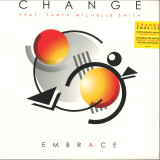
Change feat. Tanya Michelle Smith - EMBRACE LP 2x12"

Change, founded in 1980 by Mauro Malavasi, Jacques Fred Petrus, Davide Romani, and
Paolo Gianolio, is a legendary band on the interna#onal soul/disco scene, renowned for
launching iconic voices such as Luther Vandross and Jocelyn Brown.
Their debut album, The Glow of Love, was produced in 1979 between Bologna and New
York. Widely regarded as one of the greatest disco/soul/funk LPs of all #me, it achieved
enormous interna#onal success. It was the first Italian produc#on in this genre to enter the
Billboard 200 chart, peaking at #29 and earning a Gold Record. The singles “A Lover’s
Holiday” (Top 40 on the Billboard Hot 100), “Searching,” and the #tle track “The Glow of
Love” (which reached #2 in Italy) solidified the album’s global impact.
So influen#al was the record that in 2001, Janet Jackson sampled the #tle track for her hit
“All for You,” which went on to win the Grammy Award for Best R&B Recording.
Throughout the 1980s, Change released five addi#onal albums:
• Miracles (1981)
• Sharing
Your Love (1982)
• This Is Your Time (1983)
• Change of Heart (1984, produced by Jimmy
Jam & Terry Lewis)
• Turn on Your Radio (1985)
In 2010, the previously unreleased album Change Your Mind—recorded in the 1990s and
produced by Davide Romani—was finally released.
In 2018, aEer a 33-year hiatus, Love 4
Love marked the band’s comeback. Produced by Romani and Stefano Colombo, the album
introduced vocalist Tanya Michelle Smith and featured eight original tracks wriGen by
Romani, Malavasi, Colombo, and Elio Baldi Cantù. The singles included:
• “Hit or Miss” (remixed by Soulpersona)
• “Love 4 Love” (also remixed by Joey Negro)
• “Make Me (Go
Crazy)” (remixed by Opolopo)
Embrace (2025), credited to Change feat. Tanya Michelle Smith, represents the natural
musical evolu#on of Love 4 Love. Originally conceived in 2019 as Tanya Michelle Smith’s solo
album, it was later reviewed by producer Stefano Colombo together with Mauro Malavasi,
who approved the material and authorized the use of the name “Change.” Malavasi also
contributed to the cover design and selected the album #tle: Embrace.
The first single, “Sunrise Forever,” was released on January 10. The remix by Michael Gray
reached #1 on Traxsource and ranked high on the UK Soul Chart.
The album’s release was postponed when Davide Romani and Stefano Colombo decided to
complete an unfinished demo from the Love 4 Love sessions. Some original parts were lost
due to a corrupted backup, but in 2025 the track was completely rearranged with a newly
recorded bassline by Romani and fresh backing vocals.
On April 4, the single “Got 2 Get Up” was released across all digital plaOorms, receiving
strong radio airplay across Europe and entering the UK Soul Chart. On May 16, a remix by
renowned Italian duo Micky More & Andy Tee will be released in an#cipa#on of the album.
Embrace includes ten original tracks and one cover.
The album will be available on CD and vinyl, distributed by Self Distribuzione Srl. The first
500 vinyl copies will be issued as a limited “Expanded Edi&on”, including the full album plus
a bonus 12” single with Michael Gray’s remixes of “Sunrise Forever.”

Disponible

En el almacen y preparando para el envío

29,37
Hero U.D.A. - Night Driver EP

Hero U.d.a.

Night Driver EP

12inchSAIS006
SAISEI
30.05.2025

SAISEI founder Junki Inoue continues his vital archival work uncovering the riches of Japan’s distinctive electronic music scene and bringing them to new audiences around the world.

HERO U.D.A. aka Hiroyoshi Udaka is not someone you can easily google, but he’s sure lived a life worth retelling. His story starts back in the late 80s when, inspired by the acid house emanating from the UK — during what was fondly christened the Second Summer of Love — he picked up DJing and made the move from Japan to London. Throughout the 90s he DJed at underground techno institutions like London’s The End, CLUB UK and Silver Fish, as well as at the infamous Tribal Gathering raves, periodically returning to Japan to support techno greats like Colin Dale, Mad Mike, Suburban Knight and D. Wynn on tour.

The tracks on this EP, previously unreleased except for one, were all recorded after Udaka moved back from London to Tokyo, between 2002 and 2005. Yet they sound strikingly modern, drawing on a rich range of sounds that have come back round again two decades later: broken beat, acid jazz, dub and breaks. Deceptively simple grooves are given depth by layers of textures and micro samples, for example the surface noise on ‘On The Way’ that glues together an otherwise sparse skeleton of dubby pads and body popping drums. ‘Mature Missile’, ‘So Good’ and ‘Night Driver’ employ raw broken beat templates with acid accents, whimsical melodies and vocal interjections for a playful mood. ‘Sin City’ takes a darker turn, off-key piano hits and plunging bass adding to the wonkiness. The EP closes with a wiggly vignette, ‘222AM’, reminiscent of early 00s contemporaries like Mouse On Mars. Now these hidden treasures from Udaka’s archive gain a new life on SAISEI.

———

SAISEI is a Japanese word which translates to ‘reproduction’ and ‘to play’ (as in playing records). Japanese culture is widely known for its traditional nature just as much as it is for being forward into the future and this label’s concept does justice to exactly that. Having started digging for records as early as 16 years old, Junki Inoue delved into productions from 1990s Japan to uncover these native gems. SAISEI’s core concept is to recapture and reintroduce unique pieces of Japanese electronic music onto vinyl, to an audience it never reached before as most of this music was only released in Japan.


b A2. So Good Acid Funk

Disponible

En el almacen y preparando para el envío

13,03
SURPRISE CHEF - SUPERB

Surprise Chef

SUPERB

12inchBCRLP183
Big Crown Records
21.05.2025

Australia's world-renowned cinematic soul outfit Surprise Chef return with new album Superb. A record that represents a change in their creative approach and turns up the heat in their music. Trading in their meticulous writing and recording techniques for a looser and less planned approach with the intentions of bringing more levity to the process, and it comes through in spades. The high caliber musicianship is still front and center, but they push their sound into a more energetic and fun place on this album. Album opener "Sleep Dreams" is the closest thing to a Surprise Chef tune one would come to expect but then lead single "Bully Ball" comes on and you get the picture that they came to kick in the door on this one. The song's gritty drums thunder through the speakers and get covered with percussion, keys, bass, and guitar chanks that stay in the pocket and bring the funk with them. The band pushes the boundaries of arrangement with tunes like "Body Slam" that starts off like a sweet soul track then pulls a 180, turning dark and haunting, centering on a sound they created by tucking a timpani into a bathroom two doors down from the mixing board. That same sense of experimentation comes up again on "Fare Evader" where they pepper another neck breaking rhythm track with synth notes that sound like robot sound effects from a 70s sci-film. The fellas turn up the tempo for the dance with tunes like "Consulate Case" and "Tag Dag"; the former pulling influence from afro-funk and the latter from jazz-funk. They take us deep into the beautiful world of Surprise Chef ballads on "Websites" and double down on their abilities to make beautiful and ethereal tracks with "Dreamer's Disease". With their new album Superb, their new approach, and plans to tour the world, we are about to see Surprise Chef take the step from the underground's most beloved to a household name and we are definitely here for it.

Disponible

En el almacen y preparando para el envío

22,65
Shadow Child - TBC001

Shadow Child

TBC001

12inchTBC001
TBC
20.05.2025

DJ Support: Hutch, Mark Archer, The Dead Rose Music Company, OOFT, Scuba, DJ Die, Horse Meat Disco, Crazy P, Bonar Bradberry, Jordan Peak, Roman Fluege, Rampa and Gerd Janson.

Ahead of his forthcoming album and singles, Shadow Child presents a series of playful tools for DJs, with early support from TC to Gerd Jansen, FFF to Coyu plus radio spins from the likes of Danny Howard and Don Letts, these tracks are sure to please all summer. This one also contains a hidden track only available to the vinyl lovers.

Disponible

En el almacen y preparando para el envío

14,92
SURPRISE CHEF - SUPERB

Surprise Chef

SUPERB

12inchBCRLPC2183
Big Crown Records
16.05.2025

Australia's world-renowned cinematic soul outfit Surprise Chef return with new album Superb. A record that represents a change in their creative approach and turns up the heat in their music. Trading in their meticulous writing and recording techniques for a looser and less planned approach with the intentions of bringing more levity to the process, and it comes through in spades. The high caliber musicianship is still front and center, but they push their sound into a more energetic and fun place on this album. Album opener "Sleep Dreams" is the closest thing to a Surprise Chef tune one would come to expect but then lead single "Bully Ball" comes on and you get the picture that they came to kick in the door on this one. The song's gritty drums thunder through the speakers and get covered with percussion, keys, bass, and guitar chanks that stay in the pocket and bring the funk with them. The band pushes the boundaries of arrangement with tunes like "Body Slam" that starts off like a sweet soul track then pulls a 180, turning dark and haunting, centering on a sound they created by tucking a timpani into a bathroom two doors down from the mixing board. That same sense of experimentation comes up again on "Fare Evader" where they pepper another neck breaking rhythm track with synth notes that sound like robot sound effects from a 70s sci-film. The fellas turn up the tempo for the dance with tunes like "Consulate Case" and "Tag Dag"; the former pulling influence from afro-funk and the latter from jazz-funk. They take us deep into the beautiful world of Surprise Chef ballads on "Websites" and double down on their abilities to make beautiful and ethereal tracks with "Dreamer's Disease". With their new album Superb, their new approach, and plans to tour the world, we are about to see Surprise Chef take the step from the underground's most beloved to a household name and we are definitely here for it.

Disponible

En el almacen y preparando para el envío

23,95
SURPRISE CHEF - SUPERB (TAPE)

Surprise Chef

SUPERB (TAPE)

CassetteBCRCASS183
Big Crown Records
16.05.2025

Australia's world-renowned cinematic soul outfit Surprise Chef return with new album Superb. A record that represents a change in their creative approach and turns up the heat in their music. Trading in their meticulous writing and recording techniques for a looser and less planned approach with the intentions of bringing more levity to the process, and it comes through in spades. The high caliber musicianship is still front and center, but they push their sound into a more energetic and fun place on this album. Album opener "Sleep Dreams" is the closest thing to a Surprise Chef tune one would come to expect but then lead single "Bully Ball" comes on and you get the picture that they came to kick in the door on this one. The song's gritty drums thunder through the speakers and get covered with percussion, keys, bass, and guitar chanks that stay in the pocket and bring the funk with them. The band pushes the boundaries of arrangement with tunes like "Body Slam" that starts off like a sweet soul track then pulls a 180, turning dark and haunting, centering on a sound they created by tucking a timpani into a bathroom two doors down from the mixing board. That same sense of experimentation comes up again on "Fare Evader" where they pepper another neck breaking rhythm track with synth notes that sound like robot sound effects from a 70s sci-film. The fellas turn up the tempo for the dance with tunes like "Consulate Case" and "Tag Dag"; the former pulling influence from afro-funk and the latter from jazz-funk. They take us deep into the beautiful world of Surprise Chef ballads on "Websites" and double down on their abilities to make beautiful and ethereal tracks with "Dreamer's Disease". With their new album Superb, their new approach, and plans to tour the world, we are about to see Surprise Chef take the step from the underground's most beloved to a household name and we are definitely here for it.

Disponible

En el almacen y preparando para el envío

10,71
Various - THE MALE BODY WILL NEXT PT.2 (TAPE)

Following on from the celebrated first instalment, the second part of The Male Body Will Be Next compiles an entourage of daring sonic experiments, composed in response to bell hooks’ landmark book The Will to Change. Prompting artists and musicians to envision cross-gender solidarity, Osàre! Editions founder Elena Colombi presents an enrapturing, narrative album, conceptualised around collective transformation.

Resonating with hooks’ challenge to men to reclaim the sensitivity that patriarchy denies them, the name of the record arises from a photograph by Peter de Potter and Rebecca Salvadori’s film of the same title. In these depictions, naked flesh is exposed, made vulnerable and trembles with emotion as the fragility of masculine bodies are examined through the queer and female oppositional gaze. Transforming this visual language into musical expression, The Male Body Will Be Next swirls with punk vitriol, electrified noise, acid, electro and free-wheeling encounters charged by love, lust and limerence.

Gently plunking chords signal Pose Diva’s reimagining of lover’s rock before Sissy Fuss smashes in with a heavy-weight instrumental version of their erotic anthem ‘No Restraint’.
Made up of Turkish musician Etkin Çekin and Belarussian songstress Galina Ozeran, God is God delivers a gentle lullaby, while Low End Activist flirts with dark and brooding bass, shattering penetrating frequencies into luminous fragments. Riffing off the 2020 documentary about female early electronica pioneers, Loma Doom crafts a slowly oscillating drone zenith, the ultimate climax. In line with the conceptual underpinning, there are plenty of collaborations – Daytripper’s Riva and Sitar player Tommy Khosla, Lebanonese experimentalist N R and Swiss-French producer John Silvestre (AKA Typhon), as well as Colombi herself and trans author/activist Juno Roche. Within these partnerships, new modalities come alive as mediums, practices and perspectives are ignited and pushed in otherworldly, metamorphic directions.

Disponible

En el almacen y preparando para el envío

13,82
Dylan Thomas - We Don't Own, We Create

"Dylan Hayes' album debut LP, We Don't Own, We Create, released on Futurepast, is a sonic trip balancing club functionality with experimentation. The two-discs project is a bold statement of artistic intent-where minimalism, industrial textures, and introspective loopy moods collide.

As the result of 8 years of research and experimentation, We Don't Own, We Create is an electronic sci-fi odyssey, unfolding across eight tracks balancing structure with unpredictability. Co-produced and mixed by Davy Vandegaer, this album is also the story of a friendship rooted in a shared vision-crafting a signature 'futurepast' sound where old-school techno aesthetics meet fresh, yet edgy, sonic treatments. The first disc unfolds like a waking dream. My Ikigai sets the tone with pulsating, introspective club energy, blending loopy synths and a growling bass. Plastic World plunges into eerie depths, weaving spectral vocals and fragmented rhythms. Silent Reverie in To Memory drifts through textured atmospheres and layered percussive echoes. Remind Me Ridley twists hypnotic techno into a dense, mantra-like piece-its reverbs and delays build an intensity conjuring into a foggy, shifting auditive illusion.

The second disc marks the awakening, shaking off the haze with Beautiful Struggle, where abrasive loops, industrial bass surges, and dissonant synth layers build tension. Echoes of Fate condenses the album's ethos, unleashing pulsating stabs and humming rhythms that slice through the mix with razor-sharp precision. The eponymous We Don't Own, We Create is an electronic ode to the creative process, where haunting vocal loops weave through deep, trippy synth lines, blurring the boundaries between organic and synthetic. Closing on Mizze, the journey dissolves into pure introspection, fading into the ether.

The record balances four club-driven tracks and four experimental pieces, crafting a distorted, explorative soundscape-an immersive journey where dance music meets dark, avant-garde sound design."

Disponible

En el almacen y preparando para el envío

23,95
LUC-HUBERT SEJOR - MIZIK FILAMONIK: SPIRITUAL SOUND

180 G. BLACK VINYL WITH LINER NOTES IN CREOLE, FRENCH, ENGLISH

Originally released in 1979, "Spiritual Sound" lives up to its name, a soaring, triumphant album, six tracks of spirit magic from Guadeloupe.

Telluric, intense, terribly alive, the gwoka drums of Guadeloupe carry the identity of a painful and fervent island. Marked forever by the crime of slavery, Guadeloupe's créolité cherishes the ka drums and their natural environment: the low-pitched boula drum with male goatskin, the high-pitched soloist makè drum with female goatskin, the chacha, ti bwa, triangle, calabash and other percussion instruments that surround them, and the voices - the fiery, proud, timbred, urgent voices of the gwoka.


This album is also a legend for its voices: in his then dazzling youth, singer Lukuber Séjor was one of the first gwoka artists to largely feminize the chorus of répondè, who converse with his text delivered in a straight and powerful voice.

And everything here sets new standards. In 1979, Mizik Filamonik - Spiritual Sound proclaimed a spiritual patriotism of ferocious intensity. The album by Lukuber Séjor - whose spelling alone is a battle - sets out to give Guadeloupe the intangible weapons of self-respect and self-knowledge, through a singular practice of traditional music.

The genesis of gwoka music is less straightforward than one might imagine... The drums performed the servile task of accompanying the work of slaves in the fields and during the “corvées” imposed by the administration, before being freely practiced by the common people after the abolition of 1848. At the heart of the conviviality of the Guadeloupeans furthest from the cities - geographically and socially - the gwoka drums come out for carnival, funeral wakes and neighborhood celebrations, but also during strikes, fits of anger and armed vigils of the riots and revolts that have punctuated the island's history. For generations, governors of the colony and then the prefects of the overseas department of Guadeloupe have been viewing the gwoka as a potential for turbulence and a threat to public order.

But as the Beatlesmania, “chanson engagée” and rock revolutions unfolded in Europe, young people turned to the drums of mizik a vié nèg (“bad negro music”, in Creole), which Guadeloupeans had learned to despise by following the “assimilation” process advocated by the school system and most of the political class. At the end of the sixties, in a Guadeloupe mourning the deadly repression of the May 1967 social movement, they played traditional music, refusing to wrap it up in tourist prettiness and madras folk costumes. Instinctively, they played a rough and contemporary gwoka, led by the incendiary Guy Konkèt. This was the era of decisive 45 rpm records such as Robert Loyson's Kann a la richès, which brought to light the fieriest words of union rallies.

At his home in Sainte-Anne, Lukuber Séjor played with flautist Olivier Vamur and his brother Claude Vamur, who cobbled together a drum kit from tin crockery and became, a few years later, the most influential drummer in Kassav'.

These were the years of the Bumidom program, when young Guadeloupeans were encouraged to emigrate to mainland France. At the age of twenty, Lukuber Séjor embarked on the liner Irpinia, disembarking at Le Havre and taking the train to the Gare Saint-Lazare - the route taken by thousands of young West Indians who went on to study or looked for work, all the while trying to maintain a link with their homeland. In this case, it's at the Antony university residence, where Lukuber played the drum and participated in a thousand gwoka updates and aggiornamentos, while exile reinforced the need for a spiritual link with the native land.

In 1978, Guy Konkèt played at the Salle Wagram, a historic event for West Indian music. After serving as répondè - i.e. backing vocalist - on one of his home-recorded albums, Lukuber joined his live band. Little by little, he became one of the key artists on a circuit parallel to French show business. At a student party in Caen, he met a young woman from Martinique who, at the time, was more motivated by her ambitions as a visual artist than by her vocation as a musician. Her name was Jocelyne Béroard and, a few years before she plunged into the Kassav' adventure and became the greatest West Indian singer of her generation, she designed the cover of Lukuber Séjor's LP.

This ambition was obvious and imposed its will. A more or less regular band was formed, with Roger Raspail, Rudy Mompière and Éric Danquin on ka drums, Claude Vamur on ti bwa, Olivier Vamur and Françoise Lancréot on flutes and Annick Noël on keyboards. Lukuber Séjor is set on wanting to extend the gwoka palette to other instruments, as the jazz-rock revolution opens a thousand new doors. Annick Noël will play a wide range of timbres and textures on electric piano and synthesizer. Another novelty: the répondè are two men and two women, Roger Raspail, Olivier Vamur, Françoise Lancréot and Maryann Mathéus ...

Mizik Filamonik - Spiritual Sound is a self-production in which the singer and leader sank all his savings, allowing him no more than a single day in the studio. The first side is more of a musical manifesto, with the first two tracks, Éritage and Penn é plézi, being instrumentals. The third, Son, forcefully celebrates the need for Guadeloupeans to connect with the gwoka. In fact, Jocelyne Béroard's cover shows a tambouyé in the shadow of a cloudy sky, against which a radiant sun is rising and whose light will soon flood the entire landscape. The silhouette and face of this man strongly evoke the immense Vélo, master of the ka, rejected at the time on the fringes of society.

The second side of the LP is surprising. Formally, three tracks are explicitly linked like the three parts of a triptych. Primyé voyaj evokes the appalling tribulation of Africans deported as slaves to Guadeloupe; dézyèm voyaj speaks of the Bumidom program and the economic, political and social forces driving young Guadeloupeans towards the mirage of prosperity in France; twazyèm voyaj closes the cycle with the emigrants' return from Europe after years away from their island...

This gwoka, obsessed with the need to save Guadeloupe spiritually, appeals far beyond the politicized audience. Mizik Filamonik - Spiritual Sound instantly became a classic, although Lukuber Séjor never really made a career for himself as a musician.

After all, the album was released in 1980, with no promotional resources in France or Guadeloupe - and therefore no concerts. The thirty-two-year-old author, composer and performer made his own third trip back to Guadeloupe. He set up a small woodworking business, which he lost in Hurricane Hugo in 1989. His other activity, teaching in a medical-educational institute, became the core of his professional life. He continued to be an active campaigner - a campaigner for the Creole language, a campaigner for the reawakening of identity, a campaigner for special education, a campaigner for a thousand causes that he ignited with his generous and perceptive enthusiasm, such as the defense of breadfruit fries...

The echoes of his 1979 album have not died down. Of course, the use of Penn é plézi as the theme tune for Radio Guadeloupe's funeral notices from 1980 to 1992 kept him in the collective memory, but he continues to sing and compose sporadically, as with his all-female

vocal group Vwapoulouéka... Still convinced that music is a means of liberating the spirit, he continues the journey of a young man eager to deploy the power of Creole music and language.

Bertrand Dicale

Disponible

En el almacen y preparando para el envío

19,75
X-Plode - First Of Many / Watch This Go

At the start of the 1980’s X-Plode’s dad had a second-hand colour TV business in Bolton, Lancashire where he would buy, sell, repair and trade TVs. He would come back home with all kinds of things he had traded for a TV but the most memorable, to a 10 year old kid at that time, were the keyboards. He use to watch his dad play songs from the 1960’s on these keyboards and when his dad had gone out, Lee X-Plode would sneak on them and start messing about, experimenting with the drum programs and fiddling with the buttons, trying out ideas. He had to move fast though because these keyboards didn’t stay in the house for long as his dad would trade them again for something else; one time that was an old analogue echo chamber, which Lee also messed about with when his dad was out. That echo chamber was a revelation to Lee and opened up the possibilities of what was possible with sound. So by the time Lee was 16, he decided he wanted his own keyboard and started saving. When his 17th birthday came around he had saved up £200 and visited his local Argos where he bought himself a Yamaha PSS 680, an FM synthesizer with memory banks and a basic drum machine incorporated. ‘It was shit quality like, but I didn’t mind. I just wanted it for the programmable drum machine, the synth and the memory banks that came with it” Lee recalls. The year was 1987 and by this time in Lee’s life he was into reggae and hip hop, the latter he first embraced in 1983 by the way of breakdancing and listening to electro, so all he wanted to do when he got his gear was make reggae and electro sounding beats. Recalling his youth and the fun he had with the echo chamber, the next edition to his home set up was to acquire one of those, which he did via a mate of his. But by the time he got his minimal set up sorted in 1988, his musical tastes had changed. House music had landed here in UK and this was Lee’s new passion, so from that point on wards he started experimenting, trying to nail a decent house groove. ‘I wanted 808 sounds, but I didn’t know what one was!’ Lee explains.

Around late 1990 or early 1991, Lee started to improve upon his set up, purchasing an Atari STE, a Cheetah MS6 , a 6 voice polyphonic/multi-timbre analogue rack mounted synth that linked up to his Yamaha – “It wasn’t a great bit of kit, I kept getting electric shocks from it. Eventually it just blew up!” Lee had acquired a cracked copy of Cubase on floppy disk from his local computer game shop but struggled with it. “It was so complicated to understand and took me ages to get used to it. I was stoned a lot back then and I just couldn’t concentrate on anything for long” Lee laughs, continuing “I also picked up a 4 channel sampler/sequencer which plugged into the side of the Atari and that’s when I first started sampling, I think this would have been late 1991. I had the Simon Harris ‘Breaks, Beats and Scratches’ vinyl that he put out on Music for Life which were a godsend back then. I was also sampling a lot from cassette tapes, especially reggae. I would also record the Stu Allan show on Key 103FM, one of the main stations broadcasting out of Manchester. He would do a 3 hour show with hip hop and house, and then hardcore house came along. Eventually he dropped the hip hop altogether and it was just house and hardcore. I recorded the shows onto cassette most weeks and started to learn more about how house and hardcore was put together by listening to those shows.”

Disponible

En el almacen y preparando para el envío

16,18
Various - ECHOES OF ITALY – THE BIRDS OF PARADISE – EARLY 90S HOUSE VIBES VOL.2 (2x12")

Googling “paradise house”, the first results to pop up are an endless list of European b&b’s with whitewashed lime façades, all of them promising “…an unmatched travel experience a few steps from the sea”. Next, a little further down, are the institutional websites of a few select semi-luxury retirement homes (no photos shown, but lots of stock images of smiling nurses with reassuring looks). To find the “paradise house” we’re after, we have to scroll even further down. Much further down.

It feels like yesterday, and at the same time it seems like a million years ago. The Eighties had just ended, and it was still unclear what to expect from the Nineties. Mobile phones that were not the size of a briefcase and did not cost as much as a car? A frightening economic crisis? The guitar-rock revival?! Certainly, the best place to observe that moment of transition was the dancefloor. Truly epochal transformations were happening there. From America, within a short distance one from the other, two revolutionary new musical styles had arrived: the first one sounded a bit like an “on a budget” version of the best Seventies disco-music – Philly sound made with a set of piano-bar keyboards! – the other was even more sparse, futuristic and extraterrestrial. It was a music with a quite distinct “physical” component, which at the same time, to be fully grasped, seemed to call for the knotty theories of certain French post-modern philosophers: Gilles Deleuze, Félix Guattari, Paul Virilio... Both those genres – we would learn shortly after – were born in the black communities of Chicago and Detroit, although listening to those vinyl 12” (often wrapped in generic white covers, and with little indication in the label) you could not easily guess whether behind them there was a black boy from somewhere in the Usa, or a girl from Berlin, or a pale kid from a Cornish coastal town.

Quickly, similar sounds began to show up from all corners of Europe. A thousand variations of the same intuition: leaner, less lean, happier, slightly less intoxicated, more broken, slower, faster, much faster... Boom! From the dancefloors – the London ones at least, whose chronicles we eagerly read every month in the pages of The Face and i-D – came tales of a new generation of clubbers who had completely stopped “dressing up” to go dancing; of hot tempered hooligans bursting into tears and hugging everyone under the strobe lights as the notes of Strings of Life rose up through the fumes of dry ice (certain “smiling” pills were also involved, sure). At this point, however, we must move on to Switzerland.

In Switzerland, in the quiet and diligent town of Lugano, between the 1980s and 1990s there was a club called “Morandi”. Its hot night was on Wednesdays, when the audience also came from Milan, Como, Varese and Zurich. Legend goes that, one night, none less than Prince and Sheila E were spotted hiding among the sofas, on a day-off of the Italian dates of the Nude Tour… The Wednesday resident and superstar was an Italian dj with an exotic name: Don Carlos. The soundtrack he devised was a mixture of Chicago, Detroit, the most progressive R&B and certain forgotten classics of old disco music: practically, what the Paradise Garage in New York might have sounded like had it not closed in 1987. In between, Don Carlos also managed to squeeze in some tracks he had worked on in his studio on Lago Maggiore. One in particular: a track that was rather slow compared to the BPM in fashion at the time, but which was a perfect bridge between house and R&B. The title was Alone: Don Carlos would explain years later that it had to be intended both in the English meaning of “by itself” and like the Italian word meaning “halo”. That wasn’t the only double entendre about the song, anyway. Its own very deep nature was, indeed, double. On the one hand, Alone was built around an angelic keyboard pattern and a romantic piano riff that took you straight to heaven; on the other, it showcased enough electronic squelches (plus a sax part that sounded like it had been dissolved by acid rain) to pigeonhole the tune into the “junk modernity” section, aka the hallmark of all the most innovative sounds of the time: music that sounded like it was hand-crafted from the scraps of glittering overground pop.

No one knows who was the first to call it “paradise house”, nor when it happened. Alternative definitions on the same topic one happened to hear included “ambient house”, “dream house”, “Mediterranean progressive”… but of course none were as good (and alluring) as “paradise house”. What is certain is that such inclination for sounds that were in equal measure angelic and neurotic, romantic and unaffective, quickly became the trademark of the second generation of Italian house. Music that seemed shyly equidistant from all the rhythmic and electronic revolutions that had happened up to that moment (“Music perfectly adept at going nowhere slowly” as noted by English journalist Craig McLean in a legendary field report for Blah Blah Blah magazine). Music that to a inattentive ear might have sounded as anonymous as a snapshot of a random group of passers-by at 10AM in the centre of any major city, but perfectly described the (slow) awakening in the real world after the universal love binge of the so-called Second Summer of Love.

For a brief but unforgettable season, in Italy “paradise house” was the official soundtrack of interminable weekends spent inside the car, darting from one club to another, cutting the peninsula from North to centre, from East to West coast in pursuit of the latest after-hours disco, trading kilometres per hour with beats per minute: practically, a new New Year’s Eve every Friday and Saturday night. This too was no small transformation, as well as a shock for an adult Italy that was encountering for the first time – thanks to its sons and daughters – the wild side of industrial modernity. The clubbers of the so-called “fuoriorario” scene were the balls gone mad in the pinball machine most feared by newspapers, magazines and TV pundits. What they did each and every weekend, apart from going crazy to the sound of the current white labels, was linking distant geographical points and non-places (thank you Marc Augé!) – old dance halls, farmhouses and business centres – transformed for one night into house music heaven. As Marco D’Eramo wrote in his 1995 essay on Chicago, Il maiale e il grattacielo: “Four-wheeled capitalism distorts our age-old image of the city, it allows the suburbs to be connected to each other, whereas before they were connected only by the centre (…) It makes possible a metropolitan area without a metropolis, without a city centre, without downtown. The periphery is no longer a periphery of any centre, but is self-centred”.

“Paradise house” perfectly understood all of this and turned it into a sort of cyber-blues that didn’t even need words, and unexpectedly brought back a drop of melancholic (post?)-humanity within a world that by then – as we would wholly realise in the decades to come – was fully inhuman and heartless. A world where we were all alone, and surrounded by a sinister yellowish halo, like a neon at the end of its life cycle. But, for one night at least, happy."

Disponible

En el almacen y preparando para el envío

28,99
Minuit Machine - Queendom

Minuit Machine

Queendom

12inchSR0026LPCLR
Synth Religion
24.03.2025

QUEENDOM is an album that marks a new era for the project while staying true to the essence of Minuit Machine. Produced under the SYNTH RELIGION label, this opus immerses us in Amandine's introspective realm, oscillating between darkness and light, between doubt and self-conquest. While retaining the emotional DNA of previous productions, QUEENDOM stands out with a more pop-oriented touch, featuring tracks where Amandine sings in French for the first time.

The first single, "HOLD ME," is a powerful pop anthem addressed to the queer community, celebrating the freedom to be oneself and breaking free from societal and patriarchal norms. This track is a true empowerment statement, with striking electro beats supporting a strong message of emancipation and pride.

"Créatures," a collaboration between RAUMM and Minuit Machine, is a modern fairy tale—a timeless love story that could take place in any era. This salvific love, rarely seen today, embodies a poignant depth and beauty.

Continuing the journey, "Cent Fois"—a French-written track—takes us into a techno-pop universe with nostalgic yet hopeful undertones. This song perfectly reflects Minuit Machine's evolution toward a more radiant approach while staying faithful to its dark heritage.

"Party People," on the other hand, is a return to roots with dark wave/italo sounds. This hypnotic and haunting track questions identity in an increasingly robotic society, where individuals are forced to conform to imposed norms. This exploration of the individual versus the collective lies at the core of Minuit Machine's DNA.

"Mes Souvenirs," created in collaboration with Rebeka Warrior, dives intimately into the memories of Amandine and Rebeka. Together, they reveal fragments of their past—precious and vibrant memories that resonate through powerful and melancholic electro sounds.

Finally, the eponymous track "Queendom" invites us to plunge into the depths of Amandine's world—a universe that is both tormented and icy, yet resilient. Supported by a slow and captivating rhythm, this track is designed to grip and haunt the listener, like an incantation.

QUEENDOM is a bold and hybrid work where each track reflects a pursuit of sincerity and artistic reinvention while maintaining the ability to express emotions through rhythms that are both danceable and introspective. The album showcases Minuit Machine's artistic maturity, establishing itself as a must-listen in the darkwave and electronic pop scene.

Amandine entrusted the artistic direction of this album to Manon Dupeyrat, a brilliant young artist who crafted a bespoke universe perfectly aligned with the produced tracks. The album cover, both intimate and anachronistic, invites listeners into Amandine's private world through her bedroom, revealing what she wishes to share.

Disponible

En el almacen y preparando para el envío

24,58
Kitchen Plug - Nice To Meet You

Meet Kitchen Plug, the Parisian trio that somehow combines the rebellious energy of punk, the synth-driven chaos of electro, and the charisma of a boy band... except, they don’t really dance (yet).

With their new EP "Nice To Meet You," these self-proclaimed nerds have served up an unpredictable, colorful mix of electronic anthems and rock-infused vibes. It's like if your favorite computer-generated juice suddenly turned into an unstoppable emotional rollercoaster.

Expect cheeky melodies, emotional highs (and occasional lows), and enough playful swagger to make you question why you’re not already in their inner circle of "copains" (that’s French for friends, by the way). Kitchen Plug isn’t just making music; they’re creating a sound so lively and full of attitude that you’ll probably feel like you're getting a bear hug from your favorite nerdy best friend — just with more synths and less homework.

"Nice To Meet You" is the kind of EP that doesn't take itself too seriously, but it’ll still make you feel something. So, what are you waiting for? Plug in, and let's see if they can live up to their own hype. (Spoiler alert: They will.)

Disponible

En el almacen y preparando para el envío

12,56
END-JY - SITARO 2K25 EDITION

2025 marks the triumphant return of Sitaro, the iconic track that once lit up dancefloors worldwide. Originally released in 2007 and championed by the likes of Carl Cox—earning its place on Carl Cox Ultimate (Universal Music)—Sitaro is back with a fresh 2K25 Edition on Move Recordings, the newly minted sublabel of Diki Records.

The Belgian techno duo End-Jy & Dimitri Andreas, known for their heavyweight releases on Lupp, Intec, Terminal M, Music Man, and Systematic, deliver an updated version of this melodic anthem. The remastered original brims with Sitaro's signature sound: hypnotic sitar riffs, emotive atmospheres, and a groove that’s as irresistible as ever—a true dancefloor odyssey packed with intensity and raw emotion.

And for the remix? Who better than Dimitri Andreas himself. With an illustrious career spanning decades and releases on Systematic, Music Man, Kling Klong, and Token, Andreas takes Sitaro to new heights. His remix is a masterclass in contemporary melodic techno, drawing comparisons to the work of Guy J, Sébastien Léger, and Roy Rosenfeld. Expect driving Latin-inspired percussion, lush synths, and dreamy soundscapes that seamlessly blend piano-laden breakdowns with deep, pulsating grooves.
The result is a stunning reinterpretation—eclectic yet cohesive, powerful yet delicate. Dimitri Andreas once again proves why he remains a pivotal figure in the global techno landscape.
Press play, and let the journey begin.

Early support from Adriatique (Afterlife), Nick Varon (Sudbeat), Raw Main (Lost Miracle), Dclviii Ofc (Cod3qr), Alex Neri (Wildflower)…

Français

End-Jy - Sitaro (2K25 Edition) featuring Dimitri Andreas Remix

2025 marque le retour triomphal de Sitaro, le morceau emblématique qui a illuminé les pistes de danse du monde entier. Initialement sorti en 2007 et soutenu par des DJ comme Carl Cox—qui l’a même inclus dans Carl Cox Ultimate (Universal Music)—Sitaro fait son grand retour avec une toute nouvelle édition 2K25 sur Move Recordings, la nouvelle subdivision de Diki Records.

Le duo techno belge End-Jy & Dimitri Andreas, connu pour leurs sorties majeures sur Lupp, Intec, Terminal M, Music Man et Systematic, propose une version actualisée de cet hymne mélodique. L’original remasterisé regorge de la sonorité signature de Sitaro : des riffs hypnotiques de sitar, des atmosphères émotionnelles, et un groove aussi irrésistible que jamais—une véritable odyssée sur la piste de danse, remplie d’intensité et d’émotion brute.

Et pour le remix ? Qui de mieux que Dimitri Andreas lui-même ? Avec une carrière illustre qui s’étend sur plusieurs décennies et des productions sur Systematic, Music Man, Kling Klong et Token, Andreas emmène Sitaro vers de nouveaux sommets. Son remix est une véritable masterclass de techno mélodique contemporaine, qui rappelle le travail de Guy J, Sébastien Léger et Roy Rosenfeld. Attendez-vous à des percussions latines entraînantes, des synthés luxuriants et des paysages sonores oniriques qui fusionnent parfaitement des breakdowns pianistiques avec des grooves profonds et pulsants.

Le résultat est une réinterprétation impressionnante—éclectique mais cohérente, puissante mais délicate. Dimitri Andreas prouve une fois de plus pourquoi il reste une figure incontournable du paysage techno mondial.
Appuyez sur play et laissez le voyage commencer.

Support de Adriatique (Afterlife), Nick Varon (Sudbeat), Raw Main (Lost Miracle), Dclviii Ofc (Cod3qr), Alex Neri (Wildflower)…

Disponible

En el almacen y preparando para el envío

15,92
Edictum - A Cosmic Scale

The album’s title deftly gestures to the sheer vastness of astronomical dimensions, while simultaneously capturing the musical breadth within, where the eight planets are imagined as the eight notes of an octave. The work draws inspiration not only from earlier compositions —most notably Gustav Holst’s The Planets—but also from the rich astronomical and cultural contexts surrounding these celestial bodies. Here, the focus transcends direct citation of melodic motifs, instead embracing an intriguing conceptual approach on a meta level, unfolding in a series of vividly contrasting soundscapes. These contrasts shape a sweeping sonic journey, one that fully embraces the album format with both arms, inviting the listener to venture into realms both strange and wondrous, feeling the immensity of the interstellar space that lies between them. Contrast, after all, is the brushstroke that enriches our world.

Embarking on an auditory voyage, "Astral Guide" establishes the sonic framework that propels us into the boundless expanses of the cosmos. Its ethereal tones evoke the vastness of space, crafting a mood ripe for exploration within the realms of sci-fi. The subsequent tracks unfold like constellations, weaving a rich tapestry of sound that seamlessly marries cinematic soundscapes with pulsating, club-oriented rhythms. This album invites listeners to traverse its immersive landscapes, whether nestled in the comfort of home or dancing under the starlit sky, each note a guide through the transcendent experience of a nocturnal journey.

"Solar Flares" draws its inspiration from the awe-inspiring expanse of solar phenomena, capturing the majestic power of the sun as it reaches into the cosmos. This track resonates with the idea that energy, while vital, can also be a force of destruction when unleashed with overwhelming intensity. The composition beautifully mirrors the sun’s duality, where brilliance and devastation coexist, inviting listeners to reflect on the delicate balance between creation and annihilation. Through its rich textures and dynamic shifts, "Solar Flares" serves as both a homage to the celestial and a poignant reminder of nature's formidable power.

"Mercury – The Winged Messenger" embodies a meticulously crafted soundscape where artistry meets astronomy. The tempo of 173.6 BPM, derived from precise astronomical data, propels the composition into a vibrant realm that resonates with cosmic energy. Synthwave sound design intertwines seamlessly with the fluid rhythms of Drum’n’Bass, imbuing the piece with an uplifting dynamism that evokes the ethereal grace of Mercury itself. In this sonic exploration, listeners are invited to ascend on wings of sound, navigating the celestial tapestry of the universe with each invigorating beat.

"Venus, The Bringer of Peace" strikes a decidedly cozy note, presenting a poignant contrast to the more tempestuous themes often found in cosmic narratives. This composition evokes a nostalgic vision of an optimistic era, one in which humanity transcended borders and embraced the infinite possibilities of space exploration, where no destination felt too distant. The dense, languid atmosphere envelops the listener, creating a tangible sense of serenity that unfolds gradually, allowing for a meditative journey through sound. Each note serves as an invitation to linger in this tranquil embrace, reflecting on the harmonious potential of our collective aspirations and the beauty of connection in a vast universe.

The central theme of „Gaia, The Bringer of Life“ —originally not part of the planetary cycle— is the profound enabler of life on Earth. The arrangement delicately mirrors the slow, tentative unfolding of this potential, marked by an initially sparse orchestration that gradually builds in momentum. This progression crescendos, embodying the explosive dynamism of the Cambrian burst of life, ultimately culminating in a euphoric fanfare—a triumphant, celebratory flourish echoing life’s victorious emergence.

"Blue Moon" unfolds as a contemplative reverie on the tranquil clarity of a night sky, now seldom glimpsed in its natural purity, unclouded by the relentless haze of urban light. The listener is drawn into the vast embrace of the star-strewn firmament, a journey that sways between euphoric awe at nature’s sublime beauty and a profound melancholy for its fragile and imperiled state. Musically, this duality finds expression in the delicate interplay of modal mixtures, while an ever-shifting triplet groove, poised at the intersection of Outrun and melodic house, lends a pulse that is both nostalgic and forward-looking—echoing the beauty and transience of a world on the brink.

Rather than replicating the original composition of „Mars, The Bringer of War“, this interpretation seeks to evoke its profound, foreboding atmosphere. Cyberpunk emerges here as an ideal genre, channeling the dark, relentless march synonymous with Mars, the ancient god of war. The piece reverberates with intensity, as distorted vocalizations rise, embodying the anguish and visceral torment that shadow war’s violent crescendo. This auditory descent into conflict captures the relentless pulse of warfare, where sound itself becomes an embodiment of suffering and fury.

Majestically, "Jupiter, the Bringer of Jollity" emerges on the celestial stage, sweeping away the somber tones with its radiant vigor. Drawing inspiration from the triumphant strains of the original, and borrowing a melodic motif in the refrain, the piece expresses joy and buoyancy through a shift to a major key and the lilting sway of a danceable 12/8 meter. Spirited and exuberant, it leaps boldly from major to minor and back again, playfully shifting time signatures to capture a mood of unbridled festivity and jollity.

Here, a more conciliatory concept is chosen than in the original inspiration. „Saturn“ aligns with the number six, being the sixth planet from the Sun and bearing the iconic hexagonal pattern at its northern pole. What, then, could be more fitting than to render this piece in a 6/8 time signature? The arrangement unfolds with a multifaceted richness, mirroring the countless stones and ice fragments that form the foundations of Saturn’s majestic rings.

„Uranus“ adopts the theme of a light-footed, dancing instrumentation, giving the impression of perpetual motion, never quite settling. This musical choice harmonizes with the planet’s own orbit, as it spins with breathtaking velocity, teetering and swaying, seemingly unable to attain rest or stability.

The chill and vastness of the cosmos find expression in „Neptune, The Mystic“. At its core, an electronic soundscape envelops a classical arrangement, its unreachability intensified by an ethereal, otherworldly choir. Hovering at the outermost boundaries of the solar system, where warmth is but a distant memory, the composition lingers in a slow, contemplative tempo, evoking a realm where space for speculation stretches wide and silence reigns supreme.

Though Pluto may have lost its planetary status, and its companion Charon never achieved one, this shift in classification subtly aligns with the cosmic scale invoked here—one that mirrors the musical tradition of an eight-note sequence. Fittingly, the album closes with „Kuiper Belt“, a composition emblematic of the turbulence and vitality of countless smaller

celestial bodies that, though diminutive, find their rightful place within the vast architecture of the solar system.

They say nature is the greatest composer, shaping the universe with a symphony of chaos and order, beauty and danger. It is this duality that fuels the artistic vision of Edictum—a producer who, armed with a doctorate in chemistry, delves as deeply into the mysteries of molecules as he does into the depths of sound. In the tension between the vastness of the cosmos and the microscopic processes that dictate life’s rhythm, Edictum creates sonic landscapes that dissolve the boundaries between science and art.

His music is a story of contrasts—a sonic tale where the raw forces of nature clash with the intricate structures of human culture. Opposites intertwine to form a harmonious whole: the primal rhythms of the earth meet the celestial melodies of the cosmos, the rigid laws of physics blend with the boundless freedom of art. Edictum explores these polarities with meticulous devotion, each composition an expedition into uncharted soundscapes—a quest to give voice to the unfathomable.

With over 20 years immersed in the realms of electronic music, Edictum has honed a keen sense for rhythm and movement. His driving beats compel both body and mind into a hypnotic flow. Yet beyond the pulse of dance lies a complex framework of conceptual thought. Today, his creative focus revolves around holistic album projects—self-contained worlds with overarching narratives that embrace contrast and complexity. Each track stands alone as a fragment of the whole, but together, they weave a cohesive tapestry, much like the chapters of a novel that guide the listener on an emotional and sonic journey.

Edictum’s distinctive musical signature has earned him international recognition. With over 150 releases, many on prestigious platforms like the iconic *NewRetroWave* label, and collaborations with artists such as Jan Johnston, Azumi Inoue, Powernerd, and Turbo Knight, he has solidified his place in the global electronic music scene. His latest work, *A Cosmic Scale*, marks his seventh vinyl album and is released under his own label, *Echoes of Expanse*. The label’s name is no coincidence—it captures the essence of his art: echoes of infinity, the vibrations of the universe distilled into a singular sonic experience that carries the listener ever further into the boundless expanse of sound and space.

Disponible

En el almacen y preparando para el envío

22,90
Bruno Pronsato - Autoportrait En 2 Coupes

Never to rest on his laurels, Pronsato returns with two motif based tracks on Logistic. In this new work, Pronsato stitches four motifs together over two tracks (plus two digital only outtakes). Vocals, marimba, piano and pads are the forces at work here. Each playing a game of peek-a-boo throughout the four pieces...

Pronsato's approach to each of these compositions highlights his mastery in balancing complexity with accessibility, allowing each motif to shine individually while contributing to the overall narrative arc of the four pieces. Think ECM in the 80s meets Morton Subotnick...With dance stuff thrown in for good measure.

Disponible

En el almacen y preparando para el envío

12,40
Toshihiko Mori - Jinen

Toshihiko Mori – a former keyboard player with Riuichi Sakamoto – has made an EP for Biophon Records using the legendary Prophet 5 synthesizer as the main instrument.

Toshihiko Mori was born and lives in Tokyo. He toured with Riuichi Sakamoto all over the World in the 90s as a keyboard player and rhythm arranger. He also did all the drum programming on Sakamoto´s album Smoochy released in 1995.

Jinen is a different affair though. It contains no drums or sequencers, only improvisations on the Prophet 5, plus the occasional vintage Yamaha VSS-30 8-bit sampler, a few granular guitar pedals and some field recordings from Mori´s walks in the Japanese forests and mountains. Jinen is Japanese for Spontaneity.

"I was thinking Japanese culture, hi-tech and nature, Shinkansen, film directors like SABU, Masaki Kobayashi and Akira Kurosawa, and Riuichi Sakamoto´s first solo album B-2 Unit when I heard his music." (Geir Jenssen, aka Biosphere).

Disponible

En el almacen y preparando para el envío

20,50
J. D. (Puma) Lewis - Shake It - Make It Loose (LP)

The combination of their musicianship and the cutting-edge technology at the studio resulted in a masterpiece of pure, state-of-the-art funk and boogie. The album features all the hallmarks of great 80s music: fresh synths, drum machines, and powerful lead vocals from John Davis. Upbeat tracks like "The Cat (Puma)" and the title track sit comfortably alongside more soulful songs like "Tears" and "Hearts of Gold," while "Dancing Shoes" remains one of the era's catchiest dance tracks.

Still, Shake It - Make It Loose holds a few mysteries. Why was it released under the unusual name J.D. (Puma) Lewis? And what's the story behind tracks like "The Cat"? While J.D. Lewis stood for John Davis Lewis's full legal name, Hudson sheds light on the "Puma" connection: "At the time, I was working as a promotions manager for Puma sportswear. Jörg Dassler, son of Puma founder Rudolf Dassler, was a friend of mine and financed our studio sessions." As said, these sessions took place at Hartmann Digital, a state-of-the-art studio in Untertrubach, Bavaria, where iconic artists like Nena, Yello, Visage, DAF, and Soft Cell recorded.

The use of such an expensive studio would have been out of reach for the two musicians without Puma's backing, which also explains why there is a title like "Dancing Shoes." When we had licensed the track for the Boogie On The Mainline compilation in 2018, we had the chance to speak with John Davis (who sadly passed away in May 2021 due to COVID-19). Davis revealed that there were plans to make a video for the song in collaboration with Puma, but those plans fell through. In the end, the album was signed to the Deggendorf-based Metrovynil label.

Interestingly, the original contract reveals that the first version of the album only contained six tracks. Metrovynil added two more: "Sexy Highschool Lady," a track Davis recorded solo, and "Party Rap" by The Dynamite Two, which had no connection to Davis or Hudson at all. The album's credits also list a "Fred Fiore" as the person "who made all of this possible." Hudson, who sees himself as the producer, has no idea who Fiore was - likely another fabrication from the label. "That's just the kind of thing Metrovynil did," Hudson comments with some regret.

Despite the behind-the-scenes confusion, the music spoke for itself. The original pressing looked and sounded fantastic, featuring a stylish cover shot of John Davis in a sharp suit. Now, with this first-ever vinyl reissue, we're thrilled to include additional photos and more background information in a deluxe gatefold sleeve.

This reissue includes all six tracks from the original Hartmann Digital sessions, plus two bonus tracks. From the original reel tapes, we unearthed additional material that Hudson and Davis produced together in the early to mid-80s. We're excited to share the previously unreleased tracks "Life's A Party," and "Walk Out On Me." The digital version of the reissue will also feature two more songs: "Red Drops" and "Pick It Up Off The Ground."

Shake It - Make It Loose is a classic boogie-funk album that belongs in every serious funk and disco collection. It showcases the undeniable talent of two true musicians and stands as a testament to the friendship between Reg Hudson and John Davis.

Disponible

En el almacen y preparando para el envío

23,49
Norken - Our Memories Of Winter LP 2x12"

Nearly two decades after it was first released, Norken’s sleek cult classic album ‘Our Memories Of Winter’ is being reissued on vinyl via Hydrogen Dukebox on 6th December 2024.

With its unique sonic blueprint of early 2000s electronica, ‘Our Memories Of Winter’ is a record that is at once both deeply reminiscent of a particular era and place, yet remains a timeless invocation of Norken’s idiosyncratic palette of minimal, techno, house and British IDM.

This vinyl reissue presents all 12 tracks from the original release, with the inclusion of 'Df23' and 'Flirt' making this the first time that ‘Our Memories Of Winter’ is available on vinyl with the complete album tracklisting.

Norken is one of the many pseudonyms of Lee Norris, a producer who is considered by those in the know as one of the unsung heroes of UK electronica. With a slew of releases throughout the years as Man-Q-Neon, Nacht Plank, Norken, Tone Language and Metamatics, this reissue shines a light on his soulful, immersive output under the Norken name.

As Norris explains, “The release of ‘Our Memories Of Winter’ has a nostalgic, warm feeling for me. I made his album in a garden shed with a wood burner, an Atari computer and a few synths in the depths of an English winter. I still had the thought process of making emotional style techno that would warm any soul on a cold day.”

First released in 2005, ‘Our Memories Of Winter’ carries the echoes of electronic luminaries such as the Detroit ambient techno of John Beltran, through to the immersive atmospherics of Biosphere and the innovative IDM of fellow British outfits Autechre and The Black Dog. Yet as Norken, Norris retains a distinctive musical voice that has continued to deepen in stature over the years since the album’s initial release.

Opening with the brief intro cut ‘Fern 2’, the album slides into the dreamlike groove of ‘Memories’, where rich, resonant chords wrap around cool, galactic-sounding synths and a compelling bass undertow.

On ‘It Might Have Been Rain’, that signature bass texture again propels a luxuriant mid-tempo rhythm, while Norken layers in hypnotic washes of string-like synths, gentle electronic pulses and the brief murmur of a vocal, across seven-plus immersive minutes.

Vocal textures, often subtly looped and distorted, also add a distinctive depth and personality to tracks like ‘Eastern Soul’ and ‘Here’. Throughout the album, there’s a feeling of intricate microcosms unfurling, as Norken coaxes a myriad of contemplative moods and emotions from his machines.

Whether shaping the smooth, lulling ambient gauze of ‘Ty Canol’, or letting the kaleidoscopic, dancefloor-leaning drive of ‘Audic Strable’ loose like a coiled spring, ‘Our Memories Of Winter’ presents the singular voice of an artist whose innovative contribution to UK electronic music has only become heightened with the passing of time.

Disponible

En el almacen y preparando para el envío

33,40
Anja Schneider - Reworks & Remixes 3x12"

Anja Schneider

Reworks & Remixes 3x12"

3x12inchSOUS049LP
Sous
06.12.2024

Two decades in, one of dance music’s most celebrated DJs, producers, label owners, A&Rs, broadcasters, and tastemakers has big plans for this anniversary. In June, Anja Schneider will unveil an expansive rework and remix package on her benchmark-setting imprint, Sous Music, some of her best-loved tracks are there in less familiar forms. Expect fresh takes from Anja herself on seven of her favorite tracks plus a wealth of heavyweight remixers: Paramida & E-Talking, Radio Slave, Scuba, JakoJako, Julian Muller, Cassy, Deetron, Leafar Legov, Erobique, Jaymie Silk and Ackermann all being part of the impressive collection.
“The project includes new versions of my favourite tracks from the last 20 years and remixers who have accompanied, influenced, and currently impress me. Each artist holds a special connection for me,” says Anja in anticipation of this milestone release.

Disponible

En el almacen y preparando para el envío

37,77
Various - Archeo 10 Years Anniversary - Volume 1

As the tenth candle flickers atop the torta alla panna, Archeo Recordings play the Uno reverse card, breaking with tradition to give us a gift in celebration of its birthday: the first in a series of exquisite EPs on which the label's favourite contemporaries pay homage to past masters. Each re-polished gem is plucked either directly from the beatific back catalogue of the fine Florentine label or is at least Archeo-adjacent, perhaps a sign of future wonders to come. Like a musical version of Janus, who can be found at the heart of Bertoldo di Giovanni's frieze in the Medici villa, Archeo Recordings will continue to look forwards and backwards to provide sublime sounds for us all.
Pepe Maina officially joined the Archeo family in 2019 with the much-needed reissue of his 1979 masterpiece Scerizza (AR015), but his astounding music has been a constant companion to label head Manu for much longer. An inter-dimensional, multi-instrumental maverick, Maina weaves the frayed edges of prog rock, new age, organic jazz and global minimalism into a shimmering tapestry all of his own. The results are spread across fifty years and almost as many albums, largely self-released and always absolutely untarnished by commercial concerns.
Based in a small village in the hills of Brianza, just north of Milan, Maina translates the beauty of his surroundings into transformative tone poems, and the folkloric fusion of "The Infinite", originally released on his 2014 CD Tales From The Hill, is the perfect example of his practice. It opens with a recitation of Giacomo Leopardi's 1825s poem "L'Infinito" by famed Italian actor Vittorio Gassman. A leading figure in the romantic movement, Leopardi explores the idea of time and space within the natural world, and the peace that comes with an appreciation of the immensity of eternity. Manu, longtime digger and now a burgeoning producer, expands upon the original with tribal percussion, chirping electronics and a spheric bassline, folding Maina's elegant strings and gossamer pads into a new arrangement suited for a slow dance under the stars.
Unless you had a well-trained ear tuned to Italy's avant-jazz scene, chances are your first encounter with innovative flautist Roberto Aglieri came via the 2017 Archeo reissue of hisalmost untraceable LP Ragapadani (AR011). It's a true testament to Manu's digging credentials that he snatched this masterpiece out of the esoteric atmosphere and brought it attention it so richly deserved. A delicate union of digital synthesis and versatile flute - be it soft and silvery or
brilliant and clear - the 1987 album was a shapeshifting masterpiece, replaying scenes from Virgil, Verdi, Visconti and Pasolini with a neon glow. Quintessentially Italian, but uncanny and previously unimagined - Penthouse and Portico perhaps. Powered by a percolating prototechno sequence, cascading keys, hallucinogenic vocal snippets and a variety of tonal timbres from Roberto's reed, "Danza N. 1" long deserved the praise reserved for Jean-Luc Ponty's pinnacle, so many thanks to Manu for our collective introduction. The tall task of reinterpreting this particular paragon falls to Perugian polymath Daniele Tomassini AKA Feel Fly, whose peerless skills as both producer and musician have delighted DJs and dancers alike. Hot on the heels of his diverse and definitive remixes of Tony Esposito for AR027, Daniele delivers a radical rework of "Danza N. 1" perfect for both day rave sunshine and full moon party alike. Enhanced by snapping breaks and a rattling kick, the bassline gurgle emerges as a progressive powerhouse, laying the foundation for the trilling flute and circular keys to cast a psychedelic spell. As the slow-Goa revival picks up pace, this one is way ahead of the pack.
Archeo take us all the way back to the start of its story here - well almost. Though it bore the stamp AR001 (2015), this Radio Band reissue actually hit shelves months after Tony Esposito's "Je-Na' / Pagaia"; a false start perhaps but a true classic all the same. Radio Band were a group of DJs from Florence who all sailed the airways of Radio Fantasy in 1984 and whose one and only release was this super groovy slice of Italo-boogie. Following the example of Milanese DJs Band of Jocks but far surpassing their formulaic funk fizzle, Radio Band employed an intergalactic bassline, cosmic keys and that undeniably Italian style of rapping to deliver a sophisticated party-starter which even found its way to disco deity Ron Hardy. Back to the here and now, and if you've found yourself pumping an ecstatic fist to a supercharged Italian epic of late, chances are its from the mind of the mysterious Radiomarc. Operating on the ascendent Popcorn Groove imprint, this shadowy figure steers his country's lost classics into peaktime territories, finding a sweet spot between late Italo-disco, early Italo-house and contemporary cool. Pushing the tempo with a club-ready 4/4, setting the sequencer to stun and supplementing the original melodies with a series of synth riffs, the mystery producer send this one into orbit. Radio Band - Radio Rap - Radiomarc, the circle is complete.
Few have done more to develop cross-cultural musical exchange than Futuro Antico. A collaborative venture from musician, archeologist and ethnomusicologist Walter Maioli, keyboardist and tonal theoretician Riccardo Sinigaglia and multi-disciplinary artist and composer Gabin Dabiré, Futuro Antico formed in Milan in 1979, combining ancient international folkloric traditions with otherworldly electronics. The result is an arresting melange of Mediterranean, African and Asian instrumentation, mimicked by esoteric synth tones and hypnotic minimalism, which the group perfected on their acclaimed 1990 LP Dai Primitivi All'Elettronica. The meditative and transportive "Pan Tuning" belongs to their largely overlooked 2005 CD only release Intonazioni Archetipe, and has been amongst Manu's most loved tracks from the first moment he heard it. Who else is better placed to reshape this evocative opus into an immersive, transcendental dance floor journey than label favourites Mushrooms Project? The duo sows the original elements into a sprawling fifteen minute fusion of séance and science, at times propulsive with a ritualist rhythm of tuned percussion and crunching drum machine at others drifting off into ethereal ambience. Mushrooms Project continue to push the boundaries of the Afro-cosmic style, and this remix marks a new zenith.

Disponible

En el almacen y preparando para el envío

19,96
Various - Pursuit Of Change

We are proud to bring you part II of the CEP VA series, featuring six tracks that span a wide range of genres. Each track brings its own signature to this release, making it truly one of a kind.

Beta.V opens the A-side, fusing self-sung vocals with multiple synths that harmonize beautifully together to create a timeless track. This is followed by SWART's 'Eternal Raver', much akin to old-school trance thanks to hypnotic synths and dreamy textures creating a meditative state. A3 introduces ETERA’s 'Classic Shit', a dancefloor weapon with stomping beats and crisp, background drums signaling the signature sound of ETERA himself. On the B-side, SZG stands out with its gated synthline, pounding bass, and catchy vocals from Brazilian MC DDSV adding that unique energetic spin to this release. DJ HENNE’s 'Roboter' on B2 is a hard house slayer featuring a deep mid-track breakdown and self-sung vocals - a DJ HENNE classic. Wrapping up the release, Pōnky combines groovy, funky plucks with a smooth finish, closing the EP out on a playful note.

'Pursuit Of Change' drops via CEP Records on 29th November 2024.

Disponible

En el almacen y preparando para el envío

11,56
Psychedelic Budz aka Ciel x D. Tiffany - Wonk Donk

Banoffee Pies Originals continue with the 26th release in the series. D. Tiffany returns to the imprint with another collab outing, this time partnering with Ciel as the duo combine under their Psychedelic Budz moniker. Two of Canadas finest deliver two dynamic, off kilter club hitters with a special appearance from Adam Pits under his Lil Mushroom alias. Heavy and versatile productions for dance floor rotation from artists who have carefully honed their craft.

Berlin based, D. Tiffany of Vancouver, is a DJ, Producer and label boss at Planet Euphorique. Now returning to the Banoffee imprint following their Plushmanagements inc insert with regularfantasy back in 2016. A welcomed entry from prog trance revivalist who’s essential output continues to blossom.

Toronto based multi disciplinary artist Ciel whose contributions to the music sphere remain committed to diversity, inclusivity & community with a prolific career as a producer, DJ, pianist & composer ++ They’ve found involvement across groundbreaking projects like Discwoman, co founded label Parallel Minds & released notable contributions to labels such as !K7, Peach Discs, Coastal Haze & UU, all while continuing their monthly position as a Rinse FM resident.

Disponible

En el almacen y preparando para el envío

13,03
Rapha - Midnight Dancer LP

Dalmata Daniels third LP comes from Rapha, marking his return to the label after contributing to its split and compilation series. Known for bold acid treatments and dark, futuristic tones, Rapha takes his craft to new heights on Midnight Dancer, which also features remixes by CT Kidobo and PRZ. The album opens with I Win U Win, pulling listeners into an adventure of pulsing basslines and cosmic, minimal electro. CT Kidobos remix then twists it into a darker, seductive French-inspired club sound. The third track, ...And Them, continues the journey of the opener with mechanical beats and textured soundscapes, while Alien Dance highlights Raphas signature sharp, distinct style leaving a strong mark on the deep electro club scene.

On the flip side, Midnight Dancer plunges into a hypnotic realm of haunting echoes and distorted rhythms, with heavy basslines reverberating through the darkest corners of the mind. PRZs remix of the title track retains the original groove but adds a cleaner, equally impulsive electro edge perfect for the club. The albums final tracks, Lost Start and Galactico, round off the journey with shimmering electro patterns and eerie, alien soundscapes, leaving an unforgettable impression.

In Midnight Dancer, Rapha showcases his ability to blend industrial grit with cosmic melodies, delivering hard-hitting electro suited for both club play and immersive listening at home or on a night ride. Be warned DDLP03 is limited to 150 copies, housed in a Studio Jetski designed jacket with a digital download card and shrink wrap.

Disponible

En el almacen y preparando para el envío

22,14
R. Zee Jackson - Row Fisherman Row

R. Zee Jackson

Row Fisherman Row

12inchJAMWAXMAXI26
Jamwax
08.11.2024

Rzee Jackson, also known by his stage names Esso Jaxxon and Castro Pink, has been a transformative figure in the reggae music scene, both in Jamaica and Canada. Originally from Clarendon, Jamaica, Jackson's musical journey began in earnest when he moved to Canada in 1975 after a cultural exchange program in the United States. Toronto's reggae scene was vibrant with legendary figure such as Jackie Mittoo of Studio One fame, and Rzee Jackson was at the forefront, contributing to the city's unique Jamaican vibes.

Leroy Sibbles, the lead singer of The Heptones, recognized Jackson's talent and brought him into the Ital Groove Band, where Jackson sang harmonies, played Gong Bap/Congos, and engineered. The Ital Groove Band became one of Canada's most prolific reggae bands, with Jackson touring extensively. With The Ital Groove Band, Rzee Jackson quickly made his mark, collaborating with renowned producer Oswald Creary of Half Moon Records.

Through his own indie labels : Ital, BeeZee Sounds Production, and Radio Plus, Rzee Jackson has recorded and distributed music with CC Records and Jet Star in the UK. His records have resonated on radio stations across Canada, the USA, Europe, Africa, and Brazil.
On this new Jamwax release, you will play two standout tracks from the "New Beat" album, originally released in the mid-80s in Canada on Ossie Records, the label owned by Oswald Creary.

The reissue features on A-Side "Row Fisherman Row," a timeless classic from Cedric Myton & The Congos, "Blackheart Man" the iconic song from Bunny Wailer and on the B-Side "Long Long Time" a deep extended 12-inch roots track with dubwise elements reminiscent of King Tubby's style. All songs, produced by Rzee Jackson, were recorded at Half Moon Recording Studio in Toronto, Canada, under the expert engineering of Oswald Creary.

This reissue also boasts new sleeve artwork by Ras Mykha, capturing an Ethiopian-inspired scene that depicts Rzee Jackson, Jackie Mittoo, and Cedric Myton in a fisherman boat, celebrating the unity and legacy of these reggae legends.

In recent years, Rzee Jackson has been collaborating with Cedric Myton and The Congos. As a producer, engineer, singer, and songwriter, Rzee Jackson continues to contribute to the rich tapestry of reggae music, bringing authentic Jamaican and Rasta vibes to audiences globally.

Disponible

En el almacen y preparando para el envío

18,27
James Tenney - Postal Pieces

Since its founding back in 2014, Blume has carved a unique place in cultural landscape, issuing free-standing works, spanning the historical and contemporary, that represent singular gestures of creativity within the field of experimental sound. Joining their broad efforts in building networks of context and understanding that already includes the works by Werner Durand, Sarah Hennies, Bruce Nauman, John Butcher, Jocy de Oliveira, Mary Jane Leach, Valentina Magaletti, Alvin Curran, Julius Eastman, Alvin Lucier, and others, Blume return with the first ever vinyl release to attend to James Tenney’s legendary “Postal Pieces”, Marking the first ever appearance of five of the suite’s works - “Maximusic, for Max Neuhaus” (1965), “Having Never Written a Note for Percussion, for John Bergamo” (1971), “FFor Percussion Perhaps, or... Night, for Harold Budd” (1971), “Cellogram, for Joel Krosnick” (1971), and “Beast, for Buell Neidlinger” (1971) - on vinyl, drawing upon recordings made in 2003, by the Amsterdam based ensemble, The Barton Workshop, under the direction of James Fulkerson. Among the most important and highly regarded efforts in Tenney’s canon of compositions, as well as within the history of 20th Century music, these five pieces represent a crucial bridge between Fluxus-oriented conceptualism, minimalism, and the microtonal complexities that would emerge in their wakes. Issued in a highly limited vinyl edition of 300 copies, it includes exact replicas of the original postcard graphic scores, and features newly commissioned liner notes by Bradford Bailey, Blume’s brand new edition takes great steps to centring Tenney at the eye the storm during some of experimental music’s most important years.

A student of composition under Carl Ruggles, John Cage, Harry Partch, and Edgard Varèse - remaining close to all of them, and later performing in both Cage and Partch’s ensembles - as well as acoustics, information theory, and tape music composition under Lejaren Hiller, James Tenney carved a wide path within the contexts of experimental and avant-garde music during the second half of the 20th Century. Not only was he a tangible bridge between the generations of composer’s who laid much of the groundwork and the later movements of Fluxus, Minimalism, and the broader practices of experimental music, but Tenney is credited as having contributed one of the earliest applications of gestalt theory and cognitive science to music in 1961, before helping to pioneer the field of computer music at Bell Labs, during the following years.

Over the course of his career, Tenney produced music of such complexity and sophistication - paying little mind to the seductions of taste or dominant tropes of its own moment - that his work and legacy have largely remained under-recognised by the broader publics that have attended to most of his peers. Perhaps more pertinently, the body of work he produced can be perceived as too varied and complex to fit neatly within standard creative histories or critical frameworks, comprising harmonically complex works for acoustic instrumentation, musique concrète, the groundbreaking 1961 “plunderphonic” composition, “Collage No.1 (Blue Suede) (for tape)” - sampling and manipulating a recording of Elvis Presley - as well as algorithmic and computer synthesized music. Even here, within this single decade, a clear image of Tenney’s endeavours remains elusive. In addition to penning important theoretical texts, he collaborated and / or played with Max Neuhaus, La Monte Young, Steve Reich, Philip Glass, Michael Snow, Terry Riley, and numerous others; was an active member of Fluxus; starred in and composed music for Stan Brackage’s films; regularly worked with the Judson Dance Theater; co-founded and played in the ensemble, Tone Roads, with Malcolm Goldstein and Philip Corner; was a vocal advocate of the works of Conlon Nancarrow and Charles Ives, playing a significant part in the revival of both of their legacies; and regularly collaborated as a composer, musician, and actor with his then-partner, the artist Carolee Schneemann, notably co-starring in her film, “Fuses” (1965) and her legendary 1964 performance, “Meat Joy”, as well as creating sound collages for her films “Viet Flakes” (1965) and “Snows” (1970). Curiously, for a relatively absent figure in the historical and critical narratives, Tenney seems to have been the thread that bound multiple generations and disciplines of avant-garde practice in New York during this period.

Tenney was deeply invested in the quality and perception of sound. By 1970, this led him back to composing exclusively for acoustic instrumentation (though sometimes processed with tape delay) - in most cases utilising non-well tempered tuning systems to explore harmonic perception - a practice that he would remain steadfast to for the remainder of his life. This development roughly corresponded with his relocation to California, at the outset of the 1970s, following an invitation to teach at the newly founded music department at California Institute of the Arts (CalArts) in Valencia. Finding himself in regular contact with the harpist Susan Allen and the artist Allison Knowles, as well as at a great distance from many of his friends, in 1971 he completed (with the assistance of Knowles and Marie McRoy) “The Postal Pieces”, a project he had begun in 1965.

A suite of eleven compositions, “The Postal Pieces”, stands among Tenney’s well known and celebrated compositions, and illuminates the dualities embraced by the composer, notably his use of sound to develop consciousness in and of others, and his willingness to draw on elements and observations of everyday life; citing his strong dislike of writing letters as being the primary inspiration for their inception. In lieu, he conceived to send his friends - John Bergamo, Allison Knowles, Pauline Oliveros, La Monte Young, Harold Budd, Philip Corner, Joel Krosnick, Buell Neidlinger, Susan Allen, Max Neuhaus, and Malcolm Goldstein - short scores on the back of postcards. The suite is composed around three themes: Tenney’s concept of swell form (utilizing repetition and progressing through a structurally symmetrical arch), intonation, and the desire to produce “meditative perceptual states”.

A hugely important addition to Blume’s ever expanding efforts in context building and networks of creative practice, James Tenney’s “Post Pieces” is issued in a highly limited vinyl edition of 300 copies, which includes a exact replicas of the original postcard graphic scores, and features newly commissioned liner notes by Bradford Bailey.

Disponible

En el almacen y preparando para el envío

25,42
Noel Gallagher's High Flying Birds - Back The Way We Came: Vol. 1 (2011 - 2021)

Over 1.5m albums sold in the UK and 3 consecutive no 1 albums for Noel Gallagher’s High
Flying Birds – plus a record breaking 10 consecutive chart-topping studio albums in the UK
for Noel.
- Debut eponymous album released 17th Oct 2011, debuted at no 1 with 122.5k sales and
achieved double Platinum status less than 6 months post release
- International Magic DVD release of the 02 Arena gig Feb 2012 certified Gold on shipment
-2011-2012 live schedule saw NG HFB visit 32 countries across 6 continents, playing 150
shows over a 15 month period. 406k headline tickets and 1.2m festival tickets sold
- Chasing Yesterday, released 2nd March 2015, no 1 album on release with 89.1k sales and
certified Platinum
- 2015-2016 18 month world tour covering 122 shows in 28 countries. Almost 400k headline
tickets and 1.25m festival tickets
- Who Built The Moon?’ released on 24th Nov 2017 - no 1 with 77,853 sales (almost 35k sales
ahead of no 2), Silver album after only 4 days and certified Gold 2 weeks post release
- Tour covering 59 shows in 17 countries with 245k headline tickets and 550k festival tickets
- Noel Gallagher’s High Flying Birds released a series of 3 multi-genre EP’s over the course
of 2019 and 2020
- 2019 saw a host of headline festival dates covering 150k tickets sold across the summer
plus tours of the USA and Australia with Smashing Pumpkins and U2 respectively

Disponible

En el almacen y preparando para el envío

30,21
Byard Lancaster - The Complete Palm Recordings 1973-1974 (5x12") (BOXSET)

Souffle Continu records presents Byard Lancaster – The Complete Palm Recordings 1973-1974, the definitive package of Philadelphia-born jazz wizard Byard Lancaster including his 4 legendary albums released on Jef Gilson’s Palm Records in the 1970s, Us, Mother Africa, Exactement and Funny Funky Rib Crib, along with the first ever standalone edition of Love Always, a fifteen minute modal jazz beauty plus a 20 page booklet with rare photos and in-depth article about Byard Lancaster’s Parisian years by Pierre Crépon.

At the beginning of the 1960s, at the Berklee College of Music, Byard Lancaster met some feisty friends: Sonny Sharrock, Dave Burrell and Ted Daniel. It is easy to see why he rapidly became involved in free jazz. Once he was settled in New York, he appeared on Sunny Murray Quintet, recorded under the leadership of the drum crazy colleague of Albert Ayler.

In 1968, the saxophonist and flutist recorded his first album under his own name: It’s Not Up To Us. The following year he came to Paris in the wake of... Sunny Murray. He would come back to France in 1971 (again with Murray) and in 1973 (without Murray for a change). This is when he met Jef Gilson, the pianist and producer who encouraged him to record under his own name again. On Palm Records (Gilson’s label), he would release four albums: Us, Mother Africa, Exactement and Funny Funky Rib Crib.

“Us”, the first of the four records was recorded on November 24th, 1973 with Sylvin Marc on electric bass (a Fender... Lancaster?) and the evergreen Steve McCall on drums.

On the album, the trio works from the John Coltrane model; free jazz shook up by the timely contributions of the bassist, followed by a mesmerizing atmospheric music. Then, Lancaster delivers a sinuous solo path, which is a reminder of his unique tone. On the album’s companion single, the trio launches into great black music of a different genre which would lead the clairvoyant François Tusques to claim that Byard Lancaster is an “authentic representative of soul/free jazz”, to sum up this is Great Black Music! A few months after recording “Us”, Lancaster recorded “Mother Africa” along with Clint Jackson III, a trumpeter, partner of Khan Jamal or Noah Howard on other recordings.

On march 8th, 1974, Lancaster and Jackson headed up a group composed of Jean-François Catoire (electric and double bass), Keno Speller (percussion) and Jonathan Dickinson (drums). Together, they create an immediate impression. From the first seconds of “We The Blessed”, they develop a free jazz which rapidly abandons any virulence under the effect of blues and soul based interventions. When Gilson’s composition “Mother Africa” begins, listeners are transported into the studio, listening to the musicians setting up: chatting and joking... Then comes the melody: a dozen or so notes of a repeated theme which is accelerated and deformed according to their whims... The jazz played by the association Byard Lancaster / Clint Jackson III is rare: creative AND recreational. “We the blessed”, is apt listening to this again today!

The recording of “Exactement” required two sessions in the studio: February 1st and May 18th 1974 – in between the two dates, Lancaster recorded, alongside Clint Jackson, the excellent Mother Africa.

Two names appear on the cover of “Exactement”: Lancaster (Byard) and Speller (Keno). Byard Lancaster wanted to be precise, moving regularly from one instrument to another: first on piano, which was the first instrument he learned. On “Sweet Evil Miss Kisianga”, his inspiration is first and foremost Coltrane (even if leaning more towards Alice than John), this announces the storm to follow.

It is Lancaster’s horn-playing which really stands out: on alto (the sound of which is transformed by an octavoice on one track, "Dr. Oliver W. Lancaster") or soprano saxophones, as well as on flute or bass clarinet, the musician walks a tightrope making the most of all the risks he takes. Using the full register of his instruments, he has fun with the possibilities.

Then, Lancaster invokes or evokes Ornette Coleman, Eric Dolphy and even Prokofiev, before going into a danse alongside Keno Speller on percussion. Above all, he has a unique sound. Byard Lancaster, on whatever instrument he plays and by continually seeking, always ends up hitting the right note... ends up by playing exactement the note he had to play.

“Funny Funky Rib Crib” is an unforgettable recording (made up of several sessions dating from the middle of 1974) of creative jazz overwhelmed by funk and soul. If Lancaster had already made successful albums in the same genre – notably New Horizons, under the name Sounds Of Liberation which he co-led with Khan Jamal –, this one is an homage to James Brown and Sammy Davis enjoying the company of a host of guests including François Tusques (electric piano), Clint Jackson III (trumpet), François Nyombo (guitar), Joseph Traindl (trombone)...

Funny Funky Rib Crib’s cover is a three-quarter profile portrait of the saxophonist (who can also be heard on flute, piano and even vocals), however, on the record, it is the whole group, inspired and frenetic, that tests the melodies of “Just Test”, “Dogtown” or “Rib Crib” – the two versions of which display leader Lancaster’s art of nuance. On both sides of the album, the group also moves into a calmer groove, infused by blues and soul, “Work And Pray” and “Loving Kindness” are meditative tracks where listeners can lay back and relax before asking for more: Funny Funky Rib Crib!

The magnificent “Love Always” was originally released on the fourth (and last) volume of the Jef Gilson Anthology series released in 1975.
Recorded on 8th March 1974, it is a beautiful 15-minute-long modal jazz piece. Four notes from the bass (the relentless Jean-François Catoire, who makes up the rhythm section alongside drummer Jonathan Dickinson and percussionist Keno Speller), and the group is up and running!
On piano, Gilson shows the subtle tact of a sideman, leaving the lions’ share of the place to the horns. This allows us to hear the trumpet of Clint Jackson III and the alto (which sometimes sounds almost flute-like) of Byard Lancaster each staking their claim in a long hallucinatory march which moves from moments of direct exaltation to profoundly sensitive collective playing. And if further proof was required of the confidence that Byard Lancaster and Jef Gilson inspire, “Love Always” provides it on this one sided release exclusive to the box set.

Disponible

En el almacen y preparando para el envío

110,04
Mabe Fratti - Sentir Que No Sabes LP

A sense of destiny hangs over Sentir Que No Sabes, Mabe Fratti’s fourth solo-credited album released in a five year span. Her work has always possessed a finely tuned sense of drama capable of expressing a range of emotional states, and across this new album, she conveys the struggle to process various relationships or situations–and the actions that come next. Sentir Que No Sabes is urgent and clear, poppy, generous and approachable, while showcasing a considerable emotional hinterland. It is also, as Fratti is quick to mention, “groovy.”

Written and recorded with her partner, multi-instrumentalist, and co-composer Héctor Tosta (I.La Católica, Titanic), Sentir Que No Sabes is the result of an intense, detail-oriented process. Fueled by a new confidence gained in their collaborative project, Titanic, and its critically acclaimed 2023 LP, Vidrio, the two hunkered down in the familiarity of their studio (aka Tinho Studios) to bash out the initial sonic coordinates of her new record. “We talked and talked, and discussed ways of playing and recording, until things became inevitable,” Fratti explains. “We recorded a bunch of demos at our home studio and that meant we had a lot of time to re-edit and experiment. We really dug in. We were super focused on detail.” Tosta also took up the controls as producer and arranger-in-chief for all additional instruments. The album was later completed at Willem Twee Studios in Den Bosch in the Netherlands, and Pedro y el Lobo Studios and Soy Sauce Studios, in Mexico City.

For the final studio recordings, the pair were joined by drummer Gibran Andrade and trumpetist Jacob Wick to fill out and expand on Tosta’s percussion and brass arrangements. This small group of friends were able to work quickly and openly, and without fear: a testament to the exhaustive groundwork put in at Tinho Studios. This can be heard in three short, intermediary tracks that also manage to be the most aggressive on the record: “Kitana” (a scratch-laden instrumental that acts as a strange prelude for the last track, “Angel nuevo”) and a pair of two-minute instrumental interludes, “Elastica” I and II. None are throwaway mood pieces; rather they act as emotional cue cards, and hint at the way Fratti and Tosta created the overall atmosphere of Sentir Que No Sabes.

A strong sense of rhythm irrigates the sound from the jump, as heard on the glorious opening track, “Kravitz.” Here, the brilliant plucked cello line acts as a bassline and props up the steady thump of the kick drum. The cello’s growl serves as a conduit for a set of slightly paranoid lyrics that tell us “Quizás haya oídos en el techo” (“maybe there are ears in the ceiling”), while the song also introduces another staple of the record: the clever brass stabs, whistles, parps, and other interjections that paint a canvas of traffic in a city. It’s a postmodern, widescreen sound that for some might recall The Blue Nile’s Hats.

Sentir Que No Sabes is a record full to the brim with a modern pop sensibility, invoked by the sort of magpie spirit that ensnares anything it can find, repositioning sounds for the here and now. The keys and melody on the melancholy “Pantalla azul” (“Blue screen error”) transport us back to the glossy mid-1980s. “Oídos” (“Ears”) is a beautiful slice of contemporary, hybrid pop, in which Fratti’s vocal lines delicately spin themselves around the lean structures erected by the brass and drums, and the descending “plink” of a set of piano chords. Then we have a gloriously strong ending with the swell of “Angel nuevo” (“New angel”), another cinematic track full of gentle, instrument-rich swells and eddies that manages to be almost endless in its range–and yet intensely personal, as Fratti’s voice is close, almost whispering in your ear. A much needed lullaby for our fractious times.

The lyrics, for their part, have a stop-start quality to them, and hint at the small, incremental emotional taxes we pay through just living our lives. They circle around the music like birds waiting to swoop. There is something of the spiritual in all of Fratti’s work that expresses itself in a form of yearning: she looks to new horizons while personal dramas find themselves internalized, contextualized, and then dealt with through metaphor. Here, she was keen to mention Tosta’s constant encouragement in her finding a path to best sing or phrase her words to impart their maximum effect. “Hector was super inquisitive about my lyrics and asked me questions about what I meant, which sometimes is something you don't wonder so much about in isolation,” Fratti explains. “Besides, he is a great poet, and you can see that in what he did on the Titanic record. This made me go deeper into my lyric writing and definitely transformed it into something that I feel super happy about now.”

Take “Enfrente” (“In Front”), a track that initially comes across as a languid, glossy number, with plucked cello strings standing in for a bass line and brittle synth parts. Soon we catch on to a brilliant minor chord switch, which mirrors the fear and doubt expressed in the lyrics as someone “trembles up to the podium” in a “search for meaning.” There’s also the startling introduction of a vocoder in “Quieras o no” (“Whether you want it or not”); it comes precisely at the point Fratti sings “Quieras o no es un desastre” (“Whether you want it or not, it's a disaster”). Moments like these leave room for interpretation and, over time, create a strong bond between the listener and the record.

In fact, across Sentir Que No Sabes, each phrase–whether instrumental or vocal–becomes at some level emblematic of acts and moods that impart deep emotional significance. We see this best on “Intento fallido” (“Failed attempt”), which could be the score to feeling trapped in self-doubt, only to suddenly be sprung free by the song’s gloriously upbeat ending. On “Márgen del índice” (“Index margin”), the quicksilver switch between initial disharmony and a beautiful melody is breathtaking, all augmented by evocative arrangements, textured production, and the slightly playful, gnomic lyrics. The track’s emotional ecosystem allows another brilliant ending, which uses the simple repeated phrase, “Cómo lo va a ver?” (“How are you going to see it?”).

So what to make of Sentir Que No Sabes? High gloss Pastoralism? The sound of a city-bound, post-post modern soulscape? No matter the emotions evoked, it's the work of an artist coming into their own, and creating a benchmark record.

Disponible

En el almacen y preparando para el envío

24,58
Wallis - protect me from my friends

Boudica is proud to present their first record of 2024, featuring an artist who holds a special place within the platform - none other than DJ and producer Wallis.
DJ, live-act and former mastering engineer, Wallis speaks for a generation searching for novelty and emotion in the electronic music realm.
Sharp engineering skills coupled with a unique approach to sound design allowed her to develop a trademark sound. Using an array of synthesisers, effects units, and experimental studio techniques, Wallis produces melancholic electronic music rapidly shifting between different patterns and atmospheres.
She tours as a DJ and Live Act around the world, having played large festivals such as DGTL or renowned clubs like Berghain, and will happily play at a large stage one day but at a small intimate sweaty basement the next.
In 2024, she started producing music for fashion shows and debuted that project by creating the music for the entire Natasha Zinko runway show at London Fashion Week February 2024.
The EP's opening track, "Hell is a Girl from Before (Rainy Summer Mix)," introduces a stirring blend of emotions. Starting with an emotional melody, accompanied by synths and a plucked instrument, it swiftly transitions into energetic segments driven by the drums. Vocals emerge, their words almost imperceptible, adding an intimate layer to the experience. The track maintains a steady pace, evoking the ambience of a rainy summer day. This creates a melancholic yet hopeful mood, transporting listeners through a journey of introspection.
As "Protect Me From My Friends" unfolds, it feels like being whisked away to a new dimension, greeted by otherworldly, robotic sounds. The introspective journey of the previous track mutates into raw emotions, driven forward by a relentless bassline. Clear vocals take the forefront, guiding the listener through the sonic landscape, only to be interrupted by the commanding presence of the bassline, which assumes the main character role.

In "Sleeping Pills Are Gone," an atmospheric and gloomy introduction is abruptly interrupted by an acid and hefty bassline that dynamically evolves throughout the track, plunging the listener into an eyes-open dream born of a sleepless night. The vocals echo the track's title, creating a haunting repetition. Wallis strategically grants brief breaks, constructing a powerful crescendo that heightens the experience. These are momentary escapes before immersing the listener once more into the hypnotic trance induced by the solid four-to-the-floor march.
Closing the EP with a striking finale, "Teenage Apocalypse" introduces a clunky melody that encapsulates the signature sound of the record. Characteristic vocals weave throughout, guiding the listener towards the track's crescendo. Driven by a flawless fusion of drums, the song transitions seamlessly into a powerful breakbeat moment, accompanied by yet another impeccable bassline. True to its title, it evokes the intensity of a day of judgment, leaving a lasting impact as the EP draws to a close.
This EP is a testament to Wallis's growth as a producer and her fantastic storytelling ability through sound.
In the artist's words: "Sometimes life takes a weird turn. Angry, confused and dealing with moral: this EP targets the pain and absurdity of attachment and strongly themes Gregg Araki's teenage apocalypse trilogy. The artwork poem plastered on the wall was written by wallis."

Disponible

En el almacen y preparando para el envío

10,88
Dan Ghenacia - Rouge ou Noir

Dan Ghenacia

Rouge ou Noir

12inchSTSC003
Stratasonic
25.09.2024

Dan Ghenacia's influence on the European underground over the last 25-plus years cannot be overstated. He has run vital labels, hosted essential parties, laid down definitive DJ sets, and produced seminal sounds both solo and as part of the tastemaking Apollonia trio with friends Shonky and Dyed Soundorom. His understanding of house music across the ages and continents is second to none, and he brings all that experience to this fantastic new solo EP.

The bumpy and infectious 'Rouge Ou Noir' opens with looped and funky guitar riffs and neon synths winding their way through dusty, dynamic drums. Cooing vocal stabs ramp up the steaminess of this most tasteful party starter. The superb 'Chilly' has a bustling blend of louche rhythms and rugged synth arps that dart about the mix. They hurry along beneath swirling vocal sounds up top with hints of Metro Area magic and tripped-out colours, all making it a characterful groove. Last but not least, 'Chilly' gets dubbed out and becomes a more low-slung sound with a fleshy bassline popping up the choppy, playful and synth-infused rhythm.

Disponible

En el almacen y preparando para el envío

15,92
Various - 29 Speedway: UltraBody LP

29 Speedway is a record label and performance series based in Brooklyn, NY featuring forward-thinking improvisational music and live multimedia. Founded in 2020 by Ben Shirken a.k.a. Ex Wiish (‘Shards Of Axel’, Incienso 2023), 29S serves as a platform for artists exploring the fringes of interdisciplinary art and music. Hosting D.I.Y-guerrilla style sound and performance art concerts at Pioneer Works (NYC), Public Records, and in Europe in partnership with Index Records, they have worked with artists such as James Hoff, J. Albert, Yolabmi, Robert Aiki Aubrey Lowe, AceMo, Flora Yin Wong, Nexcyia, Young Boy Dancing Group, UMFANG, Color Plus, Poncili Creación, Special Guest DJ, Arushi Jain, Drumloop, Isabella Koen, Ben Bondy, Kamran Sadeghi, Yawning Portal, James K., Syndey Spann, Debit, Pent and many others.

Resident Advisor called their most recent compilation record ‘Channel Plus’ “one of the most stunning documents of the ‘modern ambient-techno movement pioneered by labels such as Motion Ward and West Mineral’, with a focus on New York as well as a global outreach that encompasses chilled-out trap, electro, downtempo and even early '00s electroacoustic music”. Their debut solo artist release from J. Albert and Will August Park, entitled “Flat Earth” (2023), was based on free improvisation and ambient jazz, receiving praise from Philip Sherburne, Shawn Reynaldo, and was included in RYMs top EPs of the year. 29S has been written about on ID, Bandcamp Daily: Best Ambient, Boomkat, Paper Mag, Artnet, Dazed, Clot Mag, Nina Protocol, and Document Journal.

The newest release from 29 Speedway, UltraBody, is a compilation record featuring the music of Jake Muir, Pent & Dylan Kerr, Nexcyia & Mu Tate, James K, Flora Yin-Wong, Ex Wiish & Dorothy Carlos, Kamran Sadeghi, Tati au Miel, James Hoff, Eric Frye, Muein and Maxwell Sterling. The record is emblematic of the artists who have performed at 29 Speedway shows in New York and Europe during the past two years, and is the third in a series released by the label.

The record was born out of a desire to investiage how the self, spirituality, and language are intertwined with the intervention of subjectivity by new technologies. With increasingly sophisticated tech, and the supposed ability to remake the world and ourselves, what differentiates our individual discretion from the will imposed upon us by software? Quoting Walter Chaw from his piece on David Cronenberg’s Videodrome, “Decades of rampant, unregulated and ill-considered technological leaps have begun to evolve, to mutate, humans at a biological level”. This haphazard acceleration towards a techno-utopic transformation of humanity has faulted, and as William Gibson put it, is leading us to live in a “half assed singularity”. In this reality, artistic processes are influenced by excessive access to computational tools and assistance, but not utterly controlled.

This in-between state of dominion is explored in 29 Speedway: UltraBody. “Incoherences” samples the utterances of Dylan Kerr’s voice processed between Pent’s percolated glazes, muddying the gulf between vaporous ambient and reflexive sound design. The voice on James Hoff’s “A... ...Cha.... A... I feel l” was created by trying to get voice cloning technology to sing a gps data stream, the music an extrapolation from an earworm he got stuck in his head while shopping in Kyoto. On “Plogue Chain”, Eric Frye’s most speculative sci-fi observations spiral into a glazed pool of digital cacophony, while Kamran Sadeghi’s “Formula Fiction” is an experiment in (un)controlled generativity. Incorporating minimal pings from a 3D simulation scene based on gravitational interaction, cello bits evolve on “Assimilation”, a collaboration between Ex Wiish & Dorothy Carlos.

On UltraBody, sound has no separate existence from space.

Disponible

En el almacen y preparando para el envío

26,01
Jobhei - Age Of Virality EP

Jobhei

Age Of Virality EP

12inchFUSE059
Fuse London
17.09.2024

A highly talented artist who has grown to make a notable impression amongst the scene’s most revered tastemakers, DJ/producer and label owner Jhobei is an individual who continues to blossom. His deep, expansive sound has already welcomed material on Up The Stuss, Limousine Dream, Mindhelmet and Picnic Records, amongst others, while featuring as a co-founder of London-based collective and label Bizarre Trax. In addition, his work as one-third of dynamic trio Felon5, coupled with his unique sound, has taken him from Albania’s ION Festival to Los Angeles, alongside making a handful of appearances for FUSE and its sister brands on home turf at fabric, The Cause and Village Underground - plus 2024’s Open Air event at Barking Park earlier this year. Building on that relationship, late September brings fresh music as Enzo Siragusa invites the exciting selector to make his label debut with an array of impressive productions across his ‘Age Of Virality’ EP. A-side opener ‘Swarming’ is all action and kicks things off with authority as a snaking bassline guides a garage-influenced trip through bumping low-ends and hooky vocal samples, while ‘Machine Language’ delivers a mix of playful tones amongst sweeping melodies while delivering a heavy dose of robot funk. On the flip, ‘Defusion Solution’ is a heady late-night excursion through skippy percussion and cosmic tones, with ‘Rising Sun’ stripping things back to deliver a classy, hazy journey as organic percussion grooves unravel effortlessly. Digital buyers are treated to a bonus cut in the form of ‘Kontrol Urload’, a sci-fi leaning cut merging glistening neon synth motifs with punchy kicks and zipping effects for maximum impact.

Disponible

En el almacen y preparando para el envío

14,24
Trentemøller - Dreamweaver LP

In May, fans were treated to the first new music from Trentemøller since 2022. A new single, "A Different Light," showcased a stunning blend of prismatic space rock and folk. For anyone wondering if it foreshadowed the release of a full-length, Dreamweaver will drop in September, on Friday the 13th.
Featuring 10 tracks that traverse Trentemøller's many musical strengths, Dreamweaver also represents an obvious artistic leap, treading new ground while retaining the overall plot. Tracks featuring vocals come courtesy of of Iceland's Disa, who has been in Trentemøller's fold since the Memoria tour.
Dreamweaver's nylon string-led opening track, and first single from the album, "A Different Light," contains many of Trentemøller's trademarks: exploring dichotomies, musical shadowplay, Nordic frigidity, and warm waves. It opens the door for the steady, hypnotic "Nightfall," with its tetherless vocal, wistful guitars, and early morning desert chill. The third track in the opening trifecta, "Dreamweavers" finds its footing with a percussive soft trot, which starts after what feels like a shortwave radio scan in search of the right chords, eventually dialing in a weightless voice. Ostensibly keeping a ruminative pace with the previous two tracks, the song and, by extension, album soon opens up as the rest of the elements drop into place with a grand, luxurious burst.
Dreamweaver is about to enter its next phase. With the hatch blown off of the portal, the noisy "I Give My Tears," driven by its glissed and fuzzy bass line, pours into the void. It's followed by its sibling, the most chaotic track on Dreamweaver, "Behind My Eyes." Arriving as a piece of noise rock pandemonium, "Behind My Eyes," can't be contained in its plush vault. A whip-crack snare and convulsing guitars smash against each other in the song's verse chamber. The tension builds, as the particles collide, pushing past the point of critical mass, kicking off the chain reaction which is the chorus. At times it harkens back to the proto-gaze tracks that gave birth to dream pop, at others it newly defines what that is. There's no time to contemplate it, though, as the song disintegrates in a microphonic feedback instant.
A respite follows with the somnambulistic pair of "Hollow" and "Empty Beaches." Then, a moment of intensity returns as the soaring textures and tribal drum bursts of "In A Storm" take control, before being taken out with the ambient slo-core of "Winter's Ghost" and "Closure." This diptych wraps up an album which certainly feels on-script for Trentemøller, but is also much more psychedelic than previous offerings.
Dreamweaver will be released on Trentemøller's own In My Room label. It is an exceedingly immersive experience, bound to release any dormant hallucinations you may be harboring.

Disponible

En el almacen y preparando para el envío

20,13
Artículos por página
N/ABPM
Vinyl