Speak to most musicians about their motivations, inspirations and processes and you will, generally, get variations on a similar, broadly consensual, theme. Natasha Pirard is genuinely different. Her interest in sound goes way beyond the superficial and the ephemeral. She is fascinated by how and why sound makes us feel, the political implications of sound, noise pollution and the everyday sounds embedded in our immediate environment.
Contextually, this makes a lot of sense when confronted with her debut release for DEEWEE, Dream Cycles. A 120-minute exploration of sounds, loops, frequencies and waves, it’s an eight- part musical cycle split into 15-minute sections across four cassettes, she believes, reflects on this notion of cyclical, rather than linear, time. The eight song cycles are repetitive. They start off basic and functional and build over time. They begin with one sound but soon you hear other sounds. From there you get taken to another point, where you hear something else and so on and so forth. The circle is never-ending.
Natasha Pirard is a musicologist and composer from Ghent. She will be releasing her album Dream Cycles in February 2024, as a limited edition four cassette box set, marking her debut on the Ghent-based label DEEWEE.
Cerca:point music
- Road To Love
- How About Me
- Singin' To The Music
- Rainy Jane
- Look At Me
- Say It Again
- I Really Love You
- Love Me For A Day
- Sitting In The Apple Tree
- Take My Love
- Pretty Little Girl
- Welcome To My Love
- Girl (Mono)
- I'll Believe In You (Mono)
- Take My Love (Mono)
- Road To Love (Mono)
- How About Me (Mono)
- I Really Love You (Mono)
7A Records is proud to present Davy Jones "The Bell Records Story". A lavish reissue of Davy Jones' self-titled album remastered with 6 bonus tracks. The CD version comes with a big 36 page colour booklet, extensive liner notes from Monkees historian Mark Kleiner and rare and previously unseen pictures. This reissue gives fans the opportunity to reassess an album that was unfairly neglected by record buyers at the time of its initial release in the fall of 1971.
Prior to entering the studio with producer Jackie Mills, Jones had recorded a batch of more somber and adult contemporary-sounding demos than the eventual Bell recordings of big band sunshine pop. While the latter played quite squarely into Jones’ established image; the former suggested another path that may (or may not) have launched Jones into a more fecund musical and commercial direction. Who can say? At the end of the day, we have these recordings and their manifold (and for too long overlooked) pleasures to enjoy, a worthy entry in the broad category of early seventies sunshine pop and in the specific canon of Davy Jones and Monkees-related recordings. Here is primetime Davy Jones, singing like an angel, and pointing to a love that leads to joy for all mankind. This release comes with a Booklet & Liner Notes & Photos
- Chance Is Her Opera
- Heatwave Pavement
- Green Ray
- Orange Zero
- Late July
- Darkness-Blue Glow
- Mono Valley
- Coastal Lagoon
- Alkaline Eye
- 3: Am Walking Smoking Talking
- Three Fires
- Disc 2
- She Smiled Mandarine Like
- Under The 3000 Foot Red Ceiling
- Orange Zero (Single)
- Chance Is Her Opera (Demo)
- Late July (Demo)
- Alkaline Eyed (Demo)
- She Smiled Mandarine Like (Demo)
World Of Echo are proud to announce the long-awaited reissue, on 17th February, of the self-titled debut album by Bristol’s Movietone. Originally released in 1995 by Planet Records and reissued on CD in 2003 by The Pastels’ Geographic Music imprint, this is the first time Movietone has been reissued on vinyl. An expanded double-LP edition, it includes the extra tracks from the 2003 CD (their first two singles, and an unreleased demo of “Chance Is Her Opera”), and adds three more unearthed gems: demos of “Alkaline Eye” and “She Smiled Mandarine Like”, and an early take of “Late July”, recorded in a garden by Dave Pearce (Flying Saucer Attack) in 1993. Taken together, this is the definitive collection of music from the first phase of one of Bristol’s most remarkable groups.
Movietone was the cumulation of a series of events, explorations, and discoveries, starting at secondary school – the group’s core membership of Kate Wright, Rachel Brook, Matt Elliott and Matt Jones met at Cotham School in Bristol. As for many other groups, their early years were all about experimenting, and finding ways to ‘make do’, a DIY sensibility that would inform Movietone through their decade-long lifespan. From formative rehearsals in a shed in the garden of Brook’s family home, to recording early material to four-track in Redland Library, and on into the Whitehouse and Mr Grin’s studio sessions for their debut album, Movietone’s music fell together in a creatively unpredictable, yet conceptually rigorous manner.
By the time they released Movietone, they’d found a home with Bristol’s Planet, run by author Richard King and James Webster, who had both released their first two singles, “She Smiled Mandarine Like” and “Mono Valley”. There was other music happening around them in Bristol, too, from the Jones brothers’ avant-rock outfit Crescent (who were Movietone’s closest conspirators), through Elliott’s jungle/electronica project Third Eye Foundation, and Brook and Elliott’s membership of Flying Saucer Attack. A closely knit community, Movietone are the centre of this nestling architecture of groups.
The vision in the music, mostly, belongs to Wright, but Movietone ran in democratic creative consort. Listening back to Movietone, you can hear this democracy in action through the wildness of the music, which is balanced by the poetics of Wright’s lyrics and melodies. Full of half-captured memories and entangled abstractions, there’s an elliptical, ruminative quality to much of the writing here that shows the deep influence of the Beat Generation writers, along with a twilight environment captured in the songs that’s pure third-album Velvets, Galaxie 500, early Tindersticks, Codeine. Unpredictable interventions – the crashing glass in “Mono Valley”, the sudden explosions of “Orange Zero” – point towards the noise blowouts of My Bloody Valentine, the unpredictability of Sonic Youth; Wright’s understated vocal cadence suggest a deep, embodied understanding of John Cage’s Indeterminacy.
Movietone would go on to make three fantastic albums for Domino – Night & Day (1997), The Blossom Filled Streets (2000) and The Sand & The Stars (2003) – and their Peel Sessions were released early in 2022 by Textile. Still held in high regard by artists like Steven R. Smith, and The Pastels, whose Stephen McRobbie once described them as “one of the great unknown English groups,” it’s an absolute thrill to listen to Movietone anew – still inspired, still seductive, still magic, still mysterious.
Following her contribution to this Spring’s Gudu & Friends Vol. 1 compilation, Lady Blacktronika steps out with a full EP for Peggy Gou’s Gudu label.
Whether operating as Lady Blacktronika or her Femanyst alias, Akua Grant has built a deserved reputation as one of house and techno’s most daring and unique artists - one that dates back 25 years now, when she first debuted as a vocalist.
“House and techno” can be a cliched catch-all term, but in Grant’s case, she really has explored the extremes of both sides. Her early Lady Blacktronika work, when she earned the nickname The First Lady of Beatdown, saw her produce and narrate a style of deep house that was both sensitive and transgressive, while as Femanyst, she explores some of techno’s darkest corners, all distorted kicks and serrated edges.
Her EP for Gudu kicks off with some serious intent: ‘Baby I Got It’ chops its vocals rough and raw, pairing them with marching drums and the sort of idiosyncratic synth-work that feels like a Blacktronika signature at this point. ‘Sing the Blues’ and ‘Hold My Hand’ take things smoother, but without ever deferring to type — as ever with Grant’s music, she works with such sleight of hand that it’s easy to skip back three minutes previous and wonder how the hell we got here. Her tracks are just that hypnotic and hallucinatory.
Closing the EP, Octo Octa provides a remix of ‘Hold My Hand’ that extends things to a full 12 minutes (note: slightly shorter on the vinyl due to time constraints), taking us out with crushed percs and held pads over some undeniable drum work.
This EP marks the final release of Gudu’s busiest year to date, with music on the label in 2023 coming from Special Request, Matisa, Mogwaa, Hiver, Matrefakt, DMX Krew, Dukwa, Brain de Palma, Lady Blacktronika, Salamanda and Closet Yi.
J. Robbins on Basilisk:
2020 gave us the pandemic, which despite all its awfulness also gave me a lot of opportunities to write and demo music - but everyone was terrified to get into the same room together to play. Finally, around February of 2021, I called up Brooks Harlan and Darren Zentek and asked if they would be down to meet me at the studio and do a 2-day session and see how it turns out. Brooks and Darren were into the idea - we were all in full cabin fever mode at that point and dying to do anything - so I sent them the demos and we did it. The musical connection had always already been there, but the energy that came from all being in the same room doing this together - something we had just spent a year wondering if we’d ever get to do again - was wonderful. It felt like having been lost in the desert, and then finding an oasis. I’ve never been so happy with a session - both the results and the experience, and the outcome was exactly what I had wanted: something more stripped down and very immediate.
We were all fired up and we did a second session in March 2022. In the interim I enlisted some collaborators:Gordon Withers to add cello and second guitar to a few songs, Janet Morgan and her two sisters to sing some harmonies, Dave Hadley to play pedal steel on “Not The End,” and Chicago punk legend John Haggerty to add an actual blazing guitar solo to the song "Exquisite Corpse." And I went on working on vocals and overdubs at home. The lyrics were (as always) somewhat therapeutical: “Automaticity” came out of thoughts on aging and remaining present in a world increasingly going on auto-pilot; “Last War” and “Dead Eyed God” work out fears prompted by January 6th and the rise of neo-fascism. More personal matters were trying to work themselves out as well. Recurring childhood dreams ("Deception Island"), surrealist games ("Exquisite Corpse"), and trephination guru Amanda Feilding ("Open Mind") were also in the mix.
Another result of pandemic isolation was that I had also been working on more abstract, electronic based music(inspired by my love of film soundtracks, Peter Gabriel’s music, and by studio work I had done not long ago with the band Locrian), using granular synthesis, sampling, and software synths. So as Basilisk came together, I wanted to see if I could pull those sounds into the flow of the record, open up its vocabulary a little and still make something cohesive. Connection has always been the whole point of music making for me. There are so many ways to come at it, and i don't want to close any of those doors. Going forward, I only want to open more of them.
The brand new EP "Wellental" by Extrawelt on Traum is herewith reveled to the fans. Their new 3 track vinyl 12" gives a nod to the mayhem and urgency of techno all finely tuned. Straightforward in its brilliance and simplicity, yet carefully measured with a maturity that speaks the language of Extrawelt´s minimalism.
We attest: a unique techno track for the dance-floor on the a side, a trippy track on b1 and a very musical one as B2.
What happens within these 3 tracks is nothing short of alchemy, traversing all sorts of grounds without ever losing the plot. It’s due to the duo’s keen grasp of sound design—they always exchange ideas, on an expansive set of hardware, so no matter what tunnel they’re traveling down head-first, the sounds are always pristine, filled with unexpected details.
The EP opens with the title track "Wellental" which translates as "wave trough". Wave trough valley refers in particular to the points of maximum negative deflection in a traveling wave. In contrast, the points of maximum positive deflection are called wave crests. Musically this converts in a way that, although the title track "Wellental" has a lot of forceful steady forward motion and zig zag sequences cutting into it, it also has that "hanging time" feeling that adds unpredictability and tension to the track. You can defiantly sense that Detroit theme in a post Detroit interpretation here.
The flip-side starts with "Unter Wasser" which is illustrated by urgent uptempo beats that can push it on the dance floor and dreamy, surreal soundscapes on the other hand that account for that great under water feel. The track sounds a bit like the "Deep End" film soundtrack from CAN in that respect.
The B2 track is called "Samtstrand" and there is a reason for this since the track is very gentle and brushes over a surface with velvet hands but in contrast to that, the Extrawelt beats are kicking out the jams here! So this song has a twin drive going!
It was winter. Six Parts Seven had returned to Ohio after touring out to Washington State, to record Casually Smashed to Pieces. There was down time between the recording and the actual release of that album in January 2007, and we were rehearsing, playing local shows, and collaborating, with most of us involved in other projects to keep the momentum going (Mike w/ Talons, Al w/ Beaten Awake), but the one we all came together over was recording an album with Joey Beltram, the songwriter behind Goodmorning Valentine, a local band we shared players with, a band we deeply admired. The music on Kissing Distance came together over two weekend days. There were a lot of people around; 6P7 and GMV players coming and going from the Saint Ledger House. There were handles of whiskey, there was weed, stacks of Marlboro Reds for the ones still dragging butts. We all went 'dancing' at Thursday's, in Akron, Ohio, on Saturday night. Not sure how we were productive the following day. Chalk that one up to relative youth. Over those two days, songs were cut without any prior rehearsal time. None of us remember how the idea came up. In hindsight, it seems inevitable. The first song on the album, "Mediation in D," had been written a couple of years before, and was the decided spark that set the fire blazing: for both bands, this song was the starting point, an invitation to take things further, to expand, combining players from both bands, our 'toolbox' had increased in size from a single hammer to a toolbox. Everything came easily at this point. "Drunk from the Bottle," is the first of the one-take/one mic songs: an SM58 used for both vocal and guitar, making it impossible to over-think anything: You got the version, or you did not, that simple. "Instrumental #2," is the last full/core band recording by Six Parts Seven. The first piece in our catalog written/arranged by Tim Gerak. This song would have been developed on our follow-up to Casually Smashed to Pieces. Alas, an album never came to be. The ache in this is real. It's there in the bass guitar, tuned high and open, played with a slide, and utilizing one of Jamie Stillman's pre- Earthquaker Devices fuzz pedals. "Lonely Daughter," is another one-take/one-mic song, notable for the lead-guitar, played by James Matthew Haas, who overdubbed his part, months later, standing alone on the deck at Joey's folks place, playing to the moonlight, making magic...
Danielle Boutet’s P »Pièces« is a mysterious artifact of Quebecois marginalia, self-released in 1985. Moving from languid ennui to high drama, »Pièces« is a dreamy gestalt, an album that borders Chanson, spoken-word, jazz noir, and minimalism, conjured from the chasm between acoustic and electronic realms. »Pièces« allows us a window into the highly intimate songcraft and compositional skill of an artist who longed to linger not in the public eye, but in relation with others and the world around her.
Born in Quebec City, Boutet studied music at the University of Montreal, where she focused on composition and percussion, before becoming involved in Montreal’s feminist and lesbian art scene. Primarily written, performed, and recorded by Boutet, with voice, guitar work, and technical assistance by Sylvie Gagnon, Pièces was created during a paradigm shift in home recording. Originally composed for the piano, Boutet and Gagnon utilized a consumer-friendly Tascam 4-track Portastudio and versatile Yamaha DX-7, alongside guitar, bass, marimba, and the human voice, to expand and contemporize the original composition’s scope.
Inspired by prog rock and British poet and musician Anne Clark, »Pièces« translates Boutet’s influence by moving between sunny, wistful fairytale and dark, wintry dirge. Filled with longing marimba, vertiginous, startling synth pads, and folk guitar, each track on Pièces offers a wholly unique proposition. Some are modal and rife with the ethereal psychological tension of a sci-fi soundtrack, while others are more like entering a smoke-laced lounge, the entertainer embodying seduction.
With the sprechgesang of artists like Serge Gainsbourg, there is an intense intimacy to Boutet’s delivery, sometimes as if she is performing for an audience of one. As one lyric goes, translated to English from French: “Like holograms/ Images from a world/ That inhales souls/ And exudes drama.” Another song contains an excerpt from The Tao of Physics: “The eastern sages specify clearly that they do not identify an ordinary void, but rather, a void having an infinite creative potential.”
To English-language audiences, the album’s title, »Pièces«, might seem to simply refer to the eleven different pieces. The title can also, of course, refer to parts of a larger whole, but Boutet is keen to point out that there is also another meaning: In French, a pièce is a room. On the cover of the original cassette, Boutet is seen sitting on a chair, alone in an empty apartment, a cable snaking at her feet. Listening to »Pièces« is like entering eleven different rooms: whether a study encased in shadow, a greenhouse left to wither in an eternal frost, or a divine nave.
Boutet sold a few dozen copies around Montreal, a scene mostly occupied by the new wave explosion de rigueur, but the inclusion of Pièces in the 1987 issue of Ladyslipper—the North Carolina-based mail order catalog that championed women musicians of all calibers and careers—led to more exposure throughout North America. “In the catalog,” Boutet says, “they included it in the New Age section, but I was, and still am, aware that this album is relatively unclassifiable.”
Boutet would release one more album, titled Musiques Urbaines, before getting pulled in the direction of interdisciplinary art and theory. “Although I never stopped making music, I lost all interest in public diffusion or performance,” Boutet says. Despite her departure from performance and publicly releasing music, she left behind a strange and enthralling document of Montreal’s 1980s feminist fringe, an aural document of the historic moment when self-recorded music and its practical potential became a prismatic reality.
Danielle Boutet’s Pièces arrives February 16, 2024 as part of uncommon¢ (“uncommon sense”), an open-ended, serialized endeavor from Freedom to Spend that provides new meaning for rarefied recordings from music’s outermost fringe.
The music of Atlanta trio Omni has always swung fast and hit hard. And Souvenir, their fourth album and second for Sub Pop, packs their biggest punch yet. Inactive during the majority of the pandemic-the longest downtime in their history-they approached this recording with lots of pent-up energy. Guitarist Frankie Broyles, singer/bassist Philip Frobos, and drummer Chris Yonker converted their creative fuel into sharp, driving songs that land immediately, sporting chopping riffs, staccato beats, and wiry melodies. Why does Souvenir sound so sharp? Because each track is a compact unit that stands on its own, reflecting the time and place in which it was created. That's why Omni called the album Souvenir: it's a collection of audio objects, a stash of musical miniatures. Think of it as a family photo album, a binder of rare playing cards, a shoebox holding precious gems. Take "Plastic Pyramid," the first song Omni wrote after coming out of lockdown. Filled with twists and turns, it's a journey unto itself, charged by clanging chords, spinning rhythm, and Frobos trading lines with Izzy Glaudini of Automatic, with whom Omni toured with last fall. (Glaudini sings on two other Souvenir tracks, the first guest vocalist the band has collaborated with). Or take opener "Exacto," a slicing web of intertwined guitar and bass. Its razor-fine notes and syncopated beats perfectly match pointillist Frobos lyrics such as "Exacto, de facto, concise, quite right"-a line that could well be an Omni mantra. The precision and clarity of Souvenir comes from some new Omni developments. For one, this is their first album with Yonker as their full-time drummer, and his forceful playing adds exclamation points to every pointed moment on Souvenir. In addition, the trio worked with Atlanta-based engineer Kristofer Sampson for the first time. Sampson pushed the band to a higher degree of power, with Frobos's vocals more upfront in his pulsing mix and the rest of the music leaping out of the speakers. You might notice that Frobos' singing is a bit more emotional and even nostalgic this time around. In crafting his vocals, he was inspired by the early college radio rock of formative favorites like REM, the Cure, and Big Audio Dynamite-the kind of bands whose melodies could have been top 40 hits in an alternative universe. The lyrics on Souvenir are also by turns funny, absurd, and even cryptic. A wry humor has always coursed through Omni's songs, and this time, it comes in shades of both dark and light. In "Granite Kiss," an "astronomical" love story concludes with the hope that "we can decay together," while in "PG," a romantic walk in the park includes a rose-colored mugging. Immediacy rushes throughout every moment of Souvenir, making it the band's most powerful album to date. Omni has truly crafted a musical keepsake-a set of songs that you'll want to keep close, an aural memento you'll cherish for the rest of time.
- A1: Ale Hop - Head Transplant
- A2: Daniela Huerta - Tza Tun Tzat
- A3: Debashis Sinha - For The Waters Ever Taste The Heavens Up Parts I-V
- B1: Hexorcismos - ¿Acaso De Veras Se Vive Con Raíz En La Tierra?
- B2: Hexorcismos & El Irreal Veintiuno - Interferencias
- B3: Jessika Khazrik - Gebera
- C1: Khyam Allami - Mix V6
- C2: Kloxii Li - Anhaga
- C3: Kmru - Hidden Options
- C4: Maf - What's Heard Once Entered (Nommo)
- D1: Portrait Xo - Mutualism_151122
- D2: Simina Oprescu - Granularities
- D3: Visions Of Lizard - Barranca Del Muerto
For the last seven years, sound artist, technologist, and electronic musician Moisés Horta Valenzuela (aka Hexorcismos) has been studying artificial intelligence and generative art, wondering how these new technologies might be augmented into his musical process. Born in Tijuana and currently based in Berlin, Hexorcismos has long attempted to break down the permeable borders between musical styles and expressions, using the spaces in between to reinforce his politics and worldview. And on 'MUTALISMX - becoming sonic network', he expands his vision, inviting artists from across the globe to collaborate on work that questions the biases inherent in AI models, offering a collective alternative that could serve as a blueprint for further research.
The majority of AI art at this stage works with "big data", taking ideas from the cultural canon and muddying them with our contemporary reality. But if we accept that mass culture is always politically biased, always swaying towards historical prejudices, then there must be a counter-narrative. Hexorcismos began to develop a bottom-up approach, using "small data" to interrogate his idiosyncratic approach to art; he built a tool called SEMILLA.AI based on neural audio synthesis that could not only mimic his sonic fingerprint but transform it into another. So when he offered the synth to his network of collaborators, he gave them the option of either using only their data or sharing the signatures of each other artist involved in the project, blurring their identities into a mutual voice.
The result is a compilation that unspools with the coherence and fluidity of a single-artist album or adventurous DJ mix, genreless and boundless but unified by a singular message. Hunanese-American artist Kloxii Li for example takes rugged percussion and tense, industrial ambience, smudging her soundscape into a swirling gust of ghostly dissonance. Hexorcismos himself contributes two compositions: the lengthy, hypnotic 'Acaso de veras se vive con raíz en la Tierra', an AI-powered scramble of his pointed tribal guarachero experiments; and 'Interferencias', a collaboration with Mexican club veteran Bryan Dálvez, aka El Irreal Veintiuno that drives intense dancefloor rhythms into a dense haze of frozen drones and radio static. Elsewhere, Berlin-based Lebanese artist and writer Jessika Khazrik dissolves her voice into a mesh of obscured rhythms and dissociated whirrs, blending the organic with the artificial but retaining an overpowering sense of humanity.
Some artists were drawn to the nebulous aspects of the technology, searching for truth in a soup of different sounds, while others, such as KMRU, used Hexorcismos's synthesizer the examine their output. On 'hidden options', the Kenyan sound artist fed his immense catalog into the neural net, bringing out his mannerisms and tendencies in the process. Each track is singular but myriad, prompting both mutual respect and a sonic becoming, a feedback process between the artist and the tool, the individual and the collective. Data sets are made by people, and by engaging directly with musicians, Hexorcismos suggests a new way of utilizing a technology demonized and glorified without careful examination. Each artist owns their AI model, and alongside the album Hexorcismos will release SEMILLA.AI to the public (with custom-made models to start the process), allowing anyone to access this revolutionary technology.
Even the album's artwork reflects the political message, conceptualized by Chilean duo hypereikon, who used AI processes to develop a visual reflection of the technology and its possibilities. Operating outside of academia and capitalist enterprises, MUTUALISMX proposes an alternative future - one without borders that's not beholden to the Western canon, where independent labor can be prioritized and celebrated, and where creativity can truly flourish.
In the beginning was a half-truth, the truth was of war and the half-truth was post-war. Fancying the pretensions of its cultural superiority, a continent chose to hide the truth behind ridiculous jargon and the soothing distance of offshored ?????????. Europe wished itself beyond war because it thought the privilege of peace a birthright, just as it refused to understand that post-war was a euphemism for interbellum. Then the truth has set us free.
The delusion was discarded and war was revealed as an inconceivable horror. Almost immediately it turned familiar and virtually comfortable. Novelty songs of drones gutting tanks became a laughing matter and the burning tanks, their crew inside, entertainment. Consequently, a plurality of people started to collectively dream of new stages of the righteous kind of carnage. This happened within weeks.
Our imagination has swollen to the point of loss of consciousness, compounded by the narrative form long in the sways of atrophy. All of this raises the question of to what degree were the years of peace culturally squandered. The art of the previous age prided itself on self-awareness, today we fail to even notice that we no longer recognize ourselves. But we have arrived where we started and our issues were not too complex for expression.
Since no art form generates action, the most appropriate art for a culture on the edge of extinction is one that simulates pain. In these times we shouldn't produce any other music, none but this, intended to prevent our silence from being misinterpreted.
"Webster explores themes of different relationships through her broody tunes, tackling the notion of writing only sad songs by writing her "saddest song" yet. In a way, the record feels like a comingof-age for the singer-songwriter into her own perfectly curated moment, which surely will lead to bigger and better things." - NYLON // "Faye Webster is filled with lush bluegrass sounds, featuring plenty of slide guitar and the occasional trill of a fiddle, which Webster's fragile voice flits through like that of a younger Natalie Prass." - W Magazine // "_a soulful offering heavily inspired by the country and western music she grew up listening to." - Pitchfork "Her self-titled record will win fans across the musical spectrum for its left-of-center approach to folk. Webster is a lifelong student of country-western songwriting and Americana sound (...) But she punctuates her own tunes with subtle flourishes of funk. Her voice hits a sweet spot somewhere between bluegrass powerhouse Alison Krauss, Natalie Prass, and Tennis's Alaina Moore, whose light vocals glide across any melody." - VICE // #8 album of 2017 - Gorilla vs. Bear
Now in its tenth year, Frankfurt-based record label Die Orakel has earned itself a strong catalogue of classy releases in a distinct sonic and visual attitude, its latest being a compilation called Braindance.
A fair assumption about Braindance as a genre could be, that it's rather in the zone of kaleidoscopic and whimsical quirktronica, less about IDM's futurist tropes. From Die Orakel's point of view, its very own Braindance compilation marks the label's tenth anniversary by releasing an intense listener's atlas, to its own and their creative collaborators' musical slant of mind.
While much could be said about spectral traces of a leftfield past, nostalgia isn't heard anywhere. The more you listen to this selection, the deeper the tracks plug into your brain—stretching from ethereal harmonic licks rippling with fragile glitches, bleepy to bass-heavy electroid steppers of any BPM range, to abstract-scientific neo-modular artistry.
Die Orakel's Braindance transmission can be had as a 15-track digi-release, as well as a 4-track vinyl EP. Pick either for your library of the future. The Braindance compilation will be released on 16 February 2024.
Sun Yellow LP[21,22 €]
Clear Vinyl
Blue Lake is the musical moniker of American born, Copenhagen based multidisciplinary artist and musician Jason Dungan, who signs to the Tonal Union imprint for the release of his new longform album ‘Sun Arcs’. It follows 2022’s release ‘Stikling’, earning a nomination for ‘Album of the Year’ at the Danish Music Awards plus warm praise from The Hum blog and musicians and DJs alike including Jack Rollo (Time is Away/NTS) and Carla dal Forno. A self taught player, Dungan began freely experimenting with self-built multi-string instruments, preferring to build his own hybrid 48-string zither and working in the realms of left-field ambient music, off kilter folk and improvised acoustic minimalism.
The starting point of ‘Sun Arcs’ saw Jason travel for a week alone to Andersabo, a cabin set in the idyllic Swedish woods just outside of Unnaryd, known also as the music project, festival and residency space which has been run by Dungan since 2016, hosting artists like Sofie Birch, Johan Carøe and Ellen Arkbro. Whilst writing 1-2 pieces per day, a conscious decision was made to leave behind everyday distractions and shut out the outside world to instead focus on the natural passage of time as Dungan recalls: “My only sense of time came from these daily walks out in the woods with my dog, and an awareness of the sun’s path as it moved across the sky each day.”
The album’s immersive world unfolds with the opener ‘Dallas’, an ode to his home state and a musical synthesis of these two disparate spaces (Texas and Denmark), the touchstones of Dungan’s life. A folk-esque single acoustic builds to a flowing arrangement of clarinets, organ and cello drones coupled with percussion. ‘Green-Yellow Field’ chimes in as the first of two solo oriented zither recordings twinned with the dreamlike title track ‘Sun Arcs’, both densely rich as cascading and overlapping harmonic tones resound. ‘Bloom’ emerges with a krautrock psyche before an eruption of cello drones, slide guitar and free-ranging zither playing, ushering in the anticipation of spring. With half of the recordings conceived in Andersabo, Jason returned to Copenhagen to form the album's centre piece ‘Rain Cycle’ which features a tempered Roland drum machine alongside shifting zither improvisations. ‘Writing’ explores the shimmering harp-like qualities of sweeping playing figurations with Dungan mapping out adjusted tuning “zones” on the zither for unconventional but creatively liberating effects. ‘Fur’ captures the feeling of openness and the momentum of time, seeing Dungan perform waves of solo clarinet, often in one takes and embellished with textural drones, a zither solo, and layers of guitar. ‘Wavelength’ the album's closer is fondly inspired by the film works of Michael Snow and Don Cherry’s seminal live album ‘Blue Lake’ (1974), as it builds out from a drone-generated zither chord and features an alto recorder solo. Dungan found a deep connection to Cherry’s stripped back performance ethos, focusing on the core beauty of minimal instrumentation creating a genre-less meeting between folk and jazz. A dialogue is formed between the solo and the bandlike performances, interlinked in a geographical duality with all finding a sense of commonplace as musical sketches of visited landscapes. The bountiful instrumentation ebbs and flows as further layers emerge with Dungan constructing his material much like an artist would, recording and reviewing, adding and subtracting.
Musically it portrays a form of double life led by an American-identifying person living in Scandinavia, and a new found presence in Denmark, seeking out underdeveloped marshlands and barren stretches of beach adrift from other rhythms and distractions. Highlighting their individual and potent importance Dungan concludes: “Both places feel like “me”, I think on some level the music is always some kind of self-portrait.” ‘Sun Arcs’ depicts the intricate balance of nature’s cycles and the paths outlined by the seasons, from a winter dormancy to a warm sun drenched scene. The album scales new glorying heights and further defines Dungan’s musical narrative, inhabiting a unique space in left-field, improvised and experimental music, borning his most accomplished compositions to date. A singular and visionary expression, drawing on an array of instruments and sound worlds with a renewed sense of joy and discovery.
The album's rich tapestry was mixed by Jeff Zeigler (Laraaji, Mary Lattimore, Kurt Vile /Steve Gunn) and mastered by Stephan Mathieu (Kali Malone, KMRU, Félicia Atkinson).
- A1: Passage Through The Spheres
- A2: All Life Long (For Organ)
- A3: No Sun To Burn (For Brass)
- B1: Prisoned On Watery Shore
- B2: Retrograde Canon
- B3: Slow Of Faith
- C1: Fastened Maze
- C2: No Sun To Burn (For Organ)
- D1: All Life Long (For Voice)
- D2: Moving Forward
- D3: Formation Flight
- D4: The Unification Of Inner & Outer Life
Kali Malone's anticipated new album "All Life Long" is a collection of music for pipe organ, choir, and brass quintet composed by Kali Malone, 2020 - 2023. Choral music performed by Macadam Ensemble and conducted by Etienne Ferschaud at Chapelle Notre-Dame-de-L'Immaculée-Conception in Nantes. Brass quintet music performed by Anima Brass at The Bunker Studio in New York City. Organ music performed by Kali Malone and Stephen O'Malley on the historical meantone tempered pipe organs at Église Saint-François in Lausanne, Orgelpark in Amsterdam, and Malmö Konstmuseum in Sweden. Kali Malone composes with a rare clarity of vision. Her music is patient and focused, built on a foundation of evolving harmonic cycles that draw out latent emotional resonances. Time is a crucial factor: letting go of expectations of duration and breadth offers a chance to find a space of reflection and contemplation. In her hands, experimental reinterpretations of centuries-old polyphonic compositional methods become portals to new ways of perceiving sound, structure, and introspection. Though awe-inspiring in scope, the most remarkable thing about Malone's music is the intimacy stirred by the close listening it encourages. Malone's new album All Life Long, created between 2020 - 2023, presents her first compositions for organ since 2019's breakthrough album The Sacrificial Code alongside interrelated pieces for voice and brass performed by Macadam Ensemble and Anima Brass. Over the course of twelve pieces, harmonic themes and patterns recur, presented in altered forms and for varied instrumentation. They emerge and reemerge like echoes of their former selves, making the familiar uncanny. Propelled by lungs and breath rather than bellows and oscillators, Malone's compositions for choir and brass take on expressive qualities that complicate the austerity that has defined her work, introducing lyricism and the beauty of human fallibility into music that has been driven by mechanical processes. At the same time, the works for organ, performed by Malone with additional accompaniment by Stephen O'Malley on four different organs dating from the 15th to 17th centuries, underscore the mighty, spectral power that those rigorous operations can achieve. All Life Long simmers in an ever-shifting tension between repetition and variation. The pieces for brass, organ, and voice are alternated asymmetrically, providing nearly continuous timbral fluctuation across its 78-minute runtime even as thematic material reiterates. Each composition's internal framework of fractal pattern permutations has the paradoxical effect of creating anticipated keystone moments of dramatic reverie and lulling the listener into believing in an illusory endlessness. On an even more granular level, the historical meantone tuning systems of each organ used, and the variable intonation of brass and voice, provide further points of emotional excavation within the harmony. The titular composition "All Life Long" appears twice on the album, first as an extended canon for organ and again in the final quarter, compactly arranged for voice In the latter, Malone pairs the music with "The Crying Water" by Arthur Symons, a poem steeped in language of mourning and eternity. For organ, "All Life Long" moves with a patient stateliness, the drama concentrated in moments when shifting tonalities generate and release dissonance and ecstasy. For voice, each word is saturated with feeling, the singers swooping gracefully downward to capture the melancholy of the narrator's relationship to the timeless tears of the sea. "Passage Through The Spheres," the album's opening piece, contains lyrics in Italian pulled from Giorgio Agamban's essay In Praise of Profanation. In it, Agamban defines profanation as, in part, the act of bringing back to communal, secular use that which has been segregated to the realm of the sacred, a process Malone enacts each time she performs on church organs. This is not music of praise, or of spiritual revelation, but it is an artistic enactment of translating the indescribable. It carries the gravity of liturgical chant, and its fixation on the infinite, but draws its weight from the earthly realm of human experience. A music that draws the listener into the present moment where they can discover themselves within the interwoven musical patterns that can come to resemble the passage of days, weeks, years, a lifetime.
The latest release on An’archives, Suikyō, documents a first-time meeting between three Japanese improvisers: Takashi Masubuchi on guitar and harmonica; Ayami Suzuki on voice and electronics; and Tomo on hurdy-gurdy. Recorded at Permian on the 29th of January, 2023, it’s a stunning, forty-minute long improvisation of rare artistic sympathy. Notably, it was the first time the trio had performed together, though Masubuchi and Suzuki have prior form as a duo; on the evening itself, the trio performance was preceded by solo sets from Suzuki and Tomo, which served as a kind of introduction, of sorts, to the broader aesthetic visions of two of the musicians on Suikyō.
Masubuchi, Suzuki and Tomo make for a fascinating trio, not only due to the shared musical sympathy that’s clear from their performance, but also due to their histories, and the way these dovetail on the music you hear on Suikyō. Masubuchi has recorded a number of stunning solo albums for guitar and has also improvised with a number of musicians: you can hear his responsiveness and thoughtful playing on albums alongside Suzuki, Taku Sugimoto, Straytone, Shizuo Uchida, Takahiro Kawaguchi, and more. Suzuki’s work for voice has been documented on several solo cassette releases, and in consort with Tetuzi Akiyama, Rob Noyes, Leo Okagawa, Aidan Baker and Tobias Humble. And Tomo’s music can be heard on a small clutch of solo CDs, as a member of Tetragrammaton and Archeus, and in collaboration with Junzo Suzuki.
The way their instrumental voices meld together on Suikyō, though, is evidence of a capacity both to draw from these histories, and to take these collective knowledges to new places. And sometimes, unexpectedly old places: Masubuchi notes that his guitar on this set took him back to the rock and blues he used to play, perhaps in earlier groups like Pelktopia, which he suggests contributes to “the psychedelic mood” of Suikyō. Tomo’s hurdy gurdy matches this by pulling drones out of the air or allowing melodies to slowly morph and envelop the listener – their development, at times, reminds me of troubadour music from Occitanie.
Suzuki’s presence is equally compelling and curious. Her voice is an eternally flexible instrument, and whether it sits unadorned within the soundworld magic’d into space by Masubuchi and Tomo, or slips between the cracks thanks to subtle use of electronic effects, it has a quality about it that is both otherworldly – at times, the voice soars and pirouettes – and thoroughly, deeply grounded, of this earth, a most human and intimate encounter. There is a lovely consort between Suzuki and Tomo, the voice and hurdy-gurdy shadowing each other: as Tomo notes, “the hurdy gurdy has been an instrument played to accompany singing since the Middle Ages.” For Suzuki, the performance was “psychedelic and hedonistic in a good way,” but it wasn’t simply given in to that experience: “we were at the same time looking at it from an objective point of view.”
That feels like the right way to approach Suikyō: as a performance that both sets the mind and ears spinning, but with a careful, thoughtful, and considerate objectivity to its moment-by-moment development. It’s also incredibly gorgeous. As a first encounter, it’s surprising in both its comfort and its challenge: and as Masubuchi says, the playing together feels just the way it had to be: “instinctive, unintentional, and inevitable.”
Roberto Agosta, or just Agosta as he likes to be called, is a Sicilian DJ and producer from Catania active all along the eastern coast of Sicily, a place that proved to be a soulful place and a training ground for a long career, making him an excellent music selector and a reference point in the spread of alternative music.
A soundtrack music enthusiast since he was a child, now a vinyl "serial gathere", Agosta has always put his vast knowledge at the service of a very personal sound that sums many different music styles and contaminations, simple and profound but straightforward and direct at the same time.
Agosta’s eponymous album, released on LP, CD and digital formats, was conceived during the Covid-19 lockdown, thanks to the precious collaboration of friend DJ and producer Massimo Napoli aka Galathea, with whom Roberto has already started another project called AN-AN that will produce a new record for Space Echo at the end of 2022.
This record highlights a typical chill-out aesthetic, thanks to its trip-hop and ambient rhythms and atmospheres, while a deeper exploration reveals the psychedelic essence of the entire work, a daring and exciting journey in the most primitive Sicily, and the energy that sustains all of its ten tracks.
Much of their author and his lifestyle - mainly based on meditation, the search for spiritual elevation, the relationship with nature and the regaining of contact with those particular places and with the people who live there - is revealed by those tracks that constitute a soundtrack for this spiritual but also extremely physical journey.
The song titles are, in fact, intrinsically linked to Roberto’s real life: the Gorna and Ilice mountains at the foot of Etna, the Carricante vineyard and its excellent wine, Unna, Three Chestnuts, Varanni, Don Alfio, Lady G. Each of them represents a pleasant and dreamlike narration and the escape from the complex dynamics of a city like Catania, among echoes of the most dreamy Pink Floyd, the softer side of ’70s krautrock, but also the Massive Attack and Tricky’s Bristol scene.
There’s also an excellent choice of synthesizers and overdubbed guitars, thanks to the talent of the multifaceted musician and producer Salvo Bruno Dub, and of Manuela Amalfitano, Loredana Poidomani and Deran Obika’s voices.
Agosta is an introspective, deep work with a cinematic vocation, perfectly rooted in the territory where it took shape, among sunny landscapes, lush with vegetation but also deserted and arid lands. From Sicily to the cosmos... enjoy!
toechter is an all-female trio operating from Berlin. toechter’s 2nd full-length album »Epic Wonder« sees its classically trained members blend elaborate string arrangements with ethereal indie pop and delicate rhythms. Katrine Grarup Elbo, Lisa Marie Vogel and Marie-Claire Schlameus exclusively use analogue sound sources (such as violin, viola, cello, and their voices), which were then electronically processed.
Named after the Greek god of the wind, toechters 2022 album »Zephyr« exhaled deeply with concurrently invigorating and confusing sounds. »Epic Wonder«, their second album, was created in the spring and summer of 2023. Playing with forms and contours, the music sounds like the awakening of something new. One seems to be listening to an ongoing conversation, an exchange about what music could be, where it wants to go and how it contributes to our view of life. It all rests on a simple premise:
»Every sound you hear in our universe comes from us. The string trio is the core of toechter, the starting point of all our work.«
Those looking for new worlds of sound can find them in the work of this classically- trained musicians. Whether they add voices or percussive instruments, sample the sounds, or manipulate them electronically; ultimately they are exploring the string trio's place in a world shaped by the digital.
»Prelude« opens the album, seemingly a conversation, yet not only between humans. We catch the word ›love‹ which soon morphs into pure sound images, while a violin theme tentatively takes over. Is it the dawning of a new day? The chorus of sound transforms into a fascinating rhythmic figure, creating a club-like experience that fades out in delicate structures. A perpetual transformation.
According to toechter, »Epic Wonder« is all about making connections. Connections between people, animals, plants, fungi, rocks, soils, oceans, ice caps, stars, and planets. One imagines oneself in a folk-pop song of the 60s, or even blown around by Morricone's desert wind:
»The world as we see it is in desperate need for a deeper understanding; for compassion, for empathy. We have to understand that we are all part of the same organism. Epic Wonder is a dream, a wish, a longing for kinship between all species that share the world - all that is alive.«
The acoustic throbbing and knocking in »Sea Of Serenity« makes you think of encounters with mythical creatures or planetary oceanography; and out of the mechanically clacking groove of »Shift Souls« a gentle, but steady movement awakens with voices that seem to sound from the depths of the sea. Everything is in flux, floating in and out of dimensions and elements.
The album ends with »Mercury«, spherically elegant and almost science fiction-like. Here, a pizzicato melody leads us back to the baroque, simultaneously representing a detail of intertwined sonic worlds, while the steady, housy baseline develops its driving theme.
»Creating the music for the album, we allowed ourselves to waft away with the aspiration that connections are possible. Sometimes dwelling on subtle, yet marveling phenomena like the evening fog covering a valley on Midsummer, sometimes on grandiose splendors like the genesis of mountains or the birth of a child - letting interactions and encounters with other beings float through the musical universe as drips of emotional perceptivity.«
For the visual manifestation of »Epic Wonder«, toechter has engaged with Finish up-and-coming lens-based artist Aino Kontinen. Her work will grace both the cover art of the album and accompany the first single and video as an ephemeral tale in motion.
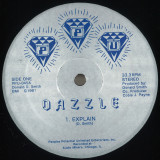
Dazzle rolled deep. Very deep. In the 1980s, it wasn't unusual for the Milwaukee-based group to show up at various Midwest night clubs in a caravan of 30-40 cars and vans. Their live following was hard won over a career that spanned 20+ years, many line up changes, and a handful of project names. Friends, family, and fans made the journey with them weekend after weekend, a testimony to both the musical prowess of the group and the tight-knit community that they emerged from.
Donald Smith, band leader, was there the whole time - joined by many of his siblings and friends - first as founder of the Ghetto Players, a early 70's nine-piece which also included siblings Michael, Ronald, and Charles. They played hard funk in the style of early Kool and the Gang, and although they sadly left no recordings, the strength of their live act managed to catch the eye of local Milwaukee R&B music entrepreneur Cobie Joe Payne. Cobie had made a couple of records locally in the early/mid 70s as a singer, including the impossibly weird and amazing rare afro-blues-funk 45 "Sweet Thing", but had never enjoyed national success. When the Ghetto Players disbanded in the early-mid 70s, Donald soon put together a new group, C on the Funk (the 'C' referring to lead vocalist and sibling Charles), under Payne's tutelage. Sister Lorrie Smith came in as the drummer, the line-up being fleshed out by brothers David and Melvin Johnson, and friend Robert Mitchell. After a few years as a strictly live attraction, they drove to Chicago and produced a single, "In the Disco" / "A Place" for Payne's small record label Sweet Thang Records in 1980. Lacking the financial backing needed to supply the local R&B disk jockey's "promotional fees" , this single sadly languished in obscurity, gathering dust inside the local tavern jukeboxes and manilla promo envelopes that comprised Payne's DIY distribution network.
C on the Funk were traveling the Mid West extensively at this point, and making some important friends on the road. Ike Wiley Jr. of the Dazz Band/Kinsman Dazz took particular interest and the band was re-christened Dazzle, partially as a tie-in with Dazz, partially to embrace the new sounds that would distinguish the 70s disco scene from what record collectors and DJs would now refer to as the "Boogie" era. There no doubt was a stigma attached to the word "Disco" as the eighties began, and as we see in this collection C On the Funk's "In the Disco" is remixed and transformed into the psychedelic synth instrumental of Dazzle's "Disco's Out", a title which embodies both the next-step approach Smith and company were pushing for, and humorously comments on the state of black dance music in the early 1980s. The Dazzle recording, done in Chicago in 1982, updated the sound and featured an expanded line up, most notably a second synth player (Charles Washington), and a percussionist/second lead vocalist (Greg McDonald). The added synth textures and deep percussive grooves give the Dazzle recordings an elegant late night vibe that resonate just as well in a good pair of headphones as they do on the dance floor. The trance inducing cough syrup-warble of "Explain" may best exemplify this here. Sadly, a pressing flaw in the 12" halted production and promotion, and the EP and the songs within were lost to the ages. The group, having done a much better line in the live music business, followed that path instead all the way to the early 90s. --bio provided by andy noble