Discover Le Deltaplane, fifth album by Andre Solomko, and third produced on Favorite Recordings, pursuing a collaboration that started more than 5 years ago.
Born in Ukraine in 1965 and now based in Finland, Andre Solomko is primarily a rich and engaging personality, but above all, a brilliant saxophonist, composer and engineer, whose contagious passion cannot leave anyone indifferent. After beginning a meteoric career in USSR, fate led him to Finland, where he started the adventure Vinyl Jam, a label / studio / group. It resulted in two self-produced albums that will capture the attention of some international collectors, including Pascal Rioux (founder of Favorite Recordings). Between 2012 and 2014, they released 2 albums together, Où es-tu maintenant and Le Polaroid, hailed by many tastemakers and meeting notable success in Japan.
Following Le Premier Disco Sans Toi, an acclaimed single released earlier this year and unveiling two new compositions with Disco flavors, Andre Solomko and Favorite Recordings also proudly present Le Deltaplane. Fully composed and arranged by Andre Solomko, the 6 tracks of the album are deeply infused with his longtime passion for Jazz-Funk and Movie-Soundtracks, this time also injecting more influences from WestCoast and Modern-Soul music.
Andre's backed again by a team of great musicians, recording and producing the album in analog like he always did. As for vocals and lyrics, he teams up with Charlotta Kerbs, a young emerging and talented singer from Helsinki.
Andre Solomko, an artist who spreads love like in the good old days!
Search:pol
* The second in Joker's trio of special releases to commemorate 10 years of his Kapsize label is to release this coming May.
* Over the past decade, Kapsize has put out some of Joker's most defining work, including the iconic 'Purple City' (produced with Ginz) — a track widely recognised as ground zero for Joker's purple dubstep aesthetic — and 2015 album, 'The Mainframe', as well as early records from Asa & Sorrow and L-Wiz.
* To be released both on special edition vinyl, A-side 'Marching Orders' features legendary grime MC and producer, Footsie, who goes hard over Joker's monstrous instrumental — think relentless, hyper-distorted club hydraulics — even acknowledging him on the hook; 'Oi Joker this beat's sick, crazy'.
* On the flip, B-side 'Polka Dot' is equally as tough, despite the dizzying melodies and gentle tones of the track's opening throws, landing as a crunching melee of textbook Joker sounds.
Oddball space disco/fnk tracks, composed between 1970 and 1985. Big tip!
.
A master of the mixing board, from the late 60s until the 90s Bernard Estardy was the wizard of French musical recordings. As head of CBE studios, he shaped everything from Gérard Manset's concept albums to Claude François' hit singles, Françoise Hardy's delicate tear-jerkers and Michel Sardou's soul-stirrers. This giant' had his hand in the whole range of mainstream French music by making his studio a veritable playground for experimentation. His legendary album La Formule du Baron,' released in 1969, and the eight LPs of production music he made between 1974 and 1978 for Tele Music are vivid proof. In the CBE studio, which she runs today, his daughter Julie Estardy discussed his singular career.
- A1: Pollen
- A2: Chowsy In Upstyled Onesy Minor
- A3: The Perfect Adult Man
- A4: Le´ Cave´ Isnt It Funny To Think Once Apon A Time People Thought The World Was Blue White Flat And Square
- A5: 808 Frapé
- B1: Reecard Farche The Torture Of Credo Mutwa And The Theft Of The Necklace Of Mysteries_Noel
- B2: Industrial Kingpins Und Drachoen
- B3: Sharkblood Sure The Sharks
- B4: Golife Refracto Relationé
- B5: Attilas Own Photos From The Shoot
Anklepants Introduces His Brand New Album For Detroit Undergroud, A Collection Of Ten Cuts, Made With His Very Own Arsenal Of Digital And Hardware Toys, Most Of Them Self Made And Customised For His Purposes. This Multi Faceted Artist Creates A Blend Of Twisted Ryhthms, Synthetic Melodies And Weird Textures And Noises, Yet Danceable Stuff But With Heavy Focus In Experimentation And Risk.
Pollen Opens The Release With A Weird Arabic Style Riff And Arpeggiated Clean Synths Over A Simple Beat, Until More Melodic Layers Complete The Equation.
Chowsey In Upstyled Onesy Minor Follows With Sampled And Morphed Traditional Instruments, Laying Over Destructed Beats And Rythms.
The Perfect Adult Man Relies On Atmospheric Stabs, Four Four Kick And Analogue Bubble Bassline, Dark, Grey And Melancholic.
'lé Cavé_isnt It Funny To Think Once Apon A Time People Thought The World Was Blue White Flat And Squaré' Is Made Of Twisted Samples, Asymetrical Grooves, Organic Instruments Decimated And Multiple Sound Layers.
808 Frapé Is An Homage To The Classic Drum Machine, Electro Shaped Drum Patterns, Floating Sounds And Crispy Metalic Glitches Dance With Random Sequences And Bleeps In A Robotic Exercise.
Reecard Farche The Torture Of Credo Mutwa And The Theft Of The Necklace Of Mysteries_noel Goes Again To Weird Random Bleepy Fields, Alien Grooves, Heavy Sound Processing And Glitched Details.
Industrial Kingpins Und Drachoen Is Dark, Obscure Number, Clear Rythms, Strings And Resonant Bassline Collide, The Groove Transforms To Broken Beats After The Break Bringing New Life To The Overall Feel.
Sharkblood, Sure The Sharks, Repeats This Phrase In Different Pitches Over A Solid Kick Pattern While More Vocal Layers Are Added Progressively In A Voice Madness.
Golife_refracto Relationé Again Plays With Samples In A Mad Style, Altering Every Parameter, Creating Granular Efects, Destroying The Audio Files Creating An Asymetric Tune.
Attila's Own Photos From The Shoot It's The Epilogue, In A Relaxed Mood, Sound Textures, Various String Samples Melting In Different Pitches And Crunchy Atmospheres.
Coletivo Vandalismo kick-start a new 12" series for the Contort Yourself label. Hailing from the city of Porto the duo also DJ under the name GAM and released their debut LP on Lake Haze's Eye For An Eye label. Their music has an immediacy that seems to stem from a background in live performance as opposed to polished studio sessions - an improvisational punk aesthetic that manages to carry this EP so strongly. Wild, crashing fx and unrecognisable vocal distortions layer atop wonky 90bpm drum machine grooves and the pair even show off what may be their turntablism skills on 'Zombie Zombie'. There's a nod to early concrete on the closing track 'Black Sun's Demise' with whirring, mechanical noise motifs suddenly jolting us into punishing gabber-at-33-minus-8 territory. The DIY spirit is alive and well here and the feeling that things could fall apart at any minute just adds to the tension.
CALIBRO 35's new single "Psycheground" flipped by the unreleased Polymeri (Afro-Utopia Vers) on limited edition 45 vinyl.
Psycheground is the new single from the Italian cinematic funk cult combo Calibro 35 available on a super limited 45 vinyl and digital download on May 04. Taken from their heavily acclaimed new album DECADE, Psycheground is an afro-funk stormer that sounds like Tony Allen involved in writing a score for a vintage Hollywood production. The new single is flipped by an alternative and hypnotic afro/tropical version of Polymeri. Don't sleep on it, all Calibro 35's previous 45s went sold out in a few days.
CALIBRO 35 enjoys a worldwide reputation as one of the coolest independent band around. They have been sampled by Dr. Dre on his Compton album, Jay-Z Love Child & Damon Albarn, they shared stages with the likes of Roy Ayers, Sun Ra Arkestra, Sharon Jones, Thundercat, Headhunters and as unique musicians they've collaborated with, amongst others PJ Harvey, Mike Patton, John Parish and Stewart Copeland and Nic Cester (The Jet). Described by Rolling Stone magazine's as the most fascinating, retro-maniac and genuine thing, that happened to Italy in the last years, Calibro 35 now count on a number of aficionados worldwide which includes VIP's fans such as Dj Food (Ninja Tune), Mr Scruff and Huey Morgan (Fun Lovin' Criminals) among others.
A native of the Caribbean coast of Colombia, Abelardo Carbono achieved legendary status in his country's storied ranks of musical icons by combining the homegrown sounds of cumbia with the chiming guitars of West African soukous, enormously popular with the local tropical sound systems, and drenching the whole thing in his off-kilter, surreal and slightly psychedelic sensibility.
With the exception of a well-received compilation of songs from his 1980s heyday, Carbono has been rarely heard from outside the sweaty dancehalls he still commands in his hometown of Barranquilla. Now, Names You Can Trust has welcomed the reclusive guitarist and singer back to the vinyl format with a simmering Afro-Carib beast of a cut, recorded with the assistance of Will "Quantic" Holland on rhythm guitar and Mario Galeano (Frente Cumbiero, Ondatropica) on keys and in conjunction with Lucas SIlva of Palenque Records & Polen Records. It's a true cross-generational and international collaboration that is uniquely possible via Colombia. The first release of this expansive & power packed studio session is a cover of vallenato pioneer Guillermo Buitrago's La Piña Madura. This updated take veers heavily towards Africa on a rock solid foundation of bass and drums, with Abelardo's trademark guitar and quirky vocals leading the way.
Greenvision is the collaborative brainchild of two ESP Institute artists, Juan Ramos and Luca Trentini AKA Trent, both longtime fixtures of Berlin's infamous playground known as Cocktail d'Amore. Separately, these two explore their own very personal avenues of expression, putting their time in the trenches and endlessly polishing their works (this makes Juan's third release with the label), but when their efforts overlap we're gifted a view into their uncanny synergy. Juan and Trent channel an exorbitant amount of smoke-fueled creativity, building layers upon layers into music so dense that the bulk of their studio time might then be spent navigating and formalizing their output into tangible tracks. Greenvison's collective debut with the ESP Institute showcases three intense cerebral workouts, Banana Paradiso, Rambutan and The Color Of Maracuja, an array of experiments pulling from all the corners of the duo's imagination—it is disorienting, cacophonous, introverted and psychedelic, but at the same time playful, melodic, euphoric and undoubtably arresting—guaranteed to induce hallucinations under proper circumstances. We welcome the induction of Greenvision to the ESP Institute, and with us as your guide, we welcome you to accompany on our descent into their abyss. Try not to get lost.
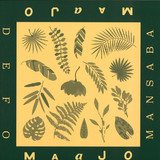
The Finnish tropical troupe Maajo is back with a two-track EP. In contrast to the Afro-Balearic sound of their 2016 debut Tropic of Tulli, the new Defo / Mansaba EP is a step in a deeper and sometimes darker direction.
Defo kicks off the EP with a driving 5/4 rhythm. Reminiscent of Mark Ernestus' Ndagga sounds, it is a tribal tune with Maajo's signature ethereal disco elements.
Trevor Deep Jr.'s version straightens out the original's unconventional time signature and focuses on a four-to-four beat and plenty of Berliner dub. The remix is a solid dancefloor tool, traversing the original like a train making its way through a dark rainforest.
The B-side is entirely covered by Mansaba, a 14-minute long journey into inwards. This studio jam, recorded largely live, is a wild mixture of polyrhythmic sequences, krautrock guitar licks, equatorial forest percussion and violin synths. The trip starts slow and soothing, sneakily picks up pace and keeps grow and growing, eventually exploding into a full-on tribal dance.
Transversales Disques present a reissue of Bernard Baschet and Michel Deneuve's 4 Espaces Sonores, originally released in 1982. Rare 1979 recording of Bernard Baschet performing on his Sound Sculptures.The Baschet brothers are known worldwide as creators of Sound Sculptures, fantastic shapes of moulded metal and glass, which combine the visual arts with music.François Baschet had always been fascinated by acoustics, by the relationships between the shape and material of an intrument and the beauty of its sound.Bernard Baschet was passionately interested in contemporary music and firmly believed that such instruments were the proper tools for modern music, for they offered to the artist and performer a personal means of expression denied by electronic devices.Together the brothers began to design and produce Sound Sculptures, which could also be regarded as musical instruments.Circa 1965, Bernard worked alongside Pierre Schaeffer as a member of the GRM (Musical Research Group) on the elaboration of what was to become Schaeffer's "Traité des objets musicaux" (Treatise on Musical Objects).The Baschet brothers also created structures and instruments of all sizes, including bell towers, windmills and fountains, using the natural elements of wind and water to make music. Bernard Baschet was especially proud of his pedagogical work amongst deprived and handicapped children, with the instrumentaium made up of fourteen pieces.
Re-issue of forgotten minimal techno abstraction from Hamilton, Ontario. The unsung genius of Secret Werewolf is fully on display on this 1996 gem.
Rubbery and polymetric, akin in mood to Robert Hood/Metroplex productions of the same era, but full of eerie metallic timbres and flexing grooves which combine into a lysergic hypnosis unlike anything else from then or now.
A taste of the forthcoming Geej re-issue project surveying the Steel City Records catalogue, a wellspring of unsung, singular dance music that arose from the abandoned industrial spaces and uncompromising producers of the fertile but secluded techno zone of Hamilton, Ontario Canada circa 1995-1997.
First time pressed in over 20 years, vinyl only.
As Fabrice Lig has contributed to the Kanzleramt History - we are returning the favour and congratulate with this release to his 25th Stage-Anniversary!
Black Stone is taken from 'Universal Tech EP' of 2003 (ka089 12'' digi). Its powerful sequence was always considered as one of the best ever to be exposed on Kanzleramt. So more than deserving and about damn time 3 new Black Stones emerge: polished into an epic set-starter or the jet-black time-lapsed grinding and compressing in the earth's crust or raw acid washed. Heiko leaves the choice to you.
Forriner are Lee Forster (Last Waltz) and Oli Warriner (Traela) Having both previously released material under their respective projects on labels such as... ESP Institute, Mule Musiq, Hhatri and World Unknown to name a few. The duo released their first offering on Futureboogie Recordings to great success, picking up airplay on BBC Radio 1. With material on Man Powers - MeMeMe and a forthcoming release on Father & Son Records and Tapes, Poland. This is the first release on their brand new imprint, "Forriner Music" The release features two Forriner originals whilst collecting remixes from underground heavyweights, Persus Traxx and Frank Butters.
*New Artwork* Early 80s rarity 'Movin On' by Zambian band Witch finally gets a repress on Invisible City Editions!
Known for their psychedelic fuzz masterpiece 'Lazy Bones', 'Movin On' shows a different side of Witch and features a whole new sound, capturing both the spirit of the early 80s and the changing political atmosphere in Africa with a perfect blend of MJ/Jake Solo boogie, and Fleetwood Mac AOR moves. The album showcases the band at its creative peak, blending American and African influences with stellar musicianship. Featuring synthesizer work by the great Patrick Mwondela. This is the African boogie version of Band On The Run.
Das HER DAMIT Tonarchiv zeichnet den Sound des Festivals auf und startet die Archivierung mit einer vierteiligen Serie. Auf der Logoseite vertont Bleak den nächtlichen Bunkerfloor mit - Poly Invaders und - Lovecraf Function , zwei effektiven Techno-Workouts aus nachdrücklichen Percussions gepaart mit atmosphärischem Tiefgang. Oliver Deutschmann zeigt mit seinem Ambient-Track - The Source den Bunkerfloor im Morgennebel, während sich die freundlich treibende Techno- Exkursion - Space Unfolding über dem aufheizten Betonfloor aufblättert. Ein Moment, bei dem sich Ausgeschlafene wie Durchgefeierte einig sind.
#HER DAMIT Tonarchiv aims to document the sound of the HER DAMIT festival and kicks things off with a four-part vinyl series. Located on the logo side is Bleak who scores the nightly bunker floor with Poly Invaders' and Lovecraf Function - two highly effective techno workouts made of punchy percussions tied up with atmospheric depth.
On the info side of the record Oliver Deutschmann's The Source' portraits the bunker floor filled with morning fog, while his friendly techno driver Space Unfolding' evolves upon the heated concrete dancefloor.
A moment where the breakfast and all-nighter crew sing from the same hymn sheet.
Aria Rostami and Daniel Blomquist are from San Francisco, CA, though Rostami has recently moved to Brooklyn, NY. Rostami and Blomquist's work occurs in two stages: the gathering/preparation of source material and the live performance. Rostami and Blomquist's source material primarily focuses on the exchange of information, repetition and decay, and surrendering aspects of creative control. The source material is either sampled and altered by Blomquist or composed and recorded by Rostami. Sometimes this material is repeatedly passed back and forth to be altered, others, it's barely touched.
Following prior albums on Glacial Movements and Jacktone, the duo return with their third full length, "Distant Companion" named after the multiple star Polaris. Comprised of Polaris Aa in orbit with Polaris Ab which in turn, are in orbit with a distant companion, Polaris B. Polaris, aka The North Star, was the star that American slaves followed to freedom. It carries with it a history of Civil Rights, a cosmic history of our origins, as all stars do, and a glimpse into the past as it floats light years away. The first two songs of "Distant Companion" were recorded during a protest performance at Grey Area Foundation of the Arts in San Francisco that featured artists representing communities, cultures and countries on the travel ban list (Executive Order 13769.) For this performance they sampled voice recordings of Persian poets Rumi, Hafez and Forough Farakhzad. Every generation seems to find, in their own way, that the pursuit for equality is not linear, but that we must know our pasts, be in tune with the present and have a will for a better future. This record stands on the shoulders of communities, artists and movements that have made art in protest of oppression, and we hope, in some way, to make a contribution to this conversation. All songs have been mastered for vinyl by George Horn at Fantasy Studios. Cover artwork features a collage by London-based artist Anthony Gerace, and each copy includes a postcard featuring a photo of the duo.
"The kind of melancholia I'm talking about, by contrast, consists not in giving up on desire, but in refusing to yield. It consists, that is to say, in a refusal to adjust to what current conditions call 'reality' - even if the cost of that refusal is that you feel like an outcast in your own time." (Mark Fisher, Ghosts Of My Life, Zero Books 2014, p. 24) In Ghosts of My Life: Writings on Depression, Hauntology and Lost Futures', the author Mark Fisher outlines - to put it in a big way - a resistant melancholy. This stands in contrast to leftist melancholy resignation', as well as something which Fisher does not talk about: its common masculine counterpart, habitual post-left cynicism - as in seen it all before'. Fisher calls this hauntological melancholy. Haunting, spooks, ghosts and apparitions are an almost constant presence on I Started Wearing Black', the second album by the Cologne-based artist Sonae (pronounced so-nah'). The term hauntology shares a fate with retro-futurism when it comes to inflationary overuse and abuse. It's a conceptual container that looks good and can hold a lot, indeed, too much. Furthermore, hauntology has its peak season behind it, a term on the threshold of its expiration date. Nevertheless, I would like to rehabilitate hauntology and use it properly to characterize I Started Wearing Black', because the term is rarely as compelling to describe music as is the case here. The most recent other example could be Asiatisch' by Fatma Al Qadiri, but with a completely different frame of reference. What are the ghosts of this music It rustles, crackles, ruffles, crunches, rattles, scrapes, sometimes a beat emerges from the constant noise, sometimes an obscure voice mumbles incomprehensibly, sometimes a melancholy piano figure is prevented by this noise from coming too much to the foreground. It definitely is eerie - to bring into play another term used by Fisher in the title of his latest book, The Weird and the Eerie'. In British pop-jargon, eerie first occurred to me more often when referring to particularly leftfield, spooky and... well... ghostly dub, a bass-heavy, echoing noise, from Augustus Pablo to Creation Rebel to Burial. Unlike the Wald & Wagner records by Wolfgang Voigt, Sonae is not a kind of neo-romantic veiling with a tendency for escapist nebula. It is more a noise of latency. The noise signals a latent - not necessarily acute - threat, a latent uneasiness about... yes... about what About a System Immanent Value Defect' That's the name of a track on I Started Wearing Black' where something that sounds like a French Horn (or a foghorn) battles for attention through or against the background noise. An email from Sonae: The piece 'System Immanent Value Defect' should actually be called 'I See Turkey'. I wrote it for my fellow student Elif - she is a pianist and Gezi Park activist from Istanbul. Through her I witnessed the inner conflict and agitation that political circumstances can create: her feelings of guilt when there was an attack, with her safe in Germany as a student, watching the events from afar. It was horrible. When her mother begged her not to come home because she feared for her safety, I felt a cold shiver run down my spine. I started with the piece from this mood, beginning with the piano, then the noise (modulated sinusoidal curves), which reminded me of waves and the then heatedly discussed Mediterranean sea: atmospheric, melancholy motifs. In contrast is the anger, the pressure, represented in corresponding sounds - hopefully audible! - During this time I started to think about world views as they can be found around the globe, in how far they held by societies and their political representation. I realized that I know of no political system that is actually about the people and what would do them good. It's always about positions, power, money. I thought that was a lot more frightening on a global scale than merely viewing Turkey in isolation. That's why the piece is called "System Immanent Value Defect", because our world suffers from precisely that. Everywhere, it's all about the wrong things.' Between the wrong things there are happy moments. In the title track, after 184 seconds of rattling and hissing, a beat is unleashed, like an arrow released from a spanned bow, a beatific relief, if there is such a thing. White Trash Rouge Noir' first meanders along spookily, then after 144 seconds it transforms itself into a distant cousin of Einstu¨rzende Neubauten's Yu¨ Gung', but there is no Big Male Ego to be fed here, and the black in the album title is a completely different type of black from that of the Neubauten. Furthermore, I Started Wearing Black' was finished long before the black dresses were worn at the Golden Globes as a sign of protest against sexual violence. Sonae writes that she herself started wearing black some time ago. Her reasons are so-called personal ones: ... resulting from an individual situation (lovesickness), I started to wear black (gaining weight and feeling ugly).' The political dimension of gaining weight, feeling ugly and therefore dressing in black in I Started Wearing Black' lurks within the noise and never becomes explicit and only rarely manifest - or a manifesto. Sonae writes about the track We Are Here': A piece for minorities... in this case, considering the current pop-feminist discourse, explicitly for women. Female artists have long been saying loud and clear that 'we are here' and 'electronic music is not a boys club!' But this pop-feminist moment should only be seen as one part of the dedication of the piece. It is for minorities, for the oppressed, who didn't belong enough.'
Klaus Walter
Der aus Oxford (UK) stammende Emseatee ist ein wenig besonders. Wie ein Forscher, in einem versteckten Labor, beginnt er mit der aufziehenden Nacht, Atmosphären, Stile und Rhythmen zu kombinieren. Er ist immer auf der Suche nach einer neuen Formel und bindet auch natürliche Sounds in seinen organischen Mix. Emseatees Experimente brauchen Zeit und gehen zurück auf den 21.06.2014. An diesem Tag bekam er Besuch von Minerva und zusammen legten sie den Grundstein für dieses Release. Die Veröffentlichung via Modularfield erfolgt am 27. April als 12'' weißes Vinyl und Digital.