
Suche:port

8
The final volume of this mammoth collection of music from Bristolian electronic music pioneer Krust is finally upon us, and like the previous parts of this collection it boasts an assemblage of music of different energies, vibes and feelings. The music contained within spans decades yet somehow refuses to be locked to one 'era' or 'style'. This is what makes this release unmissable for the hardcore fan, newcomer or completist.
'Irrational Numbers' is a meticulously curated collection of five parts, available on both vinyl and digital formats. The compilation is a treasure trove of hand-picked records and archival gems from Krust's extensive discography, thoughtfully remastered and presented anew for both devoted fans and newcomers.
'Irrational Numbers' features a dizzying array of self-released 12" cuts, exclusive unreleased VIPs and dub-plates, alongside epic major label widescreen classics. It's an unmissable journey through the sonic output of one of the UK's most distinctive and forward-looking producers.
Featured on part 5 are some groundbreaking entries into Krust's massive back catalogue. The live bass driven jazz inflected 'Second Movement' from his acclaimed 'Coded Language' LP jostles alongside the speaker smashing machine funk of 'Break Ya Neck' as well as a couple of more recent productions including the sleek and sinister 'The Portal', which is undeniably the man at his best, in full electronic stealth mode.
For longtime Krust enthusiasts, this project serves as a fond reminder of the boundless creativity and originality that flourished during the early 1990s and beyond. For those new to his work, it presents an enthralling introduction to innovative electronic music that has comfortably set the tone for generations to come. Get ready to experience the evolution of sound and immerse yourself in the visionary artistry of Krust.

After 2021’s critically acclaimed album “Afraid To Leave”, Berlin based post-punkers Bleib Modern invited artist friends to take an outside perspective on their tracks, resulting in the “2 Afraid 2 Leave” compilation, featuring remixes and reworks from several esteemed names within the darkwave, post-punk and EBM music scenes.
From club bangers like IV Horsemen’s version of “Bitter Smile” and M!R!M’s dreamy lo-fi bedroom synthpop sound on “Into The Night” to Danish deviant pop artist Dune Messiah’s crooner “Loony Voices”. The album also boasts contributions from luminaries like The KVB, The Underground Youth, Blind Delon, Shad Shadows and various Bleib Modern band member side projects.
“2 Afraid 2 Leave” offers listeners a chance to experience Bleib Modern’s music from an altered vantage point, a welcome interlude as the band forges ahead with new creations.

4
Immerse yourself in pulsating beats and refined taste with our latest Vinyl "Veinylpower." Featuring artists such as Monika Ross, Adine Frost, Ema Remedi, and Anaid, the musical journey spans from Deep House to Garage.
The design crafted by artist Kristina Supernova making your electronic music experience even more immersive.
For every record sold, a portion will be donated to SLOWODI - Solidarity with Women in Need, offering support to women facing challenging situations.
"Veinylpower" marks Veinyl Berlin's third groundbreaking release, celebrating women, the diversity of electronic music, and contributing to a meaningful cause.

Appalachian style old-time banjo and guitar player Nora Brown joins with award winning fiddler Stephanie Coleman (of Uncle Earl) to present their new EP, Lady of the Lake, featuring two tight-harmony songs and two instrumental duets.
Brought together by Brooklyn’s tight-knit old-time music community, Nora Brown and Stephanie Coleman share a rich musical partnership. Nora is a singer/banjo player, and has released 3 albums on Brooklyn based Jalopy Records. Stephanie is an award winning old-time fiddler, and has recorded with and toured with celebrated artists such as all-women string band Uncle Earl, Watchhouse’s Andrew Marlin, and more.
Lady of the Lake is the first time Nora and Stephanie have recorded together since Nora’s 2019 debut album Cinnamon Tree, and portends more exciting developments to come.
The EP will be released on vinyl and via streaming and digital download.
The special edition vinyl is available as a 10” 45rpm record, in a beautiful custom printed chipboard jacket and sleeve with liner notes by the artists.

Why is it that thousands of clubbing tourists land at Berlin Schönefeld airport every weekend? Why have clubs like Berghain become the stuff of legend the world over? Why have some of the best-known producers and techno DJs like Richie Hawtin and DJ Hell moved with their labels to this city? These are the kind of questions explored in Lost and Sound by Tobias Rapp, a German music journalist who has been living, working and partying in Berlin since the beginning of the nineties. He has spoken with DJs, clubbers, label bosses, hostel managers and urban planners; he has looked and listened carefully; and most important of all, he has been part of the dance floor himself. Every day of the week – from Wednesday night (in Watergate) right through to Wednesday night (back in Watergate).
Lost and Sound is not one of those books that try to grasp techno from a desk-bound position. Rapp zooms in to relate intimate moments in front of the DJ booth and at the bar, and then cuts to historical tangents and theoretical reflections. Detailed research is interspersed with accounts from a first-person perspective. An excellent portrait of Ricardo Villalobos, the biggest star of the Berlin minimal techno and after-party scene, stands alongside a precise sociological portrayal of the queue for Berghain. Through this interplay of music, architecture, infrastructure and drug-induced explorations of personal limits, Rapp is able to capture what makes Berlin such a unique place for electronic music and how this music is experienced.
Following its publication in Germany in February 2009, Lost and Sound made an impact not
seen from a book about popular music for a long time. This was undoubtedly due in part to the
term coined for its subtitle: the ‘Easyjet set’ is a new group of music fans who – thanks to the
deregulation of the European air travel market – now regard the aeroplane as a taxi service for
parties, effectively making Barcelona, London and Paris suburbs of Berlin.

Brand new Portuguese label focus on delivery banging tracks.
No names, no tags, just music.
Very limited hand stamped 180 gram copies, vinyl only.
No repress, grab yours while they last.
Pimento because is our favourite vegetable!
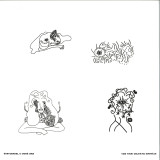
Between improv, pop and r&b abstractions, and contemplative balearics, Sam Gendel and Ugné Uma “Tam tikri objektai erdvėje” subtly meanders through a fragile and forward cosmos both inward and out.
Sam Gendel and Ugnė Uma’s Tam Tikri Objektai Erdvėje album sketches a layered, melismatic and intertextual view on what both performers define as a lightness of being. Ugnė Uma’s musical stance is influenced by experimental poetry and Lithuania’s 20th century underground music scene - jazz and folk, resulting from the liberation of the country’s independence movements. Sam Gendel, from Los Angeles, is a saxophonist and producer, proficient on more instruments than the saxophone alone, whose recorded work both solo and collaborative has brought him acclaim as a vital new voice in modern jazz and beyond.
Tam Tikri Objektai Erdvėje is Lithuanian and translates as Some Particular Objects in Space. The six tracks on the album stand for every letter of the word Saturn. They sketch out a sound palette both fragile and full of forward momentum. With hints of improv, sampling their own recorded work and sounds of a childhood’s Yamaha Portasound PSS-290 synth into abstractions of pop and r&b, some of these tracks reach an almost balearic feel, the more contemplative end of it. With lyrics delving into cosmic phenomena, Tam Tikri Objektai Erdvėje is an album about space, whether cosmic or inward or the one in between. It easily surpasses the sum of its influences and the materials and tactics used to produce it.
10
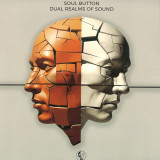
“Dual Realms of Sounds” emerges as the latest vinyl masterpiece from the enigmatic Soul Button, an audio diptych that distills the essence of his sonic signature. This meticulously curated double-vinyl collection showcases the dualistic nature of Soul Button's artistry, encapsulating the dynamic range of his most compelling works across two distinct auditory domains.
The first vinyl pays homage to the night - a pulsating journey through Soul Button's most successful, club-oriented anthems. Here, the beats intensify and the rhythms beckon you to the dance floor, with tracks like the fiery "Incendiary" and the enigmatic "Qabila" poised to ignite the crowd.
Vinyl 2 presents a shift in narrative to a more introspective realm, featuring the most melodious and soul-stirring hits from Soul Button.
The ethereal "Utopia" and the haunting "Wraith”, stand as cornerstones of this auditory expedition, channeling the essence of deep house with a dreamlike introspection, steering away from the dance floor and into the vast landscapes of the mind.
“Dual Realms of Sounds” is more than a mere collection of tracks; it is a portal to contrasting universes where rhythm and emotion converge. This release invites you to secure your passage and delve into the duality of rhythm and melody that defines Soul Button's unique sound.

Limited 100 copies.
London lyricist Slim Papi returns for the 3rd and final release in his ‘Châteauneuf-du-Papi’ series with this 4-track EP.
Following collaborations with the likes of Crimeapple, Sonnyjim & Jam Baxter, this time London’s Slim Papi teams up with the Madlib-cosigned Chris Crack, who makes a rare appearance singing his way through the Max-B reminiscent hook as well as handling a 16 bar verse. Crack appearing fresh off the back of his latest ‘Free Sex’ LP and fellow wine-afficinado Griselda/Alchemist affiliate, Willie The Kid.
Continuing the trend set through his ‘Chateauneuf-du-Papi' EP series, the EP once again sees artwork courtesy of Dublin’s Johnny Brennan and includes tracks named after cult a movie directors, iconic restaurants and highly coveted bottles of plonk. The Jon Phonics produced lead single ‘Wim Wenders’ also features Luke Mills-Pettigrew of psychedelic-jazz experimentalists, Lunch Money Life, on bass guitar. Making the 4 track opus a truly all star cast.
Continuing the self proclaimed ’travel rappers’ world hopping theme (his last ‘I’ve Long & Prosper’ project written & recorded during a stint in Brazil) the EP was written during a short stint working the harvest at a friends vineyard in Portugal’s Douro valley, working 16 hour shifts, breaking only to cook twice a day. A vibe summarised in Papi’s effortless lyrics - “Precipitation, maceration, elevation, information highway generation, microphone mathematics, fry the amoratics” - and a work ethic translated to the music we hear. With his trademark themes of vintage vehicles, water sports and the finer things in life, the guest verses from Willie The Kid & Chris Crack match this energy with a little more bravado to spare.

11
Wir entscheiden uns aktiv für das Überleben. Wir warten nicht passiv darauf. Stattdessen treffen wir die Entscheidungen, die wir treffen müssen, um das tückische Terrain des Lebens mit intaktem Körper, Geist und Seele zu durchqueren. DYING WISH haben diesen Kampf auf ihrem zweiten Album "Symptoms of Survival" (Sharptone Records) sowohl untersucht als auch vertont. Das Quintett aus Portland, OR - Sam Reynolds (Gitarre), Pedro Carrillo (Gitarre), Emma Boster (Gesang), Jeff Yambra (Schlagzeug) und Jon Mackey (Bass) - schafft den Spagat zwischen beschwörenden, von Schmerz durchdrungenen Melodien und Klanglandschaften, die aus einer chaotischen Kollision von Heavy Metal und Hardcore entstehen. Mit Millionen von Streams, ausverkauften Konzerten und viel Beifall von Brooklyn Vegan, Revolver, Stereogum, Consequence of Sound und anderen, erweitert die Gruppe auf diesen 11 Tracks ihre Vision thematisch und klanglich.

7
T4T LUV NRG presents “Call Me G”, the new album by Brooklyn’s Russell E.L. Butler, their first full length LP since the release of 2018’s critically acclaimed “The Home I’d Build For Myself and All My Friends” on Left Hand Path. In the intervening years, Russell has experienced an accumulation of personal subjective experiences which are explored through captivating musical modalities and expressions on this sprawling, gorgeous, and deeply emotional album. Russell’s work on “Call Me G” can be described as a unique amalgam of early NY house music, dub techno and poetry. The album’s title track, as well as its instrumentals, are a kind of storytelling for histories that continue to exist without observation as well as for secrets and the power they hold in spite of their truth being obscured and sometimes lost.
Storytellers like Russell have the ability to collapse the past and future into discrete experiences of non-linear time through the emotional landscape of music and voice. Each song contains a palatable loneliness and hurt to which many in this modern world can relate, but each track also suggests the possibility of genuine connection and the formation of the self through communing and reintegrating with the natural world. These parallel concepts are the subject of “Accumulation”, a writing by Russell which accompanies the release of the album. The emotions, conflicts and resolutions that accompany Russell’s storytelling are felt acutely on tracks such as “I’m Dancing No One Is Watching” and “Stare Into The Light Beam”, among others.
On the title song, which closes the album, Russell sings “Can you call me? Will you call me? All that I want is for you to call me by my name...My name is G.” Context is part of interpretation and thus it is left to the listener to feel in the music and lyrics the concept that what may seem erased never truly dies, the traces still exist in the thing that takes its place. The T4T LUV NRG label is in part a continuing effort to facilitate the documentation of true stories that don’t get told—rather than representing a singular vibe or genre. Russell’s album is a stunning and profound entry in this evolving catalog of music and art. The beautiful cover of “Call Me G” is based on a hand drawn portrait of the artist by Diego Guzman.

8
Joshua Kit Clayton released very inspiring music during the late 90’s. Forward-thinking minimal-dub-techno that influenced many artists and labels such as Vertical Forms and Scape. Joshua later designed the MSP/MAX program that is used by artists like Aphex Twin and Autechre and a major influence on the IDM, Minimal Techno sounding music.
This closing chapter of the Kit Clayton’s Retrospective trilogy featuring rarities like Sliding Window and Zepto among new and unreleased tracks. Big with fans of Basic Channel, Porter Ricks and Aphex Twin. Vinyl Only.
Joshua later designed the MSP/MAX program that is used by artists like Aphex Twin and Autechre and a major influence on the IDM, Minimal Techno sounding music.

Orphic Apparition follow up their inaugural release by RAFRAM, the collaborative project of Toronto's Raf Reza aka Raf Rizzla and UK acid house luminary Ramjac Corporation, with a new two-tracker from the transatlantic bass warriors. Where the RAFRAM 12" gifted us five variations on the same live jam cut from Grow Tottenham, here we have a spontaneous track written by Paul (Ramjac) on the A-side and a fully warped dancehall mix from Raf on the B. (short)
'Press 1 to Repeat' began as an on-the-spot demonstration of the musical self, a natural response to being asked 'What is it that you do?'. Within a few minutes Ramjac had his laptop out and was bashing out a quintessentially English sort of kitchen tabletop version of Kraftwerk - Numbers, the tongue in cheek automated voice on the other end of the line querying his account balance in tow. Proudly showing his friend Ryoko his improvisatory skills, a £10 hifi from a Japanese 2nd hand shop served as the portable monitors whilst the track waited to be brought back to his studio in London. The track is anchored by a bouncy, Irdial-reminiscent percussive workout which punches above its weight for its humble beginnings. Add the dubbed out synth pads and sort of electrical static FX in the background and everything syncs together in cosmic harmony. Hopefully Ryoko now gets the gist!
Raf Rizzla takes the stems and channels some inspiration from the Jamaican movie “Third World Cop” by turning the track on its head with a double-time baseline and half-time melody to craft a big dancehall version with a bit of a modern day On-U twist. Here Raf shows yet another side to his truly versatile production chops which have seen him release house, trance, breaks and downtempo cuts on a variety of Canadian labels prior to starting Orphic Apparition.

10
Step into a cosmic journey with "Cocaine Kisses," an ethereal album that effortlessly blends spacey synthesizers, moody melodies, and loungey beats. This captivating musical expedition reflects the tumultuous emotions of love and trust issues, resonating with listeners on a profound level. Crafted during a period of personal transformation and isolation brought about by losing management and enduring the trials of quarantine for COVID-19, each track becomes a portal to both introspection and connection. From hauntingly beautiful melodies that mirror the depths of heartache to uplifting rhythms that evoke moments of hope, this album encapsulates the paradoxical nature of human relationships. As the celestial harmonies intertwine, listeners are reminded of the resilience of the human spirit and the power of forging meaningful bonds amidst adversity. Through "Cocaine Kisses," prepare to embark on an otherworldly sonic odyssey that transcends the boundaries of time, welcoming you to a universe where love, loss, and self-discovery collide in a symphony of emotions.

8
“Only those who will risk going too far can possibly find out how far one can go.” a sage modernist poet previously whispered. And here we go, far out and yet so near, the third edition of “Risks Issues Opportunities” brings frontier reverberations scratching at the edges of dance, pop, downbeat, and other trance- portive sectors. Eight fast/slow propelling tracks. Adventurous, full of grandeur, gratifying the dance floor while equally winning the relaxation zones. Pure emotions crafted by newcomers. There is Milan’s Tagliabue, trancing slow and insightful. Or Cologne’s Grischerr, eloquently Tolouse-Low-Traxing. Some go down the slow burning road, where rhythms hang low, and suspense is in full show. Like London’s Frank Rodas, Garnu Depot from Iran, or Xei Ju from the islands of Micronesia, striking all ears with ghostly transcendental percussive science. An autumnally global voyage, which likewise offers industrialized districts by Italian producer Federico Cassetta, Metropolis minimal wave pop by Japanese musician Saeko Killy, or odd swamp funk by Chilean/German duo 7697 Miles. They all show, how far you can go, without losing your distinct flow.

On his new single "Pacifico Waves", Joel Sarakula takes the scenic route down a pacific coastline, searching for peace, enlightenment and the perfect sunset.
Travelling and searching is nothing new to Sarakula: it's almost his default way of being. Born and raised in Sydney, Australia before swapping oceans to live in the UK and more recently onwards to Gran Canaria: "I've been busy making my islands smaller" he jokes. But the music on "Pacifico Waves" sounds like none of these places: with its easy drum shuffle, soulful guitar hooks and smooth vocal harmonies it distinctly evokes Southern California. It's such a potent portrait of the West Coast that if not for the contemporary lyrics and some modern production techniques, it could be a long lost hit from an early 80s LA studio band.
"Pacifico Waves" is ultimately about memory, fantasy and the powerful emotion of reminiscing when Sarakula sings 'The sound of the ocean gets me so high, helps me remember what I left behind'.

- A1: Kavkazka Sound - All Forces On The Love Of Animals
- A2: Radiant Futur - Journey In The Deepest Of The Eyes
- A3: Mlin Patz - Smspce
- A4: Iury Lech - Here Comes Bellum Omnium Contra Omnes
- A5: Ihor Okuniev - Vernal
- B1: Rotrum – Kured
- B2: Niagara – Maja
- B3: Maarja Nuut – Flamingo Pop
- B4: Luurel Varas – Phantom Island
- B5: Terry Long Hermy – Eratifications On Observatations Of Unica
10
Ukrainian Muscut & Estonian Mida team up for “Воля x Rahu” compilation (Ukr: Volition x Est: Peace) with 100% of label profits donated to “Livyj Bereh” – a volunteer group based in Kyiv & working in regions affected by the war.
The A–side is curated by Muscut & holds only Ukrainian artists: Kavkazka Sound, Radiant Futur, Mlin Patz, Iury Lech & Ihor Okuniev. The B–side by Mida has Portuguese trio Niagara stuck in between Estonians Maarja Nuut, Rotrum, Luurel Varas & Terry Long Hermy.
Atmospheric & mellow selections on both sides, with a couple allowed left turns here & there.

12
I Talk To Water, the fifth album for Kompakt by Danish producer Kölsch, is the artist’s most personal statement yet. While all the trademarks that make his music so popular and powerful are still present – lush, melodic techno; swooping, trance-like figures; sensuous, shivery texturology – I Talk To Water is also a deep and intimate rapprochement with family and history, a beautiful, finely detailed document of loss and memory, and a tracing of the long, unbroken thread of grief that runs through our lives once we’ve lost those we loved.
The emotional core of I Talk To Water, then, is a cache of recordings by Kölsch’s father, Patrick Reilly, who passed away in 2003 from brain cancer. With time rendered elastic by the pandemic and its associated lockdowns, its sudden, alienating shifts in everyday living, Kölsch found himself reflecting on his father’s passing and ongoing spiritual presence, thinking about how best to memorialise such a significant figure in his own life. Those recordings opened a gateway, of sorts, for Kölsch to move through – a way to bring past and present together and entwine them in a sensitive, poetic manner.
Kölsch’s father was a musician – “touring in the sixties and seventies, in the Middle East especially, he was doing the whole hippy trail, playing guitar, and wrote some songs over the years,” he recalls. “But all in all, he decided to focus on family rather than pursue a musical career.” Reilly kept playing and writing music over the years, though Kölsch hadn’t listened to the material for some time: “I’d never had the guts to listen to it, because I just felt too fragile listening to his voice. It’s such a tough thing to go through.”
During the pandemic, though, Kölsch listened through the fragmented body of work that his father had produced over the years. “I decided I’m gonna finally release my dad’s music twenty years after his passing,” he reflects. “This whole album is about the process of loss, and for me it’s been one of my main driving forces in my musical life, the whole emotional aspect of whatever I’ve done has been based in that feeling that he’s not there anymore.”
Recordings of Reilly appear on three songs across I Talk To Water. His guitars drift pensively across “Grape”, offering a lush thread of melody that Kölsch wraps with clicking, driftwood rhythms and droning, melancholy bass. “Tell Me” is a lovely three-minute art song, a sadly beautiful reflection, minimally adorned with gentle keys and a muted pulse. And on the closing “It Ends Where It Began”, Kölsch lets his father’s acoustic guitar take centre stage for a lament that’s unexpectedly folksy, a guitar soli dream, which Reilly originally recorded in 1996. “He actually recorded it for my first album that never came out,” Kölsch reveals, “and I had it sitting around forever. That is purely him.”
These three imagined collaborations between father and son are poised and delicate. But their relationship also marks the gorgeous music Kölsch has made across the rest of I Talk To Water, from the itchy yet lush “Pet Sound” (titled in tribute to one of Reilly’s favourite albums), the flickering synths and yearning vocal samples that slide through “Khenpo”, the ecstatic shuddering that marks “Only Get Better”, or “Implant”’s slow-motion pans and subtle reveals.
There’s also the title song, where Kölsch is joined by guest Perry Farrell (Jane’s Addiction, Porno For Pyros), singing a mantra for internal reflection: “I talk to water / Searching for myself / Looking for answers / Oceans of you.” Farrell’s appearance brings another timbre, another spirit to the album, aligning neatly with his recent interest in electronic music. “He was completely taken by this idea of talking to water,” Kölsch says, thinking about the ways we collectively lean towards the natural world as a comfort and a listener, a guide through mourning, a way to map out the terrain of the heart. This mapping is something that Kölsch has proven remarkably adept at through the years; dance music for both body and mind, but also both for the here-and-now, and for the hereafter.
“I Talk To Water”, das fünfte Album des dänischen Produzenten Kölsch für Kompakt, ist zweifellos das persönlichste Statement des Künstlers bislang. Während alle Markenzeichen, die seine Musik so beliebt und kraftvoll machen, immer noch präsent sind – üppige, melodische Techno-Tracks; schwebende, tranceartige Elemente; sinnliche, fiebrige Texturen – ist “I Talk To Water” auch eine tiefe und intime Annäherung an Familie und Geschichte. Es ist ein wunderschönes, fein ausgearbeitetes Dokument des Verlusts und der Erinnerung, und es verfolgt den langen, ungebrochenen Faden der Trauer, der durch unser Leben läuft, sobald wir diejenigen verloren haben, die wir liebten.
Der emotionale Kern von “I Talk To Water” besteht aus Aufnahmen von Kölschs Vater, Patrick Reilly, der 2003 an Hirnkrebs verstarb. Durch die Pandemie und ihre damit verbundenen Lockdowns, die plötzlichen, entfremdenden Veränderungen im Alltag, fand Kölsch sich in Gedanken an den Tod seines Vaters und seine fortwährende spirituelle Präsenz wieder. Er überlegte, wie er eine so bedeutende Figur in seinem eigenen Leben am besten verewigen könnte. Diese Aufnahmen öffneten ihm sozusagen ein Portal, um Vergangenheit und Gegenwart miteinander zu verbinden und sie auf sensible und poetische Weise zu verweben.
Kölschs Vater war Musiker – “er tourte in den sechziger und siebziger Jahren, vor allem im Nahen Osten, auf dem Hippie Trail, spielte Gitarre und schrieb im Laufe der Jahre einige Songs”, erinnert sich Kölsch. “Aber alles in allem entschied er sich, sich auf die Familie zu konzentrieren, anstatt eine musikalische Karriere zu verfolgen.” Reilly spielte und schrieb jedoch im Laufe der Jahre weiterhin Musik, obwohl Kölsch das Material lange Zeit nicht angehört hatte: “Ich hatte nie den Mut, es anzuhören, weil ich mich einfach zu zerbrechlich fühlte, seine Stimme anzuhören. Es ist so schwer, das durchzustehen.”
Während der Pandemie hörte sich Kölsch jedoch durch das fragmentierte Werk, das sein Vater im Laufe der Jahre produziert hatte. “Ich beschloss, die Musik meines Vaters zwanzig Jahre nach seinem Tod endlich zu veröffentlichen”, reflektiert er. “Dieses ganze Album handelt von dem Verlustprozess, welcher für mich generell eine der Hauptantriebskräfte in meinem musikalischen Leben ist. Der ganze emotionale Aspekt von dem, was ich getan habe, basierte auf dem Gefühl, dass er nicht mehr da ist.”
Auf “I Talk To Water” sind Aufnahmen von Reilly in drei Songs zu hören. Seine Gitarren ziehen nachdenklich durch “Grape”, bieten einen üppigen Melodiefaden, den Kölsch mit klickenden, treibenden Rhythmen und dröhnendem, melancholischem Bass umwickelt. “Tell Me” ist ein schönes dreiminütiges Kunstlied, eine traurig-schöne Reflexion, minimal geschmückt mit sanften Tasten und einem gedämpften Puls. Und auf dem Abschlusstrack “It Ends Where It Began” lässt Kölsch die akustische Gitarre seines Vaters im Mittelpunkt stehen, ein überraschend folkiger Klagegesang, den Reilly ursprünglich 1996 aufgenommen hatte. “Er hat es tatsächlich für mein erstes Album aufgenommen, das nie veröffentlicht wurde”, enthüllt Kölsch, “und ich hatte es ewig liegen.”
Diese drei erdachten Kollaborationen zwischen Vater und Sohn sind ausgewogen und zart. Aber ihre Beziehung prägt auch die wunderschöne Musik, die Kölsch im Rest von “I Talk To Water” geschaffen hat, angefangen bei dem nervösen, aber üppigen “Pet Sound” (benannt als Hommage an eines von Reillys Lieblingsalben), den flimmernden Synthesizern und sehnsüchtigen Vocal-Samples in “Khenpo”, den ekstatischen Erschütterungen in “Only Get Better” oder den langsamen Schwenks und subtilen Enthüllungen in “Implant”.
Es gibt auch den Titelsong, in dem Kölsch von Gast Perry Farrell (Jane’s Addiction, Porno For Pyros) begleitet wird, der ein Mantra für die innere Reflexion singt: “I talk to water / Searching for myself / Looking for answers / Oceans of you.” Farrells Auftritt bringt eine weitere Klangfarbe, einen weiteren Geist in das Album, der gut zu seinem jüngsten Interesse an elektronischer Musik passt. “Er war völlig fasziniert von der Idee, mit Wasser zu sprechen”, sagt Kölsch und denkt darüber nach, wie wir kollektiv zur Natur als Trost, Zuhörer, Führer durch die Trauer neigen, um die Gelände des Herzens zu kartieren. Diese Kartierung ist etwas, in dem Kölsch im Laufe der Jahre erstaunlich geschickt war; Tanzmusik für Körper und Geist, sowohl für das Hier und Jetzt, als auch für das Leben danach.

8
Dead Fader is the alter ego of John Cohen - former Brighton resident, now based in Berlin - who has worked relentlessly since 2007 to realise his vision of electronic music. His tracks are characterised by pioneering sound explorations, which on one hand oscillate between sonic extremities and on the other hand carefully craft cinemascope sound worlds. The album became a very personal exploration for Cohen, as the themes are inquiring emotional states, and the writing process was predominantly influenced by falling in love whilst making the album. Furthermore, the film Interstellar visually influenced the album, mapped as an image for Cohen's tracks to exist in. I have watched his talent, his confidence in his ability and his output just grow and grow beyond what most humans are capable of imagining, never mind making. I think that comes from a place of wonder and exploration, a place where emotion, energy and experience are important, the long and narrow, the deaf arena, the blood forest and the glass cathedrals. Dead Fader rips you backwards through the portal as existence explodes around you, but you don't perish in the fire. It's just a ride.' - Barry Pendergast, former partner in Dead Fader T
