Sound Transmissions returns with a bang. Fully loaded and equipped with booming basses and heartwarming synths that will melt all listening habits. Premis captures frequencies and developes soundscapes, a force to be reckoned with. The remixes from Double Precision, Thrived and Sha Ru are just showing what's possible if you explore the Transmissions minds! Don't you dare sleep on this
release!
Поиск:premis
Все
- A1: People Move On
- A2: Planets
- A3: Winter
- A4: Not Alone
- A5: Did I Say
- B1: Last Ship On The River
- B2: Me & Magdalena
- B3: Souvenir
- B4: Does It All Add Up To Nothing
- B5: Lonely Night
Following on from Butler, Blake & Grant's eponymous 2025 debut for Bernard Butlers' 355 Recordings, the trio reassembled at Norman Blake's home studio. 'Murmurs' is in some ways going back to where it all began for Butler, Blake & Grant, with the trio reimagining songs from their individual back catalogues which was in fact the premise for the very early shows that they played together. It all begins with 3 guitars, 3 voices and blooms from there.
Limited edition initial pressing of 1000 copies on silver vinyl in individually numbered sleeve.
"Scottish fireside Supergroup' - Uncut
"A uniquely pastoral musical summit...the tone feels perfectly integrated and cohesive. Imagine a mostly-Caledonian CSN&Y and you get the idea" - Record Collector
- 1-: Fire Graphics
- 2: Secret Speech
- 3: Ex-Human Shield
- 4: History's Biggest T-Shirts
- 5: Not A Sound In Heaven
- 6: Company Town
- 7: You Can't Say Dallas Doesn't Love You
Bristol experimental band SUGAR HORSE are delighted to announce that their third album, Not A Sound In Heaven, will be released on 10th April 2026 via Fat Dracula Records.
To celebrate the news, the band are sharing the bruising lead single ‘Secret Speech’, available to stream on all good digital service providers from 12th February 2026.
Also announced today are a run of April 2026 UK album headline tour dates and an appearance at StrangeForms Festival 2026, with tickets on sale now (see below for full listings).
“We are fortunate enough to live in what is generally known as ‘The West’,” says front man Ash Tubb of the lyrical themes behind the new track. “I say fortunate with gritted teeth, because I know—as I’m sure the reader knows—that living in the West isn’t always rosy. The vast majority of people struggle everyday to feed, clothe and house themselves. Let alone receive adequate healthcare, schooling and workers’ rights.”
“We are, however, where all the world’s wealth is hoarded. We are at the centre of Empire. The people outside of this empire—those of the Global South—have had their resources extracted and their populations exploited by our own governments, with very little given back in return. This won’t go on forever. It will inevitably end, as all great empires do.”
“We in The West have a choice to make in the meantime; either help create a new, fairer world, or let the greed of our ruling classes become the undoing of all of us.”
The first glimpse of new material from the quartet, ‘Secret Speech’ starts as Not A Sound In Heaven means to go on—a politically-charged wrecking ball of a song that smashes its way through the often unbelievable chaos and brutality of the 21st century with vitriolic malice.
How do you capture the machinations of the geo-political industrial war machine—and all the horrors that go with it—in the studio, without seeming trite or crass? That’s the question that Sugar Horse have posed themselves on their forthcoming third album Not A Sound In Heaven, and they must surely be one of the only bands in existence capable of delivering on just that premise with both musical substance and cutting philosophical insight.
“Ever since I was born I can remember visions of war, famine, and death being beamed directly into my living room via the magic of television,” says Tubb of the record. “These visions were accompanied by newsreader narratives designed to either humanise or dehumanise the people involved. We humanise our government’s allies and dehumanise their enemies. This is taken as common sense, or even wisdom to some degree. People watch the news and accept it as fact, simple and true.”
“As a person gets older they move in one of three different directions with this acceptance of reality; They embrace what they’re being told, they fall into a kind of trust free nihilism or they learn that there are deeper narratives at play.”
“Not A Sound In Heaven is an aged acceptance of the latter. An acceptance of sitting at the centre of a global empire of both military and economic dimensions. An acceptance that the stories we’re told as a nation, or what’s generally in the zeitgeist, isn’t necessarily reality itself.”
“How does a person cope with the weight—and, frankly, the guilt—of a society that perpetuates such distinct inequalities? A society that thinks a bit of killing abroad is fine, as long as it improves the lives of people at home. You can see why so many choose to embrace it. Hell, nihilism seems pretty sensible. Once a person decides upon pursuing a degree of truth however, things get a bit depressing. Beyond depressing...maddening.”
“This album explores this kind of breezy, frivolous subject matter in a manner that will no doubt be uplifting to the listener and massively financially rewarding for the artist.”
The new album follows on from their standalone AA single ‘What’s Your ETA? Let’s Have A Tear Up’/‘Would You Like Me To Be The Cat?’ which was released late last year as a surprise double drop.
"Apopi doesn't give answers, it asks questions
It doesn't narrate events, it describes their premises and effects
It's not explicit, it's opaque
It's not a sumptuous meal, but only the meager crumbs
It's not figurative, it's the context around the frame
Apopi is everything that exists beyond the mirror
Apopi is deafening silence"
Apopi is the new project of Pepi & Katrina, two established italian djs, producers and musicians, owners of their brand new independent label Porta Nuova Records.
Other projects concerning Pepi & Katrina are: Bait e Borghi, MisteriSeParli.
The writer Max Sebald often pondered over the nature of human memory, specifically, how our thoughts and desires - and their results - overlap and mutate over time. In A Place in the Country, he writes of the significance of what see as “similarities, overlaps and coincidences”. Are they the “delusions” of the self and senses, or manifestations of “an order underlying the chaos of human relationships, ... which lies beyond our comprehension”?
Song of the Night Mists, the new album by post-classical composer Stefan Wesołowski, often feels it draws on Sebald’s premise.
On a simpler plane, the one where the market dictates the neatly ordered information we consume, Song of the Night Mists can be described thus: recorded in the main by Stefan Wesołowski in Gdańsk, both in his studio and in Saint Nicholas' Basilica, the album incorporates acoustic instruments - piano, violin, double bass - and classic synthesizers such as the Roland Jupiter-8, the Soviet Polivoks. A Roland Space Echo RE-150 tape delay was also pressed into service as an instrument. We also hear the basillica’s organ and field recordings from the Tatra Mountains. Other musicians were Maja Miro, who played the flute parts on ‘Glacial Troughs’ and brother Piotr Wesołowski, who played the organ on ‘Wilhelm Tombeau’. Sound engineer was Marcin Nenko, who was also on hand to record the basilica organ parts. The album was mixed in New York by Al Carlson (Oneohtrix Point Never, Jessica Pratt, Zola Jesus, Lady Gaga, and Liturgy) and Rafael Anton Irisarri handled the mastering.
Ostensibly, Song of the Night Mists is the last in a trilogy, following on from albums Liebestod (2013) and Rite of the End (2017). All three deal with existential matters such as love, death, decay and “an ultimate end”; apocalyptic and Promethean in spirit, and betraying very human conceits. The Sebaldian nature of the new record starts to make itself felt when Wesołowski talks of how he used sampling. One element is unexpected, that of sampling himself: “I go back to dozens of my own unused sketches and recordings, treating them as raw material to cut, slow down, reverse, and transform in every possible way.” Memory as sound, to be reemployed by the listener through their own imaginings.
Another set of samples made by Wesołowski plays another role. These are field recordings, originally created for an audio illustration of the formation of the Tatra Mountains, and used in a film by sound designer Michał Fojcik. Wesołowski: “You can hear cracking ice, streams, footsteps in the snow and the wind, and a real avalanche, recorded from the inside.” The “Tatra connection” on the album is also found in samples referencing composer Karol Szymanowski. The album’s title alludes to a poem about the mountains by Polish poet, Kazimierz Przerwa-Tetmajer.
Wesołowski’s Tatra recordings are “about a world without humans - about the fact that the world existed, was beautiful, and had meaning long before people arrived, and for the vast majority of its history, it was a place without us.” Wesołowski, using one iteration of the natural world, plays out in sound Sebald’s idea of another order, underlying the chaos of human relationships lying beyond human comprehension.
These feelings play themselves out on the five album tracks. Sonorous and rich, they illustrate tectonic shifts we have no control over. Wesołowski hints that the overall sound is a “meditation on the metaphysics of the non-human set against the spirituality that human presence has brought into it.” In that light, the opening number, ‘Core’, with its slow build, and crackling and straining sound effects, create an effect of the earth groaning into life in a creation myth. Once the piano part raps out a simple melody and modulated tonguing trumpet samples add to the overall atmosphere, the listener can certainly find a cue in the “spiritual”, or “human” side of the story. Human versus nature: from the strains and harmonic muscle stretches of the second number, ‘Glacial Troughs’, through to the powerful and filmic ‘Stalagmite’ and heart-on-sleeve romance expressed in closer, ‘Wilhelm Tombeau’, we listeners are cast as Friedrich’s wanderer, looking out over a landscape that will appear only if we engage with it.
Formations of melody appear incrementally, almost appearing by chance - like hidden footings in the rock shelves to give us something to grasp onto. Rhythms are used sparsely: the prolonged percussive taps on ‘Glacial Troughs’ are an anomaly and maybe there to give pace to the album to come; essentially to keep the listener strapped in. Elsewhere, percussion is used as an aid to mood, the two thudding, timpani-style passages on ‘Peak’ there to offset the short, beautiful, kosmische passage that splits them.
Elements of the borderline religious spirit that drove German electronic music in the late 1960s and 1970s also find a place on Song of the Night Mists. The swells and recessions of the organ find their emotional climax on ‘Wilhelm Tombeau’, a track which summons up echoes of the “mountain magic” vistas created by Popol Vuh or Tangerine Dream, especially with the slightly atonal wobble of the Mellotron that counters it.
This is a dramatic album, but it does feel a strangely short, or curtailed listen on ending, evoking the feeling one gets when waking from a dream, and, for all its incipient grandeur, a track like ‘Stalagmite’, for instance, ends on a minor note. Wesołowski admits that Song of the Night Mists is born of the all too human process of temptation, doubt and recalibration - Sebaldian overlaps and coincidences forming something that must live another life, away from its creator. In Wesołowski’s words, the album is “a newborn foal must stand up and walk right after birth.” Now it is yours to ponder.
La MegaCobla: an experienced traditional Catalan cobla wind quartet, born after an improvisation workshop with ZA! two years ago. Pep Moliner, Jordi Casas, Xavi Molina and Xavi Torrent are four of the most reputable and innovative cobla musicians, experts in hacking tradition and using their folk instruments in any modern musical genre.
Tarta Relena, young a capella trans-folk duet that have shook up theire scene. With their use of polyphony and voice FX, Helena Ros and Marta Torrella are digging in the deepest Mediterranean folk repertoire and placing it in the XXIst century with aesthetic renewal.
ZA!: Papadupau & Spazzfrica Ehd are European benchmarks of the underground Do-It-Yourself music community. Their uniquely intense shows, as well as their collective/collaborative work (wokshops, benefit shows, Do-it-Together cooperation) have allowed them to tour the whole world, from Tokyo to Maputo, from Tasmania to Sao Paulo, from New York to Saint Petersburg. Under the premise that avant-garde art is not incompatible with collective horizontal creation, ZA! mix cult, underground and popular music without asking permission.
These three elements come together with the purpose of portraying their own vision of Mediterranean music, filtered by distortion (so current in cognitive, social and identity terms) and psychedelia (so inevitable in an increasingly accelerated and saturated reality). A retro-futuristic journey from folk to free exploring the shores of the Mediterranean, claiming its power as a living core, never as a deadly border.
The TransMegaCobla fuses traditional Mediterranean culture -from bulería to kopanitsa, from gnaoua to sardana- with contemporary culture to create a fictional but deeply human and festive universe. Resurrecting the Phoenician language, the octet seeks common roots to fuse and remake them with contemporary molds such as rock, punk, free jazz and conducted improvisation. A timeless orchestra ready to invent, with real elements, a science-fiction Mediterranean in a parallel reality.
Myriad - By definition the labels premise and priority is to showcase a wildly heterogenous variety of sounds, developing a catalogue without set musical boundaries. Myriad releases can span across all sonic terrains – groove to formlessness, night to day, dance tracks to introspective ambient, and countlessly so on.
We proudly present our first release with artists Lose Endz, V.I.C.A.R.I., Stoi and LoLo. Four different moods, covering every point in time
Back in 2011 when I was tentatively looking for a second release for my fledging record label Clay Pipe Music, I stumbled upon a mysterious MySpace page by a group called ‘Tyneham House’, the page was decorated with artwork by Rena Gardiner (who was unknown to me at that time) and the music was an otherworldly mix of field recordings, Mellotron and acoustic guitar. It turned out that Tyneham was promised to Glen Johnson’s Second Language label, so I offered to do the artwork, and in January 2012 the two labels co-released it on tape and CD in a cardboard box with a handmade booklet of my illustrations.
In 2016 Clay Pipe reissued it on 10” vinyl, in an edition of just 300, which has since become sort after. The new 2023 pressing is on blue and transparent marbled vinyl, with a reverse board cover and inner sleeve, and the booklet of illustrations has been given a complete redesign. Frances Castle 2023
The pastoral, wistful yet ineffably disquieting music of Tyneham House is made by artists who wish to remain anonymous here, save for their eponymous title. The musicians are happy, however, to let it be known that these recordings have been around for some years (many of them complied from old cassettes) and that they take inspiration from the 1960s/’70s/’80s work of the Children’s Film Foundation – a body who really ought to have made a film about this mysterious West Country curio. At least now we have its endlessly poignant soundtrack.
The small village of Tyneham, on the beautiful Isle of Purbeck, in Dorset, was once a thriving little community – that is until the British Government requisitioned it for training manoeuvres and other ‘strategic purposes’ in the run up to WWII. This was supposed to be a temporary measure, but the area remained in military possession long after hostilities had ceased, causing distress among former inhabitants, many of whom were farmed out to prefabs in nearby Wareham and Swanage.
Tyneham was characterised by its red telephone box, a tiny parade of shops – Post Office Row – and a grand country pile which stood about half a mile away from the village: Tyneham House. The army removed the building’s oak panelling and ornate decorative details and promptly set about using it for target practice. So great was the shame expressed locally about the damage inflicted upon one of Dorset’s grandest houses that the powers that be decided to grow a copse around the remains of the structure to give the impression that it was no longer there. Despite this, a substantial part of the structure remains intact, including its Saxon hall.
Land access around Tyneham was opened up in the 1970s, but admission to the house remains strictly verboten. Those who’ve been found around the premises, especially anyone wielding a camera, have felt the full weight of military trespass law. Tyneham today is regarded as a nature reserve by some – as a national embarrassment by others. It’s still a political hot potato, in Dorset at least.
After debuting on Flippen Disks in 2018 and a follow-up track on Bradley Zero’s Rhythm Section, PTDD is back on Flippen Disks with this debut solo-EP called „Sizipin“.
Melting PTDD’s signature minimalist sound with a welcoming harmonic world in Hoe Je Het Snijdt, taking a wide array of influences from UK-bass and broken beat in Sizipin to HipHop in N Btj Blvn Dnsn or more progressive club sounds in Kajuit, this EP is a clear big step in PTDD’s development as a producer.
„Sizipin“, a made-up term for an adaptor that you don’t know the use for anymore, it’s a rather fitting name considering the circumstances of the creation go this EP. A connector for quitting his day-job to focus fully on audio and music work, building his studio in deep pandemic lockdown-Utrecht and most importantly becoming a father. Also features a vocal performance of PTDD’s son Olivier. Can you find it?
Having crested the west coast modular-ambient wave in just a few releases - including 2018's Sharing Waves on the influential LA experimental imprint Leaving Records - Sean Hellfritsch has swapped the mossy analog synth improvisations of his prior output for refined melodic arrangements dressed in sprightly dawn-of-digital textures. Big Earth Energy plumbs the depths of Hellfritsch's multimedia mind and naturalist heart, spinning an impressionistic narrative world off of cultural touchstones like the PC game MYST, and the work of Studio Ghibli composer Joe Hisaishi. Inspired by the aforementioned, and guided by Hellfritsch's experience as an animator and filmmaker, Big Earth Energy is the soundtrack to a hypothetical video game with a pointedly ecological premise, and a twist of psychedelic charm. In Hellfritsch's imagined virtual journey, the player assumes the perspective of a treefrog sixty-five-million years ago, hopping epochs with each new level, forming a comprehensive picture of the massive changes the planet has gone through over the eons. The ultimate goal of the game is not to amass resources, defeat enemies, or gain power, but to fully witness the unfolding of one of the biggest systems of energy imaginable - or as the album's creator puts it - "to explore the incomprehensibly vast energetic expression and mystery that is Earth." Big Earth Energy is steeped in exploratory RPG intrigue, possibility, and contemplation, lovingly overlaid with Miyazaki-an sentiments and aesthetics. The through-composed, organic, meandering synthesis heard on previous Cool Maritime albums has been fully replaced by meticulous polygonal arrangements that recall the computerized sheen of late 80s work by composers like Hiroshi Yoshimura, and Yoichiro Yoshikawa - using true-to-period gear no less. Even given its referentiality, Big Earth Energy comes off as forward-facing where so much reminiscent music remains fixed to a bygone moment in pop culture. Hellfritsch has created a musical world where the endless verdancy of the biosphere finds its parallel in the golden age of early 1990s video games, and late 80s Japanese environmental music, all while pointing to a hopeful planetary and artistic future that vindicates the motives of all of these muses.
- 1: Lemonade Tycoon
- 2: Anti-Bird-Spike-Bird-Nest
- 3: Interlude (Stride)
- 4: Allcapsallbold
- 5: Pet Boss
Taupe’s latest album release, waxing | waning delivers jazz experimentalism, ‘skronk’, avant-rock, and electronics, by the Glasgow-based trio, due out via Minority Records. Across its seven tracks, waxing | waning captures Taupe’s approach – bold and boundary pushing – shaped by a fresh shift in the band’s dynamic and compositional approach.
Taupe’s waxing | waning, co-composed and realised by its players in a studio that was once an undertaker’s premises in Glasgow, is an absolutely affirmative album, an act of cultural defiance in desperate times.
Comprising Mike Parr-Burman (guitar, bass guitar, electronics), Jamie Stockbridge (alto and baritone saxophones) and Alex Palmer (drum kit, percussion), Taupe work up a storm of skronk, free jazz and harmolodic frenzy whose closest relations include Zu, Melt Banana and John Zorn. However, waxing | waning is from its opening, stuttering blasts, an exercise in seeking out and claiming new territory, finding unique and novel permutations in which jazz, rock, electronics interbreed at breakneck pace. Here is a group determined to say and do things they don’t get to say and do elsewhere in their musical lives.
‘Lemonade Tycoon’ hits the ground skronking. It’s cubistic jazz, cumulative in its impact, avoiding the white lines of the conventional freeway, bridling, bustling, coming at you from all angles – a three way conversation of astonishing rapidity, fast track, telepathic communication – everyone from James Chance to Albert Ayler coming at you at once, before morphing in to a spidery scrawl of electronics and furious percussion. ‘Anti-Bird-Spike BirdNest’s‘ title somehow sums up the sort of mental images evoked by the music – its sheer creative disobedience, as if being chased in vain, like a delivery rider evading capture by ICE agents -– shapeshifting, assuming different shades, sprouting metal quills and, in its midsection, seeming almost to swallow itself alive, before regurgitating itself in a sublime mess.
‘Interlude (Stride)’ is not exactly ambient, more a horizontal enmeshment of percussion, drones, reverberant noise, electronics, a sonic mulch. ‘allcapsallbold' reminds of early Aksak Maboul, in its playfulness, a haywire series of short phrases, subject to mechanical interference, a complex weave of irregular rhythms, increasingly eloquent sax phraseology and caustic guitars, which land heavier and heavier. ‘Pet Boss' is the new jazz equivalent of a highly evolved, mature conversation among brilliant equals, sharp, empathetic, complementary, rising to a collective, joyful noise. On the title track, electronics descend like a shower of bright particles, intensifying in their luminosity, whitening the skies, as sax and drums kick up a tempestuous, spontaneously sculpted noise that summons the ghosts of the great free jazz players, before a dark calm descends slowly. Finally, ‘Turn Push Kick’, a burgeoning chatterstorm of electronics, before the group kicks in, at angles to one another, led by abrasive guitars, reminiscent of Sunn O))) in their ritualistic concussion, riffing, digging deep amid squealing sax and piledriving percussion.
- Hasiera 00:50
- 2: Iratzarri 0:37
- Sarrakio 02:10
- Dantza Bihurritua 03:50
- Desagertu 03:18
- Meditazioa I 02:09
- Besarkatu Ninduzun (Cdr Y Basandere Ahotsak) 03:50
- Meditazioa Ii 02:53
- Ametza Iii 02:06
- Oroipen 04:04
- Fallen Gaza 03:09
- Atseginzale Dantza 02:14
- Sua Eta Heriotza 00:59
- Agur Maria (Cdr Y Basandere Ahotsak) 03:55
- Bukaerako Dantza 04:03
- Amaiera 00:36
Una interpretación de Soinuarenbidea II debería partir de esta premisa: todo es posible, nada es aleatorio, y en sí mismo es un imposible de aleatoriedades. El escenario planteado explora la idea de realidad aumentada desde una percepción sonora, ambiental y colectiva. La obra transita hacia adelante y hacia atrás recreando experiencias extintas de porvenir incierto, tratando de facilitar un fin pacificador. Cada pieza sonora se crea, se despliega, se repliega y se destruye, en una torsión permanente de toda la realidad que hace posible cada fragmento musical, cada identidad acústica, cada espacio sonoro. Lo onírico, la ficción, y el viaje están continuamente presentes, y es en el transitar de cada fragmento donde se produce el diálogo de la exposición musical. Los elementos de esta ficción se recrean continuamente, en un continuum donde se entrelazan y se van contorsionando a medida que crecen o decrecen con cada fragmento de síntesis concreta. Los temas explícitamente musicales son el magma que conduce a dar voluptuosidad al disco, siendo la piel un contexto o límite que en sí mismo fluctúa indefinidamente en texturas y configuraciones posibles. Y la urdimbre del silencio es la síntesis que está continuamente presente y que trata de cohesionar los fragmentos en continua colisión expresiva. Las grabaciones de campo proporcionan el material sonoro concreto, y como un fractal sonoro cada una de ellas ofrece diferentes grados de interpretación que a su vez conduce a nuevos fragmentos y nuevas creaciones. Así que se puede pensar que esta es una síntesis de una posible realidad, pero interpretable en infinidad de maneras. Un movimiento y una estaticidad implícitas que generan estructuras y dinámicas acústicas. Lo que se escucha no es real, pero en sí mismo forma parte de la realidad, creando un escenario expectante. Lo cinematográfico, plástico y teatral, danzante y dinámico cobra importancia en este juego, porque se trata de contar una historia, una experiencia recreada desde los puntos de vista del arte visual. Es a su vez hilo conductor y entretenimiento, discurso político y puro divertimento. Es desde este espacio de convivencia artística que tiene sentido la totalidad y justifica el formato sonoro planteado. La contradicción de la obra es patente en el formato, y es a su vez el planteamiento de una accidentalidad en el devenir vital. Contenedor de Ruido recoge todas estas contradicciones y las manifiesta en la obra Soinuarenbidea II. Es una historia sonora, es un cuento acústico. Es un fragmento de vitalidad en imágenes audibles. Es una invitación a la reflexión, a la crítica, al disfrute, a la meditación, a la celebración. Y sobre todo es esperanzadora apreciación de la realidad como algo maleable que confeccionamos colectivamente, que requiere de una paciente observación y la participación colectiva global, en un mundo finito pleno de diversidades y del que ignoramos prácticamente todo, al que deberíamos volver con respeto y devoción.
Soinuarenbidea II-ren interpretazio batek premisa honetatik abiatu beharko luke: dena da posible, ezer ez da ausazkoa, eta, berez, ausazkotasun ezinezko bat da. Planteatutako agertokiak errealitate areagotuaren ideia aztertzen du, soinu-, ingurumen- eta talde-pertzepzio batetik abiatuta. Lanak aurrera eta atzera egiten du, etorkizun zalantzagarriko esperientzia desagertuak birsortuz eta helburu baketsua lortzen saiatuz. Soinu-pieza bakoitza sortu, hedatu, tolestu eta suntsitu egiten da, musika-zati bakoitza, identitate akustiko bakoitza eta soinu-espazio bakoitza ahalbidetzen dituen errealitate osoaren etengabeko bihurdura batean. Onirikoa, fikzioa eta bidaia etengabe daude presente, eta pasarte bakoitzaren joan-etorrian gertatzen da musika-erakusketaren elkarrizketa. Fikzio honen elementuak etengabe birsortzen dira, continuum batean, non sintesi zati zehatz bakoitzarekin hazi edo txikitu ahala elkar lotzen eta bihurritzen diren. Esplizituki musikalak diren gaiak diskoari atsegintasuna ematera eramaten duen magma dira, azala testuingurua edo muga izanik, testura eta konfigurazio posibleetan mugarik gabe aldatzen dena. Eta isiltasunaren irazkia etengabe presente dagoen sintesia da, zatiak etengabeko adierazpen-talkan kohesionatzen saiatzen dena. Landa-grabazioek soinu-material zehatza ematen dute, eta soinu-fraktal batek bezala, horietako bakoitzak interpretazio-maila desberdinak eskaintzen ditu, eta horrek, aldi berean, zati eta sorkuntza berrietara eramaten du. Beraz, pentsa daiteke errealitate posible baten sintesia dela, baina hamaika modutan interpreta daitekeena. Egitura eta dinamika akustikoak sortzen dituzten mugimendu eta estatikotasun inplizitu bat. Entzuten dena ez da erreala, baina, berez, errealitatearen parte da, eta agertoki espektakularra sortzen du. Zinematografikoak, plastikoak eta antzerkikoak, dantzariak eta dinamikoak garrantzia hartzen dute joko honetan, ikusizko artearen ikuspegitik birsortutako istorio bat, esperientzia bat, kontatzea baita helburua. Aldi berean, hari gidaria eta entretenimendua da, diskurtso politikoa eta dibertimendu hutsa. Elkarbizitzarako espazio artistiko honetatik osotasunak zentzua du eta planteatutako soinu-formatua justifikatzen du. Obraren kontraesana nabarmena da formatuan, eta, aldi berean, bizi-bilakaeran istripu-tasa bat planteatzea da. Zarata-edukiontziak kontraesan horiek guztiak jasotzen ditu eta Soinuarenbidea II obran adierazten ditu. Soinu istorio bat da, ipuin akustiko bat. Bizitasun zati bat da, irudi entzungarrietan. Hausnarketarako, kritikarako, gozamenerako, meditaziorako eta ospakizunerako gonbidapena da. Eta, batez ere, itxaropentsua da errealitatea modu kolektiboan egiten dugun gauza xaflakor gisa hautematea, behaketa pazientea eta partaidetza kolektibo globala eskatzen dituena, dibertsitatez betetako mundu mugatu batean, ia guztia kontuan hartzen ez duguna, eta errespetuz eta debozioz itzuli beharko genukeena.
An interpretation of Soinuarenbidea II should start from this premise: everything is possible, nothing is random, and in itself is an impossible randomness. The proposed scenario explores the idea of augmented reality from a sonic, environmental, and collective perception. The work moves back and forth, recreating extinct experiences of an uncertain future, seeking to facilitate a peaceful end. Each sound piece is created, unfolds, retreats, and is destroyed, in a permanent twisting of all reality that makes each musical fragment, each acoustic identity, each sonic space possible. The dreamlike, the fictional, and the journey are continually present, and it is in the transit of each fragment that the dialogue of the musical exposition takes place. The elements of this fiction are continually recreated, in a continuum where they intertwine and contort as they grow or diminish with each fragment of concrete synthesis. The explicitly musical themes are the magma that leads to the work's voluptuousness, the skin being a context or boundary that in itself fluctuates indefinitely in possible textures and configurations. And the warp of silence is the synthesis that is continually present and seeks to unite the fragments in a continuous expressive collision. The field recordings provide the concrete sound material, and like a sonic fractal, each one offers different degrees of interpretation that in turn lead to new fragments and new creations. So one can think of this as a synthesis of a possible reality, but interpretable in an infinite number of ways. An implicit movement and staticity that generate acoustic structures and dynamics. What is heard is not real, but in itself is part of reality, creating an expectant scenario. The cinematic, plastic and theatrical, dance and dynamic aspects take on importance in this game, because it is about telling a story, an experience recreated from the perspective of visual art. It is at once a common thread and entertainment, political discourse and pure entertainment. It is from this space of artistic coexistence that the whole makes sense and justifies the proposed sound format. The contradiction of the work is evident in its format, and it is, in turn, the presentation of an accidentality in the course of life. Noise Container gathers all these contradictions and manifests them in the work Soinuarenbidea II. It is a sound story, an acoustic tale. It is a fragment of vitality in audible images. It is an invitation to reflection, to critique, to enjoyment, to meditation, to celebration. And above all, it is a hopeful appreciation of reality as something malleable that we collectively craft, requiring patient observation and global collective participation, in a finite world full of diversity and of which we know practically nothing, to which we should return with respect and devotion.
Paisajes sonoros, diseño sonoro, drones y música grabada, realizada y arreglada para Contenedor de Ruido por David Aranaz. Coro: Basandere Ahotsak. Producido y mezclado por David Aranaz. Mástering: Estanis Elorza. Fotografía: David Aranaz. Texto: David Aranaz. Traducción: Saioa Aranaz Oreja. Trabajo y Diseño artístico: Cristina Martinez. Edición: Contenedor de Ruido Producciones y Sarbide Music. Distribución: Contenedor de Ruido.
Contenedor de Ruido agradece el apoyo en la realización de Soinuarenbidea II al coro Basandere Ahotsak y en especial a Eva Orbara Goicoa.
Soinuarenbidea II está dedicado al pueblo palestino.
Paisajes y objetos Sonoros, samplers y otras músicas transformadas para Soinuarenbidea II
Burlada: Paseos sonoros matinales por Merindad de Sangüesa, Calle Mayor, Capuchinas, Parque Uranga y varias iglesias y plazas. Pasajes del cotidiano: basura de papel, cristal y plástico.
Pamplona: Cementerio de San José. CEIP Sanduzelai /// Quinto Real: Fábrica de Armas, Puerto de Urkiaga y alrededores. Suite del silencio, bosques en movimiento /// Fábrica de armas de Orbaiceta: regatas, biosques, paseo sonoro hasta regata /// Belate: Puerto de Belate y alrededores. Vacas en pradera junto a las turberas /// Bardenas Reales: Suite de guitarra y Suite del silencio, estepa desértica /// Austria: Tranvías de Graz y Viena. Muchedumbre del metro de Viena.
Voces cinematográficas de: Matanza en Texas, Robocop, Espíritu Sagrado, Solo los Amantes Sobreviven, Voces de Gaza, Yojimbo, Terciopelo Azul, Los 7 Magníficos.
La pista A2 está dedicada a la memoria de David Lynch.
La pista B4 está dedicada a Eva Orbara Goicoa.
Pista A4: Contiene interpretaciones de piano de Three Piano Pieces Op.11 de Arnold Schoenberg.
Pista A5: Es una interpretación expandida con síntesis FM del Concerto Op. 24 - Etwas lebhaft - de Anton Webern.
Pista A7: Contiene la canción Besarkatu ninduzun (Letra de Josune López y música de Josu Elberdin) en interpretación de Basandere Ahotsak en la iglesia de Burutain bajo la tormenta.
Pista B2: Contiene la canción Recuerdos de la Alhambra (Fernando Tárrega) en interpretación torsionada de David Aranaz Sarasa.
Pista B14: Contiene la canción Agur María (Letra y Música de Estíbaliz Robles “Estitxu” y arreglo exclusivo de Alfonso Ortiz para Basandere Ahotsak) en interpretación de Basandere Ahotsak.
Equipamiento para Soinuarenbidea II.
Micros de condensador SE7, configuración XY y ORTF; Micros de cinta ORTIZ LUTHIER configuración XY y Blumlein; Grabadoras MARANTZ y ZOOM; Sintetizadores y samplers Elektron MONOMACHINE SPS-1, MACHINEDRUM SFX6 y MODEL:SAMPLES. Dave Smith MOPHO. Torso Electronics S-4. Sintetizador Modular 333 DIY; Guitarra clásica ALHAMBRA 6P; Esculturas Sonoras tipo Baschet, cristal y metales; Mesa Soundcraft FX16ii; Interface de Audio RME Babyface Pro FS; DAW Logic Pro; Procesamiento de modelado analógico con Acústica Audio, Waves, Softube, Brainworx, Sonible, Analog Obsesion, Tokio Dawn. Metering de Logic y RME DigiCheck . Amplificación Hafler PRO2400. Monitorización BW DM602 S3. Mezcla digital; Mastering híbrido.
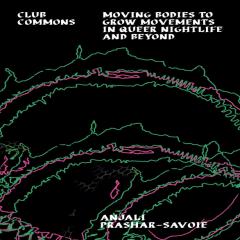
Queer communities have long transformed parties into something powerful: spaces where care flourishes, injustice gets challenged, and new worlds are danced into being. But today, DJs command huge fees while behind-the-scenes workers earn below minimum wage. Corporations profit from our culture while communities that created these spaces are displaced. As venues shut and workers burn out, it’s clear that something has gone deeply wrong.
Club Commons: Moving Bodies to Grow Movements in Queer Nightlife & Beyond by Anjali Prashar-Savoie takes you inside hidden stories of resistance and reinvention. We meet the people reshaping nightlife from below: abolitionist security teams creating safety without police, sober raves doubling as mental health support, radical childcare at parties, venues becoming worker cooperatives, and free party crews reclaiming public space. Through their work, we see how party-throwing skills build movements, how refusing to play changes everything, and why protecting queer nightlife means transforming who owns it.
Quotes
“When Anjali shines her perceptive light on dancefloor culture, everything is better illuminated. I can’t wait to read this book. It’s one we need.” Emma Warren (author of Dance Your Way Home/Up the Youth Club)
“Anjali’s one of the most exciting and insightful voices writing about dance music today, bringing fresh perspectives, intellectual rigour and emotive power to a conversation that’s too often homogenous, superficial or cynically commercial. Club Commons promises to be an essential and overdue book: a chance to reexamine the queer history of club culture, celebrate and critique its present, and map out radical possibilities for its future.” Ed Gillett (author of Party Lines)
“Beautifully written and unique, Anjali Prashar-Savoie’s behind-the-scenes journey through queer nightlife is as thorough as it is fascinating. Documenting a world that commercial interests are rapidly destroying, Club Commons is proof that queer culture holds the key to a better future for the dancefloor and beyond.” Professor Sam Parsley (author of Minor Keys, coach, DJ and founder of In the Key, a directory and platform championing the careers of women, trans and non-binary electronic music producers)
“Club Commons: Moving Bodies to Grow Movements in Queer Nightlife & Beyond is a vital reminder of how important the dance floor is to connect, unfurl and envision new futures. The text highlights the historic and existing care work entangled with the club space, particularly in providing temporary sites of refuge and embodied joy for Black and LGBTQIA+ communities. This is juxtaposed with research on the corporate and carceral commodification of nightlife in recent years, which exposes the false premise that club spaces are always radical. This book affirms my belief that the non-commercial nightlife ecosystem is an essential part of our social change infrastructure, rather than a luxury. Club Commons is a call to action to reclaim this space on our own terms and revive the underground.” Camille Sapara Barton, (author of Tending Grief: An Embodied Guide to Being with Grief Individually and in Community)
Samurai Music heralds a new seam of spacious, rhythmically curious exploration with the launch of the Saibai sub label, opened in mesmerising fashion by Brendon Moeller.
The overarching premise of Saibai is to nurture a more delicate, meditative inversion of Samurai's physical, dense sound, leaning less on the dynamics of the dancefloor while holding true to the intricate drum play and dubby principles that bind the label's sound together.
In this open-eared, inquisitive environment, Moeller is the perfect fit as an artist with decades of diverse offerings across all kinds of dubwise manifestations. On SAIBAI1, the US-based, South Africa-born producer stretches out with a live-sounding drum palette and exquisitely rendered synth work loaded with detail, character and organic flourishes. It's a light-footed approach with plenty of air flowing through the mix, but there's considerable weight in every notch of the production, not least the imposing channels of sub bass coursing beneath the frequency range.
SAIBAI1 is a feast for the senses, wholly immediate and front-loaded with fascination, setting the perfect tone for Saibai as a platform for charming, immersive electronics that take a fresh diversion from the fundamental core of Samurai's sharply defined sonic focus.
- A1: Ambition Of Men- Reuben Anderson
- A2: Come Down- Lord Tanomo
- A3: Yard Broom- Roland Alphonso & Don Drummond
- A4: Good News- The Skatalites
- A5: Birds And Bees- Ferdie Nelson
- A6: Please Beverly- Bibby And The Astronauts
- B1: Eastern Standard Time- Lord Tanamo
- B2: Lonely And Blue Boy- Ferdie Nelson
- B3: Let George Do It- Rico Rodriguez
- B4: Ska Down Jamaica Way- Ferdie Nelson & Ivan Jap
- B5: Sweet Dreams- Bibby & The Astronauts
- B6: Valley Of Green- Jackie Opel
SKA was the name given to the music that came out of Jamaica between 1961-1966. Based on the American R&B and Doo-wop records that the Sound Systems in Kingston Town used to play. However, the American records style started to mellow out, while the Jamaicans preferred a more upbeat sound. So the Sound System bosses became record producers to cater for this demand. Sir “Coxonne” Dodd and Duke Reid led the way putting the top musicians on the Island in the studio to make music unmistakably Jamaican. A lot of their early recordings were cut at Federal Records before they built their own studios.
Federal Records was the first domestic Jamaican studio, based at 220 Foreshore Road, Hagley Park, Kingston. It opened it’s doors in 1961 owned by Ken Khouri who first licensed American records to the island of Jamaica, before cutting his own tunes, which were some of the first Jamaican RnB and Ska singles. Ken Khouri initial studio was Records Limited but very basic so with the help of engineer Graeme Goodall built the new studio complex at 220 Foreshore Road which also contained a pressing plant and disc cutting room. The studio was not only the forerunner for Ska music but the music that followed and in 1981 Ken Khouri sold the complex now on the renamed road Marcus Garvey Drive to Bob Marley who renamed the premises Tuff Gong Studios whose legacy carries on today.
We have compiled some of the best SKA SOUNDS that came out of the Federal Vaults, with some of the best artists, musicians from the time. The great Lord Tanomo, Don Drummond, Rico Rodriguez, Roland Alphonso, alongside some lesser known artist. However, one thing is for sure, the quality never drops on this fine collection of Ska Hot Tunes……
Having crested the west coast modular-ambient wave in just a few releases - including 2018's Sharing Waves on the influential LA experimental imprint Leaving Records - Sean Hellfritsch has swapped the mossy analog synth improvisations of his prior output for refined melodic arrangements dressed in sprightly dawn-of-digital textures. Big Earth Energy plumbs the depths of Hellfritsch's multimedia mind and naturalist heart, spinning an impressionistic narrative world off of cultural touchstones like the PC game MYST, and the work of Studio Ghibli composer Joe Hisaishi. Inspired by the aforementioned, and guided by Hellfritsch's experience as an animator and filmmaker, Big Earth Energy is the soundtrack to a hypothetical video game with a pointedly ecological premise, and a twist of psychedelic charm. In Hellfritsch's imagined virtual journey, the player assumes the perspective of a treefrog sixty-five-million years ago, hopping epochs with each new level, forming a comprehensive picture of the massive changes the planet has gone through over the eons. The ultimate goal of the game is not to amass resources, defeat enemies, or gain power, but to fully witness the unfolding of one of the biggest systems of energy imaginable - or as the album's creator puts it - "to explore the incomprehensibly vast energetic expression and mystery that is Earth." Big Earth Energy is steeped in exploratory RPG intrigue, possibility, and contemplation, lovingly overlaid with Miyazaki-an sentiments and aesthetics. The through-composed, organic, meandering synthesis heard on previous Cool Maritime albums has been fully replaced by meticulous polygonal arrangements that recall the computerized sheen of late 80s work by composers like Hiroshi Yoshimura, and Yoichiro Yoshikawa - using true-to-period gear no less. Even given its referentiality, Big Earth Energy comes off as forward-facing where so much reminiscent music remains fixed to a bygone moment in pop culture. Hellfritsch has created a musical world where the endless verdancy of the biosphere finds its parallel in the golden age of early 1990s video games, and late 80s Japanese environmental music, all while pointing to a hopeful planetary and artistic future that vindicates the motives of all of these muses.
REPRESS
New Delhi-based Peter Cat Recording Co. will release their debut album, ‘Bismillah’ on June 14, 2019 via French independent label Panache Records. Debut UK live shows are soon also to be announced by the band.
Peter Cat Recording Co. could almost have a question mark on the end of its name. Not least as founder & frontman Suryakant Sawhney refuses to explain where that name really comes from or what it means (perhaps a reference to the Tokyo jazz club owned by Haruki Murakami), but also since the very existence of the band itself raises a raft of questions. When was the last time we fell for an indie rock band for the right reasons? Not because the band in question nostalgically imitate a perceived ‘golden age’ but because they innately embody the fundamentals of such music: fantasy, sincerity and the freedom to make music without rules or career aspi- rations. And when was the last time this kind of band sounded like Sinatra, Barry White, the sweetest doo-wop, humid fanfares and a psychedelic wedding band, all at once? And all of this coming from India?
In truth, the story of Peter Cat Recording Co. was written within the triangle of San Francisco, Delhi and Paris.
In the first of these cities, Sawhney (a native of Delhi) pitched up to study film-making. More distracted by the city’s peaking live scene of the early noughties, this is where he started to make music and to sketch out an idea for the band.“
The people I lived with supported my idea of writing music, they introduced me to great mu-
sic. There used to be a great garage scene in San Francisco, like The Oh Sees also Ty Seagall, Mikal Conin, all those bands. This is a world I had never seen in my entire life. A big inspiration from San Francisco was that you could record yourself. You don’t need to be in a studio and spend a lot of money to make an album. You can do it”.
At the end of the 2000s, Suryakant returned home to New Delhi, and started his band for real, more or less the same band that plays today. “I wasn’t so concerned about will we be performing, will we be the greatest band, will we be trendy. I just wanted to make something that was consequential and important for us, I think. Something which would last, something people could listen to and be like « this is life changing ». It was for the sake of beauty”.
For the first few years and in India alone, this is exactly what Peter Cat Recording Co. did, in total indifference to the rest of the world. This was until young Parisian label Panache stumbled across the band online via Vice’s THUMP subsidiary, stupefied by the band’s cosmic video for seven-minutes-and-counting track, ‘Love De- mons’. And so in spring of 2018, ‘Portrait Of A Time: 2010-2016’ was released on Panache - making the first international release from Peter Cat Recording Co., bizarrely enough, an anthology of re-mastered, hidden gems from the band’s ramshackle back catalogue, previously recorded in Suryakant’s own living room. With Peter Cat’s off-kilter charm hitherto unheard of beyond the fringes of India, the release provided a gateway op-
Whilst the title track found its way onto Tracks Of The Year lists at the Guardian & NME, it was tricky for new PCRC enthusiasts to get a firm grip on the startling push/pull between the immediate, uncanny music this release gathered, and the cultural backdrop of New Delhi at which it was so startlingly at odds.
Opportunity for a wider fanbase to fall in love with their cloud-like, drunken songs for the first time.
If discovering your favourite new band via a ‘Best Of’ feels a curious premise, then ‘Bismillah’ does more than hint towards the promise of Peter Cat Recording Co’s future. Blending gypsy jazz, psychedelic cabaret, space disco, bossa supernova, Bollywood and uneasy listening with kaleidoscopic ease, in many senses, the band’s knack hasn’t altered. Always different, paradoxical, unpredictable yet somehow familiar. The new album opens to the strains of bird chatter, the whisper of a city’s soundscape and the first few notes from an instrument which seem to be calling us to the departure lounge, a fore-shadow of the flight ‘Bismillah’ launches its listener
on. Suryakant sings with the detached, rueful elegance of Sinatra marooned on a desert island, whilst his band create small space-time capsules which navigate their way through genres and eras – including the future – and between nostalgia and eccentricity.
Peter Cat recently trailed ‘Bismillah’ with the release of ‘Floated By’, an appositely titled musing on failure & missed opportunities, punctuated by the fulsome brass section which weaves through so much of the album.
The languid, blue quality to the track is offset by the attendant music video, created with footage shot, implau- sibly enough, at Suryakant’s own marriage ceremony (needless to say, the wedding band hired for the day was of course, Peter Cat Recording Co.) Sawhney dryly notes; “Hopefully it’s not a many-a-times-in-a-lifetime event. You can’t fake that set, those people actually having a good time, being really emotional and intense.” ‘Bismillah’’s colour-drenched album cover also captures Suryakant’s father-in-law making his wedding toast on that same day - a nod back towards the cover of ‘Portrait Of A Time’, itself a black & white image taken at the wedding ceremony of Suryakant’s own father.
A stumbling but gracious collection of songs rooted in a kind of drunken soul music, the melancholy nature of some of the songs on ‘Bismillah’ renders them almost liquid, before they develop into more dance-like shapes. Suryakant’s rangy voice swoops from the falsetto glide of ‘I’m This’ to the beat-up baritone blown along by the warm breeze of ‘Soulless Friends’. The elliptical structure of album opener ‘Where The Money Flows’ also al-
lows for the use of brief bursts of autotune effect on his vocal without feeling incongruous, whilst the desultory lyrics of ‘Heera’ (a Hindi word for diamond) - sharing something with the Morricone school of grand storytelling - have an emotional weight that would impress even coming from a native English speaker. Perhaps the most gleefully unpredictable moment on ‘Bismillah’ comes with the illusory, vocal loops on the intro to ‘Memory Box’, errupting into 8 exhilarating minutes worth of unbridled, string-backed disco joy. A cat might have nine lives, but on ‘Bismillah’ and beyond, Peter Cat Recording Co. are hinting towards an un- knowable multitude of dimensions. Throw them all together, and it equates less to a listening experience and more to an out-of-body experience.
Peter Cat Recording Co. are: Suryakant Sawhney (vocals/guitar/organ), Dhruv Bhola (bass), Kartik S Pillai (organ/guitar/electronics), Rohit Gupta (horns), Karan Singh (drums)
- A1: So Many Miles Away
- B1: Groovy Thang
Chicago recording artist Reggie Soul (real name Reginald Stone) recording career consisted of three 45singles spread over 3 separate labels. Firstly, the funk outing “I Got Jody” backed with the soulful “I Feel So Bad” for the Red Balloon label. “I Feel So Bad” was a Lee Sain composition which Lee himself recorded under the title of “Baby Don’t Leave Me” for the Broach label. Reggie’s “I Got Jody” also came out a second time on Nation Time Records as the flipside to “Soul Walkin’” a cover version of the James Brown song but mis-credited as the performing artist Reggie Smith?
Reggie’s third release “My World of Ecstasy/Mighty Good Loving” was released on the Scott Brothers owned Capri Records label in 1968. The fledgling Capri Records Company having been set up in premises at 409, East 47TH Street in Chicago’s Southside, used the front of the building as a record store with the rehearsal studios situated at the rear, the final recording sessions took place initially at some of the smaller independent studios across the city before using the major Columbia and RCA Recording Studios as Capri Productions grew. Reggie co-wrote both sides of his Capri 45 with Charles and Walter Scott respectively. The arrangements were provided by John Jackson and Bill McFarland who alongside Claude Williams provided the horn section to many of the Scott’s future productions. The Scott Brothers were also the house band at one of the Southside’s most popular night clubs ‘The Bonanza Lounge on 7641, South Halsted. Besides performing, they used the club to scout for potential artists for their label and it is believed that’s where their business relationship with Reggie Soul initially began.
Surviving witness accounts always cite Reggie as a solo performer which begs the question who are the credited ‘The Soul Swingers’ on the Capri 45? Well, it transpires that this was a pseudonym used by the Scott Brothers present on the recording, Charles (Chuck) drums, Tommy (bass guitar) and Walter (Rhythm guitar).
At the beginning of Soul Junction’s working relationship with Scot-Tees a further Reggie Soul unissued session was mentioned and sure enough two tape boxes arrived one containing “My World Of Ecstasy/Mighty Good Loving”, great, but disappointingly the second named tape had been reused as a rehearsal tape of several recognizable riffs of later Scott-Tees productions, doh!
Then months later lady luck intervened, a box containing two unmarked acetates held together with a nut and bolt was found. After considerable investigation, it transpires that they are the missing Reggie Soul tracks which we now present to you. Both songs are A.C Carson compositions, The A-side “So Many Miles Away” is a wonderful crossover song that shares some lyrical similarities to fellow Capri stablemate Judson Moore’s released Chicago Music Bag 45 “Lisa” while the flipside of our release features Reggie’s interpretation of Judson’s “Groovy Thang”. So, at long last Soul Junction are able to present to the lost Reggie Soul sessions that several veteran soul scribes who known their onions have likened to another great Chicago recording artist, the mighty, Tyrone Davis.
- A1: Hurricane
- A2: Rain
- A3: Blackout
- A4: High Note
- A5: Bodyguard
- B1: Potential
- B2: Breeze
- B3: Cliffhanger
- B4: Ns:lc
- B5: Polarised Feat. Our Mirage
Crystal Clear Vinyl[30,88 €]
Stripping away all expectations, constraints, pressures, and limitations, there’s a certain purity and allure to art crafted simply for the sake of genuine expression. The desire to unleash one’s unencumbered ingenuity and unique vision into the world is an attitude embraced by those often celebrated for pushing boundaries, and it’s under this same premise that German newcomers SENNA were formed.
Drawing their name from the Arabic word for brightness, shine, or glow, bandmates Simon Masdjedi (vocals), Tobias Stulz (guitar/ vocals), Marcel Dürr (guitar), Fabian Cattarius (bass), and Leon Dorn(drums), never intended for SENNA–a musical outlet originally established as a studio side project–to come into its own as a fully-fledged unit. Yet, tackling a luminous blend of playful but technical instrumentation and edgy hard rock meets progressive post-hardcore styling, it’s only fitting that both the innovative outfit and their introductory work have entered the limelight for all to enjoy.
“It was really liberating,” guitarist Marcel Dürr recalls the group’s mindset leading up to their SharpTone debut. “Because we weren’t pursuing SENNA as a proper band at first, we had a lot of time to experiment with our sound. Our goal was to simply write the music that we enjoyed, without being boxed into any one genre.
Stripping away all expectations, constraints, pressures, and limitations, there’s a certain purity and allure to art crafted simply for the sake of genuine expression. The desire to unleash one’s unencumbered ingenuity and unique vision into the world is an attitude embraced by those often celebrated for pushing boundaries, and it’s under this same premise that German newcomers SENNA were formed.
Drawing their name from the Arabic word for brightness, shine, or glow, bandmates Simon Masdjedi (vocals), Tobias Stulz (guitar/ vocals), Marcel Dürr (guitar), Fabian Cattarius (bass), and Leon Dorn(drums), never intended for SENNA–a musical outlet originally established as a studio side project–to come into its own as a fully-fledged unit. Yet, tackling a luminous blend of playful but technical instrumentation and edgy hard rock meets progressive post-hardcore styling, it’s only fitting that both the innovative outfit and their introductory work have entered the limelight for all to enjoy.
“It was really liberating,” guitarist Marcel Dürr recalls the group’s mindset leading up to their SharpTone debut. “Because we weren’t pursuing SENNA as a proper band at first, we had a lot of time to experiment with our sound. Our goal was to simply write the music that we enjoyed, without being boxed into any one genre.
LP in printed inner sleeve. With De Wonderen, Donder returns once again to the essence of the trio. The result is a chaotic blend of abstract and melodic work featuring both solos, duos and trios, two covers of pop songs and some occasional whistling and Norwegian lyrics.
The album was recorded on a slow summer day in July 2023 in the old theatre hall of KC Nona in Mechelen. Besides the room's lively acoustics and the conscious choice for an upright piano, the recording is characterised by the usual unorthodox playing techniques and carefully documented imperfections.
In contrast to their previous record Het Verdriet, which emerged from a research project on Flemish (folk) music history, this time the premise was to compose and collect new material without any concepts or limitations. The result is a chaotic blend of abstract and melodic work featuring both solos, duos and trios, two covers of pop songs and some occasional whistling and Norwegian lyrics.
De Wonderen is a testament to the beauty found in the small wonders of everyday life. As Guy Peters writes in the liner notes: «With this album that bubbles with percussive ideas and unpredictable contrasts, you are once again reminded that beauty is more striking when you have to wait for it, or find it in unusual places."
Het Mierenlied and Vader Ademt were released as singles with accompanying video's by respectively 3D and motion designer Robbe Callewaert and visual artist and ceramist Juliette Pons. The full album will be released on W.E.R.F.-records November 22nd, on LP and digital platforms. The artwork was designed by Jelle Martens with photography by drummer Casper Van De Velde.
Casper Van De Velde - drums, percussion
Harrison Steingueldoir - piano
Stan Callewaert - double bass, percussion, voice
All tracks by Donder except for All I Want For Now (Genevieve Artadi) and Oh My Love (John Lennon and Yoko Ono)
This reissue of ENV001 "Premise EP" is remastered from the original tapes and features the original artwork by Todd Sines. Featuring a remix from The Connection Machine, the 1995 EP was recorded in Ohio and originally mastered inDetroit by the legendary Ron Murphy. The release marked the end of four years of Geist living the midwest and his return to the metro area of New York City, a dramatic shift that would soon be reflected in Environ's sound.
In 1994, with only a single 12" in his discography, Morgan Geist decided to start his own record label. His debut on Dan Curtin's Metamorphic label was inspired by the sounds of Detroit techno and Chicago house. But Geist was equally fascinated by UK imports from labels like Warp, B12, and ART. He sought to combine these inspirations on the first release of his new label, Environ. Featuring a remix from The Connection Machine, whose unique "Bitflower" was released the year before on Carl Craig's Planet E, "Premise EP" (1995) was recorded in Ohio and mastered in Detroit by the legendary Ron Murphy. The release also marked the end of four years of Geist living the midwest and his return to the metro area of New York City, a dramatic shift that would soon be reflected in Environ's sound. This reissue of ENV001 "Premise EP" is remastered from the original tapes and features the original artwork by Todd Sines.
- 01: King Of Rock And Roll
- 02: Hey, Hey, Hey, Hey
- 03: Spreadin' Natta What's The Matter
- 04: Shake A Hand
- 05: Dew Drop Inn
- 06: True Fine Mama
- 07: Great Gosh A'mighty
- 08: Poor Dog
- 09: Send Me Some Lovin
- 10: Slippin' And Slidin
- 11: Bama Lama Bama Loo
Black Vinyl[22,65 €]
Diamond Dogs may be a bunch of renaissance rockers deeply rooted in the early 70s British rock and roll, but just like our forerunners, we owe
almost everything to Little Richard, the architect of it all! It's impossible to even imagine rock and roll without him.
Little Richard is the soul, spirit and passion of the Diamond Dogs lifestyle, and I was six years old when I first heard 'Rip It Up' with love at first feel.
The raw energy and the blood screaming lyrics over that manic hammering piano embodied everything I craved in music, straight from the speakers to my young heart. Even if I discovered a lot of other influences later on in life, I always kept Little Richard close to where he once hit me. One of Diamond Dogs' early tunes is called 'Lunatic Eye-Rolling Delivery' which is a line nicked from a concert review of Little Richard, and we believe it sums up the essence of his greatness pretty well. He was much more than a rock pioneer, the way he dressed up and spoke was something the world had never experienced before.
Little Richard got Paul McCartney to write 'I Saw Her Standing There', got James Brown a new haircut, and put a silly little mustache on Prince!
So, the idea of recording a homage to the true king of rock and roll had been with all of us for many years when Chris Spedding one day called me
and asked if we should record something together. Of course, I immediately said yes, and then asked him to join Diamond Dogs in the upcoming
studio session to record some well selected Little Richard gems for an LP. All said and done, and Chris was extra thrilled that his favorite 'Send Me
Some Lovin'' was among the songs we picked.
And on a cold and windy January day we gathered the Dogs and the new old puppy in the sweet premises of Dog Pound Studios, along with our
beloved friend and engineer Jonas Åhlén.
So, when the room is geared up, we do our melodies as we normally do it, no rehearsals, all live, straight to tape. One hour per track is usually a
good thing! An amazing energy and swagger filled the atmosphere as Diamond Dogs and Chris fulfilled my dream.
Now that I'm listening through the vinyl, I must say that I've never been prouder of anything we've achieved with this shady bunch so far. It's like
walk the full circle, like I've been graduating from the 12-bar rock and roll academy.
Sulo, Stockholm/Sweden, 2024
Sound Like: The Faces, Rod Stewart, Frankie Miller, Elton John, Mott
The Hoople, J Geils Band, The Rolling Stones, Steppenwolf, Little
Richard
Diamond Dogs may be a bunch of renaissance rockers deeply rooted in the early 70s British rock and roll, but just like our forerunners, we owe
almost everything to Little Richard, the architect of it all! It's impossible to even imagine rock and roll without him.
Little Richard is the soul, spirit and passion of the Diamond Dogs lifestyle, and I was six years old when I first heard 'Rip It Up' with love at first feel.
The raw energy and the blood screaming lyrics over that manic hammering piano embodied everything I craved in music, straight from the speakers to my young heart. Even if I discovered a lot of other influences later on in life, I always kept Little Richard close to where he once hit me. One of Diamond Dogs' early tunes is called 'Lunatic Eye-Rolling Delivery' which is a line nicked from a concert review of Little Richard, and we believe it sums up the essence of his greatness pretty well. He was much more than a rock pioneer, the way he dressed up and spoke was something the world had never experienced before.
Little Richard got Paul McCartney to write 'I Saw Her Standing There', got James Brown a new haircut, and put a silly little mustache on Prince!
So, the idea of recording a homage to the true king of rock and roll had been with all of us for many years when Chris Spedding one day called me
and asked if we should record something together. Of course, I immediately said yes, and then asked him to join Diamond Dogs in the upcoming
studio session to record some well selected Little Richard gems for an LP. All said and done, and Chris was extra thrilled that his favorite 'Send Me
Some Lovin'' was among the songs we picked.
And on a cold and windy January day we gathered the Dogs and the new old puppy in the sweet premises of Dog Pound Studios, along with our
beloved friend and engineer Jonas Åhlén.
So, when the room is geared up, we do our melodies as we normally do it, no rehearsals, all live, straight to tape. One hour per track is usually a
good thing! An amazing energy and swagger filled the atmosphere as Diamond Dogs and Chris fulfilled my dream.
Now that I'm listening through the vinyl, I must say that I've never been prouder of anything we've achieved with this shady bunch so far. It's like
walk the full circle, like I've been graduating from the 12-bar rock and roll academy.
Sulo, Stockholm/Sweden, 2024
Sound Like: The Faces, Rod Stewart, Frankie Miller, Elton John, Mott
The Hoople, J Geils Band, The Rolling Stones, Steppenwolf, Little
Richard
- My Darling, My Angel
- Pavement
- Something For Somebody
- Virtue
- Defibrillator
- The Light Streams In And Hits My Face
- Hocus Pocus
- Hideaway
- Love Songs/ Heart Strings
- Ray Of Light
- The Worst Thing I Would Ever Do
- Horses
In Mallrat’s (aka Grace Shaw’s) vision of the world, light is more than photons and electromagnetic radiation hitting the eye — it’s a moment of divine intervention. A bold swerve into the metaphysical, this is the premise of the prized Brisbane-born, LA-based pop songwriter and producer’s 2025 sophomore album: Light hit my face like a straight right. Set against a newly informed backdrop of expressive breakbeats and dance music, its 12 songs explore the intangible and mysterious allure of human connection, held together by curious investigations into light — “the closest thing to a concept this album has,” Mallrat says. She reunited with Butterfly Blue producers Styalz Fuego (Troye Sivan, Tate McRae) and Alice Ivy, while bringing into the mix indie electronic producers Chrome Sparks and Casey MQ. Mallrat serves up highs like “Hideaway,” a song where heart-racing garage clashes with her trademark candor: “I’ll be your lucky charm just let me hang around your neck,” she sings. Sleek and early standout “Pavement” gets a gritty underlayer with chopped up vocals from DJ Zirk’s “Born 2 Lose” and mid-album standout “Hocus Pocus” finds Mallrat singing about being pulled “under the spell” of someone new, borrowing a different part of the same DJ Zirk sample to build its shimmering, dancefloor-ready facade. It’s an endeavor that perhaps reaches a peak on “Horses,” the record’s gentle and organic closer which Shaw herself calls “objectively the best song.” Written after returning home to Brisbane and “feeling like an alien,” it gained new meaning in the wake of her late sister’s passing. For Shaw, it’s the convergence of the song’s minimalism, lyrics, space, and the way her voice cracks on the recording as she sings, “Hey, I’m right here, I look different now.” After years of solidifying herself as a master of well-crafted, timeless pop — fielding recognition from New York Times, NYLON, Teen Vogue, Billboard, The FADER, NPR, and more — Light hit my face like a straight right is a step into the art of world-building, bolstered by her intuitive songwriting and clever, studied production.
From day one, Linkin Park built the band upon the premise of fusing all of their favourite styles of music-as disparate as they might be-into one signature sound. Fast-forward 12 years to LIVING THINGS and the same six players have not only developed new tools to make that philosophy a reality, but they're finally comfortable embracing-and coalescing-every aspect of their career. OK, maybe not the XXL work shirts and neon hair dye of the early days. But in their music, the band has spent the past year reinventing how to tastefully bridge the gap between all the musical destinations they've visited, and how to marry all the ideas they've accumulated. And as LIVING THINGS began taking shape, for the first time Linkin Park was eager to use every tool in their toolbox. With each song, they flexed their expertise with both cutting-edge and classic gear, and they infused their vocals with an honest, thrilling enthusiasm; they picked apart their own ideas of what defines a song, and what defines Linkin Park. LIVING THINGS is a personal album, centered on human emotions and relationships implied by the title. It is informed by and built upon all previous Linkin Park albums, while still pushing the band's sound into new territory. It's spirited, energetic, daring and unafraid to hybridize the past, present and future. It's absolute proof to a radical theory six musicians have devoted their lives to testing.
- A1: X Y. R - Wind Chimes Voices
- A2: Frunk29 - Journey In Search Of The Holy Gray
- A3: Sip - Grand Avenue
- A4: New Mexican Stargazers - Headlights In Rearview
- B1: White Poppy - On Love
- B2: Essential Key - Cold City
- B3: Unknown Me - Mirage Of Ocean
- B4: Magnétophonique - V50 Tone Transfer
- B5: David Edren - Vienya
- B6: Andra Ljos - Silver Wings And A Drop Of Blood
- C1: Wave Temples - Side Quest
- C2: Golden Hallway Music - Evening Sky People (Yaman Dream)
- C3: Vague Imaginaires - Vi La Corniche
- D1: Filthy Huns - Bleached Skull In The Desert Moonlight
- D2: Severed+Said - Flesh Tectonics
- D3: Robedoor - Drainage
Although many a vibe has shifted since the days of dubbing NNF001 one at a time on the floor of a Koreatown bachelor apartment in February of 2004, using stolen photocopies and tie-dyeing J-cards with wine, the label’s essential premise has not. Then, as now, the vision was to elevate and enshrine outsiders, foragers, hidden gems, and hybrid sounds on cheap tapes or affordable records, to be savoured and shared in the here and now. 399 catalogue titles later, the centre still holds.
To toast the label’s 20th anniversary and 400th release, we commissioned a gold roll call of alumni and affiliates: Alley Of The Sun. Named in homage to the Malibu mystic music fountainhead, skewed through a smoggy sideways lens, the 16-song, 90-minute, double LP suite spans every shade of NNF’s Pacific palette: rainforest ceremony, skyway motorik, Tascam rapture, silhouette shoegaze, basement vapour, astral ascension, jazz shadows, 5th world tropics, lucid dream drone, desert quests, prophecy electronics, ritual wreckage.
Equal parts snapshot, tapestry, and time capsule, the compilation reflects the breadth of NNF’s two-decade exploration and evolution, from simple soil to a sea of dunes. True undergrounds have no set sound or fixed polarity, only flashes of transient magic and forking paths, to be cherished and championed for as long as the candle lasts.
- Dexter Main Title
- Tonight S The Night
- Conoci La Paz
- Uruapan Breaks
- Flores Para Ti
- Blood
- Con Mi Guaguanco
- Perfidia
- Sometimes I Wonder
- Born Free
- Dexter Main Title
- Escalation
- Shipyard
- Deborah Loves Rudy/The House
- I Can T Kill
- Voodoo Jailtime
- New Legs
- Photo Albums
- Courting The Night
- Hide Your Tears
- Wink
- Astor S Birthday Party
- Epilogue/Bloodroom
- Blood Theme
- Die This Way
How did Dexter make a TV audience sympathize with a serial killer? No question, it took an ingenious premise, great writing, great direction…and a stellar ensemble cast headed by lead actor Michael C. Hall. But long-time viewers of the show know there was another “character” that played a huge role in the series: the soundtrack. From Rolfe Kent’s unforgettable title theme to the well-chosen Latin-tinged tunes that fit the Miami setting to composer Daniel Licht’s brilliant themes, the score of Dexter commented on the action even as it amplified its emotional power. Special mention must be made of the late Licht’s work, which employed Latin and electronic elements to portray Dexter’s warm and cold sides; among the favorites here are “Astor’s Birthday Party” and the haunting “Blood Theme” that played over the credits in every episode. In 2007, the Milan label put out a CD and a truncated single-LP soundtrack album containing music from the first season; now, for the first time, we at Real Gone Music are offering all of the music that appeared on the CD in an expanded double-LP edition, pressed on blood with white swirl vinyl and housed inside an appropriately gory gatefold. Don’t miss Michael C. Hall’s spoken word pieces, either…perversely pleasurable listening, limited to 1500 copies!
Before you ancients out there turn your heads and scoff at the premise of a twenty-something rock-and-roll goofball calling himself an old-anything, consider this: Mac DeMarco has spent the better part of his time thus far writing, recording, and releasing an album of his own music pretty much every calendar flip. This Old Dog makes for his fifth in just over half a decade_bringing the total to 3 LPs and 2 EPs. According to the DMV, DeMarco is 26. But in working-dog years, ol' Mac here could easily qualify for social security. To stay gold, turns out all he needed was some new tricks. It was a little space_in time, location, and method_that inspired DeMarco while making the record. Moving from his isolated Queens home to a house in Los Angeles helped give the somewhat transient Canada-native a base, and a few more months on his calendar to create did their job as well. Arriving in California with a grip of demos he'd written in New York, he realized after a few months of setting up his new shop_complete with a few new toys_that the gap was giving him perspective (insert tooth joke here). Right off the bat, from the pops and clicks of the CR-78 drum machine and acoustic strums on the album-opening "My Old Man," the synth-drenched beauty of the second track, "This Old Dog," it's clear that DeMarco's bag is filled with new tricks indeed. This Old Dog is rooted more in a synth-base than any of his previous releases, but he is careful not to let that tactic overshadow the other instruments and overall "unplugged" mood of the work: "This is my acoustic album, but it's not really an acoustic album at all. That's just what it feels like, mostly," says DeMarco. Despite the changes considered during the creation of This Old Dog, Mac DeMarco's mid-twenties masterpiece, it's clear that the engine that motors him is in no danger of slowing down.
With his Premise EP, Felix Fleer unites long-held ideas into a cohesive and deeply personal collection, offering a unique blend of intricate textures and fragile harmonies that reward attentive listeners with its meticulous attention to detail. The title track “Premise“ opens the A- side with an infectious garage groove and Fleer’s signature brand of detuned vintage polysynths, building up to a bright crescendo that reveals a rhythmically captivating vocal hook. “Know U” features a piercing drum groove, occasionally interrupted by abstract Buchla glitches and a reduced RnB vocal chop paired with ethereal, almost organ-like layers of pads to culminate in a stripped-down moment for the bass line to take center stage. The main theme of “Thinkage” is a classic break paired with a layered pattern of abstract, percussive vocal chops. This rhythmic pulse is accompanied by a wild harmony of constantly warping and evolving pads and drawn-out bass sounds. Opening the B-side, “Real Love” is the darkest tune on the EP. Its unstable chords and intricate, unpredictable textures induce a constant sense of unease, held together by a subtle techno groove. “Rush” contrasts this with a euphoric chord progression reminiscent of early post-dubstep anthems. The EP closes with “Drift,” a final climax that revisits previous themes, offering a powerful and uplifting resolution.
"Kal Marks have never made a record as personal as Wasteland Baby. Though Carl Shane, the band’s vocalist-guitarist, has made a career off of exploring blunt, uncomfortable truths through song, with Wasteland Baby, he steered Kal Marks toward something utterly new. Shane looked inward to stare down a fear that had long plagued him: What would it look like to have a child in a world that looks like this? “The album was driven by the fears I’m having about being a father,” says Shane. “The initial spark was this fear, and I thought that maybe if I could express it, I could overcome it.”
What started out with this simple premise slowly grew into a sprawling, borderline-concept record. It’s no surprise, then, that Kal Marks went deeper and darker than ever before when writing Wasteland Baby. Though, in order to reach that final product, it required the band—bassist-vocalist John Russell, drummer Adam Berkowitz, and guitarist-vocalist Christina Puerto, who is also Shane’s partner—to interrogate every decision they made with exacting detail. ”We were really all on the same page in that we wanted to make something really, really special and that was going to require us putting a lot of ego aside and just trying to serve the songs as best as possible.”
“In an ideal world, Kal Marks will go on forever. But it may be the end of a chapter for a while. I don’t want it to be the end, but there was an element running through the album that maybe could be the end,” says Shane. No matter what the future holds, Wasteland Baby is an emphatic reminder to brush off the things that keep you from truly living and venture into the unknown."
- A1: Sin Que
- A2: The Grunt
- A3: Poking Fun
- A4: Combat Unit
- A5: One, Two
- A6: The Morning After
- A7: Mr Xy
- A8: The Walt
- B1: Funky Jazz
- B2: Stop
- B3: Hoeee!
- B4: Join The Sla
- B5: War!
- B6: Track 15
- B7: Amped Up!
- C1: Exit Patty, Enter Tonya
- C2: Casio
- C3: You Know Me
- C4: Make My Funk
- C5: The Fire Dance
- C6: Where's Tonya
- D1: My Comrades
- D2: Get On The Floor
- D3: The Race
- D8: Perfect!
- D4: Capturing The Ghost
- D5: Urban Guerrilla
- D6: Walk On By
- D7: Talk Show Ho
Embarking on an unconventional premise for a beat tape is par for the course for Detroit native Waajeed, who thrives on breaking conventional boundaries. Known as the self-titled futurist Producer, DJ, and UMA Director, Waajeed typically pushes forward, but some narratives demand retrospection. Enter the compelling saga of Patricia Hearst, AKA Patty Hearst—an emblematic American tale—reimagined against the backdrop of 30 raw Hip Hop productions crafted between 2005.
Since the inception of Anxious in 2016, the band has always acted with purpose. This may seem like a simple premise, but for five kids still in high school at the time, it's quite an accomplishment. Early songs were packaged in limited run demo tapes with accompanying zines and hand-dyed t-shirts. Weekends were filled with regional runs of shows outside of their Fairfield, Connecticut homebase. With this amount of effort it's no wonder that within a few years of graduation, Anxious has built a solid foundation for their debut album to flourish upon.On Little Green House, Anxious explores what it feels like to enter adulthood in unflinching detail. The Connecticut band unpacks struggles, joys, and hard-earned realizations in a way that makes them feel wise beyond their years. Anthemic songs like lead single "In April" and guaranteed sing-along "Growing Up Song" thread the often difficult melodic-hardcore needle in a way that feels both nostalgic for the emo renaissance of yesteryear and precisely built for the current moment of genre defiant pioneering.
- Born In The U.s.a - Jason Isbell & Amanda Shires
- Cover Me - Apache Relay
- Darlington County - Quaker City Night Hawks
- Working On The Highway - Blitzen Trapper
- Downbound Train - Joe Pug
- I'm On Fire - Low
- No Surrender - Holly Williams
- Bobby Jean - Ryan Culwell
- I'm Goin' Down - Trampled By Turtles
- Glory Days - Justin Townes Earle
- Dancing In The Dark - Nicole Atkins
- My Hometown - North Mississippi Allstars
"2024 marks the 40th anniversary of Bruce Springsteen's 'Born In The U.S.A.' Although it would become his biggest selling album with seven top 10 singles on the Billboard Hot 100, Luther Dickinson of North Mississippi Allstars says ""any of those songs could be played with acoustic guitar alone and still be great."" Taking this idea as its premise, 'Dead Man's Town: A Tribute to Born in the U.S.A' strips the album's twelve indelible originals to the core, with contributions from Jason Isbell & Amanda Shires, Low, Nicole Atkins, Justin Townes Earle, Blitzen Trapper, Joe Pug, Trampled by Turtles, and more. Rolling Stone premiered Jason Isbell and Amanda Shires' Dave Cobb-produced cover of ""Born I n The U.S.A,"" saying these artists are ""reimagining 'Born in the U.S.A. with a reduced approach more influenced by that of the acoustic, ""Nebraska.""
Isbell says of his cover, """"Born In The U.S.A."" is one of my favorites because so many people have seemingly misunderstood the lyrical content and the song's overall tone. When you listen to the demo, the dark, minor key arrangement makes it clear that this is not strictly a song of celebration. We wanted to stay true to that version."" Amanda Shires adds, ""I love that the song paints a picture of struggle in the face of the American dream, and the irony in the chorus is delivered with such force that it nearly transcends irony altogether."""
In a flurry of madcap sampling pitched towards the heat of the night, Pedro Zopelar builds on the premise of his 2022 electro- funk love letter Charme, shifting his approach towards a particular
90s flair and a method with a specific end result. Ritmo Freak took root in studio experiments for a momentous — and rare — live set at São Paulo festival Não Existe in 2023, where Zopelar was caught up in one of those right-place, right- time moments we carry with us through life. As he explains himself: “This album is dedicated to freaky club culture. While I was playing at the festival there was a crazy tropical storm outside and the room was packed with the freakiest crowd. I’ve tried hard to immortalize that feeling on this record.” With the intended energy in mind, Zopelar focused on a particular mode of production centred around 12-bit sampling from his ample record collection. Considering his background as a trained pianist, here his musical instincts are forced to work within the limitations of short, snappy cuts from dusty 12”s. The lo-fi sound sources and the resourceful ways Zopelar works them gives the record an unmistakable old-skool flavour which he applies to forthright house, techno and electro funk rhythms, always taking care to draw out the soul of the music.
The stylistic touchstones flow past thick and fast on Ritmo Freak. From the amped up fierceness of the title track with its gaudy, cut n’ paste, vintage techno flavour to the effervescent electro funk of ‘Gabriellinha’s Boogie’ on to the surreal Balearic inversion of ‘Distraction’, this is a high-velocity, endlessly charming record bursting with the musicality Zopelar has made his name on. As the driving force behind many warehouse parties in São Paulo,
Zopelar has been immersed in club culture for a long time, and his distinctive catalogue of jazz, funk, acid and techno has graced highly respected labels like Apron, Selva Discos and Mother Tongue. Throughout, he’s displayed an affinity for the tangled roots of the groove with an open-eared, big-hearted sound. That’s what comes through on Ritmo Freak
Repress!
The SC704 premises are in a remote past. We need to go back to the days of the early '90s, when the first record by Schema was released.
In 1993 we handled Right Tempo records and published a 3 tracks EP which was highly acclaimed by the international acid jazz scene. Behind the project there was Nicola Conte, a leading figure in Bari's new jazz scene who acted as a catalyst in many productions.
Our followers should remember 'Introducing The Paolo Achenza Trio'.
As Paul Bradshaw from 'Straight No Chaser' magazine commented, the record was 'Rooted in the soulful funk of the sixties and early seventies jazz...'
Mysteriously, a fourth track hadn't been released at that time...
The new 7 inch series by Schema gives us the chance to listen to 'Chameleon' a cover version of Herbie Hancock's classic, featuring Gianluca Petrella on trombone.
Cathartic avant-rock, literate DIY folk & experimental composition exploring displacement, love, climate change, belonging & the places we call home - RIYL Jim O’Rourke, Richard Youngs, This Heat, Richard Dawson, Flying Nun. ‘Real Home’ is the new album by the Manchester-born, London-based artist Kiran Leonard. His sixth album proper (not including innumerable tour-only CD-Rs and short-run cassettes), since his precocious debut in 2013, ‘Real Home’ finds Leonard invigorated by inspiration and experience, making passionate, literate, and mercurial music that explores displacement, love, memory, climate change, connections to home and more. Encompassing songs recorded after moving to South London, ‘Real Home’ reflects on ideas of belonging and domesticity through folkloric, stream-of-consciousness songwriting. Across nine tracks, Leonard traces lived impressions of the household and the city, expressing sentiments of dislocation, alienation and stasis, but contentment too. Infusing the avant-rock effervescence, terraced dynamics and visionary lyricism of his music with what he defines as a greater sense of openness, Leonard is as versatile, fervent and imaginative as ever on ‘Real Home’, yet his music is somehow more intimate, affecting, and acutely expressive. Shaped by dual considerations of simplicity and formalism, ‘Real Home’ is by turns beautiful, allusive, and ruminative, an album on which Leonard considers what his songs have resembled in the past and what they mean now. In recent years, Leonard has crafted eloquent chamber music inspired by the likes of James Joyce and Clarice Lispector (‘Derevaun Seraun’), responded to contemporary politics and communication breakdown in the digital age (‘Western Culture’), and compiled solo works and ensemble recordings for a longform ode to Jonas Mekas and to one of Leonard’s enduring themes; home (‘Trespass On Foot’). On ‘Real Home’, Leonard reiterates this abiding thematic focus yet ascends to new, different heights, in music of cathartic delicacy and dissonance where all the myriad dimensions of his work to date seem to crystallize. There are sinuous songs about struggle and defying the pace of city life through drift and diversion (‘Pass Between Houses’), stirring songs of intense feeling and crescendo, described as a form of speculative detective fiction (‘Theatre for Change’). There are touching solo piano ballads (the title track), symbolic contentions with carbon capture and climate change (‘Utopia of Bog’), modes of experimental minimalism (‘Void Attentive’), and other profuse feats of compositional range, embroidered with wild tendrils of narrative and lyrical depth. A record to pore over, and get lost in. Exemplifying the vast aesthetic scope of Leonard’s music, lead single ‘My Love, Let’s Take The Stage Tonight’ is inspired by country lodestar Hank Williams, Russian poetry and a late period love poem by William Carlos Williams. Yet for Leonard, the song signals a sense of accessible materiality, and is the product of a more linear approach to writing songs: “My imitation of the great Hank Williams, in spirit if not in substance…This is one of the best efforts on Real Home at a song-as-object. Looking at it now I realise I was trying to write a song that made itself known as a song to the listener, and I wonder whether that’s crucial if you want a song to transcend its context. And that this is either accomplished through a total openness – by being inviting, by laying the tricks of the song out plain to see, as Williams and his many ghostwriters did so well – or by adopting a knowing aloofness, positioning oneself against the listener but letting it be known that that’s what it’s doing. In this song I try both, but mostly the former: as in, I wanted to write a song where every line follows on from the next.” Imbuing the endlessly elaborate and inventive qualities of his music with a newfound streak of candid, clear-cut melodicism, Leonard has reached a special place in his artistry, on a record that feels familial, and expresses closeness. Assembled with affiliates including Lauren Auder, Otto Willberg, Jasper Llewellyn (caroline), Tom Hardwick-Allan (Shovel Dance Collective), Magda McLean (caroline, The Umlauts), Alex Mckenzie (caroline, Shovel Dance Collective), Isabelle Thorn (Dear Laika) & more, the recording process had a significant influence on the subject matter of ‘Real Home’, in sessions defined by close-knit camaraderie and artistic eccentricity: “The theme of the home obviously recurs throughout the record; the album was mostly recorded in domestic spaces with friends, and the name of the album is Real Home. I like the qualifier ‘real’, like you’re getting past the cloak of the word and towards the thing-itself…also nearly all the percussion in this record was recorded on items from my dad’s shed (jam jars, sandpaper, blocks of wood, etc). Real home record!” ‘Real Home’, like anything by Kiran Leonard, is a record of dazzling multiplicity. Yet it’s a companionable prospect with a central premise; a collection of songs where listeners old and new can find a home. An album led by a scene; of Leonard standing at the threshold, ready to welcome you inside. “Exceptional songs that linger” - The Guardian // “An autodidact of amazing talent & energy” – Pitchfork // “A ridiculous amount of talent…confrontational, celebratory, provocative or perverse – he manages all of these emotions & more” - The Quietus /
Yellow Vinyl[32,56 €]
Prolific singer-songwriter Kathryn Williams and recently reinvigorated troubadour Dan Willson (aka Withered Hand) have announced a collaboration album, ‘Willson Williams’, out April 26th.
‘Willson Williams’ witnesses the meeting of two likeminded musicians who’ve built their successful, independent careers on inventive folk instrumentation, reflective and sincere lyricism, and not a small amount of self-deprecation. Their modest confessionals, written poetically and over nostalgic and atmospheric melodies, are as relatable as ever, and together they find new ways to unpack their feelings.
One overarching theme on the album is that of grief, when the writing process saw them both, tragically, in mourning for separate loved ones; Dan for his brother Karl and his friend Scott Hutchinson of Frightened Rabbit, and Kathryn for her friend, comedian and BBC Radio 4 presenter Jeremy Hardy. They explain that “the initial premise and starting point for us was discussions and open conversations on bereavement. We’d both recently lost friends who were also in the public eye, and we talked about the strange place between personal loss and the communal grieving of a public figure”. Contrastingly, the music on ‘Willson Williams’ is warm, heartfelt and even cheerful, an opposing nature that is completely in keeping with both their humour and candidness.
Black Vinyl[28,53 €]
Prolific singer-songwriter Kathryn Williams and recently reinvigorated troubadour Dan Willson (aka Withered Hand) have announced a collaboration album, ‘Willson Williams’, out April 26th.
‘Willson Williams’ witnesses the meeting of two likeminded musicians who’ve built their successful, independent careers on inventive folk instrumentation, reflective and sincere lyricism, and not a small amount of self-deprecation. Their modest confessionals, written poetically and over nostalgic and atmospheric melodies, are as relatable as ever, and together they find new ways to unpack their feelings.
One overarching theme on the album is that of grief, when the writing process saw them both, tragically, in mourning for separate loved ones; Dan for his brother Karl and his friend Scott Hutchinson of Frightened Rabbit, and Kathryn for her friend, comedian and BBC Radio 4 presenter Jeremy Hardy. They explain that “the initial premise and starting point for us was discussions and open conversations on bereavement. We’d both recently lost friends who were also in the public eye, and we talked about the strange place between personal loss and the communal grieving of a public figure”. Contrastingly, the music on ‘Willson Williams’ is warm, heartfelt and even cheerful, an opposing nature that is completely in keeping with both their humour and candidness.
The legendary Horsepower Productions return to Sneaker for a thematically charged trip into future zones, driven by dexterous breakbeat science and ruffneck soundboy wisdom.
The UK dubplate heavyweights are no stranger to a loaded sample, and they’ve got a message to impart on this double-edged record. They kick off with a rumination on the planet’s fragile ecosystem on ‘Tropic’, which looks to a possible future with an ominous fate for the foliage we hold dear. Production-wise, Horsepower set electric drum loops off against lurid daubs of synth without derailing the motion, but a huge amount of the track’s impact arrives in the sampling from a cult classic slice of sci-fi. The premise is that the last remaining trees and plants from earth are adrift in space in a bio-dome, and have been condemned for demolition - a depressingly feasible scenario with an aggravated soundtrack to boot.
On the flip, ‘Computer Rock’ rides a tough break slow and hard and injects dystopian electro synth licks into the mix for a darkside roller that celebrates the visionary talent of Jeff Brown, aka Kase 2. Brown pioneered graffiti in the 70s with futuristic styles that still hold sway today, leaning into his own sci-fi imaginings about computer worlds inhabited by extra-terrestrial beings, Brown passed away in 2011, and this track and the attendant B2 cut ‘Kase - Reprise’ pay tribute to a forefather of hip-hop culture by channeling the future shock styles of Bambaataa et al without ever sounding throwback.
The concept on this record gets taken out further with the additional digi-only tracks, which take in the low-slung, skunked up funk of ‘Blaque Gras’ and the amped up rave damage of ‘Kase 2-Part 2’. Throughout, on-point samples and a clear-eyed focus bring out the best in the Horsepower approach, offering up next level dance wreckers with something to say.