“Less than a month after one of the most violent fire events in the history of the continent, new shoots had burst through the scorched hardpan, nourished by the still-vital roots of those flayed and blackened trees.” John Vaillant, Fire Weather.
Loscil (aka Scott Morgan) returns to kranky with Lake Fire, a nine-track offering of ash-laden sonics that mine the tension within the cycle of destruction and rejuvenation.
Lake Fire is the result of a disjointed creative process. Originally conceived as a suite for electronics and ensemble, most of the original compositions were deserted, save for Ash Clouds, featuring James Meager on double bass. The remaining tracks were reshaped and remixed, built anew out of the remnants of the abandoned work. The result is a phoenix, an album burnt to the ground only to be reassembled out of its cinders. Fragments of the original lurk beneath a densely overpainted canvas of sound.
Infused into the resulting rearrangements are impressions from a road trip into the mountains marking a personal half-century milestone, surrounded by the ominous proximity of wildfires and dense smoke; celebrating life while the world burns. The album’s title comes from the striking irony that forest fires are often named after regional lakes - perhaps subconsciously referencing ancient lore. The cover photos were taken from this same trip, while sitting in a rowboat staring into the grey abyss of an opposing mountainside outside of Revelstoke, BC, obfuscated by smoke from a nearby lake fire.
Press quotes for previous solo release “Clara”:
"The sound sculptor Scott Morgan continues to astound.” Pop Matters
"A beautifully nuanced work, Clara is both revealing and mysterious -- and loscil fans wouldn't expect anything less.” Allmusic
press quotes for previous collaboration release with Lawrence English “Colours of Air”:
"As you might expect from the steady hands at the tiller, this is a cortex-hugging drone record of beauty and depth.” The Quietus
"One of the thrills of listening to this record is how its initially predictable veneer fades on subsequent listens to reveal layers of mischief underneath.” Resident Advisor
Search:process
Hitting release number three, Slush Records remaster and reissue Spacer IV aka James Zeiter’s sought-after 1997 EP on Pleasure Records. The man behind a slew of lauded records under a variety of different aliases, his sound is one that is cherished for orbiting the spheres of progressive trance and atmospheric dub techno. This four-track EP, however, saw James venture into unchartered territory, exploring a more melodic, house-tinted spectrum, before flipping back into the progressive techno-trance underbelly.
Having started life in 1995, Spacer IV had already gone from the leagues of limited white labels, to being the name stamped on one of Pleasure’s biggest-selling records by the time this EP came out. With only 195 white labels of his first record ARC 1/ARC 2 pressed, a copy was passed to Pete Robinson at Robs Records. ‘ARC 2’ was plucked from that release, supplemented with a new cut ‘ARC 3’ and given a proper pressing on Robs Records offshoot label Pleasure to notable success.
Fast forward to 1997 and James chose to depart the trance-infused techno sound of those first releases. Absorbing elements by osmosis, this EP sees James dipping his toes into fresh waters. Using what limited hardware he had available, including an Akai S950 sampler, Ensoniq ESQ-1 and Novation Bass Station 1, James laid down four distinctive and versatile club cuts.
‘Sirocco’ opens the EP, a tingling hit of endorphins that only the most timeless of tracks can elicit. Echoing pads feed acid murmurings, that sit atop dusty breakbeats and rattling sub-bass. An aural exploration, that is equal parts ethereal and empowering, taking cues from breaks, ambient, chill out and house. It’s one of those rare tracks that has the power to float you away or fuel your buzz, giving a healthy tug on the heartstrings in the process.
‘Mono’ follows, merging heads-down dancefloors with the embrace of warmer climates. It’s deep and Detroit-infused yet bolstered by a dream house bassline straight out of the Italian riviera. A dose of eyes-closed euphoria that hits just right.
The flipside sees James in more familiar territory with ‘Jetson’ and ‘Dust’. The former is a hit of space-age progressive house. Trippy, hypnotising, driving goodness, showcasing James’ ability to lock your body into a groove, yet send your mind to another world. The latter rounds out the EP, serving up an acid-swirling club stomper, forever building in intensity before dropping you into the vacuum of deep space.
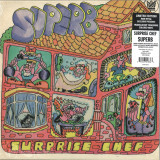
Australia's world-renowned cinematic soul outfit Surprise Chef return with new album Superb. A record that represents a change in their creative approach and turns up the heat in their music. Trading in their meticulous writing and recording techniques for a looser and less planned approach with the intentions of bringing more levity to the process, and it comes through in spades. The high caliber musicianship is still front and center, but they push their sound into a more energetic and fun place on this album. Album opener "Sleep Dreams" is the closest thing to a Surprise Chef tune one would come to expect but then lead single "Bully Ball" comes on and you get the picture that they came to kick in the door on this one. The song's gritty drums thunder through the speakers and get covered with percussion, keys, bass, and guitar chanks that stay in the pocket and bring the funk with them. The band pushes the boundaries of arrangement with tunes like "Body Slam" that starts off like a sweet soul track then pulls a 180, turning dark and haunting, centering on a sound they created by tucking a timpani into a bathroom two doors down from the mixing board. That same sense of experimentation comes up again on "Fare Evader" where they pepper another neck breaking rhythm track with synth notes that sound like robot sound effects from a 70s sci-film. The fellas turn up the tempo for the dance with tunes like "Consulate Case" and "Tag Dag"; the former pulling influence from afro-funk and the latter from jazz-funk. They take us deep into the beautiful world of Surprise Chef ballads on "Websites" and double down on their abilities to make beautiful and ethereal tracks with "Dreamer's Disease". With their new album Superb, their new approach, and plans to tour the world, we are about to see Surprise Chef take the step from the underground's most beloved to a household name and we are definitely here for it.
- A1: Resist
- A2: Mainframe
- B1: Northern Safety Route
- B2: Continental Drift
- C1: Self Synchronise
- C2: Weather The Storm
- D1: Comms Down
- D2: Phase B
- E1: Underneath
- E2: After Effects
- E3: As A Glacier
- F1: Trust The Process
- F2: Simulation Cult
- G1: Simulation Cult (Alessandro Cortini Remix)
- G2: Self Synchronise (Lord Of The Isles Remix)
- H1: Resist (John Talabot Remix)
- H2: After Effects (Surgeons Girl Remix)
- H3: Mainframe (Kaitlyn Aurelia Smith Remix)
Electronic music visionary Pye Corner Audio, a master of blending nostalgia with forward-thinking production, has carved out a unique niche in the electronic music landscape. Drawing inspiration from 1970s and 80s synthesizer music, Detroit techno, and cinematic soundtracks, his work often evokes a sense of eerie futurism.
Lapsus Records is proud to present Where Things Are Hollow: No Tomorrow, a comprehensive box set revisiting and expanding his acclaimed Where Things Are Hollow series. This release includes the first two volumes—with Volume 2 featuring an unreleased track—and two additional chapters that further enrich the series’ narrative. Once again, Pye Corner Audio delivers innovative soundscapes, drawing inspiration from ambient techno, cinematic electronica, and experimental slow disco.
The third installment unveils a constellation of entirely new tracks, weaving the ambient, synthwave, and retro-futuristic textures that define Jenkins' work. Meanwhile, Where Things Are Hollow 4 amplifies this narrative, incorporating reinterpretations by some of today’s most visionary artists: Alessandro Cortini, Kaitlyn Aurelia Smith, Lord Of The Isles, and Surgeons Girl, alongside the popular 2020 John Talabot remix of "Resist".
As with previous entries, the visual identity of Where Things Are Hollow: No Tomorrow is a striking collaboration between Basora Studio and renowned illustrator Alex Trochut, offering a visual counterpart to the series' otherworldly audio.
With all tracks remastered for this release, Where Things Are Hollow: No Tomorrow is a testament to Jenkins' enduring influence and creative evolution, cementing Pye Corner Audio as a key figure in modern electronic music.
Mathame Unveil Their Latest Masterpiece: "ANGEL"
Renowned for their groundbreaking contributions to electronic music, Italian duo Mathame is set to captivate audiences once again with their latest single, "ANGEL" Conceived in January 2024 amidst their vibrant tours across Mexico and Asia, the track marks a new pinnacle in Mathame's illustrious career. Critics have lauded "ANGEL" as a real summer anthem, perfectly capturing the essence of summer vibes with its infectious energy and uplifting melodies.
In February 2024, Mathame's journey took them to the heart of Manhattan, NYC, where they collaborated with the equally illustrious Italian duo Parisi. Known for their collaborations with industry giants like Fred Again and Swedish House Mafia, Parisi has been close allies of Mathame since Mathame invited them to perform their first-ever live shows in London and NYC during 2023 and 2024 at Mathame’s events.
This union of brotherhood and musical genius birthed "ANGEL" a track co-written by both duos and perfected through electrifying live performances during the spring. The creative process culminated in the iconic setting of Ibiza, where the final touches were added, ensuring "ANGEL" would emerge as the definitive summer anthem of 2024.
Critics have hailed "ANGEL" as a testament to the innovative spirit and profound synergy. The track showcases their ability to blend mesmerizing melodies with pulsating rhythms, creating an unforgettable experience for listeners worldwide.
"Dylan Hayes' album debut LP, We Don't Own, We Create, released on Futurepast, is a sonic trip balancing club functionality with experimentation. The two-discs project is a bold statement of artistic intent-where minimalism, industrial textures, and introspective loopy moods collide.
As the result of 8 years of research and experimentation, We Don't Own, We Create is an electronic sci-fi odyssey, unfolding across eight tracks balancing structure with unpredictability. Co-produced and mixed by Davy Vandegaer, this album is also the story of a friendship rooted in a shared vision-crafting a signature 'futurepast' sound where old-school techno aesthetics meet fresh, yet edgy, sonic treatments. The first disc unfolds like a waking dream. My Ikigai sets the tone with pulsating, introspective club energy, blending loopy synths and a growling bass. Plastic World plunges into eerie depths, weaving spectral vocals and fragmented rhythms. Silent Reverie in To Memory drifts through textured atmospheres and layered percussive echoes. Remind Me Ridley twists hypnotic techno into a dense, mantra-like piece-its reverbs and delays build an intensity conjuring into a foggy, shifting auditive illusion.
The second disc marks the awakening, shaking off the haze with Beautiful Struggle, where abrasive loops, industrial bass surges, and dissonant synth layers build tension. Echoes of Fate condenses the album's ethos, unleashing pulsating stabs and humming rhythms that slice through the mix with razor-sharp precision. The eponymous We Don't Own, We Create is an electronic ode to the creative process, where haunting vocal loops weave through deep, trippy synth lines, blurring the boundaries between organic and synthetic. Closing on Mizze, the journey dissolves into pure introspection, fading into the ether.
The record balances four club-driven tracks and four experimental pieces, crafting a distorted, explorative soundscape-an immersive journey where dance music meets dark, avant-garde sound design."
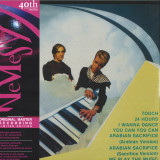
On the occasion of the 40th anniversary of its original release, this limited edition Black vinyl is reissued in an exclusive version, created using the Original Master Tape to ensure an authentic and faithful sound to the original recording. The high-quality mastering process ensures optimal sound performance, enhancing every detail of the production, from the depth of the bass to the clarity of the highs. Pressed on 180g Black vinyl, this product is marked with the SIAE trademark to guarantee authenticity and has been carefully crafted to provide a flawless listening experience.
This limited edition also includes an autographed photo from the band, making it even more personal and collectible.
This limited edition, available in a limited run of only 250 copies, is designed for true collectors and enthusiasts. Each copy of the 40th Anniversary Limited Edition Black Vinyl pays tribute to an album highly appreciated by Italo-Dance music lovers.
Originally released in 1985, the album challenged the conventions of the time with an alternative and innovative sound, standing out in the Italo Disco scene. The album received international praise, especially from the most demanding audiophiles, for its pioneering production and ability to distinguish itself from mainstream sounds. The remastering process from the Original Master preserves the authenticity of the original sound, delivering superior quality.
With the included removable OBI, this special edition gains an additional distinctive touch, completing its design and reinforcing its status as a cult item. Don’t miss the opportunity to own this unique vinyl, perfect for those who appreciate authentic music and wish to enrich their collection with a rare and valuable piece.
Aimer Perdre is a movie by the Guit Brothers and tells the story of Armande Pigeon; the queen of shenanigans. In Brussels, she struggles to make ends meet because she can’t stop gambling on everything, always ending up on the wrong side of luck. When she teams up with Ronnie one night, everything changes – they win it all. And when you hit a winning streak, you have to know when to stop.
For Aimer Perdre, Brooklyn NY native Simon Hanes travelled to Brussels in order to work directly with the directors, synchronizing the editing of the film with the composition of the soundtrack so that both processes would influence each other. Hanes and the Guits spent 3 months working alongside each other almost every day, passing ideas back and forth and allowing the soundtrack to grow organically. The music is an honest representation of Hanes’ experiences over those months, which he spent couch surfing across Brussels, sharing meals and ideas with new friends in broken refrains of French and English – falling asleep at the Cinémathèque, and occasionally breaking into abandoned buildings…but thats a story for another time.
Throughout all this, Simon hired musicians he met in bars, members of the Brussels experimental/artistic community, singers from a choir that was rehearsing in the squat where the Guits built their editing room…All the while sculpting the soundtrack out of these seemingly dissolute elements and constantly blurring the line between the compositional process and his day to day life.
Finally the process culminated in hiring the FAMES string orchestra for ONE SINGLE HOUR (all they could afford) to achieve the full orchestral sound the film’s climax so clearly needed.
The end result, like the film itself, is a reflection of life – a hodgepodge of sounds, colors and ideas that come together to create a beautiful, unique tapestry, sometimes harmonious, other times less so.
Comes with a limited edition flexidisc with a bonus track.
180 G. BLACK VINYL WITH LINER NOTES IN CREOLE, FRENCH, ENGLISH
Originally released in 1979, "Spiritual Sound" lives up to its name, a soaring, triumphant album, six tracks of spirit magic from Guadeloupe.
Telluric, intense, terribly alive, the gwoka drums of Guadeloupe carry the identity of a painful and fervent island. Marked forever by the crime of slavery, Guadeloupe's créolité cherishes the ka drums and their natural environment: the low-pitched boula drum with male goatskin, the high-pitched soloist makè drum with female goatskin, the chacha, ti bwa, triangle, calabash and other percussion instruments that surround them, and the voices - the fiery, proud, timbred, urgent voices of the gwoka.
This album is also a legend for its voices: in his then dazzling youth, singer Lukuber Séjor was one of the first gwoka artists to largely feminize the chorus of répondè, who converse with his text delivered in a straight and powerful voice.
And everything here sets new standards. In 1979, Mizik Filamonik - Spiritual Sound proclaimed a spiritual patriotism of ferocious intensity. The album by Lukuber Séjor - whose spelling alone is a battle - sets out to give Guadeloupe the intangible weapons of self-respect and self-knowledge, through a singular practice of traditional music.
The genesis of gwoka music is less straightforward than one might imagine... The drums performed the servile task of accompanying the work of slaves in the fields and during the “corvées” imposed by the administration, before being freely practiced by the common people after the abolition of 1848. At the heart of the conviviality of the Guadeloupeans furthest from the cities - geographically and socially - the gwoka drums come out for carnival, funeral wakes and neighborhood celebrations, but also during strikes, fits of anger and armed vigils of the riots and revolts that have punctuated the island's history. For generations, governors of the colony and then the prefects of the overseas department of Guadeloupe have been viewing the gwoka as a potential for turbulence and a threat to public order.
But as the Beatlesmania, “chanson engagée” and rock revolutions unfolded in Europe, young people turned to the drums of mizik a vié nèg (“bad negro music”, in Creole), which Guadeloupeans had learned to despise by following the “assimilation” process advocated by the school system and most of the political class. At the end of the sixties, in a Guadeloupe mourning the deadly repression of the May 1967 social movement, they played traditional music, refusing to wrap it up in tourist prettiness and madras folk costumes. Instinctively, they played a rough and contemporary gwoka, led by the incendiary Guy Konkèt. This was the era of decisive 45 rpm records such as Robert Loyson's Kann a la richès, which brought to light the fieriest words of union rallies.
At his home in Sainte-Anne, Lukuber Séjor played with flautist Olivier Vamur and his brother Claude Vamur, who cobbled together a drum kit from tin crockery and became, a few years later, the most influential drummer in Kassav'.
These were the years of the Bumidom program, when young Guadeloupeans were encouraged to emigrate to mainland France. At the age of twenty, Lukuber Séjor embarked on the liner Irpinia, disembarking at Le Havre and taking the train to the Gare Saint-Lazare - the route taken by thousands of young West Indians who went on to study or looked for work, all the while trying to maintain a link with their homeland. In this case, it's at the Antony university residence, where Lukuber played the drum and participated in a thousand gwoka updates and aggiornamentos, while exile reinforced the need for a spiritual link with the native land.
In 1978, Guy Konkèt played at the Salle Wagram, a historic event for West Indian music. After serving as répondè - i.e. backing vocalist - on one of his home-recorded albums, Lukuber joined his live band. Little by little, he became one of the key artists on a circuit parallel to French show business. At a student party in Caen, he met a young woman from Martinique who, at the time, was more motivated by her ambitions as a visual artist than by her vocation as a musician. Her name was Jocelyne Béroard and, a few years before she plunged into the Kassav' adventure and became the greatest West Indian singer of her generation, she designed the cover of Lukuber Séjor's LP.
This ambition was obvious and imposed its will. A more or less regular band was formed, with Roger Raspail, Rudy Mompière and Éric Danquin on ka drums, Claude Vamur on ti bwa, Olivier Vamur and Françoise Lancréot on flutes and Annick Noël on keyboards. Lukuber Séjor is set on wanting to extend the gwoka palette to other instruments, as the jazz-rock revolution opens a thousand new doors. Annick Noël will play a wide range of timbres and textures on electric piano and synthesizer. Another novelty: the répondè are two men and two women, Roger Raspail, Olivier Vamur, Françoise Lancréot and Maryann Mathéus ...
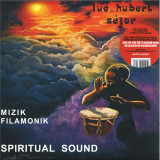
Mizik Filamonik - Spiritual Sound is a self-production in which the singer and leader sank all his savings, allowing him no more than a single day in the studio. The first side is more of a musical manifesto, with the first two tracks, Éritage and Penn é plézi, being instrumentals. The third, Son, forcefully celebrates the need for Guadeloupeans to connect with the gwoka. In fact, Jocelyne Béroard's cover shows a tambouyé in the shadow of a cloudy sky, against which a radiant sun is rising and whose light will soon flood the entire landscape. The silhouette and face of this man strongly evoke the immense Vélo, master of the ka, rejected at the time on the fringes of society.
The second side of the LP is surprising. Formally, three tracks are explicitly linked like the three parts of a triptych. Primyé voyaj evokes the appalling tribulation of Africans deported as slaves to Guadeloupe; dézyèm voyaj speaks of the Bumidom program and the economic, political and social forces driving young Guadeloupeans towards the mirage of prosperity in France; twazyèm voyaj closes the cycle with the emigrants' return from Europe after years away from their island...
This gwoka, obsessed with the need to save Guadeloupe spiritually, appeals far beyond the politicized audience. Mizik Filamonik - Spiritual Sound instantly became a classic, although Lukuber Séjor never really made a career for himself as a musician.
After all, the album was released in 1980, with no promotional resources in France or Guadeloupe - and therefore no concerts. The thirty-two-year-old author, composer and performer made his own third trip back to Guadeloupe. He set up a small woodworking business, which he lost in Hurricane Hugo in 1989. His other activity, teaching in a medical-educational institute, became the core of his professional life. He continued to be an active campaigner - a campaigner for the Creole language, a campaigner for the reawakening of identity, a campaigner for special education, a campaigner for a thousand causes that he ignited with his generous and perceptive enthusiasm, such as the defense of breadfruit fries...
The echoes of his 1979 album have not died down. Of course, the use of Penn é plézi as the theme tune for Radio Guadeloupe's funeral notices from 1980 to 1992 kept him in the collective memory, but he continues to sing and compose sporadically, as with his all-female
vocal group Vwapoulouéka... Still convinced that music is a means of liberating the spirit, he continues the journey of a young man eager to deploy the power of Creole music and language.
Bertrand Dicale
Experimental dub techno duo Dialog present their first officially released live recording. Captured at the intimate French festival Pe:rsona, from the team behind the Positive Education events, the recording captures Samuel van Dijk (VC-118A) and Rasmus Hedlund exploring mechanical rhythmic impulses and organic tones and textures—malleable metallic and elemental forms passing through chasms of processing and shrouded in womb-like melancholic hum.
Across two sides of immersive, head-nodding sonics, Dialog take the principles of dub techno into forward-thinking territory with a distinctly tactile approach to sound design—a mind-melting listen for casual chillers and committed voyagers alike.
"Acid Floresta" is the result of a process of sonic recognition and translation. A term that has taken shape over the past few years to name a search that, in reality, began more than a decade ago: the intersection between foreign rhythms and the music that inhabits the streets, with its social dynamics and its irreducible vitality.
This album is born from the observation and listening of the everyday sounds that shape the sonic identity of the neighborhood: the corner store, the metro, the billiard hall, the street corner. Spaces where music is not a choice but a constant pulse of life. The percussion of the street, the echo of a distant radio, the spontaneous phrasing of a conversation—these become raw material. From there, the process moves to the studio, where bass, synthesizers, drum machines, and samplers serve as tools of translation: what begins as a documentation of reality transforms into a musical interpretation.
At this point, a tension emerges between what is learned and what is felt. For years, tropical music and vallenato were part of a sonic landscape that coexisted with external influences, generating both distance and affinity. But within that push and pull—between the familiar and the unknown—a common thread was revealed: sabor. Not as a genre, but as an essence, a vital and irreplace able force.
"Acid Floresta" is structured in three and the performative stage, where music returns to the streets, closing the cycle. It is in this final moment that its true nature emerges: in the shared vibration, in danceability, in what connects beyond geography and context.
The album proposes a dialogue between intimacy and collective experimentation, between latineo and electronic music, between the raw and the processed. A space where the music of the streets and the music of the floresta converge to create a new sonic memory.
Berlin-based Italian artist expands the musical facets of the label with his first vinyl. The EP ventures into an intriguing cognitive space where club rhythms meet abstract organic and experimental sounds, written inbetween January and March 2024, A dead river is defined by its dynamic energy and rich layered textures.
The sounds emerge from a synergie of pure analog processing and modern digital sound design. In the building blocks are combined atonal drones and atmospheric elements to create moody storytelling. Uptempo beats on a solid groovy structure pronounce his repetitive groove punchy tribalism.
To speak to Luca Daniel Schwarz aka LDS about his music is to be enthusiastically guided into a complex world of his own creation: clean and powerful techno which pulses with life from the textured patterns and drum sequences that have fills and accents that would make anyone who’s picked up a set of drumsticks envious. Yet this ecosystem of noise is deceptive; Schwarz’s process for making music is very different to how a live drummer would create the same subtlety of performance. Forever researching new technology, Luca got deeply interested in different programming languages, and created a series of probability-based music tools for manoeuvring sounds and sequencing.
Manipulating those probabilities takes a skilful alchemy, needing understanding of both musical structure and how the tools he devised work. To return to the drummer analogy, if the drummer is focussed and intentional in the moment of playing, then the method used in LDS tracks is almost diametrically opposed, with all of the intention coming in the assembly of the instruments, potential paths, and gateways; once play is pressed the music flows, following all the rules that were set in advance, not unlike a domino run or Rube Goldberg machine. And like a domino run, the results are fascinating and, ultimately, fun: staccato vocals pop in and out in ‘zipp prompt’; laser-like synths pulse; background noises sweep across the aural plane of the dub techno of ‘diff, blockmix’ and ‘pow’ adding texture that brings vitality all-too-easily missed out when complex mathematical
processes become entwined with music creation. The high sensitivity to texture and rhythmic detail in Stadion Progg is multiplied further on Jean Redondo's remix - whose track, Hypersonic, was the backbone of 2023’s ‘yet’ compilation on Tresor.
The balance between technology and a sense of fun might also come from the maker; it’s not easy to overstate Schwarz’s passion for what is now his favourite way to make music, “it never gets boring. There’s always a moment of anticipation to see what actually emerges.” And the true “power of 2” comes into play when the resulting music can be fed back through the system again and again, potentiating the music in exponential ways.
Hot on the heels of previous explorations of Hindustani, East Bloc, pan-Asian, and Brazilian cultural touchstones, Toofli now pays homage to the vocal eroticism that beats at the heart of French pop music. The fourth faceless wizards once again bring their magical touch to uncharted musical territory, employing a precise process of cuts and edits in service of Toofli's groove agenda.
A half-step beat glides through haunting atmospheres and hard-driven hypnotic rhythms, offering a fresh perspective on the iconic 'Voyage' in the opening piece. The great French pop diva aesthetic continues to evolve in the second track, now taking on an ultra-chill mood with funky minimalism and late-night soul melancholia. The unexpected twist on the flip side blends breakbeat science with gentle digitalia, creating a unique mix perfect for the most sophisticated dancefloors. Kraftwerk's pioneering hymn "Tour de France" is reimagined with tough electro production, while retaining the essence of the monumental original.
Twenty-four years on from its original release, Monolake's seminal Gravity receives its first vinyl pressing courtesy of Field Records. Occupying its own space at the intersection of dub techno, minimal and electronica, it's an ageless album of staggering vision and technological prowess which has matured into an all-time pillar of electronic music. This edition, remastered by the album's key architect Robert Henke, follows on from the recent reissue of Monolake's first album, Hongkong.
Arriving just after the turn of the millennium, Gravity marked a turning point for Monolake. With co-founder Gerhard Behles moving on to other ventures, Henke produced most of the album solo and journeyed deeper into spatial exploration and the dub-informed principles that underpinned their project from the start. Minimalism and negative space run through the whole record, from the keen slithers of percussion pinging through lattices of delay to the hypnotising pulse of subliminal basslines anchoring the tracks. Gravity is a record which hangs on techno's linearity as a form of meditation, but the crystalline clarity of the mix allows every micro-fluctuation in rhythm and sound to cut through.
Compared to a lot of overly sterile digital music released in the early 2000s, Gravity endures thanks to the warmth and texture Henke elicited from his processes — even when leaning into none-more-digital effects like bit reduction. He described the ninth-floor view over Berlin from his studio at night as a key influence on the sound of the record, but the space Gravity shapes out feels thrillingly implacable. Unbound by the standard conventions of time and space, Gravity stands proud as a true original and finally gets the ceremonious vinyl pressing it so richly deserves.
Lance Ferguson (of The Bamboos, Menagerie and lately, The Ferguson Rogers Process) releases a newly scored soundtrack for the 1981 French film L'ocean de toi.
The romantic thriller was the debut film by enigmatic French director Leroi Alarie, long thought lost forever, but recently a 35mm print was unearthed that he has agreed to release after many requests and much negotiation.
Ahead of its planned restoration and subsequent re-release, Ferguson was asked to compose all-new music for the film personally by Alarie (now aged 69), as the original score was never to the auteur's liking - cobbled together at the time with a patchwork of sound library pieces imposed upon him by the film's producers in order to save money. He was in so much conflict with the producers throughout the shooting and editing of the film that upon completion he took the only existing finished print and refused to have it released.
Ferguson's score is a collection of languid, dreamy (mainly) instrumental Funk pieces that evoke the hazy, sun-kissed atmosphere of the film. Conceived and imagined to suit the aesthetic of the era, but with an inevitable twist of "la modernité". It's a fitting match for this new addition to the canon of early '80s European arthouse cinema, thankfully rescued from obscurity for 21st-century audiences to finally enjoy.
MARTHIAL joins NECHTO with ‘NECH029’, a four-track vinyl release blending tradition and futurism. The record pays homage to a genre central to MARTHIAL’s imagination, drawing on its history to shape a forward-thinking sonic vision. The Milan-born and -based artist describes the EP as “a reflection on change: everything transforms, everything evolves, and we are tasked with finding harmony between what has been and what could be”.
Born Alessandro Vaccari, MARTHIAL is a DJ, producer, and founder of Milan’s independent cultural hub, the Tempio del Futuro Perduto. Through this unique space and his 24/H Records label, MARTHIAL has collaborated with influential artists like Stanislav Tolkachev and Fabrizio Rat. His music evokes ethereal atmospheres and hypnotic rhythms, bridging Detroit-inspired soundscapes with innovative, interstellar journeys.
The EP represents a personal journey for MARTHIAL, who describes the process of revisiting this sonic language as an opportunity to redefine himself and his perspective on the world. By channelling the past as a guide and embracing the future as a responsibility, he crafts a cohesive narrative that combines deep emotional resonance with forward-thinking energy.
‘NECH029’ is a cohesive exploration of these elements, delivering pulsating energy and emotional depth across its four tracks: ‘Don’t Wanna’, ‘Soul Groove’, ‘The Dancer Gift’, and ‘Infinito Imperfetto’.
Strictly Ragga is a track that me & Mr Sensi finished together in 2014, but at the time, there was no label interest in it and besides some DJ support from Bailey, Equinox, Double O & a few others at the time, we sort of forgot that it had existed. Recently though, whilst organising my projects folder, I rediscovered the tune and thought it was worth releasing myself now that I'm able to do that on Future Retro London.
FM Dial, I sort of can't really remember the exact process behind it being made. If I remember right, Kid Lib sent me the parts of a tune called Unauthorized around 2013 (I think?), it was quite fully formed but it had no bassline on it. I never made time to work on it, so I think he sent it to Mr Sensi, who did some work on it but also didn't finish it. Then last year, I found a folder that Mr Sensi had sent me years back, which had the parts for a tune that he never finished, which I then finished. I sent the tune to Kid Lib when it was done, having forgotten about Unauthorized and it turned out that I finished a version that Mr Sensi had worked on of Kid Lib's track, without knowing anything about Mr Sensi's involvement in Unauthorized. All a bit confusing I know, but anyway, all that matters was that the tune was finished.
Nice one to Mr Sensi & Kid Lib for their involvement in this release and to Bailey, Equinox, Double O and everyone else that gave Strictly Ragga some support in its initial existenc