
out of Stock
Order now and we will order the item for you at our supplier.
14,50 €
Last In: 29 days ago
Order now and we will order the item for you at our supplier.

On a creative roll of late, Linkwoods productions have branched out in many directions, a collaboration LP with jazz Genius Greg Foat, Another with Local Edinburgh Legend Other lands and a load more yet to surface. Linkwood now comes back to solo work with a hyper focused piece of electro goodness. Lo-fi but all the better for it, Mono comprises 14 deeply distilled tracks. After producing some more complex records it was time for a pure palate cleanser so we locked Nick in the Athens of the north studio for a week with his friends Moog and Oberheim to see what might happen. Somewhere between Electro, Early 80s Synth pop and techno the album is an extremely listenable piece as a whole, unpretentious and timeless. Sprinklings ofDave Stewart pop noodles, Newbuild, Early Era Nu Groove but very much Linkwood at the same time, I cant recommend this enough.
Order now and we will order the item for you at our supplier.

Order now and we will order the item for you at our supplier.

Bon Iver's debut full-length For Emma, Forever Ago has been making major waves in critics circles based on the strength of an early artist-pressed advance cd and a couple awe-inspiring sets at CMJ in October 2007. The New York Times called it "irresistible" and Pitchfork stamped its early review of the album with a Recommended tag. For those of you hiding away in a cabin of your own, it's time that you hear the story, and more importantly, the music. Bon Iver (pronounced: bohn eevair; French for "good winter" and spelled wrong on purpose) is a greeting, a celebration and a sentiment. It is a new statement of an artist moving on and establishing the groundwork for a lasting career. For Emma, Forever Ago is the debut of this lineage of songs. As a whole, the record is entirely cohesive throughout and remains centered around a particular aesthetic, prompted by the time and place for which it was recorded. Justin Vernon, the primary force behind Bon Iver, seems to have tested his boundaries to the maximum, and in doing so has managed to break free from any pre-cursing or finished forms. It wasn't planned. The goal was to hibernate. Vernon moved to a remote cabin in the woods of Northwestern Wisconsin at the onset of winter. He lived there alone for three months, filling his days with wood splitting and other chores around the land. This solitary time slowly began feeding a bold, uninhibited new musical focus. The days slowly evolved into nights filled with twelve-hour recording blocks, breaking only for trips on the tractor into the pines to saw and haul firewood, or for frozen sunrises high up a deer stand. All of his personal trouble, lack of perspective, heartache, longing, love, loss and guilt that had been stock piled over the course of the past six years, was suddenly purged into the form of song.
Order now and we will order the item for you at our supplier.

After a 30-year interstellar silence, the enigmatic producer Alien Signal—pioneering alias of Italian electronic composer Alex Silvi—reemerges with Whispers from Distant Suns, a transcendent odyssey that bridges retro-futurism and modern electronica. Hailed as a magnum opus, this album transcends genre boundaries, captivating ambient purists, downtempo aficionados, and even experimental listeners with its hypnotic fusion of analog warmth and digital precision.
Cosmic Tapestry of Sound
Drawing comparisons to Vangelis’ Antarctica and Alpha—but reimagined through a 21stcentury lens—Whispers from Distant Suns marries nostalgic synth textures with cuttingedge production. Silvi’s mastery of melody shines through in tracks like “Stardust
Memories” and “Fragile Eden” where shimmering arpeggios and celestial pads drift over robotic, glitch-infused drum patterns and sparse, meditative percussion. The result is a paradox: a retro-futuristic soundscape that feels simultaneously ancient and alien, familiar yet unexplored.
Listener Testimonials
Fans and critics have flooded forums with praise:
“An auditory revelation! It’s like Vangelis met Jon Hopkins in a nebula—vintage soul with a futuristic heartbeat.”
“The textures are gorgeously cinematic. Closing your eyes, you’re adrift in a Tarkovsky film scored for the Andromeda galaxy.”
The Vinyl Experience
Pressed on heavyweight vinyl, the album’s physical release amplifies its immersive qualities. The gatefold sleeve, adorned with surrealist astrophotography and metallic
foiling, mirrors the music’s cosmic ethos. Side A leans into Balearic serenity, with sundappled grooves and aquatic synth ripples, while Side B delves into darker, more
experimental terrain—think Aphex Twin’s Selected Ambient Works colliding with the organic rhythms of Jon Hopkins.
Maturity in Motion
This album is a testament to Silvi’s evolution. Tracks like “Seeds Of Light” and “Message from Andromeda Galaxy” showcase his refined ear for dynamics, balancing silence and sound with surgical precision. Vintage drum machines spar with glitches, while field recordings of crashing waves and interstellar static blur the line between Earth and cosmos. The closing track, “The Star Charts We Shared” crescendos into a 6-minute ambient requiem, leaving listeners suspended in a state of weightless awe.
Final Transmission
Whispers from Distant Suns is more than an album—it’s a transcendent odyssey. Spanning time, space, and the artist’s own creative evolution, this immersive work invites listeners to lose themselves in its ebb and flow. Designed for moments both intimate and expansive, its balearic-tinged atmospheres resonate equally through dawnlit Mediterranean terraces or the solitary glow of headphones in darkness. These are compositions that pulse, morph, and haunt the air long after the final note fades. A living soundscape meant to accompany life’s quiet revelations and clandestine joys—a soundtrack to your most personal moments, crafted as what the artist calls ‘private dance music.’
Tailored for the Discerning Listener
Whispers from Distant Suns is designed with the true connoisseur in mind. This album is a must-have for:
Vinyl Collectors & Audiophiles: Those who value the warmth and tactile experience of heavyweight, limited edition pressings
Electronic Ambient and Downtempo Fans: Listeners who appreciate immersive soundscapes that merge retro analog charm with modern digital innovation.
Retro-Futurism Enthusiasts: Fans of pioneering artists like Vangelis, Boards of Canada, and early Warp Records who seek music that bridges nostalgic synth textures with futuristic experimentation.
Experimental Music Explorers: Individuals drawn to sonic narratives that invite deep, contemplative listening—perfect for both introspective moments and immersive listening sessions.
This release is not just an album; it’s a curated experience for those who desire music as a multidimensional art form, merging the vintage allure of analog sound with a contemporary, cosmic vision.
For fans of: Vangelis, Biosphere, Jon Hopkins, early Warp Records.
Order now and we will order the item for you at our supplier.

Vol 1[28,99 €]
Googling “paradise house”, the first results to pop up are an endless list of European b&b’s with whitewashed lime façades, all of them promising “…an unmatched travel experience a few steps from the sea”. Next, a little further down, are the institutional websites of a few select semi-luxury retirement homes (no photos shown, but lots of stock images of smiling nurses with reassuring looks). To find the “paradise house” we’re after, we have to scroll even further down. Much further down.
It feels like yesterday, and at the same time it seems like a million years ago. The Eighties had just ended, and it was still unclear what to expect from the Nineties. Mobile phones that were not the size of a briefcase and did not cost as much as a car? A frightening economic crisis? The guitar-rock revival?! Certainly, the best place to observe that moment of transition was the dancefloor. Truly epochal transformations were happening there. From America, within a short distance one from the other, two revolutionary new musical styles had arrived: the first one sounded a bit like an “on a budget” version of the best Seventies disco-music – Philly sound made with a set of piano-bar keyboards! – the other was even more sparse, futuristic and extraterrestrial. It was a music with a quite distinct “physical” component, which at the same time, to be fully grasped, seemed to call for the knotty theories of certain French post-modern philosophers: Gilles Deleuze, Félix Guattari, Paul Virilio... Both those genres – we would learn shortly after – were born in the black communities of Chicago and Detroit, although listening to those vinyl 12” (often wrapped in generic white covers, and with little indication in the label) you could not easily guess whether behind them there was a black boy from somewhere in the Usa, or a girl from Berlin, or a pale kid from a Cornish coastal town.
Quickly, similar sounds began to show up from all corners of Europe. A thousand variations of the same intuition: leaner, less lean, happier, slightly less intoxicated, more broken, slower, faster, much faster... Boom! From the dancefloors – the London ones at least, whose chronicles we eagerly read every month in the pages of The Face and i-D – came tales of a new generation of clubbers who had completely stopped “dressing up” to go dancing; of hot tempered hooligans bursting into tears and hugging everyone under the strobe lights as the notes of Strings of Life rose up through the fumes of dry ice (certain “smiling” pills were also involved, sure). At this point, however, we must move on to Switzerland.
In Switzerland, in the quiet and diligent town of Lugano, between the 1980s and 1990s there was a club called “Morandi”. Its hot night was on Wednesdays, when the audience also came from Milan, Como, Varese and Zurich. Legend goes that, one night, none less than Prince and Sheila E were spotted hiding among the sofas, on a day-off of the Italian dates of the Nude Tour… The Wednesday resident and superstar was an Italian dj with an exotic name: Don Carlos. The soundtrack he devised was a mixture of Chicago, Detroit, the most progressive R&B and certain forgotten classics of old disco music: practically, what the Paradise Garage in New York might have sounded like had it not closed in 1987. In between, Don Carlos also managed to squeeze in some tracks he had worked on in his studio on Lago Maggiore. One in particular: a track that was rather slow compared to the BPM in fashion at the time, but which was a perfect bridge between house and R&B. The title was Alone: Don Carlos would explain years later that it had to be intended both in the English meaning of “by itself” and like the Italian word meaning “halo”. That wasn’t the only double entendre about the song, anyway. Its own very deep nature was, indeed, double. On the one hand, Alone was built around an angelic keyboard pattern and a romantic piano riff that took you straight to heaven; on the other, it showcased enough electronic squelches (plus a sax part that sounded like it had been dissolved by acid rain) to pigeonhole the tune into the “junk modernity” section, aka the hallmark of all the most innovative sounds of the time: music that sounded like it was hand-crafted from the scraps of glittering overground pop.
No one knows who was the first to call it “paradise house”, nor when it happened. Alternative definitions on the same topic one happened to hear included “ambient house”, “dream house”, “Mediterranean progressive”… but of course none were as good (and alluring) as “paradise house”. What is certain is that such inclination for sounds that were in equal measure angelic and neurotic, romantic and unaffective, quickly became the trademark of the second generation of Italian house. Music that seemed shyly equidistant from all the rhythmic and electronic revolutions that had happened up to that moment (“Music perfectly adept at going nowhere slowly” as noted by English journalist Craig McLean in a legendary field report for Blah Blah Blah magazine). Music that to a inattentive ear might have sounded as anonymous as a snapshot of a random group of passers-by at 10AM in the centre of any major city, but perfectly described the (slow) awakening in the real world after the universal love binge of the so-called Second Summer of Love.
For a brief but unforgettable season, in Italy “paradise house” was the official soundtrack of interminable weekends spent inside the car, darting from one club to another, cutting the peninsula from North to centre, from East to West coast in pursuit of the latest after-hours disco, trading kilometres per hour with beats per minute: practically, a new New Year’s Eve every Friday and Saturday night. This too was no small transformation, as well as a shock for an adult Italy that was encountering for the first time – thanks to its sons and daughters – the wild side of industrial modernity. The clubbers of the so-called “fuoriorario” scene were the balls gone mad in the pinball machine most feared by newspapers, magazines and TV pundits. What they did each and every weekend, apart from going crazy to the sound of the current white labels, was linking distant geographical points and non-places (thank you Marc Augé!) – old dance halls, farmhouses and business centres – transformed for one night into house music heaven. As Marco D’Eramo wrote in his 1995 essay on Chicago, Il maiale e il grattacielo: “Four-wheeled capitalism distorts our age-old image of the city, it allows the suburbs to be connected to each other, whereas before they were connected only by the centre (…) It makes possible a metropolitan area without a metropolis, without a city centre, without downtown. The periphery is no longer a periphery of any centre, but is self-centred”.
“Paradise house” perfectly understood all of this and turned it into a sort of cyber-blues that didn’t even need words, and unexpectedly brought back a drop of melancholic (post?)-humanity within a world that by then – as we would wholly realise in the decades to come – was fully inhuman and heartless. A world where we were all alone, and surrounded by a sinister yellowish halo, like a neon at the end of its life cycle. But, for one night at least, happy."
Order now and we will order the item for you at our supplier.

Madronas’ debut LP Erogenous Biome is an amorphous, murky, cathartic offering. A duet of modular synthesizer and winds that’s equal parts doom and ecstasy, it’s the sound of a majestic butterfly emerging from it’s slimy chrysalis just in time to catch the sun setting on the end of days, a bewitching, heavy ceremony, a power-wash of both mind and spirit.
Tracked in one continuous take at Brooklyn’s Heavy Meadow studio, individual tracks were gleaned from the purge and eschew predictable structures, making for a dense, fluid suite of improvisation, like dancing smoke ribbons in the dark. The duo's chosen sound sources are seemingly opposite - Ry Fyan’s modular’s coming from electronic oscillators, Isaiah Barr’s saxophone and various flutes originating with the breath - but the visceral, imprecise, alive quality to the sound of both lends the record a thrilling combination of rapturous harmony and gritty, intense friction.
Opening the session in ritualistic, foreboding fashion, Voluntary lurches to life with rattles and wandering, bassy arpeggios before a suona’s cry signals the seance has officially begun. Ostraca Loam spits explosive modular rhythms and eerie shrieks for the flute to float above, while Detritus Harp smudges mechanical whirring, pensive horn and wind chimes for an untethered drift. Petrified Microdot swells with menacing sci-fi sequences and breathtaking sax runs until they both run out of breath, and Negative Lingam starts out in a panic of breathy riffing before exhaling into one of the most sublime passages on the record. Rhythmic pounding and undulating flutes punctuate Lenticular Shroud, before The Preparation Of The Novel sets the winds aside for a synthesized dual fit for electric dreams. The title track dominates the B-side, it's shimmering levity slowly unfurling to reveal itself as a kind of post-apocalyptic devotional music, deep space drifting grounded by earthly flutes, and Vale Of Cashmere offers an ascetic, contemplative closure, sparse flute and chiming rhythms organic or electronic - by this time it’s hard to know, it doesn’t matter either way.
Erogenous Biome is a world of it’s own, and one Impatience is honored to offer a window into.
RIYL - Senyawa, witchcraft, Colin Stetson , Civilistjavel, Mars (the planet), Finis Africae, raga, Stephen O’Malley, modular synthesizer, Anthony Braxton, Shabaka.
Madronas is Ry Fyan and Isaiah Barr. Fyan is a painter and tattoo artist, this is his first release. Barr is a prolific instigator of the downtown New York scene, producing and playing saxophone in jazz circles with his group Onyx Collective, as a player and/or producer on records by Nick Hakim, David Byrne and Wiki, performing live with William Parker and as part of his projects Universal Space Jam and Cafe Dewanee.
Erogenous Biome was recorded and mastered by Griffin Jennings at Heavy Meadow, Brooklyn.
Vinyl was cut by Beau Thomas at Ten Eight Seven Mastering, Berlin.
Artwork is by Ry Fyan, typography and layout by Nicolas Turek.
Order now and we will order the item for you at our supplier.

Limited Edition 12"
Left Ear are delivering two previous unreleased Australian ‘experimental’ electronic tracks from the 80’s and honoring them with a split 12” release.
Side A: Features an unreleased full-length version of Tim Gruchy’s Jungles, a solo electro-percussive piece recorded in Tim’s Lab D’Avoid studio in Brisbane. The track is emblematic of his style during an era when he worked extensively in music, both as a percussionist and primarily with electronics, including early analog synths.
A shorter version was originally released on the Meanjin (Brisbane) art collective ZIP’s Eye Ear EP book package in 1986 and, more recently, on Left Ear’s Antipodean Anomalies 2 compilation.
This original version of Jungles was initially part of the soundtrack for the ZIP Performing Group’s infamous Ironing Board Dances. Footage of the performance was treated through a Fairlight synthesizer, mixed with hand-painted slides, and transferred to VHS for various film festivals.
Side B: Michael Krillich’s Arnhem Land began its journey in 1982 in a shared house in North Bondi. Inspired by Brian Eno and David Byrne’s My Life in the Bush of Ghosts, he experimented with tape loops, cut-ups, and samples, incorporating synthesizers, effects pedals, a drum machine, and an unknown sample from an Australian Aboriginal record. This creation became part of his cassette release, Thematic Variations.
In 2010, Krillich uploaded an unreleased extended version of Arnhem Land from Thematic Variations to YouTube, which was shared by record dealer Matt Bowden with Left Ear Records, who pursued to release it on vinyl. Their search to uncover the sample’s origins led them to Arnhem Land Vol. 1 (1957), recorded by Peter Elkin in the Daly River region.
After years of research and through the guidance of Professor Allan Marrett and local custodians, the sample was verified as a “Wangga” ceremonial song sung by George Morkai, an Emmiyangarl man. Rights to the song had passed through generations to Tobias Worumbu, who granted us permission for its use, bringing Arnhem Land full circle.
expected to be published on 31.03.2025
"Body Jumper" is the first studio album from American band Provoker, who are paving the way for a new generation of post-punk. Produced by the band themselves, this breakout record sold over 1000 units sold via D2C previously and will now be available for the first time ever to purchase through retail. Packed with hits including "Bugs & Humans", this is a record that continues to grow along with the band.
expected to be published on 31.03.2025

If every significant artist has an underrated gem in its catalog, then Mirage is that album for Fleetwood Mac. An obvious return to relative simplicity after the dramatic tension of Rumours and experimental ambitions of Tusk, the 1982 album finds the band re-grouping after a brief hiatus and again climbing to the top of the charts. Extremely well-crafted, well-produced, and well-performed, the double-platinum effort distills the group’s hallmark strengths into a filler-free set that never runs short of addictive pop hooks or daft accents.
Sourced from the original analog master tapes, pressed at Fidelity Record Pressing in California, and housed in a Stoughton jacket, Mobile Fidelity’s numbered-edition 180g 45RPM 2LP set presents Mirage in reference sound for the first time. The efforts co-producers/engineers Ken Caillat and Richard Dashut went to capture the splintered albeit formidable band can be heard with stunning accuracy, range, depth, and detail.
Though Rumours understandably gets a permanent spot in the audiophile hall of fame, the smooth, clear, and dynamic sonics on Mirage confirm that the record that stood as Fleetwood Mac’s last effort for five years deserves a place in the same vaunted arena. The presence and imaging of Mick Fleetwood’s percussion alone on this reissue might have you wondering how this slice of soft-rock bliss has gone under-noticed for decades. Other prized aural aspects — separation, definition, impact, tonal balance — are also here in spades.
Like much surrounding Fleetwood Mac in the 1980s, arriving at Mirage was not easy. Caillat searched for studios located outside of Los Angeles on a mission to change up the vibe of the band’s prior recording sessions. Everyone settled on Le Chateau in France, where relations between some members remained icy — and cooperation with the producers strained. Battles with exhaustion, bitterness, and addiction further informed the proceedings at the 18th century complex in the French countryside, where even communal meals were allegedly eaten in silence.
Inevitably, the feelings that co-producer Lindsey Buckingham, Stevie Nicks, Christine McVie, and company harbored — as well as the situations in which they found themselves — drifted into the songwriting. In its rapid ascent to rock-star royalty status, Fleetwood Mac drifted apart, embarked on solo pursuits, and found it was lonely at the top. Emptiness, the illusion of dreams, the longing for love, the want to escape to bygone times of innocence and happiness: Such themes inform a majority of the narratives. Even if the lyrics regularly take a back seat to easygoing arrangements that allow Mirage to come on like a refreshing breeze on a sunny summer afternoon.
Home to three Top 25 singles in the U.S. and having occupied the pole position of the Top 200 album charts for five weeks, Mirage rightfully resonated with the mainstream and attracted listeners on both sides of the pond. And how, via a smart blend of sugary melodies, warm harmonies, interlaced notes, nimble rhythms, taut structures, and passionate vocals. Not to mention the presence of what arguably remains Nicks’ signature song, the biographical “Gypsy,” a meditation on the loss of her close friend Robin Anderson that teems with majesty, mystery, and mysticism — and which gets an assist from Buckingham’s shaded tack piano and richly strummed guitar chords.
Its ranking as an all-time classic aside, that No. 12 hit has plenty of company when it comes to brilliant pop turns on Mirage. On the subject of Nicks, the raspy singer gets a little bit country on “That’s Alright.” Its clip-clopping pace and two-stepping progression complement subtle vocal swells that emerge during the final verse of a tune that is ostensibly about leaving but still conveys forgiveness and grace. And what would a Fleetwood Mac record be without Nicks drawing on the tools of the supernatural — cards, dreams, wolves, and the like — on the twirling “Straight Back.”
Despite the potency of Nicks’ primary contributions, Mirage seemingly unfolds as a tight competition between Buckingham and McVie — and one that ultimately ends in a draw. Buckingham’s salvos include the contagious “Can’t Go Back,” a yearning to time-travel back to the past that’s complete with hall-of-mirrors backing vocals; “Oh Diane,” out-of- left-field ear candy sweetened with hiccupped vocals and salt-and-pepper-shaken grooves; the chiming “Eyes of the World”; and “Empire State,” a delightfully fluttering track whose high-range vocals, lap harp notes, and ringing xylophones hint at the galaxies of sound that would erupt on Tango in the Night.
Then there’s McVie. As elegant, understated, and coolheaded as she’s ever been on record, she pours her heart out on cuts that revolve around her inevitable split with Beach Boy Dennis Wilson. In the process, she punctuates Mirage with a characteristic not always associated with catchy pop music: emotional weight, and the sense of dreaded acceptance in the face of dreams deferred.
“I wish you were here/Holding me tight,” McVie sings over a delicate melody on the album-closing piano ballad “Wish You Were Here.” Though they hoped otherwise, for the members Fleetwood Mac, distance and separation were always close at hand. Believing otherwise, inviting nostalgia, and pretending everything was fine only amounts to a mirage.
expected to be published on 31.03.2025

The new vinyl release is here, featuring two iconic tracks from the '70s and '80s reworked into classic house remixes by the Vannelli family. Joe T Vannelli delivers the remix of Thrill Me by The Wonderland Band, while the Vannelli Bros present their rework of Party On by Pure Energy. Both tracks are presented as Classic Mix versions, cra;ed to fill the dancefloors with their infectious groove.
Order now and we will order the item for you at our supplier.

"Quique" von Seefeel erschien 1993 auf dem Label Too Pure und verschmolz Elemente von Shoegaze, Ambient und elektronischer Musik zu einem innovativen und genreübergreifenden Sound. Die komplexen Texturen, pulsierenden Rhythmen und ätherischen Melodien des Albums sorgen für ein intensives Hörerlebnis, wobei Titel wie "Climactic Phase #3" und "Industrious" den bahnbrechenden Ansatz der Band verdeutlichen. Mark Cliffords aufwändige Produktion, kombiniert mit Sarah Peacocks zartem Gesang, schafft eine traumhafte Atmosphäre. "Quique" war ein Wegbereiter für die Verschmelzung von organischen und digitalen Klangwelten. Das am 28. März erscheinende, komplett neu gemasterte Reissue ist als Doppel-CD in der erweiterten "Redux" Version mit 9 Bonus Tracks sowie neuem Artwork und als Doppel-Vinyl in der ursprünglichen Länge und dem originalen Artwork erhältlich.
Order now and we will order the item for you at our supplier.

Roi is the new album from Sultan Stevenson, one of the most compelling voices emerging on the UK and European jazz scenes.Known for his ability to seamlessly merge narrative and accessibility, Stevenson’s music captures listeners both within and outsidethe jazz community. Drawing deep inspiration from legends like McCoy Tyner, Herbie Hancock, Kenny Kirkland, and Geri Allen,Stevenson’s compositions are an exploration of faith, identity, and the complexities of the human experience. His signature style,rooted in quartal harmony, vamps, pedal points, and modality, is elevated by his natural storytelling ability.Stevenson’s sound is unmistakably inclusive, with a humble approach that prioritises dramatic interplay within his trio over overlycomplex musical ideas. His music is captivating and approachable, reflecting his relationship with the Lord and his culturalheritage. Stevenson’s method of creating compositions, often starting with a central motif and building around contrasting melodicideas, highlights his deep understanding of contrast and narrative in music, resulting in compositions that resonate with a widerange of listeners.As a performer, Stevenson is quickly becoming a thrilling force in jazz, translating heritage and spirituality into an evolving andrelevant sound. With El Roi, he continues the journey he began with his debut album Faithful One, which saw each track serve aunique purpose within a larger conceptual narrative. Stevenson’s keen attention to musician selection, including his regularbandmates Jacob Gryn and Joel Waters, alongside collaborations with figures like Denys Baptiste, speaks to his commitment toboth personal and professional growth. His music is not only a reflection of his influences but also of his vision for what modernjazz can communicate to the world today.
expected to be published on 28.03.2025

London-based vocal and electronic collective NYX have announced their long-anticipated eponymous debut album, to be released digitally and on vinyl on 28th March 2025 via their own label, NYX Collective Records.
Alongside today’s news, they’ve also shared the first single, “Daughters”: a hair-raising, untamed cry that surrenders to the intensity of the human experience. With the lead vocal recorded in a beach-side kitchen in New Zealand, cicadas bleed through the soaring chant and heavy, visceral drums. The track opens soft and earnest, expanding in their rage, resilience, and liberation, transforming pain into a re-wilding of the spirit, a celebration of their collective power.
NYX say of the track: "Daughters” is an initiation into the underworld - an invitation to come face to face with our losses. To look towards the shame, rage, and pain embedded in our bodies, and open through the fear that has closed down our throats. These are our wild voices that want to be heard and loved - by ourselves, by our pack."
NYX is the result of years of collaboration and transformation, reflecting the collective’s signature blend of experimental vocal techniques and electronic alchemy. NYX’s debut album pulses with primal energy and delicate introspection, weaving together the ancient and the futuristic. It’s a spellbinding journey through the human experience, crafted not just to be heard, but also deeply felt.
The album brings together the group's full evolution and experimentation, collaborators on the album include sound designer, composer and NYX string player Alicia Jane Turner, harpist Miriam Adefris, as well as additional drums and production by Memory Play and Sebastian Gainsbourgh (Vessel), artwork by NYX member Shireen Qureshi, co-produced by Marta Salogni and mastered by Heba Kadry.
NYX showcases the choir's far-reaching emotional breadth. The introduction, “Mother”, is inspired by the first chapter of the foundational work of Taoism, Lao Tzu’s Tao Te Ching. In this, NYX’s opening prayer, the listener finds themselves in a swelling crescendo of NYX’s all-encompassing vocals and synth drones. The album spirals through swirling loops of haunting voices and layered strings that come together like crashing waves, bursting through in feral upheaval. “Through Fire” and “Daughters” erupt into heart-wrenching post-apocalyptic chorus and pounding bass-heavy drums, then slip into a blissful sound bath, “Awe”, whose choir harmonies layered with lush harps radiate pure wonderment, and the closing track, a cover of Suicide’s 1979 “Dream Baby Dream”, dissolves into reverberating echoes. NYX leaves an indelible mark, reminding us of the radical potential of healing and love.
In Greek mythology, NYX is the primordial goddess of the night, born from chaos giving birth to light and day. Inspired by this duality, NYX’s music harnesses the voice as a limitless medium for profound emotion, capturing the vast spectrum of human experience with power and authenticity.
expected to be published on 28.03.2025

London-based vocal and electronic collective NYX have announced their long-anticipated eponymous debut album, to be released digitally and on vinyl on 28th March 2025 via their own label, NYX Collective Records.
Alongside today’s news, they’ve also shared the first single, “Daughters”: a hair-raising, untamed cry that surrenders to the intensity of the human experience. With the lead vocal recorded in a beach-side kitchen in New Zealand, cicadas bleed through the soaring chant and heavy, visceral drums. The track opens soft and earnest, expanding in their rage, resilience, and liberation, transforming pain into a re-wilding of the spirit, a celebration of their collective power.
NYX say of the track: "Daughters” is an initiation into the underworld - an invitation to come face to face with our losses. To look towards the shame, rage, and pain embedded in our bodies, and open through the fear that has closed down our throats. These are our wild voices that want to be heard and loved - by ourselves, by our pack."
NYX is the result of years of collaboration and transformation, reflecting the collective’s signature blend of experimental vocal techniques and electronic alchemy. NYX’s debut album pulses with primal energy and delicate introspection, weaving together the ancient and the futuristic. It’s a spellbinding journey through the human experience, crafted not just to be heard, but also deeply felt.
The album brings together the group's full evolution and experimentation, collaborators on the album include sound designer, composer and NYX string player Alicia Jane Turner, harpist Miriam Adefris, as well as additional drums and production by Memory Play and Sebastian Gainsbourgh (Vessel), artwork by NYX member Shireen Qureshi, co-produced by Marta Salogni and mastered by Heba Kadry.
NYX showcases the choir's far-reaching emotional breadth. The introduction, “Mother”, is inspired by the first chapter of the foundational work of Taoism, Lao Tzu’s Tao Te Ching. In this, NYX’s opening prayer, the listener finds themselves in a swelling crescendo of NYX’s all-encompassing vocals and synth drones. The album spirals through swirling loops of haunting voices and layered strings that come together like crashing waves, bursting through in feral upheaval. “Through Fire” and “Daughters” erupt into heart-wrenching post-apocalyptic chorus and pounding bass-heavy drums, then slip into a blissful sound bath, “Awe”, whose choir harmonies layered with lush harps radiate pure wonderment, and the closing track, a cover of Suicide’s 1979 “Dream Baby Dream”, dissolves into reverberating echoes. NYX leaves an indelible mark, reminding us of the radical potential of healing and love.
In Greek mythology, NYX is the primordial goddess of the night, born from chaos giving birth to light and day. Inspired by this duality, NYX’s music harnesses the voice as a limitless medium for profound emotion, capturing the vast spectrum of human experience with power and authenticity.
expected to be published on 28.03.2025

In their new album Bagola, Trio Da Kali present newly composed songs accompanied on balafon and ngoniba, that provide a rich accompaniment to the spectacular voice of Hawa Kasse Mady Diabaté. She inherits her singing style from her father, the late Kasse Mady Diabaté, who was widely recognized as one of Africa"s all-time greatest singers and won a Grammy nomination in 2004. Hawa"s voice has an exquisite purity and expressiveness, with a wide emotional range. She is equally at home in the lively, 9/8 rhythms of the title track Bagola, a light-hearted critique of men in Malian society, to the soulful Orpaillage, a song that laments the destruction of land from gold-panning. Orpaillage was in fact composed on the spot in the studio, reflecting the creative chemistry between these three musicians. The musical director of the trio is balafon (xylophone) player Lassana Diabaté, born in Guinea into a well-known family of balafon musicians. His remarkable dexterity on the balafon earned him a place in Toumani Diabaté"s Symmetric Orchestra, and later on in the group Afrocubism (featuring Eliades Ochoa). He has collaborated with many musicians, including bluesman Taj Mahal on the album Kulanjan. With two balafons of 22 rosewood keys each, tuned to play chromatic scales, Lassana Diabaté achieves a perfect balance of rhythm, melody, harmony and virtuosic embellishment. David Harrington, leader of Kronos Quartet, compares him to none other than JS Bach. Underpinning the balafon with compulsive groove, is the large ngoniba, played with brilliant musicality by Madou Kouyaté (son of Bassekou Kouyaté and member of his group Ngoniba). Madou, the youngest member of Trio Da Kali, also adds rich harmonies with his deep breathy voice to the songs. Trio Da Kali were founded in 2013 under the initiative of the Aga Khan Music Programme, with the help of three-times Grammy-nominated music producer Lucy Durán. The Trio first rose to international fame with their sublime album Ladilikan (World Circuit Records 2017), featuring an unprecedented and multi-award-winning collaboration with Kronos Quartet, the legendary classical string quartet from San Francisco. Bagola is a showcase of Trio Da Kali"s entrancing and unique sound, only equaled by their magical performances on stage.
expected to be published on 28.03.2025

Yearly compilation series RADAR KEROXEN return with its fifth volume of themed based albums showcasing the talents and misfortunes of carefully selected musical projects based or connected with the Canary Islands.
With its first volume released in 2020 aiming to introduce and divulge adventurous Island based music, the Keroxen imprint now presents Vol.5 with a collection of tracks born out of an in-situ collective performance at the Keroxen Festival iconic venue - a massive disused gasoline tank near the harbour of Santa Cruz de Tenerife.
The Radar Drone Ensemble, as it was named for that night only, took advantage of the tank’s natural reverb to perform an improvised piece exploring the cavernous resonance corners inherent to the locale. The four artists then took a few months to compose a 9 track LP inspired by the site’s peculiar sound.
Gonçalo F. Cardoso kicks opens up the proceedings with two broody new tracks, in a style not heard since his 2015 album A Study of 21st Century Drone Acoustics. Doomed and menacing atmospherics brush shoulders with creepy and ethereal chants creating the perfect opening for this drone themed edition of Radar Keroxen. Eduardo Briganty (also from MINIATURa) follows with two equally deranged feedback based compositions letting his guitar riffs and distortions roam free. Afgan aka Mladen Kurajica (from GAF, Lagoss and Tupperwear) takes things further to an Angus MacLise inspired drone collage of mystic percussions, field recordings and electronic modular storms. Resonance aka Javier Perez wraps up the journey with his now trademark soothing synth compositions full of warm tones and blissful melodies.
The album comes, as always, wrapped into a dizzying post-tropical collage artwork by Pura Marquez.
Order now and we will order the item for you at our supplier.

The band Unknown Mortal Orchestra sometimes enjoys making purely instrumental music. In addition to the vocal-based records they're more well-known for, they've also begun to make an instrumental series called the IC where they spend time in a chosen city and improvise and collaborate on non-vocal music. Recently the band spent time in Colombia to make music and initiate their new keyboard player Christian Li. The resulting sessions have become IC-02 Bogota, a musical document of the time they spent in that exciting city and the possible background music for some strange parties and night drives in your future.
expected to be published on 28.03.2025

Experience two iconic pop anthems like never before—reimagined in smooth, feel-good reggae!
Side A: Justin Bieber's Baby gets a laid-back, island-style makeover, bringing fresh warmth to the beloved hit.
Side B: Miley Cyrus' Party in the U.S.A. transforms into a breezy reggae groove, perfect for any vibe.
This special 7-inch release delivers pure reggae magic, blending nostalgia with irresistible rhythms. A must-have for music lovers!
expected to be published on 28.03.2025
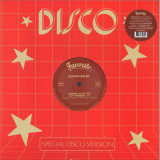
We’re thrilled to present this new 12inch single release, pursuing our digging into gems previously compiled in some of our various reissue compilations series.. On this occasion, it seemed only natural to highlight two exceptional tracks with numerous points in common.
"Hangin’ On to You" by Jonathan Jr. and "Flyin’ To Santa Barbara" by Special Occasion both hail from Belgium, produced in the mid-80s under the direction of Tony Baron, a producer and artist deeply involved in several New Beat projects and closely tied to the Nunk Records label. Both tracks also appeared in the 4th edition of our AOR Global Sounds compilation series, now sold out.
But beyond mere coincidence, these two tracks are perfect examples of the fusion between Disco rhythms and sound, with the smooth, colorful vibe of AOR productions from that era. Presented here in their 12-inch single versions, these gems are bound to delight DJs and music lovers alike.
We hope you’ll enjoy!
Your Favorite!
Order now and we will order the item for you at our supplier.
