Buscar:quan


After a storied recording career that has so far taken in albums for Further, Mathematics and Danyy Wolfers Strange Life label, Spanish artist Vagon Brei added label boss to his CV earlier this year with launch of Mystic & Quantum. Record labels come and go but few arrive driven a real specific concept in a way that Mystic & Quantum are with each album length release conceived to show stories of "adventures, magic, science". Having launched in auspicious fashion with albums from DMX KREW and San Laurentino, Vagon Brei helms the third release with a nine track set entitled The Secret Of Swamp Castle. Seemingly taking influence from Giallo Horror, Brei's album comes across as a compelling collection of synth explorations that will have you returning again and again in order to uncover the Swamp Castle's secrets.
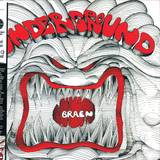
During the '70s, work days at Umiliani's Sound Workshop Studios were hectic; thousands of sessions were held in order to keep up with a very busy Italian movie industry: Hundreds of soundtracks alongside with music library were recorded and released on vinyl in very limited quantities for TV and film production use only. Those LPs are now proper collectors' items, extremely hard to find.
Filled with hypnotic bass lines, heavy drums and screaming fuzz guitars "Underground", the first LP of the fictitious group known as Braen's Machine, is one of the rarest and the most expensive of them all, always "reaching" sky high prices throughout the second hand vinyl market. A fast-beat jam with hammond scales and a twin lead guitar theme ("Flying") opens the A Side soon followed by "Imphormal", a classicfunk-beat-meetsfender- rhodes-and-psychedelic-guitar number. The music then switch to "thriller territories" with "Murder" which is based on prepared piano swells and a deeply hypnotic walking bass, reminiscent of the best Morricone's soundtracks for Dario Argento's movies. Two highly percussive songs complete the A Side: "Gap" is an improvised song with guitar and keyboards dwelling over an infectious drum rhythm while a marching snare and a vibraslap effect are the special features on "Militar Police".
The mood relaxes slightly on the opening of the B Side with a lazy jazz groove on "New Experience" but the rock influences are soon brought back on the following track "Fall Out". "Obstinacy" is all about keyboards with syncopated rhodes themes and distorted hammond sustained notes whilst the fuzz guitar is back again screaming through the left channel on the last song of the album, "Description". We could happly say that that was the golden age of the Italian music library. But who's behind the name "Braen's Machine" On the original cover the songs are credited to the composers Braen and Gisteri. Braen was a pseudonym often used by Alessandro Alessandroni, an extremely skilled and versatile musician, and one of Umiliani's closestcollaborators. He could write, conduct and arrange, he could sing (ever heard "Mah Na Mah Na"), he could whistle (ever heard Morricone's "For a fistful of dollars") and he could play almost anything: guitar, bass tuba, accordion, sitar and the list grows..... His first album "Alessandro Alessandroni e il suo complesso" (Sermi, 1969), had transformed the Italian library music from orchestral sound beds into the psychedelia we all love; the extremely fuzzy guitars are very "present" on "Underground" too. For a long time Gisteri's real identity was rather mysterious; often wrongly attributed to Umiliani. Gisteri was the pseudonym of Oronzo De Filippi, art name of Rino De Filippi, music supervisor to the Italian public broadcast company (RAI) between the '60s and the '70s. De Filippi composed other notable pieces such as "Riflessi" (Edipan, 1975) and "Nel mondo del lavoro" (Sermi, 1972).
De Filippi passed away few years ago but we were able to contact Alessandroni to talk about this LP. Remembering "Underground" recording session as one of the thousands he took part of, Alessandroni told us that this record was produced very quickly, in two days maximum. This was made possible by a team of wonderfully capable session musicians and the creative genius behind the mixing desk; this incredible combination helped to focus on the mood of each track even more. Unfortunately there are no liner notes but Alessandroni's memories and speculations, based on other music tracked in the same period at Soundworkshop by resident engineer Claudio Batussi, led us to identify this as the most probable lineup: Munari on drums, Majorana on bass, Vannucchi on keyboards and Alessandroni himself on guitar. For this reissue the sound has been restored and the cover art reproduced exactly as it was.

For the second instalment from Quantum Entanglement we delve into the misty past, a time when moving parts ruled the dance, when the power of the night rested on a needle and a bassline, and before CDJs calculated the bpm for you...you had to touch things, buy things, and the bassline ruled over all. Acid Thunder, a classic by Fast Eddie, was the first dance record i ever bought. It was important. The guy who sold it to me, at the time a spotty school kid in his school uniform, was called John Stapleton, and the shop was Sidetrax in Bristol. Mentrix totally gets the kinda NY sluttiness of the original, and brings it right up to date....less of a cover, more of a homage, the entanglement of then and now. Need You is an entanglement of two very unlikely BFFs... John Lee Hooker and Joey Beltram. This isn't really a cover, it's more like the offspring of many things, times, and moments - it's like the grandchild of John Lee Hooker's track dated the nephew of Joey Beltram's track and lived in Neukölln. Again, Direct - 'Techno Gone Mad' on R&S was another of my earliest techno purchases - at the time it was considered 'Dutch Hardcore' but now, it's almost cute.... Quantum Entanglement....recycling other people's good ideas since January 2014
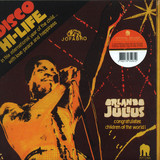
Hot Casa Records reissues Disco Hi-Life, a real treasure album composed and interpreted by Afro-Soul maestro, Orlando Julius. Comes as delux 180 gramms vinyl with tip on jacket & inserts with interviews & photos. Check!
Following up to the 12inch release (HC07 / 2009), here comes the remastered version of a real mindblower piece from 1976 including four unreleased tracks, all recorded with the best Nigerian musicians, between Ginger Baker' Studio in Lagos and the American Star Studio in West Virginia, USA.
Orlando Julius Aremu Olusanya Ekemode was born in 1943 in Ikole-Ekiti, Nigeria and can be considered as a main figure of the Afro-Soul music history. One of the first African musician to get signed on a 'Major' label (Polydor), he delivered many hit single as a composer and effortlessly performed live as a tenor sax and singer. He worked and met with some of the 'greatest', such as Louis Armstrong, James Brown (for his Nigerian tour with Bootsy Collins), The Crusaders, Gil Scott Heron, or Hugh Masekela.
In the middle of 1975, just after they finished the recording of The Boys Doing It' album with Hugh Masekela, they all flew to Ghana and Lagos. It was holyday and Orlando had also plenty of time to focus on his own songs. He wrote 'Disco Hi-Life' in Yoruba and 'Children of the World' in English. And he immediately planned a recording session including 12 finest musicians, such as the great singer Dora Ifudu Avery, Adelaja Gboyega on keys, Kenneth Okulolo on Bass guitar, Butley Moore on drums, Fela's collaborator Tunde William on Trumpet, and also Ade, who helped sang 'Love Peace & Happiness'.
Originally released by Nigerian label Jofabro in partnership with the UNICEF association for the 'International year of the Child', it was only available in few promotional quantity... here comes the very first official reissue of this dancefloor masterpiece!

Franc Spangler is back with three brand new cuts to form the Painted Lady EP. Spangler, also known as Jamie Odell also known as Jimpster returns to Delusions Of Grandeur following something of a hiatus since his 2010 EP Forever And A Day. Not that there hasn't been demand (following his brilliant remix of Norm De Plume for vinyl only label Kolour Limited) but with a busy gig schedule and two labels to keep on top of, the Spangler moniker has always been seen as a bit of a special side project where quality presides over quantity.
Title track Painted Lady kicks things off in fine style with warm, deep house being the order of the day. Franc gets just enough dust in amongst the layering keyboards and echoing stabs to keep things the right side of smooth, the overall vibe is rolling with subtle FX and sounds poking through every now and then bringing a new element to latch onto.
Up next we have Lumpsucker, which brings us a lovely, blissed out, slice of electronica underpinned by classic TR707 beats adding just the right amount of jack to the track. We're getting hints of YMO and Balil with a lingering note of Larry Heard on the finish.
Finally, we're treated to the epic closer that is Camberwell Beauty. Mid tempo boogie beats with crunchy claps and steady hats lay the bedrock for a loping CS5 bassline whilst lush keys shimmer and swirl like little fluffy clouds in a bright summer's sky.

Music from the documentary "I Dream Of Wires" f/several large-format modulars as well as his own Eurorack system. It doesn't revel in classicist synthpop motifs or vocoder-pop of recent years but focusses on making strange sounds sing.

In the 1970s the American composer Henry Flynt started a series of pieces under the title - New American Ethnic Music'. In so doing he worked together native styles of music such as blues, Country or Hillbilly with electronic production methods to make something altogether new. So far in Germany it has never been attempted to rework folklore electronically for a compilation. However, this picture changes if one redefines the idea of who the population is. Incomers have brought new - national anthems' to Germany, which means: even the Portuguese Fado, the African Gnawa, the Croatian Klapa or the Vietnamese Quan ho are these days at home in Germany.
With the cultural project - Heimatlieder aus Deutschland' ('Native songs from Germany') founded by former Spex editor Mark Terkessidis and label manager Jochen Kühling all the various styles of traditional folk music now found in Germany has been collected. Thirteen of the songs recorded for the project have now been transformed by contemporary electronic producers to present a - New German Ethnic Music'. But why remixes For one thing electronic music has recently focused a lot on the past (Ghost Music, Hypnagogic Pop etc.) - electronic editing is well suited to follow the effects of the immigrant music which the - imaginary national anthems' has created. Furthermore the project's instigators were curious how - electronic musicians' would handle folk music and folk songs which is a hugely difficult task. To this end artists were sought out who could get along with the idea of each music style and who are known to already have experimented with the human voice. The results are as varied as the music styles and Djs involved. Some melodies remain completely intact while others are abstracted beyond recognition.
Margaret Dygas' associative approach ensured that she presents a polish song about a girls arranged marriage with a claustrophobic feeling. With his remix of the Marrabenta of Mozambique Mark Ernestus has continued the rhythmic experiments he is known for with Jeri Jeri. Thomas Mahmoud translated Gnawa into dub and finally Ulrich Schnauss turned the song of the Italian Chorus of - Donni So' into a hymn for the horizon-expanding power of migration.
Hopefully this compilation will also expand some horizons.
Margaret Dygas - Impulse Remix
Thomas Mahmoud - Arab Disco Dub Remix

Nach der Veröffentlichung des neuen Albums "Tomorrow's Harvest", das von einer aufsehenerregenden Internetmarketingstrategie begleitet wurde und Boards Of Canada weltweit erstmals in die Charts katapultierte, erscheint nun - aufgrund starker Nachfrage - eine Reissue-Reihe mit all ihren bisherigen Vinylformaten. Jedes neue Vinyl enthält diesmal zusätzlich einen Downloadcode sowie einen BOC-Sticker aus der jeweiligen Zeitphase. Zuerst erscheinen die Alben "Music Has The Right To Children" (1998), "Geogaddi" (2002) und "The Campfire Headphase" (2006), im zweiten Schritt das Minialbum "Twoism" (1995) sowie die beiden EPs "In A Beautiful Place Out In The Country" (2000) und "Trans Canada Highway" (2006).

Jose Cabrera and Fred P split the first installment of the Perception series. The Determinism EP sees JC and FP giving their slant on principles of quantum level events through sound. Raw and driving, this EP is a more than an adequate DJ tool, it's a formula for the transportation of the subconscious.
Determinism is a metaphysical philosophical position stating that for everything that happens there are conditions such that, given those conditions, nothing else could happen. "There are many determinisms, depending upon what pre-conditions are considered to be determinative of an event." Deterministic theories throughout the history of philosophy have sprung from diverse motives and considerations, some of which overlap. Some forms of determinism can be tested empirically with ideas stemming from physics and the philosophy of physics. The opposite of determinism is some kind of indeterminism (otherwise called nondeterminism).
Ernesto Ferreyra is a producer of pedigree, and a bastion of quality over quantity. His releases for Cynosure and Mutek_rec and his stunning album for Lucianos Cadenza imprint attest to this. His new Message From Abroad EP for Memoria continues his trend for finding beauty and groove in depth and restraint. The lazy funk of A Ship In The Skys plump bassline doesnt quite suggest whats to come; that being dreamy, atmospheric tech
house of the highest order. A masterful use of space, FX and texture runs through the track, subtle, heady melodies laced with warm, intricate percussion and deft soundscapes. The unexpected twists and turns in Ferreyras genius arrangement make for a constantly engaging ride during which you're always kept on your toes. Think Cocoon in its deeper, more sumptuous moments and you're heading in the right direction. Mostly Numb
goes deeper still, rolling yet subdued bass undulating beneath delicate pad sounds and sprightly piano chords. Otherworldly sounds tickle the tracks edges, a hypnotic undercurrent swirling around the soft melodies and carefully utilised sounds. Chilling rounds off this engrossing EP in a more percussive manner, with its combination of taut snares and juicy wooden percussion pattering away alongside chunky tech bass and tripped-out FX
and vocal.

2024 Repress
Following the legendary first two, stoically super minimal records “SOG 1“ and “SOG 2“ that provide ecstasy disguised as boredom on Kompakt Extra/Speicher in 2007, and the outstanding beautifully bizarre “SOG - Abweichung“ on Profan in 2010, we are now listening to “FREMDE HÄNDE“. Like its predecessors, this SOG stands in the tradition of „The Art of Omission“ with Wolfgang Voigt variegating his preference for the bluntly straightforward quaver bass in two different forms. The A-side contains a tonally noncommittal sequence ambling across the keyboard in quantised form, reminiscing of the arpeggiator (accompaniment function) function of early 70ies' and 80ies' synthesizers. On the B-side, daring and thoroughly unquantised quaver rhythms rock around a bass drum that, as the only straight element, tries to keep the whole thing together. The result sounds a little like a delirious Can Live.
Nach den legendären ersten beiden stoisch-superminimalen, als Langeweile getarnten Ekstase-Platten “SOG 1“ und “SOG 2“ auf Kompakt Extra/Speicher in 2007 und der überaus skurril-schönen “SOG - Abweichung“ auf Profan in 2010, hören wir nun “FREMDE HÄNDE“. Auch diese SOG steht natürlich ganz in der Tradition der “Kunst des Weglassens“. Wolfgang Voigt variiert hier seine Vorliebe für den stumpf-geraden Achtelbass auf zwei verschiedene Weisen. Auf der A-Seite haben wir eine tonal unverbindlich über die Tastatur wandernde Sequenz in quantisierter Form, die an die Arpeggiator (Begleitautomatik) Funktion früher 70er und 80er Jahre Syntheziser erinnert. Auf der B-Seite kreist die Achtel-Rhythmik in eher rockigem Sound ganz und gar unquantisiert und rhythmisch gewagt um die Bassdrum, die das Ganze als einzig gerades Element versucht zusammen zu halten. Das klingt ein bisschen wie Can live im Vollrausch.


