The norwegian group Boastein was founded by Are Storstein and Øistein Boassen in 1970. Boastein's debut album "Jeg har min egen luke" became something of a holy grail within alternative music in Norway. This is DIY rock from the anarchist basement with a sound and lyrics that was quite groundbraking when it came out. It was also one of the very first independent releases in Norway. The album can be described as free and progressive underground rock filled with dark humor, political sting and a good amount of weirdness. The record was first released in 399 copies in 1977.
Cerca:quit
quannnic is a non-binary shoegaze / rock artist releasing music independently with deadAir Records (quinn, Jane Remover.) Inuenced by artists such as Deftones and Nirvana, quannnic seamlessly modernizes sonic aspects of 90s rock for today's listener. Since releasing their 2022 album Kenopsia, quannnic has organically built an impressive fan base with over 900k monthly listeners and 30m
global streams to date. They released Stepdream in November 2023, with features on the Fader, spins on NTS radio, and placement on Spotify playlists like ALLURE and IRL Angel.
This is tenor saxophonist Hank Mobley’s first release on the Prestige label, after one previous Blue Note release. Here he is joined by Donald Byrd (trumpet), Barry Harris (piano), Doug Watkins (bass) and
Art Taylor (drum) with a guest appearance from Jackie McLean (alto saxophone) on one track. As one might expected, the program is quite « be boppy »,
with the band running through bop standards like Bud Powell « Bouncing with Bud », Monk’s « 52nd Street » and Parker’s « Au Privave ». Mobley’s supremely confident solos are
highlights of these tracks and he swings through the rather plain arrangements of « Bouncing with Bud » and « Au Privave » , with exceptional phrasing and melodic finesse, through Byrd’s and Harris’s solos as satisfying as well.
This EP was one of the fastest selling records we have released in the last few years and more importantly it marked the triumphant return of Messiah to the rave scene! All three remixes are just sublime but don’t take my word for it, listen to the sound clips. All of the artists involved brought their A-game and then some for this, quite frankly, gorgeous slice of wax.
Portland based act Dancing Plague has been a steady presence in the dark/cold electronic music scene for quite a few years now.
Since 2016 Conor Knowles’ solo project has been putting out one constant flow of independent releases on multiple formats such as vinyl LPs, EPs, tapes and CDs, creating one sonic palette rich with Ebm, goth, industrial and synth influences.
On their 5th studio album, Dancing Plague continues to flesh out and perfect their unique brand of crushing darkwave.
Elogium explores themes of loss, regret, rebirth and growth coupled with throbbing basslines, rave synths, and pounding drums. Knowles balances aggressive waves of electronics with enough pop sensibilities and catchy hooks to be inviting to those new to the genre.
His skills can be clearly appreciated on tracks like the first single Fading Forms which explores the somber feeling of the years passing you by. Knowles’ emotive baritone crooning paints a melancholic picture of the slow fading of time as you feel like you’re fading with it. The words fall like snow onto cold fields of pulsing 80s synths and pounding drum machine rhythms that bring forth nostalgic familiarity but feel fresh at the same time.
Fans of classic icons such as Depeche Mode, Ministry, Nine Inch Nails as well as contemporary torchbearers Cold Cave and Kontravoid do not sleep on this.
Plenty of disturbing beauty to be found in the depths of the underground
For Fans of Robyn, Tirzah, Charli XCX, Mica Levi, Jessy Lanza, Maurice Fulton. "Don't come closer, because I might hurt you boy / You don't deserve it, I treat you like a toy." So sings 28-year-old South East London musician Tatyana on "It's Over", the sad and squelchy electro-leaning title track to her second album. Primarily written and produced over the summer of `23, It's Over follows the loose trajectory of a not-quite-relationship from the year before. But, more than that, it's an album about modern dating, alienation and the confines of existing online. If you've heard Tatyana's name before, it's probably because she released a debut album back in 2022, Treat Me Right, co-produced with Metronomy's Joe Mount, a record she describes as more of a collaboration. For It's Over, Tatyana took control of every aspect of the album's creation, from the production (she co-produced it alongside Mikko Gordon) to the artwork and the technology she used throughout. "This record made me technically proficient because I really pushed myself," says Tatyana. "I figured out a lot of things that I didn't know before. In the past, I allowed others to lead the charge and I'm not doing that any more." Born in London, before moving to Russia, Holland and Singapore in her teens, before eventually studying music at Berklee College in the USA - which she attained on full scholarship - and then back to London, Tatyana imbues her music with both haywire technical proficiency and encyclopaedic, far-flung tastes. Mostly, though, her sound originates from a pure love of the dancefloor: Robyn, Tirzah, Mica Levi, Jessy Lanza, The Knife. You can hear these dance-pop influences everywhere, from the colourful synth shapes of "Control (ft. Dave Okumu)" to the crackling analogue hiss of "Nothing is True, Everything is Possible". Lean in a little closer, too, and you might catch the shimmer of a harp on every song (she's played harp since she was a little girl, and toured extensively as a professional session harpist). "I write about love, I write about romance, these are the things that interest me," says Tatyana. "That's what this record is. It's about this relationship that broke my brain and I had to write about it."
- A1: Intro 0 50
- A2: Wordplay 3 17
- A3: Spontaneity 4 08
- A4: Rugged Ruff 3 08
- A5: Interlude 0 29
- B1: I Confess 4 06
- B2: Uknowhowwedu 3 35
- B3: Interlude 1 09
- B4: Total Wreck 3 26
- B5: Innovation 3 23
- C1: Da Jawn 5 19
- C2: Interlude 1 05
- C3: True Honey Buns (Dat Freak Sh*T) 3 41
- D1: 3 Tha Hard Way 4 12
- D2: Biggest Part Of Me 4 51
- D3: Path To Rhythm 3 24
Bahamadia’s 1996 debut album Kollage is rightly regarded as one of the greatest rap albums of the 1990s. For the first time ever, Be With present the definitive double LP version of this eternal hip-hop classic, including the legendary "Path To Rhythm" which never appeared on the original LP or on vinyl, anywhere. An indelible VIBE from start-to-finish, Kollage presents Bahamadia's swirling rhymes delivered with an irresistibly butter flow and razor-sharp assuredness over a steady slew of smoothed-out, jazzed-up, blunted beats. Achingly cool and effortlessly funky throughout, it's an absolute must for true 90s hip-hop fanatics.
The entire Kollage project was recorded at D&D Studios and the ties to Gang Starr are keenly felt, with DJ Premier producing five tracks in addition to the killer songs Guru had already produced with her. Working with the cream of the mid-90s East Coast sound, Kollage is, accordingly, a record that demonstrates a varied musical taste with disparate influences, as Bahamadia has previously stated: “The title Kollage was a reflection of my state of mind. I first got interested in music from playing my parents’ and grandparents’ records, as well what I heard on the radio. I wanted Kollage to reflect that diversity both lyrically and sonically."
With intelligent, poetic lyricism and a laconic verbal style bursting with both warm texture and deceptive energy, Bahamadia’s flow was as inspired by Aretha and Nancy Wilson as it was Q-Tip, Schoolly D and Lady B. Swaggering out the gate, "WordPlay" finds Bahamadia confidently showcasing her considerable old-school battle-rhyme skills over a Guru beat that utilises an infectiously bouncy bassline with splashes of sultry jazz horns and a Jeru vocal snatch for the hook. Up next, the quietly shimmering and ruggedly beautiful "Spontaneity" is one of the most alluring on the record, Da Beatminerz crafting a brilliantly soulful and jazzy soundscape for Bahamadia's effortless vocals to float across. It's followed by "Rugged Ruff", where the rapper carefully constructs a swift off-beat flow over Premier's raw jazzy fire.
With smooth spacey synth vibes overseen by former Geto Boys producer N.O. Joe, "I Confess" is, without question, a fly love song and soothing (p)-funk groove. "UKNOWHOWWEDU" is an airy, chilled tribute to her hometown. Produced by Ski Beatz & DJ Redhanded, it rides a gloriously mellow break. It's a true Philly anthem, shouting out a who’s who of the entire city’s scene. Early banger "Total Wreck" follows, presenting a murky Guru instrumental elevated by jazzy horns. Bahamadia invokes the title's suggestion, firing her brilliant bars more aggressively than we’re accustomed to. More Beatminerz-brilliance comes in the way of "Innovation", an opportunity for the MC to invoke Freestyle Fellowship in her forward-thinking and literary verses. "Da Jawn" features hometown buddies The Roots, with Black Thought gliding into a back-and-forth with Bahamadia over ?uestlove’s warm, snapping percussion. With the strut club banger "True Honey Buns (Dat Freak Sh*t)", DJ Premier provides some laidback vibrant boom bap for Bahamadia to share a wild, cautionary tale about a night out with her girl, Kia.
Fan favourite "3 Tha Hard Way" is a hypnotically sinister cut, with Bahamadia, K-Swift and Mecca Star taking star turns to coast over DJ Premier’s raw beat whilst the tender "Biggest Part Of Me" is a heartfelt stunner dedicated to her son. Incredibly, only the European and Japanese CD versions of Kollage was released with the brilliantly breezy “Path To Rhythm”, featuring Ursula Rucker. Whilst ostensibly a "bonus track", it's anything but, to our ears. Very much in sonic conversation with KRS-One's stretched-out sleeper classic "Higher Level", it's absolutely essential so we had to include it, appearing on wax for the first time here, exclusively. Quite a coup.
Somewhat predictably, whilst Kollage was released to significant critical acclaim, it suffered from disappointing sales. In the intervening years - and for far too long - it was a criminally underrated record, an increasingly hidden gem. We hope this double LP reissue - which looks and sounds amazing - will go some way to correct this. This 2024 Be With double LP re-issue has been mastered for vinyl by Simon Francis, cut by Cicely Balston and pressed at Record Industry. It's too bold and beautiful to remain overlooked and underserved.
Stolen Goods Records announce Pergola's cinematic techno 'Zed' EP, featuring a remix from indie-dance legend CURSES.
Exploring hypnotic, emotionally charged melodies and vast techno breakdowns, the title track opens up the EP with a strong sense of mystery. Suspenseful strings build in anticipation as the bassline filters in intensity, this deep space offenng is the perfect example of a tune fit for the club as well as headphone-listening.
'Freak' is a beautifully intense piece featuring soft synths marked by subtle scratches, a feel-good vocal and the catchy strum of a quitar. '"Zed' is then given the CURSES treatment, the Optimo Music, Bordello a Parigi and Correspondant artist amplifies its retro feel resulting in nine minutes of pure dark disco hedonism. Closing out the release is an ambient collaboration between Pergola and Luigi Sambuy, 'Tunnel' is an ode to the early days of IDM through to the '70s.
*"Zed' marks the third release on Lele Sacchi & Asian Fake's Stolen Goods Records and follows up their widely acclaimed 'Volume 0' compilation as well as the recent collaborative EP between Black Loops & Innocent Soul. Since its launch last summer, the label has seen the support of artists like Dixon, Sasha, DJ Seinfeld and DJ Sneak and has garnered plays on prestigious stations like NTS and BBC Radio 1. The imprint continues its strong start to the year with three new tracks from the hyper-talented Pergola: a newcomer to the scene whos aready listed on labels such as Multinotes, Sementa ano Adriatiques Siamese, the latter which saw/ him reach number one on Beatport's Electronica chart.
When the grunge explosion of the early `90s elevated Seattle's flannel-clad misfits out of the divey clubs of downtown and into the mainstream, a new generation of restless artists filled the void left in the Pacific Northwest's underground music scene. The under-21 crowd making music in the wake of Nevermind seemed even less enamored with the slick production values, classic rock nods, and testosterone-fueled moshing culture that came with the Zeitgeist, favoring their own kind of Revolution Summer-style pivot away from the popular sounds of the era towards a more emotionally nuanced, melodic, and inclusive style of punk. The Puget Sound trio Lync perfectly captured the spirit of that era, blending the passionate chaos of the DC and San Diego scenes with the rough-hewn DIY pop sensibilities of Olympia's thriving indie community into one unified sound. Though they were only a band for two years, they helped define the next era of the Northwest underground, inspiring countless other artists and instigating the creation of beloved records from the region. After being out of print for over a decade, the band's sole LP These Are Not Fall Colors has been remastered and expanded into a 2xLP with the inclusion of "Can't Tie Yet"_a compilation track from the album's recording session_into a deluxe edition available courtesy of Suicide Squeeze Records. Originally released on K Records in the summer of '94 just a few months before the band called it quits, These Are Not Fall Colors is a boisterous collection of scrappy basement-show anthems played on duct-taped-together gear. Led by the off-kilter melodies of late singer/guitarist Sam Jayne and hammered into place by the driving bass of James Bertram and drum battery of David Schneider, the album's eleven songs channel that undefinable sound of the early `90s before descriptors like "post-hardcore" and "emo" became pejorative terms. Sure, you get a sense of the more sophisticated mid-tempo punk approach on songs like "B" and "Silverspoon Glasses," and maybe catch wind of wistful songwriting on "Pennies to Save" and "Cue Cards," but Lync seemed to cull their ideas from whatever bits of inspiration they could find in the gray gloom and geographic isolation of western Washington, absorbing it all and churning it together into a style uniquely their own. Despite Lync's short existence, modest aspirations, and DIY approach, their work had a ripple effect. Jayne would go on to make music under the moniker of Love As Laughter. Built to Spill's Doug Martsch was so enamored by the album that he enlisted Bertram and Schneider to serve as his rhythm section on the There's Nothing Wrong with Love tour. These Are Not Fall Colors engineer Phil Ek would go on to help record and produce records by Fleet Foxes, Band of Horses, and The Shins. Early bassist Isaac Brock and These Are Not Fall Colors album art contributor Jeremiah Green would go on to form Modest Mouse. Bertram and Green would also go on to form the revered indie rock group Red Stars Theory. At times it feels like you could pick any major Northwest indie rock group from the `90s and `00s and trace their DNA back to Lync. The deluxe edition of These Are Not Fall Colors comes pressed on 180g vinyl and packaged in a gatefold cover with printed inner sleeves and expanded artwork by Jesse LeDoux. The 2xLP also features an 18x24 poster with extensive liner notes by Brian Cook. Altogether, this new version of These Are Not Fall Colors not only brings this celebrated classic back into analog libraries of old fans, it also provides new context and appreciation for Lync's ongoing impact on both a local and international level.
In our 20th celebration year we welcome back Loz Goddard! It’s been quite a while since we last saw him on our label. With his standout debut collab release with Harry Wolfman in 2016 he has developed a unique mix of electronica, deep soundscapes and lush organic Deep House on labels such as “Oath”, “Razor N Tape”, “Church”, “Outplay” and “Apparel Music”. Now he finally returns with a mini album that features beautiful crafted ambient and electronica cuts paired with three upbeat tracks that will for sure shake the dance floors in and outdoors this summer! Enjoy!
In his own words, here are some insights on the influences and production process of these six pieces:
The release is named after a night in the White Hotel in Salford watching Skee Mask. At the time I had a bunch of unfinished ambient ideas as a result of making “Balloon Tree Road” (out on Oath). There were a lot of ideas I still loved that didn’t get finished for that release, so I set about finishing them late 2022 & early 2023 with the view to releasing an EP or ‘mini album’ that was again angled a bit more towards home-listening.
The more upbeat tracks are newer jams that I created in 2023. I wanted to include a few club-ready tracks on the record as well, so the release appeals to DJ’s as well as home listeners. I approached the production much like my past two records on Oath, with lots of live drum elements, some sampling and a mixing approach which keeps everything sound warm and organic. It’s rough round the edges - as has been the case with my productions of late - and offers a nice contrast to my DJ sets and radio shows at the moment, in which I am playing mostly Deep/Progressive House, Breaks & Techno. There’s some influence on the title track from the Deep & Lo-Fi House sound of artists like Baltra & Mall Grab, and I have taken influence from all the breaks I’ve been playing in DJ sets for ‘How’s This for a Vague Song Title’.
All tracks mastered by Salz Mastering in Cologne. Photography & Art by Break 3000.
- A1: Solomonic Reggae Star - Anti-Apartheid
- A2: Solomonic Reggae Star - Solidarity
- A3: Bunny Wailer - Arab Oil Weapon (12" Disco Mix)
- B1: Bunny Wailer - Love Fire
- B2: Bunny Wailer - Love's Version
- B3: Bunny Wailer - Bright Soul
- C1: Bunny Wailer - Rise & Shine
- C2: Solomonic All Stars - Solomonic Dub
- C3: Bunny Wailer - Riding
- C4: Bunny Wailer - Galang So
- D1: Bunny Wailer - Troubles Is On The Road Again
- D2: Bunny Wailer - Cease Fire
- D3: Bunny Wailer - Rule Dancehall
- D4: Solomonic All Stars - Rule Dancehall (Dub Version)
At the same time that Neville 'Bunny Wailer' Livingston recorded his debut solo long playing masterpiece, 'Blackheart Man', he was also creating a series of singles for his own Solomonic label. These records were every bit as good, at times even better, but they have never been released outside of Jamaica. Until now...,
It is next to impossible to ever overstate the importance of The Wailers to the history of Jamaican music and, as the last surviving member of the group, Bunny Wailer rightly regards himself as the sole keeper of their history ever mindful of the group's exalted position in the story of reggae music and the importance of their legacy. In 2010 Dub Store were proud to be able to work with Bunny on re-releasing a selection of his earliest recordings for the Solomonic label, lovingly restored and presented in reproduction sleeves and labels, on limited edition seven and twelve inch singles. Now, taking another step forward, we are more than proud to present Bunny's timeless music on two beautifully packaged CD's and double LP's. Bunny's first solo album, 'Blackheart Man' originally released in 1976 on his own Solomonic label in Jamaica and on Island in the UK, is one of the undisputed all time classics of Jamaican music and established Bunny Wailer as a highly respected, world renowned artist in his own right. During this period Bunny also produced a series of singles released in Jamaica and the UK in strictly limited quantities without the benefit of international distribution, that are every bit as good and, in some cases, even better than this awesome debut long player. Original copies have subsequently become highly prized, and highly priced, collector's items. "Classic rarities" is an overused and abused term too often employed to describe average records that failed to sell on their initial release but both 'Tread Along' and 'Rise & Shine' are packed from beginning to end with a searing selection of some of the greatest and hardest to find reggae records ever produced. 'Tread Along' opens, naturally enough, with 'Tread Along' from 1969, one of the last singles for The Wailers' own Wail N Soul M label, and runs through the first release on the Solomonic label, 'Searching For Love' also known as 'Search For I', 'Bide Up' released as 1974 drew to a close, a radical reworking of 'Pass It On' and a marked contrast to the version on The Wailers' 'Burnin'', album, 'Life Line' and the prophetic 'Arabs Oil Weapon' kept the pressure on as Bunny began outlining the flawless 'Blackheart Man' album. Each release was a certified classic in its own right. Peter Tosh's melodica version to Bunny's 'Amagideon' ('Armageddon'), the first track on 'Rise & Shine', is followed by 'Love Fire', an update of another Wail N Soul M track, 'Fire Fire'/'Babylon Burning', through to one of the deepest roots records ever created, 'Rise & Shine', on to 'Riding' from the 'Bunny Wailer Sings The Wailers' sessions (but not featured on the album) and a huge hit in the UK in 1981, and closing with 'Rule Dance Hall' from 1985. No idle boast..., The liner notes feature the story of The Wailers, as told to Dub Store by Bunny himself in Kingston in an enlightening 2012 interview, and rarely seen contemporary photographs complete these essential releases. The music of Bunny Wailer was not only a medium for change and protest but also to elucidate and educate and 'Tread Along' and 'Rise & Shine' finally complete the canon of un-compiled Wailers music. "I'm quite satisfied, you know, reggae music is the kind of music that although sometimes you would look at it and say..., boy, it's hard..., then again you look at what it has done for the people of the world you know that that couldn't be locked up in a little place like Jamaica!" Bunny Wailer
The tom-tom heavy tribal rhythm of “Wela Wela” is one of the rawest, hardest cuts from the band Black Blood, a conglomeration of musicians from the central part of the African continent who were based in Belgium. The group had a breakout single in 1974 with the exotica-leaning “A.I.E. (A Mwana)” but never were able to quite capture the excitement that single generated with their follow up records. We can only guess that songs like “Wela Wela” were simply way too heavy for the pop tastes of the day, since the groove is a beast! — an acid rock tangent of the “Soul Makossa” riff that radiates pure energy. Mr. K aserts “It’s an incredible song to dance to, but was not very DJ friendly, and I never seem to hear other DJs play it... or even talk about it.” Originally debuted on his Grass Roots album, Mr. K's new rearrangement should change that, especially now that it's been made available on this hard hitting, portable 7-inch format.
Originally released the same year as Black Blood’s debut, “Komi Ke Kenam (Fish & Funjee)” was discovered and distributed by a small independent Brooklyn label that featured many other incredible African bands of the 70's. The song opens with a tough breakbeat (subtly extended by Mr. K on our release), and rumbles over a funky bassline and slicing wah-wah guitar before bursting out with a sax-led climax, a gritty get-down jam if there ever was one.
Both cuts have been remastered expressly for DJ play and are loud and clubworthy, in new extended edits that tease every last bit of funk from the originals.
Suffolk-based singer songwriter James Varda’s fourth and final album before his death from a long battle with cancer in 2015, Chance And Time, set for a vinyl only reissue on Unspun Heroes is an astonishing aural document of a creative, forward -thinking musician coming to terms with a life slowly evaporating away. There is hubris, melancholy and an undeniable weight of sadness in these ten songs but, miraculously, there is also a stoic realisation and acceptance from Varda that is both heart-wrenching and deeply affecting. On Chance And Time Varda reconnects the human spirit to the land, a heavy, fearful heart to an optimistic soul, and in a beautiful poetic flourish gives a real tangible sense of loving and hope to his family and friends offering genuine reassurance and even, at times, a green light for celebration.
Carrying a certain air of mystique, that same sense of a ‘other worldliness’ if you will of say a Karen Dalton or a Jeff Buckley, Varda’s delivery and tone carries huge emotional weight here and an unique ability to add an honest perspective and warmth to the starkest of realities. The hard hitting impact of the opening tracks is blunt and sharply defined. There is pain, hardship, and fear wrapped in these tales - ‘The Doctor Spoke, Two Hearts Broke” - made all the more hitting as this is a real life journey in the here and now being catalogued. As we move towards the second half of the record there is something even deeper and truly incredible at play. Varda’s whole demeanor is one of understanding and acceptance - hear the celebratory shamanic vibe of the extraordinary ‘Pass It On’ and the poignantly reflective, chokingly sad finale ‘We Won’t Dream’ - bringing to an end a record that will leave a mark on everyone who hears it. Real art is both timeless and omnipresent, these songs from James Varda will hang in the air forever and be there for those who look to find understanding, joy and a sense of hope. Chance And Time is both an extraordinary record and poignant study of life and living, of death and what comes after.
James Varda released four albums between 1988 and his death in 2015. A fledgling career beginning on the singer-songwriting folk scene where his arrival was met with both curiosity and critical acclaim as was his debut, the John Leckie produced Hunger. Any momentum was lost however as it would be ten years before the next, In The Valley was met with a ruffle of applause. Cancer took hold of the troubadour and for a number of years Varda lived life and wrote songs until The River And The Stars appeared like a phoenix from the flames as he began to wrestle with the realities of his situation. It’s a record that beautifully lays the ground for this his masterpiece that was to follow.
Unspun Heroes, a new label set up by Simon White, has the sole purpose of finding and reissuing albums that he considers both undervalued and seemingly ignored. All releases will be on vinyl only complete with Obi strip and extensive liner notes. Each will be individually numbered and limited.
- Mar Vista - Visions Part 1 Her Eyes Are Closed
- Kennlisch - Kennlisch
- Crystal Eyes - Crystalzed
- Warlus - Girl Like You
- Gerard Alfonsi - Fana Stickle
- Geoffroy - Viking
- Amphyrite - Symphonie Pour 3 Oeufs Brouilles
- Eole - Friendship
- Capucine - Les Elephants
- Rictus - Flashes
- Inscir Transit Express
- Polaris - Polaris
- Joel Boutolleau - Force
- Spotch Forcey - Frustre
- Demon Wizard - Black Witch
- Temple Sun - Voyage Sans Retour
- Chantal Weber - Ballade Aux Chataignes Tombees
- Jean-Claude Zemour - X Kmh
- Rhodes Co - Baoum
- Guidon Edmond Et Clafoutis - Stormy Sunday
"For a long time, I'd come across these discs without really understanding what connected them, apart from a button and that famous logo designed by René Dessirier. Then, with a little more digging, I discovered the "self-production" link. For choirs, schools, folk singers, young pop groups, popular homes and even great composers who engraved unique copies of certain recording sessions...
The French equivalent of the English "Derby Service", the Kiosque d'Orphée, formerly at 7 Rue Grégoire de Tours in the 6th arrondissement, was taken over by Georges Batard in 1967 and moved to 20 Rue des Tournelles in the 4th arrondissement of Paris. The adventure lasted until 1991. Georges Batard was a sound engineer who used a Neumann tube engraver to engrave acetates from the tapes he received, before printing the precious vinyls in the press factories of the day, where he was able to produce very small runs of between 50 and 500 copies.
Of course, there were other structures for releasing his records, such as Voxigrave or, later, FLVM, but none of them had so many records in their catalog. Le Kiosque d'Orphée was neither a label nor a publisher, but a structure that allowed you to press your own vinyl, at a time when it was quite an adventure to get your first 45 rpm or 33 rpm album released!
Georges Batard was described as passionate and conscientious. His son, bassist Didier Batard, wrote of him:
"Georges was passionate about recording and reproducing the stereo sound of his great passion, music. He paid close attention to distortion rates, signal-to-noise ratios, response curves, rise times and other damping factors in audio equipment. He was looking for the exact reproduction of concert hall sound in his living room (with the same sound level, if possible...). In the late '50s/early '60s, he found other sound enthusiasts in AFDERS (Association Française pour le Développement de l'Enregistrement et de la Reproduction Sonores). He became its honorary president. Every Saturday afternoon, its members met to test au- dio equipment. Their opinions were published in the monthly Revue du Son.
All you had to do was send in your tapes and choose the number of record copies you'd like to take home with you, so you could finally share your creations and, in a way, exist. You could opt for a generic sleeve, available in several colors, directly customizable with your name and credits, or you could design your dream sleeve yourself in your living room or at a printer's.
This "Do It Yourself" temple gave birth to some superb pouches. Stencilled, hand-written, illustrated with paintings, drawings, illustrations by friends or girlfriends of the time, photo prints hastily stuck in the middle of a blank, white sleeve, on which the traces of time would leave their imprints, so that collectors and the curious would come and buy them decades later, with the promise of a musical discovery, unfortunately not always fulfilled...
What most of these records have in common is the youth of their songwriters, whether or not they've had a career. Stories of buddies, of getting by and dreams of glory made up this catalog. Most of them were amateur productions, both in terms of the level of the musicians and the quality of the recordings, made on a two-track or, the ultimate luxury, a 4-track in a teenager's bedroom or parents' living room.
It was the beginning of the home studio, thanks to the advent of the Revox portable tape recorder. A bit of a shaky DIY system, but, in return, the luxury of setting no limits: one-sided tracks, no outside censorship, no artistic director, no manager, no Barclay or EMI/Pathé Marconi logos...
When you finally had your own record, you could give it away or sell it to friends, family or after concerts. You could also drop it off at the nearest record shop, with undisguised pride.
It was also a calling card that could be sent to radio stations or music labels, in the hope of launching a career...
Many of the protagonists in this story tried to sign with labels, but in those days, bridges were not so easy to build between one's hometown, or even one's village, and the major or more specialized label that might have released these records. At the time, the advertisements published in the press by the Kiosque d'Orphée opened up the field of possibilities for provincial composers. It was now possible to make their own record, without having to go through the process of signing with a label.
Some of the composers who have gone on to make a career have used this channel to release their first record or parallel projects (Claude Engel, Dominique A, Andy Emler, Michel Deneuve, Claude Mairet, Mick Piellard, Tristan Mu- rail...) and sometimes even single or very limited pressings of work or promotional copies (Bernard Parmegiani, Jef Gilson...).
This album is the conclusion of a long investigation, begun six years ago. It took a long time to find the records, scattered all over the place, in the homes of collectors and sometimes the musicians themselves, and then to listen to them, sometimes painstakingly, to unearth these moments of grace.
From this work, 23 tracks remain, but there are dozens of others that could have been included, so we had to choose, and the choice had to be as universal as possible. This selection is obviously not objective, but I hope you'll like it.
Today's music is raw, touching and powerful. "
Jean-Baptiste Guillot - Born Bad Records
Recorded in Oslo in September 1970, Afric Pepperbird was released on New Year's Day in 1971. Half a century later, it still conveys the freshness and excitement of discoveries being made. The album signalled the arrival of four Norwegian improvisers - Jan Garbarek, Terje Rypdal, Arild Andersen and Jon Christensen - at the fledgling ECM label. It was the start of a lifelong association with each of the musicians, whose influence was soon to reach far beyond the borders of their homeland. In extended passages on Afric Pepperbird, with Christensen and Andersen stretching out, it's quite often Rypdal effectively holding the centre with taut chords. Everybody is roaring here, with Garbarek deep into his free jazz vocabulary. "Garbarek should be heard," wrote reviewer Joe Klee in DownBeat. "I would venture that not since Django Reinhardt has there been a European jazz musician so original and forward-looking as this young Norwegian."
Japanese alt-rock band BO NINGEN are delighted to announce they will be releasing an alternative soundtrack album to cult director Alejandro Jodorowsky's seminal film 'The Holy Mountain', set for release on 15th March 2024 via Alcopop! Records on double CD and a limited box set of triple vinyl, each in their own unique colour In partnership with Deeper Into Movies, the band will also be hosting a very special live performance of their alternative soundtrack at EartH, Hackney on 1st March 2024 --a 700 capacity tiered seated venue with original Art Deco features and state of the art L-ISA sound system, to provide the best possible experience of this must-see-and-hear event.
Commenting on the release, Kohhei Matsuda (guitar/synth) and Monchan Monna (drums) said: "We wanted to make something more than 'a band jamming to the film' live score. To do so, we tried to decipher the secret of Jodorowsky's alchemy to reach our own Holy Mountain, reflecting the underlying structure of the film-- which is delusional at sight, yet mystically logical throughout--in each stage of the music. It was quite an experience to work on the piece that way, diving deep into the director's vision where the border between the reality, delusion, the film, and real life blurs. Trying not to drown in it all, we had to find our own path back to our own version of reality. This is an aural representation of our own version of the film. We hope each of you find your own way to your own version of The Holy Mountain through reliving this mind-altering journey with us."
The band originally performed their alternative soundtrack to the film 'Holy Mountain' in July 2019 for 2 sold out nights at the Rio Cinema in Dalston, where it was nominated for 'Best Event Cinema Campaign Of The Year 2019'. During the brief latter periods of the pandemic when the band were allowed to travel internationally between London and Japan, BO NINGEN at last managed to reconvene as a unit in London to finally commit the soundtrack to record.
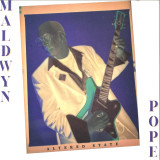
Starting his career with appearances on BBC Radio 1 and signing with Elton Johns label as a teenager, Maldwyn Pope's presence in music has been rich and productive from an early age eventually leading to working with people like Cliff Richards, Art Garfunkel and Bonnie Taylor. However, his presence in Italo-Disco has been quite scarce, but completely on point. "Altered State" is a masterpiece amongst enthusiasts and collectors of dancefloor sleaze and downtempo wellness. Heavy rock influence meets Rimini with this one off experiment from the seasoned multi instrumentalist. Original instrumental remix done by none other than Alessandro Novaga, the entity responsible behind one of Ron Hardy's favorite DJ tools (Faces Drums). B-side features an 11 minute excursion into a completely new altered state of dubby delayed trance, for special cosmic holes only. Re-issued with new full artwork.
HJirok is a mythical figure, conceived as a fictional character by Iranian-born Kurdish singer and artist Hani Mojahedy. Together with versatile music producer And Toma of Mouse On Mars, she combined a variety of sounds collected during their joint travels to Iraqi Kurdistan and elsewhere with heavily processed recordings of Sufi drum rhythms and setar melodies. The result is a driving, dubbed-out, and deeply intricate soundscape that perfectly sets the stage for Mojahedy's extended, unconventional vocal techniques and polyglot lyrics. Both informed by tradition and rigorously forward-looking, »Hjirok« (with a lowercase J) is at once a profoundly personal album and a universal utopian promise. As a ghost from the past, HJirok draws on Mojtahedy's memories to mould a new future out of them.
The foundation for »Hjirok« was laid in the city of Erbil in the Kurdish part of Iraq. During one of their stays in the region, Mojahedy and Toma recorded the three percussionists Hadi Alizadeh, Jawad Salkhordeh and Serdar Saydan as well as setar player Ali Choolaei from Motahedy's backing band while they were playingthe rhythms and notes that she had grown up with in the house of her grandfather in the Iranian city of Sanandaj. Her memories of that place revolve around hypnotic Sufi music, dervishes in deep trance, and ecstatic singing. Much like this music seemed to open a portal to other dimensions, the inhabitants of the house lived in a sort of alternative reality: It provided them with a hideaway from political circumstances. Following the Iranian revolution in 1979, a Kurdish rebellion ensued but was met with the utmost brutality by the new regime, which resulted in the death of thousands.
It is no coincidence that the music on »Hirok« would draw on rhythmic patterns that were passed on from one generation to the next for hundreds of years. »The project is rooted in the figures of the Sufi dervishes and thus a culture that precedes today's political, social, cultural, and religious systems,« explains Mohtahedy. »The Sufi sound travelled around the entire world. I like to think of it as a dialogue between peoples-one based on the rhythms of the drums and the sound of their voices.« Toma adds that by electronically transforming the recordings and enriching them with field recordings from both rural and urban spaces, they were able to use the stories told by the drums and the setar to create an entirely new narrative.
The story told by these eight pieces is hence a deeply personal, but also inherently political one. Moitahedy herself left Iran in 2004 and relocated to Berlin in 2010. Having continued to use her art as a platform to tirelessly advocate for the rights of the Kurdish people and women under oppressive regimes, she has not been allowed to return to her country of origin ever since. »Hani is singing for equality and there are people who are afraid of that-her femininity, her strength.« Toma says. Much like earlier Hirok sound installations addressed human-made climate change and other systemic ills, also »Hjirok« can hardly be disconnected from far-reaching struggles for liberation and equality.
This is also true on a thematic and even linguistic level. »The lyrics are about a promise,« Mojahedy says, citing Kurdish writer Ebdulla Pesêw as an inspiration. »At their core, these are about that day on which violence and fear become a thing of the past; what they tell you is ot not give up, to keep hoping,« she adds. The promise embedded in them is an emancipatory one. These contents are mirrored on a linguistic level: The lyrics were written in both Kurdish and Farsi, blurring the lines between the two languages and thus, Kurdish and Persian cultures.
Mojahedy, or rather HJirok, conveys these philosophical themes with elegance. Herversatile vocal performance is only loosely basedo n established styles. »Of course everything started with traditional rhythms, but we kept pushing things further and further, so Idid the same with my voice,« Mojahedy explains. »There were no boundaries.« The same can be said of the field recordings that she and Toma used. Whether it's conversations between members of the Pesmerge, the Kurdish armed forces, having a chat in meadow full of bunnies or the humming and buzzing of metropolises like Tehran: »Hirok« paints a sonic picture that is quite literally autopian one; that of a non-place in which different soundscapes, cultures and ways of life coexist peacefully.
What the album conjures up from Mojahedy's memory is not only a very specific place during a unique time in history as experienced by a single person. It is also ametaphorical home open to anyone who wishes to enter - promise of a better, more egalitarian future for everyone. Hence, HJirok will bring it on tour, presenting the material as an audio-visual live show that makes use of the photo and video material that Mojahedy and Toma have collected during their travels through Kurdistan.ja
O*RS are proud to release „HERON“, the first album by newcomer duo Heron from Leipzig. On their debut LP Heron tap into Synthwave with hints of Pop. The introspective lyrics elevate the 80s-like soundscape to an immersive listening experience. Producer Tino Kulisch and singer/writer Birthe Kleemann have been working on this project for quite a while now. Both of them are multitalented musicians who were involved in several band projects before forming Heron. We are very happy they came together and gave us their album „HERON“.
limited edition of 300
includes: poster , download code , sticker
One thing is certain about the idiosyncratic J. B. Lenoir, he was a true original. No one ever sounded quite like him and despite comparisons by some writers to Arthur Crudup his high pitched vocals were pretty much unique. Although J. B. Lenoir only had one hit in the US with “Mama Talk to Your Daughter” his influence over the British blues scene was immense. In fact John Mayall was a huge fan and he helped to get his 45s released in the UK. Rocking R&B and topical social commentary all thrown in the mix. This is Chicago blues with a twist. Let’s call it Chicago blues J.B. Lenoir style. Limited edition press on 140 gram colour blue/black marbled vinyl.