- A1: Baby Elephant Walk 2:43
- A2: Moon River 2:41
- A3: Breakfast At Tiffany's 2:46
- A4: Peter Gunn 2:04
- A5: Speedy Gonzales 1:44
- A6: Theme From "Hatari" 2:54
- A7: Sidewalks Of Cuba 3:19
- A8: Tequila 2:36
- A9: Mister Lucky (Goes Latin) 2:14
- B1: Something For Cat 3:09
- B2: Bijou 3:08
- B3: Experiment In Terror (Twist) 2:42
- B4: A Cool Shade Of Blue 3:48
- B5: Lujon 2:38
- B6: Moanin' 2:51
- B7: Stars And Stripes Forever 3:36
- B8: Moon River Cha Cha 2:36
Поиск:r 04
Все
- A1: There Is No Time (Prelude)
- A2: The Call
- A3: Theme De Crabtree
- A4: Road Of The Lonely Ones
- A5: Loose Goose
- A6: Dirtknock
- A7: Hopprock
- A8: Riddim Chant
- B1: Sound Ancestors
- B2: One For Quartabe / Right Now
- B3: Hang Out (Phone Off) (Phone Off)
- B4: Two For 2 - For Dilla
- B5: Latino Negro
- B6: The New Normal
- B7: Chino
- B8: Duumbiyay
Now Available On Cassette Tape! Music By Madlib Arranged By Kieran Hebden. Gil Evans to Miles Davis…. Holger Czukay to the ensemble known as Can….Jean Claude Vannier to Serge Gainsbourg on Histoire de Melody Nelson. That’s the only way to explain the specificity of Four Tet and Madlib’s collaboration, in this special album that showcases a two-decade long friendship that has resulted in an album that follows Madlib’s classics like Quasimoto’s The Unseen, Madvillainy and his Pinata and Bandana albums with Freddie Gibbs. “A few months ago I completed work on an album with my friend Madlib that we’d been making for the last few years. He is always making loads of music in all sorts of styles and I was listening to some of his new beats and studio sessions when I had the idea that it would be great to hear some of these ideas made into a Madlib solo album. Not made into beats for vocalists to use but instead arranged into tracks that could all flow together in an album designed to be listened to start to finish. I put this concept to him when we were hanging out eating some nice food one day and we decided to work on this together with him sending me tracks, loops, ideas and experiments that I would arrange, edit, manipulate and combine. I was sent hundreds of pieces of music over a couple of years stretch and during that time I put together this album with all the parts that fitted with my vision.” - Kieran Hebden AKA Four Tet
- A1: Sagittarius A (Right Ascension) 05 15
- A2: Pleasure Discipline 05 57
- A3: Ertrinken 05 38
- B1: Growth Cycle (Featuring Robert Owens) 05 52
- B2: Zahlensender 08 04
- B3: The Approach 03 27
- C1: Nylon Mood 06 26
- C2: Alphabet City 05 43
- C3: Don't Ask, Don't Tell 06 10
- D1: No Entiendes 06 56
- D2: Kurzstrecke 06 43
- D3: Golden Dawn (Featuring Stefanie Parnow) 07 14
- E1: Interdimensional Interferenc 05 58
- E2: Distant Paradise 08 05
- F1: Be (Featuring Robert Owens) 04 50
- F2: Vampir 06 29
- G1: Downtown | 161 11 38
H- side is etched
The American cable-television industry exploded in the 1980s, pushing broadcasts of diverse programming and emissions of low-laying cultures into homes. Community stations piggybacked on the digital developments of the time, extending their existence through telephony and broadcast a iliates. For those growing up in this time, in locations such as New York City, the localized communications beamed into their homes exposed them to an impressionable array of disparate sounds and visions.
Move into the 1990s and New York was filled to the brim of emergent cultures drawing from this ebullition of communication. From Rammellzee’s shapeshifting to the late Judy Russell and Frank and Karen Mendez’s Nu Groove imprint fusing reggae, poetry and house, nascent ideas emanated from the city walls, from within stores such as Sonic Groove store and on VHS releases such as Stakker’s The Evil Acid Baron Show, a legendary technicolor psychedelic trip along the wildest frontiers of acid house. As scenes expanded and identities developed, such individuals weather the events of the visceral now, expressing themselves right into an unpredictable future.
Function’s long career has seen him uncover a vast range of sonic identities, a mainstay through house, techno and industrial with collaborations with the likes of Regis, Damon Wild alongside his highly influential Infrastructure imprint. With influences deeply tied to pop art, rave and gay scenes, and early memories of block-parties emitting Kraftwerk and Strafe, he found himself seeking out the undercover illegal nights of the 90s on a quest of sexual unearthing, mixing the ever-yearning escapology mission of disco with the influential DJ sets of Jeff Mills.
For his new album Existenz, he marks a clear step away from the corporeal techno of his recent releases. Pivoting around themes of religion, sexuality, trauma and healing, it is a work expansive and celebratory, a clear liberation from a deeply internalized past. Formed from a collection of recordings made in a period from late 2016 to mid 2019, Existenz takes the form of a creative outburst in reaction to a number of traumas - recent, childhood and throughout Function’s life. Life partner Stefanie Parnow assisted the production process in its entirety, providing inspiration, spiritual healing and featuring vocal contributions.
Cosmic synths soar and swoop in ‘Pleasure Discipline’ through towering stacks of rhythm that stutter and creak to a halt before rebooting, a firm robotic response to human intervention. ‘Zahlensender’ reflects a spatial tetris of urban life, as digitalization set within an XYZ matrix confronts the sprawling city. Constant arpeggiated meditations echo synaptic transmissions, e ecting a dissolution of boundaries. ’The Approach’ recalls the unification of the self, a state of delirium non-subjective and smooth, as all connections and functions give way to simple intensities of feeling, crossing the threshold into spirituality. ’Golden Dawn’, featuring Stefanie Parnow, marks a further elevation of dubbed-out euphoria, as once more positive rays emerge. His ode to the effortless short-trip urban navigation 'Kurzstrecke' finds Function in motion, upfront and bold, snapshots of conversation and flickers of light. 'Ertrinken' finds metallic bass jabs swamping snipped synthetic voices, with hidden stores of emotion set as a nod to the history of vocoders as a tool for encrypted military communication. House icon Robert Owens features on 'Growth Cycle' and 'Be', entrenching a celebratory atmosphere over Function's clubwise leanings. Closing track 'Downtown 161' reflects the unmistakeable filtered and squashed interjections of television, and sampled dance vocals - a sound for the curious, dreamers and dancers.
With Existenz, Function reveals an essential body of work, spread over 4LP - thought experiments on the role of identity and spirituality after a lifetime of upheaval and trauma. Leading up until the release date, Function will undertake an album promo tour with select dates - A/V shows at Berlin Atonal and Rural festival in Japan, and three dates as part of his Bassiani residency.
Composer duo Kaae & Batz release hazy electronica single and announces new album L.U.S.H on vinyl. Kaae & Batz, the duo behind the Netflix series Bordertown’s score, is ready with a new album. The first single “Into the Void” is released 15th September, while the album L.U.S.H lands 29th October both digitally and on vinyl on Copenhagen- based record label StereoRoyal.
The album is a collection of reflective and melancholic cinematic tracks with clear references to jazz and neo-classicism where organic elements merge with electronic textures and emotional vocal samples. The album is teased with the first single “Into the Void (Part 1)” – a dark and hazy dystopia accompanied by beautiful piano chords. The album came to life on a 14-day trip to Istanbul and the majority of the tracks, including the first single “Into the Void”, are created entirely from samples and programming.
Kaae & Batz has previously released two albums, Basement Tales (2015) and Mosaic (2019), as well as composed scores for several international film productions which have garnered attention and critical acclaim in the industry. The story about childhood friends Kaspar Kaae (CODY) and Brian Batz (Sleep Party People) dates back to their teenage years in Bornholm where they were both born and raised. They went to high school together, cultivated their shared interest in music, and played together in bands. These years became the cornerstone of their friendship and musical collaboration.
With L.U.S.H, Kaae & Batz shines a light on Danish electronica. The album is released 29th October on a limited-edition LP (180g) and on all streaming platforms.
A trademark feature of Fontän is their ability to sound far out into cosmos but still earth-bound. The spacious vibrations in the music seem to come from somewhere hidden deep beneath the moss, a sound travelling through thousand miles of mycelia from tree to tree covering vast areas of forest landscape before shooting out from the leaves through the atmosphere, straight into space.
Fontän pays justice to the term neo psychedelia. It´s easy to grasp the term “psychedelic” but harder to actually produce relevant psychedelic music. This band does just that; the respect for the for the past masters of psychedelia is obvious but Fontän doesn’t make sentimental music – they keep pushing the envelope of what this genre is.
In a parallel universe with the Kosmiche Musik being born in Sweden, this is how the Norse equivalent of Tangerine Dream might have sounded like.
After being out of print for several years, Duval Timothy’s phenomenal ‘Brown Loop’ has finally been reissued. Recorded in New York in the winter months of 2016, this brand-new edition features a slightly adjusted track listing. The release date is 2nd of October 2020, which happens to be the multidisciplinary artist’s birthday. Duval has asked me to write a few words about his record.
I often find myself listening to Duval’s music when travelling. On an aeroplane for example, where the comforting piano pieces are set starkly against the sound of the world passing by, the constant engine humming, air conditioning running. Or when I’m walking through a city I’ve not been to before, the music blending into the continuous noise of cars and motorbikes, anchoring me when I find myself in unknown surroundings. Grounding me, one note at a time, in contrast to a city that does the exact opposite. Duval’s compositions bring a sense of comfort where there is detachment. It’s the soundtrack for an immigrant (such as myself), alienated from wherever he came, but someone who also doesn’t fully belong to the place he set off to.
I heard Duval describe the music of Brown Loop as ascending a mountain, and after you reached the top you come down to the other end. Through rhythmic repetitive patterns, the music builds. Within the pieces, melodies stray away from the theme, into unknown territories, but always find their way back to a comfortable home. Most elaborately this happens on my favourite piece, Hairs. The patterns and melodies on pieces such as Through The Night and (recently added to the vinyl version) G are stripped down to their very essence.
It is not just jazz, it’s pure hip hop, as the hooks are reminiscent of the shards of melancholy legends like Dilla, Pete Rock and Havoc used in their best work. In terms of repetition, the music is also very techno. And like in all good techno, the patterns (perhaps contrary to popular belief) ooze humanity and emotion. But most of all Duval’s Brown Loop is a very personal record. it takes courage to expose your inner self like that in the most minimal of compositions. But once you find the right notes, the right pattern, music is the most beautiful thing in the world.
For Memory Pearl’s »Music for 7 Paintings« Moshe Fisher–Rozenberg traveled to art galleries throughout North America searching for paintings which would enrapture him.
Like the experience of being drawn into the worlds of those paintings, these seven tracks — each one directly referencing a single work by Joan Mitchell, Robert Ryman, Lee Krasner, Helen Frankenthaler, Franz Kline, or Jackson Pollock — are love letters to the sympathetic vibration of one creative mind encountering another. They trace the way art inspires and generates art. Each resonates with the reconstructive energy that comes from translating the visual to the auditory.
One might expect a jagged, alienating angularity, given the modernist and postmodern source material. Instead there is warmth and depth of sentiment, accented by the analogue and digital synth pitch–shifts and cascades. The pieces crackle with the energy of translation: something new is created as the medium changes, mediated across the boundaries of genre. There are associations, asides, tangents as each work is »read« into its new format. There is no alienation, no cold distance: only engagement and warmth. The album’s lead track, Natural Answer, 1976 opens with sounds that feel like the gaze being caught and drawn into an intimate emotional connection with a work. Cupola, 1958–1960 begins with a thickly layered wash of sound as nostalgic as a train ride through the outskirts of a city at night, then expands into a cavernous memory–scene of personal association.
Fisher–Rozenberg brings a vast experience to bear on the paintings that inspire »Music for 7 Paintings«. While this may be his debut full length as a solo artist, he is a consummate collaborator (Alvvays, Fucked Up, U.S. Girls, Youth Lagoon, Man Forever) best known as the drummer and synthesist in Absolutely Free. Also clear is his visual sensibility — his instinct for how to translate the emotive context of visual art into sound, honed in collaborative work on kinetic sculptures, immersive installations and film scores. But what most comes to the fore is perhaps his recent graduate work in music therapy, and the sensitivity learned through his leading of music therapy sessions at Toronto's Centre for Addiction and Mental Health. This direct encounter with music’s power to heal lends the tracks a sacred, therapeutic quality. They are suffused with curative frequencies that connect the isolated individual to a world of contemplative beauty.
»Music For 7 Paintings« catalogues the energy in the gaze of a seasoned musician, translating brushstroke to sound.
“In the early 2000s, Tokyo's SuperDeluxe was a meeting point for many experimental musicians, both international and Japanese. This duo sprung from a live collaboration at the venue in 2006, where Machida was experimenting with processed steel pan and Lyall was largely performing using a tabletop guitar setup with a range of electronics. Many subsequent encounters were heavily experimental, ranging from densely layered noise music to sound collage.
Through the years, the collaboration shifted to a more tonal approach, with standard tunings and stronger compositional elements. Both musicians have a deep interest in traditional improvisational forms, so there was a natural evolution towards structural ideas—based on minimal scalar patterns—as the sound became more acoustic. The most recent instrumentation explores the unusual combination of steel pan, slit drums and banjo, while also delving deeper into the characteristics of the instruments themselves.”
"(…) Pak Yan Lau, one of the most original pianists of the new European creative scene, has the ability to build complex formal architectures starting from minimal materials – insistent rhythms, barely hinted melodies, electronic effects as evocative as they are mysterious. Darin Gray uses his long experience as the backbone of many improvisational groups with a painstaking work on timbre and a deep and multiform sound, providing a solid support to extemporary creations that have the solidity of pondered compositions. The music of the duo develops on wide structural strings, elegantly combining the continuous surprise of free improvisation with the material suggestions of electroacoustic experimentation, in a game of references and narrative developments almost cinematic, which tell a fascinating sound world, strangely familiar yet constantly new and surprising."
(Nicola Negri, Centro d’Arte Padova, Italy)
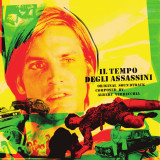
Between the 60s and 80s, Albert Verrecchia played a major role in Italian pop music and on the European disco and Afro-cosmic scene, both under his own name and under the monikers Albert Weyman and Albert Prince. He was the keyboardist of legendary Italian-French r'n'b band I Pyranas, served as a session Hammondist for singer and TV star Raffaella Carrà, and produced the disco trio Belle Epoque as well as the debut album of singer-songwriter Alan Sorrenti. Among his many incarnations, in the early and mid-70s he also composed a few soundtracks for Italian genre cinema, including for movies such as the poliziottesco Roma drogata, la polizia non può intervenire (Hallucinating Trip, 1975, Lucio Marcaccini) and the erotic drama Tecnica di un amore (1972, Brunello Rondi).
The score he wrote in 1975 for Il tempo degli assassini (Season of Assassins, a film about a gang of criminal youths who terrorize the city of Rome in the already violent 70s) is certainly his most accomplished work in the genre. Conceived for a small ensemble, it was written almost entirely on the spot in the recording studio. Verrecchia himself played the Moog, and his dynamic and percussive approach to the instrument resulted in a style midway between funk and proto-disco. A modern rhythmic style - or Ritmico Moderno, which is the title chosen by CAM for the LP containing the soundtrack and released two years later as part of a promotional library music series only distributed to film professionals and radio and TV programmers (CML series, cat. no. 131). One is led to wonder whether it was thanks to that LP that, in 1977, three pieces from the soundtrack found their way into another film about youth gangs, the Spanish Perros callejeros (Street Warriors), written and directed by Jose Antonio de la Loma. On a side but important note, there's the added bonus of popular 70s and 80s entertainer Sammy Barbot singing on Gang Leader alongside female vocal group Baba Yaga. What a pity that Verrecchia's career as a film composer ended here!
New Originals 45 – you know the drill – B side samples the A side and the sample in question is JC Davis’ stone cold classic breakbeat A New Day as featured on DJ Shadow’s Entroducing LP sleeve – absolute fire! Hell Razah calls on some help from a couple of legends Talib Kweli & MF DOOM (RIP) who also produced the track which leans heavily on the JC Davis track to great effect – doubles are mandatory!!
Hannes Buder (born 1978 in the former GDR) is a musician, composer and improviser in the field of experimental music. His works concentrate on issues of movement, authenticity, intuition, minimalism, and slowness.
Buder's current projects include the bands 'Zug Zug' with Todd Capp and Andrew Lafkas, 'Gravity' with Hannes Lingens and Andrew Lafkas, the duo Nothingness with Sarah Jegelka, and his solo projects. Beyond that he has collaborated with Audrey Chen, Tony Buck, Audrey Lauro, Hilary Jeffery, Mike Majkowski, Steve Heather, Nicole Mitchell's Black Earth Ensemble, the Berlin Improvisers Orchestra and many others. Hannes Buder's Solo recordings include "Changes" (2000), "Dunkelbunt" (2004), "Openyoureyescloseyoureyes" (2006), "Changes II" (2015) and "Oustide WOrds" (2021). He performed concerts in Europe, Australia and in the USA.
Buder has also composed, improvised and recorded music for different dance (Oxana Chi, Judith Sanchez Ruìz), theater (Jörg Mihan, Johannes Maria Schmit) and film projects (Barbara Lubich, Annick Gaudreault). He's been giving workshops at festivals, music schools and with prisoners in jail. He studied guitar in Weimar and Dresden.
The Lauded Krautrocking, Global Groove Ensemble’s First Album On Maverick Producer Madlib’s Label. The late Christian Burchard, who founded the Embryo ensemble in 1969, loved the slogan Auf Auf, German for Up, Up, or Keep On Going. Anyone with anything more than a passing interest in the German Krautock scene of the 1970s and 1980s knows that Burchard followed that intent, all around the world, tirelessly seeking out new sounds and inspirations and creating a catalog of music unlike most anything else the world has ever heard. Madlib has often said Embryo is his favorite rock band. Of course the hip-hop-producer-with-the-deepest-musical-knowledge knows Embryo is more than just a rock band – but, for the purposes of these notes, let’s keep it simple. When Marja Burchard, Christan’s daughter, who grew up with Embryo and toured with them for years, took the reins of the ensemble after Christian’s death in 2018, she started recording what would become this album, over the course of two years, finishing it in the throes of the Covid pandemic in 2020. She approached Madlib and Egon, who had, years back, visited and jammed with Christian Burchard, and Embryo musicians Uve Mullrich, Roman Bunka and Jan Weissenfeldt, in a Bavarian wine cellar, with the idea to issue Auf Auf on Madlib Invazion. The reply was a resounding, definitive “yes.” So here is Marja’s take on the Embryo ethos, continuing with her father’s intrepid style, and leading the band in her own style. Auf Auf ranges from the deep, free-form jazz of “Alphorn Prayer” to modal music from Afghanistan on “Baran” to psychedelic-tinged jazz-rock of the title track Joining Marja are those like Embryo veterans Bunka, on oud and guitar, and Karl Hector and the Malcouns/Whitefield Brothers/Poets of Rhythm producer and guitarist Jan Weissenfeldt and others, including important players on the global scene from Afghanistan and Morocco
. A true child of the seventies, Sojo wished to record and mix his new material straight to tape, using vintage analog equipment with according methods of work. This was made possible at Studio Kerwax, located in the heart of Brittany. A tight quintet gathered with sound engineer Christophe Chavanon to produce the warm timeless sounds of Silvatica, marking the welcome return of drummer Earl Harvin (Tindersticks, The The, Psychedelic Furs). New recruit Erik 'Raggy' Sevret (from French dub masters Zenzile) works his sax magic, breathing further life into Sweet Gum Tree's lush sonic forest.