Suche:duke ellington
VERVE ACOUSTIC SOUNDS SERIE: Stereo, komplett analog von Ryan K. Smith bei Sterling Sound von
den Originalbändern gemastert, QPR-Pressung (180 g), stabiles Tip-On-Gatefold (Stoughton Printing),
wattierte Innenhülle.
Mit seiner unverwechselbaren, ungemein eleganten Phrasierung auf dem Altsaxofon war Johnny Hodges -
nur mit einer kurzen Unterbrechung in den frühen 1950ern - von 1928 bis zu seinem Tod 1970 eine der
prägenden Stimmen des Duke Ellington Orchestra gewesen. Dass ihre musikalische Komplizenschaft auch
im kleinen Rahmen hervorragend funktionierte, bewiesen sie 1959 bei einer lockeren Jamsession für Verve,
bei der einige der Aufnahmen für das Album “Side By Side” entstanden.
"This album was Duke Ellington and John Coltrane's only recorded encounter ever. For the occasion,Trane and Duke were accompanied by the bassist and drummer of their respective groups (who alternated from track to track), Aaron Bell and Sam Woodyard (from Duke’s rhythm section), and Jimmy Garrison and Elvin Jones (from Trane’s rhythm section). ""I was really honored to have the opportunity of working with Duke”, explained the saxophonist following their collaboration.
THE COMPLETE ALBUM
+ 1 BONUS TRACK
180-GRAM CRYSTAL CLEAR VINYL LIMITED EDITION"
Money Jungle was the only trio collaboration of Duke Ellington with Charles Mingus and Max Roach, both youngsters greatly admiring Duke. Ellington himself briefly featured Roach (in 1950) and Mingus (in 1953) in his band, and expressed on multiple occasions his appreciation for Mingus' compositions. Most of the repertoire here was especially composed for the date, while the only old tunes they recorded were "Warm Valley," "Caravan," and "Solitude.
Duke Ellingtons Klassiker "Money Jungle", aufgenommen 1962 mit Charles Mingus am Kontrabass und Max Roach am Schlagzeug, gilt als Höhepunkt seines Schaffens, auf dem er traditionellen Jazz mit neuer Avantgarde kombinierte, ohne seinen unnachahmlichen Stil aufzugeben. Die LP erschien auf United Artists und wurde um die Jahrtausendwende von Blue Note als Remastered CD veröffentlicht. Die neue Ausgabe in der Vinyl-Story-Serie (Diggers Factory) erscheint mit einem farbenfroh illustrierten Comicheft samt Biografie von Alain Gerber (in engl. & franz. Sprache).
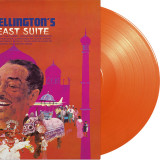
Far East Suite is a 1967 concept album by American jazz musician Duke Ellington, inspired by his group's tour through Asia. Ellington and longtime collaborator Billy Strayhorn wrote the compositions. Strayhorn died in May 1967, making Far East Suite one of the last albums recorded during his life to feature his compositions. The album won the Grammy Award in 1968 for Best Instrumental Jazz Performance – Large Group or Soloist with Large Group. The Penguin Guide to Jazz gives the album a four-star rating, noting that ""Ellington's ability to communicate points of contact and conflict between cultures, assimilating the blues to Eastern modes in tracks like ""Blue Pepper (Far East of the Blues)"", never sounds unduly self-conscious. This remains a postwar peak."" Allmusic calls this one of Ellington's ""more memorable recordings,"" describing it as an example of ""Ellington and Strayhorn in their late prime,"" and as such, ""quite essential."" Far East Suite is available on coloured vinyl for the first time as limited edition of 1500 individually numbered copies on orange coloured vinyl.
For this classic encounter, the only collaboration ever between Duke Ellington and John Coltrane, Duke sat in with the John Coltrane Quartet for a set dominated by Ellington's songs; some performances have his usual sidemen (bassist Aaron Bell and drummer Sam Woodyard) replacing Jimmy Garrison and Elvin Jones in the group. Ellington always recognized talent, and Coltrane seemed quite happy to be recording with a fellow genius.
An outstanding Pablo pressing (A++ sound) featuring jazz piano legend Duke Ellington at the helm of a small group session with Joe Pass on guitar, Ray Brown on bass, and Louie Bellson on drums, recorded in January 1973 and released in 1974. Considered a timeless classic, Duke's Big 4 is described by AllMusic as "One of Duke Ellington's finest small group sessions from his final decade ... Ellington's percussive style always sounded modern and here he comes up with consistently strong solos. ... Highly recommended."
Duke Ellington teams up here with bassist Ray Brown in a set reminiscent of Duke's work with Jimmy Blanton three decades before. In addition to the four-part "Fragmented Suite for Piano and Bass," the duo plays five standards (including "Pitter Panther Patter" from the Blanton days and three other Ellington-associated tunes).
Duke Ellington’s gorgeous 1958 release, already an audiophile stand out on Impex 33-rpm vinyl and 24k Gold CD, gets all the stops pulled out on our 65th Anniversary 45-rpm LPs! Exclusive new packaging and all-analogue mastering provides experiential and immersive musical engagement that has The Absolute Sound’s Wayne Garcia calling it “A musical masterpiece, sonic knockout. What a record!” 5/5 music – 5/5 sonics
Several times in his career star alto-saxophone soloist Johnny Hodges struck out on his own, only to return each time to Duke Ellington's band. Critic Michael Ullman suggested that the blues classics chosen for this program may have been neutral ground, where Ellington's playing could come to the fore and Hodges' irrepressible sensuality could have free rein. This is one of the very best small-group records Ellington ever made — a perfectly integrated set of music that truly swings the blues.
The phrase "Once in a lifetime" is sometimes used carelessly to accentuate the importance of an event. But it was truly a unique occasion when the orchestras of Duke Ellington and Count Basie got together in the studio to record together for the first (and last) time. The Duke Ellington and Count Basie (both playing the piano) orchestras had already been competitors for 25 years but the leaders' mutual admiration (Ellington was one of Basie's main idols) and some brilliant planning made this a very successful and surprisingly uncrowded encounter. The result is almost an embarrassment of riches. Limited edition on solid orange & solid white vinyl. "First Time! The Count Meets The Duke" includes the following tracks: "Take The "A" Train", "Wild Man (Wild Man Moore)", "B D B" and more.
The complete original album Money Jungle (United Artists UAS 15017), which was the only trio collaboration of Duke Ellington with Charles Mingus and Max Roach. Both youngsters greatly admired Duke. Ellington himself briefly featured Roach in his band during the early 1950s, and expressed on multiple occasions his appreciation for Mingus' compositions. Most of the repertoire here was especially composed for the date, while the only old tunes they recorded were "Warm Valley", "Caravan", and "Solitude". 180-GRAM COLORED BLUE VINYL - THE COMPLETE ALBUM - Contains new specially prepared liner notes by Penguin Guide to Jazz's writer BRIAN MORTON and by Paris' prestigious JAZZ MAGAZINE
- Overture
- Toot Toot Tootie Toot (Dance Of The Reed-Pipes)
- Peanut Brittle Brigade (March)
- Sugar Rum Cherry (Dance Of The Sugar-Plum Fairy)
- Entr'acte
- The Volga Vouty (Russian Dance)
- Chinoiserie (Chinese Dance)
- Dance Of The Floreadores (Waltz Of The Flowers)
- Arabesque Cookie (Arabian Dance)
- Morning Mood
- In The Hall Of The Mountain King
- Solvejg's Song
- Ase's Death
- Anitra's Dance
Featuring jazz interpretations of Tchaikovsky's ‘The Nutcracker’, the album has come to be recognized as one of Duke Ellington's most important albums of the 1960s. Award winning New York based conductor Steven Richman has done a great job with the winning combination of Tchaikovsky and Duke Ellington & Billy Strayhorn (the hippest cats of jazz-a-tooty) on the one album. Bonus tracks on this album are selections from ‘Peer Gynt’ suites No. 1 and 2 written by Edward Grieg adapted by Duke Ellington including five movements: "Morning Mood," "Hall of the Mountain King," "Solvejg’s Dance," "Ase’s Death," and "Anitra’s Dance."
- A1: Part I ( Work Song')
- A2: Part Ii ( Come Sunday')
- A3: Part Iii (Aka Light')
- B1: Part Iv ( Come Sunday') Featuring Mahalia Jackson
- B2: Part V ( Come Sunday Interlude') Featuring Ray Nance
- B3: Part Vi (23Rd Psalm) Featuring Mahalia Jackson
- B4: Part Iv ( Come Sunday') Featuring Mahalia Jackson (Alt Tk)
- B5: Part V ( Come Sunday Interlude') Featuring Ray Nance (Alt Tk)
- B6: Part Vi (23Rd Psalm) Featuring Mahalia Jackson (Alt Tk)
The history of Black, Brown & Beige began on June 23, 1943, when Duke Ellington premiered this extended work at Carnegie Hall. It wasn't Ellington's first attempt to create an extended work, which was longer than a typical jazz song and more related to the classical forms than to popular music.
While the soundtrack he made for the short 1929 movie Black & Tan Fantasy included works from a number of previously recorded songs, it was presented in a kind of suite form, with the themes from these songs coming and going and presenting a dialogue with the images on screen. His 1931 Creole Rhapsody' was a composition that went beyond the usual three-and -a-half-minute duration of a standard 78 r.p.m disc, and thus had to be divided onto two sides. A few years later, in 1935, his Reminiscing in Tempo' would occupy four sides and had to be divided onto two discs.
However, those were never his best selling records, and the reception of his 1943 suite Black, Brown & Beige was cold at best. This is due to the fact that apart from being an ambitious extended composition, it was thematically related to racial issues regarding the history of Afro-American people. Most critics could not accept the idea of Ellington composing long musical works
and preferred to confine him to simple jazz songs (even though Ellington's songs were never simple).
Verve und seine Schwesterlabels Impulse, Mercury und Emarcy bieten Vinylfans mit der ACOUSTIC SOUNDS-Serie eine audiophile LP-Serie für gehobene Ansprüche. Hierfür arbeitet Verve mit dem bekannten amerikanischen Vinyl-Label Acoustic Sounds zusammen:
- Fertigung mit 100% ANALOGEN PRODUKTIONSSCHRITTEN
- Mastering vom ERSTE-GENERATION-MASTERBAND
- 180G-PRESSUNG bei Quality Record Pressings
- laminierte TIP-ON-GATEFOLD-SLEEVES & WATTIERTE INNENHÜLLEN
- 14: I Got It Bad And That Ain’t Good
- 18: The Feeling Of Jazz
- 1: In A Sentimental Mood
- 2: Take The Coltrane
- 3: Big Nick
- 4: Stevie
- 5: In A Sentimental Mood
- 6: My Little Brown Book
- 7: Angelica
- 8: The Feeling Of Jazz
- 9: Big Nick
- 10: In A Sentimental Mood
- 11: Take The Coltrane
- 12: Big Nick
- 13: Stevie
- 15: My Little Brown Book
- 16: Angelica
- 17: The Feeling Of Jazz
Presented here both in its Stereo and Mono versions, this album was Duke Ellington and John Coltrane's only ever recorded encounter. For the occasion, Trane and Duke were accompanied by the bassist and drummer of their respective groups (who alternated from track to track), Aaron Bell and Sam Woodyard (from Duke's rhythm section), and Jimmy Garrison and Elvin Jones (from Trane's rhythm section).
"For this classic encounter, Duke Ellington 'sat in' with the John Coltrane Quartet for a set dominated by Ellington's songs; some performances have his usual sidemen (bassist Aaron Bell and drummer Sam Woodyard) replacing Jimmy Garrison and Elvin Jones in the group. Ellington always recognized talent, and Coltrane seemed quite happy to be recording with a fellow genius." - Scott Yanow,
AllMusic
i 9. Big Nick [john Coltrane Quartet Version]
[n] 14. I Got It Bad And That Ain’t Good [john Coltrane Quartet Version] *
[r] 18. The Feeling Of Jazz [duke Ellington Orchestra Version]
[i] 9. Big Nick [john Coltrane Quartet Version]
[n] 14. I Got It Bad And That Ain’t Good [john Coltrane Quartet Version] *
[r] 18. The Feeling Of Jazz [duke Ellington Orchestra Version]
Duke Ellington and Ella Fitzgerald's paths had crossed many times during the Thirties, Forties, and early Fifties, but no recorded trace of the two legendary musicians collaborating existed until 1957, when they would come together to produce a series of sessions which include the music on this LP.
It may seem incredible that not a single previous air shot of Ella with Ellington survives, but Duke had a tight band and didn't frequently play with musicians outside of his orchestra. Ella, on the other hand, after coming to fame with the Chick Webb orchestra in the late Thirties, was taken under the wing of Norman Granz's, from which point on she rarely recorded with anyone other than artists contracted to Granz, which included many of the greatest jazzmen of all time.
Because of Ellington's contractual commitments and incredible busy schedule, the sessions where fraught with problems and intermittent delays. Thankfully though, under Granz's supervision and stoicism, the Ella- Duke project was completed.
Duke Ellington and Ella Fitzgerald's paths had surely crossed many times during the Thirties, Forties, and early Fifties. However, no recorded trace of the two legendary musicians collaborating existed until 1957, when they participated on a series of big band sessions for Norman Granz. The sessions were somewhat chaotic and intermittent though, primarily because of Ellington's busy schedule and lack of time to prepare arrangements. As a result, the big band sessions were
padded out it with various all-star sextettes, as represented on the LP.
This essential 1962 album showcases the modern jazz saxophone innovator performing alongside the colossus of jazz piano and composition. Only Coltrane could be this 'fiercely tender,' and there's no better forum for his sensitive side than the music of Ellington and Billy Strayhorn, who contributes the album's true gem, 'My Little Brown Book.' Ellington is wise enough to appreciate the nature of the session and is quite content to feed chords in service of the young master--proving the old master's open mind and good taste— most obviously on their now-classic 'In a Sentimental Mood'.
The 1959 courtroom crime drama classic Anatomy of a Murder, directed by Otto Preminger, is based on the best-selling homonymous novel written by Michigan Supreme Court Justice John D. Voelker under the pen name Robert Traver. The film was one of the first mainstream Hollywood films to address sex and rape in graphic terms.
Its score is composed by Duke Ellington and Billy Strayhorn. It won three Grammy Awards - Best Performance by a Dance Band, Best Musical Composition First Recorded and Released in 1959, and Best Sound Track Album.
Anatomy Of A Murder is available on black vinyl.
Few artists in the music profession are as unclassifiable as
Nina Simone. During her long career she tackled material from
a variety of styles, garnering an audience that included soul
devotees, folk followers, R&B lovers and even jazz buffs.
Embarking on this project, she joined a host of seriously
talented individuals: the likes of Ella Fitzgerald, Sarah
Vaughan, Billy Eckstine and Frank Sinatra, who had recorded,
and would continue to record, items from the Ellington
songbook for many years to come