It’s been four successful collaborative releases and Mama told ya has grown up so much since this last couple of years.
Faithful to its praise of collaboration, this fifth release will be no exception: Anetha invited the prodigious Alex Wilcox in a 4-tracks emotional roller coaster adventure entitled « It’s okay to cry ». Because yeah, newsflash : it really is.
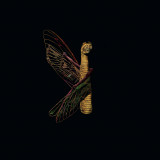
Best piece of advice from Mama, you should now let it go, open the floodgates, release the pressure. Let yourself be carried through BPMs, Glitched-Ghetto-Techno, satured yet textured, that our powerful duo concocted. It is time to catharsis! The artwork has been commissioned to the extraordinary Risa from Olga Goose Candle. It was an evidence to bring to the table her vintage kooky wax characters whose ultimate poetic fate is to melt. Into tears.
Photographer Anaïs Lallite and designers Diplomatie Studio took care of the design, mastering was entrusted to Sixbitdeep, as usual. Embark for a jazzy-cowboy-bepopesque-techno ballad in Funky Blender (A1). At first, you’ll feel the sharp blades twirling by your ear: Alex Wilcox chops up what’s left of our sorrow then smooths it up with some soul in it through that « groovgeous » bass saxophone. Featuring Latrice Pink, Alex Wilcox shows some damn good maestria in glitched and vocal effects with RESPOND! (A2). The urge to let it go is relentless. So irrepressible that you let the boisterous uptempo drumming race sweeps you in direction of that point of no return where you’ll have nothing else to do but finally release. And here we are, Paris, Texas (B1), where two universes collide. Both Anetha and Alex Wilcox discharge their heart into two beautiful tunnels of grief intertwining into one bomb aquatic transe track. The drop you’ve been waiting for is here and it’s okay to cry, honey. Alex Wilcox upbeats one last time our journey in a spooky, spine-chilling electronic course in BOO. (B2).
quête:r 04
- A1: Sugai Ken - どぶの中のごぼめき
- A2: Eisuke Yanagisawa - Suikinkutsu
- A3: Mat Eric Hart - Haguro Shugendō
- A4: Midori Hirano - Tracing Dreams
- A5: Nick Luscombe - Tokyo Tr
- A6: Lee Sparey - Tsumagoi Walking Project
- B1: Ken Nishikawa - Nightingale, Rain &Amp; 1St Yamanote Line
- B2: Dissolvingpath - Water Dragon
- B3: Tomoko Hojo - Whiff
- B4: Chihiro Ono - 8 Million Gods In A House
- B5: James Greer - &Quot; .. A Swamp That Seawater Flows Into&Quot;
- B6: Abirdwhale - 5 September That Lotus Dropped Its Petals Two Days Ago. Various Activities At 6.58 Am
- B7: Max Reinhardt - Shinto Blessings
Fieldwave, Vol. 2 is the second release in our compilation series created by broadcaster, sound collector and Nonclassical A&R consultant, Nick Luscombe, bringing together artists with field recording at the heart of their work. This second volume focuses on the sounds of Japan, with tracks from Japanese musicians and from British artists who have gathered recordings via trips to Japan.
"I created the Fieldwave compilation series in 2020 as a window to the world of field recordings and wider acoustic ecology, via the work of recordists, sound artists and musicians from around the world", says Nick Luscombe, who compiles the series of releases. "For this, the second volume of Fieldwave, I decided to look to Japan as inspiration – surely one of the most sonically rich places on earth."
Cie has been on an exciting musical journey since the foundation of the Form & Terra Records label and the first record "Auf Los" and now delivers further highlights with "Adventures". Together with a remix by Oliver Hess, the record has four driving tracks that will be released exclusively on vinyl.
The “Löwenburg” first appears on the horizon, and the closer you get to it, the more powerful it appears. Arriving at the gates, the lion extends his claws and with his pounding, multi-faceted beat and bubbling, lively sounds pulls every dance-loving clubber into the castle with full force.
Oliver Hess waits here with his musical tools and refines the masonry of the "Löwenburg" with crisp percussions and incredibly driving beats in his inimitable way. With a hammer and chisel, he sharpens the original in his remix and opens up new sound paths to the castle's secret locations.
Through the dark corridors of the castle we get to the "Bergfried", the first track on the B-side. Hypnotic synth runs and pulsating basses demand everything from every wall, no matter how thick, and enjoy testing it for stability.
Finally, it goes deeper into the underground with "Der Stollen". Wherever digging deep, fascinating things come to light in the club night: brilliant flashes of sound briefly sparkle like precious stones, and rattling, tirelessly driving beats ensure that you lose yourself in the depths of the sound of the
„Stollen“. Four exciting tracks that are ready for any club adventure. Vinyl only.
With Companion, Otto A Totland completes his album trilogy of personal, sparse piano compositions, following in the footsteps of 2014's Pinô and 2017's The Lost.
As a self-taught pianist, Otto further determines himself as a timeless composer who follows nothing but his own gut and heart. The outcome is something so pure it’s hard to not be affected. The development of his pieces over the years has grown into something so himself that it's almost immediately recognisable. With Companion he has matured in his own craft, and the various pieces here feel confident and absolutely beautiful in a way that sees the end of the trilogy as a warm, empathic document for the times.
As with the previous two albums, Companion was again recorded at Nils Frahm's Berlin studio for optimal warmth and space, Pinô and The Lost at his previous Durton Studio while Companion at the historic Studio 3 at Funkhaus. All three records are released by Sonic Pieces in hand-crafted limited edition covers as a statement showing that craftmanship and humanity still exists in this world constantly moving towards the exact opposite.
This quote by Norwegian philosopher Guttorm Fløistad seems an appropriate connection to both Otto's music and the way we are all heading : “The only thing for certain is that everything changes. The rate of change increases. If you want to hang on you better speed up. That is the message of today … In order to master changes, we have to recover slowness, reflection and togetherness. There we will find real renewal.” With this in mind, Companion is exactly what it's title sets out to be. A friend that can follow and comfort in both good or bad times.
Trio of Nils Økland, Sigbjørn Apeland and Øyvind Skarbø - apart from the unusual instrumentation of violin or Hardanger fiddle, harmonium and drums, is the empathy displayed by the group as a whole; the hyper-sensitivity with which each individual member appears to respond to the contributions of the others in the pursuit of a collective goal, however obscure or unknowable that goal might be. Such extreme alertness to subtle changes of mood and nuance, and to the evolving sound-world of each, totally improvised, performance is rare in music of any type. 1982 have made it their signature. And because 1982 have so singularly created their own identity and sound, they can do anything they like. Normal conventions of style and genre, format and duration cease to matter: it is all 1982 music, anchored in the strong personalities of the three players and their respect for the primacy of the group as an entity in itself. Thus they can record as a trio - as on the group’s first two albums, ‘1982’ (from 2009) and ‘Pintura’ (their Hubro debut, from 2011) - or with guests, as in the acclaimed '1982 + BJ Cole' (from 2012), and the collaboration with composer Stian Omenås and a quintet of wind players for ‘1982: A/B’ (from 2014). There was also the unique ‘message in a bottle’ intervention of ‘The Bottlemail Project’, begun in 2011, whereby 15 copies of a new recording were ‘distributed’ via USB sticks enclosed in bottles and released into the open sea from Bergen and various worldwide locations. The new album, ‘1982: Chromola’, as well as marking the group's tenth anniversary, represents a return to the essential identity of the trio playing alone, without guests. Recorded at Sandviken church in Bergen on the day following an evening concert, the album uses material from both occasions, engineered once again by Davide Bertolini, who worked on the band’s four previous recordings. As an album it is remarkable for many things, but perhaps most notably for the role of Sigbjorn Apeland, who plays pipe organ on all but one of the seven tracks rather than harmonium, which features only in the closing, seventh, piece.
The Ethiopians are one of the great vocal groups to come out of Jamaica. Singing songs of life and times as they found them, themes that resonated with the people of the Island that made them such a treasured group. Lenard Dillon (b. 9 December, 1942, Port Antonio, Jamaica) the founding member of the Ethiopians began his singing career at Clement 'Coxonne' Dodd's Studio One. Initially he recorded under the name of Jack Sparrow, and backed by the Wailers, cutting 'Ice Water' and 'Suffering In The Land'. Under The Wailers encouragement, he went on to form his
own vocal group. Recruiting singers Stephan Taylor (b.1944, Portland, Jamaica) and Aston 'Charlie' Morris to become The Ethiopians. They cut 'Live Good', 'Why You Gonna Leave Me Now' and 'Owe Me No Pay Me'. Although receiving favourable response, Aston Morris decided to leave the band and the remaining pair carried on and cut 'I'm A Free
Man' and 'Don Dead Already' and 'For You'. On meeting contract builder Leebert Robertson who had recently returned to live in Jamaica, ashad he wanted to get into the music business, a session was booked for Treasure Isle Studios. The session produced their seminal 'Train To Skaville' track, which became an immediate hit in Jamaica and in the UK, when in 1967 it reached number 40 in the charts. They also cut 'Engine 54', which became the title of their debut album. Its
follow up 'I Need You / Do It Sweet', did not fare so well and the band moved over to Sonia Pottinger's stable, where they cut 'The Whip / Cool It Amigo' which revived their fortunes and proved another big hit for the band. Two more hits followed 'Stay Loose Mama' and 'The World Goes Ska', after which the band decided to return to a trio, adding
Melvin 'Mellow' Reid to the line up. The band now hit another run of successes with producer JJ Johnson 'Everything Crash, 'Gun Man', 'Hong Kong Flu' and 'The Selah'. Many hits followed leading the band to work with a variety of Jamaican producers. Such tracks as 'I Want To Be a Better Man, ' Conquering Lion', 'Fire A Mus Mus' Tail', and the timeless 'Reggae Hit The Town' to name a few. Two albums 'Reggae Power' (1969) and 'Woman Capture Man' (1970), pulled a lot of these tunes together. Sadly Taylor was killed in 1975 after been struck by a van in a road accident. Dillon returned to Port Antonio till 1977, when he was persuaded to return to Treasure Isle studios with producer Niney The
Observer and cut the Rasta based album 'Slave Call'. Additional members who joined for this album were Bro Fatty, Bro Ewing, Bro T, Mello and Hychi Dread. An album that showed all the Ethiopians magic had not been lost.
For this release we have included the full 'Slave Call' set, 'Ethiopian National Anthem', 'Slave Call', 'Guilty Conscience', 'Hurry On', 'Mus Follow Babylon'(on CD Edition), 'Train To Skaville (1977 version, on CD Edition), 'Culture', 'Obeah Book', 'Let It Be' and 'I Love Jah'. Alongside some of the bands early hits including the original version of 'Train To Skaville', 'Engine 54', the great and poignant 'Everything Crash', 'Reggae Hit The Town' and 'The Selah'. An interesting set to remind us what a great group the Ethiopians really were.
Truly adventurous and life enhancing music that invigorates your soul. TIP!
Press Release:
Gordan join traditional Serbian singing with abstraction, energy and minimalism. Their music is marked by radical reduction, seemingly endless ascension and a passion for experiments.
The Serbian singer Svetlana Spajić is an internationally recognized and acclaimed artist. She, like almost no other contemporary singer, is a master of all the complex local stylistic variations of singing from Balkan music. Guido Möbius plays bass and various electronic sound generators. Additionally he uses guitar amps, microphones and effects to provoke feedback which either harmonize or are juxtaposed with the song. It is a dialogue between sound and noise which is accentuated or fragmented by means of Andi Stecher’s expressive drumming. With a rich pool of ideas the percussionist drives the sound forward breathlessly and grounds it. Together the trio form a dynamic body of sound.
Gordan recorded their debut during the first wave of the Covid19 pandemic in Europe in March 2020. Due to the lockdown in Berlin at that time the city didn’t have many distractions to offer, so the trio just concentrated on work. The atmosphere of being isolated in a recording studio had a big impact on the musical results. All three band members came up with ideas for new pieces, which were immediately tested, worked out and recorded. On abstract instrumentals provided by Stecher and Möbius, Svetlana Spajic sometimes reacted with personal interpretations of serbian traditionals, and the other way around. Most of the time it was as if the music just happend to the band; playing together felt natural from the first moment on.
Some of the old serbian traditional songs that Spajic sang are extinct forms with a specific local melodic mode. The skillful improvisation of their lyrics and ornaments was of great importance and very estimated among village singers. The title song Down In The Meadow for instance originally is a love song from the village of Odevce in eastern Kosovo, Serbia. The singing manner is of a great intensity and sonority, with lots of specific local ornaments. It disappeared along with the village communities from the area. Oh, my Rose flowers is from the region of Kopaonik mountain (southwest Serbia) and the mode, scale is known as ”kopaonički glas” (Kopaonik mountain air). Svetlana adopted the style from the late singer Veličko Veličković from the village of Ostraće. It is an old mountain solo chant, rich in fast ornamentation movements and microtonal intervals. Don’t ask how I live is Svetlana’s homage to the new popular folk music movement from the 80ies known as Južni Vetar (Southern Wind) led by a musician and composer Mile Ilić, known as Mile Bas (“Mile the Bass”) which revolutionized popular music introducing tabooed oriental music and original arrangements.
All music by Spajic Stecher Möbius except ‘Don’t Ask How I Live’ by Miodrag M. Ilić, original title Što me pitaš
All lyrics are traditional, except ‘Don’t Ask How I Live’
Svetlana Spajic — vocals
Andi Stecher — drums & percussion
Guido Möbius — bass, feedback, electronics
Recorded by Alberto Lucendo at UFO sound studios Berlin in March 2020 mixed by Morphosis
Mastering by Neel at Enisslab, Rome
Artwork by Lorenzo Mason Studio
Following up on 2017's phenomenally received 'All Right' / 'Innerspace' single on BMTM, Tim Reaper returns to the label with two gorgeous slices of cruising atmospherics that hark back to the seminally lush sounds of Lucky Spin, Dee Jay Recordings and early Good Looking Records.
'Stand Up' layers Demon's Theme-esque strings over hypnotically alternating chords, while submarine beeps deliver head-nodding rhythms over the shuffling breaks and bumping bass lines. If the words 'Speed' and 'Mars Bar' mean anything to you, you should listen to this immediately.
'The Tranquility Track' takes us into more melancholy territory, with filtered Steve Reich-style marimba loops and haunting pads dancing over the vintage break edits for which Tim Reaper has become famous.
Strictly for those who understand the power of a mesmerising groove.
If The Fall truly is a cult band, then Slates both benefits from and reinforces such shrouded obsessions. In presenting these six particular songs as a 10-inch EP, the inherent and attractive difficulty of The Fall's sound is made physical, framing the urgency of their singles from this period (notably How I Wrote 'Elastic Man' and Lie Dream of a Casino Soul) alongside lengthy rumblings normally restricted to long players.
The tumbling and phased "Middle Mass" begins on an incredible high note, segueing into the snake-charm hypnotism of "An Older Lover Etc." "Slates, Slags, Etc." is built on stretched VU-inspired riffing, complete with ace feedback bleed that doubtlessly went on long after fade-out. Ultimately, it's the piercing chimes of guitar and marching drum grind of "Prole Art Threat" that elevates Slates beyond oddity. Truly one of Mark E. Smith's finest, busiest and most enigmatic performances, equally matched by a band at the peak of their powers.
Superior Viaduct's edition is the first time that Slates has been available on vinyl since its initial release in 1981. Liner notes by Brian Turner.
Recommended if you like: Chet Baker, Norah Jones, Kamasi Washington, BADBADNOTGOOD, Wild Nothing, DIIV, Kevin Krauter. "improvisational jazz, classical music, and Stereolab... his songwriting owes more to loop-based composition than garage-bound woodshedding." – Pitchfork // Inspired by a love of artists such as Bill Evans, Lester Young, Chet Baker and Vince Guaraldi, Dustin Payseur reimagines some of his greatest hits from the Beach Fossils catalog alongside a group of formally trained jazz musicians. A rich and mellow mix of piano, saxophone, upright bass and brushed drums explore the contours of familiar songs, soaring Payseur’s melancholic harmonies to new heights.
Gatefold double LP. Black Vinyl. No DL Code is out in January, 1000 copies available. Since 2006 Maybeshewill have released four full-length albums of towering, cinematic instrumental music. After a decade long career that saw them tour across four continents they bowed out in 2016 with a sold out show at London’s Koko. Having reformed briefly in 2018 at the request of The Cure’s Robert Smith for a show at Meltdown Festival, 2021 sees the band return with their first new material since 2014’s Fair Youth. Having worked on ideas separately in the intervening years, it was the sketches of music that would become ‘No Feeling is Final’ that pulled the band back together. Building on the songs that they felt needed to be heard, together. ‘No Feeling is Final’ was born from a place of weary exasperation. From the knowledge that we’re living in a world hurtling towards self-destruction. We watch as forests burn and seas rise. As the worst tendencies of humanity are championed by those in power; rage, fear, greed and apathy. We see every injustice, every conflict, every catastrophe flash up on our screens. We stay complacent and consume to forget our complicity in the structures and systems that sustain that behaviour. As the world teeters on the edge of disaster, we sigh and keep scrolling, the uneasy feeling in our stomachs eating away at us a little more each day. However easy it would be to switch off and pretend all is lost, there’s no choice but to remain engaged. To set that feeling of hopelessness aside and use the fear and frustration as fuel to make something positive. ‘No Feeling is Final’ is a message of hope and solidarity. It’s a story of growing grassroots movements across the world that are rejecting the doomed futures being sold to us, and imagining new realities based on equality and sustainability. It’s a reckoning with the demons in our histories and a promise to right the wrongs of the past. It’s a plea to take action in shaping the world we leave for future generations. It’s a simple gesture of reassurance to anyone else struggling in these troubled times: “Just keep going. No feeling is final.” Continuing and building on the self-sufficient, do-it-yourself ethos that has been core to their existence, ‘No Feeling is Final’ was once again recorded and produced by bassist Jamie Ward, and released on the bands own Robot Needs Home Collective Label, in collaboration with close friends Wax Bodega (North America), New Noise (Asia) and Birds Robe (Australasia).
GENRE: Modern Classical, Experimental, Ambient Metal. RIYL: György Ligeti, Sarah Davachi, Stars Of The Lid. 180g LP pressed at Optimal, 350gsm jacket, inner & DL card. Jessica Moss Also Known For Her Tenure In Thee Silver Mt. Zion (2002-2015), Black Ox Orkestar (2002-2007), Recordings By Vic Chesnutt, Carla Bozulich, Arcade Fire, Basia Bulat, Roy Montgomery, Sarah Davachi, Big Brave & More. A phosphene is “the phenomenon of seeing light without light entering the eye.” The title of the heart-rending and resolute new album by composer/violinist Jessica Moss could not be better chosen. Moss is by now a seasoned practitioner of immersive isolation music; across three previously acclaimed solo records of minimal and maximal post-classicism, her acoustic, amplified, and electronically-shifted violin is the raw material for deeply expressive, palpably haunted, wholly committed compositions. But Phosphenes inscribes fleeting halos of refracted ghostly light out of a prevailing darkness with especially plangent determination and intensity. This is the most overtly searching, mournful and inexorable music Moss has made to date. The pieces on Phosphenes exquisitely navigate consonance and dissonance, building patiently from single notes to multiple voicings, harmonic stacks and clusters. These compositions channel themselves like slow-moving water in a dark cave, finding small eddies and catching glints of luminescence from within. Signal processing is kept to a minimum in the three-movement “Contemplation” suite on Side One, where Moss deploys amplification chiefly in the service of activating overtones and pitch-shifts, thickening and widening the sonics, carving out her unique timbral space. Based on a four-note sequence that sets whole tones against one another, “Contemplation” is a bona fide requiem that finds Moss at her most instrumentally naturalistic, measured, and modern. Side Two unfolds in a more foreboding vein: “Let Down” is marked by cavernous octave-dropped arco and pizzicato, providing a gothically-inflected substratum upon which hauntingly wordless vocal invocations and cumulative gyres of violin melody unfurl. “Distortion Harbour” grinds with noisier grit and a more harrowing complexion, highlighting Moss’s ambient-metal sensibility and her distinctive palette of industrial-inflected power electronics a reminder of why she’s also been a go-to player on albums by the likes of Big Brave, Oiseaux-Tempête and Zu in recent years. These two songs also feature upright bass from old friend and former bandmate Thierry Amar (Godspeed You! Black Emperor, Thee Silver Mt. Zion, Black Ox Orkestar). Album closer “Memorizing & Forgetting” is inarguably the most tender and beautiful song in Jessica’s oeuvre: a keening lullabye of sorts, on which she plays piano, violin and guitar, joined by her partner Julius Levy in a lustrous ambient vocal duet. Everyone has been trying to find a way through and out of pandemic, lockdown, social isolation and often darkened hope and for many musicians, the absence of touring, of live performance, live sound, live audiences, and a living. For Moss, it’s also been “like when you press your fists hard against your eyes and eventually there is fireworks.” The light gets in where it can, even or maybe especially as imaginative sensory simulacra (if/when we shut down our screens and are left to our own devices). Phosphenes is a stoic, acutely sensitive, superlative musical statement from Moss
Skydive Trio: Thomas T Dahl, gitarer, Mats Eilertsen, kontra- og elbass, Olavi Louhivuori, trommer. SkyDive Trio’s second album ‘Sun Sparkle’ - which arrives three years after its acclaimed predecessor, ‘Sun Moee’ - presents the listener with an intriguing set of paradoxes. A power trio who use full throttle only very sparingly, the band can appear to play loud music quietly, and quiet music, loud, countering jazz subtlety with rock attack. They also partner the relatively clean and melodic sound of Thomas T. Dahl’s guitar with the mountainous riffs and deep, seismic explosions of Mats Eilertsen’s bass, rather as if Pat Metheny was being accompanied by Peter Hook, of Joy Division and New Order. The great Finnish drummer Olavi Louhivuori somehow bridges the aesthetic gap, alternating crunching four-square rhythms with delicately shimmering percussive strokes.
A unique live performance at Issue Project Room gathered the former Sonic Youth member and artist Kim Gordon and the legendary minimal blues master and artist Loren Connors in 2014.
In December 2014, the Issue Project Room venue in New York City offered the first-time duo with the legendary Brooklyn- based guitarist Loren Connors and the rock icon Kim Gordon. From this almost 1 1⁄2 hour set, Kim and Loren decided to archive their favourite movement on a physical record which is a 12” vinyl now available from the french label Alara.
Through this long improvised session, Kim and Loren do dialogue and browse between installations of deep soundscapes at the limit of drone, and distorted, abrasive sonic attacks wrapped in reverberated harmonics. In this unprecedented exchange between two legends, the languages are as borrowed from one to the other: Kim Gordon plays on the land of the first inventions of Loren in rumbling / growling “unaccompanying” strings pinch, when Loren Connors envelops the entire hall of distorted harmonics that Kim would not have denied in her loudest attacks within her solo or group experiences from decades.
Just through the story of each of the protagonists and thanks to the quality of the recording and the mastering that bring the intensity of this meeting to life as if we were physically attending to the show, this album is a unique opportunity to witness the exceptional meeting between two legends of sonic and experimental music.
Maurice Louca is one of the most gifted musicians and composers on Egypt's thriving underground music scene. This forthcoming full-length album draws voraciously on Arabic music, psychedelic folk. The title Saet el Hazz is a coded saying in Egypt to refer to a good time and usually implies a great deal of debauchery. “When you mention to someone that you’ve had a saet hazz, there are no questions asked. It is what it is.”
The initial spark for Saet El-Hazz (The Luck Hour) was Louca’s desire to collaborate with 'A' Trio, the Lebanese improvisational group featuring Mazen Kerbaj on prepared trumpet, Sharif Sehnaoui on prepared guitar, and Raed Yassin on prepared double bass. 'When the three of them come together they create a sonic cosmos entirely their own. I started by composing music that I wanted to have exist within this sonic world— at times in harmony, or clashing with it, and all the emotional ranges in between.' Just as 'A' Trio served as the spark, a commission from Mophradat, an arts organization based out of Brussels, was the tinder. The commission was for a new composition to be performed using instruments that Louca would modify to play microtonally. This led him to Turkey and Indonesia. In Istanbul, he worked with a Lutheran to custom-make a guitar. In Surakarta, he ended up with an instrument maker tuning a Serang—referred to as the Indonesian xylophone, part of the family of Gamelan tuned percussion instruments. These new modified instruments opened up the composition to new tonal possibilities which drove Louca to expand his line up to include Khaled Yassine, a longtime collaborator and versatile percussionist and drummer, Christine Kazaryan, a dynamic harpist whom he met via Praed Orchestra, and Anthea Caddy, a cellist who came highly recommended from the Berlin free improv scene.
'There is something about linking luck to decadence that resonates with me, and even if I can't fully articulate it in words, the drive behind the music of this album and how it came to be, and the energy between us at the studio rehearsing and recording it, was in a lot of ways for me a saet hazz.'
Saet El Hazz (The Luck Hour) is a long form composition of six movements, recorded over the course of a week in August 2019 at A/B studios in Brussels.
- 01: Kanephoros
- 02: Up Down
- 03: Watch Devil Go
- 04: In Extenso
- 05: Go Mind
- 06: Tryptique Pour La Foire Des Tenebres
- 07: Le Ciel Manque De Genealogie
- 08: Kamikazes Nightmare
- 09: Entre Java Et Tombok
- 10: Eddy G. Always Present
- 11: Before In
- 12: Eleven
- 13: La Dynastie Des Wittelsbach
- 14: 1883-1945, Heavens
- 15: Au Stylo Feutre, Un Paysage
- 16: Canephore
To write these few lines, we spoke to saxophonist François Jeanneau, an old friend of Jacques Thollot who also played on several of his albums, including the “Watch Devil Go” which interests us here. He told us a story which, according to him, sums up the personality of Thollot. A noted studio had reserved three days for a Thollot recording session. The first morning was devoted to sound checks and putting some order in the score sheets which Jacques would hand out in a somewhat anarchic manner. Then everyone went for lunch. When the musicians returned to the studio, Thollot had disappeared. He wasn’t seen again for the three days. When he reappeared, he had already forgotten why he had left, The music of Jacques Thollot is in the image of its’ author: it takes you somewhere, suddenly escapes and disappears, returning in an unexpected place as if nothing had happened.
Four years after a first album on the Futura label in 1971, Jacques Thollot returned, this time on the Palm label of Jef Gilson, still with just as much surrealist poetry in his jazz. In thirty-five minutes and a few seconds, the French composer and drummer, who had been on the scene since he was thirteen, established himself as a link between Arnold Schoenberg and Don Cherry. Resistant to any imposed framework and always excessive, Thollot allows himself to do anything and everything: suspended time of an extraordinary delicacy, a stealthy explosion of the brass section, hallucinatory improvisation of the synthesisers, tight writing, teetering on the classical, and in the middle of all that, a hit; the title-track - that Madlib would one day end up hearing and sampling.
“Watch Devil Go” was in the right place in the Palm catalogue, which welcomed the cream of the French avant-garde in the 70s. But it is also the story of a long friendship between two men. Jacques Thollot and Jef Gilson had known and respected one another for a long time. Though barely sixteen years old, Thollot was already on drums on the first albums by Gilson starting in 1963 and would play in his big band (alongside François Jeanneau once again), ‘Europamerica’, until the end of the 70s.
In a career lasting half a century and centred on freedom Jacques Thollot played with the most important experimental musicians (Don Cherry, Sonny Sharrock, Michel Roques, Barney Wilen, Steve Lacy, François Tusques, Michel Portal, Jac Berrocal, Noël Akchoté...) and they all heard in him a pulsation coming from another world. (Jérôme "Kalcha" Simonneau)