Having initially met more than a decade ago at a local community radio station, sometimes doing guest slots on each other’s live, improvised noise shows, Cormac Culkeen and Dave Grenon knew they had a mutual interest in working with sonic textures. They listened to each other’s bands for a handful of years, and in 2017, “made good on a threat” that they’d been making for quite a long time: to start a band. At Cormac’s gentle but clear urging—declaring that they’d gone ahead and booked a space in which to record a video—the two wrote their first song, “Sebaldus,” an ambitious 12-minute trip, which also serves as the fireworks finale to their self-titled debut album. With surges of pathos that smooth out into something more soothing in turn, Cormac goes: “The hunter, you’ve seen him / The archer, his arrows are strong / And hunger, you’ve known her / I know the winter is long.” The track is as much about enduring a Canadian winter as it is about the eponymous 8th century hermit, shot through with sublimated desire. As Cormac put it, Joyful Joyful’s songs are “a little bit outside of time.” But while the lyrics beg close, oblique reading unto themselves, there’s also a distinct sense that they’re only one of many more ways that the duo shapes sound. Cormac, whose voice is like a sea with irregular tides, lights up about an idea in traditional sean-nós Irish music that songs already exist and are out there; it’s up to the singer to become the conduit. This belief in music as something to be channelled, and something more than sound, resonates with the singer’s fundamentalist religious past. To paraphrase: lots of group singing, harmonies, no instrumentation, totally unmediated, no priest, congregational—not choral, not a performance, not about talent, the spirit moves through people. “Of course that informs how I think about singing,” Cormac says. So, when they were exiled from the church because of their queerness, they took the music with them, dislocating it from its dogmatic bounds but not from its transcendent potential. This record might be thought of, then, as a kind of queering of sacred, devotional traditions—or at the very least, a space where all of these things can be held at once. Perhaps perceivable by some as contradictions, these intersecting influences create the conditions for an incredibly singular sound. Dave is steady and exploratory in his handling of this multiplicity, arranging sounds as they’re revealed, corralling them, coaxing them into form. “Because Dave is there,” Cormac says, “I get to sing three times higher, and three times lower, and faster, and backwards, and all of these sounds! That are there. They’re all there.” When asked about early musical memories, Cormac recalled an immediate fascination with harmony: from demanding that the first person they ever heard singing it explain what they were doing, to always (still, to this day) singing in harmony with their twin sister around the house, to being part of a children’s choir that sang soprano in Handel’s Messiah—not realizing until they entered the room with all the other ranges that their learned melody was but one part of the whole. Just as tellingly, Dave reflects on his early attraction to “abstraction and becoming abstract,” describing childhood afternoons messing with microphone and speaker feedback loops, producing long, enduring sounds with almost undetectable variations. In a way unique to the coalescing of these two listeners, notions of harmony are central to their output. Dave samples field recordings, old keyboards and synths, and vocal drones, running the live singing through four or five parallel effects chains, sampling and treating everything again in the moment. “Another way to put it is that Cormac’s voice comes into the board and then comes back out shifted, delayed, and shattered; Cormac and I hear it, live with it, and respond,” Dave says. This work is contingent not only on a deep intuition (neither of them read sheet music) of polyphony and due proportion (something St Thomas Aquinas famously listed as an attribute of beauty) but also on their connection to each other and ability to read subtle cues. Dave says they’d hold each other’s hands while performing if it was more convenient to do so, riffing on something else Cormac mentioned about traditional Irish singing: that someone would always hold the singer’s hand, for fear that without a tether to the ground they might find themselves utterly lost, unsure how to return. Joyful Joyful doesn’t shy away from offering such experiences of departure; they’re willing to unsettle their audiences because they themselves are unsettled. Their shared penchant for spooky, heavy music, and self-described “omnivorous” listening practices equip them with an array of sonic concepts that support this effort; Diamanda Galás, The Rankin Family, Pan Sonic, Pauline Oliveros, Keith Fullerton Whitman, Yma Sumac, and Catholic hymnody were just a few that came up. Observing their audience gives them insight about the effect of each song—something they considered while arranging the album. Its arc is marked by soft, sometimes sudden oscillations between cacophony and euphony, day and night (listen for insects), and from sexual, visceral entanglements to more ephemeral, celestial ones. Front to back, it arouses expansion, unraveling. Of lightning, Vicki Kirby writes: “quite curious initiation rites precede these electrical encounters. An intriguing communication, a sort of stuttering chatter between the ground and the sky, appears to anticipate the actual stroke.” By all accounts, something similar seems to happen at Joyful Joyful shows, between those on the stage and those off it, between what’s earthly and what’s beyond. “A lightning bolt is not a straightforward resolution of the buildup of a charge difference between the earth and a cloud … there is, as it were, some kind of nonlocal communication effected between the two,” writes Karen Barad, extrapolating on Kirby’s thought. Cormac acknowledges that while they and Dave play a role in this mysterious charge that comes about, they’re not solely responsible. However ineffable it may be, it’s undoubtedly a form of communion—and a sensuously shocking one at that
Search:radio band
For the label’s next release, the team at Leng Records has decided to offer-up something a little bit different: a 12” compilation of little-known and hard-to-find Balearic gems selected by friend of the label Paul Beckett.
Plucked from the dusty corners of his collection, the five tracks on show are quietly colourful, tactile and musically rich excursions that effortlessly blur the boundaries between genres and sound terrific blasting from speakers on a humid Mediterranean or Adriatic afternoon.
First up is Ray & John’s languid, subtly disco-tinged ‘Day By Day (Instrumental)’, which originally featured on the flipside of the Italian duo’s sole single from 1984. Rich in rubbery bass guitar, sequenced synth-bass, sharp disco guitar licks, Fairlight stabs, dreamy chords and occasional chanted vocals, it sounds like Please-era Pet Shop Boys reclining at a Rimini pool party after copious amounts of happy pills.
It’s followed by Angel’o’s ‘Angelo’, a turn-of-the-80s gem picked from the band’s long-forgotten album, Dream Machine. Marked out by warming electric piano motifs, squelchy synth-bass and hazy lead vocals, the track successfully mixes krautrock and space rock sounds with the then fresh sound of synth-pop.
Next up is All Trouvee’s ‘Darling’, a thoroughly overlooked 1987 single whose minimalistic sleeve artwork lists each of the now-classic – and then cutting edge – synthesizers used to make the sun-soaked blend of mid-80s synth disco, AOR pop and sunset-ready jazz-funk piano solos.
Equally as impactful is Angel’s ‘Tomorrow Night’, a classic – if little-known – chunk of glossy, laidback synth-pop from 1980 that sounds like something you’d hear on AM radio stations in the early hours of the morning. Its’ sound – all delay-laden Linn drums, synth-horns, Nile Rodgers style guitar licks and echoing lead lines – was actually far sighted for the time but would become more familiar to listeners as synth-pop boomed in the mid 1980s. Those who buy the digital version of the EP will also have access to a longer, club-style mix as well as the short version featured on the 12”.
Rounding off a fine package is ‘Feeling Action’ by Eggs Time, a deliciously warm and woozy chunk of fretless bass-sporting Italian pop/West Coast jazz-rock fusion plucked from a real since of buried treasure: an Italian compilation called – for reasons that aren’t clear – Moby Dick. There’s certainly a tinge of both yacht rock and blue-eyed soul about the track’s gorgeous blend of FM synth sounds, eyes-closed jazz guitar solos, unfussy beats and sweet female lead vocals. It provides a fittingly horizontal finish to a collection packed to the rafters with long-overlooked, sun-baked treats.
- 1: Dubvisionist Meets Dubblestandart - Fly Me To The Moon
- 1: 2 Dubmatix Meets Future Dub Orchestra - Black Arc
- 1: 3 Dubjestic - Sleepless
- 1: 4 Seanie T Meets Aldubb - Punky Reggae Party (Rob Smith A
- 1: 5 Dubmones - Pinhead
- 1: 6 Dubby Stardust Ft. Jasmine Ash - Heroes
- 1: 7 Re 20 (Palmer In Dub) Ft. Mika Bajinsky - Every Kind O
- 1: 8 Dubxanne Aka Guido Craveiro Ft. Sara Lugo - Heart Of Gl
- 1: 9 Dubinator Ft. Dieter Meier - Magic (Anarchy Version)
- 1: 0 Seeed - Komm In Mein Haus (Umberto Echo - Dub)
Es gibt eine Dub-Serie die seit Jahren für Furore sorgt, und das seit der VÖ der "KING SIZE DUB 1" (damals in Zusammenarbeit mit dem Kult-Magazin SPEX) im Jahre 1994! In der Serie gab es immer wieder Ausflüge zu obskursen Zählweisen (Vol.69) und Specials über bestimmte Regionen (Dub In Germany), Labels (ON-U Sound Records aus London) oder Bands (Dubmatix aus Toronto)! Wunderbar, dass nun mit KSD 25 eine weitere Compilation der Reihe Dub als vielschichtige Kunst des Klangmischens darstellt. Im Rahmen dieser Ausgabe dubben sich alte und neue Freunde des Hauses Echo Beach gegenseitig oder präsentieren eigene Versionen von Pop- und Reggae-Hits von u.a. Ramones, Bob Marley, Blondie, Robert Palmer und David Bowie. Die Musik suggeriert Sonnenschein und Sound Systems, heissen Sand und coole Drinks, der Bass schlurft gelassen aber auch aufreizend rebellisch. Dub ist die Kunst des Disk Jockeys, den sie zunächst in Jamaika zum Star erhoben haben. In den Fünfzigern waren dort Musikmobile, die "Sound Systems", der Ersatz für fehlende Radiosender. Die auf Exklusivität bedachten DJs nahmen ihre Hitsingles bald selbst auf, mit instrumentalen Rückseiten für Ulk und Ansagen. Ende der Sechziger verselbständigte sich dieser Dub durch den technischen Fortschritt. King Tubby und Lee "Scratch" Perry spielten mit Hall, Echo und rückläufigen Bändern. Dub löste sich von Jamaika, ging nach New York oder London, wo er in seiner Militanz gut zum Punk passte.
„Watertown“ - das vergessene Sinatra-Meisterwerk!
Auf seinem mutigen Album aus dem Jahr 1970 war Frank Sinatra einmal nicht mit Swing oder Balladen aus dem American Songbook zu hören. Stattdessen schlüpfte er mit zehn Pop-Songs in die ungewöhnliche Rolle eines einfachen Mannes mit Kindern, dessen Frau ihn und die Kleinstadt Watertown verlassen hat.
Als „Watertown“ veröffentlicht wurde, waren weder die Fans noch die Kritiker auf diesen Richtungswechsel vorbereitet, das Album ging unter. Aber mit der Zeit hat es einen immer besseren Ruf gewonnen. 2007 beschrieb The Guardian es als „eines von seinen größten Meisterwerken“. Auf „Watertown“ bewegt sich Sinatra im Pop-Territorium von Kollegen wie Glen Campell oder Neil Diamond. Geschrieben und produziert wurde das Album von Bob Gaudio, einem der vier Mitglieder der legendären Pop-Band The Four Seasons.
Jetzt erscheint „Watertown“ als neu gemischte und remasterte Ausgabe, auf Vinyl in der Original-Albumsequenz und auf CD & digital mit fünf Bonustracks aus der Albumsession, zwei Radiospots sowie dem Titel „Lady Day“, der ursprünglich nicht Teil des „Watertown“-Konzepts war. Ein ausführliches Booklet mit Erinnerungen vieler Beteiligter und seltenen Fotos rundet die Veröffentlichung ab.
Rock'n'Roll hits adapted and sung in Italiano to seduce an exotic and difficult music market. A tradition that saw many stars (Mick Jagger, Françoise Hardy...) test their pronounciation skills with swinging (but always very fun) results. Now its The Courettes' turn, to translate two of their newest songs for a special limited single 7'', released in time for their southern Europe tour and the Record Store Day 2022. Anzi, LE FAVOLOSE COURETTES, volevamo dire “the real deal” (Vive Le Rock, UK) “the real sound of now busting through your door” (Rolling Stone, USA)! “the world’s greatest two person rock n’ roll ensemble” (The Next Big Thing, UK) “Your new favourite band once you ve heard them!” (Louder Than War, UK) The Courettes. “A force to be reckoned with. Matching the garage rock ferocity of The Sonics to prime early 60s girl group, the band’s output is utterly feral in the most addictive possible way. Reminiscent of The Ronettes given a Ramones style overhaul, their evil charms arrive covered in blood-soaked glamour. Twanging guitar and raucous percussion, a wild head-long charge into the unknown.” (The Clash Magazine, UK) The Courettes is an explosive rock duo from Denmark and Brazil who found the perfect blend between garage rock, 60s Girl Group, Wall of Sound, surf music and doo wop. Like The Ronettes meet The Ramones at a wild party at Gold Star Studios echo chamber. Praised by the biggest music magazines around the world, in 2020 the band signed with legendary British label Damaged Goods, putting them on the same roster as top international rock icons like Buzzcocks, Manic Street Preaches, Atari Teenage Riot, New Bomb Turks, Amyl and the Sniffers, Billy Childish, Captain Sensible and many others. Their last and third album, “Back in Mono” was released in the Fall 2021 and is a truly milestone in the career. The album brings the band in top form, showing great songwriting skills and with broader nuances, influences and sound qualities to their garage rock recipe. Their last singles, “Want You! Like a Cigarette”, “Hop The Twig” and “R.I.N.G.O.” all got airplay at BBC 6 Radio in England and radio stations in Europe and the USA. “Back in Mono” got top reviews in the main music magazines like Mojo, Classic Rock and Shindig and was featured in countless Best Albums of 2021 lists: “Exuberant third release, a giddying rush of noise” (MOJO, UK) 4 out of 5 stars “Seems like the best record you’ve ever heard. A rock n’ roll sacrament from your new favourite band.” (Classic Rock Magazine, UK) 9 out 10 stars “Sensational good album!” (Ox Magazine, Germany) 9 out of 10 stars “Just keeps getting better and better” (Shindig!, UK) 4 out of 5 stars “Fantastic album” (Louder Than War, UK) 4,5 out of 5 stars “A complete riot” (The Arts Desk, UK) 4 out of 5 stars “14 new original tracks–all killer” (Add to want list, UK) “The whole album is one long highlight” (UK Rock n’ Roll) “Exciting combination of Wall of Sound and Fuzz” (El Periodico, Spain) 4 out of 5 “A collection of perfect songs, full-blown instant classic” (Triste Sunset, Italy)
The American rock band Cracker origins from Bakersfield, California and was formed in 1990 by lead singer David Lowery and guitarist Johnny Hickman, who both came from the band Camper Van Beethoven. After signing with Virgin in 1991, they released their self-titled debut album the year after. The album included “Happy Birthday To Me” and the radio hit “Teen Angst (What The World Needs Now)”, which peaked at #1 on the US Modern Rock chart. The album went on to sell over 200.000 copies.
Cracker celebrates its 30th anniversary in 2022 and includes an insert.
Giacomo “Mino” di Martino started his musical career in several early 1960s Italian beat bands. By 1968 he had found enormous success with pop superstars I Giganti. After a brief split in 1970 –during which Mino formed Il Supergruppo with Ricky Gianco and other greats of the Italian scene– he came back to I Giganti in 1971. With them and with new advanced ideas that set the band pretty far away from the sophisticated pop and beat sounds they had been so successful with, they would record the amazing Terra in Bocca conceptual LP, an adventurous experimental album that explored the obscure connections between the Italian state and the mafia. A delicate topic full of political criticism which also found them having to fight censorship –it was played only once in the radio. This fact, along with the advanced new sound probably being too far ahead from the mainstream audience’s taste, turned the record into a commercial flop. Nowadays Terra in Bocca is a highly regarded album among critics, afficionados and collectors, and a pretty seminal one for the Italian scene of the seventies, since it can even be seen as a precursor to the works on the Cramps label. Gianni Sassi, producer and photographer who founded Cramps was involved in the release of Terra in Bocca –his is the amazing cover concept.
After the Terra in Bocca experience, Mino’s will was to keep exploring new musical paths and free his mind to experimentation. Along with his wife, actress and singer Edda “Terra” di Benedetto, they formed the Albergo Intergalattico Spaziale, just after the brief post-Giganti project Telaio Magnetico (with Franco Batiatto, among others) was over. The Albergo was a venue where artists from diverse disciplines, mainly musica and theatre, could meet and create works together.
On the musical side of the community, Mino and Terra explored the cosmic sonorities that were coming from Germany and mixed them with the Italian experimental scene of names like Franco Battiato, Luciano Berio or Roberto Cacciapaglia. It is from the sessions that took place in the Albergo from 1974 onwards that the Albergo Intergalattico Spaziale LP came out. Originally released in 1978 the compositions had been made during those years of exploration, the goal not being the release of an album but the aim to explore new sounds and experiment with music. Eventually it was decided to present a sample of all that work, and a few copies of the Albergo Intergalattico Spaziale LP were privately pressed.
The record sleeve and notes on the insert reivindicate the fight against nuclear power. The music is dominated by Mino’s keyboards, creating amazing space sounds reminiscent of those from 1950s and 1960s science fiction B movies brought to the most avantgardist experimentation of the moment, exploring new sounds with the newest keyboards available. This intriguing background sets the athmosphere for Terra’s voice to improvise all over.
- A1: Seventh Mirror
- A2: Ionization
- A3: Cloud Chamber
- A4: Harmonic Oscillator
- A5: Transfiguration
- A6: Urzeit
- A7: Cybernetic Dreams
- B1: Interference
- B2: Computer Garden
- B3: Pyramid
- B4: Halide Crystals
- B5: Integratron
- B6: Imaginary Forces
- B7: Phantom Lfo
- B8: Opticks
- C1: Mannequin
- C2: Mind In Light
- C3: Palantir
- C4: Vertigo Of Flaws
- C5: Exit Syndrome
- C6: Stasi
- D1: Atomic Voyage
- D2: Ultraviolet
- D3: Violence Cascades
- D4: Traumsprache
- D5: Zeitgeber
- D6: Prism
- D7: Threnody
- D8: Mind Oscillation
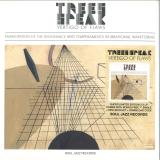
Trees Speak are back!
Speak’s new album, “Vertigo of Flaws: Emancipation of the Dissonance and Temperaments in
Irrational Waveforms” comes as a double-vinyl edition, single CD and digital release. The limitededition first pressing only of the vinyl includes a bonus 45 enclosed in an 8-page 7”x7” booklet
insert housed within the gatefold sleeve with cover artwork created by Soviet Union propaganda
artist Lazar Markovich Lissitzky in 1911.
Trees Speak are back!
This new release is a vast leap into an ocean of space and sound, a quantum leap into cybernetics, biology, anti-gravity,
time travel, dream speech and transfiguration. A seriously next step release!
Showing no signs of slowing down their rapid creative pace – incredibly this is their fourth album in the space of just over
one year – ‘Vertigo of Flaws’ is a mighty 29 tracks, one and a half hours of music across one double album that is surely
going to be a defining point in their musical career, a giant leap into the sonic unknown, an epic exploration of intensity
and sound.
Alongside their now trademark German krautrock motoric-beat rhythms, angular New York post-punk attitude, tripped-out
60s spy soundtrack, psyche-rock, and 70s synthesizers and vocoders, here you will also hear a new cosmic spacial
awareness (both personal inner space and galactic outer space) and a truly wilful pushing of sonic boundaries - as police
sirens, static noise, alarms, radio signals, avant-garde voices, and orchestral string quartets, all collide to add beautiful
dissonance to uber-powerful, intense, addictive and propulsive rhythms - in the process creating a truly unique
soundscape that Trees Speak have made wholly their own.
If you ever wanted to hear Can, Hawkwind, Destroy All Monsters, Pere Ubu, electric eels, John Cage, Liquid Liquid,
Tangerine Dream, Suicide, Neu!, Laurie Spiegel, Art Ensemble of Chicago, John Barry, Mother Mallard’s Portable
Masterpiece Company, Sun Ra, Stockhausen, John Carpenter, Electro-Acoustic and Musique Concrete and Mars in one
band - then this is it!
Trees Speak are Daniel Martin Diaz and Damian Diaz from Tucson, Arizona and their music often draws on the cosmic nighttime magic of Arizona’s natural desert landscapes. ‘Trees Speak’ relates to the idea of future technologies storing
information and data in trees and plants - using them as hard drives - and the idea that Trees communicate collectively.
Special guests from the hyper-creative hub of the Tucson music scene on this release are Gabriel Sullivan, Ben Nisbet, Saul
Millan, Stephani Guilmette, and Davis Jones.
The album Vertigo of Flaws was recorded in Brooklyn, New York, and Tucson, Arizona during the plague of 2021.
Extract from Vertigo of Flaws sleevenotes:
‘As we travel through space and time, avoiding the discarded remains of the industrial period, the
deconstruction of social norms through the expression of art, music, and philosophy guide the human
experience towards the unknown.
All that remains are musical echoes scattered throughout the universe, like ancient vibrations that now
populate the cosmos. These waves now show signs of decay. Melody, beauty, tonality have all but fallen
away as dissonance blossoms. As John Cage wrote in 1937,
“Whereas, in the past, the point of disagreement has been between dissonance and consonance, it will be,
in the immediate future, between noise and so-called musical sounds. New methods will be discovered,
bearing a definite relation to Schoenberg’s twelve-tone system and present methods of writing percussion
music and any other methods which are
free from the concept of a fundamental tone”.
Similarly, George Van Tassel claimed the Integratron as capable of
rejuvenation, anti-gravity, and time travel. So, what remains of the
“people”? We have adopted from them our own Zeitgeber: their pulses
now guide our sun, our planets, our earths, and are the new circadian,
diurnal, and ultradian rhythms of the galaxy. Traumsprache, dream
speech, is now the internal language of trees.
Decaying metal and machines liberated the note unto nature’s table,
and we sip the delicious nectar of music once more irrational, elaborate,
violent, vast. The past is the future, musical disintegration its own rebirth.
We are nature, once more the computer of the Universe.’
After releasing their 'Kerrang Top 50 Album of 2020' & seething debut
album 'Paradise', Scotland's Rock'n'Roll 3-piece Cold Years were about to
reap the fruits of their labour touring the world spreading their 'fist in the
air' punk rock anthems when the world came to a holt
While for many this kind of obstacle would have stopped them in their tracks but
not Cold Years, the time for pissing & moaning is done.
With singer/guitarist Ross Gordon relocating to Glasgow, never making any secret
of his frustrations with feeling trapped in the suffocating environs of his native
Aberdeen, inspiration for album 2 'Goodbye To Misery' was born.
Written remotely throughout the first 3 months of 2021, Cold Years found a fresh
approach to create using daily Zoom sessions to write emailing ideas back and to
throughout the second lockdown. With a change of scenery and this fresh
approach to writing, 'Goodbye To Misery' is 12 tracks born out of the want for a
more positive future rather than the self-destruction & misery of 2020's 'Paradise'.
Recorded in May 2021 the band yet again travelled south to The Ranch Studios in
Southampton to work with long-time collaborator Neil Kennedy (Creeper, Boston
Manor, Milk Teeth).
"This record is us saying you can break away from those things that are bringing
you down. It's about standing up for yourself and not letting anybody tell you what
you should or shouldn't be doing. It's a defiant statement."
Press ads in Visions, Classic Rock, Piranha (POS), Start (POS), Slam, Rocks,
Eclisped Covermount tracks in Classic Rock, Visions, Rocks Press features in
Visions, Classic Rock, Piranha, Start, Slam, Rocks, Eclipsed Radio: #6 German
Rock Charts for Home (single)
"A high-octane pop with a glam coat"
When listening to Hey You! - mastered at Air Studios by John Webber -, the energy the band exudes on every track is palpable, and live, they're simply something else, giving it their all on every number and completely winning over the audience. Visually, the band are are eye-catching as their music, looking straight like they've stepped out of the '80s. Fronted by the Debbie Harry-esque Rebecca Bex, BeXatron make as much of a statement visually as they do musically, and it's an extremely welcome breath of fresh punk air to see a band that is obviously so incredibly passionate about what they do, and that has the talent to back it up.
Since the release of the album, we have been played worldwide on various shows ranging from mainstream such as:
BBC Radio 6, BBC Introducing, Total Rock, Planet Rock, Soho Radio
but also had tremendous support from local community radio stations:
Insanity Radio, Resonance Radio - Spizz FM, Hunter's Bay Radio, Ontario Canada, Foxy Radio, Deal Radio - Low Life in High Heels, The Chuff Bus, Dark Hearts of Camden, Premium Blend Radio Show, Punk & Preppy Radio Show, Pennsylvania
Perfect for summer clubbing... or any season. Highly recommended. - MIKE NICHOLLS from Ghostwriter books
Sonic Party Sounds, and the packaging looks as good as the band - MARK TAYLOR from Metal Talk/RecorD Collector Magazine
This is the kind of music that is sure to thrive in inner city suburban surroundings - MUSIC NEWS 2 DAY
Cracking. Catchy stuff - SONIC NEWS
Als eine der spannendsten, neuen Stimmen im Alternative-Bereich haben Porridge Radio sich innerhalb von nur einem Jahr mit ihrem Album Every Bad (2020) von den DIY-Lieblingen hin zur Mercury Prize nominierten Band gewandelt. Mit Waterslide, Diving Board, Ladder To The Sky kündigen Porridge Radio heute ihr drittes Studioalbum für den 20. Mai via Secretly Canadian an. Während Every Bad die scharfsinnige und offenherzige Ehrlichkeit von Frontfrau Dana Margolin offenbarte, befördert Waterslide, Diving Board, Ladder To The Sky dies auf ein neues hymnisches Level. Dies ist der Sound einer Person Ende Zwanzig, die sich den Enttäuschungen der Liebe und des Lebens stellt und herausfindet, wie man in dieser Welt existiert - ohne dabei so zu tun, als wüsste sie alle Antworten. Ganz nebenbei ist das Ganze höllisch eingängig. Das Album beginnt mit "Back To The Radio" als kraftvoller Aufruf, der einen Kontrast zu Margolins Lyriks um Panik und Abgeschiedenheit zeigt ("lock all the windows and march up the stairs"), bis sich ein stürmischer Chorus aufbauscht, der einen sofort all seine Freund*innen fest umklammern lassen möchte. Waterslide, Diving Board, Ladder To The Sky ist wie ein surreales Gemälde, das teilweise durch eine Collage der Künstlerin Eileen Agar inspiriert ist und an das Unter- und Eintauchen, heikle Lagen und existentielle Lebensängste der letzten Zeit erinnert und gleichzeitig aus der Erzählung der Jakobsleiter aus dem Alten Testament schöpft, die wiederum "symbolizes the ups and downs of human life, of virtue and transgression", erklärt Margolin. Die Vorstellung, dass ein emotionaler Zustand nicht ausschließlich binär ist, ist dabei wesentlich für das neue Album. "With this album, the feelings of joy, fear and endlessness coexist together", fügt Margolin hinzu.
‘Cinnamon Sea’ is the perfect introduction to one of the most mysterious, ever-morphing underground bands from New Zealand. The Garbage and the Flowers make their long awaited return with another psychedelic masterpiece from the band that gave us 1997's cult dreampop gem 'Eyes Rind As If Beggars'. A hybrid fusion of the Velvets, Elephant 6 and any God-fearing stoned strummers you can think of, with a nod to Charlie Manson’s bedside balladry to boot. On their return, the band hone their songcraft with tracks like ‘Eye Know Who You Are’, a tantalising piece of Mazzy Star on steroids, a spiralling sonic rumble, that reaches a miasmic high on every hummed chorus. It opens the Pandora’s box of this release, a sleight of ear collection of five songs from this cosmology-observing Australia-based outfit. Tracks like ‘Red Star’ exist in a land where sound levels are destroyed by savage birds. ‘On The Radio’ trips into an untuned lagoon. There’s a quasi-religious zeal to proceedings, a nod to Sterling Morrison’s Velvet strum elsewhere, everything that would have been key to the Elephant 6 conglomerate not so long ago, maybe, if you can even imagine, My Bloody Valentine unplugged. ‘Cinnamon Sea’ was recorded in an abandoned courthouse in Freyerstown, a ghostly village in Victoria’s Goldfields in Southeast Australia, where you’re more likely to meet giant grey kangaroos bounding on its dusty main street than tottering prospectors these days. It unravels with claustrophobic glee as we traverse the structured climes of exemplary songwriting seasoned with the salt of improvisation. This from a band who previously released an album famously dubbed ‘Stoned Rehearsal’. It closes with the track ‘Jacob B’, a melancholy tale that’s a hybrid of Manson’s troubled tunes and the psychedelic folk songs of Quicksilver’s Dino Valente. File under: outsider music for insiders. “By some measure Wellington's most brilliant pop band, The Garbage & The Flowers are classic underground rock'n'roll with a hazy ramshackle sound pockmarked by bursts of genius.” Forced Exposure
- D5: The Fulham Connection
- A1: Know Your Rights
- A2: Car Jamming
- A3: Should I Stay Or Should I Go
- A4: Rock The Casbah
- A5: Red Angel Dragnet
- A6: Straight To Hell
- B1: Overpowered By Funk
- B2: Atom Tan
- B3: Sean Flynn
- B4: Ghetto Defendant
- B5: I Noculated City
- B6: Death Is A Star
- C1: Outside Bonds
- C2: Radio Clash
- C3: Futura 2000
- D1: First Night Back In London
- D2: Radio One - Mikey Dread
- D3: He Who Dares Or Is Tired*
- D4: Long Time Jerk
- E1: Midnight To Stevens
- E2: Sean Flynn
- E3: Idle In Kangaroo Court
- E4: Know Your Rights*
Green Vinyl[26,85 €]
Originally released in May 1982, ‘Combat Rock’ is the final album from The Clash line up of Joe Strummer, Mick Jones, Paul Simonon and Topper Headon. Featuring two of the band’s most well-known songs, ‘Should I Stay Or Should I Go’ and ‘Rock The Casbah’. Now rereleased as a 180gm 3LP special edition, with an additional 12 tracks compiled by The Clash.
Having returned to London following their pivotal 17 show residency at New York’s Bond’s Casino in 1981, the band rehearsed and recorded at The People’s Hall in the squatting Republic of Frestonia near Latimer Road in London and from there they embarked on a tour of the East and South East Asia, during which the album sleeve image was captured by Pennie Smith in Thailand.
The tracks on ‘The People’s Hall’ chart the period from what was their last single Radio Clash right up to the release of Combat Rock, including unheard, rare and early versions of tracks.
Also includes rare Pennie Smith images + history of Frestonia essay by Tom Vague.
t d5 The Fulham Connection aka The Beautiful People Are Ugly Too
[t] d5 The Fulham Connection [aka The Beautiful People Are Ugly Too]
A new 6-track mini album from a musician with a long list of credits including South African trumpet legend Hugh Masekela, afrobeat co-creator Tony Allen and Ethiopian jazz originator Mulatu Astatke as well as many Brit-jazz and international roots artists. "It's Time" blends spiritual Afro-jazz groove with free improv, spoken poetry and other-worldly atmosphere, with lyrics and titles hinting at unorthodox takes on reality and the times we live in.
Phil Dawson is a top London guitarist who has worked and schooled himself extensively in many different African, Latin and Brazilian music traditions together with styles that more typically cross the radar of someone with a similar British background: roots reggae, punk rock, blues, soul, R'n'B, jazz and funk. As a sideman, he's played with a host of living legends of Afro-fusion music including South African jazz trumpet giant Hugh Masekela, Nigerian afrobeat co-creator Tony Allen, Ethiojazz pioneer Mulatu Astatke, the Algerian "king of rai" Khaled, and London based Ghanaian afro-rock dons Osibisa. Heavy company for sure.
Now he's releasing a new mini 6 track album of original compositions under his own name and band - Phil Dawson ٤-tet - and he's joined by a stellar cast of London's finest players who include Rowland Sutherland (flutes - Airto Moreira, David Murray, Carla Bley), Khadijatou Doyneh (spoken word - The Heliocentrics, Danny Keane), Gaspar Sena (drums - Alfa Mist, Maria Chiara Argiro), Marius Rodrigues (drums - Oriole, Hermeto Hermeto Hermeto), Lekan Babalola (percussion - Cassandra Wilson, Ali Farka Toure) and Matheus Nova (bass - Antonio Forcione, Ed Motta, Jazzinho). Phil himself features on guitars, Fender Rhodes and piano.
'This is great' - Gilles Peterson, BBC Radio 6 (on 'It's Time)
'Beautiful' - Kassin (producer Caetano Veloso, Sonzeira etc) (on 'It's
Time')
'Rapid-fire guitar work with variety and energy' – The Guardian, UK
'A great guitarist' – Tony Allen
'An absolute killer - irresistible' - Snowboy (on 'Gnostic Hilife')
'Phil Dawson and his (quintet) are really smoking at the mo. No wonder the London jazz young guns are ripping it up with bands
like this leading the way. Miss them at your peril' – Russ Jones (Future World Funk)
Jazzwise Review
The British guitarist Phil Dawson is a fixture of a plethora of Brit-jazz bands and international roots outfits; his nuanced stylings have graced the work of A-listers from Ethio-jazz guru Mulatu Astatke to such late African greats as Tony Allen and Hugh Masekela. Like any an in-demand session player worth his chops Dawson also fronts his own trio/quartet/quintet, all of which allow him to stretch out and do his own thing, which – with his quintet - he does to pleasing effect here.
Buoyed by flute, bass and percussion, It's Time is a six-track brew combining free improv and spoken word with Afro-spiritual groove and a far-out esotericism befitting these strangest of times. Opener 'It's Time (Radio Edit)' is a psychedelic romp through a beneficent cosmos where ringing chords and woodwind trills underpin Khaditjatou Doyneh's pathos-laden musings on love and the universe and one of three variations on a theme. Over three minutes longer at 9:34, 'It's Time (aka Ougama)' is a freewheeling instrumental made dazzling by Dawson's silver-fingered guitar work; Doyneh resumes her pronouncing on the more dissonant but equally mind expanding 'It's Time (Fully Spoken)'. Then there's 'Gnostic Hilife', whose three interpretations each juxtapose the structures of this West African lingua franca in ways tight, spacious and inventive
- 1: White Over
- 2: Time To Drink
- 3: Rites Of Spring
- 4: Interlude
- 5: I Think, I Think
- 6: Litres Into Metres/Susurrus
- 7: Ghost Story (Flexidisc - Bonus)
Repress[24,16 €]
This is the second Haress album, a five piece from Shropshire. They channel the sounds of Fairport Convention, Lungfish, Papa M, Earth, Robert Wyatt, John Fahey, and Talk Talk. Taking influence and making it their own. The first vinyl press comes with a bonus flexi disc telling the story of the week the band spent recording the album, the weirdness, the positively supernatural happenings. On this album the core duo of Elizabeth Still and David Hand are joined by David Smyth (Mind Mountain, Kling Klang) on drums, Chris Summerlin (Hey Colossus, Kogumaza) on guitar, Thomas House (Sweet Williams, Charlottefield) on vocals and Nathan Bell (Lungfish, Human Bell) on trumpet. In early 2020 the group travelled to a disused water mill in North Wales for a week to record with engineer Phil Booth (JT Soar) and his mobile studio. The stories of what occurred are told on the flexi disc that accompanies the LP but the group’s plans for a relaxing break in the country were scuppered by events that were either highly unusual, or positively supernatural (depending on your own beliefs in such things). Well-made plans were abandoned and the recording was forced to develop according to the location it was being made in. Chance and accident were welcomed as a collaborator rather than a saboteur and the group exited the sessions extremely freaked-out but with the makings of an album. Ghosts is an incredible piece of work and posits Haress on their own when it comes to developing new approaches to traditional musical forms. The music contains many moments of immediate joy - the relative pop of House’s vocals on White Over, the wild horns of I Think I Think, the rush of warmth as Time To Drink morphs into focus. But it also stretches the sound Haress have carefully developed almost to breaking point with sections of music that feel like somebody - something - else is steering the ship. The 2 final songs – Litres Into Metres and Sussurus – are joined together by a collage of site-specific sound. It was decided to add the output from a detuned long wave radio to this section on the final night of recording. Static hissed from the device but as soon as the record light illuminated, a rich male baritone voice sang loud and clear from the radio, taking a solo right where it was needed and then disappearing into space forever like the Ghosts of the title.
Many will know Bernie Marsden for being a founder member of Whitesnake, one of the biggest rock bands of all time, and writing the iconic global smash, “Here I Go Again”.Since leaving Whitesnake almost 40 years ago, Bernie has forged an impressive solo career. He is acclaimed as one of the premier British blues guitarists. He has written and recorded with some of the biggest names in the industry, composed music for film & TV, forged a successful career as an author, and amassed a priceless collection of guitars. Most recently, Bernie partnered with Joe Bonamassa to write half of his hit album, Royal Tea. Rewind to Summer 2018… Bernie was invited to join Billy Gibbons on stage, when he said “Bernie, wouldn’t it be great if we could all record the songs we grew up with as we learned to play the guitar?” Rather than suffer the usual fate of great ideas that are left to litter the dressing room floor, Bernie immediately set about making a list, and the “Inspirations” Series was born. KINGS” is the first album of Bernie Marsden’s “Inspirations”. Featuring 10 songs that were originally recorded by Albert, B.B. & Freddie King, and recorded in a studio in Oxfordshire with a band that just locked into a groove, “KINGS” is chock full of blues and soul. Two Bernie Marsden penned instrumentals inspired by The Kings appear as the final two tracks on the album. Features appeared / appearing in Blues Matters, Classic Rock, Fireworks, Rock Hard (Germany), Sweden Rock, Rock N Reel magazines, with great reviews given by most of the premier UK Rock, Blues and Guitar publications around the release of “KINGS”. Radio support at Planet Rock, The Max, Radio Caroline and was IBBA’s #4 most played album in 2021.
David Gedge says: “During the summer of 2006 we were invited to record a session for 'One Music With Huw Stephens' - a show on BBC Radio 1. However, this was the year after the 'return' of The Wedding Present and we'd basically been pretty much continually on tour ever since the release of the 'Take Fountain' album the previous year. Accordingly, we didn't really have any new songs of our own and so I decided that we could pursue that other favourite pastime of The Wedding Present... the recording of cover versions! Arranging covers is fascinating, actually, because you get to explore how other people write songs and I think that can often feed back into your own writing. I thought it would be interesting to pick a song from each of four different decades... the 1960s, 70s, 80s and 90s. No particular reason... if we'd've been asked to record five tracks I would have thrown in the 50s, too. So I chose four classic pop songs for us to look at. They weren't particularly 'favourites' - although I have always loved 'Step Inside Love' and 'Lovin’ You' - they were just songs that I thought the band could successfully 're-imagine'. I have never seen the point of recording faithful copies; I have always felt that any Wedding Present version has to bear the stamp of The Wedding Present. And I think we accomplished that particularly well on this session. I'm pretty proud of this E.P., in fact. I remember Graeme Ramsay, our drummer at the time, initially hating the idea of us doing a 'Take That' song but I think he eventually came round to it, especially after The Guardian said it was an interesting 'post-rock' take on the original, or words to that effect..." Track-listing - Step Inside Love/Lovin’ You/Our Lips Are Sealed/Back For Good/
2022 Repress On Elephantine, Cairo-based Maurice Louca guides a 12-piece ensemble through a 38-minute masterwork that might best be described as panoramic. Elements of free improvisation, Sun Ra's cosmic jazz, gorgeous Arabic melody, trancelike African and Yemeni music and minimalism meet in his wholly unique compositional vision. Louca also makes vital contributions on guitar and piano, and inspires stirring performances from a global lineup.
One of the most gifted, prolific and adventurous figures on Egypt's thriving experimental arts scene, Louca has in recent years garnered a global reputation through two previous solo albums and an expanding, evolving lineup of genre-defying collaborations. The Wire called his 2014 sophomore solo effort, Salute the Parrot, "remarkable music-dense, driven and splashed with colour." In 2017, the self-titled debut by Lekhfa, the trio of Louca and vocalists Maryam Saleh and Tamer Abu Ghazaleh, was praised as an "edgy triumph" in The Guardian and picked by BBC Radio 3's Late Junction as one of the very best 12 albums of 2017.
For Louca, 36, Elephantine serves as both the pinnacle of his wide-ranging experience and a bold next step in his development as a composer, arranger and bandleader. The celebrated Egyptian visual artist Maha Maamoun has created the album cover art, following her contribution to Salute the Parrot. "There was a blessed thing about the process of making this record," Louca says of the sessions, held last year in Stockholm and featuring the leader on guitar and piano. "The dynamic between us musically but also as people ...What these musicians delivered was really more than I could ask for, Everyone played their hearts out on this record."
The music-from its pensive lulls through its stretches of hard-grooving hypnosis and moments of avant-jazz catharsis-testifies to that rapport. Best absorbed as a continuous performance, Elephantine's six individually named tracks nonetheless present striking self-contained landscapes. "The Leper" entrances through a deft use of repetition that Louca gleaned from cosmic jazz, African and Yemeni music and other transcendental modal traditions. (Those who've followed Louca's work might be reminded of the Dwarfs of East Agouza, his mesmeric unit with Shalabi and Sun City Girls' Alan Bishop.)
"Laika" manages to evoke the minimalists, though on the combustible terms of '60s and '70s free jazz; "One More for the Gutter," on which Louca ingeniously pits one half of his ensemble against the other, albeit in a synergistic way, mines similarly fiery terrain. "The Palm of a Ghost" distills the band to a Cairo-rooted core, featuring stirring spontaneous melodies from oud player Natik Awayez, violinist Ayman Asfour and vocalist Nadah El Shazly. The album's title track follows, and it too blurs the border between composition and improvisation with gorgeously atmospheric results. "Al Khawaga," with its colossal ensemble riffs, beautifully dirty swing and impassioned blowing, is an ideal finale.
With their new album, If I Never Know You Like This Again, SOAK has
finally shaken the hangover of their starry debut ‘Before We Forgot How
To Dream’, and the pressures that came with it, hiding in the wings of
their ambitious follow up album, ‘Grim Town’.
Having come up through BBC Introducing at the tender age of 15, before
signing to Rough Trade Records, as well as winning the RTE Choice
Music Prize and The Northern Irish Music Prize, in addition to being the
youngest ever Mercury Prize nominee, SOAK has again and again been
described as “the voice of a generation.”
Showing, from a young age, an intensely artistic awareness of the poetry
of memory, Bridie Monds-Watson, aka SOAK, would incessantly
photograph and video everything, documenting and organising the
material so it was always there for them to revisit. “I always want to
remember exactly how I felt at a certain moment.” Now, at 25, SOAK’s
third album, ‘If I Never Know You Like This Again', is naturally made up
of what Bridie intimately calls ‘song-memories’.
Working closely with Tommy McLaughlin (Villagers), with whom Bridie
has been collaborating with since the age of 15, and armed with
influences from Pavement to Radiohead to Broken Social Scene, they
wrote most of the album together before recording it with the rest of the
band in Attica Studios, Donegal.
Throughout the album SOAK pushes and pulls at melodies, but never
milks their brilliance. Bridie masterfully glides their vocal melody slightly
off-kilter above excitable compressed high hats and flourishing guitar
lines. With the new direction of a grungier, more lo-fi production, the
swooning guitars are given a contemporary pop edge, reflected in the
rich and robust musicality of songs like ‘Bleach’, ‘Last July’ and ‘Pretzel’.
There’s a constant pulsating beat at the album’s centre, propelling it
towards a kind of dewy happiness, like the end credits of a 90s comingof-age film. Bridie’s lyrics move through the songs almost as effortlessly
and they sing them, and the songs when read, read like poetry.
With this album Bridie is, as the title suggests, freezing time in the
pursuit of truth: capturing their life into existence. In the world of ‘If I
Never Know You Like This Again’, a life is lived only because it's
remembered.
Light Green Marbled Vinyl
Naarm/Melbourne 4-piece screensaver is back with a double A-side 7-inch single just 6-months after delivering their 10-track debut album Expressions of Interest on Upset the Rhythm (UK) and Heavy Machinery (AU) to positive international response.
See praise for the record on Maximum Rock ‘n’ Roll, KEXP, and Post Trash. The album has also been a regular feature on Henry Rollin’s KCRW Santa Monica radio show.
The band return with two distinctly different tracks that extend upon the blend of post-punk, new wave and synth-punk on their debut.
Side A, Clean Current is a burst of high-energy: nervy guitars and groovy bass underpinned with krautrock drums and cosmic synth noise, overlayed with delay heavy vocals. Repeats is the flipside of the coin, a moody post-punk stomper, led by gritty sawtooth synth, chorus-soaked guitar, textural percussion and soaring vocals. Lyrically Clean Current spits out retorts aimed at the engulfing nature of anxiety whilst Repeats critiques the repetition of modern life, languishing human existence.