Celebrating over ten years in the game, Seth Troxler and The Martinez Brothers' carefully cultivated Tuskegee Music imprint returns with a deeply rooted collaboration between West Coast-based talents Late Delivery and BL SUEDE. Reinterpreting a club classic from Sheila E. and Prince, blending soul, deep tech house and freestyle influences at 130 bpm, ‘Glam Life’ lives up to the prosperous vibe of its title.
Originally from Washington D.C. and New Orleans respectively, Late Delivery have been refining their shared love of house culture since meeting in 2008. Collaborating with Inglewood, CA raised producer and vocalist BL SUEDE, this ode to a iconic time in Black music culture is imbued with the same sense of musicality, with BL’s fluid vocals in a heavenly posture amid joyous horns and irresistible percussion.”
Kenny Glasgow’s smooth, restrained take presents a champagne room mirror perspective on this particular ‘Glamorous Life’, with the former Art Department man and US rave scene lifer tapping directly into sensual, minimal pleasure. Afriqua meanwhile takes BL SUEDE's versatile vocals in a bright, diverse direction, conjuring fresh elements from an archive of breaks and bubbling basslines, landing between modern Amapiano and vintage EBM.
quête:raíz
- 1: Pristine Christine
- 2: Get Out Of My Dream
- 3: Truck Train Tractor
- 4: Once More
- 5: Almost Prayed
- 6: If She Doesn’t Smile (It’ll Rain)
- 7: Talulah Gosh
- 8: Crash
- 9: It’s A Good Thing
- 10: Hang-Ten!
- 11: When It All Comes Down
- 12: Kaleidoscope World
- 13: Somewhere In China
- 14: I’ll Still Be There
- 15: Abandon Ship
- Someone Stole My Wheels
- 2: Dying Day
- 3: Hammering Heart
- 4: Why Does The Rain
- 5: Yesterday
- 6: Ten Miles
- 7: Sensitive
- 8: Brighter
- 9: Adam’s Song (Pour Fenella)
- 10: She Looks Right Through Me
- 11: Therese
- 12: Velocity Girl
- 13: Will He Kiss Me Tonight
- 14: Some Candy Talking
- 15: Candydiosis
Needle Mythology, the label founded by music writer, author and broadcaster Pete Paphides, is thrilled to announce the release of SENSITIVE the first ever vinyl anthology to cover the indiepop scene of the 1980s. SENSITIVE features 30 songs in total by artists who defined the indiepop aesthetic, among them The Jesus & Mary Chain, The Sea Urchins, Primal Scream, The Pastels, Talulah Gosh, Orange Juice, The Field Mice, The Primitives, The Wedding Present, Miaow, Razorcuts, Dolly Mixture, The Bodines, Shop Assistants, The Soup Dragons, The Loft, The Chills, That Petrol Emotion and The Railway Children. SENSITIVE takes its name from the single released by The Field Mice, and marks the first time that The Field Mice have allowed one of their songs to be used on a compilation released by any label other than Sarah Records, who released all their records at the time. Also features on SENSITIVE is Dying Day from Orange Juice’s hugely influential debut album You Can’t Hide Your Love Forever – marking the only time that Edwyn Collins and his wife and manager Grace Maxwell have given permission for an Orange Juice song to be featured on an anthology. Many of the records featured on SENSITIVE have become highly sought-after collectors’ items since their original release. The Sea Urchins’ Pristine Christine changes hands for up to £400. Original mint copies of April Showers’ only single Abandon Ship command up to £380. If you were to try and individually buy all the records featuring the songs on SENSITIVE, you can expect to pay something around £1150. SENSITIVE features 10,000 words of extensive track-by-track notes and an essay by Pete Paphides, who was and remains an avid proponent of the indiepop scene that this collection chronicles. All the songs on SENSITIVE have been newly mastered at Abbey Road by Miles Showell. SENSITIVE will be released on double LP and double CD Needle Mythology Records.
Released via RCA Records - Louis Dunford is a story teller, with stories that need to be told. Born under Bow bells and raised in Islington, Louis' songs are chapters straight out of his lived experiences. Sometime raw, sometimes funny and always honest, the stories are all underpinned by infectious melodic hooks. To date, he’s best known for singles including ‘Lucy,’ ‘The Local’ and ‘The Angel (North London Forever)’—an ode to his hometown, which has been adopted by Arsenal FC fans as their official club anthem. Now comes Louis’ debut album, titled Be Lucky, featuring the above mentioned singles and 11 more tracks - weaving a story of his life and observations so far.
- Hot-Dog
- Show Me What You Got
- Break Stuff
- The One
- Livin It Up
- My Generation
- Re-Arranged
- Muster Of Puppets
- Faith
- Full Nelson
- My Way
- Nookie
- I Would For You
- Take A Look Around
- Rollin (Air Raid Vehicle)
Rock im Park 2001 is a live festival recording from Nuremberg, Germany. The festival performance of Limp Bizkit is praised as CHAOTIC FRENZIED-HIGH ENERGY. DJ Lethal functions as the sound designer shaping their sound on this recording. According to Lethal, “I try and bring new sounds, not just the regular chirping scratching sounds. It’s all different stuff that you haven’t heard before”. In the UK it was released as a CD & DVD while the video was solely released as a DVD in the United States. It has NEVER been released on vinyl.
THIS DELUXE PACKAGE INCLUDES AN OBI SIDE STRIP, SINGLE ALBUM JACKET, TWO PRINTED INNER SLEEVES, NEW RECORD LABELS AND SPECIALTY COLOR VINYL.
In Todmorden, the oddly-named market border town in West Yorkshire with a habit for embracing the weird and wonderful, a burst of sunshine is a precious thing. Through the thick of Winter, through every season in fact, the town’s folk are used to the wind and rain, fog and mist. As much a part of the town as the trademark deep valley it sits in, here the lay of the land invites the weather in, just as it does the many musicians, artists, and unique characters that have come to call the place home over the centuries.
Bridget Hayden is one such soul who found a home among these hills. The experimental musician, who invites the ghosts in for the classic folk songs that make up her stunning new album, knows only too well about such weather, how rare and treasured the breaks from it are. Her favourite thing to do in the valley, she says, is “to make the most of every tiny minute of sunshine.”
Such aspirations nearly derailed the recording of Cold Blows the Rain, her new eight-song collection released via the Todmorden- based label Basin Rock. Having hired the town’s Oddfellow’s Hall to record these new songs in the late summer of 2022, Hayden says the weather was so good she ended up basking in every second of it, only moving inside to begin recording when the sun was setting, working deep into the night to make up the time.
There’s a good chance, however, that it had to be this way. The songs that make up Cold Blows the Rain are not made for the sunlight. They come, instead, wrapped in mist and coated with drizzle, those elements shaping the album as much as the voice and the instruments held within, as real but ambiguous as the ghosts that linger in the shadows. The sound of the dark valley floor.
Mostly centred around meditative and experimental improvisation, Bridget’s work to-date has seen her spend more than two decades recording and performing on the underground music scene. She’s also toured internationally both as a solo artist and as part of bands such as Schisms and The Telescopes, while working on various side-projects with the likes of Folklore Tapes.
For all of this sonic exploration, so much of her work has been formed around elements of traditional folk aesthetics and, over time, she began to piece together a collection of reinterpreted traditional songs that she absorbed as a child from her mother: through The Dubliners and Muddy Waters, to Bessie Smith and The Leadbelly Songbook. Harvesting her love for Nina Simone, Karen Dalton, Margaret Barry, and more, Bridget takes these traditional songs and transforms them into something uniquely evocative
"It goes back to the womb,” Bridget says of that connection. “I would not call it a memory as it is so deep within my blood and bones. My mum was the source, she sang all the time, as part of life. So it was a very lulling and natural introduction. It seemed common to hear her singing – unbeknownst to her – in time with a raindrop dripping at the window,” Bridget continues. “I’ve always wanted to do a folk record as I love these songs so much. It comes much more naturally to me to sing other people’s words, especially when they’re as beautiful as these old verses.”
Underpinned by waves of analogue reverb, and led by Bridget’s stirring and weather-beaten voice, the songs on Cold Blows the Rain drift and crawl like low heavy clouds on flat-top hills, shaped by the land. The backdrop is equally as arresting, all subtle gloom cast in shadow, a gentle but pronounced swirling of textures, crafted from harmonium and violin courtesy of The Apparitions (Sam Mcloughlin and Dan Bridgewood-Hill).
“The weather speaks the most eloquently about human loss,” Bridget says, articulating such sentiments. “It’s good to feel enveloped by something so much vaster than ourselves. The rain and the tears all become one.”
So 2020 was going to be the year of Van Weezer -- the big riffs rock album Weezer made as an homage to the metal bands they loved growing up -- until, thanks to the global pandemic, it suddenly wasn't. The entire time, however, Weezer frontman Rivers Cuomo was busy at the piano, writing a very different album that referenced another vital musical touchstone of his youth: The Beach Boys' Pet Sounds.
Throughout the summer of Covid-19, he and the band -- along with a 38 piece orchestra -- chipped away at masked recording sessions until the record was complete. The result is an album called OK Human -- a cheeky nod to Radiohead's technophobic future-trip OK Computer, but sounding nothing at all like that record. Taking the listener bit by bit through parts of Cuomo's every day, it's a Technicolor symphonic spree that meditates on how over-and-under-connected we all are, particularly in a year where we can see each other with greater ease, but actually can't physically be near each other at all.
OK Human is also packed to the brim with some of the best, most personal songs Cuomo has written in the last decade, all of which shine brighter and bolder with splashes of string and horn arrangements courtesy of album producer Jake Sinclair and arranger Rob Mathes. It's hard to imagine any other band who came up in the alt haze of the 90s creating a simply perfect orchestral pop album, but that is exactly what Weezer's done; OK Human is a testament to the excellent, enduring melodies Cuomo has written since Weezer's inception, and the ones he continues to write today.
Laufey is Los Angeles-based singer, composer, producer and multi-instrumentalist whose jazz songs are about young love and self-discovery. Raised between Reykjavik and Washington, D.C. with annual visits to Beijing, the Icelandic-Chinese artist grew up playing cello as well as piano and became hooked on the jazz standards of Ella Fitzgerald after digging through her father's record collection. Typical of Me is Laufey’s debut EP including her breakout single “Street by Street” - the 2023 pressing includes an updated cover & expanded insert.
- A1: Progetto Tribale - The Sweep
- A2: Onirico - Echo Giomini
- A3: Open Spaces - Artist In Wonderland
- B1: Alex Neri – The Wizard (Hot Funky Version)
- B2: M C.j. Feat. Sima - To Yourself Be Free - Instrumental Mix Energy Prod
- B3: Mato Grosso - Titanic Expande
- C1: Dreamatic - I Can Feel It (Part 1)
- C2: Carol Bailey - Understand Me Free Your Mind (Dream Piano Remix)
- C3: The True Underground Sound Of Rome - Secret Doctrine
- D1: Don Carlos - Boy
- D2: Lazy Bird – Jazzy Doll (Odyssey Dub)
Vol 2[28,99 €]
Volume 1 of this expertly curated project of 90s Italian House - put together by Don Carlos.
If Paradise was half as nice… by Fabio De Luca.
Googling “paradise house”, the first results to pop up are an endless list of European b&b’s with whitewashed lime façades, all of them promising “…an unmatched travel experience a few steps from the sea”. Next, a little further down, are the institutional websites of a few select semi-luxury retirement homes (no photos shown, but lots of stock images of smiling nurses with reassuring looks). To find the “paradise house” we’re after, we have to scroll even further down. Much further down.
It feels like yesterday, and at the same time it seems like a million years ago. The Eighties had just ended, and it was still unclear what to expect from the Nineties. Mobile phones that were not the size of a briefcase and did not cost as much as a car? A frightening economic crisis? The guitar-rock revival?! Certainly, the best place to observe that moment of transition was the dancefloor. Truly epochal transformations were happening there. From America, within a short distance one from the other, two revolutionary new musical styles had arrived: the first one sounded a bit like an “on a budget” version of the best Seventies disco-music – Philly sound made with a set of piano-bar keyboards! – the other was even more sparse, futuristic and extraterrestrial. It was a music with a quite distinct “physical” component, which at the same time, to be fully grasped, seemed to call for the knotty theories of certain French post-modern philosophers: Gilles Deleuze, Félix Guattari, Paul Virilio... Both those genres – we would learn shortly after – were born in the black communities of Chicago and Detroit, although listening to those vinyl 12” (often wrapped in generic white covers, and with little indication in the label) you could not easily guess whether behind them there was a black boy from somewhere in the Usa, or a girl from Berlin, or a pale kid from a Cornish coastal town.
Quickly, similar sounds began to show up from all corners of Europe. A thousand variations of the same intuition: leaner, less lean, happier, slightly less intoxicated, more broken, slower, faster, much faster... Boom! From the dancefloors – the London ones at least, whose chronicles we eagerly read every month in the pages of The Face and i-D – came tales of a new generation of clubbers who had completely stopped “dressing up” to go dancing; of hot tempered hooligans bursting into tears and hugging everyone under the strobe lights as the notes of Strings of Life rose up through the fumes of dry ice (certain “smiling” pills were also involved, sure). At this point, however, we must move on to Switzerland.
In Switzerland, in the quiet and diligent town of Lugano, between the 1980s and 1990s there was a club called “Morandi”. Its hot night was on Wednesdays, when the audience also came from Milan, Como, Varese and Zurich. Legend goes that, one night, none less than Prince and Sheila E were spotted hiding among the sofas, on a day-off of the Italian dates of the Nude Tour… The Wednesday resident and superstar was an Italian dj with an exotic name: Don Carlos. The soundtrack he devised was a mixture of Chicago, Detroit, the most progressive R&B and certain forgotten classics of old disco music: practically, what the Paradise Garage in New York might have sounded like had it not closed in 1987. In between, Don Carlos also managed to squeeze in some tracks he had worked on in his studio on Lago Maggiore. One in particular: a track that was rather slow compared to the BPM in fashion at the time, but which was a perfect bridge between house and R&B. The title was Alone: Don Carlos would explain years later that it had to be intended both in the English meaning of “by itself” and like the Italian word meaning “halo”. That wasn’t the only double entendre about the song, anyway. Its own very deep nature was, indeed, double. On the one hand, Alone was built around an angelic keyboard pattern and a romantic piano riff that took you straight to heaven; on the other, it showcased enough electronic squelches (plus a sax part that sounded like it had been dissolved by acid rain) to pigeonhole the tune into the “junk modernity” section, aka the hallmark of all the most innovative sounds of the time: music that sounded like it was hand-crafted from the scraps of glittering overground pop.
No one knows who was the first to call it “paradise house”, nor when it happened. Alternative definitions on the same topic one happened to hear included “ambient house”, “dream house”, “Mediterranean progressive”… but of course none were as good (and alluring) as “paradise house”. What is certain is that such inclination for sounds that were in equal measure angelic and neurotic, romantic and unaffective, quickly became the trademark of the second generation of Italian house. Music that seemed shyly equidistant from all the rhythmic and electronic revolutions that had happened up to that moment (“Music perfectly adept at going nowhere slowly” as noted by English journalist Craig McLean in a legendary field report for Blah Blah Blah magazine). Music that to a inattentive ear might have sounded as anonymous as a snapshot of a random group of passers-by at 10AM in the centre of any major city, but perfectly described the (slow) awakening in the real world after the universal love binge of the so-called Second Summer of Love.
For a brief but unforgettable season, in Italy “paradise house” was the official soundtrack of interminable weekends spent inside the car, darting from one club to another, cutting the peninsula from North to centre, from East to West coast in pursuit of the latest after-hours disco, trading kilometres per hour with beats per minute: practically, a new New Year’s Eve every Friday and Saturday night. This too was no small transformation, as well as a shock for an adult Italy that was encountering for the first time – thanks to its sons and daughters – the wild side of industrial modernity. The clubbers of the so-called “fuoriorario” scene were the balls gone mad in the pinball machine most feared by newspapers, magazines and TV pundits. What they did each and every weekend, apart from going crazy to the sound of the current white labels, was linking distant geographical points and non-places (thank you Marc Augé!) – old dance halls, farmhouses and business centres – transformed for one night into house music heaven. As Marco D’Eramo wrote in his 1995 essay on Chicago, Il maiale e il grattacielo: “Four-wheeled capitalism distorts our age-old image of the city, it allows the suburbs to be connected to each other, whereas before they were connected only by the centre (…) It makes possible a metropolitan area without a metropolis, without a city centre, without downtown. The periphery is no longer a periphery of any centre, but is self-centred”.
“Paradise house” perfectly understood all of this and turned it into a sort of cyber-blues that didn’t even need words, and unexpectedly brought back a drop of melancholic (post?)-humanity within a world that by then – as we would wholly realise in the decades to come – was fully inhuman and heartless. A world where we were all alone, and surrounded by a sinister yellowish halo, like a neon at the end of its life cycle. But, for one night at least, happy.
Miki Yui is a musician, artist, and composer, originally from Tokyo, who has been based in Düsseldorf since 1994. Her whose work has long explored multiple forms of media, while documenting liminal zones of perception. On her latest album, As If, Yui creates a subtly connected suite of electronic music, drawn from improvisations and randomised processes that she has engaged with modular synthesis. Deeply poetic in its expression, even at its most minimal, the six pieces on As If have a curious tenor – they are, each of them, intensely sensuous, almost haptic listening experiences, as though the laser focus that Yui displays towards her compositions allows her to engage them as almost physical presences in the world.
One of the keys that unlocks the intimate complexity-in-simplicity of As If was Yui’s encounters with the Amazonian rainforest in Manaus, Brazil in 2018. Finding that the sounds in the rainforest both shadowed and echoed the music she had been making for two decades, she embraced the possibilities of modular synthesis, the sounds of which she discovered “have astonishing similarities to the sounds I experienced in the rainforest.” There is, indeed, something natural about the way these sounds bloom in real time; in their dedicated focus to the subtle development and mutation of several discrete parameters of sound, they grow slowly, gradually, their rhizomic structures suggesting that we are always situated within the middle of sound.
Sometimes, the material here has a kind of febrile energy, as on the ticking, clacking electronics of “Generativ”, a track that seems to rotate in the air in front of the listener, the light reflecting off its multiple surfaces as we catch the intricacies of its micro-patterns. Elsewhere, we slide into a cooled but welcoming environment, like the late-night fire-fly horizon of “Song 4”; there’s also the humid, dripping tropical sunset that’s documented on “Summernight”. It’s a music that’s hard to locate external coordinates for, though there are, perhaps, some parallels with the work of Laurie Spiegel, Eliane Radigue’s Vice Versa, and Pauline Oliveros’s “Roots of the Moment”. But As If is an extraordinary collection of naturally developing, rich studies for slowly mutating, enveloping, elemental electronics.
- A1: Eyes On Mine
- A2: Last April
- A3: Lime Tree House
- B1: Mother's Son
- B2: My Greatest Friend
- B3: August Blue
Limited edition classic black vinyl mini-album of cathartic slowcore by The Declining Winter, the new vehicle of Richard Adams, formerly of Domino Records post-rockers, Hood. The next release on the acclaimed boutique English independent label, Second Language Music, will be ‘Last April,’ the new mini-album by The Declining Winter, a raw, deeply emotional monument of loss, grief and heartbreak that treads in the footsteps of Red House Painters’ ‘Down Colorful Hill,’ Low’s ‘I Could Live In Hope’ and Songs: Ohia’s ‘Didn’t It Rain.’ This is not a heart-on-your-sleeve record. It does away with the sleeve and goes straight for carving a heart on the arm. Recordings which emerged out of a period of shock, grief and trauma, these six songs were all written on the same night and form a stately tribute to a loved one lost. The Declining Winter strip things back to just Richard Adams’ plaintive voice and acoustic guitar, alongside the beautiful, irrefutably melancholy string arrangements/playing of Sarah Kemp (Brave Timbers). There’s been no attempt to plane off any rough edges – here and there, the creak of a chair, a guitar note missed, a voice almost cracking with emotion – these recordings are like cathartic scrawls in a diary. Only this one has been left out for anyone to read. As with his previous band, Hood, Adams has a way of evoking a particularly pastoral, English melancholy, of lonely morning hikes in inclement weathers, of rain on slate in the West Yorkshire streets where he was raised and still lives.
- A1: Start Again
- A2: Bring The Rain
- A3: Paranoid
- A4: Your Team
- A5: A Pleasure To Have In Class
- B1: Loves Me Not
- B2: Nothing Good (Ever Comes From Dreaming)
- B3: Happy Anniversary
- B4: It’s My Business
- B5: Blue Grey Eyes
Die Debüt-LP der Londonerin Nia Wyn ist ein fesselndes Soulwerk, inspiriert von der Musik aus Detroit, Philadelphia und Memphis der 1960/1970er Jahre, das ihren selbstbewussten Produktionsstil, ihre Begabung für authentisches und introspektives Geschichtenerzählen und ihre unverwechselbar kraftvolle Stimme offenbart. Thematisch deckt die LP ein breites Spektrum ab, von Nias Erfahrung, als Erwachsene mit Autismus diagnostiziert zu werden, über psychische Probleme bis zu den Kulturkriegen gegen die Queer-/Trans-Communities. Der Albumtitel ist eine Anspielung auf schulische Erfahrungen ängstlicher (nicht diagnostizierter neurodivergenter) Kinder der Millennial-Generation.
- 1: Beast In Black
- 2: Blind And Frozen
- 3: Blood Of A Lion
- 4: Born Again
- 5: Zodd The Immortal
- 6: The Fifth Angel
- 7: Crazy, Mad, Insane
- 8: Eternal Fire
- 9: End Of The World
- 10: Ghost In The Rain
Re-Release auf transparent orangenem Vinyl.
- A1: Afterworld
- A2: Japanese Medicine
- A3: All These Things
- A4: Hibernation
- A5: Voiceprint
- B1: The Day Before
- B2: Deep Below
- B3: Nature Breaks
- B4: Sleepwalking
Rats on Rafts descend further into the brooding wasteland on their new album ‘Deep Below’, a darker, slower, eroded sound from the Rotterdam band. Highlighting different shades within the monochrome landscape compared to their previous, more colourful albums: they dive deeper into their psyche, questioning our relationships with nature, religion and each other. Echoes of The Cure, Cocteau Twins and Slowdive seem present yet so many different influences make up an album that only they could create. It sees Rats on Rafts coming of age whilst raising their heads from the underground. Forever drifting into new territory, ‘Deep Below’ is certainly their darkest and most cohesive work to date. True to their analogue recording process, the tape machines, reverbs, echoes and vital new ingredients: the Soundcraft 1s mixing desk (Used by Lee Perry) and the eerie sounding Eminent String Ensemble synth all amplify the authentic sounds of the 1980’s without sounding like a relic. ‘Japanese Medicine’ is a haunting minor chord piece driven by debris of icy chiming guitars, galloping drums and waves of lush synths. lyrically it gathers memories of teenage friendship, littered with cigarettes, life-changing records, punctuated with the dark thoughts and the demons they summon up. Though the band have kept the songs relatively slow-paced and sparse, deeper ruminations of mortality and alienation creep through the cracks. ‘Nature Breaks’, the most propulsive song on the record, thematically locks into this notion, as Fagan meditates on human impulse in the face of abject survival, and how those situations often unlock one's true self. You may conclude Rotterdam’s Rats on Rafts relationship with the past is complicated. ‘The Moon Is Big’ (2011) ‘Tape Hiss’ (2015) and ‘Excerpts From Chapter 3’ (2021) are truly gripping analog timestamps of a band refusing to give in to the supposed ‘progress of the world’ instead forging their own way each time. ‘Deep Below’ is Rats on Rafts’ most minimalist work since their 2011 debut. Where the latter album was fuelled by a brash bravado, these recordings meditate on sentiments of doubt, loss, and ageing. “One of the great contemporary European rock bands” Louder Than War
QLine ...the railway to the underground... via Detroit
DRIVETRAIN/“Belle”
An dish of sliced vocal drops melted over smoldering rhythm.
DJ CENT/“Hold Out”
The uplifting and spirited melody of praiseworthy beats.
J.GARCIA/”Reflekt”
A tranquilizing vaccine of mesmerizing electronic flow.
BLAKTONY/“Eastern Market (shed 3)”
The one-stop shop for a militant, deep ambient groove.
QLine features an all Detroit artist lineup.
Especial welcomes new artist DJ 1985 to the label. As so often, the idea of pushing new music has been the raison d'etre of the past decade. An EP of a love for Acid, from the breaks anthem of the title We Trippin’ to exploring the ethereal and even mind-melting Ambient House and Balearic of how the Roland TB-303 has become a fundamental element in the history of electronic music.
Soviet born; Belgrade exile Stanislav Grishchuk is DJ 1985. A man of many monikers, came to House later, originally progressing from Breaks, Hardcore and onto Drum and Bass as DJ Saint Man, a Mixmaster in the truest sense, switching it up to include Ghetto House and Booty, DJing led to producing, finally seeing DJ 1985 emerged to encompass Acid, Bleep, Breakbeat, Chicago and beyond.
A DJ supreme from the old school – check his Boiler Room mix for live vinyl dexterity – his productions nod to Aphex Twin and the Rephlex / UK lineage, the Techno. Electro of masters Underground Resistance and Drexciya and on to Italo, Italian House and early 90s New Jersey and New York’s golden period and of course the masters Kraftwerk, all influence the sounds of this debut EP.
Starting as 808 and 909 Electro and Techno jams, all the tracks are recorded live, MPC, synth and drum machines, no computers involved. We Trippin’ is built around the “Think” break, with trippy 303 line, some 808, synths and off we go “we trippin”.
Dolphin and Sirens was inspired by the Boka Bay dolphins of Montenegro, near where the recording was made. A flotation bath of warm dreamy acid beats and aquatic found sound, fast, shifting breaks, the Adriatic Sea of Croatia and beyond beckoning.
Catland’s title is a nod to Stanislav’s love of all the feline, but the breaks’n’303 cut is an endlessly uplifting spark, celestial, a cosmic evolutionary odyssey.
DJ 1985 completes his debut EP with the aptly titled The Last One. Spherular, mysterious, this rise of spatial breaks is a reawakening of symbolic music that is touched by both East and West. Stanislav’s music intersects, trans-national, almost spiritual and psychedelic. Live jamming, more hearted, the snap electro percussion, dream-laden pads are twinned with an ethereal otherness via the endless possibilities of the TB-303.
DJ Support: Carlita, Dar Disku, Disco Arabesquo & Moving Still
Melbourne-based producer Rami Imam unveils Safara, the latest release on his own label, Ponda Records, which he founded in 2020 as a platform for his cross-cultural sound explorations. Drawing from the rich traditions of the Middle East, North Africa, and the Mediterranean, Safara is a six-track odyssey of energetic and euphoric house and disco house, deeply rooted in both nostalgia and innovation. Safara is the culmination of Imam's immersion into the golden eras of global music, channelling the soulful rhythms and melodies of Afro-Funk, West African Highlife, Arab Disco, Bollywood, Afro-Cuban Jazz, Libyan Reggae, and Algerian Rai. By blending these timeless influences with a modern, dancefloor-oriented focus, Imam creates a sound that is both steeped in history and refreshingly new.
With a sonic palette that includes iconic synths such as the Juno 106, Super 6, SH 101, Moog Model D, and the 303, Imam weaves the analog warmth of these instruments into lush, modern productions. Piano and strings—his favourite classical instruments—add an organic layer of emotional depth, connecting the pulse of the dancefloor with the timeless elegance of traditional composition.
Safara is more than a collection of tracks; it is a journey across continents and eras, where the pulse of the past meets the driving force of the present. Recorded in Melbourne but influenced by sounds from around the world, Safara invites listeners to traverse vast musical landscapes—from the hypnotic grooves of North African rhythms to the sun-drenched melodies of Mediterranean shores—culminating in a transportive experience that lingers long after the final beat fades.
By balancing the ancient with the futuristic, Imam has crafted a record that feels both comfortingly familiar and daringly innovative. Safara is a testament to the endless possibilities of blending cultures, genres, and eras into something that is not just heard but felt—music for the soul as much as for the dancefloor.
- A1: Come As You Are (Instrumental)
- A2: Love Brings Happiness (Instrumental)
- A3: Black Rainbows (Instrumental)
- A4: The Summer Time (Instrumental)
- A5: Love Can Be (Instrumental)
- B1: People Of The Sun (Instrumental)
- B2: My Mystic Life (Instrumental)
- B3: Cosmic Changes (Instrumental)
- B4: Black Love (Instrumental)
- B5: Visions (Instrumental)
Purple Vinyl[26,01 €]
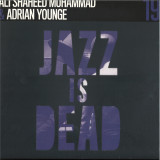
Instrumentals JID019 captures the musical alchemy produced at the Linear Labs Studio by producers Adrian Younge and Ali Shaheed Muhammad. These instrumental recordings encapsulate the spirit of the Jazz Is Dead concert and recording series, celebrating the African-American art form known as jazz through improvisation, musical collaboration and authentic cross-generational and cross-cultural communication.