Coming in blazing-hot off the heels of their very welcome reunion set for the recent Glossolalia LP, Dave Aju & The Invisible Art Trio are apparently out for no mercy here on their potent Elbow Grease debut for the label’s third offering.
“Next 2 You” was a deep jam session-based composition started overseas some 8+ years back in an earlier
incarnation, with the raw-edged flavors and voodoo feels of the OG underground era and has now been unearthed and blessed for pure dancefloor detonation by the everelusive LA-based musical squad.
quête:raw q
Eddie Leader has had his most productive year since releasing his first record under the Slum Science alias in 2004. Leader has delivered music on labels like Jovonn’s Body n’ Deep, Doorly’s Reptile Dysfunction, the iconic Hard Times label and his own Hudd Traxx in the past 12 months, most recently collaborating with Chez Damier on ‘Pressure’. This record is by far the deepest of them all. ‘Lost in…’ kicks things off and takes you on a deep hypnotic journey along the house spectrum. ‘The Unknown’ has a raw and underground vibe with a heavy bass line and takes inspiration from both Chicago & Detroit. The Tribal Manifestation Mix of ‘The Unknown' picks up the tempo on the B side for a peak time dancefloor rework. Eddie closes out the EP with ‘You’, which is a smooth vocal infused early hours future classic. Hudd Traxx have also had a very productive year and there’s still more to come in 2023.
GIL’s second release provides moments of lightness and euphoria,
offering a glimpse of the transcendental experiences that can be found in nature. Anam Cara, which means “soul friend” in Gaelic, sets the tone for the journey that listeners are about to embark on. Each track is a sonic tribute to the power and beauty of friendship, evoking the many moods and emotions that are part of this intricate relationship. The modular sounds add a sense of intricacy and complexity to the record, while the metallic textures add a raw and industrial edge that complements the softer, fluid movements of the aquatic elements. The blend of downtempo and deep techno creates a sonic landscape that is both contemplative and hypnotic, inviting listeners to reflect on the many nuances of friendship. From the ethereal modular sounds of “Henko (Ethereal Reshape)” to the shimmering metallic textures of “Henko (Tapasya Mix)” each track is a unique sonic journey that captures the essence of this powerful relationship. Written, produced and engineered by Gilmer Galibard Vinyl Mastered by Anne Taegert at D&M Artwork by Gilmer Galibard
The fourth EP from HOMO-CENTRIC Records presents GIDEÖN's broad musical vision, with tracks that span genres such as house and techno, as well as other influences, and includes his latest offering, “A Road Called Destiny”, his headiest offering yet and hot on the heels of previous anthem “Brighter Day”. This latest gospel belter has been tearing up dancefloors all summer and the track reaches euphoric heights comparable with the Baptist sermons featured in the house classics from the likes of Kerry Chandler and Robert Hood. "Hector’s Revenge" is a dark sleazy queer techno anthem already slaying Berghain’s main floor, "Vasquez Goes East" is a "raw basement cut that tips its hat to Junior Vasquez’s Sound Factory classic "Get Your Hands Off My Man” whilst “Fridays” serves up classic Swing 52 style chopped-up vocal cuts straight from vintage 90s NYC. Scope, range and diversity, but all quintessentially GIDEÖN
Under the alias 4E, producer Can Oral created his own unique sound of raw, futuristic acid-electro. The A-Side tracks "Ask Isadora" and "Conga Banana" first appeared on the album, Blue Note, released on Home Entertainment in 1996. On the flip are two unreleased tracks picked from his extensive archive and edited by FIT Siegel. These were also recorded during this era, which Can describes below:
"In the 90s I moved to NYC to start a band with Jimi Tenor. I had a small flat in the East Village with the apartment number 4E and that became my artist name for the downtempo and electro material I was working on. The style I called Futuristic Electro because I didn't want to relate to the old school with this. I had my studio on the kitchen floor and pretty much only used EMU SP-1200, TB-303, TR-808 and SH-101 by good ol’ Roland. In a way NYC was still developing because it was all about house music. In 1995, I opened Temple Records in Manhattan with Dr Walker from Air Liquide and DJ DB from Smile Communications. The record shop was inside the Liquid Sky clothing store. After a fire in the shop, along with a falling out with the owner I decided to talk to a fortune teller to find out what the future held. Her name was Isadora, and she had a TV show called "Ask Isadora." She told me on live television to move out, have my own shop and be independent, so I did. Thanks Isadora!"
An antidote to the tough-guy hardcore spreading from CBGB's, emo outliers Native Nod's unique genre juxtaposition of damaged art-rock, daring/naive songwriting, and raw, poetic vocals have set them apart from the glut of early-'90s post-hardcore. Compiled here are the band's trio of seminal 7" EPs for the Gern Blandsten label, with liner notes by Jenn Pelly and scores of unseen photographs and ephemera.
In 1972, a foursome of design students set out to make a record. This was, in many ways, a strictly creative endeavor. The quartet — composed of Dave Pescod, Alan Lewis, Phil Rawle, and Ted Rockley — were all trained, not as musicians, but as creatives. Art school heavyweights, the four were well-versed in the methodology of intentional experimentation, in the delicate balance of pushing the limits without completely unmooring oneself from a guiding creative intention. Emboldened by a high-brow familiarity with thoughtful experimentation and all the non-conviction of non-musicians, Bowes Road Band’s stint in the world of popular music yielded a record that is as much mind-melting as it is a direct product of its time. Their sprawling LP “Back in the HCA” embodies the exigence “art for art’s sake,” but it is for art’s sake that this record, however off the deep end it seems to travel (hear: “Doctor, Doctor”), remains a unified, and stunning, body of work. The LP’s do-ityourself garage rock noisemaking meets highfalutin creative processes. “Back in the HCA” is warbling psychedelic freakout (“Two Fingers,” “Doctor, Doctor”), Donovan-esque English countryside folk stylings (“Inside My Head,” “Goodbye to Rosie”), and avant-garde jazz improvisions (“Grass is Grass,” “Tomorrow’s Truth”) in one luminous release.
Originally an 9-track LP, Jakarta, Uno Loop, and Bowes Road Band decided to mine the six most cohesive tracks for the reissue, though the extras may be released somewhere down the line. Cohesion efforts aside, “Back in the HCA” stands alone in its singular conception of a genre-bending continuum — it evades definition. That said, the LP can easily be situated in the sonic environment in which it was conceived. By the end of the 60s, England was crawling with blues-based rock outfits that were starting to venture into prog rock territory. You can hear this popular dint cast over the folkier side of the LP. But Bowes Road Band was armed with their non-musicianship: they existed completely liberated from the motivating yet ultimately paralyzing lust for stardom. Enjoying this liberation, Bowes Road Band was utterly free to make noise. This freedom meant drawn out sax interludes amidst sweetly folk stylings (“Grass is Grass”) and Shaggs-like fuzzed-out freakouts that spiral into a void (Doctor, Doctor). This freedom also meant straight-forward tuneful cuts like “Goodbye Rosie” that conspicuously introduce heavily distorted auto-organ accompaniment mid-track amidst poignant lyricism. Bowes Road Band crafts a unified sound and then cracks it open.
With a completely off-the-radar status, Bowes Road Band could only press 50 copies of the record — 10 for each of them and 10 for the school. The band’s lifespan was to end there, or so they thought. “Back in the HCA” was the accidental fruit of a Berlin flea market treasure hunt by Jannis Stürtz, DJ and co-founder of Habibi Funk and Jakarta Records. After finding and sharing the LP with a few colleagues, Stürtz managed to get in touch with the band, get ahold of the master tapes collecting dust in Ted Rockley’s attic, and start the reissuing process. The record is still adorned with its original cover art designed by Alan Pescod, both reminiscent of bygone school days and the Zoom calls of yesterday — in short, reunion. Its re-discovery was happenstance and ought to be listened to as such. That is, “Back in the HCA” was not made to be listened to on a broad scale, or, at least, was not made with this goal in mind; it is neither in its time nor of its time. Of course, the group explicitly cites the folk tunes of the English countryside, the distorted rock groups that reigned during the record’s conception, and the fringes of psychedelic music that only the uber-underground might recognize (e.g., “Dreaming of Alice”). Yet still with these obvious influences, “Back in the HCA” always existed beyond the domain of both traditional musicianship and conventional commodification. Bowes Road Band’s DIY musicality beams through in technicolor across “Back in the HCA.” The vinyl includes an 8-page booklet detailing the albums creation and interviews with the band.
Lead single “Grass is Grass,” out July 14 along with album pre-order, encapsulates the record’s range: the track unfurls into a sprawling sax-driven trip following a sundrenched, Donovan-esque intro w/ lyrics “naively about parks and gardens, not marijuana!” The keyed-down folk cut “Goodbye to Rosie” is single 2 and elevates stripped-down acoustics with golden tinges, out August 4th. Focus track “Tomorrow’s Truth” constructs the fuzzed-out underbelly of acid folk. Listen for echoes of late Beatles, Mark Fry, and Donovan (if they were armed by an unshakabele willful naiveté). Like Sgt. Pepper’s on a shoestring budget—take a trip to the underground with LP “Back in the HCA,” available everywhere physically and digitally on September 1st via Jakarta Records and Uno Loop.
Besides online promotion from label profiles, the album will be further promoted by external agencies within the UK and US.
Black cloud is descending – Black Magic Six set to release their fifth album in September, new single Blood of Babylon out now The title of Black Magic Six’s upcoming album Black Cloud Descending really sums up the mood and thoughts of its creators during the album making process. It tells stories of constant escaping, accepting defeat, destinies of outcasts, failures, and drunks. Tales of the wiser, exaggerated lies, vague rumours, fuzzy states of mind and suspicious circumstances – even the thought in the back of your head about the possibility of redemption while standing on the edge of the cliff right before falling in; it’s all there. The album’s first single Blood of Babylon is a garage rocking song about Sam Berkowitz’s relationship with Sam Carr’s speaking dog. Lyrical themes of the upcoming album are moving between reality and the imaginary world; remembering the moments at Belo Horizonte, how to use the powder that protects you from the evil eye, how it felt to wonder in the same alleyways with the werewolf of Istanbul or diving to safety to the bottom of a pond in Northern Savo. Listen Blood of Babylon here: https://youtu.be/S7mEujUIlrw Musically the album is on a narrow path. All the sounds heard on Black Cloud Descending are produced by Taskinen and Motherfuckin’ Japa. Sure, there are two exceptions; the gong heard in the end of Werewolf of Istanbul was recorded by Sakke Koivula at his home and the church bells in the outro of Full House Blues are ringed by unknown. Previous albums of BM6 had lots of guests playing guitar, percussions, harmonica, and visiting singers. People that one could call actual musicians. These past albums have had a softer, more versatile, and maybe even a livelier touch to them. This time around there’s only the core; the percussionist and the singing guitar player. The result is more raw, rugged, and rougher than before. Black Cloud Descending is out on September 1st on vinyl, CD, and digital platforms. The album was produced, recorded, and mixed by Mitro Kylliäinen at Kung Fu Audio along with BM6 during 2022-2023. Original art used for the album cover was made by Greger Grönholm. The band will play selected live shows to celebrate the new album in Finland, Germany, Denmark, and Spain. Dates of these gigs will be announced closer to the release date of the album.
During the latter half of the seventies very few came close to emulating the success of the productions of Joe Gibbs and Errol Thompson. 'The Mighty Two' took the greatest of Kingston's musical and technical innovations and transformed the cutting edge into a commercial proposition that crossed over to the rest of the world. 'Under Heavy Manners'' was an essential purchase as well as a defining statement on the sombre mood of the times in the year that two sevens clash and forty years after its original release, the raw reality of 'Under Heavy Manners' continues to hit home.
You have said too much to a stranger in a bar bathroom; your back is killing you because of everything you haven’t said; you’ve overwatered your houseplants again. Small Million is here for you. Flowing from the collaboration of longtime creative partners Ryan Linder and Malachi Graham, the Portland-based indie pop outfit welds deeply affecting sonic production to smart lyrics about intuition and inhibition, losing control and ending up in unexpected places, being willing to fuck up, bodies hurt and bodies joyful.
The effect is both intimate and epic, delicate and fierce. Listen to it to ache, dance to it to heal. In the time since Small Million's last release, years of chronic pain have led lead vocalist and lyricist Malachi Graham to deep explorations of embodiment that have changed everything from her singing voice to her dance moves to her observation of human frailty. “There’s one side of chronic pain that leads you towards intuition, self-discovery, and listening closely to yourself. But it also means you end up sitting on the side of the room a lot, watching people and paying attention. Also you’re pissed,” notes Graham. Producer and instrumentalist Ryan Linder’s background as a filmmaker informs the textured richness and intelligent restraint of his song building. He approaches production with obsessive technical rigor that’s always in service of centering intense emotion.
Graham’s clear, unadulterated vocals breathe at the heart of Linder’s rich sonic terrain, drawing comparisons to The Cranberries and Florence + the Machine. Linder and Graham have been writing as a duo for a decade, but for their newest chapter they've expanded the band, enlisting Ben Tyler (Small Skies) on drums and Kale Chesney (Lo Pony) on bass and harmonies.
Small Million's evolution into a four-piece has expanded the band’s sound from their synth pop origins to encompass more organic, raw indie rock energy. Small Million has played with artists like Fakear, IDER, Hatchie, HÆLOS, Lo Moon, and Loch Lomond, and their tracks have been featured on compilations by Tender Loving Empire, PDX Pop Now!, and Vortex Music Magazine. They released their debut EP Before the Fall in June 2016, their follow-up, Young Fools, in Fall 2018, and singles “Saintly” and “Tarot” in 2019. Their newest music is dropping throughout 2022.
Remastered for its 10th Anniversary, the newly cut vinyl edition of Ripely Pine features the bonus track “Up In The Rafters,” long a live favorite that really should have been on the album in the first place. More than anything, Aly Spaltro has 20,000 second-hand DVDs to thank for her first album. Despite being recorded at a proper studio in her recently adopted home of Brooklyn, Ripely Pine showcases songs conceived during her tenure at Bart’s & Greg’s DVD Explosion in Brunswick, Maine. Little did customers know, the same store they’d drop off their Transformers movies was providing the ideal four-year cocoon for the development of a major musical talent. Spaltro worked the 3:00 PM to 11:00 PM shift. Each night, after locking up, she’d walk past Drama and Horror, pull out her music gear from behind a wall of movies, and write and record songs until morning broke. She did this every day, drawing strength from the monotony of her routine and testing out multiple techniques, approaches and instrumentation. Anger, confusion, love, happiness and sadness reigned, and the songs ran rampant, with little form or structure. Isolated for those many hours, Spaltro let melodies morph together, break apart and pair up. This is how she taught herself to write music and sing. Taking the name Lady Lamb the Beekeeper, Spaltro became one of the most beloved musicians in Portland. Her live shows were unhinged, as melodies followed an internal logic only apparent to Spaltro herself. She sang and played guitar, and the songs offered a vivid yet brief snapshot of her expansive world. At 23, with years of writing and performing music already under her belt, she ventured to the next milestone—recording an album. This would be the first time she did so in a professional studio and the first time she shared the process with anyone else. Luckily, she met Nadim Issa at Let ’Em Music in Brooklyn. He was taken enough by her abilities to dedicate nine full months toward the recording of Ripely Pine, and she with his producing abilities to ease comfortably into making him a part of her recording process. She wrote everything—all the songs, all the arrangements. And the two of them assembled an album that finally fit what existed in Spaltro’s mind. Keeping the songs’ stark rawness, the record is a pure representation of her sound. Ripely Pine shouts the introduction of a new talent from every groove. These recordings come as close as possible to conveying the intense majesty of her live shows, and, much like those performances, a narrative breathes through the record’s progression. The album opens with urgency and anger, settles into reconciliation and reciprocation, and ultimately reaches toward resolution, realizing infatuation leads to a loss of self; instead, embracing one’s own strengths is the most powerful thing of all.
Raw Energy by JD Twitch showing Petersen's Trance (Not Trance) the way to the dancefloor.
Synths and sitars for eternal bliss on the flipside. Another pin glowing!
Back in 2017, Basso delved into his micro-press cassette collection to treat us to the first retrospective of kosmische wizard Trance. Spanning both the bucolic and galactic, ‚Tapes' (GBR010) suspended time and space, enveloping us in the nebulous beauty of Jürgen Petersen's misty ambience.
Among the appreciative audience for this mind expanding release was one JD Twitch aka Keith McIvor, one half of the mighty Optimo. Keith's vision of remixing Jurgen's ‚Purification' for the club was embraced by both the artist and the label guy with glowing eyes. Charting a course through progressive house, ambient techno and the weirder bits of the solar system, McIvor combines the celestial synthesis of the original with some tough and tracky drum programming, turning the intensity up to 11 in pursuit of early morning ascension. A sensitive arrangement allows space for Peterson's waveforms to work their magic, while laser fire and additional fx abuse unlock evolutionary abilities buried deep in your unconscious mind.
The previously unreleased, largely unheard ‚Contemplation' was originally intended to feature on the ‚Tapes' compilation, but fell off the edge of that flat Earth thanks to its maximal runtime. Too good to remain a secret, this crepuscular creation enjoys the entirety of the B-side, drifting through the eons via meditative electronics, delicate sitar and a touch of tapey flutter.
Embrace the almost 40 year old tape's flaws and imperfections that could not be restorated and dive into the immersive and unparalleled.
This is music for higher beings.
Founded in 1971, Matumbi was among the earliest and best British reggae bands. They did, however, also record under different guises, including The 4th Street Orchestra. In their acclaimed Rough Guide to Reggae, Steve Barrow and Peter Dalton rate this album (and its counterpart Leggo! Ah-Fi-We-Dis) as "the best showcase for Matumbi's talents". This release marks the first LP reissue of this genuine UK roots-monument since 1976.
Original member Dennis 'Blackbeard' Bovell (of LKJ and Dub Band fame) knew the local sound system-scene like the back of his hand and most tracks on Ah Who Seh? Go Deh! were initially cut as exclusive 'specials' for his own Jah Sufferer sound system and for fellow soundmen. Hardly anyone hearing these tunes at reggae parties or would have guessed they didn't originate in Kingston but were recorded in London. And neither did many who bought the records when they were released a few years later. That's hardly surprising, as the material Bovell & Co churned out could easily compete with the toughest output of their Jamaican counterparts. A splendid version of the 1970 Kingstonians smash "Singer Man" is the most familiar tune here. But it's the band's own outstanding, heavyweight roots tunes like "Jah Chase Dem" or "Za-Ion", their versions popping up later in true sound system style for maximum impact, that will have reggae fans prick up their ears.
Ah Who Seh? Go-Deh! is available as a limited edition of 750 individually numbered copies on orange coloured vinyl.
Rare Jazz-Funk album from 1978 by Headhunters founder.
Featuring an all-star line-up including Herbie Hancock.
Originally released in 1978 on Tobisha EMI Japan.
First vinyl reissue outside of Japan released in collab w/Totown Records. Comes with double side insert.
Paul Jackson (born in Oakland, California in 1947) needs little introduction. Paul began playing bass at the age of nine and was considered by many of his teachers to be a musical prodigy. Jackson was known as a “Musician’s Musician” and shaped a sound that launched a new direction in contemporary music: the so-called ‘Pulse Playing’, a trademark sound of close-meshed funk grooves combined with sensational rhythms. With this innovative approach, he influenced entire generations of jazz and funk musicians to come. Paul’s compositions were sampled by big acts from the likes of Prince, TLC, Mobb Deep and NWA…just to name a few.
Paul Jackson was a founding member of the Headhunters under Herbie Hancock (THE group responsible for their ground-breaking fusion and jazz-funk compositions that took the world by storm in the 70’s). The solid union between Hancock and Jackson has been especially evident in the many international tours they have made together…not to mention that he participated on most of the Headhunters albums and Herbie’s solo albums.
Paul has also worked as a producer and as a studio/live musician alongside acts such as Santana, Sonny Rollins and The Pointer Sisters. He was a frequent guest performer at renowned international festivals such as the Montreux and Newport events. Jackson’s composing has not gone without recognition and was nominated for Grammy Awards in 1974, 1975 and 1976. Like other highly talented, creatively motivated engineers of music, Paul has expanded his career to other mediums such as playing on blockbuster movie soundtracks such as “Death wish” and “Dirty Harry”.
Paul Jackson also wrote five solo albums worth listening to – including the monster of an album that is known as “Black Octopus” which is considered to be a kind of lost Headhunters album.
His debut album “Black Octopus” saw the light of day in 1978 and is a total piece of art filled with abstract sticky funky grooves, floating electric piano playing, strong thumping bass lines, raw heavy drums and amazing vocal acrobatics (Jackson himself takes vocals in 3 out of 5 songs, and his soulful singing voice strikes an emotional chord that does not go unnoticed).
On “Black Octopus” you’ll also find some of the best all-star musicians from the likes of Alphonse Mouzon (Roy Ayers, Betty Davis, Azar Lawrence)…and last but not least fellow Headhunters Bennie Maupin and Herbie Hancock himself.
With “Black Octopus” Paul Jackson wrote the book on how a jazz-funk-fusion album should sound like. The fact that the album was only distributed in Japan at the time (Jackson resided in Tokyo since the late 70’s, where he passed away in 2021) continues to increase its reputation as an album that is VERY hard to find. This is a must-have gem…not only for fans of jazz, funk and rare grooves, but also for DJs and collectors around the globe.
RAWAX welcomes Ferdinand Steinbacher aka Brevis Bounce to the artist family! We are very happy to present you this great talent HOUSEWAX. After joining a RAWAX micro GARDEN FESTIVAL with Move D, Ferdinand went home and started (impressed from David's set) to jam. He uploaded the video on social media. Luckily we saw it and asked him to make us some tracks - the result is his first vinyl release called "Vibrant Remedy" which will be out in January.
Highly recommended!
"Ein außergewöhnliches Talent" (Jamie Cullum), "aktuell der Name in aller Munde" (BBC 3), "eine Kraft, mit der man rechnen muss" (Jazzwise). Mit gerade einmal 21 Jahren ist die Saxofonistin Emma Rawicz aktuell „talk of the town“ der britischen Jazz-Szene, die aktuell zu den interessantesten der Welt gehört. Ihr ACT-Debüt ‘Chroma‘ ist nicht nur ein extrem vielschichtiges, im wahrsten Sinne farbenfrohes
Album, sondern auch ein Statement und Ausrufezeichen in Richtung der internationalen Jazz-Szene.
Inaugural vinyl pressing & remastered audio of Death Metal legends INCANTATION’s Upon the Throne of Apocalypse, the original rough mix of the recording that became the infamous full-length album Mortal Throne of Nazarene. Dynamic-yet-raw, brutal-yet-atmospheric, and death-yet-doomy, Upon the Throne of Apocalypse remaster features the original artwork by Wes Benscoter (Slayer, Nile, Cattle Decapitation).
2024 BLACK VINYL REPRESS.
One can hardly imagine the genre-busting, culture-crossing musical magic of Outkast, Prince, Erykah Badu, Rick James, The Roots, or even the early Red Hot Chili Peppers without the influence of R&B pioneer Betty Davis. Her style of raw and revelatory punk-funk defies any notions that women can’t be visionaries in the worlds of rock and pop. In recent years, rappers from Ice Cube to Talib Kweli to Ludacris have rhymed over her intensely strong but sensual music.
There is one testimonial about Betty Davis that is universal: she was a woman ahead of her time. In our contemporary moment, this may not be as self-evident as it was thirty years ago – we live in an age that’s been profoundly changed by flamboyant flaunting of female sexuality: from Parlet to Madonna, Lil Kim to Kelis. Yet, back in 1973 when Betty Davis first showed up in her silver go-go boots, dazzling smile and towering Afro, who could you possibly have compared her to? Marva Whitney had the voice but not the independence. Labelle wouldn’t get sexy with their “Lady Marmalade” for another year while Millie Jackson wasn’t “Feelin’ Bitchy” until 1977. Even Tina Turner, the most obvious predecessor to Betty’s fierce style wasn’t completely out of Ike’s shadow until later in the decade.
Ms. Davis’s unique story, still sadly mostly unknown, is unlike any other in popular music. Betty wrote the song “Uptown” for the Chambers Brothers before marrying Miles Davis in the late ‘60s, influencing him with psychedelic rock, and introducing him to Jimi Hendrix — personally inspiring the classic album ’Bitches Brew.’
But her songwriting ability was way ahead of its time as well. Betty not only wrote every song she ever recorded and produced every album after her first, but the young woman penned the tunes that got The Commodores signed to Motown. The Detroit label soon came calling, pitching a Motown songwriting deal, which Betty turned down. Motown wanted to own everything. Heading to the UK, Marc Bolan of T. Rex urged the creative dynamo to start writing for herself. A common thread throughout Betty’s career would be her unbending Do-It-Yourself ethic, which made her quickly turn down anyone who didn’t fit with the vision. She would eventually say no to Eric Clapton as her album producer, seeing him as too banal.
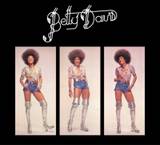
In 1973, Davis would finally kick off her cosmic career with an amazingly progressive hard funk and sweet soul self-titled debut. Davis showcased her fiercely unique talent and features such gems as “If I’m In Luck I Might Get Picked Up” and “Game Is My Middle Name.” The album Betty Davis was recorded with Sly & The Family Stone’s rhythm section, sharply produced by Sly Stone drummer Greg Errico, and featured backing vocals from Sylvester and the Pointer Sisters.