Following the recent 'Aset Forever EP' by label bosses Dusky, 17 Steps announces its next release in the form of the 'Off Peak EP' by innovative Russian duo Formally Unknown.
The three broken beat originals will be familiar to anyone who has seen label owners' Dusky DJ recently.
Lead track 'Off Peak' offsets a breakdown of deep, Detroit-nodding chords with thunderous bass, modular bleeps and broken percussion that will test the outer limits of any sound system.
On the remix, Warehouse Music's Mella Dee flips the original with 4x4 kicks, spacey pads and layered percussion that glides in and out seamlessly, providing the EP with a hazy, dubbed out techno gem.
Industrial broken beat jam 'Burnin' again blends atmospheric chords with chopped samples to create a carefully crafted leftfield trip that feels like the perfect soundtrack to an industrial How It's Made video.
Closing things off 'Arp Three' brings things to a darker, stripped back close in a panic alarm buzz of broken bass and twisted FX - with distant rave divas crackling through the mix.
quête:re lay
DFA release Crooked Man's new album, 'Crooked House'.
Speaking about the album's lead track, 'Take It All Away',
Crooked Man says: 'It's about not being suffocated under the
mountains of useless crap that Mammon shits into every
crevice of modern life... quite possibly the world's only anti
consumerist disco song.'
The elusive Crooked Man returns to DFA with 'Crooked House'
LP, a maximalist take on electronic and house music that picks
up where 2016's self-titled album left off. Teaming up again
with Michael Somerset Ward (Clock DVA) and David Lewin
(Bleep & Booster) in the studio, Richard Barratt crafts a
comprehensive journey of hi-fi house belters with more sinister
electro-pop mixed in for good measure.
The album is influenced by two historic epicentres of electronic
music: Sheffield UK, where Richard has had an illustrious
career in a mix of legendary groups like Funky Worm, Sweet
Exorcist and The All Seeing I; and the NYC Loft-era disco
sound, where extended grooves were layered with peaktime
choruses.
Richard's diverse collaborations and intensely prolific
discography have now led him to records as lush and
sophisticated as 'Crooked House'. Considering the rarity of a
live Crooked Man performance or DJ set, it's a testament to his
hyper-creativity that these tracks are able to reach new heights
in a club setting. With support from disco historian Bill Brewster
and NTS resident Ross Allen, it's clear that 'Crooked House'
brings a timeless vitality to the current landscape of dance
music and continues an exciting new chapter in Crooked Man's
career.
LP format includes digital download code.
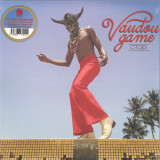
No one had been through those doors in years. Unchanged, seemingly untouched, just a Guard watching over it, one wondered whether the place would ever see the light of day again. Built in the 70s by Scotch, there were only twenty such places in the entire world. Twenty studios, all identical. Most had undergone a digital makeover in the 80s, but not this one; situated in Lomé, this studio had stayed true to its original form. Silent and uninhabited but waiting for one thing, and one thing only: for the sacred fire to be lit once again. That of the Togolese Recording Office, is studio OTODI for those in the know. Through thick layers of dust, the console was vibrating still, impatient to be turned on and spurt out the sound so unique to analog. That sound is what Peter Solo and his band Vaudou Game came to seek out.
The original vibrations of Lomé's sound, resonating within the studio space, an undercurrent pulsing within the walls, the floor, and the entire atmosphere. A presence at once electrical and mystical sourced through the amps that had never really gone cold, despite the deep sleep that they had been forced into. In taking over the studio's 3000 square feet, enough to house a full orchestra, Vaudou Game had the space necessary to conjure the spirits of voodoo, those very spirits who watch over men and nature, and with whom Peter converses every day.
For the most authentic of frequencies to fully imbibe this third album, Peter Solo entrusted the rhythmic section to a Togolese bass and drum duo, putting the groove in the expert hands of those versed in feeling and a type of musicianship that you can't learn in any school. This was also a way to put OTODI on the path of a more heavily hued funk sound, the backbone of which maintains flexibility and agility when moving over to highlife, straightens out when enhanced with frequent guest Roger Damawuzan's James Brown type screams, and softens when making the way for strings. Snaking and undulating when a chorus of Togolese women takes over, guiding it towards a slow, hypnotic trance. Up until now, Vaudou Game had maintained their connection to Togo from their base in France. This time, recording the entire album in Lomé at OTODI with local musicians, Peter Solo drew the voodoo fluid directly from the source, once again using only Togolese scales to make his guitar sing, his strings acting as channels between listeners and deities...
Deep late 80's percussion LP created to accompany contemporary jazz-dance classes. African instrumentation meets Western Jazz arrangements and computer technology. TIP!
.
Percussions Pour La Danse was a collaboration between North American born jazz & contemporary-dance instructor Tony Kennybrew and French musician Jean-Pierre Boistel. Tony, a Washington native who had studied, taught and danced professionally since the age of 12, found himself in France in the late 80's. It's here that he linked up with like-minded musician Jean-Pierre; who had recently returned from a 6-month trip to West Africa. A trip that helped refine his craft that begun in the early 70's.
The music was created for Tony to use when teaching contemporary jazz-dance classes and to accompany live performance, allowing students to 'dance slowly, rapidly and change speeds without changing the tempo!'. This work of rhythmic research was based on the 'Balance of The Walk'; in 4 times, in 6 times, in 7 times & in 3 times. In order to reach the spatial possibilities he was striving for, Jean-Pierre would also use computer assisted programming to sample and re-play his own instrumentation. This allowed him to lay down the tempo of the track and then play live over the top, which in turn gave him the freedom to add the desired instruments and effects to each song.
Jean-Pierre's use of instruments such as the Kalimba, Talking Drum & Sanza gives the album a distinctly African feel, while contemporary Jazz-dance time signatures adds a unique perspective to these traditional instrumentations creating an ethereal balance between the old and new.
Behind the pseudonym is the Finnish producer Samu Vesterinen. Latmos is Samu's way to express the mindset of a Nordic enviroment. He gets inspired from minimalism and his surrounding habitat with it's beautiful spruce forests. He incorporates these natural images into he's restrained, yet layered soundscapes, using different synthesizers and hardware.
Composer, multi-instrumentalist and mixed-media artist, Takehisa Kosugi has stood on the forefront of the Japanese avant-garde for over six decades. In the 1960s, he was part of Japan's first improvisational music collective, Group Ongaku, and contributed to Fluxus in New York. In 1969, he founded the influential, experimental ensemble The Taj Mahal Travellers, and in 1975 he would release his first solo album, Catch-Wave.
"Mano-Dharma '74" features improvised violin drones and voice with various oscillators, echo delays and layered tape experiments that the artist made in New York in 1967. While Kosugi's continuously changing spectrum of sound shifts gradually (almost imperceptibly), photocell synthesizers create ultra-low frequencies to disturb the crestless sound waves. The brighter the light is, the harsher the noise becomes.
Black Sun Records returns with a monster collaboration from Unhuman & Surit. Unhuman is best known for his contributions on labels such as Instruments Of Discipline, Liber Null & Veleno Viola among many others, his sound running the gamut between noise, power-electronics, EBM & techno; Surit is better known as one half of NX1, recently releasing some solo remixes on his own Nexe Records label and on some others. Together they deliver a powerful 4 track EP, opening with 'Moral Poverty', a perfect driving track with fat bass, metal percussion and layered pads that trap you from the very beginning; next is 'Surrender', a twisted break-cut full of character, complex yet effective, a mind-warping, beautiful journey. Turning to the B-side, the track that gives name to the EP 'Impact Bashing', delivers pure, raw, industrial- techno, oppressive, incisive & brutal. 'Precipitated Paranoia', closes the record, a higher bpm techno cut, defined by the power of the drums and held in tension by jittering, nervous synths.
- A1: The Sound Of Confusion
- A2: 2.35 (Version 1)
- A3: Losing Touch With My Mind
- A4: Amen
- B1: That's Just Fine (Vocal Version)
- B2: Come Down Easy
- B3: Mary Anne
- C1: Feel So Good
- C2: 2.35 (Feedback Version)
- C3: Hey Man
- C4: It's Allright
- D1: 2.35 (Version 2)
- D2: Things'll Never Be The Same
- D3: Transparent Radiation (Organ Version)
- D4: Repeater (Demo)
Double LP on heavyweight 180 gram audiophile black vinyl in a wide spined sleeve with new artwork layout. Re-mastered by John Rivers at Woodbine Studios especially for vinyl release. Includes a bonus track not on the CD version and new artwork design. Never has a record been so aptly titled, or so perfectly descriptive of a band's particular vision of the universe. For all that, the original appearance of Taking Drugs was in fact a bootleg on the semi-legendary/semi-notorious Father Yod imprint in 1990, later supplemented with contemporary outtakes and cuts for the Bomp reissue in 1994 and one further song for the Space Age version in 2000. The original seven tracks, dated January 1986 and the first recordings to feature Pete Bain on bass, are collectively known as the Northampton Demos, understandably named for the recording location in a studio outside said English city. Both Sonic and Pierce have been on record as long preferring these takes to the eventual versions that surfaced for the most part on Sound of Confusion. Certainly it's a fine set of performances, showing a definite step toward the more familiar sound of the group and away from the rougher takes on For All the Fucked Up Children of the World. "The Sound of Confusion," aka "Walkin' With Jesus," rips along with fierce energy, Pierce's singing and the rampaging, primitive wail and rumble of the band just wonderful. "Losing Touch With My Mind" takes things to an even higher level, a huge wallop of feedback and beat (Natty Brooker's drumming in particular delivers just what the doctor ordered), Pierce delivering the lines with a flat, cutting drawl. On the slightly lighter tip, "Come Down Easy" is more or less fully in place (aside from singing about it being 1986!), possessing a more upfront but less vocally distinct feel than the Perfect Prescription take. The tracks that surfaced on the later reissues come from a variety of different sessions, including the original take on "Feel So Good" and a good live version of "Things'll Never Be the Same," one of several cuts featuring Brooker's drumming replacement Rosco.
- A1: I.o.t.a. (Instrument Of The Ancestors)
- A2: Play It Up
- A3: Overload
- A4: Blam
- A5: Williehook (Skit)
- A6: Aerosol
- A7: Vital Transformation
- B1: You Can Always Count On Me (Ft Shana Jenson)
- B2: These Are The Things I Really Like About You (Ft Dudley Perkins)
- B3: Canadian Hillbilly
- B4: Conmigo (Reprise)
- B5: Bobbie's Dittie
- B6: Ciao
Georgia Anne Muldrow returns with a modern soul classic in the
making - 'Overload', via Flying Lotus's Brainfeeder record label.
An incredibly talented vocalist, songwriter and producer,
Georgia Anne Muldrow effortlessly spans jazz, soul and hip hop
and, during her 12 year career, has collaborated with Madlib,
Erykah Badu, Dev Hynes aka Blood Orange, Bilal and Robert
Glasper.
'Overload' was executively produced by Flying Lotus, Aloe Blacc
and Dudley Perkins.
For fans of NxWorries, Erykah Badu, The Internet, Madlib.
Notable collaborations on 'Overload' include Dudley Perkins,
Shana Jenson, Moods, Lustbass and Mike & Keys (50 Cent,
Nipsey Hussle, Snoop Dogg, G-Eazy), who contribute
production to four tracks including the sleek, anthemic title
track alongside Khalil (Dr Dre).
CD digipack. LP pressed on 180g heavyweight black vinyl in an
artworked innersleeve housed in a 3mm spined outer sleeve
with digital download card included.
Artwork by Martin Norwood (Nice Dreams Studio). Layout by
Adam Stover.
'No one sings a heavy love song like Georgia Anne Muldrow' -
Pitchfork Best New Track
'Beautifully poised between classic 90s R&B and something
strange, disorientating and psychedelic.' - The Guardian
It's not the fall that hurts, it's when you hit the ground - that's what - Failing Upwards' is all about. On Lehult's fourteenth release Lucky Charms breaks away from 4-to-the-floor territory to deliver a fun trip through skippy drum workouts and jazzy warmth. Spread out across the full A-Side is 'Einbahnstraßen-Sound". Heard first on the Lehult Worldwide FM Special last year, this highly requested tune finally sees the light of day in all its trippy, warm, analogue glory. 'Oase' takes things a notch deeper by layering lush synths, swarming melodies and ski field recordings over a laid back electro-groove. 'Rex Dubius' translates the vibe of the first two tracks into a more straightforward, dubby groove - not without the skipping beats and the warm counterparts, though.
180g vinyl, limited pressing
Emotional Rescue returns to the music of Elaine Kibaro with a special 7" single to accompany the Pour L'Amour album collection (ERC066). Here then are two bonus versions of songs from the LP with a unique Arabic recording of her "hit" Aurore and also, the previously unreleased on vinyl instrumental version of her balearic / boogie jam, Ne Doute Pas.
Having moved from Tunisia to France at the age of 13, Kibaro's duel sensibility has long been apparent in her music and performance. The early success of her debut 7" De L'autre Cote Du Miroir in 1977, was soon followed by her most 'successful' song in Aurore, first released as a 7" in 1978, before appearing again as 9 minute extended version on the 1979 Miroirs LP.
In the same year she recorded a special 7" single on the little known World Music label. Singing the lyrics in Arabic - renamed here to its true translation - much else remained the same. The music of the original, the spoken intro soon gives way to what is essentially a leftfield disco groove, with building strings, funky bass and some late archetypal 70s Euro drumming. Atop this the vocals are delivered in Kibaro's ubiquitous chanson delivery, her heartfelt singing, the congos breakdown and then chorus, as the songs builds, all lead to head-nodding smiles all round.
With this is Ne Doute Pas. A stand out from Pour L'Amour, the vocal version appeared in 1989 as a single and on the now sought after, Kiroel album. This instrumental simply let's the music shine. A Linn rise and fall bassline, soft, layered keys and mode horns are run and rerun in a catchy, incessant flow like a PWL demo. The 10 years between the 2 tracks is apparent in the instrumentation but the link between the two - Kibaro herself - is clear and worth enjoying for that.
'Breathe The Machine' is the first installment of Dojostudio and presents a musical world rich in harmonics, low frequency and melodic impact, yet with enough space in between to allow that perfect breathing room essential for powerful dance cuts. 'Breathe The Machine' portrays a world that initially feels robotic, yet instills an organic fluidity known only to come from humanoid beings, breathing life into a system littered with code and coldness. Billy Dalessandro presents 3 original cuts, plus a rendition of the title track by Mike Shannon.
Both for 'Breathe The Machine' and 'Tractor Beam' the Waldorf Microwave XT 2 and the Jomox 888 were the primary sound sources. For 'Breathe The Machine' the 888 was processed through a Jomox T-Resonator, which added harmonic distortion, and also spread the stereo spectrum out a bit offering the drums a more washed-out feel. The XT was layered track by track by performing patterns live into an editor until the desired ideas were properly recorded. Mike Shannon was brought on board to offer a contrasting expression of 'Breathe The Machine' and when asked how the process went he stated:
"I took the source sounds, edited them and processed them to work with a groove I had written for this remix. I mainly used the pad, lead synth and synth effects from the original. The rest of the gold I engineered."
On 'Tractor Beam', subtle use shows that ample space in between ideas make things seem larger than life. By allowing a more minimal approach in the production process the sounds can easily co-exist, allowing for that 'big room' sound without overwhelming the overall experience.
The digital exclusive 'Deliverance' was created using NI's Maschine for the drums, and FM8 and Reaktor were the sources of the synths. Drum patterns were created in Maschine and then recorded in realtime back into the DAW as it played, with real-time tweaking of the hi-hat to create the desired impact, especially at the break. The synth and pad patterns were recorded as MIDI into the editor, and then automation of the synths' VCF rounded out the expression needed to complete the emotional process.
All in all, DOJ001 is mostly an all-hardware showdown, with 'Deliverance' being the only 'virtual' attempt. Life is in nature, not in machines, yet the culmination of the two worlds can be beautiful, if only properly tamed and understood. Lest we beware! Stay tuned... and thanks for listening!
Steve Bicknell returns to his 6dimensions label, adopting his The Evader guise once again with a re- issue release titled 'Awakening The Past 2'. Returning as The Evader for the second instalment of 'Awakening The Past', this will be Steve's fourth appearance on 6dimensions and features four tracks from 1994's 'No Hats Required' EP, which dropped on influential UK label, Cosmic Records - the tracks were originally made by Steve to be played together as a segment in various combinations. This release follows outings from 6dimensions artists Jing, Metro Skim and Heartless - continuing the label's theme of illustrating the 'human mind's natural make-up'. 'No Hats Required - Track 1' displays a locked 4x4 groove, filled with tidy modulations bouncing gracefully off the kicks before 'Track 6' offers a fast-pitched looping beat with floating percussive jitters. 'Track 2' then features twisted stab sequences over a minimal drum loop before a rolling 808 beat joins oscillating bass flutters in 'Track 3'. On the flip, Bicknell presents two new tracks recorded in 2017. 'Power Of Balance' provides cross firing synth shrills layered and tough techno convolutions to generate a rising intensity, until 'Shifting Illusion' concludes the package with minimalist dubbed-out flavours whilst flush melodies harmonise with continuous pulsations.
Making his first appearance on the label, Argy lays down a three-part heavyweight production for Crosstown Rebels this October. The Greek producer effortlessly showcases his unique style and ability to create music that is sure to create heat on the dance floor.
Title track Worthless opens up the EP with a bouncy groove and sensual, breathy male vocal. Next, La Vida introduces a more percussive-led beat, creating an industrial soundscape. Get Ready closes the EP with its darkly hypnotic beat, lending itself to a more tribal aesthetic.
The word 'diverse' is most definitely one that can be used to describe Argy. Having been in the game for more than a decade, he's released music on Poker Flat, Cocoon, Objektivity, Desolat and Cuttin' Headz. He's worked alongside a range of key figures in the industry including Kerri Chandler and Manuel Göttsching. Argy has proved his prowess as a DJ holding down residencies at Amnesia, Space, Destino and Pacha as well as regular appearances at Berlin's Panorama Bar.
This is the third album of Book Of Air, a series created by the granvat platform and curated by the composers and brothers Stijn and Bert Cools.
As in the first Book Of Air album "Fieldtone" and the second "vvolk", the parameters time and sound are again widely present. This time the 3 interwoven bass lines give the deep drive and foundation of the sound, completed with a layer of acoustic instruments and sparkling chords on top. "Se (In) De Bos" is inspired by the fluctuation objectivity of our daily observations.
vvolk investigates performing and improvising music, in close relation to present time; what are the possibilities in playing music, when changes in this music pass by unnoticed How do we as musicians relate to the running time of a performance This clearly challenges the improvising musicians, and makes audience and
performers discover new territories in collective improvisation.
Shortly after releasing his highly acclaimed 'The Benoît Pioulard Listening Matter'(Kranky), Pioulard left on tour to Europe in order to promote the album. This tour took him to several distinctive places ranging from urban Brussels to rural France and the mystic capital city of Iceland, Reykjavik.
Once returned to Seattle, these new impressions and memories formed the inspiration to make 'Slow spark, soft spoke'. Not surprisingly, the album continues in the same vein as his tour cd 'Lignin Poise' - which was repressed on vinyl by Beacon Sound - and is characterized by slowly moving lo-fi ambient textures. The album reveals Pioulards most melancholic side and once again shows his capabilities to bring beautiful sonic narratives with only a few instrumental layers.
Here we see San Proper and The Mole make a welcome return to the imprint following solo EP's, this time they join forces with Hreno for a three track EP from the powerhouse trio.
Leading on the package is 'Friendly Tears' which features yet another leading figure in the house scene, Dekmantel regular Tom Trago, as you'd expect from such an impressive array of artists we're treated so soul drenched house driven by swinging organic drums, infectious funk licks and hooky synth lines before the 'Chunkless Mix' strips things back a little, laying focus solely on the 80's tinged synth work, delayed vocal murmurs and
minimalistic percussion.'On The Floor' then rounds out the package, retaining a similar aesthetic with choppy guitar melodies, penetrating bass stabs, crunchy rhythms and resonant arpeggio synths ebbing and flowing dynamically throughout.
The New York Downtown Producer/Composer Returns With His First New Album In 3 Years
EIGHTEEN: the year of release, 2018. EIGHTEEN: the age at which I first used a synthesizer.
In creating EIGHTEEN I worked independently in the studio, initially building up tracks with synthesizers and found sounds recorded in my daily comings and goings. After working with the tracks over a period of months,I shared them with a few musicians, who added their own instrumental layers. Though working independently, we all shared a similar working process: working in our personal recording spaces, as opposed to larger recording studios.
The musicians are: Gabe Gurnsey (drums) of Factory Floor, with whom I collaborated on the Beachcombing EP and performed live at London's ICA. I appear on Gabe's newly released album Physical;
Larry Saltzman (guitar) has played in my Love Of Life Orchestra since the 1970's. Well-known for his work with Arthur Russell ('Kiss Me Again', Flying Hearts), he is in high demand in NYC by acts such as Simon and Garfunkel;
Paul Nowinski, (bass) has played with LOLO since the 1980's. Paul has an impressive list of credits, including Les Paul, Keith Richards, Bernard Purdie and the Boston Pops; Matt Mottel, (electric piano), is the newest addition to the Love Of Life Orchestra. He is half the duo Talibam!, a leading act in the noise jazz scene; Lewin Barringer, (guitar), is a talented guitarist and producer in Philadelphia.
After mixing the final tracks, I brought the mixes to Berlin. There I worked with the brilliant mastering engineer Mike Grinser who helped to give the album a unified sound.
I think of this album as electronic music. It was created in my home studio, using analog and digital synthesizers, found sounds recorded on my phone, and instrumental parts contributed by friends. Finely crafted melodies and harmonies are set against subway noises, street construction, and distant foghorns. Sometimes there are sustained clusters, generated by my leaning against the keyboard. Deliberateness paired with randomness: this is what guided the artistic process.
This album is atypical for me as I am not playing saxophone. (I do play one reed instrument - a harmonica.) I grew up with the sax as my primary instrument. Yet my father was a radio journalist so the reel-to-reel tape recorder was a ubiquitous presence in the family home. From an early age,
I experimented with the tape machine: recording, overdubbing and splicing tape. I learned about Varese from Frank Zappa liner notes; I read John Cage's 'Silence.' Electronic music was on my radar.
My first exposure to an actual synthesizer came when I recorded my first single at the fabled Sound City Studio in Van Nuys, CA. The studio had a custom Neve board, but it also had a firstgeneration Moog modular synthesizer sitting unused in the maintenance room. I asked and they kindly let me experiment with it. Soon, I enrolled at the University of California - San Diego after I discovered they had separate studios for their Moog and Buchla systems. These large modular synthesizers were affordable then only by institutions and rock stars. But these would be soon eclipsed by smaller, cheaper synths in the 70's and early 80's. In the same way, recording studio technology became accessible in the 90's. . And thus the personal computer and digital audio allowed studio quality production in the home studio. Electronic music had become democratized.
Handmade music by way of digital technology: this is the music of EIGHTEEN
David Hanke is best known for his long-standing work as Renegades Of Jazz, as well as recent incarnations Dem Juju Poets and his exotic outfit Mankoora. The versatile producer and DJ returned to his blissful electronic roots with his latest project Keno earlier in 2018, released on the Agogo imprint.
Daviddelivers two sides of what he calls Krauthaus for Shapes of Rhythm. Kugelkreisis a mathematical word. Kugel in German means a ball/sphere and Kreis means circle. One is 2D and one is 3D.
The music is as intriguing as the terminology: long, psychedelic, deep and textured house music, suitable for those late night DJ sets or after parties.
On side A, Der Kugelkreis, spaced-out melodies mix with playful yet purposeful bass to create an ethereal atmosphere. It's got groove from the get-go. Tribal Afro-infused drum sounds propel it forward and, as such, Hanke is happy to tease us for almost three minutes before introducing the rest of his rhythm section. Drowsy horns float in a little later, adding another layer to the dreamy aesthetics.
The B side Permutation is also a long, deep excursion and features layered Fender Rhodes behind chopped, stabby vocals, before thunderous percussion chisels right through the middle of it all.
Available on limited-release vinyl 12" with fully printed outer sleeve, and digital