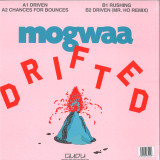
Mogwaa returns to Peggy Gou’s Gudu label with Drifted, his second EP for the imprint and a perfect summary of what makes him one of Korea’s most exciting contemporary artists - complete with a remix by Klasse Werks founder Mr. Ho.
A staple of Seoul’s electronic scene, Mogwaa’s catalogue takes in everything from ambient to jungle - but at the centre of his music, there’s always a distinct sense of melody and pure compositional chops that defines his music regardless of style or tempo. Put simply, you know a Mogwaa track when you hear one.
Quicker in tempo than his last EP for Gudu, Drifted opens with ‘Driven’ - a combo of chopped-up breaks and a relentless riff that does just what the title implies - before Mogwaa really flexes those melodic chops on ‘Chances for Bounces’, getting heady with synthesized voices and an almost Detroit-leaning bassline over an 808 groove. ‘Rushing’ takes things further into peaktime with an acid bassline and some nifty automation to keep things ascending, before Mr. Ho’s remix of ‘Driven’ closes the EP on a dreamy techno tip.
Following several European runs last year that saw Mogwaa perform at Warehouse Project, Pleasure Gardens and more, plus a Boiler Room in Seoul alongside Anz, Sharda, Finn, Closet Yi and Seesea, Drifted is another snapshot into the sound world of this remarkable talent.
Buscar:re style
After a recent, acclaimed EP on Madrid’s Analogical Force label, Suction Records is thrilled to announce “Grey With Breaks,” the 8th full-length album by Lowfish.
The electro veteran, who’s been programming 808s since the early ‘90s, returns to Suction Records, the label he co-founded and debuted on in 1997. “Grey With Breaks” is an electro record, with thick analog basslines and TR-808 boom tschak front & centre, but Lowfish’s electro-style stands out from the pack.
Not only is the LP devoid of the Drexciya/Dopplereffekt worship that permeates the scene these days, it also rarely hits above 110bpm, oozing with melancholic melody.
"Morphing Chinese traditional music with bass, Chicago footwork and AI-manipulated birdsong. It's quite a feat to sound this ancient and futuristic simultaneously." The Guardian
"The album presents a world where flute and guanzi find common ground with choral vocals, ambient and AI- manipulated birdsongs." Vinyl Factory
"There has never been a record that sounds like this. And, very possibly, never will be again" Bandcamp
'At once fine-grained and expansive, Lee's work combines traditional Chinese music and historical references with wild electronic experimentation" Pitchfork, 7.6
'Island Birdy' samples Bollywood vocals, 'Foreign Flowers' has hints of warped drum & bass and 'Feather Signifier' is steeped in jazz fusion....Lee's most organic work has plenty of diverse influences" Resident Advisor, Album Of The Day
Swirling layers of OST-style sound design, dreamy choir vocals and traditional Chinese folk combine across eight dynamic and transportive tracks on Birdy Island, the latest album by Beijing-based producer/artist, Howie Lee.
On Birdy Island Lee's intricate brand of traditional pan-asian exploration meets experimental bass weight sound via stripped-back UK Grime sonics and ceremonial taoist music.
- Introduction By David Kapralik / My Name Is Barbra
- Much More
- Napoleon
- I Hate Music
- Right As The Rain
- Cry Me A River
- Value
- Lover, Come Back To Me
- Band Introductions
- Soon It's Gonna Rain
- Come To The Supermarket (In Old Peking)
- When The Sun Comes Out
- Happy Days Are Here Again
- Keepin' Out Of Mischief Now
- A Sleepin' Bee
- I Had Myself A True Love
- Bewitched, Bothered And Bewildered
- Who's Afraid Of The Big Bad Wolf?
- I'll Tell The Man In The Street
- A Taste Of Honey
- Never Will I Marry
- Nobody's Heart Belongs To Me
- My Honey's Lovin' Arms
- I Stayed Too Long At The Fair
Every Aspect of the Production Personally Supervised by Barbra Streisand
Mixed by Jochem van der Saag from the Original Analogue Session Tapes & Mastered in 24 bit/96 kHz by Paul Blakemore
Lacquer Pressing Master Created by Bernie Grundman
Pressed at RTI
Tip-On Gatefold Jacket
Deluxe 12-Page Booklet Featuring Barbra's Recollections, the Recording's History & Production, and Performance Photos
The Premiere New York City Nightclub Event of 1962! The Most Anticipated Live Album of 2022!
In the fall of 1960, New York City wasn't the same urban mecca it is today. Neither was eighteen-year old Barbra Streisand, who emerged on the Greenwich Village club scene at a small, cozy venue on West 8th Street called the Bon Soir, where she received rave reviews and wooed the crowd with her incredible performances. Within two years Streisand, whose magnificent interpretations of both standards and quirky, obscure cabaret tunes was a nationwide sensation, was knocking audiences dead with her nightly performance as Miss Marmelstein in David Merrick's I Can Get It For You Wholesale on Broadway.
Sixty years, multiple Grammy, Emmy, Oscar, Tony and Golden Globe awards and nearly two hundred million record sales later, Barbra has for the first time authorized the release of a major portion of her Bon Soir performances, as captured in 1962 by Columbia Records. IMPEX Records - in conjunction with Sony Music Entertainment - is proud to present the audiophile 180-gram vinyl LP and SACD editions of the most sought-after recordings in Barbra's legendary career: Live at the Bon Soir: Greenwich Village, NY - November 1962. This gorgeous album features twenty-four brilliant performances personally selected by Barbra Streisand from the original Bon Soir master tapes and expertly mixed and mastered by Paul Blakemore and Jochem van der Saag, under the supervision of producers Barbra Streisand, Martin Erlichman and Jay Landers.
IMPEX RECORDS has created two versions of this noteworthy release: a two-LP vinyl edition and a 24 bit / 96 kHz SACD. To achieve the best fidelity possible, engineer Paul Blakemore transferred the original three-track session tapes to high-resolution 96/24-bit digital files, which were then mixed by Jochem van der Saag. For mastering, Blakemore used an all-analog signal-processing chain in order to maintain the warmth of the original analogue recordings. To master the vinyl LP edition, IMPEX engaged Bernie Grundman, who has mastered many of Barbra's albums over the last sixty years, to create the lacquer pressing master.
Rich with the club's atmosphere, these historic, essential recordings present a warm, charming portrait of a truly important moment in New York City history and American pop culture. Several years removed from Manhattan's flourishing jazz nightclub scene, tiny clubs such as the Bon Soir began popping up, and served as both a forum and launching pad for some of the finest vocalists and musicians the east coast had to offer.
Because of Barbra's success there, Columbia Records A&R rep David Kapralik decided that the first album from his newly-signed artist would emanate from a setting in which she had become most comfortable: the small stage at the Bon Soir. Producer Mike Berniker and recording engineers Roy Halee and Adjutor "Pappy" Theroux set up the mics and recorders, and for three nights harnessed the electrifying show that Barbra had crafted.
"The recordings we did at the Bon Soir were so authentically 'Barbra.' I produced her first three albums at Columbia, and while they were wonderful accomplishments, I thought that what she did each night at the Bon Soir transcended anything we ever did in the studio." - Mike Berniker
Columbia ultimately decided to bring Barbra into the studio to record her first album, and except for the inclusion of several tracks on compilations through the years, the Bon Soir tapes laid dormant in the vault. Now, through this extraordinary release, everyone can at last enjoy the early sound and style of an icon in-the-making: the same brilliant artist whose performances at the Bon Soir were lauded by everyone from actress Helen Hayes to lyricists Alan and Marilyn Bergman. We invite you to join us for an evening at the fabled Bon Soir. Take a seat, order a drink and revel in the magic that is Barbra. You will not be disappointed!
White Vinyl
Gost Zvuk prepare for a busy 2023 with an enthralling double LP's worth of futurist sound design from Flaty. In the game for more than a decade now, the producer, mastering engineer and all-round visionary artist has delivered an impressive range of music across both his own ANWO imprint as well as for West Mineral ltd., 12th Isle, Firecracker and more.
Always content to subvert expectations and blur stylistic lines, on Intuitive Word there is a clear fascination with a spectral, whittled-down-to-its-core type of avant-pop/RNB hybrid. Digital strings, dubbed beyond recognition semantic snatches, re-imagined new age style synthesis and even flourishes of MMORPG computer game soundtracks all combine into something that feels uniquely Flaty. In a sense, Intuitive Word marries ambient sound collage and hyperreal, narrative-style vocal processing. However, glimmers of shoegaze and old 'ethereal' bands (think Harold Budd & Cocteau Twins) crop up on tracks like 'Tree' and 'Nepal Lit', a testament to Flaty's skill for world-building and atmospherics.
Across the 19 cuts there is a recurring theme of choral style, computer generated elegies. A kind of 'cristal trance', in their words. 'Mint' combines these with overtly RNB style vocal samples, whereas darker, more broken beat soundscapes can be heard on the Madteo collab 'Observer'. With plenty of sombre and cinematic style ventures such as 'NEWS' breaking up the album and eschewing this focus on vocals, we find one of the most consistent producers in the current Russian scene delivering what may well be his most accomplished collection yet.
Entirely remastered from the original analogue tapes and featuring brand new artwork designed by Luke Insect, this Four Flies reissue finally brings back to life one of the most surprising albums from the strange phenomenon that was the Italian library music of the Seventies.
Gianni Safred's Electronic Designs was released in 1977 on the Milanese label Jump, in their "Music Scene" series, simply as a collection of musical pieces intended for use in television programmes. However, hidden behind a nondescript cover were twelve electronic music tracks revealing a recognizable style of composition; twelve little gems masterly combining experimentation, catchiness and practical functionality thanks to a unified and unique style. Each through a specific mood, these tracks give expression to Safred's distinctive sound, where irresistible mechanical grooves are over-layered with melodic lines perfectly played on a Polymoog or ARP Odyssey.
A native of Trieste, Safred started out with little swing bands soon after WW2, before eventually playing with great soloists like Django Rheinhardt. Ultimately, it is his background as a jazz pianist that makes Electronic Designs so special. As with other Italian jazzmen who got into synthesizers (above all, Piero Umiliani), Safred's blend of complex harmonies and (quasi-) bebop virtuoso flourishes, with its obsessive repetitions and refined tone colours, gives a retro-futuristic quality to this library album, whose electronic music islight-years ahead ofthe 'pop' electronic music of the time and, in many ways, anticipates the best stylistic features of early-Nineties dance music.
Safred best expresses his experimental verve – and does a great job in creating the 'electronic designs' of the title – in "Mystification", "City Problems", "Trapdoor", "Planetarium" and "Poe's Clock", all of which unfold through hypnotic beats and sinusoid or square wave explosions. In other tracks, however, the compositional style is less unconventional, with relaxed yet not banal atmospheres ("Spheres", "Elastic Points", "Sacred Interlude"), as well as flashes of irresistible groove inspired by Herbie Hancock's more pop-oriented work ("Automation Age", "Jazz Motion Study", "Bottom Up"). The album's masterpiece is arguably "Hasty Chant", a detective-funk ride with an unforgettable theme, which manages to pull all of the album's various strands into a cohesive whole – as a side note, the allusive and apt description of the song on the back cover reads: "Things are happening".
2023 Repress
Dub companion to the 'five star' 1978 release, 'Africa Must Be Free By 1983,' this album underscores the relationship between producer Augustus Pablo and performer Hugh Mundell. Pablo's dub productions, mixed by King Jammy form the perfect compliment to these classic rhythms and melodies. Re-mastered for release in celebration of the 40th anniversary of the Greensleeves label, the album is example of why Augustus Pablo continues to inspire reggae music fans and musicians these
Pablo's Rockers International productions in dub, in their original packaging. Re-mastered for the 40th Anniversary of Greensleeves label.
Lee Stevens returns to Luv Shack Records for his first solo EP in over ten years, after exploring a more relaxed sound under his Rising Seed moniker.
The opening track “Right On” creates a sonic universe where Ennio Morricone and John Carpenter have joined forces to make synth heavy dance music.
„Maskaron“ sounds like a full homage to new wave and the obscure side of italo disco, topped with chanting reminiscent of 1970s western movies.
On "Trippin´ On Your Love" Lee Stevens taps into early proto-house and synth-dance, complete with arp bass and occasional breakbeats.
Track number four, "Ju Know," features Lee Stevens and long-time collaborator Simonlebon in a moody, upbeat jam with heavy low-end synths, bittersweet vocal samples, and 80s pop-style piano chords.
Finally, the closing track "Destruction" features tight 808 drums accompanying a dark bassline and eerie vocals, with uplifting synth chords reminding us there is still hope.
- A1: Erstes Kapitel (Verschliffen)
- A2: Zweites Kapitel (Ruckartig)
- A3: Drittes Kapitel (Ungesagt, Dann Vergessen)
- A4: Viertes Kapitel (Bewusstseinsfrei)
- B1: Fünftes Kapitel (Kreuzweis)
- B2: Sechstes Kapitel (Herausgewunden)
- B3: Siebentes Kapitel (Verflochten)
- B4: Letztes Kapitel (Halb Vermutet, Halb Gesehen)
11th album by the one-of-a-kind collective: psychedelia and free form jazz (not jazz) trigger a sophisticated excursion into weird textures with drastic turns. Dislocated dense music full of secret connections!
Kammerflimmer Kollektief – "Schemen"
Before reason prevails, invoked by those who want everything to remain as it is, Kammerflimmer Kollektief disrupts the established supply chains of sound. It seeks more interesting ways to assemble them. Trusting in this, because of the fact that every sound that still comes out of a guitar, a bass, a harmonium, drums and electronic devices has already been taken into the common mangle of meaning anyway. Enough of all that. Here, nothing is explained. Here we speak in schemes. Polished and jerky.
The images that Kammerflimmer Kollektief conjures up therefore happen not in the focus of consciousness, but rather in its outer realms. In those to which one does not give one's full attention at the moment, but which are nevertheless perceived. For example, when a leaf falls from the ground back up to the tree in the corner of your eye, and for an instant you think this is possible, before you realize it was a small bird flying into the tree; it is in just such irritating moments between perception and realization that the art of the Kollektief also unfolds. On "Schemen", familiar fragments float gently around their core – a Fender Rhodes tone, a bass figure, a guitar motif, a masterful drum shuffle, a moment of icy stasis borrowed from the harmonium playing of Christa 'Nico' Päffgen. Triggering brief associations, they slowly rush off in other directions through free jazz-informed editing work, whereupon such zones can also arise in which perception has a few tricks ready and earlier experience suddenly breaks into the now in a completely different way. Half suspected, half seen.
Half-music like Can from Cologne – also masters of improvised editing – sometimes produced a few decades ago in their in-between moments. The first minutes of "Future Days" for example, which fade in gently, sketch a barely graspable figure emerging from all directions of the room. Kammerflimmer Kollektief also engages in similarly open moments of development. Loosely, it eludes the first formative impressions, keeping itself ready for moments that do not follow any logic of appointment. This looseness in handling makes Kammerflimmer Kollektief so fluidly audible, even when dissonant peaks and free playing arise. What Karlheinz Stockhausen is to Can's understanding of composition, the recordings of The Cocoon are to Kammerflimmer Kollektief. The Cocoon, a meeting of garage psychedelics from the Hannover area with free jazzers from the Galaxie Dream Band, whose album "While The Recording Engineer Sleeps", recorded in 1985 in unguarded moments, operates in a very similar way with decentralized perceptual ambivalences and only appeared more or less secretly four years later on Wilhelm Reich Schallspeicher. Other traces of "Schemen" lead to the debut album of Quicksilver Messenger Service. The guitars of Gary Duncan and John Cipollina, which refer to themselves in an unforced manner, are instructions to let go. They don't want to be traced in every note as a solo, but they give their music a sense that the essential takes place off center, in the mutual and intuitive gift of loving attentions. Consciousness-free.
Loving turns like the little guitar phrase that, like a kind of leitmotif, is repeatedly ghosting more or less unchanged through all of the Kammerflimmer Kollektief albums. A Coricidin induced, very catchy slide idea filtered out of ancient Æther, which – who knows – maybe even centuries ago found its way from somewhere to America – the old, the eerie – and from there wafted on through the ages to southern Germany, to a smoky studio in the Upper Rhine lowlands. A memory of which even the memory no longer knows what it once reminded. Unsaid, then forgotten.
In Kammerflimmer Kollektief you will also find a friend of slowly building, unhurried music, which probably would have been appreciated by the old Franz Mesmer, who 200 years ago, after tranquilizing treatments, sometimes used to play for his patients ambient melodies on the enormous glass harmonica. However, in order not to surrender completely to the flow of one's own life energy, as Mesmer had in mind with his therapies, Kammerflimmer Kollektief occasionally adds hectic tensions, gently embraced by the droning of a sine wave generator, as if a trance could briefly refesh. This old analog sine wave generator is new in the Kammerflimmer assortment of sounds. So, the art of the Kollektief likes to dock occasionally in modern times, yet with the past in mind. Mental states begin to flicker between imagination and certainty, between culture-bound art expression and coincidences: A cawing and scraping can always just be a cawing and scraping with Kammerflimmer Kollektief, the way Andy Warhol's mushroom eater just eats a mushroom.
Heike Aumüller's cover works, which illustrate all the Kammerflimmer Kollektief albums, additionally act as amplifiers of unexplained refractions. Her style consists of eye-corner art that remains so, even when looked at directly. Her shots remain disquieting because they do not jolt themselves into a reassuring order, even in retrospect. Rather than evading the fear that arises when looking at them by trying to impose some irrational rhyme or reason, that fear must simply be endured. This strategy of endurance is equally applicable to the music. The trick is to let parts be parts without compulsively seeking delusional patterns that lull us into a false sense of security and in doing so, possibly delude ourselves. In this context, freedom means not having to anxiously attach a fantasized superior meaning to everything. "Schemen" has an conspiracy disintegrating effect.
b A2 Zweites Kapitel (ruckartig) [feat. Heike Aumüller]
2023 Repress
Barry Brown's 1980 Showcase album was unleashed in true drum and bass Prince Jammy fashion with ' Conscious Dread' 'It A Go Dread', 'School Days', 'Ain't Gonna Turn Back'(with DJ Scorcher), stretching out twelve inch style to deliver a Waterhouse rock solid vocal and dub masterpiece.
If Susan Subtract of High-Functioning Flesh / Physical Wash personally supports this Portand based duo is because everything that should be the modern american funky ebm / minimal synth is present in “Costo Humano”. Puerta Negra delivers amazing industrial breaks covered in a very simple but extremely effective by funky bass lines perfectly finished by ensoniq style super synth leads culminated by harsh raged vocals sung in castillan language. This is for sure one of the most fresh and brilliant modern ebm work coming from the states recently. For the likes of the west coast modern ebm acts such as Spike Hellis or the mentioned High-Functioning Flesh.
Swedish Doom/Death Metal from the Champions League of that genre!
Runemagick mines the darkest seams of crushing Death/Doom Metal for unremitting headbanging groove. Runemagick are among the most
underrated bands in the history of Metal. Their relative obscurity is hard to pin down. Musically, in terms of songcraft, atmosphere, and immersion into the unearthly realms of the occult, they are basically without peers. Yet despite a prolific thirty-year existence, their reputation exists on the fringes: highly regarded by some but not highly enough considering the overall quality of their output.
From start to finish Runemagick plays well done ancient Death/Doom metal, very slow and heavy, but the balance between Death and Doom Metal is very well chosen! This will relive the glory days of the good old 90’s stuff from the United Kingdom! Deep and intense grunts, the freezing thick guitars and the intense bass lines really spread a gloomy frightening atmosphere. Runemagick have written an album against all kinds of trends hailing a style which.
Originally released in 2014, Kero Kero Bonito’s debut mixtape, Intro Bonito, was a monumental success in the underground hyperpop scene bubbling up throughout the band’s hometown of South London. The trio, featuring Gus Lobban, Jamie Bulled, and Sarah Midori Perry, started crafting their unique blend of electronic pop music after school friends Gus & Jamie met Sarah on the internet. With Perry’s unique singing style (featuring lyrics in both Japanese and English), the band went on to write influential tracks such as “Sick Beat,” “I’d Rather Sleep,” “Pocket Crocodile,” and others that were inspired by J-pop, dancehall, and video game music.
The Intro Bonito mixtape paved the way for Kero Kero Bonito’s rise from underground glitch pop wizards to a monumental act within the PC Music scene and beyond. Since its release, the trio has built up a devoted fanbase across the globe, racked up over 500 million streams & video views across multiple albums, EPs, and singles, collaborated with numerous high-profile artists (e.g. 100 gecs, Porter Robinson, Felicita, Soccer Mommy, Ashnikko, etc), and performed at festivals around the world.
Fans of the innovations and originality that sprang from the L.A. underground of the late 1970s and ’80s often ask, “What’s Paul B. Cutler been up to?” A vital participant in the Los Angeles music scene of that period as bandleader, songwriter, musician and producer, Cutler’s work—in particular his guitar playing— with The Consumers, 45 Grave, Vox Pop and The Dream Syndicate is still admired by fans and an influence on anyone interested in that period and the styles that developed from it. In 2014, “Ryan Adams contacted me and wanted to form a band. He loved 45 Grave, he wanted to do some goth / punk, whatever you want to call it. That’s right up my alley. He’s amazingly talented and inspiring to work with. We did that for a while, and I wrote a bunch of songs.” Enthused about his new material, Cutler continued recording songs with just his signature electric guitar style and vocals. As this was developing, another vet of the early L.A. scene—Brad Laner of Medicine and Savage Republic—got in touch with Cutler. Soon Laner was mixing, co-producing, playing keyboards as well as adding the rhythm section. The overall process took some time, with songwriting beginning in 2014. When reflecting on the music that comprises Les Fleurs, “To me, and it does not sound like it, but because of the philosophy I had while producing it, it’s punk. I come from the original punk, before it was a genre. Before it was a ‘sound.’ When I got to LA in 1977 there were about twenty, maybe thirty bands and they all sounded very different. The Screamers, The Deadbeats, so many different takes on what music could be. There was no chance for commercial success so we all just did what we wanted. I never stopped. So philosophically I consider this punk rock, made in its original spirit although nobody would recognize it as such. I am a punk to this day.” So that, dear reader, is the basic story. Now it’s up to you to see what you recognize in Paul B. Cutler’s Les Fleurs.
Summer Forever And Ever succeeds Blue Gene Stew, 2019’s debut by the Wolfmanhattan Project, a collective unit co-starring three musicians familiar to In The Red listeners: singer-guitarist Mick Collins, front man of the seminal Detroit-bred garage units the Dirtbombs and the Gories, singer-guitarist Kid Congo Powers who played in such legendary bands as the Gun Club, the Cramps, and Nick Cave and the Bad Seeds, and drummer-vocalist Bob Bert, whose skin work has distinguished albums by Sonic Youth, Pussy Galore, Lydia Lunch’s Retrovirus, and Jon Spencer and the HITmakers. The group was founded as a studio project by three musicians who are kept busy by their primary bands. Blue Gene Stew was written and recorded quickly. Powers says, “I think that the new record was much more a group effort. I think there’s more of a group kind of sound, as eclectic as it is. I feel like we all played together, as opposed to playing on each other’s songs.” Bert notes that the band’s music is grounded in spontaneity: “Me and Mick went in and had a couple of rehearsals, and I would come up with a beat, he would come up with a riff. I still have a cassette Walkman, believe it or not, and we’d put it down on that. It wasn’t even a full song. We’d just put down a bunch of ideas. When it came to recording we’d lay down the basic tracks and work out different things, and a lot of it was made up on the spot. It really is a great collaboration.” Recorded and engineered by Mark C. of Live Skull at his studio, Summer Forever And Ever finds Powers playing piano and the Kaoss touch-pad effects unit and Collins playing synthesizer, in addition to their usual instruments. The album reflects the same eclectic mix of musical styles heard on the debut. References and sometimes even direct quotes from sources as diverse as the Andrea True Connection, Captain Beefheart, the Count Five, and Eurythmics leap out of the speakers.
In 2019 we released the Discodrums 12'' on our own newfound The Night Land Records. With its screen-printed cover and limited edition it was a tribute to a format and culture dear to our hearts: Vinyl. Our intention was to keep releasing records in this style, with songs already mixed, mastered and ready to fly.
Had we known it would take three years to get the next EPs out we would probably have reconsidered everything. Series of strange incidents, accidents and negligence made us think this project was cursed but the music felt too important to us to let it go. We kept working to get it out and now we finally arrive with two "new" EPs: Melbourne Bolero and Bosco/Bosca. This is classic Talaboman; Chuggy, hypnotic, dub flavoured Latin-Scando house music, released on vinyl with beautiful screen-printed covers designed by DR.ME in Manchester. Three years too late but a hundred years too soon? Dance is timeless, thanks for listening.
The small town of Bremen in Northern Germany has a long musical tradition ever since the Brothers Grimm issued the tale of the Bremen Town Musicians. Now it is the Our Label brothers that bring you music from that very city, which was their own place to be for musical nightlife adventures: Uncle Hammond’s Soul Jazz Movement is a seven piece group honoring the groovy styles of Jimmy Smith and Reuben Wilson. This 45 features their interpretation of two of the bands' favorite tunes. "Greens" is a midtempo boogaloo-ish groove for the dancefloor and "Waltz" was an instant choice by Our Label's Gu for its deep and soulful harmonies. Bothe tracks were recorded live at the famous Studio Nord in Bremen, Germany.
This limited 7“ release comes with a full picture cover.
A great first vinyl release by a great band! Don't miss it!
Ayami Suzuki is a Japanese singer and sound artist who uses her voice and field recordings to create ambient experimental mindmelts. Her new LP, Umbilical, hears the virtuoso team up with Brazilian musician Carlos Ferreira, who normally stays rooted in meditative styles from drone to post-rock.
The pair take up equal weight space on this calming, umbral new cassette album, which was made remotely between Japan and Brazil. Few know how these two masterminds met, but what we do know is that the LP evokes a usually very difficult-to-pin mood - its course makes us imagine the feeling of encountering some otherworldly nymph, or half-divine fairy, in a baroque outdoor bathhouse on one sunny May morning.
Aiming to reflect Suzuki and Ferreira’s intimate and close connection across the distance that separated them, it is (not by coincidence) certainly a gap-bridging album, spanning everything ethereal, REM-sleepy, and stretched-out.
Chichi Music is proud and happy to present second wax joining four different styles of music coming across the dancefloor. ChV002
includes (in alphabetical order) tracks from Arturo Gioia, Enzo Leep aka Giralda, Lukea and Miguel Seabra.
This vinyl represents a journey from minimal music through break-beat to finally rominimal!
Since his last outing on Control Freak with the sold-out Bunzunkunzun EP, Syz has built a reputation as one of the UKs most distinctive club producers, weaving playful, percussive techno with soundsystem-driven bass music. Releases via Shanti Celeste’s Peach Discs and more recently on Banoffee Pies have cemented his position as a rising star of the UK scene.
Much of this acclaim started with 2020’s Mindforms - a self-released mini-LP which saw the young producer step away from the dancefloor to explore an expansive sonic world, ‘balancing the tranquility of the ecological world with the immediacy of the digital one. Tropical botany meets ethereal cyberspace through a fusion of styles, influenced by UK techno, hip hop, ambient, acid, and sound-system-driven bass music’.
The original release was accompanied by a highly limited run of just 10 dubplates. Deeming this 6-tracker too good not to receive a proper pressing, Control Freak are proud to present the first ever complete vinyl run for Mindforms, housed in full-colour centre-cut sleeves featuring an adaptation of the original artwork by Jamie Fallon (Ghost Cell), reworked by London-based designer Blixa Aguerreberry.
Alongside the record, Syz & Control Freak have curated Clubforms, a collection of remixes available digitally from some of our favourite producers, each bringing the original release firmly onto the dancefloor with their own production flourishes.



