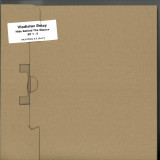
Vladislav Delay's complete "Hide Behind The Silence" series. Intuitive and raw music, momentary and reflective, released on Ripatti's own label Rajaton.
Stillness is a myth. Consider concepts such as ”still water”, or ”still air” for that matter. Go to a restaurant, ask them for a glass of still water, hold it against the light and see where we’re at. Even though the water itself has been captured and imprisoned in the glass, it never stops breathing. It’s filled with tiny particles, dancing. Everything can be explained on a molecular level, but since we’re not scientists – and even if you happen to be – it’s the natural world of perception that moves me.
Still air is very similar. A hot summer’s day with zero wind feels completely still. It’s the closest I have felt to complete stillness. Or for a more urban adaptation, imagine the same vibe inside a normal apartment. In those moments, revelations and mind- blowing experiences can be had with experiments in stillness.
Try this: Just sit down for a minute on a sunny day, making sure there’s enough natural light. Do absolutely nothing. Try not to breathe for a bit. (If you need a mental anchor, you can play Cage’s 4’33” in your head but nothing else.) Watch the tiny dots of dust dancing :..’ ̈.:; ́ ́*°.,’:,. ̈ ̈ ̈ ̈:,.’
The movement is crazy, but the feeling of stillness comes from witnessing how subtle it is. In (perceived) complete stillness, every act of microscopic mobility seems to speak volumes. Yet, it feels both reassuring and oddly threatening that the stillness is never complete. What if we would need absolute stillness? Or is it just enough that we can perceive something as such? Extremes attract, so for both water and air, extraordinary movement is equally fascinating. That is also a luxury item of sorts. For us to enjoy a very ”loud” body of water or air, we need to be safe, in enough control of the situation. So when you are, it’s worthwhile to pay attention and take it all in.
A rapid flowing free with extreme strength and just barely in control. Look at that water go! No still water on this one, only ”sparkling”. A windy day when birds seem surprised how hard it is to fly, but in the end they make it. Trees bend but don’t break. The wind shows you its movement but doesn’t hurt you. It feels friendly, like a big clumsy dog that doesn’t quite understand its size.
It’s beautiful to be a guest of the elements, but not at the mercy of them. A new kind of dialogue forms.
Q&A with Sasu Ripatti:
1) Tell us something about the EP series ”Hide Behind the Silence”, what’s the idea and what can we expect?
Exploration of inaction. Of many kinds. In arts and in personal life, or at bigger and more serious levels. Questioning myself as a human being as well as an artist. Acknowledging the growing activism all around, and the very clear need for it, and how it reflects my own inaction.
Musically speaking, after Rakka, Isoviha and Speed Demon, I finally found some relief, but more importantly lost the need to go musically ever more outward and intensive. I felt quite strongly certain periods/moods from the past and they made me revisit some musical ideas or states of mind I was exploring early on.
It’s about live moments being captured, not much premeditation or editing. More intuitive and raw, even though the end result (to me) feels and sounds quite introspective and calm. It’s not very ambitious. Momentary and reflective.
2) Your music doesn’t sound very silent. Does it come from somewhere behind the silence?
Oh, this time to me it sounds quite quiet and playing with space if not silence. I don’t know what’s actually behind silence, but I think silence is the source of everything. We just don’t understand it yet.
3) What kind of thoughts or experiences gave inspiration to this series?
Writing this in Nov ’22, it’s not a stretch to say the world has been really unwell. Sometimes, like Mika Vainio put it, the world eats you up. I feel a bit like that. And I try to hide in my studio and stay away from it all, but it’s getting harder by the day. I’ve been questioning myself and thinking if what us artists are doing is worth anything, and whether it’s just a selfish thing I’ve been doing for the past 25 years, running away from everything. I haven’t come to a conclusion yet.
4) Is it easy for you to be in silence, or around silence?
Absolutely. I not only hide behind silence but I also love silence. It’s only since I started going back to nature as a grown-up person that I sensed and was enveloped by silence, true silence. I have begun to appreciate it a lot. I think all the people should spend more time in silence.
All tracks composed and produced by Sasu Ripatti.
Artwork by Marc Hohmann, photography by Shinnosuke Yoshimori.
Mastering by Stephan Mathieu for Schwebung Mastering.
Vinyl cut by SST Brueggemann.
Publishing by WARP Music Ltd.
quête:real
- A1: Please Come Out
- A2: Wicked
- B1: Working With
- IB2: N My Head
- C1: Got Your Money
- C2: Didn't You Know
- D1: Two-Door
- E1: Memory Lane
- E2: Good Girls And Boys
- F1: All I Want From You
- F2: Don't Sell Rock
- G1: What Yours
- G2: Tweets
- H1: You Check
- H2: Hero Forever
- I1: Don't Pick Up
- I2: You Don't Know Me Anymore
- J1: Tenderly With You
- J2: Now Let's Wait
Sasu Ripatti's complete "Dancefloor Classics" series. Music for imaginary dancefloors, released on Ripatti's own label Rajaton.
”Look up, into the light” she said, while the camera shutter clicked. ”Like this? Does it look holy?” His neck felt stiff. Her reply: ”Yes, just like that. What do you mean holy? Like religious? ”No, more like trying to look very far, somewhere beyond what we can see.” ”Okay, stand still, I’m going to come close to you now. The light hits your face great.” click, click, click.
He noticed her fingernails. They were not polished. Natural. Even somewhat rugged, as if something wore out the fingers slightly. What had these hands held besides the camera? What made the edges of her fingernails drift off?
He thought it’s weird to look straight into the camera. The photographer had closed her left eye, the one not looking into the lens. Then it opened, she looked up, perusing the surroundings, then she closed her eye again, then looked up, closed, looking up, very quickly. It all seemed very professional. Maybe she calculated the light, making sure it’s close to perfect. ”What will these photos look like?” – the thought popped into his head briefly. It was liberating to think it wouldn’t matter.
”What’s that song playing?” he asked. ”Wait a sec, Ol’ Dirty Bastard?” she replied. ”Oh yeah, right. But the sample?” ”Hey, could you look up again, like that. No, lower.”
New directions: ”Look out from the window, turn left.” ”My left or yours?” ”Yours, I always try to think from the direction of my model.” How professional! This is a good shoot, so natural. Should I worry about how the photos look like? No, I don’t want to. His thoughts bounced around. What would the story be like? It’s a big newspaper, everyone will read it. Maybe someone drinks coffee and eats a stroopwafel while they do it. Will they place the waffle on top of the mug for a brief while, so that it gets hot and the syrup melts a little? Then it feels wet, and you can bend the cookie.
She broke his train of thought off midway through: ”Now turn right, but look left, and slightly up, but don’t turn your face right.” ”Umm, like this? Sounds like a set of pilates instructions.” she laughed ”You do pilates?” ”Yeah, it’s hard sometimes. Have you tried?” ”No”, she said. ”I’m not good for sports that are done in groups.” ”Yeah, but in pilates you can just be inside your mind, drowning in your private thoughts.”
”What are you thinking in pilates?” she asked, taking more photos. ”Well, mostly just which way is right. And which left.” click, click.
Q&A with Sasu Ripatti:
1) Tell us something about the EP series ”Dancefloor Classics”, what’s the idea and what can we expect?
I’ve been slowly writing these sort of dance music pieces and finally curated them together for a conceptual release. I like to create music for a dancefloor that exists only in my imagination and doesn’t try to suck up to the standardized reality.
2) Your vinyl format is 10” which is quite special (as opposed to LP / 12”). Why did you choose it?
It’s my favourite format, absolutely. The size is perfect, and you can make it sound really good @ 45 rpm. And you still can make great artwork.
3) You seem interested in sampling/repurposing, what does it mean to you as an artist to approach something already existing from a new angle? How does the source material inform you about the approach to take?
I guess i could flip it around and just say I’ve outgrown synths or electronic sounds to a great extend, and having gotten rid off all my synths already good while ago I’ve used samples as my main source material a lot. It’s obvious on this series that i’ve sampled existing music, but I also sample instruments and things in the studio and resample my own library that I have built over the years, it’s quite large. To me the end result matters, not so much how I get there. Once I have something on my keyboard and play around, it’s all an instrument, though with sampling other music it becomes a really interesting and complex one as you’re possibly playing rhythm, but also harmonic content and maybe hooks or whatever, all at once.
I never sample premeditadedly, like listening to records and looking for that mindblowing 3 sec part. I just throw the cards in the air and see what lands where, just full intuition and hopefully zero mind involved, playing tons of stuff, trying things, just recording hours of stuff. Then comes the interesting part to listen to hours of mostly crazy stuff and finding that mindblowing 3 sec part.
4) What is your relationship with the dancefloor (conceptually and/or in experiences / as a performer)?
Very complicated. I have never really felt comfortable on a dancefloor but have always wanted to. There’s something in club music, in theory, that really speaks to me. It has never really materialized for me – speaking mainly from a performer’s point of view who goes to check on a dancefloor for a moment after a concert. I never have DJ’d or felt much interest towards it. But again, I love the idea and concept of DJing. As well as producing music for imaginary DJs. Lately, as in the past 10+ years, I haven’t even performed in any sort of club spaces. So my relationship to the dancefloor is quite removed and reduced, but there’s quite a bit of passion and interest left.
All tracks composed and produced by Sasu Ripatti.
Artwork & photography by Marc Hohmann.
Mastering by Stephan Mathieu for Schwebung Mastering.
Vinyl cut by SST Brueggemann.
Publishing by WARP Music Ltd.
Good things take time. What’s 17 years? Not even a quarter of Keith Richards! 17 years lay between Heiko Voss’ debut album “Call Me Killer” and the incredible follow-up “3:30 Minutes To Live”, which saw the light of day in 2022 on Michael Mayer’s “other label” IMARA. There are serious voices saying that the 80s were only really complete with the release of this album. Now it took the blink of an eye of a year for the remixes to be finished. And they turned out so well that Michael Mayer from KOMPAKT licensed the “3 Remixes for Heiko Voss” without further ado.
Running back guru GERD JANSON was an early adopter of the album. Highly motivated, he twirls “Follow Your Line” rhythmically somehow in the direction of Kate Bush’s “Running Up That Hill”. How did he do that? Never mind. It grooves like crazy and keeps even larger floors moving.
ADA, the Hamburg grand dame of techno pop, has taken on the in tongue speaking funk banger “Talking Man” and dipped it in fairy dust. The result is probably the most sensational, soulful club track ever. Honestly.
The package is rounded off with a powerful Dub Version of “Follow Your Line” by the IMARA and KOMPAKT boss himself. Because he can do it.
Open your heart, let the remixes in.
Gut Ding will Weile haben. Was sind schon 17 Jahre? Nicht mal ein Viertel Keith Richards! 17 Jahre lagen zwischen Heiko Voss’ Debutalbum “Call Me Killer” und dem unglaublichen Nachfolger “3:30 Minutes To Live”, der 2022 auf Michael Mayers “anderem Label” IMARA das Licht derWelt erblickte. Es gibt ernstzunehmende Stimmen, die besagen, dass die 80er Jahre eigentlich erst mit der Veröffentlichung dieses Albums vollendet waren. Nun hat es einen kurzen Wimpernschlag von einem Jahr gedauert, bis die Remixe fertig waren. Und die sind so gut geworden, dass Michael Mayer von KOMPAKT die “3 Remixe für Heiko Voss” kurzerhand lizenziert hat.
Ein “early adopter” des Albums war Running Back Obermotz GERD JANSON. Top motiviert zwirbelt er “Follow Your Line” rhythmisch irgendwie in Richtung Kate Bush’s “Running Up That Hill”. Wie hat er das nur gemacht? Egal. Es groovt wie Bolle und hält auch größere Floors in Bewegung.
ADA, die Hamburger Grand Dame des Techno Pop hat sich des in Zungen sprechenden Funk Kloppers “Talking Man” angenommen und ihn ordentlich in Feenstaub getunkt. Dabei entstand der wohl sensationellste, soulfulste Club Track ever. Ehrlich.
Abgerundet wird das Paket mit einer kräftigen Dub Version von “Follow Your Line” vom IMARA bzw. KOMPAKT Boss selbst. Weil er’s kann.
Herzklappen auf, Remixe rein.
The latest by Texan-turned-Angeleno progressive vaporwave producer Carlos Ramirez aka AURAGRAPH finds him shifting focus to the dance floor across eight chrome clockworks of cosmic acid house and liquid rave glide: 'New Standard'. Inspired by lessons learned during a 5K mile American road trip tour in the summer 2022, he set to work in his Simi Valley Tuff Shed of synths and hardware, pursuing an explicitly DJ-friendly muse: "I realized I wanted to make a record where every track could go off in a live setting."These cuts do just that, revved and rhythmic, peppered with slap bass, Madchester whistles, filtered acid, gated snares, baggy cowbell, and sample pack classics - record scratches, orchestral stabs, the "Yeah! Woo!" from Lynn Collins "Think (About It)." Ramirez describes the process as immediate and instinctual: "I'd turn on the MPC, pick a tempo, and just improv - it was incredibly fun."From sleek freeway techno ("110 Cruising") to arcade lurker acid ("Coast 2 Coast") to big room bangers ("666 Ambience"), the tracks time-travel across the canon of club music, sifting tricks and styles to fashion fresh anthems of hypnagogic jack. It's an album channeled as much as crafted, tapping into the decks of mythic warehouse infinities past and present, where the system rips all night and acid never dies.
Divino Nino's new album Foam feels like catching up with a lifelong friend. There's undeniable songwriting chemistry between guitarist Camilo Medina and bassist Javier Forero, who met as kids in Bogota, Colombia and years later reconnected by sheer happenstance after their families had both moved to Miami. Both studied at the School of the Art Institute of Chicago where they met guitarist Guillermo Rodriguez and eventually Drummer Pierce Codina. Now Chicagoans, their rhythmic, soulful - and at times bilingual - Latinx punk songs are a reflection of their continent-spanning bond and proof that Divino Nino couldn't have formed without unlikely but happy coincidences.The ten tracks on Foam feature wistfully romantic lyrics like the yearning plea on the title track ("I really wanna run away with you"), and sunny, honeyed arrangements. Songs like "Quiero" trade-off between English and Spanish with woozy guitars and harmonies anchoring the sweetness of the lyrics. The quartet's Latin American roots seep in throughout the LP's silky psychedelic flourishes but especially on single "Maria," which is sung entirely in Spanish. Inspired in equal parts by Argentine punk and the narratives of Mexican telenovelas, the personality-filled track is one of the most memorable on the record.
Jordan Munson ist ein Komponist, Performer und Multimedia-Künstler. In seinen Werken erforscht er die Erinnerung und unsere Beziehung zur Technologie, und es heißt, dass er "akustische Melodien und elektronische Rhythmen mit aufregender Absicht verschmilzt" (The New York Times). Seine Kompositionen beruhen auf einer Ausbildung in Perkussion, Improvisation, Pop und Sounddesign und stellen subtile Landschaften mit reichhaltigen Texturen und treibenden Melodien einander gegenüber. Munson setzt Technologie ein, um natürliche Klänge zu interpretieren und umgekehrt, wobei er sich auf die Übertragungsverluste konzentriert, die durch diese ständige Neusynthese entstehen. "Heartless Fools" wurde 2018 in den Greenhouse Studios in Reykjavík, Island, aufgenommen. Seit diesen ersten Aufnahmen ist die Musik durch weitreichende Zusammenarbeit mit Musikern aus Jazz, Klassik und Pop gewachsen. Zu den Künstlern gehören das experimentelle Pop-Trio Square Peg Round Hole, die Sänger*innen Isaiah Robinson und Hanna Benn sowie die isländische Cellistin Pórdís Gerdur Jónsdóttir. Während die Musik selbst nicht politisch sein soll, bezieht sich der Titel "Heartless Fools" auf die Reaktion von zwei Personen auf die aktuelle politische Landschaft. Die erste arbeitet sich durch Schock und Trauer, während sie die Realitäten dieser Welt wahrnimmt, und versucht, dem Ganzen einen Sinn zu geben. Die andere, angeheizt durch einen Verlust der kulturellen Identität, ist voller Wut, die sie antreibt, unmenschliche Dinge zu tun. Dies zeigt sich in der Musik als Kampf zwischen Ordnung und Chaos, Kontemplation und Ungeduld. Die Werke stehen in einem ständigen Spannungsfeld, sowohl intern und miteinander.
Black Vinyl[45,34 €]
- New repress Edition - Pressed on Metallic Silver Wax - LP housed in an expanded gatefold jacket - Includes lyric insert and repro archival newspaper fold-out // Reissue of the pioneering group's debut album First Issue. In 1976 Johnny Rotten and the Sex Pistols set the agenda for punk's year zero with 'Anarchy In The UK', a song that summed up the spirit, sound and attitude of the band in one shocking package. Two years later, the Sex Pistols were in tatters, but Rotten was as unsentimental as you'd hope. He reverted to his real name - John Lydon - and set about forming a band whose very identity kicked against press and media manipulation. Featuring bassist Jah Wobble, drummer Jim Walker and guitarist Keith Levene, his new group were Public Image Limited. The public image would be limited. PiL were a very distinct prospect from the Pistols, founded with a greater thought for rhythm, and with a sound that turned the page from snarling punk to a more experimental sound fusing rock, dance, folk, ballet, pop and dub. But that's not to say Lydon's new outfit lacked vitriol. 'Public Image' hits out against the notorious British tabloid press, who never gave Lydon an easy ride, and against his own Sex Pistols public image - "You only saw me for the clothes I wore". The debut single (and the album that followed) operated as a theme song and a manifesto: "_my entrance/My own creation/My grand finale/My goodbye," as the lyrics had it. It is, essentially, the sound of four people letting loose in a studio - and not caring what anyone else thought.
Die kratzigen Gitarrenhooks, das eingängige Schlagzeugspiel und die ausgedehnten Codas klingen eindeutig nach Großstadt, doch bei WIDOWSPEAK gesellt sich ein trockener Minimalismus und eine an die Atmosphäre von David Lynch Filmen erinnernde Düsternis, die aus der Kleinstadt der Bandmitglieder stammt. Während der Grunge Seattle berühmt machte und die Riot Grrl und die DIY Einstellungen synonym mit Olympia sind, steht Tacoma für etwas Raueres und Düsteres. Berühmt-berüchtigt für den beißenden Gestank der Papiermühlen hat die Stadt es dennoch geschafft, eine fruchtbare Musikszene ihr Eigen zu nennen - nur wenige Außenstehende wissen das. Drei Jahre, nachdem sie schon bei einem kurzlebigen Sampler Label Projekt aufeinander getroffen waren, fragte Michael Molly, ob es nicht Zeit wäre, eine neue Band zu gründen. Molly fing trotz Bühnenangst an, zu schreiben und kurz darauf lud Michael den Gitarristen Robert Earl Thomas zu einer ersten Probe ein. Obwohl Robert seine Gitarre über die Musikanlage spielen musste und Michael auf nur zwei Trommeln spielte, zeigte die erste Stunde, dass alles passte. Sie suchten einen Namen aus, den Molly sich schon Monate vorher ausgedacht hatte und der Sound von WIDOWSPEAK begann, Form anzunehmen. Im Herbst hatte das Trio sechs Songs für eine Kassette names ,October Tape" zusammen, die sie nur mit einem Laptop Mikrophon und Garageband aufgenommen hatten. Das Tape fiel in die Hände von Captured Tracks und hier ist das selbstbetitelte Debüt. Aufgenommen mit Jarvis Taveniere von WOODS bekamen die noch zittrigen Probetracks im Studio Luft zum Atmen. ,Widowspeak" erschafft eine unheimliche Atmosphäre, die sich manchmal auf den Jukebox Pop der Fünfziger oder auf die Psychedelia der Sechziger gründet. Während WIDOWSPEAK mit ruhigeren Acts wie MAZZY STAR oder CAT POWER verglichen wurden, haben sie einen Sound definiert, der ernsthaft nostalgisch und zunehmend selbstbewusst ist.
ASA
Arturo Lanz Saverio Evangelista AtomTM
are the last three futurists on earth.
»Radial« is the result of a vivid creative merge between Esplendor Geométrico and AtomTM. A transparent diamond formed by a heavy implosion. Its underlying massive mechanics are covered by a crystal surface made to cut reality in half. Just one letter short of “radical”, this album is no less than exactly that – an orgy of powerful, blunt repetition and hyperbolic simplicity, a profound evocation of nothingness and its surroundings.
Keiji Haino/Jim O'rourke/Oren Ambarchi
With pats on the head, just one too few is evil one too many...
- My “Watashi Dake?” Is Definitely Not Included In This Unequal Treaty, Is It?
- Right Brain, Left Brain; Right, Left; Right Wing, Left Wing. Just How Many Combinations Can Be Made From These?
- “Critical Consciousness?” That’s Been Abandoned In Corner Of A Shower Room In A 53-Storey Apartment Building Inhabited By Extra-Terrestrial Lifeforms…
- I Thought I Had Pulverized It Summarily But There Are Just Too Many Who Lack Reality Or Who Are Cowards So I Cannot Change A Thing
- E1: Still Divided Into Pieces? Let’s Reconnect Them Recognise That You Are A Point And The Longest Line Let It Become Light
- I Can No Longer Sense That Sacred Feeling Of Expression Just The Loitering Of Vulgar Vibrations That Can Only Be Described As A Half-Hearted Class Reunion Will You Consent To This?
- There Are Always Things I Wish To Say But I Can Only Convey Them In This Language August 6 August 9
The heavyweight trio of Keiji Haino, Jim O’Rourke and Oren Ambarchi return with their 12th and most epic release to date, the triple LP With pats on the head, just one too few is evil one too many is good that's all it is. Documenting the entirety of their final performance at the dearly departed Roppongi home of Tokyo underground institution SuperDeluxe in November 2018, the music spread across these six sides splits the difference between the guitar-bass-drums power trio moves and experiments with novel instrumentation that have defined the trio’s decade of working together. Containing some of the most delicate music the three have committed to wax since the gorgeous 12-string acoustic guitar and dulcimer tones of Only wanting to melt beautifully away is it a lack of contentment that stirs affection for those things said to be as of yet unseen (BT011), this wide-ranging release also offers up some of their most blistering free rock performances yet.
The side-long opening piece finds Haino on a single snare drum in duet with O’Rourke on unamplified electric guitar, playing in the lovely post-Bailey vein heard on his classic 90s recordings with Henry Kaiser and Mats Gustafsson. Spiky dissonance and ringing harmonics interweave with flowing melodic fragments as Haino single-mindedly explores the resonance of the snare like an untutored Han Bennink. On ‘Right brain, left brain; right, left; right wing, left wing. Just how many combinations can be made from these?’, O’Rourke moves to synth and electronics, joined by Ambarchi on drums, who at first focuses on sizzle cymbals before hypnotic cycles of gentle tom rhythms combine with electronic burbles and flutters to suggest a dream collaboration between Masahiko Togashi and Jean Schwarz. Ambarchi’s percussion is then joined by Haino on wandering, overblown flute, before the man in black switches back to the snare for a bizarre, stuttering drum duet.
For the first trio performance, Haino makes another new addition to his seemingly infinite catalogue of instruments, this time a homemade contraption he refers to as ‘Strings of Dubious Reputation’. Joined by O’Rourke on increasingly spaced-out electric guitar and Ambarchi on skittering percussion, Haino’s wonky, slack strings adds a definite ‘musique brut’ edge to this side-long performance, certainly one of the most enchantingly odd in the trio’s discography. When the group reconvene for the second set, spread out across the final three sides, they seem ready to breathe fire from the first instant. O’Rourke slashes distorted chords on the six-string bass, Ambarchi breaks into his signature irregular caveman thump, and Haino squeals and squawks on heavily delayed oboe before unleashing an overpowering electrical storm when he first picks up the guitar. For over half an hour, the trio pound out one of their most relentless performances, a constantly rearranging kaleidoscope of tortured fuzz guitar, insanely busy bass riffing and propulsive, tumbling drums. A hushed atmosphere initially reigns on the final long piece, given the mournful title ‘There are always things I wish to say but I can only convey them in this language August 6 August 9’. Haino’s clean guitar strumming calls up the shimmering tones of his PSF classic Affection, gradually building to a surging wall of sound, bass and drums lumbering through a roar of jet-engine guitar. Arriving in a deluxe trifold package with photos by Lasse Marhaug alongside inner sleeves with extensive live images, this epic release is perhaps the most remarkable document yet of this unique trio’s stamina and continuing inventiveness.
It's not hyperbole to state that Touché Amoré's third album Is Survived By is the band's most pivotal album. Released 10 years ago on September 24th, 2013 via Deathwish Inc., Is Survived By tackles the complicated nature of leaving a lasting legacy and the uncertainty that surrounds that; ultimately resulting in a record about learning to find the validation and love within one’s self. Produced by the legendary Brad Wood (Sunny Day Real Estate, Liz Phair, mewithoutYou), the recording sessions were a lesson in growth for the Los Angeles quintet - vocalist Jeremy Bolm, guitarists Nick Steinhardt and Clayton Stevens, bassist Tyler Kirby, and drummer Elliot Babin - as the band transformed from a group of individuals who play hardcore songs to the established headlining act that Touché Amoré is today. Is Survived By received critical acclaim from the likes of Pitchfork, The A.V. Club, The Needle Drop, and more - resulting in the album being 13th highest rated album of 2013 per Metacritic. It was also the band's first record to chart on the U.S. Billboard 200, peaking at 85. But most importantly, Is Survived By is beloved by fans new and old.
- A1: Let 'Em Know
- A2: Live And Let Live
- A3: That’s When Ya Lost
- B1: A Name I Call Myself
- B2: Disseshowedo
- B3: What A Way To Go Out
- B4: Never No More
- C1 93: Til Infinity
- C2: Limitations (Feat. Casual & Del Tha Funkee Homosapien)
- C3: Anything Can Happen
- D1: Make Your Mind Up
- D2: Batting Practice
- D3: Tell Me Who Profits
- D4: Outro
Consisting of MCs A+, Phesto, Opio and Tajai (with production by A+, Domino, Del the Funky Homosapien, Jay Biz and Casual), East Oakland’s Souls of Mischief burst onto the scene in the early 90s with an impact that few other West Coast artists had at the time. Culminating in the release of their classic debut, they created a bouillabaisse that was most parts West Coast swagger but - similar to The D.O.C. and Cypress Hill - with a sonic approach that could just as well have stepped off the streets of New York City. Recorded in less than two weeks at San Francisco's Hyde Street Studios, 93 ‘til Infinity doesn’t suffer from a single freshman jitter or misstep. It’s a fully-realized effort, packed from start to finish with ridiculous lyricism - all carried out in impressive four-part, tag-team style - and backed by a wide range of musical possibilities, from hard boom-bap to 70s CTI-jazz-sprinkled grooves. But without worthy music, the group’s high-level lyricism could have fallen by the wayside. Digging deep into crates that other producers had yet to mine, the production crew gave the quartet exactly what they needed, with unpredictable rolling basslines, dusty drums and jazz keyboard and horn stabs and swirls. Non-singles like Disseshowedo (produced by Domino and Jay Biz), Batting Practice (Casual), Limitations (Jay Biz, with Del and Casual contributing verses) and What A Way To Go Out (Domino) made sure that the fast-forward button remained untouched. Get On Down is proud to present a 30th Anniversary pressing of this west coast Hip-Hop classic on cloudy blue and cloudy yellow vinyl, packaged in a gatefold jacket with liner notes and a commemorative 30th Anniversary stamped numbered OBI.
The Vampisoul chicas are back. And for the third time. And, although collectors and connoisseurs have never stopped playing the songs by these Spanish female singers, here they are again, sounding as vibrant as they did half a century ago. Because these children of their times, the musical decades of the 60s and 70s covered by this compilation, boldly ventured into the limited spaces of freedom open to female artists back then. And they did so with attitude, in search of the right repertoire, proudly presenting new, daring personal projects often breaking away from the demure tone adopted by mainstream local female singers. And they were canny about it too. Realizing that the censors working back would just listen to the song that the record company flagged up as the listening target on the A side and not bother to flip the single over, they recorded many of their racier songs on the B side. That exciting dark side of singles, which have long tempted collectors. Lacking the freedom and visibility enjoyed today, these daring records by these female singers went as far as they could and a few managed to go beyond. The songs on this compilation tell everyday stories, narrating small socio-musical conquests revolving round the enduring theme of young love. Sass, sex, boy-girl rivalry, the defense of liberating women's fashion and, saying what women think loud and clear, all characterize these grooves. Performed in a variety of musical styles ranging from ye-yé, twist, disco, beat, popcorn, flamenco pop to Northern Soul, and, even more surprisingly, sung in an everyday, natural and self-assured tone that must have ruffled some feathers. As in previous volumes of "¡Chicas!", this third compilation includes female singers from outside Spain but whose career, their decision to sing in Spanish or their long tours and local stays, and occasionally permanent residence, meant their albums were created, recorded or produced here in Spain. It's a winning proposition for everyone. Take the band Los Bravos, four of the singers that passed through the ranks of this quintessentially Spanish group were foreigners. It's part of our open-door policy. Spain is different. In every sense. But let's get down to the serious stuff and the ritual: vinyl on the turntable and needle poised ready to play. Third volume of Vampis' ¡Chicas! series, an irresistible collection of ye-yé, twist, disco, beat, popcorn, flamenco pop and even Northern Soul! From the early 60s and in the middle of a difficult political and social context, Spanish female singers - and those who moved to Spain - disregarded conventions and overcame all barriers to be part of a music movement that shook the Spanish society of the period. Many of the 24 tracks are reissued for the first time, including very hard-to-find records. It includes extensive notes by Vicente Fabuel featuring all the original record sleeves and artist photos.
Out of print for quite a few years now, this album is a stunning power-pop gem recorded at a time when this kind of girl group pairing with punk rock was unusual.b This is one of the most iconic albums released on Greg Shaw's Bomp! Records. It now includes bonus tracks on top! Definitely stood the test of time. Check out the titles, these young ladies were wearing their collective hearts on those sleeves of theirs. This kind of girl group pairing with punk rock was unusual at the time and it provided a much-needed antidote to the male dominated skinny tie brigade. Nikki looked like Pam Dawber (Mindy from Mork and Mindy) and sounded like Clare Grogan (of Altered Images) what was not to be instantly smitten by. Born and bred in Detroit, Miss Corvette reportedly ran away from home at age 16 because her mother refused to allow her to attend an MC5 show. Greg Shaw wrote the following in the liner notes to the 20th Anniversary label compilation, Destination Bomp! "Nikki was a tireless worker. Like some coalminer's daughter, she'd travel around the country with her band. Playing 200 shows a year. She knew everybody and was a lot of fun to hang out with so, I figured that if all her friends bought the record... so I signed her. The girl had style and attitude galore plus, she had master guitarist/songwriter and former Romantic Peter James. One of Detroit's most savvy cats." The lady herself kindly supplied the following summary. "We went to LA and signed with Bomp in maybe 1979 but Greg wasn't sure what to do with us. We did the Honey Bop single with Ronny Weiser at Rollin Rock and a couple songs with the Kessel Brothers. We started something with Kim Fowley that did not work out. They kept trying different producers until we finally decided to go back to Detroit and do the album on our own. We didn't have a lot of experience but we knew what we wanted and Detroit was part of that so we recorded the album and had a blast doing it. Peter wanted us to be poppier and I wanted to be more punk. We sort of met in the middle with what I've always called Bubblegum Punk. I can't believe it's been 43 years since this came out and there are still kids discovering it and people who grew up with it that still listen to it. I constantly hear from people all different ages, all over the world about how much they love it album and that really means so, so much to me!" Hear the phenomenon for yourself.
Recorded in an abandoned water tank in rural northwest Colorado and inspired by Muriel Rukeyser’s circa-1935 poem of the same name, violinist Leslee Smucker explores the range and saturation of intense natural reverb on Breathing Landscape. The artist pushes her instrument to the limit –by turns percussive, sweeping, and scraping– and, on several tracks, utilizes her own voice as well, resulting in an album that combines breathtaking beauty and visceral texture. Leaning into the meditative quality being present in one moment can provide, this is music you can feel on your skin, calling out from our decomposing modernity into the indifferent sky above. Conjuring deep time but captured in one day, the album is simultaneously immediate and vaporous, primeval-sounding yet unapologetically modern. When you travel out of the mountains down into the rangelands of what we know today as western Colorado, the horizon opens up to reveal an ancient and scarred land. Cell phone coverage is spotty at best and towns are sparse. Time escapes our efforts to contain it and is instead etched into the hot, dry canyons. Approaching The Tank, outside the settlement of Rangely, oil pumps work ceaselessly on the other side of the gravel road, extracting a grim future. Inside The Tank it is 20 degrees warmer than outside, a zone of strange harmonics, exchanges of sound and stillness, and explorations of landscapes both exterior and interior. In what she describes as a "sauna of sound", Smucker "was transported by the reverberation to another realm. Birds and trucks passed outside, while the wind was an integral part to the sound making
MONO’s beloved debut album finally available again on vinyl, note the new price. Remastered for vinyl by Bob Weston at Chicago Mastering Service. Features all-new cover art // One of the most distinctive bands of the 21st century.” – Pitchfork // “Essential, really” – Exclaim! // “MONO have now well and truly sealed their place in the pantheon of rock history.” – Rock Sound // Under The Pipal Tree is the debut album by now-legendary Japanese experimental rock band, MONO. Released in 2001 on avant-garde icon John Zorn's Tzadik label, Under The Pipal Tree showcased a young Japanese quartet whose wide range of influences - most notably Sonic Youth, Mogwai, The Velvet Underground, and Neil Young's Crazy Horse - were on ferocious and ambitious display. Though MONO would eventually become known for their expert marriage of metal and classical genres, Under The Pipal Tree highlights the band's psychedelic roots. Long stretches of hypnotic, melodic washes give way to scorching guitar freakouts that evaporate into haunting silence. It's remarkable not just for its earnest exploration, but for its startling execution. Fifteen years and eight albums later, Under The Pipal Tree stands as one of the great debut albums by a seminal underground band. Finally released on vinyl for the first time ever, Under The Pipal Tree has been remastered for vinyl by longt ime friend and tour mate, Bob Weston at Chicago Mastering Service. The double album is packaged in all new artwork, and is pressed onto audiophile-quality 100% virgin vinyl. This stunning album has never looked, sounded, or felt better
B2 Recordings rolls out more of its quality-assured deep house here with Label head Bengoa stepping up next for a new three-tracker that comes with featured guests Kristina Berger and Brothers' Vibe. 'Idyot' kicks off with deep and pulsing synths and clacking hits that bring an early Chicago vibe next to the libidinous and erotic vocals which really tease.
'Meet Me Halfway' sinks into a super silky groove that is deep as you like and driven by stylish drum hits under a muttered vocal. 'Come On Now' then sinks into a more acid-laced atmosphere with sustained chords keeping you on edge next to loose and jumbled percussion. It's a stylistically diverse EP, this one.
- A1: Another Friday Night
- A2: Head & Heart Feat Mnek
- A3: Bed Feat Raye & David Guetta
- A4: Out Out Feat Jax Jones, Charli Xcx & Saweetie
- A5: Desire Feat Icona Pop & Rain Radio
- A6: Dance Around It Feat Caity Baser
- A7: Do U Want Me Baby? Feat Billen Ted & Elphi
- B1: 0800 Heaven Feat Nathan Dawe & Ella Henderson
- B2: Lionheart Feat Tom Grennan
- B3: History Feat Becky Hill
- B4: Sorry
- B5: Lonely
- B6: I Wish Feat Mabel
- B7: What Would You Do? Feat David Guetta & Bryson Tiller
Transparent Orange Vinyl[18,91 €]
On 6th October, multi BRIT-nominated DJ/producer Joel Corry releases his debut album, ‘Another Friday Night’ via Asylum / Atlantic Records, with the pre-order going live on the 18th August.
To be released on both vinyl & CD, as well as via streaming/download, ‘Another Friday Night’ is a collection of Joel’s most iconic records of the last five years, including breakthrough hit ‘Sorry’, ‘Lonely’, multi-platinum UK #1 single ‘Head & Heart’ ft. MNEK, ‘BED’ w/ RAYE & David Guetta, ‘OUT OUT’ w/ Jax Jones, Charli XCX & Saweetie, plus fresh 2023 cuts like ‘Dance Around It’ with Caity Baser and the anthemic ‘0800 HEAVEN’ with Nathan Dawe & Ella Henderson, ‘Another Friday Night’ toasts a remarkable run of releases that’s seen Joel become one of the UK’s biggest and most impactful dance acts.
“My debut album ‘Another Friday Night’ is the biggest moment of my life”, says Joel Corry. “Everything I have dreamed about and worked so hard for has come together with the release of this record. It has been an incredible journey and I am so proud to have reached this moment in my career. I want the songs to make people feel good and bring happiness to their days, and the album includes everyone’s favourite bangers from over the years, as well as some really exciting new material. This is the ultimate Joel Corry playlist, perfect for Another Friday Night.”
Ahead of the release of ‘Another Friday Night’ on October 6th, Joel has also announced a special headline show at London’s Ministry Of Sound on Friday 29th September – his first London headline date since playing at former 5000-cap venue, Printworks, in autumn 2021.
Fans who pre-order ‘Another Friday Night’ will be granted early pre-sale access to tickets on August 24th, before general sale opens on August 25th
The first in a four-volume retrospective of Kuduro and tarraxinha pioneer DJ ZNOBIA. Incoming unto the world for a very long time from the musseke of Rangel, home of Casa da Mé&e Ju, in the Angolan capital o Ldanda, one if not the pivotal visionary of his country’s music electronic and digital modernism DJ Znobia, o/fum/an inventor. Usually considered the first purveyor of the fluency regarding tarraxinha (drinking in its foundational slow shuffle from the city of Benguela), as well as a main player in free thinking, spontaneous, funny, depressive, silly, melancholic, hilarious all encompassing beats within kuduro, batida, techno and beyond, his influence as a producer, DJ, MC and public fiuce has had a great imprint in Angolan culture for the better part of the last three ecades. This venture went through over 700 tracks of his archive (more than double are lost in the meantime between his and the NNT library) in order to collaboratively select a fiercely representative albeit balanced affair from his production, between instrumentals for sung kuduro, instrumental kuduro/batida, sung and instrumental tarraxinha, and other creative styling from the late 90’s to the mid 2000’s. Forms now heard around the world which started here, with Znobia a decisively influential contributor, along with several of his peers and collaborators, which will be also in evidence in this four volume retrospective. His story is way too far flung for this endeavor to try and make a simple narrative out of it. You have to be him, you have to be within this territory, and we ask of the people who will approach to ask him what has happened with the history of this music and what is the current reality at ground zero Luanda, as he is a mirror and visionary of its streets, in a country with such complicated dynamics and brutal treatment of its citizens. To try to put in a clean slate for this conversation, let’s talk to a genius of street music. Your question. First, here's the opening collection of what we have to share with you.
Mona Mur - ein Name, der für eine rauchig-coole Stimme, manisch-intensive Auftritte und eine illustre Liste von wechselnden Mitmusikern steht. Sie ist nicht nur Sängerin, sondern auch Songschreiberin und Produzentin. Als "80s survivor" hat sie sich in den letzten drei Jahrzehnten kontinuierlich in der Musikszene behauptet, auf Tour oder in ihrem eigenen Berliner Studio KATANA. Jetzt können Musikliebhaber ihr 2019er Album "Delinquent" als limitierte Vinyl-Edition auf dem Hamburger Label Cheezy Crust Records erleben. "Delinquent" ist eine Sammlung von 12 Songs auf Deutsch in hartem Schwarz-Weiß, - kurze Geschichten im Urban Desperado Style - körperlich schmerzhaft, schön und brutal wie die gegenwärtige Realität. Trotz ihrer Intensität sind sie tanzbar und verströmen eine unerwartete Leichtigkeit, sogar Humor. An der Seite von Mona Mur: Ralf Goldkind (bekannt durch Lucilectric und Die Fantastischen 4), Co-Produzent und Co-Autor von "Delinquent". Goldkinds hypnotische Twang-Gitarren und Minimal-Elektronik-Loops fungieren als kraftvolle Auslöser für den Elektro-Rock'n'Roll, der auf diesem Album zu hören ist. Die Zusammenarbeit zwischen Mona Mur und Ralf Goldkind hat einen knalligen und eingängigen Sound hervorgebracht. Goldkind, Hitproduzent und Punk der ersten Stunde, zeigte sich begeistert, endlich das Mona Mur-Album zu realisieren, von dem er schon immer geträumt hatte. Die Musik von Mona Mur ist eine einzigartige Mischung aus düsteren und intensiven Emotionen, die in einem elektrisierenden Soundgewand verpackt sind. Mit "Delinquent" setzt sie ein eindrucksvolles Zeichen in der Welt der alternativen Musik. "Delinquent" wird die Fans begeistern und neue Hörer in ihren Bann ziehen. Als Gastvokalistinnen sind Anja Huwe (X Mal Deutschland), Bettina Köster (Malaria) und Annika Line Trost (Cobra Killer) zu hören.


