The very first initial Minimum Success Records release features the legacy of some finest mix of breakbeat, gabber & hardcore influenced tracks with some ghetto touch produced in the studio sessions between 1993-1997 by the duo Amalgam 5 at West 20 Studio in Turku, Finland. Well after a decade being buried in the deepest master tapes archives these tracks are finally seeing a daylight and becoming available on a beautifully designed vinyl release by Bank™.
Search:reason s
Workaday Strangeness: Gyrating Death Throes From a Void Axiom' is the new LP from Glasgow-based music originator Wormhook. The music therein, we understand, emerged for highly personal therapeutic reasons; nevertheless to describe it as ‘idiosyncratic’ would do a disservice both to Wormhook and to the concept of idiosyncrasy. While the record is certainly a profoundly unique, irreplicable creation, its music is nevertheless based on a visceral, breathing human rhythm which is common to all living bodies. It represents a celebration of the act of creation as a means of processing psychic and spiritual conflict, unconscious thought leading to spontaneous musical discovery.
Through something approaching the musical equivalent of automatic writing, Wormhook gives birth to fluid, home-woven spectral incantations and an untutored, backward-masked concrète hymnody. Brittle-as-glass guitar and grainy, hand-processed electronics underpin cantorial, intuitively modal vocals delivering a kind of raw, revelatory yet anti-prophetic ur-poetry, bridging the centuries between Hildegard von Bingen and Lonnie Holley and fixing the solitary star of Wormhook within the hermetic constellation which these visionaries inhabit.
- Alasdair Roberts 2023
- A1: Approach 1' 52
- A2: Omaggio A Fellini 1' 50
- A3: Pipes 4' 05
- A4: Orgal 3' 38
- A5: Babbel 3' 54
- A6: Yaya 4' 21
- B1: Ba Loon 3' 17
- B2: Clocking 3' 37
- B3: Wail 8' 34
- B4: Bottom 3' 34
- B5: Feeder 1' 36
- C1: Spindrift 3' 35
- C2: Surfer 4' 00
- C3: Low Roller 3' 24
- C4: Still 4' 56
- C5: Beating 3' 51
- D1: Picolo 5' 41
- D2: Wire 2' 07
- D3: Knock 6' 21
- D4: Wah 3' 02
- D5: Aah 1' 40
Tod Dockstader's Aerial series, an electronic/drone masterpiece, is cherished among fans of the artist's work and this second volume is available in an audiophile quality double LP edition.
Tod Dockstader's Aerial series is sourced from his life long passion for shortwave radio. Dockstader collected over 90 hours of recordings, made at night, and comprised of cross signals and fragments plucked from the atmosphere.
Opening with airwave drones, Dockstader gradually allows elements to slowly come and go, summoning an ominous atmosphere of ethereal cloud clouds. Malignant placidity continues, giving the feeling of eavesdropping upon late-night audio activity not unlike discovering number stations while sweeping the dials. These sounds pull you in as their density and rhythms come and go.
Backward voices, deep echoing choruses of conversations flowing under the surface, ocean sounds, pulsing electro-rhythms, all seem to be created via the collaging of many hours of source recordings. A masterwork of collage and juxtaposition by an overlooked pioneer of American electronic music.
Artwork by John Brien (Imprec) is inspired by the propagation of shortwave radio signals throughout the earth's atmosphere.
"This return of Dockstader is something to cherish, not just because his output has been so limited and scarce but because what we do have is so intriguing, persuasive and cliche-free; the music of an inspired explorer who trails in nobody's slipstream." The Wire
"One of the great figures of musique concrete composition." Dusted
The Aerial project
I've written before of my interest in shortwave radio, in the notes to the Quatermass CD. Also, in the notes to the Omniphony CD (which has my first "Aerial" mix, "Past Prelude," in it), I mentioned "The Aerial Etudes," which was my working title for what became the three CDs you have. And, at the end of an interview with Chris Cutler (which can be found in the "Unofficial TD Website"), the piece I mentioned I was starting to work on at the time became Aerial.) When I was very young, people got most of their entertainment from radio. They called it "playing the radio," as if it were a musical instrument. That's what I've tried to do in this piece. About this time, a few people encouraged me to look into using a computer for this work.
I'd never used one, but I saw it would allow me to keep my mixes digital - no more transfer losses. So, at the end of 2001, I got a computer and an editing program for it, and spent what seemed a long time learning it. I began selecting mixes and loading them into the computer in late March, 2002. Out of the 580, I selected 90 "best" mixes - eventually reduced to 59, the ones on the CDs. Finally, in assembling the CDs, I followed David Myers' suggestion to allow each piece to flow into the next - making a continuous journey to the end. Tod Dockstader, 14 september 2003
About Tod Dockstader: Dockstader moved to New York in 1958 and became a self-taught sound engineer and sound effects specialist and apprenticed as a recording engineer at Gotham Recording Studios. It was around this time that he started to use his off-work hours to experiment with mixing and manipulating sounds on magnetic tape (musique concrète). By 1960 he had amassed enough material to assemble his first record Eight Electronic Pieces which was released on the Folkways label in 1961 (this would later be used in the soundtrack of Fellini’s Satyricon). The last of the eight pieces was later re-worked into his first stereo piece. In 1961 he applied to use the facilities at the Columbia-Princeton Electronic Music Center and was denied access by Vladimir Ussachevsky. Ussachevsky’s official reason was the “overstrained” scheduling of the studios, although many suspect that Dockstader’s lack of academic training was a factor in the decision. He continued to create music throughout the first half of the 60s, working principally with tape manipulation effects. His last piece at Gotham was Four Telemetry Tapes in 1965, after which he left to work as an audio-visual designer on the Air Canada Pavillion at Montreal’s Expo ‘67. It was around this time in 1966 that some of Dockstader’s pieces were released on three Owl L.P.s, and his work became known to a larger audience. He achieved modest recognition and radio play alongside the likes of Karlheinz Stockhausen, Edgard Varèse, and John Cage.
Franco Esse is the moniker of Francesco Semproni, who in the late 60s began working as a music and recording assistant in major recording studios in Rome, Italy. He started out at Dirmaphone (then located in Via Pola) under sound engineer Gianni Fornari, before following him to the Emmequattro studios in Viale Mazzini, which at the time were the headquarters of Edipan, the record label founded by composer and conductor Bruno Nicolai after parting ways with friend and fellow composer Ennio Morricone.
Semproni tried to become a singer-songwriter in the early 80s, when he recorded a number of demos with the session musicians who gravitated around the studios. None of these demos was ever released though, for reasons that are still unclear today – his thorny and stubborn personality may have been a factor, since it apparently made him reluctant to compromise with the major record labels of the time.
The unsuccessful efforts to launch his solo artist career led to a personal crisis, and Franco Esse eventually quit music to go to work as a sales assistant in a toyshop in Rome's Prati neighbourhood.
Today he seems to have vanished without a trace, but after extensive research, we managed to dig some of his demos out of an abandoned archive and miraculously bring back to life two semi-instrumental tracks he recorded in 1983.
Both of them reveal Franco Esse as a refined musician with a reserved personality, an almost minimalist approach to lyric-writing, and a strongly cinematic synth-pop style that is in line with the musical trends of the time and gives a nod to the soundtracks of Fabio Liberatori, falling somewhere in between slow-wave and new-romantic.
These two ballads would have been the perfect soundtrack to cold winter nights in the early 80s, with snowflakes floating down on ski slopes, people clad in puffy down jackets, and music pouring into headphones from walkmans kept in back jean pockets.
This mini album was originally published on Semantica Records in 2010 as a extremely limited 100 copy only reference. 12 years later we recover this for the Drivecom’s catalogue and fans of the label. This is a re-press edition with a new mastering and cutting, focused in the audio quality more than trying to get a maximum volume or gain. So this is one of the reasons that the side A cutting is trying to keep the tracks in the outside area of the vinyl in the most possible way, trying to avoid distortions or other artifacts from the inner vinyl curvature.
This 12” contains the same tracks on vinyl as the original edition but a couple of bonuses as a digital download. Those tracks called "Axonal Destruction (1999 Rework)" and "Automatic Reconstruction" were never released.
Note: For the people who purchase a physical copy in the shops, please take a picture of your purchase and share it on social networks, then we’ll send you a special download code.
In the musical eld, this reference was introduced with minimal and repetitive mental synth lines, mainly triggered from TB303 sequenced lines as the vertebral spinae, slow and progressive cadence rhythms with a touch of experimental electro and vocoders on board, exception is the rst tittle “Ultralink” which gives the name to the reference and it’s also the most club-oriented track in the mini album. About the thematic is all surrounded of such as mental driving musical lines so all the tittles were focused in the neuroscience
The album began to take shape duringJanuary 2019.
It has been recorded live by Matt Bordin ad Inside Outside
Studio, in Veneto, Italy. The choice of this method is due to the
desire to avoid the use of any post-production tool, to
maintain a natural sound and a hard impact on the listener.
"Robox" is made of nine instrumental songs characterized with
A furious post-punk full of violent and high impact riffs.
The artwork has been realized by Lacy Faery: nine monstrous
creatures, everyone of which portrays a song.
The cover art is the final portrait: the representation of
Dante's infernal journey, here embodied by the Robox, who
goes through the nine circles of Hell and faces the ancestral
traumas that affect the human psyche during its
trasformative path.
On Oct. 14th "Hard Pop" - first official single, published along
with a video - has been released.
The video has been realized by Mauro Romanzi in the ''lounge''
room of the Astro Club in Fontanafredda.
In few days the video reached more than 10k views on Youtube.
A red suite, a robot mask, violent riffs and
furious post-punk: this is Robox.
Francesco “Cesco” Cescato – Bass
Carlo Veneziano (One Dimensional Man, Orfaust, Julinko) – Guitar
Franz Valente (Il Teatro Degli Orrori, Buñuel, Snare Drum Exorcism) – Drums The Robox project was born out of the idea of making music that points towards future and innovation. This music wants to escape
from the monotony and from general music trends of the music industry.
The band uses the sound as a carrier for the lightning of the senses, to give a strong emotional shake to whoever listens to it.
After a long period made of musical experiences and geographical
distance, the Robox project starts to take shape in 2016.
During this period the songs start to sound defined, also because of
the practice coming from the first live shows.
Cesco, struck by a vision, since the first gigs starts to go on stage with a specific outfit: a bright red suite and a golden mask, evoking the image of a robotic man, the Robox: a superhero that fights the eternal struggle between instinct and reason.
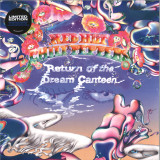
Red Hot Chili Peppers announce their brand new studio album, Return of the Dream Canteen which will be released October 14th on Warner Records. The surprise announcement was dropped at Denver’s Empower Field to rapturous response as the North American leg of their critically and commercially acclaimed global stadium tour kicked off.
The news of Return of the Dream Canteen's imminent release marks the band’s second album of 2022, hot on the heels of the platinum-selling chart topper Unlimited Love which was released in April debuting at #1 in the UK. It will also be the band's second Rick Rubin produced album of 2022, and reinforces their reputation as a band at their absolute peak, riding the crest of an undeniable creative wave.
Continuing to win over audiences across the generations, the band performed a run of sold-out UK/EU dates earlier this year, including two nights at London Stadium. "A scorching European touch-down from the California legends" – CLASH
We went in search of ourselves as the band that we have somehow always been. Just for the fun of it we jammed and learned some old songs. Before long we started the mysterious process of building new songs. A beautiful bit of chemistry meddling that had befriended us hundreds of times along the way. Once we found that slip stream of sound and vision, we just kept mining. With time turned into an elastic waist band of oversized underwear, we had no reason to stop writing and rocking. It felt like a dream. When all was said and done, our moody love for each other and the magic of music had gifted us with more songs than we knew what to do with. Well we figured it out. 2 double albums released back to back. The second of which is easily as meaningful as the first or should that be reversed. 'Return of the Dream Canteen' is everything we are and ever dreamed of being. It’s packed. Made with the blood of our hearts, yours truly, the Red Hot Chili Peppers.
Shine Grooves: "This story began in 2008, at that time I dreamed of launching my own music label and was searching for something unique. I was looking for music in different sources and came across the Frunk29's tracks, this is how I met Marat Shainsky, his release was the first on the Biotronic Records (the label I owned in the mid-00s). Later Marat introduced me to his friend - Sergey Lazarev, aka Lazzich and we immediately put together the next release for the label. It was wonderful and hypnotizing music I had never heard before. After some time we prepared the material for the first Biotronic Vinyl, which was authored by Lazzich, but the release did not happen, due to certain circumstances. And now, 15 years later, the idea comes true, we release the Lazzich mini-album on the Hanagasumi 04. Although Sergey is no longer with us, but his music will live forever. Thanks to everyone who took a part in the search for materials, archives, projects, sketches. Special thanks to Shipulina Yana for providing information and cooperation, Marat Shainsky for the advice and tracks searching, Matvey Andreenko for giving me the large media archive of Lazzich's works, Denis Rooter for designing the cover, Semen Pupyshev for mixing the found Sergey's Reason-projects".
2022 Repress
Dear Friends,
25 years of KOMPAKT is no reason to get hysterical. Then again, it's a nice occasion to have a laid back look at the situation in electronic music today. Minimal techno in all it's varieties is now established as the worlds best dance music, as you may know. So far, so good. What's next Nothing. Dance on!
I've gain two essential insights with the passage of time. First off, that music which over the years only knew 'faster, better, stronger' and 'forwards ever - backwards never' can constantly repeat, quote and loop itself without killing itself. A music that suspends the meaning of time and eventually can set a parallel, better universe of fantasy against the twisted grimaces of reality. Again and again.
And secondly, that getting older living in/with this music is a quite relative term to which ideally a serenity of age can ring a bell. This shows that 25 years after 1993 so many protagonists, enthusiasts, DJs, musicians, relentlessly rave fighters - with all personal advancement - are still there and still celebrate, play or produce this/theirs music; and compete themselves and their music just with that.
Two such heroes of the neat and tidy bass drum culture are with no doubt T.RAUMSCHMIERE aka MARCO HAAS and REINHARD VOIGT. From day one, those two figureheads have given live-techno the glam of stage-diving rock 'n' roll, long before vodka and beer prevailed as alternative lube for ecstatic dancefloors.
Even better they both now raise the glass at the longest techno-bar in the world named KOMPAKT EXTRA/SPEICHER. With DREI MILLIONEN KO¨LSCH, Reinhard Voigt continues to establish his savvy 'way into sound', which he's pursued for a few years now on his many releases. He's turning genre cliche´s into a very personal take with his defiant mix of the deepness of a lonesome cowboy and his implicit faith in the dancefloor and gives the music a very personal touch of ennnoblement of the faith in itself. Technos dignity shall be inviolable.
For me, AUGEN ZU by T.RAUMSCHMIERE is one of the most beautiful masterpieces of bass-heavy 'Umta Umta' techno. A few strikingly brilliant vocal lines from the master himself, put through the machines and combined with a relentlessly sequencer that says it all. This cheers my heart and we will always need such tracks to remind us of ourselves. And to forget about ourselves. Smash hits of unreason! Or the prettiest declaration of love to a music which gets its magical moments from what's happening between the bass drum-beats. But only by this when the bassdrum remains linear and will do so forever. Both Marco Haas and Reinhard Voigt know that. Because after techno comes always techno.
Wolfgang Voigt - May, 2018 Wolfgang Voigt - May, 2018
25 Jahre KOMPAKT sind kein Grund sich aufzuregen. Aber dennoch ein schöner Anlass, einen gelassenen Blick auf die Lage der elektronischen Musik zu werfen. Denn der globale Minimal-Techno, in seinen unterschiedlichen Spielarten, hat sich bekanntlich längst als beste Tanzmusik der Welt etabliert. Recht so. Was nun Gar nichts. Weitertanzen.
Zwei essentielle Erkenntnisse haben sich bei mir im Laufe der Zeit durchgesetzt: Erstens - dass eine Musik, die über Jahre nur ein »Höher, Schneller, Weiter« oder ein »Forwards Ever - Backwards Never« kannte, sich ständig wiederholen, selbst zitieren und loopen kann, ohne daran zu ersticken. Die Bedeutung von Zeit und Vergänglichkeit im besten Sinne außer Kraft setzen und der hässlichen Fratze der Realität eine parallele, bessere Welt der Fantasie entgegensetzen kann. Immer wieder.
Und zweitens: dass »Altern in/mit dieser Musik« ein sehr relativer Begriff ist, dem bestenfalls Altersgelassenheit etwas sagt, Alter. Das zeigt sich immer wieder im schönsten Sinne, wenn 25 Jahre nach 1993 so viele Akteure, Enthusiasten, DJs, Musikanten, unkaputtbare Kampfraver, bei aller persönlichen Weiterentwicklung, immer noch da sind und immer noch diese/ihre Musik abfeiern, auflegen oder eben produzieren und sich und ihr Tun auch nur daran messen lassen müssen.
Zwei solche Recken der gepflegten Bassdrumkultur sind zweifelsohne T.RAUMSCHMIERE aka MARCO HAAS und REINHARD VOIGT. Zwei Rampensäue der ersten Stunde, die Live-Techno den Glam des Rock'n'Roll Stagedivings gegeben haben, lange bevor Vodka und Bier sich als alternative Gleitmittel eines ektatischen Dancefloors in der Breite durchgesetzt hatten.
Umso schöner, dass sich eben diese Beiden mal wieder an der längsten Techno-Theke der Welt, genannt KOMPAKT EXTRA/SPEICHER über die beiden Seiten einer Schallplatte hinweg musikalisch zuprosten. Mit dem Track DREI MILLIONEN KÖLSCH setzt REINHARD VOIGT seinen smarten »way into sound« fort, den er schon seit ein paar Jahren auf diversen Veröffentlichungen konsequent verfolgt. Mit einer trotzigen Mischung aus lonesome cowboyhafter Deepness und dem unbedingten Bekenntnis zum Dancefloor schafft er es, den Klischees des Techno eine sehr persönliche Note der Veredelung des Glaubens an sich selbst zu geben. Die Würde des Techno ist unantastbar.
Der Track AUGEN ZU von T.RAUMSCHMIERE ist für mich eines der schönsten Meisterstücke in der Tradition des oktavbassgeschwängerten Umta-Umta Techno. Einige wenige markant brilliante Textzeilen, vom Meister selbst in deutscher Sprache durch die Maschinen geschickt, gepaart mit einem Sequenzer der keine Gefangenen macht, lassen keine Fragen offen. Da geht mir Herz und Rucksack auf. Solche Tracks werden wir immer brauchen, um uns an uns selbst zu erinnern. Um uns immer wieder selbst zu vergessen. Smash-Hits der Unvernunft! Oder die schönste Liebeserklärung an eine Musik, die ihre magischsten Momente immer aus dem gezogen hat, was zwischen den Bassdrumschlägen passiert. Das funktioniert aber nur, wenn die Bassdrum gerade ist und es für immer bleibt. Und Marco Haas und Reinhard Voigt wissen das. Denn nach Techno kommt immer noch Techno.
Wolfgang Voigt, Mai 2018
- A1: Neal Howard - Indulge (Discomedments Homage Re-Edit)
- A2: Minimalarchiv - Seduced By Theory
- B1: Nexus 21 - Silicon (Don't Need The Bleep Mix)
- B2: Discomendments - Herd Immunity
- C1: Doggy - Neurosilence (Unreleased)
- C2: Mark Archer - The Presence Of Beauty
- D1: Mg - 2 Sensual
- D2: C&M Connection - Bio Rhythms
It’s not normal to take 31 years to release a follow up album. But then Network was never a normal sort of record label, and often opted for the quirky rather than the quick buck. The logo was launched in 1990 and that year, along with a slew of startlingly good singles, created and issued two bio-rhythm compilations, each of which showcased cutting edge USA techno rubbing shoulders alongside its’ sparse UK bleep counterpart.
At the time the words quality and dance music compilations were not phrases shared that much. bio-rhythm 1 and it’s almost instant follow up bio-rhythm 2 bucked the trend with groundbreaking exclusive tracks, iconic minimal artwork and surreal sleeve notes.
Each of the albums have been hailed by many as piece de resistance primers to electronica music.
As well as capturing the zitgeist of a blurry everything of that moment experimental time, they have endured to be acclaimed as all time iconic classics. So why was there no follow up? One reason was that things were moving so bewilderingly fast at the time for Network that the emphasis was always on the next thing, not regurgitating repetitive beat ideas.
Another was that the opportunity arose to direct the acumen gained from the bio-rhythm experience at the release of two (now equally acclaimed) compilations from Frank and Karen Mendez’s cult Nu-Groove label.
The current Network reconstruction meant an opportunity to re-indulge and finally release bio-rhythm 3. Matt Anniss’s splendid sleeve notes are reproduced below and tell you all you need to know about the carefully selected (and mostly exclusive to this collection) tracks on 2 x 12 vinyl for increased sonic joy. Network. We continue.
- A1: Kim English - Treat Me Right (David Morales Club Mix)
- A2: Sandy B - Feel Like Singing (Adelphi Music Factory Remix)
- B1: Byron Stingily - Get Up Everybody (Darius Syrossian Remix)
- B2: Byron Stingily - Get Up Everybody (Parade Mix)
- C1: Pj - Can Ya Tell Me (Gerd Janson Piano Megamix)
- C2: Pj - Can Ya Tell Me (Gerd Janson Bonus Beat)
- C3: Pj - Can Ya Tell Me (Pierre’s Phat Dub)
- D1: Wonderboy - Jerk It (Sorley Street Mix)
- D2: Wonderboy - Jerk It (Felix Da Housecat Original Nooworld Underground Mix)
- E1: Innervision Ft Melonie Daniels - Don’t You Ever Give Up (Ian Friday Libation Vox)
- E2: Innervision Ft Melonie Daniels - Don’t You Ever Give Up (Ricanstruction Vocal)
- F1: Kim English - Learn 2 Luv (Ralf Gum Remix)
- F2: Kim English - Learn 2 Luv (Mood Ii Swing Club Mix)
- G1: Deep Creed - The Anthem (Monki Remix)
- G2: Deep Creed - The Anthem (Armand Van Helden Original Circle Mix)
- H1: Kim English - It Makes A Difference (Danny Howard Remix)
- H2: Danny Krivit & Kyle Smith Present Kim English - It Makes A Difference (Dub)
Black Vinyl[33,57 €]
Nervous Records, the iconic label synonymous with the rise of house from the streets of New York City, will mark 30 years in the music industry by releasing the celebratory compilation LP ‘Nervous Records: 30 Years’ on October 1st (Part 1) and October 15th (Part 2).
Featuring original mixes of the label’s biggest tracks, plus remixes by some of its most celebrated acts, ‘Nervous Records: 30 Years’ is both a celebration of the past and of the future. Featuring a who’s who of electronic dance music, the long player sees names including Louie Vega, David Morales Darius Syrossian, Tensnake, Monki, Franky Rizardo, Danny Howard and more take on iconic Nervous cuts: ‘You Make Me Feel Mighty Real’, ‘Treat Me Right’, ‘Future Groove’, ‘Feel Like Singing’, ‘Get Up Everybody’, ‘Break You’, ‘Hot’, ‘End This Hate’, ‘Unspeakable Joy’, ‘Can Ya Tell Me’, ‘Jerk It’, ‘The Anthem’, ‘It Makes A Difference’, ‘Learn 2 Luv’ and ‘Don’t You Ever Give Up’.
The album marks one of the most enduring, extraordinary legacies to grace America’s illustrious music history, not just in electronica but far beyond. Founded in 1991 by Michael and his father Sam Weiss, and recognizable immediately by its distinctive character logo, the label grew rapidly, in no small part due to Michael Weiss’ practically unmatched passion for discovering new music.
“Louie Vega and Kenny Dope woke me at 4am on Tuesday night, Wednesday morning from their studio telling me they had something really different that I needed to hear,” Michael recollects. “I asked if they could play it over the phone. They said if I wanted to hear it I had to come to the studio. So of course I got myself up, got dressed and went there. That “really different track” ended up being ‘The Nervous Track’, a tune that became our signature release and was also highly instrumental in the emergency of London’s ‘Broken Beat’ movement.”
The label’s willingness to take chances on fresh sounds and innovative concepts rising up from the melting pot sidewalks of NYC ensured a body of work that has become a living musical history of the city. House cuts ‘Unspeakable Joy’ and ‘Nitelife’ (Kim English), ‘Get Up (Everybody)’ (Byron Stingily) and ‘Feel Like Singing’ (Sandy B) bump up against hip-hop anthems like ‘Who Got Da Props’ (Black Moon) and “Bucktown” (Smif-n-Wessun) and reggae cut ‘Take It Easy’ (Mad Lion); soulful flows from Mood II Swing (Kim English ‘Learn 2 Luv’, Loni Clark “Rushing”), Armand Van Helden (‘The Anthem’) and Nuyorican Soul (‘Mind Fluid’) sit alongside seminal techno singles like Winx’ ‘Don’t Laugh’. The young artists and producers who joined the Nervous Records’ family have gone on to become some of the most hallowed and celebrated dance acts of all time: Louie Vega, Kenny Dope, David Morales, Tony Humphries, Roger Sanchez, Armand Van Helden, Kerri Chandler, Kim English, Byron Stingily, Josh Wink, to name just a handful.
“We did a release with Josh Wink under his Winx alias entitled ‘Nervous Build-Up’,” Michael said. “It did well and it was obvious how talented Josh was. Subsequent to that release I was pretty persistent in asking him to continue to play me his new demos. During one phone conversation he said, “Mike I’m gonna play you something over the phone but don’t laugh when you hear it.” That demo ended up being ‘Don’t Laugh’, which became one of our biggest international hits and still to this day is one of America’s earliest and most impactful techno hits.”
As much a celebration of the label’s future as it is of their past, Nervous Records: 30 Years is but a marker in the imprints’ history, a clear sign of where they’ve been and also where they’re going. With 30 years behind them, the label’s determination to unearth new raw diamonds in the rough is as unwavering as ever.
“I’ve always been one to look at what others are doing (the industry at large) and think, “ok, are they doing this specific thing for a reason, or doing it because everyone else is doing the same thing” and make my decision based on that,” says Nervous Records’ General Manager Andrew Salsano. “In an age where data metrics and analytics reign supreme, I remain steadfast that they should be complementary to your decision and not the sole indicator to make one. So many songs today are written with 15 second hooks in mind for social media, and while there’s nothing wrong with that business model you will always be chasing the wave instead of carving out your own path and identity.
“My primary focus for the sound of the label has and will continue to revolve around signing good songs and music that has the ability to react at the street level first. The best results come from artists that are firstly given a bit of local love that grows into a global impact. Fresh ideas that express child-like curiosity and artists showing vulnerability in their music are also something I look for, artists and producers that are not making music with certain markets in mind, but rather their own style and signature that is unique but able to straddle the fine line of underground and overground.”
Still as raw, as underground and as finely tuned to the dance floor as they ever have been, perhaps the secret to the success - and the longevity - of Nervous Records has something to do with that hard, dogged, no-holds-barred NYC edge that runs through the veins of the label. With the next generation of producers rising from the clubs of New York, one thing is certain; Nervous Records will be there to find them, nurture them and bring them to the world at large, over the next decade and beyond.
As Modularz approaches it’s 50th release - Label owner Developer decided to feature a 4 track sampler taken from
The new Lp by Chicago’s Zachary Lubin named “Omronicon” this is Modularz 49 to be exact and features a wealth of groove based bangers all carrying the same aesthetic and theme through the recordings. It’s hard to pin point if this is a hard or deep release so let’s say it’s entirely both and with good reason - it’s also very synth heavy and gains ongoing momentum the more you listen. It’s very obvious that Modularz puts out excellent techno and this is by far no exception. TIP
Repress
Techno Letfield legend. Peder Mannerfelt returns, this time in original format, with the second version of a track called The B. The first version probably never existed. As you will hope that this one never existed too while your brain is melting in a Swedish oven spiced with hoovers and sub bass.
Hard to deny the back and forward energy between the Copenhagen scene and KAOS. Repro is back in the show. The moment of impact is a heavy trip on high energy mode. Please wear your helmets.
Dirty Rocking Bassline is most probably one of my (and SPFDJ) top 3 most played tracks ever. That would be a reason to be more than excited to welcome directly from Devon (UK) to Darc Marc. But you wanted more: Running With The Devil has been another sure hit in your TRACK ID?? requests in the last months. Free-party rooted, hyperdrive, sexy, dark, fast... And now you believe.
The hardcore-IDMish dystopia from Uncrat closes poetically this new issue, giving more meaning than ever to that mighty quote that once a wise friend of mine said at an after and that I take now as life motto.
#TOOMUCHISTHEMINIMUM
That old saying goes
Punks jump up to get beat down
So in times of no voice or reason
Why not welcome back three techno delinquents
Who know how better than most
To throw a hard left to the bass-drum punch
T.RAUMSCHMIERE has soared on our SPEICHER eagle some few times past
And returns with a hearty swill of his signature romper room liberation techno
Drink it up and let the BASS BALLERT VOM BALKON
Take you to oblivion
Brothers VOIGT & VOIGT are no strangers to our series
And their new episode is unlike any show you have seen
Starring BASSTARD – that low slung, deep bass minstrel
2 Part Erdinger and 4 Part Absolut.
Eine alte Redensart besagt
Wer die Fresse aufreißt, der bekommt sie poliert
In Zeiten ohne Sinn und Verstand
Heißen wir drei Gauner willkommen
Berühmt und berüchtigt
Für ihre harten Schläge
T.RAUMSCHMIERE ist schon einige Male
Auf dem SPEICHER Adler gesegelt
Nun kehrt er zurück, mit einem herzhaften Trank
Kinderzimmerbefreiungstechno Nimm einen tiefen Schluck
BASS BALLERT VOM BALKON
Um alles andere zu vergessen
Auch die Gebrüder Voigt
Sind uns Weggefährten
Und ihr neuester Streich
Ist wie kein anderer zuvor
BASSTARD
Tiefergelegter Tiefbassbarde
2 Teile Erdinger, 4 Teile Absolut
We think our 6th release – not counting the überdrüber
‘sizzling hot edits’ – is a good display of the rtct.records
variety. Four artists from all over continental Europe are
showcasing their eclectic styles, fully exploring the richness of
house music front to back and old to new. Whether you hated
or enjoyed the record, let us know what you did with it. And, you know, just for reasons of SEOability, here are artist names again: PARADISO RHYTHM!
MUTENOISE! GUS NOBEL! LEO WOELFEL!
- A1: Parade Ground - The Lights Gone
- A2: Diseno Corbusier - La Esperanza Esta En Antena
- A3: Lena Platonos - Mia Gata Sas Perimenei Ste Gonia
- A4: Victrola - Luca (Instrumental)
- A5: Borghesia - Magla
- B1: Tom Ellard - Ga Duum Blitzfonika
- B2: X-Ray Pop - Corto Maltese
- B3: Second Decay - Lubeckerstrasse
- B4: From Nursery To Misery - Contentment
- B5: Cyrnai - Digital Grit Box (Demo)
Celebrating a Decade of Dark Entries with a compilation titled ‘Tens Across The Board’. We revisit our roster and chose 10 songs from 10 bands from 10 different countries spanning the years 1981-1993. The songs flow in chronological order and have never appeared on vinyl, with 7 of the songs previously unreleased.
The compilation begins in 1981 with Parade Ground from Belgium, the duo of brothers Pierre and Jean-Marc Pauly with help from Patrick Codenys and Jean-Luc of Front 242. “The Light’s Gone” was one of their earliest experiments and employs a stark minimalism with modular synthesizers, guitar reverb and tape delay. Next we venture to Granada, Spain in 1982 to meet the trio of Diseño Corbusier. Influenced by Cabaret Voltaire and Dadaism, “La Esperanza está en Antenas” was the band’s take on melancholic pop fueled by a robotic DR-55 bass-line. Sailing the Mediterranean Sea to Athens to meet Greek electronic goddess Lena Platonos who shares a demo from 1983. “Μια Γάτα Σασ Περιμένει Στη Γωνία” translates to “A Cat Is Waiting On The Corner” and is possibly the witchiest sounds we’ve shared yet, ending with a blood curdling scream. Frozen in 1983 we cross Ionian Sea to Messina, Italy and visit Victrola, the duo of Antonino “Eze” Cuscinà and Carlo Smeriglio. They’ve unearthed a melodic instrumental version of “Luca” fueled by a Korg Polysix and TB-303. Traveling across the Adriatic to Slovenia circa 1984, where Borghesia are working on their album ‘Ljubav Je Hladnija Od Smrti’. “Magla” translates to “Fog” fitting for the thick, somber electronics of Aldo Ivancic providing a dense atmosphere for the baritone vocals of Dario Seraval.
On Side B we go down under to Sydney and excavate a hidden Tom Ellard song recorded in 1984 under the alias Lord Metal, an anagram of his name for copyright reasons. “Ga Duum Blitzfonika” is a slow-motion, unadulterated dance groove originally released on the cassette compilation "Independent World”. Skipping ahead to 1986 in Tours, France we salute X-Ray Pop the minimum new wave duo of Didier "Doc" Pilot and Zouka Dzaza. They contribute the hypnotically fragile “Corto Maltese” that originally appeared on the cassette compilation ‘Plop’. Crossing the German boarder we arrive in Dortmund at the apartment of Andreas Sippel of Second Decay who recorded the instrumental demo “Lübeckerstrasse” in 1988 with partner Christian Purwien. Utilizing an TR-808, SH-101 and Arp Odyssey this cold slice of futurism was named after the street Andreas lived on. Traveling westward to England, specifically Basildon, Essex to the teenage bedroom of From Nursery To Misery, the trio of identical twin sister vocalists Gina and Tina Fear and keyboard player Lee Stevens. “Contentment” is an introspective, ethereal pop song with child-like vocals that originally appeared on the Belgian tape compilation ‘Heartbeat Vol.4’ in 1989. Finally, we return home to San Francisco and close out the compilation with Cyrnai the moniker of multi-instrumentalist Carolyn Fok. “Digital Grit Box (Demo)” was an outtake from the ‘Transfiguration’ album sessions recorded in 1993, utilizing dark dance drum beats made with MIDI sequencer programs Studio Vision and Sample Cell.
All songs have been remastered by George Horn at Fantasy Studios. The vinyl is housed in a custom designed jacket by Eloise Leigh featuring our label’s colors black-white-red with connect-the-dots pattern linking the 10 songs via maps/timeline/location, all relating to the reissue process, plus source images from San Francisco, our hometown. For this landmark release we've also printed a 2-sided fold-out wall poster that includes every artist we've released in our first 10 years 2009-2019 in black, red and silver metallic ink, plus an 8x11 insert with lyrics, notes and photos.
Percussionist Jamie Muir was a member of King Crimson during the recording of Larks' Tongues In Aspic, in 1973. Staying less than a year with Robert Fripp, the Scot had already cut his teeth with another master guitarist, Derek Bailey, as part of the Music Improvisation Company, along with Evan Parker, Hugh Davies and Christine Jeffrey, whose eponymous 1970 album was one of the first releases on ECM. Muir and Bailey recorded Dart Drug eleven years later, in 1981.There's no shortage of great percussionists in the brief history of free improvised music but on the strength of Dart Drug alone Jamie Muir deserves a place at High Table. Unlike for example Han Bennink and John Stevens, though, you can't hear echoes of any particular jazz drummer in Muir's playing, even if he has expressed appreciation for Milford Graves (who himself sounded like nobody else who'd come before him).What on earth did Muir's kit consist of Some instruments are clearly identifiable (bells, gongs, chimes, woodblocks); others could be... well, anything. Old suitcases thwacked with rolled up newspapers Tin cans and hubcaps inside a washing machine Who cares It sounds terrific - but if you're the kind of person who faints at the sound of nails scraping a blackboard, you might want to nip out and put the kettle on towards the end of the title track.Dart Drug is consistently thrilling, and often very amusing - but it's certainly not easy listening. In music we talk about playing with other musicians, whereas in sport you play against another opponent (or with your team against another team). Why not play against in music, too That's precisely what happens very often in improvised music, and Bailey was particularly good at it. How can a humble acoustic guitar hope to compete with a Muir in full flight Sometimes Bailey's content to sit on those open strings, teasing out yet another exquisite Webernian constellation of ringing harmonics and wait for the dust to settle in Muir's junkyard, but elsewhere he sets off into uncharted territory himself.'The way to discover the undiscovered in performing terms is to immediately reject all situations as you identify them (the cloud of unknowing) - which is to give music a future.' Bailey evidently concurred with this spoken statement by Muir, including it in his book Improvisation.Derek Bailey is no longer with us, of course, and Muir gave up performing music back in 1989. All the more reason for seeking out this magnificent, wild album.
KHT 008 is coming from no less than the man who is called The Prince of Techno' by his peers.
And that is for a reason: Blake was part of the first wave of Detroit techno artists and dis and contributed to the techno movement from the mid 80s. Tracks like When a dream becomes U' or Our love' are milestones of electronic music, his style, which he calls Poetry and Rhythm' is distinctive. For Killekill House Trax he delivers the Acid Life EP which comes along with two strong, acid driven tracks, the A-side darker and more chicago-oriented with its rhythmical focus and the punchy kick, the B-side more Detroit-ish with its uplifting chords.
Timeless!
Music has always coursed through Roman Lindau's blood. Even if he weren't the accomplished producer and respected DJ he is today, the German audiophile would still be spending all his money on the stuff; giving over all his time to the art form. ''I'm a music junkie. I need music to live'' he states matter-of-factly. ''For me it's the elixir of life.''
Good job, then, that he gets to spend his ..
Roman Lindau is a German techno DJ, artists and producer, as well as being a core member of the infamous Fachwerk Records from Berlin.
Music has always coursed through Roman's veins ever since he was a young boy so it is no suprise that he became the accomplished producer and highly respected DJ that he is today.
In the late 2000´s Lindau became active in the Berlin electronic music scene, beginning to play music in clubs as well as producing his own music.
The first track he released in 2008 on his home label Fachwerk Records appeared in one the world famous Berghain Mix Compilations, mixed by Len Faki.
Following from this Berghain invited Roman to contribute an exclusive Track for Ben Klock´s Berghain Mix in 2009. After this success the gates opened for him to play regularly as a DJ at Berghain.
At the same time he continued to work on music for Fachwerk Records. He produced dance floor smashers like ´Crasse´ in 2011 and ´Rave on´ in 2014, which were charted by the likes of Ben Klock, Sven Väth & Chris Liebing, afirming his deserved place amongst the techno elite.
More recently in 2015 the well known Victor Calderone from NYC invited Roman to release on his label Matter+.
The reason why Roman is such a great DJ is because of the fact he knows what the people want! ''I love to dance and that's very important: as DJ you need to feel what the crowd want so you can help them to party and have fun.''
Combining a varied selection of raw house and techno in his sets, recent bookings have taken Roman across the world; from the hallowed techno Mecca that is Berghain to dark underground clubs as part of the recent Fachwerk label tour.
He has performed at every legendary Berlin venue, past and present from Tresor to Berghain, and it is this that gives Roman the edge above the rest. If you can do it there, you can do it anywhere!
From 2014 Till the closing he was a resident DJ at Stattbad, one of Berlins findest adress for Electronic Music.
the tale of the mythic pentaki mountain has been engraved on a two-sided circular piece of wax. the north face of the peak is steep, abrasive, and has been the subject of many legends in the region. it is said that whoever would manage to climb it would find a plateau, leading to a place called "the single source of truth". considered as the ultimate goal by both psychedelic gurus and database optimization corporations, and as an ideal retirement destination for a couple of lost souls in search for coherence and objectivity, the source diffuses endless loops of haunted voices, apparently sampled from a discarded call center, running low on power, encouraging listeners to shorten cycles, deliver requests and improve user experience. it is also said that anyone climbing from the south side would never reach the summit or find his way to the plateau, and would always end up on a lower altitude than where he started. this topographical anomaly is probably the reason why the south face of the pentaki has always been favorited by locals, with its sunny weather and its luxurious vegetation flourishing along the soft downward slope, leading to a slow and peaceful end.