Recent Arts is a duo conformed by visual artist Valentina Berthelon and musician Tobias Freund. Together they build live performances using video projections and experimental sound –charged with symbols, stories and poetry– thus generating sound environments that invite to enjoy the music while deeply connecting with our perceptions of the world and our sense of realities within it.
Cerca:recent arts
Recent Arts is a duo conformed by visual artist Valentina Berthelon and musician Tobias Freund. Together they build live performances using video projections and experimental sound -charged with symbols, stories and poetry- thus generating sound environments that invite to enjoy the music while deeply connecting with our perceptions of the world and our sense of realities within it. Access audiovisual material at: recentarts Written and produced by Tobias Freund at Non Standard Studios, Berlin 2018 Vocals by Barbie Williams, Video by Valentina Berthelon
Released on Limited Edition Black Vinyl with a replica of the original sleeve and insert (300 Copies only). The beginning of the 1980s wasn't a great time to be young. Between 1979 and 1981 youth unemployment more than doubled to over 900,000. Many approaches were tried to tackle the problem and one of the more innovative was the Arts Opportunity Theatre a charity founded in Bristol by Reynold Duncan and Yvonne Deutschman. Financed by assorted public bodies, it aimed to train young people in a range of performing arts as well as the multiple skills needed to produce, organise and put on shows. Over a seven year period the Arts Opportunity Theatre put on a succession of shows not only locally, but travelling as far as the Continent and trained hundreds of young people in everything from music to book keeping. People who passed through the collective would go on to form the core of many local bands and be involved in a large proportion of Bristol music releases, especially reggae. The first show put on in 1981 and 1982 was "Freedom City" which prominently featured Zion Band. In May 1982 the Zion Band musicians from the show went into Right Track Studio in Bristol and recorded four vocals and two dubs that would be released the following January on a 12" single. Back in 2011 Bristol Archive Records included "Twelve Tribes" on a compilation and would later also compile "Babylon Fire/Babylon Dub", but the other three tracks could only be found on the scarce original 12" which in recent years has rocketed in price fetching in excess of £150. We believe music should be affordable and available so 2026 will see Bristol Archive Records reissue the Zion Band "Freedom City" 12" in it's entirety, complete with its original picture sleeve and insert with a limited pressing of 300 copies on black vinyl. This release is dedicated to the late Reynold Duncan RIP.
- A1: Dj Ski's Intro
- A2: Nineteen Seventy Something
- A3: Son Of Yvonne
- B1: Da' Pro
- B2: Store Frontin
- B3: Me & My Gang
- B4: Crush Hour (Feat Pav Bundy)
- C1: Think I Am (Feat Big Daddy Kane & Mf Doom)
- C2: Fresh Fest Reggie B
- C3: Hoe-Tel-Leftovers
- C4: Slow Down
- D1: Home Sweet Home (Feat Pav Bundy)
- D2: Dedication
- D3: I Did It
- D4: Outtakes
Repress incoming!
Following the success of two collaborative releases (EMC “The Show”/2008 and Ace & Edo G “Arts & Entertainment” /2009), Masta Ace joins forces with the metal faced MF Doom for Son of Yvonne, a highly personal concept album that celebrates the life and legacy of Ace’s recently departed Mother. Like his 2004 landmark Disposable Arts, Son of Yvonne is meticulously constructed with stories, settings, and characters that resonate with flesh and bone humanity. Interstitial vignettes provide a thematic backbone to the experience, and each track complements and completes the previous to form a narrative whole: a sometimes visceral, sometimes nostalgic slice of Ace’s young life in Brownsville, Brooklyn. Entirely underscored by MF Doom’s iconic Special Herbs instrumentals, Son of Yvonne features the Juice Crew general Big Daddy Kane, new comers Pav Bundy (The Bundies), Reggie B and even MF Doom on the mic. It’s Masta Ace’s no frills flow, however, that looms largest above the dusty samples and digger loops that define Doom’s production. Ace’s photo-realistic rhymes about stick-up kids, spraycan artists and wack emcees add extra gravity to his already celebrated reputation as “truly an under-appreciated rap veteran and underground luminary” (Allmusic Guide). Like Eminem recalls in his 2008 autobiography The Way I Am, “Masta Ace had amazing storytelling skills. His thoughts were so vivid.” TRACKLIST: A1. DJ Ski's Intro A2. Ninteen Seventy Something A3. Son Of Yvonne B1. Da Pro B2. Store Frontin B3. Me & My Gang B4. Crush Hour feat Pav Bundy C1. Think I Am feat Big Daddy Kane & Mf Doom C2. Fresh Fest Reggie B C3. Hoe-Tel-leftovers C4. Slow Down D1. Home Sweet Home feat Pav Bundy D2. Dedication D3. I Did It D4. In Da Spot feat Milani The Artis D5. Outtakes
In a sharp-angled, fiercely inventive reflection on the nature of club culture and digital fatigue, Simo Cell and Abdullah Miniawy reunite to deliver their new album, Dying is the internet, to Dekmantel's UFO series.
French producer Simo Cell has blazed a singular path from his dubstep-influenced origins to become a leading light in contemporary leftfield club music, twisting up adventurous rhythms and flamboyant production in pursuit of a perpetual freshness for the floor. Egyptian singer, poet, producer and composer Abdullah Miniawy has become equally omnipresent in the past 10 years, straddling the arts world and leading with his piercing Arabic lyricism while maintaining an eternally curious spirit that leads into open-ended, experimental music from the abstract to the propulsive.
Following up on their 2020 EP for BFDM, Kill Me Or Negotiate, Miniawy describes their sharply focused new album as "a playful prophecy about the triggers of a new global revolution." Cell considers the title, Dying is the internet, to be a mantra about "how the internet lost its soul," becoming "less about sharing ideas and more about surviving in a digital business ecosystem." Deliberately at odds with the reel-ready two-minute attention span of the average social media surfer (i.e. everyone), the pair set out to make an album that takes its time to reveal nuanced ideas and expressions. Rather than one-note despair for the modern malaise, Cell and Miniawy offer a philosophical reminder that this present moment in the human experience is a temporary phase, no matter how overwhelming it feels.
Dying is the internet finds Miniawy experimenting with auto-tune across the record, while Cell has developed his voice design chops and compositional instincts, moving closer to fully realised song structures without losing the fundamental 'clubbiness' of each track. The result is a cohesive, wildly original kind of heavyweight dance music that slings out hooks left right and centre, from Miniawy's laconic trumpet looming through low-slung 'Reels in 360' and 'Travelling In BCC' to the persistent handclaps that bring 'Living Emojis' to life. Miniawy's poetry explores the power of insistent, repeated phrases in a break from his more typically structured form.
Kenyan powerhouse Lord Spikeheart adds extra snarl to stripped-back, slow-burn opener 'I See The Stadium', but otherwise Dying is the internet is purely the work of Miniawy and Cell casting their considerable chops out into unexplored territory. The results are electric, bound together by a consistent economy of sound that burrows into a shroud of bass-heavy minimalism barely masking Cell's incredibly detailed studio flex. Even the beatless flourish of the Miniawy-produced 'Tear Chime' comes loaded with physicality — a sensory rush at the mid-section of the album bookended by some of the most idiosyncratic club music in recent memory.
Both Simo Cell and Abdullah Miniawy have already proved themselves as fearless innovators across different fields. The strength of their partnership lies in their ability to make space for each other while letting their distinctive sonic identities ring loud and true. Dying is the internet has immediacy and physicality to translate over a soundsystem, but its intricacies are purpose-built for repeat visits and contemplation, unveiling hidden dimensions the deeper you dive into it.
Renowned Italian jazz master Nicola Conte presents an incandescent limited edition 7" single for Record Store Day 2026. "Terra Em Transe" and "Naquela Base" are brand new tracks from sessions for Conte's forthcoming Far Out Recordings album, drawing deep from early 70s Brazilian jazz and modal hard bossa while underlining the vital role of the arts in social and political struggle.
In Nicola's own words: "Terra Em Transe' is a dedication to visionary director Glauber Rocha and to all free thinkers willing to portray the conflicts, contradictions and lies of those in power around the world." The original composition takes inspiration from Milton Nascimento's vocal harmonies and Tamba 4's sophisticated samba-jazz.
'Naquela Base' is a stunning reinvention of João Donato's classic: pure modal hard bossa recorded entirely live in the studio. Inspired by samba-jazz classics like Tenório Jr.'s "Embalo" and Paulo Moura's "Fibra", the track is carried beautifully by Teppo Mäkynen's masterful drumming, with solos from Gaetano Partipilo on alto saxophone and Pietro Lussu on piano, supported by Ameen Saleem on double bass and Abdissa Assefa on percussion.
Having released music with Blue Note, Impulse! and Schema records, Nicola Conte's relationship with Far Out Recordings has produced his acclaimed Umoja project, his five-part Viagem compilation series, and most recently Viaggio, a compilation exploring Italy's library music renaissance from 1970-79.
'Terra Em Transe / Naquela Base' will be released as a limited edition 7" single for Record Store Day 2026 via Far Out Recordings.
While they’ve been active for more than two decades, it’s only been in recent years that the Berlin and New York based contemporary sonic arts platform, Soundwalk Collective, has begun to gather the accolades and attention that they rightfully deserve. Firmly rooted within a multi-disciplinary practice that engages the narrative potential of sound within the contexts of visual art, dance, music and film, as well as tapping anthropological, ethnographic, and psycho-geographic research, they’ve gained great note for collaborations with Jean-Luc Goddard, Nan Goldin, Sasha Waltz, Charlotte Gainsbourg, and numerous others.
Building on the back of 2023’s brilliant “All the Beauty and the Bloodshed”, Soundwalk Collective now returns with “Khandroma”, one of their most fascinating and singular endeavours to date, which re-engages their enduring creative partnerships with Patti Smith. Issued by Ubi Kū, a brand new imprint founded by the Italian Buddhist Union dedicated to the relationships between Buddhist cultures, music, and sound, across the album’s stunning two sides this incredible ensemble draws inspiration from and conjures Tibetan deities, the Himalayan Plateau, the valleys of Nepal and the highest peaks where the most ancient Buddhist temples reside, culminating as a sprawling sonic tapestry like little else. Issued as a beautifully produced, limited edition vinyl LP and CD, mixed and mastered by Giuseppe Ielasi, complete with a booklet featuring liner note essays penned by Chiara Bellini and Filippo Lunardo, and images by Stephan Crasneanscki, it’s hands down among our favourite releases by Soundwalk Collective to date and not to be missed!
An international experimental sound art collective founded in 2001 by the artists Stephan Crasneanscki, who was joined in 2008 by producer Simone Merli, Soundwalk Collective is a contemporary sonic arts platform, featuring a rotating constellation of artists and musicians, that, in vastly varied number of ways, has continuously explored the remarkable potential of sound within the contexts of visual art, dance, music and film, offering particular emphasis to anthropological, ethnographic, and psycho-geographic research, examining conceptual, literary or artistic themes. In addition to their many collaborations and accolades that attend to an increased ambitious catalog of releases, they scored Laura Poitras’ film, “All the Beauty and the Bloodshed”, which won the Golden Lion at the 2022 Venice Film Festival, as well performed and exhibited at Berghain, CTM Festival, documenta, Manifesta, New Museum, and Centre Pompidou, where they notably opened “Evidence”, a exhibition with Patti Smith comprising an audio-visual journey from the work of French poets Arthur Rimbaud, Antonin Artaud and René Daumal. While Soundwalk Collective’s output and use of sonority - sometimes original composition and others manipulated archival recordings - and context is varied, the project’s endeavours are unified by a focus on sound as material that is both tactile and poetic, pursuing layered narratives that address ideas of memory, time, love and loss. Their latest, “Khandroma”, enlisting Patti Smith’s contribution on one of its tracks, stands among the most exciting and rich of these explorations yet.
Perhaps the best way of approaching “Khandroma” is through Soundwalk Collective’s longstanding focus on the discipline of psycho-geography - a practice that interrogates the impact of an environment’s embedded histories and meanings on the psychology of the present - as well as the group’s integration of observations of nature, and uses of non-linear narrative, as a vehicle for recording and the synthesis of meaning. Like previous projects that have encountered them traveling extensively across the world, occupying diverse environments for long periods of investigation and fieldwork, during which they source materials for subsequent works, the material roots of “Khandroma” are a body of field recordings made by Crasneanscki, Francisco López, and Merli at altitudes between 2,760 and 4,500 meters, in varying locations across Upper Mustang during 2016.
Drawing the album’s title from the Tibetan feminine deity who reigns the skies, the album’s two compositions weave a stunning sonic tapestry from collaged sounds of nature, bells, drones, unplaceable tones and vocals, and in the case of its second piece, “Chasing the Demon”, the voice of Patti Smith, culminating as a deeply emotive and imagistic expanse that taps something far more profound than any of its single parts. As the collective states: “the album traces the continuous morphing of the wind into sound expressions. The Himalayan Plateau seems designed to amplify and echo the encounter of the breaths, the prayers, and the chants emerging from around and within those temples; amid the sounding of bells, the turning of prayer wheels, and the billowing of flags. A resonant musical body that we recorded so as to capture its boundless mutations; an unstoppable force that cries, whispers, and blows through and over stones, wood, empty halls and monastic robes, etching an ever-changing sonic landscape onto the surfaces it encounters.”
Immersive, stunningly beautiful, and haunting, “Khandroma” draws the ancient and distant into the consciousness of the present, close to home, bordering on the profound. Issued by Ubi Kū as a beautifully produced, limited edition vinyl LP and CD, mixed and mastered by Giuseppe Ielasi, complete with a booklet featuring liner note essays penned by Chiara Bellini and Filippo Lunardo, and images by Stephan Crasneanscki, we can’t recommend it enough.
Always endeavoring to drop it a little way different, Ital Counselor Records once again stretch things in a forward direction while paying full and forceful tribute to that which has come before. This heartical 7" is a tribute to the late great Prince Lincoln Thompson in the form of a reimagined take on his composition "Kinky Money Game."
It is with great honor that ITAL COUNSELOR records has been able to work with two legends of the music business on this slab of plastic. Firstly, Jeb Loy Nichols comes with a storied history in music and the visual arts. He first came to ITAL COUNSELOR’s attention upon discovering the 1981 compilation, “Wild Paarty Sounds” via Cherry Red/On-U Sound. Later would be greater, with projects skirting the realms of country, soul, reggae, and leftfield. Bands like the Fellow Travelers, solo albums with Adrian Sherwood, and more recently writing songs for Horace Andy’s latest On-U album have all contributed to an impressive body of work.
Over the years when Jeb is not making music, he can be found writing books or churning out block prints of birds, leaves, pithy phrases, and the odd sleeve art for labels like Pressure Sounds, and, yes ITAL COUNSELOR. His sleeve work on this 7” indeed captures the essence of the music hiding under the cardboard exterior. Lo-fi, retro while poignantly on time. Social commentary manifested auditorily and visually.
Jeb’s reinterpretation of Thompson's original bubbles over a slow burning one drop built by none other than Studio One, Riz Records, and Tuff Scout Records alum Gil Cang. In yet another musical first brought to you by ITAL COUNSELOR, this piece of wax represents the only time Jeb and Gil have worked together. The results are a magical mix equally at home in the hands of a sound system operator unconstrained by the current ‘steppers’ norms as it is on a home stereo where one can deeply sit with the lyrics of depth and significance. An old time something feel for these nowadays times. An ITAL COUNSELOR Records essential.
Feel the vibes…
- A1: World Is Dog
- A2: Cctv (Feat Creature)
- A3: Yottabyte
- A4: Bad Pollen (Feat Billy Woods)
- A5: Slum Of A Disregard
- A6: Rfid
- A7: Instant Transfer (Feat Billy Woods)
- A8: Ikebana
- B1: In The Shadow Of If
- B2: Skp
- B3: Hushpuppies
- B4: 14 4 (Feat. Skech185)
- B5: Voice 2 Skull
- B6: Xolo
- B7: Zigzagzig
Black Vinyl[35,08 €]
We’re teaming up with ELUCID and Fat Possum for a limited edition of 300 copies of a Rush Hour black ice coloured edition.
E L U C I D, one half of the illustrious duo Armand Hammer, is here with the full-length follow-up to 'I Told Bessie'. Further experiments in the sonic, expanding on the 'live' side of music paired with the embracing of chaos. Something you haven't heard, or not so for a very long time. E L U C I D is here to reveal the bleakness of reality.
---------------------------------------------------------------------------------
''There is never time in the future in which we will work out our salvation. The challenge is in the moment; the time is always now.''
James Baldwin
A raw, crackling urgency runs through rapper-producer ELUCID’s new album REVELATOR like an underground power line. There is no space here for sepia-toned reminiscences or indulgent self-mythologizing. Intellectual rabbit holes have been filled in with concrete and rebar ; there is nowhere to hide and no off ramp from the audio Autobahn that ELUCID has fashioned—a renegade Robert Moses with gold fronts, bulldozing the homes of the powerful and the complicit. REVELATOR brims with the energy of now, with a refusal to look away. Carpe diem in a murder one mask.
Born in Jamaica, Queens, ELUCID has been on the cutting edge of New York’s underground scene since the mid-2000s. From the beginning, he has defied both convention and expectation. He ran with Okayplayer darlings Tanya Morgan, but his own music eschewed their throwback charm for glitchy noise experiments and bass-swamped culture jamming. His 2016 debut studio project Save Yourself (re-released in a deluxe edition last year) announced him in earnest. But in recent years, his Armand Hammer releases with partner-in-crime billy woods have received significant attention and acclaim. Serving as a followup to his last solo album—2022’s comparatively balmy I Told Bessie—ELUCID hoped to “re-distinguish” himself with REVELATOR, setting himself apart amidst the increasing attention around the music he and his friends are making together.
For ELUCID, this meant setting bold new challenges for himself. One of these was diving further into live instrumentation than ever before—”getting my Quincy Jones on,” as he puts it. The testing ground for this approach was Armand Hammer’s most recent project, 2023’s We Buy Diabetic Test Strips’ Möbius strip soundscapes, warmed with instrumental flourishes and skin-shedding beat progressions. With REVELATOR, though, ELUCID strove to create an atmosphere of chaos, embracing experimental electronics and atonal sample bursts. He worked on much of the album with co-producer Jon Nellen, who comes from a background in avant-garde and Indian classical music. “I wanted to get as freaky as I could at this moment. I wanted people to hear things, maybe for the first time, or in a way they haven’t for a long while,” the rapper explains.
ELUCID arrived at the studio with a collection of noise sources: non-referential samples, glitches and noises. Together he, Nellen, and others created forms out of them and, as ELUCID recalls, “just started playing drums with it.” Their fried, distorted sound was directly inspired by Miles Davis at his most uncompromising—specifically, the tone-clustering funk track “Rated X” from his 1974 double LP Get Up With It. At times, the pairing of rap with avant-fusion sounds also brings Emergency! from The Tony Williams Lifetime to mind, perhaps in an alternate timeline where the late drummer was listening to Ice Cube’s AmeriKKKa’s Most Wanted.
“The World is Dog,” REVELATOR’s lead single, functions as the album’s aesthetic thesis statement. Like the Davis track, the textures are punishing, the tonality is in free-fall, and the driving breakbeat of a groove cuts in and out unceremoniously. Avant-jazz bassist Luke Stewart, who appears throughout the record, holds the whole thing together just long enough for ELUCID to tightwalk over the beat. This tension is exactly where REVELATOR sets itself apart; in a time of drumless loops, and safe soul samples, this is a high-wire act with no safety net. Similarly, the song announces the themes of the album within just a few phrases, evoking the way societies accept and adjust to new levels of debasement and brutality while suffocating under the weight of history: “Can’t clock the kill, all a mystery/Forced past will eating everyone eventually/The world is dog.”
Many of the songs on REVELATOR grapple obliquely with dissolution and disenfranchisement in America and across the world—the grim realities of our domestic sociopolitical climate and our involvement in foreign conflicts. “Much of my artistic and political sensibility comes from the Black arts movement here in New York,” ELUCID explains. “Recognizing the interconnected global struggles against oppression, artists and thinkers created works and actions in solidarity with freedom movements in South Africa and Palestine.” ELUCID cites intellectuals like Amiri Baraka, Kwame Nkrumah, Audre Lorde, Sonia Sanchez, and Nikki Giovanni among his heroes. (One track on the album is specifically inspired by Lorde’s work, “SKP,” citing the scholar’s paper “Uses of the Erotic: The Erotic As Power.”) Songs like REVELATOR’s insistent closer “ZIGZAGZIG,” find ELUCID applying up-to-the-minute messaging, making explicit reference to the conflict in Gaza: “Feed a war machine…from river to sea, in lieu of peace.”
Despite ELUCID’s preference for cacophonous system overload here, the rapper also provides moments of respite. Recorded at The Alchemist’s Los Angeles studio, the laid-back, wheezing “INSTANT TRANSFER” is a collaboration with billy woods, which crystallizes their shared sense of creative determination. “With much momentum behind us and even more on the horizon, I knew a purpose, and that every step was ordered to that purpose,” ELUCID said of the experience. Meanwhile, the jittery “HUSHPUPPIES” is a playful anomaly on the track list, providing a snapshot of ELUCID watching his grandparents in the kitchen while preparing for Friday night fish fry dinners.
“Love still rules over on this side,” ELUCID says. ”I’m raising a family. We are making meaning and finding joy in the midst of all the fucked up-ness of everything around us because the alternative is cowardice and slow death. We remain rooted. We celebrate our people and our wins. Struggle is necessary.”
“IKEBANA” is one of ELUCID’s strongest statements of purpose on the record, blending the record’s heaviest themes with its most hopeful sentiments. supported by a shoutalong refrain and an urgent prog-funk groove. Breaking away from images of dissolution and crumbling societal systems that populate REVELATOR, ELUCID notes that the only way to navigate life’s bleakest landscapes is to cling to love and believe in those around you—to look forward toward something better that may or may not be possible. For the rapper, one of the album’s most trenchant lines comes during a centerpiece of a beat drop: “Being alive/I must look up.”
“The lyric ‘being alive I must look up’ is important especially in the context of this album. Much of the album imagery is harsh and reflects the actual doom some of us experience. But still I/we exist,” ELUCID explains.
Every artist is, in one way or another, the product of their time, bound by life’s leaden gravity to operate within the space of that which is already known. But there are some who are able to shake free of these ties, to shape the culture as it unfolds, to make the present their own.
Revelation, as a concept, points to the scales falling from people’s eyes—something that has been hiding in plain sight becoming clear. “The revelator relates to things that have been talked about, things that have been forecasted,” ELUCID adds. “And now they’re really here, and everyone sees it. And there’s no escaping.” REVELATOR plays out with the unmitigated power of those storms, laying waste to any genre conventions in pursuit of a certain physicality. Here, ELUCID develops a wholly distinctive musical language to explore our fractured modernity.
REVELATOR's packaging was designed by longtime Armand Hammer / Backwoodz art director, Alexander Richter.
2024 Repress
Chontane returns to Mutual Rytm with a more raw and aggressive sound than before across six powerful new tracks on his latest EP, 'Permanent'.
Berlin-based Ukrainian DJ/producer Chontane has had a busy twelve months. Capped off by recently launching his own new TANE label, the exciting talent has been working hard to reinvent and refresh his sound in the studio. Mastering new techniques to push things to the next level, this EP and return to SHDW & Obscure Shape's Mutual Rytm proves he has succeeded and then some. Where previous works on the likes of ARTS and Rekids were full and more melodic, here he has restricted himself and gone for a more visceral sound. Developed and built in all new ways with an innovative approach to sound design and arrangement, the tracks on the package showcase a more serious and harder-hitting side to his sound as he unveils his impactful 'Permanent' EP.
Opener 'Graze' has a monstrous feel to it, with ghoulish synth loops and industrial textures all coming on strong and heavy. As it bangs along, incendiary hi-hats and lithe pads all bring extra weight and detail. 'Cumaru' is a highpaced techno workout with a frenzy of synths and percussion, all making for dense layers of heavily textured sound. 'Schima' brings some big techno bounce in the drums and more hurried, rusty synth loops that lock you into the darkness. Showing yet another side, 'Lauan' is a little more paired back with pounding tribal grooves and bright synths, bringing relentless yet funk-fuelled intensity. 'Vevis' is the most melodic of the lot - a heavy track but with subtle optimism in the rising background synths that will surely get hands in the air.
Last of all is digital bonus 'Makore', a cauldron of intensity with scraping hits and relentless drums, vastly oversized hi-hats and slamming bass. This high-impact, beautifully brutal yet groove-heavy techno takes Chontane's sound into new realms, and delivers an impressive return on a label continuing to push the genre forward.
- A1: Here Lies Love Feat. Florence Welch (Florence & The Machine)
- A2: Every Drop Of Rain Feat. Candie Payne & St. Vincent
- A3: You'll Be Taken Care Of Feat. Tori Amos
- A4: The Rose Of Tacloban Eat. Martha Wainwright
- A5: A Perfect Hand Feat. Steve Earle
- B1: Eleven Days Feat Cyndi Lauper
- B2: When She Passed By Feat. Allison Moorer
- B3: Walk Like A Woman Feat. Charmaine Clamor
- B4: Don't You Agree? Feat. Róisín Murphy
- B5: Pretty Face Feat. Camille
- B6: Ladies In Blue Feat. Theresa Andersson
- C1: Dancing Together Feat Sharon Jones
- C2: How Are You? Feat. Nellie Mckay
- C3: Men Will Do Anything Feat. Alice Russell
- C4: The Whole Man Feat. Kate Pierson
- C5: Never So Big Feat. Sia
- C6: Please Don't Feat. Santi White
- D1: American Troglodyte
- D2: Solano Avenue Feat. Nicole Atkins
- D3: Order 1081 Feat. Natalie Merchant
- D4: Seven Years Feat. Shara Worden (My Brightest Diamond)
- D5: Why Don't You Love Me? Feat. Tori Amos & Cyndi Lauper
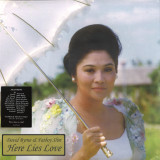
David Byrne & Fatboy Slim’s acclaimed 2010 album Here Lies Love receives its first-ever vinyl release to coincide with a new production opening on Broadway this summer. Here Lies Love is a double-disc song cycle – improbably poignant, decidedly surreal, surprisingly thought provoking – about the rise and fall of the Philippines' notorious Imelda Marcos. It was conceived by David Byrne; composed by Byrne and DJ/recording artist Fatboy Slim, AKA Norman Cook; and performed by a dream cast drawn from the worlds of indie rock, alt country, R&B and pop. Byrne's taste in collaborators is as imaginative as it is impeccable, including Cyndi Lauper (who recounts, to lighthearted disco beats, Imelda's courtship with Ferdinand Marcos), Steve Earle (as the power-hungry Ferdinand), Dap-Kings vocalist Sharon Jones (recalling Imelda's introduction into New York society) and Natalie Merchant (as spurned Imelda confidante Estrella, anticipating the onset of martial law). Along with vocals turns from such stars as Tori Amos and the B-52's Kate Pierson, Byrne works with rising indie rockers St. Vincent and My Brightest Diamond; New York chanteuses Nellie McKay and Martha Wainwright; and dance-music divas Róisín Murphy and Santigold. Byrne himself appears as the voice of imperialistic America on ‘American Troglodyte’, a send-up that wouldn't have seemed out of places in Talking Heads' True Stories.
Byrne originally envisioned this as a musical theatre piece, to be mounted in disco and nightclub settings, reflecting the globe-trotting Marcos' taste for such velvet-roped spots as Studio 54 and Regine's. In 2006, he performed work-in-progress versions to enthusiastic audiences at New York City's Carnegie Hall and the Adelaide Festival in Australia. While plans for a US theatrical production continued to evolve, he delivered this unique recording. The award-winning theatrical production eventually premiered at The Public Theater in New York in 2013, travelled to London’s National Theater for a sold-out run (2014–15), and was remounted at the Seattle Repertory Theater (2017).
Here Lies Love has an effervescent disco feel, redolent of Fatboy Slim's own dance-floor anthems, with warm undercurrents of the Latin rhythms that have percolated through Byrne's recent solo work. The sunny arrangements act in counterpoint to the reality of the Marcos' increasingly repressive regime, reflecting the imagined inner life of the glamour-obsessed Imelda. Explains Byrne, "For me, the darker side of the excesses are, for the most part, a matter of record. A lot of the audience is going to come with that knowledge already. What's more of a challenge is to get inside the head of the person who was behind all of that, and understand what made them tick." Byrne offers no judgment and avoids the obvious – there is no mention of Imelda's infamous shoe collection.
Many of Byrne's lyrics are, astonishingly enough, constructed from actual Imelda quotes, including the project's title, the words that Imelda, now returned to the Philippines from US-assisted exile in Hawaii, would like to have inscribed on her gravestone. In addition to his new liner note, Byrne illustrates the story with archival photos. In a detailed preface, he reveals what drew him to this subject and the bumpy route he took to launch the project and, ultimately, record this album. The booklet is indeed a page-turner, just as Here Lies Love is a wonderfully old-school album that rewards start-to-finish listening. Once again, Byrne – beloved as musician, thinker and bicyclist-about-town – reveals the breadth and singularity of his vision.
The new production of Here Lies Love will premiere at the Broadway Theatre in New York City. Performances begin June 17, ahead of an official opening night on July 20. Tony Award winner Alex Timbers (direction) and Olivier Award nominee Annie-B Parson (choreography) reunite with Byrne (concept, music, and lyrics) and Fatboy Slim (music) to bring Here Lies Love to Broadway, continuing a ten-plus year collaboration on the project. Tom Gandey and J Pardo contribute additional music. Here Lies Love is produced on Broadway by Hal Luftig, Patrick Catullo, Diana DiMenna for Plate Spinner Productions, Clint Ramos, and Jose Antonio Vargas. The staging at the Broadway Theatre will transform the venue’s traditional proscenium floor space into a dance club environment, where audiences will stand and move with the actors. A wide variety of standing and seating options will be available throughout the theatre’s reconstructed space. The producers of Here Lies Love said, “As a team of binational American producers – Filipinos among us – we are thrilled to bring Here Lies Love to Broadway! We welcome everyone to experience this singularly exuberant piece of theatre. The history of the Philippines is inseparable from the history of the United States, and as both evolve, we cannot think of a more appropriate time to stage this show. See you on the dance floor!”
David Byrne’s recent works include the launch of Reasons to be Cheerful, an online magazine focused on solutions-oriented stories about problems being solved all over the world (2019); Joan of Arc: Into the Fire, a theatrical exploration of the historical heroine that premiered at the Public Theater in New York (2017); The Institute Presents: NEUROSOCIETY, a series of interactive environments created in conjunction with PACE Arts + Technology that question human perception and bias (2016); Contemporary Color, an event inspired by the American folk tradition of color guard and performed at Brooklyn’s Barclays Center and Toronto’s Air Canada Centre (2015); Here Lies Love; Love This Giant, a studio album and worldwide tour created with St. Vincent (2012); and How Music Works, a book about the history, experience, and social aspects of music (2012).
Byrne curated Southbank Centre’s annual Meltdown festival in London in 2015. A co-founder of the group Talking Heads (1976–88), he has released eight studio albums as a solo artist and worked on multiple other projects, including collaborations with Brian Eno, Twyla Tharp, Robert Wilson, and Jonathan Demme, among others. He also founded the highly respected record label Luaka Bop. Recognition of Byrne’s various works include Obies, Drama Desk, Lortel, and Evening Standard awards for Here Lies Love; an Oscar, Grammy, and Golden Globe for the soundtrack to Bernardo Bertolucci’s The Last Emperor; and induction into the Rock and Roll Hall of Fame with Talking Heads. Byrne’s work as a visual artist has been published and exhibited since his college days, including photography, filmmaking, and writing. He lives in New York City. In addition to 2019’s cast album for American Utopia on Broadway, Nonesuch has released eight other David Byrne records since 2003, including 2018’s American Utopia studio album and two versions of his musical Here Lies Love.
q C6. Please Don't feat. Santi White Santigold
Martinesque started his nighttime adventures with tasteful house records towards the tail end of the nineties. Inspired by the deep explorations of Chicago and New York stalwarts, he’s found pleasure in playing out low-slung grooves and stripped-back entries from all corners of electronic music. Since, the Basel native has honed his craft in clubs around the country and beyond. Methodically stitching together records from his vaults, Martinesque escalates from meditative rhythm workouts to subdued dancefloor drama in a controlled fashion.
He’s developed his artistic vision through residencies in some of Switzerland’s most cherished spaces, but nowadays found his spot as Elysia’s head of bookings, where he’s since showcased a full-spectrum analysis of contemporary dance music.
His most recent endeavour is Adam’s Bite, a cross-disciplinary cooperation zoning in on oblique music and visual arts, further cementing his position as a driving figure in a thriving scene.
Dies Lexic is a duo by Inês Tartaruga Água and Xavier Paes. Part of Favela Discos collective and label, they explore the channelling potentialities of sound, wandering between spectrums, ethereal soundscapes and zones of sonic subduction through means of DIY electro-acoustic instruments, amplified objects, electronics and composition processes based on repetition, language, chaosmosis and error.
Lexicon Hall, the long overdue debut album by the Portuguese duo of intrepid sound explorers, is a sort of digital ayahuasca, an intense psychedelic journey guided by drums and harshly bowed strings, channelling voices from other planes and fusing them with Dies Lexic’s very own distinctive voice. If you close your eyes hard enough you can probably see Tony Conrad waving hello in the middle of a dark jungle that is inhabited by tribes of our ancestors.
Artists bio:
Inês Tartaruga Água is a multidisciplinary artist, focused on the issues of deep ecology and radical regeneration, sound explorer and practitioner of DIY philosophy as well as collaborative and participatory practices in public space. Participates in collective exhibitions since 2013, highlighting the “XIII International Biennial of Artistic Ceramics” (Aveiro, 2017), “Убежище / Suoja / Shelter Festival - Laboratory” (Helsinki, 2019), «48 часов Новосибирск» (Siberia, 2019), or “Soundscapes” (Bahrain, 2019), and has her first individual artistic residency “Méhtēr: Matter, Form and Transformation” at Júlio Dinis Museum in Ovar (2018). Recently, Água has debuted sound pieces in Casa de Serralves (Porto, 2021) and in Casa das Conchas (Spain, 2021).
Xavier Paes is a transdisciplinary artist based in Porto. He divides his practice between visual arts, sound, performance, gleaning improvisation and multi-instrumentalism, focusing on ideas such as acoustic phenomena, repetition, resonant and sympathetic bodies, echo and ecology. He has presented his work at institutions, galleries, festivals, kiosks, raves and after-parties, highlighting places such as Serralves Museum, Oliva Arts Center, Porto Municipal Gallery, Stichting Centrum (The Hague), OCCII and Vondelbunker (Amsterdam), La Pointe Lafayette and L'international (Paris), STUK (Louven), Overtoon (Brussels) and Villa Arson (Nice).
Clear Vinyl
Tacit Group is an audio-visual group founded in 2008 with a vision of creating new art for the 21st century. Based in Seoul but working globally, the group comprises composer Jaeho Chang and electronic musician Gazaebal(Lee Jinwon).
With audio-visual art as its core content, Tacit Group has expanded in a contemporary and experimental way in multimedia performances, interactive installations, and music installations. Representative works such as ‘Hun-Min-Jeong-Ak,’ ‘Game Over,’ ‘Morse ㅋung ㅋung,’ combine a systematic worldview weaved through intuitive materials and technology inspired by normal everyday activities such as games and text chatting. In particular, works that utilize the beauty and communica- tion power of characters are among their most striking.
“It’s like wind chimes,” says Tacit Group’s Jeaho Chang. “The creator makes the pipes, but the wind makes the music.” He’s talking about the algorithmic music that Tacit Group creates. Jaeho and Gazaebal create audio/visual systems using code that the pair work within to unleash their utterly compelling AV performances, each show, each track, as unique as a snowflake. The pair met at Korea National University of Arts in 2006. Jaeho Chang was a media installation artist and composer who’d studied classical composition in Korea and electronic music at Den Haag’s Conservatoire. Gazaebal, who’d moved to the US as a teen, had worked at the renowned Quad group studios as a sound engineer, recording acts including Rage Against The Machine, Wu Tang and Janet Jackson. Returning to Korea, he had found success as a K-Pop producer, (founding the act Banana Girl, and writing their No.1 Korean hit ‘Shake Your Ass’) and DJing under the moniker Gazaebal, before deciding to go ‘back to school’ to learn to create more challenging music.
The quiet and reserved Jae and the more outgoing Gazaebal bonded over a shared vision, forming Tacit Group in 2008. And until recently, everything they have done has been through the medium of their globally acclaimed live shows, playing all over the world from Lincoln Center in NY, the Museum of Contemporary Art in Chicago, MMCA (National Museum of Modern and Contemporary Art) and Nam June Paik Art Center in Korea, Aarhus Festival in Denmark, Stereolux in France and NYU Abu Dhabi.
Each show an utterly unique and compelling event, a synthesis of music and visual art that has echoes of the concept of synesthesia: “we love the idea that the audience can ‘see’ the music.” says Gazaebal, “the way that you can hear a painting like Edvard Munch’s ‘The Scream’.” The frameworks and systems are created in advance using code such as C++ and max/M- SP(sometimes combined with analog and modular synthesizers), often growing out a of a simple idea (one of their first composi- tions, ‘Game Over’ explored the idea of a Tetris gameplay as a musical score) while on stage the pair react to the audience, creating new inputs and variables that can lead the performance in ways that are unexpected and even self sustaining - some of their installations could in theory continue to evolve and run on into infinity.
For Tacit Group, the process is as important as the outcome, and every bit as fascinating for the audience, who’ve been known to react like the crowd at a rock band gig to tracks / installations like ‘Hun-Min-Jeong-Ak’ which sees abstract geometric shapes based on the Korean alphabet evolve (through the process of live text interchanges between the pair) to become almost an immersive call and response.With that in mind, the duo have long been reluctant to commit to the idea of releasing via a ‘fixed medium’ it was actually the release of an acclaimed (and beautifully designed) book Tacit.print0_Anthology that convinced them to share their work more widely through an album.
- A1: Let It Hurt – 2:24
- A2: Dub, It Hurt – 0:54
- A3: My Moon – 3:05
- A4: Hang On Feat. Benji. – 3:32
- A5: Call Me Back Feat. Sadboi And Kabusa Oriental Choir – 2:56
- A6: Let Go – 3:02
- A7: Interlude 1 – 0:28
- B1: I Am What I Am What I Am – 2:39
- B2: I Dream, I Rush – 2:21
- B3: Interlude 2 – 0:53
- B4: Room333 Feat. Zacari – 3:01
- B5: Sodom And Gomorrah Feat. 36Birds – 3:34
* Edition of 500 colored vinyl (transparent purple)
* Artwork developed in collaboration with Paris-based visual artist Caroline Ventura
* Including download code
i got a song, it’s gonna make us millions is the highly anticipated new album by Sirens Of Lesbos, led by sisters Jasmina and Nabyla Serag. The dynamic release is a vibrant showcase of the group's expansive musical range, blending R’n’B/Soul, Afrobeats, electronic music, and lo-fi indie pop into a rich, genre-defying experience. With its eclectic sound and captivating melodies, the album solidifies Sirens Of Lesbos as a standout force in modern music.
Featuring on the album are the singles “Room 333” feat. Kendrick-Lamar-collaborator Zacari, a futuristic R’n’B song with progressive club beats; the epic “Call Me Back” (feat. Drake-co-signed rapper SadBoi and the Kabusa Oriental Choir); and dub-infused reggae song “Let It Hurt”, plus new song “My Moon”, which draws inspiration from artists like Bruce Hornsby, Justin Vernon, and Jai Paul. Sirens Of Lesbos have earned widespread acclaim from outlets like CLASH, COLORS, Dork, Tsugi and Earmilk, with BBC 1Xtra’s CassKidd calling the collective “magical.”
As Black women living in the diaspora, Jasmina and Nabyla navigate the intersection of their parents’ collectivist North-East African culture and the Western emphasis on individuality. Questions of identity have always been central to their journey. While society often demands clear-cut definitions, the sisters have come to embrace their multifaceted identities: “We have always been many things.”
Both artists are deeply rooted in the technical and philosophical dimensions of sound. Jasmina recently completed her Sound Arts degree, and Nabyla is now finishing hers. Their academic pursuits have included creating abstract sound installations in exhibition spaces. However, their focus for the foreseeable future is on elevating the Sirens Of Lesbos project, writing and producing standout indie pop tracks, performing live, and delivering unforgettable experiences for their audiences.
—
The vinyl version of i got a song, it’s gonna make us millions is published by Präsens Editionen, a Switzerland-based publishing house and music label. Founded in 2011 in the process of launching zweikommasieben Magazin, Präsens Editionen has since released music on vinyl, cassette, CD, and digital formats—alongside magazines, books, and other printed matter. Recent audio releases include works by Martina Lussi, spalarnia, Magda Drozd, Anom Vitruv, Belia Winnewisser, and Red On, among others.
- Ntr1
- Ntr2
- Drg5
- Drn9
- Drg10
- SL12:
- Drg14
- Drg15
- Prn2#16
- Otr
- Prn2_9Ofm15Tb
- Prn2_9Ofm15Ta
- Prn2_M15T
- Prn2_M15T_Selforg_Tapecut
NYZ (David Burraston) presents this collection of generative music pieces carefully extracted from a PreenFM2 gifted to him by Aphex Twin. PRN2_M15t is being released at the same time as an LP titled Stria from Dr. John Chowning who invented the original FM synthesis algorithms which were sold to Yamaha and used in the creation of the DX series of keyboards. An interview with Chowning, conducted by David Burraston, will be published at the same time.
David Burraston is an award winning artist/scientist working in the areas of technology and electronic music, operating Noyzelab as an independent art/science music studio since 1981. Numerous research publications include a 2006 PhD thesis Generative Music & Cellular Automata, which developed and applied fundamental new concepts from generative music practice to a key problem in complex systems theory.
His experimental arts practice encompasses field recording, landscape-scale sound art, chaos/complexity, practice-based research, sound synthesis and electronic music. He performs, lectures, conducts workshops and creates art installations in Regional NSW and around the world. David also designs and builds sound synthesizers based on his theories of chaos/complexity science. He was recently interviewed by Bandcamp Daily and The Wire Magazine.
David has worked with many diverse collaborators such as Aphex Twin, Chris Watson, Doug Quin, Russell Haswell, Robin Fox, Oren Ambarchi, Sarah Last, Cat Hope, Garry Bradbury, William Barton, Alan Lamb, MIT Media Lab and the Australian Broadcasting Corporation. In 2014 he independently published the legendary "SYROBONKERS!", the most technical and in-depth interview ever given by Aphex Twin.
- 1: Timeless
- 2: Peony Garden
- 3: Marrow
- 4: Moonflower
- 5: Linen
- 6: Boy Beneath
- 7: Mirrors
Intricate structures with an intertwining of spontaneity and randomness, meeting the diverse genre influences of the band members from mediaeval music to shoegaze to noise. That is Unravel, the new album, and first in six years, from Czech band Manon Meurt.
"Unravel reflects the different stages of dissociation, a person's thoughts, observations - whether of the environment or of oneself - and admiration for the beauty and cruelty that nature mirrors," multi-instrumentalist and lyricist Kateřina Elznicová says of the album.
Produced by Eddie Stevens (Freakpower, Zero 7, Moloko, Roisin Murphy) the album was pieced together from recorded fragments, meticulously pieced together. The title Unravel refers to the development of the band, unravelling what they are to find the full potential of their music as well as uncovering the layered nature of the songs and emotions.
"Eddie Stevens’ approach to recording was a big surprise. We understood that there was no one right version of the songs. Each of our themes carries a certain energy that can manifest and blossom in many ways. Compared to previous records, the vision of each member was much more evident, while we learned not to cling to our individual ideas of a signifying break or a nu-metal bounce at the end of an ambient song. The main thing was a common concept," adds keyboardist David Tichý on creating the seven songs on the record.
Abum producer Eddie Stevens describes the collaboration, “Each album is an adventure. You do some preparation, check the route over and over, prepare for any eventuality that your packing space and imagination will allow, plan some places to stop and rest en route, places to eat, sleep, then consider the challenges - the ice wall, the summit, even just finding your way in foreign land. But despite all that planning, you can never really say for sure what’s going to happen, what unexpected path you might take, what strangers might invite you in for a cup of tea and to what ends. So it was making Unravel with Manon Meurt and engineer and studio owner Lukas Martinek at Svárov studios and of course back home in the relative safety of my studio. Musicians who quickly became friends showed me more than I showed them, people with ideas, with creativity seeping from their pores. Music making the right way: no blinkers, no walls, no preconceptions, no barriers, no rules. What a pleasure, and what a magical, technicoloured,
kaleidoscopic album we’ve made together, “
The combination of industrial material with plant motifs in the work Untitled_1 by Ukrainian artist Liza Libenko, which adorns the cover of Unravel, strongly attracted the band. After all, floral motifs have always been close to Manon Meurt's music. Libenko, a student of the Academy of Fine Arts and a finalist of the prestigious Austrian Strabag Artaward International Prize, has recently been working on overcoming the narrative boundaries of the canvas, the paintings "attack"the viewer. Sunflowers are a powerful symbol of life and the sun; in Libenko's paintings they are black and burnt, serving as an allegory for contemporary conditions. The work was photographed by photographer and artist Marcel Rozhoň, and the final processing of the Unravel album was done by graphic artist Zuzana Malá.
Limited Plum Colored, Full colored Vinyl 12” Jacket 12 Inch Release
Hot on the heels of the recently released Divine Harmonics – From Then Until Now (Part One of Two) the limited orange vinyl edition that sold out within weeks, we are thrilled to announce the arrival of the highly anticipated Part Two of Kuniyuki and Joaquin “Joe” Claussell’s Divine Harmonics imprint.
This next installment is expected to surpass the excitement of both earlier releases, especially as it comes as a plum colored vinyl packaged in a stunning full-color jacket designed by the incomparable Akemi Shimada. As with all Divine Harmonics editions, this is a strictly limited full 12-inch package, created with collectors in mind.
About the Record
Recorded in a fully equipped studio in Brooklyn, New York, this project was born from the idea of gathering musicians who deeply admire Kuniyuki’s work and inviting them to contribute to the composition.
Balmat 17 marks both a return and a new frontier. It is the second album on the label from Patricia Wolf, whose 2022 album See-Through is one of the most beloved in Balmat’s catalog; it also marks the first time that Wolf has turned her hand to a film soundtrack. The results are every bit as magical as fans of the Portland, Oregon, composer’s music might expect.
Hrafnamynd—Icelandic for “raven film”—is a new feature-length documentary by experimental filmmaker Edward Pack Davee. Shot on a mix of film and digital formats, and incorporating his father’s Ektachrome slides from the 1970s, the autobiographical film works on multiple levels at once: a reminiscence of his childhood in Iceland, an exploration of landscape and folklore, and a documentary study of the island nation’s ravens—including a talking raven named Krummi.
Wolf is the perfect artist to score such an unusual film. Mixing ambient music and field recording—including extensive experience documenting bird song—Wolf brings an unusually empathic perspective to her music. In the context of Hrafnamynd, her airy melodies, pensive atmospheres, and vivid textures intuitively complement the film’s grainy film stock and blown-out colors. Friends for years, the two artists further bonded when Wolf asked Pack to film music videos for her songs “Woodland Encounter” (from See-Through) and “The Culmination Of” (from I'll Look For You In Others). Pack used Wolf’s previously recorded music as placeholders as he began assembling a rough cut of the film, which made her a natural choice to help him complete his idiosyncratic vision with an all-new, bespoke score.
But Wolf’s soundtrack also indisputably stands alone as a full-length album. Largely created using the UDO Super 6 synthesizer, it features a carefully distilled palette of warm, string-like pads and darkly glistening mallets, rounded out with the very occasional introduction of nylon string guitar. Musically and stylistically, the album’s 11 tracks represent both a continuation of the ruminative sound of See-Through and also an extension into new expressive modes. Few musicians, ambient or otherwise, are as skilled at balancing melody with atmosphere, or at finding ways to eke fresh at finding ways to eke fresh, surprising sounds out of an intentionally reduced toolkit. Meditative, immersive, and emotionally generous Wolf’s Hrafnamynd soundtrack evokes a range of ambient classics from decades past while confidently marking out its own verdant patch of ground.
Artist’s Statement:
Edward and I have been friends for years, but we really started to get to know one another better after I hired him to make music videos for my songs “Woodland Encounter” and “The Culmination Of.” For those projects we got to spend a lot of time hiking in various locations around the Pacific Northwest with his camera, very nice lenses, and tripod. Keeping quiet, hidden, and vigilant we searched for wildlife, good light on the trees, meadows, lakes, rivers, and skies. Edward was already an appreciator of my music and I was already in awe of his filmmaking talents so it felt like a great fit. Although we work in different areas of art our styles compliment one another. We both tend toward slow and careful pacing, with a focus on emotion and introspective reflections on life and the landscapes around us. For this reason, Iknew that I could trust Edward to create videos for my music. We saw so many beautiful and unexpected things on our filming days, but I was moved to tears once I saw how magnificent and poetic it all was. His video work from the cinematography, to the editing, and color correction helped bring my inner vision to life.
A few months after that, Edward surprised me with an invitation to work on the soundtrack for his new film, Hrafnamynd. I enthusiastically said yes. I had always wanted to work on a film, and I knew that his filmmaking style would be inspiring to write music for. I had recently acquired an UDO Super 6 synthesizer but hadn't used it much. I decided that this would be the synth that I'd use for the film. It has the ability to sound very modern, but can also sound so warm and fuzzy, like a synth from the 1970s. It turned out to be the perfect instrument for this project as the film itself straddles time from the ’70s to today.
When Edward sent me the rough cut of the film, he used placeholder music to help give me an idea of the emotion and energy that he was hoping to achieve for each scene. For many of the scenes, Edward used music from my albums as temporary tracks. This told me that he trusted my work and style and therefore I should just trust my intuition with how to proceed. I wanted to make sure that everything that I made was a direct reflection of what was happening on screen, a mirror of its emotion and energy so people could really lock into the film psychologically. This process took my composing to unexpected places—like being led by a strange cat or a raven that seemed to have something to show me. I found that the approach made the music so much more dynamic than my usual style. I really enjoyed being influenced by the action and dialog on the screen. Thankfully, Edward was very happy with the work. I made sure to handle this project with the utmost care because this is about his life and his family, and an exploration of the experiences that made him an artist and filmmaker. While watching the film many times over, I found myself thinking about my own family and my early memories with them and how the place where I grew up has influenced who I have become. I found that his film invites the viewer to reflect on their own lives in a similar way. I hope that this music and film can guide others to contemplate on the history of their beingness and the people and places that shaped them.
Another aspect to this project is the splendor and wonder of Iceland itself. I had the opportunity to visit Iceland for the first time in 2023. I got to play a show there for the Extreme Chill Festival and met many friendly and brilliant Icelanders. I also got to collect field recordings that I used in the film. It's a fascinating place and culture that easily captures the hearts and imaginations of anyone who visits. Whether you spend your time in the city immersed in its impressive arts scene, or venture out into the wilderness to behold its wondrous landscape, it will leave a lasting impression. The soundtrack is also a love letter to Iceland itself.
José James just can’t leave the ’70s alone. Or maybe it’s the other way around. The singer, songwriter, bandleader, and producer was born in 1978, after all, but over his past 17 years of fundamentally forward-looking, blessedly mercurial music, he keeps getting pulled back in. His 2013 Blue Note breakthrough No Beginning No End revisited the hooky, funky, jazz-streaked songcraft of the time through a modern crate-digger’s ears. On 2020’s No Beginning No End 2 — James’ debut on his own Rainbow Blonde Records — he went back through the portal with a small army of fellow celebrated eclecticists. Just last year, there was the album 1978, a richly layered love letter to said year that felt deep, luxe, and cool. It’s as if — vested with the restless fluidity of jazz, the tuned-in sensitivity of soul, and the revisionist grit of hip-hop — he is trying to play his way into the exact moment when, culturally speaking, everything was about to change.
“I'm still so fascinated by the tension in that era of all these seemingly clashing things happening at once,” says James. “The loft scene, the jazz scene, Elton and Billy, Bob Marley, the Isleys, Funkadelic, disco being this behemoth in a way I don't think we even understand today… And then there’s where everybody went from there — into hip-hop, into punk rock, exploding jazz. It's like a summation of the ’70s, and it's about to transform. It's the peak of the rollercoaster.”
Literally breaking into history is impossible, of course, but James’ new LP, 1978: Revenge of the Dragon, does feel like breaking through or bursting out. In loving contrast to its predecessor, the fresh set plays hot, like a Friday night out at the Mudd Club in its prime. Though he’s dreamt up albums with collaborator counts approaching the dozens, James gathered a tight crew for this one. Himself and Taali on vocals. BIGYUKI on keys and analog synth. Jharis Yokley on drums. Bass split between David Ginyard (Blood Orange, Terence Blanchard) and Kyle Miles (Michelle Ndgeocello, Nick Hakim). And an all-star brass lineup: Takuya Kuroda on trumpet, young lion Ebban Dorsey on alto sax, and genre-spanning ronin Ben Wendel on tenor sax. They set up in Dreamland Studios near Woodstock, a restored 19th century church, and recorded live to tape, two tracks, drums pushed to the max — “a small homage to the rise of punk,” says James.
In that place out of time, the band laid down a handful of choice covers and some wild originals, like the single “They Sleep, We Grind (for Badu),” a decades-collapsing cut powered by an ugly groove. Steeped in dub, funk, and sampledelia, James chants an artists’ mantra (“They sleep, we grind / Man, f--- your nine to five”), makes lyrical callouts to Marley and Nas, and channels everything from George Clinton to J Dilla, not to mention the earthy mysticism of Erykah Badu. In 2023, James released and toured his Badu covers LP, On & On. “Living in her musical house for a year was transformative,” he says. “This is my summary of everything I learned through her, tying it to this idea that artists move differently. We are in society but we are outside, too, looking out and in at the same time. Our hours are different, our schedules are different.”
To that point, James and co. actually began each day in the woods, filming the album’s visual companion piece, Revenge of the Dragon, an honest-to-God kung-fu short complete with bad overdubs, training montages, camera tricks, and plot twists. The film pays tribute not only to the genre’s greatest year (1978, of course), but also its cinematic exchange with Blaxploitation, plus James’ own recent Shaolin training and admiration for Bruce Lee as a culture-bridging force (the LP’s cover recreates an iconic shot of Lee). On top of that, says James, “We had this immediacy in the studio. Live, one take, no overdubbing. I feel like that's where the martial arts piece comes in, where it's about being relaxed but also aware, and there's immediacy in your movements.”
Across the project, tribute takes that refracted, multifaceted form. From his personal late-’70s playlist, James chose four covers reflecting the era’s disco-fied churn: the MJ-meets-Quincy dancefloor masterpiece “Rock With You”; Herbie Hancock’s prescient vocoder fever dream, “I Thought It Was You”; and a pair of Black-radio hits from two bands whose fans typically wouldn’t have been caught dead in the same stadium: “Miss You” by the Rolling Stones and the Bee Gees’ “Inside and Out.” All of it gets filtered through a contemporary Black (and beyond) lens, coming out loud, free, funky, and buzzing — dynamic, yes, but also of a joyous piece.
1978: Revenge of the Dragon transports you to a crowded room where all this is playing out in real time. That feeling is helped out by opener “Tokyo Daydream,” a bass-driven swan dive into a neverending night of boutique bar-hopping and neon revelry. Later, “Rise of the Tiger” finds James bringing rare braggadocio to a propulsive track with growling synth lines and a hunger for whatever comes next. And then there’s the closer, “Last Call at the Mudd Club,” which with its upbeat energy and string of Stevie-inspired pickup lines, evokes the sort of unabashedly elated track the DJ throws on at 3:56 a.m. before everyone is kicked out. “I wanted to leave the album on that note,” says James. “If this was a night out in New York, this would be the last thing you hear before you get in that taxi and go back to your apartment.” Or, perhaps, back to 2025.
*180g virgin leaded vinyl in a deluxe textured heavy gatefold cover, with paste-on artwork and special anti-static innersleeve.* Note: The pressing is absolute on point!!!!
Vincent Gallo and Harper Simon with a beautifully recorded suite of songs and instrumentals.
" More than two decades since he blew minds with a suite of brilliant releases on Warp, Vincent Gallo returns to the world of music at long last in Butterfly, his duo with Harper Simon, with the project’s full-length debut, “The Music of Butterfly”. A gesture of gentle, DIY / bedroom left-field pop, falling within the rough territory for which Gallo became renowned during the late '90s and early 2000s, while interweaving fascinating flirtations with minimalism and experimentalism, it’s a truly captivating piece of work that’s hard to get off the turntable after the first needle drop.
In the arts, the lines between genius and madness, as well as fact and fiction, often blur. Such, it seems, has always been the life of the artist, filmmaker, actor, musician, and composer Vincent Gallo. A cult figure and a member of various creative undergrounds for the better part of half a century, Gallo has courted controversy, ruffled feathers, and made some of the most singular statements to flirt at the outer edges of popular culture that can be called to mind. Arguably most well known for his work in film, during the late '90s and early 2000s - notably with his soundtrack for “Buffalo 66” and a suite of releases on Warp - Gallo became something of a sensation in the world of independent music for a visionary, incredibly unique and sensitive approach to sonority. For a time, the world was abuzz, waiting on bated breath for more, and yet time passed. Bar a few fragments, appearing here and there, almost nothing has been heard from Gallo, within the world of music, for more than 20 years. That is, until now, with the release of “The Music of Butterfly”, the debut full-length of Butterfly, his duo with Harper Simon: beautifully produced and issued by Family Friend Records - Gallo’s own label, founded in 1981 - in a deluxe edition that simply left us speechless: 180g vinyl in textured heavy gatefold cover with paste-on artwork and thick anti-static innersleeve. More or less picking up from where we last encountered him, spinning captivating melodies and gentle song-craft within the quieter temperaments of DIY, left-field pop, once again, and at long last, Vincent Gallo, encountered in an incredibly successful collaboration with Harper Simon as Butterfly, reminds us that he’s as much a force within the realm of music as he is within film. Not to be missed. This one isn’t going to sit around for long.
Vincent Gallo’s biography reads like the stuff of blaring beauty: a figure of moderate fame in his own right, who has remained at the centre of cultural ferment as the decades have rolled by. Born in 1961, in Buffalo, New York, as the story goes he ran away to New York City at the age of 16 and fell into the brewing counterculture of the Downtown scene, William Burroughs and John Giorno, in addition to the cream of his own peers, and began making paintings, music, and experimenting with film. In addition to being a member of the now legendary band Gray, with the artist, Jean-Michel Basquiat, and the filmmaker, Michael Holman, Gallo appeared in the cult 1981 film “Downtown 81”, before slowly beginning a career as an actor and catching the eye of Claire Denis, who brought his talents into the broader cultural gaze. Catapulted into the public by his own subsequent career as a filmmaker with “Buffalo '66” (1998) and “The Brown Bunny” (2003), both of which were marked by controversy and praise, Gallo further captivated the public with a partially brilliant, if not relatively brief, flurry of activity in the realms of music.
While Gallo had already been making music for roughly two decades at the time of his release of the “Brown Bunny” soundtrack, and the four release issued by Warp in rapid succession between 2001 and 2002 - “When”, “Honey Bunny”, “So Sad”, and “Recordings of Music for Film” - the almost fanatical fandom reached a fever pitch at the moment, allowing him, for some, to be regarded as much, if not more, as a musical artist than an actor and filmmaker. Anyway you cut it, in a few short years, he proved himself to be a polymath of rare talent. Somewhere along the way, while both were working as members of Yoko Ono's Plastic One Band, Gallo met the New York based, highly regarded singer-songwriter, guitarist, and producer, Harper Simon, who also happens to be the son of Paul Simon. The pair fell into an incredibly fruitful duo collaboration, which came to be called Butterfly, and “The Music of Butterfly” being their debut full-length release.
Written, performed, and recorded by Vincent Gallo and Harper Simon in New York City between the winter of 2018 and the spring of 2019, the ten tracks comprising “The Music of Butterfly” are cumulatively a gesture of gentle, DIY / bedroom left-field pop, falling within the rough territory for which Gallo became renowned during the late '90s and early 2000s, making one feel like barely a moment had passed since we’d encountered his graceful hand at song-craft. Stripped back and raw, while retaining a sense of warmth and intimacy, across the length of “The Music of Butterfly” the duo of Gallo and Simon weave something completely captivating at the juncture of minimalism, experimentalism, and pop: meandering moments of texture and tone, slowly forming toward flirtations of melody that flower into song and back again. Somehow playful and light, while also remarkably emotive and personal, it’s almost as though each of these tracks crystallised out the air, unlabored and exactly as they should be without a note or beat more.
An engrossing immersion into both Gallo and Simon’s remarkably accomplished minds, having followed the path toward one another after radically different experiences and careers, “The Music of Butterfly” is one of those records that’ll be hard to get off the turntable after that first needle drop, and rarely leave the listening pile for some time to come. Issued by Family Friend Records in a beautiful deluxe edition that is unmatched even among the most stunning recent productions we can call to mind - 180g vinyl in textured heavy gatefold cover with paste-on artwork and thick anti-static innersleeve - it’s lovely to have Gallo back in the musical mix after so many years. "
- A1: Spirit Of Cyrus (Ft. Snoop Dogg)
- A2: The Force
- A3: Saturday Night Special (Ft. Rick Ross, Fat Joe)
- A4: Black Code Suite
- A5: Passion
- A6: Proclivitie (Ft. Saweetie)
- A7: Post Modern
- B1: 30 Decembers
- B2: Runnit Back
- B3: Huey In The Chair (Ft. Busta Rhymes)
- B4: Basquiat Energy
- B5: Praise Him (Ft. Nas)
- B6: Murdergram Deux (Ft. Eminem)
- B7: The Vow (Ft. Mad Squablz, J-S.a.n.d., Don Pablito)
Rock & Roll Hall of Fame inductee, two-time Grammy® Award-winning Hip-Hop icon, Kennedy Center Honoree, actor, author, NAACP Image Award winner, entrepreneur, philanthropist, and founder/CEO of Rock The Bells, LL COOL J continues his trailblazing career with upcoming album 'The FORCE'.
LL’s highly anticipated 14th studio album The FORCE (Frequencies of Real Creative Energy) set for release September 6th follows over a decade long hiatus. The record was executive produced by Hip-Hop innovator and Rock & Roll Hall of Fame inductee Q-Tip, of A Tribe Called Quest. With this album, LL will help celebrate the 40th anniversary of the creation of Def Jam Recordings. As LL was the label’s first release, there is no better way to represent the legacy of Def Jam Recordings on its 40th year
Rock & Roll Hall of Fame inductee, two-time Grammy® Award-winning Hip-Hop icon, Kennedy Center Honoree, actor, author, NAACP Image Award winner, entrepreneur, philanthropist, and founder and CEO of Rock The Bells, LL COOL J has created one of the most multifaceted careers and brands in entertainment and continues to display his wide range of talents with every project.
Four decades after he first burst onto the scene, LL COOL J continues his vibrant, trailblazing career. LL COOL J helped elevate the burgeoning rap and Hip-Hop scene of the 80’s, which developed into the musical and cultural phenomenon that is Hip-Hop as we know it today. Of LL’s many contributions to the culture, he also is credited with the creation of the acronym “G.O.A.T.” - short for “Greatest of All Time.”
First introduced to the world in 1984 as a Def Jam Recordings’ flagship artist, LL is the first rap artist to amass ten consecutive platinum-plus selling albums, including his critically-acclaimed debut album, RADIO, and the international, timeless anthem and album of the same name, MAMA SAID KNOCK YOU OUT. LL’s hit singles include “Going Back to Cali,” “Doin’ It,” “Around the Way Girl,” “Loungin’”, “Headsprung,” and Hip-Hop’s first rap ballad “I Need Love.”
Up next, this fall LL is back to make his latest artistic contribution and continue to elevate Hip-Hop culture after over a decade long hiatus with the release of his highly anticipated new album, The FORCE (Frequencies of Real Creative Energy), executive produced by Hip-Hop innovator and Rock & Roll Hall of Fame inductee Q-Tip, of A Tribe Called Quest. With this album, LL will help celebrate the 40th anniversary of the creation of Def Jam Recordings.
In December 2017, LL became the first rapper to earn the prestigious Kennedy Center Honor, which is America’s highest achievement for any performer. In addition, he received his star on the world-renowned Hollywood Walk of Fame on January 21, 2016.
In March 2018, LL launched his own SiriusXM timeless Hip-Hop channel entitled “LL COOL J's Rock The Bells Radio,” garnering millions of daily listeners. The channel features a wide range of innovative and timeless Hip-Hop content, music, interviews, and in-depth retrospectives curated, programmed, and presented by the award-winning artist himself. Since founding the radio station, Rock The Bells has developed into a global platform that has become the preeminent voice for timeless Hip-Hop. Rock The Bells focuses on content, commerce and experiences that honor the CULTURE and the core elements of Hip-Hop – MCs, DJs, Breakers, Graffiti Artists – and more. Rock The Bells hosted its inaugural eponymous music festival in Queens, New York in August 2022, which sold out back-to-back years in 2022 and 2023, where LL headlined both festivals.
LL COOL J was inducted into the Rock & Roll Hall of Fame on October 30, 2021, in Cleveland, Ohio for the 36th annual induction ceremony. Considered by most as the crowning achievement for one’s musical career, the ceremony was a celebration of LL’s lasting impact on Hip-Hop and the music industry.
In Summer 2023, LL COOL J, Rock The Bells, and Live Nation Urban kicked off his first arena tour in 30 years across North America called The F.O.R.C.E. Tour, inspired by the name of LL’s forthcoming album. Living up to the acronym for Frequencies of Real Creative Energy, the lineup for this tour was personally curated by LL COOL J. Building off their amazing performance together on the GRAMMY® Awards earlier that year celebrating the 50th Anniversary of Hip-Hop, all dates featured collaborative live performances with preeminent Award-winning Hip-Hop band The Roots, the legendary DJ Jazzy Jeff, and DJ Z-Trip.
LL hosted the GRAMMY® Awards for an unprecedented five years in a row from 2012-2016, for which he earned rave reviews. In addition, he hosted and produced the GRAMMY® Nominations Concert Live Special for seven years and has also been a presenter at the Emmy®, Golden Globe® and SAG Awards. Most recently, at the end of 2023, LL helped produce CBS’ live concert special A GRAMMY Salute To 50 Years Of Hip-Hop, which celebrated the 50th anniversary of Hip-Hop and was nominated for an NAACP Image Award.
LL has always been an avid philanthropist involved in numerous causes, including literacy for kids as well as music and arts programs in schools. Founded in 2005, LL’s charity “Jump & Ball” – which takes place every August in his hometown of Queens, New York – aims to give back to his local community by offering an athletic and team building program dedicated to bringing wholesome fun to young people.
Between being a musician, actor, philanthropist and entrepreneur, LL COOL J is the ultimate multi-hyphenate whose career continues to expand and where he remains one of the most beloved and innovative brands in entertainment. He currently resides in both New York and Los Angeles.
- A1: Heaven, Or Paradise; And Hell (Ft Adrien Soleiman)
- A2: Our Dead Can’t Rest (Old Jugha Flute Dance)
- A3: Miracle
- A4: The Crane Has Lost Its Way Across The Heaven
- A5: Unraveling (Interlude)
- B1: Zephyr
- B2: Far From The Eye, Far From The Heart
- B3: What Solace Can I Give (Ft Adrien Soleiman)
- B4: …Nothing Matters More Than Touching You Although I Haven’t Touched You Yet
Lara Sarkissian’s long-awaited debut full-length, ‘Remnants’ is an ornate patchwork of ancient and modern sonic shapes that uses the vernacular of electronic music to reformulate Armenian traditions and memories. Taking digitally modeled instruments (such as the kanun, a large zither, and the duduk, an ancient double reed woodwind instrument), vocals, davul and dhol drums, tenor saxophone (from acclaimed Paris-based player Adrien Soleiman) and myriad electronic elements and techniques, Sarkissian tangles the old and the new, creating an immersive, narrative-driven experience that’s powered by history, mythology and her own familial connection to the West Asian landscape. It’s an album that’s best absorbed like a film; only multiple encounters can reveal its layered themes and references to industrial music, noise, various club styles, ambient and traditional folk.
Born and raised in San Francisco and currently based in Los Angeles, Sarkissian has developed her unique approach to composition over years of relentless experimentation across various disciplines. Her interest in music production initially stemmed from her filmmaking and video editing work, when she began to sculpt her own sound collages and scores to accompany the visuals. Since then, she’s constantly blurred the boundary between dance and experimental music, DJing around the world, producing AV installations and scoring film and video projects that have been exhibited in Berlin’s Gropius Bau, Montréal’s Musée d’art contemporain, the Music Center Los Angeles and other prestigious institutions, and releasing music with labels such as Tresor, Knekelhuis, All Centre, Silva Electronics and CLUB CHAI, the label and event series she co-founded. In recent years, she’s also been able to advance the theory behind her art, publishing a conversation with ethnomusicologist Sylvia Alajaji in the Journal of the Society of Armenian Studies in 2021, and unveiling her methodology in Norient’s ‘This Track Contains Politics – The Culture of Sampling in Experimental Electronica’ a year later.
‘Remnants’ is a new stage in Sarkissian’s evolution as an artist; not only is it her first proper album, but it’s the inaugural release on her new platform btwn Earth+Sky. She sees the label as a place to encourage collaborations between musicians and producers and prioritize sound in visual arts realms, and ‘Remnants’ is the ideal proof of concept. It opens with ‘Heaven, or Paradise; and Hell’, a track that’s inspired by the layout of the Armenian sharakan (or hymn) ‘Aravot Luso’. Sarkissian imagines the original piece’s harmonies and melodies as parts of a dreamy electronic opera, using digital kanun sounds to punctuate her woozy, evocative synths. Soleimen joins on tenor sax in the third act, while Sarkissian repeats the chant and Jace Akira adds ghostly traces of electric guitar and bass. And on the rousing ‘Our Dead Can’t Rest (Old Jugha Flute Dance)’, Sarkissian chops urgent davul and dhol drum rhythms with spine-chilling shvi woodwind sounds lifted from a documentary about Old Jugha. The title is a reference to the moving of graves by Armenian families; the area initially housed over 10,000 elaborately carved khachkars (cross stones), one of which is pictured on the album’s cover, provided by historian Argam Aivazian’s archive.
On ‘Miracle’, Sarkissian samples atmospheres from the post-Soviet Armenian comedy film ‘Կիսանդրի’ (Kisandri). She takes this opportunity to lighten the mood a little, powdering her smudged samples with tightly edited breaks and bass thumps. It’s not until the album’s middle section that the duduk, perhaps Armenia’s best-known instrument, makes its appearance. Its familiar reedy tones, popularized by Djivan Gasparyan on his many Hollywood soundtrack appearances, emerge on ‘Unraveling (Interlude)’, weaving through the acidic ‘Zephyr’ and ‘Far from the eye far from the Heart’, a post-punk inspired stomper. Sarkissian mutates the instrument almost beyond recognition, pitching and layering it into a voice-like wail that creeps between her woody, dancefloor-primed percussion on the former, and turning it into a gentle, ghostly moan on the latter. And she brings ‘Remnants’ to a close with two of her most cryptic tracks, marrying digital kanun strings with Soleiman’s resonant tenor hums on ‘What Solace Can I Give’, and looping the same saxophone sounds until they dissolve into the air on the beatless closer ‘…nothing matters more than touching you although i haven’t touched you yet’.
It’s an album that ties up Sarkissian’s various interests and experiences, finding a romantic, poetic glimmer of light in history’s darkness. But most of all, ‘Remnants’ is about the optimism of starting anew, and rebuilding a life from the pieces of everything that’s been left behind.
Japanese ambient owes a great debt to Masahiro Sugaya, whose work has been re-assessed and taken on all the more importance in recent years. The now cult musician and composer released his The Long Living Things album in 1988 for the performing arts company he belonged to, Pappa Tarahumara. Though it was overlooked for many years, it is now in sharp focus and gets a deserving reissue on vinyl for the first time ever by P-Vine which he also belonged to, and has long been overlooked by all but a few enthusiastic music lovers. One track from it was Grammy-nominated and rich of the record is minimalistic, with soft interwoven sequences that keep you afloat amongst the warming pads.
Marionette presents 'dessus oben alto up', the first collaborative recording by Andrea Belfi and Jules Reidy. Hailing from different ends of the globe (Australia and Italy) but both longtime residents of Berlin, Reidy and Belfi’s approaches have much in common, bringing together compositional precision and electroacoustic rigour with improvisation freedom, the immediate gratifications of rhythmic pulse, and an overtly lyrical sensibility. Working together during a residency at the sound studio of Berlin’s Callie’s, an arts institution housed in a 19th century machine factory, the pair (with Marco Anulli manning the desk) have conjured up four expansive pieces where the beautifully recorded percussive clarity of Belfi’s drums threads through a sparkling haze of guitars and electronics.
Opener ‘dessus’ begins with Reidy’s distinctive just-intoned guitar figures, shimmering over a delicate substratum of Befli’s brushwork and bass drum accents. As in all of Reidy’s recent work, the guitar is twisted out of cliché by the unfamiliar tuning and electronic processing. Hanging almost inaudibly in the background for much of the piece, a rush of synthetic tones surges into the foreground to end it. ‘oben’ is built from kinetic patterns of picked guitar arpeggios, locking into irregular grooves with Belfi’s drums, which move from elegant rolls and cymbal patter to driving closed hi-hats and explosive rock interjections. Around the traditional instruments and across the stereo field, electronic sounds swarm and swirl, fizzing and popping in a sun-drenched soundscape that at points suggests both vintage analogue synth destruction and glitching harmonies. ‘alto’ begins in similar territory but turned up a notch, eventually settling into a propulsive 6/8 groove of shifting drum accents, manically strummed 12 string acoustic, and burbling synth chords.
The B side is dedicated to the fifteen-minute ‘up’, where the strategies adopted on the other pieces are put in the service of a more relaxed, slowly unfolding epic. Anchored by a steady pulse throughout, the piece combines chiming guitars, dubbed-out bass lines and constantly adjusted percussive details into a complex flux of sound. Change is at once so subtle and so ever-present that, at any given moment, the listener can never be entirely sure quite how they got there.
Rediscovered and compiled for release shortly before her death in November 2023, Further Selections from the Electric Harpsichord presents a never-before-heard recording of composer and artist Catherine Christer Hennix's early magnum opus. Originally debuted in 1976 at the festival Brouwer's Lattice at Stockholm's Moderna Museet, The Electric Harpsichord has steadily mystified fans and students of Western minimalist music for its implacable, transformative qualities, and the long-held, relative obscurity of its creator. Like the work of Hennix's close friend La Monte Young, the piece is set in just intonation and focuses on the transcendental potentials of precise tuning, inspired by their studies with Pandit Pran Nath. Composed of bursts of oscillating, synthetic tones using a carefully retuned synthesizer and a tape-based system for feedback delay, the sounds swirl, twinkle, and appear to bend time, space, and perception. Additional, sustained chords on the sheng, most likely played by her Deontic Miracle bandmate Hans Isgren, are present at the opening of the piece and reemerge towards the end of the recording. The release of Further Selections constitutes the most comprehensive original recording of this foundational work to date. Originally billed as The Well-Tuned Organ during its debut in Sweden, The Electric Harpsichord has developed a legendary reputation, predicated on a twenty-six minute fragment salvaged and circulated by Hennix's friend Henry Flynt. Promoting its importance on multiple occasions, Flynt aired the work on WBAI radio, organized a pair of tape concerts at New York alternative arts spaces in 1970s, and later penned a 1998 essay which served as the liner notes to its eventual CD release in 2010. For him, this work not only represented a sterling milestone in minimal sonic aesthetics, but also spawned a new genre that he dubbed "hallucinogenic/ecstatic sound environments (HESE)," which in turn inspired his own drone-like compositions. Gradually, interest in the recording led to a spate of archival projects, public performances, and new compositions by Hennix in the 2010s, in turn drawing into focus her multifarious practice, which includes serious contributions towards mathematics, poetry, sculpture, Noh drama, philosophy, and light art. Since 2018, Blank Forms has spearheaded a comprehensive publication effort in support of her work, including the writing collection Poësy Matters and Other Matters (2018); archival recordings like Selected Early Keyboard Works (2018) and The Deontic Miracle's Selections from 100 Models of Hegikan Roku (2019); and recent compositions such as Blues Alif Lam Mim (2021) and Solo for Tamburium (2023).
'Hollywood' is Andreas Raser debut album. After their single releases 'Willow' 'Reignite' and 'Spent' the LA-Hamburg band will release their first vinyl on Polly Records.
Andreas Raser consists of Camille Clair, from Los Angeles, and Albert Dietrich, from Hamburg, who first started making music together in 2020 while studying art in Frankfurt am Main, Germany. Their debut album "Hollywood" was recorded in the school, and realized simultaneously with a collaborative visual arts practice. Andreas Raser is currently based in Vienna, Austria. They recently had their live debut opening 3 show for Bar Italia.
- Reverend Horace Tyler - Intro 00:35
- The Thrillers Band - The Thrillers Band Theme 03:12
- Carla & The Carlettes - Love Makes A Woman 04:06
- The Channels 4 - I Wish It Would Rain 03:13
- Sharon Seabrook & The Starlettes - Come & Get These Memories 03:03
- The United Souls - I Want To Be Sweeter To You (Than I Was Yesterday) 03:08
- The Destinations - Cowboys To Girls 03:11
- Carla & The Carlettes - Grooving 03:00
- The Channels 4 - Cross My Heart 03:30
- The United Souls - The Way You Do The Things You Do 02:39
- The Starlettes - Dry Your Eyes 02:13
Big Crown Records is proud to present the reissue of one of Brooklyn’s most sought after “holy grail” soul records, YIA Talent Hunt Winners. Youth in Action, Inc. (YIA) was formed in 1963 when the Central Brooklyn Coordinating Council received a grant to develop a youth services program in the Bedford-Stuyvesant community. It was originally organized to identify and address the social problems that were leading to the high crime rate in Bed-Stuy. Recently the Smithsonian Museum of African American History released an archive of footage filmed by a community activist, which shows the real-world effects of the group’s efforts: young people engaged in sports, the arts, and other activities to better themselves and their world. The appearances by Jackie and Bobby Kennedy point to the group's relationship to the Great Society programs of President Lyndon B. Johnson. What there is no mention of in either the NMAAHC’s collection of YIA materials nor in the Brooklyn Public Library’s also extensive collection is this talent show and the record that came to be because of it.
Local vocal groups chose tunes to cover from the era (1964 - 1968) ranging from The Rascals to The Intruders, from The O’Jays to Billy Stewart. All of these groups were backed by a local act called The Thrillers Band. The winners of the talent contest were then invited into the studio to record their versions which would be pressed up on this record and given away to local radio and TV stations. The hope of the whole thing was that this would help the young groups get discovered by producers and record labels and start their professional music careers. The intro to the album is Reverend Horace Tyler congratulating the winners and asking them “to just remember, when you reach the top and become our big stars of tomorrow, don’t forget YIA”.
What this album may lack in fidelity and production it more than makes up for in charm. The engineers at the recording sessions pump in pre recorded applause and screaming to give the it the feel of the day of the contest while the young groups sing their hearts out, clearly giving their all. From today’s perspective, soul music fans will lose it over the choices of covers on this record and the killer, raw, innocent performances of them by these local Brooklyn groups. The Channels 4, Carla & The Carlettes, The United Souls, Sharon Seabrook & The Starlettes, and The Destinations all won that day and got to take place in this record. It makes you wonder, and even pine for the performances of the groups who didn’t make the cut, even if just to find out what tunes they covered, or better yet, were their original songs written by some of them for this contest?
It is with great pleasure that we make this available to the public again. This is a truly rare record, and an awesome piece of New York History.
'a masterclass in hardcore dancefloor and bittersweet feeling...Alex Crossan is both acclaimed and not feted enough' **** The Observer
Available on his own Pond Recordings, Curve 1 is a love-letter to club spaces, and the music and people who fill them.
Mura Masa’s forth album is a full-circle moment. Departing from the pop-leaning narrative and who’s-who guestlist of his most recent records, Curve 1 heads back down the rabbit-hole of club music that’s alternately euphoric, introspective, nostalgic and future-facing. Full of tension and release, ambiguity and playfulness, the significance of Curve 1 is left up to the individual: whether enjoyed solo or in the sweat of a packed room, here is music as enigmatic and layered as its author.
Mura Masa himself introduces Curve 1 as 'a manifestation of an attitude I’ve been cultivating in my personal life; ignore everything. All the content, all of the attention economy, all of it. In doing that, the really meaningful and vital parts of what’s around you make themselves known and unignorable, demanding your energy. It’s my first offering as an independent artist through my own record label, and as such I wanted it to be as free and anti-narrative as possible. Impressionistic. Music as entertainment has in many cases, to me, become very advertorial and excessively sentimental in terms of creating narrative around albums and artists. I wanted to strip this away as much as possible to leave room for the music to create its own meaning in the lives of people who form connections with it. It's hard for me not to explain away the intricacies and ideas contained within these records after having theorised and tolled and executed them over the course of nearly three years, but I think it’s far more fitting of the album’s intent to say simply: listen to it in the dark.'
Curve 1 pulls Mura Masa into focus as one of this generation’s most influential figures. Aptly reflecting his rare standing at the heart of youth culture, Mura Masa recently co-wrote long standing collaborator PinkPantheress’ single ‘Turn It Up’, as well as creating a series of remixes for Troye Sivan’s ‘Honey’. From producing global hits like ‘Boy’s a liar Pt.2’ to seminal records like Shygirl’s Mercury-nominated Nymph, it’s a juncture that has also seen Mura Masa embark on a new chapter of his own. He has set up his label and a creative hub and arts space - The Pond - in Peckham as a base for emerging artists and likeminded creatives, which will launch officially next year. Across his three critically-acclaimed solo albums, Mura Masa has built an audience who will follow wherever his genre-defying work goes next; with 2 billion streams, headline festival sets around the world, and live shows ranging from Alexandra Palace to Warehouse Project.
Curve 1 marks a back-to-your-roots approach whilst also highlighting the trailblazing young star’s recurring theme: to capture ‘that’ curvature in pop culture, to make it Mura Masa’s own, and to push things forward.
'Curve 1 has a club focus, no f—ks attitude and production that’s mature, lush — simply put, it’s just cool.' billboard
'a scintillating love letter to club culture and sounds' Wonderland
'the Grammy-winning producer throws a total curveball. Ditching his usual dreamy pop, Mura goes full hardcore dance. From techno to vintage rave' **** The Mirror
'Get sweaty as Mura makes it messy' **** The Sunday Express
'a total curveball...intense but full of hooks' **** The Daily Star
'Mura Masa has always been ahead of the creative curve, but with his new album, the tenured producer is consciously forging a path inspired by his newfound independence.'
'a grab-bag of sounds from a brilliantly restless mind' Rolling Stone
Cool Calm Pete has been featured in the past with MF Doom, RJD2, El-P, Morcheeba, Sharon Jones & The Dap-Kings, Aesop Rock, and others. More recently with Kool Keith, Real Bad Man, Heems, and Lee Scott.
Lost (Director’s Cut) kicks off Petes return with some new projects on deck.
Sometimes it takes time for something to establish its proper place in culture, and the modern-day discourse never fails to rush to label an album to be a classic or a flop. Then there are albums like Cool Calm Pete’s “LOST.” Adored by its dedicated fan base upon its original release in 2005 on Embedded Records and Definitive Jux, this record has continued to garner attention over the years from those who are familiar with it. While word-of-mouth alone may not have been sufficient to propel the album to mainstream success, its enduring popularity two decades later is a testament to its well-deserved recognition as an indie rap cult classic. The Korean-American emcee born as Pete Chung wasn’t asking to be a pioneer but having been raised in Queens NY during the golden era of hip hop, rhyming better than his peers just naturally became his identity. Throughout his debut album, his slow-paced, conversational flow fit like a glove to the self-produced “working class” beats that color most of the album. His education in fine arts as a painter and his day-job with a then-burgeoning lifestyle brand called Supreme sometimes took precedence in his professional life, but his dedication to the craft as a hip hop artist was evident, and fans took notice. The album hasn’t been re-released since its initial 2005 drop. and vinyl copies haven’t sold on the collectors’ market for less than $100 in years. With its first official re-release, the laws of supply-and-demand will surely alter that market, and chances are that with more ears to hear the album, those original pressings will only become hotter. In the meantime, the new “LOST (Director’s Cut)” has been re-mastered and extended for release on Cool Calm Pete’s own label Bubble Wife Records, with never-before-heard cuts led by a remix of the title track by Blockhead. Find it.
This work has become more popular in recent years because of its gentle style. Of particular note is the masterpiece "Walk The Way Of The New World," which is beautiful to the core due to the balance between the mellow electric piano melody, light flute, a flowing track with female scat, and Madhubuti's heroic poetry. The plaintive and mystical tone of the song is ear-catching. The funky, high-speed jazz of "Talking Stick" and the fast-paced title track "Rise, Vision, Comin" are also superb. This is a masterpiece of an album that is even better than "Medasi".
"For A Fleeting Moment" is the result of the dialogue between the Swiss photographer Simone Kappeler and the Japanese musician Tomotsugu Nakamura initiated by IIKKI, between March 2023 and May 2024.
Tomotsugu Nakamura is a musician and graphic designer residing in Tokyo, Japan. His primary artistic practice is to compose music with some fragments of minimal acoustic and electronic tones and some field recordings. In Concert, he he has played with various genre of musicians and his works have been released by Kaico, Audiobulb Records, and more recently by the French label LAAPS.
Born in 1952 in Frauenfeld (Switzerland) where she lives and works, Simone Kappeler started taking pictures at the age of 11. After studying German literature and art history, she studied photography at the Zurich University of the Arts. During a three-month trip to the United States in 1981, she took her first pictures using cheap cameras, especially the Diana camera.
Hasselblad, Leica, Diana, Brownie, Polaroid, disposable camera, expired or infrared films, since 1970, Simone Kappeler has explored all types of photographic techniques. Her work, experimental and poetic, reveals to us the curiously foreign world that surrounds us.
Since 1982, ongoing projects in southern France and the Grisons.1982/83, studio in New York, conceptual photography and Super 8 films. 1983/84, theater photographer, Schauspielhaus Zürich. 2009, six-week photographic study of Japan, 2015 studio in New York. Her work was the subject of a first monograph: "Seile. Fluss. Nacht. Fotografien 1964–2011", edited by Hatje Cantz and is regularly exhibited in Galleries and Museum in Europe and United States.
For A Fleeting Moment is her first book gathered exclusively a part of her wide polaroid works from 2011 to 2023.
Fine Art Book, Ltd. to 700 copies:
Hardcover book printed on Glossy Modern Paper 170g/m2 // 104 pages, 19cm x 22.5cm, 66 photos // Front cover points and back cover logo embossed // Selective UV varnish // Hand-numbered.
Book[47,27 €]
"For A Fleeting Moment" is the result of the dialogue between the Swiss photographer Simone Kappeler and the Japanese musician Tomotsugu Nakamura initiated by IIKKI, between March 2023 and May 2024.
Tomotsugu Nakamura is a musician and graphic designer residing in Tokyo, Japan. His primary artistic practice is to compose music with some fragments of minimal acoustic and electronic tones and some field recordings. In Concert, he he has played with various genre of musicians and his works have been released by Kaico, Audiobulb Records, and more recently by the French label LAAPS.
Born in 1952 in Frauenfeld (Switzerland) where she lives and works, Simone Kappeler started taking pictures at the age of 11. After studying German literature and art history, she studied photography at the Zurich University of the Arts. During a three-month trip to the United States in 1981, she took her first pictures using cheap cameras, especially the Diana camera.
Hasselblad, Leica, Diana, Brownie, Polaroid, disposable camera, expired or infrared films, since 1970, Simone Kappeler has explored all types of photographic techniques. Her work, experimental and poetic, reveals to us the curiously foreign world that surrounds us.
Since 1982, ongoing projects in southern France and the Grisons.1982/83, studio in New York, conceptual photography and Super 8 films. 1983/84, theater photographer, Schauspielhaus Zürich. 2009, six-week photographic study of Japan, 2015 studio in New York. Her work was the subject of a first monograph: "Seile. Fluss. Nacht. Fotografien 1964–2011", edited by Hatje Cantz and is regularly exhibited in Galleries and Museum in Europe and United States.
For A Fleeting Moment is her first book gathered exclusively a part of her wide polaroid works from 2011 to 2023.
Fine Art Book, Ltd. to 700 copies:
Hardcover book printed on Glossy Modern Paper 170g/m2 // 104 pages, 19cm x 22.5cm, 66 photos // Front cover points and back cover logo embossed // Selective UV varnish // Hand-numbered.
The organic minimalism of composer and producer Kirk Barley is collected on his new studio album Marionette, released via Odda Recordings.
Whether drawing from field recordings, found sound, instrumental improvisations or synthetic processes, Barley’s compositions evoke unfolding sound worlds, as simple ideas or motifs are layered and developed into complex set-pieces that reveal themselves over time.
Marionette showcases the breadth and variety of the Yorkshire-born artist’s sound, weaving together familiar and uncanny moods of rural England and its Victorian architecture, as suggested by the gated garden print of the album’s cover. Unfurling between physical textures – the patina of vinyl crackle or gentle rain – and the hyper-real spaces that his music inhabits, Barley describes the compositions as “landscape or static scene paintings,” with many of the album’s tracks taking nature’s rhythms as their compositional cue.
On ‘Seafarer’, this manifests in the repeated synth swells of a boat on rough waters, while title track ‘Marionette’ imagines an eerie scene, were shadows flicker by an open fire. Similarly,‘Lake of Gold’ layers plucked strings at different scales and velocities to create what Barley calls the “rain-like quality” of the rhythm.
Drawing from jazz, minimalism and techno, Barley focuses on the detailed qualities of sound, experimenting with time signatures, temporals and tuning systems. His esoteric alter-ego Bambooman (2013-2018) found a home on Matthew Herbert’s Accidental imprint, releasing the album Whispers in 2017.
In contrast, under the pseudonym Church Andrews (most notably in collaboration with drummer Matt Davies), he produces synthetic, often beat-focused music, using digital synthesis and algorithmic composition techniques, with the live drum performances triggering and modulating Barley’s synths. The duo has recently performed at festivals such as Rewire and Waking Life, filmed sessions for Fact Magazine and Slate & Ash, and recently had their music played out by Aphex Twin.
Under his own name, Barley released his debut album Landscapes in 2019 on 33-33 Records and received support from the likes of NTS Radio and BBC 6 Music. Barley has performed at events across the UK and Europe alongside the likes of Andy Stott, Beatrice Dillon, Jan Jelinek, MF DOOM and Madlib. He has also completed commissioned work for the British Art Show, Camden Arts Centre, MSCTY and the Open Music Archive.
2024 Repress
Silvana Noris, Italian-German singer, is an artist who has embraced theater, sport (she has been awarded on various occasions in various martial arts disciplines), writing and singing.
The cult song "Din Don" published under the pseudonym of Evo in 1983 for the Italian label "Cultura & Musica".
With Silvana's voice in a very deep and dark intonation, accompanied by synthesizer chords creating a sort of melancholic cosmic-disco, defining an underground hit that has been only recently rediscovered by DJ-Harvey and played into his exclusive "Sarcastic-disco" sessions. Today Best Record Italy presents it again in a limited
edition remastered from the original master tapes at the highest level of quality possible!
repress
As EarToGround Records hits its seminal tenth release we have decided to go all out sonically and visually.
As you all know Dax has been a core member of EarToGround right from the beginning. It all began with his and Chris Stanford's jointly produced track 'Programm' on ETG001.
From then on in he has worked tirelessly at his East London studio, climbing through the ranks to become the very respected and some would say inspirational producer he is now. Over the last year he has very much honed in and developed his now unique sound and recently released on much respected, high quality labels such as Deeply Rooted.
You could say his own EP on ETG has been a long time coming but we like to think ETG010 is what he has been building up to, some of his best work to date. We will let you decide
3 new solid, hook heavy, DJ and dancefloor friendly tracks from Dax as well as 2 centralized locked grooves and additional, extremely slick remix work from ARTS label boss 'Emmanuel'...
Black vinyl. Internal textured black inner sleeve. External textured white outer sleeve. 2 ETG Invader Stickers. Again the artwork is Space related. The theme this time pays homage to what can arguably be called one of the best modern SYFY films ever made.
- A1: String Quartet No. 5 I
- A2: String Quartet No. 5 Ii
- A3: String Quartet No. 5 Iii
- A4: String Quartet No. 5 Iv
- A5: String Quartet No. 5 V
- B1: String Quartet No. 4 (Buczak) I
- B2: String Quartet No. 4 (Buczak) Ii
- B3: String Quartet No. 4 (Buczak) Iii
- C1: String Quartet No. 2 (Company) I
- C2: String Quartet No. 2 (Company) Ii
- C3: String Quartet No. 2 (Company) Iii
- C4: String Quartet No. 2 (Company) Iv
- D1: String Quartet No. 3 (Mishima) 1957 – Award Montage
- D2: String Quartet No. 3 (Mishima) November 25 – Ichigaya
- D3: String Quartet No. 3 (Mishima) 1934 – Grandmother And Kimitake
- D4: String Quartet No. 3 (Mishima) 1962 – Body Building
- D5: String Quartet No. 3 (Mishima) Blood Oath
- D6: String Quartet No. 3 (Mishima) Mishima/Closing
When Kronos plays a piece, they become fellow composers, true collaborators. Without them, we wouldn’t have the kind of string quartet playing that we find around us today. There are two kinds of string quartet playing: the ‘Before Kronos’ and the ‘After Kronos’.” – Philip Glass
‘Kronos Quartet has broken the boundaries of what string quartets can do.’ – New York Times
Nonesuch releases Kronos Quartet’s acclaimed album Kronos Quartet Performs Philip Glass on vinyl for the first time to coincide with Kronos Quartet: Five Decades, a year-long celebration marking the quartet’s 50th anniversary. Originally released in 1995, the album features David Harrington (violin), John Sherba, (violin), Hank Dutt (viola) and Joan Jeanrenaud (cello) performing Quartet No. 2 (Company) (1983), No. 3 (Mishima) (1985), No. 4 (Buczak) (1990), and No. 5 (1991), the first piece Glass wrote especially for Kronos. Recorded at Skywalker Sound in California, the album was produced by Judith Sherman, Kurt Munkacsi and Philip Glass. The cover art features Francesco Clemente’s painting The Four Corners (1985). At the time of the album’s release, the New York Times said, ‘It contains some of Glass's best music since Koyaanisqatsi. His ear for sumptuous string sonorities is undeniable,’ while the Washington Post called it ‘An ideal combination of composer and performers.’ It was a top 10 hit on Billboard’s Top Classical Albums, and spent 12 weeks on Billboard’s Classical chart.
In his original liner note, critic Mark Swed wrote, ‘Glass’ string quartets may contain his most intimate music. They are works through which a very public composer, perhaps the most important opera reformer of our age and a longstanding collaborator in large-scale music theater, holds up a mirror to himself and his way of composing. “In an odd way,” Glass explains, “string quartets have always functioned like that for composers. I don’t really know why, but it’s almost impossible to get away from it. It’s the way composers of the past have thought and that’s no less true for me. It’s almost as if we say we’re going to write a string quartet, we take a deep breath, and we wade in to try to write the most serious, significant piece that we can.” Glass says that as he sat down to write String Quartet No. 5, he had discovered that perhaps not taking a serious tone might be the most serious way to deal with it. “I was thinking that I had really gone beyond the need to write a serious string quartet and that I could write a quartet that is about musicality, which in a certain way is the most serious subject.”’
Glass’ first numbered quartet was written in 1966; however, he did not return to the string quartet medium until 1983, when he provided incidental music for a dramatization of Samuel Beckett’s prose poem, Company. During those 17 years, Glass had formed an ensemble and developed his style in a series of increasingly elaborate pieces for it. String Quartet No. 3 is also adapted to dramatic music, this time from his score to the 1985 Paul Schrader film, Mishima. It was with the music of Mishima that Kronos became associated with Glass, recording the string quartet sections of the soundtrack and subsequently working extensively with the composer on all five of his numbered quartets. Kronos also gave the first concert performances of Company and Mishima. String Quartet No. 4 was composed in remembrance of the artist Brian Buczak, who died of AIDS in 1988.
As Kronos’ anniversary season continues with further concerts around the world, Nonesuch will reissue Black Angels on vinyl on February 16. First released in 1990, the award-winning album includes George Crumb’s title piece, which inspired David Harrington to found the quartet. Called ‘an unusually elevated and searing Vietnam War protest’ by the New York Times, it sets a dark, powerful tone for this collection, which addresses the political/physical/spiritual consequences of war. Also featured are works by Charles Ives, István Márta, Thomas Tallis, and Dmitri Shostakovich. ‘Stylishly packaged, intelligently programmed, superbly recorded and brilliantly performed,’ proclaimed Gramophone. ‘In short, very much the sort of disc we’ve come to expect from the talented and imaginative Kronos Quartet.’ The Evening Standard included it among its ‘100 Definitive Classical Albums of the 20th Century’.
Born in Baltimore, Maryland, in 1937, Philip Glass is a graduate of the University of Chicago and the Juilliard School. By 1974, he had created a large collection of music for The Philip Glass Ensemble. The period culminated in the landmark opera, Einstein on the Beach. Since Einstein, Glass’s repertoire has grown to include music for opera, dance, theatre, orchestra, and film. His scores have received Academy Award nominations (including Kundun and The Hours, as well as Notes on a Scandal) and a Golden Globe (The Truman Show). Recent works include his memoir, Words Without Music, his first Piano Sonata, opera Circus Days and Nights, and Symphony No. 14. Glass received the Praemium Imperiale in 2012, the US National Medal of the Arts from President Barack Obama in 2016, and 41st Kennedy Center Honors in 2018.
Nonesuch’s relationship with Glass began in 1985, with the release of the score for Paul Schrader’s Mishima featuring Kronos Quartet. Over the years other Glass works on Nonesuch have included Einstein on the Beach (1993), Kronos Quartet Performs Philip Glass (1995), Music in Twelve Parts (1996), Glass Box (2008), as well as the soundtracks for Powaqqatsi (1988), Kundun (1997), Koyaanisqatsi (1998), and The Hours (2002), amongst others.
For 50 years, San Francisco’s Kronos Quartet – David Harrington (violin), John Sherba (violin), Hank Dutt (viola), and Paul Wiancko (cello) – has challenged and reimagined what a string quartet can be. Founded at a time when the form was largely centred on long-established, Western European traditions, Kronos has been at the forefront of revolutionizing the string quartet into a living art form that responds to the people and issues of our time. In the process, Kronos has become one of the most celebrated and influential groups of our era, performing thousands of concerts worldwide, releasing more than 70 recordings of extraordinary breadth and creativity, and collaborating with many of the world’s most accomplished composers and performers. Through its nonprofit organization, Kronos Performing Arts Association, Kronos has commissioned more than 1,000 works and arrangements for string quartet – including the Kronos Fifty for the Future library of free, educational repertoire. Kronos has received more than 40 awards, including three Grammy Awards and the Polar Music, Avery Fisher, and Edison Klassiek Oeuvre Prizes.
Kronos is prolific and wide-ranging on recordings. The ensemble’s expansive discography on Nonesuch includes three Grammy-winning albums: Terry Riley’s Sun Rings (2019), Landfall with Laurie Anderson (2018), and Alban Berg’s Lyric Suite featuring soprano Dawn Upshaw (2003); the 40th-anniversary boxed set Kronos Explorer Series; Nuevo (2002), a Grammy- and Latin Grammy–nominated celebration of Mexican culture; Pieces of Africa (1992), a showcase of African-born composers that simultaneously topped Billboard’s Classical and World Music charts; and Folk Songs (2017), Nonesuch’s 50th album with Kronos, which featured Sam Amidon, Olivia Chaney, Rhiannon Giddens, and Natalie Merchant singing traditional folk songs.
Maurice Louca & his band Elephantine announce Moonshine, shining brightly with a live, raw, collective sound. Maurice Louca's band is incredible: double drummers Tommaso Cappellato & Özün Usta, Piero Bittolo Bon on alto, Daniel Gahrton on baritone and Isak Hedtjärn on clarinet, Rasmus Svale Kjærgård Lund on tuba, Rosa Brunello on bass, Els Vandeweyer on vibraphone, Louca on guitar/lap steel/synth.
As Asher Gamedze puts it in his essay: "Abstract territories of freedom, always grounded, expansive, multiple, internally differentiated, and elephantine."
One of the most gifted, prolific and adventurous figures on Egypt's thriving experimental arts scene, Louca has in recent years garnered a global reputation through three previous solo albums and an expanding, evolving lineup of genre-defying collaborations. The Wire called his 2014 sophomore solo effort, Salute the Parrot, "remarkable music-dense, driven and splashed with colour.

For Louca, Elephantine serves as both the pinnacle of his wide-ranging experience and a bold next step in his development as a composer, arranger and bandleader, from Cosmic Jazz, African and World music to transcendental modal traditions. The music-from its pensive lulls through its stretches of hard-grooving hypnosis and moments of avant-jazz.
- A1: Memory Of The Gods (Full Version)
- A2: Opening Act
- A3: Carbo Village ~ Pious Believers
- A4: A Deus
- A5: Dangerous Zone
- A6: That Which Lurks In The Darkness
- A7: Garmia Tower
- B1: Fight!! Ver.1
- B2: You Won’t Be Able To Kill Me Just Like That!
- B3: Come On, Let’s Travel
- B4: Agear Town ~ Cursed Land
- B5: Commercial City Of Liligue ~ Pretense Of Prosperity
- B6: The Broken Seal
- B7: Having Dinner
- C1: Purification Of Darkness ~ Battle With The Parts
- C2: Nightmare Village Mirumu ~ A Good, Unknown Anxiety
- C3: Fight!! Ver.2
- C4: St. Heim Papal State ~ Pious Believers
- C5: Granas Sanctuary
- C6: Granasaber
- D1: Cyrum Kingdom ~ Prosperity And Freedom
- D2: Live! Live!! Live!!!
- D3: Cyrum Castle
- D4: Cyrum Kingdom Announcement ~ March
- D5: Romance At A Windy Isle
- D6: Have Faith In Yourself
- D7: Fight!! Ver.3 ~ Middle Boss Battle
- D8: Heh, They Didn’t Even Get To Fight Back!
- E1: Skye’s Reminiscence
- E2: Nanan Village ~ Placid Nature
- E3: Traditional Song ~ The Villager’s Chorus
- E4: Despair And Hope
- E5: Elegy
- E6: Collapse
- E7: The Mythical World
- F1: Valmar
- F2: A Farewell, And Decision
- F3: Ryudo Awakens ~ Prayers Of The People
- F4: Fight!! Ver.4 ~ The Final Battle
- F5: Canção Do Povo
Join Ryudo and his team on their greatest adventure yet! We're delighted to be collaborating again with Game Arts on this new vinyl edition of the Grandia II soundtrack, composed and arranged by Noriyuki Iwadare and entirely remastered for the vinyl format!
A cult title for the Dreamcast released in Japan in 2000 and acclaimed in particular for its innovative combat system, the game recently benefited from a remastered version in 2019 on Nintendo Switch and PC.
The Grandia II Memorial Soundtrack Edition comes in the form of a luxurious vinyl box set, newly illustrated for the occasion by the game's original character designer, Youshi Kanoe.
It contains 3 yellow color discs inserted in individually illustrated sleeves and a newly designed 16-page booklet with illustrations by Youshi Kanoe and new comments from the team, including Kei Shigema (Scenario Writer), Atsuko Nishida (Designer), Noriyuki Iwadare (Composer) and vocal Kaori Kawasumi.
The Grandia II Original Soundtrack CD Edition comes in the form of a luxurious box set, newly illustrated for the occasion by the game's original character designer, Youshi Kanoe.
It includes 2 CDs and a 16-page booklet with illustrations by Youshi Kanoe and new comments from the team, including Kei Shigema (scriptwriter), Atsuko Nishida (designer), Noriyuki Iwadare (composer) and singer Kaori Kawasumi.
Moving to England for its second release, Rant & Rave Records presents a proper EP from South Wales-based producer JoeFarr, known for his dancefloor jams on labels such as: 'SLAM', 'Arts', and his most recent success with 2019's epic 12" 'Death Becomes Us'. On the a-side 'In This Anger', which JoeFarr has written with Louisahhh, an anxiously dark, slowly developing atmosphere menaces behind a slow rolling, broken beat for maximum effect. This is punctuated by dark, slightly distorted female vocals with sporadic lyrics subtly encouraging its dance floors to move.. and think. Signature hard and bouncy grooves with infectious in-yer-face techno riffs dominate the rest of the EP with tracks 'Laced Up', 'You Can See Me' and 'You will See Me (Hardcore)', effortlessly weaving in and out of the pulsating groove with an interesting palette of machine sounding synths and heavily processed vocals.