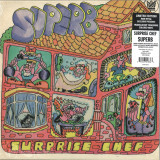
Australia's world-renowned cinematic soul outfit Surprise Chef return with new album Superb. A record that represents a change in their creative approach and turns up the heat in their music. Trading in their meticulous writing and recording techniques for a looser and less planned approach with the intentions of bringing more levity to the process, and it comes through in spades. The high caliber musicianship is still front and center, but they push their sound into a more energetic and fun place on this album. Album opener "Sleep Dreams" is the closest thing to a Surprise Chef tune one would come to expect but then lead single "Bully Ball" comes on and you get the picture that they came to kick in the door on this one. The song's gritty drums thunder through the speakers and get covered with percussion, keys, bass, and guitar chanks that stay in the pocket and bring the funk with them. The band pushes the boundaries of arrangement with tunes like "Body Slam" that starts off like a sweet soul track then pulls a 180, turning dark and haunting, centering on a sound they created by tucking a timpani into a bathroom two doors down from the mixing board. That same sense of experimentation comes up again on "Fare Evader" where they pepper another neck breaking rhythm track with synth notes that sound like robot sound effects from a 70s sci-film. The fellas turn up the tempo for the dance with tunes like "Consulate Case" and "Tag Dag"; the former pulling influence from afro-funk and the latter from jazz-funk. They take us deep into the beautiful world of Surprise Chef ballads on "Websites" and double down on their abilities to make beautiful and ethereal tracks with "Dreamer's Disease". With their new album Superb, their new approach, and plans to tour the world, we are about to see Surprise Chef take the step from the underground's most beloved to a household name and we are definitely here for it.
Cerca:record breakin music
Australia's world-renowned cinematic soul outfit Surprise Chef return with new album Superb. A record that represents a change in their creative approach and turns up the heat in their music. Trading in their meticulous writing and recording techniques for a looser and less planned approach with the intentions of bringing more levity to the process, and it comes through in spades. The high caliber musicianship is still front and center, but they push their sound into a more energetic and fun place on this album. Album opener "Sleep Dreams" is the closest thing to a Surprise Chef tune one would come to expect but then lead single "Bully Ball" comes on and you get the picture that they came to kick in the door on this one. The song's gritty drums thunder through the speakers and get covered with percussion, keys, bass, and guitar chanks that stay in the pocket and bring the funk with them. The band pushes the boundaries of arrangement with tunes like "Body Slam" that starts off like a sweet soul track then pulls a 180, turning dark and haunting, centering on a sound they created by tucking a timpani into a bathroom two doors down from the mixing board. That same sense of experimentation comes up again on "Fare Evader" where they pepper another neck breaking rhythm track with synth notes that sound like robot sound effects from a 70s sci-film. The fellas turn up the tempo for the dance with tunes like "Consulate Case" and "Tag Dag"; the former pulling influence from afro-funk and the latter from jazz-funk. They take us deep into the beautiful world of Surprise Chef ballads on "Websites" and double down on their abilities to make beautiful and ethereal tracks with "Dreamer's Disease". With their new album Superb, their new approach, and plans to tour the world, we are about to see Surprise Chef take the step from the underground's most beloved to a household name and we are definitely here for it.
- A1: Everything Is Real
- A2: Antibodies
- A3: She's On The Radio
- A4: Life In A New Motion
- A5: Tropical Suite São Paulo
- B1: Pretty Tall Girls
- B2: Budapest
- B3: Down On Serpent Street - Alternate
- B4: The Paper Bride
- C1: The Wild
- C2: I Shall Take It Anyway
- C3: The Bird Is On Fire
- C4: Jesus Told Me Too
- D1: Country Leather
- D2: Carrie Ann
- D3: The Word
- D4: The Music Never Dies
Poni Hoax, a French band born in the early 2000s under the impulse of Laurent Bardainne, immediately emerged as the union of converging forces: on one side, the precision of a composer and instrumentalist breaking away from jazz conservatory traditions; on the other, the magnetic presence of Nicolas Ker, a terminal new wave crooner with a sepulchral voice. Surrounded by Arnaud Roulin on keyboards, Vincent Taeger on drums, and Nicolas Villebrun on guitar, they made an instant mark with Budapest—dark and haunting—followed by the unstoppable She’s on the Radio, crafting a unique identity that blended the venomous elegance of Roxy Music, the tension of New Order, and the fervor of Larry Levan. With Images of Sigrid, Poni Hoax achieved the miracle of an instant classic before continuing their journey with A State of War and Tropical Suite, sonic odysseys haunted by memory and distant horizons. On stage, it was either an apocalypse or a revelation—a Formula 1 driven by a gang of Gremlins, a blazing energy leaving only burning embers in its wake. The adventure came to a tragic end with the passing of Nicolas Ker in 2021, as the notes of Laurent Bardainne’s saxophone rose into the gray skies of Père-Lachaise, the final echo of a dazzling odyssey.In 2025, Poni Hoax celebrates its 20th anniversary with the release of Greatest Hits: Everything is Real.
- A1: Dj G2G - *Ussy (Ft. Jahanam)
- A1: Boys Noize - Bvrning (Vinyl Only)
- A3: Locked Club - Ring My Bells
- A4: Adame Dj - Beat Maquinario
- B1: Safety Trance & Umru - Sidewinder
- B2: Kfr - There Is Something I Can't Find Ft. Mayah Alkhateri
- B3: Slim Soledad - Vai Toma Na Rave
- B4: Manni Dee - Break Me Ft. Bodur
- C1: Schacke - Control Freak
- C2: Øtta - Mão Na Parede
- C3: Anna Lann - Silver Plug
- D1: Tinkerhell - Cross Ways
- D2: David Löhlein - El Baile
- D3: Isaiah - Lone Soldier
- E1: Dj Babatr - Kick The Floor
- E2: Ilya Gadaev - Pleasuredom
- E3: Marceldune - Run And Dream, Kiss And Bye
- E4: Scntst - Feedback
- F1: Baseck - Let It Go
- F2: Dj Wifi - Like 2 Ride
- F3: Æro Nova - B1Te
- F4: Boys Noize - Sireneh
Boys Noize presents ONES and ZEROS OAZ, a new experimental record label with the mission of breaking open the space of possibilities for techno and beyond. Reflecting new modes of subcultural circulation and integrating music,
objects, and a pluralistic network of artists, OAZ debuts with the 22-track Bo compilation, including two Boys Noize solo tracks, one of them “Bvrning” (Vinyl Only), as well as tracks by Locked Club, Safety Trance & umru, DJ Babatr, Slim Soledad, Schacke, KFR, TINKERHELL, David Löhlein, MarcelDune, and more.
"The acclaimed 2007 album reissued on 1LP clear vinyl. Taken from the original 2007 masters when Pete Doherty was at the pinnacle of his creative powers, ‘Shotter’s Nation’ followed in the footsteps 'Down In Albion’, the band’s debut album, and Doherty’s first album outside of his first band - the era-defining Libertines. Both were met with commercial and critical acclaim, breaking into the top 10 of the album charts.
‘Shotter’s Nation’ is unmistakably Doherty. Melodic, stark, catchy, raw, brilliantly unique - his music has always created an unflappable loyalty from his many fans, remaining timeless, yet still sending a nostalgic excitement through its listeners. The album also features four songs co-written by Doherty’s then-girlfriend Kate Moss who also regularly performed live with them.
The approach to the recording and release of the album was an escape from Doherty’s previous methods. Stephen Street (The Smiths, Blur, Morrissey, The Cranberries) took over producer duties from The Clash's Mick Jones, and it was and his first album released by a major label, Parlophone."
Chalo & Vell return with Made From Moss Volume 2, marking the next step in their collaborative EP series. This four-track of club rollers explores a range of styles and tempos, each track anchored by distinctive rhythms and textures aimed squarely at the dancefloor.
Bangkok, despite being a bustling metropolis, boasts a music scene that feels as intimate and vibrant as those found in smaller European cities. It’s a place where local creatives from various disciplines come together, leaving their artistic imprint across the city. This collaborative energy resonates through Boiled Wonderland’s catalog, which features artists like DOTT, Sarayu, and Chalo—pioneers of Thailand’s burgeoning underground music movement. Both DOTT and Sarayu are co-founders of the record store and label More Rice Records, while Chalo plays a pivotal role as the mastering engineer at Thailand’s pressing plant, Resurrecc. It’s here that the Made From Moss project took root.
While Boiled Wonderland continues to champion eclectic and boundary-pushing music, its sonic direction has evolved to embrace a more dancefloor-oriented approach. This shift reflects the label’s immersion in Bangkok’s electrifying club culture and the inspiration drawn from the city’s warm, sunlit atmosphere.
The Made From Moss series emerged from a creative dialogue between Chalo and label founder Vell. Moss, with its simplicity yet dynamic nature, became the symbolic foundation for a series focused on rhythmically driven, danceable tracks. This vision also sparked the creation of Mosspit events and welcomed MetalMetal as a core contributor.
Chalo’s opener, Feeling, weaves house-inflected vocals with acid synth lines, building a steady groove that carries effortlessly to the finish. Tolerance Break follows, layering dynamic snares, tight breaks, and basslines that pulse with energy. On the B-side, Vell leads with The Ship Rolls Through, a euphoric roller balanced by flickering sound effects that keep the track grounded. Back To Normality closes the EP, leaning into progressive tones with bouncing bass lines that sizzle toward a breaking point, bringing the EP to a close.
The record is already receiving support from the likes of: Ploy, Mixtress, Raresh, Space Dimension Controller, Jennifer Cardini, Answer Code Request and many more.
- A1: Summer Overture
- A2: Party
- A3: Coney Island Dreaming
- A4: Party
- A5: Chocolate Charms
- A6: Ghosts Of Things To Come
- A7: Dreams
- A8: Tense
- A9: Dr. Pill
- A10: High On Life
- A11: Ghosts
- A12: Crimin' & Dealin
- A13: Hope Overture
- A14: Tense
- A15: Bialy & Lox Conga
- B1: Cleaning Apartment
- B2: Ghosts-Falling
- B3: Dreams
- B4: Arnold
- B5: Marion Barfs
- B6: Supermarket Sweep
- B7: Dreams
- B8: Sara Goldfarb Has Left The Building
- B9: Bugs Got A Devilish Grin Conga
- C5: The Beginning Of The End
- C6: Ghosts Of A Future Lost
- C7: Meltdown
- C8: Lux Aeterna
- C9: Coney Island Low
- D1: Purple In The Morning, Blue In The Afternoon, Orange In The Evening, Green At Night
- D2: 30 Days To Revolutionize Your Life!!! 1-900-976-Juice
- C1: Winter Overture
- C2: Southern Hospitality
- C3: Fear
- C4: Full Tense
To coincide with its 20th anniversary, Clint Mansell's haunting score to Darren Aronofsky's 2000 film, Requiem for a Dream, performed by Kronos Quartet, returns to vinyl. This was Mansell’s second of several collaborations with Aronofsky, following 1997’s π, and features arrangements by David Lang of Bang on a Can. The film stars Academy Award-winner Ellen Burstyn, Jared Leto, Jennifer Connelly and Marlon Wayans, and was adapted from the 1978 novel by Hubert Selby, Jr. (Last Exit to Brooklyn), who also wrote the screenplay with Aronofsky. Set on the rusted mean streets of Coney Island, Brooklyn, Requiem for a Dream tells the parallel stories of four people pursuing their dreams of better lives. The reissue features the original soundtrack, plus two bonus tracks.
Clint Mansell, a musician, composer, and founding member of the band Pop Will Eat Itself, first worked with Darren Aronofsky on the score for his 1998 film π. Also released by Nonesuch are Mansell’s scores for Aronofsky's The Fountain (2006), nominated for a Golden Globe, and Noah (2014). His other scores include The Wrestler (2008), Moon (2009), Black Swan (2010), Filth (2013), Stoker (2013), High Rise (2016), for which he received an Ivor Novello nomination, and Loving Vincent (2017).
For more than 40 years, San Francisco’s Kronos Quartet – David Harrington (violin), John Sherba (violin), Hank Dutt (viola), and Sunny Yang (cello) – has combined a spirit of fearless exploration with a commitment to continually re-imagining the string quartet experience. In the process, Kronos has become one of the world’s most celebrated and influential ensembles, performing thousands of concerts, releasing more than 50 recordings, collaborating with many of the world’s most eclectic composers and performers, and commissioning over 850 works and arrangements for string quartet. A Grammy winner, Kronos is also the only recipient of both the Polar Music Prize and the Avery Fisher Prize. Most recently, in 2019, Nonesuch released Kronos’s ground-breaking collaboration with composer Terry Riley, Sun Rings, and, in 2017, Folk Songs, featuring Sam Amidon, Olivia Chaney, Rhiannon Giddens and Natalie Merchant.
As the tenth candle flickers atop the torta alla panna, Archeo Recordings play the Uno reverse card, breaking with tradition to give us a gift in celebration of its birthday: the first in a series of exquisite EPs on which the label's favourite contemporaries pay homage to past masters. Each re-polished gem is plucked either directly from the beatific back catalogue of the fine Florentine label or is at least Archeo-adjacent, perhaps a sign of future wonders to come. Like a musical version of Janus, who can be found at the heart of Bertoldo di Giovanni's frieze in the Medici villa, Archeo Recordings will continue to look forwards and backwards to provide sublime sounds for us all.
Pepe Maina officially joined the Archeo family in 2019 with the much-needed reissue of his 1979 masterpiece Scerizza (AR015), but his astounding music has been a constant companion to label head Manu for much longer. An inter-dimensional, multi-instrumental maverick, Maina weaves the frayed edges of prog rock, new age, organic jazz and global minimalism into a shimmering tapestry all of his own. The results are spread across fifty years and almost as many albums, largely self-released and always absolutely untarnished by commercial concerns.
Based in a small village in the hills of Brianza, just north of Milan, Maina translates the beauty of his surroundings into transformative tone poems, and the folkloric fusion of "The Infinite", originally released on his 2014 CD Tales From The Hill, is the perfect example of his practice. It opens with a recitation of Giacomo Leopardi's 1825s poem "L'Infinito" by famed Italian actor Vittorio Gassman. A leading figure in the romantic movement, Leopardi explores the idea of time and space within the natural world, and the peace that comes with an appreciation of the immensity of eternity. Manu, longtime digger and now a burgeoning producer, expands upon the original with tribal percussion, chirping electronics and a spheric bassline, folding Maina's elegant strings and gossamer pads into a new arrangement suited for a slow dance under the stars.
Unless you had a well-trained ear tuned to Italy's avant-jazz scene, chances are your first encounter with innovative flautist Roberto Aglieri came via the 2017 Archeo reissue of hisalmost untraceable LP Ragapadani (AR011). It's a true testament to Manu's digging credentials that he snatched this masterpiece out of the esoteric atmosphere and brought it attention it so richly deserved. A delicate union of digital synthesis and versatile flute - be it soft and silvery or
brilliant and clear - the 1987 album was a shapeshifting masterpiece, replaying scenes from Virgil, Verdi, Visconti and Pasolini with a neon glow. Quintessentially Italian, but uncanny and previously unimagined - Penthouse and Portico perhaps. Powered by a percolating prototechno sequence, cascading keys, hallucinogenic vocal snippets and a variety of tonal timbres from Roberto's reed, "Danza N. 1" long deserved the praise reserved for Jean-Luc Ponty's pinnacle, so many thanks to Manu for our collective introduction. The tall task of reinterpreting this particular paragon falls to Perugian polymath Daniele Tomassini AKA Feel Fly, whose peerless skills as both producer and musician have delighted DJs and dancers alike. Hot on the heels of his diverse and definitive remixes of Tony Esposito for AR027, Daniele delivers a radical rework of "Danza N. 1" perfect for both day rave sunshine and full moon party alike. Enhanced by snapping breaks and a rattling kick, the bassline gurgle emerges as a progressive powerhouse, laying the foundation for the trilling flute and circular keys to cast a psychedelic spell. As the slow-Goa revival picks up pace, this one is way ahead of the pack.
Archeo take us all the way back to the start of its story here - well almost. Though it bore the stamp AR001 (2015), this Radio Band reissue actually hit shelves months after Tony Esposito's "Je-Na' / Pagaia"; a false start perhaps but a true classic all the same. Radio Band were a group of DJs from Florence who all sailed the airways of Radio Fantasy in 1984 and whose one and only release was this super groovy slice of Italo-boogie. Following the example of Milanese DJs Band of Jocks but far surpassing their formulaic funk fizzle, Radio Band employed an intergalactic bassline, cosmic keys and that undeniably Italian style of rapping to deliver a sophisticated party-starter which even found its way to disco deity Ron Hardy. Back to the here and now, and if you've found yourself pumping an ecstatic fist to a supercharged Italian epic of late, chances are its from the mind of the mysterious Radiomarc. Operating on the ascendent Popcorn Groove imprint, this shadowy figure steers his country's lost classics into peaktime territories, finding a sweet spot between late Italo-disco, early Italo-house and contemporary cool. Pushing the tempo with a club-ready 4/4, setting the sequencer to stun and supplementing the original melodies with a series of synth riffs, the mystery producer send this one into orbit. Radio Band - Radio Rap - Radiomarc, the circle is complete.
Few have done more to develop cross-cultural musical exchange than Futuro Antico. A collaborative venture from musician, archeologist and ethnomusicologist Walter Maioli, keyboardist and tonal theoretician Riccardo Sinigaglia and multi-disciplinary artist and composer Gabin Dabiré, Futuro Antico formed in Milan in 1979, combining ancient international folkloric traditions with otherworldly electronics. The result is an arresting melange of Mediterranean, African and Asian instrumentation, mimicked by esoteric synth tones and hypnotic minimalism, which the group perfected on their acclaimed 1990 LP Dai Primitivi All'Elettronica. The meditative and transportive "Pan Tuning" belongs to their largely overlooked 2005 CD only release Intonazioni Archetipe, and has been amongst Manu's most loved tracks from the first moment he heard it. Who else is better placed to reshape this evocative opus into an immersive, transcendental dance floor journey than label favourites Mushrooms Project? The duo sows the original elements into a sprawling fifteen minute fusion of séance and science, at times propulsive with a ritualist rhythm of tuned percussion and crunching drum machine at others drifting off into ethereal ambience. Mushrooms Project continue to push the boundaries of the Afro-cosmic style, and this remix marks a new zenith.
- A1: Tell It To Me Slowly Feat. Nick Richards
- A2: Jungle Run Feat. Nubiya Brandon
- B1: Basa Basa Feat. K.o.g
- B2: Brother Feat. Nubiya Brandon
- C1: Borders Feat. Pilo Adami
- C2: Permission Feat. Nubiya Brandon
- C3: Addis To London Feat. Mulatu Astatke
- D1: Ghosts Feat. Nick Richards
- D2: They Talk Feat. K.o.g
- D3: Sugar Cane Feat. Nubiya Brandon
Strut proudly present the brand-new studio album from Nubiyan Twist, 'Jungle Run'.
Now one of the leading lights in the UK's new generation of soulful, genre-fluid artists, the Leeds-born and now London-based 12-piece collective have created their finest recordings to date, effortlessly weaving together elements of jazz, soul, hip hop, African styles, Latin, dub, hip hop and electronics in a flow of thought-provoking and life-affirming music.
Recorded at the band's own self-built Henwood Studio in rural Oxfordshire, the album effortlessly moves through different voices from the band's circle. The inimitable, timeless vocals of Nubiya Brandon lead the way on the album's title track about breaking preconceptions and promoting equality, 'Where you from I'm from wherever I be.' Saxophonist Nick Richards vocals the killer first single from the album about inner turmoil and a search for the truth, 'Tell It To Me Slowly' while rising Ghanaian star K.O.G. appears on the Afro jams 'Basa Basa' and 'They Talk'. Percussionist Pilo Adami (Nina Miranda / Afrosamba) voices the infectious bossa-jazz jam 'Borders'. The band also draft in two African legends for guest duties with the original Afrobeat maestro Tony Allen on 'Ghosts' and Ethio jazz pioneer Mulatu Astatke contributing vibes on the sinuous 'Addis To London'. 'The depth of talent and ideas that every member of this group has brought to the table for this album is incredible,'
says producer and orchestrator Tom Excell. 'Conceptually, 'Jungle Run' is all about connecting different people and cultures whilst exploring the journey of individuals. This album is the pinnacle of everything we have done to date and to collaborate with the godfathers of Afrobeat and Ethio Jazz and celebrate their music in a modern context was very humbling.'
The album is another landmark for a band that has been consistently developing their sound since their formation in 2015 at Leeds College Of Music. 'One of the biggest factors in our sound was the exciting music scene in Leeds,' explains saxman Joe Henwood. 'From a reggae night called 'Sub Dub' to venues playing whacked out experimental jazz.' Since then, the band's self-titled debut album (2015), EP 'Siren Song' (2016) and single 'Dance Inna London' (2017) have become classics in their own right and their live show has become an essential ticket; previous live highlights have included high profile slots at David Byrne's Meltdown at the South Bank and Glastonbury West Holts
'Jungle Run' is released on 15th February on CD, 2LP and digital. Cover artwork comes from acclaimed designer Marcus Davies and the album is mastered by The Carvery. Nubiyan Twist tour across Europe from November.
Here at Mr Bongo we have been inundated with people asking us to reissue this release. Ana Frango Elétrico's petit cult classic masterpiece 'Little Electric Chicken Heart' from 2019, which was only ever released on vinyl and CD in Brazil and Japan, has fast become a collector's item.
Well received by fans, DJs, and reviewers on release, The Needle Drop expressed "Ana Frango Elétrico's authentically vintage fusion of chamber pop, rock, samba and jazz is a real blast!" listing it as one of its Top 50 Albums of 2019. The album's reputation has been slowly building ever since, gaining a Latin Grammy nomination in 2020, and now solidly cementing itself as a gem of contemporary Brazilian music.
Across the albums nine tracks, Ana blends elements and influences from MPB, Tropicália, indie rock, punk and pop, forging them together with a sumptuous dose of her signature style. The finesse of 'Saudade' kicks off the LP, one of Ana's most known tracks to a non-Brazilian audience. A sublime opener, beginning with a spellbinding piano solo before transcending into a beautiful dream-laden slice of warmth, complete with luscious jazzy horns and deft vocal delivery. ‘Promessa e previsões’ follows, the only track on the album not to be written by Ana, instead being penned by Chico França. It’s a swelling and sweeping twilight groover, building and breaking across absorbing peaks.
Other highlights on the album include the anthemic 'Chocolate', which was a firm favourite with a packed sing-along crowd when we heard Ana perform it live. Elsewhere, 'Se No Cinema' hits with its quirky allure, charm and catchy melodies before transforming into a carnival spirit.
Tapping into the richness of Brazil’s new wave of musical energy, the album also includes a heavyweight lineup of collaborations with artists such as Dora Morelenbaum (Bala Desejo), Tim Bernardes, Antonio Neves and Guilherme Lirio to name but a few.
A short, sweet and refreshing record, that leaves nothing to waste, marrying playful ideas with poignant themes. 'Little Electric Chicken Heart' is a future classic and will beguile fans of ‘70s Brazilian recordings, Gal Costa, Mac DeMarco, Stereolab, Superorganism, Caetano Veloso and more.
- A1: World Is Dog
- A2: Cctv (Feat Creature)
- A3: Yottabyte
- A4: Bad Pollen (Feat Billy Woods)
- A5: Slum Of A Disregard
- A6: Rfid
- A7: Instant Transfer (Feat Billy Woods)
- A8: Ikebana
- B1: In The Shadow Of If
- B2: Skp
- B3: Hushpuppies
- B4: 14 4 (Feat. Skech185)
- B5: Voice 2 Skull
- B6: Xolo
- B7: Zigzagzig
Black Vinyl[35,08 €]
We’re teaming up with ELUCID and Fat Possum for a limited edition of 300 copies of a Rush Hour black ice coloured edition.
E L U C I D, one half of the illustrious duo Armand Hammer, is here with the full-length follow-up to 'I Told Bessie'. Further experiments in the sonic, expanding on the 'live' side of music paired with the embracing of chaos. Something you haven't heard, or not so for a very long time. E L U C I D is here to reveal the bleakness of reality.
---------------------------------------------------------------------------------
''There is never time in the future in which we will work out our salvation. The challenge is in the moment; the time is always now.''
James Baldwin
A raw, crackling urgency runs through rapper-producer ELUCID’s new album REVELATOR like an underground power line. There is no space here for sepia-toned reminiscences or indulgent self-mythologizing. Intellectual rabbit holes have been filled in with concrete and rebar ; there is nowhere to hide and no off ramp from the audio Autobahn that ELUCID has fashioned—a renegade Robert Moses with gold fronts, bulldozing the homes of the powerful and the complicit. REVELATOR brims with the energy of now, with a refusal to look away. Carpe diem in a murder one mask.
Born in Jamaica, Queens, ELUCID has been on the cutting edge of New York’s underground scene since the mid-2000s. From the beginning, he has defied both convention and expectation. He ran with Okayplayer darlings Tanya Morgan, but his own music eschewed their throwback charm for glitchy noise experiments and bass-swamped culture jamming. His 2016 debut studio project Save Yourself (re-released in a deluxe edition last year) announced him in earnest. But in recent years, his Armand Hammer releases with partner-in-crime billy woods have received significant attention and acclaim. Serving as a followup to his last solo album—2022’s comparatively balmy I Told Bessie—ELUCID hoped to “re-distinguish” himself with REVELATOR, setting himself apart amidst the increasing attention around the music he and his friends are making together.
For ELUCID, this meant setting bold new challenges for himself. One of these was diving further into live instrumentation than ever before—”getting my Quincy Jones on,” as he puts it. The testing ground for this approach was Armand Hammer’s most recent project, 2023’s We Buy Diabetic Test Strips’ Möbius strip soundscapes, warmed with instrumental flourishes and skin-shedding beat progressions. With REVELATOR, though, ELUCID strove to create an atmosphere of chaos, embracing experimental electronics and atonal sample bursts. He worked on much of the album with co-producer Jon Nellen, who comes from a background in avant-garde and Indian classical music. “I wanted to get as freaky as I could at this moment. I wanted people to hear things, maybe for the first time, or in a way they haven’t for a long while,” the rapper explains.
ELUCID arrived at the studio with a collection of noise sources: non-referential samples, glitches and noises. Together he, Nellen, and others created forms out of them and, as ELUCID recalls, “just started playing drums with it.” Their fried, distorted sound was directly inspired by Miles Davis at his most uncompromising—specifically, the tone-clustering funk track “Rated X” from his 1974 double LP Get Up With It. At times, the pairing of rap with avant-fusion sounds also brings Emergency! from The Tony Williams Lifetime to mind, perhaps in an alternate timeline where the late drummer was listening to Ice Cube’s AmeriKKKa’s Most Wanted.
“The World is Dog,” REVELATOR’s lead single, functions as the album’s aesthetic thesis statement. Like the Davis track, the textures are punishing, the tonality is in free-fall, and the driving breakbeat of a groove cuts in and out unceremoniously. Avant-jazz bassist Luke Stewart, who appears throughout the record, holds the whole thing together just long enough for ELUCID to tightwalk over the beat. This tension is exactly where REVELATOR sets itself apart; in a time of drumless loops, and safe soul samples, this is a high-wire act with no safety net. Similarly, the song announces the themes of the album within just a few phrases, evoking the way societies accept and adjust to new levels of debasement and brutality while suffocating under the weight of history: “Can’t clock the kill, all a mystery/Forced past will eating everyone eventually/The world is dog.”
Many of the songs on REVELATOR grapple obliquely with dissolution and disenfranchisement in America and across the world—the grim realities of our domestic sociopolitical climate and our involvement in foreign conflicts. “Much of my artistic and political sensibility comes from the Black arts movement here in New York,” ELUCID explains. “Recognizing the interconnected global struggles against oppression, artists and thinkers created works and actions in solidarity with freedom movements in South Africa and Palestine.” ELUCID cites intellectuals like Amiri Baraka, Kwame Nkrumah, Audre Lorde, Sonia Sanchez, and Nikki Giovanni among his heroes. (One track on the album is specifically inspired by Lorde’s work, “SKP,” citing the scholar’s paper “Uses of the Erotic: The Erotic As Power.”) Songs like REVELATOR’s insistent closer “ZIGZAGZIG,” find ELUCID applying up-to-the-minute messaging, making explicit reference to the conflict in Gaza: “Feed a war machine…from river to sea, in lieu of peace.”
Despite ELUCID’s preference for cacophonous system overload here, the rapper also provides moments of respite. Recorded at The Alchemist’s Los Angeles studio, the laid-back, wheezing “INSTANT TRANSFER” is a collaboration with billy woods, which crystallizes their shared sense of creative determination. “With much momentum behind us and even more on the horizon, I knew a purpose, and that every step was ordered to that purpose,” ELUCID said of the experience. Meanwhile, the jittery “HUSHPUPPIES” is a playful anomaly on the track list, providing a snapshot of ELUCID watching his grandparents in the kitchen while preparing for Friday night fish fry dinners.
“Love still rules over on this side,” ELUCID says. ”I’m raising a family. We are making meaning and finding joy in the midst of all the fucked up-ness of everything around us because the alternative is cowardice and slow death. We remain rooted. We celebrate our people and our wins. Struggle is necessary.”
“IKEBANA” is one of ELUCID’s strongest statements of purpose on the record, blending the record’s heaviest themes with its most hopeful sentiments. supported by a shoutalong refrain and an urgent prog-funk groove. Breaking away from images of dissolution and crumbling societal systems that populate REVELATOR, ELUCID notes that the only way to navigate life’s bleakest landscapes is to cling to love and believe in those around you—to look forward toward something better that may or may not be possible. For the rapper, one of the album’s most trenchant lines comes during a centerpiece of a beat drop: “Being alive/I must look up.”
“The lyric ‘being alive I must look up’ is important especially in the context of this album. Much of the album imagery is harsh and reflects the actual doom some of us experience. But still I/we exist,” ELUCID explains.
Every artist is, in one way or another, the product of their time, bound by life’s leaden gravity to operate within the space of that which is already known. But there are some who are able to shake free of these ties, to shape the culture as it unfolds, to make the present their own.
Revelation, as a concept, points to the scales falling from people’s eyes—something that has been hiding in plain sight becoming clear. “The revelator relates to things that have been talked about, things that have been forecasted,” ELUCID adds. “And now they’re really here, and everyone sees it. And there’s no escaping.” REVELATOR plays out with the unmitigated power of those storms, laying waste to any genre conventions in pursuit of a certain physicality. Here, ELUCID develops a wholly distinctive musical language to explore our fractured modernity.
REVELATOR's packaging was designed by longtime Armand Hammer / Backwoodz art director, Alexander Richter.
This October Jamiroquai celebrates the 30th anniversary of ‘The Return Of The Space Cowboy’. Their second album, it will be reissued as a double-LP set on 140g “moon grey” vinyl and includes Michael Gray’s Good Vibe Zone edit of ‘Space Cowboy’ - which has never been released on a physical product. The packaging has also been re-designed for this anniversary release including foil enhancement of the original cover design.
‘The Return Of The Space Cowboy’ is the follow up album to the band’s huge 1993 debut, ‘Emergency On Planet Earth’. Selling over 3 million copies globally, ‘Emergency On Planet Earth’ put the band on the map with their distinctive sound standing them apart from other popular acts of the time.
‘The Return Of The Space Cowboy’ was released just one year later and was met with great critical and public acclaim. Certified Platinum in the UK, Japan and France, it achieved chart success in multiple countries and spawned the single ‘Space Cowboy’ which remains one of their biggest tracks to date. Critically the album was lauded with Rolling Stone saying "Jamiroquai parlay jazzy soul pop so tight it crackles… Nowadays, when most funk comes out of cans, Jamiroquai's live spark glows", The Guardian said “... this second album sounds like vintage Stevie Wonder and Johnny 'Guitar' Watson, but Kay's vocals are as snappy and engaging as his extrovert persona" and Q magazine said it “combines intricate arrangements with several long, free-form workouts crammed with virtuoso performances".
For many, this album is defined by some of the most complex songwriting the band have ever produced and Jay Kay called it “one of our most creative and accomplished albums”. The process of making the album came with many challenges. Having to recruit a new drummer (after Nick Van Gelder failed to return from holiday), the band were met with second-album syndrome with Kay proclaiming since that lyrics weren’t coming "... because suddenly I wasn't homeless, I had everything I needed. So I found myself creating problems to write about." The songwriting process was complex for the band as Jay Kay was often dissatisfied with the results, leading songs to be scrapped or rewritten, but half-way through recording Kay wrote ‘Space Cowboy’, a song which reflects darker times during the recording session, and it became the catalyst of creative inspiration helping them finish the record. On this 30th anniversary edition of the album Space Cowboy gets a modern dance makeover courtesy of DJ Michael Gray, shedding new light on the track and emphasising it’s already infectious groove.
The album built on the success of ‘Emergency On Planet Earth’ and Jamiroquai have become one of the UK’s most pioneering and ground breaking bands of the past 30 years. Pushing boundaries and bringing jazz and funk to a mainstream audience, their sound is not only unique, but immediately recognisable.
- A1: Blue Beach - Welcome To Your Beach
- A2: Never Find A Girl (To Love Me Like You Do)
- A3: By The Pool
- A4: Roll Over, Beethoven - Out Of The Beach
- A5: In The Shade
- A6: Looking Across The Street
- A7: Long Distance Look
- B1: Hot Afternoon
- B2: Crying In The Sun
- B3: The Next Time
- B4: Miss B B. Walks Away
- B5: Sleep Walk
- B6: Standing There
For the first time since its inception 36 years ago, Steve Hiett’s elusive Down On The Road By The Beach is finally made available outside of Japan. Most recognized in the fashion sphere as an English photographer and graphic designer, Hiett‘s transportive audio portraits amplify his serpentine guitar to the infinite blue, recorded across Paris, Tokyo and New York with no coastline in sight. Now widely celebrated as a desert island disc, very little is actually known of its unfathomable genesis.
A career devotee of Brian Wilson’s ground breaking harmonies, Hiett shot The Beach Boys for Rolling Stone - as well as The Doors, Miles Davis and Jimi Hendrix (in one of his final performances at the 1970 Isle Of Wight Festival) - while establishing himself as a fashion photographer. Decamping to Paris in 1972, he began what would become 20-year collaborations with Vogue Paris and Marie Claire, printing his signature warm, saturated and vibrantly hued snapshots.
In 1982, representatives from Tokyo’s Galerie Watari visited him to propose a solo exhibition. Asking if he could insert a 7” of original music into the back of the exhibition catalogue, Hiett laid down ‘Blue Beach - Welcome To Your Beach’ in a Parisian radio station, playing all of the instruments himself, and two more cuts in New York with Yoko Ono, The Doobie Brothers and Steely Dan hired-gun Elliot Randall. Once dispatched, the phone began ringing off the hook with requests for him to fly to Tokyo. Assuming these long-distance callers were wanting him to check proofs for the book, it wasn’t until he arrived that he discovered CBS/Sony had facilitated an entire album. Heitt hastily gripped some petty cash, bought a guitar and retreated to his hotel room to start writing.
Entering the studio the following day, he was further surprised by a waiting room of session players known as Moonriders - one of Japan’s most acclaimed rock bands of the 1980s. Intimidated by their indecipherable sheet music, Hiett suggested Randall join them and with money being no object for major labels at the time, his wingman was on the next plane out of New York to finalise the high production indulgence. Near-ambient arrangements that float in a space between The Durutti Column, Steve Cropper and Ashra, Down On The Road By The Beach also crowns Hiett the master of recontextualization with his zero-gravity blues visions of Roll Over Beethoven, Santo & Johnny’s Sleep Walk and the 1967 Eddie Floyd soul hit Never Found A Girl.
Produced in coordination between Be With, Efficient Space and the artist, this definitive reissue is restored from original masters with vivid reproductions of the Down On The Road By The Beach exhibition catalogue, intended to accompany its original release, and extensive liner notes penned by fellow Steve Hiett obsessive Mikey IQ Jones.
2024 Repress
Straight in the wake of their eponymous debut LP released on the label back in 2016, Weval return to Kompakt this year with their sophomore album, 'The Weight', breaking their pop-mellow, nostalgia-friendly facet further out in the open as they arrive "at this place again were everything felt spontaneous, new and exciting, like we had in the beginning". Orbiting around that ever luminous yet wistful melodic halo that surrounds their music, this second full-length effort sweeps an extra-wide and languidly woven palette of emotions and moods, making for a uniquely ambitious and generously coloured mosaic of sound. If the recording sessions "often started grumpy and emotionless" by Harm and Merijn's own admission, the pair was "surprised by the joy it gave us, which can be compared to the emotions we felt back in the first days of making music together"; subsequently reconnecting with that fresh, naïve feeling of "absolute creative freedom" they were after. The album is also the fruit of a whole new working process for them - more playful and unpredictable - which saw them switch from "guitars lying around to piano, onto our own synths and the most cheap quirky toys synths you can imagine", and involved "recording all of our own samples, voice and almost every instrument out of the box - which for us was a totally new way of working". "We've always wanted a narrative for the album, and finding the right order perhaps took the most effort" they explain; "we felt anxious, felt insanely positive, felt heartbroken again, felt in love again, and there was death, and even suicide around us. It was quite chaotic. As a whole, 'The Weight' breathes with that transformative richness, free of limits and rules, except perhaps to "do quick and not think too much". Amidst this collection of songs and instrumentals that live by Weval's singularly positive take on music - one that can "lift you up, and make you feel hopeful without being necessarily straight out 'happy'" as they define it, the title-track and lead single stays true to the duo's dynamic approach, putting on a fine balance of floor and dream inducing adaptability that sound engineer David Wrench (Frank Ocean, The XX, FKA Twigs, Caribou… etc.) subtly made palpable. There's heavy showers of funk drops pouring from endless bars of thunderstorm clouds and laid-back riffs beating a restrained poolside-party kind of pulse, but also sensual vocals rising from beneath the sheets and rueful polaroid-filtered ambiences to soundtrack all possible moments in life - from the most euphoric to those when music seems the only viable healing potion. More on the post-KLF, BoC-inflected electronica side of things, 'Are You Even Real' takes its listener for a round-trip across the star-studded dome and beyond, before songs like 'Someday' and 'Same Little Thing' head back down to a state of pulsating, earthly organicity, tense and mercurial as get. An arpeggiated slice of piano-strewn kosmische, 'Heaven' is another invitation to an epic-scale odyssey from the inner-spheres into the distant fringes of the outer-world. Weightless and airy, yet texturally dense and widely magnetic overall, Weval second LP is a synthesis of the duo's multi-angle take on electronics: blissed-out, heartening and infinitely free.
Nur zweieinhalb Jahre nach der Veröffentlichung ihres selbstbetitelten Debutalbums finden sich WEVAL zurück "an jenem Ort, an dem sich alles spontan, neu und aufregend anfühlt - so wie als wir anfingen zusammen Musik zu schreiben". An diesem Ort entstand "The Weight", ihr zweiter Longplayer, auf dem Weval sich ganz den Pop-verliebten, Nostalgie-freundlichen Facetten ihres Sounds öffnen. Stetig um den sehnsuchtsvollen Strahlenkranz ihrer Melodien tanzend, legt diese Platte noch vielschichtigere, mit feinster Präzision gewobene Gefühlswelten frei.
Obwohl die Aufnahmesessions nach eigenem Bekunden oftmals "miesepetrig und emotionsarm" begannen, so war das Duo überrascht darüber, wie schnell sich bei der Arbeit jene Freude einstellte, die sie aus ihren künstlerischen Anfangstagen kannten, eine Woge des frischen, naiven Gefühls der "absoluten kreativen Freiheit". Dieses Album ist die Frucht eines verspielteren und unvorhersehbareren Arbeitsprozesses innerhalb der Band, in welchem alles zum Einsatz kam, was ihnen in die Finger kam - von der ollen Gitarre, die in der Studioecke stand, über ein Piano und den bandeigenen Sythesizern und den sonderbarsten Spielzeuginstrumenten, die man sich vorstellen kann. All dies sowie zahlreiche Vocalaufnahmen dienten als alleinige Samplequelle - "was für uns eine völlig neue Arbeitsweise war". "Es war uns wichtig für das Album den perfekten Erzählbogen zu spannen. Die richtige Reihenfolge zu finden war ein extrem aufwendiger Vorgang", erklären Harm und Merjin. "Uns war bange, wir fühlten uns total selbstsicher, uns zerbrach das Herz und wir verliebten uns erneut. Wir waren sogar von Tod und Selbstmord umgeben. Alles war Chaos. Insgesamt atmet "The Weight" die Reichhaltigkeit dieser sich ständig verändernden Gefühlslagen, frei von Einschränkungen und Regeln - außer vielleicht "mach es schnell und zerdenke die Dinge nicht." Inmitten dieser Ansammlung von Songs und Instrumentals, die aus Wevals einzigartiger, von Zuversicht geprägter Herangehensweise entstanden sind - "Musik, die dich hochzieht und Hoffnung spendet, ohne dich notwendigerweise happy zu machen. Der Titeltrack "The Weight" steht exemplarisch für Wevals ambivalenten Ansatz, die feine Balance zwischen Dancefloor und Traumzuständen, perfekt in Szene gesetzt von Soundengineer David Wrench (Frank Ocean, The XX, FKA Twigs, Caribou… etc.).
Der schwer aus gewaltigen Gewitterwolken tropfende Funk, die eine verhaltene Poolparty suggerierenden Riffs, die sinnlichen, geisterhaften Vocals und ein verwaschenes Ambiente, das wie ein Album alter Polaroidaufnahmen alle erdenklichen Momente des Lebens festhält - von den euphorischsten bis hin zu jenen, in denen Musik der einzige Trank ist, der Linderung verheißt. Das post-KLF und Boards of Canada evozierende "Are You Even Real" führt den Hörer auf einen imaginären Flug ins Sternenzelt, während organisch-klingende Songs wie "Someday" oder "Same Little Thing" wie Quecksilber am Boden haften. "Heaven" ist eines jener "kosmische" Stücke mit wilden Arpeggios und Pianosprengseln, die Weval in den vergangenen zwei Jahren zu einer Live-Sensation werden liessen. Wevals Musik ist schwerelos und luftig, aber gleichermassen von dichter Struktur und von einer magnetischen Anziehungskraft. Ihr zweites Album "The Weight" ist eine Synthese aus dem multi-perspektivischem, kaleidoskopischen Verständnis von elektronischer Musik: Herzerwärmend, alles umschmeichelnd und unendlich frei.
NYC dance music legend Joey Longo has been a part of the dance music soundscape for those in the know from way back when, his first records surfacing in 1989 under a variety of monikers and on a slew of labels out of NYC. Some (Cabaret, Loop d'Loop, Foot Stompin') were his own, others (Underworld, Maxi, Minimal) not, but the they always came bearing the credit 'produced by Pal Joey'. Joey hit the heights early on, as one of his earliest records, Dance (as Earth People), went big in dance music terms. If you were raving in the early '90s chances are you will be getting flashbacks from 'Dance', as it was played across a number of scenes. A deeper 'beats' mix features on this gem of an album, his first in over 10 years, along with a perfectly selected blend of classic cuts, new versions and remixes and unreleased wonders. Mastered to perfection, but keeping his raw New York style.
It's been 40 years since Michal Turtle released his seminal, ground-breaking album "Music From The Living Room" into the world and promptly disappeared back into the aether.
An extremely obscure cult classic known only to deep diggers and aficionados of the finest order, it wasn't until Music From Memory reissued some of the tracks from it via retrospective compilations of Turtle's unreleased music almost 30 years later that his name become more widely known and a new generation were able to discover the artist's unique and pioneering style of experimental electronic music production, the majority of it very much ahead of its time, and to this day, still timeless.
Invisible Inc contacted Turtle in the summer of 2023 about releasing something else by him and it was during this exchange of emails that ideas were expressed about releasing not simply a straightforward reissue of "Music From The Living Room" to mark its 40th anniversary (the album has never been reissued in full) but rather a re-imagined/re-constructed take on the album bringing contemporary techniques, styles and newly recorded vocal and instrument parts into the mix and breathing new life into these wonderful compositions.
Collaborators old and new were brought into the studio and the songs re-created from the ground up. Familiar songs like "Are You Psychic?" and "Village Voice" get overhauled and echo remnants of their original counterparts but simultaneously sound like completely new tracks. The always mesmerising "Phantoms of Dreamland" is represented through a live recording at Café Oto featuring original album vocalist Lucianne Lasalle and regular collaborator HOVE on electronics. The remaining tracks, however, will be completely new to the ears of most people, never having been reissued or heard in these new forms ever before.
Regardless, whether in some way familiar or not, these hypnotic and repetitive pieces of beautiful sound art, all very different in style from one another, have an entirely new identity that even diehard devotees of the originals will fall in love with.
“Holy shit. This record is amazing. 'Are You Psychic?' is really something” dj_2button Dummy Hand / Weirdos Inc.
“What a record!” Cosmo Vitelli I'm A Cliché
“Amazing release. Probably your best release yet! Does everything an amazing record should and more...” Alexis Le-Tan Oddity Radio / Full Circle / Offen Music
Limited 100 copies.
London lyricist Slim Papi returns for the 3rd and final release in his ‘Châteauneuf-du-Papi’ series with this 4-track EP.
Following collaborations with the likes of Crimeapple, Sonnyjim & Jam Baxter, this time London’s Slim Papi teams up with the Madlib-cosigned Chris Crack, who makes a rare appearance singing his way through the Max-B reminiscent hook as well as handling a 16 bar verse. Crack appearing fresh off the back of his latest ‘Free Sex’ LP and fellow wine-afficinado Griselda/Alchemist affiliate, Willie The Kid.
Continuing the trend set through his ‘Chateauneuf-du-Papi' EP series, the EP once again sees artwork courtesy of Dublin’s Johnny Brennan and includes tracks named after cult a movie directors, iconic restaurants and highly coveted bottles of plonk. The Jon Phonics produced lead single ‘Wim Wenders’ also features Luke Mills-Pettigrew of psychedelic-jazz experimentalists, Lunch Money Life, on bass guitar. Making the 4 track opus a truly all star cast.
Continuing the self proclaimed ’travel rappers’ world hopping theme (his last ‘I’ve Long & Prosper’ project written & recorded during a stint in Brazil) the EP was written during a short stint working the harvest at a friends vineyard in Portugal’s Douro valley, working 16 hour shifts, breaking only to cook twice a day. A vibe summarised in Papi’s effortless lyrics - “Precipitation, maceration, elevation, information highway generation, microphone mathematics, fry the amoratics” - and a work ethic translated to the music we hear. With his trademark themes of vintage vehicles, water sports and the finer things in life, the guest verses from Willie The Kid & Chris Crack match this energy with a little more bravado to spare.
Mr Beatnick & Richard Greenan present their debut full length collaboration, "??????". Brought together by their twin residencies on NTS Radio, the duo have forged distinct paths in respective scenes over the last decade - as producers, DJs and label heads of imprints Mythstery and Kit Records.
The strength of their partnership is built on contrasting styles; Mr Beatnick's sound orbits the woozier fringes of house and hip-hop, while Richard Greenan has settled in the cracks between ambient, textural experimentation and the avant-garde. Here, these approaches coalesce in unexpected ways - with violin, harp, guitar and saxophone finding themselves serrated by volleys of percussion and punchily melodic bass.
With much of the music recorded during the pair's residency in Margate, the album documents a weekend toasted and skewed progressively sideways. The opening salvo of cascading synth muscle ("Goodnight Mush") and fragmented acoustic stepper ("Superb Crafty Gardens") could evoke Devo and Pete Rock breaking fried toast over a dirty fry up. Side A's pop sensibilities peak on the lucidly string-laden "Harbour Arms", complete with pristine guest vocal by bb sway.
Then, like the work of a pair of pissed beavers, things start to get pretty weird. Familiar structures ferment laterally, from the midi swamp-hop of "Bellows of the Earth", to the cooked techno-funk stylings of "Bronze Pears". "How to Draw Roger" offers a magma-like credits roll, the sun's purple yolk poached over a hoppy sea of amber.
*MILKY CLEAR VINYL - 300 COPIES ONLY FOR WORLD!!* Technology + Teamwork’s fizzling synths, interweaving textures and punchy rhythms are beguiling on their long-awaited debut album We Used To Be Friends. However, at the heart of it all it’s the connection between the group’s two members, Anthony Silvester and Sarah Jones, the friendship the much-travelled duo have managed to maintain for nearly 15 years and a showcase of the slow-burning construction of the electronic world that they’ve surrounded themselves with. We Used To Be Friends is ultimately the tale of two storied artists in their own right, holding onto each other through personal and career twists and turns, relocations and broader movements through respective phases of their lives. Silvester and Jones first met and then collaborated as part of biting post-punk five-piece XX Teens in 2008, eventually breaking off to forge their own path together even as the latter’s demand as a drummer grew. Performing with everyone from Hot Chip, Harry Styles and Bloc Party among many others, Jones has been a constant percussive presence across the sphere of alternative UK pop music – she’s also found time for her own solo project Pillow Person and played on records by the likes of Puscifer and Kurt Vile. Silvester meanwhile has performed in art galleries across Europe including: Fridericianum in Kassel, Kölnischer Kunstverein in Cologne, and Vleeshal in Middelburg, as well as providing sound design and composing work for several art films. Technology + Teamwork is the constant throughout all of that though. “Technology + Teamwork's name perfectly describes how we work” Silvester explains. “Sometimes the teamwork is between each other and sometimes it’s between us and the technology.” Although going by the name Technology + Teamwork as far back as 2014, two events conspired that pulled the project into focus for the pair of them: firstly, Silvester spent a year constructing a soundproof studio shed on the border of London and Essex where he lives. Secondly, inevitably, the pandemic brought the globe-trotting Jones back home to just seven miles away from her long-time collaborator and friend. “We probably hung out more than we had for a few years” says Silvester. “Also, after all her Pillow Person releases Sarah had gotten really good with recording vocals and knowing what did and didn’t work and had a really good home studio set up. We still worked separately though, exchanging ideas via email and WhatsApp.” As with many artists through 2020 and early 2021, working separately was a new necessity that they were forced to adapt to. However, it became clear that there were creative benefits to it. “It really changed our sound and our sounds became a lot more focused as a result” Jones says. “I wanted to use the same ideas of improvisation that I might use while playing the drums for myself and apply that to melodies and lyrics.” The album bristles with hyperpop modernity. You can hear it in the manipulated vocals most prominently on Big Blue’s disco strut and on Moving Too’s heady mix of pitched up voice and burrowing sub bass. However, the pair also looked to San Francisco and the West Coast synthesis movement of the 60s, Silvester inspired by the likes of Suzanne Ciani and Don Buchla. The plaintive lo-fi and melancholy of Amsterdam incorporates Mutable Instrument’s Marbles by Émilie Gillet which – inspired by Buchla’s own synthesis work – outputs random voltages to give the track an air of unpredictability. It’s something that occurs throughout the album, the duo revelling in the happy accidents that disrupt the flow of their hook-laden pop. “The ‘Buchlian’ ideas of music having randomness and uncertainty, completely freed us up” Silvester explains. “It felt a bit like having more members in the band, machines that didn't do what you expected or intended.” Perhaps more subtly, is the influence of 17th and 18th century Baroque music, with Silvester drawing a line between it and the 90’s R’n’B he and Jones both love – exemplified perhaps best on K+B’s percussive claps and sultry grooves. The portentous juddering synthpop of the title track, meanwhile, alludes specifically to Handel’s Sarabande. It’s typical of an album that only needs a scratch of its seemingly glossy surface to unearth a myriad of contorted touchstones and reference points that’ve fermented beneath it. Thematically there’s an anxious sense to the record, with tracks often balancing above a quiet sense of unerring tension even at their most bombastic. Moving Too is the result of an existential doubt that hit Silvester while out cycling, with the outro refrain "it's not enough to die you also have to be forgotten" a take on something Samuel Beckett once said. These worries are echoed on the album’s closing track What A Year, which borrows a lot of lines from the late drag performer and fashion designer Dorian Corey including the grimly defiant "you're gonna leave your mark somewhere in this world just by getting through it”. Those clouds offer a counter point to We Used To Be Friends, but then isn’t that what great pop albums do? Technology + Teamwork undoubtedly love the craft of the hook and the song, but they always position themselves left of centre, prepared to scuff things up, pull something out of shape or manipulate something to leave it sounding warped. Much like their friendship, nothing here is particularly linear – and it’s all the better for it. Bio: Anthony Silvester & Sarah Jones first collaborated as part of biting post-punk five piece XX Teens in 2008, eventually breaking off to forge their own path together even as the latter's demand as a drummer grew. Performing with everyone from Hot Chip, Bat for Lashes, Harry Styles and Bloc Party (among many others), Jones has been a constant percussive presence across the sphere of alternative UK pop music - she's also found time for her own solo project Pillow Person and played on records by the likes of Puscifer and Kurt Vile. Silvester meanwhile has performed in art galleries across Europe including Fridericianum in Kassel, Kölnischer Kunstverein in Cologne, and Wleeshal in Middelburg, as well as providing sound design and composing work for several art films. Technology & Teamwork is the constant throughout all of that though. "We Used To Be Friends" proves that Technology & Teamwork undoubtedly love the craft of the hook and the song, but they always position themselves left of centre, prepared to scuff things up, pull something out of shape or manipulate something to leave it sounding warped. Much like their friendship, nothing hear is particularly linear - and it's all the better for it.