The demo take of “That’s Why I Love You” was recorded within the Detroit - Memphis workflow of award winning producer Don Davis alongside several other cuts which never saw the light of the day. In pursue of our label main commitment, we have tried hard in the completion of the vocal take to preserve the original southern feel of the demo and at the same time we are offering it to you on the flip side exactly as it came out of the magnetic tape. Hope you like the whole Detroit project as it unfolds. Many stoiries about the people behind the shades of our beautiful music in our book FUNK INVESTIGATORS
Search:reel people music
- 1: The Ballad Of Crowfoot
- 1: 2 Peruvian Dream (Part )
- 1: 3 Charlie
- 1: 4 Broker
- 1: 5I Pity The Country
- 1: 6C Razy Horse
- 1: 7L Ouis Riel
- 1: 8 S Hool Days
- 1: 9 Te Carver
- 1: 0O Canada!
- 1: Down By The Stream (Starlight Maiden)
- 1: 2 Rattling Along The Freight Train (To The Spirit Land)
- 1: 3 Pontiac
- 1: 4 The Pacific
- 1: 5 Nova Scotia
- 1: 6 The Dreamer
- 1: 7 Sonnet 33 And 55 / Friendship Dance
- 1: 8 Wounded Lake
- 1: 9 Métis Red River Song
- 1: 20 Son Of The Sun
- 1: 2 The Lovenant Chain
- 1: 22 Bear And Fish
- The definitive overview of one of Canada's unsung musical heroes - Rare/previously unreleased recordings, photos, and interviews - Lyrics, discography, and filmography - Audio re-mastered by John Baldwin Mastering - Artwork by Christi Belcourt and Alanna Edwards - Liner notes by Kevin Howes (Voluntary In Nature) - Contributions from the Dunn family, Bob Robb, and Alanis Obomsawin (OC) // How did you first experience the poetry, music, and film of Willie Dunn? In a Montreal coffeehouse during the mid-1960s? On a CBC Indian Magazine broadcast with host Johnny Yesno? At a Toronto record store or Native Friendship Centre at the turn of the 1970s? Waiting outside of the Mohawk Nation Longhouse? Maybe in your parent's record collection on the Rez? A White Roots of Peace gathering? Pow wow? The Mariposa Folk Festival? Or was it that Save James Bay Benefit back in '73? On a good friend's stereo? Sitting around a crackling campfire? How about an old NFB film reel or VHS tape in high school? Or while attending Manitou College? A German concert hall in the 1980s? Maybe a direct action protest on the colonial streets of Canada? Busking in Ottawa during the 1990s? College radio? At Willie's celebration of life service in 2013 alongside Alanis Obomsawin and Willy Mitchell? LITA's Grammy-nominated Native North America (Vol. 1) compilation or the very anthology you hold in your hands? There should be no judgment for coming to things when you do. All that's important is remaining open to life-changing messages such as these_ Willie Dunn shared truth through song and celluloid. His original composition, "I Pity the Country," is an unparalleled statement on the greed and hate created by humankind, recorded in 1971 and still unfortunately needed today. "It's like the reason you're supposed to make music," said Kurt Vile about the song to MOJO Magazine in 2015. With "Charlie," Willie was the first to deliver the devastating story of Chanie Wenjack and the Canadian residential school system to the music community, nearly 50 years before the much-celebrated Secret Path, yet ignored outside of Indian Country and the folk festival circuit. Dunn's film technique, featured in 1968's The Ballad of Crowfoot (NFB), predates the "Ken Burns effect" to great effect. Are you catching the drift? Willie Dunn was not only a trailblazing leader in his time, but well ahead of the curve, simply without the PR push and big money backing of major label players. "He was our Leonard Cohen," said singer-songwriter Eric Landry about his musical hero. The only difference is that Willie refused to play the Hollywood showbiz game. In talent, he is Cohen, Dylan, and Cash rolled into one and along with Buffy Sainte-Marie, Floyd Red Crow Westerman, and A. Paul Ortega, brought a new set of perspectives and realities to the folk music tradition. Willie spoke directly to his people and Mother Earth through his creations, not only from experience but by examining his roots and connecting with the world in which he lived. We are humbled to help honor Willie Dunn. May he never be forgotten_ PEACE
Record Kicks presents "The Black Stone Affair" the lost Italian Cinematic Masterpiece by Whatitdo Archive Group on limited edition 45.
For the first time ever, Record Kicks is pleased to announce the release of the long lost soundtrack by Whatitdo Archive Group to the Italian Cinematic Masterpiece "The Black Stone Affair''. The Soundtrack will be released on April 09 on Gatefold LP, CD and Digital Download. The first extract from the movie soundtrack is a limited edition 45 vinyl featuring "The Return of Beaumont Jenkins" on side A and the non-album bonus track "La Pietra" on side B. The 45 will be released in limited edition to 500 copies worldwide next March 05.
Long thought to be lost alongside the movie itself by the production studio, the soundtrack's master reels were recently recovered and its audio meticulously restored and remastered by J.J. Golden in Ventura, CA. The movie itself was understood to be unusual for its time: a globetrotting adventure/western-noir written and directed by aspiring visionary, Stefano Paradisi. Unfortunately for Paradisi, the tragic loss of his masterpiece also meant the end of his short lived career in movies. People who worked on the film have been cited as saying this film was going to be a turning point in Italian cinema and henceforth put Paradisi on the map alongside the likes of Fellini and Antonioni.
While the movie never saw the light of day, the soundtrack by obscure band Whatitdo Archive Group has thankfully been recovered. The music itself is staggering to hear and this limited edition ultra groovy 45 is just a little appetizer of what you'll be hearing on the LP. Rare groove and soundtrack fans don't sleep on it.
Amsterdam-based keyboardist, composer and owner of the Flowriders studio Vincent Helbers released his debut album ‘Hear To See’ as Seravince in 2013. A blend of broken beat, future soul and multiple adjective-jazz styles, compiled in a masterfully mixed 45-minute album. Now, 7 years later, the album is released on vinyl for the first time in a limited quantity of 150 copies.
Seravince’s 'Hear To See' sees Vincent cultivating his extensive experience inside the studio. The album is deeply rooted in broken beat drum grooves, provided by longtime collaborator and UK drummer extraordinaire Richard Spaven. These are accompanied by the jazz-inspired harmonies and solos from Seravince himself. All musical elements are one takes, recorded on analogue tape. “I want the sound to maintain the rawness and organic vibe”, Seravince explains. The sensual vocals on the album are courtesy of RH Factor singer Renee Neufville (US) and Sharlene Hector (UK), who’s worked together with Reel People and Basement Jaxx.
Names You Can Trust is proud to present a special collaboration with Barbès Records and the legendary godfathers of cumbia amazónica, Los Wembler's de Iquitos. Featuring two songs mixed expressly for 7-inch directly from the reels of their 2019 album, VISIÓN DEL AYAHUASCA, it's the latest entry in the group's historic canon of a particular brand of bonafide psychedelia, a worthy addition to a catalog of recordings that have made their way around the world to fans, DJs and sound systems since the group's beginnings in the late '60s.
The band's 50 year-old origin story begins when electric instruments started showing up at the port city of Iquitos, Peru. This seminal moment of international trade at the gateway to the Amazon inspired a shoemaker named Solomon Sanchez to start a band with his five sons. Los Wembler's were the first band in the capital of the Peruvian Amazon to play popular local rhythms with electric guitars. Their revolutionary sound, fuzzy lysergic guitar helixes wrapped around melancholic melodies, would go on to have an enormous impact on the whole of South American popular music, echoing throughout the continent and further, into the States and eventually across the world.
The past few years have seen a new wave of interest in the band's music. Los Wembler's, the sons, now fathers and grandfathers themselves, have brought their trademark sound on recent tours to Mexico, Europe and North America, where it has been embraced by a new generation of musicians and listeners.
As Los Wembler's prepared for a lengthy tour in 2020 to coincide with this new 7-inch issue, the world abruptly changed course. The COVID-19 outbreak has had particularly devastating consequences in the Peruvian Amazon. With an urban density of around a million people, Iquitos is the largest isolated city in the world, reachable only by boat or plane and surrounded by the vastness of the rainforest. A buzzing multicultural city, Iquitos was catapulted into modernity during the late 19th century's rubber fever. It is home to not only the members of Los Wembler's, but several legendary and influential musicians who helped lay the groundwork for the roots of chicha, the distinctively Peruvian brand of cumbia.
- A1: Pata Pata (Mono Version)
- A2: Ha Po Zamani (Mono Version)
- A3: What Is Love (Mono Version)
- A4: Maria Fulo (Mono Version)
- A5: Yetentu Tizaleny (Mono Version)
- A6: Click Song Number One (Mono Version)
- B1: Ring Bell, Ring Bell (Mono Version)
- B2: Jol’inkomo (Mono Version)
- B3: West Wind (Mono Version)
- B4: Saduva (Mono Version)
- B5: A Piece Of Ground (Mono Version)
- C1: Pata Pata (Stereo Version)
- C2: Ha Po Zamani (Stereo Version)
- C3: What Is Love (Stereo Version)
- C4: Maria Fulo (Stereo Version)
- C5: Yetentu Tizaleny (Stereo Version)
- C6: Click Song Number One (Stereo Version)
- D1: Ring Bell, Ring Bell (Stereo Version)
- D2: Jol’inkomo (Stereo Version)
- D3: West Wind (Stereo Version)
- D4: Saduva (Stereo Version)
- D5: A Piece Of Ground (Stereo Version)
Strut presents an all-time classic of South African music, the definitive remastered edition of Miriam Makeba’s ‘Pata Pata’, her first album recorded for Reprise in 1966.
The album marked a significant international breakthrough for Makeba. Moving to the US after the anti-apartheid film ‘Come Back, Africa’ gained international attention and staying there in exile, she quickly built her career in New York during
the ‘60s, mentored by Harry Belafonte. Signing with Reprise after a period with RCA, she returned to one of her older songs: “I wrote ‘Pata Pata’ back in 1956, back in South Africa,” remembered Makeba in her autobiography. “It was a fun little song and I was thinking of a dance that we do at home (“pata” means ‘touch” in Zulu and Xhosa).” Originally a hit in South Africa with her early vocal harmony group the Skylarks, the new recording, produced by Jerry Ragovoy, brought a lighter uptempo R’nB arrangement, adding some English lyrics. “It was my first truly big seller. All of
a sudden, people who never knew I had been in America since 1959 were asking me to be on their television shows and play at their concert halls during 1967. In the discotheques, they invented a new dance called the ‘Pata Pata’ where couples dance
apart and then reach out and touch each other. I went to Argentina for a concert and, across South America, they are singing my song.” The track peaked on the Billboard Hot 100 at no. 12 and the album. Other songs In the album included a version of the traditional Xhosa classic, ‘Click Song Number One’ (‘Qongqothwane’), the atmospheric ‘West Wind’, later famously
covered by her friend Nina Simone, and a version of Tilahun Gessesse’s ‘Yetentu Tizaleny’ which Makeba learned on a trip to Addis to perform for Haile Selassie at the Organisation Of African Unity. Mastered by The Carvery from the original reel to reel tapes, ‘Pata Pata’ is released in its mono and stereo versions for the first time. Physical formats feature brand new sleeve notes alongside rare photos from the time of recording and session details.
The album is released on 6th September on 2LP, 1CD, streaming and digital
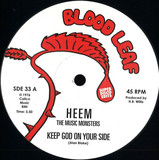
coming out of Philadelphia heem the music monsters were produced and handle by long time philly producer and writer Hubert willis. The group had small success circa 1976 with their psych funk 45 "wake up people"/piece of the rock" they recorded a few more tracks from those sessions and what lay on the reels for all these years is probably their best yet...Its just right for now. "Keep god on your side" is modern soul disco of the highest order, over 5 mins long it leads you onto the dancefloor and never lets go! Flip it over and you have one hell of a funk disco instrumental entitled " going down (incognito)". We have maintained the Blood Leaf label with a slightly new design
Music has always played a major part in Ezel's life.
Having done remix work for labels such as Yoruba, King Street and Reel People and working with artists such as Tortured Soul, Daz-I-Kue, AtJazz, John Arnold & Jeremy Ellis, it's now time to welcome Ezel to the Local Talk family with 'Get Down'.
Opening is the title track 'Get Down (Original Mix)', with its immersive chords, bumping bassline and the help from the unmistakeable vocal talents of Tumelo, it's House the way we like it. Both soulful and deep.On the B-side Ezel serves us a remix of Get Down. There's no denying in that there's a strong Osunlade 'Envisionesque' feel to this one - and that's a good thing !
An absolute must for every DJ's bag, trust us.
Finally production heavyweight Atjazz revisits the glory of the Bayacou Mix but focuses more on the finer tweaks, it's all in the details folks.