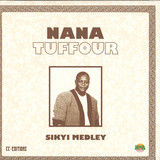
Kalita Records and CC:EDITIONS (a new venture by
Australia's CC:DISCO) jointly announce a 12' EP
comprised of four of Nana Tuffour's greatest electronic
burger highlife tracks, accompanied by interview-based liner
notes. Here, in partnership with Nana, we select two highly
sought-after songs from his 1993 release 'Genesis', namely
'Sikyi Medley' and 'M'Anu Me Ho', and pair them his with two
lesser known yet equally deserving tracks 'Asamando' and
'Jesus' from his 1997 CD-only release 'Highlife Tropicana'.
Hailing from Kumasi, the capital of the Ashanti region in Ghana,
Nana Tuffour is by far one of the most important exponents of
modern highlife music. He studied piano at college and cut his
teeth in the '70s as an organist and vocalist for the incomparable
Kyeremanteng Atwede and Dr. K Gyasi's Noble Kings Band.
Fast forward to 1981 and Ghana was at the apex of its golden age
of music. This era was brought to an abrupt end by political
upheaval when the military took over the government and as a
result a restrictive dusk to dawn curfew was imposed between
1982 and 1984. This resulted in a total obliteration of the country's
night life, and Nana just like many other prominent musicians
including Pat Thomas and George Darko left Ghana for greener
pastures, the most popular destinations being Nigeria and
Germany. The Rheinklang Studio in Düsseldorf run by a young
inimitable German sound engineer Bodo Staiger and another
'exiled' Ghanaian musician Charles Amoah played a crucial role
for those musicians who had chosen Germany. This studio
became the focal point for Ghanaian musicians and the birthplace
of a new sound, now known as 'Burger highlife' - traditional
Ghanaian highlife infused with the more up to date electronic and
disco sounds of the West. It is arguable that Nana has played a
crucial role in Burger highlife and developing the sound of
traditional Ghanaian highlife more widely to what it is today, with
his innovative use of electronic accompaniment pushing its
boundaries to its creative extremes.
It is Burger highlife's transcendence of traditional musical
boundaries that helps make it so accessible to listeners,
appealing not only to Ghanaians back home but now highly
regarded and sought-after by those in the West interested in
more occidental disco and electronic sounds. We hope that you
enjoy the four songs offered here, each chosen to demonstrate
Nana's singular influence on the development of Burger highlife.
Поиск:region
Все
Catch Recordings return with their 13th release, this time from DJ Najaora. He's an emerging talent from the ever growing Techno region in Georgia who's mature, fully formed sound is showcased here across three innovative left-field Techno & electro tracks. The excellent 'Night Dreamers' takes the A1 spot. It's an analogue electro cut throughout. With forceful broken drums accompanied by electric lead lines that provide a powerful energy for the dance floor.'Space Call' is a more cerebral and less dance floor affair that has you day dreaming amongst the meandering pads and classic Detroit electro vibes. A soft acid line runs throughout, while the whole cuts creates nostalgia of old Warp Records.Last of all 'Simulaq' which takes the B-side has wide and vast rubber kicks alongside booming bass. Making this side a merge of Bass and Electro. Trippy stabs and dark energy pervades the whole thing, making it track for the late hours.
While 13 is an unlucky number for some, this certainly doesn't seem to be the case for Catch Recordings.
The inaugural release on enigmatic conceptual artist and Freerotation regular Aboutface's new label Coordinates- a limited physical release series exclusively showcasing his music and original art, depicting conceptual themes and exploring the aural terrain of two sets of location coordinates around the world. Coordinates #1 explores ultra-sonic bat recordings from Lincolnshire, England, and ancient mayan culture from the Chiapas region, Mexico.
The keeping of pets marks humans' attempt at taking possession of a part of reality that is not at his disposal. Dressing a piece of the real that lives according to entirely non-human rules and which only in the saddest case does not resist the discipline of the human symbolic order vehemently and in a sustained matter, is a violent act of protection. Because in the non-place of the real, all that which we are helpless in the face of looms: the non-logical and the nameless, the violence and the noise, yet also the unrestrained and unfiltered desire.The innocuous figure of the pet marks a gateway to an investigation of these eerie milieus, while electronic dance music lends itself to this investigation in an outstanding way. This constellation marks the subject of Column's 'Pets II.'
Column is the name of Cologne based renaissance man Jan Philipp Janzen, who, as chief emissary of Cologne's pop internationalism, has been playing the field in various functions for Von Spar, Cologne Tapes, Urlaub in Polen, Owen Pallett, Scout Niblett or The Field, and who has also, in one way or another, been involved in most relevant records coming out of Cologne for the past number of years. After his excellent solo debut 'Pets I' (Areal, 2016), Janzen presents another extraordinary record in 'Pets II,' perfectly complemented by another ghostly oil work of Burkhard Mönnich on the cover.Sonically, 'Pets II' marks a clear development for Column. In its exploration of the thresholds of the real, it sets two points of focus, corresponding with the split in sides A and B.
Side A, on which Janzen teams up with long-time friend myr. (PNN), explores the uncanny as a fissure of the symbolic order, and the subsequent breaking in of the real. It opens with two peaktime rockets that have their wooden, nether-regional groove narrated by grim, down-pitched vocals. The ethereal remix by Leibniz (hundert) seems to be observing the situation from a hiding place, and is the side's clandestine and no less dark closer.
Side B, for which Janzen invited studiomate Marvin Horsch (Dorfjungs/Beats in Space) along, delivers two swaying synthesizer workouts, the second of which, 'Molly and Swerve,' is directed firmly at the dancefloor again. What is at stake here is the transition between a free, undirected jouissance of the real and a more ordered becoming-lust. Here, as in Map.ache's (Kann/Giegling/Altin Village) remix which closes out 'Pets II,' it becomes clear what connections dance music can foster between a free, impersonal desire and the sphere of interpersonal wanting, but also the losses that are negotiated in it. Above all, however, it becomes evident what a courageous daring project 'Pets II' is in all of its conceptual and aesthetic determination; with Von Spar's standout 'Garzweiler' 12' (Altin Village & Mine, 2017), it documents a New Cologne Realism.
Sfetsas formed GFO in 1976, in order to accomplish an ambition dating back to his 1960's Avant-garde period in Paris: to create a piece of work that would expand the boundaries of Greek traditional music. The result is a Progressive-Jazz Fusion masterpiece comprising complex and intriguing compositions, and performed by Athens' best musicians of the day.
.
Sfetsas grew up on the island of Lefkada where he studied classical music from an early age at the local conservatory. At the same
time he was genuinely connected to traditional music and especially to the sound of the clarinet, the lead instrument in the region's
folk music. From a young age Sfetsas would perform with Gypsy orchestras in local feasts. It was this experience that inspired him
to create the GFO after his return from Paris in 1975. Sfetsas founded the orchestra while working at the National Radio, an orchestra comprised mostly of members of the Variety Music Orchestra, who had a solid background in both classical and traditional music. In that way, he was able to realise his ambition. Something he could not do in Paris, since it was impossible to find musicians trained
in both musical cultures.
The recordings on this album, forming only a small part of his overall body of work with GFO, are previously unreleased. The music
was recorded Stereo on Reel Tape and with high standards for the time, with the current mastering process highlighting even more
the quality of the recordings. The result is a truly impressive and pure audiophile album.
Beautiful 1 LP Edition with 350g cardboard old Stoughton tip-on sleeve, Sticker - MKWAJU ensembleâs highly sought-after album reissued on vinyl for the first time since 1981. Also available on CD. - 33 rpm LP mastercut by Emil Berliner from original tapes! WRWTFWW Records is over the moon to announce the official reissue of legendary album KI-Motion by Japanese percussionist Midori Takadaâs MKWAJU ensemble, sourced from the original masters and available in two versions: a vinyl LP cut at Emil Berliner Studios and housed in 350g old Stoughton tip-on sleeve, and a digipak CD. A highly creative and transcendental fusion of marimba, vibraphone, bamboo percussion and synthesizers, KI-Motion was recorded in 1981 and captures the birth of Midori Takadaâs exploration of minimalism, African rhythmic tradition, and ambient music. The album takes its conceptual inspiration from the tamarind ( âmkwajuâ in Swahili), a drought resistant tree notably used to craft some of the first mallets and marimbas but also known for its culinary and medical uses, an essential symbol of life and identity for the Central African grasslands. Drawing from the regionâs culture and music as well as the crucial notion that rhythms represent the very fabric of life, Midori Takada leads her ensemble into environmental heaven to create one of the highlights of her recording career and an absolute must-have from the golden age of Japanese ambientâ¦the ideal companion to her majestic Through The Looking Glass opus!
Teste returns with The Box Man, a five-track EP that marks their first release of original material in 25 years. Formed during the early nineties in Hamilton, Ontario, they put out only three official records between 1992-1993 on Probe Records, most notably 'The Wipe,' which is regarded as a genre defining classic, while the follow-up 'Regions' also served as a template for the ensuing sonics of contemporary techno. With only a handful of live actions, the final chaotic show (public disturbance) occurred for Pure in Glasgow 1994. Afterwards, the original Teste lineup of juvenile delinquents disbanded but unwittingly ended up defining the hypnotic and drugged out strains of today's afterhours techno parties. The project vanished for decades until reactivating the chaos in 2014, promoting a slew of remixes 'The Rewipes,' by artists such as Rrose and Terence Fixmer, on the Edit Select imprint.
Since then, original member David Foster, still at large as //HUREN//, has been slugging it out in the fringes with influential output on the seminal Zhark Recordings Berlin and has collaborated as O/H with Rich Oddie of Orphx. First meeting on Mayday 2017 in Berlin, a new alliance with Martin Maischein aka Goner formed. Goner is likewise a veteran with essential output under various monikers on imprints such as Force Inc., Editions Mego, and Hospital Productions. From that pairing, The Box Man came into being for the second release on BITE, the Berlin techno label run by Hayden Payne and Florian Engerling.
The Box Man picks up where Teste last left us with their revolutionary vision of techno and continues to further their interdimensional manifestation of insanity and formation. Pure techno serving as a method of psychic expulsion and self-reckoning. From the opening, the eponymous track approaches full panoramic throttle as metallic synths creep 360 degrees around the listener, setting the tone for panic and loss of cognitive control. Teste then moves into the stealthier outpatient techno rhythms of 'The Long Term Care Facility' and 'Thieves Are Operating In This Area'. The EP contrasts its propulsion with different interpretations of its blueprint. 'Foaming At The Mouth' delves into Cabaret Voltaire-alike rhythm box violence until all is closed with the comedown melodies of 'Lyubov'. Through highly adept methods of sound design and neural interpretation, Teste once again cuts apart reality with their music, expressing nightmares and visions via new rituals and mind control techno.
Coming from different regions in France, Violent Quand On Aime's members have joined forces to canalize their energies into something truly essential. Far away from hype and expectation they have created their own peculiar world. Expect a certain electronic griminess with hints of 90's hiphop, postpunk alienation and an affinity for Musique Concrète. The overall experience is similar to the excitement one feels when hearing something genuinely original. This mini-album is the follow-up to their very impressive 7' on Le Syndicat Des Scorpions.
Baiano & Os Novos Caetanos was a band formed by prolific and multi-talented Brazilian comedians Chico Anysio and Arnaud Rodrigues. Satirising Brazil's Tropicalia movement in the 1970s, the duo took a friendly crack at the likes of Caetano Veloso and psychedelic rockers Novos Baianos, with their righteous tropicalista alter-egos 'Baiano' and 'Paulinho Boca de Profeta' poetically denouncing the dictatorship while simultaneously mocking those who took themselves too seriously. Jazz funk legends Azymuth play backing band with keyboard maestro Jose Roberto Bertrami also responsible for the arrangements on the album. Azymuth's free and funky psych sounds combine with accordion, harmonica, brass and plenty of rural Brazilian rhythms, for a hugely varied album drawing on MPB, funk and soulful samba rock. The album also features Orlandivo who co-wrote many of the songs, and renowned multi-instrumentalist and producer Durval Ferreira.
- A1: A Min We Vo Nou We - Les Sympathics De Porto Novo
- A2: Asaw Fofor - Ignace De Souza & The Melody Aces
- A3: Dja Dja Dja - Stanislas Tohon
- B1: L´enfance - Elias Akadiri & Sunny Black´s Band
- B2: Mé Adomina - Picoby Band D´abomey
- B3: Nounignon Ma Klon Midji - Antoine Dougbé
- B4: Moulon Devia - Orch. Poly-Rythmo De Cotonou
- C1: Paulina - Black Santiago
- C2: Glenon Ho Akue - Lokonon André Et Les Volcans
- C3: Sadé - Sebastien Pynasco And L´orchestre Black Santiago
- C4: Baba L´oke Ba´wagbe - Super Borgou De Parakou
- D1: Gangnidodo - Cornaire Salifou Michel Et L´orchestre El Rego & Ses Commandos
- D2: How Much Love Naturally Cost - Gnonnas Pedro And His Dadjes Band
- D3: Idavi - Orchestre Poly-Rythmo De Cotonou
African Scream Contest 2
A great compilation can open the gate to another world. Who knew that some of the most exciting Afro-funk records of all time were actually made in the small West African country of Benin Once Analog Africa released the first African Scream Contest in 2008, the proof was there for all to hear, gut-busting yelps, lethally well- drilled horn sections and irresistibly insistent rhythms added up to a record that took you into its own space with the same electrifying sureness as any favourite blues or soul or funk or punk sampler you might care to mention.
Ten years on, intrepid crate-digger Samy Ben Redjeb unveils a new treasure- trove of Vodoun-inspired Afrobeat heavy funk crossover greatness. Right from the laceratingly raw guitar fanfare which kicks o Les Sympathics' pile-driving opener, it's clear that African Scream Contest II is going to be every bit as joyous a voyage of discovery as its predecessor. And just as you're trying to get o the canvas after this one-punch knock out, an irresistible Afro-ska romp with a more than subliminal echo of the Batman theme puts you right back there. Ignace De Souza and the Melody Aces' Asaw Fofor" would've been a killer instrumental but once you've factored in the improbably-rich-to-the-point-of-being-Nat-King-Cole-influenced lead vocal, it's a total revelation.
The screaming does not stop there, in fact it's only just beginning. But the
strange thing about African Scream Contest II's celebration of unfettered Beninese creativity is that it would not have been possible without the assistance of a musician who had been trained by the Russian secret services to "search and destroy" enemies of the country's (then) Marxist-Leninist president Mathieu Kerekou.
Already familiar to fans of the first African Scream Contest as a mainstay of ruthlessly disciplined military band Les Volcans de la Capitale, Lokonon André vanished in a cloud of dust at Ben Redjeb's behest with a list of names and some petrol money, only to return a few days later having miraculously tracked down every single name he'd been given. The source of this Afrobeat bounty-hunter's impressive people-finding skills - his training with the KGB - highlights the tension between encroaching authoritarian politics and fearless expressions of personal creative freedom which is the back-story of so much great African music of the 60s and 70s. Happily, in this instance, Lokonon was tracking the artists down to oer them licensing deals, rather than to arrest them.
Where some purveyors of vintage African sounds seem to be strip-mining the
continent's musical heritage with no less rapacious intent than the mining companies and colonial authorities who previously extracted its mineral wealth, Samy Ben Redjeb's determination to track this amazing music to its human sources pays huge karmic dividends.
Like every other Analog Africa release, African Scream Contest II is illuminated by meticulously researched text and eortlessly fashion-forward photography supplied by the artists themselves. Looming large - alongside Lokonon André - in the cast of biopic-worthy characters to emerge from this seductive tropical miasma is visionary space-nerd Bernard Dohounso, who laid the foundations for Benin's vinyl predominance by importing and assembling the turntables that would play the products of his Bond villain-acronymed pressing plant SATEL, a factory that would revolutionise the music industry in the whole region.
The scene documented here couldn't have been born anywhere else but in the Benin Republic , and the prime reason for that is Vodoun. It's one of the world's most complex religions, involving the worship of some 250 divinities, where each divinity has its own specific set of rhythms, and the bands introduced on the African Scream Contest series and other compilations from that country were no less diverse than that army of dierent Gods. At once restless pioneers and masters of the art of modernising their own folklore, the mystic sound of Vodoun was their prime source of inspiration.
One especially irascible Vodoun-adept was Antoine Dougbe, who styled himself The devil's prime minister' while turning ancestral rhythms into satanically alluring modern beats. As Orchestre Poly-Rythmo songwriter Pynasco has observed sagely, Evil is not elsewhere, evil extends into the house'. And African Scream Contest II is a gloriously cinematic road-trip through an undiscovered realm of music lore whose familiarity is every bit as thrilling as its otherness.
Written by Ben Thomson, March 2018
- A1: Moment Of Collapse (Feat. Heidi Vogel)
- A2: Palmares Fantasy (Feat. Hermeto Pascoal)
- A3: Waltz For Hermeto (Feat. Hermeto Pascoal)
- A4: The Blonde
- B1: Montreux (Feat. Hermeto Pascoal)
- B2: Said (Feat. Hermeto Pascoal)
- B3: Tudo Que Voce Podia Ser (Feat. Sabrina Malheiros)
- B4: The Conversation (Feat. Hermeto Pascoal)
For his third album for Far Out Recordings, London based multi-instrumentalist and one of Europe's finest saxophonists Sean Khan ventures to Rio de Janeiro to collaborate with iconic Brazilian polymath Hermeto Pascoal. Taking its title from the escaped slave settlement 'Palmares' in the Northeast of Brazil during the 1600s, Palmares Fantasy is Khan's utopian jazz message for the world, and features Azymuth drummer Ivan 'Mamao' Conti, bassist Paulo Russo, guitarist Jim Mullen, and guest vocals from Brazilian chanteuse Sabrina Malheiros, and Cinematic Orchestra frontwoman Heidi Vogel.
Like Hermeto Pascoal, Sean Khan is a self-taught musician. Never able to afford his original dream of studying at Berklee, and having been turned away from Guildhall School of Music for being 'too raw', he became disillusioned with what he saw as the exclusivity, elitism and dangerous institutionalisation of the jazz world. Yet Sean's love for music and the drive to create never faltered.
Hermeto Pascoal, the man Miles Davis once dubbed the most impressive musician in the world', is a similarly independent artist. A true maverick whose ingenuity and freedom from conventional restraints is so great that he has essentially conceived his own musical language, made him the dream collaboration for Sean.
Aspiring to inclusivity and equality also informs the message in Khan's music. Inspired by the 17th Century settlement of Palmares in Brazil's Alagoas region, which was free from the Portuguese crown's murderous exploitation of South America for a century, Khan notes his fascination with the fact that while majoritively made up of escaped African slaves, many deserter conquistadors also joined the settlement.
Hearing the deep-grooving title track with this history in mind, the listener is transported to a futuristic musical eden, with Mamao's insatiable 10/8 rhythm back-boning Hermeto's wild improvised vocals, rhodes and whistles, while Sean's harmonically brilliant sax and flute add more layers of moody, characterful expression. 'Moment of Collapse' is Sean's poetic study on the uncertainties of modern day western civilisation, delicately presented by the gorgeous vocals of Heidi Vogel and drenched in lugubrious strings and Alice Coltrane-esque harp. The two covers on the album are of Hermeto's own 'Montreux' (on which Hermeto plays solos on a teapot and a pint of water), and an uplifting soulful jazz-funk take on Milton Nascimento & Lo Borges MPB classic 'Tudo Que Voce Podia Ser' featuring the vocals of pioneering nu-bossa voice Sabrina Malheiros.
The recording sessions for the album were part of an intensive and hugely productive eight-week excursion to South America for Far Out boss Joe Davis in the summer of 2016, which also saw the sessions for Azymuth's Fênix and a forthcoming album from Uruguayan fusion legend Hugo Fattoruso.
Fantastic' Gilles Peterson
Loving this!' Opolopo
Thank you!' Sassy J
Proper! Great track.' Colin Dale
this is great!' Yannick Elverfeld (RBMA / Needs Records)
I've enjoyed Sean Khan's earlier releases, but this really seems like he's grown into his fairly considerable talent.' Mark Sampson (Songlines)
His last album was his best so far, but I think this one may be even better.' Laurence Pragnell (Soul Brother Records)
dope!!!' Kyri (R2 Records)
this is great - really cool vibe!' Sam Redmore
wonderful track - can't wait to hear the lp.' Simon Harrison (Basic Soul Radio)
This is very tasty indeed.' Gavin Boyd (Soul Has No Tempo)
Stunning!!!' Mark Milz (Further In Fusion)
Oi Oi' Samuel Lloyd (Balamii Radio)
PRESS / ONLINE
VINYL FACTORY (UK) News (Anton Spice) 09/03/18 online
SOUNDS & COLOURS (UK) News (Gabriel Gahan) 09/03/18 online
THE WIRE (UK) Review confirmed (Joseph Stanard) print
EVENING STANDARD (UK) Review confirmed (Jane Cornwell) print + online
ECHOES MAGAZINE (UK) Review confirmed (Laurence Pragnell) print
LIBERATION (FR) Feature confirmed (Jacques Denis) print + online
MUSIC IS MY SANCTUARY (CA) Premiere confirmed (Mike Jones) online
JAZZ MAGAZINE (FR) Review confirmed (Frederic Goaty) print
SHINDIG! (UK) Review confirmed (Grahame Bent) print
MUSICA MACONDO (UK) Premiere confirmed (Tim Garcia) online
RAWCKUS MAGAZINE (USA) News (Randy Radic) online
KIND OF JAZZ (UK) Review confirmed (Fernando Rose) online
TONART MAGAZINE (DE) Review confirmed (Michael Moehring) print
WORLD MUSIC NETWORK (USA) Review confirmed (Raul Da Gama) online
BADD PRESS BLOG (USA) Review confirmed (Kevin Press) online
ORKESTER JOURNALEN (DK) Review confirmed (Patrik Sandberg) print
LIVE
WORLDWIDE FM (UK) Sean Khan live session confirmed (Gilles Peterson)
RADIO
BBC RADIO 6 (UK) Gilles Peterson - Palmares Fantasy (24/02/18) link
OTHER
BRITISH AIRWAYS On board BA flights (June 2018)
From his Saint Denis apartment, and with the help of his machines, Labelle has laid the foundations of an electronic maloya, modern and deeply rooted in its home territory: La Réunion. On 'univers-île' his latest album released in September 2017, the sound of the Creole Reunionese language played a key role. On 'Post-Maloya", Labelle release a fascinating EP of introspective trance music. Post-Maloya EP is characterized by vivid dream-like journey through which traces a path of exploration. Here you will find the maloya stamp, which is Reunionese traditional music, both in the rhythms and the instruments used, like the valiha. This traditional tubular harp from Madagascar is played by Vola on the track 'Jaojoby'. Vola was taught by Rajery himself, who is widely considered as master of this instrument. This track is an homage to Jaojoby, king of Salegy, a popular musician in Madagascar. The hypnotic sounds evoke distant dimensions and resonate like shamanic incantations whose aim is to gently lead us towards the trance. As the title suggests - 'Post-maloya' is the exploration of new musical processes mixed with the use of traditional maloya instrumentation. This is an appropriate name for this new opus, which is more electronic and percussive; carving an experimental path between electronic and traditional music. In parallel with the creation this EP, the Regional Conservatory of Réunion Island has given free reign to Labelle to create a series of live performances which he played all around the island last month, including an original creation linked to his expression of 'Post-maloya' supported by an ensemble of eleven musicians from Réunion Island's regional orchestra.
Crying Bamboos is a translation of the pidgin description of the sound of sacred flutes: "Mambu i cry, i cry, i cry".
Sacred flutes are blown to make the cries of spirits by adult men in the Madang region of Papua New Guinea. Pairs of long bamboo male and female flutes are played for ceremonies in the coastal villages near the Ramu River. There are seven male initiation flute cries from Bosmun, four flute cries from Bak: Borai with occasional single garamut percussion and two flute cries from Kaean, one with vocals and hand drums. The flute players were of the last generation to have learned this skill during a complete cycle of male initiation. These previouslyunreleased recordings were made in 1979.
Recorded by Ragnar Johnson
Notes by Ragnar Johnson and Jessica Mayer
Photographs by Ragnar Johnson
Tape to digital transfer and mastering by Dave Hunt at
Dave Hunt Audio, London
Cut by Rashad Becker at Dubplates and Mastering, Berlin
DJ Katapila's Aroo EP is the latest addition to the iconoclastic producer's catalog of fast-paced, pan-West African-influenced dance music. From a young age, Ishmael Abbey was a beloved local DJ in Accra, Ghana's competitive and rapidly-evolving music galaxy. DJ Katapila's debut release with Awesome Tapes From Africa, 2016's reissue of Trotro, ignited international acclaim for the Ghanaian DJ and producer: The New York Times, Pitchfork, Resident Advisor and FACT heaped praise on his work. Katapila launched a touring career beyond his grueling schedule of all-night parties around Ghana's southern coast and neighboring countries, heading to Europe and the UK, where he performed at festivals and clubs the pasty two years. Katapila brought Ghana's street party culture to audiences overseas, a wave of joy and happy dancers were left in his wake. The song Aroo' uses his earlier song Cocoawra' as a jumping off point and expands upon its endearing quick-rhythmed interplay of vocal hiccups and percussive clinks. Katapila thinks of Aroo' as a simple math equation: Francophone rhythms plus techno equals so hot and danceable.' While traveling this past summer in Europe, he continued to work on the minimalist electronic music steeped in his hometown rhythms that has made him a growing and singular voice in West African music. Having never travelled outside his region before, the contemporary sounds of London impacted his sonic palette, triggering new song African Techno.' He explains, In Europe and the UK they like these techno songs and house music. They have songs that sound like African music, and we have songs that sound like house music and techno music.' Ghana Baby DJ' references his ongoing development of Ga dance music style gbe ohe. It also conjures his daughter's voice and inimitable vibe and blends it with the characteristic clave rhythm of this. The EP's final cut is a track released with a an eye-catching music video this summer called "Monkey." Following radio play in Ghana and demand from fans online, this track makes its debut on vinyl. Awesome Tapes From Africa is proud to present new music from this unmistakably original artist with an honesty and unpretentiousness that feels good at this current point in history.
Montreal electronic duo Essaie Pas are back with their fifth album (their second on DFA Records).
Essaie pas always seek out fresh challenges. After all, there's a whole universe of sounds, sights, and new ideas to explore. Emerging from Montreal's sprawling electronic scene, the duo - Marie Davidson and Pierre Guerineau- feel completely free to express themselves, to sketch out hitherto unmapped musical regions.
Forthcoming album New Path takes this one step further. The duo's fifth album to date - and second on powerhouse label DFA Records -is loosely based on Philip K. Dick's A Scanner Darkly', a classic of dystopian science fiction.
I read the book a long time ago, maybe 15 years ago, and it had a strong impression on me,' explains Pierre. In our previous work we always looked to music as inspiration in our lives, but this time we felt the desire to try something different, that's not based on ourselves but on someone else's universe. It was going to be more conceptual, more political.'
New Path touches on personal ground, on addiction, loss, and the lingering strength of identity within late capitalism's mass media paranoia. It pins down the central character's destructive addiction, using this as a metaphor to explore the dichotomous rupture between our inner lives and our social environment, one that is often fed and soothed by drug abuse, social media, or any kind of dependence.
I think it touches us on many levels,' Pierre continues. We can talk about drug addiction issues, we can talk about the mass surveillance world we live in, but there's also the experience of loss, of grief. I was surprised by how the book felt so modern and accurate to the time we live in right now. Dick's visions of surveillance are the reality of social control today.'
It's a record that continually ties itself in knots, a puzzle that is outwardly beguiling while the solutions remain inherently allusive. As Pierre points out, it's even present in the title. I like the fact that it sounds optimistic, but in the book it's actually an illusion,' he explains.
But it's a challenge met with humour, picking up on the wry elements of Philip K. Dick's own writing - witness the subtle wit of songs such as 'Complet Brouillé', 'Les Agents Des Stups' or as in 'Futur Parlé's tripped-out lyrics, offsetting intense themes with something a little more playful.
The conceptual nature of New Path belies the subtle personal shifts within the band. A husband and wife duo, Essaie pas thrive on freedom, on parting to focus on outside projects in Montreal and Berlin before returning renewed, flushed with fresh inspiration.
Both personally and for Essaie pas it's good that both of us have separate projects,' he explains. Marie has been constantly touring solo for the last year. On my side I've been producing other people's music (Bernardino Femminielli, Pelada or Sleazy to name a few). Collaborating in the studio with talented people with unique aesthetics and different creative processes is really refreshing as an artist.'
The complexity of the project mirrors the complexities within Essaie pas' career to date - forever unpredictable, their wiry, individual sound offers a tangled vision of tomorrow's aesthetics. I think this was the main challenge,' muses Pierre. To adapt what we've been doing live, which before was always changing, and corner it, make it cohesive'.
Ultimately, what the duo want is a challenge, to be forced to raise their expectations again and again, to look continually to the future. This is cold music for cold times, yet beneath this lies a continual search for the humane.
Seven years ago, Max Tundra sent Daphne and Celeste a tweet, asking if he could write and produce their comeback single. Four years later their song You & I Alone ripped through the internet. Today they announce the forthcoming release of the most unlikely comeback album of 2018.
Three years after their comeback song, 'BB' arrives online as their new album's appetiser, an uncompromising takedown of the anodyne and anonymous. BB stands for Basic Busker,' explains Max, any one of countless identikit instigators of mundane melodies that have brought the mood down in recent years. Pop music should lift the spirits - so why are the airwaves full of these mundane strummers'
The world has changed a hell of a lot since Daphne & Celeste stormed up the charts with their effervescent earworms U.G.L.Y. and Ooh Stick You, back near the birth of the 21st century. So you'd be forgiven for failing to predict the fruitful union of D&C with a maverick electronic producer known for his records on Warp and Domino Records. But Max Tundra has long held an ambition to become a pop producer, and this new album is an addictive combination of the eccentric, creative and melodic.
After an initial sharing of tracks and ideas around the release of that first single in 2015, Max Tundra set about writing an album's worth of material, inspired by the unique kinship, born of shared experience, between Daphne and Celeste, and his own unexpected part in their story. Last year, Tundra brought his suitcase full of songs to a desert retreat near Joshua Tree, where he joined D&C for the 'working holiday' that produced Daphne & Celeste Save The World.
A full-length album of giddy, ridiculous, genre-bursting pop, 'Daphne & Celeste Save The World' finds our friends in fine, soaring, melodic voice, with Tundra's restlessly inventive production a toothsome, chordy, maximalist feast. These 13 songs touch on subjects as varied as time travel, succulents, pipelines under the ocean, cabins in the wood, unadventurous guitarists and different regions of the brain, but above all the sweet, enduring friendship of those two people who, long ago, told us all to Ooh Stick You.
Seeking the overwhelming vibration of the genuine sound wave and its profound echo on the soul, Kenneth James Gibson has spent his career experimenting under a variety of aliases like as many brushstrokes to an ever polymorphic palette - successively releasing as (a)pendics.shuffle, Bell Gardens, Reverse Commuter, dubLoner, Kenneth James G., KJ Gibbs, Bal Cath, Eight Frozen Modules, and Premature Wig... the list is long. Near to two years after his first incursion on Kompakt with his third studio LP 'The Evening Falls', Gibson returns with 'In The Fields Of Nothing', his second full-length delivery for the Cologne-based imprint.
A piece of intricate scales and moods, by turn streaming with the quiet flow of a small meandering rill, then suddenly veering off into an oceanic kind of tumult, 'In The Fields Of Nothing' was conceived as a proper film soundtrack with its rhythmic ebb-and-flow and deep sense of immersion, pulling the strings to an imaginary scenario where the uncanny rubs shoulders with a minute care for the immersion and deep emotional involvement of its whole.
Like entangling multiple levels of consciousness through a millefeuille of textures, piano and strings as well as a flurry of subtly FX-soaked instrumentals, Gibson reflects on his new album - created and recorded right after 'The Evening Falls' came out - as hugely inspired by the lushly forested mountain landscapes of his home region, the bewitching Idyllwild, California. With each track being an essential petal in the narrative corolla figured by Gibson, it's a breathing forest of sounds that deploys, bearing the memories of Kenneth's early morning and late night wanderings in the wild, alone and not, with the ancient trees' vital force for main companion.
An attempt at capturing a slice of these ephemeral sensations felt when striding along across the steep ridges and stony paths of the San Jacinto mountains, staring at the star-studded dome or gazing into the quiet horizon at dawn, 'In The Fields Of Nothing' eludes the single genre encapsulation, opting for the all-embracing openness of scope as it hops from droney melodic interplays ("Her Flood") and roomy string-laden folk drifts ("Further From Home") through Ligetian webs of sound ("Thirsty Lullaby", "Fields Of Everything") and poignant threnodies ("Unblinded"), onto sorrowful pop ballads ("Far From Home") and lulling ambient scapes ("To Love A Rotting Piano", "Plastic Consequence")
A quartet of heavy reworks. Reginald Omas Mamode IV truly does what he does best, bringing a percussive, low-slung funk to one of the most ethereal and beautiful pieces of soul on the album, Sunshine. Glenn Astro, elevates Bossa B to a jostling, bouncing shuffler that eventually turns around and heads skyward with uplifting chords and irresistible bass.
Deoke heads into the darker regions of the original for his huge remix of Bossa B. Finally the ever exceptional Mr Beatnick simply took the stereo track for Kalimba 2 and edited it into a mind-opening dub. Handling bass and harmonics as only he can, a true highlight of this high quality remix package.
The second album by Istanbul's clarinet virtuoso Cüneyt Sepetçi is an intense trip into modern Turkish wedding and party music. The foundations go deep into Turkey and the surrounding regions' history, which each generation innovates and develops. These days, no wedding or circumcision party is complete without the sound of the micro-tonal keyboard. A new addition, these Turkish keyboardists can play between notes, and supply banging club rhythms in wide variety of time signatures.Sepetçi uses the bedrock of Volkan Sever's synth insanity as a jumping off point for some truly crazy solos. His fluttering sheets of notes tie knots around the pulsating, fried synthesizer. For this recording session, Sepetçi brought in two drummers, Fatih Özden (tapan) and Samet Sertol (darabouka), to play along with the Turkish drum machine. A dense nest of rhythmic complexity is the result. And to further connect to this music's rich past, the ancient double reed zurna of Ahmet Özden and Yasar Uçar's European violin weave ancient melodies and incredible solos throughout.
These musicians are some of the best in Istanbul, and all of these songs are first takes, recorded live with very little planning. Sepetçi essentially leads the band through these complex arrangements as they play them.In Istanbul, one may see Sepetçi playing for change on Istiklal Caddesi, the famous Turkish walking street at the center of the city. Or one may see him on one of the TV stations, playing Anatolian songs in his inimitable style. He's even begun touring outside of Turkey—at Denmark's Roskilde Festival, and at concerts in Italy, Beirut, and Israel. I want to go to America. He says. Do they have mosques there
In recent years Moiré has become an integral figure in re-imagining club music. The enigmatic artist has travelled a note-perfect path and in just a few years has collaborated with fundamental record labels such as R&S, Werk Discs and Rush Hour. After his second and long awaited album "No Future" (Ghostly International, 2017), Moiré's "BBOY EDITS 01" is the first signing on C.E.E. The four track EP is comprised of unreleased material designed for the dance floor and provides continuity to his much prized Neversleep series. Club Excursionista de l'Electrònica (C.E.E.) is a moral, spiritual and cultural entity founded in 1875 in Vall de Camprodon. C.E.E. includes thousands of anonymous members who are organized into subdivisions and enjoy Sunday excursions into nature to end the weekend, where the joys of nightlife give way to clean air and mountain pursuits. C.E.E. can be described as "electronica folklorists", with a select catalogue of sounds from across the continent and beyond that represent an ethnographical journey through the most modern treatments of songs and popular dances practiced in clubs and tents all over the region.