A multifaceted and detached balancing act between
electronica and breakbeats, with a touch of minimalist
elements and spherical sounds, describes the first release on
NL by the currently living in Leipzig, Natalie Luengo. In her
early youth infected with house and techno, she simply never
gets tired of this long-standing double relationship. A touch of
breaky grooves and acid with a breeze of electro and provided
with melodic elements define their mixes and productions.
Cerca:rela
iven Jones’ rather slack approach to track titles (both being consistent with and sometimes even just supplying them), it’s a bit of a relief to realize that two tracks with the same name are indeed related. In the case of “Arab Jerusalem”, which makes up nearly half of the newly-released Lalique Gadaffi Handgrenade, that kinship is immediately apparent even though both tracks are clearly their own experiences.
Released as the first track on the Minaret-Spearker picture disc 7” in 1996, “Arab Jeruzalem” (spelling also sometimes being fairly slack) is 5:42 of effectively shifting dark ambience, wordless female vocals drifting over the hand percussion, chimes, and static of the track, with eventual conversational loops discussing... something underneath. The end of that version is especially striking for the way the woman’s wordless singing starts being sampled in such a way that it overlays the whole track (and, slightly, itself). The almost 24-minute “Arab Jerusalem” here might be called the Deer Hunter version of the same story, building with great patience and many more abstract detours towards what now seems like simultaneously an excerpt and, now, a climax. As with many of Jones’ more ambient tracks, the great length just lets it cast its spell more thoroughly and entrancingly.
The other three tracks, meanwhile, suggest some of Jones’ other work but never evoke them as directly as “Arab Jerusalem”. “Jordan River” is nearly as long (a second shy of 20 minutes) but strips out the vocal elements in its predecessor, focusing instead on a more active percussive workout (analogue and digital both) and a river of hiss running down the center of the track. The title track of Lalique Gadaffi Handgrenade might bring to mind the title of “Lalique Gadaffi Jar” from Libya Tour Guide (last reissued by Staalplaat in 2015), but if they’re sonically related Jones must have practically melted the other track to get this one. And the closing “Desert Gulag” (like the title track, a much more manageable length than the first two epic tracks here) bears a slight resemblance to “Negev Gulag” from 1996’s Fatah Guerrilla, here what was a piercing, repetitive drone is softened and looped over more of Jones’ percussion. The result is a well-rounded release that shows off many aspects of Jones’ sound as Muslimgauze, while existing (like many of these DAT tapes do) in conversation with much of his previously released work.
In the mid-80's, an original form of music was discovered on the midi-capable little planet of Austin, Texas. At the age of 32, Charles Ditto would release his first solo album applying cutting edge computers and synthesizers of the era (Roland DX7, Roland MKS-20, Roland MKS-80, Sequential Circuits Profit 2000 along with a Macintosh SE), creating a unique and detailed world that was inspired by Cluster, Eno & The Residents.
In Human Terms bridges the gab between contemporary classical and minimal pop. Rhythmic but melodically abstract. Microtonal and organic. Often described as experimental electronics, tone poems or Cyber-delic-psychotropic-avante-garde.
In Human Terms, remains very emotion, deep and different. Ditto's music imparts a new listening experience that is still somewhat indescribable today, but remains approachable and relatable.
'What makes Ditto's music so strikingly different is his overt use of emotion, very descriptive melodies and deep atmosphere' Audio Magazine - August 1988 // 'If Erik Satie had midi gear' Keyboard Magazine - April 1988 // 'Brian Eno meets Seastones, but with more melody' Relix Magazine - August, 1988 // 'Ditto's choice of Synthesizer tones are at once both organic and unique' Electronic Musician - June 1988.
“Osondi owendi. What is cherished by some is despised by others. One man’s meat is another man’s poison. Different strokes for different folks. To each their own. Osondi owendi.
It’s a conventional aphorism in the Igbo language but if you utter the word “osondi owendi” in Nigeria today, the first thing that comes to anybody’s mind is the cucumber-cool highlife music maestro Chief Stephen Osita Osadebe and his legendary album that takes its name from the adage. Released in 1984, Osondi Owendi was instantly received as Osadebe’s magnum opus, the crowning event of an exalted career stretching back to the early years of highlife’s emergence as Nigeria’s predominant popular music.
Stephen Osadebe first appeared on the music scene in 1958 as a spry, twenty-two year-old vocalist in the Empire Rhythm Skies Orchestra, directed by bandleader Steven Amechi. With his dapper suits, urbane Nat King Cole-influenced vocal stylings and jaunty, uptempo, calypso-scented dance tunes, he personified the frisky spirit and anxious aspirations of a young, educated generation that had come of age in the wake of the Second World War, in a Nigeria that was rapidly shaking off British colonization and marching towards an independent future. 1959 would be the year that he truly made his mark in the business with his debut solo single “Lagos Life Na So So Enjoyment.” A giddy exhortation of the music, sex, fun and freedom availed by life in the big city, the song became a sensation and an anthem, and Stephen Osadebe became the leader of his own popular dance band, the Nigerian Sound Makers.
Osadebe would ride this wave of acclaim through most of the nineteen sixties, but a change in direction would be called for at the dawn of the seventies. As Nigeria emerged from a devastating civil war, so did a new generation of youth inspired by rock and funk, confrontational sounds reflective of a more violent, less idealistic era. All of the sudden, the idioms of the post-WWII dance orchestras that nurtured Osadebe’s cohort seemed quaint, the stuff of nostalgia. Osadebe needed to evolve to respond to the new tumultuous, turned-up times.
His response? He cooled it down.
Abetted by a new crop of fire-blooded young players, Osadebe slowed his music to a mellow, meditative tempo, brought forward the lumbering, Afro Cuban-accented bass and percussion, from the rockers he borrowed searing lead lines on the electric guitar. Over this musical bedrock, doesn’t so much as sing as he dreamily muses, coos, sighs aphorisms, words of wisdom and inspiration. “When one listens to my music, all I say appears meaningful,” Osadebe explained his lyrical approach, “at times they are in the form of proverbs which provoke much thought afterwards.” The result is a blend that is both rollicking and soothingly languid. Osadebe christened the style Oyolima—a tranquil, otherworldly state of total relaxation and pleasure. Osondi Owendi represents oyolima at its finest, and possibly Nigerian highlife in epitome.
Osondi owendi. What is cherished by some is despised by others. In some way, the album’s title constitutes a paradox. Because Osondi Owendi is a record that it’s almost impossible to imagine being despised by anybody."
- A1: Red Earth
- A2: Raw Gold
- A3: Citrine Sun
- A4: Cadmium Vert
- A5: Cerulean Blue
- A6: Indigo Dore
- A7: Magenta Rose
- A8: Omega Prism
- B1: Red Earth (Instrumental)
- B2: Raw Gold (Instrumental)
- B3: Citrine Sun (Instrumental)
- B4: Cadmium Vert (Instrumental)
- B5: Cerulean Blue (Instrumental)
- B6: Indigo Dore (Instrumental)
- B7: Magenta Rose (Instrumental)
- B8: Omega Prism (Instrumental)
Sound is a potent force that can awaken your purpose and re-balance your spirit. It has the power to relax, as well as inspire you, through the positive therapy of sound vibrations. Elemental Resonance is a trailblazing meditation album where vibrational sound practitioner, Tracie Storey, combines the energy waves made by music, with positive words of love and harmony to produce inner peace, deep relaxation and a higher spiritual connection.
Storey explains “The idea for this album came to me 2 years ago when I was living in Montreal, Canada. I’d been learning to form shapes, textures and colour with sound and going deep within the architecture of my own inner space. These powerful compositions have really helped me on my journey. Creating transformative tools are now part of my life’s work, using the medium of vibrational sound which transcends all boundaries”.
Storey guides you through a series of mindful meditations - each connected to the seven energy chakras - and each supported by sound vibrations, colours to visualise, and positive affirmations to re-balance your entire being and bring you waves of calmness, strength, warmth and joy.
Released on Celestial Being, label boss Felix Buxton (Basement Jaxx), says “I’m thrilled to support this project, everywhere I look people are discovering more about Vibration and how it affects them.
Tracie is leading the way forward for new generations, uncovering more of our potential as humans. This is a great way to switch off the world and switch on to your deeper self.”
Storey has been active as a vibrational sound practitioner, for the past 5 years. Previous to six years training under Master Fabien Maman, who’s one of the world's leading experts on vibrational sound therapy, founder of the Tama-Do Academy.
She also travelled the globe as a DJ on the international dance scene (releasing on Ministry of Sound and producing mixes for the likes of Kiss FM).
DeForrest Brown Jr. is an outspoken theorist, journalist, curator, visual artist and musician. Raised in the deep South, DeForrest moved to New York a few years ago and has been shaking things up IRL and online ever since.
- He asks difficult questions that make us relook at how we think
about race, class, post-racial ideas, historical events and the social
structures in America.
- His work defies narrow bags and he’s truly a unique cultural polygot
comfortable booking an artist like Felicia Atkinson at Issue Project
Room or shaking up people on the street with his “Make Techno
Black Again” hat line.
- His project Speaker Music was inspired by Rhythmanalysis, a book
of essays by urbanist philosopher Henri Lefebvre as well as
considerations of momentum and the “chronopolitical” from British
cultural theorist Kodwo Eshun. Mobilizing freely improvised
electronic percussion and stereophonic audio recordings, Speaker
Music yearns to caress, engineer and sculpt sentiment into a multi-
textural rhythmic body, quivering moments into a collapsed
“nonpulsed time.”
- His debut for Planet Mu centers around weary sonic portraiture of
sonorous and cybernetic energy music – a music encoded with an
encrypted heat but made “with empathy and without excess.” His
“touching of frequencies” unveils a romantic abstraction of sonic
narratives that recalls previous innovations by musicians such as
Les McCann, Urban Tribe and James Stinson.
DeForrest Brown Jr. will be present at Unsound Festival in October at which he’ll be launching a new publication w/ Primary Information.
He will also present a special event at respected New York art gallery Artist Space on Friday December 13th at which he’ll be launching a book related to the album.
Additional dates will happen between October and next Spring - A Video will also be launched when the album is announced in early October (...).
"The first series comprises six related movements, usually organised in pairs, electronic sounds with instrumental and more rarely, concrete sounds: Incidences/resonances brings into play controlled resonances akin to sounds of concrete origin in a process that helps to expand the variable electronic sound sources.
Here, 'incidents' are opposed to one-off 'accidents' in the second movement: Accidents/Harmoniques (Accidents/Harmonics). In the second movement, very short events of instrumental origin change the harmonic tone of the continuum they interrupt or overlap.
Moreover, the high notes are underplayed, which stimulates the attention given to other phenomena generally hidden by the melodic form applied to the instrumental play. Géologie sonore (Sound Geology) is similar to a flight over an area where different 'sound' layers come to the surface one after the other.
When seen from high above, instrumental and electronic sounds seem to fuse ... Dynamique de la resonance (Dynamics of Resonance) is a microphonic exploration of a single sound resonating through different forms of percussion. L'Etude élastique (Elastic Study) places together various sounds produced by 'touching' elastic or instrumental skins (baloons, doumbeks) or vibrating strings and a number of instrumental gestures close to this 'touch', using electronic processes to generate white noise.
Conjugaison du timbre (Conjugated Tone), the last movement in the series, uses the same substance to apply rhythmic forms onto a perpetually varying tone continuum. "The second series of movements draws its inspiration from concrete and electronic sources rather than instrumental ones. Incidences/battements (Incidences/Beatings) is a reminder of the first movement in the first series which then quickly moves into Natures éphémères (Ephemeral Natures): ephemeral play on instrumental and electronic sounds, singled out by their internal trajectory rather than by the material itself. Matières induites (Induced Matters): just as molecular effervescence triggers a changes of state, it seems that the different states of these sound materials can be generated by each other or through induction processes.
In Ondes croisées (Crossed Waves), the pizz vibrations interfere with somehow 'visible' water drops on the surface of a similar material. Pleins et déliés (Downstrokes and Upstrokes) can be listened to as the energies absorbed in the motion of bouncing bodies, while hollow 'bubbles' and points bring together some people's gravity and others' downwards movements. The work finishes with Points contre champs (Reverse Angle Points).
Here, the notion of perspective of the different sound threads weaving a kind of network, or field, traps the occasional iterative elements in the foreground and progressively absorbs them, giving more space for the angle - and the chanted sound - to grow." (B.P.).
- A1: Laurent Garnier - Water Planet
- A2: Mono Junk - Beyond The Darkness
- B1: Psychick Warriors Ov Gaia - The Valley
- B2: Melody Boy 2000 - Plenty Of Love
- C1: Drax Ltd Ii - Amphetamine
- C2: Dan Curtin - 3Rd From The Sun
- C3: Front 242 - U-Men
- D1: The Prince Of Dance Music - E3 E6 Roll On
- D2: Pan Sonic - Lahetys/Transmission
- D3: Burial - Archangel
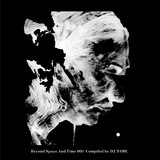
Beyond Space And Time is the new record label from Japanese music festival, Rainbow Disco Club (RDC). RDC has been welcoming music loving people to Japan for over a decade. Throughout the festival's history, RDC have been fortunate to constantly encounter performers and DJs who've collaborated with them in establishing a beautiful dance floor year in, year out. These relationships have lead RDC to start their own label, and now gives them the opportunity to reveal one of the best-kept secrets: What is in a DJ's record bag?
This time around, festival regular DJ Nobu kindly opens up his collection and shares the music he loves with us all. On visual duty we welcome Senekt - his representational yet contemporary drawing illustrates the emotion we feel from DJ Nobu.
We have much more music to come in future from artists that we trust and respect.
▼ DJ Nobu describes 10 tracks this way ▼
A1. Laurent Garnier - Water Planet
Highly respected French DJ/Producer Laurent Garnier has been releasing tracks for decades capturing the very essence of Detroit Techno and Breakbeat. He always manages to create something truly emotional. This is not his biggest hit, but it's my favorite.
A2. Mono Junk - Beyond The Darkness
This track represents the very early days of Techno with it's ravey atmosphere. It has a primitive feel, and the obscure mixdown sounds almost unbalanced. That said, this one really stands out when DJing. Very cool.
B1. Psychick Warriors Ov Gaia - The Valley
It was always my intention to include this track in a compilation if were I ever to do one. It has a fat underlying groove, with some indigenous spices thrown in. The whole thing is put together beautifully. No complaints!
B2. Melody Boy 2000 - Plenty Of Love
I wanted to include a track that had Jacking feel to it - that is my definition of dance music. This track mixes well in both Techno and House DJ sets.
C1. Drax Ltd. II - Amphetamine
This is my all time favorite track by Thomas P Heckman. It asks questions and strikes down all the boring 'wanna be cool' techno tracks. It is obviously a well known tune already, but I include it here because I'm often asked for it's track ID from new kids in the game. This is a classic that should be passed down.
C2. Dan Curtin - 3rd From The Sun
Curtin's refined synth grooves and bass lines make this a true timeless classic. It do not get tired of listening to his rhythms and melodies - he always gets it just right.
C3. Front 242 - U-Men.
The originator of Electric Body Music. Their husky vocals, hard rhythms and strong synth basslines made the group very popular at the time, and they are still to this present day. To me, this track represents what the Belgian New Beat scene is all about.
D1. The Prince Of Dance Music - E3 E6 Roll On
This is the track I played the most up until around 2006. It is a genuine house track that cuts through trends in music. A hidden floor killer.
D2. Pan Sonic - Lähetys / Transmission
Electronic music has existed for decades, and if you are to choose some of the best from all scattered & hidden places, Pan Sonic's 'Lähetys / Transmission' must be considered. The track emerges beautifully - breaking structures and transcending the past. Every layer of the piece is produced with such delicacy and care, that as a whole it magically drags you into the world of the unknown.
D3. Burial - Archangel
This track merges melancholic emotions with technological prowess at the highest level, and deeply impacted the dance music scene on it's release. I recently played this track at the end of my set at the forward thinking Terraforma Festival in Milan. It faded out to huge applause from the open minded crowd. A moment to be remembered.
Following January’s acclaimed vinyl debut from Exterior and summer’s much-loved Kota Motomura EP, Edinburgh’s Hobbes Music label ends 2019 with its first album release, also a debut, from GAMING, a fresh new braindance electronica project straight outta Glasgow.
GAMING is a new solo outing that brings together a lifelong love of music and technology and creating left field, rhythmic electronica. It’s the sound of IDM, nineties techno and mensch maschine computer music that is as spontaneous as it is programmed. It's a bit of a grower and may take time to get under your skin....
“Scenes From A Deserted City is a collection of tracks that started as a set of riffs, loops, rhythms and grooves and unfurled around a sense of growing unease about the future of the urban environment around me.
It’s an album that started out as sound…and ended up as a way of telling stories about the age of anxiety we live in, how our world is changing, and how we find a way through that.
This is DIY electronica from Glasgow – it was made on a growing collection of digital and analogue synths and FX units, including a bunch of modular racks, each with its own idiosyncrasies and character that belies the assumption of the binary.
The studio where it was recorded – an abandoned, and often very cold, school building reclaimed by the community some twenty years ago – offered up stories of resilience, even when all seems lost. (I’m not sure what the mice contributed but they definitely climbed in and out of some synths).
This album is ultimately about my changing relationship with Glasgow, a city I’ve lived in for more than 25 years. It’s about how I feel now about the increasing sense of urban decay and how the city can be a very isolating place. It’s about how I reflect on my younger creative self trying to find a direction but mainly feeling a sense of dislocation and not fitting in. And it’s about the questions I have about how that relationship is changing, how it will be forced to move forward.
The result is a soundtrack for walking home on your own, in that headphone bubble when it’s just you focusing on that music that makes sense to you alone. It’s for early in the morning, after the night before, or going to work with the memories of that slipping and sliding inside your head. It’s about how it feels to be both elated and lonely, to be lost in the familiar, despairingly hopeful.”
Redsonja Records brings to light reference number 16, held back until now, as to date 18 of our catalog has already been released. Visionary 01 is an EP by VVAA released on vinyl and digital format which showcase new a graphic identity of Redsonja Records: the warrior. In addition, RS16 also includes a future reference: Visionary 02. The four producers that participate coincide in several aspects related to the concept we believe in as a label. They all possess a kind of "divine touch" when producing their tracks, you can tell they all work from their soul. Jose Rico presents a track title ‘Discotime’, deep rhythmic cadences in the purest Detroit style; clean, bright, and delightfully mischievous sounding. Analogies intentionally created, synths that cross each other with elegance and leave space for all the necessaries. The result is an essential track in any relevant music collection. It takes us to other worlds that are more relaxed, more divinized, more colorful, more leisurely ...
After stand out releases this year on Version and Wisdom Teeth Piezo returns to Ansia with a new 2 track EP Art Attack Gone Wrong / perccssszzzz. As has been evident with past records Piezo has always had a strong ear for using interesting sounds which have been expertly sculpted to create a unique sound universe.While releasing on other labels has allowed him to work closely with his peers the freedom of having his own label allows for him to explore his influences from the Italian rave scenes in a more direct manner. For ANSIA004 these influences are streamlined into a techno orientated sound palette with traditional four-on-the-floor beat patterns but with an approach more related to the sounds of Diagonal than Berghain.With 'Art Attack Gone Wrong' the milanese producer merges dancefloor efficiency with a playful approach to distortion, melody and sound design, while on the flip you will find 'perccssszzz', a no-frills heavy-swinged drum workout which, as the names suggests, refuses to include pretty much anything else than percussive elements. This time Ansia goes dark for the vinyl edition with white-ink stamped Tweetie on black label - and last but not least, 180gr vinyl cut deep and loud!
When acclaimed South African musician Guy Buttery first sought out Dr. Kanada Narahari in late 2016, it was as his patient.
“It was a dark time.” Buttery recalls, “I had been bedridden for months and had been suffering from debilitating bouts of fatigue which no diagnosis or medication could help me get to the bottom of. When I first met Kanada, I was at the stage where even picking up my guitar to make music had become a joyless and taxing exercise.”
As Buttery’s searched for a cure, a family member recommended he see Kanada an Ayurvedic doctor who had relocated to South Africa from India and set up a practice in Durban. It was during this consultation, that the musician first experienced how Narahari infused the healing properties of Indian Classical music into his practice. Rather than treating him with a smorgasbord of pharmaceuticals, Narahari played his sitar and set Buttery on a strict daily diet of Raga’s to fast track his recovery.
Buttery was not only struck by his doctor’s musical talents but by the powerful healing properties inherent in his sitar compositions. When he left Narahari’s doctors room that afternoon, he asserts he was feeling decidedly clearer, lighter and stronger.
“Diving into Kanada’s music was definitely one of the reasons I'm still here today.” he admits. “The consistent tonal centre at the heart of Indian Classical Music, literally became my support pillar over this period. A central core of sorts in which to fall back on, strengthen and discover.”
Narahari as it turned out, was not only a prominent music therapist (and one of the only Ayurvedic doctors practicing in South Africa) but like Buttery, a highly accomplished musician with a devoted following back in his homeland.
Born in a small village along the Western Ghats in Karnataka, India, Narahari, at the age of nine, had enrolled to study Carnatic classical vocal and developed an interest in Hindustani Classical music with a particular passion for the sitar. While Buttery had secured his reputation as one of South Africa’s musical treasures, a multi-instrumentalist who commands sold-out performances both locally and internationally and more recently had been awarded the prestigious 2018 Standard Bank Young Artist for Music.
From this consultation, a friendship developed between the two musicians with Buttery soon inviting Narahari to join him in his studio. But it wasn’t all plain sailing in the beginning. While Buttery and Narahari’s sensibilities were very much aligned, there were a range of cultural and musical influences, nuances and inflections that first needed to be navigated and understood.
“I suppose we had to find a common ground.” Buttery says, before adding, “Which in the end turned out to be pretty "uncommon ground" for the both of us.”
It was after a few intensive sessions together that something exhilarating began to emerge. What began as a few idle improvisations soon evolved into feverish and lengthier jams. Whenever time permitted, the musicians would meet, descending deeper into the emerging sounds, while reimagining the realms that existed between their African and Indian heritages.
Over the next few months, the duo would rack up over fifteen hours of recordings in studio, and it was up to Buttery to shape the material into an album which they collectively titled Nāḍī, which Narahari translates from the Sanskrit as "The Channel" or "An Internal River".
During this period, Narahari bestowed upon Buttery, the moniker Guruji while Guy would refer to him, in affectionate return, as Panditji. Each time the musicians would meet, the studio space would be cleared by an impromptu ritual, with Guruji burning African Imphepho while Panditji would chant a Sanskrit mantra dusting Indian Agarbatti clouds over their instruments.
Once the room had been made hazy with this aromatic alchemy (with the ancestors welcomed in) the musicians would pick up their instruments and plunge into shimmering tides of sound. Reflecting on these sessions, Narahari recalls the immense creative freedom he felt throughout: “Guy and I tried to wander as much as possible, without any speculative, preoccupied ideologies or limitations. Love remained at the forefront of our journey together.”
“Those evenings we spent together in the studio” adds Buttery, “felt incredibly rich with purpose and a profound sense of freedom. While improvising, anything could happen and mostly did.”
On a first listen, the tracks on Nāḍī emerge as salty, humid invocations to the inscrutable depths and misty myths of the Indian ocean-- that vast body of water that stretches between, and laps the shorelines, of the artists’ respective homelands.
When asked to describe the sound him and Narahari refined, Buttery prefers to relay a series of evocative images.
“For me” he explains, “Nāḍī is a lighthouse, a beacon that resides at the bottom of the ocean.” As Buttery envisions it, “what once offered light to guide ships to safety, has been submerged and re-purposed by marine life as a coral-reef temple. Similarly, this sunken lighthouse exists as a concealed cenotaph, memorializing the ancient sea-routes and passages that once connected the two distant lands.”
On paper this may sound obscure but listening to the songs, it serves as an apt metaphor.
Across each meditative movement, listeners are able to relive the journey, immersing themselves in a series of incantations, replete with high dynamics, delicate African-Indian inflections and virtuoso string playing of an entirely new order. Further complimenting the fusion of musical dialects are a range of guest artists including Shane Cooper on bass, Thandi Ntuli on vocals, Chris Letcher on organ, Ronan Skillen on tabla and percussion and Julian Redpath on guitar, synth and backing vocals.
Now like the submerged lighthouse, the recordings stand as a monument, a marker and snapshot of this fortuitous meeting, a tribute to the healing gifts of Guruji and Panditji in performance. It’s a process that already, both musicians look back on with reverence and nostalgia.
Buttery ruminates in closing, that when he first met Kanada his illness correlated with the biggest drought South Africa had experienced in many years “…for whatever reason, whenever we would connect and make music together, the sky would tend to open. Even if it was just a few drops. This went on for months, until finally the drought dissipated and my health had been restored.”
By the time the heavens did open across the East Coast, a deep friendship had been forged and with it abundant musical offerings poured down. A treasured sample of which we able to share in every time we press play and immerse ourselves in the sacrosanct musical universe that is Nāḍī.
Julio Victoria is a name that needs no introduction in Colombia's electronic music scene. One of the most influential DJs to emerge from South America over the last decade, Julionow presents Astrolabe, his new EP and first vinyl release. It is also his debut for South East London based label, Church.
The vinyl, composed of three portentous tracks, found its inspiration in an elaborate old fashioned instrument, historically used by astronomers and navigators to identify new stars and planets. Perhaps that's the reason why "Astrolabe" immerses the listener into a celestial state of relaxation and contemplation. A dance ritual that never ends. "Evasión" introduces a more percussive lead groove that carries hypnotic top lines of fuzzy synth patterns that ease across the duration of the track. "Tres" closes the collection with groove inducing hats and a pulsing bass line that partners perfectly with more reverb-soaked swells of filtered chords and showers of twinkling & expanding melodies.
Astrolabe will have a solid run of launch events across Colombia, as well as in Asia and Europe, which will include Seoul, Tokyo, Hong Kong, London, Zurich and Dublin.
WRWTFWW Records is insanely happy to announce the first ever vinyl reissue for both volumes of Yoshio Ojima's superb environmental music project Une Collection des Chaînons I and II: Music For Spiral, originally released in 1988 on CD only. Each volume is sourced from original masters and comes as a double vinyl LP with liner notes in English and Japanese . This marks the inaugural release from the ESPLANADE SERIES by WRWTFWW Records which focuses on the works of Yoshio Ojima and friends.
Une Collection des Chaînons II (along with its complementary predecessor Une Collection des Chaînons I) gathers selected music pieces conceptualized and produced for sound-designing the Wacoal Art Center in Aoyama (Tokyo) also known as Spiral, a hub for a wide range of sophisticated cultural proposals spanning visual arts, theatre, music, design, fashion, and lifestyle.
Named after its superb curled-shaped structures laid in a vast atrium, Spiral is a monumental work of architecture by Fumihiko Maki, designed according to the principles of Metabolism, a movement advocating the fusion of the notions of megastructures and organic biological growth - in essence, evolving designs and constructions, adapting to human needs naturally.
Evolving, organic, adapting, these are notions that perfectly describe Yoshio Ojima's divinely designed brand of environmental music. Continuing, embellishing and bringing the Collection des Chaînons (which translates as collection of links) full circle, this second volume approaches sound design in relation to various contexts, sizes, and shapes. The nanoscopic neoclassical lullaby "Les Trois Grâces" brings attention to the importance of small details, "Pulse at Soothe" starts with the minimalism of a Satoshi Ashikawa piece and slowly drifts into mystical landscapes and cavernous echoes, "Entomology" and its melancholic artificial forest feels like a Twin Peaks mirage, and "Atrium" literally feels like a floating visit of a gigantic open space structure. With each timbre selected with extreme precision, each element placed in space with the utmost care, and textures worked to allow a wide canvas of emotion for the listeners, Yoshio Ojima's music is the constantly transforming connecting point between humanity and architecture.
Sitting alongside Midori Takada's Through The Looking Glass, Satoshi Ashikawa's Still Way, Hiroshi Yoshimura's Green, or Yutaka Hirose's NOVA, Une Collection des Chaînons is a pivotal work of Japanese environnmental/ambient/minimalist music.
A note from Yoshio Ojima: "Please listen to this album at around the same volume as daily life sounds such as air conditioners and refrigerators."
Germany's rising newcomer DJ and producer Desroi will deliver his debut album on Semantica by early November. He has gained wide attention with his Dwell in Motion EP on Avian in 2018. Each artist has a special story to tell about their musicianship. Techno producer Desroi, who in every day life goes under the name Frederic Lindemann, has a relatively no-nonsense one. Observing from the outside, his production process seems to be one of tight structure and focus, holding great modernistic vision. Desroi studied Composition at Folkwang University of Arts - parallel to his already ongoing career as a DJ, producer and label owner - having graduated in 2018. His craftsmanship combined with a more theoretical academic view gives him a distinguished position on the scene. Desroi is curious about exploring the bridges between contemporary music and techno, and he recently said he is less interested in arrangement, melodies and harmony, and much rather focuses strongly on textures, rhythms and new sounds. Listening to his compositions these quotes makes nothing but sense; Desroi's techno is entrancing and layered but holds no unnecessary clutter.
Infinite Tape Loops Vol.1" immediately brings to mind the emotional and gorgeous series of Albums "The Disintegration Loops" by William Basinski.
The records revolve around a very short melodic loop of approximately N/A seconds, that plays through the whole pieces from the beginning to the end. Around them, strings and pad harmonization fill the gaps with a gentle tapestry of long diluted sounds becoming the primary element of the compositions.
Timbric variations are the push that gets these compositions to flow, amplitude automations and gradual filtering develop a certain movement and introduce changes in the background-figure relationship of the two main sound actors. This floating, a heavy sound is lightly elevating, into light sounds that become grounded in appearance and disappearances, underlining a static, eternal landscape that will never change its behavior.
Beyond Space And Time is the new record label from Japanese music festival, Rainbow Disco Club (RDC). RDC has been welcoming music loving people to Japan for over a decade. Throughout the festival's history, the organisers have been fortunate to collaborate with amazing performers and DJs who’ve provided a beautiful dancefloor year in, year out. These relationships have lead RDC to start their own label, and they are now given the opportunity to reveal one of the best-kept secrets: What is in a DJ's record bag?
This time around, festival regular DJ Nobu kindly opens up his collection, and shares the music he loves with us all. On visual duty we welcome Senekt - his representational yet contemporary drawing illustrates the emotion we feel from DJ Nobu.
DJ Nobu selects Pan Sonic's epic Lähetys /Transmission, for this limited one sided 7". It is the first time this track has been released on vinyl. The release is meant as a preview to his forthcoming vinyl compilation from DJ Nobu - a 2LP voyage that navigates much of his musical background, and includes all time favorites.
DJ Nobu describes the track this way…
"Electronic music has existed for decades, and if you are to choose some of the best from all scattered & hidden pieces, Pan Sonic's 'Lähetys / Transmission' must be considered. The track emerges beautifully - breaking structures and transcending the past. Every layer of the piece is produced with such delicacy and care, that as a whole it magically drags you into the world of the unknown."
We have much more music to come in future from artists and DJs that we trust and respect.
In a turn of events, Startree finds itself wading into the slower, more sensual side of things for its third release, courtesy of relative newcomer and super-talent Nelson Bishop. “Alice et les Aloes“ is a heart-rending, melancholic-yet-propulsive piece which impels the dancer in lovely and unforseen directions. The bass guitar holds the bottom down with a easy-yet-mighty, low-slung sleaze, and the ascending electric piano and keyboard figures joyfully take it to the stars. Soulful with modern-rock edges, this is music which endears itself to the listener on more than one level and for longer than one season.
“Still Life Noix de Coco” is rooted in a stomping Linndrum pattern, vaguely post-punk chorus-y bass and wistful, descending organ timbres. Driving and somewhat mysterious, you would do well to time the release of fog onto your dancefloor to coincide with the airing of this jam. Shoring up the other side is Darshan Jesrani’s take on “Alice et les Aloes.” In this version, Darshan takes the track around the corner, through the unmarked door, past the video arcade and straight to the ideal dancefloor, heaving and smiling, warm with bodies emoting to each instrument as it is given space, by the arrangement, to shine. Startree is proud to present this release as a continuing statement of its musical intentions and its simple desire to inspire and have a good time.