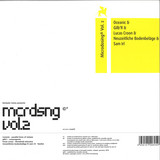
Microdosing is a series of compilation 12”s selected by Julienne Dessagne aka Fantastic Twins, and designed in collaboration with French visual artist Geff Pellet. Microdosing is a collective experiment aimed at helping you fighting back your modern obsession with happiness. You may deserve a nice day but the day does not need a nice you, nothing should be forced, everything is permitted. Microdosing will provide you with sonic healing weapons on regular basis and at irregular dosage. Those doses will favour psychedelic social techniques against self help tyranny, creation over soma, provoking over numbing, our outer-selves over our inner-selves. Microdosing refuses the fatality of the pleasure principle. Life is a struggle, time to embrace it. —— "My battery is low and it’s getting dark” We at Microdosing will make Opportunity’s famous last words fully ours. Some would see these as an epitaph on a black screen, we embrace them as a reclaimed fragility. Are we grains of sand wandering in space, hoping for a goal? No. We are the cosmos, the cosmos is us, unafraid of the end, unafraid of the void. Before the rise of the infinite silence, Microdosing brings you new guiding lights, white sun or black hole being a simple permutation of the kinetic rainbow. Oceanic’s “Parallel Lines Of Stripes” is a meandering mantra, an synthesised Moebius ring, a mission to your heart, that furthest star in the sky. Gilb’R’s “Cosmogonie” simply reminds us of the profound relation between spatial systems and the holy act of birth (cosmo, world and gon, conceive). The universe is a body, your body is your universe. Lucas Croon’s “Threshold Stimulus” is the soundtrack of a never ending voyage, the man is on a trip to the core sanctum. Imagine Space as a reverberation room cladded with bakelite. Losing yourself in delay repeats sometimes is the shortest way. Neuzeitliche Bodenbeläge & Sam Irl’s “Faeden” is another hymn to the umbilical chords joining us to the outer world, a black monolith of kraut acid, a pagan dance as portal to a destination only you can choose. Microdosing will be back soon with more enablers, helping to turn your petty struggles into a search for a meaning of life. The Quest lives on.
Search:repeat
Zodiac, a new collaboration between Brendon Moeller and Monty Luke, present a heady brew of sci-fi dub and deep rhythms on a full-length album, ‘Serengeti By Night’.
With meditative roots music at the very heart of ‘Serengeti’, experimental ideas are excavated over ten tracks. Vivid atmospheres are conjured up, as tribal trance, voodoo dub and otherworldly electronics are deployed over rock steady rhythms.
With influences that lie in the musical endeavours of African Headcharge to Rhythm & Sound, Public Image Limited to Cybotron, Zodiac keep the flame burning for exploratory dub-leanings, and deliver an album from the space station above that administers sophisticated braindance sounds that will command repeat listens...
Inner atmos and next time – rain into rivers, rivers to rain.
Sequence is subjective, irrelevant – it’s where we stand. Out of order, we dissolve and reform, coming together to come undone. There is no first, no now, no next – just precision points in the wide deep sky.
Another bang, another – it’s the reading which is important. Repeating in parallel, the natural loop is healing; repair, resonance, return. We live in a fragment; soft light and clouds drift like dreams into memory, showing movement in the mirror.
“Here the performer becomes free like the playful clouds high above the world of pain, suffering, happiness, ecstasy, disappointment, greed and ambition of human life”
In this present, we are touched to have unreleased business from Memphis. In unlocking the stoic DAT tapes we open a direct channel from 1993 to this now; three tracks which are meditative, essential rhythm with direct, organic charge. It’s Dream Night Dance Music and Osram 509, with RHK, En-Trance, and Microgravity.
More poetry in remembering our first release was also Memphis. Big complex loops and inner paths. Who’s been here before? All of us, one of us, none of us.
What is the Inner Dance? A musically assisted trip through thought-movement. It is not a show, it is a party. The participation of a room full of individuals having their own personal experience. Like looking closer at the ground to see there is movement within, focus acutely and see the life within life.
Gene Tellem launches her own label Bienvenue Records, welcoming you to a world of sounds for all the extroverted introverts out there. With headquarters at La Rama in Montreal, we plan on assisting your journey through local & international sounds.
For this first EP Gene lays down the foundation for what is to come. Journey agent tracks for all looking to experience the music, an extended groove, more than just a drop & repeat. ‘Groove PM’ sets the scene, we play in the sun during the day and at night we smooth out the rigid edges of the hustle. ’N’ You’ is here to get you in touch with your natural swing, ride on the simplicity of moderate changes and witness just how much we have. ‘Tender As A Rhodes’ is an ode to that thing that changed it all, the universal jazz sound, dub it out, stretch it out, and watch the whole room come together. As the morning comes we get ‘Chipped’, dance ’til the next day comes and hit the streets with a little pep in your step. Crossing paths with your neighbours on the way home, they might not know but all who witnessed do, we who dance the night are the warriors that keep the light on in the darkness.
Thanks for joining us and please do stay tuned for more.
-La Rama
The soundtrack is an important part of the project. It was composed by Jean-Charles Bastion and includes three exclusive titles by
Laurent Garnier. The same type of freedom present in the movie is felt in the soundtrack: the main themes are repeated and twisted,
without getting frozen. Stunning, dreamy, dancy... The music is adapted to the rhythm of the story, like if it was Anna's mirror.
Anna misses the flight she was supposed to take to visit Greg, her boyfriend, in Barcelona. After the plane crashes, she falls into the vertigo of an avoided death. She starts to be pulled away from reality and present. While her couple breaks up, Paris becomes the mirror of her distress.
Paris Is Us, directed by Elisabeth Vogler, was shot between 2014 and 2017, from the National Music Day to Johnny Halliday's funeral, through Charlie's Walk and the Nuit Debout movement... An evolutionary and ambitious movie, mixing the destiny of the city to Anna's life. It is a movie where the unpredictable has the main role.
Black Truffle is pleased to announce the release of this genuine head-scratcher, the first collaboration between DJ/mixtape-compiler Kayo Makino and underground legend Tori Kudo. Originally created to be played between acts at the launch of Eiko Ishibashi’s acclaimed The Dreams My Bones Dream and then reworked and refined for LP release, the two side-long pieces are sonic environments constructed by Makino for Kudo’s piano to inhabit, or, as the LP’s credits suggest, a cinéma pour l’oreille in which Kudo’s piano plays the starring role. Beginning with a soothing field recording of crickets dramatically punctuated by smashing glass, the first side finds Kudo playing his way repeatedly through one of Satie’s 1897 Pièces froides. Best known to many listeners for his role as leader of the ecstatically shambolic rock unit Maher Shalal Hash Baz, Kudo’s performance of Satie’s whimsical yet haunting melody is alternately halting and fluid, delighting in the hesitations of unstudied technique and the subtle variations between repeated attempts. While the combination of Kudo’s piano and the background of crickets initially suggests a documentary approach to recording – as if the we are simply hearing incidental sounds creeping through an open window – things take an unexpected turn a few minutes in when Kudo’s piano is suddenly doubled. Layering two separate attempts at the same piece of top of each other, Makino’s unorthodox mixing blurs Satie’s original into a fog of stumbling echoes that becomes increasingly dreamlike as the chirping crickets are overtaken by pattering rain, German dialogue and traffic sounds. The second side begins in a similarly inscrutable vein, with snatches of birds and film music providing a gentle backdrop for Kudo’s improvisational variations on a chord progression that, as his performance builds over its twenty-minute duration, somehow begins to suggest the sadly swaggering grandeur of Mick Taylor-era Rolling Stones. Makino accompanies and eventually overwhelms Kudo’s piano with a bizarre layer of digitally processed voice and drums, stretched out into a disorienting haze before suddenly retreating to leave Kudo’s piano accompanied only by a barking dog. Seemingly unrelated to anything else being produced in the world of contemporary music, this is a striking collaboration between two unique musical personalities that bridges the mundane and the surreal, opening up a dream-space both haunted and hospitable.
Franc Spangler makes a welcome and long overdue return to Delusions with a mighty-fine three tracker packed with the good stuff. The throbbing bump of the title track with it’s bouncing square-wave bassline and drifting stabs leads the charge, crunchy hats driving along the groove whilst a cut up vocal ratchets up the energy.
Flipping over we have Somewhere Else, a much deeper and jazzier affair based around a repeating four bar horn part. Never straying too far from the dance floor, Franc keeps things percussive and dynamic whilst conjuring up a moment of musical bliss, chiming synths dripping down like golden rays of sunshine on the densely textured orchestral layers.
Closing off the release, Dreamworld takes us by the hand on a tropical excursion, low slung beats punctuated by echoing xylophone riffs and Apito whistle. Dubby atmospherics and warm Juno106 chords give the track a Balearic mood perfect for the summer months ahead.
San Francisco’s Honey Soundsystem Records returns with a new single this July, inaugurating a new collaborative guise from Juan Maclean and Kevin McHugh (aka La-4a / Ambivalent) entitled Longlost.
It is rare the combination of simple and catchy happen in dance music, but ‘Take 8’ is just that. A song so heartfelt and recognizable it demanded its own slab of wax, a true single! This expertly mixed and crafted house cut romances listeners into a catchy live piano ditty that seemingly could pleasurably repeat for days.
Inspired by the tracks lead melody, the label set up NYC classical Pianist and friend of Honey Soundsystem crew Kevin Devine on a blind date with the producers a new version. Kevin whipped up a compositional response to the original and he was recorded live on a Grand in La-4a’s studio. Finally, to make it a family affair, Taraval, known for his work of Four Tet’s TEXT, teams up with label co-founder Jackie House for a kraut-no take on the original, fusing vacillating resonant bleeps and robust drums with glimpses of the original’s ethereal sounds.
Calling Marcelle a DJ doesn’t wholly represent what she’s doing. (Three) turntables and a mixer is more the medium that she uses to create and share sounds, ideas and moments.
The same goes for her own productions. They don't have a fixed style, as can be heard on all five EP's released by the Munich label Jahmoni since 2016. They are free in attitude and music and cross boundaries between genres. Most tracks are a collision of ideas, a magically gritty, self-aware car crash as if Muslimgauze grew up in sunny Lisbon with the Principe crew as opposed to the grim North of England.
On her new LP 'One Place For The First Time' we find nine tracks brimming with ideas that ignore stale production norms. Sure, the pulsing drum 'n' bass-esque 'Hippies Use Side Door' is weirdly danceable, just like the cackling stomp of 'Respect Caged Animals', but can we dance to 'Technicians And Their Smoke Machines'? (Answer: We’d certainly enjoy trying). It's almost a jazz song, but like with everything Marcelle does, it's jazz from a different world and has proven to be a dancefloor smash when she’s played out the dubplate over recent months.
Marcelle's life-long love for far-out dub is clear in 'Dub (Dub)' and 'Respect My Snack Foods' is in the same 'educational' tradition as was the song about how to deal with constipation (olive oil!) from the 2018 'Psalm Tree' EP. Now we learn how to apologise. 'The Mother Of All Messes' (a UK newspaper headline about Brexit) introduces perhaps a more tender side, a comforting nursery rhyme plays while a muffled kick occasionally growls with distortion - as if it knows the importance of its place in the dance.
By the time the refrain of the intro track returns it seems to carry more significance, Marcelle has made her point quite clear. Defiant til the end… ‘Don’t touch the table!’ This particular sample is taken from Marcelle's legendary Boiler Room performance at 2018's Nyege Nyege Festival in Uganda where the MC of the event repeatedly declares that 'She Plays Vinyl' and therefore asks 'Don't Touch The Table!'. It goes without saying that the latter song is full of banging on the table noises.
The sleeve - as always with Marcelle - is very colourful and features photos of knitted egg cosies and images related to individual songs. It's a bit of a puzzle to find out which photo connects to which song, an enjoyable challenge, just like the LP itself.
Shining on lineups whether they’re cutting edge festivals, big clubs, touring circus shows or DIY garage venues comes naturally given she approaches all with the same mindset ('always the same, always different'), these causes are adopting her rather than the other way round.
Marcelle is a genuine innovator who remains inherently relevant by not following trends, not focusing on technicalities, having a sense of humour, dissolving obsolete structures, being excited, defying others rules while creating new ones, eschewing #tagline posers and ‘tasteless A&R wankers’, supporting artists that need it, supporting places that need it, supporting people who need it and not giving a fuck for as long as possible.
And HUGELY welcome living proof that you can excel in doing things differently and having a bloody good time n all.
James Marrs, London, March 2019
- 1: Shine A Little Light
- 2: Eagle Birds
- 3: Lo/Hi
- 4: Walk Across The Water
- 5: Tell Me Lies
- 6: Every Little Thing
- 7: Get Yourself Together
- 8: Sit Around And Miss You
- 9: Go
- 10: Breaking Down
- 11: Under The Gun
- 12: Fire Walk With Me
The Black Keys’ long-awaited ninth studio album, “Let’s Rock”, their first in five years, is a return to the straightforward rock of the singer/guitarist Dan Auerbach and drummer Patrick Carney’s early days as a band. Auerbach says, “When we’re together we are The Black Keys, that’s where that real magic is, and always has been since we were sixteen.” The album includes the hit single ‘Lo/Hi’. The Black Keys’ touring begins in North America in September, with further international dates to be announced soon.
“Let’s Rock” was written, tracked live, and produced by Auerbach and Carney at Easy Eye Sound studio in Nashville and features backing vocals from Leisa Hans and Ashley Wilcoxson. “The record is like a homage to electric guitar,” says Carney. “We took a simple approach and trimmed all the fat like we used to.”
The “Let’s Rock” Tour will hit cities including Chicago, Nashville, New York, Los Angeles, and Austin. Special guests Modest Mouse will provide support on all dates, and Shannon & The Clams, Jimmy “Duck” Holmes, *repeat repeat, and Jessy Wilson will each open select shows on the tour. The band also headlines 2019’s Life Is Beautiful festival in Las Vegas on September 21.
Rolling Stone named ‘Lo/Hi’ a “Song You Need to Know” and said, ‘the Keys have officially returned, louder than ever’ and the New York Times calls the song ‘the kind of garage-boogie stomp that the band never left behind.’ In the words of the NME, ‘It’s the soundtrack to the type of party that doesn’t exist anymore, but one you still wish you were cool enough to get the invite to.’
Formed in Akron, Ohio in 2001, The Black Keys have released eight studio albums: their debut The Big Come Up (2002), followed by Thickfreakness (2003) and Rubber Factory (2004), along with their releases on Nonesuch Records, Magic Potion (2006), Attack & Release (2008), Brothers (2010), El Camino (2011), and, most recently, Turn Blue (2014). The band has won six Grammy Awards and headlined festivals including Coachella, Lollapalooza, and Governors Ball.
Since their last album together, both Auerbach and Carney have been creative forces behind a number of wide-ranging artists:
Dan Auerbach formed the Easy Eye Sound record label, named after his Nashville studio, in 2017, with the release of his second solo album, Waiting on a Song. Since its launch, Easy Eye Sound has become home to a wide range of artists including Yola, Shannon & The Clams, Dee White, Shannon Shaw, Sonny Smith, Robert Finley, and The Gibson Brothers; it also has released the posthumous album by Leo Bud Welch as well as previously unreleased material by Link Wray.
Patrick Carney has produced and recorded new music with artists such as Calvin Johnson, Michelle Branch, Damns of the West, Tobias Jesso, Jr., Jessy Wilson, Tennis, *repeat repeat, Wild Belle, Sad Planets, Turbo Fruits, and more. He also created the theme music for the Netflix TV show BoJack Horseman with his late uncle, Ralph Carney.
Like a homage to smoke-filled vaults, aging billiard rooms and crumby packets of pork scratchings in the Working Men's Clubs of days gone by, Todmorden-by-way of-Europe trio Syd, Jake and Giulia are about to fling open the doors of their own millennial social hub with the fresh post-punk of infectious debut single, 'Bad Blood' / 'Suburban Heights.'
'We grew up in northern towns trying to get in to pubs in social clubs because that's all we had. The name is an ode to that,' explains Working Men's Club's 17-year-old singer and guitarist, Sydney Minsky-Sargeant. 'Our surroundings and their differences has influenced us a lot on these tracks.'
Joined by guitarist-vocalist Giulia Bonometti, 23 and drummer Jake Bogacki, 18, the trio have always had a clear sense of their whereabouts; quite simply, they wouldn't even exist without multi-nationalism. Meeting at college in Manchester, Syd and Jake are from Todmorden and Hebden Bridge, but their families hail from Poland whilst Giulia moved to the UK from Lake Garda, Italy. 'The songs are based on the culture of walking round Manchester every day then going back to the countryside each night and how the contrast of going back into the hills made us sane,' Syd tells.
Working Men's Club are wise beyond their years as they seemingly offer words of wisdom, to be repeated like some kind of break-up mantra, until everything's ok; 'Be happy when the sun shines / Be happy when the sun rains / You know you should do the same.'
If 'Bad Blood' is the day, 'Suburban Heights' is the night. Recorded with Alex Greave at The Nave in Leeds, steady riffs from Syd's fingers tap-dance on the strings alongside Jake's skill in working a jagged snare. Meanwhile Giulia's heavenly disco 'ooohs' recall Donna Summer feeling the love whilst cutting right to the contentious subject of gentrification. 'Suburban Heights refers to how apparent it is that cities are expanding to hold more people and buildings are rising, they're morphing into these dystopian party towns,' tells Syd.
Already with shows supporting The Wedding Present and Brian Jonestown Massacre behind them, Syd says it's only the beginning; 'Those shows were great experiences and ones we'll have for life. We love making music and we're so grateful for what we've achieved so far; hopefully there'll be plenty more to come.'
Aggelos Baltas is a veteran of the global electronic music scene, responsible for a handful of celebrated EBM 12”s as Dream Weapons, and a particularly heady and open-ended brand of krautrock as Fantastikoi Hxoi. His newest project, Anatolian Weapons, was conceived as a way to bring together these two seemingly mismatched concepts, with the polyrhythmic percussion and wailing tones of Greek folk music serving as their unlikely bonding agent. His output garners praise particularly around the Golden Pudel scene, such as Vladimir Ivkovic, and Phuong Dan. Lena Willikens, from the same circle, included Baltas’ track “Disillusioned” on her Dekmantel Selectors compilation in 2018.
But where much of what Baltas has released as Anatolian Weapons is instantly recognizable as dance music, To The Mother Of Gods—Baltas’ debut album for Beats In Space—is something else entirely. Created in tandem with Greek folk musician Seirios Savvaidis, it is a work of simultaneous collaboration and subtraction whose meticulous construction becomes more apparent with every listen. An album-length exploration of what happens when the principles of dance music are applied to pre-digital musical modalities. It is a record of psychedelic folk music that has more in common with Kikagaku Moyo, Minami Deutsch, and the Habibi Funk label than it does with anything else Baltas has produced under any alias. It’s difficult to imagine this music in any kind of club setting.
And yet, it’s very much the work of a DJ. Baltas initially heard Savvaidis’ music through a friend, and was absolutely amazed. “It was his very esoteric, pagan [music and] beautiful lyrics that grabbed me,” he writes. Seirios is a composer and performer of traditional Greek folk music with a growing discography of regional psych-rock gems. Baltas reached out to collaborate and the seeds of To The Mother Of Gods were sown.
Savvidis contributed stems of ten songs, which Baltas deconstructs and rearranges with appreciation of the ancestry of their lineage and of the deceptively ancient eerie, droning qualities inherent in the style. Occasionally augmenting Savvaidis’ recordings with his own, Baltas treats these elements as if raw materials for an architectural process.
To The Mother Of Gods showcases Baltas’ arrangement skills. He treats Savvaidis’ songs as landscapes, filling them with slanted, droning light and setting the singer’s vocals in dead center. His years behind the decks have given him an intuitive understanding of dynamics—drums crest and recede like tides, snippets of bassline repeat and swirl. He knows how to entrance, and when to push the music from the head to the body. Opener “Taratchi Katarratchi” (“Stormy Cataract”) is sung as a spell to ward off the fear of death, but Baltas’ orchestration demonstrates that dancing is an equally effective way of dispelling the darkness. The beat he assembles from Savvaidis’ playing recalls the late-night ecstasies of Primal Scream circa Screamadelica.
To The Mother Of Gods is a reminder that folk music and dance music are both powered by their audience as much as the musicians themselves. Savvaidis’ lyrics echo pagan Greek themes, touching on what Baltas calls “the magic of nature.” At times, as on “Kalesma” (“Invitation”), this can feel incantatory. Savvaidis chisels his vocal melodies into hard, clipped syllables, their cadence recalling Gregorian chant, and yet Baltas cloaks these details in washes of distortion. “Ston Stavraito” (“In Stavraithos”) is delivered with a lamentive tenderness that Baltas swells into a prideful stomp, immersing Savvaidis in marching drums and distant vocals that form a resilient protest-song. To The Mother Of Gods is a testament to the ongoing and innate truth that music can take us beyond ourselves. That repetition and drone can shepherd us to a liminal space beyond thought and rationality, where the wall between perception and reality does not exist. Call it spirit, if you want, and watch as it courses its way through modern-day dance music, mid-century psych, and the ancient sounds of the anatol.
Anatolian Weapons’ To The Mother Of Gods will be available from Beats In Space on June 14, 2019 in limited vinyl and unlimited digital forms.
Artist Highlights
• Aggelos Baltas is an Athenian music producer creating and Djing under the monikers of Anatolian Weapons, Fantastikoi Hxoi, and Dream Weapons.
• The Anatolian Weapons moniker is an outlet for Baltas to explore global music—from African to Anatolian and Middle Eastern, while also incorporating sounds from his home country of Greece.
“Ta Da” is the debut full length from J. McFarlane Reality Guest, the collective name for the trio headed by the eponymous McFarlane. As a member of the group Twerps, McFarlane has traversed guitar-centric, melodic pop music for some years while honing a highly unique, personal musical language. Ta Da is the first recorded unveiling of McFarlane’s affecting, oblique songwriting panache. Originally released in her native Australia on Hobbies Galore, Ta Da will be released worldwide by Night School in June 2019.
Wheezing into view with a troubled reed instrument set against a s of whoozy synth lines, Human Tissue Act is a foggy curtain the listener is invited to peel back. The dissonant notes are left to dance entwined, with clarinet heralding a Harry Partch-esque mallet percussion interlude. It’s a mood. With no resolution in sight, an audience dragged closer into uncertainty is suddenly drenched with the light of inter-weaving wah wah synth and saxophone. I Am A Toy introduces us to McFarlane’s vocal, an effortless and matter-of-fact, accented statement that quietly takes the reins. While McFarlane’s previous work in Twerps might reference 80s UK and antipodean guitar pop, Ta Da showcases a different influences immersed in psychedelic music and synths. It’s a brilliant, deft concoction swimming in Young Marble Giants-type minimalism washed with bare pop and harmony similar to Kevin Ayers making sense of a Melbourne suburb full of faces half-recognised in the blanching sun.
What Has He Bought begins with a Casio-keyboard rhythm pattern, palm-muted guitars and immaculately enunciated vocal give way to a burnt melodica part that elevates the spirits. Simple patterns repeated, like a well-tempered pop song that does what it needs to do and no more, build into the sound of summer leaking orange juice. They’re moments of joy, layered on top of each other like a melting cake. Do You Like What I’m Sayin’ recalls Marine Girls covering a classic ‘66 Garage nugget, organ lines fighting funk with guitar chords played just behind the percussion. “In a talking world, meanings are the same. Words want to hold on to the people they contain. Do you like what I’m sayin’?” We’re in a Beckett play perhaps, obtuse absurdities rendered pretty. Alien Ceremony is a heart-melter, given a melancholic timbre by bowed double bass it’s a tragi-comic piece that almost reeks of Robert Wyatt at his mid-whimsical twisting a fugue completely out of shape. Beneath the layers of harmony and twinkling instrumentation you sense there’s a genuine sadness somewhere even if it remains veiled.
Through out Ta Da, McFarlane plays with counterpoint and contrast to sometimes delirious effect. On Your Torturer, a simple, upbeat chord progression is hard panned, underpinning a flute solo which seems out of place, hence making it completely in place on this warmly surreal album. My Enemy is a slowly swinging eulogy to a failed relationship punctuated by analogue synth burbles, with our protagonist simply asking, in the aftermath, “can we be nice?” Here McFarlane’s vocal is straight forward, lyrically conversational but still not completely in focus, a surreal kitchen sink drama filtered through a dream where everything is in the wrong place. It’s a fine precursor to Heartburn, which similarly borrows BBC Radiophonic Workshop-style noise synths and the use of space to carve up the simple “You Will Make My Heart Burn” line. At this point, the listener has been in such close proximity to McFarlane’s show, the reality guest in a performance where they’re the sole audience member, that when Where Are You My Love rises on the horizon as a sleepy, psychedelic send off it’s uplifting. The vocal drifts away into the sunset, simple and direct. It leaves the listener slightly confused, perhaps, but grateful for the gentle surprise.
“Built By Humanoid” is Humanoid's second album, a mere 30 years after the debut, though Brian Dougans claims the first album wasn't really him anyway.
Humanoid's classic acid house single, ‘Stakker Humanoid’, highly regarded as one of the key tracks from the era (Richard James (Aphex Twin) sights the Stakker project as a major influence), enjoyed massive success in 1988. Reaching No.1 for 5 weeks in the UK dance charts, performances on Top of the Pops, a John Peel session for the BBC and European tours eventually led to an album deal.
Whilst all this was happening, Brian Dougans (one half of electronic legends Future Sound of London) claims he was returning to his squat in Kings Cross with no electricity or water. He not only became disillusioned with the business, but also became increasingly ill from the conditions he was living in. Around 6 tracks into the album, he left London and record label, Streetsounds, returning to Manchester to recover and regroup his thoughts. However, Steetsounds pressed ahead with the album and it was finished in Brian’s absence with guest performers.
Brian left Humanoid behind and went on to create FSOL with Gaz Cobain becoming leading lights in the burgeoning ambient scene, scoring a top 10 album "Lifeforms" on Virgin Records.
In 2003 Rephlex (Aphex Twin’s label) released a posthumous album of 1988 out takes compiled by Brian.
Recently Humanoid tracks have been popping up on modern compilation albums (Touched Music / Gasman, etc) signalling a possible return.
“Built by Humanoid” is a brand new nine track album of future acid cuts, breaks and electronics, a lot of which is credited to 2 synthesisers co-designed by Brian Dougans and English Electronics company Digitana. It is this innovation that has helped usher Humanoid back into the limelight and consequently the album has a rather new and unique sound and style.
The track ‘Polymath’ is created using a possibility / probability theory that results in a track which at no point repeats itself - 303 tinged acidic bubbles. Meanwhile ‘Traktion’ is a break beat, pulse laden, bass heavy monster. ‘Fu*k It’ is the future sound of 303. Fast, frantic and beat driven. Whilst ‘Post Humans’ combines thumping 909 and 303 into an acid hallucination.
Black Truffle is honoured to announce the first ever vinyl reissue of David Rosenboom’s legendary Brainwave Music, originally released on A.R.C. Records in 1975 and here expanded to a double LP with the addition of over 40 minutes of contemporaneous material. Pioneer of live electronics, innovator in music education, collaborator with artists as diverse as Jon Hassell, Jacqueline Humbert, Terry Riley and Anthony Braxton, Rosenboom is renowned for his ground-breaking experiments with the use of brain biofeedback to control live electronic systems.
Each of the three pieces that make up the original Brainwave Music LP integrates biofeedback with musical technology in different ways. In the side-long opening piece “Portable Gold and Philosophers’ Stones”, four performers have electrodes and monitoring devices attached to their bodies to receive information about brainwaves, temperature, and galvanic skin response. This information is analysed and fed into a complex set of frequency dividers and filters, manned by Rosenboom, but essentially played by each of the performers through their psychophysiological responses to the situation. The result is a slowly unfolding web of filtered electronic tones over a tanpura-esque fundamental, possessing the unhurried, stately grandeur of an electronic raga. In “Chilean Drought”, three different variations of a text about a drought in Chile, each read by a different voice in a different style, are associated with the Beta, Alpha, and Theta brainwave bands. Alongside an insistent piano accompaniment, we hear a constantly shifting combination of the three vocal recordings controlled by the relative preponderance of each of the brainwave bands in the soloist whose brainwaves are being monitored. “Piano Etude I (Alpha)”, the earliest piece included here, is based on research into the link between Alpha brain wave production and the execution of repetitive motor tasks. As Rosenboom plays a very rapid, incessantly repeated pattern in both hands – deliberately designed to be difficult to execute without being in an alert, non-thinking state similar to that associated with strong Alpha brainwave production – two filters controlled by monitoring his brainwaves process the piano sound, moving gradually higher in frequency as the average Alpha amplitude increases, resulting in a hypnotic, constantly shifting blur of repeated notes reflected through the shimmering, watery lights of the filters. For this reissue, the original LP is supplemented with an additional LP containing an unreleased 1977 live recording of Rosenboom’s “On Being Invisible”, in which the composer himself performs on an array of electronics that are fed information from his brainwaves. Stretching out over 40 minutes, the piece begins in similar territory to “Portable Gold and Philosophers’ Stones” but eventually becomes far wilder, building up to pointillistic bleeps and dense layers of electronic fizz that unexpectedly cut to near-silence. As Rosenboom explains, the piece creates a situation in which the ‘performer’s active imaginative listening became one of the ways to play their instrument, as well as an active agent in how self-organizing musical forms might emerge.’ Enriched with archival images and new notes from the composer, this expanded reissue of Brainwave Music is essential listening for anyone interested in the history of live electronic music and alive to the possibilities it might still contain.
A1: Damn – deez be some underwater dwellers. Hittin that snare like dem old boys – Lee Scratch or Mad Professor; This stuff is on fire, and not for Fyre; Works on real floors, can’t #Hashtag that shit.
A2: Mr. Max takes us down the Cavelerra highway; Starting with a solid and sparse veneer, turns into a wicked acid-filled warehouse jack. Throw in a strobe and some smoke and away we go.
B1: Old school maestro goes into stormy moody mode. Applying the simple counterpunch with a long and winding synth line, Edgar sneaks in a menacing acid line – teleporting you into the deepest corners of dystopian space. Definitely some shamanic tendencies going on here.
B2: The Anarchy Skyalkers. Nomen est omen. B-boy beats, 90ties rave; Boats and Hoes; Acid in da House; Repeat after me.
Repress available in early May.
Faitiche releases a new collaboration between the Japanese sound artist ASUNA and Jan Jelinek: the album Signals Bulletin brings together joint improvisations and compositions made over a period of three years in Berlin, Kyoto and Kanazawa. ASUNA’s meandering organ drones merge with Jelinek’s pulsating synthesizer and field recording loops to create dense superclusters that span broad harmonic arcs.
"Watching the Japanese sound artist ASUNA playing the organ, some people might be surprised. ASUNA is no virtuoso flying over the keyboard in a rage. Instead, with the calm gestures of an office worker, he cuts strips of adhesive tape to the correct length before sticking them onto the keys of his instrument. In this way, large clusters of keys are held down, creating a dense and sustained range of frequencies, while the sound artist continually prepares further sets of keys or removes tape again. I have rarely seen a more convincing performance concept, with such a power to fascinate.
I first met ASUNA when we both gave a concert at the 21st Century Museum of Contemporary Art in Kanazawa, his home city. He performed the organ drones as described above and I immediately knew I wanted to collaborate with him. Six years and five meetings later, we completed Signals Bulletin. The album includes both joint improvisations and compositions, recorded in Berlin, Kanazawa and Kyoto.
Whether using prepared organ, Casio keyboards or mechanical plastic toys, ASUNA creates rich textures of sound that barely change over long stretches of time. It is a music without breaks. For a while, I was unsure how my loops made using modular synthesizers and live sampling fitted here – until I realized the role I had to take in this duet: I would provide the rhythmically pulsating foundation over which his dense continuums could unfold.
The result is harmonically drifting superclusters that put us into a meditation-like state. It can perhaps be compared to Automatic Writing – a mode of creative expression floating somewhere between concentration and distraction. Both the structure of our pieces and our approach to our instruments allow a similar “absence”: we let the machines play and repeat themselves – while we, in a mild form of trance, adopt the role of observers, intervening only occasionally.
It is no coincidence that ASUNA owns a collection of Doodle Art – drawings jotted down during conversations or while talking on the phone. It is said that works made like this point to the unconscious and reveal pet motifs – because a doodler always inadvertently returns to his or her favourite themes. The artwork for Signals Bulletin features pictures from the collection, in this case sheets of paper from the pads provided in stationery shops to test out pens. The special quality of such doodles is that the jumble of drawings is the work of a collective whose individual members do not know each other. Layer by layer is added, by someone different each time – until it becomes a dense cluster of lines and symbols ..."
Jan Jelinek, Berlin 2018
Back in 2014 when we first released the self-titled Chupame El Dedo we weren't sure if people could hold their mojitos while banging to their music. In 2019 we seriously advise to keep your hands free while listening to their second album. Formed by psych cumbia master Eblis Alvarez (Meridian Brothers) and Pedro Ojeda (Romperayo), the man that found the perfect cocktail mix for acid + folk + tropical beats, Chupame El Dedo are ready to mess around with Satan. 'No Te Metas Con Satan' it's a humorous title for music that expels cartoonish metal-vibes mixed with tropical rhythms. It's a pitch perfect title for a record that's never at the right pitch. The humour makes way for the funny stories that Eblis and Pedro explore in their lyrics. Souk's fourth release is a daring adventure in global beats. Frequently it comes to mind the universe of Quasimoto, Madlib's abstract hip hop that sounded delicious in the early 2000s. Chupame El Dedo lives in the same kind of power trip, fuelled by intense salsa rhythms dressed with heavy metal images.
That's where Satan comes into place. The Devil wears many clothes, but none are as multi-coloured and trendy as the ones we see in 'No Te Metas Con Satan'. We are advised of that during the first side of the LP. Each song dares the listener, with a multitude of ideas, sometimes dissonant ones, that find their way to make sense. An example The first song 'No Te Metas Con Satan' sounds like a perverted version of 'Da Ya Think I'm Sexy' and when you think it's over, it starts again, repeating ideas and leaving you extremely confused. What the fuck just happened Chupame El Dedo happened.
And it goes on. Flip to the other side and 'Alexandra Candelaria' says hi. A 7:43 minute long sinful & hilarious soup opera. No-one is ready for this. Laughter mixes with intense head banging, while we listen to what would happen if Jodorowsky made a Cartoon Network show. A damn good one. Maybe it's a good idea to not mess around with Satan, but you'll be in serious trouble if you don't listen to this. Seriously.
Rudolf Abramov is a duo based in Berlin and Israel, which seem to have been a door opener to unexpected musical encounters, because it's an almost impossible task to sum up their sound in a comprehensible way. In their own words their music is 'a response to a seemingly endless conflict about disgust, acceptance and love.' Now Hoga Nord Rekord is releasing their Mini-LP 'Krass kontrast'.
Rudolf Abramov is Roland 303, programmed drums, oriental samples, eastern mysticism and instrumentation dressed as German machine funk, Disco, Turkish psychedelia, Krautrock, EBM and so on, and so on.. their music is cosmic, beautiful and boundless.
The arpeggio on the track 'Projekt 4' is running on infinite repeat in a parallell reality where 1982 never ended, where Rudolf Abramov move freely through different dimensions and where they are in total control of their unpredictable creation!
Warehouse Find!
Danish producer Paxton Fettel joins Delusions for his debut EP for the label entitled Night Waves. Despite his youth, he has notched up an enviable catalogue of original, eclectic releases including two LP's for Greta Cottage Workshop as well as EP's for Plumage, Kolour LTD and Apersonal. Paxton's unique sound and audiophile approach to production has led to remixes for Uffe on Tartelet, Chocky on Secret Reels and most recently Sunrom on edgling vinyl-only label The Bricks.
For his Night Waves EP we get a snapshot of the mans diversity across three original tracks. The opener sees Paxton in his most raw, jacking, dance oor focussed mood to date and the result is a high energy house track which punches hard on a big system. Featuring his own bass playing, snipped and squeezed through the sonic mangle, Night Waves steams along with big bold pianos, swinging hats and just the right amount of oating synths. Simple elements which combine to be so much more than the sum of its parts and one of those stand-out cuts that will be stuck in your head long after you've left the danceoor.
Flipping over we have Paxton going full-on jazz mode in Pacica 399 To Freedom. A track which once again has his beloved Sandberg California live bass part pushed to the fore, pianos, strings and synths building around the driving disco groove. Feel-good sunshine vibes oozing from the speakers as little melodies dance around the sizzling hi hats and encompassing pulse of the kick drum.
Finally we have a deeper note to close on with It's Clear. A repeating vocal hook runs throughout the intro while intricate drum programming gives a nod to the sounds of broken beat and live jazz sensibilities. The end result is a warm, loose and dubby jam which completes the package in ne style and leaves us looking forward to hearing more from this talented young producer from Copenhagen.