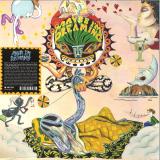
Originally conceived as a compilation of outtakes and live recordings from The Shadow Ring's 1995 stateside tour, Wax-Work Echoes takes its name from the first line of "Put the Music in Its Coffin," the title track of the group's breakthrough release. Lambkin abandons the bitsand- bobs approach, advancing the Shadow Ring concept with entirely original material that builds on the unit's self-mythologizing lyrics, celebrates the clicking of horse hooves, ponders on the sociability of rats and mice, and warns of the dangers of poultry. The first Shadow Ring album to officially include Tim Goss in the main lineup, Wax- Work Echoes reveals the group in its final and lasting form, awash in the outer bounds of atmospheric exploration, with Lambkin's familiar wry and morbid lyricism and the stripped-down angularity of amateurishly detuned guitars fully intact. While Klaus Canterbury and Tony Clark seem all but forgotten, and the shrugged off S. Fritz is listed on the liner notes as performing only "when required," Lambkin did solicit contributions from outside the inner circle. A bit of "Mambo Twist," lifted from a tape of unreleased Vitamin B12 material sent to Lambkin by Alasdair Willis, found its way into "V.E.R.M.I.N.," while an extended epistle contribution from Richard Youngs (and, technically, Brian Lavelle) would be employed in the second half of "Catching Sight/Of Passing Things." Released on CD in 1996 for Bruce Russell's newly minted Corpus Hermeticum, Wax-Work Echoes was recorded concurrently with intense rehearsal periods, in anticipation of the forthcoming "Rose Watson Tour," and was supported by a celebratory fanzine media blitz. The album seemingly absorbs the frenetic excess of the band's transatlantic travels; Wax-Work Echoes channels the trio's wilder instincts into an unresolved catharsis, not yet free of frustration or restlessness. Out of print for almost three decades and available here for the first time ever on long-playing disc, Wax-Work Echoes is a classic from the outer eddies of The Shadow Ring's sound, a must-have for any aficionado's collection: "A window slides, glass slips from frame / And canvas carcass breathes again." Throughout their legendary, decade-long run, the Shadow Ring were an enigmatic force on the international musical sub-underground. Before their disbandment in 2002, this shambolic rock outfit, formed by a group of rowdy teenagers in southeast England, left behind a mighty run of eight LPs, a handful of 7"s, and a spate of raucous live shows and cryptic zine appearances on both sides of the Atlantic, all which have bolstered their enduring word-of-mouth mystique. Beginning in 2023 with the first-ever vinyl pressing of the self-released pre-Shadow Ring tape The Cat & Bells Club (1992), Blank Forms Editions has been conducting a systematic retrospective of the storied group. Wax-Work Echoes and Hold Onto I.D. are the latest releases in a multiyear reissue effort that includes several LPs, a comprehensive CD box set, and a nearly five-hundred-page book.
Buscar:reve recordings
For his third long-player under the Phi-Psonics banner, Ford-Young marshalled a series of live recordings at the Healing Force Of The Universe record store in Pasadena, sculpting fourteen tracks, largely composed in the moment with a fluctuating cast of players, which wonderfully transmit his ideals of community and inner peace. Called "Expanding To One", it features exquisitely calming yet searching pieces like "There"s Still Hope", where Seth"s softly undulating bassline underpins beatific explorations from core Phi-Psonics members, Sylvain Carton and Randal Fisher (both on saxophone), and Josh Collazo (drums), alongside guests Zach Tenorio (Wurlitzer piano) and Mathias Künzli (percussion). Equally sublime, "Healing Time" ripples like a mountain stream, with Ford-Young, Carton, Fisher and Tenorio joined by Minta Spencer (harp), Dylan Day (guitar) and, on drums/percussion, Jay Bellerose, a revered LA stickman most recently under the spotlight in Jeff Parker ETA IVtet.
- Ida Red
- Glory In The Meetinghouse
- Flowery Girls
- I Had A Good Father And Mother
- Shady Grove
- Pretty Fair Maid
- Billy Button
- Puncheon Camps
- The Queen Of Rocky Ripple
- Boatsman
SEAWEED GREEN VINYL[22,27 €]
Old-time and traditional music stay exciting for their contrasts. Exacting instrumentation honed through mentorships and late-night jams at fiddler's conventions tangles with a community-sourced inventiveness that influences variants and new sounds. Joseph Decosimo is a master of this genre for this very reason, blending deep technique with an openness and curiosity that keep his music crackling with life. A "marvelous fiddler" (No Depression) and banjo player who braids "exultation and veneration" (INDY Week) into his music, on his third solo album Fiery Gizzard Decosimo gathers a close-knit ensemble of friends from his musical career to infuse his interpretations of fiddle and banjo pieces with a contagious communal joy. As an artist working with traditional music from the South and Appalachia, Decosimo chooses songs based not only on historical significance and lineage but also his own sensory approach. For Fiery Gizzard, his ear was tuned to otherworldly tones and mystery, sourcing from field recordings such as Virginia fiddler Luther Davis' hypnotic version of "Shady Grove" while amping up the music's psychedelic potential. On the middle Tennessee banjo composition "Flowery Girls," a VHS of bluesman Abner Jay inspired Decosimo to rig up a pickup inside a fretless banjo and play it thr ough a tube amp to capture some of Jay's edge and funkiness. But to round out the sound and keep it kinetic meant galvanizing a genre-eschewing crew to jam out - and not in a "spaced-out drooly" kind of way, he laughs, but as a sort of "responsive conversation." Decosimo has always been a community-minded artist. He began playing as a seventh graderin Tennessee, fostering relationships with older players at jams and in homes, a learning mode natural to his inquisitive nature and desire for musical connection. A folklorist by intuition, he later became one by profession, studying with old-time legend Clyde Davenport, teaching in East Tennessee State University's renowned bluegrass program, and receiving his PhD at the University of North Carolina with a dissertation titled "Catching the `Wild Note': Listening, Learning, and Connoisseurship in Old-Time Music." In North Carolina, Decosimo kicked about in the verdant environment of Durham and Chapel Hill's folk and indie scenes, collaborating with artists including Alice Gerrard, Hiss Golden Messenger, and Jake Xerxes Fussell. This community has influenced his own music, including his "sublime and strangely heartening" (Bandcamp Daily) 2022 release While You Were Slumbering and Beehive Cathedral, Decosimo's 2024 "Appalachian mountain music treasury" (New Commute) trio album with Luke Richardson and Cleek Schrey for Dear Life Records. Continuing on this path, Fiery Gizzard is home base for a loose outfit of mostly Tarheel-based musicians from within and beyond traditional music. Inspired by a tour with fiddler Stephanie Coleman (Nora Brown), guitarist Jay Hammond, and synth builder and multi-instrumentalist Matthew O'Connell, Decosimo assembled studiomates based on close friendships and comfort. Coleman, O'Connell, and Hammond contribute to Fiery Gizzard, along with bassist and producer Andy Stack (Helado Negro, Wye Oak), horn player Kelly Pratt (Beirut, David Byrne), Mipso and Fust's Libby Rodenbough, Joseph O'Connell (Elephant Micah), andtrad/experimental artist Cleek Schrey. Decosimo's fiddle and banjo work is virtuosic, intricate and simple simultaneously, a testament to his many years of study. On some tracks, his playing or lovely, plain-hearted singing is the centerpiece, such as on his interpretations of Texan street preacher Washington Phillips' 1929 recording "I Had a Good Father and Mother" or the Eastern Kentucky fiddle barn-burner "Glory in the Meetinghouse," famously played by Luther Strong for Alan Lomax. But there's also a trusting open-door policy, like where Southern Appalachian tune "Ida Red" relaxes into Coleman's sweet, confident fiddling and Hammond's loping guitar. As a bandleader, Decosimo's confidence and enthusiasm for the music reveal the heart of traditional music and how it can come to life through community. Fiery Gizzard is Joseph Decosimo as a powerful champion of traditional music - a sponge who soaks up as much as he squeezes out, a responsive artist who makes his genre accessible, and a magnet who can bring musicians of all sorts into his orbit with his same passion.
- Fate Is
- Billboard
- Love Has No Pride (Condemned)
- Underneath
- November
- Maura
- Coyote
- Revenge Of The Lawn
Banana Stand vinyl. I Was Trying to Describe You to Someone is Wednesday's second fulllength album & first as a full band. The Asheville, NC quintet (guitarist/ vocalist Karly Hartzman, lead guitarist Daniel Gorham, pedal steel guitarist Xandy Chelmis, bassist Margo Schultz & drummer Alan Miller) maximizes the dark dissonance of a three guitar attack to highlight the emotionality of Hartzman's bell-clear vocals & wisps of half-recalled memories & literary references that make up her lyrics. I Was Trying to Describe You to Someone's eight songs meld elements of shoegaze, grunge, indie pop & southern American culture into a uniquely personal style of modern rock music that resonates with power & tenderness. The ever-darkening & deepening of Wednesdays' sound on I Was Trying to Describe You to Someone owes a debt of influence to The Swirlies, Arthur Russell, Red House Painters, Tenniscoats, Ana Roxanne, Acetone, & their continued collaboration with MJ Lenderman (who lends backing vocals to the songs "Billboard" & "November"). I Was Trying to Describe You to Someone was recorded at Hartzman's home with engineering assistance from her roommate Colin Miller. The depth & clarity of the recordings balance the distorted volume of Wednesday's live performances with the intimacy of Hartzman's voice. Her words hold the center of the chaos, unobscured by the power of the band. Hartzman describes her lyrics as "attempts to access old personal memories & do them justice through prose, with inspiration from the writings of Richard Brautigan, Flannery O'Connor, David Berman & Tom Robbins, & movies like Steel Magnolias."
- A1: The Watson Brothers Band - Justwhistle
- A2: Jim Huxley - Tessa On A Magazine
- A3: Rick Penta - My Story Changes
- A4: Mak - That's Life
- A5: Palm Pizazz! - Silent Letter
- A6: Twice As Nice - Thoughts Of You
- B1: Barracuda - Baby I Love You
- B2: Elderberry Jak - Forrest On The Mountain
- B3: Dennis - Walk With Me
- B4: Jim Ware - Green Eyed Gypsy
- B5: John Lyle - Oh My Wind
- C1: Peter Kraemer - Let The Light Slip
- C2: Brian Freel - Nightrider
- C3: Michael Moore - Holland
- C4: Clete Stallbaumer - John’s Song
- C5: Ronnie White - The Jump
- D1: David Owens - Take Off Your Armour
- D2: The Squad - D L.m.h.i.m.a
- D3: Christoph Spendel Group - Forever
- D4: Awakening - Gotta Do Somethin / Might As Well Cultivate
‘Maybe I’m Dreaming’ is the latest collection selected by Mikey Young (Total Control, EddyCurrent Suppression Ring) and Keith Abrahamsson (Founder and Head of A&R at AnthologyRecordings), the mangled minds behind the beloved ‘Follow the Sun’, ‘Sad About the Times’,and ‘…Still Sad’ compilations. The twenty tracks of ‘Maybe I’m Dreaming’ make a conscious(and unconscious) detour from its predecessors, sourced entirely from private press releases,spanning new decades and production modes within homespun folk, soft rock and otherwise70s and 80s FM radio adjacent music. The magic of ‘Maybe I’m Dreaming’ is the untold story of the artists behind these songs; thosewho missed the big time, but whose song craft and unrequited care hit the right notes, bothhigh and low.
Where ‘Follow the Sun’ and ‘Sad About the Times’ introduced us to the fame chasing, ambitioncrashing crooners who missed their shot in the mainstream, ‘Maybe I’m Dreaming’ delvesdeeper into the isolated wilds - a private world where production quirks, late-night tape hiss andone-man studio dreams were not necessarily a choice but the hand that was dealt.
With the parameters set to ‘private press only’, Young and Abrahamsson follow a circuitous trailof invention and emotion, documenting a spirit that’s more homespun, sometimes lonelier andoften a little weirder. The guitars still strum, but the keyboards’ hum is more prevalent andprecious; wistful harmonies brush up against lo-fi drum machines; a bittersweet fog lingeringover even the brightest melodies.
As with their previous collaborations, Young and Abrahamsson weren’t interested inconstructing a museum or drafting a historical survey. ‘Maybe I’m Dreaming’ is a sentimentalmixtape, assembled late at night when the mind wanders and old memories blur with imaginedfutures, those within reach and those far too mysterious to ever encounter. Songs wereunearthed in personal collections, deep YouTube burrows, dilapidated web archives and thedim corners of Discogs, with many selections tied not only to intuition but to personalconnection. Some tracks arrived via friends - Kelley Stoltz, a frequent guide for Young, tipped him off toboth Peter Kraemer’s lost gem ‘Let the Light Slip’ and Awakening’s revelatory closer - addingan unseen but deeply felt thread of camaraderie to the compilation.
The journey takes in a wide, strange sweep: The Watson Brothers Band’s ‘Just Whistle’ opensthe collection with a sigh and a shrug, a song that feels like it’s been waiting for decades to beheard again. Jim Huxley’s ‘Tessa on a Magazine’, rediscovered after a long and winding searchby Young, shimmers with a distinctly Australian melancholia. The heartbreak of Rick Penta’s‘My Story Changes’ and Twice As Nice’s delicate ‘Thoughts of You’ float easily alongside themore buoyant, radio-dream sheen of Barracuda’s ‘Baby I Love You’ and MAK’s sunshinedappled ‘That’s Life’.
Widening the aperture to the late 1970s and early 1980s allows for a deeper exploration intoevolving production techniques and musical technologies. The Squad’s ‘D.L.M.H.I.M.A.’ andChristoph Spendel Group’s ‘Forever’ crackle with the kind of bedroom synth warmth that couldonly come from the analogue age, while the soulful, yearning undercurrent of Awakening’s‘Gotta Do Somethin / Might As Well Cultivate’ caps the collection with a call for action - ormaybe just acceptance - in an accidental Brian Eno ‘Here Come the Warm Jets’ parroting.
While ‘Maybe I’m Dreaming’ moves away from the ‘sad man with guitar’ archetype that hoveredover its predecessors, it remains tethered to a familiar emotional gravity - a balance of longingand lightness that defines this corner of the musical universe. Each track shuffles gentlybetween resignation and hope, sadness and serenity, as if the artists themselves were chasinga dream just beyond reach, recording not for fame but for the simple act of getting it, thatprimal, creative itch, out into the world.
Available on CD and 2LP, featuring the third eye-opening artwork of Dang Wayne Olsen. Thedouble LP set arrives in an outrageous double-wide spine jacket with printed inners and adream journal entry by Pacific Northwest artifactual authority Josh Lewellen.
2025 Repress
Laurie Torres is a Canadian musician and composer raised in Montréal, Québec by Haitian parents. Since 2008, she has been a trusted stage and studio performer for Julia Jacklin, Pomme, and Land of Talk, as well as being a founding member of Folly & The Hunter, with whom she recorded four studio albums and toured Canada, Europe and the UK.
In 2023, Laurie shifted focus to work on her own creations, a process of making time - the will and the need becoming omnipresent. Drawing creative inspiration from contemporary artists like Tirzah, Gia Margaret, Valentina Magaletti, Tara Clerkin Trio and ML Buch, 'Après coup' finds Torres intersecting at a pivotal moment where artists whose marginalized identities are at the forefront in creating a beautiful array of "other options".
"Being othered and tokenized as a woman who plays music, as well as a queer and black person, takes a toll, while also positively feeding a strong urge to push and be seen."
Centering around piano, drums and synthesizer with interweaving field recordings, 'Après coup' follows the precursor ep 'Correspondances' in the form of a sprawling 11-track album. Translating directly from French - afterwards, after the event - its title subliminally points at something deeper between the lines. Recorded in 2023 between tours in a small window of time where 'normal' life hadn't quite recommenced, Torres meticulously crafted her debut solo material in view of surrounding nature, all providing the perfect nourishment for long streams of improvisation. Built right up to the edge of a lake, Studio Wild in St-Zénon, Québec offered an unparalleled location and set up for her freeform creativity.
Instrumental music seemed like a natural response and evolution for Torres who had long basked in the world of "pop music" as she elaborates: "I had an urge to use creativity as a sort of resting place, a place where things can unfold slowly and take time to reveal themselves. In other worlds words, I felt the need to make something slower, more elusive"
The immediacy of Torres' recorded takes doubled with minimal overdubs create a fiercely direct, intimate and unpolished lo-fi beauty. 'Après coup' then is self-reflective, open and inclusive with Torres allowing herself to be fully seen. An album to be felt at close distance with unrivalled authenticity. This album stands as a testament to Laurie's artistic evolution and serves as a beacon, inspiring her to continue nurturing her own creative pursuits and finding exhilarating freedom.
- Oh No
- Fail
- World
- Never
- Flag
- Please
- Nothing
- Break
- Home
‘Best tunes for your answering machine’ is the debut album of oblique, introspective electronic music by the mysterious solo artist Tekamolo.
Fusing melancholic synth pop and absurdist trip hop, ‘best tunes for your answering machine’ is a special assemblage of pitch-modified vocals, retrofuturist samples and freeform electronics that coalesces into music both outlandish and bittersweet, playful and profound.
Produced by a renowned artist, opting to conceal their identity under the guise of a new pseudonym, Tekamolo presents a series of curious, incognito confessionals with ‘best tunes for your answering machine’. An album led by a voice like a sentient, heavy-hearted android, the nine tracks collected here contend with themes of inertia, solitude and longing, revealing an inspired, affecting stream of messages from an unknown caller.
Without preconceptions tied to provenance, this is music liberated from the burdens of biographical detail. Music that eschews ego and the cult of the self. An album that can be heard purely for the strange, poignant sounds unfurled throughout.
For Tekamolo, the album signifies an attempt to navigate aesthetic reductionism, as well as an absolute sense of seclusion:
“An audio diary of a lonely soul. Broken, wounded mantra-songs. Memories of things that never happened. Dreams that never had the chance to be dreamed. Disassembled songs. As if testing the limits of emptiness — how much void can a song endure while still remaining a song? How much can be stripped away, how bare can it be, and still, the groove lingers, the melody pierces the memory, sinking into the listener's mind.
These are the skeletons of songs, an attempt to assemble music from the bare minimum — words, sounds, fragments of memory.
The songs are filled with desperate calm. They are not sung to the world, nor to anyone tangible, but solely to oneself and to the unseen. In a way, they could be considered songs of the end of the world: you wake up, and there is not a single person left in the world. At least, no one you can see. You wander through empty streets and deserted shopping malls, humming softly to yourself, hoping that someone — anyone — might hear you.”
‘best tunes for your answering machine’ is a sui generis conception of warped 21st century blues from an enigmatic figure, a work filled with surreal, indelible songs of modern isolation. Lost contemporary hymns, now recovered. Voicemails worth hearing.
- 1: Main Title And Closing Theme
- 2: The Corbomite Maneuver: Radiation / Cube Radiation / Baby Balok / Fesarius Approaches
- 3: Charlie X: Kirk's Command / Charlie's Mystery / Charlie's Gift
- 4: Charlie X: Kirk Is Worried / Card Tricks / Charlie's Yen
- 5: Charlie X: Zap Sam / Zap Janice / Zap The Cap / Zap The Spaceship
- 6: Charlie X: Charlie's Friend / Goodbye Charlie / Finale
- 1: The Doomsday Machine: Goodbye M. Decker / Kirk Does It Again
- 2: Mudd's Women: Three Venuses / Meet Mr. Mudd / Hello Girls / Venus Aboard / Mudd Laffs
- 3: Mudd's Women: Hello Ruth / The Last Crystal / The Venus Drug
- 4: Mudd's Women: Planet Rigel / Eve Is Out / Space Radio
- 5: Mudd's Women: Eve Cooks / Pretty Eve / Mudd's Farewell
- 1: Main Title And Closing Theme
- 2: By Any Other Name: Neutralizer / Kelvan Theme / More Neutralizers / Broken Blocks
- 3: By Any Other Name: Rojan's Revenge / Rojan's Blocks / Pretty Words / Rojan's Victory / Finale
- 4: The Trouble With Tribbles: A Matter Of Pride / No Tribble At All / Big Fight
- 5: Mirror, Mirror: Mirror, Mirror / Black Ship Theme / The Agonizer / Meet Marlena
- 6: Mirror, Mirror: Black Ship Tension / Goodbye Marlena / Short Curtain
- 1: The Empath: Enter Gem / Kirk Healed
- 2: The Empath: Vian Lab / The Subjects / Cave Exit / Star Trek Chase
- 3: The Empath: Help Him / Spock Stuck / Mccoy Tortured
- 4: The Empath: Time Grows Short
- 5: The Empath: Vian's Farewell / Empath Finale
This 2-LP set brings together both volumes of Fred Steiner and The Royal Philharmonic Orchestra’s recordings of music from the original Star Trek TV series, featuring score cues from classic episodes like The Trouble With Tribbles, By Any Other Name, The Doomsday Machine, and many more. Pressed on Translucent Clear vinyl, the set comes in a gatefold jacket featuring brand-new art from acclaimed illustrator Malachi Ward.
Repress!
Tony Price is back again with Street Theatre, an electrifying new LP on his Maximum Exposure label that serves up eight tracks of rude, crude, real-deal house music with absolute attitude.
Following the recent release of the psychedelic jazz reveries of Requiem for the Ontario Science Centre, this is his second release of 2025 and marks a return to the dancefloor.
Street Theatre is total midnight music—eight tracks of ferocious Chicago house worship, replete with slamming drum machine beatdowns, laser-guided synthesizers, and radioactive funk refractions that evoke Z-Factor’s primal neon pulse, trench coat-era Prince, WBMX cut-ups, and Ron Hardy’s splice-happy Muzic Box mania.
Produced in the span of a week at his studio in Greektown, Toronto, these recordings exemplify what can now undoubtedly be called Tony Price’s signature style—an unvarnished, elemental, no-nonsense approach to record production and sound design that reduces dance music down to its crudest textures and core principles, an approach and ethos that have guided his entire body of work.
Tony’s recorded output showcases fearless exploration across genres—classic house, funk, electro, and the outer limits of electronic jazz and musique concrète. Street Theatre stands tall alongside his Hit Piece LP, the Bail Bonds EP, and his NTS show, The Maximum Exposure Power Hour, as a bold, ecstatic, and direct expression of the eternal essence of house music.
Seedbed is a new revolving-door collective project helmed by Atlanta songwriter JJ Posway (Sloping, Scooterbabe). After six years of recording what was to be the ambitious final studio album of Posway’s long-running Athens-based band Scooterbabe, most traces of the group’s scrappy indie pop had been burnished off to reveal something entirely new. What emerged from the ashes was Seedbed.
Largely composed of performances and songwriting contributions by Scooterbabe’s final lineup (Anna Staddon vocals, keyboard, Michael Buice [bass], Zach Spires [drums]), the formation of Seedbed marks the calling in of producer Terence Chiyezhan to help mix and arrange years of piecemealed recordings. The result is an intensely imposing stylistic shift for Posway and company, as tense as the apt title of Seedbed’s growing pains-fueled debut album Stalemate implies.
Stalemate stares straight into an all-consuming whirlpool of a million swirling emotions spanning the past seven years; It’s glistening and reflective on “Unit 4” and “C c c c c c c c c c c,” while cacophonously turbulent for “Fingertips Like Ice” and foreboding album opener “Mouse At Your Feet.” But the entirety of Stalemate is nostalgia-soaked and dripping with the painful necessity of change. It brazenly steeps in the tension and grief that accompanies evolution - even at the risk of drowning in it completely.
A Deep Dive Into Rock Royalty - The Many Faces of Deep Purple (2 LPS)
Step into the legendary world of Deep Purple with this exclusive double vinyl release, The Many Faces of Deep Purple. More than just a tribute, this compilation is a curated journey through the band's extensive musical legacy, featuring collaborations, rare recordings, and side projects from key members like Glenn Hughes, Joe Lynn Turner, Nicky Simper, Ian Gillan, Don Airey, and Jon Lord. Pressed by MPO for optimal sound quality, this deluxe edition includes 20 tracks across four sides, each selected to reveal a new facet of one of rock’s most influential bands.
Unreleased Gems, All-Star Collaborations & Classic Covers
This collection uncovers the band’s wider universe, from early recordings by Episode Six and Warhorse to powerhouse tracks by Trapeze, Funky Junction, and Quatermass II. Glenn Hughes lends his unmistakable voice to standout perfor- mances, including Piece of My Heart and Freak Out Tonight, while Joe Lynn Turner teams up with guitar icon Leslie West for a searing version of The Seeker. Listeners will also discover rare studio tributes and pre-fame moments, such as the spirited Deep Purple covers by Thin Lizzy members under the Funky Junction moniker.
A Must-Have for Collectors & Classic Rock Fans
Packaged in a striking gatefold sleeve and featuring liner notes that contextualize each track, The Many Faces of Deep Purple is a collector’s dream and a sonic treasure trove. Whether you’re a longtime fan or a new listener exploring rock’s golden age, this double LP release delivers an immersive and essential experience that celebrates the talent, evolution, and influence of the Deep Purple legacy. Available now in limited quantities, don’t miss your chance to own a unique piece of rock history.
for the next release on galaxiid, we present "carpet watcher", the long-awaited second album from ishome, the project of russian producer and visual artist mirabella karyanova.
emerging from the far eastern port city of nakhodka, ishome's music has always carried a sense of distance and introspection. her debut album confession (2013) became a cult classic, a fragile, cinematic blend of ambient textures, submerged rhythms and quiet emotion.
carpet watcher was completed in 2018 but remained unreleased until now. like much of ishome's work, it was created with no urgency to be heard, a self-contained world suspended in time. drifting between viscous beats and spectral melodies, the album feels like a memory slowly coming into focus.
from her earliest recordings, mirabella has resisted genre classification. her sound draws from minimal techno, ambient, leftfield pop, outsider art, and the surrealism of soviet-era animation. in her hands, these influences dissolve into something deeply personal, a language of mood and movement rather than style.
beyond the studio, ishome has performed live across europe and russia, including sets at berghain and signal festival, as well as appearances on boiler room and nts. she also creates under the mischievous alias shadowax, where playful chaos replaces introspection. her audiovisual performances, combining original music, iphone-shot footage, digital collage and hand-drawn animation, reveal the full breadth of her artistic vision. dreamlike, humorous and emotionally direct.
ishome rarely releases her music, and when she does, it feels less like a project and more like a postcard from a world she's still wandering through. carpet watcher is the first glimpse into that world in over ten years.
Krystof is the nom de plume of Polish-born composer, producer and DJ Krzysztof Skonieczny. After a decade in London, Krystof relocated to the remote, serrated landscape of La Palma, in Spain's Canary Islands. There he came into possession of a piece of land scattered with natural caves - one of which became his home and recording studio.
It was here that Krystof wrote his debut album, Diario di Vacanza. This record is a paean to the fertile terrain of La Palma, replete with its tangled networks of hiking paths, minas galerias (water tunnels), black sand beaches and banana groves.
Recordings of these spaces, melded with modular synthesis and electronic composition, form the basis for Krystof's work. These are soundscapes that hum with volcanic activity, bubble, burst and chatter - cooling to reveal locations, impressions, and fragments of a shared lived experience on the island.
- A1: Travelin' Man
- A2: Poor Little Fool
- A3: Hello Mary Lou
- A4: Waitin' In School
- A5: Be-Bop Baby
- A6: I'm Walkin
- A7: Believe What You Say
- A8: I Got A Feeling
- A9: Young World
- A10: Lonesome Town
- B1: It's Late
- B2: Teenage Idol
- B3: It's Up To You
- B4: A Teenager's Romance
- B5: Stood Up
- B6: Never Be Anyone Else But You
- B7: Just A Little Too Much
- B8: A Wonder Like You
- B9: Everlovin
- B10: Sweeter Than You
When Elvis joined the Army in 1958, Ricky Nelson was the young man who, it was predicted, would fill the King’s blue suede shoes. He went on to become a country-rock pioneer, but everybody still remembered his pop hits. Ricky Nelson's teenage celebrity typecast him for life, but these recordings from his heyday reveal a solid musician who matured and grew over time. It’s also fair to say that his later music opened the door for the Eagles, featuring ex-Stone Canyon Band bass player Randy Meisner, to pass through. It was more than a sympathy vote that saw Nelson posthumously inducted into the Rock and Roll Hall of Fame in 1987.
For her second full-length as Plume Girl, Sowmya Somanath crafts a space where boundaries of language, feeling, and sound start to dissolve. ‘Unnameable Glory’ ruminates on the limits of expression, and the luminous freedom that emerges when we let go of the need to name. Elaborating on the exploratory songs of her debut, Plume Girl continues to bring together Hindustani classical improvisation, ambient soundscapes, and experimental pop.
Somanath’s voice—from gentle murmur to radiant call—guides the listener through dreamlike arrangements: sunrise guitar arpeggios, humming choirs, heartbeat kickdrums, and synths tremble. Elsewhere field sounds and old family recordings are collaged, a woman’s giggle transposed into a piano melody, a sloshing body of water mirrored by synth bleeps. Plume Girl conjures moments of revelation, drawing from the natural beauty and intuition, that unnameable glory.
Is there a divinity or a wholeness that exists beyond language, belief, or tradition? Unnameable Glory both celebrates and gently challenges the notion: Can we honour the creative richness of culture while also seeing through the divisions it creates? Can we meet the world—and each other—without assumption, without fear, with eyes made new? In these songs, the sacred is found not in grand gestures, but in the anonymous freedom of simply being: the iridescence of oil and water on a street, the smile of a stranger, the hush that settles by a creek.
At the heart of the album is a sense of curiosity and surrender—a willingness to listen without judgment, to let the moment be unnameable, to allow wonder to arise and dissolve. And yet, as Somanath notes, there’s an impulse to capture that’s tough to ignore; a need to replicate and remember. Unnameable Glory dwells in this tension: between holding and letting go, between the urge to define and the beauty of what cannot be contained. There is a quiet, revolutionary joy in simply living and sensing together. Music becomes a meeting place for the whole, the holy, and the unnamable.
Tracks include unearthed fragments of BLADDER FLASK, circa ’80s by Richard Rupenus, a founding member of THE NEW BLOCKADERS.
STEVEN STAPLETON, ANDREW LILES, RICHARD RUPENUS.
New studio album “Backside” on vinyl by Nurse With Wound, includes unearthed fragments of Bladder Flask by Richard Rupenus, circa ’80s, also released on Cd in 2024 (there is also a DIY “lathe cut”).
Cover art by Babs Santini.
The paths of Nurse With Wound and Bladder Flask first crossed in 1980 and the following year Bladder Flask’s debut album One Day I Was So Sad That The Corners Of My Mouth Met & Everybody Thought I Was Whistling (Orgel Fesper Music) was distributed by United Dairies.
Following the aborted project for a second Bladder Flask album, scheduled for 1981, some forty years later, Richard Rupenus approached Steven Stapleton to use fragments of old recordings he’d unearthed from “Bladder Flask”, an invitation that Stapleton accepted, and rather than simply remixing or reworking existing Bladder Flask tracks, Steven Stapleton and Andrew Liles have succeeded in reinforcing Nurse With Wound and Bladder Flask’s sense of the absurd in this new opus “Backside”.
“As the closest release style-wise to classic old NWW in decades, the album’s opening track ‘Backside’ could almost be a relic of the early 1980s, full of squeaky and crunchy noises, big plate reverbs, lots of plunderphonics meets musique concrete type cut-up work, bizarre vocals and all sorts of unfathomable sonic elements. It’s quite an intense listen, but totally enjoyable. ‘Chernobyl Picnic’ feels more like ‘Cooloorta’-era NWW, as it involves more use of extended tones, with lots of liberally chopped-up and totally messed about sounds, much of it fried and modulated in the most fascinating ways, a kind of harsher and more multi-faceted ‘Soliloquy For Lilith.’ An excellent release, especially for jaded old NWW fans who want more in the style of ‘the good old days’ (Alan Freeman)”.
- A1: (20:54)
- B1: (21:52)
‘With Time, We Learned To Ask Less’ is the first duo album by Giuseppe Ielasi and Riccardo D. Wanke after decades of friendship and the occasional artistic collaboration. Working with only electric guitar and electric piano as well as a gentle dose of reverb, these improvisation-based recordings showcase the rapprochement of two artists whose interests are perfectly aligned. Their carefulness, attention to detail, and shared desire to sculpt space through music instead of just occupying it create a unique harmony between these two exceptional musicians who consistently stay mindful of the old adage that music is the space between the notes. Following up on solo albums sees them seamlessly combining the sparse but lush aesthetics of those experiments throughout these 44 minutes. Having lived close to each other in Northern Italy, where the prolific mastering engineer Ielasi still resides to this day, he and Wanke were members of the group Medves together with Andrea Belfi, Renato Rinaldi and Stefano Pilia before Wanke relocated to Lisbon. When Ielasi, who had mastered Wanke’s recent solo albums including 2023’s »i« for electric pianos, was invited to play a concert in the Portuguese capital in the summer of that year, the two took the opportunity to go on stage together. Infatuated by the results of this fully improvised set, they organised a two-day session in Ielasi’s Monza studio shortly thereafter and edited the recordings over the course of the following months. The resulting album shows them moving slowly through sonic space and time, complementing and counterpointing each other’s playing. They leave each other room in which to unfold and let short moments of silence speak for themselves. ‘With Time, We Learned To Ask Less’ is the closest you will get to hearing the air sing.
Far Out Recordings continues its reissue campaign of the late Argentinian guitarist Agustin Pereyra Lucena's work with the first-ever vinyl reissue of his singular 1988 private press album, Puertos De Alternativa, now his most sought-after LP. The album features some of Agustin’s most uniquely beautiful compositions, including “Luces de Valeria” and “Preparativos Maritimos,” alongside Baden Powell's “Pequeño Vals” and “O Cego Aderaldo (Nordeste...),” and “Tema Barroco” by his longtime collaborator, Guilhermo Reuter.
By 1988, Agustín had established himself as one of Argentina’s foremost interpreters of Brazilian music. The seventies saw success with his group Candeias, and he gained recognition in Brazil, forming friendships and collaborations with luminaries such as Vinicius de Moraes, Baden Powell, Dorival Caymmi, Toquinho, and Maria Bethania. Following the era of dictatorship in South America, Agustín spent the late seventies and early eighties, living and touring in Norway as part of his European travels with his group Agustín Pereyra Lucena quartet.
Recorded after returning to his native Buenos Aires, Agustin Peyera Lucena’s Puertos de Alternativa emerged from this confluence of diverse experiences and influences, revealing an artist deeply connected to his environment. The album's title, meaning "Alternative Harbours," reflects Agustín's particular affinity for water. He observed that much of his favourite music originated from places with rivers and seas nearby, noting, "There is a flow near water that influences guitar playing for sure."
With a profound connection to both instrument and environment, Agustín’s music is often difficult to place. The album begins rooted deeply in South American soil, drawing clear inspiration from Brazilian guitar masters like Heitor Villa Lobos, Garoto and Baden Powell. But, as it progresses, a sense of journey unfolds, evoking new landscapes and horizons – from the crystalline beauty of glacial Norway to the gentle currents of the Rio de la Plata.
The ensemble on Puertos de Alternativa features notable Argentinian musicians, including drummer Osvaldo Avena, flautist Rubén Izarrualde, and saxophonist Bernardo Baraj.
Mastered by Stuart Hawkes at Metropolis Studios from the original master tapes which had been lovingly kept by Agustin’s nephew José Lucena Perreyra
Tracklist & Credits:
A1. Luces De Valeria (Agustin Pereyra Lucena)
Guitar, Vocals – Agustin Pereyra Lucena
Piano, Bass, Drums, Vocals – Guillermo Reuter
Tamboril – Julio Said
A2. Pequeña Valsa (Baden Powell)
Arranged By Flute – Lucho González
Drums – Osvaldo Avena
Flute – Alejandro Santos
Guitar – Agustin Pereyra Lucena
Tambora – Eduardo Avena
A3. Planicie (El Llano) (Agustin Pereyra Lucena)
Arranged By Flute – Lucho González
Flute – Rubén Izarrualde
Keyboards, Acoustic Bass, Percussion, Arranged By Keyboards – Guillermo Reuter
Guitar – Agustin Pereyra Lucena
A4. Tema Barroco (Guillermo Reuter)
Guitar – Agustin Pereyra Lucena
Percussion – Guillermo Reuter
A5. O Cego Aderaldo (Nordeste...) (Baden Powell)
Guitar – Agustin Pereyra Lucena
B1. Tres Que Quedaron (Agustin Pereyra Lucena, Andrés Laprida)
Drums – Osvaldo López
Flute – Rubén Izarrualde
Piano, Keyboards, Bass, Directed By – Guillermo Reuter
Soprano Saxophone – Bernardo Baraj
Electric Piano, Arranged By – Andrés Laprida
Guitar, Electric Guitar, Vocals – Agustin Pereyra Lucena
B2. Preparativos Maritimos (Andrés Laprida, Agustin Pereyra Lucena, Guillermo Reuter)
Guitar, Vocals – Agustin Pereyra Lucena
Keyboards, Acoustic Bass, Percussion, Arranged By – Guillermo Reuter
B3. Puertos De Alternativa (Agustin Pereyra Lucena)
Guitar, Effects – Agustin Pereyra Lucena
B4. Casi-Numbe (Luis González Cárpena, Agustin Pereyra Lucena)
Bass – Lucho González
Bass Flute – Rubén Izarrrualde
Berimbau – Horacio Veros
Keyboards, Piano, Vocals, Drums, Arranged By – Guillermo Reuter
Guitar, Vocals, Arranged By – Agustin Pereyra Lucena
"The restorations of The Lost Recordings are worthy of those devoted to master paintings." — Le Journal du Dimanche
"We discovered these previously unpublished tapes in the archives of the RBB — the Berlin radio. This discovery is absolutely major because these two incredible musicians had recorded too little together and because this recording offers us the possibility to listen to them in works that were unpublished so far in their discography — notably an extraordinary sonata by Prokofiev! And what can we say about this Bach sonata, with an Andante that brought tears to the eyes of everyone present in the studio at the time." — Frédéric D'ORIA-NICOLAS, Musical treasure seeker
János Starker, cellist, and György Sebok, pianist, were both born in Hungary early in the 20th century. They were welcomed into the formidable Franz Liszt Academy of Music in Budapest, and emigrated to the USA, where they both held the title of Distinguished Professor at the Indiana University School of Music in Bloomington. Both heavy smokers and sometimes reputed — unjustly — to be harsh, austere and insensitive to trends, they were drawn to music in all its varieties and fascinated by its many colours. They had one aim only, one noble objective: to showcase the works all composers, as evidenced by this recording made in the legendary Studio 3 of Berlin Radio on 24 October 1963.
Starker and Sebok were fully imbued with the aesthetics that Prokofiev proclaimed: "I cultivate melody and strive to introduce feeling and emotion into my works. No matter that some call me a cubist, adding that I systematically avoid any emotional or romantic elements in my quest to reach only objectivity."
Next, and at the opposite end of the spectrum, is the Spanish passion of the two pieces by Granados and De Falla, pieces that nevertheless also convey melancholy. Starker and Sebok launch into the works with enthusiasm and intensity.
The last piece, Bach's Sonata in G Major, BWV 1027 for Viola da Gamba and Keyboard, is one of three he composed, probably in Köthen. Because they may have originally been written for other instruments, they can easily be transcribed for the cello and piano. They reveal the rich influences that pervaded the German region during the first half of the 18th century. The two musicians give us a sublime interpretation of the beauty of the counterpoint in this Sonata.
These recordings attest to the importance that the two superb musicians attached to working in the service of the composers. We wonder if, in that enchanted studio in Berlin in 1963, they knew how much further they went to bewitch us and touch us so profoundly.
- A1: Receive
- A2: The Way Ahead
- B1: Communication Through Movement
- B2: It Forms In Waves
"Receive” is the fully improvised fourth album from I Am An Instrument. It follows up on a series of 3 elegant and melodic recordings by a finely tuned and talented group of musicians at the height of their powers.
For I Am An Instrument ( IAAI) the focus is always on the music and this fourth album is no exception. This session was performed and recorded live to an enchanted and attentive crowd at “All-Dayer” Copenhagen, taking place halfway through a free 12 hour Sunday session of dancing and listening in an audiophile environment.
While picking up on tempo, compared to previous recordings, this record also reveals the polyrhythmic dance dynamic central to the improvised style these fresh players have developed amongst themselves. ‘ Receive’ is an elegant and powerful celebration of music and melody evolving in the seconds as they pass.